HEGEL'S DIALECTICAL
MATERIALISM
GeorgWilhelm Friedrich Hegel(1770-1831)wasa
Germanphilosopher andaleading figurein
Germanidealism. Hismajorworksinclude The
PhenomenologyofSpirit, Science ofLogic, andThe
Encyclopedia ofPhilosophicalSciences.
HIS WORKS
• Phenomenology of Spirit
• Science of Logic
• Encyclopedia of the Philosophical Sciences
• Elements of the Philosophy of Right
• Lectures on the Philosophy of History
Dialectic /ˌdʌɪəˈlɛktɪk/
• the art of investigating or discussing the truth of opinions
• We can learn from opposite ideas
Materialism /məˈtɪərɪəlɪz(ə)m/
• Materialism is a realist philosophy of science, which holds that
the world is material; all phenomena in the universe consist of
"matter in motion" according to natural laws.
■ Hegel's main philosophical project was to take these
contradictions and interpret them as part of a
comprehensive, evolving, rational unity that, he called "the
absolute Idea“
■ According to Hegel, the main characteristic of this unity
was that it evolves through and manifests itself
in contradiction
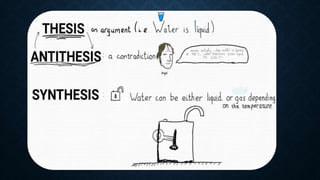
Thesis: The initial abstract philosophical idea or
proposition.
Antithesis: The contradictory opposing idea that
negates or reacts against the thesis. Or it can just be
different from the Thesis
Synthesis: The resolution that merges the partial truths
from the thesis and antithesis into a new, higher and
more complete conception or idea.
Hegel's Dialectical Materialism, concept, works, example

Hegel's Dialectical Materialism, concept, works, example

  • 1.
    HEGEL'S DIALECTICAL MATERIALISM GeorgWilhelm FriedrichHegel(1770-1831)wasa Germanphilosopher andaleading figurein Germanidealism. Hismajorworksinclude The PhenomenologyofSpirit, Science ofLogic, andThe Encyclopedia ofPhilosophicalSciences.
  • 2.
    HIS WORKS • Phenomenologyof Spirit • Science of Logic • Encyclopedia of the Philosophical Sciences • Elements of the Philosophy of Right • Lectures on the Philosophy of History
  • 3.
    Dialectic /ˌdʌɪəˈlɛktɪk/ • theart of investigating or discussing the truth of opinions • We can learn from opposite ideas Materialism /məˈtɪərɪəlɪz(ə)m/ • Materialism is a realist philosophy of science, which holds that the world is material; all phenomena in the universe consist of "matter in motion" according to natural laws.
  • 4.
    ■ Hegel's mainphilosophical project was to take these contradictions and interpret them as part of a comprehensive, evolving, rational unity that, he called "the absolute Idea“ ■ According to Hegel, the main characteristic of this unity was that it evolves through and manifests itself in contradiction
  • 5.
    Thesis: The initialabstract philosophical idea or proposition. Antithesis: The contradictory opposing idea that negates or reacts against the thesis. Or it can just be different from the Thesis Synthesis: The resolution that merges the partial truths from the thesis and antithesis into a new, higher and more complete conception or idea.