ASIA
BRAND FOOTPRINT
2020
A RANKING OF THE MOST CHOSEN CONSUMER BRANDS
2ND
EDITION
JUNE 2020
What is
Brand Footprint
The Brand Footprint ranking reveals how consumers
around the world today are buying FMCG brands, as well
as highlighting the opportunities that remain for brands
to increase their footprint.
Consumer reach points
There is a decision point in every FMCG purchase;
a point at which the shopper decides to buy one brand
instead of another. The Brand Footprint ranking reveals
which brands are winning at that moment of truth, using
the Consumer Reach Points measure. This measures
a brand’s strength in terms of the number of times brands
are chosen by shoppers.
The Consumer Reach Points of each brand is calculated
by multiplying three numbers:
• Penetration
• Population
• Consumer Choice
The measurement is then weighted by actual population
to calculate the brand’s reach. As well as a clear picture of
the size of its global footprint, this reveals where the brand
has opportunities to grow its penetration and its
frequency.
Consumer Reach Points (CRPs)
explained
The categories:
The complete ranking comprises five global FMCG
sectors – Beverages, Food, Dairy, Beauty and
Personal Care, and Homecare – tracked by Kantar
through Worldpanel FMCG. Fresh Food, Batteries
and Pet Food are not included in the global
ranking. All data relates to purchases brought into
the home to be used or consumed there.
The data period:
The Brand Footprint ranking is based on data
collected over the 52-week period between
November 2018 to the end of October 2019.
Criteria of eligibility for a brand to appear in
the Global ranking:
Only global brands are analysed to create the
global Top 50 Ranking.To be considered as global,
a brand must be available in at least two
continents. Data collected from Cote d'Ivoire,
Egypt, Ghana, Japan, Nigeria and UAE is not
included in the global ranking.
The ‘universe’:
The data collected covers 74% of the global
population across 52 countries, and 85% of global
GDP.
Data source:
Brand Footprint is a Kantar initiative.
Thanks to our partnerships we have been able to
offer countries outside of the Kantar footprint
Data for Austria, Belgium, Czech Republic,
Denmark, Germany, Hungary, Italy, Poland,
Romania, Russia, Slovakia, the Netherlands and
Sweden was provided by GfK
Data for the USA was provided by IRI
Data for Japan was provided by Intage
Kantar in collaboration with CTR in China
You can access the data from all the countries
and sectors in this year’s Brand Footprint online.
Learn more about your brand’s global footprint
and the most chosen brands in your sector and
market.
www.kantar.com/brandfootprint
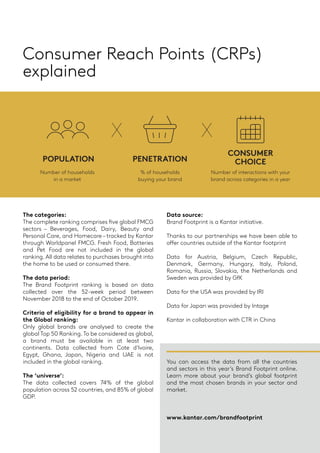
POPULATION PENETRATION
CONSUMER
CHOICE
X X
Number of households
in a market
% of households
buying your brand
Number of interactions with your
brand across categories in a year
What is inside
PAGE 6
Asia CEO Foreword
PAGE 8
Leveraging Brand Growth
Alongside Asia’s Evolving
Consumer Behaviour
PAGE 11
Asia Market Features
• LOCAL MARKET’S RANKING
• THE STORIES AND GROWTH LEVERS
BEHIND THE BRANDS
12 CHINA MAINLAND
19 INDONESIA
27 KOREA
34 MALAYSIA
43 PHILIPPINES
48 TAIWAN
53 THAILAND
61 VIETNAM
PAGE 68
Brand Navigation
Through the COVID-19
Pandemic
ASIA BRAND FOOTPRINT 2020 6
The brands in our ranking have faced challenges
of an unprecedented magnitude. Asia was the
epicentre of the COVID-19 outbreak and its
effects have disrupted and reshaped most
businesses. Fortunately, FMCG brands are
masters at innovating swiftly in response to
changing consumer needs.
Congratulations must go to each and every brand
in the Asia Brand Footprint 2020 ranking. Bearing
in mind the sheer size and diversity of our region
and the huge number of brands operating here,
simply being among the top in the region is an
achievement that should never be underestimated.
Despite the turbulent times we are facing, it is
important to note that the 5 strategic growth
levers remain unchanged. To reach more
shoppers and expand their footprint, brands must
still focus on finding new shoppers, creating
new occasions, entering new categories,
identifying new needs and increasing their
presence. While the long-term effects of the
pandemic are unclear, it is certain to be a catalyst
for lasting new behaviours. In particular, brands
should be aware of and adapt to the following
main changes:
WELCOME TO THE SECOND ANNUAL EDITION
OF OUR ASIA BRAND FOOTPRINT REPORT
WHICH ONCE AGAIN PUTS THE REGION’S MOST
CHOSEN CONSUMER BRANDS IN THE SPOTLIGHT.
ASIA CEO FOREWORD
ASIA CEO FOREWORD
Marcy Kou
CEO, Asia
Worldpanel Division, Kantar
ASIA BRAND FOOTPRINT 2020 7
• An uplift in demand for health and hygiene
products. Already an increasing trend across
Asia, the COVID-19 pandemic has driven greater
awareness and acceptance of the importance of
maintaining good health. This has created an
opportunity for personal care and household
cleaning brands to raise themselves up to the next
category level.
• Reduced mobility has created new purchase
habits. Lockdown has changed the balance of
consumers’ in-home and out-of-home spend,
and this is likely to continue through this year as
freedom of movement remains constrained. This
has been a plus for some categories and a minus
for others. Brands which have lost moments
should look for ways they can innovate to adapt
the products and experiences they offer for the
home environment.
• Concerns over household finances are rising.
COVID-19 has had a profound impact on
shoppers’ financial situations, and the outlook
remains uncertain. Consumers will be more
careful with their expenditure and heightened
price sensitivity may lead to more bargain
hunting. This might have an impact on the trend
for premiumisation which had been growing
across Asia. It is possible that we will see a return
to polarisation with some consumers shifting
spend to value brands, whereas others will decide
to treat themselves to ‘the best’ because they are
limited in other areas of their lives. Brands must
provide good value, while making products
available in a range of pack sizes and price points
to reach all buyer groups.
Brands also need to be mindful of changing
consumer mindsets and needs and as such they
would need to wear two hats. In the short-term
they should be agile, helping shoppers’ transition
to the ‘new normal’ by meeting their changing
needs in an affordable way. They must closely
monitor and understand how the situation is
progressing at an individual market level – each
was uniquely affected and will rebuild at a
different rate and in a different way.
Alongside staying relevant to shoppers in the
short-term, brands must keep their long-term
strategic hat on. This means continuing to follow
the long-term build, trust and the relevance to the
consumers and focusing on the 5 growth levers.
The brands that can do both will not only survive
the turbulence – they will position themselves to
win in the post-COVID world.
In this report you will find the ranking and
overview for the Asia region, detailed profiles for
each market and brand success stories. I hope you
will find the shared insights impactful and
valuable.
ASIA CEO FOREWORD
ASIA BRAND FOOTPRINT 2020 8
LEVERAGING BRAND GROWTH
ALONGSIDE ASIA’S EVOLVING
CONSUMER BEHAVIOUR
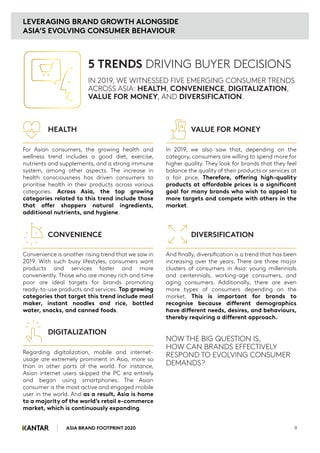
5 TRENDS DRIVING BUYER DECISIONS
5 KEY LEVERS FOR BRAND GROWTH
ASIA BRAND FOOTPRINT 2020 9
For Asian consumers, the growing health and
wellness trend includes a good diet, exercise,
nutrients and supplements, and a strong immune
system, among other aspects. The increase in
health consciousness has driven consumers to
prioritise health in their products across various
categories. Across Asia, the top growing
categories related to this trend include those
that offer shoppers natural ingredients,
additional nutrients, and hygiene.
Convenience is another rising trend that we saw in
2019. With such busy lifestyles, consumers want
products and services faster and more
conveniently. Those who are money rich and time
poor are ideal targets for brands promoting
ready-to-use products and services. Top growing
categories that target this trend include meal
maker, instant noodles and rice, bottled
water, snacks, and canned foods.
Regarding digitalization, mobile and internet-
usage are extremely prominent in Asia, more so
than in other parts of the world. For instance,
Asian internet users skipped the PC era entirely
and began using smartphones. The Asian
consumer is the most active and engaged mobile
user in the world. And as a result, Asia is home
to a majority of the world’s retail e-commerce
market, which is continuously expanding.
In 2019, we also saw that, depending on the
category, consumers are willing to spend more for
higher quality. They look for brands that they feel
balance the quality of their products or services at
a fair price. Therefore, offering high-quality
products at affordable prices is a significant
goal for many brands who wish to appeal to
more targets and compete with others in the
market.
And finally, diversification is a trend that has been
increasing over the years. There are three major
clusters of consumers in Asia: young millennials
and centennials, working-age consumers, and
aging consumers. Additionally, there are even
more types of consumers depending on the
market. This is important for brands to
recognise because different demographics
have different needs, desires, and behaviours,
thereby requiring a different approach.
NOW THE BIG QUESTION IS,
HOW CAN BRANDS EFFECTIVELY
RESPOND TO EVOLVING CONSUMER
DEMANDS?
LEVERAGING BRAND GROWTH ALONGSIDE
ASIA’S EVOLVING CONSUMER BEHAVIOUR
5 TRENDS DRIVING BUYER DECISIONS
IN 2019, WE WITNESSED FIVE EMERGING CONSUMER TRENDS
ACROSS ASIA: HEALTH, CONVENIENCE, DIGITALIZATION,
VALUE FOR MONEY, AND DIVERSIFICATION.
HEALTH VALUE FOR MONEY
CONVENIENCE DIVERSIFICATION
DIGITALIZATION
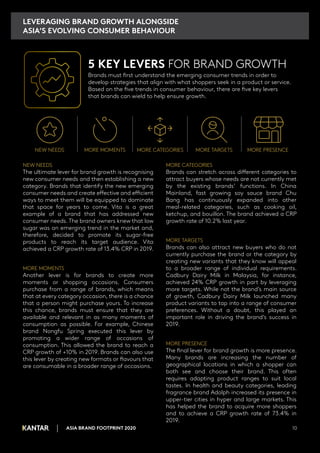
5 KEY LEVERS FOR BRAND GROWTH
Brands must first understand the emerging consumer trends in order to
develop strategies that align with what shoppers seek in a product or service.
Based on the five trends in consumer behaviour, there are five key levers
that brands can wield to help ensure growth.
ASIA BRAND FOOTPRINT 2020 10
LEVERAGING BRAND GROWTH ALONGSIDE
ASIA’S EVOLVING CONSUMER BEHAVIOUR
NEW NEEDS MORE MOMENTS MORE CATEGORIES MORE TARGETS MORE PRESENCE
NEW NEEDS
The ultimate lever for brand growth is recognising
new consumer needs and then establishing a new
category. Brands that identify the new emerging
consumer needs and create effective and efficient
ways to meet them will be equipped to dominate
that space for years to come. Vita is a great
example of a brand that has addressed new
consumer needs. The brand owners knew that low
sugar was an emerging trend in the market and,
therefore, decided to promote its sugar-free
products to reach its target audience. Vita
achieved a CRP growth rate of 13.4% CRP in 2019.
MORE MOMENTS
Another lever is for brands to create more
moments or shopping occasions. Consumers
purchase from a range of brands, which means
that at every category occasion, there is a chance
that a person might purchase yours. To increase
this chance, brands must ensure that they are
available and relevant in as many moments of
consumption as possible. For example, Chinese
brand Nongfu Spring executed this lever by
promoting a wider range of occasions of
consumption. This allowed the brand to reach a
CRP growth of +10% in 2019. Brands can also use
this lever by creating new formats or flavours that
are consumable in a broader range of occasions.
MORE CATEGORIES
Brands can stretch across different categories to
attract buyers whose needs are not currently met
by the existing brands’ functions. In China
Mainland, fast growing soy sauce brand Chu
Bang has continuously expanded into other
meal-related categories, such as cooking oil,
ketchup, and bouillon. The brand achieved a CRP
growth rate of 10.2% last year.
MORE TARGETS
Brands can also attract new buyers who do not
currently purchase the brand or the category by
creating new variants that they know will appeal
to a broader range of individual requirements.
Cadbury Dairy Milk in Malaysia, for instance,
achieved 24% CRP growth in part by leveraging
more targets. While not the brand’s main source
of growth, Cadbury Dairy Milk launched many
product variants to tap into a range of consumer
preferences. Without a doubt, this played an
important role in driving the brand’s success in
2019.
MORE PRESENCE
The final lever for brand growth is more presence.
Many brands are increasing the number of
geographical locations in which a shopper can
both see and choose their brand. This often
requires adapting product ranges to suit local
tastes. In health and beauty categories, leading
fragrance brand Adolph increased its presence in
upper-tier cities in hyper and large markets. This
has helped the brand to acquire more shoppers
and to achieve a CRP growth rate of 73.4% in
2019.
ASIA MARKET FEATURES
CHINA MAINLAND
INDONESIA
KOREA
MALAYSIA
PHILIPPINES
TAIWAN
THAILAND
VIETNAM
ASIA BRAND FOOTPRINT 2020 12
CHINA MAINLAND
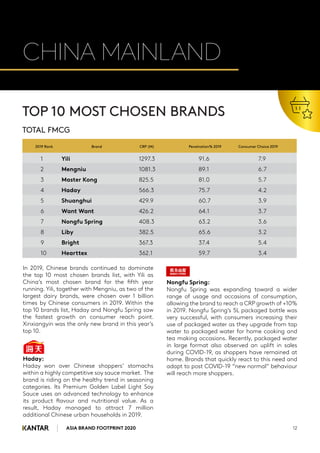
In 2019, Chinese brands continued to dominate
the top 10 most chosen brands list, with Yili as
China’s most chosen brand for the fifth year
running. Yili, together with Mengniu, as two of the
largest dairy brands, were chosen over 1 billion
times by Chinese consumers in 2019. Within the
top 10 brands list, Haday and Nongfu Spring saw
the fastest growth on consumer reach point.
Xinxiangyin was the only new brand in this year’s
top 10.
Haday:
Haday won over Chinese shoppers’ stomachs
within a highly competitive soy sauce market. The
brand is riding on the healthy trend in seasoning
categories. Its Premium Golden Label Light Soy
Sauce uses an advanced technology to enhance
its product flavour and nutritional value. As a
result, Haday managed to attract 7 million
additional Chinese urban households in 2019.
Nongfu Spring:
Nongfu Spring was expanding toward a wider
range of usage and occasions of consumption,
allowing the brand to reach a CRP growth of +10%
in 2019. Nongfu Spring’s 5L packaged bottle was
very successful, with consumers increasing their
use of packaged water as they upgrade from tap
water to packaged water for home cooking and
tea making occasions. Recently, packaged water
in large format also observed an uplift in sales
during COVID-19, as shoppers have remained at
home. Brands that quickly react to this need and
adapt to post COVID-19 “new normal” behaviour
will reach more shoppers.
1 Yili 1297.3 91.6 7.9
2 Mengniu 1081.3 89.1 6.7
3 Master Kong 825.5 81.0 5.7
4 Haday 566.3 75.7 4.2
5 Shuanghui 429.9 60.7 3.9
6 Want Want 426.2 64.1 3.7
7 Nongfu Spring 408.3 63.2 3.6
8 Liby 382.5 65.6 3.2
9 Bright 367.3 37.4 5.4
10 Hearttex 362.1 59.7 3.4
2019 Rank Brand CRP (M) Penetration% 2019 Consumer Choice 2019
TOP 10 MOST CHOSEN BRANDS
TOTAL FMCG
ASIA MARKET FEATURES CHINA MAINLAND
13
ASIA BRAND FOOTPRINT 2020
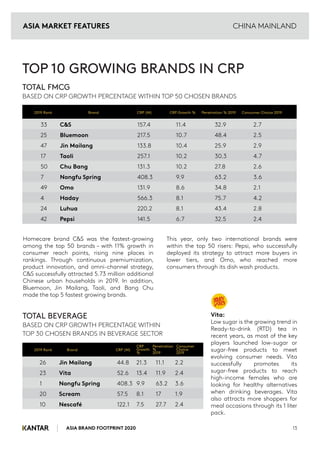
Homecare brand C&S was the fastest-growing
among the top 50 brands – with 11% growth in
consumer reach points, rising nine places in
rankings. Through continuous premiumization,
product innovation, and omni-channel strategy,
C&S successfully attracted 5.73 million additional
Chinese urban households in 2019. In addition,
Bluemoon, Jin Mailang, Taoli, and Bang Chu
made the top 5 fastest growing brands.
This year, only two international brands were
within the top 50 risers: Pepsi, who successfully
deployed its strategy to attract more buyers in
lower tiers, and Omo, who reached more
consumers through its dish wash products.
Vita:
Low sugar is the growing trend in
Ready-to-drink (RTD) tea in
recent years, as most of the key
players launched low-sugar or
sugar-free products to meet
evolving consumer needs. Vita
successfully promotes its
sugar-free products to reach
high-income females who are
looking for healthy alternatives
when drinking beverages. Vita
also attracts more shoppers for
meal occasions through its 1 liter
pack.
33 C&S 157.4 11.4 32.9 2.7
25 Bluemoon 217.5 10.7 48.4 2.5
47 Jin Mailang 133.8 10.4 25.9 2.9
17 Taoli 257.1 10.2 30.3 4.7
50 Chu Bang 131.3 10.2 27.8 2.6
7 Nongfu Spring 408.3 9.9 63.2 3.6
49 Omo 131.9 8.6 34.8 2.1
4 Haday 566.3 8.1 75.7 4.2
24 Luhua 220.2 8.1 43.4 2.8
42 Pepsi 141.5 6.7 32.5 2.4
2019 Rank Brand CRP (M) CRP Growth % Penetration % 2019 Consumer Choice 2019
TOP 10 GROWING BRANDS IN CRP
TOTAL FMCG
BASED ON CRP GROWTH PERCENTAGE WITHIN TOP 50 CHOSEN BRANDS
TOTAL BEVERAGE
BASED ON CRP GROWTH PERCENTAGE WITHIN
TOP 30 CHOSEN BRANDS IN BEVERAGE SECTOR
26 Jin Mailang 44.8 21.3 11.1 2.2
23 Vita 52.6 13.4 11.9 2.4
1 Nongfu Spring 408.3 9.9 63.2 3.6
20 Scream 57.5 8.1 17 1.9
10 Nescafé 122.1 7.5 27.7 2.4
2019 Rank Brand CRP (M)
CRP
Growth
%
Penetration
%
2019
Consumer
Choice
2019
ASIA BRAND FOOTPRINT 2020
ASIA MARKET FEATURES CHINA MAINLAND
14
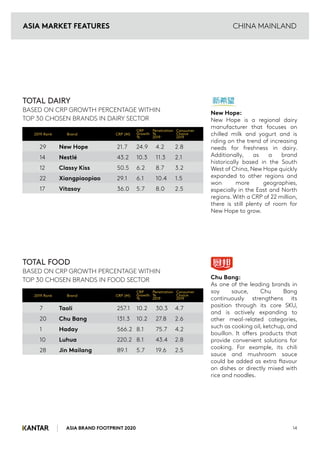
New Hope:
New Hope is a regional dairy
manufacturer that focuses on
chilled milk and yogurt and is
riding on the trend of increasing
needs for freshness in dairy.
Additionally, as a brand
historically based in the South
West of China, New Hope quickly
expanded to other regions and
won more geographies,
especially in the East and North
regions. With a CRP of 22 million,
there is still plenty of room for
New Hope to grow.
Chu Bang:
As one of the leading brands in
soy sauce, Chu Bang
continuously strengthens its
position through its core SKU,
and is actively expanding to
other meal-related categories,
such as cooking oil, ketchup, and
bouillon. It offers products that
provide convenient solutions for
cooking. For example, its chili
sauce and mushroom sauce
could be added as extra flavour
on dishes or directly mixed with
rice and noodles.
TOTAL DAIRY
BASED ON CRP GROWTH PERCENTAGE WITHIN
TOP 30 CHOSEN BRANDS IN DAIRY SECTOR
TOTAL FOOD
BASED ON CRP GROWTH PERCENTAGE WITHIN
TOP 30 CHOSEN BRANDS IN FOOD SECTOR
29 New Hope 21.7 24.9 4.2 2.8
14 Nestlé 43.2 10.3 11.3 2.1
12 Classy Kiss 50.5 6.2 8.7 3.2
22 Xiangpiaopiao 29.1 6.1 10.4 1.5
17 Vitasoy 36.0 5.7 8.0 2.5
2019 Rank Brand CRP (M)
CRP
Growth
%
Penetration
%
2019
Consumer
Choice
2019
7 Taoli 257.1 10.2 30.3 4.7
20 Chu Bang 131.3 10.2 27.8 2.6
1 Haday 566.2 8.1 75.7 4.2
10 Luhua 220.2 8.1 43.4 2.8
28 Jin Mailang 89.1 5.7 19.6 2.5
2019 Rank Brand CRP (M)
CRP
Growth
%
Penetration
%
2019
Consumer
Choice
2019
ASIA BRAND FOOTPRINT 2020
CHINA MAINLAND
15
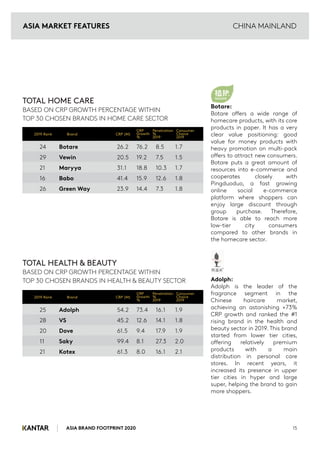
Botare:
Botare offers a wide range of
homecare products, with its core
products in paper. It has a very
clear value positioning: good
value for money products with
heavy promotion on multi-pack
offers to attract new consumers.
Botare puts a great amount of
resources into e-commerce and
cooperates closely with
Pingduoduo, a fast growing
online social e-commerce
platform where shoppers can
enjoy large discount through
group purchase. Therefore,
Botare is able to reach more
low-tier city consumers
compared to other brands in
the homecare sector.
Adolph:
Adolph is the leader of the
fragrance segment in the
Chinese haircare market,
achieving an astonishing +73%
CRP growth and ranked the #1
rising brand in the health and
beauty sector in 2019. This brand
started from lower tier cities,
offering relatively premium
products with a main
distribution in personal care
stores. In recent years, it
increased its presence in upper
tier cities in hyper and large
super, helping the brand to gain
more shoppers.
TOTAL HOME CARE
BASED ON CRP GROWTH PERCENTAGE WITHIN
TOP 30 CHOSEN BRANDS IN HOME CARE SECTOR
TOTAL HEALTH & BEAUTY
BASED ON CRP GROWTH PERCENTAGE WITHIN
TOP 30 CHOSEN BRANDS IN HEALTH & BEAUTY SECTOR
24 Botare 26.2 76.2 8.5 1.7
29 Vewin 20.5 19.2 7.5 1.5
21 Maryya 31.1 18.8 10.3 1.7
16 Babo 41.4 15.9 12.6 1.8
26 Green Way 23.9 14.4 7.3 1.8
2019 Rank Brand CRP (M)
CRP
Growth
%
Penetration
%
2019
Consumer
Choice
2019
25 Adolph 54.2 73.4 16.1 1.9
28 VS 45.2 12.6 14.1 1.8
20 Dove 61.5 9.4 17.9 1.9
11 Saky 99.4 8.1 27.3 2.0
21 Kotex 61.3 8.0 16.1 2.1
2019 Rank Brand CRP (M)
CRP
Growth
%
Penetration
%
2019
Consumer
Choice
2019
ASIA MARKET FEATURES
ASIA BRAND FOOTPRINT 2020
CHINA MAINLAND
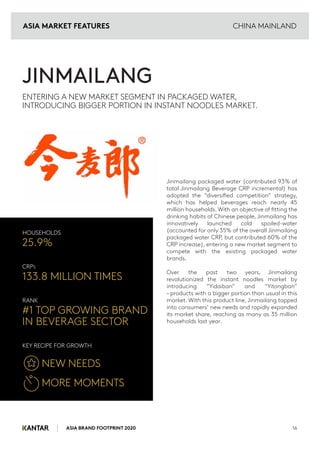
Jinmailang packaged water (contributed 93% of
total Jinmailang Beverage CRP incremental) has
adopted the “diversified competition” strategy,
which has helped beverages reach nearly 45
million households.With an objective of fitting the
drinking habits of Chinese people, Jinmailang has
innovatively launched cold spoiled-water
(accounted for only 35% of the overall Jinmailang
packaged water CRP, but contributed 60% of the
CRP increase), entering a new market segment to
compete with the existing packaged water
brands.
Over the past two years, Jinmailang
revolutionized the instant noodles market by
introducing “Yidaiban” and “Yitongban”
– products with a bigger portion than usual in this
market. With this product line, Jinmailang tapped
into consumers’ new needs and rapidly expanded
its market share, reaching as many as 35 million
households last year.
HOUSEHOLDS
25.9%
CRPS
133.8 MILLION TIMES
RANK
#1 TOP GROWING BRAND
IN BEVERAGE SECTOR
KEY RECIPE FOR GROWTH
NEW NEEDS
MORE MOMENTS
16
JINMAILANG
ENTERING A NEW MARKET SEGMENT IN PACKAGED WATER,
INTRODUCING BIGGER PORTION IN INSTANT NOODLES MARKET.
ASIA MARKET FEATURES
ASIA BRAND FOOTPRINT 2020
CHINA MAINLAND
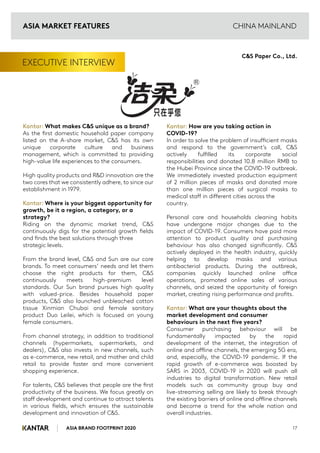
EXECUTIVE INTERVIEW
Kantar: What makes C&S unique as a brand?
As the first domestic household paper company
listed on the A-share market, C&S has its own
unique corporate culture and business
management, which is committed to providing
high-value life experiences to the consumers.
High quality products and R&D innovation are the
two cores that we consistently adhere, to since our
establishment in 1979.
Kantar: Where is your biggest opportunity for
growth, be it a region, a category, or a
strategy?
Riding on the dynamic market trend, C&S
continuously digs for the potential growth fields
and finds the best solutions through three
strategic levels.
From the brand level, C&S and Sun are our core
brands. To meet consumers’ needs and let them
choose the right products for them, C&S
continuously meets high-premium level
standards. Our Sun brand pursues high quality
with valued-price. Besides household paper
products, C&S also launched unbleached cotton
tissue Xinmian Chubai and female sanitary
product Duo Leilei, which is focused on young
female consumers.
From channel strategy, in addition to traditional
channels (hypermarkets, supermarkets, and
dealers), C&S also invests in new channels, such
as e-commerce, new retail, and mother and child
retail to provide faster and more convenient
shopping experience.
For talents, C&S believes that people are the first
productivity of the business. We focus greatly on
staff development and continue to attract talents
in various fields, which ensures the sustainable
development and innovation of C&S.
Kantar: How are you taking action in
COVID-19?
In order to solve the problem of insufficient masks
and respond to the government’s call, C&S
actively fulfilled its corporate social
responsibilities and donated 10.8 million RMB to
the Hubei Province since the COVID-19 outbreak.
We immediately invested production equipment
of 2 million pieces of masks and donated more
than one million pieces of surgical masks to
medical staff in different cities across the
country.
Personal care and households cleaning habits
have undergone major changes due to the
impact of COVID-19. Consumers have paid more
attention to product quality and purchasing
behaviour has also changed significantly. C&S
actively deployed in the health industry, quickly
helping to develop masks and various
antibacterial products. During the outbreak,
companies quickly launched online office
operations, promoted online sales of various
channels, and seized the opportunity of foreign
market, creating rising performance and profits.
Kantar: What are your thoughts about the
market development and consumer
behaviours in the next five years?
Consumer purchasing behaviour will be
fundamentally impacted by the rapid
development of the internet, the integration of
online and offline channels, the emerging 5G era,
and, especially, the COVID-19 pandemic. If the
rapid growth of e-commerce was boosted by
SARS in 2003, COVID-19 in 2020 will push all
industries to digital transformation. New retail
models such as community group buy and
live-streaming selling are likely to break through
the existing barriers of online and offline channels
and become a trend for the whole nation and
overall industries.
17
C&S Paper Co., Ltd.
ASIA MARKET FEATURES
ASIA BRAND FOOTPRINT 2020
CHINA MAINLAND
18
“
The FMCG market in China remained fiercely competitive in 2019, as more new
entrants joined the market to challenge the incumbents. Disruptive growth was
witnessed across all categories. Chinese consumers continue to desire high quality
products, and consumers in lower tier cities remain critical to incremental growth. The
entry of new brands, either from abroad via cross-border e-commerce platforms or
other with rising fast through local social media platforms, resulted in intensified
competition among the established players, but also brought new dynamics to the
market.
In such a rapidly changing market, winners in FMCG, whether big or small, grow by
excelling in at least three brand building practices:
• Identifying and fulfilling emerging and highly individualized consumer needs
• Optimizing marketing investment with the most effective content, social media,
and livestreaming-based ecommerce
• Integrating online and offline channels with a coherent omni-channel strategy
A post COVID-19 China presents opportunities for all players – brands will have to
demonstrate full agility and relevance, tailor their offer to new occasions, and build
their marketing message closely around new media and sales channels.
”
Jason Yu
Managing Director, Greater China
Worldpanel Division, Kantar
ASIA MARKET FEATURES
INDONESIA
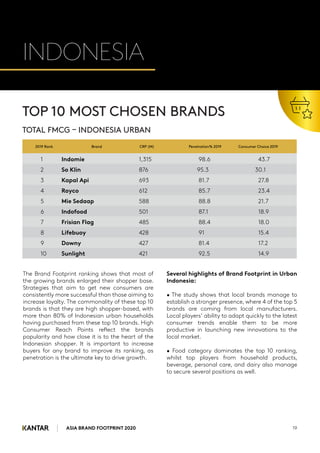
The Brand Footprint ranking shows that most of
the growing brands enlarged their shopper base.
Strategies that aim to get new consumers are
consistently more successful than those aiming to
increase loyalty. The commonality of these top 10
brands is that they are high shopper-based, with
more than 80% of Indonesian urban households
having purchased from these top 10 brands. High
Consumer Reach Points reflect the brands
popularity and how close it is to the heart of the
Indonesian shopper. It is important to increase
buyers for any brand to improve its ranking, as
penetration is the ultimate key to drive growth.
Several highlights of Brand Footprint in Urban
Indonesia:
• The study shows that local brands manage to
establish a stronger presence, where 4 of the top 5
brands are coming from local manufacturers.
Local players’ ability to adapt quickly to the latest
consumer trends enable them to be more
productive in launching new innovations to the
local market.
• Food category dominates the top 10 ranking,
whilst top players from household products,
beverage, personal care, and dairy also manage
to secure several positions as well.
1 Indomie 1,315 98.6 43.7
2 So Klin 876 95.3 30.1
3 Kapal Api 693 81.7 27.8
4 Royco 612 85.7 23.4
5 Mie Sedaap 588 88.8 21.7
6 Indofood 501 87.1 18.9
7 Frisian Flag 485 88.4 18.0
8 Lifebuoy 428 91 15.4
9 Downy 427 81.4 17.2
10 Sunlight 421 92.5 14.9
TOP 10 MOST CHOSEN BRANDS
TOTAL FMCG – INDONESIA URBAN
ASIA BRAND FOOTPRINT 2020 19
2019 Rank Brand CRP (M) Penetration% 2019 Consumer Choice 2019
ASIA BRAND FOOTPRINT 2020 20
INDONESIA
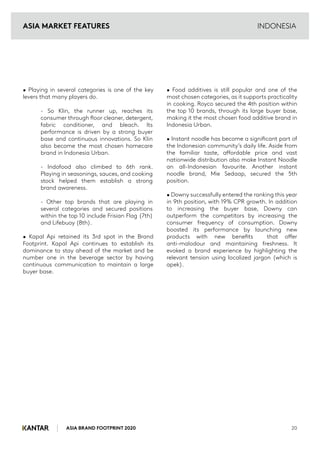
• Playing in several categories is one of the key
levers that many players do.
• Kapal Api retained its 3rd spot in the Brand
Footprint. Kapal Api continues to establish its
dominance to stay ahead of the market and be
number one in the beverage sector by having
continuous communication to maintain a large
buyer base.
• Food additives is still popular and one of the
most chosen categories, as it supports practicality
in cooking. Royco secured the 4th position within
the top 10 brands, through its large buyer base,
making it the most chosen food additive brand in
Indonesia Urban.
• Instant noodle has become a significant part of
the Indonesian community’s daily life. Aside from
the familiar taste, affordable price and vast
nationwide distribution also make Instant Noodle
an all-Indonesian favourite. Another instant
noodle brand, Mie Sedaap, secured the 5th
position.
• Downy successfully entered the ranking this year
in 9th position, with 19% CPR growth. In addition
to increasing the buyer base, Downy can
outperform the competitors by increasing the
consumer frequency of consumption. Downy
boosted its performance by launching new
products with new benefits that offer
anti-malodour and maintaining freshness. It
evoked a brand experience by highlighting the
relevant tension using localized jargon (which is
apek).
ASIA MARKET FEATURES
- So Klin, the runner up, reaches its
consumer through floor cleaner, detergent,
fabric conditioner, and bleach. Its
performance is driven by a strong buyer
base and continuous innovations. So Klin
also become the most chosen homecare
brand in Indonesia Urban.
- Indofood also climbed to 6th rank.
Playing in seasonings, sauces, and cooking
stock helped them establish a strong
brand awareness.
- Other top brands that are playing in
several categories and secured positions
within the top 10 include Frisian Flag (7th)
and Lifebuoy (8th).
ASIA BRAND FOOTPRINT 2020 21
INDONESIA
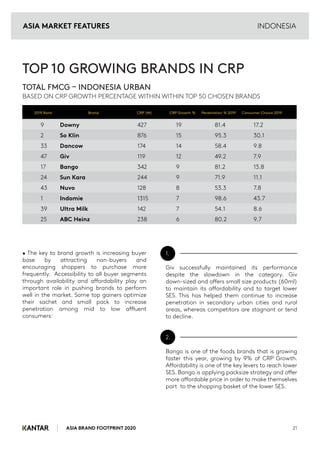
• The key to brand growth is increasing buyer
base by attracting non-buyers and
encouraging shoppers to purchase more
frequently. Accessibility to all buyer segments
through availability and affordability play an
important role in pushing brands to perform
well in the market. Some top gainers optimize
their sachet and small pack to increase
penetration among mid to low affluent
consumers:
1.
Giv successfully maintained its performance
despite the slowdown in the category. Giv
down-sized and offers small size products (60ml)
to maintain its affordability and to target lower
SES. This has helped them continue to increase
penetration in secondary urban cities and rural
areas, whereas competitors are stagnant or tend
to decline.
2.
Bango is one of the foods brands that is growing
faster this year, growing by 9% of CRP Growth.
Affordability is one of the key levers to reach lower
SES. Bango is applying packsize strategy and offer
more affordable price in order to make themselves
part to the shopping basket of the lower SES.
TOP 10 GROWING BRANDS IN CRP
TOTAL FMCG – INDONESIA URBAN
BASED ON CRP GROWTH PERCENTAGE WITHIN WITHIN TOP 50 CHOSEN BRANDS
9 Downy 427 19 81.4 17.2
2 So Klin 876 15 95.3 30.1
33 Dancow 174 14 58.4 9.8
47 Giv 119 12 49.2 7.9
17 Bango 342 9 81.2 13.8
24 Sun Kara 244 9 71.9 11.1
43 Nuvo 128 8 53.3 7.8
1 Indomie 1315 7 98.6 43.7
39 Ultra Milk 142 7 54.1 8.6
25 ABC Heinz 238 6 80.2 9.7
2019 Rank Brand CRP (M) CRP Growth % Penetration % 2019 Consumer Choice 2019
ASIA MARKET FEATURES
ASIA BRAND FOOTPRINT 2020 22
INDONESIA
DANCOW
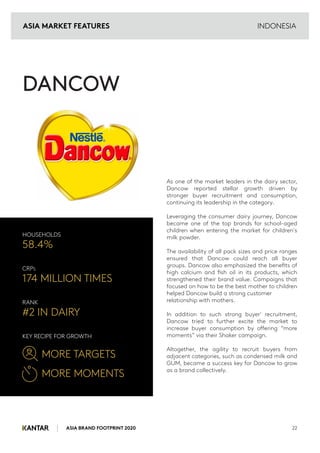
As one of the market leaders in the dairy sector,
Dancow reported stellar growth driven by
stronger buyer recruitment and consumption,
continuing its leadership in the category.
Leveraging the consumer dairy journey, Dancow
became one of the top brands for school-aged
children when entering the market for children's
milk powder.
The availability of all pack sizes and price ranges
ensured that Dancow could reach all buyer
groups. Dancow also emphasized the benefits of
high calcium and fish oil in its products, which
strengthened their brand value. Campaigns that
focused on how to be the best mother to children
helped Dancow build a strong customer
relationship with mothers.
In addition to such strong buyer' recruitment,
Dancow tried to further excite the market to
increase buyer consumption by offering “more
moments” via their Shaker campaign.
Altogether, the agility to recruit buyers from
adjacent categories, such as condensed milk and
GUM, became a success key for Dancow to grow
as a brand collectively.
HOUSEHOLDS
58.4%
CRPS
174 MILLION TIMES
RANK
#2 IN DAIRY
KEY RECIPE FOR GROWTH
MORE TARGETS
MORE MOMENTS
ASIA MARKET FEATURES
ASIA BRAND FOOTPRINT 2020 23
INDONESIA
EXECUTIVE INTERVIEW
Kantar: What makes Roma unique as
a brand?
Roma is the biggest brand in Indonesia when it
comes to biscuits. Across all markets, biscuit
categories usually have one iconic brand that is
part of everyone’s life. In Indonesia, Roma has
that stature.
Dipping Roma in a cup of tea or coffee is how
Indonesians begin their day. Roma is part of great
family moments. Since its launch, the brand
purpose has been to “Serve Goodness and
Happiness.” This philosophy guides us all the way.
This guiding principle is the one that drives our
business growth, innovation, and
sustainability.
Kantar: Where is your biggest opportunity for
growth (this could be a region, category, or
strategy)?
At Mayora, our vision is to be the best food and
beverage company in Asia. We are always looking
for opportunities to delight consumers. We believe
that every category has a potential to grow
through purposeful offering, great
communication, insight, and innovation. As for
the region, Asia, India, Middle East, and Africa are
the regions that are growing and promising.
Kantar: What was your biggest success in
2019? Why?
As of 2019, Mayora is one of the highest FMCG
growth in Indonesia amongst top 10 FMCGs
companies. This is a remarkable achievement in
Mayora’s successful track record, which shows
a CAGR > 15% in the last 10 years.
Kantar: What are your concerns for your
brand, category, or industry as a whole?
We are concerned about brands, categories, and
industries losing relevancy and creativity in driving
the growth and building meaningful brands for
consumers around the world.
As more and more media fragments and digital
platforms penetrate, the industry is changing in
the way brands get built. Digital’s aggressive price
off/ promo advertising model is making brand
building tougher and tougher and sensitizing
consumers to excessive promo buying. Our
challenge would be to build power brands in this
new normal.
Kantar: How do you think 2019 in FMCG will
be remembered?
People will remember that in 2019, FMCG volume
growth was negative, while its value growth in
single digits rose. And this has been happening for
the last 3 years already.
Having said that, there are companies and
brands that can survive and maintain double digit
growth, and one of them is Mayora. We believe
that purposeful brands with great campaigns
and innovation will always win the consumer’s
heart, and this is the secret to achieve double digit
growth again.
SPOKESPERSON:
Ricky Afrianto
Global Marketing Head
ASIA MARKET FEATURES
ASIA BRAND FOOTPRINT 2020 24
INDONESIA
Kantar: Which other brands did you admire in
2019? Why?
At Mayora, we do not see a specific or particular
brand or company as a benchmark. Rather, we
see that each company has its own strengths.
A couple of brands/companies that we admire
include:
• In Indonesia, we do see how the local company
Emtek Group moved from traditional TV stations
to embrace technology and become a company
that offers integrated solutions in media.
• Ferero is a brand that consistently offers high
quality, premium products.
• We are impressed by the way Mars manages the
distribution and visibility around the world.
• We admire Huawei’s infrastructure and how it
has become an innovative company that offers
premium products and competes with global
players.
Kantar: What about consumer behaviour has
surprised you the most over the past five
years?
When we realize that consumers who we view as
older actually behave similar to the youth
regarding technology. They embrace digital/
technology like chatting, video calling, and
e-payment.
The adoption of e-commerce from FMCG
perspective in Indonesia is not as high as in China.
And we do see two key barriers: delivery cost and
the behaviour.
Our experiences tell that, in FMCG perspective,
consumers don’t respond to advertising messages
via digital platforms as good as when it is all
promo or discount.
Kantar: And what do you think the next five
years will hold?
Technology will disrupt distribution in FMCG. This
will shake the industry. Only those players who
prepare for this will survive and win.
Changing consumer behaviours, the increasingly
cluttered nature of the media and new
technologies will continue to disrupt the way we
do our business and the way we market our
brands.
Business can go up and down, including start-ups,
but there is always a better solution for
consumers. No more instructions in apps or digital
are needed because these platforms intuitively
understand people better.
We will no longer discuss the importance of offline
VS online or omni-channel or the rise of AI, IoT,
and ML, but rather the competition from each
player to bring value to consumers and humanize
digital/technology.
Kantar: What did you do differently during
COVID-19 to still reach your consumers?
We are working hard to always stay relevant:
• Adapt your communication to reflect the
current situation and offer the solution.
• Strengthen your brand purpose to drive equity
campaign.
• Focus on the right brand/category, geography,
and investment.
ASIA MARKET FEATURES
ASIA BRAND FOOTPRINT 2020 25
EXECUTIVE INTERVIEW
Kantar: What makes Downy unique as a
brand?
Downy has been relentlessly focusing on providing
consumers with a superior laundry experience.
Downy has managed to become synonymous
with the key category need of long-lasting
freshness for clothes. We pioneered the sensorial
category, with winning claims such as “like
wearing perfume every day” and “even better
than expensive perfumes.”
Kantar: Where is your biggest opportunity for
growth (this could be a region, category, or
strategy)?
The biggest opportunity for Downy will be to stay
close to consumers’ evolving needs in the new
normal and design our products, benefits and
communication that best addresses these needs.
Kantar: What was your biggest success in
2019? Why?
In 2019, Downy made a move to own Malodor
removal, another core category need, leveraging
insights which other brands had not tapped into.
The new products launched were supported by
communication that was relevant and resonated
with the Indonesian consumer, resulting in
spectacular in-market success and the #1 position
in Indonesia Fabric Enhancer market.
Kantar: What do you think the next five years
will hold?
Moving forward, the brand’s mission is to become
a true love mark for the Indonesian consumer,
delighting them at the first and second moments
of truth.
SPOKESPERSON:
Arvind Rayappa
Commercial Leader,
Indonesia Fabric
and Homecare
INDONESIA
ASIA MARKET FEATURES
INDONESIA
ASIA BRAND FOOTPRINT 2020 26
“
FMCG market has bounced back in 2019, as the Indonesian economy has
demonstrated a stable performance over the past year. The bounce back has been
driven by a volume uptick which is a good sign for the manufacturers. While there are
opportunities abound for brands to continue growing, brands cannot afford to
become complacent and expect growth to happen organically. Brands will still need to
ensure that they remain relevant to the consumer and earn their growth.
The longer-term trends remain relevant - going digital, seeking convenience,
experience-led consumer behaviour. Additionally, the trend of the shift in trade
channels pushed on by minimarkets and growing e-commerce means that
consumers today are spoilt for choices in their shopping.
I am happy to see that most of the top chosen brands continue to be among the most
chosen brands in Indonesia and, at the same time, there are some new brands
breaking into the top brands list. I am sure there are many learnings from the levers to
growth that the marketer can apply to their brands.
”
Venu Madhav
General Manager, Indonesia
Worldpanel Division, Kantar
ASIA MARKET FEATURES
ASIA BRAND FOOTPRINT 2020 27
KOREA
In Korea, many consumers have already
experienced market paradigm evolution due to
the exceptionally digitalized environment,
demographic changes, and rapidly changing
social and cultural environment. And we expect
that COVID-19 will accelerate this paradigm
evolution.
Rapid changes in retail landscape, target
expansion, product concepts, OTT, and the new
“homeconomy” (home+economy) are happening
in diverse aspects. The importance of the online
market in FMCG is steadily increasing while its
target has expanded from young targets to
seniors. Furthermore, in-home consumption
behaviour centred on families of one to two
people is expanding into overall household
consumption behaviours.
“Accelerated E-commerce Growth in FMCG
Market”
“Active Senior” refers to those in their 50s and 60s
with ample wealth and income, a term that has
already emerged in Korea three to four years ago.
Unlike the typical elderly in the past, they spare no
investment or consumption on themselves,
especially in the online market.
Right now, the expression “target expansion
within the channel” may be correct, but in the
near future, categories targeting younger age
groups will be able to expand their targets to the
senior group. In other words, the target group
biased toward specific age groups will be able to
expand their consumer touchpoint, thanks to
e-commerce. Thus, the reverse situation, “target
expansion through the channel” will become
common.
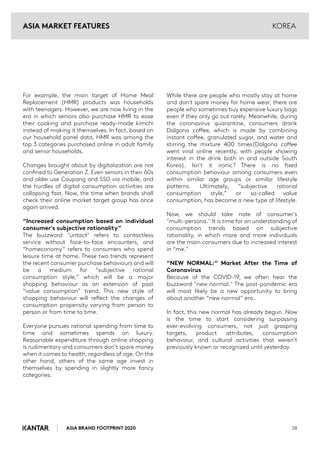
1 Ottogi 92.5 90.2
2 Seoul Milk 76.9 55.7
3 Dongwon 71.9 85
4 Masinnen Milk 71.3 50.8
5 Chungjungone 65.4 83.7
6 Baekseol 62.6 83.5
7 Will 58.3 9.4
8 Bibigo 54.7 70.4
9 Ottogi ramen 49.7 70.7
10 Jinramen 45.5 61.9
TOP 10 MOST CHOSEN BRANDS
TOTAL FMCG
2019 Rank Brand CRP (M) Penetration% 2019
ASIA BRAND FOOTPRINT 2020 28
KOREA
For example, the main target of Home Meal
Replacement (HMR) products was households
with teenagers. However, we are now living in the
era in which seniors also purchase HMR to ease
their cooking and purchase ready-made kimchi
instead of making it themselves. In fact, based on
our household panel data, HMR was among the
top 3 categories purchased online in adult family
and senior households.
Changes brought about by digitalization are not
confined to Generation Z. Even seniors in their 60s
and older use Coupang and SSG via mobile, and
the hurdles of digital consumption activities are
collapsing fast. Now, the time when brands shall
check their online market target group has once
again arrived.
“Increased consumption based on individual
consumer's subjective rationality”
The buzzword "untact" refers to contactless
service without face-to-face encounters, and
“homeconomy” refers to consumers who spend
leisure time at home. These two trends represent
the recent consumer purchase behaviours and will
be a medium for “subjective rational
consumption style,” which will be a major
shopping behaviour as an extension of past
“value consumption” trend. This new style of
shopping behaviour will reflect the changes of
consumption propensity varying from person to
person or from time to time.
Everyone pursues rational spending from time to
time and sometimes spends on luxury.
Reasonable expenditure through online shopping
is rudimentary and consumers don’t spare money
when it comes to health, regardless of age. On the
other hand, others of the same age invest in
themselves by spending in slightly more fancy
categories.
While there are people who mostly stay at home
and don't spare money for home wear, there are
people who sometimes buy expensive luxury bags
even if they only go out rarely. Meanwhile, during
the coronavirus quarantine, consumers drank
Dalgona coffee, which is made by combining
instant coffee, granulated sugar, and water and
stirring the mixture 400 times(Dalgona coffee
went viral online recently, with people showing
interest in the drink both in and outside South
Korea). Isn't it ironic? There is no fixed
consumption behaviour among consumers even
within similar age groups or similar lifestyle
patterns. Ultimately, “subjective rational
consumption style,” or so-called value
consumption, has become a new type of lifestyle.
Now, we should take note of consumer's
"multi-persona." It is time for an understanding of
consumption trends based on subjective
rationality, in which more and more individuals
are the main consumers due to increased interest
in “me."
“NEW NORMAL:” Market After the Time of
Coronavirus
Because of the COVID-19, we often hear the
buzzword "new normal." The post-pandemic era
will most likely be a new opportunity to bring
about another “new normal” era.
In fact, this new normal has already begun. Now
is the time to start considering surpassing
ever-evolving consumers, not just grasping
targets, product attributes, consumption
behaviour, and cultural activities that weren’t
previously known or recognized until yesterday.
ASIA MARKET FEATURES
ASIA BRAND FOOTPRINT 2020 29
KOREA
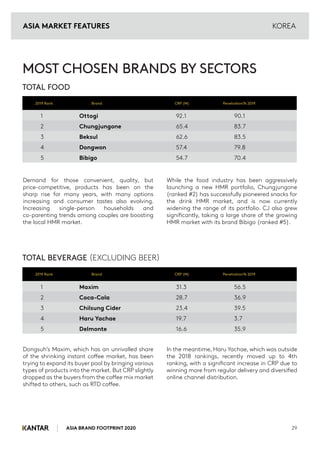
1 Ottogi 92.1 90.1
2 Chungjungone 65.4 83.7
3 Beksul 62.6 83.5
4 Dongwon 57.4 79.8
5 Bibigo 54.7 70.4
MOST CHOSEN BRANDS BY SECTORS
TOTAL FOOD
Demand for those convenient, quality, but
price-competitive, products has been on the
sharp rise for many years, with many options
increasing and consumer tastes also evolving.
Increasing single-person households and
co-parenting trends among couples are boosting
the local HMR market.
While the food industry has been aggressively
launching a new HMR portfolio, Chungjungone
(ranked #2) has successfully pioneered snacks for
the drink HMR market, and is now currently
widening the range of its portfolio. CJ also grew
significantly, taking a large share of the growing
HMR market with its brand Bibigo (ranked #5).
Dongsuh’s Maxim, which has an unrivalled share
of the shrinking instant coffee market, has been
trying to expand its buyer pool by bringing various
types of products into the market. But CRP slightly
dropped as the buyers from the coffee mix market
shifted to others, such as RTD coffee.
In the meantime, Haru Yachae, which was outside
the 2018 rankings, recently moved up to 4th
ranking, with a significant increase in CRP due to
winning more from regular delivery and diversified
online channel distribution.
1 Maxim 31.3 56.5
2 Coca-Cola 28.7 36.9
3 Chilsung Cider 23.4 39.5
4 Haru Yachae 19.7 3.7
5 Delmonte 16.6 35.9
TOTAL BEVERAGE (EXCLUDING BEER)
2019 Rank Brand CRP (M) Penetration% 2019
ASIA MARKET FEATURES
ASIA BRAND FOOTPRINT 2020 30
KOREA
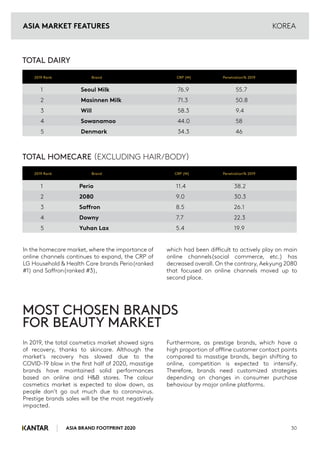
1 Seoul Milk 76.9 55.7
2 Masinnen Milk 71.3 50.8
3 Will 58.3 9.4
4 Sowanamoo 44.0 58
5 Denmark 34.3 46
TOTAL DAIRY
1 Perio 11.4 38.2
2 2080 9.0 30.3
3 Saffron 8.5 26.1
4 Downy 7.7 22.3
5 Yuhan Lax 5.4 19.9
TOTAL HOMECARE (EXCLUDING HAIR/BODY)
In the homecare market, where the importance of
online channels continues to expand, the CRP of
LG Household & Health Care brands Perio(ranked
#1) and Saffron(ranked #3),
which had been difficult to actively play on main
online channels(social commerce, etc.) has
decreased overall. On the contrary, Aekyung 2080
that focused on online channels moved up to
second place.
In 2019, the total cosmetics market showed signs
of recovery, thanks to skincare. Although the
market's recovery has slowed due to the
COVID-19 blow in the first half of 2020, masstige
brands have maintained solid performances
based on online and H&B stores. The colour
cosmetics market is expected to slow down, as
people don’t go out much due to coronavirus.
Prestige brands sales will be the most negatively
impacted.
Furthermore, as prestige brands, which have a
high proportion of offline customer contact points
compared to masstige brands, begin shifting to
online, competition is expected to intensify.
Therefore, brands need customized strategies
depending on changes in consumer purchase
behaviour by major online platforms.
MOST CHOSEN BRANDS
FOR BEAUTY MARKET
2019 Rank Brand CRP (M) Penetration% 2019
ASIA MARKET FEATURES
ASIA BRAND FOOTPRINT 2020 31
KOREA
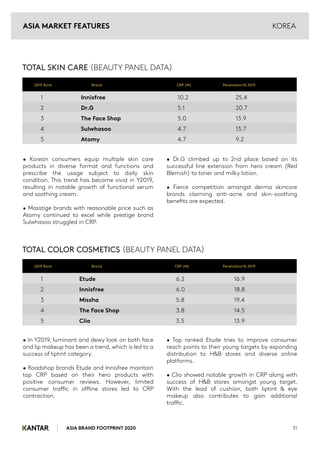
• Korean consumers equip multiple skin care
products in diverse format and functions and
prescribe the usage subject to daily skin
condition. This trend has become vivid in Y2019,
resulting in notable growth of functional serum
and soothing cream.
• Masstige brands with reasonable price such as
Atomy continued to excel while prestige brand
Sulwhasoo struggled in CRP.
• Dr.G climbed up to 2nd place based on its
successful line extension from hero cream (Red
Blemish) to toner and milky lotion.
• Fierce competition amongst derma skincare
brands claiming anti-acne and skin-soothing
benefits are expected.
• In Y2019, luminant and dewy look on both face
and lip makeup has been a trend, which is led to a
success of liptint category.
• Roadshop brands Etude and Innisfree maintain
top CRP based on their hero products with
positive consumer reviews. However, limited
consumer traffic in offline stores led to CRP
contraction.
• Top ranked Etude tries to improve consumer
reach points to their young targets by expanding
distribution to H&B stores and diverse online
platforms.
• Clio showed notable growth in CRP along with
success of H&B stores amongst young target.
With the lead of cushion, both liptint & eye
makeup also contributes to gain additional
traffic.
1 Innisfree 10.2 25.4
2 Dr.G 5.1 20.7
3 The Face Shop 5.0 13.9
4 Sulwhasoo 4.7 13.7
5 Atomy 4.7 9.2
TOTAL SKIN CARE (BEAUTY PANEL DATA)
1 Etude 6.2 16.9
2 Innisfree 6.0 18.8
3 Missha 5.8 19.4
4 The Face Shop 3.8 14.5
5 Clio 3.5 13.9
TOTAL COLOR COSMETICS (BEAUTY PANEL DATA)
2019 Rank Brand CRP (M) Penetration% 2019
ASIA MARKET FEATURES
ASIA BRAND FOOTPRINT 2020 32
KOREA
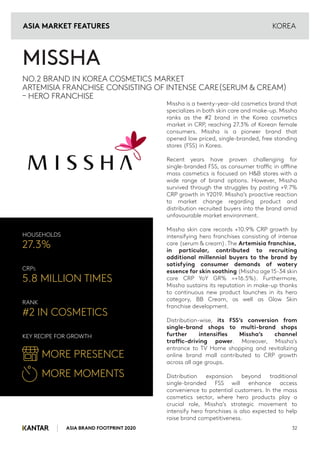
Missha is a twenty-year-old cosmetics brand that
specializes in both skin care and make-up. Missha
ranks as the #2 brand in the Korea cosmetics
market in CRP, reaching 27.3% of Korean female
consumers. Missha is a pioneer brand that
opened low priced, single-branded, free standing
stores (FSS) in Korea.
Recent years have proven challenging for
single-branded FSS, as consumer traffic in offline
mass cosmetics is focused on H&B stores with a
wide range of brand options. However, Missha
survived through the struggles by posting +9.7%
CRP growth in Y2019. Missha’s proactive reaction
to market change regarding product and
distribution recruited buyers into the brand amid
unfavourable market environment.
Missha skin care records +10.9% CRP growth by
intensifying hero franchises consisting of intense
care (serum & cream). The Artemisia franchise,
in particular, contributed to recruiting
additional millennial buyers to the brand by
satisfying consumer demands of watery
essence for skin soothing (Missha age 15-34 skin
care CRP YoY GR% =+16.5%). Furthermore,
Missha sustains its reputation in make-up thanks
to continuous new product launches in its hero
category, BB Cream, as well as Glow Skin
franchise development.
Distribution-wise, its FSS’s conversion from
single-brand shops to multi-brand shops
further intensifies Missha’s channel
traffic-driving power. Moreover, Missha’s
entrance to TV Home shopping and revitalizing
online brand mall contributed to CRP growth
across all age groups.
Distribution expansion beyond traditional
single-branded FSS will enhance access
convenience to potential customers. In the mass
cosmetics sector, where hero products play a
crucial role, Missha’s strategic movement to
intensify hero franchises is also expected to help
raise brand competitiveness.
HOUSEHOLDS
27.3%
CRPS
5.8 MILLION TIMES
RANK
#2 IN COSMETICS
KEY RECIPE FOR GROWTH
MORE PRESENCE
MORE MOMENTS
MISSHA
NO.2 BRAND IN KOREA COSMETICS MARKET
ARTEMISIA FRANCHISE CONSISTING OF INTENSE CARE(SERUM & CREAM)
– HERO FRANCHISE
ASIA MARKET FEATURES
KOREA
ASIA BRAND FOOTPRINT 2020 33
“
This year, COVID-19 has introduced an unprecedented and powerful impact on the
general environments surrounding us.
Therefore, to face the changes in the business environment that COVID-19 will bring
about, it is crucial that we take this time to check our own brands from various angles
such as consumer behaviour, distribution environment, products, as well as
communication aspects.
By dealing with these drastic changes in the market wisely, we can expect a better
market position than before the COVID-19 outbreak.
”
Francis Oh
General Manager, Korea
Worldpanel Division, Kantar
ASIA MARKET FEATURES
ASIA BRAND FOOTPRINT 2020 34
MALAYSIA
1 Maggi 44 85.4 8.7
2 Milo 33 81.6 6.9
3 Marigold 21 62.8 5.7
4 Dutch Lady 21 60.2 5.9
5 Adabi 20 55 6.3
6 Ayam 19 58.9 5.4
7 Babas 15 44.6 5.8
8 Nestlé 15 60.9 4.1
9 Munchy’s 15 61.6 4.1
10 F&N 14 54.3 4.5
TOP 10 MOST CHOSEN BRANDS
TOTAL FMCG
Continued dominance of big players (Maggi
and Milo) with the emergence of local and
regional players (Adabi, Ayam, and Babas)
are the key themes in the 2019 Malaysia
market!
Over the past few years, Malaysia has been
observing mainly flat FMCG growth, and 2019 was
no exception. FMCG showed a flat growth, despite
a moderate growth of 4.3% for total GDP. This
could be driven by a continued
declining trend of consumer sentiment index after
the general election in 2018. This year, shoppers
did purchase FMCG items more frequently, but
the basket size declined, which negated the
growth of frequency rebound. Shoppers also
downgraded to cheaper options, especially in
dairy, which resulted in a negative impact on
consumer spending.
With the major impact of COVID-19, the growth
will be even more challenging for some FMCG
categories moving forward, hence, a deep
understanding of the consumer mind set and a
tailored strategy across channels and segments
will be key to success. Understanding who your
shoppers are, as well as how and when they shop
and use your products, is more important now
than ever, as this behaviour forms the basis of
new-norm post COVID-19.
Kantar’s recommendation would be:
1. Right Channel Focus – with the change in
shopper purchase habits, priority should be given
to the winning channels.
2. Strengthen Value Proposition – key messages
and media channels are even more critical.
3. Ensure Repeat Purchase – trial generation will
be key for all brands, but it will be important to
know how to retain your shoppers.
2019 Rank Brand CRP (M) Penetration% 2019 Consumer Choice 2019
ASIA BRAND FOOTPRINT 2020 35
MALAYSIA
Maggi:
Maggi sustained its #1 position in latest year
thanks to a great performance on both Instant
Noodles and Culinary Aids! The brand reinforced
its presence on Goreng Noodles with the second
year of success of “Maggi Pedas Giler” range and
managed to strengthen Maggi Cukup Rasa’s
shopper base.
Milo:
Malaysian’s favourite chocolate malt beverage,
Milo sustained its 2nd position in consumer reach
points for 2019. Milo continued to spend on both
conventional and online media as well as create
more touch points through events and other
activations to sustain shoppers in the market.
43 Goodday 6 56 34.8 3.1
41 Prego 6 27 35.6 3.1
12 Saji 14 19 48.3 5.0
23 Mr. Potato 9 19 43.1 3.7
5 Adabi 20 17 55.0 6.3
34 Kotex 7 12 38.7 3.1
31 Daia 8 9 39.5 3.4
18 Jalen 11 8 40.9 4.5
29 Surf/Sunlight 9 8 41.7 3.5
8 Nestlé 15 7 60.9 4.1
TOP 10 GROWING BRANDS IN CRP
BASED ON CRP GROWTH PERCENTAGE WITHIN TOP 50 CHOSEN BRANDS
TOTAL FMCG
Tropicana:
A top brand in the juice market,
Tropicana has not only ventured
into different flavours to attract
more shoppers, but it also
launched 100% fruit juices to tap
into health trends. Additionally,
the push for bundle pack
promotions help generate more
purchases.
TOTAL BEVERAGE
2019 Rank Brand CRP (M) CRP Growth % Penetration % 2019 Consumer Choice 2019
15 Drinho 2 24 11.8 2.4
8 Tropicana 3 20 21.0 2.8
13 Spritzer 2 19 11.6 2.7
10 Super 3 17 15.8 2.7
16 Cactus 2 17 7.8 3.7
2019 Rank Brand CRP (M)
CRP
Growth
%
Penetration
%
2019
Consumer
Choice
2019
ASIA MARKET FEATURES
ASIA BRAND FOOTPRINT 2020 36
MALAYSIA
Farm Fresh:
Farm Fresh has been riding on
the trend of fresh milk produced
locally in Malaysia. It also used
unconventional channels of
home delivery to reach to target
shoppers. Furthermore, its
innovative Kurma flavour is the
fastest growing flavour amongst
the mass Malay shoppers.
Cadbury Dairy Milk:
A favourite Malaysian chocolate
brand – riding on mostly day to
day consumption. They have
launched many variants to tap
into different consumer
preference however the main
growth is driven by their core
pure chocolate formats.
Daia:
With the launch of its 2in1
product Daia Softergent, which
combines the function of
detergent and softener, Daia has
ramped up its gains from other
laundry players in the Malaysian
market.
Antabax:
Antabax’s growth is riding on the
growing trend of medicated
soaps in Malaysia. With
aggressive promotions and
stronger recruitment, Antabax
has garnered more shoppers and
more occasions over the year.
Nivea:
Nivea has key dominance across
the categories where it has
presence, whether be it
deodorant, skin care, or baby
soap/lotions.
TOTAL DAIRY
TOTAL FOOD
TOTAL HOME CARE
TOTAL HEALTH & BEAUTY
10 Goodday 6 56 34.8 3.1
32 Oki 2 44 8.0 3.3
12 Farm Fresh 5 31 23.3 3.4
28 Carnation 2 24 12.4 2.3
11 Saji 5 22 24.8 3.5
2019 Rank Brand CRP (M)
CRP
Growth
%
Penetration
%
2019
Consumer
Choice
2019
18 Prego 6 27 35.6 3.1
29 Cadbury's Dairy Milk 5 24 30.3 2.9
12 Mr. Potato 9 19 43.1 3.7
51 Indomie 2 19 18.1 2.1
54 Marina 2 19 16.9 2.2
2019 Rank Brand CRP (M)
CRP
Growth
%
Penetration
%
2019
Consumer
Choice
2019
12 Downy 3 12 19.3 3.0
8 Labour 5 10 27.9 2.9
4 Daia 8 9 39.5 3.4
3 Surf 9 8 41.7 3.5
9 Kuat Harimau 4 8 28.2 2.7
2019 Rank Brand CRP (M)
CRP
Growth
%
Penetration
%
2019
Consumer
Choice
2019
12 Antabax 3 26 21.2 2.3
4 Kotex 7 12 38.7 3.1
10 Nivea 4 10 27.4 2.6
7 Drypers 5 9 14.5 5.6
6 Lifebuoy 5 8 30.4 2.7
2019 Rank Brand CRP (M)
CRP
Growth
%
Penetration
%
2019
Consumer
Choice
2019
ASIA MARKET FEATURES
ASIA BRAND FOOTPRINT 2020 37
Prego has successfully managed to become the
fastest-growing brand within the Food sector in
2019 vs. last year. The brand has managed to not
only grow its’ shopper base by an incremental
211,000 new households but also increased the
rate of purchase for each shopper.
The brand has capitalized on consumers’
increasing needs for:
1. Convenience
2. New dish experiences and experimentations
The brand also managed to penetrate in adjacent
categories such as Dry Pasta. The key pillars of
Prego’s growth continued to be its innovation into
different flavors such as Mac & Cheese etc. and
effective 360° communication plans.
With today’s changing lifestyles of consumers,
especially given the Covid-19 pandemic, we
expect to see an increase in home-cooking
coupled with attempts and desires for a broader,
more varied meal repertoire. This behavioral
change definitely unlocks more opportunities for
food brands like Prego to win more purchases
especially if it offers speed, ease, and variety in
cooking.
HOUSEHOLDS
36%
CRPS
6 MILLION TIMES
RANK
#1 TOP GROWING BRAND
WITHIN BIG FOOD
BRANDS
KEY RECIPE FOR GROWTH
MORE CATEGORIES
MORE MOMENTS
PREGO
LEADER OF FOOD IN CONSUMER CHOICES
PASTA SAUCE AND DRY PASTA TO DEVELOP NEW CULINARY HABITS
MALAYSIA
R
ASIA MARKET FEATURES
ASIA BRAND FOOTPRINT 2020 38
EXECUTIVE INTERVIEW
Kantar: What makes Prego unique as
a brand?
Prego is a well-known brand for pasta meals. It is
unique to Malaysians because it offers a good
range of products and variants that suit local
taste buds and preferences. The brand remains
top of mind within the category.
Kantar: Where is your biggest opportunity for
growth (this could be a region, category, or
strategy)?
Food and lifestyle trends will continue to be the
biggest opportunity to drive penetration and
consumption frequency. Food trends are
constantly evolving, given the influence of culture
infusions and consumer openness to explore new,
exciting tastes. With lifestyle changes that
demand for greater convenience and a new level
of creativity regarding “how we live today,” there
will be higher food expectations and, hence, a
bigger opportunity for a growing category like
pasta.
Kantar: What was your biggest success in
2019? Why?
Our innovation pillar. We had a successful and
impactful launch for our Prego Mac & Cheese. The
success factors were driven by:
• Tapping into the popularity of the cheese
flavour trend, which is widely accepted and
familiar among Malaysians.
• Embedding a compelling and effective
communication plan that strongly leveraged on
kids’ pester power to encourage offtake and
consumption.
Kantar: What are your concerns for your
brand, category, or industry as a whole?
Given the current economic situation that is
uncertain and volatile, consumers will be more
careful with their expenditure, which will
potentially accelerate the “habit/ trend” of
bargain hunting, as consumer price sensitivity
may heighten. It is important for brands to
embrace this change in providing product value
and be nimble in meeting these changes.
SPOKESPERSON:
Imun Lim
Marketing Director
Vanessa Lim
Marketing Manager
– Pasta Meals
MALAYSIA
R
ASIA MARKET FEATURES
ASIA BRAND FOOTPRINT 2020 39
MALAYSIA
Kantar: How do you think 2019 in FMCG will
be remembered?
The year where the industry had low growth in
many categories due to multiple economic and
social factors; one in which success was driven by
multiple innovations and entrance into new
categories. It will also be the year remembered as
the one before “the big change” in 2020.
Kantar: What about consumer behaviour has
surprised you the most over the past five
years?
The experimental nature of consumers of fusing
flavours in food and beverages. For example, Nasi
Lemak burgers and Hainanese chicken rice
potato chips. The other one which surprised me
was how quickly K-influence went mass, be it in
food, drinks, language adoption, music, or
entertainment, across the globe, but especially in
Malaysia.
Kantar: And what do you think the next five
years will hold?
With the current pandemic, we can only expect
volatility and uncertainty. As guardians and
builders of brands, we need to focus on our
purpose to our consumers, deliver what meets
their needs, and be agile in our journey.
Kantar: What did you do differently during
COVID-19 pandemic?
Pasta meal was a category that had a large surge
during the pandemic. Prego was able to help
families and moms have delicious, convenient,
and affordable pasta meals when they were
facing the lockdown at home.
We shared simple recipes under our campaign
“Prego Semudah 1-2-3” to assist moms and
relieve their pain points on what to cook for each
meal. We also reviewed and changed our
Ramadhan/Raya plans to focus on Malaysia’s
B-40 group and front liners who needed our
support in these times.
Additionally, when the pandemic started and
Malaysia imposed the movement control order
(MCO), Prego leveraged on the need for
convenience to encourage Malaysians to
consume pasta meals at home.
Riding on the insights that consumers were largely
concerned about stock availability both at home
and in-market, plus having the ability to prepare a
meal at home, our content largely advocated the
message of “#stayhome, #staysafe as Prego is a
quick and easy solution to your meal preparation
and can deliver overall recipe convenience.”
ASIA MARKET FEATURES
ASIA BRAND FOOTPRINT 2020 40
EXECUTIVE INTERVIEW
Kantar: What makes Saji unique as a brand?
Saji shares a lot of local values with our
consumers. Being part of the FGV group, our
supply chain is fully integrated from farm to table.
The brand is seen as a local champion that helps
build the community and gives back to society. It
is a brand that’s close to their hearts, resulting in
high brand loyalty.
Kantar: Where is your biggest opportunity for
growth (this could be region, category, or
strategy)?
Locally, the biggest opportunity for growth now is
to fulfil essential needs. Our best sellers have
always been palm-based downstream products,
but we are moving beyond oils and fats. Our goal
is to offer high quality food products at affordable
prices, which are easily accessible to the masses.
Internationally, we are building our footprint in
emerging markets such as Southeast Asia, Middle
East, North Africa, and West Africa with the same
goal in mind.
Kantar: What was your biggest success in
2019 and why?
In 2019, the brand grew exponentially in Malaysia.
Each product category within Saji’s brand
portfolio grew beyond market average.
Consumers were starting to recognise the brand
beyond the cooking oil category.
Kantar: What are your concerns for your
brand, category, or industry as a whole?
We are always concerned about delivering the
best to our consumers and in any case, that we
are not able to fulfil that promise, we go out of our
way to make it up to them. Customer service is an
area that is crucial to the overall brand
experience. On that front, we are constantly
improving.
Kantar: How do you think 2019 in FMCG will
be remembered?
FMCG in 2019 will be remembered as a year of the
rise of the underdogs. Many local brands emerged
as unexpected winners, as consumers shift their
support towards locally produced goods, a trend
that may be seen across the globe.
SPOKESPERSON:
Shammim Azad Kamruzaman
Chief Executive Officer
MALAYSIA
ASIA MARKET FEATURES
ASIA BRAND FOOTPRINT 2020 41
MALAYSIA
Kantar: What about consumer behaviour has
surprised you the most over the past 5 years?
Health and environmental awareness have been
picking up over the past 5 years but have yet to
reach mass adoption. Brands that focus on these
two factors have seen an uptrend over the years
but are still considered niche. Growth in
e-commerce, especially in FMCG, has seen slower
adoption rates compared to other categories.
What’s surprising is that these are seen as
temporary trends, rather than
permanent changes.
Kantar: What do you think the next 5 years
will hold?
As previously mentioned, the next 5 years will shift
the masses to embrace healthy and
environmentally conscious lifestyles, and
e-commerce will achieve much higher adoption
rates. The pandemic is seen as the catalyst
towards new and lasting behaviours. Companies
will also adopt digital solutions faster, making
operations more efficient, which in turn will
benefit end users.
Kantar: What did you do differently during
COVID-19 pandemic to still reach your
consumers?
In terms of communication, we shifted our focus
on digital platforms and sent messages that were
relevant to their interests, such as #StayAtHome,
#KitaJagaKita, and so on. Consumers found the
brand to be updated and relatable to their current
situation and, therefore, felt connected.
At the same time, we put in a lot of effort to
immediately help those in need. Starting with
supporting healthcare front-liners, we then
prepared over 16,000 bags filled with essential
goods to be distributed across the country.
We continued these charitable efforts through our
Ramadan campaign called “Kongsi Rezeki
Seikhlas Hati” where we invited our consumers to
take part in helping those in need just by
purchasing our products. For any FGV products
purchased, send us a proof of purchase and we’ll
match the value of your purchase to be given to
charity under your name. It fits the spirit of giving
in Ramadan and is relevant to the current
situation. This helped position the brand and
company as caring, honest, and community-
driven.
ASIA MARKET FEATURES
MALAYSIA
ASIA BRAND FOOTPRINT 2020 42
“
Household FMCG spend in Malaysia has been stagnant for the past several years.
In 2019, there was only 1% more CRP compared with a year ago. About half of the
brands in Malaysia gained more consumer decisions, while the remaining half got less.
The top 10 brands in Malaysia have a slight leading edge to win more consumer choic-
es; however, we also see an example of a smaller brand that could gain almost 60%
CRP and moved up 25 in the Brand Footprint ranking. We featured their success stories
in hope to identify insights that we can all learn from.
”
Howard Chang
Managing Director, Malaysia and Thailand
Worldpanel Division, Kantar
ASIA MARKET FEATURES
ASIA BRAND FOOTPRINT 2020 43
ASIA BRAND FOOTPRINT 2020
PHILIPPINES
1 Lucky Me 837 97.2 35.2
2 Nescafé 520 82.9 25.6
3 Silver Swan 500 79.5 25.7
4 Kopiko 472 71.2 27.1
5 Surf 470 85.6 22.4
6 Bear Brand 444 84.7 21.4
7 Palmolive 424 77.4 22.3
8 Sunsilk 414 71.7 23.5
9 Coca-Cola 394 73.5 21.9
10 Creamsilk 389 74.3 21.4
TOP 10 MOST CHOSEN BRANDS
TOTAL FMCG
Staple household brands make up the Top 10
most chosen brands in the Philippines
The commonality among the top brands is their
high reach, purchased by more than 70% of
Filipino households.
Lucky Me, a local noodle brand, remains the most
chosen consumer brand in the Philippines,
maintaining this title over the past 5 years. It has
reached almost all Filipino homes and is bought
36x a year. Lucky Me continues to improve its
existing products, through improved recipes and
adding new formats.
Coca-Cola climbs to the 9th spot, with a previous
ranking of 16. The soft drink brand was able to
bounce back from the effects of the Sugar Tax
implementation enacted last 2018. By
reformulating and executing an effective SKU
strategy, it was able to regain buyers and increase
more frequent purchase in 2019.
Nescafe held its 2nd ranking, as Filipinos continue
to be a coffee-loving nation. Kopiko also moved
up to 4th ranking, as it was able to expand its
reach to higher SECs.
Although 6 out of the 10 brands are from food and
beverage sectors, there are also brands from the
beauty and personal care sector, as well as the
homecare sector. Hair care brands like Palmolive,
Sunsilk, and Creamsilk are among the top choices
for Filipino shoppers and are able to retain their
rankings from last year. Surf continues to be the
only detergent brand in the top 10.
2019 Rank Brand CRP (M) Penetration% 2019 Consumer Choice 2019
ASIA BRAND FOOTPRINT 2020 44
PHILIPPINES
TOP 10 GROWING BRANDS IN CRP
BASED ON CRP GROWTH PERCENTAGE WITHIN TOP 70 CHOSEN BRANDS
TOTAL FMCG
The growth of the top 10 fastest rising brands
is driven by their ability to recruit more
shoppers and encourage more frequent
purchase. They are able to attract new buyers
year on year, raising their popularity among
consumers.
Wings, a detergent brand, continues to grow very
fast, but is topped by Birch Tree, a local dairy
brand. This milk powder brand was able to gain
over 4 million homes in two years. A combination
of price, promotions and strong messaging was
able to push Birch Tree to be the number two milk
powder brand in the country.
Bioderm, a local soap brand, also moves up
through the rankings for fastest growing brands.
For the past three years it was able to
continuously gain new buyers and see an increase
in shopper purchase frequency, now averaging 8x
a year. The brand is strongly promoting its
message in social media, that Bioderm fights
against germs and is suitable for the whole family.
27 Birch Tree 137 54 39.5 14.1
38 Wings 104 35 32.0 13.3
67 Bioderm 54 26 28.1 7.9
9 Coca-Cola 394 20 73.5 21.9
63 Calla 60 20 26.7 9.2
60 Gardenia 61 19 33.8 7.4
49 Pride 77 18 33.0 9.5
55 EQ 64 13 20.4 12.8
59 Happy (Fiberline Ind.) 62 13 15.7 16.0
57 Royal Tru Orange 63 12 43.0 6.0
2019 Rank Brand CRP (M) CRP Growth % Penetration % 2019 Consumer Choice 2019
ASIA MARKET FEATURES
ASIA BRAND FOOTPRINT 2020 45
Birch Tree shot up in rankings and is considered
the fastest rising brand in the Philippines. In just
two years, almost 40% of Filipino homes already
purchase this brand. It is the third most chosen
dairy brand, following category giants Bear Brand
and Milo.
In a market dominated by bigger packs, the
introduction of Birch Tree’s 33g sachet has
propelled the brand’s exponential growth. Its
attractive price point and “Sustansyafordable”
(Nutritious + Affordable) messaging helped the
brand to reach lower-income homes, where
consumers shop in provision stores. Sari-sari
stores became the main channel for the brand,
which works well with its low price and sachet
format.
Birch Tree’s buyer base growth cuts across all
regions, socio-economic classes, and ages, truly
embodying their message: “It’s Everybody’s Milk.”
Other marketing activities and endorsers also
greatly aided the offtake of the brand. With a
strong buyer base, the brand’s newly introduced
chocolate flavour has already gained 14%
penetration within its first year of launch.
Birch Tree has successfully become the #2 brand
in the powdered milk category, as it continually
recruits new buyers.
HOUSEHOLDS
40%
CRPS
137 MILLION TIMES
RANK
#27
KEY RECIPE FOR GROWTH
MORE NEEDS
MORE MOMENTS
BIRCH TREE
“EVERYBODY’S MILK”
PHILIPPINES
ASIA MARKET FEATURES
ASIA BRAND FOOTPRINT 2020 46
Unlike most manufacturers who tend to launch
their products in capital regions first, Wings chose
to seed first in the Mindanao region, followed by
Visayas. This proved to be a good strategy, as
their distribution strength in both regions
continues to drive growth. More than 40% of
Filipino homes purchase Wings in Visayas, and
almost 70% of homes from Mindanao choose
Wings as their laundry detergent. These two
regions remain the brand’s stronghold. Wings has
established itself as a regional player, able to
compete with the bigger brands in the market,
and is steadily gaining reach in other parts of the
country.
With an average price 27% lower than the others
in the category, Wings leverages on a strong value
positioning. It demonstrates the ability to deliver
the basics well, at an affordable price.
HOUSEHOLDS
32%
CRPS
104 MILLION TIMES
RANK
#38
KEY RECIPE FOR GROWTH
MORE PRESENCE
WINGS
THE REGIONAL PLAYER
PHILIPPINES
ASIA MARKET FEATURES
PHILIPPINES
ASIA BRAND FOOTPRINT 2020 47
“
Our ranking continues to demonstrate the importance of staple household brands in
Filipino homes. Those brands sustain their leadership by constantly adapting their
portfolio to new consumer needs and conveying this through inspiring
communication. Price, however, remains an important factor for Filipino shoppers and
several of the fastest growing brands have used this lever to gain more shoppers.
Hence, a brand’s ability to demonstrate excellent value for money remains essential to
further grow and remain relevant in our market.
”
Marie-Anne Lezoraine
General Manager, Philippines
Worldpanel Division, Kantar
ASIA MARKET FEATURES
ASIA BRAND FOOTPRINT 2020 48
TAIWAN
1 I MEI 86 88.9 10.1
2 Kuang Chuan 61 76.9 8.4
3 Fresh Delight 46 67.6 7.4
4 Wei Chuan Lin Feng Yin 34 42.5 9.2
5 Uni-President 33 72.9 5.0
6 Uni-President Chui Sui 27 48.6 6.4
7 Kirkland Signature 22 39.3 5.6
8 Quaker 21 60.9 3.8
9 Uni-President Ch’un Chi Cha 18 27.2 7.8
10 Laurel 17 56.4 3.5
TOP 10 MOST CHOSEN BRANDS
TOTAL FMCG
HEALTH,
INNOVATION,
AND CONVENIENCE
ARE THE KEY THEMES FOR SUCCESS
IN THE 2019 TAIWAN MARKET.
#LocalPower
The top 5 ranking remained occupied by local
brands, and those leading brands stand to create
the growth in CRP. In Taiwan, 1% penetration
represents around 86,500 households. I MEI, for
example, reported 8,650,000 Taiwan households
in 2019.
#TrustForUse
The top 6 out of 10 brands remain the same as the
previous year, demonstrating consumer trust in
brand quality and loyalty. These six brands are in
dairy, and take the lead due to higher in-home
penetration and repeat purchase frequency.
2019 Rank Brand CRP (M) Penetration% 2019 Consumer Choice 2019
ASIA BRAND FOOTPRINT 2020 49
TAIWAN
TOTAL FOOD
1 I MEI 35 -4
2 Uni-President 20 5
3 Laurel 17 0
4 Lay's 15 1
5 Tai Sun 11 0
2019 Rank Brand CRP (M) CRP Growth %
MOST CHOSEN BRANDS BY SECTORS
Uni-President:
As one of main manufacturers in Taiwan,
Uni-President continues expanding its portfolio
towards offering, for example, frozen and chilled
food, to gain 5% growth in CRP.
TOTAL DAIRY
1 Kuang Chuan 55 4
2 I MEI 44 20
3 Fresh Delight 44 1
4 Wei Chuan Lin Feng Yin 34 8
5 Uni-President Chui Sui 27 -2
I MEI:
As the top Brand Footprint ranking in Taiwan, I MEI
continuously wins CRP consumer reach in dairy
categories. Plant-based dairy or fresh milk, for
example, generate 20% growth.
TOTAL BEVERAGE
1 18 15
2 Super Supau 15 -6
3 Hey Song 15 -6
4 Vitalon Ochaen 13 19
5 12 8
Vitalon Ochaen:
Both new product offering flavours and new
product pack types contributed to Vitalon
Ochaen’s 19% CRP growth.
TOTAL HOME CARE
1 Kleenex 9 -14
2 DE YI (YFY) 6 9
3 May Flower 5 -15
4 Andante 5 -12
5 Bai Lan (Unilever) 5 -7
DE YI:
In 2019, DE YI launched new product lines, fabric
detergent and dish wash, to leverage its
homecare brand image for new recruits,
achieving 9% CRP growth.
Uni-President
Ch’un Chi Cha
Uni-President
Mai Hsiang
2019 Rank Brand CRP (M) CRP Growth %
ASIA MARKET FEATURES
TAIWAN
TOTAL PERSONAL CARE
1 Sofy 12 -8
2 Kotex 11 3
3 Carnation (KNH) 8 -9
4 Darlie 7 -8
5 Colgate 6 -5
Kotex:
Through aggressive marketing communication in
the femcare category, Kotex achieved 3% CRP
growth, acquiring new shoppers via brand
innovation, offering products like pads, liners, and
tampons.
TOP 10 GROWING BRANDS IN CRP
BASED ON CRP GROWTH PERCENTAGE WITHIN TOP 50 CHOSEN BRANDS
TOTAL FMCG
#CreativeInNPD
In top rising, impulse categories for food and
beverage grow fast, especially snack brands like
Cadina. This is due to the launch of worldwide
flavour taste NPDs. Vitalon Ochaen is another
example, having launched its new sugar-free tea
and a sugary tea series, expanding into new
packaging type.
#RetailerPower
Retailers push to create the growth of consumer
choices to expand new recruiting and repeat. Both
Costco Kirkland and Carrefour demonstrated that
private labels are also able to fulfil consumer
expectations of balancing quality and price.
ASIA BRAND FOOTPRINT 2020 50
44 Cadina 7 45 33.5 2.4
41 Carrefour 7 27 27.5 2.6
7 Kirkland Signature 22 24 39.3 5.6
32 Bifido 9 20 35.8 3.0
16 Vitalon Ochaen 13 19 38.4 3.9
43 Koikeya 7 17 31.0 2.6
9 Uni-President Ch’un Chi Cha 18 15 27.2 7.8
40 Lipton 7 15 28.5 3.0
5 Uni-President 33 9 72.9 5.0
4 Wei Chuan Lin Feng Yin 34 8 42.5 9.2
2019 Rank Brand CRP (M) CRP Growth % Penetration % 2019 Consumer Choice 2019
2019 Rank Brand CRP (M) CRP Growth %
ASIA MARKET FEATURES
ASIA BRAND FOOTPRINT 2020 51
TAIWAN
Vitalon Ochaen is a local Taiwan tea brand that
manufactures RTD teas as its main market
position. Its penetration has increased from
35.5% in 2018 to 38.4% in 2019, driving 19% CRP
growth. It continued launching new flavours, with
its sugar-free Japanese raw tea leading the
momentum, while product line extension into
chilled packaging served as another driver.
Vitalon Ochaen launched a sugar-free Japanese
raw tea that portrayed a different profile than
what buyers were accustomed to. It used famous
Asian actors as celebrity endorsers in 2019,
thereby rebuilding brand awareness in young
buyers. It also expanded its product line to include
a more sugary tea series, using different types of
product packaging such as tetra pak, not only PET
bottles. Thus, this brand had more opportunities
to display products to the buyers in the retail
channel so that it made more shelf presence,
which was also the reason for increased sales in
two consecutive years.
HOUSEHOLDS
38.4%
CRPS
13 MILLION TIMES
RANK
#5 IN TOP GROWING
KEY RECIPE FOR GROWTH
MORE TARGET
MORE PRESENCE
VITALON OCHAEN
RISING LEADER OF BEVERAGE IN CONSUMER CHOICES
ASIA MARKET FEATURES
TAIWAN
ASIA BRAND FOOTPRINT 2020 52
“
In 2019, FMCG brands in Taiwan strived to achieve growth, as leading brands suffered
from severe competitive challenges. The latest Brand Footprint ranking shows that
winning brands are TrustForUse, CreativeInNPD, and benefit from RetailerPower.
Due to the COVID-19 impact, 2020 would be a turning point for agile players that are
able to adapt to the new normal and uncover future growth opportunities.
”
Jason Yu
Managing Director, Greater China
Worldpanel Division, Kantar
ASIA MARKET FEATURES
ASIA BRAND FOOTPRINT 2020 53
THAILAND
1 Dutch Mill 186 72.1 10.0
2 Mama 170 81.1 8.2
3 Lay's 146 59.9 9.5
4 Nescafé 139 55.4 9.8
5 Rosdee 136 66.8 7.9
6 Colgate 128 81.4 5.8
7 Ajinomoto 118 61.1 7.6
8 Hygiene 116 64.7 6.8
9 Pepsi 102 46.8 8.5
10 Lactasoy 97 50.9 7.5
TOP 10 MOST CHOSEN BRANDS
TOTAL FMCG
INNOVATION, HEALTH,
AND CONVENIENCE
2019 was another challenging year for FMCG
spend in Thailand with a flat growth. Among 571
established FMCG brands, 50% of them were able
to gain more consumer decisions (CRP)
compared to a year ago. There are three key
success themes behind these brands winning
more consumer choices: innovation, health and
convenience.
What shoppers look for evolves over time as their
lifestyle and needs change. Especially, COVID-19
impacts how consumer behave and how they
shop. Growth is becoming harder to come by, and
together with the new norm of post-COVID19, it’s
more crucial than ever for every brand to better
understand what matters to shopper and their
needs.
Recession?
Expect weaker consumer spending as the
unemployment rate increases and various
movement control introduces disruption to many
businesses. Learnings from the previous financial
crisis show that shoppers would always find
different ways to manage their expenses. Is your
category a necessity? Are there alternative
substitutions? Would private labels make a
comeback? Will shoppers be more price sensitive
or even willing to down trade?
Strengthen Value Proposition
Key messages and media channels are even more
critical.
2019 Rank Brand CRP (M) Penetration% 2019 Consumer Choice 2019
ASIA BRAND FOOTPRINT 2020 54
THAILAND
Hygiene:
Hygiene made our top chosen list with an
astonishing CRP growth of 11%. This growth is
largely credited to its launch of Life Nature®, with
natural extracts that are less harmful to the
environment and the body. Hygiene was chosen
more than 116 million times throughout 2019.
Pepsi:
No Sugar beverage mixed together with a new
flavor like Pepsi Max Raspberry captured a
significant shoppers’ Decisions in 2019 The
variant is refreshing, innovative, and fun. Six
months after launch, Pepsi Max Raspberry had
achieved 540k CRPs, representing 1 in 5
transactions for Total PepsiMax.
TOP 10 GROWING BRANDS IN CRP
BASED ON CRP GROWTH PERCENTAGE WITHIN TOP 50 CHOSEN BRANDS
TOTAL FMCG
46 Singha 39 31 21.6 7.0
36 Sponsor 49 14 28.5 6.8
8 Hygiene 116 11 64.7 6.8
34 Mitr Phol 52 10 55.0 3.7
49 Brand's 38 10 24.4 6.0
47 Chang (Thai Bev) 39 8 15.4 9.7
11 Coca-Cola 97 6 51.6 7.4
23 Omo 64 5 56.2 4.5
33 M-150 53 5 21.0 9.9
9 Pepsi 102 4 46.8 8.5
2019 Rank Brand CRP (M) CRP Growth % Penetration % 2019 Consumer Choice 2019
TOTAL BEVERAGE
26 C-Vitt 11 108 9.5 4.6
28 Namthip 10 81 9.6 3.9
42 Shark 4 68 2.3 7.4
8 Singha 39 31 21.6 7.0
16 Deedo 26 30 23.3 4.4
2019 Rank Brand CRP (M)
CRP
Growth
%
Penetration
%
2019
Consumer
Choice
2019
C-Vitt:
A brand that builds an image of
being healthy, improving the
immune system, and helping
consumers meet the daily
recommended vitamin C, C-Vitt
also promotes several usage
occasions, such as feeling ill. This
makes it relevant in the Thai
market, where shoppers are
looking for a healthier beverage
option.
ASIA MARKET FEATURES
ASIA BRAND FOOTPRINT 2020 55
THAILAND
Sesame Soy:
With constant promotions and
communications regarding
value-added soy milk with high
calcium and high Vitamin E,
Sesame Soy reached the top 3
fast riser in dairy.
Nissin:
A brand with a price premium
over market average, Nissin has
proven its popularity with a
consumer base of 5.5 million
households and CRP growth of
44%. This shows that shoppers
are willing to pay more for
benefits like unique taste and
flavour.
Roza:
Roza demonstrates effective
communication on online
platform, as well as a strong
brand image. It has a wide
variety of products, suitable for
family settings, promoting
warmth and a familiar feeling
around the product.
TOTAL DAIRY
TOTAL FOOD
38 Ensure 1 241 1.8 1.9
43 Ship 1 211 0.6 5.0
36 Sesame Soy 1 143 2.3 2.0
45 Deedo 1 101 1.0 2.5
32 Richesse 2 84 4.1 2.1
2019 Rank Brand CRP (M)
CRP
Growth
%
Penetration
%
2019
Consumer
Choice
2019
37 Nissin 14 44.0 22.1 2.6
30 Wang Kanai 17 24.0 25.3 2.6
21 O-Lean 24 22.0 33.3 2.8
17 Roza 28 18.0 38.9 2.8
33 Amphawa 16 13.0 17.7 3.6
2019 Rank Brand CRP (M)
CRP
Growth
%
Penetration
%
2019
Consumer
Choice
2019
ASIA MARKET FEATURES
ASIA BRAND FOOTPRINT 2020 56
THAILAND
TOTAL HOME CARE
TOTAL HEALTH & BEAUTY
D-Nee:
With its quality product, smart
communication through various
social media platforms, and
strong distribution, D-Nee ranks
4th on our homecare list. With
communications promoting
safety for kids, parents have put
their trust in D-Nee.
Elis:
A new entrant into the
competitive femcare market, Elis
captured about 10% of category
spend within the three years
since its launch. The brand’s
frequent mentions in social
media led to its popularity
among urban and younger
females. It delivered an
impressive result in 2019, with 7
million consumer decisions.
Tepthai:
A new comer in the toothpaste
category, Tepthai’s herbal
ingredients offer multiple oral
care benefits to users, providing
consumers with the ability to
achieve effective oral care
hygiene in a single product. The
brand price per kg is about 160%
to market average; however,
consumers found the product
value for money, due to its
tactical pack size and “green
bean size usage – where a tube
can be used for 350 times.”
31 Vivy 5 66 6.8 2.8
48 Goldeer 2 50 2.7 3.0
37 Kleenex 3 48 6.4 2.0
16 D-Nee 17 36 11.3 4.9
25 Wow 7 29 8.1 3.4
2019 Rank Brand CRP (M)
CRP
Growth
%
Penetration
%
2019
Consumer
Choice
2019
44 Elis 7 96 10.0 2.6
35 Tepthai 10 71 16.1 2.5
41 L'Oreal 8 34 11.9 2.5
38 Benice 9 29 14.7 2.3
48 Raw Ra 6 19 6.0 3.9
2019 Rank Brand CRP (M)
CRP
Growth
%
Penetration
%
2019
Consumer
Choice
2019
ASIA MARKET FEATURES
ASIA BRAND FOOTPRINT 2020 57
THAILAND
Despite being the market leader in Thailand’s
instant noodles market, Mama continues to be
relentless in finding new ways to grow and
innovate. Even within their already successful
premium Mama OK (Oriental Kitchen) product
line, they have not fallen prey to complacency.
The breakthrough new product release that had
propelled the brand’s growth in the previous year
is none other than Mama OK Salted Egg.
By jumping on the "Salted Egg" bandwagon at
the perfect time, combined with a spicy mélange
of flavour and a unique egg-yolk texture, this was
the most successful NPD in Thailand during 2019,
with more than 3.6m choices. In fact, it
out-performed all previous instant noodle NPDs
since 2017 in terms trial. Like the rest of the Mama
OK product line, the value proposition is offering
import-level tastes at a much more affordable
price-point.
Now, the question on everyone's mind is "will it
last?" While we've seen many salted egg
flavoured products fade from the spotlight, our
data suggests that this flavour is here to stay and
will continue as a vital part of Mama's portfolio.
HOUSEHOLDS
81%
CRPS
170 MILLION TIMES
RANK
#1 IN FOOD
KEY RECIPE FOR GROWTH
MORE PRESENCE
MORE MOMENTS
MAMA
LEADER OF FOOD IN CONSUMER CHOICES
SALTED EGG FLAVOUR BRIGHT NEW EXCITEMENT
ASIA MARKET FEATURES
ASIA BRAND FOOTPRINT 2020 58
THAILAND
EXECUTIVE INTERVIEW
Kantar: What makes MAMA unique as a
brand?
The value of Saha Group is built on the principle of
honesty by selling good quality products at fair
prices. We have always been focused on
maintaining quality standards and developing
new innovations to serve the continuously
changing consumer needs, behaviours, lifestyles,
and beliefs. For over 40 years, MAMA has adhered
to this principle by staying true to the classic
slogan of “MAMA AROI.” The brand continues to
offer various delicious tastes in different forms of
instant foods that consistently excite consumers
while strengthening relationships with customers
through communication campaigns and
activities.
Kantar: What was your biggest success in
2019? Why?
We consider the relaunch of our “Mama OK” line
to be our 2019 success. The line was originally
launched 20 years back as “Mama Oriental
Kitchen” and positioned itself as the premium
instant noodle product, with authentic oriental
flavours. In early 2019, we decided to capture
younger consumers by simply calling the line
“Mama OK,” and we launched new stir-fried
salted egg flavour noodles to the market by
capitalizing on the upward trend of salted-egg
popularity. With our distinctive taste, outstanding
packaging design, as well as communication
campaign, we received overwhelming feedback
from the consumers from all over the country.
Shortly after, we launched the “OK Generation”
brand campaign, featuring superstar JJ
(Kritsanapoom Pibulsonggram) as the presenter,
which strengthened our position of instant noodle
brands for new generations.
We also emphasize using data, research, and
marketing intelligence in every phase of product
life cycle.
Kantar: What do you think the challenge in
FMCG was in 2019?
The 2019 Instant noodles market was full of new
variety and flavours. Many of them were imported
brands with a lot higher price. While instant
noodles consumption experienced only slight
growth and the shelf space in retail remained the
same or less, every brand had to struggle to stay
present in the market and in the mind of
consumers.
Kantar: Where do you see the FMCG market
going in the next five years?
While most consumers still continue to buy FMCG
offline, more and more consumers will buy them
online after they become familiar with online
purchases and cashless society during the
COVID-19 pandemic. Innovative packaging and
pack size variety will be necessary to serve
consumers on different platforms.
Kantar: What did you do differently during
the COVID-19 pandemic, to still reach your
consumers?
As one of the stock-up and donation items, MAMA
faced panic demand from retailers and end
consumers during the pandemic. We responded
to the sharp demand increase by increasing
production plan, adjusting the number of
production SKUs, instilling a new system to
allocate our limited supply to all retailers
appropriately and fairly, offering direct-to-retailer
shipping, increasing stock replenishment, and
offering the goods direct-to-consumer via online
platforms.
SPOKESPERSON:
Chailada Tantivejakul
Vice President
ASIA MARKET FEATURES
ASIA BRAND FOOTPRINT 2020 59
THAILAND
EXECUTIVE INTERVIEW
Kantar: What makes Hygiene unique as a
brand?
For the better part of our 36-year journey,
Hygiene has aimed to be a world class hassle-free
laundry system that serves both domestic and
global markets through our commitment to
making a meaningful difference to people’s lives.
With this mission in mind, we uphold four traits as
our mantra to set us apart from our competitors.
The first is “being insightful.” We are
consumer-centric and insightful enough to
innovate and best serve our consumers’ needs.
Next, “innovation.” We continuously innovate for
the future of better living with an “in love”
attitude, in which our team is passionate about
improving the quality of people’s lives. Last but
not least, “integrity.” We never compromise
quality when developing a new product. Product
quality is always first priority.
These have helped us to continuously redefine the
new frontier and set new standards as to how we
work. Hygiene now means much more than a
well-known fabric care brand in Thailand. We
believe we have become a household necessity
that every home must have to ensure the hygiene
of their loved ones.We are proud to have made an
impact in people’s lives through our quality
product, and this is what truly makes us “unique.”
Kantar: What was your biggest success in
2019? Why?
2019 was one of the biggest milestones in
Hygiene’s history. We reached our highest sales
and become #1 most chosen brand in household
category. But that’s not all. Our metric of success
goes beyond sales. We also like to measure our
success through our consumers’ admiration. It is
important that consumers love and truly
appreciate our products, because that means we
truly know our consumers.
However, one of the key important elements to
our success is innovation. This not only applies to
new products, but all the processes and services
needed to create new products. We believe
innovation will unlock growth for us as a brand
and a company. We know that a brand with
purpose will grow, a brand that knows its
consumers’ purpose will grow, and a brand that
constantly innovates will also grow.
In 2019, Hygiene launched new products “Hygiene
Expert Care Life Nature,” which propelled us to
the #1 position in that segment within just three
months of its launch. As we embrace the new
culture of working we can learn from the start-up
world to help unlock our creativity and innovation
so as to better serve consumers and the
constantly changing world today.
SPOKESPERSON:
Thiti Thanesvorakul
Vice President
ASIA MARKET FEATURES
THAILAND
ASIA BRAND FOOTPRINT 2020 60
“
Before the COVID-19 impact, Thailand’s FMCG market spend growth was already
showing an “L” shape from its peak in 2011. Since then, it’s been rather flat,
particularly in the past 3 years, with growth only between -0.4% and 0.9%.
Despite the flat consumer spending in grocery, there are brands that continue to win
more consumer choices during this challenging time. Learning from their success
would help us to understand the drivers and, hopefully, create ideas to replicate their
success.
Thai shoppers are willing to pay for premium products if they are relevant and if the
benefits out-weight the cost. The common winning formula in food and beverage is
health, nutrition added, and exotic flavour.
To win more consumer choices, the rule of thumb is that you need to be relevant, either
by solving an existing problem or creating new usage occasions. Effective
communication and utilizing the right media channel for the right target audience are
crucial.
”
Howard Chang
Managing Director, Malaysia and Thailand
Worldpanel Division, Kantar
ASIA MARKET FEATURES
ASIA BRAND FOOTPRINT 2020 61
VIETNAM
1 Vinamilk  48  91.5  18.7 
2 Hao Hao  18  74.9 8.3 
3 Nam Ngu  13  67.3  7.1 
4 Th True  11  51.9  7.7 
5 Ngoi Sao Phuong Nam 11  46.4  8.2 
6 Milo  11  51.4  7.3 
7 Ajinomoto  10  75.0  4.7 
8 Chin Su  10  62.4  5.7 
9 Coca-Cola  10  68.9  5.0 
10 Sunlight  10  72.7  4.6 
TOP 10 MOST CHOSEN BRANDS
TOTAL FMCG - URBAN 4 KEY CITIES
1 Vinamilk  136  72.8  10.9 
2 Nam Ngu  121  77.0  9.2 
3 3 Mien (Uniben)  102  65.3  9.1 
4 Hao Hao  79  59.9  7.7 
5 Gau Do (Asia Foods) 78  57.4  7.9 
6 Fami  65  49.2  7.7 
7 Ajinomoto  62  66.3  5.5 
8 Chin Su  62  70.9  5.1 
9 P|S  59  81.6  4.3 
10 Kokomi  56  46.6  7.0 
TOTAL FMCG - RURAL
2019 Rank Brand CRP (M) Penetration% 2019 Consumer Choice 2019
ASIA BRAND FOOTPRINT 2020 62
VIETNAM
URBAN 4 CITIES  RURAL 
MOST CHOSEN BRAND OWNERS
Vinamilk 66  1  Unilever  310 
Unilever  50  2  Masan Consumer  297 
Masan Consumer  37  3  Vinamilk  218 
Nestlé 28 4 Calofic 108
Acecook 24 5 Acecook 103
 
BRAND OWNER  CRP(M) 2019 RANK  BRAND OWNER  CRP(M) 
It is no surprise that food and beverage brands
maintain their stronghold in the ranking of
the most chosen FMCG brands in Vietnam,
with such a high usage frequency significantly
increasing their CRPs per year.
Marketing activities and strong advertising
campaigns have also helped with their non-stop
effort in driving high brand awareness and
purchasing.
Vinamilk, the well-known local dairy
manufacturer is still being chosen the most in
both urban (4 cities) and rural Vietnam. This is in
part due to its huge coverage regarding consumer
base, especially in urban where its penetration is
much higher than others on the list. Additionally,
its eponymous brand attracted nearly 120,000
new households in rural areas by continuously
emphasizing its core fresh image. And the launch
of organic products further enhanced the brand’s
image.
Combining the marked success of Vinamilk and
Ngoi Sao Phuong Nam (another Vinamilk brand
among the top 10 FMCG ranking), Vinamilk
upholds its #1 standing and is chosen more than
65 million times per year by urban (4 cities)
households.
Impressively Sunlight and P/S, both owned by the
global giant FMCG manufacturer Unilever,
retained their positions in the top 10 most chosen
brands as the unique non-food brands in urban (4
cities) and rural, respectively. This positive
performance helped Unilever retain its title as the
most chosen brand owner in rural Vietnam, while
also creating a safe gap between other
competitors in urban ranking in terms of CRPs.
ASIA MARKET FEATURES
ASIA BRAND FOOTPRINT 2020 63
MOST CHOSEN BRANDS BY SECTORS
VIETNAM
TOTAL HEALTH & BEAUTY
1 P|S 7 71.1 3.7
2 Diana 7 60.2 4.3
3 Lifebuoy 6 61.0 3.5
4 Sunsilk 5 33.3 5.6
5 Colgate 5 55.8 3.0
2019 Rank Brand CRP (M)
URBAN 4 CITIES  RURAL
Penetration
% 2019
Consumer
Choice
2019
1 P|S 59 81.6 4.3
2 Sunsilk 43 43.0 5.8
3 Clear 40 48.0 4.9
4 Lifebuoy 26 43.7 3.4
5 Dove 24 30.8 4.6
TOTAL HOME CARE
1 Sunlight 10 72.7 4.6
2 Omo 7 61.7 4.3
3 Comfort 5 47.2 4.1
4 Downy 4 39.8 3.7
5 Lix 3 37.4 3.1
1 Sunlight 50 68.2 4.3
2 Omo 41 62.0 3.9
3 Comfort 35 49.7 4.1
4 Lix 27 29.8 5.4
5 Aba 23 36.1 3.7
TOTAL FOOD
1 Hao Hao 18 74.9 8.3
2 Nam Ngu 13 67.3 7.1
3 Ajinomoto 10 75.0 4.7
4 Chin Su 10 62.4 5.7
5 Bien Hoa 8 62.2 4.6
1 Nam Ngu 121 77.0 9.2
2 3 Mien 102 65.3 9.1
3 Hao Hao 79 59.9 7.7
4 Gau Do 78 57.4 7.9
5 Ajinomoto 62 66.3 5.5
2019 Rank Brand CRP (M)
Penetration
% 2019
Consumer
Choice
2019
2019 Rank Brand CRP (M)
Penetration
% 2019
Consumer
Choice
2019
2019 Rank Brand CRP (M)
Penetration
% 2019
Consumer
Choice
2019
2019 Rank Brand CRP (M)
Penetration
% 2019
Consumer
Choice
2019
2019 Rank Brand CRP (M)
Penetration
% 2019
Consumer
Choice
2019
ASIA MARKET FEATURES
ASIA BRAND FOOTPRINT 2020 64
TOTAL BEVERAGES
1 Coca-Cola 10 68.9 5.0
2 Tiger 8 40.9 6.8
3 Nescafé 6 36.6 6.2
4 Sting 6 27.5 7.9
5 G7 5 35.9 4.8
URBAN 4 CITIES  RURAL
1 Saigon (Beer)52 45.4 6.7
2 Nescafé 27 29.0 5.5
3 Ha Noi (Beer)26 29.0 5.2
4 Coca-Cola 21 43.1 2.8
5 Red Bull 18 28.9 3.6
TOTAL DAIRY AND
DAIRY SUBSTITUTES
1 Vinamilk 48 91.5 18.7
2 Th True 11 51.8 7.7
3 11 46.4 8.2
4 Milo 10 50.8 7.3
5 Ong Tho 9 55.6 5.7
1 Vinamilk 136 72.8 10.9
2 Fami 65 49.2 7.7
3 Ong Tho 45 48.6 5.4
4 Milo 36 35.4 6.0
5 Moc Chau 23 21.5 6.4
VIETNAM
48 Vinacafe 3 20 13.9 8.2
47 Lix 3 19 37.4 3.1
8 Chin Su 10 15 62.4 5.7
4 Th True 11 11 51.9 7.7
31 Omachi 5 11 45.6 4.0
43 Aquafina 4 8 25.5 5.4
39 La Vie 4 6 32.0 4.7
40 Downy 4 5 39.8 3.7
19 Diana 7 4 60.2 4.3
32 Cai Lan 5 4 36.2 5.0
TOP 10 GROWING BRANDS IN CRP
BASED ON CRP GROWTH PERCENTAGE WITHIN TOP 50 CHOSEN BRANDS
TOTAL FMCG - URBAN 4 CITIES
2019 Rank Brand CRP (M)
Penetration
% 2019
Consumer
Choice
2019
2019 Rank Brand CRP (M)
Penetration
% 2019
Consumer
Choice
2019
2019 Rank Brand CRP (M)
Penetration
% 2019
Consumer
Choice
2019
2019 Rank Brand CRP (M)
Penetration
% 2019
Consumer
Choice
2019
2019 Rank Brand CRP (M) CRP Growth % Penetration % 2019 Consumer Choice 2019
Ngoi Sao
Phuong Nam
ASIA MARKET FEATURES
ASIA BRAND FOOTPRINT 2020 65
VIETNAM
34 Th True 21 20 27.4 4.5
21 Milo 36 16 35.5 6.0
44 Neptune 17 15 32.5 3.1
48 G7 14 14 25.6 3.3
39 Tuong An 18 12 29.1 3.6
15 Simply (Cai Lan) 44 11 48.8 5.3
11 Saigon (Beer) 52 10 45.4 6.7
3 3 Mien (Uniben) 102 9 65.3 9.1
8 Chin Su 62 9 70.9 5.1
18 Omo 41 9 62.0 3.9
TOTAL FMCG - RURAL
The expansion in consumer base is the key
growth driver among top 10 risers, with lots of
new buyers acquired throughout the year.
Achieving a robust growth of 20% in terms of
CRPs in rural Vietnam, Th True is recognised as the
fastest growing brand. This is thanks to its product
portfolio expansion, with products like Th True
Juice, Th True Yogurt, and Th True Rice, which
meets different consumer needs.
Riding on the health and convenience trend, as
well as offering a variety of product lines, Lavie,
the bottled water brand owned by Nestle,
reported an impressive performance by recruiting
more than 81,000 new buyers in urban (4 cities)
last year.
Despite being a well-established brand, Milo
progressively increased its footprint in rural areas
with the double-digit CRP growth of 16% and over
420,000 new households acquired. This Nestle
brand continues its focus on the nutrition trend
and strengthens its brand awareness through
several advertising campaigns.
2019 Rank Brand CRP (M) CRP Growth % Penetration % 2019 Consumer Choice 2019
TOP 10 GROWING BRANDS IN CRP
BASED ON CRP GROWTH PERCENTAGE WITHIN TOP 50 CHOSEN BRANDS
ASIA MARKET FEATURES
ASIA BRAND FOOTPRINT 2020 66
Yakult, a drinking yogurt brand owned by a
Japanese manufacturer, entered the Vietnam
market in 2007 and has progressively become a
market leader within the functional drinking
yogurt segment.
Due to the heightened health and convenience
trends among Vietnamese consumers in recent
years, drinking yogurt has demonstrated an
optimistic performance in both Vietnam urban (4
key cities) and rural areas.
Capturing that huge opportunity, Yakult has
strongly invested in social media, as well as
branding activities to raise its brand awareness
and emphasize the nutritional benefit it can
bring. Yakult tapped into prevailing trends and
expanded the distribution from offline to online,
which partly helped to increase its shopper base.
Noticeably, Yakult launched “Yakult Lady,” its
creative format, to not only help simplify and
fasten purchases, but also to directly engage with
consumers.
Moreover, the brand increasingly invests in
marketing and communication with a couple of
yearly TV campaigns. These campaigns highlight
“Japanese origin” and air during family holiday
occasions to create a symbol of health and
connection to family.
Due to these factors, the brand attracted more
than 120,000 new urban households within a year
and achieved an impressive growth of 23% in
terms of CRPs. Overall, Yakult has jumped three
spots in urban (4 cities) ranking, entering the top
10 most chosen brands among dairy and dairy
substitutes for the first time.
HOUSEHOLDS
23%
CRPS
3 MILLION TIMES
RANK
TOP 10 IN DAIRY & DAIRY
SUBSTITUTES RANKING
KEY RECIPE FOR GROWTH
MORE PRESENCE
MORE MOMENTS
MORE TARGETS
A MARKET LEADER IN FUNCTIONAL DRINKING YOGURT
VIETNAM
YAKULT
Data in Urban Vietnam 4 key cities
ASIA MARKET FEATURES
VIETNAM
ASIA BRAND FOOTPRINT 2020 67
“
2019 was a strong year for FMCG consumption in Vietnam for both urban and rural
areas, surpassing the growth of 2017 and 2018. This was partly a result of brands’
efforts to push the boundaries and discover more new consumer demand spaces, as
well as smart investments in advertising and promotion campaigns from
manufacturers. There are plenty of successful cases of brands expanding in terms of
CRPs, which brands can examine and learn from to help drive growth. The retail
landscape also continues to develop with impressive contribution from emerging
channels like online and mini-stores, as well as big formats like hyper and super, which
present new and different avenues for brands to explore and reach new
shoppers.
”
Fabrice Carrasco
Managing Director, Vietnam & Philippines
Strategic Project Director, Asia
Worldpanel Division, Kantar
ASIA MARKET FEATURES
Global markets and economies are shuttering at the hands of COVID-19.
Brands are now called to understand the pandemic’s impact on different
industries, as well as the evolving consumer behaviour.
Understanding how shoppers’ needs are changing is a vital first step for brand
owners to effectively adapt their management strategy. Only then, can brands
align with consumer demands and expectations during this time of crisis and,
later, recovery.
ASIA BRAND FOOTPRINT 2020 68
BRAND NAVIGATION
THROUGH THE COVID-19
PANDEMIC
Throughout the pandemic in Asia, we have
identified six factors that broadly impact how
FMCG performs by market. These factors have
and will continue to influence how consumers
shop.
Mobility
The first factor is related to mobility, specifically,
the length of time in which people are in
lockdown. The longer the lockdown is enforced,
the more significant the impact is to FMCG
expenditure. The second factor is the restriction
level of the lockdown regarding how flexible versus
how strict the mandates are. The level of flexibility
imposed equally impacts the frequency and
number of categories consumers shop, as well as
their spending.
Spending Power
The next factor we have discovered is household
income and SEC contribution. Lower income
households who live on daily or weekly wages are
generally more impacted, in that they are often
obligated to choose between essentials versus
non-essentials. The fourth factor is festivities.
Major festivities like Lunar New Year, Ramadan,
and Eid al-Fitr not only impact the shopper
purchase cycle, but also the categories in which
they purchase.
THE SHIFT IN SHOPPER BEHAVIOUR
Availability
Ease of access to stores is another factor
influencing consumer activity. The availability of
“proximity” channels and the product ranges
stocked are essential. And finally, e-commerce
and O2O development are also factors.
The pandemic has inevitably accelerated the
adoption of e-commerce and O2O across
markets due to social distancing. Whilst this has
helped in driving reach for the channel, it is
critically important that manufacturers continue
to leverage the use of the channel as an
“incremental” lever to both categories and
brands. This will help brands avoid potentially
cannibalizing on sales in their existing brick and
mortar channels.
Where e-commerce and O2O is still in its infancy
and developing stage, proximity channels such as
minimarkets, supermarkets, and others will be a
clear default channel.
It’s important for brands to ensure the right SKUs
and products offer in both online and offline
platforms, with clear differentiating features to
serve various occasions and needs.
We have observed four clusters across Asia
based on how consumers shop before the
lockdown mandates versus after. The first
cluster is “overly cautious,” meaning that
shoppers react by making big purchases ahead of
and during the lockdown. This growth trend
continues during lockdown. The second cluster is
“challenged,” in which shoppers decrease their
spending both before and after the lockdown,
with no strong signs of recovery in sight.
PRE- VERSUS POST-LOCKDOWN SHOPPING:
FOUR CLUSTERS ACROSS ASIA
Next, there is the “undeterred” cluster, which
illustrates minimal impact to overall FMCG spend
due to lower restrictions on mobility. The question
regarding this cluster is, can we expect to
continue business as usual? And the fourth cluster
is “road to recovery,” which refers to countries in a
state of “sudden shock,” where consumers have
little time to react. This cluster does show signs of
recovery post-lockdown.
ASIA BRAND FOOTPRINT 2020 69
BRAND NAVIGATION THROUGH THE COVID-19 PANDEMIC
Analysing based on these four clusters, it is
evident that some countries have experienced
a drastic shift in shopping patterns, while the
reactions of some are muted.
Vietnam, for example, experienced an “overly
cautious” cluster of spending. While they have
had the lowest number of cases, they were quick
to react to the crisis. On the other hand, Indonesia
has the highest number of cases in Southeast Asia
(SEA), yet experienced very little impact
(“undeterred”).
The Philippines represents a “challenged” cluster,
with a prolonged lockdown that is taking a heavy
toll on its overall FMCG market. Both China and
South Korea fall under “road to recovery,” as they
began witnessing a rebound around six weeks
after the lockdown.
In line with the global picture, the biggest brands are the ones winning across Asia. Nearly all
leading brands are being chosen at a faster rate than the average category growth rate. And in the event
that a leading brand did not grow faster than the category, it still achieved double digit growth, and even
triple digit growth. One example of this is with hand wash products.
Overall, we see that Asian consumer purchases reflect their growing needs for hygiene products, cooking
aids and essentials, convenient foods, and nutritional and immune-boosting products.
In line with the global picture, the biggest brands are the ones
winning across Asia. Nearly all leading brands are being
chosen at a faster rate than the average category growth
rate. And in the event that a leading brand did not grow faster
than the category, it still achieved double digit growth, and
even triple digit growth. One example of this is with hand
wash products.
BIG BRANDS ARE WINNING
HYGIENE PRODUCTS
% VALUE GROWTH (COVID period* vs YA)
Hand wash Average Category Leading brand
Malaysia +179% +110%
Vietnam (Urban 4 cities) +599% +372%
Philippines +151% +102%
Wet tissue/Wipes Average Category Leading brand
China Mainland +65% +98%
Taiwan +49% +81%
Paper products Average Category Leading brand
Thailand +12% +19%
Taiwan +34% +30%
Philippines (Toilet tissue) +54% +67%
Household cleaners Average Category Leading brand
Philippines (Toilet cleaner) +66% +39%
Vietnam (Bathroom & Toilet +33% +64%
cleaner-Urban 4 cities)
ASIA BRAND FOOTPRINT 2020 70
BRAND NAVIGATION THROUGH THE COVID-19 PANDEMIC
*COVID-19 period: We have normalized each market by
its respective COVID-19 time due to the difference among markets.
With lockdown mandates in place, consumers across Asia
have spent significantly more time at home. Therefore,
at-home cooking and in-house dining have become more
popular than ever before, yielding an increased need for
cooking products and essentials.
Asian consumers demonstrated more spending on cooking
aids and essentials, evident by the value growth of dish wash
liquid, seasoning, and sauces. Vietnam, for example, shows a
+17% value growth and a +24% growth from leading brands.
For seasoning products, Indonesia had a +19% average
category growth, and for sauces, specifically fish sauce, value
growth in Vietnam spiked by +35%.
COOKING AIDS
& ESSENTIALS
% VALUE GROWTH (COVID period* vs YA)
Dishwash liquid Average Category Leading brand
Thailand +11% +11%
Vietnam (Urban 4 cities) +17% +24%
Seasoning Average Category Leading brand
Indonesia (Urban) +19% +16%
Thailand +9% +21%
Sauces Average Category Leading brand
China Mainland +14% +19%
(Soy + Oyster sauce)
Malaysia (Salad dressing) +43% +41%
Vietnam (Fish sauce - Urban +35% +22%
4 cities)
% VALUE GROWTH (COVID period* vs YA)
Instant Noodle Average Category Leading brand
China Mainland +101% +112%
Malaysia +60% +59%
Vietnam (Urban 4 cities) +112% +82%
Snacks Average Category Leading brand
China Mainland +19% +59%
Taiwan +11% +11%
Vietnam (Urban 4 cities) +21% +33%
Convenience is another major buyer trend that we saw
emerge in 2019. And as such, convenience foods even play a
more important role during quarantine time. Products in this
category, like instant noodles, snacks, and cakes and cereals,
have all witnessed a surge in demand. For instant noodles,
China Mainland takes the lead with +101% average category
value growth. Vietnam shows +21% growth in snacks, as well
as +50% in cakes/cereals.
CONVENIENT FOODS
BRAND NAVIGATION THROUGH THE COVID-19 PANDEMIC
ASIA BRAND FOOTPRINT 2020 71
*COVID-19 period: We have normalized each market by
its respective COVID-19 time due to the difference among markets.
% VALUE GROWTH (COVID period* vs YA)
Cakes/Cereals Average Category Leading brand
Malaysia (cereals) +38% +46%
Thailand (sweet biscuits/cakes) +7% +16%
Vietnam (Cakes -Urban 4 cities)+50% +49%
Canned Fish Average Category Leading brand
Indonesia (Urban) +36% +33%
Philippines +25% +45%
Thailand +54% +66%
Even before the virus outbreak occurred, health and wellness
was a prominent trend in Asian consumer behaviour.
Shoppers are prioritising their health and purchasing items
that they know can help boost their immune system during
COVID-19. Products like milk and immune-boosting drinks
have been in-demand commodities.
In Malaysia, liquid milk demonstrates an average category
growth of +55%, while powder milk increased by +12% in
Indonesia. And regarding immune-boosting drinks,
ready-to-drink (RTD) fruit juice increase by +10% in Indonesia,
while functional drinks spiked by +92% in Thailand.
NUTRITION
& IMMUNE-BOOSTING
PRODUCTS
% VALUE GROWTH (COVID period* vs YA)
Milk for Adult/Family Average Category Leading brand
Malaysia (Liquid) +55% +63%
Indonesia (Powder - Urban) +12% +16%
Vietnam (Powder – Urban +21% +41%
4 cities)
Immune-boosting drink Average Category Leading brand
Indonesia (RTD Fruit Juice +10% +88%
- Urban)
Thailand (Functional drink) +92% +75%
Philippines (RTD Juice) +11% +16%
Cheese/Margarine Average Category Leading brand
Malaysia (Margarine) +72% +63%
Philippines (Cheese) +12% +24%
BRAND NAVIGATION THROUGH THE COVID-19 PANDEMIC
ASIA BRAND FOOTPRINT 2020 72
*COVID-19 period: We have normalized each market by
its respective COVID-19 time due to the difference among markets.
As mentioned in the report, there are also five key levers for brand growth during these times: new needs,
more moments, more categories, more targets, and more presence.
Big brands across Asia, in various categories, have proven that by riding on one or more of these
levers, businesses can achieve sustainable growth, even during challenging times.
THE BIG QUESTION:
HOW ARE BIG BRANDS ADAPTING AND THRIVING?
BRAND NAVIGATION THROUGH THE COVID-19 PANDEMIC
ASIA BRAND FOOTPRINT 2020 73
CHINA MAINLAND
Instant Noodle: Support the fight against COVID-19 and secure supply
Instant noodles were out of stock during the COVID-19 outbreak, due to stockpiling. To secure supply,
Master Kong rapidly resumed production during the Spring Festival holidays. At the same time, the brand
actively communicated on social platforms to show different ways of cooking instant noodles, thereby
engaging and comforting people during the lockdown.
Snacks: Trendy innovations in NPD
Salty snack is a promising category to create a taste that instils joy and a sense of relief during hard times.
Lay’s outperforms the market with 60% sales growth. Its media strategy is skewed to social media to
engage consumers individually and show a sense of caring and being with “you.” The creative NPD in the
spring is an important growth engine to continuously bring joy to consumers. In addition, riding on the
emerging channel for a contactless, safe shopping experience has also accelerated its growth during
COVID-19.
Sold out instant noodle shelves
during the outbreak
Show caring via
social media
Successful sparkling NPD in the romantic
season to deliver love & joy; cross-border
cooperation with Lux to create buzz
Leverage growing O2O
delivery during Covid-19
Employees busy loading up at a Master Kong
factory to support the front line
Master Kong communicates interesting ways to
eat instant noodles on TikTok
BRAND NAVIGATION THROUGH THE COVID-19 PANDEMIC
ASIA BRAND FOOTPRINT 2020 74
INDONESIA
Milk: Stay active with the kids
With schools closed, households with kids feel that COVID-19 is highly impacting their usual routines. This
led formula milk brands, like Dancow and SGM, to increase their engagement and remain present among
their targets by encouraging moms to continue stimulating children’s creativity at home during this
period. By leveraging more presence, these brands achieved success during the most trying times.
Seasoning: Guide and support consumers via inspiration
With #stay@home trending during the pandemic, Royco created a platform to inspire consumers to
cook, upload photos, and donate to the needy.
BRAND NAVIGATION THROUGH THE COVID-19 PANDEMIC
ASIA BRAND FOOTPRINT 2020 75
MALAYSIA
Margarine: Stay creative in baking
Planta Malaysia grew by a significant 63% during lockdown and Raya periods. The brand leveraged
in-home baking occasions while families stayed at home, and during the Raya period, which is a key
season festivity for baking.
THE PHILIPPINES
Canned food: One with the community
Mega Sardines engaged consumers by encouraging them to share their quarantine cooking recipes,
promoting safety reminders, and being available in online stores. The company also led efforts to help the
community through donations and the Malasakit Kitchen.
Stay at Home message & tips
Donations, Tribute to Front Liners Online Channels #MEGAginalinganchallenge
Creative Cooking
Safety Reminders
Raya Campaign & Contest
BRAND NAVIGATION THROUGH THE COVID-19 PANDEMIC
ASIA BRAND FOOTPRINT 2020 76
THAILAND
Immune-boosting drink: Embrace relevance
C-Vitt might be the brand to have benefited most during the outbreak, as its category is more relevant.
The functional drink category is growing 91% YTD April 2020, with C-Vitt’s growth reaching a high 75%.
TAIWAN
Wet Tissue: Stand with consumers in the fight against COVID-19
KNH’s anti-bacterial wipes have been highly accessible in every channel throughout the pandemic. And
in addition to its strong presence in surgical mask manufacturing, KNH maintains its standing as a
trusted brand in sanitary products, achieving a growth of 81% in 2020’s Q1 versus last year.
High in-store visibility
Collaboration with major CVS/EC platforms to launch limited edition of package design
Free Premium of Face Mask Even you might be scared with COVID,
do not worry if you are with C-Vitt
Display with hygiene products
Media exposure as top surgical mask
manufacturer in Taiwan
VIETNAM
Hand wash: Be ready, be positive
The brand Lifebuoy successfully engaged with the current situation via COVID-related ads and
communications, like the “Tram rua tay da chien” campaign. This campaign provided hand sink and
hand wash across Vietnam by inviting consumers to participate in donating through dance competition
“Ghen Co Vy.” The brand also had new launches, such as antibacterial wet tissues and hand sanitizer, to
capture the rising consumer need for hygiene and health prevention.
In short, Lifebuoy embraced digital channels and leveraged its partnership with retailers in both online
and offline stores.
Snacks: Stay home, have fun
Oishi is another example of a brand that engaged with the current situation. Using COVID-related
communications, the brand captured more in-home occasions through a series of creative ways to make
homemade treats by using its products and mini games, making stay@home moments more excited.
BRAND NAVIGATION THROUGH THE COVID-19 PANDEMIC
ASIA BRAND FOOTPRINT 2020 77
Keep engaged by creating digital contents
with positive messages
Fast response to emerging consumer
needs with new launches: hand sanitizer,
wet tissue
Stand with communities and embrace
corporate social responsibility
Innovation with new products and new flavors Inspire creative ways of treats at home,
create new consumption occasions
Keep consumers engaged through
mini games
As brands trek onward through the pandemic,
it is critical that they understand the shift in
consumer behaviours and adapt their brand
management strategy accordingly.
Given the rise of online shopping, we have seen
that some brands are leveraging the momentum
by increasing their digital presence through online
touchpoints and social platforms. Even more so,
some brands are providing their own home
delivery service to expand their reach and meet
the consumer need for less human contact.
Brands are also getting creative with their
communications to better engage and
emphasize with the current situation. We can see
many that are promoting positive messages and
meaningful activities to support and engage with
consumers. And while digitalization is massive,
brands cannot forego offline stores. It’s important
that brands and products are available,
accessible, and visible across channels both online
and offline, to reach as many shoppers as
possible.
PERSEVERANCE IN TIMES OF UNCERTAINTY
4 THINGS TO THINK ABOUT:
Moving forward, it is important that brands ask
themselves where their category fits in today’s
market. They must analyse how the profile of their
consumers has changed, as well as the occasions
and needs available to drive more relevancy to
their category.
As we enter the economic recession post
pandemic, we must recognize and adapt our
brands and offers to continue serving the greater
population. In markets where the lower SEC/SES
population is significant, an understanding on
how to better reach these potentially “displaced”
consumers will be vital.
We must keep in mind that big brands remain big
due to penetration and reach. Hence, brands will
need to consider if there are any new calibrations
that will need to be adopted in the areas of pack
and pricing strategy to meet new consumer
realities.
Despite the many challenges that COVID-19 has
presented across all industries, we know that there
are many opportunities for brands to ensure
growth. As long as brands can remain innovative
and agile, they have a great chance to create
future success in post-lockdown and beyond.
BRAND NAVIGATION THROUGH THE COVID-19 PANDEMIC
ASIA BRAND FOOTPRINT 2020 78
EMBRACING
ONLINE
OPTIMIZING
PRODUCT
DELIVERY
ENGAGING
WITH CURRENT
SITUATION
LEVERAGING
RETAIL
PARTNERSHIP
About Kantar
Kantar is the world’s leading evidence-based insights and
consulting company. We have a complete, unique and
rounded understanding of how people think, feel and act;
globally and locally in over 90 markets. By combining the
deep expertise of our people, our data resources and
benchmarks, our innovative analytics and technology, we
help our clients understand people and inspire growth.
FIND OUT MORE
Asia
Marcy Kou
CEO, Asia
Worldpanel Division
Marcy.Kou@kantar.com
North Asia
Jason Yu
Managing Director, Greater China
Worldpanel Division
jason.yu@ctrchina.cn
Francis Oh
General Manager, Korea
Worldpanel Division
Francis.Oh@kantar.com
South East Asia
Venu Madhav
General Manager, Indonesia
Worldpanel Division
Venu.Madhav@kantar.com
Howard Chang
Managing Director, Malaysia and Thailand
Worldpanel Division
Howard.Chang@kantar.com
Fabrice Carrasco
Managing Director, Philippines & Vietnam
Worldpanel Division
Fabrice.Carrasco@kantar.com
Marie-Anne Lezoraine
General Manager, Philippines
Worldpanel Division
Marie-Anne.Lezoraine@kantar.com
Media Inquiries
Charles Chow
Head of Marketing, Asia
Worldpanel Division
Charles.Chow@kantar.com
Chivanon Piyaphitakskul
Marketing Manager, Malaysia and Thailand
Worldpanel Division
Chivanon.Piyaphitakskul@kantar.com
Nguyen Thi Nhu Ngoc
Marketing Manager, Vietnam
Worldpanel Division
Nhungoc.Nguyenthi@kantar.com
Kantar asia-brand-footprint-2020

Kantar asia-brand-footprint-2020

  • 1.
    ASIA BRAND FOOTPRINT 2020 A RANKINGOF THE MOST CHOSEN CONSUMER BRANDS 2ND EDITION JUNE 2020
  • 2.
    What is Brand Footprint TheBrand Footprint ranking reveals how consumers around the world today are buying FMCG brands, as well as highlighting the opportunities that remain for brands to increase their footprint.
  • 3.
    Consumer reach points Thereis a decision point in every FMCG purchase; a point at which the shopper decides to buy one brand instead of another. The Brand Footprint ranking reveals which brands are winning at that moment of truth, using the Consumer Reach Points measure. This measures a brand’s strength in terms of the number of times brands are chosen by shoppers. The Consumer Reach Points of each brand is calculated by multiplying three numbers: • Penetration • Population • Consumer Choice The measurement is then weighted by actual population to calculate the brand’s reach. As well as a clear picture of the size of its global footprint, this reveals where the brand has opportunities to grow its penetration and its frequency.
  • 4.
    Consumer Reach Points(CRPs) explained The categories: The complete ranking comprises five global FMCG sectors – Beverages, Food, Dairy, Beauty and Personal Care, and Homecare – tracked by Kantar through Worldpanel FMCG. Fresh Food, Batteries and Pet Food are not included in the global ranking. All data relates to purchases brought into the home to be used or consumed there. The data period: The Brand Footprint ranking is based on data collected over the 52-week period between November 2018 to the end of October 2019. Criteria of eligibility for a brand to appear in the Global ranking: Only global brands are analysed to create the global Top 50 Ranking.To be considered as global, a brand must be available in at least two continents. Data collected from Cote d'Ivoire, Egypt, Ghana, Japan, Nigeria and UAE is not included in the global ranking. The ‘universe’: The data collected covers 74% of the global population across 52 countries, and 85% of global GDP. Data source: Brand Footprint is a Kantar initiative. Thanks to our partnerships we have been able to offer countries outside of the Kantar footprint Data for Austria, Belgium, Czech Republic, Denmark, Germany, Hungary, Italy, Poland, Romania, Russia, Slovakia, the Netherlands and Sweden was provided by GfK Data for the USA was provided by IRI Data for Japan was provided by Intage Kantar in collaboration with CTR in China You can access the data from all the countries and sectors in this year’s Brand Footprint online. Learn more about your brand’s global footprint and the most chosen brands in your sector and market. www.kantar.com/brandfootprint POPULATION PENETRATION CONSUMER CHOICE X X Number of households in a market % of households buying your brand Number of interactions with your brand across categories in a year
  • 5.
    What is inside PAGE6 Asia CEO Foreword PAGE 8 Leveraging Brand Growth Alongside Asia’s Evolving Consumer Behaviour PAGE 11 Asia Market Features • LOCAL MARKET’S RANKING • THE STORIES AND GROWTH LEVERS BEHIND THE BRANDS 12 CHINA MAINLAND 19 INDONESIA 27 KOREA 34 MALAYSIA 43 PHILIPPINES 48 TAIWAN 53 THAILAND 61 VIETNAM PAGE 68 Brand Navigation Through the COVID-19 Pandemic
  • 6.
    ASIA BRAND FOOTPRINT2020 6 The brands in our ranking have faced challenges of an unprecedented magnitude. Asia was the epicentre of the COVID-19 outbreak and its effects have disrupted and reshaped most businesses. Fortunately, FMCG brands are masters at innovating swiftly in response to changing consumer needs. Congratulations must go to each and every brand in the Asia Brand Footprint 2020 ranking. Bearing in mind the sheer size and diversity of our region and the huge number of brands operating here, simply being among the top in the region is an achievement that should never be underestimated. Despite the turbulent times we are facing, it is important to note that the 5 strategic growth levers remain unchanged. To reach more shoppers and expand their footprint, brands must still focus on finding new shoppers, creating new occasions, entering new categories, identifying new needs and increasing their presence. While the long-term effects of the pandemic are unclear, it is certain to be a catalyst for lasting new behaviours. In particular, brands should be aware of and adapt to the following main changes: WELCOME TO THE SECOND ANNUAL EDITION OF OUR ASIA BRAND FOOTPRINT REPORT WHICH ONCE AGAIN PUTS THE REGION’S MOST CHOSEN CONSUMER BRANDS IN THE SPOTLIGHT. ASIA CEO FOREWORD ASIA CEO FOREWORD Marcy Kou CEO, Asia Worldpanel Division, Kantar
  • 7.
    ASIA BRAND FOOTPRINT2020 7 • An uplift in demand for health and hygiene products. Already an increasing trend across Asia, the COVID-19 pandemic has driven greater awareness and acceptance of the importance of maintaining good health. This has created an opportunity for personal care and household cleaning brands to raise themselves up to the next category level. • Reduced mobility has created new purchase habits. Lockdown has changed the balance of consumers’ in-home and out-of-home spend, and this is likely to continue through this year as freedom of movement remains constrained. This has been a plus for some categories and a minus for others. Brands which have lost moments should look for ways they can innovate to adapt the products and experiences they offer for the home environment. • Concerns over household finances are rising. COVID-19 has had a profound impact on shoppers’ financial situations, and the outlook remains uncertain. Consumers will be more careful with their expenditure and heightened price sensitivity may lead to more bargain hunting. This might have an impact on the trend for premiumisation which had been growing across Asia. It is possible that we will see a return to polarisation with some consumers shifting spend to value brands, whereas others will decide to treat themselves to ‘the best’ because they are limited in other areas of their lives. Brands must provide good value, while making products available in a range of pack sizes and price points to reach all buyer groups. Brands also need to be mindful of changing consumer mindsets and needs and as such they would need to wear two hats. In the short-term they should be agile, helping shoppers’ transition to the ‘new normal’ by meeting their changing needs in an affordable way. They must closely monitor and understand how the situation is progressing at an individual market level – each was uniquely affected and will rebuild at a different rate and in a different way. Alongside staying relevant to shoppers in the short-term, brands must keep their long-term strategic hat on. This means continuing to follow the long-term build, trust and the relevance to the consumers and focusing on the 5 growth levers. The brands that can do both will not only survive the turbulence – they will position themselves to win in the post-COVID world. In this report you will find the ranking and overview for the Asia region, detailed profiles for each market and brand success stories. I hope you will find the shared insights impactful and valuable. ASIA CEO FOREWORD

  • 8.
    ASIA BRAND FOOTPRINT2020 8 LEVERAGING BRAND GROWTH ALONGSIDE ASIA’S EVOLVING CONSUMER BEHAVIOUR 5 TRENDS DRIVING BUYER DECISIONS 5 KEY LEVERS FOR BRAND GROWTH
  • 9.
    ASIA BRAND FOOTPRINT2020 9 For Asian consumers, the growing health and wellness trend includes a good diet, exercise, nutrients and supplements, and a strong immune system, among other aspects. The increase in health consciousness has driven consumers to prioritise health in their products across various categories. Across Asia, the top growing categories related to this trend include those that offer shoppers natural ingredients, additional nutrients, and hygiene. Convenience is another rising trend that we saw in 2019. With such busy lifestyles, consumers want products and services faster and more conveniently. Those who are money rich and time poor are ideal targets for brands promoting ready-to-use products and services. Top growing categories that target this trend include meal maker, instant noodles and rice, bottled water, snacks, and canned foods. Regarding digitalization, mobile and internet- usage are extremely prominent in Asia, more so than in other parts of the world. For instance, Asian internet users skipped the PC era entirely and began using smartphones. The Asian consumer is the most active and engaged mobile user in the world. And as a result, Asia is home to a majority of the world’s retail e-commerce market, which is continuously expanding. In 2019, we also saw that, depending on the category, consumers are willing to spend more for higher quality. They look for brands that they feel balance the quality of their products or services at a fair price. Therefore, offering high-quality products at affordable prices is a significant goal for many brands who wish to appeal to more targets and compete with others in the market. And finally, diversification is a trend that has been increasing over the years. There are three major clusters of consumers in Asia: young millennials and centennials, working-age consumers, and aging consumers. Additionally, there are even more types of consumers depending on the market. This is important for brands to recognise because different demographics have different needs, desires, and behaviours, thereby requiring a different approach. NOW THE BIG QUESTION IS, HOW CAN BRANDS EFFECTIVELY RESPOND TO EVOLVING CONSUMER DEMANDS? LEVERAGING BRAND GROWTH ALONGSIDE ASIA’S EVOLVING CONSUMER BEHAVIOUR 5 TRENDS DRIVING BUYER DECISIONS IN 2019, WE WITNESSED FIVE EMERGING CONSUMER TRENDS ACROSS ASIA: HEALTH, CONVENIENCE, DIGITALIZATION, VALUE FOR MONEY, AND DIVERSIFICATION. HEALTH VALUE FOR MONEY CONVENIENCE DIVERSIFICATION DIGITALIZATION
  • 10.
    5 KEY LEVERSFOR BRAND GROWTH Brands must first understand the emerging consumer trends in order to develop strategies that align with what shoppers seek in a product or service. Based on the five trends in consumer behaviour, there are five key levers that brands can wield to help ensure growth. ASIA BRAND FOOTPRINT 2020 10 LEVERAGING BRAND GROWTH ALONGSIDE ASIA’S EVOLVING CONSUMER BEHAVIOUR NEW NEEDS MORE MOMENTS MORE CATEGORIES MORE TARGETS MORE PRESENCE NEW NEEDS The ultimate lever for brand growth is recognising new consumer needs and then establishing a new category. Brands that identify the new emerging consumer needs and create effective and efficient ways to meet them will be equipped to dominate that space for years to come. Vita is a great example of a brand that has addressed new consumer needs. The brand owners knew that low sugar was an emerging trend in the market and, therefore, decided to promote its sugar-free products to reach its target audience. Vita achieved a CRP growth rate of 13.4% CRP in 2019. MORE MOMENTS Another lever is for brands to create more moments or shopping occasions. Consumers purchase from a range of brands, which means that at every category occasion, there is a chance that a person might purchase yours. To increase this chance, brands must ensure that they are available and relevant in as many moments of consumption as possible. For example, Chinese brand Nongfu Spring executed this lever by promoting a wider range of occasions of consumption. This allowed the brand to reach a CRP growth of +10% in 2019. Brands can also use this lever by creating new formats or flavours that are consumable in a broader range of occasions. MORE CATEGORIES Brands can stretch across different categories to attract buyers whose needs are not currently met by the existing brands’ functions. In China Mainland, fast growing soy sauce brand Chu Bang has continuously expanded into other meal-related categories, such as cooking oil, ketchup, and bouillon. The brand achieved a CRP growth rate of 10.2% last year. MORE TARGETS Brands can also attract new buyers who do not currently purchase the brand or the category by creating new variants that they know will appeal to a broader range of individual requirements. Cadbury Dairy Milk in Malaysia, for instance, achieved 24% CRP growth in part by leveraging more targets. While not the brand’s main source of growth, Cadbury Dairy Milk launched many product variants to tap into a range of consumer preferences. Without a doubt, this played an important role in driving the brand’s success in 2019. MORE PRESENCE The final lever for brand growth is more presence. Many brands are increasing the number of geographical locations in which a shopper can both see and choose their brand. This often requires adapting product ranges to suit local tastes. In health and beauty categories, leading fragrance brand Adolph increased its presence in upper-tier cities in hyper and large markets. This has helped the brand to acquire more shoppers and to achieve a CRP growth rate of 73.4% in 2019.
  • 11.
    ASIA MARKET FEATURES CHINAMAINLAND INDONESIA KOREA MALAYSIA PHILIPPINES TAIWAN THAILAND VIETNAM
  • 12.
    ASIA BRAND FOOTPRINT2020 12 CHINA MAINLAND In 2019, Chinese brands continued to dominate the top 10 most chosen brands list, with Yili as China’s most chosen brand for the fifth year running. Yili, together with Mengniu, as two of the largest dairy brands, were chosen over 1 billion times by Chinese consumers in 2019. Within the top 10 brands list, Haday and Nongfu Spring saw the fastest growth on consumer reach point. Xinxiangyin was the only new brand in this year’s top 10. Haday: Haday won over Chinese shoppers’ stomachs within a highly competitive soy sauce market. The brand is riding on the healthy trend in seasoning categories. Its Premium Golden Label Light Soy Sauce uses an advanced technology to enhance its product flavour and nutritional value. As a result, Haday managed to attract 7 million additional Chinese urban households in 2019. Nongfu Spring: Nongfu Spring was expanding toward a wider range of usage and occasions of consumption, allowing the brand to reach a CRP growth of +10% in 2019. Nongfu Spring’s 5L packaged bottle was very successful, with consumers increasing their use of packaged water as they upgrade from tap water to packaged water for home cooking and tea making occasions. Recently, packaged water in large format also observed an uplift in sales during COVID-19, as shoppers have remained at home. Brands that quickly react to this need and adapt to post COVID-19 “new normal” behaviour will reach more shoppers. 1 Yili 1297.3 91.6 7.9 2 Mengniu 1081.3 89.1 6.7 3 Master Kong 825.5 81.0 5.7 4 Haday 566.3 75.7 4.2 5 Shuanghui 429.9 60.7 3.9 6 Want Want 426.2 64.1 3.7 7 Nongfu Spring 408.3 63.2 3.6 8 Liby 382.5 65.6 3.2 9 Bright 367.3 37.4 5.4 10 Hearttex 362.1 59.7 3.4 2019 Rank Brand CRP (M) Penetration% 2019 Consumer Choice 2019 TOP 10 MOST CHOSEN BRANDS TOTAL FMCG
  • 13.
    ASIA MARKET FEATURESCHINA MAINLAND 13 ASIA BRAND FOOTPRINT 2020 Homecare brand C&S was the fastest-growing among the top 50 brands – with 11% growth in consumer reach points, rising nine places in rankings. Through continuous premiumization, product innovation, and omni-channel strategy, C&S successfully attracted 5.73 million additional Chinese urban households in 2019. In addition, Bluemoon, Jin Mailang, Taoli, and Bang Chu made the top 5 fastest growing brands. This year, only two international brands were within the top 50 risers: Pepsi, who successfully deployed its strategy to attract more buyers in lower tiers, and Omo, who reached more consumers through its dish wash products. Vita: Low sugar is the growing trend in Ready-to-drink (RTD) tea in recent years, as most of the key players launched low-sugar or sugar-free products to meet evolving consumer needs. Vita successfully promotes its sugar-free products to reach high-income females who are looking for healthy alternatives when drinking beverages. Vita also attracts more shoppers for meal occasions through its 1 liter pack. 33 C&S 157.4 11.4 32.9 2.7 25 Bluemoon 217.5 10.7 48.4 2.5 47 Jin Mailang 133.8 10.4 25.9 2.9 17 Taoli 257.1 10.2 30.3 4.7 50 Chu Bang 131.3 10.2 27.8 2.6 7 Nongfu Spring 408.3 9.9 63.2 3.6 49 Omo 131.9 8.6 34.8 2.1 4 Haday 566.3 8.1 75.7 4.2 24 Luhua 220.2 8.1 43.4 2.8 42 Pepsi 141.5 6.7 32.5 2.4 2019 Rank Brand CRP (M) CRP Growth % Penetration % 2019 Consumer Choice 2019 TOP 10 GROWING BRANDS IN CRP TOTAL FMCG BASED ON CRP GROWTH PERCENTAGE WITHIN TOP 50 CHOSEN BRANDS TOTAL BEVERAGE BASED ON CRP GROWTH PERCENTAGE WITHIN TOP 30 CHOSEN BRANDS IN BEVERAGE SECTOR 26 Jin Mailang 44.8 21.3 11.1 2.2 23 Vita 52.6 13.4 11.9 2.4 1 Nongfu Spring 408.3 9.9 63.2 3.6 20 Scream 57.5 8.1 17 1.9 10 Nescafé 122.1 7.5 27.7 2.4 2019 Rank Brand CRP (M) CRP Growth % Penetration % 2019 Consumer Choice 2019
  • 14.
    ASIA BRAND FOOTPRINT2020 ASIA MARKET FEATURES CHINA MAINLAND 14 New Hope: New Hope is a regional dairy manufacturer that focuses on chilled milk and yogurt and is riding on the trend of increasing needs for freshness in dairy. Additionally, as a brand historically based in the South West of China, New Hope quickly expanded to other regions and won more geographies, especially in the East and North regions. With a CRP of 22 million, there is still plenty of room for New Hope to grow. Chu Bang: As one of the leading brands in soy sauce, Chu Bang continuously strengthens its position through its core SKU, and is actively expanding to other meal-related categories, such as cooking oil, ketchup, and bouillon. It offers products that provide convenient solutions for cooking. For example, its chili sauce and mushroom sauce could be added as extra flavour on dishes or directly mixed with rice and noodles. TOTAL DAIRY BASED ON CRP GROWTH PERCENTAGE WITHIN TOP 30 CHOSEN BRANDS IN DAIRY SECTOR TOTAL FOOD BASED ON CRP GROWTH PERCENTAGE WITHIN TOP 30 CHOSEN BRANDS IN FOOD SECTOR 29 New Hope 21.7 24.9 4.2 2.8 14 Nestlé 43.2 10.3 11.3 2.1 12 Classy Kiss 50.5 6.2 8.7 3.2 22 Xiangpiaopiao 29.1 6.1 10.4 1.5 17 Vitasoy 36.0 5.7 8.0 2.5 2019 Rank Brand CRP (M) CRP Growth % Penetration % 2019 Consumer Choice 2019 7 Taoli 257.1 10.2 30.3 4.7 20 Chu Bang 131.3 10.2 27.8 2.6 1 Haday 566.2 8.1 75.7 4.2 10 Luhua 220.2 8.1 43.4 2.8 28 Jin Mailang 89.1 5.7 19.6 2.5 2019 Rank Brand CRP (M) CRP Growth % Penetration % 2019 Consumer Choice 2019
  • 15.
    ASIA BRAND FOOTPRINT2020 CHINA MAINLAND 15 Botare: Botare offers a wide range of homecare products, with its core products in paper. It has a very clear value positioning: good value for money products with heavy promotion on multi-pack offers to attract new consumers. Botare puts a great amount of resources into e-commerce and cooperates closely with Pingduoduo, a fast growing online social e-commerce platform where shoppers can enjoy large discount through group purchase. Therefore, Botare is able to reach more low-tier city consumers compared to other brands in the homecare sector. Adolph: Adolph is the leader of the fragrance segment in the Chinese haircare market, achieving an astonishing +73% CRP growth and ranked the #1 rising brand in the health and beauty sector in 2019. This brand started from lower tier cities, offering relatively premium products with a main distribution in personal care stores. In recent years, it increased its presence in upper tier cities in hyper and large super, helping the brand to gain more shoppers. TOTAL HOME CARE BASED ON CRP GROWTH PERCENTAGE WITHIN TOP 30 CHOSEN BRANDS IN HOME CARE SECTOR TOTAL HEALTH & BEAUTY BASED ON CRP GROWTH PERCENTAGE WITHIN TOP 30 CHOSEN BRANDS IN HEALTH & BEAUTY SECTOR 24 Botare 26.2 76.2 8.5 1.7 29 Vewin 20.5 19.2 7.5 1.5 21 Maryya 31.1 18.8 10.3 1.7 16 Babo 41.4 15.9 12.6 1.8 26 Green Way 23.9 14.4 7.3 1.8 2019 Rank Brand CRP (M) CRP Growth % Penetration % 2019 Consumer Choice 2019 25 Adolph 54.2 73.4 16.1 1.9 28 VS 45.2 12.6 14.1 1.8 20 Dove 61.5 9.4 17.9 1.9 11 Saky 99.4 8.1 27.3 2.0 21 Kotex 61.3 8.0 16.1 2.1 2019 Rank Brand CRP (M) CRP Growth % Penetration % 2019 Consumer Choice 2019 ASIA MARKET FEATURES
  • 16.
    ASIA BRAND FOOTPRINT2020 CHINA MAINLAND Jinmailang packaged water (contributed 93% of total Jinmailang Beverage CRP incremental) has adopted the “diversified competition” strategy, which has helped beverages reach nearly 45 million households.With an objective of fitting the drinking habits of Chinese people, Jinmailang has innovatively launched cold spoiled-water (accounted for only 35% of the overall Jinmailang packaged water CRP, but contributed 60% of the CRP increase), entering a new market segment to compete with the existing packaged water brands. Over the past two years, Jinmailang revolutionized the instant noodles market by introducing “Yidaiban” and “Yitongban” – products with a bigger portion than usual in this market. With this product line, Jinmailang tapped into consumers’ new needs and rapidly expanded its market share, reaching as many as 35 million households last year. HOUSEHOLDS 25.9% CRPS 133.8 MILLION TIMES RANK #1 TOP GROWING BRAND IN BEVERAGE SECTOR KEY RECIPE FOR GROWTH NEW NEEDS MORE MOMENTS 16 JINMAILANG ENTERING A NEW MARKET SEGMENT IN PACKAGED WATER, INTRODUCING BIGGER PORTION IN INSTANT NOODLES MARKET. ASIA MARKET FEATURES
  • 17.
    ASIA BRAND FOOTPRINT2020 CHINA MAINLAND EXECUTIVE INTERVIEW Kantar: What makes C&S unique as a brand? As the first domestic household paper company listed on the A-share market, C&S has its own unique corporate culture and business management, which is committed to providing high-value life experiences to the consumers. High quality products and R&D innovation are the two cores that we consistently adhere, to since our establishment in 1979. Kantar: Where is your biggest opportunity for growth, be it a region, a category, or a strategy? Riding on the dynamic market trend, C&S continuously digs for the potential growth fields and finds the best solutions through three strategic levels. From the brand level, C&S and Sun are our core brands. To meet consumers’ needs and let them choose the right products for them, C&S continuously meets high-premium level standards. Our Sun brand pursues high quality with valued-price. Besides household paper products, C&S also launched unbleached cotton tissue Xinmian Chubai and female sanitary product Duo Leilei, which is focused on young female consumers. From channel strategy, in addition to traditional channels (hypermarkets, supermarkets, and dealers), C&S also invests in new channels, such as e-commerce, new retail, and mother and child retail to provide faster and more convenient shopping experience. For talents, C&S believes that people are the first productivity of the business. We focus greatly on staff development and continue to attract talents in various fields, which ensures the sustainable development and innovation of C&S. Kantar: How are you taking action in COVID-19? In order to solve the problem of insufficient masks and respond to the government’s call, C&S actively fulfilled its corporate social responsibilities and donated 10.8 million RMB to the Hubei Province since the COVID-19 outbreak. We immediately invested production equipment of 2 million pieces of masks and donated more than one million pieces of surgical masks to medical staff in different cities across the country. Personal care and households cleaning habits have undergone major changes due to the impact of COVID-19. Consumers have paid more attention to product quality and purchasing behaviour has also changed significantly. C&S actively deployed in the health industry, quickly helping to develop masks and various antibacterial products. During the outbreak, companies quickly launched online office operations, promoted online sales of various channels, and seized the opportunity of foreign market, creating rising performance and profits. Kantar: What are your thoughts about the market development and consumer behaviours in the next five years? Consumer purchasing behaviour will be fundamentally impacted by the rapid development of the internet, the integration of online and offline channels, the emerging 5G era, and, especially, the COVID-19 pandemic. If the rapid growth of e-commerce was boosted by SARS in 2003, COVID-19 in 2020 will push all industries to digital transformation. New retail models such as community group buy and live-streaming selling are likely to break through the existing barriers of online and offline channels and become a trend for the whole nation and overall industries. 17 C&S Paper Co., Ltd. ASIA MARKET FEATURES
  • 18.
    ASIA BRAND FOOTPRINT2020 CHINA MAINLAND 18 “ The FMCG market in China remained fiercely competitive in 2019, as more new entrants joined the market to challenge the incumbents. Disruptive growth was witnessed across all categories. Chinese consumers continue to desire high quality products, and consumers in lower tier cities remain critical to incremental growth. The entry of new brands, either from abroad via cross-border e-commerce platforms or other with rising fast through local social media platforms, resulted in intensified competition among the established players, but also brought new dynamics to the market. In such a rapidly changing market, winners in FMCG, whether big or small, grow by excelling in at least three brand building practices: • Identifying and fulfilling emerging and highly individualized consumer needs • Optimizing marketing investment with the most effective content, social media, and livestreaming-based ecommerce • Integrating online and offline channels with a coherent omni-channel strategy A post COVID-19 China presents opportunities for all players – brands will have to demonstrate full agility and relevance, tailor their offer to new occasions, and build their marketing message closely around new media and sales channels. ” Jason Yu Managing Director, Greater China Worldpanel Division, Kantar ASIA MARKET FEATURES
  • 19.
    INDONESIA The Brand Footprintranking shows that most of the growing brands enlarged their shopper base. Strategies that aim to get new consumers are consistently more successful than those aiming to increase loyalty. The commonality of these top 10 brands is that they are high shopper-based, with more than 80% of Indonesian urban households having purchased from these top 10 brands. High Consumer Reach Points reflect the brands popularity and how close it is to the heart of the Indonesian shopper. It is important to increase buyers for any brand to improve its ranking, as penetration is the ultimate key to drive growth. Several highlights of Brand Footprint in Urban Indonesia: • The study shows that local brands manage to establish a stronger presence, where 4 of the top 5 brands are coming from local manufacturers. Local players’ ability to adapt quickly to the latest consumer trends enable them to be more productive in launching new innovations to the local market. • Food category dominates the top 10 ranking, whilst top players from household products, beverage, personal care, and dairy also manage to secure several positions as well. 1 Indomie 1,315 98.6 43.7 2 So Klin 876 95.3 30.1 3 Kapal Api 693 81.7 27.8 4 Royco 612 85.7 23.4 5 Mie Sedaap 588 88.8 21.7 6 Indofood 501 87.1 18.9 7 Frisian Flag 485 88.4 18.0 8 Lifebuoy 428 91 15.4 9 Downy 427 81.4 17.2 10 Sunlight 421 92.5 14.9 TOP 10 MOST CHOSEN BRANDS TOTAL FMCG – INDONESIA URBAN ASIA BRAND FOOTPRINT 2020 19 2019 Rank Brand CRP (M) Penetration% 2019 Consumer Choice 2019
  • 20.
    ASIA BRAND FOOTPRINT2020 20 INDONESIA • Playing in several categories is one of the key levers that many players do. • Kapal Api retained its 3rd spot in the Brand Footprint. Kapal Api continues to establish its dominance to stay ahead of the market and be number one in the beverage sector by having continuous communication to maintain a large buyer base. • Food additives is still popular and one of the most chosen categories, as it supports practicality in cooking. Royco secured the 4th position within the top 10 brands, through its large buyer base, making it the most chosen food additive brand in Indonesia Urban. • Instant noodle has become a significant part of the Indonesian community’s daily life. Aside from the familiar taste, affordable price and vast nationwide distribution also make Instant Noodle an all-Indonesian favourite. Another instant noodle brand, Mie Sedaap, secured the 5th position. • Downy successfully entered the ranking this year in 9th position, with 19% CPR growth. In addition to increasing the buyer base, Downy can outperform the competitors by increasing the consumer frequency of consumption. Downy boosted its performance by launching new products with new benefits that offer anti-malodour and maintaining freshness. It evoked a brand experience by highlighting the relevant tension using localized jargon (which is apek). ASIA MARKET FEATURES - So Klin, the runner up, reaches its consumer through floor cleaner, detergent, fabric conditioner, and bleach. Its performance is driven by a strong buyer base and continuous innovations. So Klin also become the most chosen homecare brand in Indonesia Urban. - Indofood also climbed to 6th rank. Playing in seasonings, sauces, and cooking stock helped them establish a strong brand awareness. - Other top brands that are playing in several categories and secured positions within the top 10 include Frisian Flag (7th) and Lifebuoy (8th).
  • 21.
    ASIA BRAND FOOTPRINT2020 21 INDONESIA • The key to brand growth is increasing buyer base by attracting non-buyers and encouraging shoppers to purchase more frequently. Accessibility to all buyer segments through availability and affordability play an important role in pushing brands to perform well in the market. Some top gainers optimize their sachet and small pack to increase penetration among mid to low affluent consumers: 1. Giv successfully maintained its performance despite the slowdown in the category. Giv down-sized and offers small size products (60ml) to maintain its affordability and to target lower SES. This has helped them continue to increase penetration in secondary urban cities and rural areas, whereas competitors are stagnant or tend to decline. 2. Bango is one of the foods brands that is growing faster this year, growing by 9% of CRP Growth. Affordability is one of the key levers to reach lower SES. Bango is applying packsize strategy and offer more affordable price in order to make themselves part to the shopping basket of the lower SES. TOP 10 GROWING BRANDS IN CRP TOTAL FMCG – INDONESIA URBAN BASED ON CRP GROWTH PERCENTAGE WITHIN WITHIN TOP 50 CHOSEN BRANDS 9 Downy 427 19 81.4 17.2 2 So Klin 876 15 95.3 30.1 33 Dancow 174 14 58.4 9.8 47 Giv 119 12 49.2 7.9 17 Bango 342 9 81.2 13.8 24 Sun Kara 244 9 71.9 11.1 43 Nuvo 128 8 53.3 7.8 1 Indomie 1315 7 98.6 43.7 39 Ultra Milk 142 7 54.1 8.6 25 ABC Heinz 238 6 80.2 9.7 2019 Rank Brand CRP (M) CRP Growth % Penetration % 2019 Consumer Choice 2019 ASIA MARKET FEATURES
  • 22.
    ASIA BRAND FOOTPRINT2020 22 INDONESIA DANCOW As one of the market leaders in the dairy sector, Dancow reported stellar growth driven by stronger buyer recruitment and consumption, continuing its leadership in the category. Leveraging the consumer dairy journey, Dancow became one of the top brands for school-aged children when entering the market for children's milk powder. The availability of all pack sizes and price ranges ensured that Dancow could reach all buyer groups. Dancow also emphasized the benefits of high calcium and fish oil in its products, which strengthened their brand value. Campaigns that focused on how to be the best mother to children helped Dancow build a strong customer relationship with mothers. In addition to such strong buyer' recruitment, Dancow tried to further excite the market to increase buyer consumption by offering “more moments” via their Shaker campaign. Altogether, the agility to recruit buyers from adjacent categories, such as condensed milk and GUM, became a success key for Dancow to grow as a brand collectively. HOUSEHOLDS 58.4% CRPS 174 MILLION TIMES RANK #2 IN DAIRY KEY RECIPE FOR GROWTH MORE TARGETS MORE MOMENTS ASIA MARKET FEATURES
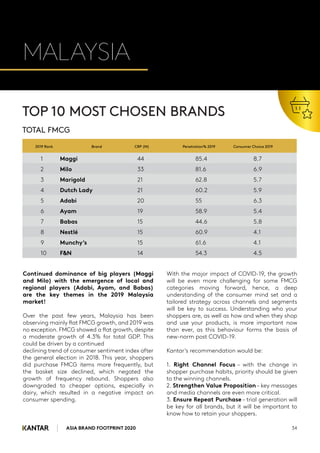
  • 23.
    ASIA BRAND FOOTPRINT2020 23 INDONESIA EXECUTIVE INTERVIEW Kantar: What makes Roma unique as a brand? Roma is the biggest brand in Indonesia when it comes to biscuits. Across all markets, biscuit categories usually have one iconic brand that is part of everyone’s life. In Indonesia, Roma has that stature. Dipping Roma in a cup of tea or coffee is how Indonesians begin their day. Roma is part of great family moments. Since its launch, the brand purpose has been to “Serve Goodness and Happiness.” This philosophy guides us all the way. This guiding principle is the one that drives our business growth, innovation, and sustainability. Kantar: Where is your biggest opportunity for growth (this could be a region, category, or strategy)? At Mayora, our vision is to be the best food and beverage company in Asia. We are always looking for opportunities to delight consumers. We believe that every category has a potential to grow through purposeful offering, great communication, insight, and innovation. As for the region, Asia, India, Middle East, and Africa are the regions that are growing and promising. Kantar: What was your biggest success in 2019? Why? As of 2019, Mayora is one of the highest FMCG growth in Indonesia amongst top 10 FMCGs companies. This is a remarkable achievement in Mayora’s successful track record, which shows a CAGR > 15% in the last 10 years. Kantar: What are your concerns for your brand, category, or industry as a whole? We are concerned about brands, categories, and industries losing relevancy and creativity in driving the growth and building meaningful brands for consumers around the world. As more and more media fragments and digital platforms penetrate, the industry is changing in the way brands get built. Digital’s aggressive price off/ promo advertising model is making brand building tougher and tougher and sensitizing consumers to excessive promo buying. Our challenge would be to build power brands in this new normal. Kantar: How do you think 2019 in FMCG will be remembered? People will remember that in 2019, FMCG volume growth was negative, while its value growth in single digits rose. And this has been happening for the last 3 years already. Having said that, there are companies and brands that can survive and maintain double digit growth, and one of them is Mayora. We believe that purposeful brands with great campaigns and innovation will always win the consumer’s heart, and this is the secret to achieve double digit growth again. SPOKESPERSON: Ricky Afrianto Global Marketing Head ASIA MARKET FEATURES
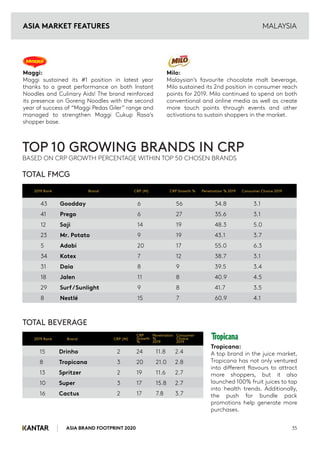
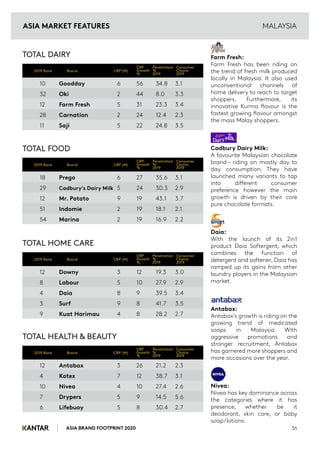
  • 24.
    ASIA BRAND FOOTPRINT2020 24 INDONESIA Kantar: Which other brands did you admire in 2019? Why? At Mayora, we do not see a specific or particular brand or company as a benchmark. Rather, we see that each company has its own strengths. A couple of brands/companies that we admire include: • In Indonesia, we do see how the local company Emtek Group moved from traditional TV stations to embrace technology and become a company that offers integrated solutions in media. • Ferero is a brand that consistently offers high quality, premium products. • We are impressed by the way Mars manages the distribution and visibility around the world. • We admire Huawei’s infrastructure and how it has become an innovative company that offers premium products and competes with global players. Kantar: What about consumer behaviour has surprised you the most over the past five years? When we realize that consumers who we view as older actually behave similar to the youth regarding technology. They embrace digital/ technology like chatting, video calling, and e-payment. The adoption of e-commerce from FMCG perspective in Indonesia is not as high as in China. And we do see two key barriers: delivery cost and the behaviour. Our experiences tell that, in FMCG perspective, consumers don’t respond to advertising messages via digital platforms as good as when it is all promo or discount. Kantar: And what do you think the next five years will hold? Technology will disrupt distribution in FMCG. This will shake the industry. Only those players who prepare for this will survive and win. Changing consumer behaviours, the increasingly cluttered nature of the media and new technologies will continue to disrupt the way we do our business and the way we market our brands. Business can go up and down, including start-ups, but there is always a better solution for consumers. No more instructions in apps or digital are needed because these platforms intuitively understand people better. We will no longer discuss the importance of offline VS online or omni-channel or the rise of AI, IoT, and ML, but rather the competition from each player to bring value to consumers and humanize digital/technology. Kantar: What did you do differently during COVID-19 to still reach your consumers? We are working hard to always stay relevant: • Adapt your communication to reflect the current situation and offer the solution. • Strengthen your brand purpose to drive equity campaign. • Focus on the right brand/category, geography, and investment. ASIA MARKET FEATURES
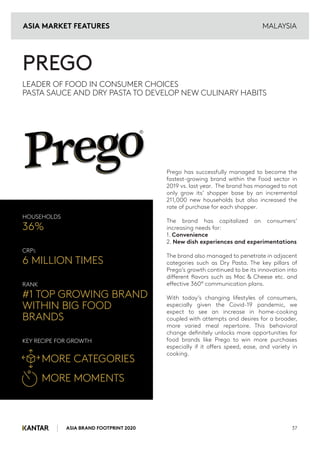
  • 25.
    ASIA BRAND FOOTPRINT2020 25 EXECUTIVE INTERVIEW Kantar: What makes Downy unique as a brand? Downy has been relentlessly focusing on providing consumers with a superior laundry experience. Downy has managed to become synonymous with the key category need of long-lasting freshness for clothes. We pioneered the sensorial category, with winning claims such as “like wearing perfume every day” and “even better than expensive perfumes.” Kantar: Where is your biggest opportunity for growth (this could be a region, category, or strategy)? The biggest opportunity for Downy will be to stay close to consumers’ evolving needs in the new normal and design our products, benefits and communication that best addresses these needs. Kantar: What was your biggest success in 2019? Why? In 2019, Downy made a move to own Malodor removal, another core category need, leveraging insights which other brands had not tapped into. The new products launched were supported by communication that was relevant and resonated with the Indonesian consumer, resulting in spectacular in-market success and the #1 position in Indonesia Fabric Enhancer market. Kantar: What do you think the next five years will hold? Moving forward, the brand’s mission is to become a true love mark for the Indonesian consumer, delighting them at the first and second moments of truth. SPOKESPERSON: Arvind Rayappa Commercial Leader, Indonesia Fabric and Homecare INDONESIA ASIA MARKET FEATURES
  • 26.
    INDONESIA ASIA BRAND FOOTPRINT2020 26 “ FMCG market has bounced back in 2019, as the Indonesian economy has demonstrated a stable performance over the past year. The bounce back has been driven by a volume uptick which is a good sign for the manufacturers. While there are opportunities abound for brands to continue growing, brands cannot afford to become complacent and expect growth to happen organically. Brands will still need to ensure that they remain relevant to the consumer and earn their growth. The longer-term trends remain relevant - going digital, seeking convenience, experience-led consumer behaviour. Additionally, the trend of the shift in trade channels pushed on by minimarkets and growing e-commerce means that consumers today are spoilt for choices in their shopping. I am happy to see that most of the top chosen brands continue to be among the most chosen brands in Indonesia and, at the same time, there are some new brands breaking into the top brands list. I am sure there are many learnings from the levers to growth that the marketer can apply to their brands. ” Venu Madhav General Manager, Indonesia Worldpanel Division, Kantar ASIA MARKET FEATURES
  • 27.
    ASIA BRAND FOOTPRINT2020 27 KOREA In Korea, many consumers have already experienced market paradigm evolution due to the exceptionally digitalized environment, demographic changes, and rapidly changing social and cultural environment. And we expect that COVID-19 will accelerate this paradigm evolution. Rapid changes in retail landscape, target expansion, product concepts, OTT, and the new “homeconomy” (home+economy) are happening in diverse aspects. The importance of the online market in FMCG is steadily increasing while its target has expanded from young targets to seniors. Furthermore, in-home consumption behaviour centred on families of one to two people is expanding into overall household consumption behaviours. “Accelerated E-commerce Growth in FMCG Market” “Active Senior” refers to those in their 50s and 60s with ample wealth and income, a term that has already emerged in Korea three to four years ago. Unlike the typical elderly in the past, they spare no investment or consumption on themselves, especially in the online market. Right now, the expression “target expansion within the channel” may be correct, but in the near future, categories targeting younger age groups will be able to expand their targets to the senior group. In other words, the target group biased toward specific age groups will be able to expand their consumer touchpoint, thanks to e-commerce. Thus, the reverse situation, “target expansion through the channel” will become common. 1 Ottogi 92.5 90.2 2 Seoul Milk 76.9 55.7 3 Dongwon 71.9 85 4 Masinnen Milk 71.3 50.8 5 Chungjungone 65.4 83.7 6 Baekseol 62.6 83.5 7 Will 58.3 9.4 8 Bibigo 54.7 70.4 9 Ottogi ramen 49.7 70.7 10 Jinramen 45.5 61.9 TOP 10 MOST CHOSEN BRANDS TOTAL FMCG 2019 Rank Brand CRP (M) Penetration% 2019
  • 28.
    ASIA BRAND FOOTPRINT2020 28 KOREA For example, the main target of Home Meal Replacement (HMR) products was households with teenagers. However, we are now living in the era in which seniors also purchase HMR to ease their cooking and purchase ready-made kimchi instead of making it themselves. In fact, based on our household panel data, HMR was among the top 3 categories purchased online in adult family and senior households. Changes brought about by digitalization are not confined to Generation Z. Even seniors in their 60s and older use Coupang and SSG via mobile, and the hurdles of digital consumption activities are collapsing fast. Now, the time when brands shall check their online market target group has once again arrived. “Increased consumption based on individual consumer's subjective rationality” The buzzword "untact" refers to contactless service without face-to-face encounters, and “homeconomy” refers to consumers who spend leisure time at home. These two trends represent the recent consumer purchase behaviours and will be a medium for “subjective rational consumption style,” which will be a major shopping behaviour as an extension of past “value consumption” trend. This new style of shopping behaviour will reflect the changes of consumption propensity varying from person to person or from time to time. Everyone pursues rational spending from time to time and sometimes spends on luxury. Reasonable expenditure through online shopping is rudimentary and consumers don’t spare money when it comes to health, regardless of age. On the other hand, others of the same age invest in themselves by spending in slightly more fancy categories. While there are people who mostly stay at home and don't spare money for home wear, there are people who sometimes buy expensive luxury bags even if they only go out rarely. Meanwhile, during the coronavirus quarantine, consumers drank Dalgona coffee, which is made by combining instant coffee, granulated sugar, and water and stirring the mixture 400 times(Dalgona coffee went viral online recently, with people showing interest in the drink both in and outside South Korea). Isn't it ironic? There is no fixed consumption behaviour among consumers even within similar age groups or similar lifestyle patterns. Ultimately, “subjective rational consumption style,” or so-called value consumption, has become a new type of lifestyle. Now, we should take note of consumer's "multi-persona." It is time for an understanding of consumption trends based on subjective rationality, in which more and more individuals are the main consumers due to increased interest in “me." “NEW NORMAL:” Market After the Time of Coronavirus Because of the COVID-19, we often hear the buzzword "new normal." The post-pandemic era will most likely be a new opportunity to bring about another “new normal” era. In fact, this new normal has already begun. Now is the time to start considering surpassing ever-evolving consumers, not just grasping targets, product attributes, consumption behaviour, and cultural activities that weren’t previously known or recognized until yesterday. ASIA MARKET FEATURES
  • 29.
    ASIA BRAND FOOTPRINT2020 29 KOREA 1 Ottogi 92.1 90.1 2 Chungjungone 65.4 83.7 3 Beksul 62.6 83.5 4 Dongwon 57.4 79.8 5 Bibigo 54.7 70.4 MOST CHOSEN BRANDS BY SECTORS TOTAL FOOD Demand for those convenient, quality, but price-competitive, products has been on the sharp rise for many years, with many options increasing and consumer tastes also evolving. Increasing single-person households and co-parenting trends among couples are boosting the local HMR market. While the food industry has been aggressively launching a new HMR portfolio, Chungjungone (ranked #2) has successfully pioneered snacks for the drink HMR market, and is now currently widening the range of its portfolio. CJ also grew significantly, taking a large share of the growing HMR market with its brand Bibigo (ranked #5). Dongsuh’s Maxim, which has an unrivalled share of the shrinking instant coffee market, has been trying to expand its buyer pool by bringing various types of products into the market. But CRP slightly dropped as the buyers from the coffee mix market shifted to others, such as RTD coffee. In the meantime, Haru Yachae, which was outside the 2018 rankings, recently moved up to 4th ranking, with a significant increase in CRP due to winning more from regular delivery and diversified online channel distribution. 1 Maxim 31.3 56.5 2 Coca-Cola 28.7 36.9 3 Chilsung Cider 23.4 39.5 4 Haru Yachae 19.7 3.7 5 Delmonte 16.6 35.9 TOTAL BEVERAGE (EXCLUDING BEER) 2019 Rank Brand CRP (M) Penetration% 2019 2019 Rank Brand CRP (M) Penetration% 2019 ASIA MARKET FEATURES
  • 30.
    ASIA BRAND FOOTPRINT2020 30 KOREA 1 Seoul Milk 76.9 55.7 2 Masinnen Milk 71.3 50.8 3 Will 58.3 9.4 4 Sowanamoo 44.0 58 5 Denmark 34.3 46 TOTAL DAIRY 1 Perio 11.4 38.2 2 2080 9.0 30.3 3 Saffron 8.5 26.1 4 Downy 7.7 22.3 5 Yuhan Lax 5.4 19.9 TOTAL HOMECARE (EXCLUDING HAIR/BODY) In the homecare market, where the importance of online channels continues to expand, the CRP of LG Household & Health Care brands Perio(ranked #1) and Saffron(ranked #3), which had been difficult to actively play on main online channels(social commerce, etc.) has decreased overall. On the contrary, Aekyung 2080 that focused on online channels moved up to second place. In 2019, the total cosmetics market showed signs of recovery, thanks to skincare. Although the market's recovery has slowed due to the COVID-19 blow in the first half of 2020, masstige brands have maintained solid performances based on online and H&B stores. The colour cosmetics market is expected to slow down, as people don’t go out much due to coronavirus. Prestige brands sales will be the most negatively impacted. Furthermore, as prestige brands, which have a high proportion of offline customer contact points compared to masstige brands, begin shifting to online, competition is expected to intensify. Therefore, brands need customized strategies depending on changes in consumer purchase behaviour by major online platforms. MOST CHOSEN BRANDS FOR BEAUTY MARKET 2019 Rank Brand CRP (M) Penetration% 2019 2019 Rank Brand CRP (M) Penetration% 2019 ASIA MARKET FEATURES
  • 31.
    ASIA BRAND FOOTPRINT2020 31 KOREA • Korean consumers equip multiple skin care products in diverse format and functions and prescribe the usage subject to daily skin condition. This trend has become vivid in Y2019, resulting in notable growth of functional serum and soothing cream. • Masstige brands with reasonable price such as Atomy continued to excel while prestige brand Sulwhasoo struggled in CRP. • Dr.G climbed up to 2nd place based on its successful line extension from hero cream (Red Blemish) to toner and milky lotion. • Fierce competition amongst derma skincare brands claiming anti-acne and skin-soothing benefits are expected. • In Y2019, luminant and dewy look on both face and lip makeup has been a trend, which is led to a success of liptint category. • Roadshop brands Etude and Innisfree maintain top CRP based on their hero products with positive consumer reviews. However, limited consumer traffic in offline stores led to CRP contraction. • Top ranked Etude tries to improve consumer reach points to their young targets by expanding distribution to H&B stores and diverse online platforms. • Clio showed notable growth in CRP along with success of H&B stores amongst young target. With the lead of cushion, both liptint & eye makeup also contributes to gain additional traffic. 1 Innisfree 10.2 25.4 2 Dr.G 5.1 20.7 3 The Face Shop 5.0 13.9 4 Sulwhasoo 4.7 13.7 5 Atomy 4.7 9.2 TOTAL SKIN CARE (BEAUTY PANEL DATA) 1 Etude 6.2 16.9 2 Innisfree 6.0 18.8 3 Missha 5.8 19.4 4 The Face Shop 3.8 14.5 5 Clio 3.5 13.9 TOTAL COLOR COSMETICS (BEAUTY PANEL DATA) 2019 Rank Brand CRP (M) Penetration% 2019 2019 Rank Brand CRP (M) Penetration% 2019 ASIA MARKET FEATURES
  • 32.
    ASIA BRAND FOOTPRINT2020 32 KOREA Missha is a twenty-year-old cosmetics brand that specializes in both skin care and make-up. Missha ranks as the #2 brand in the Korea cosmetics market in CRP, reaching 27.3% of Korean female consumers. Missha is a pioneer brand that opened low priced, single-branded, free standing stores (FSS) in Korea. Recent years have proven challenging for single-branded FSS, as consumer traffic in offline mass cosmetics is focused on H&B stores with a wide range of brand options. However, Missha survived through the struggles by posting +9.7% CRP growth in Y2019. Missha’s proactive reaction to market change regarding product and distribution recruited buyers into the brand amid unfavourable market environment. Missha skin care records +10.9% CRP growth by intensifying hero franchises consisting of intense care (serum & cream). The Artemisia franchise, in particular, contributed to recruiting additional millennial buyers to the brand by satisfying consumer demands of watery essence for skin soothing (Missha age 15-34 skin care CRP YoY GR% =+16.5%). Furthermore, Missha sustains its reputation in make-up thanks to continuous new product launches in its hero category, BB Cream, as well as Glow Skin franchise development. Distribution-wise, its FSS’s conversion from single-brand shops to multi-brand shops further intensifies Missha’s channel traffic-driving power. Moreover, Missha’s entrance to TV Home shopping and revitalizing online brand mall contributed to CRP growth across all age groups. Distribution expansion beyond traditional single-branded FSS will enhance access convenience to potential customers. In the mass cosmetics sector, where hero products play a crucial role, Missha’s strategic movement to intensify hero franchises is also expected to help raise brand competitiveness. HOUSEHOLDS 27.3% CRPS 5.8 MILLION TIMES RANK #2 IN COSMETICS KEY RECIPE FOR GROWTH MORE PRESENCE MORE MOMENTS MISSHA NO.2 BRAND IN KOREA COSMETICS MARKET ARTEMISIA FRANCHISE CONSISTING OF INTENSE CARE(SERUM & CREAM) – HERO FRANCHISE ASIA MARKET FEATURES
  • 33.
    KOREA ASIA BRAND FOOTPRINT2020 33 “ This year, COVID-19 has introduced an unprecedented and powerful impact on the general environments surrounding us. Therefore, to face the changes in the business environment that COVID-19 will bring about, it is crucial that we take this time to check our own brands from various angles such as consumer behaviour, distribution environment, products, as well as communication aspects. By dealing with these drastic changes in the market wisely, we can expect a better market position than before the COVID-19 outbreak. ” Francis Oh General Manager, Korea Worldpanel Division, Kantar ASIA MARKET FEATURES
  • 34.
    ASIA BRAND FOOTPRINT2020 34 MALAYSIA 1 Maggi 44 85.4 8.7 2 Milo 33 81.6 6.9 3 Marigold 21 62.8 5.7 4 Dutch Lady 21 60.2 5.9 5 Adabi 20 55 6.3 6 Ayam 19 58.9 5.4 7 Babas 15 44.6 5.8 8 Nestlé 15 60.9 4.1 9 Munchy’s 15 61.6 4.1 10 F&N 14 54.3 4.5 TOP 10 MOST CHOSEN BRANDS TOTAL FMCG Continued dominance of big players (Maggi and Milo) with the emergence of local and regional players (Adabi, Ayam, and Babas) are the key themes in the 2019 Malaysia market! Over the past few years, Malaysia has been observing mainly flat FMCG growth, and 2019 was no exception. FMCG showed a flat growth, despite a moderate growth of 4.3% for total GDP. This could be driven by a continued declining trend of consumer sentiment index after the general election in 2018. This year, shoppers did purchase FMCG items more frequently, but the basket size declined, which negated the growth of frequency rebound. Shoppers also downgraded to cheaper options, especially in dairy, which resulted in a negative impact on consumer spending. With the major impact of COVID-19, the growth will be even more challenging for some FMCG categories moving forward, hence, a deep understanding of the consumer mind set and a tailored strategy across channels and segments will be key to success. Understanding who your shoppers are, as well as how and when they shop and use your products, is more important now than ever, as this behaviour forms the basis of new-norm post COVID-19. Kantar’s recommendation would be: 1. Right Channel Focus – with the change in shopper purchase habits, priority should be given to the winning channels. 2. Strengthen Value Proposition – key messages and media channels are even more critical. 3. Ensure Repeat Purchase – trial generation will be key for all brands, but it will be important to know how to retain your shoppers. 2019 Rank Brand CRP (M) Penetration% 2019 Consumer Choice 2019
  • 35.
    ASIA BRAND FOOTPRINT2020 35 MALAYSIA Maggi: Maggi sustained its #1 position in latest year thanks to a great performance on both Instant Noodles and Culinary Aids! The brand reinforced its presence on Goreng Noodles with the second year of success of “Maggi Pedas Giler” range and managed to strengthen Maggi Cukup Rasa’s shopper base. Milo: Malaysian’s favourite chocolate malt beverage, Milo sustained its 2nd position in consumer reach points for 2019. Milo continued to spend on both conventional and online media as well as create more touch points through events and other activations to sustain shoppers in the market. 43 Goodday 6 56 34.8 3.1 41 Prego 6 27 35.6 3.1 12 Saji 14 19 48.3 5.0 23 Mr. Potato 9 19 43.1 3.7 5 Adabi 20 17 55.0 6.3 34 Kotex 7 12 38.7 3.1 31 Daia 8 9 39.5 3.4 18 Jalen 11 8 40.9 4.5 29 Surf/Sunlight 9 8 41.7 3.5 8 Nestlé 15 7 60.9 4.1 TOP 10 GROWING BRANDS IN CRP BASED ON CRP GROWTH PERCENTAGE WITHIN TOP 50 CHOSEN BRANDS TOTAL FMCG Tropicana: A top brand in the juice market, Tropicana has not only ventured into different flavours to attract more shoppers, but it also launched 100% fruit juices to tap into health trends. Additionally, the push for bundle pack promotions help generate more purchases. TOTAL BEVERAGE 2019 Rank Brand CRP (M) CRP Growth % Penetration % 2019 Consumer Choice 2019 15 Drinho 2 24 11.8 2.4 8 Tropicana 3 20 21.0 2.8 13 Spritzer 2 19 11.6 2.7 10 Super 3 17 15.8 2.7 16 Cactus 2 17 7.8 3.7 2019 Rank Brand CRP (M) CRP Growth % Penetration % 2019 Consumer Choice 2019 ASIA MARKET FEATURES
  • 36.
    ASIA BRAND FOOTPRINT2020 36 MALAYSIA Farm Fresh: Farm Fresh has been riding on the trend of fresh milk produced locally in Malaysia. It also used unconventional channels of home delivery to reach to target shoppers. Furthermore, its innovative Kurma flavour is the fastest growing flavour amongst the mass Malay shoppers. Cadbury Dairy Milk: A favourite Malaysian chocolate brand – riding on mostly day to day consumption. They have launched many variants to tap into different consumer preference however the main growth is driven by their core pure chocolate formats. Daia: With the launch of its 2in1 product Daia Softergent, which combines the function of detergent and softener, Daia has ramped up its gains from other laundry players in the Malaysian market. Antabax: Antabax’s growth is riding on the growing trend of medicated soaps in Malaysia. With aggressive promotions and stronger recruitment, Antabax has garnered more shoppers and more occasions over the year. Nivea: Nivea has key dominance across the categories where it has presence, whether be it deodorant, skin care, or baby soap/lotions. TOTAL DAIRY TOTAL FOOD TOTAL HOME CARE TOTAL HEALTH & BEAUTY 10 Goodday 6 56 34.8 3.1 32 Oki 2 44 8.0 3.3 12 Farm Fresh 5 31 23.3 3.4 28 Carnation 2 24 12.4 2.3 11 Saji 5 22 24.8 3.5 2019 Rank Brand CRP (M) CRP Growth % Penetration % 2019 Consumer Choice 2019 18 Prego 6 27 35.6 3.1 29 Cadbury's Dairy Milk 5 24 30.3 2.9 12 Mr. Potato 9 19 43.1 3.7 51 Indomie 2 19 18.1 2.1 54 Marina 2 19 16.9 2.2 2019 Rank Brand CRP (M) CRP Growth % Penetration % 2019 Consumer Choice 2019 12 Downy 3 12 19.3 3.0 8 Labour 5 10 27.9 2.9 4 Daia 8 9 39.5 3.4 3 Surf 9 8 41.7 3.5 9 Kuat Harimau 4 8 28.2 2.7 2019 Rank Brand CRP (M) CRP Growth % Penetration % 2019 Consumer Choice 2019 12 Antabax 3 26 21.2 2.3 4 Kotex 7 12 38.7 3.1 10 Nivea 4 10 27.4 2.6 7 Drypers 5 9 14.5 5.6 6 Lifebuoy 5 8 30.4 2.7 2019 Rank Brand CRP (M) CRP Growth % Penetration % 2019 Consumer Choice 2019 ASIA MARKET FEATURES
  • 37.
    ASIA BRAND FOOTPRINT2020 37 Prego has successfully managed to become the fastest-growing brand within the Food sector in 2019 vs. last year. The brand has managed to not only grow its’ shopper base by an incremental 211,000 new households but also increased the rate of purchase for each shopper. The brand has capitalized on consumers’ increasing needs for: 1. Convenience 2. New dish experiences and experimentations The brand also managed to penetrate in adjacent categories such as Dry Pasta. The key pillars of Prego’s growth continued to be its innovation into different flavors such as Mac & Cheese etc. and effective 360° communication plans. With today’s changing lifestyles of consumers, especially given the Covid-19 pandemic, we expect to see an increase in home-cooking coupled with attempts and desires for a broader, more varied meal repertoire. This behavioral change definitely unlocks more opportunities for food brands like Prego to win more purchases especially if it offers speed, ease, and variety in cooking. HOUSEHOLDS 36% CRPS 6 MILLION TIMES RANK #1 TOP GROWING BRAND WITHIN BIG FOOD BRANDS KEY RECIPE FOR GROWTH MORE CATEGORIES MORE MOMENTS PREGO LEADER OF FOOD IN CONSUMER CHOICES PASTA SAUCE AND DRY PASTA TO DEVELOP NEW CULINARY HABITS MALAYSIA R ASIA MARKET FEATURES
  • 38.
    ASIA BRAND FOOTPRINT2020 38 EXECUTIVE INTERVIEW Kantar: What makes Prego unique as a brand? Prego is a well-known brand for pasta meals. It is unique to Malaysians because it offers a good range of products and variants that suit local taste buds and preferences. The brand remains top of mind within the category. Kantar: Where is your biggest opportunity for growth (this could be a region, category, or strategy)? Food and lifestyle trends will continue to be the biggest opportunity to drive penetration and consumption frequency. Food trends are constantly evolving, given the influence of culture infusions and consumer openness to explore new, exciting tastes. With lifestyle changes that demand for greater convenience and a new level of creativity regarding “how we live today,” there will be higher food expectations and, hence, a bigger opportunity for a growing category like pasta. Kantar: What was your biggest success in 2019? Why? Our innovation pillar. We had a successful and impactful launch for our Prego Mac & Cheese. The success factors were driven by: • Tapping into the popularity of the cheese flavour trend, which is widely accepted and familiar among Malaysians. • Embedding a compelling and effective communication plan that strongly leveraged on kids’ pester power to encourage offtake and consumption. Kantar: What are your concerns for your brand, category, or industry as a whole? Given the current economic situation that is uncertain and volatile, consumers will be more careful with their expenditure, which will potentially accelerate the “habit/ trend” of bargain hunting, as consumer price sensitivity may heighten. It is important for brands to embrace this change in providing product value and be nimble in meeting these changes. SPOKESPERSON: Imun Lim Marketing Director Vanessa Lim Marketing Manager – Pasta Meals MALAYSIA R ASIA MARKET FEATURES
  • 39.
    ASIA BRAND FOOTPRINT2020 39 MALAYSIA Kantar: How do you think 2019 in FMCG will be remembered? The year where the industry had low growth in many categories due to multiple economic and social factors; one in which success was driven by multiple innovations and entrance into new categories. It will also be the year remembered as the one before “the big change” in 2020. Kantar: What about consumer behaviour has surprised you the most over the past five years? The experimental nature of consumers of fusing flavours in food and beverages. For example, Nasi Lemak burgers and Hainanese chicken rice potato chips. The other one which surprised me was how quickly K-influence went mass, be it in food, drinks, language adoption, music, or entertainment, across the globe, but especially in Malaysia. Kantar: And what do you think the next five years will hold? With the current pandemic, we can only expect volatility and uncertainty. As guardians and builders of brands, we need to focus on our purpose to our consumers, deliver what meets their needs, and be agile in our journey. Kantar: What did you do differently during COVID-19 pandemic? Pasta meal was a category that had a large surge during the pandemic. Prego was able to help families and moms have delicious, convenient, and affordable pasta meals when they were facing the lockdown at home. We shared simple recipes under our campaign “Prego Semudah 1-2-3” to assist moms and relieve their pain points on what to cook for each meal. We also reviewed and changed our Ramadhan/Raya plans to focus on Malaysia’s B-40 group and front liners who needed our support in these times. Additionally, when the pandemic started and Malaysia imposed the movement control order (MCO), Prego leveraged on the need for convenience to encourage Malaysians to consume pasta meals at home. Riding on the insights that consumers were largely concerned about stock availability both at home and in-market, plus having the ability to prepare a meal at home, our content largely advocated the message of “#stayhome, #staysafe as Prego is a quick and easy solution to your meal preparation and can deliver overall recipe convenience.” ASIA MARKET FEATURES
  • 40.
    ASIA BRAND FOOTPRINT2020 40 EXECUTIVE INTERVIEW Kantar: What makes Saji unique as a brand? Saji shares a lot of local values with our consumers. Being part of the FGV group, our supply chain is fully integrated from farm to table. The brand is seen as a local champion that helps build the community and gives back to society. It is a brand that’s close to their hearts, resulting in high brand loyalty. Kantar: Where is your biggest opportunity for growth (this could be region, category, or strategy)? Locally, the biggest opportunity for growth now is to fulfil essential needs. Our best sellers have always been palm-based downstream products, but we are moving beyond oils and fats. Our goal is to offer high quality food products at affordable prices, which are easily accessible to the masses. Internationally, we are building our footprint in emerging markets such as Southeast Asia, Middle East, North Africa, and West Africa with the same goal in mind. Kantar: What was your biggest success in 2019 and why? In 2019, the brand grew exponentially in Malaysia. Each product category within Saji’s brand portfolio grew beyond market average. Consumers were starting to recognise the brand beyond the cooking oil category. Kantar: What are your concerns for your brand, category, or industry as a whole? We are always concerned about delivering the best to our consumers and in any case, that we are not able to fulfil that promise, we go out of our way to make it up to them. Customer service is an area that is crucial to the overall brand experience. On that front, we are constantly improving. Kantar: How do you think 2019 in FMCG will be remembered? FMCG in 2019 will be remembered as a year of the rise of the underdogs. Many local brands emerged as unexpected winners, as consumers shift their support towards locally produced goods, a trend that may be seen across the globe. SPOKESPERSON: Shammim Azad Kamruzaman Chief Executive Officer MALAYSIA ASIA MARKET FEATURES
  • 41.
    ASIA BRAND FOOTPRINT2020 41 MALAYSIA Kantar: What about consumer behaviour has surprised you the most over the past 5 years? Health and environmental awareness have been picking up over the past 5 years but have yet to reach mass adoption. Brands that focus on these two factors have seen an uptrend over the years but are still considered niche. Growth in e-commerce, especially in FMCG, has seen slower adoption rates compared to other categories. What’s surprising is that these are seen as temporary trends, rather than permanent changes. Kantar: What do you think the next 5 years will hold? As previously mentioned, the next 5 years will shift the masses to embrace healthy and environmentally conscious lifestyles, and e-commerce will achieve much higher adoption rates. The pandemic is seen as the catalyst towards new and lasting behaviours. Companies will also adopt digital solutions faster, making operations more efficient, which in turn will benefit end users. Kantar: What did you do differently during COVID-19 pandemic to still reach your consumers? In terms of communication, we shifted our focus on digital platforms and sent messages that were relevant to their interests, such as #StayAtHome, #KitaJagaKita, and so on. Consumers found the brand to be updated and relatable to their current situation and, therefore, felt connected. At the same time, we put in a lot of effort to immediately help those in need. Starting with supporting healthcare front-liners, we then prepared over 16,000 bags filled with essential goods to be distributed across the country. We continued these charitable efforts through our Ramadan campaign called “Kongsi Rezeki Seikhlas Hati” where we invited our consumers to take part in helping those in need just by purchasing our products. For any FGV products purchased, send us a proof of purchase and we’ll match the value of your purchase to be given to charity under your name. It fits the spirit of giving in Ramadan and is relevant to the current situation. This helped position the brand and company as caring, honest, and community- driven. ASIA MARKET FEATURES
  • 42.
    MALAYSIA ASIA BRAND FOOTPRINT2020 42 “ Household FMCG spend in Malaysia has been stagnant for the past several years. In 2019, there was only 1% more CRP compared with a year ago. About half of the brands in Malaysia gained more consumer decisions, while the remaining half got less. The top 10 brands in Malaysia have a slight leading edge to win more consumer choic- es; however, we also see an example of a smaller brand that could gain almost 60% CRP and moved up 25 in the Brand Footprint ranking. We featured their success stories in hope to identify insights that we can all learn from. ” Howard Chang Managing Director, Malaysia and Thailand Worldpanel Division, Kantar ASIA MARKET FEATURES
  • 43.
    ASIA BRAND FOOTPRINT2020 43 ASIA BRAND FOOTPRINT 2020 PHILIPPINES 1 Lucky Me 837 97.2 35.2 2 Nescafé 520 82.9 25.6 3 Silver Swan 500 79.5 25.7 4 Kopiko 472 71.2 27.1 5 Surf 470 85.6 22.4 6 Bear Brand 444 84.7 21.4 7 Palmolive 424 77.4 22.3 8 Sunsilk 414 71.7 23.5 9 Coca-Cola 394 73.5 21.9 10 Creamsilk 389 74.3 21.4 TOP 10 MOST CHOSEN BRANDS TOTAL FMCG Staple household brands make up the Top 10 most chosen brands in the Philippines The commonality among the top brands is their high reach, purchased by more than 70% of Filipino households. Lucky Me, a local noodle brand, remains the most chosen consumer brand in the Philippines, maintaining this title over the past 5 years. It has reached almost all Filipino homes and is bought 36x a year. Lucky Me continues to improve its existing products, through improved recipes and adding new formats. Coca-Cola climbs to the 9th spot, with a previous ranking of 16. The soft drink brand was able to bounce back from the effects of the Sugar Tax implementation enacted last 2018. By reformulating and executing an effective SKU strategy, it was able to regain buyers and increase more frequent purchase in 2019. Nescafe held its 2nd ranking, as Filipinos continue to be a coffee-loving nation. Kopiko also moved up to 4th ranking, as it was able to expand its reach to higher SECs. Although 6 out of the 10 brands are from food and beverage sectors, there are also brands from the beauty and personal care sector, as well as the homecare sector. Hair care brands like Palmolive, Sunsilk, and Creamsilk are among the top choices for Filipino shoppers and are able to retain their rankings from last year. Surf continues to be the only detergent brand in the top 10. 2019 Rank Brand CRP (M) Penetration% 2019 Consumer Choice 2019
  • 44.
    ASIA BRAND FOOTPRINT2020 44 PHILIPPINES TOP 10 GROWING BRANDS IN CRP BASED ON CRP GROWTH PERCENTAGE WITHIN TOP 70 CHOSEN BRANDS TOTAL FMCG The growth of the top 10 fastest rising brands is driven by their ability to recruit more shoppers and encourage more frequent purchase. They are able to attract new buyers year on year, raising their popularity among consumers. Wings, a detergent brand, continues to grow very fast, but is topped by Birch Tree, a local dairy brand. This milk powder brand was able to gain over 4 million homes in two years. A combination of price, promotions and strong messaging was able to push Birch Tree to be the number two milk powder brand in the country. Bioderm, a local soap brand, also moves up through the rankings for fastest growing brands. For the past three years it was able to continuously gain new buyers and see an increase in shopper purchase frequency, now averaging 8x a year. The brand is strongly promoting its message in social media, that Bioderm fights against germs and is suitable for the whole family. 27 Birch Tree 137 54 39.5 14.1 38 Wings 104 35 32.0 13.3 67 Bioderm 54 26 28.1 7.9 9 Coca-Cola 394 20 73.5 21.9 63 Calla 60 20 26.7 9.2 60 Gardenia 61 19 33.8 7.4 49 Pride 77 18 33.0 9.5 55 EQ 64 13 20.4 12.8 59 Happy (Fiberline Ind.) 62 13 15.7 16.0 57 Royal Tru Orange 63 12 43.0 6.0 2019 Rank Brand CRP (M) CRP Growth % Penetration % 2019 Consumer Choice 2019 ASIA MARKET FEATURES
  • 45.
    ASIA BRAND FOOTPRINT2020 45 Birch Tree shot up in rankings and is considered the fastest rising brand in the Philippines. In just two years, almost 40% of Filipino homes already purchase this brand. It is the third most chosen dairy brand, following category giants Bear Brand and Milo. In a market dominated by bigger packs, the introduction of Birch Tree’s 33g sachet has propelled the brand’s exponential growth. Its attractive price point and “Sustansyafordable” (Nutritious + Affordable) messaging helped the brand to reach lower-income homes, where consumers shop in provision stores. Sari-sari stores became the main channel for the brand, which works well with its low price and sachet format. Birch Tree’s buyer base growth cuts across all regions, socio-economic classes, and ages, truly embodying their message: “It’s Everybody’s Milk.” Other marketing activities and endorsers also greatly aided the offtake of the brand. With a strong buyer base, the brand’s newly introduced chocolate flavour has already gained 14% penetration within its first year of launch. Birch Tree has successfully become the #2 brand in the powdered milk category, as it continually recruits new buyers. HOUSEHOLDS 40% CRPS 137 MILLION TIMES RANK #27 KEY RECIPE FOR GROWTH MORE NEEDS MORE MOMENTS BIRCH TREE “EVERYBODY’S MILK” PHILIPPINES ASIA MARKET FEATURES
  • 46.
    ASIA BRAND FOOTPRINT2020 46 Unlike most manufacturers who tend to launch their products in capital regions first, Wings chose to seed first in the Mindanao region, followed by Visayas. This proved to be a good strategy, as their distribution strength in both regions continues to drive growth. More than 40% of Filipino homes purchase Wings in Visayas, and almost 70% of homes from Mindanao choose Wings as their laundry detergent. These two regions remain the brand’s stronghold. Wings has established itself as a regional player, able to compete with the bigger brands in the market, and is steadily gaining reach in other parts of the country. With an average price 27% lower than the others in the category, Wings leverages on a strong value positioning. It demonstrates the ability to deliver the basics well, at an affordable price. HOUSEHOLDS 32% CRPS 104 MILLION TIMES RANK #38 KEY RECIPE FOR GROWTH MORE PRESENCE WINGS THE REGIONAL PLAYER PHILIPPINES ASIA MARKET FEATURES
  • 47.
    PHILIPPINES ASIA BRAND FOOTPRINT2020 47 “ Our ranking continues to demonstrate the importance of staple household brands in Filipino homes. Those brands sustain their leadership by constantly adapting their portfolio to new consumer needs and conveying this through inspiring communication. Price, however, remains an important factor for Filipino shoppers and several of the fastest growing brands have used this lever to gain more shoppers. Hence, a brand’s ability to demonstrate excellent value for money remains essential to further grow and remain relevant in our market. ” Marie-Anne Lezoraine General Manager, Philippines Worldpanel Division, Kantar ASIA MARKET FEATURES
  • 48.
    ASIA BRAND FOOTPRINT2020 48 TAIWAN 1 I MEI 86 88.9 10.1 2 Kuang Chuan 61 76.9 8.4 3 Fresh Delight 46 67.6 7.4 4 Wei Chuan Lin Feng Yin 34 42.5 9.2 5 Uni-President 33 72.9 5.0 6 Uni-President Chui Sui 27 48.6 6.4 7 Kirkland Signature 22 39.3 5.6 8 Quaker 21 60.9 3.8 9 Uni-President Ch’un Chi Cha 18 27.2 7.8 10 Laurel 17 56.4 3.5 TOP 10 MOST CHOSEN BRANDS TOTAL FMCG HEALTH, INNOVATION, AND CONVENIENCE ARE THE KEY THEMES FOR SUCCESS IN THE 2019 TAIWAN MARKET. #LocalPower The top 5 ranking remained occupied by local brands, and those leading brands stand to create the growth in CRP. In Taiwan, 1% penetration represents around 86,500 households. I MEI, for example, reported 8,650,000 Taiwan households in 2019. #TrustForUse The top 6 out of 10 brands remain the same as the previous year, demonstrating consumer trust in brand quality and loyalty. These six brands are in dairy, and take the lead due to higher in-home penetration and repeat purchase frequency. 2019 Rank Brand CRP (M) Penetration% 2019 Consumer Choice 2019
  • 49.
    ASIA BRAND FOOTPRINT2020 49 TAIWAN TOTAL FOOD 1 I MEI 35 -4 2 Uni-President 20 5 3 Laurel 17 0 4 Lay's 15 1 5 Tai Sun 11 0 2019 Rank Brand CRP (M) CRP Growth % MOST CHOSEN BRANDS BY SECTORS Uni-President: As one of main manufacturers in Taiwan, Uni-President continues expanding its portfolio towards offering, for example, frozen and chilled food, to gain 5% growth in CRP. TOTAL DAIRY 1 Kuang Chuan 55 4 2 I MEI 44 20 3 Fresh Delight 44 1 4 Wei Chuan Lin Feng Yin 34 8 5 Uni-President Chui Sui 27 -2 I MEI: As the top Brand Footprint ranking in Taiwan, I MEI continuously wins CRP consumer reach in dairy categories. Plant-based dairy or fresh milk, for example, generate 20% growth. TOTAL BEVERAGE 1 18 15 2 Super Supau 15 -6 3 Hey Song 15 -6 4 Vitalon Ochaen 13 19 5 12 8 Vitalon Ochaen: Both new product offering flavours and new product pack types contributed to Vitalon Ochaen’s 19% CRP growth. TOTAL HOME CARE 1 Kleenex 9 -14 2 DE YI (YFY) 6 9 3 May Flower 5 -15 4 Andante 5 -12 5 Bai Lan (Unilever) 5 -7 DE YI: In 2019, DE YI launched new product lines, fabric detergent and dish wash, to leverage its homecare brand image for new recruits, achieving 9% CRP growth. Uni-President Ch’un Chi Cha Uni-President Mai Hsiang 2019 Rank Brand CRP (M) CRP Growth % 2019 Rank Brand CRP (M) CRP Growth % 2019 Rank Brand CRP (M) CRP Growth % ASIA MARKET FEATURES
  • 50.
    TAIWAN TOTAL PERSONAL CARE 1Sofy 12 -8 2 Kotex 11 3 3 Carnation (KNH) 8 -9 4 Darlie 7 -8 5 Colgate 6 -5 Kotex: Through aggressive marketing communication in the femcare category, Kotex achieved 3% CRP growth, acquiring new shoppers via brand innovation, offering products like pads, liners, and tampons. TOP 10 GROWING BRANDS IN CRP BASED ON CRP GROWTH PERCENTAGE WITHIN TOP 50 CHOSEN BRANDS TOTAL FMCG #CreativeInNPD In top rising, impulse categories for food and beverage grow fast, especially snack brands like Cadina. This is due to the launch of worldwide flavour taste NPDs. Vitalon Ochaen is another example, having launched its new sugar-free tea and a sugary tea series, expanding into new packaging type. #RetailerPower Retailers push to create the growth of consumer choices to expand new recruiting and repeat. Both Costco Kirkland and Carrefour demonstrated that private labels are also able to fulfil consumer expectations of balancing quality and price. ASIA BRAND FOOTPRINT 2020 50 44 Cadina 7 45 33.5 2.4 41 Carrefour 7 27 27.5 2.6 7 Kirkland Signature 22 24 39.3 5.6 32 Bifido 9 20 35.8 3.0 16 Vitalon Ochaen 13 19 38.4 3.9 43 Koikeya 7 17 31.0 2.6 9 Uni-President Ch’un Chi Cha 18 15 27.2 7.8 40 Lipton 7 15 28.5 3.0 5 Uni-President 33 9 72.9 5.0 4 Wei Chuan Lin Feng Yin 34 8 42.5 9.2 2019 Rank Brand CRP (M) CRP Growth % Penetration % 2019 Consumer Choice 2019 2019 Rank Brand CRP (M) CRP Growth % ASIA MARKET FEATURES
  • 51.
    ASIA BRAND FOOTPRINT2020 51 TAIWAN Vitalon Ochaen is a local Taiwan tea brand that manufactures RTD teas as its main market position. Its penetration has increased from 35.5% in 2018 to 38.4% in 2019, driving 19% CRP growth. It continued launching new flavours, with its sugar-free Japanese raw tea leading the momentum, while product line extension into chilled packaging served as another driver. Vitalon Ochaen launched a sugar-free Japanese raw tea that portrayed a different profile than what buyers were accustomed to. It used famous Asian actors as celebrity endorsers in 2019, thereby rebuilding brand awareness in young buyers. It also expanded its product line to include a more sugary tea series, using different types of product packaging such as tetra pak, not only PET bottles. Thus, this brand had more opportunities to display products to the buyers in the retail channel so that it made more shelf presence, which was also the reason for increased sales in two consecutive years. HOUSEHOLDS 38.4% CRPS 13 MILLION TIMES RANK #5 IN TOP GROWING KEY RECIPE FOR GROWTH MORE TARGET MORE PRESENCE VITALON OCHAEN RISING LEADER OF BEVERAGE IN CONSUMER CHOICES ASIA MARKET FEATURES
  • 52.
    TAIWAN ASIA BRAND FOOTPRINT2020 52 “ In 2019, FMCG brands in Taiwan strived to achieve growth, as leading brands suffered from severe competitive challenges. The latest Brand Footprint ranking shows that winning brands are TrustForUse, CreativeInNPD, and benefit from RetailerPower. Due to the COVID-19 impact, 2020 would be a turning point for agile players that are able to adapt to the new normal and uncover future growth opportunities. ” Jason Yu Managing Director, Greater China Worldpanel Division, Kantar ASIA MARKET FEATURES
  • 53.
    ASIA BRAND FOOTPRINT2020 53 THAILAND 1 Dutch Mill 186 72.1 10.0 2 Mama 170 81.1 8.2 3 Lay's 146 59.9 9.5 4 Nescafé 139 55.4 9.8 5 Rosdee 136 66.8 7.9 6 Colgate 128 81.4 5.8 7 Ajinomoto 118 61.1 7.6 8 Hygiene 116 64.7 6.8 9 Pepsi 102 46.8 8.5 10 Lactasoy 97 50.9 7.5 TOP 10 MOST CHOSEN BRANDS TOTAL FMCG INNOVATION, HEALTH, AND CONVENIENCE 2019 was another challenging year for FMCG spend in Thailand with a flat growth. Among 571 established FMCG brands, 50% of them were able to gain more consumer decisions (CRP) compared to a year ago. There are three key success themes behind these brands winning more consumer choices: innovation, health and convenience. What shoppers look for evolves over time as their lifestyle and needs change. Especially, COVID-19 impacts how consumer behave and how they shop. Growth is becoming harder to come by, and together with the new norm of post-COVID19, it’s more crucial than ever for every brand to better understand what matters to shopper and their needs. Recession? Expect weaker consumer spending as the unemployment rate increases and various movement control introduces disruption to many businesses. Learnings from the previous financial crisis show that shoppers would always find different ways to manage their expenses. Is your category a necessity? Are there alternative substitutions? Would private labels make a comeback? Will shoppers be more price sensitive or even willing to down trade? Strengthen Value Proposition Key messages and media channels are even more critical. 2019 Rank Brand CRP (M) Penetration% 2019 Consumer Choice 2019
  • 54.
    ASIA BRAND FOOTPRINT2020 54 THAILAND Hygiene: Hygiene made our top chosen list with an astonishing CRP growth of 11%. This growth is largely credited to its launch of Life Nature®, with natural extracts that are less harmful to the environment and the body. Hygiene was chosen more than 116 million times throughout 2019. Pepsi: No Sugar beverage mixed together with a new flavor like Pepsi Max Raspberry captured a significant shoppers’ Decisions in 2019 The variant is refreshing, innovative, and fun. Six months after launch, Pepsi Max Raspberry had achieved 540k CRPs, representing 1 in 5 transactions for Total PepsiMax. TOP 10 GROWING BRANDS IN CRP BASED ON CRP GROWTH PERCENTAGE WITHIN TOP 50 CHOSEN BRANDS TOTAL FMCG 46 Singha 39 31 21.6 7.0 36 Sponsor 49 14 28.5 6.8 8 Hygiene 116 11 64.7 6.8 34 Mitr Phol 52 10 55.0 3.7 49 Brand's 38 10 24.4 6.0 47 Chang (Thai Bev) 39 8 15.4 9.7 11 Coca-Cola 97 6 51.6 7.4 23 Omo 64 5 56.2 4.5 33 M-150 53 5 21.0 9.9 9 Pepsi 102 4 46.8 8.5 2019 Rank Brand CRP (M) CRP Growth % Penetration % 2019 Consumer Choice 2019 TOTAL BEVERAGE 26 C-Vitt 11 108 9.5 4.6 28 Namthip 10 81 9.6 3.9 42 Shark 4 68 2.3 7.4 8 Singha 39 31 21.6 7.0 16 Deedo 26 30 23.3 4.4 2019 Rank Brand CRP (M) CRP Growth % Penetration % 2019 Consumer Choice 2019 C-Vitt: A brand that builds an image of being healthy, improving the immune system, and helping consumers meet the daily recommended vitamin C, C-Vitt also promotes several usage occasions, such as feeling ill. This makes it relevant in the Thai market, where shoppers are looking for a healthier beverage option. ASIA MARKET FEATURES
  • 55.
    ASIA BRAND FOOTPRINT2020 55 THAILAND Sesame Soy: With constant promotions and communications regarding value-added soy milk with high calcium and high Vitamin E, Sesame Soy reached the top 3 fast riser in dairy. Nissin: A brand with a price premium over market average, Nissin has proven its popularity with a consumer base of 5.5 million households and CRP growth of 44%. This shows that shoppers are willing to pay more for benefits like unique taste and flavour. Roza: Roza demonstrates effective communication on online platform, as well as a strong brand image. It has a wide variety of products, suitable for family settings, promoting warmth and a familiar feeling around the product. TOTAL DAIRY TOTAL FOOD 38 Ensure 1 241 1.8 1.9 43 Ship 1 211 0.6 5.0 36 Sesame Soy 1 143 2.3 2.0 45 Deedo 1 101 1.0 2.5 32 Richesse 2 84 4.1 2.1 2019 Rank Brand CRP (M) CRP Growth % Penetration % 2019 Consumer Choice 2019 37 Nissin 14 44.0 22.1 2.6 30 Wang Kanai 17 24.0 25.3 2.6 21 O-Lean 24 22.0 33.3 2.8 17 Roza 28 18.0 38.9 2.8 33 Amphawa 16 13.0 17.7 3.6 2019 Rank Brand CRP (M) CRP Growth % Penetration % 2019 Consumer Choice 2019 ASIA MARKET FEATURES
  • 56.
    ASIA BRAND FOOTPRINT2020 56 THAILAND TOTAL HOME CARE TOTAL HEALTH & BEAUTY D-Nee: With its quality product, smart communication through various social media platforms, and strong distribution, D-Nee ranks 4th on our homecare list. With communications promoting safety for kids, parents have put their trust in D-Nee. Elis: A new entrant into the competitive femcare market, Elis captured about 10% of category spend within the three years since its launch. The brand’s frequent mentions in social media led to its popularity among urban and younger females. It delivered an impressive result in 2019, with 7 million consumer decisions. Tepthai: A new comer in the toothpaste category, Tepthai’s herbal ingredients offer multiple oral care benefits to users, providing consumers with the ability to achieve effective oral care hygiene in a single product. The brand price per kg is about 160% to market average; however, consumers found the product value for money, due to its tactical pack size and “green bean size usage – where a tube can be used for 350 times.” 31 Vivy 5 66 6.8 2.8 48 Goldeer 2 50 2.7 3.0 37 Kleenex 3 48 6.4 2.0 16 D-Nee 17 36 11.3 4.9 25 Wow 7 29 8.1 3.4 2019 Rank Brand CRP (M) CRP Growth % Penetration % 2019 Consumer Choice 2019 44 Elis 7 96 10.0 2.6 35 Tepthai 10 71 16.1 2.5 41 L'Oreal 8 34 11.9 2.5 38 Benice 9 29 14.7 2.3 48 Raw Ra 6 19 6.0 3.9 2019 Rank Brand CRP (M) CRP Growth % Penetration % 2019 Consumer Choice 2019 ASIA MARKET FEATURES
  • 57.
    ASIA BRAND FOOTPRINT2020 57 THAILAND Despite being the market leader in Thailand’s instant noodles market, Mama continues to be relentless in finding new ways to grow and innovate. Even within their already successful premium Mama OK (Oriental Kitchen) product line, they have not fallen prey to complacency. The breakthrough new product release that had propelled the brand’s growth in the previous year is none other than Mama OK Salted Egg. By jumping on the "Salted Egg" bandwagon at the perfect time, combined with a spicy mélange of flavour and a unique egg-yolk texture, this was the most successful NPD in Thailand during 2019, with more than 3.6m choices. In fact, it out-performed all previous instant noodle NPDs since 2017 in terms trial. Like the rest of the Mama OK product line, the value proposition is offering import-level tastes at a much more affordable price-point. Now, the question on everyone's mind is "will it last?" While we've seen many salted egg flavoured products fade from the spotlight, our data suggests that this flavour is here to stay and will continue as a vital part of Mama's portfolio. HOUSEHOLDS 81% CRPS 170 MILLION TIMES RANK #1 IN FOOD KEY RECIPE FOR GROWTH MORE PRESENCE MORE MOMENTS MAMA LEADER OF FOOD IN CONSUMER CHOICES SALTED EGG FLAVOUR BRIGHT NEW EXCITEMENT ASIA MARKET FEATURES
  • 58.
    ASIA BRAND FOOTPRINT2020 58 THAILAND EXECUTIVE INTERVIEW Kantar: What makes MAMA unique as a brand? The value of Saha Group is built on the principle of honesty by selling good quality products at fair prices. We have always been focused on maintaining quality standards and developing new innovations to serve the continuously changing consumer needs, behaviours, lifestyles, and beliefs. For over 40 years, MAMA has adhered to this principle by staying true to the classic slogan of “MAMA AROI.” The brand continues to offer various delicious tastes in different forms of instant foods that consistently excite consumers while strengthening relationships with customers through communication campaigns and activities. Kantar: What was your biggest success in 2019? Why? We consider the relaunch of our “Mama OK” line to be our 2019 success. The line was originally launched 20 years back as “Mama Oriental Kitchen” and positioned itself as the premium instant noodle product, with authentic oriental flavours. In early 2019, we decided to capture younger consumers by simply calling the line “Mama OK,” and we launched new stir-fried salted egg flavour noodles to the market by capitalizing on the upward trend of salted-egg popularity. With our distinctive taste, outstanding packaging design, as well as communication campaign, we received overwhelming feedback from the consumers from all over the country. Shortly after, we launched the “OK Generation” brand campaign, featuring superstar JJ (Kritsanapoom Pibulsonggram) as the presenter, which strengthened our position of instant noodle brands for new generations. We also emphasize using data, research, and marketing intelligence in every phase of product life cycle. Kantar: What do you think the challenge in FMCG was in 2019? The 2019 Instant noodles market was full of new variety and flavours. Many of them were imported brands with a lot higher price. While instant noodles consumption experienced only slight growth and the shelf space in retail remained the same or less, every brand had to struggle to stay present in the market and in the mind of consumers. Kantar: Where do you see the FMCG market going in the next five years? While most consumers still continue to buy FMCG offline, more and more consumers will buy them online after they become familiar with online purchases and cashless society during the COVID-19 pandemic. Innovative packaging and pack size variety will be necessary to serve consumers on different platforms. Kantar: What did you do differently during the COVID-19 pandemic, to still reach your consumers? As one of the stock-up and donation items, MAMA faced panic demand from retailers and end consumers during the pandemic. We responded to the sharp demand increase by increasing production plan, adjusting the number of production SKUs, instilling a new system to allocate our limited supply to all retailers appropriately and fairly, offering direct-to-retailer shipping, increasing stock replenishment, and offering the goods direct-to-consumer via online platforms. SPOKESPERSON: Chailada Tantivejakul Vice President ASIA MARKET FEATURES
  • 59.
    ASIA BRAND FOOTPRINT2020 59 THAILAND EXECUTIVE INTERVIEW Kantar: What makes Hygiene unique as a brand? For the better part of our 36-year journey, Hygiene has aimed to be a world class hassle-free laundry system that serves both domestic and global markets through our commitment to making a meaningful difference to people’s lives. With this mission in mind, we uphold four traits as our mantra to set us apart from our competitors. The first is “being insightful.” We are consumer-centric and insightful enough to innovate and best serve our consumers’ needs. Next, “innovation.” We continuously innovate for the future of better living with an “in love” attitude, in which our team is passionate about improving the quality of people’s lives. Last but not least, “integrity.” We never compromise quality when developing a new product. Product quality is always first priority. These have helped us to continuously redefine the new frontier and set new standards as to how we work. Hygiene now means much more than a well-known fabric care brand in Thailand. We believe we have become a household necessity that every home must have to ensure the hygiene of their loved ones.We are proud to have made an impact in people’s lives through our quality product, and this is what truly makes us “unique.” Kantar: What was your biggest success in 2019? Why? 2019 was one of the biggest milestones in Hygiene’s history. We reached our highest sales and become #1 most chosen brand in household category. But that’s not all. Our metric of success goes beyond sales. We also like to measure our success through our consumers’ admiration. It is important that consumers love and truly appreciate our products, because that means we truly know our consumers. However, one of the key important elements to our success is innovation. This not only applies to new products, but all the processes and services needed to create new products. We believe innovation will unlock growth for us as a brand and a company. We know that a brand with purpose will grow, a brand that knows its consumers’ purpose will grow, and a brand that constantly innovates will also grow. In 2019, Hygiene launched new products “Hygiene Expert Care Life Nature,” which propelled us to the #1 position in that segment within just three months of its launch. As we embrace the new culture of working we can learn from the start-up world to help unlock our creativity and innovation so as to better serve consumers and the constantly changing world today. SPOKESPERSON: Thiti Thanesvorakul Vice President ASIA MARKET FEATURES
  • 60.
    THAILAND ASIA BRAND FOOTPRINT2020 60 “ Before the COVID-19 impact, Thailand’s FMCG market spend growth was already showing an “L” shape from its peak in 2011. Since then, it’s been rather flat, particularly in the past 3 years, with growth only between -0.4% and 0.9%. Despite the flat consumer spending in grocery, there are brands that continue to win more consumer choices during this challenging time. Learning from their success would help us to understand the drivers and, hopefully, create ideas to replicate their success. Thai shoppers are willing to pay for premium products if they are relevant and if the benefits out-weight the cost. The common winning formula in food and beverage is health, nutrition added, and exotic flavour. To win more consumer choices, the rule of thumb is that you need to be relevant, either by solving an existing problem or creating new usage occasions. Effective communication and utilizing the right media channel for the right target audience are crucial. ” Howard Chang Managing Director, Malaysia and Thailand Worldpanel Division, Kantar ASIA MARKET FEATURES
  • 61.
    ASIA BRAND FOOTPRINT2020 61 VIETNAM 1 Vinamilk  48  91.5  18.7  2 Hao Hao  18  74.9 8.3  3 Nam Ngu  13  67.3  7.1  4 Th True  11  51.9  7.7  5 Ngoi Sao Phuong Nam 11  46.4  8.2  6 Milo  11  51.4  7.3  7 Ajinomoto  10  75.0  4.7  8 Chin Su  10  62.4  5.7  9 Coca-Cola  10  68.9  5.0  10 Sunlight  10  72.7  4.6  TOP 10 MOST CHOSEN BRANDS TOTAL FMCG - URBAN 4 KEY CITIES 1 Vinamilk  136  72.8  10.9  2 Nam Ngu  121  77.0  9.2  3 3 Mien (Uniben)  102  65.3  9.1  4 Hao Hao  79  59.9  7.7  5 Gau Do (Asia Foods) 78  57.4  7.9  6 Fami  65  49.2  7.7  7 Ajinomoto  62  66.3  5.5  8 Chin Su  62  70.9  5.1  9 P|S  59  81.6  4.3  10 Kokomi  56  46.6  7.0  TOTAL FMCG - RURAL 2019 Rank Brand CRP (M) Penetration% 2019 Consumer Choice 2019 2019 Rank Brand CRP (M) Penetration% 2019 Consumer Choice 2019
  • 62.
    ASIA BRAND FOOTPRINT2020 62 VIETNAM URBAN 4 CITIES  RURAL  MOST CHOSEN BRAND OWNERS Vinamilk 66  1  Unilever  310  Unilever  50  2  Masan Consumer  297  Masan Consumer  37  3  Vinamilk  218  Nestlé 28 4 Calofic 108 Acecook 24 5 Acecook 103   BRAND OWNER  CRP(M) 2019 RANK  BRAND OWNER  CRP(M)  It is no surprise that food and beverage brands maintain their stronghold in the ranking of the most chosen FMCG brands in Vietnam, with such a high usage frequency significantly increasing their CRPs per year. Marketing activities and strong advertising campaigns have also helped with their non-stop effort in driving high brand awareness and purchasing. Vinamilk, the well-known local dairy manufacturer is still being chosen the most in both urban (4 cities) and rural Vietnam. This is in part due to its huge coverage regarding consumer base, especially in urban where its penetration is much higher than others on the list. Additionally, its eponymous brand attracted nearly 120,000 new households in rural areas by continuously emphasizing its core fresh image. And the launch of organic products further enhanced the brand’s image. Combining the marked success of Vinamilk and Ngoi Sao Phuong Nam (another Vinamilk brand among the top 10 FMCG ranking), Vinamilk upholds its #1 standing and is chosen more than 65 million times per year by urban (4 cities) households. Impressively Sunlight and P/S, both owned by the global giant FMCG manufacturer Unilever, retained their positions in the top 10 most chosen brands as the unique non-food brands in urban (4 cities) and rural, respectively. This positive performance helped Unilever retain its title as the most chosen brand owner in rural Vietnam, while also creating a safe gap between other competitors in urban ranking in terms of CRPs. ASIA MARKET FEATURES
  • 63.
    ASIA BRAND FOOTPRINT2020 63 MOST CHOSEN BRANDS BY SECTORS VIETNAM TOTAL HEALTH & BEAUTY 1 P|S 7 71.1 3.7 2 Diana 7 60.2 4.3 3 Lifebuoy 6 61.0 3.5 4 Sunsilk 5 33.3 5.6 5 Colgate 5 55.8 3.0 2019 Rank Brand CRP (M) URBAN 4 CITIES  RURAL Penetration % 2019 Consumer Choice 2019 1 P|S 59 81.6 4.3 2 Sunsilk 43 43.0 5.8 3 Clear 40 48.0 4.9 4 Lifebuoy 26 43.7 3.4 5 Dove 24 30.8 4.6 TOTAL HOME CARE 1 Sunlight 10 72.7 4.6 2 Omo 7 61.7 4.3 3 Comfort 5 47.2 4.1 4 Downy 4 39.8 3.7 5 Lix 3 37.4 3.1 1 Sunlight 50 68.2 4.3 2 Omo 41 62.0 3.9 3 Comfort 35 49.7 4.1 4 Lix 27 29.8 5.4 5 Aba 23 36.1 3.7 TOTAL FOOD 1 Hao Hao 18 74.9 8.3 2 Nam Ngu 13 67.3 7.1 3 Ajinomoto 10 75.0 4.7 4 Chin Su 10 62.4 5.7 5 Bien Hoa 8 62.2 4.6 1 Nam Ngu 121 77.0 9.2 2 3 Mien 102 65.3 9.1 3 Hao Hao 79 59.9 7.7 4 Gau Do 78 57.4 7.9 5 Ajinomoto 62 66.3 5.5 2019 Rank Brand CRP (M) Penetration % 2019 Consumer Choice 2019 2019 Rank Brand CRP (M) Penetration % 2019 Consumer Choice 2019 2019 Rank Brand CRP (M) Penetration % 2019 Consumer Choice 2019 2019 Rank Brand CRP (M) Penetration % 2019 Consumer Choice 2019 2019 Rank Brand CRP (M) Penetration % 2019 Consumer Choice 2019 ASIA MARKET FEATURES
  • 64.
    ASIA BRAND FOOTPRINT2020 64 TOTAL BEVERAGES 1 Coca-Cola 10 68.9 5.0 2 Tiger 8 40.9 6.8 3 Nescafé 6 36.6 6.2 4 Sting 6 27.5 7.9 5 G7 5 35.9 4.8 URBAN 4 CITIES  RURAL 1 Saigon (Beer)52 45.4 6.7 2 Nescafé 27 29.0 5.5 3 Ha Noi (Beer)26 29.0 5.2 4 Coca-Cola 21 43.1 2.8 5 Red Bull 18 28.9 3.6 TOTAL DAIRY AND DAIRY SUBSTITUTES 1 Vinamilk 48 91.5 18.7 2 Th True 11 51.8 7.7 3 11 46.4 8.2 4 Milo 10 50.8 7.3 5 Ong Tho 9 55.6 5.7 1 Vinamilk 136 72.8 10.9 2 Fami 65 49.2 7.7 3 Ong Tho 45 48.6 5.4 4 Milo 36 35.4 6.0 5 Moc Chau 23 21.5 6.4 VIETNAM 48 Vinacafe 3 20 13.9 8.2 47 Lix 3 19 37.4 3.1 8 Chin Su 10 15 62.4 5.7 4 Th True 11 11 51.9 7.7 31 Omachi 5 11 45.6 4.0 43 Aquafina 4 8 25.5 5.4 39 La Vie 4 6 32.0 4.7 40 Downy 4 5 39.8 3.7 19 Diana 7 4 60.2 4.3 32 Cai Lan 5 4 36.2 5.0 TOP 10 GROWING BRANDS IN CRP BASED ON CRP GROWTH PERCENTAGE WITHIN TOP 50 CHOSEN BRANDS TOTAL FMCG - URBAN 4 CITIES 2019 Rank Brand CRP (M) Penetration % 2019 Consumer Choice 2019 2019 Rank Brand CRP (M) Penetration % 2019 Consumer Choice 2019 2019 Rank Brand CRP (M) Penetration % 2019 Consumer Choice 2019 2019 Rank Brand CRP (M) Penetration % 2019 Consumer Choice 2019 2019 Rank Brand CRP (M) CRP Growth % Penetration % 2019 Consumer Choice 2019 Ngoi Sao Phuong Nam ASIA MARKET FEATURES
  • 65.
    ASIA BRAND FOOTPRINT2020 65 VIETNAM 34 Th True 21 20 27.4 4.5 21 Milo 36 16 35.5 6.0 44 Neptune 17 15 32.5 3.1 48 G7 14 14 25.6 3.3 39 Tuong An 18 12 29.1 3.6 15 Simply (Cai Lan) 44 11 48.8 5.3 11 Saigon (Beer) 52 10 45.4 6.7 3 3 Mien (Uniben) 102 9 65.3 9.1 8 Chin Su 62 9 70.9 5.1 18 Omo 41 9 62.0 3.9 TOTAL FMCG - RURAL The expansion in consumer base is the key growth driver among top 10 risers, with lots of new buyers acquired throughout the year. Achieving a robust growth of 20% in terms of CRPs in rural Vietnam, Th True is recognised as the fastest growing brand. This is thanks to its product portfolio expansion, with products like Th True Juice, Th True Yogurt, and Th True Rice, which meets different consumer needs. Riding on the health and convenience trend, as well as offering a variety of product lines, Lavie, the bottled water brand owned by Nestle, reported an impressive performance by recruiting more than 81,000 new buyers in urban (4 cities) last year. Despite being a well-established brand, Milo progressively increased its footprint in rural areas with the double-digit CRP growth of 16% and over 420,000 new households acquired. This Nestle brand continues its focus on the nutrition trend and strengthens its brand awareness through several advertising campaigns. 2019 Rank Brand CRP (M) CRP Growth % Penetration % 2019 Consumer Choice 2019 TOP 10 GROWING BRANDS IN CRP BASED ON CRP GROWTH PERCENTAGE WITHIN TOP 50 CHOSEN BRANDS ASIA MARKET FEATURES
  • 66.
    ASIA BRAND FOOTPRINT2020 66 Yakult, a drinking yogurt brand owned by a Japanese manufacturer, entered the Vietnam market in 2007 and has progressively become a market leader within the functional drinking yogurt segment. Due to the heightened health and convenience trends among Vietnamese consumers in recent years, drinking yogurt has demonstrated an optimistic performance in both Vietnam urban (4 key cities) and rural areas. Capturing that huge opportunity, Yakult has strongly invested in social media, as well as branding activities to raise its brand awareness and emphasize the nutritional benefit it can bring. Yakult tapped into prevailing trends and expanded the distribution from offline to online, which partly helped to increase its shopper base. Noticeably, Yakult launched “Yakult Lady,” its creative format, to not only help simplify and fasten purchases, but also to directly engage with consumers. Moreover, the brand increasingly invests in marketing and communication with a couple of yearly TV campaigns. These campaigns highlight “Japanese origin” and air during family holiday occasions to create a symbol of health and connection to family. Due to these factors, the brand attracted more than 120,000 new urban households within a year and achieved an impressive growth of 23% in terms of CRPs. Overall, Yakult has jumped three spots in urban (4 cities) ranking, entering the top 10 most chosen brands among dairy and dairy substitutes for the first time. HOUSEHOLDS 23% CRPS 3 MILLION TIMES RANK TOP 10 IN DAIRY & DAIRY SUBSTITUTES RANKING KEY RECIPE FOR GROWTH MORE PRESENCE MORE MOMENTS MORE TARGETS A MARKET LEADER IN FUNCTIONAL DRINKING YOGURT VIETNAM YAKULT Data in Urban Vietnam 4 key cities ASIA MARKET FEATURES
  • 67.
    VIETNAM ASIA BRAND FOOTPRINT2020 67 “ 2019 was a strong year for FMCG consumption in Vietnam for both urban and rural areas, surpassing the growth of 2017 and 2018. This was partly a result of brands’ efforts to push the boundaries and discover more new consumer demand spaces, as well as smart investments in advertising and promotion campaigns from manufacturers. There are plenty of successful cases of brands expanding in terms of CRPs, which brands can examine and learn from to help drive growth. The retail landscape also continues to develop with impressive contribution from emerging channels like online and mini-stores, as well as big formats like hyper and super, which present new and different avenues for brands to explore and reach new shoppers. ” Fabrice Carrasco Managing Director, Vietnam & Philippines Strategic Project Director, Asia Worldpanel Division, Kantar ASIA MARKET FEATURES
  • 68.
    Global markets andeconomies are shuttering at the hands of COVID-19. Brands are now called to understand the pandemic’s impact on different industries, as well as the evolving consumer behaviour. Understanding how shoppers’ needs are changing is a vital first step for brand owners to effectively adapt their management strategy. Only then, can brands align with consumer demands and expectations during this time of crisis and, later, recovery. ASIA BRAND FOOTPRINT 2020 68 BRAND NAVIGATION THROUGH THE COVID-19 PANDEMIC
  • 69.
    Throughout the pandemicin Asia, we have identified six factors that broadly impact how FMCG performs by market. These factors have and will continue to influence how consumers shop. Mobility The first factor is related to mobility, specifically, the length of time in which people are in lockdown. The longer the lockdown is enforced, the more significant the impact is to FMCG expenditure. The second factor is the restriction level of the lockdown regarding how flexible versus how strict the mandates are. The level of flexibility imposed equally impacts the frequency and number of categories consumers shop, as well as their spending. Spending Power The next factor we have discovered is household income and SEC contribution. Lower income households who live on daily or weekly wages are generally more impacted, in that they are often obligated to choose between essentials versus non-essentials. The fourth factor is festivities. Major festivities like Lunar New Year, Ramadan, and Eid al-Fitr not only impact the shopper purchase cycle, but also the categories in which they purchase. THE SHIFT IN SHOPPER BEHAVIOUR Availability Ease of access to stores is another factor influencing consumer activity. The availability of “proximity” channels and the product ranges stocked are essential. And finally, e-commerce and O2O development are also factors. The pandemic has inevitably accelerated the adoption of e-commerce and O2O across markets due to social distancing. Whilst this has helped in driving reach for the channel, it is critically important that manufacturers continue to leverage the use of the channel as an “incremental” lever to both categories and brands. This will help brands avoid potentially cannibalizing on sales in their existing brick and mortar channels. Where e-commerce and O2O is still in its infancy and developing stage, proximity channels such as minimarkets, supermarkets, and others will be a clear default channel. It’s important for brands to ensure the right SKUs and products offer in both online and offline platforms, with clear differentiating features to serve various occasions and needs. We have observed four clusters across Asia based on how consumers shop before the lockdown mandates versus after. The first cluster is “overly cautious,” meaning that shoppers react by making big purchases ahead of and during the lockdown. This growth trend continues during lockdown. The second cluster is “challenged,” in which shoppers decrease their spending both before and after the lockdown, with no strong signs of recovery in sight. PRE- VERSUS POST-LOCKDOWN SHOPPING: FOUR CLUSTERS ACROSS ASIA Next, there is the “undeterred” cluster, which illustrates minimal impact to overall FMCG spend due to lower restrictions on mobility. The question regarding this cluster is, can we expect to continue business as usual? And the fourth cluster is “road to recovery,” which refers to countries in a state of “sudden shock,” where consumers have little time to react. This cluster does show signs of recovery post-lockdown. ASIA BRAND FOOTPRINT 2020 69 BRAND NAVIGATION THROUGH THE COVID-19 PANDEMIC
  • 70.
    Analysing based onthese four clusters, it is evident that some countries have experienced a drastic shift in shopping patterns, while the reactions of some are muted. Vietnam, for example, experienced an “overly cautious” cluster of spending. While they have had the lowest number of cases, they were quick to react to the crisis. On the other hand, Indonesia has the highest number of cases in Southeast Asia (SEA), yet experienced very little impact (“undeterred”). The Philippines represents a “challenged” cluster, with a prolonged lockdown that is taking a heavy toll on its overall FMCG market. Both China and South Korea fall under “road to recovery,” as they began witnessing a rebound around six weeks after the lockdown. In line with the global picture, the biggest brands are the ones winning across Asia. Nearly all leading brands are being chosen at a faster rate than the average category growth rate. And in the event that a leading brand did not grow faster than the category, it still achieved double digit growth, and even triple digit growth. One example of this is with hand wash products. Overall, we see that Asian consumer purchases reflect their growing needs for hygiene products, cooking aids and essentials, convenient foods, and nutritional and immune-boosting products. In line with the global picture, the biggest brands are the ones winning across Asia. Nearly all leading brands are being chosen at a faster rate than the average category growth rate. And in the event that a leading brand did not grow faster than the category, it still achieved double digit growth, and even triple digit growth. One example of this is with hand wash products. BIG BRANDS ARE WINNING HYGIENE PRODUCTS % VALUE GROWTH (COVID period* vs YA) Hand wash Average Category Leading brand Malaysia +179% +110% Vietnam (Urban 4 cities) +599% +372% Philippines +151% +102% Wet tissue/Wipes Average Category Leading brand China Mainland +65% +98% Taiwan +49% +81% Paper products Average Category Leading brand Thailand +12% +19% Taiwan +34% +30% Philippines (Toilet tissue) +54% +67% Household cleaners Average Category Leading brand Philippines (Toilet cleaner) +66% +39% Vietnam (Bathroom & Toilet +33% +64% cleaner-Urban 4 cities) ASIA BRAND FOOTPRINT 2020 70 BRAND NAVIGATION THROUGH THE COVID-19 PANDEMIC *COVID-19 period: We have normalized each market by its respective COVID-19 time due to the difference among markets.
  • 71.
    With lockdown mandatesin place, consumers across Asia have spent significantly more time at home. Therefore, at-home cooking and in-house dining have become more popular than ever before, yielding an increased need for cooking products and essentials. Asian consumers demonstrated more spending on cooking aids and essentials, evident by the value growth of dish wash liquid, seasoning, and sauces. Vietnam, for example, shows a +17% value growth and a +24% growth from leading brands. For seasoning products, Indonesia had a +19% average category growth, and for sauces, specifically fish sauce, value growth in Vietnam spiked by +35%. COOKING AIDS & ESSENTIALS % VALUE GROWTH (COVID period* vs YA) Dishwash liquid Average Category Leading brand Thailand +11% +11% Vietnam (Urban 4 cities) +17% +24% Seasoning Average Category Leading brand Indonesia (Urban) +19% +16% Thailand +9% +21% Sauces Average Category Leading brand China Mainland +14% +19% (Soy + Oyster sauce) Malaysia (Salad dressing) +43% +41% Vietnam (Fish sauce - Urban +35% +22% 4 cities) % VALUE GROWTH (COVID period* vs YA) Instant Noodle Average Category Leading brand China Mainland +101% +112% Malaysia +60% +59% Vietnam (Urban 4 cities) +112% +82% Snacks Average Category Leading brand China Mainland +19% +59% Taiwan +11% +11% Vietnam (Urban 4 cities) +21% +33% Convenience is another major buyer trend that we saw emerge in 2019. And as such, convenience foods even play a more important role during quarantine time. Products in this category, like instant noodles, snacks, and cakes and cereals, have all witnessed a surge in demand. For instant noodles, China Mainland takes the lead with +101% average category value growth. Vietnam shows +21% growth in snacks, as well as +50% in cakes/cereals. CONVENIENT FOODS BRAND NAVIGATION THROUGH THE COVID-19 PANDEMIC ASIA BRAND FOOTPRINT 2020 71 *COVID-19 period: We have normalized each market by its respective COVID-19 time due to the difference among markets.
  • 72.
    % VALUE GROWTH(COVID period* vs YA) Cakes/Cereals Average Category Leading brand Malaysia (cereals) +38% +46% Thailand (sweet biscuits/cakes) +7% +16% Vietnam (Cakes -Urban 4 cities)+50% +49% Canned Fish Average Category Leading brand Indonesia (Urban) +36% +33% Philippines +25% +45% Thailand +54% +66% Even before the virus outbreak occurred, health and wellness was a prominent trend in Asian consumer behaviour. Shoppers are prioritising their health and purchasing items that they know can help boost their immune system during COVID-19. Products like milk and immune-boosting drinks have been in-demand commodities. In Malaysia, liquid milk demonstrates an average category growth of +55%, while powder milk increased by +12% in Indonesia. And regarding immune-boosting drinks, ready-to-drink (RTD) fruit juice increase by +10% in Indonesia, while functional drinks spiked by +92% in Thailand. NUTRITION & IMMUNE-BOOSTING PRODUCTS % VALUE GROWTH (COVID period* vs YA) Milk for Adult/Family Average Category Leading brand Malaysia (Liquid) +55% +63% Indonesia (Powder - Urban) +12% +16% Vietnam (Powder – Urban +21% +41% 4 cities) Immune-boosting drink Average Category Leading brand Indonesia (RTD Fruit Juice +10% +88% - Urban) Thailand (Functional drink) +92% +75% Philippines (RTD Juice) +11% +16% Cheese/Margarine Average Category Leading brand Malaysia (Margarine) +72% +63% Philippines (Cheese) +12% +24% BRAND NAVIGATION THROUGH THE COVID-19 PANDEMIC ASIA BRAND FOOTPRINT 2020 72 *COVID-19 period: We have normalized each market by its respective COVID-19 time due to the difference among markets.
  • 73.
    As mentioned inthe report, there are also five key levers for brand growth during these times: new needs, more moments, more categories, more targets, and more presence. Big brands across Asia, in various categories, have proven that by riding on one or more of these levers, businesses can achieve sustainable growth, even during challenging times. THE BIG QUESTION: HOW ARE BIG BRANDS ADAPTING AND THRIVING? BRAND NAVIGATION THROUGH THE COVID-19 PANDEMIC ASIA BRAND FOOTPRINT 2020 73 CHINA MAINLAND Instant Noodle: Support the fight against COVID-19 and secure supply Instant noodles were out of stock during the COVID-19 outbreak, due to stockpiling. To secure supply, Master Kong rapidly resumed production during the Spring Festival holidays. At the same time, the brand actively communicated on social platforms to show different ways of cooking instant noodles, thereby engaging and comforting people during the lockdown. Snacks: Trendy innovations in NPD Salty snack is a promising category to create a taste that instils joy and a sense of relief during hard times. Lay’s outperforms the market with 60% sales growth. Its media strategy is skewed to social media to engage consumers individually and show a sense of caring and being with “you.” The creative NPD in the spring is an important growth engine to continuously bring joy to consumers. In addition, riding on the emerging channel for a contactless, safe shopping experience has also accelerated its growth during COVID-19. Sold out instant noodle shelves during the outbreak Show caring via social media Successful sparkling NPD in the romantic season to deliver love & joy; cross-border cooperation with Lux to create buzz Leverage growing O2O delivery during Covid-19 Employees busy loading up at a Master Kong factory to support the front line Master Kong communicates interesting ways to eat instant noodles on TikTok
  • 74.
    BRAND NAVIGATION THROUGHTHE COVID-19 PANDEMIC ASIA BRAND FOOTPRINT 2020 74 INDONESIA Milk: Stay active with the kids With schools closed, households with kids feel that COVID-19 is highly impacting their usual routines. This led formula milk brands, like Dancow and SGM, to increase their engagement and remain present among their targets by encouraging moms to continue stimulating children’s creativity at home during this period. By leveraging more presence, these brands achieved success during the most trying times. Seasoning: Guide and support consumers via inspiration With #stay@home trending during the pandemic, Royco created a platform to inspire consumers to cook, upload photos, and donate to the needy.
  • 75.
    BRAND NAVIGATION THROUGHTHE COVID-19 PANDEMIC ASIA BRAND FOOTPRINT 2020 75 MALAYSIA Margarine: Stay creative in baking Planta Malaysia grew by a significant 63% during lockdown and Raya periods. The brand leveraged in-home baking occasions while families stayed at home, and during the Raya period, which is a key season festivity for baking. THE PHILIPPINES Canned food: One with the community Mega Sardines engaged consumers by encouraging them to share their quarantine cooking recipes, promoting safety reminders, and being available in online stores. The company also led efforts to help the community through donations and the Malasakit Kitchen. Stay at Home message & tips Donations, Tribute to Front Liners Online Channels #MEGAginalinganchallenge Creative Cooking Safety Reminders Raya Campaign & Contest
  • 76.
    BRAND NAVIGATION THROUGHTHE COVID-19 PANDEMIC ASIA BRAND FOOTPRINT 2020 76 THAILAND Immune-boosting drink: Embrace relevance C-Vitt might be the brand to have benefited most during the outbreak, as its category is more relevant. The functional drink category is growing 91% YTD April 2020, with C-Vitt’s growth reaching a high 75%. TAIWAN Wet Tissue: Stand with consumers in the fight against COVID-19 KNH’s anti-bacterial wipes have been highly accessible in every channel throughout the pandemic. And in addition to its strong presence in surgical mask manufacturing, KNH maintains its standing as a trusted brand in sanitary products, achieving a growth of 81% in 2020’s Q1 versus last year. High in-store visibility Collaboration with major CVS/EC platforms to launch limited edition of package design Free Premium of Face Mask Even you might be scared with COVID, do not worry if you are with C-Vitt Display with hygiene products Media exposure as top surgical mask manufacturer in Taiwan
  • 77.
    VIETNAM Hand wash: Beready, be positive The brand Lifebuoy successfully engaged with the current situation via COVID-related ads and communications, like the “Tram rua tay da chien” campaign. This campaign provided hand sink and hand wash across Vietnam by inviting consumers to participate in donating through dance competition “Ghen Co Vy.” The brand also had new launches, such as antibacterial wet tissues and hand sanitizer, to capture the rising consumer need for hygiene and health prevention. In short, Lifebuoy embraced digital channels and leveraged its partnership with retailers in both online and offline stores. Snacks: Stay home, have fun Oishi is another example of a brand that engaged with the current situation. Using COVID-related communications, the brand captured more in-home occasions through a series of creative ways to make homemade treats by using its products and mini games, making stay@home moments more excited. BRAND NAVIGATION THROUGH THE COVID-19 PANDEMIC ASIA BRAND FOOTPRINT 2020 77 Keep engaged by creating digital contents with positive messages Fast response to emerging consumer needs with new launches: hand sanitizer, wet tissue Stand with communities and embrace corporate social responsibility Innovation with new products and new flavors Inspire creative ways of treats at home, create new consumption occasions Keep consumers engaged through mini games
  • 78.
    As brands trekonward through the pandemic, it is critical that they understand the shift in consumer behaviours and adapt their brand management strategy accordingly. Given the rise of online shopping, we have seen that some brands are leveraging the momentum by increasing their digital presence through online touchpoints and social platforms. Even more so, some brands are providing their own home delivery service to expand their reach and meet the consumer need for less human contact. Brands are also getting creative with their communications to better engage and emphasize with the current situation. We can see many that are promoting positive messages and meaningful activities to support and engage with consumers. And while digitalization is massive, brands cannot forego offline stores. It’s important that brands and products are available, accessible, and visible across channels both online and offline, to reach as many shoppers as possible. PERSEVERANCE IN TIMES OF UNCERTAINTY 4 THINGS TO THINK ABOUT: Moving forward, it is important that brands ask themselves where their category fits in today’s market. They must analyse how the profile of their consumers has changed, as well as the occasions and needs available to drive more relevancy to their category. As we enter the economic recession post pandemic, we must recognize and adapt our brands and offers to continue serving the greater population. In markets where the lower SEC/SES population is significant, an understanding on how to better reach these potentially “displaced” consumers will be vital. We must keep in mind that big brands remain big due to penetration and reach. Hence, brands will need to consider if there are any new calibrations that will need to be adopted in the areas of pack and pricing strategy to meet new consumer realities. Despite the many challenges that COVID-19 has presented across all industries, we know that there are many opportunities for brands to ensure growth. As long as brands can remain innovative and agile, they have a great chance to create future success in post-lockdown and beyond. BRAND NAVIGATION THROUGH THE COVID-19 PANDEMIC ASIA BRAND FOOTPRINT 2020 78 EMBRACING ONLINE OPTIMIZING PRODUCT DELIVERY ENGAGING WITH CURRENT SITUATION LEVERAGING RETAIL PARTNERSHIP
  • 79.
    About Kantar Kantar isthe world’s leading evidence-based insights and consulting company. We have a complete, unique and rounded understanding of how people think, feel and act; globally and locally in over 90 markets. By combining the deep expertise of our people, our data resources and benchmarks, our innovative analytics and technology, we help our clients understand people and inspire growth.
  • 80.
    FIND OUT MORE Asia MarcyKou CEO, Asia Worldpanel Division Marcy.Kou@kantar.com North Asia Jason Yu Managing Director, Greater China Worldpanel Division jason.yu@ctrchina.cn Francis Oh General Manager, Korea Worldpanel Division Francis.Oh@kantar.com South East Asia Venu Madhav General Manager, Indonesia Worldpanel Division Venu.Madhav@kantar.com Howard Chang Managing Director, Malaysia and Thailand Worldpanel Division Howard.Chang@kantar.com Fabrice Carrasco Managing Director, Philippines & Vietnam Worldpanel Division Fabrice.Carrasco@kantar.com Marie-Anne Lezoraine General Manager, Philippines Worldpanel Division Marie-Anne.Lezoraine@kantar.com Media Inquiries Charles Chow Head of Marketing, Asia Worldpanel Division Charles.Chow@kantar.com Chivanon Piyaphitakskul Marketing Manager, Malaysia and Thailand Worldpanel Division Chivanon.Piyaphitakskul@kantar.com Nguyen Thi Nhu Ngoc Marketing Manager, Vietnam Worldpanel Division Nhungoc.Nguyenthi@kantar.com