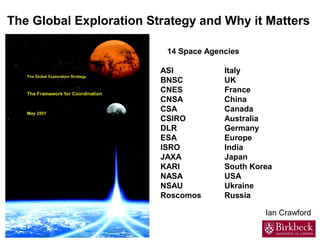
14 Space Agencies
ASI Italy
BNSC UK
CNES France
CNSA China
CSA Canada
CSIRO Australia
DLR Germany
ESA Europe
ISRO India
JAXA Japan
KARI South Korea
NASA USA
NSAU Ukraine
Roscomos Russia
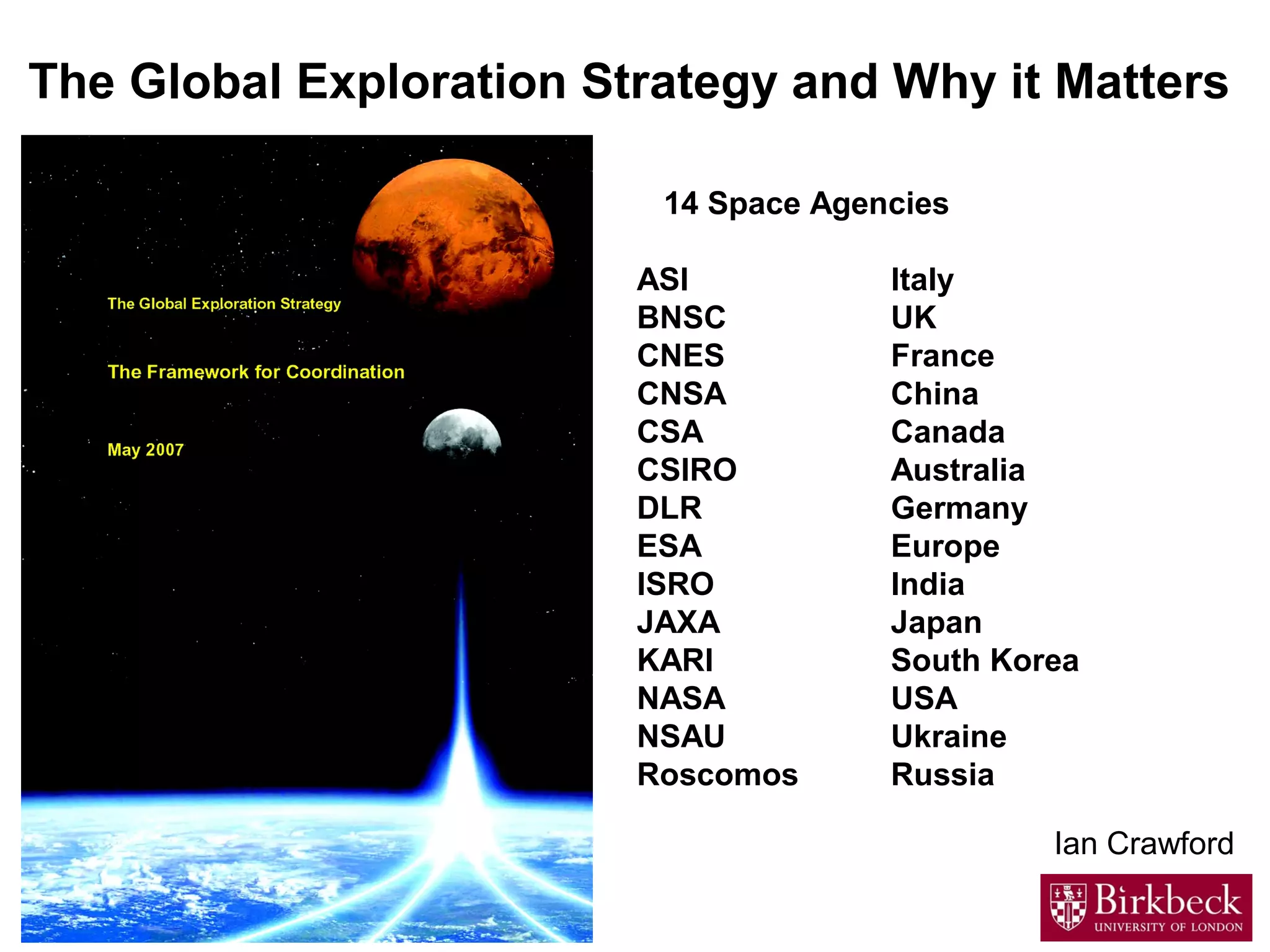
The Global Exploration Strategy and Why it Matters
Ian Crawford
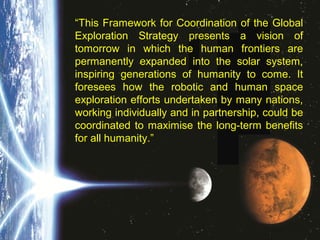
“This Framework for Coordination of the Global
Exploration Strategy presents a vision of
tomorrow in which the human frontiers are
permanently expanded into the solar system,
inspiring generations of humanity to come. It
foresees how the robotic and human space
exploration efforts undertaken by many nations,
working individually and in partnership, could be
coordinated to maximise the long-term benefits
for all humanity.”
Space exploration is driven by
• human civilization: extending human presence to other planets to
enable eventual settlement;
• scientific knowledge: pursuing scientific activities that address
fundamental questions about the history of Earth, the solar system, and
the universe – and about our place in them;
• global partnerships: providing a challenging, shared, and peaceful
activity that unites nations in pursuit of common objectives;
• economic expansion: expanding Earth’s economic sphere and
conducting space activities that benefit life on the home planet; and
• public engagement: using a vibrant space exploration programme to
engage the public, encourage students and help develop the high-tech
workforce required to address the challenges of tomorrow.
http://www.globalspaceexploration.org
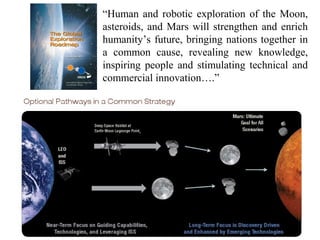
“Human and robotic exploration of the Moon,
asteroids, and Mars will strengthen and enrich
humanity’s future, bringing nations together in
a common cause, revealing new knowledge,
inspiring people and stimulating technical and
commercial innovation….”
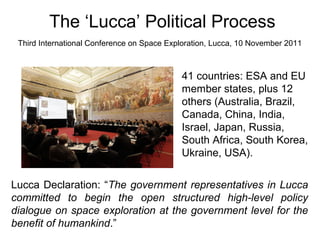
The ‘Lucca’ Political Process
Third International Conference on Space Exploration, Lucca, 10 November 2011
41 countries: ESA and EU
member states, plus 12
others (Australia, Brazil,
Canada, China, India,
Israel, Japan, Russia,
South Africa, South Korea,
Ukraine, USA).
Lucca Declaration: “The government representatives in Lucca
committed to begin the open structured high-level policy
dialogue on space exploration at the government level for the
benefit of humankind.”
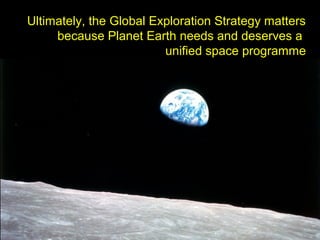
Ultimately, the Global Exploration Strategy matters
because Planet Earth needs and deserves a
unified space programme
Maintaining the momentum:
Ensure that the GES is more widely known
about by potential beneficiaries (science
and industry) and by the wider public
Ensure that UKSA are made aware
that the UK space community
considers it to be important
(UK)SEDS and Space
Generation Advisory
Council can play
an important
role

The Global Exploration Strategy and Why it Matters

  • 1.
    14 Space Agencies ASIItaly BNSC UK CNES France CNSA China CSA Canada CSIRO Australia DLR Germany ESA Europe ISRO India JAXA Japan KARI South Korea NASA USA NSAU Ukraine Roscomos Russia The Global Exploration Strategy and Why it Matters Ian Crawford
  • 2.
    “This Framework forCoordination of the Global Exploration Strategy presents a vision of tomorrow in which the human frontiers are permanently expanded into the solar system, inspiring generations of humanity to come. It foresees how the robotic and human space exploration efforts undertaken by many nations, working individually and in partnership, could be coordinated to maximise the long-term benefits for all humanity.”
  • 3.
    Space exploration isdriven by • human civilization: extending human presence to other planets to enable eventual settlement; • scientific knowledge: pursuing scientific activities that address fundamental questions about the history of Earth, the solar system, and the universe – and about our place in them; • global partnerships: providing a challenging, shared, and peaceful activity that unites nations in pursuit of common objectives; • economic expansion: expanding Earth’s economic sphere and conducting space activities that benefit life on the home planet; and • public engagement: using a vibrant space exploration programme to engage the public, encourage students and help develop the high-tech workforce required to address the challenges of tomorrow.
  • 4.
  • 5.
    “Human and roboticexploration of the Moon, asteroids, and Mars will strengthen and enrich humanity’s future, bringing nations together in a common cause, revealing new knowledge, inspiring people and stimulating technical and commercial innovation….”
  • 7.
    The ‘Lucca’ PoliticalProcess Third International Conference on Space Exploration, Lucca, 10 November 2011 41 countries: ESA and EU member states, plus 12 others (Australia, Brazil, Canada, China, India, Israel, Japan, Russia, South Africa, South Korea, Ukraine, USA). Lucca Declaration: “The government representatives in Lucca committed to begin the open structured high-level policy dialogue on space exploration at the government level for the benefit of humankind.”
  • 8.
    Ultimately, the GlobalExploration Strategy matters because Planet Earth needs and deserves a unified space programme
  • 9.
    Maintaining the momentum: Ensurethat the GES is more widely known about by potential beneficiaries (science and industry) and by the wider public Ensure that UKSA are made aware that the UK space community considers it to be important (UK)SEDS and Space Generation Advisory Council can play an important role