Understanding
“Just IN Time &
Cultural Difference”
&
NAME ID
MD. SHAHIDUL ISLAM RAFI 12
MD. SHARIFUL ISLAM 31
MD. MAHFUZ BILLAH 25
MD. ANAMUL HAQUE 39
Group member info
We will solve these Questions
1. What is JIT? briefly mention its history & five main features?
2. What are the cultural differences between India and Japan? Mention any five.
3. What are the cultural barriers for falling JIT in a country like India? Mention any five.
4. How JIT/TQM can be implemented in country like India? Give five facts and logic.
5. Is it possible JIT in Bangladesh? Constructs 10 reasoning based on your logic.
1. What is JIT? briefly mention its history & five main features?
Answer :
Just-in-time (JIT) is an inventory strategy companies employ to increase efficiency and
decrease waste by receiving goods only as they are needed in the production process, thereby
reducing inventory costs.
History : Henry Ford who applied Just in Time principles to manage inventory in the Ford
Automobile Company during the early part of the 20th Century, the origins of the JIT as a
management strategy traces to Taiichi Onho of the Toyota Manufacturing Company.
Five main feature :
1. Continuous improvement in quality, quantity and cost.
2. Elimination of waste.
3. Reduction in inventory level.
4. Set up time reduction increase flexibility.
5. Cost saving.
2. What are the cultural differences between India and
Japan? Mention any five.
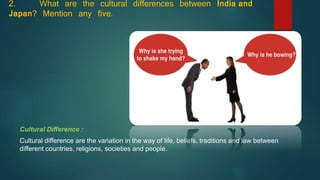
Cultural Difference :
Cultural difference are the variation in the way of life, beliefs, traditions and law between
different countries, religions, societies and people.
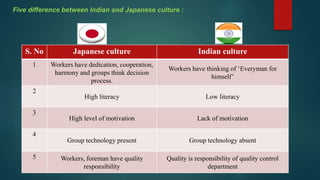
S. No Japanese culture Indian culture
1 Workers have dedication, cooperation,
harmony and groups think decision
process.
Workers have thinking of ‘Everyman for
himself’
2
High literacy Low literacy
3
High level of motivation Lack of motivation
4
Group technology present Group technology absent
5 Workers, foreman have quality
responsibility
Quality is responsibility of quality control
department
Five difference between Indian and Japanese culture :
3. What are the cultural barriers for falling JIT in a country
like India? Mention any five.
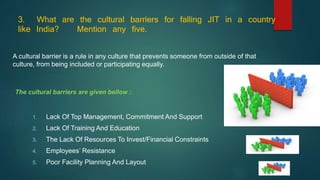
The cultural barriers are given bellow :
1. Lack Of Top Management, Commitment And Support
2. Lack Of Training And Education
3. The Lack Of Resources To Invest/Financial Constraints
4. Employees’ Resistance
5. Poor Facility Planning And Layout
A cultural barrier is a rule in any culture that prevents someone from outside of that
culture, from being included or participating equally.
4. How JIT/TQM can be implemented in country like India?
Give five facts and logic.
Answer :
Five fact to how JIT/TQM can be implemented in a country like India :
1. Increasing the organization’s ability to complete with other and remain competitive over
the long run. The competiveness of the use of JIT manufacturing process as they can
develop a more optimal process for their firms.
2. Increasing efficiency within the production process. Efficiency is obtained through the
increase of productivity and decrease of cost.
3. Reducing waste materials, time and effort. It can help to reduce the costs.
4. Reducing waste of motion (energy).
5. Reducing waste of transportation.
5. Is it possible JIT in Bangladesh? Constructs 10
reasoning based on your logic.
Answer :
Yes it is! As Bangladesh is a developing country, Bangladesh trying to develop it’s economy. As JIT
technique helps to develop economy Bangladesh definitely will go for it.
Ten reason as my logic :
1. Change the culture.
2. Change the management system.
3. Follow to Japanese system.
4. We are very productive.
5. We can work hard if we get pressure.
6. Bangladeshi are good in cooperate.
7. Awareness to every workers.
8. Positively taken the pressure.
9. Developing cooperation skill.
10. Come to work place at specific time.
just in time

just in time

  • 1.
    Understanding “Just IN Time& Cultural Difference” &
  • 2.
    NAME ID MD. SHAHIDULISLAM RAFI 12 MD. SHARIFUL ISLAM 31 MD. MAHFUZ BILLAH 25 MD. ANAMUL HAQUE 39 Group member info
  • 3.
    We will solvethese Questions 1. What is JIT? briefly mention its history & five main features? 2. What are the cultural differences between India and Japan? Mention any five. 3. What are the cultural barriers for falling JIT in a country like India? Mention any five. 4. How JIT/TQM can be implemented in country like India? Give five facts and logic. 5. Is it possible JIT in Bangladesh? Constructs 10 reasoning based on your logic.
  • 4.
    1. What isJIT? briefly mention its history & five main features? Answer : Just-in-time (JIT) is an inventory strategy companies employ to increase efficiency and decrease waste by receiving goods only as they are needed in the production process, thereby reducing inventory costs. History : Henry Ford who applied Just in Time principles to manage inventory in the Ford Automobile Company during the early part of the 20th Century, the origins of the JIT as a management strategy traces to Taiichi Onho of the Toyota Manufacturing Company. Five main feature : 1. Continuous improvement in quality, quantity and cost. 2. Elimination of waste. 3. Reduction in inventory level. 4. Set up time reduction increase flexibility. 5. Cost saving.
  • 5.
    2. What arethe cultural differences between India and Japan? Mention any five. Cultural Difference : Cultural difference are the variation in the way of life, beliefs, traditions and law between different countries, religions, societies and people.
  • 6.
    S. No Japaneseculture Indian culture 1 Workers have dedication, cooperation, harmony and groups think decision process. Workers have thinking of ‘Everyman for himself’ 2 High literacy Low literacy 3 High level of motivation Lack of motivation 4 Group technology present Group technology absent 5 Workers, foreman have quality responsibility Quality is responsibility of quality control department Five difference between Indian and Japanese culture :
  • 7.
    3. What arethe cultural barriers for falling JIT in a country like India? Mention any five. The cultural barriers are given bellow : 1. Lack Of Top Management, Commitment And Support 2. Lack Of Training And Education 3. The Lack Of Resources To Invest/Financial Constraints 4. Employees’ Resistance 5. Poor Facility Planning And Layout A cultural barrier is a rule in any culture that prevents someone from outside of that culture, from being included or participating equally.
  • 8.
    4. How JIT/TQMcan be implemented in country like India? Give five facts and logic. Answer : Five fact to how JIT/TQM can be implemented in a country like India : 1. Increasing the organization’s ability to complete with other and remain competitive over the long run. The competiveness of the use of JIT manufacturing process as they can develop a more optimal process for their firms. 2. Increasing efficiency within the production process. Efficiency is obtained through the increase of productivity and decrease of cost. 3. Reducing waste materials, time and effort. It can help to reduce the costs. 4. Reducing waste of motion (energy). 5. Reducing waste of transportation.
  • 9.
    5. Is itpossible JIT in Bangladesh? Constructs 10 reasoning based on your logic. Answer : Yes it is! As Bangladesh is a developing country, Bangladesh trying to develop it’s economy. As JIT technique helps to develop economy Bangladesh definitely will go for it. Ten reason as my logic : 1. Change the culture. 2. Change the management system. 3. Follow to Japanese system. 4. We are very productive. 5. We can work hard if we get pressure. 6. Bangladeshi are good in cooperate. 7. Awareness to every workers. 8. Positively taken the pressure. 9. Developing cooperation skill. 10. Come to work place at specific time.