Just Enough
(Automated) Testing
Kate Green
@4kategreen
kategreen.codes
What Will I Cover?
All testing budgets are smaller than we want. Let’s use those resources wisely.
We will talk about:
Methods of analyzing your system
Prioritizing testing of different issues
Applying the correct test type for the problem
Novel testing approaches
@4kategreen
kategreen.codes
•
•
•
•
Company Risk Tolerance Profile
Higher Tolerance Lower Tolerance
Industry
Stage
Goals can give insights into particular problems
1. Increase quality to retain customers
2.
3.
4.
This gives you an idea of what
to expect from your organization,
it may not reflect reality!
@4kategreen
kategreen.codes
Brittle Code
Code that Changes Often Has Privacy or Security Concerns
High Traffic Areas
Where to Focus Your Efforts
Places with lots of bugs
Code with lots of dependencies
Code with hard-coded values
Places your team experiments
Formulae that change regularly
Login
Sign up
Password Changes
Search
Sorting and filtering
Checkout
API endpoints that handle user data
Forms or other user input fields
Permissions and role-based access control
@4kategreen
kategreen.codes
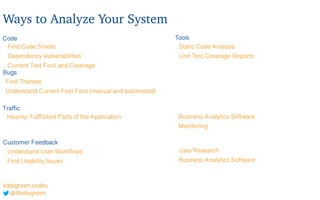
Ways to Analyze Your System
Bugs
Code
Traffic
Customer Feedback
Tools
Find Code Smells
Dependency Vulnerabilities
Current Test Focii and Coverage
Static Code Analysis
Unit Test Coverage Reports
Find Themes
Understand Current Fest Focii (manual and automated)
Business Analytics Software
Monitoring
Heavily-Trafficked Parts of the Application
Understand User Workflows
Find Usability Issues
User Research
Business Analytics Software
@4kategreen
kategreen.codes
1
Find the Risky Parts
Brittle Code Code that Changes Often
Has Privacy or Security Concerns High Traffic Areas
Identify parts of your system that fall into each category
@4kategreen
kategreen.codes
Prioritize Your Risks
The next step is to prioritize the risks you identified on the last page. There are two ways to evaluate the
risk. First, evaluate the severity. Then, evaluate simplicity of fixing the issue. Evaluate on a scale of 1-10.
Risk SimplicitySeverity
1.
2.
3.
4.
Average
@4kategreen
kategreen.codes
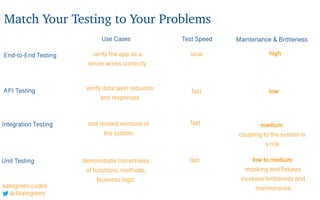
Match Your Testing to Your Problems
End-to-End Testing
API Testing
Integration Testing
Unit Testing
Test Speed Maintenance & BrittlenessUse Cases
verify the app as a
whole works correctly
slow
fast
fast
fast
high
low
medium:
coupling to the system is
a risk
low to medium:
mocking and fixtures
increase brittleness and
maintenance
test related sections of
the system
demonstrate correctness
of functions, methods,
business logic
verify data layer requests
and responses
@4kategreen
kategreen.codes
Creative Test Approaches
To minimize dependencies on fixtures, try Property-Based Testing. Property-based testing applies many
random inputs based on expected types.
To get a better look at the effectiveness of unit tests, look at Mutation Testing. It applies source code
variants to your unit tests and documents which cases were missed.
To make API Testing more comprehensive, try Consumer-Driven Contract Testing. Testing with contracts
enables to test both the request and response parts of an API call.
If your testing requires creativity, then you need to evaluate which parts of your system should be
automated and which should be manual.
@4kategreen
If your needs are around observability or tracking performance, you should look at Monitoring.
kategreen.codes
Apply Test Types to Your Problem Areas
Problem Test Type Why?
1.
2.
3.
4.
@4kategreen
kategreen.codes

Just Enough (Automated) Testing

  • 1.
    Just Enough (Automated) Testing KateGreen @4kategreen kategreen.codes
  • 2.
    What Will ICover? All testing budgets are smaller than we want. Let’s use those resources wisely. We will talk about: Methods of analyzing your system Prioritizing testing of different issues Applying the correct test type for the problem Novel testing approaches @4kategreen kategreen.codes • • • •
  • 3.
    Company Risk ToleranceProfile Higher Tolerance Lower Tolerance Industry Stage Goals can give insights into particular problems 1. Increase quality to retain customers 2. 3. 4. This gives you an idea of what to expect from your organization, it may not reflect reality! @4kategreen kategreen.codes
  • 4.
    Brittle Code Code thatChanges Often Has Privacy or Security Concerns High Traffic Areas Where to Focus Your Efforts Places with lots of bugs Code with lots of dependencies Code with hard-coded values Places your team experiments Formulae that change regularly Login Sign up Password Changes Search Sorting and filtering Checkout API endpoints that handle user data Forms or other user input fields Permissions and role-based access control @4kategreen kategreen.codes
  • 5.
    Ways to AnalyzeYour System Bugs Code Traffic Customer Feedback Tools Find Code Smells Dependency Vulnerabilities Current Test Focii and Coverage Static Code Analysis Unit Test Coverage Reports Find Themes Understand Current Fest Focii (manual and automated) Business Analytics Software Monitoring Heavily-Trafficked Parts of the Application Understand User Workflows Find Usability Issues User Research Business Analytics Software @4kategreen kategreen.codes 1
  • 6.
    Find the RiskyParts Brittle Code Code that Changes Often Has Privacy or Security Concerns High Traffic Areas Identify parts of your system that fall into each category @4kategreen kategreen.codes
  • 7.
    Prioritize Your Risks Thenext step is to prioritize the risks you identified on the last page. There are two ways to evaluate the risk. First, evaluate the severity. Then, evaluate simplicity of fixing the issue. Evaluate on a scale of 1-10. Risk SimplicitySeverity 1. 2. 3. 4. Average @4kategreen kategreen.codes
  • 8.
    Match Your Testingto Your Problems End-to-End Testing API Testing Integration Testing Unit Testing Test Speed Maintenance & BrittlenessUse Cases verify the app as a whole works correctly slow fast fast fast high low medium: coupling to the system is a risk low to medium: mocking and fixtures increase brittleness and maintenance test related sections of the system demonstrate correctness of functions, methods, business logic verify data layer requests and responses @4kategreen kategreen.codes
  • 9.
    Creative Test Approaches Tominimize dependencies on fixtures, try Property-Based Testing. Property-based testing applies many random inputs based on expected types. To get a better look at the effectiveness of unit tests, look at Mutation Testing. It applies source code variants to your unit tests and documents which cases were missed. To make API Testing more comprehensive, try Consumer-Driven Contract Testing. Testing with contracts enables to test both the request and response parts of an API call. If your testing requires creativity, then you need to evaluate which parts of your system should be automated and which should be manual. @4kategreen If your needs are around observability or tracking performance, you should look at Monitoring. kategreen.codes
  • 10.
    Apply Test Typesto Your Problem Areas Problem Test Type Why? 1. 2. 3. 4. @4kategreen kategreen.codes