







Journalism in Pakistan - Training Needs Assessment
This Training Need Assessment (TNA) has been produced by Mishal Pakistan
(www.mishal.com.pk) with assistance of International Media Support
(www.mediasupport.org) under a media development program for Pakistan supported
by DANIDA. The contents of this resource reflect the views and findings of the
producers/authors alone not necessarily of IMS or DANIDA."
News Channels
Geo News
Dawn News
ARY News
KTN News (Sindhi)
AVT Khyber (Pushto)
Vsh News (Balochi)
Newspapers
Daily Jang
The News
Dawn
Daily Qudrat (Quetta)
Daily Kawish (Sindhi)
Daily Wahdat (Pushto)
Radio
Samaa FM 107.4
Research Team:
Amir Jahangir, Research Lead
Amna Sabahat, Research Program Manager
Prof. Dr. Zafar Iqbal, Research Advisor
Training Needs Assessment Report
Based on Major News Bulletins of Selected News Media Channels and Newspapers
during October 2015
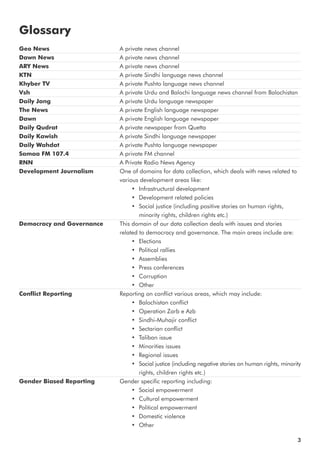
Glossary
3
Geo News A private news channel
Dawn News A private news channel
ARY News A private news channel
KTN A private Sindhi language news channel
Khyber TV A private Pushto language news channel
Vsh A private Urdu and Balochi language news channel from Balochistan
Daily Jang A private Urdu language newspaper
The News A private English language newspaper
Dawn A private English language newspaper
Daily Qudrat A private newspaper from Quetta
Daily Kawish A private Sindhi language newspaper
Daily Wahdat A private Pushto language newspaper
Samaa FM 107.4 A private FM channel
RNN A Private Radio News Agency
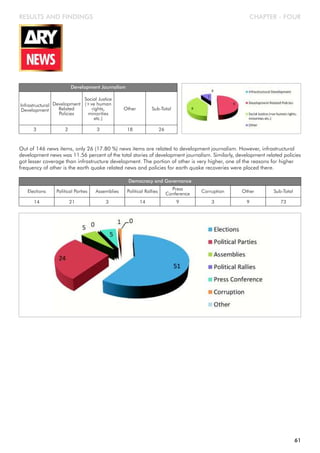
Development Journalism One of domains for data collection, which deals with news related to
various development areas like:
• Infrastructural development
• Development related policies
• Social justice (including positive stories on human rights,
minority rights, children rights etc.)
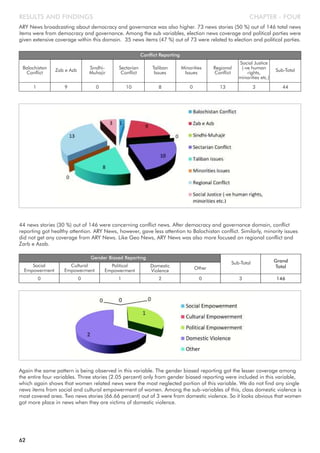
Democracy and Governance This domain of our data collection deals with issues and stories
related to democracy and governance. The main areas include are:
• Elections
• Political rallies
• Assemblies
• Press conferences
• Corruption
• Other
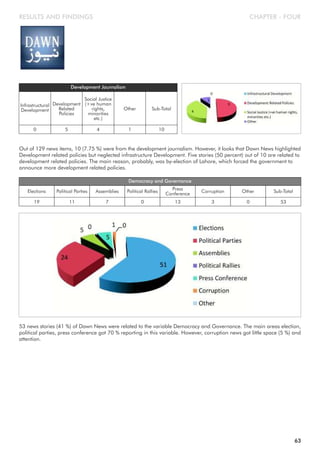
Conflict Reporting Reporting on conflict various areas, which may include:
• Balochistan conflict
• Operation Zarb e Azb
• Sindhi-Muhajir conflict
• Sectarian conflict
• Taliban issue
• Minorities issues
• Regional issues
• Social justice (including negative stories on human rights, minority
rights, children rights etc.)
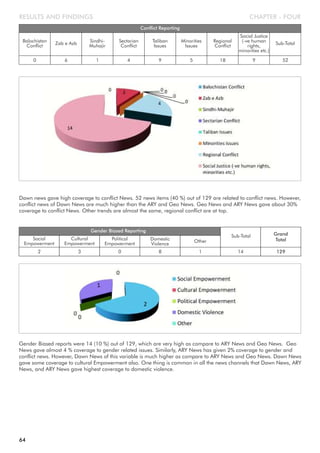
Gender Biased Reporting Gender specific reporting including:
• Social empowerment
• Cultural empowerment
• Political empowerment
• Domestic violence
• Other
Preface
Executive Summary
Chapter - One Introduction
Objectives of the Study
Chapter - Two Literature Review
Theoretical Framework
Chapter - Three The Methodology
Chapter - Four Results and Findings
• Print Media
• Analysis of (Print) Media Related Dynamics and Major Themes
• Reporting Dynamics
• Editing Dynamics
• Management Issues
• Photojournalism
• Electronic Media
• Analysis of Electronic Media Related Dynamics and Major Themes
• Reporting Dynamics
• Editing Dynamics
• Management Issues
• Production Dynamics
• Case Study - I
• Case Study - II
Chapter - Five Conclusions
• Analyses of Electronic Media
• Analyses of Print Media
Chapter - Six Recommendations
References
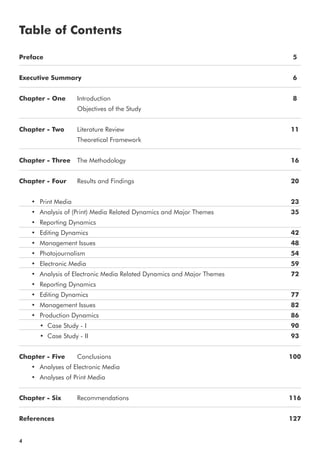
Table of Contents
4
5
6
8
11
16
20
23
35
42
48
54
59
72
77
82
86
90
93
100
116
127
Preface
5
The journalism training need assessment (TNA) looks specifically in to the current practices
of journalists in Pakistan in order to identify skills that need to be focused on while designing
trainings. The sample size for this study was shortlisted after various consultative meetings
and focus group discussions (FGDs) with about 82 media stakeholders, along with 60 Key
Information Influencers. The sample also included a cross section of 14 media outlets from
national and vernacular media consisting of both the print and electronic media representing
English, Urdu, Sindhi, Pushto, and other regional languages.
The data set for evaluation was collected by conducting surveys in each province and gathering
the pertinent media content generated at regional and national level. The compiled report is
based on a qualitative and quantitative study of the research dimensions which can identify
an astute picture of the current practices of the various media outlets across Pakistan. The
report identifies gaps amongst medium, skills, and themes. The Medium was further subdivided
in to Radio, TV, and Print. Similarly, skills were further quantified in terms of reporting skills,
editing, production, management, and photojournalism. The third pillar of the research ,
themes, were narrowed down to development journalism, democracy & governance, conflict,
rights and gender reporting. The TNA report produced by Mishal Pakistan also identifies
journalistic practices that can be improved through trainings, and proposes recommendations
to be taken in to account for designing and conducting journalism trainings in each province.
The key objective of this research was to study and measure the existing journalism practices
as well as the limitations faced by journalists in Pakistan at national and regional level. In
addition to this, the TNA report highlights the areas, that regional and national journalists
need to be trained in to improve the professional skills of regional language journalists in the
four provinces of Pakistan.
Mishal Pakistan is grateful to all the stakeholders who have contributed in developing this
knowledge resource, especially the representatives of the regulatory bodies at Pakistan Electronic
Media Regulatory Authority (PEMRA), Press Council of Pakistan (PCP), Pakistan Federal Union
of Journalists (PFUJ), and Media Sciences/Journalism Departments at various universities across
Pakistan. Mishal Pakistan would also like to thank Dr. Zafar Iqbal, Chairman Department of
Mass Communication at the International Islamic University Islamabad (IUII). The research
team is also obliged to the team of International Media Support (IMS) for their technical and
financial support to undertake this study.
Mishal Pakistan believes that this is a step towards identifying the basic elements required to
raise the bar of editorial standards for a more informed and interconnected society in Pakistan
and beyond.
Mishal Pakistan Team
Mass media, in contemporary times, are central to every social system. Their development paves the way for the development
of every organ of the society. The reverse of it is also somewhat true as we live in a time when realities are the media
construction. Thus, it becomes all the way important to improve media contents to construct a better world around us.
This study aims at evaluating as how mass media in Pakistan are performing and what major problems areas are, and
what kind of training do we need to impart to ameliorate the rather worsening situation.
This study has attempted to explore mass media contents in four main domains including Development Journalism,
Democracy and Governance, Conflict Reporting and Gender Biased Reporting patterns. Each single domain has multiple
sub-dimensions making it all encompassing to study the problem in depth.
Our chosen four main domains are evaluated further in four media related dynamics, which include Reporting Dynamics,
Editing Dynamics, Management Dynamics, Photojournalism for print media evaluation only, and Production Dynamics
for electronic media only. Four media dynamics were further deconstructed into a multi-prong analysis to make the need
assessment more comprehensive.
The data have been collected using various measurement levels like nominal, ordinal and ratio, wherein we have tried
to make the data collection mechanism scientific. The variables measured at nominal level are either dichotomic or at
places trichotomic. Some of the variables have been measured using Thurston scale as they were ordinal (having intrinsic
rank order) in them.
Another important aspect of data collection has been the use of metaphors and adjectives. This is based on the assumption
that our media are less careful in using strong adjectives in headlines, and metaphors for personalities, places and events
without knowing the meanings in them and the consequences that may result from their use.
The mass media selected for the study are categorized into three main sections - print media, electronic media and FM
radio. The print media include national (Urdu and English) and regional newspapers - Daily Jang (Urdu), The News
(English), Dawn (English), Daily Qudrat (Balochi), Daily Kawsih (Sindhi), Daily Wahdat (Pushto). The electronic media
segment includes Geo News, ARY News, Dawn News, KTN (Sindhi), Khyber TV (Pushto), and Vsh (Balochi). Only one FM
radio has been included in the study to understand the tenor of FM radio new pattern. Efforts have been made to include
newspapers and news channels representing the whole country and all major languages. The data collected from these
news media (print and electronic) were of one month only, i.e. October 2015.
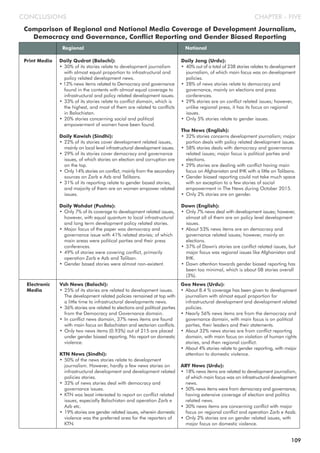
The study has concluded that most of the news channels of national stature mainly cover the development related news
of policy levels, and are least inclined in giving time and space to infrastructural development news stories. Nonetheless,
the situation is almost reverse for the regional news channels, wherein they give relatively more time and space to news
stories of infrastructural developments. Furthermore, there is a difference of reporting patterns of both levels of news
channels. National level news channels place the stories of development when there is a prominent personality on the
scene like prime minister or chief of army staff etc. Hence, reporting of the event or details of the development story
surrounds more about the personality and less about the project(s). On the other hand, regional level news channels with
their narrow focus have been found to be giving enough time and space to infrastructural development stories. Editing,
production and management dynamics are evaluated of relatively low standards among the regional news channels, and
their professionals need to be given high level trainings enabling them to dispense their responsibilities meeting needs
of the profession. Though national news channels are performing relatively better in this regard; nevertheless, reporting
and editing issues need serious attention.
Electronic media channels have been found to be extremely political in their news coverage. Over 50% of the time, space
and efforts are focused on politics and political affairs, political leaders leaving many other important segments of news
apart. During the month under analysis, local body elections were in progress and by-elections also happened to take
place; hence, it was quite natural for the media to shift to political discussions and rallies. But, as these are quite easy
assignments for the media professionals and requiring less logistics and investigation, thus huge media contents were
politics related. Regional news channels were also suffering from politics fever during the month of October.
Conflict related news stories were more often related to either Operation Zarb e Azb or Taliban, that too relying mainly
on ISPR statements and tweets or international news agencies.
We have found news media channels' serious indifference towards gender related news stories. If there were any news
story in the bulletins, that was often a story of domestic violence. Their production quality was also poor and investigation
was seldom done by the reporters, while ethics largely compromised.
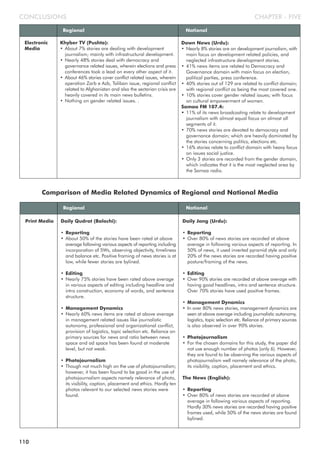
Newspapers of national stature like Daily Jang, Dawn, The News etc. mainly covered stories of infrastructural development
on their city pages only despite the fact that some of them were of national significance. However, most of them put them
SUMMARY
6
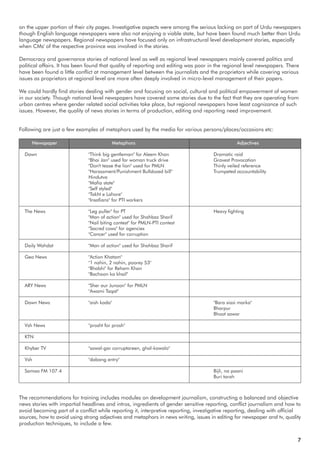
Newspaper Metaphors Adjectives
Dawn "Think big gentleman" for Aleem Khan Dramatic raid
"Bhai Jan" used for woman truck drive Gravest Provocation
"Don't tease the lion" used for PMLN Thinly veiled reference
"Harassment/Punishment Bulldozed bill" Trumpeted accountability
Hindutva
"Mafia state"
"Self styled"
"Takht e Lahore"
"Insafians" for PTI workers
The News "Leg puller" for PT Heavy fighting
"Man of action" used for Shahbaz Sharif
"Nail biting contest" for PMLN-PTI contest
"Sacred cows" for agencies
"Cancer" used for corruption
Daily Wahdat "Man of action" used for Shahbaz Sharif
Geo News "Action Khatam"
"1 nahin, 2 nahin, poorey 53"
"Bhabhi" for Reham Khan
"Bachoon ka khail"
ARY News "Sher aur Junoon" for PMLN
"Awami Taqat"
Dawn News "aish kada" "Bara siasi marka"
Bharpur
Bhoot sawar
Vsh News "prosht for prosh"
KTN
Khyber TV "sawal-gar corruptareen, ghal-kawalo"
Vsh "dabang entry"
Samaa FM 107.4 Bijli, na paani
Buri tarah
7
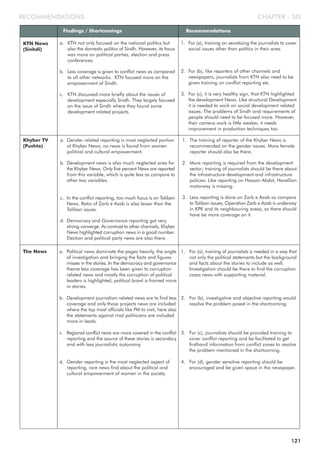
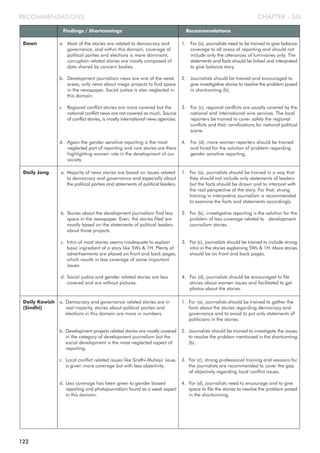
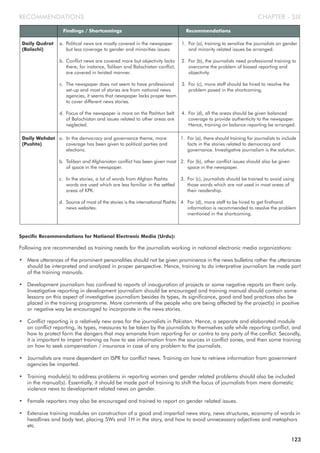
The recommendations for training includes modules on development journalism, constructing a balanced and objective
news stories with impartial headlines and intros, ingredients of gender sensitive reporting, conflict journalism and how to
avoid becoming part of a conflict while reporting it, interpretive reporting, investigative reporting, dealing with official
sources, how to avoid using strong adjectives and metaphors in news writing, issues in editing for newspaper and tv, quality
production techniques, to include a few.
on the upper portion of their city pages. Investigative aspects were among the serious lacking on part of Urdu newspapers
though English language newspapers were also not enjoying a viable state, but have been found much better than Urdu
language newspapers. Regional newspapers have focused only on infrastructural level development stories, especially
when CMs' of the respective province was involved in the stories.
Democracy and governance stories of national level as well as regional level newspapers mainly covered politics and
political affairs. It has been found that quality of reporting and editing was poor in the regional level newspapers. There
have been found a little conflict at management level between the journalists and the proprietors while covering various
issues as proprietors at regional level are more often deeply involved in micro-level management of their papers.
We could hardly find stories dealing with gender and focusing on social, cultural and political empowerment of women
in our society. Though national level newspapers have covered some stories due to the fact that they are operating from
urban centres where gender related social activities take place, but regional newspapers have least cognizance of such
issues. However, the quality of news stories in terms of production, editing and reporting need improvement.
Following are just a few examples of metaphors used by the media for various persons/places/occasions etc:
CHAPTER - ONE
INTRODUCTION
Journalists play a vital role in shaping public opinion.
Journalists and journalism in general are considered and
supposed to serve multiple roles in a social system. They
have a direct influence on people's mind for shaping their
opinion on issues ranging from government's policies to
common problems. As Guthrie (1979) said, 'when citizens
read a news magazine, they form a view, an opinion' (p.264).
This power makes them one of the most influential elements
of the society. Nonetheless, this unrestrained authority with
the journalists, on the other hand, asks for a greater sense
of responsibility too at the same time.
People expect news stories to be factual and something to
be trusted. So while journalists enjoy this unlimited power
of injecting their views and opinions to the public, it becomes
the public's right to question journalists - who are the source
of providing them information and helping them construct
opinions on vital issues of their system. Their education level,
salary, job satisfaction, political or religious affiliations etc.,
and these all characteristics affect the type of story they
construct and present to the public. Thus, these attributes
should essentially be considered while studying journalists.
Mass media are pervasive and have become increasingly
important in contemporary societies. Among them, news
media have become the main source of information for the
majority of people. And in news media, journalists play a
tremendous role in shaping the public's agenda (McCombs,
1972). Despite expanding media houses and growing
interest in journalism studies and journalists' role as the
main source of information in modern societies, quite a few
empirical studies on journalists and their impacts on
journalism have been conducted, particularly in Pakistan.
Today with oodles of newspapers and TV stations owned by
political and well-heeled people while contents of the media
channels are often questioned to inspect their authenticity,
there must be a mechanism of seeking information about
the journalists who develop these contents. Certainly, they
must be educated and well trained in their beats to accomplish
this vital responsibility.
Shoemaker & Reese (1996) identified several influences on
journalists which have great bearings on the media contents.
They categorized these influences into micro-level; personal,
demographic and attitudinal variables and macro-level;
societal values and ideologies. The findings of these
approaches inferred that they have a direct impact on
journalists' individual values, media routines, organizational
values, extra-media influences, and ideology.
One of the most important aspects which is generally
overlooked in Pakistan is the journalists' level of job
satisfaction. This dimension includes their likeness towards
their job, their personal assessment about the working
conditions, degree of autonomy, relationship to their
supervisors and satisfaction with what they are (monetarily)
compensated. In other words, tangible benefits such as
salary, benefits and other perks combine with professional
rewards like job autonomy and respect form job satisfaction.
Job dissatisfaction in term of various factors mentioned
above and others such as poor working conditions, worst
CHAPTER - ONE
INTRODUCTION
9
financial conditions and the dangers and threats they face
during the dispensation of their authorized errands, are
leading to a culture in which complaints and suspicions
about the integrity of newsmen may arise easily.
Defining a Journalist
It is extremely important to understand who is a journalist
and what does journalism mean before moving ahead.
Some of the well-known definitions are discussed in the
following lines.
A journalist collects and disseminates information about
current events, people, trends and issues. His work is
acknowledged as journalism. Reporters, editors,
photographers working in newspapers, television, radio,
magazines or news agencies all fall into this category. They
are expected to report in the most objective and unbiased
way to serve the public good. A columnist is also journalist
who writes pieces that appear regularly in newspapers or
magazines1.
Another definition says, "A person who writes news stories
or articles for a newspaper or magazine or broadcasts them
on radio or television"2 . A curious, sharp and vigilant
observer with an exact memory makes a competent journalist.
S/he must also have a grip on general knowledge and
literature, and must develop an accurate, impartial and
effective expression. S/he must be an educated person and
his commitment should be to his work alone.
According to the instructional curriculum, devised for district
correspondents by the Pakistan Press International and the
Pakistan Press Foundation, a journalist must meet the criteria
of minimum education, maximum general knowledge,
language proficiency, news sense, professional honesty,
neutrality and diligence3.
A pure presentation of the facts is more the essence of
journalism; it is the direct transfer of events into written or
spoken words, without involving your emotions and then
leaving it to the audience to decide that themselves4.
Basically, journalism doesn't have a concrete definition (aside
from what the Dictionary says). Sometimes, it requires people
to put aside their own personal beliefs for the sake of fair
reporting for the public. It requires cutting certain parts of
a story out keeping in view the interests of organization's
policy.
It is a balance that every individual has to find. Finding this
balance is a sensitive and difficult art that is why journalists
have a crucial importance in a society. They require ability
to go out in public and spend extended periods of time
talking to complete strangers as well as the ability to sit
alone for hours and write and rewrite something to make
it appealing and interesting to readers.
Why Knowing Journalists is Important?
The news media exert significant influence on our perceptions
of what are the most salient issues of the day. Bernard
Cohen says about the news media that it could not be
successful in telling people what to think, but without any
doubt they are successful in inspiring them what to think
about (Cohen, 1963). Media can set the agenda for public
thought and discussion.
Walter Lippmann and American philosopher John Dewey
debated over the role of journalism in a democracy (1920)5.
They opine that a role of journalists is more than just 'to
pass on information'. They must be aware of their crucial
importance in shaping public opinion, so the repercussions
must be calculated wisely before writing anything.
This idea of journalism identified as 'community journalism'
gave an insight as to how journalists perceive their roles in
society and then how common public build trust and count
on them.
In America, a general expectation from journalists is that
they should serve as watchdogs on government, businesses
and other actors, enabling people to make informed decisions
on the issues of the time6.
Despite professionalization and objective methods, journalism
remains an impossibly complex practice because, among
other things, it deals with the human perception and
evaluation of events and the relaying of those events in
language (spoken and written) and pictures. These things
make it imperative that journalists who have such a vital
role in society must be known to people who are being
influenced by their writings.
OBJECTIVES OF THE STUDY
This study aims at analyzing the media contents produced
by the journalists in dispensation of their professional duties,
and then identifying the problems areas that might need
training of the journalists. Following objectives have been
devised for the study:
• To find out as how the issues related to democracy and
governance are being framed and covered by the media
of various genre in Pakistan;
• To find out as how the stories of physical and policy level
development are treated by the selected media;
• To find out as how the conflict related issues are reported
including ethnic conflict, regional conflicts and other
forms of conflict are reported;
CHAPTER - ONEINTRODUCTION
10
1. http://en.wikipedia.org/wiki/Journalists, retrieved on November 16, 2009
2. http://dictionary.cambridge.org/define.asp?key=42952&dict=CALD&topic=the-press-and-news-reporting, retrieved on December 14, 2009.
3. http://www.pakistanpressfoundation.org/useraboutus.asp, retrieved on October 12,2009
4. http://freakangels.com/whitechapel/comments.php?DiscussionID=3263, retrieved on August, 2009
5. http://journalistjournal-emike.blogspot.com/2008/01/role-of-journalism-in-democracy.html Retrieved on September 12 (2009).
6. http://en.wikipedia.org/wiki/Journalism#Role_of_journalism_in_a_democracy Retrieved on September 12 (2009).
• To find out as how reporting on gender related issues is
done by the journalists and identifying the problem areas
in contemporary journalism practices, which may need
training of the potential reporters;
• To find out as what are the most problematic areas of
reporting on the issues mentioned above including
identifying the issues related to reporting, management,
production, photojournalism and editing;
• To suggest ways to improving quality of reporting on the
selected themes and sub-themes in the selected professional
areas in the selected media of Pakistan.
CHAPTER - ONEINTRODUCTION
11
CHAPTER - TWO
LITERATURE REVIEW
Journalism and journalists have always been the interest of
sociologists because the writing of the journalists tends to
affect the lives of the people in society. Journalists play a
special role in society by providing us the information we
need, guiding people in making decisions about their lives
and about society at large. This information and guidance
influence is at every level i.e. personal, organizational and
societal level (Dickinson, 2008). Information about society
can be obtained through many ways 'journalism' and
'sociology' are among the most important while painting,
sculpture, film, photography, theatre, and literary fiction are
some of the others (Becker, 2007). Becker further explained
that journalism has got much importance because of its
objectivity and truthfulness.
Dickinson argued that there had been a shift on scholarly
research for journalists as 'sociology of the news worker
have become less common' while description on other
broader areas are highly emphasized. 'Our sociological
understanding of how and why journalists act is limited; the
theoretical move to social structures, processes and institutions
has left the sociology of journalistic practice far behind'
(Dickinson, 2008, p.1385).
Recent researches on journalists' job satisfaction brought
some unexpected facts as Reinard (2007) studied institutional
and personal issues that influence overall job satisfaction
of newspaper employees. It was observed that overall job
satisfaction has strong relationship with organizational
support and moderate relationship with social support. The
population of the study constituted editors and managing
editors of the daily newspapers. The data also revealed that
about 25% of the journalists intend to leave the profession
and the major reason found behind this were industry issues
and work environment. Journalists were contacted through
emails for getting their responses, this type of methodology
may be adopted in a few countries where journalists use
emails more often otherwise there is always a danger that
the questionnaire may go unnoticed by the receiver.
How journalists' conception of their professional role possibly
affects the way they write news originated in the twentieth
century when Weaver and Wilhoit first studied it in 1986,
however, after then the idea has been a topic of different
researches in different countries for the scholars.
Journalistic role conception was studied by (Vos, 2005)
exploring the linkage between journalistic role conception
and construction of news. The basic definition of journalistic
role conception refers to the way journalists perform and
act in society. Although this definition is very brief in nature
but still it contains quite a wide range that is why other
recent studies have used this term.
Journalistic role conception was studied by different scholars
in different contexts. For example Weaver and Wilhoit (1986,
1996) examined it in the context of journalistic professionalism
while Johnstone, Slawski, and Bowman (1976) conducted
a study on this subject in the context of journalistic
responsibility. However journalistic responsibility is also
referred to an indicator of professionalism, while Weaver
and Wilhoit examined "roles, values, ethics" as indicators of
professionalism (Weaver &Wilhoit, 1986, p. 104).
CHAPTER - TWO
LITERATURE REVIEW
13
So professionalism in journalism has been a source of
debate from a long time as "whether journalism rose to the
level of a profession" (Vos, 2005).
How journalists perceive their functions has been studied
by different researchers and the comparison of the different
countries show that these roles do vary in different countries
with diverse ethnic backgrounds. Weaver et al. (1996, 2003)
studied American journalists and described that most
important roles found were "Interpreter", "Disseminator" and
"Investigator". The majority believed that they should
"investigate government claims" and "get information to the
public quickly." Second category had the opinion that they
should "provide analysis of complex problems." The role of
journalists as "Adversary" to the government was found
among the lowest level while their role as a "Populist Mobilizer"
was the least among these roles. Similarity of the results
found in a study on Canadian journalists by Robinson and
Saint-Jean (1996) shows that the role of interpreter is
considered more important.
Itai and Yehiel also examined the functional perceptions on
the individual journalist's level, on levels of the media
organizations and the media institution. The functional
perceptions of journalists were studied as they appear in
codes of ethics perceived as the "professional compass"
(Allison, 1986). The results of the study showed that overall,
the journalistic functional approach, as reflected in the codes
of ethics, 'are low both on the involvement and on the
adversary sequences,'
Although a relationship does exist between personal values
and professional roles of journalists, 'research on both topics
have remained distinct and the relationship between the
two has not been explored in a systematic way' (Plaisance,
Skewes, 2003). Patrick and Elizabeth have tried to explore
this relationship and that how journalists rank these values
against the roles they embrace, and whether factors like
age, their job period and designation affect the way they
rank these values and perform roles?
The population of the survey constituted the naïve reporters
to veteran executive and managing editors. It was observed
that a 'journalist's years in journalism years in the community
and number of news organizations seemed to be more
consistently correlated to his or her role conceptions.' The
results divulge that 'Honest' was ranked the most important
value by most journalists followed by 'Fair' and the others
came as 'Responsible' and 'Capable'.
Factors of subjectivity i.e. influence of individuals'
characteristics on the kind of work they produce is researched
and has been proved over time. Organizational influence
on news construction also has its base in research, as
Shoemaker and Reese (1996) said that an individual journalist
does not have an effect on news content as compared to
organizations and social systems. However the influence of
individual journalists is obvious in shaping of a news story
in what he or she thinks is important.
Research about the sociology of the journalists is relatively
new in Pakistan although many studies have been done in
worldwide regarding the job satisfaction of the journalists,
their demographic profiles, journalistic role conception,
journalists' societal role and the social status of journalists.
Malik (2000) in his report which covered the information
about professional lives and working conditions of 4,500
journalists around the country (Pakistan) described that only
seven per cent of the journalists are under the age of 25.
About 52 per cent are in the 25 to 35 years of category.
Thirty three per cent are between 35 and 45 years old. Six
percent are above 45 years but below 55 years and about
two per cent of the country's urban journalists are above 55
years old. The data revealed that very few journalists are
recorded who work under wage ward system; a large
majority denied the existence of wage board application in
their pay packages. Rural journalists are in very deplorable
conditions as not even paid by their employees, while urban
journalists too, are not found better off.
Robinson and Kohut (Robinson & Kohut, 1988) conducted
a survey research about the believability ratings of 39 news
organizations and news personalities. According to McGrath
(1985), 'three fourth of the public' keeps some reservation
about the credibility of the press, and media on the whole
is faced with the image problem. Later it was argued that
McGrath developed a very broad approach in defining
'credibility' when this term was narrowed down to the
believability of specific news organizations, the results showed
some obvious differences. As the general trend found in the
research study of (Robinson & Kohut, 1988) that most of
the people trust media and they get from it in the form of
news information. Another important fact drawn from the
survey was that 'believability' of people towards media
organizations and media personalities does not affect due
to the demographic attributes. Similarly grouping media
organizations does exist but this grouping has not been
made on the basis of 'dichotomy' of print and electronic
media. Around 2,014 adults were interviewed in this study
with 150 questions based on 4 points scale.
A very surprising fact found in the survey was that people
give more point of believability to hard news organizations
as compared to soft news organizations. While investigating
the believability level for press and political leaders, it was
also seen that press had clearly got more points that political
leaders.
THEORETICAL FRAMEWORK
The term 'media sociology' is increasingly applied to the
studies which look at why the contents of the media are the
way they are (Shoemaker, 1996). This is an increasingly
popular area of research with a wide variety of studies
finding interesting results and offering a number of
explanations of those results.
To comprehend the media's influences on audiences, tests
on five media sociological theoretical approaches were
conducted. Those approaches included the (1) mirror
approach which was based on the assumption that media
accurately presents the reality, other four approaches were
CHAPTER - TWOLITERATURE REVIEW
14
based on theoretical perspectives i.e. (2) routines of
newsgathering, (3) the journalist-centered approach, (4)
social/institutional influence, and (5) the hegemony approach,
these all approaches proposed different interpretations of
how media contents suffer objectivity.
Routines of news gathering approach
Among these approaches theoretical perspective which is
routines of newsgathering approach is more relevant to the
present study. This approach looks at how news organizations'
habits and routines affect the kind of stories that are written,
published or broadcast. Routines may be type of:
• Deadline: which make the journalists stop seeking
information in order to file the story within time.
• Available sources are more likely to be institutional and
this makes it difficult for individual and special interest
groups to get media access.
• Event orientation of most media stories, especially in
television where good visuals are easier with events than
with issues.
• Inverted pyramid style of writing news stories which conveys
the journalists' assessment of importance to the reader.
• Gate keeping which covers the selection, shaping and
timing of the stories.
Several researchers have studied newsgathering habits
including Gilton, Goldenberg, Tuchman and Gans. Most
of the studies of the routines of newsgathering supported
the notion that news is shaped by organizational habits.
Thus the present research study can be approached with
this theoretical perspective as working environment and
working habits of the media tend to affect the process of
news writing.
This early research forced scholars to think about journalists
as part of an environment inhabited by other people,
resources, agendas, pressures, and interests. It started with
a consideration of the finite and identifiable practices involved
in journalistic work and gradually expanded to examine the
larger settings in which journalists interacted with each other.
Another stage of sociologically motivated inquiries, from
the late 1960s onward, looked toward broad organizational
settings as a way to examine the patterns of interaction
among journalists (Ettema and Whitney, 1982). Although
as early as (Rosten, 1937) looked at the settings in which
journalists worked through a sociological lens in The
Washington Correspondents, here organizational theory,
and particularly the ethnography of work places, became
a favored perspective, particularly in the United States, for
considering journalistic practice and journalism.
Organizational Theory
The earliest studies in this vein used social control as a
means to explain journalistic interaction within an
organizational setting (Warner, 1971). The first extensive
study of journalism, utilizing in part organizational theory,
was in 'News from Nowhere' (Epstein, 1973). He suggested
that organizational and technical constraints managed the
making of news. Staking his claim on organizational theory,
Epstein argued that most of what we regard as news was
derived from the organizational tensions involved in producing
news. So-called news norms needed to be accomplished
through organizational routines: A time bias, for instance,
was resolved by dividing news pieces into types (such as
spot news or delayed news), while a bias toward the
unexpected depended on covering routine events (such as
press conferences). This theory also has an implication on
this research study as an overall work environment and
work pressures do influence work and make the perception
towards job environment and job satisfaction.
Job Characteristics Theory
Job characteristics theory (Hackman and Oldham 1975,
1980) is based on the relationship between characteristics
and employees' responses. Theme of theory states that
workers experience greater job satisfaction when the task
process has five main attributes: skill variety, task identity,
task significance, autonomy and job feedback. These all
factors are related to how individuals are predicted to prosper
in their work.
Among these five attributes autonomy and job feedback
variables are the part of this research study. These variables
are included and researched that how these factors affect
the journalists' performance in their professions.
CHAPTER - TWOLITERATURE REVIEW
15
CHAPTER - THREE
THE METHODOLOGY
The study is to investigate and explore as what problems
are there in the news coverage of leading national and
regional print and electronic media of Pakistan. This not
only includes Urdu and English language but also include
the Sindhi, Pashto and Balochi.
This study focuses on four main variables, wherein it aimed
at analyzing the standards of reporting, editing,
photojournalism and production qualitatively and
quantitatively the contents of electronic as well as print
media. These four variables include
1. Development Journalism
2. Democracy and Governance
3. Conflict Reporting
4. Gender Biased Reporting
Development journalism
Developmental journalism in the media, print and broadcast,
is part of the larger notion of using mass media s tools of
national development, so the construct of development
journalism may well be measured by looking at:
Infrastructural development
• Here, the news about the infrastructure being developed
by government would be considered for analysis. For
example work on dams, roads, building, bridges,
tunnel etc.
Development policies
• The announcement by the government about any
upcoming projects etc. will be considered t paced under
this category of news. Similarly, budget allocations,
announcements of new development plans etc. will also
become part of this domain.
Social development
• The stories of human rights or any positive development
on rights will be analyzed under this variable. Negative
news like human rights violation will not be discussed
under this category.
Democracy and Governance
Similarly, the construct of Democracy and Governance is
divided into six sub-categories, election, political parties,
assemblies, political rallies, press conferences and corruption.
Election
• Election is the most fundamental part of democracy; hence
measuring it is considered necessary to know the construct
of Democracy and Governance.
Political parties
• A political party is defined as an organized group of
people with at least roughly similar political aims and
opinions, that seeks to influence public policy by getting
its candidates elected to public office. In political parties
all the activities of politician regarding politics are included.
Similarly, the statements of political leader are also given
place in this category.
CHAPTER - THREE
THE METHODOLOGY
17
CHAPTER - THREETHE METHODOLOGY
Assemblies
• The proceeding of National assembly, Senate and all the
four provincial assemblies are included in this category
and the statement by any politician on the assembly floor
is placed here.
Political rallies
• Any mass gatherings by political leaders or political parties
are included in the category of political rallies. These
gathering may be in the favor or against any policy of
the government, but only of political nature. Any non
political gathering or rallies would is not include in this
variable.
Press conferences
• Most of the politicians are in contact with public through
the press conferences. So press conference is one of the
political tools to make an announcement or to answer
the journalists. Here, only the press conferences of politician
are given value to measure our construct of democracy
and governance.
Corruption
• Corruption means dishonest or fraudulent conduct by
those in power. The last thing which is included in this
construct is corruption, but here corruption means the
corruption of politician.
Conflict Reporting
The other important construct is conflict reporting. After the
start of war against terror, the conflict news reporting has
increased, especially in Pakistan when we find great
insurgency in FATA and Balochistan.
Our construct of conflict reporting is based on the following:
Balochistan Conflict
• The news regarding Balochistan insurgency or terrorist
activities in Balochistan is placed here. The quantitative
and qualitative analyses will be done.
Zarb e Azab
• Under this variable, focus will mainly be on the operation
going on in FATA. Especially the strikes by army there and
attacks on military or paramilitary forces will be included.
The army chief visits to FATA or any other related statement
of military personal regarding the operation Zarb e Azab
will also be the part of this variable.
Sindhi-Muhajir Conflict
• In this variable focus will be on MQM and Sindhi nationalist
parties and PPP, especially the demand of division of Sindh
on the bases of administrative power by MQM.
Sectarian conflict
• This variable will be focus on news stories of Sunny-Shia
conflict. The attacks on Shia, suicide attacks on Shia
gathering will also be the highlighted feature of this
segment. The controversial statement against the belief
of any sect will also be included.
Taliban issue
• Terrorist activity by Talibans in the entire country will be
fall here. Any terrorist activity in the country except FATA
will be recorded under this variable. The terrorist attacks
in Balochistan those who were accepted by Taliban
authorities will also fall in the ambit of this variable.
Minorities Issues
• The minority's issue, like the problems of Christian and
Hindus will be recorded here. Violence or conflict against
the minorities will be reported under this variable. The
protest of minorities against any policy or issue will also
be covered in this variable.
Regional conflict
• In regional conflict, the attention is given to the problems
between the two countries, like Pakistan - Afghanistan
problem regarding terrorism or borders issue. Similarly
the conflict between India and Pakistan will also be
highlighted in this variable. However the internal problems
of country are not discussed here. Only the matters
between two states will be given space in this variable.
Social Justice
• The violation of human rights or any negative news
regarding Human right will fall here. For instance, a
students or child is tortured or killed by somebody,
maltreatment of servant or subordinates etc. The women
rights violation will not fall under this variables.
Gender Biased Reporting
Following four indicators / sub-variables form gender biased
media treatment:
Social Empowerment
Social empowerment is the process of accessing opportunities
and resources in order to make personal choices (e.g.
choosing what to eat, what to wear, what neighborhood to
live in etc.) and have some control over our environment.
In this variable, the news related to social empowerment to
the women will be considered. Like, women of Islamabad
who is driving a truck to earn the money.
Cultural Empowerment
Women living in their traditional rigid societal environment
but still doing something for positive change will be considered
here.
Political Empowerment
• Women political empowerment news is given the place
in this variable. Like the women of Rahim Yar Khan
became the Member of Parliament in Canada. The women
in politics will fall in the political empowerment domain.
The statements of women politician will also be included.
Domestic violence
• Any kind of violence against women whether in physical
form or in any other form will be considered here.
To measure quantitatively these four news variables, first it
is investigated as how many number of time a news event
occurred; secondly it has been investigated as how much
time / space is given to each news variable.
18
CHAPTER - THREETHE METHODOLOGY
To do the qualitative and quantitative analyses, Thurston
scale is used. First measurement is done in the reporting
domain. In reporting, incorporation of 5W, objectivity,
timeliness, how the story was framed; whether he framed
the positively or negatively; and lastly how much balance
was the reporting?
Second media domain to judge the quality of news was
editing. It is done by investigating as how headline was
constructed and what kind of intro was given, how words
were used and what was the structure of the sentence? The
placement of news is also very important in the editing
portion. For example, whether a news was placed on front
page or back page or city page? If it is placed on front page
then whether is it placed on upper part of the newspaper
or lower part of the newspaper?
Third media domain is management related matters. In this
regard, it is seen as whether proper logistic were provided
to cover a story, whether media used the primary sources
or secondary sources, or was there appear to have any
ideological conflict with the organizational interests or not?
The last media related domain was different for electronic
media and print media. The print media was having
photojournalism and electronic media contents were seen
in terms of production. In production, it has been seen as
how much duration is given to a single news. Quality of
production, whether sound bites were combined with visual
or package was having only sound bites, did the channel
use the camera and light or did they take the footage from
social media or a mobile footage etc were considered
important. Similarly, for the print media photojournalism
included whether the placement of the photo was relevant,
the photo was ethical etc. For example, if a photo is having
such image which is showing blood then it was considered
as unethical. Did the image have visibility depending on
the size of the picture; how caption was written etc were
also important part of photojournalism regime.
Two different sheets were used for electronic media and
print media. Both the sheet were divided into four different
segments, three segments were common, like reporting,
editing, management. Only difference was in one segment;
i.e. the electronic media sheet contained the segment of
production whereas the print media sheet was having
photojournalism.
19
CHAPTER - FOUR
RESULTS AND
FINDINGS
Mass media in Pakistan has witnessed turbulent times in the
last 65 years. From military regimes to exploitation by the
pressure groups, and lately the snatching of journalistic
autonomy by the profiteering designs of media owners, the
media and media men have more often been under stress.
This remorse state of affairs in Pakistan has resulted in multi-
faceted problems in the institution of journalism and its
professionals. One among them is deprivation of the most
sacred asset of media that is the responsibility to society
they (media and media men) serve. Conflict in the social
system has dragged the whole media system into its ambit,
leaving almost no space for professional journalistic practices.
Thus, the mass media landscape seems oblique and obscure
wherein media doesn’t seem to be performing up to the
normal standards of the profession. In addition to this,
media organizations appear to be partisans in their
approaches; the journalists are ill-skilled and devoid of the
sense of being responsible for their deeds to the society.
Similarly, media owners are either conflict mongers or
hunting for influence and profits. These are some of the
outcomes of the problems that media in Pakistan have been
observed confronting.
During this study, print media was observed to suffer the
most due to problems in polity and in mass media as an
institution. At present, newspapers do not seem to share
common grounds with the professional journalism and
rather work in tandem. The print media organizations, at
national level, have differing professional ideologies and
tenets to follow in the process of dispensing their
responsibilities. The trait that appears to be professional
and ethical for one organization does not enjoy the same
status by another. On the other hand, at the regional level,
regional languages are not just the medium of delivery of
information and news but a circumference which divides
the print media organizations into different entities. Therefore,
the spread of this culture of differing professional and
political ideologies to regions has affected the regional
newspapers too. Consequently, regional and local media,
instead of unanimously defining journalism and journalistic
practices for all involved, operate having different sets of
responsibilities and objectives for journalists. This state has
been adversely affected the journalistic approaches and
skills at various levels, and the most significant tenets of
journalism have been jeopardized and compromised in the
hands of media organizations and their rat race of mustering
more and more profits out of their businesses, where the
most compromising commodity remain the media ethics.
Nonetheless, electronic media also lagged behind in receiving
the adversaries on media ethics. The elite of the system,
interested in securing more influence, jumped into media
profession and started building media conglomerations to
create strong socio-political safety firewalls around their
personal and professional interests. Hence, for such media
owners, holding the reins of a media organization only
meant having control and power in the system. As a result,
in such a state, professional journalism became the ultimate
casualty. The study for journalism training need assessment
(TNA) also observed that the electronic media lacks an
insight about its role in a society and media personnel are
devoid of journalistic principles that is most desired one in
the current democratic setup. The worrying situation doesn't
end here, it's negative fall outs plagued the regional electronic
21
CHAPTER - FOUR
RESULTS AND
FINDINGS
media too. The study also finds that when the regional and
local media organizations find nothing sensational to increase
their ratings, they resort to giving hype to national and
international level media discourses, bringing the
(dis)information to masses.
Radio broadcast is also not very different from print and
television media. The negligence of regulatory bodies has
allowed the broadcasters to be an entertainer, news caster
and an accountability institution instead of producing license
specific content. Hence, the radio broadcasters are continually
suffering from serious problems of non-professionalism.
The Lack of appreciation mechanisms in the media ecosystem
for ethical journalism is an important factor for encouraging
non-professionalism in the industry. Negative or un-ethical
journalism practices can create nuance value, while ethical
journalism can be treated as dull and insipid. Appreciation
mechanisms like journalism awards and other recognitions
by the industry, in addition to trainings and capacity building
initiatives, are some of the interventions that create value
for professionalism and ethical journalism.
Overall, owing to the current state of mass communication
in Pakistan, it is an opportune time to inculcate professional
journalism in the country through meticulously designed
trainings. The trainings at national and regional level will
promote and facilitate ethical practices among journalists.
It goes without saying that unless and until journalists are
trained professionally to understand and have a clear sense
of their ethical responsibilities, their role as a journalist will
remain violated by the profit mongers.
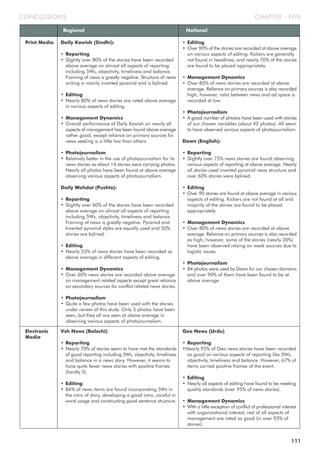
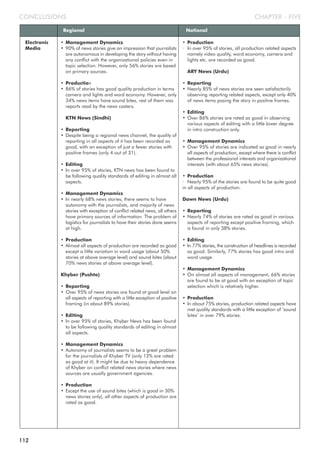
As explained in the methods, the analysis is based on four
major variables; viz, Development Journalism, Democracy
and Governance, Conflict Reporting and Photojournalism
for print media. For electronic media, the photojournalism
component was replaced with 'Production' related details.
Besides collecting examples from some of the sub-themes
on the aforementioned major themes, the selected
newspapers have also been evaluated as what kinds of
adjectives and metaphors have been employed and for
what objects / personalities etc.
The results and analyses section is divided into two major
portions based on findings on data collected from print
media and electronic media. Further, print and electronic
media portions are divided into two main streams -
(i) analysis of each variable for the selected newspapers /
channels in terms of their coverage in sub-themes and then
(ii) analysis of various aspects like reporting, editing,
management related issues, production and photojournalism
(in case of print media) in correspondence with the major
themes.
The selected media include:
Print Media:
• Daily Jang, Daily Qudrat (Quetta), Daily Kawish (Sindhi
language newspaper) and Daily Wahdat (Pushto langauge
newspaper).
• English language newspapers were The News and Dawn.
Electronic Media:
• Geo News, ARY News, Dawn News, KTN (Sindhi Channel),
Khyber TV (Pushto Channel) and VSH News (Balochi
Channel).
Radio:
• Samaa Channel FM 107.4.
In addition to mainstream media, one radio channel (Samaa
FM 107.4) has also been included in the study to give
representation to radio news broadcasting. Radio's paltry
representation in the study is predominantly due to two
reasons - (i) there are only two channels giving news brief
in their transmissions (Power 99 and Samaa FM 107.4);
and then (ii) radio license is primarily for entertainment
under the PEMRA rules. Hence, to make the study
comprehensive in nature having representation of all possible
media of regional and national levels, Samaa FM 107.4
has also been included for evaluation of its news contents.
Another important aspect of FM broadcasting relates to its
reach. Currently available FM channels giving some of their
time space to news and current affairs are mainly urban
based, and are operating for and from the metropolitan
areas. Only possible competing counterpart(s) could be the
FM channels of Pakistan Broadcasting Corporation. But, this
comparison may not appear to be justified due to the
infrastructural base of the competing organizations, besides
their ownership dynamics.
22
CHAPTER - FOURRESULTS AND FINDINGS
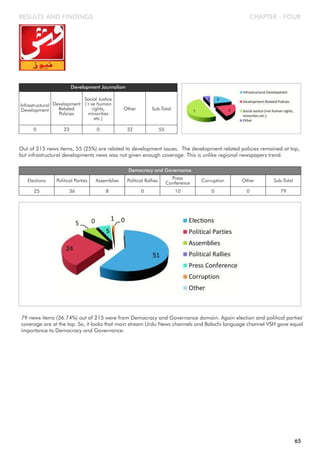
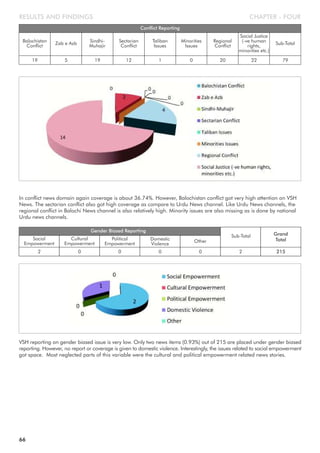
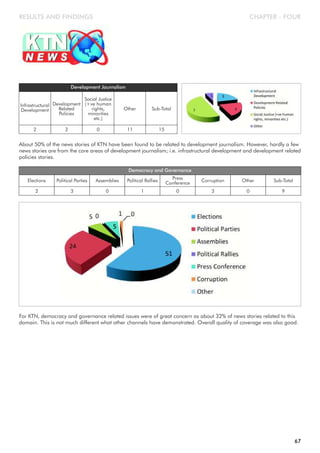
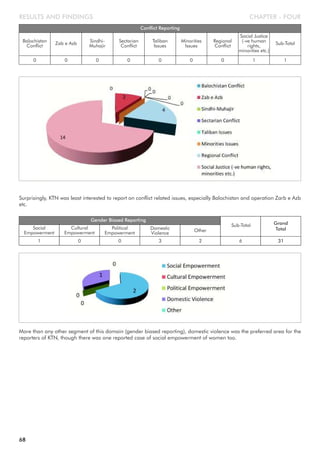
Infrastructural
Development
Development Journalism
Development
Related
Policies
Social Justice
(+ve human
rights,
minorities
etc.)
Other Sub-Total
1 8 9 1 19
Dawn seems to have special focus for system level development related issues that may include development policies and
issues concerning social justice. For instance, 'Breast cancer campaign to start from 2016', a development related news
story appeared on15.10.2015, 'After Geeta, focus shift to Pakistani boy in India' (31.10.2015) in human rights perspective
and 'Call for improvement in blasphemy law is not objectionable: SC' (06.10.2015) etc.
Overall trend in covering development journalism related issues by the Dawn is relatively good; however, it does not seem
to be giving much space to infrastructural development related news stories. It might be due to the fact that most of the
infrastructural development stories are city or a limited area specific with a little significance for the entire country.
The language used and other editing parameters are of relatively higher standards.
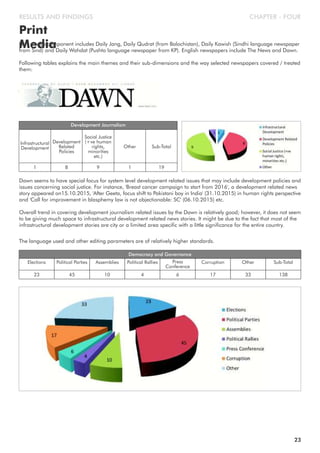
Elections
Democracy and Governance
Political Parties Assemblies Political Rallies Press
Conference
23 45 10 4 6
Corruption Other Sub-Total
17 33 138
Print media component includes Daily Jang, Daily Qudrat (from Balochistan), Daily Kawish (Sindhi language newspaper
from Sind) and Daily Wahdat (Pushto language newspaper from KP). English newspapers include The News and Dawn.
Following tables explains the main themes and their sub-dimensions and the way selected newspapers covered / treated
them:
Print
Media
23
Out of total of 262 news stories analyzed, 138 (52.67%) stories related to issues concerning Democracy and Governance.
Within this category, major focus has been political parties, their leaders statements etc. However, as the local bodies
elections were in process, hence, sufficient space was allotted to elections reporting as well. There seems to have a balance
in the overall coverage of all sub-themes keeping in view the reports that may emanate from these segments and
conventionally attended by the media in Pakistan.
CHAPTER - FOUR
Balochistan
Conflict
Conflict Reporting
Zab e Azb Sindhi-
Muhajir
Sectarian
Conflict
Taliban
Issues
4 2 1 4 11
Minorities
Issues
Social Justice
(-ve human
rights,
minorities etc.)
Sub-Total
0 22 97
Regional
Conflict
53
Conflict reporting could get a good amount of coverage from Dawn. This is about 36.64 % (97 news stories), out of which
major areas were only two; i.e. Regional Conflicts mainly involving Afghanistan and Kashmir, and then Taliban related
news stories. Dawn has taken conflict reporting in system perspective instead dealing with them as issues pertaining to
some specific areas only rather the issues that are of great significance for the regional overall.
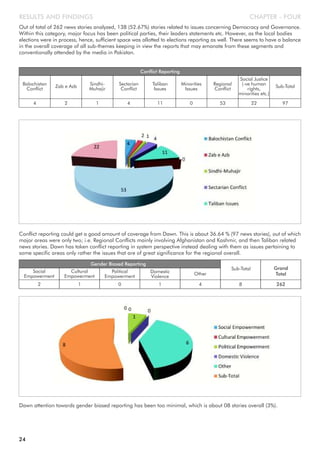
Social
Empowerment
Gender Biased Reporting
Cultural
Empowerment
Political
Empowerment
Domestic
Violence
2 1 0 1
Other
Sub-Total Grand
Total
4 8 262
Dawn attention towards gender biased reporting has been too minimal, which is about 08 stories overall (3%).
RESULTS AND FINDINGS
24
CHAPTER - FOUR
Infrastructural
Development
Development Journalism
Development
Related
Policies
Social Justice
(+ve human
rights,
minorities
etc.)
Other Sub-Total
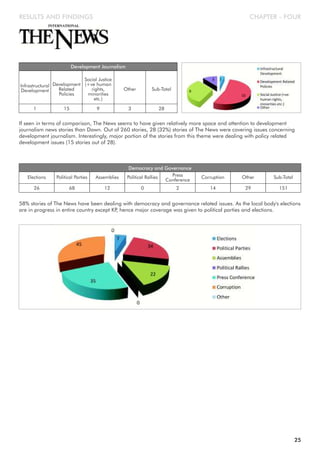
1 15 9 3 28
If seen in terms of comparison, The News seems to have given relatively more space and attention to development
journalism news stories than Dawn. Out of 260 stories, 28 (32%) stories of The News were covering issues concerning
development journalism. Interestingly, major portion of the stories from this theme were dealing with policy related
development issues (15 stories out of 28).
Elections
Democracy and Governance
Political Parties Assemblies Political Rallies Press
Conference
26 68 12 0 2
Corruption Other Sub-Total
14 29 151
58% stories of The News have been dealing with democracy and governance related issues. As the local body's elections
are in progress in entire country except KP, hence major coverage was given to political parties and elections.
RESULTS AND FINDINGS
25
Balochistan
Conflict
Conflict Reporting
Zab e Azb Sindhi-
Muhajir
Sectarian
Conflict
Taliban
Issues
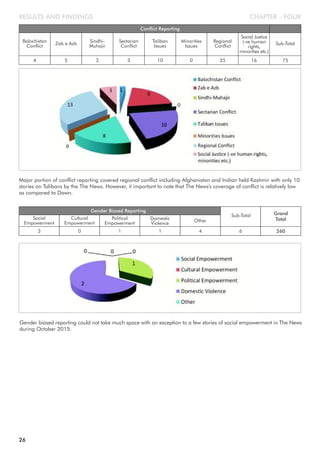
4 5 2 3 10
Minorities
Issues
Social Justice
(-ve human
rights,
minorities etc.)
Sub-Total
0 16 75
Regional
Conflict
35
Major portion of conflict reporting covered regional conflict including Afghanistan and Indian held Kashmir with only 10
stories on Talibans by the The News. However, it important to note that The News's coverage of conflict is relatively low
as compared to Dawn.
Social
Empowerment
Gender Biased Reporting
Cultural
Empowerment
Political
Empowerment
Domestic
Violence
3 0 1 1
Other
Sub-Total Grand
Total
4 6 260
Gender biased reporting could not take much space with an exception to a few stories of social empowerment in The News
during October 2015.
CHAPTER - FOURRESULTS AND FINDINGS
26
CHAPTER - FOUR
Infrastructural
Development
Development Journalism
Development
Related
Policies
Social Justice
(+ve human
rights,
minorities
etc.)
Other Sub-Total
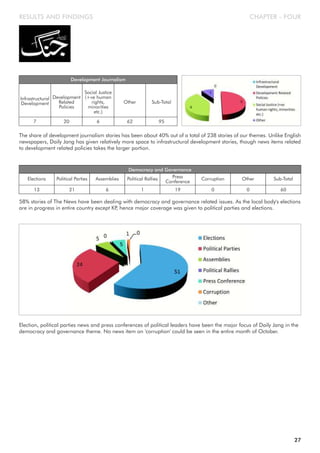
7 20 6 62 95
The share of development journalism stories has been about 40% out of a total of 238 stories of our themes. Unlike English
newspapers, Daily Jang has given relatively more space to infrastructural development stories, though news items related
to development related policies takes the larger portion.
Elections
Democracy and Governance
Political Parties Assemblies Political Rallies Press
Conference
13 21 6 1 19
Corruption Other Sub-Total
0 0 60
58% stories of The News have been dealing with democracy and governance related issues. As the local body's elections
are in progress in entire country except KP, hence major coverage was given to political parties and elections.
Election, political parties news and press conferences of political leaders have been the major focus of Daily Jang in the
democracy and governance theme. No news item on 'corruption' could be seen in the entire month of October.
RESULTS AND FINDINGS
27
Balochistan
Conflict
Conflict Reporting
Zab e Azb
Sindhi-
Muhajir
Sectarian
Conflict
Taliban
Issues
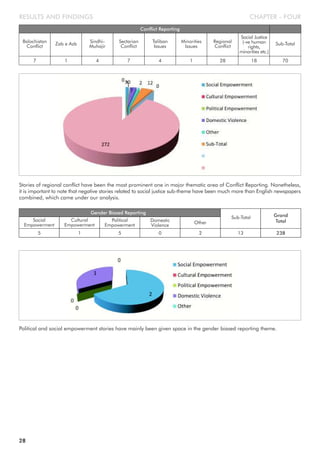
7 1 4 7 4
Minorities
Issues
Social Justice
(-ve human
rights,
minorities etc.)
Sub-Total
1 18 70
Regional
Conflict
28
CHAPTER - FOUR
Stories of regional conflict have been the most prominent one in major thematic area of Conflict Reporting. Nonetheless,
it is important to note that negative stories related to social justice sub-theme have been much more than English newspapers
combined, which came under our analysis.
Social
Empowerment
Gender Biased Reporting
Cultural
Empowerment
Political
Empowerment
Domestic
Violence
5 1 5 0
Other
Sub-Total Grand
Total
2 13 238
Political and social empowerment stories have mainly been given space in the gender biased reporting theme.
RESULTS AND FINDINGS
28
Infrastructural
Development
Development Journalism
Development
Related
Policies
Social Justice
(+ve human
rights,
minorities
etc.)
Other Sub-Total
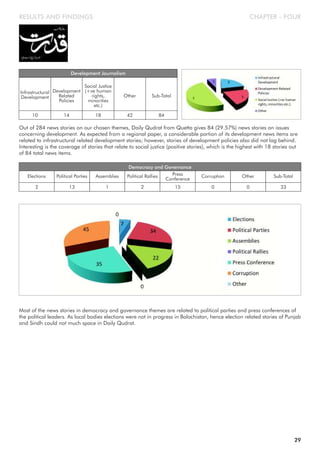
10 14 18 42 84
Out of 284 news stories on our chosen themes, Daily Qudrat from Quetta gives 84 (29.57%) news stories on issues
concerning development. As expected from a regional paper, a considerable portion of its development news items are
related to infrastructural related development stories; however, stories of development policies also did not lag behind.
Interesting is the coverage of stories that relate to social justice (positive stories), which is the highest with 18 stories out
of 84 total news items.
Elections
Democracy and Governance
Political Parties Assemblies Political Rallies Press
Conference
2 13 1 2 15
Corruption Other Sub-Total
0 0 33
Most of the news stories in democracy and governance themes are related to political parties and press conferences of
the political leaders. As local bodies elections were not in progress in Balochistan, hence election related stories of Punjab
and Sindh could not much space in Daily Qudrat.
CHAPTER - FOURRESULTS AND FINDINGS
29
CHAPTER - FOUR
Balochistan
Conflict
Conflict Reporting
Zab e Azb Sindhi-
Muhajir
Sectarian
Conflict
Taliban
Issues
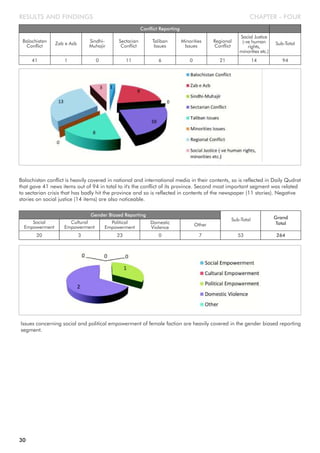
41 1 0 11 6
Minorities
Issues
Social Justice
(-ve human
rights,
minorities etc.)
Sub-Total
0 14 94
Regional
Conflict
21
Balochistan conflict is heavily covered in national and international media in their contents, so is reflected in Daily Qudrat
that gave 41 news items out of 94 in total to it's the conflict of its province. Second most important segment was related
to sectarian crisis that has badly hit the province and so is reflected in contents of the newspaper (11 stories). Negative
stories on social justice (14 items) are also noticeable.
Social
Empowerment
Gender Biased Reporting
Cultural
Empowerment
Political
Empowerment
Domestic
Violence
20 3 23 0
Other
Sub-Total Grand
Total
7 53 264
Issues concerning social and political empowerment of female faction are heavily covered in the gender biased reporting
segment.
RESULTS AND FINDINGS
30
CHAPTER - FOUR
Infrastructural
Development
Development Journalism
Development
Related
Policies
Social Justice
(+ve human
rights,
minorities
etc.)
Other Sub-Total
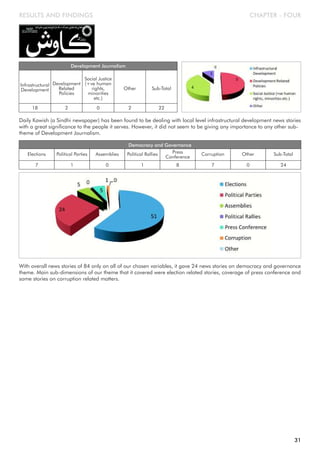
18 2 0 2 22
Daily Kawish (a Sindhi newspaper) has been found to be dealing with local level infrastructural development news stories
with a great significance to the people it serves. However, it did not seem to be giving any importance to any other sub-
theme of Development Journalism.
Elections
Democracy and Governance
Political Parties Assemblies Political Rallies Press
Conference
7 1 0 1 8
Corruption Other Sub-Total
7 0 24
With overall news stories of 84 only on all of our chosen variables, it gave 24 news stories on democracy and governance
theme. Main sub-dimensions of our theme that it covered were election related stories, coverage of press conference and
some stories on corruption related matters.
RESULTS AND FINDINGS
31
CHAPTER - FOUR
Balochistan
Conflict
Conflict Reporting
Zab e Azb Sindhi-
Muhajir
Sectarian
Conflict
Taliban
Issues
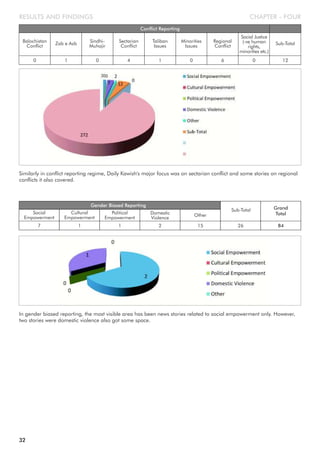
0 1 0 4 1
Minorities
Issues
Social Justice
(-ve human
rights,
minorities etc.)
Sub-Total
0 0 12
Regional
Conflict
6
Similarly in conflict reporting regime, Daily Kawish's major focus was on sectarian conflict and some stories on regional
conflicts it also covered.
Social
Empowerment
Gender Biased Reporting
Cultural
Empowerment
Political
Empowerment
Domestic
Violence
7 1 1 2
Other
Sub-Total Grand
Total
15 26 84
In gender biased reporting, the most visible area has been news stories related to social empowerment only. However,
two stories were domestic violence also got some space.
RESULTS AND FINDINGS
32
Infrastructural
Development
Development Journalism
Development
Related
Policies
Social Justice
(+ve human
rights,
minorities
etc.)
Other Sub-Total
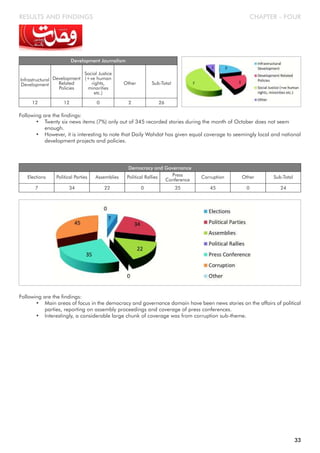
12 12 0 2 26
CHAPTER - FOUR
Following are the findings:
• Twenty six news items (7%) only out of 345 recorded stories during the month of October does not seem
enough.
• However, it is interesting to note that Daily Wahdat has given equal coverage to seemingly local and national
development projects and policies.
Elections
Democracy and Governance
Political Parties Assemblies Political Rallies Press
Conference
7 34 22 0 35
Corruption Other Sub-Total
45 0 24
Following are the findings:
• Main areas of focus in the democracy and governance domain have been news stories on the affairs of political
parties, reporting on assembly proceedings and coverage of press conferences.
• Interestingly, a considerable large chunk of coverage was from corruption sub-theme.
RESULTS AND FINDINGS
33
Balochistan
Conflict
Conflict Reporting
Zab e Azb Sindhi-
Muhajir
Sectarian
Conflict
Taliban
Issues
5 3 1 2 149
Minorities
Issues
Social Justice
(-ve human
rights,
minorities etc.)
Sub-Total
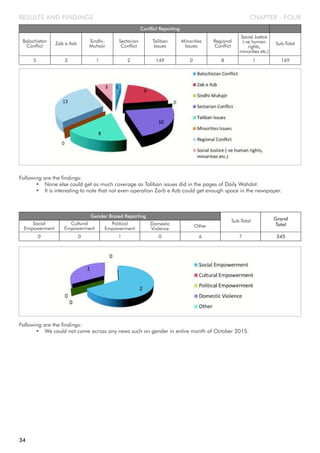
0 1 169
Regional
Conflict
8
Following are the findings:
• None else could get as much coverage as Taliban issues did in the pages of Daily Wahdat.
• It is interesting to note that not even operation Zarb e Azb could get enough space in the newspaper.
CHAPTER - FOUR
Social
Empowerment
Gender Biased Reporting
Cultural
Empowerment
Political
Empowerment
Domestic
Violence
0 0 1 0
Other
Sub-Total Grand
Total
6 7 345
Following are the findings:
• We could not come across any news such on gender in entire month of October 2015.
RESULTS AND FINDINGS
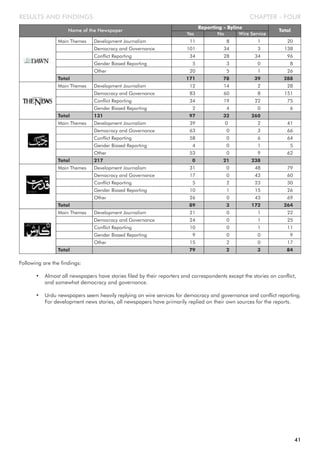
34
Following are the findings:
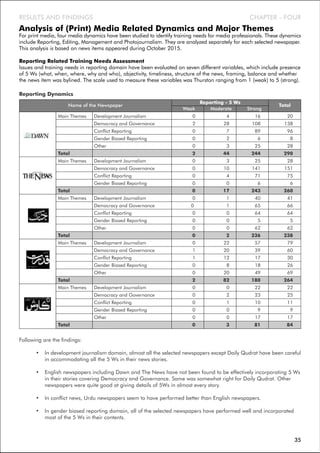
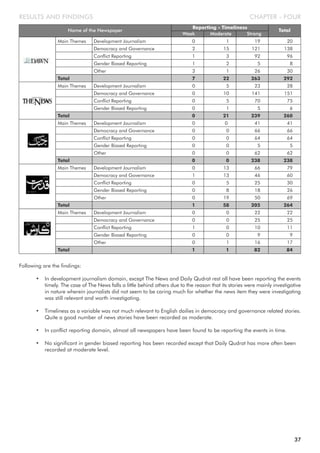
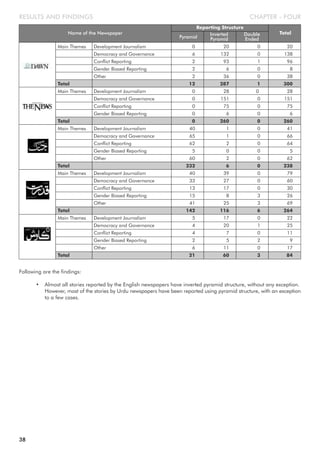
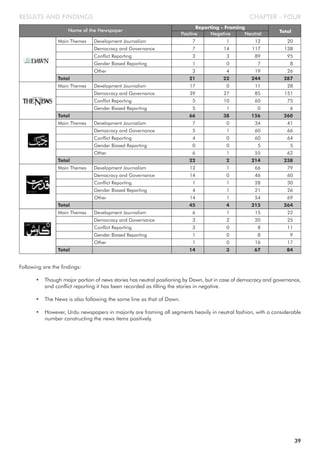
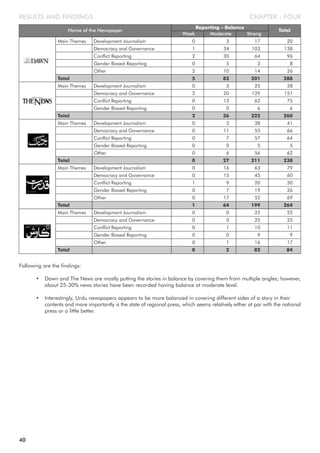
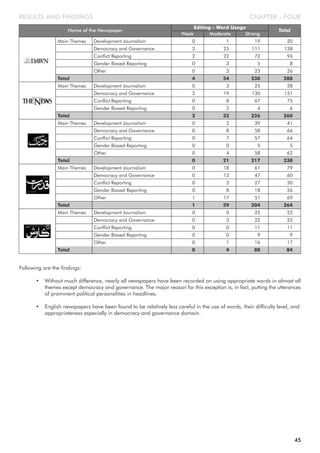
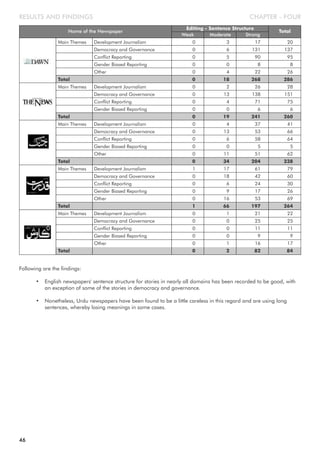
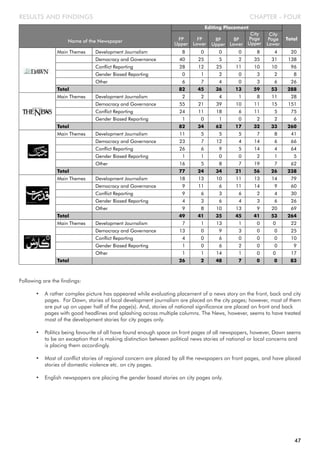
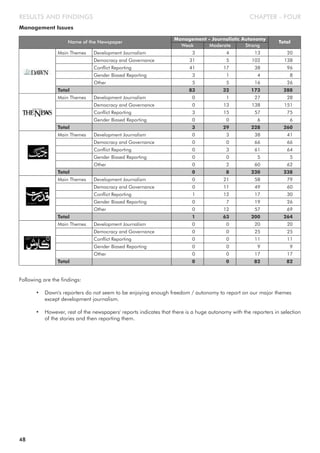
• In development journalism domain, almost all the selected newspapers except Daily Qudrat have been careful
in accommodating all the 5 Ws in their news stories.
• English newspapers including Dawn and The News have not been found to be effectively incorporating 5 Ws
in their stories covering Democracy and Governance. Same was somewhat right for Daily Qudrat. Other
newspapers were quite good at giving details of 5Ws in almost every story.
• In conflict news, Urdu newspapers seem to have performed better than English newspapers.
• In gender biased reporting domain, all of the selected newspapers have performed well and incorporated
most of the 5 Ws in their contents.
Analysis of (Print) Media Related Dynamics and Major Themes
For print media, four media dynamics have been studied to identify training needs for media professionals. These dynamics
include Reporting, Editing, Management and Photojournalism. They are analyzed separately for each selected newspaper.
This analysis is based on news items appeared during October 2015.
Reporting Related Training Needs Assessment
Issues and training needs in reporting domain have been evaluated on seven different variables, which include presence
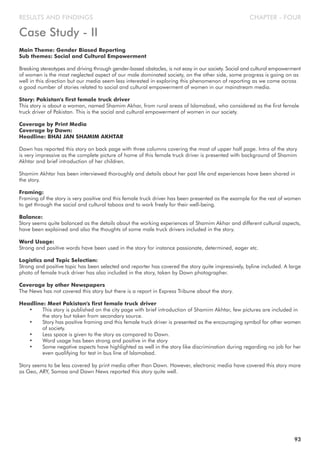
of 5 Ws (what, when, where, why and who), objectivity, timeliness, structure of the news, framing, balance and whether
the news item was bylined. The scale used to measure these variables was Thurston ranging from 1 (weak) to 5 (strong).
Reporting Dynamics
CHAPTER - FOURRESULTS AND FINDINGS
Name of the Newspaper
Weak Moderate Strong
Reporting - 5 Ws
Total
Main Themes Development Journalism 0 4 16 20
Democracy and Governance 2 28 108 138
Conflict Reporting 0 7 89 96
Gender Biased Reporting 0 2 6 8
Other 0 3 25 28
Total 2 44 244 290
Main Themes Development Journalism 0 3 25 28
Democracy and Governance 0 10 141 151
Conflict Reporting 0 4 71 75
Gender Biased Reporting 0 0 6 6
Total 0 17 243 260
Main Themes Development Journalism 0 1 40 41
Democracy and Governance 0 1 65 66
Conflict Reporting 0 0 64 64
Gender Biased Reporting 0 0 5 5
Other 0 0 62 62
Total 0 2 236 238
Main Themes Development Journalism 0 22 57 79
Democracy and Governance 1 20 39 60
Conflict Reporting 1 12 17 30
Gender Biased Reporting 0 8 18 26
Other 0 20 49 69
Total 2 82 180 264
Main Themes Development Journalism 0 0 22 22
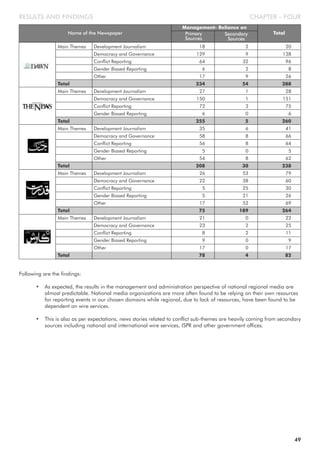
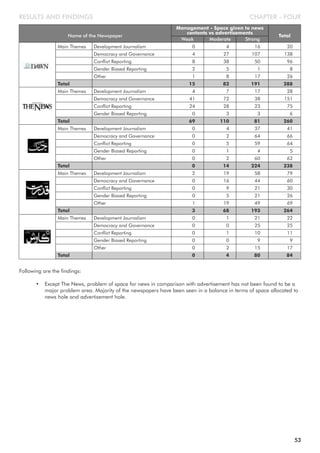
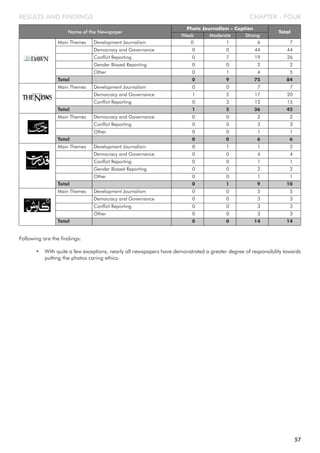
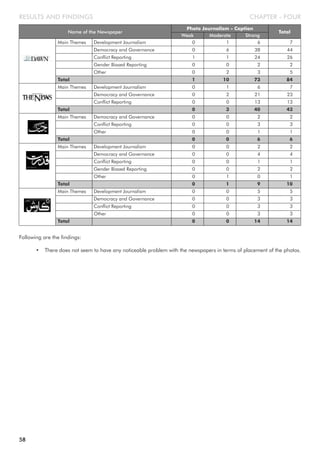
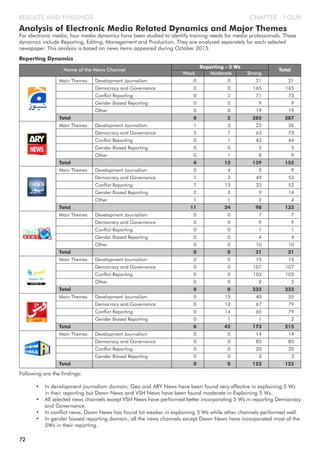
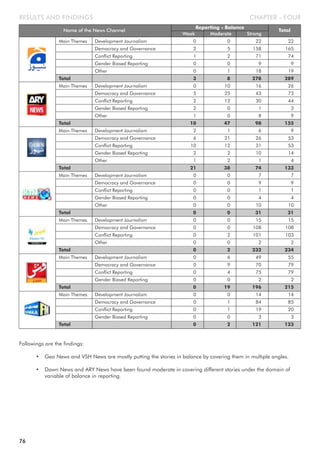
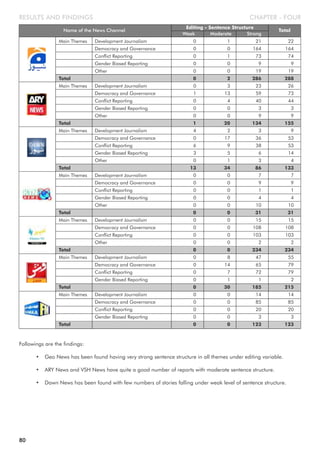
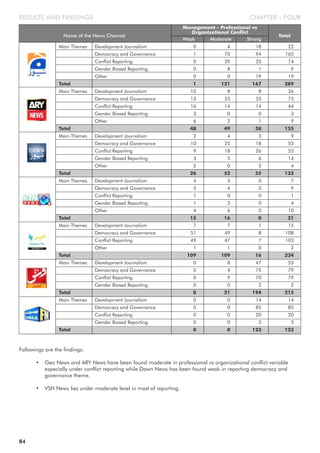
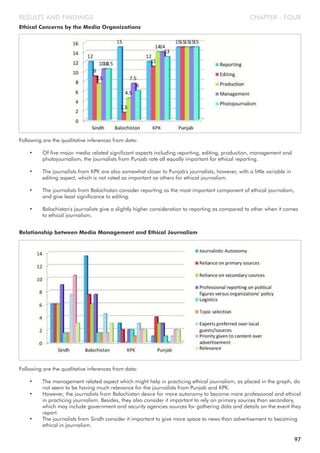
Democracy and Governance 0 2 23 25
Conflict Reporting 0 1 10 11
Gender Biased Reporting 0 0 9 9
Other 0 0 17 17
Total 0 3 81 84
35
Following are the findings:
• Except Daily Qudrat, almost all newspapers have been found to be objective in reporting stories in the domain
of development journalism. However, there is a little exception in English language newspapers where they
are evaluated at moderate level in a considerable number of stories in this domain.
• Objectivity in the democracy and governance domain has been found to be equal among all up to a greater
extent with an exception of Dawn, The News and Daily Qudrat. There were quite a good number of stories
having been found at moderate level in observing objectivity in the news stories.
• In Conflict Reporting domain, Dawn and The News have somewhat been found to be lagging behind the Urdu
newspapers (with an only exception of Daily Qudrat) under the objectivity variable.
• Almost all newspapers have been found to operating well on gender biased reporting domain.
CHAPTER - FOURRESULTS AND FINDINGS
Name of the Newspaper
Weak Moderate Strong
Reporting - Objectivity
Total
Main Themes Development Journalism 0 1 19 20
Democracy and Governance 3 15 120 138
Conflict Reporting 0 17 79 96
Gender Biased Reporting 0 1 7 8
Other 1 2 25 28
Total 4 36 250 290
Main Themes Development Journalism 0 2 26 28
Democracy and Governance 1 18 132 151
Conflict Reporting 0 6 69 75
Gender Biased Reporting 0 1 5 6
Total 1 27 232 260
Main Themes Development Journalism 0 0 41 41
Democracy and Governance 0 3 63 66
Conflict Reporting 0 2 62 64
Gender Biased Reporting 0 0 5 5
Other 0 0 62 62
Total 0 5 233 238
Main Themes Development Journalism 0 28 51 79
Democracy and Governance 0 16 44 60
Conflict Reporting 0 7 23 30
Gender Biased Reporting 0 5 21 26
Other 0 19 50 69
Total 0 75 189 264
Main Themes Development Journalism 0 0 22 22
Democracy and Governance 0 0 25 25
Conflict Reporting 0 0 11 11
Gender Biased Reporting 0 0 9 9
Other 0 0 17 17
Total 0 0 84 84
36
CHAPTER - FOURRESULTS AND FINDINGS
Following are the findings:
• In development journalism domain, except The News and Daily Qudrat rest all have been reporting the events
timely. The case of The News falls a little behind others due to the reason that its stories were mainly investigative
in nature wherein journalists did not seem to be caring much for whether the news item they were investigating
was still relevant and worth investigating.
• Timeliness as a variable was not much relevant to English dailies in democracy and governance related stories.
Quite a good number of news stories have been recorded as moderate.
• In conflict reporting domain, almost all newspapers have been found to be reporting the events in time.
• No significant in gender biased reporting has been recorded except that Daily Qudrat has more often been
recorded at moderate level.
Name of the Newspaper
Weak Moderate Strong
Reporting - Timeliness
Total
Main Themes Development Journalism 0 1 19 20
Democracy and Governance 2 15 121 138
Conflict Reporting 1 3 92 96
Gender Biased Reporting 1 2 5 8
Other 3 1 26 30
Total 7 22 263 292
Main Themes Development Journalism 0 5 23 28
Democracy and Governance 0 10 141 151
Conflict Reporting 0 5 70 75
Gender Biased Reporting 0 1 5 6
Total 0 21 239 260
Main Themes Development Journalism 0 0 41 41
Democracy and Governance 0 0 66 66
Conflict Reporting 0 0 64 64
Gender Biased Reporting 0 0 5 5
Other 0 0 62 62
Total 0 0 238 238
Main Themes Development Journalism 0 13 66 79
Democracy and Governance 1 13 46 60
Conflict Reporting 0 5 25 30
Gender Biased Reporting 0 8 18 26
Other 0 19 50 69
Total 1 58 205 264
Main Themes Development Journalism 0 0 22 22
Democracy and Governance 0 0 25 25
Conflict Reporting 1 0 10 11
Gender Biased Reporting 0 0 9 9
Other 0 1 16 17
Total 1 1 82 84
37
CHAPTER - FOUR
Following are the findings:
• Almost all stories reported by the English newspapers have inverted pyramid structure, without any exception.
However, most of the stories by Urdu newspapers have been reported using pyramid structure, with an exception
to a few cases.
RESULTS AND FINDINGS
Name of the Newspaper
Pyramid
Reporting Structure
Total
Main Themes Development Journalism 0 20 0 20
Democracy and Governance 6 132 0 138
Conflict Reporting 2 93 1 96
Gender Biased Reporting 2 6 0 8
Other 2 36 0 38
Total 12 287 1 300
Main Themes Development Journalism 0 28 0 28
Democracy and Governance 0 151 0 151
Conflict Reporting 0 75 0 75
Gender Biased Reporting 0 6 0 6
Total 0 260 0 260
Main Themes Development Journalism 40 1 0 41
Democracy and Governance 65 1 0 66
Conflict Reporting 62 2 0 64
Gender Biased Reporting 5 0 0 5
Other 60 2 0 62
Total 232 6 0 238
Main Themes Development Journalism 40 39 0 79
Democracy and Governance 33 27 0 60
Conflict Reporting 13 17 0 30
Gender Biased Reporting 15 8 3 26
Other 41 25 3 69
Total 142 116 6 264
Main Themes Development Journalism 5 17 0 22
Democracy and Governance 4 20 1 25
Conflict Reporting 4 7 0 11
Gender Biased Reporting 2 5 2 9
Other 6 11 0 17
Total 21 60 3 84
Inverted
Pyramid
Double
Ended
38
CHAPTER - FOUR
Following are the findings:
• Though major portion of news stories has neutral positioning by Dawn, but in case of democracy and governance,
and conflict reporting it has been recorded as tilting the stories in negative.
• The News is also following the same line as that of Dawn.
• However, Urdu newspapers in majority are framing all segments heavily in neutral fashion, with a considerable
number constructing the news items positively.
RESULTS AND FINDINGS
Name of the Newspaper
Positive
Reporting - Framing
Total
Main Themes Development Journalism 7 1 12 20
Democracy and Governance 7 14 117 138
Conflict Reporting 3 3 89 95
Gender Biased Reporting 1 0 7 8
Other 3 4 19 26
Total 21 22 244 287
Main Themes Development Journalism 17 0 11 28
Democracy and Governance 39 27 85 151
Conflict Reporting 5 10 60 75
Gender Biased Reporting 5 1 0 6
Total 66 38 156 260
Main Themes Development Journalism 7 0 34 41
Democracy and Governance 5 1 60 66
Conflict Reporting 4 0 60 64
Gender Biased Reporting 0 0 5 5
Other 6 1 55 62
Total 22 2 214 238
Main Themes Development Journalism 12 1 66 79
Democracy and Governance 14 0 46 60
Conflict Reporting 1 1 28 30
Gender Biased Reporting 4 1 21 26
Other 14 1 54 69
Total 45 4 215 264
Main Themes Development Journalism 6 1 15 22
Democracy and Governance 3 2 20 25
Conflict Reporting 3 0 8 11
Gender Biased Reporting 1 0 8 9
Other 1 0 16 17
Total 14 3 67 84
Negative Neutral
39
CHAPTER - FOUR
Following are the findings:
• Dawn and The News are mostly putting the stories in balance by covering them from multiple angles; however,
about 25-30% news stories have been recorded having balance at moderate level.
• Interestingly, Urdu newspapers appears to be more balanced in covering different sides of a story in their
contents and more importantly is the state of regional press, which seems relatively either at par with the national
press or a little better.
RESULTS AND FINDINGS
Name of the Newspaper
Weak Moderate Strong
Reporting - Balance
Total
Main Themes Development Journalism 0 3 17 20
Democracy and Governance 1 34 103 138
Conflict Reporting 2 30 64 96
Gender Biased Reporting 0 5 3 8
Other 2 10 14 26
Total 5 82 201 288
Main Themes Development Journalism 0 3 25 28
Democracy and Governance 2 20 129 151
Conflict Reporting 0 13 62 75
Gender Biased Reporting 0 0 6 6
Total 2 36 222 260
Main Themes Development Journalism 0 3 38 41
Democracy and Governance 0 11 55 66
Conflict Reporting 0 7 57 64
Gender Biased Reporting 0 0 5 5
Other 0 6 56 62
Total 0 27 211 238
Main Themes Development Journalism 0 16 63 79
Democracy and Governance 0 15 45 60
Conflict Reporting 1 9 20 30
Gender Biased Reporting 0 7 19 26
Other 0 17 52 69
Total 1 64 199 264
Main Themes Development Journalism 0 0 22 22
Democracy and Governance 0 0 25 25
Conflict Reporting 0 1 10 11
Gender Biased Reporting 0 0 9 9
Other 0 1 16 17
Total 0 2 82 84
40
CHAPTER - FOUR
Following are the findings:
• Almost all newspapers have stories filed by their reporters and correspondents except the stories on conflict,
and somewhat democracy and governance.
• Urdu newspapers seem heavily replying on wire services for democracy and governance and conflict reporting.
For development news stories, all newspapers have primarily replied on their own sources for the reports.
RESULTS AND FINDINGS
Name of the Newspaper
Yes No Wire Service
Reporting - Byline
Total
Main Themes Development Journalism 11 8 1 20
Democracy and Governance 101 34 3 138
Conflict Reporting 34 28 34 96
Gender Biased Reporting 5 3 0 8
Other 20 5 1 26
Total 171 78 39 288
Main Themes Development Journalism 12 14 2 28
Democracy and Governance 83 60 8 151
Conflict Reporting 34 19 22 75
Gender Biased Reporting 2 4 0 6
Total 131 97 32 260
Main Themes Development Journalism 39 0 2 41
Democracy and Governance 63 0 3 66
Conflict Reporting 58 0 6 64
Gender Biased Reporting 4 0 1 5
Other 53 0 9 62
Total 217 0 21 238
Main Themes Development Journalism 31 0 48 79
Democracy and Governance 17 0 43 60
Conflict Reporting 5 2 23 30
Gender Biased Reporting 10 1 15 26
Other 26 0 43 69
Total 89 3 172 264
Main Themes Development Journalism 21 0 1 22
Democracy and Governance 24 0 1 25
Conflict Reporting 10 0 1 11
Gender Biased Reporting 9 0 0 9
Other 15 2 0 17
Total 79 2 3 84
41
CHAPTER - FOUR
Editing Dynamics
RESULTS AND FINDINGS
Name of the Newspaper
Editing - Headlines
Total
Main Themes Development Journalism 0 0 20 20
Democracy and Governance 4 16 118 138
Conflict Reporting 1 8 87 96
Gender Biased Reporting 0 2 6 8
Other 0 3 23 26
Total 5 29 254 288
Main Themes Development Journalism 0 4 24 28
Democracy and Governance 4 11 136 151
Conflict Reporting 0 2 73 75
Gender Biased Reporting 0 0 6 6
Total 4 17 239 260
Main Themes Development Journalism 0 3 38 41
Democracy and Governance 0 8 58 66
Conflict Reporting 0 4 60 64
Gender Biased Reporting 0 0 5 5
Other 0 5 57 62
Total 0 20 218 238
Main Themes Development Journalism 1 18 60 79
Democracy and Governance 0 13 47 60
Conflict Reporting 0 6 24 30
Gender Biased Reporting 0 9 17 26
Other 0 17 52 69
Total 1 63 200 264
Main Themes Development Journalism 0 0 21 21
Democracy and Governance 0 0 25 25
Conflict Reporting 0 0 10 10
Gender Biased Reporting 0 0 9 9
Other 0 0 17 17
Total 0 0 82 82
Moderate StrongWeak
42
Following are the findings:
• Headlines for nearly all themes have found to be strong especially when it comes to democracy and governance
as most of them they were the lead stories. Some stories by Dawn did not have strong headlines rather very
sketchy and one needs to go through the Intro to understand the crux of story.
• Similarly, stories of development journalism and conflict and gender have also been found to be having strong
headlines giving maximum details of the event, which can make the skippers understand what is inside of the
news item.
CHAPTER - FOUR
Following are the findings:
• Daily Jang stands distinguished in developing a good intro, while Daily Kawish also seems to be doing good
at it.
• However, English language dailies although have been developing good intro of stories on all themes,
nonetheless, some stories on democracy and governance segment are found to be at moderate level in
intro construction.
RESULTS AND FINDINGS
Name of the Newspaper
Editing - Intro
Total
Main Themes Development Journalism 0 1 19 20
Democracy and Governance 0 14 123 137
Conflict Reporting 0 2 93 95
Gender Biased Reporting 0 2 6 8
Other 0 5 21 26
Total 0 24 262 286
Main Themes Development Journalism 0 3 25 28
Democracy and Governance 0 10 141 151
Conflict Reporting 0 7 68 75
Gender Biased Reporting 0 0 6 6
Total 0 20 240 260
Main Themes Development Journalism 0 2 39 41
Democracy and Governance 0 2 64 66
Conflict Reporting 0 0 64 64
Gender Biased Reporting 0 0 5 5
Other 0 5 57 62
Total 0 9 229 238
Main Themes Development Journalism 1 17 61 79
Democracy and Governance 1 22 37 60
Conflict Reporting 1 9 20 30
Gender Biased Reporting 0 5 21 26
Other 0 24 45 69
Total 3 77 184 264
Main Themes Development Journalism 0 0 1 1
Democracy and Governance 0 0 1 1
Conflict Reporting 0 0 2 2
Other 0 0 1 1
Total 0 0 5 5
Moderate StrongWeak
43
CHAPTER - FOUR
Following are the findings:
• Not all English newspapers have kickers or deckers in their headline structure.
• However, Urdu newspapers stand parallel to each other in giving details of the stories in either kickers of deckers
as part of the main headline.
RESULTS AND FINDINGS
Main Themes Development Journalism 0 0 1 1
Democracy and Governance 0 0 1 1
Conflict Reporting 0 1 0 1
Total 0 1 2 3
Main Themes Development Journalism 0 1 40 41
Democracy and Governance 0 4 62 66
Conflict Reporting 0 7 57 64
Gender Biased Reporting 0 0 5 5
Other 0 4 58 62
Total 0 16 222 238
Main Themes Development Journalism 0 24 55 79
Democracy and Governance 0 11 49 60
Conflict Reporting 1 8 21 30
Gender Biased Reporting 0 9 17 26
Other 0 17 52 69
Total 1 69 194 264
Main Themes Development Journalism 0 0 1 1
Total 0 0 1 1
Name of the Newspaper
Editing - Kicker
Total
Moderate StrongWeak
44
CHAPTER - FOUR
Following are the findings:
• Without much difference, nearly all newspapers have been recorded on using appropriate words in almost all
themes except democracy and governance. The major reason for this exception is, in fact, putting the utterances
of prominent political personalities in headlines.
• English newspapers have been found to be relatively less careful in the use of words, their difficulty level, and
appropriateness especially in democracy and governance domain.
RESULTS AND FINDINGS
Name of the Newspaper
Editing - Word Usage
Total
Moderate StrongWeak
Main Themes Development Journalism 0 1 19 20
Democracy and Governance 2 25 111 138
Conflict Reporting 2 22 72 96
Gender Biased Reporting 0 3 5 8
Other 0 3 23 26
Total 4 54 230 288
Main Themes Development Journalism 0 3 25 28
Democracy and Governance 2 19 130 151
Conflict Reporting 0 8 67 75
Gender Biased Reporting 0 2 4 6
Total 2 32 226 260
Main Themes Development Journalism 0 2 39 41
Democracy and Governance 0 8 58 66
Conflict Reporting 0 7 57 64
Gender Biased Reporting 0 0 5 5
Other 0 4 58 62
Total 0 21 217 238
Main Themes Development Journalism 0 18 61 79
Democracy and Governance 0 13 47 60
Conflict Reporting 0 3 27 30
Gender Biased Reporting 0 8 18 26
Other 1 17 51 69
Total 1 59 204 264
Main Themes Development Journalism 0 0 22 22
Democracy and Governance 0 3 22 25
Conflict Reporting 0 0 11 11
Gender Biased Reporting 0 0 9 9
Other 0 1 16 17
Total 0 4 80 84
45
CHAPTER - FOUR
Following are the findings:
• English newspapers' sentence structure for stories in nearly all domains has been recorded to be good, with
an exception of some of the stories in democracy and governance.
• Nonetheless, Urdu newspapers have been found to be a little careless in this regard and are using long
sentences, whereby losing meanings in some cases.
RESULTS AND FINDINGS
Name of the Newspaper
Editing - Sentence Structure
Total
Moderate StrongWeak
Main Themes Development Journalism 0 3 17 20
Democracy and Governance 0 6 131 137
Conflict Reporting 0 5 90 95
Gender Biased Reporting 0 0 8 8
Other 0 4 22 26
Total 0 18 268 286
Main Themes Development Journalism 0 2 26 28
Democracy and Governance 0 13 138 151
Conflict Reporting 0 4 71 75
Gender Biased Reporting 0 0 6 6
Total 0 19 241 260
Main Themes Development Journalism 0 4 37 41
Democracy and Governance 0 13 53 66
Conflict Reporting 0 6 58 64
Gender Biased Reporting 0 0 5 5
Other 0 11 51 62
Total 0 34 204 238
Main Themes Development Journalism 1 17 61 79
Democracy and Governance 0 18 42 60
Conflict Reporting 0 6 24 30
Gender Biased Reporting 0 9 17 26
Other 0 16 53 69
Total 1 66 197 264
Main Themes Development Journalism 0 1 21 22
Democracy and Governance 0 0 25 25
Conflict Reporting 0 0 11 11
Gender Biased Reporting 0 0 9 9
Other 0 1 16 17
Total 0 2 82 84
46
Name of the Newspaper
Editing Placement
TotalFP
Upper
FP
Lower
BP
Upper
BP
Lower
City
Page
Upper
City
Page
Lower
CHAPTER - FOUR
Following are the findings:
• A rather complex picture has appeared while evaluating placement of a news story on the front, back and city
pages. For Dawn, stories of local development journalism are placed on the city pages; however, most of them
are put up on upper half of the page(s). And, stories of national significance are placed on front and back
pages with good headlines and splashing across multiple columns. The News, however, seems to have treated
most of the development stories for city pages only.
• Politics being favourite of all have found enough space on front pages of all newspapers, however, Dawn seems
to be an exception that is making distinction between political news stories of national or local concerns and
is placing them accordingly.
• Most of conflict stories of regional concern are placed by all the newspapers on front pages, and have placed
stories of domestic violence etc. on city pages.
• English newspapers are placing the gender based stories on city pages only.
RESULTS AND FINDINGS
Main Themes Development Journalism 8 0 0 0 8 4 20
Democracy and Governance 40 25 5 2 35 31 138
Conflict Reporting 28 12 25 11 10 10 96
Gender Biased Reporting 0 1 2 0 3 2 8
Other 6 7 4 0 3 6 26
Total 82 45 36 13 59 53 288
Main Themes Development Journalism 2 2 4 1 8 11 28
Democracy and Governance 55 21 39 10 11 15 151
Conflict Reporting 24 11 18 6 11 5 75
Gender Biased Reporting 1 0 1 0 2 2 6
Total 82 34 62 17 32 33 260
Main Themes Development Journalism 11 5 5 5 7 8 41
Democracy and Governance 23 7 12 4 14 6 66
Conflict Reporting 26 6 9 5 14 4 64
Gender Biased Reporting 1 1 0 0 2 1 5
Other 16 5 8 7 19 7 62
Total 77 24 34 21 56 26 238
Main Themes Development Journalism 18 13 10 11 13 14 79
Democracy and Governance 9 11 6 11 14 9 60
Conflict Reporting 9 6 3 6 2 4 30
Gender Biased Reporting 4 3 6 4 3 6 26
Other 9 8 10 13 9 20 69
Total 49 41 35 45 41 53 264
Main Themes Development Journalism 7 1 13 1 0 0 22
Democracy and Governance 13 0 9 3 0 0 25
Conflict Reporting 4 0 6 0 0 0 10
Gender Biased Reporting 1 0 6 2 0 0 9
Other 1 1 14 1 0 0 17
Total 26 2 48 7 0 0 83
47
CHAPTER - FOUR
Management Issues
Following are the findings:
• Dawn's reporters do not seem to be enjoying enough freedom / autonomy to report on our major themes
except development journalism.
• However, rest of the newspapers' reports indicates that there is a huge autonomy with the reporters in selection
of the stories and then reporting them.
RESULTS AND FINDINGS
Name of the Newspaper
Management - Journalistic Autonomy
Total
Moderate StrongWeak
Main Themes Development Journalism 3 4 13 20
Democracy and Governance 31 5 102 138
Conflict Reporting 41 17 38 96
Gender Biased Reporting 3 1 4 8
Other 5 5 16 26
Total 83 32 173 288
Main Themes Development Journalism 0 1 27 28
Democracy and Governance 0 13 138 151
Conflict Reporting 3 15 57 75
Gender Biased Reporting 0 0 6 6
Total 3 29 228 260
Main Themes Development Journalism 0 3 38 41
Democracy and Governance 0 0 66 66
Conflict Reporting 0 3 61 64
Gender Biased Reporting 0 0 5 5
Other 0 2 60 62
Total 0 8 230 238
Main Themes Development Journalism 0 21 58 79
Democracy and Governance 0 11 49 60
Conflict Reporting 1 12 17 30
Gender Biased Reporting 0 7 19 26
Other 0 12 57 69
Total 1 63 200 264
Main Themes Development Journalism 0 0 20 20
Democracy and Governance 0 0 25 25
Conflict Reporting 0 0 11 11
Gender Biased Reporting 0 0 9 9
Other 0 0 17 17
Total 0 0 82 82
48
CHAPTER - FOUR
Following are the findings:
• As expected, the results in the management and administration perspective of national regional media are
almost predictable. National media organizations are more often found to be relying on their own resources
for reporting events in our chosen domains while regional, due to lack of resources, have been found to be
dependent on wire services.
• This is also as per expectations, news stories related to conflict sub-themes are heavily coming from secondary
sources including national and international wire services, ISPR and other government offices.
RESULTS AND FINDINGS
Main Themes Development Journalism 18 2 20
Democracy and Governance 129 9 138
Conflict Reporting 64 32 96
Gender Biased Reporting 6 2 8
Other 17 9 26
Total 234 54 288
Main Themes Development Journalism 27 1 28
Democracy and Governance 150 1 151
Conflict Reporting 72 3 75
Gender Biased Reporting 6 0 6
Total 255 5 260
Main Themes Development Journalism 35 6 41
Democracy and Governance 58 8 66
Conflict Reporting 56 8 64
Gender Biased Reporting 5 0 5
Other 54 8 62
Total 208 30 238
Main Themes Development Journalism 26 53 79
Democracy and Governance 22 38 60
Conflict Reporting 5 25 30
Gender Biased Reporting 5 21 26
Other 17 52 69
Total 75 189 264
Main Themes Development Journalism 21 0 22
Democracy and Governance 23 2 25
Conflict Reporting 8 2 11
Gender Biased Reporting 9 0 9
Other 17 0 17
Total 78 4 82
Name of the Newspaper Primary
Sources
Management- Reliance on
TotalSecondary
Sources
49
CHAPTER - FOUR
Following are the findings:
• Conflict of interest between the organizational objectives and professional preferences of journalists is an
important point of concern for media world over. Here in our case, it has been found that the level of conflict
between the preferences of media organizations and media professionals is found at a minimum level; however,
it exists to a greater extent in the regional media organizations.
• It can be inferred from some of other studies conducted in the area that regional media organizations are not
huge in size and their proprietors are usually involved in micro-level management of their media contents;
hence, conflict is a natural outcome, unlike the national and huge media organizations.
RESULTS AND FINDINGS
Name of the Newspaper
Management - Professional vs
Organizational Conflict
Total
Moderate StrongWeak
Main Themes Development Journalism 20 0 0 20
Democracy and Governance 136 0 2 138
Conflict Reporting 91 5 0 96
Gender Biased Reporting 7 1 0 8
Other 25 1 0 26
Total 279 7 2 288
Main Themes Development Journalism 27 1 0 28
Democracy and Governance 142 9 0 151
Conflict Reporting 72 3 0 75
Gender Biased Reporting 6 0 0 6
Total 247 13 0 260
Main Themes Development Journalism 0 0 41 41
Democracy and Governance 0 3 63 66
Conflict Reporting 0 1 63 64
Gender Biased Reporting 0 1 4 5
Other 0 0 62 62
Total 0 5 233 238
Main Themes Development Journalism 3 20 56 79
Democracy and Governance 1 18 41 60
Conflict Reporting 2 10 18 30
Gender Biased Reporting 0 8 18 26
Other 0 10 59 69
Total 6 66 192 264
Main Themes Development Journalism 0 0 22 22
Democracy and Governance 1 1 23 25
Conflict Reporting 0 0 11 11
Gender Biased Reporting 0 0 9 9
Other 0 0 17 17
Total 1 1 82 84
50
CHAPTER - FOURRESULTS AND FINDINGS
Name of the Newspaper
Management - Logistics
Total
Moderate StrongWeak
Main Themes Development Journalism 1 4 15 20
Democracy and Governance 9 20 109 138
Conflict Reporting 35 19 42 96
Gender Biased Reporting 2 2 4 8
Other 8 7 11 26
Total 55 52 181 288
Main Themes Development Journalism 2 4 22 28
Democracy and Governance 6 13 132 151
Conflict Reporting 20 12 43 75
Gender Biased Reporting 2 0 4 6
Total 30 29 201 260
Main Themes Development Journalism 0 0 41 41
Democracy and Governance 0 2 64 66
Conflict Reporting 0 4 60 64
Gender Biased Reporting 0 0 5 5
Other 0 0 62 62
Total 0 6 232 238
Main Themes Development Journalism 0 7 72 79
Democracy and Governance 0 10 50 60
Conflict Reporting 0 12 18 30
Gender Biased Reporting 0 6 20 26
Other 0 9 60 69
Total 0 44 220 264
Main Themes Development Journalism 0 2 20 22
Democracy and Governance 0 1 24 25
Conflict Reporting 0 0 11 11
Gender Biased Reporting 0 0 9 9
Other 0 0 17 17
Total 0 3 81 84
51
Following are the findings:
• We have found that the provision of logistics for covering events and developing investigative reports is a
problem for regional and national media alike.
• Interestingly, reporting conflict does not seem to be a problem area in many of the cases. Probably, the main
reason for this finding is access to conflict ridden areas; hence, usually it is hardly desired and demanded by
the journalists to provide with them the necessary logistics, transports etc. to cover the stories in the conflict
zones. Additionally, the stories of conflict from Balochistan, FATA and Afghanistan are mainly received from
both official sources and international agencies, and scantly from the correspondents from the regions.
CHAPTER - FOUR
Following are the findings:
• Selection of topics for reporting in the respective areas of journalists has not been found to be a major concern.
RESULTS AND FINDINGS
Main Themes Development Journalism 0 20 20
Democracy and Governance 13 125 138
Conflict Reporting 9 87 96
Gender Biased Reporting 2 6 8
Other 4 22 26
Total 28 260 288
Main Themes Development Journalism 1 26 27
Democracy and Governance 7 144 151
Conflict Reporting 3 72 75
Gender Biased Reporting 0 6 6
Total 11 248 259
Main Themes Development Journalism 0 41 41
Democracy and Governance 0 66 66
Conflict Reporting 0 64 64
Gender Biased Reporting 0 5 5
Other 0 62 62
Total 0 238 238
Main Themes Development Journalism 21 58 79
Democracy and Governance 8 52 60
Conflict Reporting 4 26 30
Gender Biased Reporting 5 21 26
Other 22 47 69
Total 60 204 264
Main Themes Development Journalism 1 21 22
Democracy and Governance 3 22 25
Conflict Reporting 1 10 11
Gender Biased Reporting 0 9 9
Other 1 16 17
Total 6 78 84
Name of the Newspaper Moderate
Management - Topic Selection
Total
Strong
52
CHAPTER - FOUR
Following are the findings:
• Except The News, problem of space for news in comparison with advertisement has not been found to be a
major problem area. Majority of the newspapers have been seen in a balance in terms of space allocated to
news hole and advertisement hole.
RESULTS AND FINDINGS
Name of the Newspaper
Management - Space given to news
contents vs advertisements
Total
Moderate StrongWeak
Main Themes Development Journalism 0 4 16 20
Democracy and Governance 4 27 107 138
Conflict Reporting 8 38 50 96
Gender Biased Reporting 2 5 1 8
Other 1 8 17 26
Total 15 82 191 288
Main Themes Development Journalism 4 7 17 28
Democracy and Governance 41 72 38 151
Conflict Reporting 24 28 23 75
Gender Biased Reporting 0 3 3 6
Total 69 110 81 260
Main Themes Development Journalism 0 4 37 41
Democracy and Governance 0 2 64 66
Conflict Reporting 0 5 59 64
Gender Biased Reporting 0 1 4 5
Other 0 2 60 62
Total 0 14 224 238
Main Themes Development Journalism 2 19 58 79
Democracy and Governance 0 16 44 60
Conflict Reporting 0 9 21 30
Gender Biased Reporting 0 5 21 26
Other 1 19 49 69
Total 3 68 193 264
Main Themes Development Journalism 0 1 21 22
Democracy and Governance 0 0 25 25
Conflict Reporting 0 1 10 11
Gender Biased Reporting 0 0 9 9
Other 0 2 15 17
Total 0 4 80 84
53
CHAPTER - FOUR
Photojournalism
Following are the findings:
• Dawn, in use of photos for the reports, does not seem to be strong when it comes to placing right photos for
the right news stories, especially in the domain of democracy and governance. In the domain of conflict reporting,
it is found to be performing better.
• The News and other newspapers are also facing the same problems in terms of placing right photo for the right
story.
• Nonetheless, regional newspapers do not have enough photos for their stories; hence, they have not relied
much on photojournalism.
RESULTS AND FINDINGS
Name of the Newspaper
Photo Journalism - Relevance
Total
Moderate StrongWeak
Main Themes Development Journalism 2 1 4 7
Democracy and Governance 26 1 17 44
Conflict Reporting 4 1 21 26
Gender Biased Reporting 1 0 1 2
Other 2 0 3 5
Total 35 3 46 84
Main Themes Development Journalism 4 1 2 7
Democracy and Governance 9 1 10 20
Conflict Reporting 4 2 9 15
Total 17 4 21 42
Main Themes Democracy and Governance 0 0 2 2
Conflict Reporting 0 0 3 3
Other 0 0 1 1
Total 0 0 6 6
Main Themes Development Journalism 0 0 2 2
Democracy and Governance 0 1 3 4
Conflict Reporting 0 1 0 1
Gender Biased Reporting 0 0 2 2
Other 0 0 1 1
Total 0 2 8 10
Main Themes Development Journalism 0 0 5 5
Democracy and Governance 0 0 3 3
Conflict Reporting 0 0 3 3
Other 0 0 3 3
Total 0 0 14 14
54
CHAPTER - FOUR
Following are the findings:
• Nearly all newspapers have been seen performing better in making the photos visible to readers, once placed
with any story.
RESULTS AND FINDINGS
Name of the Newspaper
Photo Journalism - Visibility
Total
Moderate StrongWeak
Main Themes Development Journalism 0 0 7 7
Democracy and Governance 0 4 40 44
Conflict Reporting 1 2 23 26
Gender Biased Reporting 0 0 2 2
Other 0 1 4 5
Total 1 7 76 84
Main Themes Development Journalism 0 0 7 7
Democracy and Governance 0 2 18 20
Conflict Reporting 0 1 14 15
Total 0 3 39 42
Main Themes Democracy and Governance 0 0 2 2
Conflict Reporting 0 0 3 3
Other 0 0 1 1
Total 0 0 6 6
Main Themes Development Journalism 0 1 1 2
Democracy and Governance 0 0 4 4
Conflict Reporting 0 0 1 1
Gender Biased Reporting 0 1 1 2
Other 0 0 1 1
Total 0 2 8 10
Main Themes Development Journalism 0 0 5 5
Democracy and Governance 0 1 2 3
Conflict Reporting 0 0 3 3
Other 0 0 3 3
Total 0 1 13 14
55
CHAPTER - FOUR
Following are the findings:
• National newspapers are performing well in constructing good captions for the photos placed with the stories.
• However, the regional media needs to be trained in developing strong captions, placing appropriate words
capable of communicating meaningful messages to their readers.
RESULTS AND FINDINGS
Name of the Newspaper
Photo Journalism - Caption
Total
Moderate StrongWeak
Main Themes Development Journalism 0 1 6 7
Democracy and Governance 0 4 40 44
Conflict Reporting 1 0 25 26
Gender Biased Reporting 0 0 2 2
Other 0 0 5 5
Total 1 5 78 84
Main Themes Development Journalism 0 0 7 7
Democracy and Governance 0 1 19 20
Conflict Reporting 0 0 15 15
Total 0 1 41 42
Main Themes Democracy and Governance 0 0 2 2
Conflict Reporting 0 0 3 3
Other 0 0 1 1
Total 0 0 6 6
Main Themes Development Journalism 0 0 2 2
Democracy and Governance 0 0 4 4
Conflict Reporting 0 0 1 1
Gender Biased Reporting 0 0 2 2
Other 0 0 1 1
Total 0 0 10 10
Main Themes Development Journalism 0 0 5 5
Democracy and Governance 0 0 3 3
Conflict Reporting 0 0 3 3
Other 0 0 3 3
Total 0 0 14 14
56
CHAPTER - FOUR
Following are the findings:
• With quite a few exceptions, nearly all newspapers have demonstrated a greater degree of responsibility towards
putting the photos caring ethics.
RESULTS AND FINDINGS
Name of the Newspaper
Photo Journalism - Caption
Total
Moderate StrongWeak
Main Themes Development Journalism 0 1 6 7
Democracy and Governance 0 0 44 44
Conflict Reporting 0 7 19 26
Gender Biased Reporting 0 0 2 2
Other 0 1 4 5
Total 0 9 75 84
Main Themes Development Journalism 0 0 7 7
Democracy and Governance 1 2 17 20
Conflict Reporting 0 3 12 15
Total 1 5 36 42
Main Themes Democracy and Governance 0 0 2 2
Conflict Reporting 0 0 3 3
Other 0 0 1 1
Total 0 0 6 6
Main Themes Development Journalism 0 1 1 2
Democracy and Governance 0 0 4 4
Conflict Reporting 0 0 1 1
Gender Biased Reporting 0 0 2 2
Other 0 0 1 1
Total 0 1 9 10
Main Themes Development Journalism 0 0 5 5
Democracy and Governance 0 0 3 3
Conflict Reporting 0 0 3 3
Other 0 0 3 3
Total 0 0 14 14
57
CHAPTER - FOURRESULTS AND FINDINGS
Name of the Newspaper
Photo Journalism - Caption
Total
Moderate StrongWeak
Main Themes Development Journalism 0 1 6 7
Democracy and Governance 0 6 38 44
Conflict Reporting 1 1 24 26
Gender Biased Reporting 0 0 2 2
Other 0 2 3 5
Total 1 10 73 84
Main Themes Development Journalism 0 1 6 7
Democracy and Governance 0 2 21 23
Conflict Reporting 0 0 13 13
Total 0 3 40 43
Main Themes Democracy and Governance 0 0 2 2
Conflict Reporting 0 0 3 3
Other 0 0 1 1
Total 0 0 6 6
Main Themes Development Journalism 0 0 2 2
Democracy and Governance 0 0 4 4
Conflict Reporting 0 0 1 1
Gender Biased Reporting 0 0 2 2
Other 0 1 0 1
Total 0 1 9 10
Main Themes Development Journalism 0 0 5 5
Democracy and Governance 0 0 3 3
Conflict Reporting 0 0 3 3
Other 0 0 3 3
Total 0 0 14 14
58
Following are the findings:
• There does not seem to have any noticeable problem with the newspapers in terms of placement of the photos.
CHAPTER - FOUR
ELECTRONIC MEDIA
Infrastructural
Development
Development Journalism
Development
Related
Policies
Social Justice
(+ve human
rights,
minorities
etc.)
Other Sub-Total
5 5 1 12 23
Geo News has given equal coverage to infrastructural development and development related policies. Out of 23 news
items, 10 news combines were from infrastructure development and development related polices. The most neglected area
was social justice as only one news item was given space out of 23. Overall a satisfactory trend Geo News demonstrated
towards the development journalism. About 8.4 % coverage was given to development journalism. It looked little lesser
but we have to see that two big election campaigns of local bodies election and NA 122 by-election were also there in
this month.
Electronic media component includes 9'o (pm) clock bulletins of Geo News, ARY News, Dan News, KTN News (Sindhi),
Khyber News (Pushto) and VSH News (Baochi). One radio bulletin of 107.4, Samaa Radio has also been included to assess
the training needs of journalists.
Following tables explains the main themes and their sub-dimensions and the way our chosen channels covered / treated
them:
Elections
Democracy and Governance
Political Parties Assemblies Political Rallies Press
Conference
44 58 5 1 28
Corruption Other Sub-Total
15 0 151
RESULTS AND FINDINGS
Out of a total of 272 news items, 151 (55.5%) news are from the democracy and governance domain, which shows that
a very strong coverage is given to Democracy and Governance. Within this category, the main focus is on political parties,
their leaders and their statements. The other highlighting feature of this variable is elections news. NA 122 election news
remained at top in this variable. As this was not an ordinary by-election, the leadership of two big parties was deeply
involved in it so this might be one of the reasons for extensive coverage of election news.
59
CHAPTER - FOURRESULTS AND FINDINGS
Balochistan
Conflict
Conflict Reporting
Zab e Azb
Sindhi-
Muhajir
Sectarian
Conflict
Taliban
Issues
5 11 1 10 4
Minorities
Issues
Social Justice
(-ve human
rights,
minorities etc.)
Sub-Total
1 28 86
Regional
Conflict
26
Out of 272 news items, 86 (31.61 %) are from conflict reporting domain. After democracy and governance, the most
covered area by Geo News is conflict reporting. Within this domain, the most covered area is social justice, of which most
of the time was given to news about the violation of human rights. Another area which got more attention in this variable
was from regional conflict (26 news items). However, operation Zarb e Azab and Sectarian conflict got almost equal
attention.
In conflict reporting regime, the channel relied mainly on secondary resources (ISPR, wires services etc.). Specially in Zarb
e Azab, Balochistan conflict and Taliban issues, more reliance was on ISPR tweets and statement from the government
officials. For instance, 'first Pakistan drone plane strikes North Waziristan and killed five people', which was on based only
on ISPR tweet/statement.
Social
Empowerment
Gender Biased Reporting
Cultural
Empowerment
Political
Empowerment
Domestic
Violence
3 0 0 7
Other
Sub-Total Grand
Total
2 12 272
Gender biased reporting was less covered area among the four variables. Geo News covered only 12 (4.41 %) news items
from gender biased reporting. The main area which got attention is this variable was domestic violence. Seven news items
(58.33 %) of news were from 12 news items, which shows that domestic violence had precedence over kinds of issues.
However, less coverage is given to social empowerment and most neglected news from this variable was issues related
to cultural and political empowerment.
60
CHAPTER - FOUR
Infrastructural
Development
Development Journalism
Development
Related
Policies
Social Justice
(+ve human
rights,
minorities
etc.)
Other Sub-Total
3 2 3 18 26
Out of 146 news items, only 26 (17.80 %) news items are related to development journalism. However, infrastructural
development news was 11.56 percent of the total stories of development journalism. Similarly, development related policies
got lesser coverage than infrastructure development. The portion of other is very higher, one of the reasons for higher
frequency of other is the earth quake related news and policies for earth quake recoveries were placed there.
Elections
Democracy and Governance
Political Parties Assemblies Political Rallies
Press
Conference
14 21 3 14 9
Corruption Other Sub-Total
3 9 73
RESULTS AND FINDINGS
61
ARY News broadcasting about democracy and governance was also higher. 73 news stories (50 %) out of 146 total news
items were from democracy and governance. Among the sub variables, election news coverage and political parties were
given extensive coverage within this domain. 35 news items (47 %) out of 73 were related to election and political parties.
CHAPTER - FOURRESULTS AND FINDINGS
Balochistan
Conflict
Conflict Reporting
Zab e Azb
Sindhi-
Muhajir
Sectarian
Conflict
Taliban
Issues
1 9 0 10 8
Minorities
Issues
Social Justice
(-ve human
rights,
minorities etc.)
Sub-Total
0 3 44
Regional
Conflict
13
44 news stories (30 %) out of 146 were concerning conflict news. After democracy and governance domain, conflict
reporting got healthy attention. ARY News, however, gave less attention to Balochistan conflict. Similarly, minority issues
did not get any coverage from ARY News. Like Geo News, ARY News was also more focused on regional conflict and
Zarb e Azab.
Social
Empowerment
Gender Biased Reporting
Cultural
Empowerment
Political
Empowerment
Domestic
Violence
0 0 1 2
Other
Sub-Total Grand
Total
0 3 146
Again the same pattern is being observed in this variable. The gender biased reporting got the lesser coverage among
the entire four variables. Three stories (2.05 percent) only from gender biased reporting were included in this variable,
which again shows that women related news were the most neglected portion of this variable. We do not find any single
news items from social and cultural empowerment of women. Among the sub-variables of this, class domestic violence is
most covered area. Two news stories (66.66 percent) out of 3 were from domestic violence. So it looks obvious that women
got more place in news when they are victims of domestic violence.
62
CHAPTER - FOUR
Infrastructural
Development
Development Journalism
Development
Related
Policies
Social Justice
(+ve human
rights,
minorities
etc.)
Other Sub-Total
0 5 4 1 10
Out of 129 news items, 10 (7.75 %) were from the development journalism. However, it looks that Dawn News highlighted
Development related policies but neglected infrastructure Development. Five stories (50 percent) out of 10 are related to
development related policies. The main reason, probably, was by-election of Lahore, which forced the government to
announce more development related policies.
Elections
Democracy and Governance
Political Parties Assemblies Political Rallies Press
Conference
19 11 7 0 13
Corruption Other Sub-Total
3 0 53
RESULTS AND FINDINGS
53 news stories (41 %) of Dawn News were related to the variable Democracy and Governance. The main areas election,
political parties, press conference got 70 % reporting in this variable. However, corruption news got little space (5 %) and
attention.
63
CHAPTER - FOURRESULTS AND FINDINGS
Balochistan
Conflict
Conflict Reporting
Zab e Azb
Sindhi-
Muhajir
Sectarian
Conflict
Taliban
Issues
0 6 1 4 9
Minorities
Issues
Social Justice
(-ve human
rights,
minorities etc.)
Sub-Total
5 9 52
Regional
Conflict
18
Dawn news gave high coverage to conflict News. 52 news items (40 %) out of 129 are related to conflict news. However,
conflict news of Dawn News are much higher than the ARY and Geo News. Geo News and ARY News gave about 30%
coverage to conflict News. Other trends are almost the same, regional conflict are at top.
Social
Empowerment
Gender Biased Reporting
Cultural
Empowerment
Political
Empowerment
Domestic
Violence
2 3 0 8
Other
Sub-Total Grand
Total
1 14 129
Gender Biased reports were 14 (10 %) out of 129, which are very high as compare to ARY News and Geo News. Geo
News gave almost 4 % coverage to gender related issues. Similarly, ARY News has given 2% coverage to gender and
conflict news. However, Dawn News of this variable is much higher as compare to ARY News and Geo News. Dawn News
gave some coverage to cultural Empowerment also. One thing is common in all the news channels that Dawn News, ARY
News, and ARY News gave highest coverage to domestic violence.
64
CHAPTER - FOUR
Infrastructural
Development
Development Journalism
Development
Related
Policies
Social Justice
(+ve human
rights,
minorities
etc.)
Other Sub-Total
0 23 0 32 55
Out of 215 news items, 55 (25%) are related to development issues. The development related policies remained at top,
but infrastructural developments news was not given enough coverage. This is unlike regional newspapers trend.
Elections
Democracy and Governance
Political Parties Assemblies Political Rallies Press
Conference
25 36 8 0 10
Corruption Other Sub-Total
0 0 79
RESULTS AND FINDINGS
79 news items (36.74%) out of 215 were from Democracy and Governance domain. Again election and political parties'
coverage are at the top. So, it looks that main stream Urdu News channels and Balochi language channel VSH gave equal
importance to Democracy and Governance.
65
CHAPTER - FOURRESULTS AND FINDINGS
Balochistan
Conflict
Conflict Reporting
Zab e Azb Sindhi-
Muhajir
Sectarian
Conflict
Taliban
Issues
19 5 19 12 1
Minorities
Issues
Social Justice
(-ve human
rights,
minorities etc.)
Sub-Total
0 22 79
Regional
Conflict
20
In conflict news domain again coverage is about 36.74%. However, Balochistan conflict got very high attention on VSH
News. The sectarian conflict also got high coverage as compare to Urdu News channel. Like Urdu News channels, the
regional conflict in Balochi News channel is also relatively high. Minority issues are also missing as is done by national
Urdu news channels.
Social
Empowerment
Gender Biased Reporting
Cultural
Empowerment
Political
Empowerment
Domestic
Violence
2 0 0 0
Other
Sub-Total Grand
Total
0 2 215
VSH reporting on gender biased issue is very low. Only two news items (0.93%) out of 215 are placed under gender biased
reporting. However, no report or coverage is given to domestic violence. Interestingly, the issues related to social empowerment
got space. Most neglected parts of this variable were the cultural and political empowerment related news stories.
66
CHAPTER - FOUR
Infrastructural
Development
Development Journalism
Development
Related
Policies
Social Justice
(+ve human
rights,
minorities
etc.)
Other Sub-Total
2 2 0 11 15
About 50% of the news stories of KTN have been found to be related to development journalism. However, hardly a few
news stories are from the core areas of development journalism; i.e. infrastructural development and development related
policies stories.
Elections
Democracy and Governance
Political Parties Assemblies Political Rallies Press
Conference
2 3 0 1 0
Corruption Other Sub-Total
3 0 9
RESULTS AND FINDINGS
For KTN, democracy and governance related issues were of great concern as about 32% of news stories related to this
domain. This is not much different what other channels have demonstrated. Overall quality of coverage was also good.
67
CHAPTER - FOURRESULTS AND FINDINGS
Balochistan
Conflict
Conflict Reporting
Zab e Azb Sindhi-
Muhajir
Sectarian
Conflict
Taliban
Issues
0 0 0 0 0
Minorities
Issues
Social Justice
(-ve human
rights,
minorities etc.)
Sub-Total
0 1 1
Regional
Conflict
0
Surprisingly, KTN was least interested to report on conflict related issues, especially Balochistan and operation Zarb e Azb
etc.
Social
Empowerment
Gender Biased Reporting
Cultural
Empowerment
Political
Empowerment
Domestic
Violence
1 0 0 3
Other
Sub-Total Grand
Total
2 6 31
More than any other segment of this domain (gender biased reporting), domestic violence was the preferred area for the
reporters of KTN, though there was one reported case of social empowerment of women too.
68
CHAPTER - FOUR
Infrastructural
Development
Development Journalism
Development
Related
Policies
Social Justice
(+ve human
rights,
minorities
etc.)
Other Sub-Total
7 5 1 2 15
Though infrastructural development have been found to be at the top for a regional channel like Khyber TV, however, it
has given enough space and time to development related policies too. This happened to be primarily due to debates on
water/dams issues, Pak-China Corridor moots etc.
Elections
Democracy and Governance
Political Parties Assemblies Political Rallies Press
Conference
34 9 21 1 26
Corruption Other Sub-Total
17 0 108
RESULTS AND FINDINGS
Elections and press conference took a lead on every other aspect of democracy and governance related issues. But, unlike
many other channels, Khyber TV gave sufficient coverage and time to corruption issues and cases. As the assembly session
was also on during the time period of our analysis, quite visible coverage to assembly session can also be seen.
69
CHAPTER - FOURRESULTS AND FINDINGS
Balochistan
Conflict
Conflict Reporting
Zab e Azb
Sindhi-
Muhajir
Sectarian
Conflict
Taliban
Issues
6 12 9 14 40
Minorities
Issues
Social Justice
(-ve human
rights,
minorities etc.)
Sub-Total
1 7 103
Regional
Conflict
14
KP being a conflict hit area, the same is visible in its reporting wherein operation Zarb e Azb, Taliban issue, regional conflict
related to Afghanistan and also the sectarian crisis, all are heavily covered in its main news bulletins. Out of total of 226
news stories, 103 stories were on conflict on Khyber TV.
Social
Empowerment
Gender Biased Reporting
Cultural
Empowerment
Political
Empowerment
Domestic
Violence
0 0 0 0
Other
Sub-Total Grand
Total
0 0 226
We could not record any report on gender related issues during the month of October 2015.
70
CHAPTER - FOUR
Infrastructural
Development
Development Journalism
Development
Related
Policies
Social Justice
(+ve human
rights,
minorities
etc.)
Other Sub-Total
3 3 7 1 14
Samaa FM gives headlines of its national TV bulletins only. Looking at the data we retrieved, it is evident that development
journalism is covered at national and regional level alike, i.e. news on infrastructural development and development
policies (usually long term development plans) alike. However, it has been interesting to note that social justice sub-domain
carries relatively a good number of news stories.
Elections
Democracy and Governance
Political Parties Assemblies Political Rallies Press
Conference
51 24 5 0 5
Corruption Other Sub-Total
1 0 86
RESULTS AND FINDINGS
Out of 123 total news stories, 86 (70%) are devoted to democracy and governance domain; meaning by news bulletins
are heavily dominated by the stories concerning politics, elections etc. Corruption related stories, which more often need
rigorous investigations do not seem to be getting attention of the media.
71
CHAPTER - FOURRESULTS AND FINDINGS
Balochistan
Conflict
Conflict Reporting
Zab e Azb
Sindhi-
Muhajir
Sectarian
Conflict
Taliban
Issues
0 2 0 0 0
Minorities
Issues
Social Justice
(-ve human
rights,
minorities etc.)
Sub-Total
0 14 20
Regional
Conflict
4
Social justice domain carries 14 news stories out of 20 total from this theme. This indicates that Samaa gives consideration
importance to issues like human rights, minorities etc. Hence, least efforts are required to make the journalists of this
organization sensitive to this area.
Social
Empowerment
Gender Biased Reporting
Cultural
Empowerment
Political
Empowerment
Domestic
Violence
2 0 0 1
Other
Sub-Total Grand
Total
0 3 123
One of the neglected areas has been gender related news stories by the Samaa radio. Training modules need to sensitize
the media practitioners to identify and report issues related to gender in an amiable fashion.
72
Analysis of Electronic Media Related Dynamics and Major Themes
For electronic media, four media dynamics have been studied to identify training needs for media professionals. These
dynamics include Reporting, Editing, Management and Production. They are analyzed separately for each selected
newspaper. This analysis is based on news items appeared during October 2015.
Reporting Dynamics
CHAPTER - FOURRESULTS AND FINDINGS
Following are the findings:
• In development journalism domain, Geo and ARY News have been found very effective in explaining 5 Ws
in their reporting but Dawn News and VSH News have been found moderate in Explaining 5 Ws.
• All selected news channels except VSH News have performed better incorporating 5 Ws in reporting Democracy
and Governance.
• In conflict news, Dawn News has found bit weaker in explaining 5 Ws while other channels performed well.
• In gender biased reporting domain, all the news channels except Dawn News have incorporated most of the
5Ws in their reporting.
Name of the News Channel
Weak Moderate Strong
Reporting - 5 Ws
Total
Main Themes Development Journalism 0 0 21 21
Democracy and Governance 0 0 165 165
Conflict Reporting 0 2 71 73
Gender Biased Reporting 0 0 9 9
Other 0 0 19 19
Total 0 2 285 287
Main Themes Development Journalism 1 3 22 26
Democracy and Governance 3 7 63 73
Conflict Reporting 0 1 43 44
Gender Biased Reporting 0 0 3 3
Other 0 1 8 9
Total 4 12 139 155
Main Themes Development Journalism 0 4 5 9
Democracy and Governance 1 3 49 53
Conflict Reporting 7 13 33 53
Gender Biased Reporting 2 3 9 14
Other 1 1 2 4
Total 11 24 98 133
Main Themes Development Journalism 0 0 7 7
Democracy and Governance 0 0 9 9
Conflict Reporting 0 0 1 1
Gender Biased Reporting 0 0 4 4
Other 0 0 10 10
Total 0 0 31 31
Main Themes Development Journalism 0 0 15 15
Democracy and Governance 0 0 107 107
Conflict Reporting 0 0 103 103
Other 0 0 2 2
Total 0 0 233 233
Main Themes Development Journalism 0 15 40 55
Democracy and Governance 0 12 67 79
Conflict Reporting 0 14 65 79
Gender Biased Reporting 0 1 1 2
Total 0 42 173 215
Main Themes Development Journalism 0 0 14 14
Democracy and Governance 0 0 85 85
Conflict Reporting 0 0 20 20
Gender Biased Reporting 0 0 3 3
Total 0 0 123 123
72
CHAPTER - FOURRESULTS AND FINDINGS
Following are the findings:
• Almost all the channels have been found to be objective in covering the domain of development journalism
except Dawn News which has been rated at moderate in some stories in this very domain.
• Objectivity in the democracy and governance domain has been found well and almost equal among all up
to a greater extent with an exception of ARY News.
• In Conflict Reporting domain, Geo News and VSH News have been found very objective, while ARY News and
Dawn News to be slightly on moderate side for conflict reporting.
• Almost all the news channels have been found to operating well on gender biased reporting domain except
Dawn News.
Name of the News Channel
Weak Moderate Strong
Reporting - Objectivity
Total
Main Themes Development Journalism 0 0 22 22
Democracy and Governance 0 0 164 164
Conflict Reporting 0 1 73 74
Gender Biased Reporting 0 0 9 9
Other 0 0 19 19
Total 0 1 287 288
Main Themes Development Journalism 1 4 21 26
Democracy and Governance 2 11 60 73
Conflict Reporting 1 1 42 44
Gender Biased Reporting 0 1 2 3
Other 0 1 8 9
Total 4 18 133 155
Main Themes Development Journalism 2 3 4 9
Democracy and Governance 2 2 49 53
Conflict Reporting 9 8 36 53
Gender Biased Reporting 5 4 5 14
Other 2 1 1 4
Total 20 18 95 133
Main Themes Development Journalism 0 0 7 7
Democracy and Governance 0 0 9 9
Conflict Reporting 0 0 1 1
Gender Biased Reporting 0 0 4 4
Other 0 0 10 10
Total 0 0 31 31
Main Themes Development Journalism 0 0 15 15
Democracy and Governance 0 1 107 108
Conflict Reporting 0 2 101 103
Other 0 0 2 2
Total 0 3 231 234
Main Themes Development Journalism 0 1 54 55
Democracy and Governance 0 1 78 79
Conflict Reporting 0 0 79 79
Gender Biased Reporting 0 0 2 2
Total 0 2 213 215
Main Themes Development Journalism 0 0 14 14
Democracy and Governance 0 0 85 85
Conflict Reporting 0 0 20 20
Gender Biased Reporting 0 0 3 3
Total 0 0 123 123
73
CHAPTER - FOURRESULTS AND FINDINGS
Followings are the findings:
• In development journalism domain, all the news channels have been reporting the events timely.
• All the news channels except ARY News have performed well in democracy and governance domain under
the variable of timeliness, quite a good number of news reports of ARY News have been found as moderate.
• Under the conflict domain reporting all the news channels have been reporting timely.
• No significant in gender biased reporting has been found except that Dawn News has more often been recorded
at moderate level.
Name of the News Channel
Weak Moderate Strong
Reporting - Timeliness
Total
Main Themes Development Journalism 0 0 22 22
Democracy and Governance 0 1 164 165
Conflict Reporting 0 1 73 74
Gender Biased Reporting 0 0 9 9
Other 0 0 19 19
Total 0 2 287 289
Main Themes Development Journalism 1 2 23 26
Democracy and Governance 0 20 53 73
Conflict Reporting 0 4 40 44
Gender Biased Reporting 0 0 3 3
Other 0 0 9 9
Total 1 26 128 155
Main Themes Development Journalism 2 0 7 9
Democracy and Governance 1 6 46 53
Conflict Reporting 4 6 43 53
Gender Biased Reporting 2 3 9 14
Other 1 1 2 4
Total 10 16 107 133
Main Themes Development Journalism 0 0 7 7
Democracy and Governance 0 0 9 9
Conflict Reporting 0 0 1 1
Gender Biased Reporting 0 0 4 4
Other 0 0 10 10
Total 0 0 31 31
Main Themes Development Journalism 0 0 15 15
Democracy and Governance 0 0 108 108
Conflict Reporting 0 0 103 103
Other 0 0 2 2
Total 0 0 234 234
Main Themes Development Journalism 0 4 51 55
Democracy and Governance 0 2 77 79
Conflict Reporting 0 0 79 79
Gender Biased Reporting 0 0 2 2
Total 0 6 209 215
Main Themes Development Journalism 0 0 14 14
Democracy and Governance 0 0 85 85
Conflict Reporting 0 0 20 20
Gender Biased Reporting 0 0 3 3
Total 0 0 123 123
74
CHAPTER - FOURRESULTS AND FINDINGS
Followings are the findings:
• In development journalism domain most of the reporting of all channels have been found positive in framing
except Dawn which has covered few stories bit negatively.
• Under the democracy and governance domain most of the channels have been found reporting positively and
neutrally.
• Other than Dawn News which has covered quite a number of stories negatively in conflict reporting, rest of
all news channels have performed well under conflict domain.
• Geo News and ARY News have covered gender biased reporting mostly positively while rest of channels have
mixed trends.
Name of the News Channel
Reporting - Framing
Total
Main Themes Development Journalism 17 0 5 22
Democracy and Governance 107 9 48 164
Conflict Reporting 57 2 15 74
Gender Biased Reporting 3 0 6 9
Other 15 0 4 19
Total 199 11 78 288
Main Themes Development Journalism 18 2 6 26
Democracy and Governance 16 6 51 73
Conflict Reporting 19 3 22 44
Gender Biased Reporting 3 0 0 3
Other 7 1 1 9
Total 63 12 80 155
Main Themes Development Journalism 1 3 5 9
Democracy and Governance 21 17 15 53
Conflict Reporting 19 14 20 53
Gender Biased Reporting 6 4 4 14
Other 4 0 0 4
Total 51 38 44 133
Main Themes Development Journalism 0 0 7 7
Democracy and Governance 1 0 8 9
Conflict Reporting 0 0 1 1
Gender Biased Reporting 0 1 3 4
Other 3 0 7 10
Total 4 1 26 31
Main Themes Development Journalism 15 0 0 15
Democracy and Governance 99 6 3 108
Conflict Reporting 88 12 3 103
Other 1 1 0 2
Total 208 20 6 234
Main Themes Development Journalism 4 0 51 55
Democracy and Governance 0 3 76 79
Conflict Reporting 1 0 78 79
Gender Biased Reporting 0 0 2 2
Total 5 3 207 215
Main Themes Development Journalism 11 3 0 14
Democracy and Governance 35 29 21 85
Conflict Reporting 14 1 5 20
Gender Biased Reporting 2 0 1 3
Total 62 34 27 123
Positive Negative Neutral
75
CHAPTER - FOURRESULTS AND FINDINGS
Followings are the findings:
• Geo News and VSH News are mostly putting the stories in balance by covering them in multiple angles.
• Dawn News and ARY News have been found moderate in covering different stories under the domain of
variable of balance in reporting.
Name of the News Channel
Weak Moderate Strong
Reporting - Balance
Total
Main Themes Development Journalism 0 0 22 22
Democracy and Governance 2 5 158 165
Conflict Reporting 1 2 71 74
Gender Biased Reporting 0 0 9 9
Other 0 1 18 19
Total 3 8 278 289
Main Themes Development Journalism 0 10 16 26
Democracy and Governance 5 25 43 73
Conflict Reporting 2 12 30 44
Gender Biased Reporting 2 0 1 3
Other 1 0 8 9
Total 10 47 98 155
Main Themes Development Journalism 2 1 6 9
Democracy and Governance 6 21 26 53
Conflict Reporting 10 12 31 53
Gender Biased Reporting 2 2 10 14
Other 1 2 1 4
Total 21 38 74 133
Main Themes Development Journalism 0 0 7 7
Democracy and Governance 0 0 9 9
Conflict Reporting 0 0 1 1
Gender Biased Reporting 0 0 4 4
Other 0 0 10 10
Total 0 0 31 31
Main Themes Development Journalism 0 0 15 15
Democracy and Governance 0 0 108 108
Conflict Reporting 0 2 101 103
Other 0 0 2 2
Total 0 2 232 234
Main Themes Development Journalism 0 6 49 55
Democracy and Governance 0 9 70 79
Conflict Reporting 0 4 75 79
Gender Biased Reporting 0 0 2 2
Total 0 19 196 215
Main Themes Development Journalism 0 0 14 14
Democracy and Governance 0 1 84 85
Conflict Reporting 0 1 19 20
Gender Biased Reporting 0 0 3 3
Total 0 2 121 123
76
Editing Dynamics
CHAPTER - FOURRESULTS AND FINDINGS
Followings are the findings:
• Headlines found to be strong especially when it comes to democracy and governance as most of the headlines
were from this vary domain. Some stories by Dawn did have fall under moderate and weak level.
Name of the News Channel
Weak Moderate Strong
Editing - Headlines
Total
Main Themes Development Journalism 0 1 21 22
Democracy and Governance 0 2 163 165
Conflict Reporting 0 0 74 74
Gender Biased Reporting 0 0 9 9
Other 0 0 19 19
Total 0 3 286 289
Main Themes Development Journalism 0 3 23 26
Democracy and Governance 2 12 59 73
Conflict Reporting 0 1 43 44
Gender Biased Reporting 0 0 3 3
Other 0 0 9 9
Total 2 16 137 155
Main Themes Development Journalism 1 3 5 9
Democracy and Governance 1 1 51 53
Conflict Reporting 9 5 37 51
Gender Biased Reporting 3 4 7 14
Other 1 0 3 4
Total 15 13 103 131
Main Themes Development Journalism 0 0 7 7
Democracy and Governance 0 0 9 9
Conflict Reporting 0 0 1 1
Gender Biased Reporting 0 0 4 4
Other 0 0 10 10
Total 0 0 31 31
Main Themes Development Journalism 0 0 15 15
Democracy and Governance 1 0 107 108
Conflict Reporting 0 1 102 103
Other 0 0 2 2
Total 1 1 232 234
Main Themes Development Journalism 0 0 55 55
Democracy and Governance 0 0 79 79
Conflict Reporting 0 0 79 79
Gender Biased Reporting 0 0 2 2
Total 0 0 215 215
Main Themes Development Journalism 0 0 14 14
Democracy and Governance 0 0 85 85
Conflict Reporting 0 0 20 20
Gender Biased Reporting 0 0 3 3
Total 0 0 123 123
77
CHAPTER - FOURRESULTS AND FINDINGS
Followings are the findings:
• Geo News and ARY News have been found distinguished in presenting intro in their reporting, while
Dawn News VSH News seem to be having number of reports under moderate level.
• Democracy and governance domain have been found most strong when we come to intro in almost all the
channels.
Name of the News Channel
Weak Moderate Strong
Editing - Intro
Total
Main Themes Development Journalism 0 0 22 22
Democracy and Governance 0 0 165 165
Conflict Reporting 0 1 73 74
Gender Biased Reporting 0 0 9 9
Other 0 0 19 19
Total 0 1 288 289
Main Themes Development Journalism 0 6 20 26
Democracy and Governance 3 20 50 73
Conflict Reporting 0 4 40 44
Gender Biased Reporting 0 1 2 3
Other 0 1 8 9
Total 3 32 120 155
Main Themes Development Journalism 3 2 4 9
Democracy and Governance 0 11 42 53
Conflict Reporting 6 7 40 53
Gender Biased Reporting 1 6 7 14
Other 1 1 2 4
Total 11 27 95 133
Main Themes Development Journalism 0 0 7 7
Democracy and Governance 0 0 9 9
Conflict Reporting 0 0 1 1
Gender Biased Reporting 0 0 4 4
Other 0 0 10 10
Total 0 0 31 31
Main Themes Development Journalism 0 0 15 15
Democracy and Governance 0 1 107 108
Conflict Reporting 0 1 102 103
Other 0 0 2 2
Total 0 2 232 234
Main Themes Development Journalism 0 4 51 55
Democracy and Governance 0 16 63 79
Conflict Reporting 0 10 69 79
Gender Biased Reporting 0 0 2 2
Total 0 30 185 215
Main Themes Development Journalism 0 0 14 14
Democracy and Governance 0 0 85 85
Conflict Reporting 0 0 20 20
Gender Biased Reporting 0 0 3 3
Total 0 0 123 123
78
CHAPTER - FOURRESULTS AND FINDINGS
Followings are the findings:
• Geo News and ARY News have been found using strong words in majority of their news reports under all
themes, while Dawn News and VSH have considerably use moderate words in its reporting.
Name of the News Channel
Weak Moderate Strong
Editing - Word Usage
Total
Main Themes Development Journalism 0 1 21 22
Democracy and Governance 0 12 153 165
Conflict Reporting 0 7 67 74
Gender Biased Reporting 0 2 7 9
Other 0 0 19 19
Total 0 22 267 289
Main Themes Development Journalism 0 3 23 26
Democracy and Governance 0 25 48 73
Conflict Reporting 0 7 37 44
Gender Biased Reporting 0 0 3 3
Other 0 0 9 9
Total 0 35 120 155
Main Themes Development Journalism 0 2 7 9
Democracy and Governance 1 14 38 53
Conflict Reporting 3 13 35 51
Gender Biased Reporting 2 2 10 14
Other 2 0 2 4
Total 8 31 92 131
Main Themes Development Journalism 0 0 7 7
Democracy and Governance 0 0 9 9
Conflict Reporting 0 0 1 1
Gender Biased Reporting 0 0 4 4
Other 0 0 10 10
Total 0 0 31 31
Main Themes Development Journalism 0 0 15 15
Democracy and Governance 0 0 108 108
Conflict Reporting 0 0 103 103
Other 0 0 2 2
Total 0 0 234 234
Main Themes Development Journalism 0 6 49 55
Democracy and Governance 0 6 73 79
Conflict Reporting 0 17 62 79
Gender Biased Reporting 0 0 2 2
Total 0 29 186 215
Main Themes Development Journalism 0 0 14 14
Democracy and Governance 0 0 85 85
Conflict Reporting 0 0 20 20
Gender Biased Reporting 0 0 3 3
Total 0 0 123 123
79
CHAPTER - FOURRESULTS AND FINDINGS
Followings are the findings:
• Geo News has been found having very strong sentence structure in all themes under editing variable.
• ARY News and VSH News have quite a good number of reports with moderate sentence structure.
• Dawn News has been found with few numbers of stories falling under weak level of sentence structure.
Name of the News Channel
Weak Moderate Strong
Editing - Sentence Structure
Total
Main Themes Development Journalism 0 1 21 22
Democracy and Governance 0 0 164 164
Conflict Reporting 0 1 73 74
Gender Biased Reporting 0 0 9 9
Other 0 0 19 19
Total 0 2 286 288
Main Themes Development Journalism 0 3 23 26
Democracy and Governance 1 13 59 73
Conflict Reporting 0 4 40 44
Gender Biased Reporting 0 0 3 3
Other 0 0 9 9
Total 1 20 134 155
Main Themes Development Journalism 4 2 3 9
Democracy and Governance 0 17 36 53
Conflict Reporting 6 9 38 53
Gender Biased Reporting 3 5 6 14
Other 0 1 3 4
Total 13 34 86 133
Main Themes Development Journalism 0 0 7 7
Democracy and Governance 0 0 9 9
Conflict Reporting 0 0 1 1
Gender Biased Reporting 0 0 4 4
Other 0 0 10 10
Total 0 0 31 31
Main Themes Development Journalism 0 0 15 15
Democracy and Governance 0 0 108 108
Conflict Reporting 0 0 103 103
Other 0 0 2 2
Total 0 0 234 234
Main Themes Development Journalism 0 8 47 55
Democracy and Governance 0 14 65 79
Conflict Reporting 0 7 72 79
Gender Biased Reporting 0 1 1 2
Total 0 30 185 215
Main Themes Development Journalism 0 0 14 14
Democracy and Governance 0 0 85 85
Conflict Reporting 0 0 20 20
Gender Biased Reporting 0 0 3 3
Total 0 0 123 123
80
CHAPTER - FOURRESULTS AND FINDINGS
Followings are the findings:
• Geo News and ARY News have been found having very strong in placement of news reports in their bulletins
under all themes and especially under the democracy and governance.
• Dawn News has quite a good number of reports with moderate editing placement.
81
Name of the News Channel
Weak Moderate Strong
Editing Placement
Total
Main Themes Development Journalism 0 0 22 22
Democracy and Governance 1 0 164 165
Conflict Reporting 0 0 74 74
Gender Biased Reporting 0 0 9 9
Other 0 0 19 19
Total 1 0 288 289
Main Themes Development Journalism 1 3 22 26
Democracy and Governance 0 19 54 73
Conflict Reporting 4 3 37 44
Gender Biased Reporting 0 1 2 3
Other 0 1 8 9
Total 5 27 123 155
Main Themes Development Journalism 1 3 5 9
Democracy and Governance 4 15 34 53
Conflict Reporting 12 17 24 53
Gender Biased Reporting 4 0 10 14
Other 1 1 2 4
Total 22 36 75 133
Main Themes Development Journalism 0 0 7 7
Democracy and Governance 0 0 9 9
Conflict Reporting 0 0 1 1
Gender Biased Reporting 0 0 4 4
Other 0 0 10 10
Total 0 0 31 31
Main Themes Development Journalism 0 0 15 15
Democracy and Governance 0 0 108 108
Conflict Reporting 0 0 103 103
Other 0 0 2 2
Total 0 0 234 234
Main Themes Development Journalism 0 0 14 14
Democracy and Governance 0 0 85 85
Conflict Reporting 0 0 20 20
Gender Biased Reporting 0 0 3 3
Total 0 0 123 123
Management Related Issues
CHAPTER - FOURRESULTS AND FINDINGS
Followings are the findings:
• Geo News has been found having very strong journalistic autonomy in all themes.
• Journalistic autonomy under conflict reporting has been found in all the channels very weak as channels have
to rely on secondary sources for reporting this vary domain.
• Journalistic autonomy under democracy and governance theme has been found most strong in almost all the
news channels.
82
Name of the News Channel
Weak Moderate Strong
Management - Journalistic Autonomy
Total
Main Themes Development Journalism 0 0 22 22
Democracy and Governance 1 2 162 165
Conflict Reporting 3 1 69 73
Gender Biased Reporting 0 0 9 9
Other 0 0 19 19
Total 4 3 281 288
Main Themes Development Journalism 7 7 12 26
Democracy and Governance 14 31 28 73
Conflict Reporting 20 17 7 44
Gender Biased Reporting 2 1 0 3
Other 0 5 4 9
Total 43 61 51 155
Main Themes Development Journalism 3 1 5 9
Democracy and Governance 4 2 47 53
Conflict Reporting 19 6 28 53
Gender Biased Reporting 6 3 5 14
Other 1 0 3 4
Total 33 12 88 133
Main Themes Development Journalism 0 1 6 7
Democracy and Governance 0 5 4 9
Conflict Reporting 0 1 0 1
Gender Biased Reporting 0 1 3 4
Other 0 2 8 10
Total 0 10 21 31
Main Themes Development Journalism 8 4 3 15
Democracy and Governance 46 49 13 108
Conflict Reporting 45 48 10 103
Other 0 0 2 2
Total 101 105 28 234
Main Themes Development Journalism 0 7 48 55
Democracy and Governance 0 7 72 79
Conflict Reporting 0 7 72 79
Gender Biased Reporting 0 0 2 2
Total 0 21 194 215
Main Themes Development Journalism 0 0 14 14
Democracy and Governance 0 2 83 85
Conflict Reporting 0 1 19 20
Gender Biased Reporting 0 0 3 3
Total 0 3 120 123
CHAPTER - FOURRESULTS AND FINDINGS
Followings are the findings:
• Almost all news channels have reported stories relying on primary source especially under the democracy and
governance theme.
• Under the conflict reporting majority of the reports have been found having secondary source in all channels.
83
Name of the News Channel
Weak Moderate Strong
TotalName of the News Channel Primary
Sources
Management- Reliance on
TotalSecondary
Sources
Main Themes Development Journalism 22 0 22
Democracy and Governance 154 11 165
Conflict Reporting 61 13 74
Gender Biased Reporting 9 0 9
Other 19 0 19
Total 265 24 289
Main Themes Development Journalism 23 3 26
Democracy and Governance 70 3 73
Conflict Reporting 26 18 44
Gender Biased Reporting 3 0 3
Other 7 2 9
Total 129 26 155
Main Themes Development Journalism 5 4 9
Democracy and Governance 47 6 53
Conflict Reporting 21 32 53
Gender Biased Reporting 13 1 14
Other 2 2 4
Total 88 45 133
Main Themes Development Journalism 7 0 7
Democracy and Governance 8 1 9
Conflict Reporting 1 0 1
Gender Biased Reporting 4 0 4
Other 10 0 10
Total 30 1 31
Main Themes Development Journalism 4 11 15
Democracy and Governance 54 54 108
Conflict Reporting 41 61 103
Other 2 0 2
Total 104 129 234
Main Themes Development Journalism 25 30 55
Democracy and Governance 51 28 79
Conflict Reporting 44 35 79
Gender Biased Reporting 2 0 2
Total 122 93 215
Main Themes Development Journalism 9 5 14
Democracy and Governance 79 6 85
Conflict Reporting 13 7 20
Gender Biased Reporting 3 0 3
Total 105 18 123
CHAPTER - FOURRESULTS AND FINDINGS
Followings are the findings:
• Geo News and ARY News have been found moderate in professional vs organizational conflict variable
especially under conflict reporting while Dawn News has been found weak in reporting democracy and
governance theme.
• VSH News lies under moderate level in most of reporting.
84
Name of the News Channel
Weak Moderate Strong
Management - Professional vs
Organizational Conflict
Total
Main Themes Development Journalism 0 4 18 22
Democracy and Governance 1 70 94 165
Conflict Reporting 0 39 35 74
Gender Biased Reporting 0 8 1 9
Other 0 0 19 19
Total 1 121 167 289
Main Themes Development Journalism 10 8 8 26
Democracy and Governance 13 25 35 73
Conflict Reporting 16 14 14 44
Gender Biased Reporting 3 0 0 3
Other 6 2 1 9
Total 48 49 58 155
Main Themes Development Journalism 2 4 3 9
Democracy and Governance 10 25 18 53
Conflict Reporting 9 18 26 53
Gender Biased Reporting 3 5 6 14
Other 2 0 2 4
Total 26 52 55 133
Main Themes Development Journalism 4 3 0 7
Democracy and Governance 5 4 0 9
Conflict Reporting 1 0 0 1
Gender Biased Reporting 1 3 0 4
Other 4 6 0 10
Total 15 16 0 31
Main Themes Development Journalism 7 7 1 15
Democracy and Governance 51 49 8 108
Conflict Reporting 49 47 7 103
Other 1 1 0 2
Total 109 109 16 234
Main Themes Development Journalism 0 8 47 55
Democracy and Governance 0 4 75 79
Conflict Reporting 0 9 70 79
Gender Biased Reporting 0 0 2 2
Total 0 21 194 215
Main Themes Development Journalism 0 0 14 14
Democracy and Governance 0 0 85 85
Conflict Reporting 0 0 20 20
Gender Biased Reporting 0 0 3 3
Total 0 0 123 123
CHAPTER - FOURRESULTS AND FINDINGS
Followings are the findings:
• Topic selection of development journalism theme has been found strong in all channels except Dawn News
with some moderate reporting.
• Topic selection in the theme of democracy and governance has been the most strong in all channels but ARY
News having quite a good number of reports under moderate level.
85
Name of the News Channel
Weak Moderate Strong
Management - Logistics
Total
Main Themes Development Journalism 0 1 21 22
Democracy and Governance 0 0 164 164
Conflict Reporting 1 2 71 74
Gender Biased Reporting 0 0 9 9
Other 0 0 19 19
Total 1 3 284 288
Main Themes Development Journalism 5 9 12 26
Democracy and Governance 11 21 41 73
Conflict Reporting 5 7 32 44
Gender Biased Reporting 2 0 1 3
Other 3 1 5 9
Total 26 38 91 155
Main Themes Development Journalism 0 2 7 9
Democracy and Governance 2 10 41 53
Conflict Reporting 14 16 23 53
Gender Biased Reporting 5 5 4 14
Other 2 1 1 4
Total 23 34 76 133
Main Themes Development Journalism 6 1 0 7
Democracy and Governance 6 3 0 9
Conflict Reporting 1 0 0 1
Gender Biased Reporting 1 3 0 4
Other 6 4 0 10
Total 20 11 0 31
Main Themes Development Journalism 10 5 0 15
Democracy and Governance 71 36 1 108
Conflict Reporting 66 34 3 103
Other 1 1 0 2
Total 150 80 4 234
Main Themes Development Journalism 0 4 51 55
Democracy and Governance 0 10 69 79
Conflict Reporting 0 9 70 79
Gender Biased Reporting 0 0 2 2
Total 0 23 192 215
Main Themes Development Journalism 0 0 14 14
Democracy and Governance 3 0 82 85
Conflict Reporting 0 0 20 20
Gender Biased Reporting 0 0 3 3
Total 3 0 120 123
CHAPTER - FOURRESULTS AND FINDINGS
Production Dynamics
Followings are the findings:
• Democracy and governance theme under the production variable has been found the most strong in almost
all the news channels.
• Conflict reporting has been in the moderate level in all channels except Geo News.
• Gender biased reporting has been the most neglected theme with very few reports but with strong
production quality.
86
Name of the News Channel
Weak Moderate Strong
Production - Quality
Total
Main Themes Development Journalism 0 0 21 21
Democracy and Governance 0 2 161 163
Conflict Reporting 0 1 73 74
Gender Biased Reporting 0 0 8 8
Other 0 0 19 19
Total 0 3 282 285
Main Themes Development Journalism 0 4 22 26
Democracy and Governance 4 14 55 73
Conflict Reporting 2 10 32 44
Gender Biased Reporting 0 1 2 3
Other 0 0 9 9
Total 6 29 120 155
Main Themes Development Journalism 0 2 7 9
Democracy and Governance 1 10 42 53
Conflict Reporting 3 15 35 53
Gender Biased Reporting 0 4 10 14
Other 0 0 4 4
Total 4 31 98 133
Main Themes Development Journalism 2 2 3 7
Democracy and Governance 2 1 6 9
Conflict Reporting 0 0 1 1
Gender Biased Reporting 0 2 2 4
Other 4 3 3 10
Total 8 8 15 31
Main Themes Development Journalism 0 0 15 15
Democracy and Governance 0 1 107 108
Conflict Reporting 0 0 103 103
Other 0 0 2 2
Total 0 1 233 234
Main Themes Development Journalism 0 7 48 55
Democracy and Governance 0 10 69 79
Conflict Reporting 0 12 67 79
Gender Biased Reporting 0 0 2 2
Total 0 29 186 215
Main Themes Development Journalism 0 0 14 14
Democracy and Governance 0 0 85 85
Conflict Reporting 0 0 20 20
Gender Biased Reporting 0 0 3 3
Total 0 0 123 123
CHAPTER - FOURRESULTS AND FINDINGS
Followings are the findings:
• Democracy and governance theme has been found having sound bites in reporting of all the selected channels
except VSH News.
• Conflict reporting has been found with less sound bites in all news channels except Geo News.
• Development journalism theme has sound bites in reporting of all channels mostly except VSH News, which
has a lot of stories with no sound bites.
87
Main Themes Development Journalism 21 0 21
Democracy and Governance 162 0 162
Conflict Reporting 68 2 70
Gender Biased Reporting 9 0 9
Other 19 0 19
Total 279 2 281
Main Themes Development Journalism 21 5 26
Democracy and Governance 28 45 73
Conflict Reporting 27 17 44
Gender Biased Reporting 2 1 3
Other 9 0 9
Total 87 68 155
Main Themes Development Journalism 3 6 9
Democracy and Governance 51 2 53
Conflict Reporting 37 16 53
Gender Biased Reporting 11 3 14
Other 3 1 4
Total 105 28 133
Main Themes Development Journalism 7 0 7
Democracy and Governance 9 0 9
Conflict Reporting 1 0 1
Gender Biased Reporting 4 0 4
Other 10 0 10
Total 31 0 31
Main Themes Development Journalism 3 12 15
Democracy and Governance 37 71 108
Conflict Reporting 28 75 103
Other 0 2 2
Total 71 163 234
Main Themes Development Journalism 21 34 55
Democracy and Governance 24 55 79
Conflict Reporting 28 51 79
Gender Biased Reporting 1 1 2
Total 74 141 215
Main Themes Development Journalism 14 0 14
Democracy and Governance 84 0 84
Conflict Reporting 20 0 20
Gender Biased Reporting 3 0 3
Total 122 0 122
Name of the News Channel
Yes
Production - Sound Bites
Total
No
CHAPTER - FOURRESULTS AND FINDINGS
Followings are the findings:
• Development journalism theme has been found with strong word economy in all the channels.
• Democracy and governance theme has been found with quite a good number of reports with moderate level
under the variable of word economy.
• Conflict reporting has been found the strongest in all news channels under word economy variable.
88
Name of the News Channel
Weak Moderate Strong
Production - Word Economy
Total
Main Themes Development Journalism 0 2 20 22
Democracy and Governance 0 21 143 164
Conflict Reporting 0 14 60 74
Gender Biased Reporting 0 1 8 9
Other 0 0 19 19
Total 0 38 250 288
Main Themes Development Journalism 0 3 23 26
Democracy and Governance 2 24 47 73
Conflict Reporting 1 6 37 44
Gender Biased Reporting 0 1 2 3
Other 0 1 8 9
Total 3 35 117 155
Main Themes Development Journalism 0 3 6 9
Democracy and Governance 2 10 40 52
Conflict Reporting 0 9 44 53
Gender Biased Reporting 2 3 9 14
Other 0 2 2 4
Total 4 27 101 132
Main Themes Development Journalism 3 1 3 7
Democracy and Governance 2 1 6 9
Conflict Reporting 0 0 1 1
Gender Biased Reporting 0 2 2 4
Other 3 4 3 10
Total 8 8 15 31
Main Themes Development Journalism 0 0 15 15
Democracy and Governance 0 0 107 107
Conflict Reporting 0 0 103 103
Other 0 0 2 2
Total 0 0 233 233
Main Themes Development Journalism 0 3 52 55
Democracy and Governance 0 7 72 79
Conflict Reporting 0 13 66 79
Gender Biased Reporting 0 0 2 2
Total 0 23 192 215
Main Themes Development Journalism 0 0 14 14
Democracy and Governance 0 0 85 85
Conflict Reporting 0 0 20 20
Gender Biased Reporting 0 0 3 3
Total 0 0 123 123
CHAPTER - FOURRESULTS AND FINDINGS
Followings are the findings:
• Geo News has been found the most strong in camera/light variable of production among all the channels.
• Democracy and governance has been found the most strong theme when it comes to camera variable of
production in all the channels.
• Conflict reporting has been found the weakest theme in this variable.
89
Name of the News Channel
Weak Moderate Strong
Production - Camera / Light
Total
Main Themes Development Journalism 0 0 22 22
Democracy and Governance 2 9 153 164
Conflict Reporting 7 7 60 74
Gender Biased Reporting 1 1 7 9
Other 0 0 19 19
Total 10 17 261 288
Main Themes Development Journalism 1 6 19 26
Democracy and Governance 7 25 41 73
Conflict Reporting 10 16 18 44
Gender Biased Reporting 0 1 2 3
Other 1 3 5 9
Total 19 51 85 155
Main Themes Development Journalism 1 1 7 9
Democracy and Governance 3 11 39 53
Conflict Reporting 10 18 25 53
Gender Biased Reporting 3 3 8 14
Other 0 1 3 4
Total 17 34 82 133
Main Themes Development Journalism 3 1 3 7
Democracy and Governance 2 1 6 9
Conflict Reporting 0 0 1 1
Gender Biased Reporting 0 2 2 4
Other 3 4 3 10
Total 8 8 15 31
Main Themes Development Journalism 0 0 15 15
Democracy and Governance 0 0 108 108
Conflict Reporting 0 0 102 102
Other 0 0 2 2
Total 0 0 233 233
Main Themes Development Journalism 0 9 46 55
Democracy and Governance 0 15 64 79
Conflict Reporting 0 6 73 79
Gender Biased Reporting 0 0 2 2
Total 0 30 185 215
Main Themes Development Journalism 8 6 0 14
Democracy and Governance 39 46 0 85
Conflict Reporting 8 12 0 20
Gender Biased Reporting 2 1 0 3
Total 58 65 0 123
Case Studies
90
CHAPTER - FOURRESULTS AND FINDINGS
Case Study - I
Event:
Policeman slapped and insulted a women in public using extremely abusive language when she was caught stealing a
mobile phone on October 21, 2015.
Video of the event can be accessed through the following web page:
http://www.currentaffairspk.com/how-punjab-police-is-beating-a-woman-for-stealing/
The video that was trending on social media showing a man wearing a police uniform publicly humiliating a woman.
The man identified as Akbar, was a guard of a local company, as per statement by te Police Department, and had illegally
worn a police uniform. Akbar was arrested from Hijrat colony, Karachi. The event occurred at Gulf Shopping Centre.
The video had revealed a shocking incident of public humiliation and brutality against a woman, accused of an alleged
theft, being violently forced to confess to the crime right in front of a child while a crowd could be seen watching her
being tormented in the background of the video.
Investigation officials revealed that a case was lodged against the woman for theft in Clifton Police Station last year. She
was subjected to torture by the administration of the shopping mall before being handed over to police on Muharram 7
(October 21).
The woman was shown being slapped on the face aggressively multiple times in the video, and was verbally abused in
extremely foul language loudly in front of the public including the child.
Audio revealed the guard saying, "Now I will see how she does not confess to the theft and does not return the stolen
items."
ARY News Treatment of the Event
Headline Police Akhir kub sudray gee. Khatoon par mobile churnay ka Ilzam, police walay nay thupar bursa deayay.
Duration 10 mints 41 seconds
Some details are as under:
• This news is included in Headlines news. And in detailed news, news bulletin was started from this news.
• News was given priority over all the news. Total time given to the news was 10 minutes and 41 seconds,
• All the details are present except the detail of a policeman.
• That person was not a policeman but was actually a private guard who was wearing the suit of police.
• Detailed and complete information about the women and her past activities of theft in the same place,
• Which forced the shopkeeper to arrest her and finally handed over to the union?
• The entire incident happened in the union office.
Geo News Treatment of the Event
Some details are as under:
Headline Karachi main moubeena choar Khatoon par police ahalkar ka tashadud, thapar maray galyan bukeen. Chory
ka faisala adalat karay gee, iss khatoon par tashadud ka ikhtayar kiss nay deeya.
Duration 2 mints 30 seconds
• This news is placed on the second number; first news was about theft incident in Karachi. Whereas ARY News placed
it on the first. Another striking difference was that ARY News just telecasted the footage which gained popularity on
social media, in which policeman was hitting and slapping the Woman. But Geo News along this broadcasted new
video in which women is caught red-handed by the shop keeper.
• Geo News also correctly mentioned that person is not a policeman but is a scout policeman.
• Geo news also gave the name as Akbar. But one thing which is additional that this woman was also accused of theft
of jewelers. Name of woman is also mentioned by the Geo reporter.
91
CHAPTER - FOURRESULTS AND FINDINGS
DAWN News Treatment of the Event
No news from this incident by Dawn News.
GEO News ARY News
Difference between ARY and
Geo News Coverage
Geo News had the footage of woman
when she red handed caught
ARY placed this incident at first place
where Geo News placed it on 2nd position
Geo mentioned the name of woman,
which should not be there
Mentioned that is not a policeman, but a
scout, which is true information
News of this incident is about 10 minutes,
where Geo have 2 and half minute
coverage to this incident.
Geo also added that the woman theft
the jewelers which nobody else
mentioned
Name of scout is mentioned
Akbar
Detailed news that this incident is
happening at the union office of traders
92
CHAPTER - FOURRESULTS AND FINDINGS
Main Theme: Gender Biased Reporting
Sub themes: Social and Cultural Empowerment
Breaking stereotypes and driving through gender-based obstacles, is not easy in our society. Social and cultural empowerment
of women is the most neglected aspect of our male dominated society, on the other side, some progress is going on as
well in this direction but our media seem less interested in exploring this phenomenon of reporting as we come across
a good number of stories related to social and cultural empowerment of women in our mainstream media.
Story: Pakistan's first female truck driver
This story is about a woman, named Shamim Akhar, from rural areas of Islamabad, who considered as the first female
truck driver of Pakistan. This is the social and cultural empowerment of women in our society.
Coverage by Print Media
Coverage by Dawn:
Headline: BHAI JAN SHAMIM AKHTAR
Dawn has reported this story on back page with three columns covering the most of upper half page. Intro of the story
is very impressive as the complete picture of home of this female truck driver is presented with background of Shamim
Akhtar and brief introduction of her children.
Shamim Akhtar has been interviewed thoroughly and details about her past life and experiences have been shared in
the story.
Framing:
Framing of the story is very positive and this female truck driver has been presented as the example for the rest of women
to get through the social and cultural taboos and to work freely for their well-being.
Balance:
Story seems quite balanced as the details about the working experiences of Shamim Akhar and different cultural aspects,
have been explained and also the thoughts of some male truck drivers included in the story.
Word Usage:
Strong and positive words have been used in the story for instance passionate, determined, eager etc.
Logistics and Topic Selection:
Strong and positive topic has been selected and reporter has covered the story quite impressively, byline included. A large
photo of female truck driver has also included in the story, taken by Dawn photographer.
Coverage by other Newspapers
The News has not covered this story but there is a report in Express Tribune about the story.
Headline: Meet Pakistan's first female truck driver
• This story is published on the city page with brief introduction of Shamim Akhtar, few pictures are included in
the story but taken from secondary source.
• Story has positive framing and this female truck driver is presented as the encouraging symbol for other women
of society.
• Less space is given to the story as compared to Dawn.
• Word usage has been strong and positive in the story
• Some negative aspects have highlighted as well in the story like discrimination during regarding no job for her
even qualifying for test in bus line of Islamabad.
Story seems to be less covered by print media other than Dawn. However, electronic media have covered this story more
as Geo, ARY, Samaa and Dawn News reported this story quite well.
93
Case Study - II
CHAPTER - FOURRESULTS AND FINDINGS
The graphic representation of the responses received is as under:
94
Media Ethics Framework in Pakistan Needs Improvement
Following are the qualitative inferences from data:
• A large number of journalists from Punjab agree to the point that our ethic codes for print media need
improvement. The lowest on this point are journalists from Balochistan.
• Majority of journalists from Sindh has the opinion that electronic media code of ethics need improvement.
• For radio and online contents, we do not see much difference in the opinion of journalists except that they agree
that these codes also need improvement.
Analysis of Key Informants Interviews (KIIs)
A questionnaire instrument comprising close and open ended questions on ethical issues concerning the dispensation
of their professional chores was distributed among the journalists from all four provinces of Pakistan. The main ingredients
of the instrument included the media ethics framework in Pakistan, the issues of its practices, whether the ethic codes
are at par with international commitments, institutional safeguards against the odds in the way of practicing ethic codes,
most common challenges the journalists encounter, and where do the journalists more often face ethical dilemmas.
Some 50 journalists from all four provinces were consulted to know their views on the above enunciated ethical concerns.
Data of varying numbers from all the provinces have been equated at 15 (journalists).
CHAPTER - FOURRESULTS AND FINDINGS
Practices of Code of Ethics
Following are the qualitative inferences from data:
• Quite surprisingly, the journalists from Punjab only have been seen satisfied with the practices of code of ethics
in their province.
• The deplorable state has been observed among the journalists' community from KPK, who have altogether
rejected the notion of any good practices of code of ethics in their province.
• Print media practices in terms of ethics by the journalists from Sindh, and electronic media practices by the
journalists from Balochistan have somewhat been satisfactory. However, the level of satisfaction is quite low in
all provinces except Punjab.
95
Following are the qualitative inferences from data:
• Majority of the journalists from Punjab have opined that our ethic codes are meeting the international commitments
/ obligations, particularly in print media regime.
• Journalists from Sindh consider that Pakistan's print media ethic codes are somewhat closer to international
commitments; however, we are low at electronic media, radio and online media.
• Journalists from KP have not demonstrated much interest in this area.
Pakistan Media Code of Ethics and International Ethical Commitments
Whether media codes of ethics in Pakistan are at par with international ethical commitments, following was the response:
CHAPTER - FOURRESULTS AND FINDINGS
Perception of Problems in Reporting Ethical
96
Ethical Concerns by the Media Organizations
Following are the qualitative inferences from data:
• The electronic media journalists from Punjab have been found to be satisfied with the concerns of their
organizations towards media code of ethics.
• The level of satisfaction among the journalists from Sindh towards their organizations' concern on account of
media ethics is though not ideal but better than the journalists from Balochistan and KPK.
Following are the qualitative inferences from data:
• Quite surprisingly, the journalists from Punjab only have been seen satisfied with the practices of code of ethics
in their province.
• The deplorable state has been observed among the journalists' community from KPK, who have altogether
rejected the notion of any good practices of code of ethics in their province.
• Print media practices in terms of ethics by the journalists from Sindh, and electronic media practices by the
journalists from Balochistan have somewhat been satisfactory. However, the level of satisfaction is quite low in
all provinces except Punjab.
Ethical Concerns by the Media Organizations
CHAPTER - FOURRESULTS AND FINDINGS
Relationship between Media Management and Ethical Journalism
97
Following are the qualitative inferences from data:
• Of five major media related significant aspects including reporting, editing, production, management and
photojournalism, the journalists from Punjab rate all equally important for ethical reporting.
• The journalists from KPK are also somewhat closer to Punjab's journalists, however, with a little variable in
editing aspect, which is not rated as important as others for ethical journalism.
• The journalists from Balochistan consider reporting as the most important component of ethical journalism,
and give least significance to editing.
• Balochistan's journalists give a slightly higher consideration to reporting as compared to other when it comes
to ethical journalism.
Following are the qualitative inferences from data:
• The management related aspect which might help in practicing ethical journalism, as placed in the graph, do
not seem to be having much relevance for the journalists from Punjab and KPK.
• However, the journalists from Balochistan desire for more autonomy to become more professional and ethical
in practicing journalism. Besides, they also consider it important to rely on primary sources than secondary,
which may include government and security agencies sources for gathering data and details on the event they
report.
• The journalists from Sindh consider it important to give more space to news than advertisement to becoming
ethical in journalism.
Punjab · Political / government pressures
· Security of journalists
· Low salary / income
CHAPTER - FOURRESULTS AND FINDINGS
Challenges to Ethical Journalism
Responding to an open ended question on what are the most important challenges to ethical journalism, the journalists
from all the provinces enlisted variety of issues. However, the most common challenges are listed below:
Province Challenges
Sindh · Organizational pressures
· Security of journalists
· Political and government threats
· Breaking news race
· Threats by powerful groups
Khyber Pukhtoonkhaw · Political / government pressures
· Security of journalists
· Terrorists / sectarian groups pressure
· Militancy
· Owners’ pressures
Balochistan · Law and order
· Low Salary
· Lack of training
· Prolitical pressures
· Sectarian violence
Consolidated Findings from Key Informant Interviews (KIIs)
It has been interesting to figure out the responses from working journalists from all four provinces of Pakistan, and results
have been greatly varying with a few exceptions. The consolidated findings are given below:
• Journalists from all across the provinces agree that our code of ethics framework needs to be improved.
• Regarding whether our code of ethics framework meet the international media obligations / commitments, only
journalists from Punjab have been found to be satisfied with it, and journalists provinces have showed very low level
of satisfaction on this. The journalists from KPK have showed complete dissatisfaction on our code of ethics framework
once seen in comparison to international practices.
• Only journalists from Punjab have been seen satisfied with the practices of code of ethics in their province. Journalists
from Sindh and Balochistan have expressed their dissatisfaction on code of ethics practices in their province, while
KPK’s journalists were greatly dissatisfied with the current practices of code of ethics in their province.
• Journalists from Punjab have demonstrated satisfaction on the question of their organizations’ concern towards
practices of code of ethics, while responses of the journalists from Balochistan and Sindh are rated at somewhat
satisfied on this. KPK’s journalists have expressed complete dissatisfaction on their organizations’ concern over the
practices of code of ethics.
• Quite surprisingly, the journalists from Balochistan only have expressed that they don’t feel it difficult to practice
ethical journalism, while all journalists from all other provinces feel it difficult to follow code of ethics in their official
chores.
• It has been found that the journalists from Balochistan only feel that reporting is the most significant aspect helpful
following code of ethics as compared to editing, production and photojournalism; while journalists from other provinces
rate all aspects equally important.
• The common challenges to practicing ethical journalism have been identified as security of journalists, political /
government pressures, organizational pressures, breaking news syndrome and low salary of the journalists.
98
CHAPTER - FOURRESULTS AND FINDINGS
Findings from the Focus Group Discussions
Two focus group discussions (FDGs) were conducted at International Islamic University Islamabad on 16 October and
22 October, 2015. About 40 women and 42 men from media and communication studies background participated in
the study.
The discussion gathered the following information:
• PEMRA is not playing an affective role to implement the rules and regulations pertinent to ethical journalism is
Pakistan.
• An independent, impartial, and neutral body is required to ensure ethical and professional journalism as PEMRA
was seen to be very bias.
• Pakistani environment is not very safe for practicing ethical journalism as influential people use illegal means
to suppress journalists (abductions and murders of journalists were mentioned).
• Pakistan's media is not giving priority to social issues.
• Media are bias when it comes to political reporting.
• Making money seems to be the priority over ethical practices.
• Media owners are businessmen and hence influence impartiality of journalists working for such business oriented
organizations.
• Geo News was claimed to be supporting PML-N, ARY was claimed to be supporting PTI.
• Dawn TV was voted to be the only neutral news channel.
• Lack of investigative journalism due to lack of capacity of journalists, lack of resources and monitory insecurities
in Pakistan were identified as problem areas for ethical journalism.
• Dependence on foreign news agencies for even national issues was highlighted.
• Use of Indian dramas and their influence on Pakistani culture was also mentioned and criticized.
99
CHAPTER - FIVE
CONCLUSIONS
As this report contains multiple media outlets from print and
electronic, it appears expedient to place the conclusions in
separate segments shedding light on each genre of media's
training needs.
Analyses of Electronic Media
Geo News
If we go through the Geo News bulletin from 9 to 10 o
clock (pm), we find that most of the news are from the
Democracy and Governance domain. Among the sub-
themes of this domain, we find that most of the news are
from our first two variables that are election and political
parties. The two main events of election might also be the
reason - the election of NA 122 on 11th of October and
local bodies' election on 31st of October.
The other domain / variable Development journalism got
very less attention on Geo News. The main neglected part
was the social justice. Only two news items were from this
segment. Most of the infrastructure related polices were
announced by the PM Nawaz Sharif, we may say that as
far as development journalism is concerned only
announcement(s) from the government benches were
highlighted. No (investigative) report was presented by
media itself regarding the infrastructural development. Many
projects regarding infrastructure are in progress but we do
not find investigative news from the channel.
From the third variable of conflicts, mostly news which we
found were from Zarb e Azab, but main thing in this variables
is that most of the news were based on secondary resources.
The statements by ISPR and other law and enforcement
agencies were treated as news. We do not find any journalistic
autonomy in such news. The figure of terrorist who were
killed in these attacks were not confirmed by any other
sources. The minorities' issues were also not highlighted in
the main bulletins.
Among all these variables gender biased reporting got very
less attention in the news bulletin. The most covered area
in this variable is Domestic violence. Mostly coverage in this
variable is given to domestic violence. We could not find
even single news from cultural empowerment and political
empowerment.
Dawn News
The bulletin of Dawn News also revolves around the election
and political parties. But Dawn News also focused more on
the corruption segment. They did not only focus on elections
and political parties. Their news of assemblies is highlighted
feature of this variable, but overall most dominated area in
this variable is election and political parties.
In conflict news, like other channels most coverage was
given to Zarb e Azab. We also do not find any neutral
coverage of Zarb e Azab. Only ISPR tweets were made news.
Dawn News television did not give any coverage to
Baluchistan issue.
CHAPTER - FIVE
CONCLUSIONS
101
Whenever there is news regarding infrastructure, its portrayal
is negatively. For example, no news about metro how it is
serving the people of Rawalpindi and Islamabad, but
statements against metro are highlighted in the news. When
government inaugurated some new development projects,
they gave evaluation how government saved the money on
these projects instead of praising government or doing some
investigation on the negative statements made. We hardly
found any positive news regarding infrastructure.
In our next variable Gender biased reporting again got very
less space. Social empowerment, political and cultural
empowerments are the most neglected parts of the women
related stories. We hardly found good positive news regarding
social, political and cultural empowerment of women. The
channel when gave coverage to women that was of domestic
violence. Domestic violence was given more coverage and
more attention in the 9pm bulletins. It looks that our channel
only considers domestic violence as news.
ARY News
ARY News also followed the same pattern; however, their
coverage to political parties outnumbers the others. Second
most covered area was election among the variable of
democracy and governance. The other variables under the
umbrella of democracy and governance got little attention
in the main bulletin. ARY News sufficiently covered press
conferences under this variable.
The variable of Development journalism is again neglected
by the bulletins of ARY News. Similarly, the development
related policies also got very less coverage only two news
stories got the place in the ARY main bulletin of 9pm.
Among the conflict news, the stories on Zarb e Azab are on
the top. The extensive coverage was given to Zarb e Azab.
However, no journalist autonomy in these news could be
observed. No news was there from the primary resources.
However ARY give extensive coverage to regional conflict
especially related to India. The coverage of regional conflict
is almost equal to Zarb e Azab.
Just like other channels, very less coverage is found to our
next variable gender biased reporting. The channel gave
very less coverage to the news regarding the empowerment
of women whether in politics, culture or social. Whenever
women are highlighted they are highlighted in the domestic
violence.
Vsh News (Balochi Language)
Vsh News is the only Balochi News Channel operating in
Pakistan. The channel is run privately and it has its main
headquarter in Karachi. The channel is widely watched by
the Baloch viewers across Pakistani Balochistan, Irani
Balochistan, and the Baloch in Afghanistan, UAE, and in
many of the Arab countries.
The major focus of it remains on the news of national and
international level and gives a great focus to the news
regarding Balochistan. It largely covers the local issues in
Balochistan and being a Balochi language channel it has
greater audience in the Baloch areas.
Furthermore, keeping in mind the interests of its viewership,
within the domain of national level news, it includes
community issues, education, health, local politics, domestic
issues and provincial matters. Coverage of foreign affair is
limited. Those international news stories are covered which
have linkages with Pakistan; for example the official visits
of PM or other high official functionaries to USA or China.
Also, it includes those foreign countries affairs which have
bilateral relationship with Pakistan like Pak-China, Iran,
Saudi Arabia, and the US. Moreover, it gives a good range
of coverage to the Baloch areas in Karachi like, Lyari,
Golimar, Faqir colony, Gulshan Iqbal and Malir. These are
the areas where a large population of Baloch lives and the
Vsh channel has a large audience in these areas.
The news packages compiled in Karachi and Balochistan
are by its reporters including federal capital because in most
of the Baloch dominated districts, the channel has its reporters
and bureau chiefs to cover the issues that matter for its
audience. The channel also has its reporters in some Arab
countries like, Dubai, UAE, Bahrain, Oman etc. Being a
regional channel, it is interesting to note that its news sources
are primary in abundance. This marks the reliability of news
sources. On the other hand news packages on Punjab, KPK
and some other areas of Pakistan are mostly the news
releases. It focuses on secondary sources where the coverage
of news isn't by the reach of its reporters.
Being the only channel in Balochi language, it doesn't have
any competitor that's why the people watch it since they
don't have any other option.
It has a balanced approach in broadcasting news because
it has support from the common people and also the
government. It has the source of earning from the
advertisements which it gets from the companies and from
the government of Balochistan. Besides this, it has a very
good financial support from the Baloch residing in Arab
countries. That's how the Vsh channel manages its economy.
However, its budget is not that much a big one because it
gets a limited number of advertisements that's why its
equipment are not of that high quality and it seems they
don't even have a big studio because at the time of
broadcasting the news, the camera is directly focused to the
newsreader.
The overall structure of the channel is satisfactory in terms
of objectivity, balanced broadcasting, journalistic autonomy
and the selection of the news is also quite balanced. Being
a regional channel it also highlights the matters of education,
Balochi music, social matters, the poor conditions of hospitals
and many other such issues that's how it gets the attraction
of the Baloch population.
KTN News
Among Sindhi electronic channels, KTN News ranks the
highest. KTN Network also plays its role in print media. KTN
and KTN News channels are the 2 channels of KTN
Network, of which KTN is based on news, entertainment
and showbiz. Regarding present training needs assessment,
following themes are discussed below with their sub-themes:
CHAPTER - FIVECONCLUSIONS
102
Development Journalism
In October, the news about Development Journalism having
the sub categories like, Infrastructural development,
development related policies or Social Justice (+ve human
rights, minorities etc.) were discussed very briefly. In context
of Sindh, the news were good for the development of Sindh.
The KTN Network also highlighted the problems of Sindh
regarding its development.
Democracy & Governance
Coverage regarding elections, political parties, assemblies,
political rallies, press conferences and corruption cases are
included in this variable. We have found its reporting as
neutral without having any noticeable tilt towards any
particular political party. Their reports of the general issues
were also neutral, not supporting any agenda against the
constitution.
Conflict
The whole country is facing the problems, but KTN News
Network has been found to be attempting for the
empowerment of Sindh.
Gender Biased Reporting
Though very few reports appeared on the subjects under
this variable including social, cultural, and political
empowerment, and domestic issues, but overall quality of
news was somewhat neutral and positive.
News were covered from the areas of Sindh, their first priority
was and Sindh and their audience was mostly the people
of Sindh. News stories were mostly covered by their local
reporters; sometimes by their correspondents from abroad,
but the sensationalization was not in the reporters. Selection
of topics was also prudent. But the network regarding
production and technology was not good, their camera
quality was low and the camera operators were not
professionals and the indoor lighting in news rooms was
fine.
Keys Findings / Conclusions
1. Mostly coverage is given to Election and Political News.
2. Image of CM Sindh mostly presented as negative.
3. Zarb e Azab got extensive coverage but mostly single
sided reporting based on ISPR statements or tweets, no
independent reporting on this issue.
4. Less coverage is given to Balochistan issues/conflict.
5. Infrastructure news got coverage when PM is involved
or any negative statement from any leader about those
projects.
6. No news report by any reporter on the development
project on which work is going on; for example, Neelum
Jhelum project, Hassan Abdal Havellian motor way
work, many roads of western route of economic corridor
are under construction but no news report from those
projects only ISPR Highlighted and tweeted that out of
900 km, they have built 550 km in Baluchistan during
COAS visit to Balochistan.
7. Infrastructure policies got news when only some opposition
parties criticized those policies. For example, reservation
of ANP on economic corridor.
8. If development news is there they are in negative tone;
e.g. corruption.
9. Gender related reporting revolves around the violence
against women; the women in achievement are neglected
in mainstream news bulletins.
10.Geo news duration of Headline is about six minutes,
where as Dawn and ARY News duration of Headline
news is about three minutes.
Khyber News
Khyber News is one of the most trusted and viewed Pushto
language channel with a vast viewership not only in Pakistan,
but also abroad. Following lines attempts to analyze it
contents:
Development Journalism
A total of 15 news items are found concerning development
journalism domain. This is approximately 5% of the total
news. It shows that very marginal coverage is given to
development related news segment.
Out of 294 news stories, only 6 news items are from the
infrastructural development theme. This marks only 2%. It
shows that very small proportion of infrastructural news is
there in already neglected theme of development news.
Reporting has been found to be poor on social justice; one
news item out of 294. This is less than one percent.
Democracy and Governance Reporting
Nearly 121 news items were found related to democracy
and governance domain. This makes 41% of the total. Only
34 items were from elections sub-theme. This is almost 12%
of the total coverage. It is quite high when we consider that
election of NA 122 was being held in Lahore. Similarly, by-
election though was in KPK, but it provided good and healthy
coverage to election news stories. Ten items were also from
the political party domain, 23 items were from the assemblies,
which is quite higher than the other channels. About 25
items were there from other variable of corruption, which
shows that Khyber News gives extensive coverage to the
corruption, much higher than its counterparts from other
provinces.
Conflict Reporting
The conflict news got very strong coverage from the Khyber
News. The reason is quite obvious as KPK is most conflict
affected area and operation Zarb e Azab is also going on
in this area. The most of time from this variable was given
to Taliban Issue. About 40 news items were there from the
Taliban issues. This is 13% of the total news stories. Twelve
items were from the Operation Zarb e Azab, which is 4%.
Six items related to Balochistan conflict, while nine items
were found from Sindhi-Muhajir conflict. The most neglected
area in this variable was minorities' issues; only one news
is from this area. The regional conflict got also good
CHAPTER - FIVECONCLUSIONS
103
coverage. About 14 News items were related to regional
conflict, which is 5% of the total news.
Gender Related Reporting
The most neglected area for Khyber tv was gender related
issues. Thais is 0.34%, which is very low, indeed. No coverage
is given to women issues or their cultural and political
empowerment.
Analyses of Print Media
Daily Jang
Jang Group, which is known as the largest media
organization of Pakistan, has made a mark for its journalistic
activities. Jang newspaper which has a wide circulation
across the country is the major Urdu paper with a high
readership both in Pakistan and overseas due to which its
news and headlines matter much because they have a very
high level of influence over the minds of its readers.
Furthermore, the paper has a good authenticity and
effectiveness because it has a very large team across the
country and abroad and whatever the news that are published
in the newspaper on the daily basis, among them most of
the news stories are compiled by the reporters or the
correspondents of the newspaper due to which it is considered
to have a well organized team to cover any important issue
of the national matter everywhere. If we look at the news
that get place in the paper, specifically national news, city
page news stories except those of the international news
stories, are by the correspondents and this source
authenticates the news which the people preferably love to
read. A few stories are by APP, AFP and other news agencies
in cases of foreign stories can be seen. The first hand
information and experience adds to authentication of the
source, reliability and improves standard of the paper.
The objectivity level meets journalistic code which matters
the most especially in the case of a newspaper which has
one of the largest circulations countrywide. So in the
newspaper the reports are composed by keeping the
objectivity in focus. This to a great extent makes the
composition objective.
Subject matters of news are of a wide variety including
politics, social issues, religious matter, Balochistan conflict,
foreign affairs, governance, social justice, domestic violence,
and so forth because the paper has a good number of
readership in all federating units of the country. Hence, it
seems to be covering all the important events and issues in
all provinces, including the capital and the tribal areas.
Furthermore, issues related to political parties and political
statements of leading or ruling parties are observed as a
dominant feature of the news. This to a little extent has
caused a breakage of balance of the composition of news
although structurally news composition criteria meet the
needs as per story compilation. It shows the people controlling
the politics are too influencing the spaces of the respective
newspaper by their statements and press releases.
Mostly in the intro, the paper doesn't seem to be very hard
in answering all the 5Ws and 1H. Comparatively there is
a huge gap between the intro of English newspapers and
Urdu like Daily Jang. Sometimes three questions are answered
and sometimes two or four, the answer of five is very rare.
Who, where, when, why, what and how are explained in
the body of news either of inverted pyramid style or inverted
pyramid style. It points to moderate introduction. The
headlines are mostly of statement when it comes to political
news and the rest are not statement sort. The discourse of
the headlines are designed as catchy sometimes with strong
adjectives makes it more eye catching because they try to
create intensity so that the people get attracted towards it.
The headlines are followed by a kicker which gives a little
interpretation to the headlines only in cases of the lead,
second lead and third lead.
The news regarding domestic violence, social justice and
those which are documented in one or two columns are
with no news pictures and mostly the news regarding political
parties, political rallies, relating to high level issue in national
level or the ministries in the government are given space
with their pictures. The leads, which are of course the most
important news or event of the day, are mostly attached
with photographs which give a better relativity and explanation
of the news; the latter does not.
On the daily basis a good space of paper is covered with
advertisements and in many cases, a greater space is given
to advertisements in front and back pages rather than the
news.
With a view to providing an authentic and balanced source
of information to the readers, Daily Jang maintains its ethical
standard. Over all it shows a neutral picture; nevertheless,
technically a few minor structural weak areas which have
been highlighted above exist.
With the above mentioned points and areas one can say
that authenticity, objectivity, journalistic autonomy, balanced
approach and the areas of this newspaper are satisfactory
though we can't say it is fully standardized or ideal.
The News
Democracy and Governance
Political news dominate the pages heavily, huge coverage
has been given to the news about political parties. Front
and back pages are filled massively with political stuff, news
stories have been covered with specific angle mostly to
highlight the political brawl, statements of politicians have
been mostly consider as the news stories and whole story
consists of those points which have been addressed by a
politician. The angle of investigation and brining the facts
and figures miss in the news stories. Tweets of politicians
have been included as news stories. News stories about
some specific politicians have been given more space and
with some specific angles.
There are stories where the actual news should have been
about the development project but the political color is more
visible than the details of the news and the spicy words used
against the rival politicians.
CHAPTER - FIVECONCLUSIONS
104
Elections related news are the second most dominant category
in the theme of democracy and governance. Again the news
relating to statements of political leaders against the
opponents, are picked as the headlines but the actual
problems and issues of masses have not been highlighted
in the news most of the time.
Assemblies are covered in a way that there is only political
quarrel going on and news about the legislations and bills
in the assemblies and different committees of parliament
have not been highlighted much. Even the fundamental
work done regarding drafting of bills in different committees
of upper and lower houses and other issues discussed there,
have not been included in news stories in details but the
statement against any party or politician is picked as the
news.
Less coverage has been given to the corruption related news
and mostly the corruption of politicians has appeared in
the newspaper but corruption stories of some mightiest of
society and bureaucrats are not covered as much.
Conflict News
Conflict news are the second most chunk of new stories.
Regional conflict news dominate in terms of quantity in this
category of news stories. Journalistic autonomy seems very
low here as the journalists do not have access to those
conflict zones. The media overall do not invest much to
cover this gap and rely on the news agencies for the news,
source of these conflict news is mostly ISPR, international
news agencies pegging specific angles to the stories, which
at times prove to be the venom against the Muslims and
Pakistan.
Coverage of negative human rights news mostly consists of
that what has happened and factors of analysis regarding
the causes and social imparities lack in this direction.
There is also less investigation and lack of reliance on
primary source in the coverage of Taliban issue as well.
Mostly news are based on the information provided by the
security institutions without going in the areas to get details
by the locals, here the journalistic autonomy lacks and
mostly no verification of figures by independent sources
included in the news. Tweets by the ISPR are picked up as
the headlines without investigating about the news stories.
Balochistan issue has been covered very less and only few
incidents are included in news about this topic. There is
almost no investigation and clear picture of ground realities
has not been included in the news stories as well. Information
given by the security and govt. institutions has been included
most of the time in the news.
Development Journalism
Stories of development projects are another missing factor
and the quantity of news related to development projects
is not much and it seems that there are very a few
development projects because of this less coverage by the
newspaper. Another factor is that such news stories are
mostly from one province and other provinces have not
been given much coverage. News of those development
projects mostly include where the inauguration is done by
Prime Minister or CM of the Punjab. Here, also the details
of those projects become secondary but the spicy words
used by the politicians for opponents become the headlines.
Development related policies are given more coverage in
this category as it is shared by the govt. via some press talks
or briefings after meetings, so the newspaper just share the
news without much effort on part of newspaper's reporters.
Gender Based News
There are very few news stories about the women issues.
There seems no efforts on part of newspaper to highlight
the women role in the development of society or about the
social or political rights of women. We see very less coverage
in the newspaper about the success stories of different
women of our society. There is definitely progress going on
in the society about the political and cultural empowerment
of women but the news stories have not been included.
Key points about news pattern of The News:
i. Most of the stories carry neutral and strong words but
in the political news stories some spicy and catchy words
have been used.
ii. Pages are mostly filled with ads and especially the ads
related to electronic media programs cover more than
the half of a page most of times.
iii. Most of the stories in the city pages are without bylines.
Dawn
Democracy and Governance
Overwhelming coverage has been given to the news related
to political parties, more than 50% news fall in the category
of democracy and governance where the news about political
parties and election related news dominate mostly. Coverage
of political leaders has been the dominant factor and
headlines are crafted with the statements of those leaders,
whereas the element of investigating about the news story
misses mostly.
Elections related news also make the significant chunk of
headline, here also the news relating to statements of political
leaders against the opponents, are picked as the headlines
but the actual facts and trends of concern constituencies are
ignored.
News about the legislation and bills in the assemblies and
different committees of parliament are not covered much,
even here instead covering the basic work done regarding
legislation in the assemblies and standing committees, but
the headlines are coined with statements given by the
parliamentarians on other issues.
Less coverage has been given to the corruption related news
and mostly the data shared by the NAB and other
departments are included in the news without adding much
by the reporter. News about the corruption of politicians are
mostly appeared in the newspaper but corruption cases of
other segments of society like bureaucrats and by other
private people are not covered much.
CHAPTER - FIVECONCLUSIONS
105
Conflict News
Conflict news form the second most portion of news. Regional
conflict stories have been given significant coverage, and
vast majority of news items related to conflict consist of the
regional conflict news. Source of the conflict news is mostly
the international news agencies and as these agencies cover
the news with specific angles so the stories sometimes include
the venom against the Muslims and Pakistan. Journalistic
autonomy seems very less here as the journalists do not
have access easily to those areas.
Coverage of negative human rights news mostly consists of
that what has happened and factors of analysis regarding
the causes and social imparities lack in this direction.
There is also less investigation and lack of reliance on
primary source in the coverage of Taliban issue as well.
Mostly news are consisted on the information provided by
the security institutions without going in the areas to get
details by the locals, here the journalistic autonomy lacks
and mostly no verification of figures by independent sources
included in the news. Tweets by the ISPR are picked as the
headlines without independently verifying or adding details
about the story.
There is very less coverage of Balochistan issue and only
few incidents are included in news about this topic. There
is no investigative and in-depth analysis about the Balochistan
conflict and what is the situation on ground, only the
information shared by the security and govt. institutions has
been included most of the time in the news.
Development Journalism
There is very less coverage about the development and it
seems that no significant development projects are there
because of this less coverage by the newspapers, only those
development projects has been highlighted in the newspaper
where the prime minister himself has visited. Development
related policies are given more coverage in this category
as it is shared by the govt. via some press talks or briefings
after meetings so media just to share the news without much
effort on part of newspaper's reporters.
Social justice news have been covered with some good
efforts but quantity is too less as well.
Gender Based News
Gender based news is the most neglected part of news
coverage in this very newspaper. There are rare news about
the women role in the development of society or about the
social or political rights of women. No coverage in the
newspaper about the success stories of different prominent
women of society. Here, one interesting point is that there
is no coverage of violence against women either but we
know there are so many cases on daily basis in our society
when women are harassed or violence is used against them.
Key points about news pattern of daily dawn:
• Most of the stories carry neutral and strong words and
balance is also there mostly in the stories.
• Byline is mention in majority of stories but in city pages
most of news are given without referring credit to the
concern reporters.
• There has been comparatively less ads in the
newspaper and the content has dominated the pages
mostly.
• Photojournalism is the weak element as most of photos
are from news agencies and photos relating to stories
are also less in numbers.
Daily Kawish (Sindhi Language)
Daily Kawish analysis is as under:
Development Journalism
In month of October, the news regarding Development
Journalism having the sub categories like, infrastructural
development, development related policies or Social Justice
(+ve human rights, minorities etc.) were discussed very
clearly in reference to objectivity of journalism.
Democracy & Governance
Daily Kawish reported, like national newspapers, heavily
on elections, political parties etc. Quite a few news stories
on corruption stories and stories of investigative nature have
been recorded.
Conflict Reporting
In Pakistan, Sindh Province like other provinces is also facing
enormous problems. Hence, local conflict related issues
Sindhi-Muhajir issues, sectarian issues etc. were given some
coverage; however, we could not see these issues being
discussed in objective fashion. The conflict related news
stories on talibans and operation Zarb e Azb, like other
media, were merely based on ISPR's statements and tweets.
Gender Biased Reporting
We could not record much on this aspect.
The major and primary source of their reporting from Sindh
was their local reporters and other sources were from bureau
reports or monitoring desk. News stories were mostly covered
with the main reporting formula of journalism; i.e. 5Ws and
1H. Structure, Frame and Balance of News was neutral.
Stories were observed to be edited by the professionals,
they tried their best, journalistic autonomy was seen among
the reporters. News structure was at times was pyramid and
sometimes it was inverted pyramid. Selection of topics was
also ok. Photojournalism was recorded at average, the
visibility of images was not good enough even the ethics,
relevance and captions were, however, good.
Daily Qudrat
The authenticity and credibility of any media industry is
derived from the overall organized setup of that particular
media organization whose high level organizers become
fully aware about the regional issues, social norms, beliefs
and values of the societal structure in which the media
circulates.
Daily Qudrat has its focus in Quetta city of Balochistan
mainly and it has offices in Karachi and Islamabad as well,
but when we look at the journalistic setup of the paper, we
come to know that it lags far behind in this era of media
competition because the credibility and authenticity of
newspaper depends upon the team that operates around
CHAPTER - FIVECONCLUSIONS
106
the circulated areas of the newspaper, but unfortunately
we can rarely find any news or report that is produced by
the Daily Qudrat itself. Out findings reveal that almost all
the news or reports that are published in the paper are
purchased from the different agencies, mostly national news
agencies that is why it can rightly be said that the paper has
a very limited team which copies and pastes the news taken
from the news agencies.
Moreover, Daily Qudrat covers all the important national
issues that take place in the country, particularly the political
situation and political parties. Furthermore, it gives a good
space to the news with regard to Balochistan, but has a very
heavy focus on the Pashtoon belt and the issues relating to
other parts are given lesser importance in term of space.
Only a few news that were produced by Daily Qudrat, were
reported from the political rallies and conferences of the
Pashtoon nationalist parties because they have very limited
number of reporters due to which they totally rely on the
secondary sources.
In addition, when we look at the front and back pages of
the paper, we hardly find any advertisement which clarifies
the fact that the newspaper has a very low and small budget
that's what doesn't allow them to setup an influential media
setup and this surely is the reason that the newspaper is
totally dependent on the news agencies for attaining news.
With regard to objectivity and balanced headlines, it generates
satisfactory headlines because it most often picks up the
news from the secondary sources and putting the statements
of political parties or leaders on the pages.
Besides this, the selection of news, looks like other papers,
as it has its due focus on political issues of the country and
other segments of society hardly get place. One can hardly
find news regarding minorities, gender issues, education,
and health etc. or we can simply say that they don't create
any news rather they have a dependency approach due to
which its influence is less and has a very limited area of
circulation.
With regard to conflict news, it had a good space and
whenever the news had connection with Taliban and
Balochistan conflict, then its wording was exaggerated or
it had a partial approach which goes against the journalistic
autonomy and objectivity. Particularly, when the Taliban
carried out successful attacks in Afghanistan then it could
be seen that the headlines contained very soft words for the
Taliban, but when the Taliban had done something in
Pakistan then of course the headline seemed to be hard
with towards Taliban. The same case could be observed in
the headlines regarding India and Kashmir conflict.
And due to less advertisement, the paper has to paste dozens
of news just to fill the pages.
The newspaper runs an active page on social media network,
Facebook and it has an exaggerated posture just to get the
attraction of the audience. The headlines of Facebook page
are meant to put issues on high, resultantly when someone
looks at the headline at first, he/she may think the news
may contain very important information but when you click
it to have a glance over the detail of the news, you find
nothing like that you expected.
To conclude, Daily Qudrat has to strive hard to become an
effective and authentic source of information for the masses
around the country and particularly in Balochistan. For this
the paper has got to hire experience journalists which the
paper doesn't have currently. Secondly, it has to create a
team of energetic journalists because presently it doesn't
have its own team due to which it fails to get the attraction
of the audience and it has to go a long journey to adopt a
journalistic framework.
CHAPTER - FIVECONCLUSIONS
107
Social justice 0% Assemblies 18%
Other 0% Corruption 2%
Infrastructural 1% Election 7% Taliban and Afhanistan 50% 1%
Related police 1% Political parties 15% Zarb-e-azb balochistan sindh
mahjar, minorities regional
conflict, sectarian 15%
Develop journalism Democracy Conflict Gender biased reporting
Daily Wahdat (Pushto)
Daily Wahdat, Peshawar, sufficiently covers 5Ws and 1H. The structure of the sentences is good as the sentences of news
were short and comprehensive. The word usage was good but a lot of words from Afghan Pashto words were used, which
are unknown in KPK settled area like Peshawar , Mardan, Sawabi, D.I.Khan etc., but the trible belt population is familiar
with this type of common Pashto words. We have observed that some news stories copy were just the cut-past from the
international Pashto news web-sites like BBC Pashto and voice of America Pashto service. Though some stories were
attributed to primary source, but most of the stories had a secondary source. The effect of the news on the reader must
be negative because Wahdat covers most of the conflict news related to terrorism, Taliban, militancy and extremism.
CHAPTER - FIVECONCLUSIONS
Comparative Analysis:
National and regional media, all across the world, are viewed operating under different ownership dynamics, objectives,
organizations' size, training level of their professional operatives, target audience, to include a few. Generally, regional
media are considered more parochial in their approaches as compared to national and international media outlets.
However, this does not seem to be true for all the regional, national and international media as some of the studies indicate
that even at times the international and national media function to achieve limited (regional) objectives; while on the other
hand, at some places, even the regional media have been observed following standards and objectives of an international
media organizations with a localized outlook.
The state of Pakistan's regional and national media organizations is not much different what has generally been analyzed
in research studies world over. The tables given attempt to make a comparison of regional and national print and electronic
media outlets to highlight the similarities and differences in their functioning, preferences, their focus on our selected
domains / variables, and management related issues confronted by the journalists at large. However, to make understanding
of comparative analysis a little more comprehensive and comprehendible, it is given in two separate tables. The first table
explains similarities and differences of coverage of our four major domains of reporting including Development Journalism,
Democracy and Governance, Conflict Reporting and Gender Biased Reporting in the selected regional and national media
outlets. Second table explains the similarities and differences on the professional and organizational aspects.
108
Regional National
Daily Qudrat (Balochi):
• 30% of its stories relate to development journalism
with almost equal proportion to infrastructural and
policy related development news.
• 12% news items related to Democracy and governance
found in the contents with almost equal coverage to
infrastructural and policy related development issues.
• 33% of its stories relate to conflict domain, which is
the highest, and most of them are related to conflicts
in Balochistan.
• 20% stories concerning social and political
empowerment of women have been found.
Daily Kawish (Sindhi):
• 22% of its stories cover development related issues,
mainly on local level infrastructural development issues.
• 29% of its stories cover democracy and governance
issues, of which stories on election and corruption are
on the top.
• Only 14% stories on conflict, mainly from the secondary
sources on Zarb e Azb and Talibans.
• 31% of its reporting relate to gender based stories,
and majority of them are on women empower related
issues.
Daily Wahdat (Pushto):
• Only 7% of its coverage to development related issues,
however, with equal quantum to local infrastructural
and long term development policy related stories.
• Major focus of the paper was democracy and
governance issue with 41% related stories; of which
main areas were political parties and their press
conferences.
• 49% of stories were covering conflict, primarily
operation Zarb e Azb and Taliban.
• Gender based stories were almost non-existent.
Daily Jang (Urdu):
• 40% out of a total of 238 stories relates to development
journalism, of which main focus was on development
policies.
• 28% of news stories relate to democracy and
governance, mainly on elections and press
conferences.
• 29% stories are on conflict related issues; however,
unlike regional press, it has its focus on regional
issues.
• Only 5% stories relate to gender issues.
The News (English):
• 32% stories concerns development journalism; major
portion deals with policy related development issues.
• 58% stories deals with democracy and governance
related issues; major focus is political parties and
elections.
• 29% stories are dealing with conflict having main
focus on Afghanistan and IHK with a little on Talibans.
• Gender biased reporting could not take much space
with an exception to a few stories of social
empowerment in The News during October 2015.
• Only 2% stories are on gender.
Dawn (English):
• Only 7% news deal with development issues; however,
almost all of them are on policy level development
issues.
• About 53% news items are on democracy and
governance related issues; however, mainly on
elections.
• 37% of Dawn's stories are conflict related issues, but
major focus was regional issues like Afghanistan and
IHK.
• Dawn attention towards gender biased reporting has
been too minimal, which is about 08 stories overall
(3%).
Print Media
Vsh News (Balochi):
• 25% of its stories are related to development issues.
The development related policies remained at top with
a little time to infrastructural developments news.
• 36% stories are related to elections and political parties
from the Democracy and Governance domain.
• In conflict news domain, 37% news items are found
with main focus on Balochistan and sectarian conflicts.
• Only two news items (0.93%) out of 215 are placed
under gender biased reporting. No report on domestic
violence.
KTN News (Sindhi):
• 50% of the news stories relate to development
journalism. However, hardly a few news stories on
infrastructural development and development related
policies stories.
• 32% of news stories deal with democracy and
governance issues.
• KTN was least interested to report on conflict related
issues, especially Balochistan and operation Zarb e
Azb etc.
• 19% stories are gender related issues, wherein domestic
violence was the preferred area for the reporters of
KTN.
Geo News (Urdu):
• About 8.4 % coverage has been given to development
journalism with almost equal proportion for
infrastructural development and development related
policies.
• Nearly 56% news items are from the democracy and
governance domain, with main focus is on political
parties, their leaders and their statements.
• About 32% news stories are from conflict reporting
domain, with main focus on violation of human rights
stories, and then regional conflict.
• About 4% stories relate to gender reporting, with major
attention to domestic violence.
ARY News (Urdu):
• 18% news items are related to development journalism,
of which main focus was on infrastructural development
news.
• 50% news items were from democracy and governance,
having extensive coverage of election and politics
related news.
• 30% news items are concerning conflict with major
focus on regional conflict and operation Zarb e Azab.
• Only 2% stories are on gender related issues, with
major focus on domestic violence.
Electronic
Media
CHAPTER - FIVECONCLUSIONS
Comparison of Regional and National Media Coverage of Development Journalism,
Democracy and Governance, Conflict Reporting and Gender Biased Reporting
109
Regional National
Khyber TV (Pushto):
• About 7% stories are dealing with development
journalism; mainly with infrastructural development.
• Nearly 48% stories deal with democracy and
governance related issues, wherein elections and press
conferences took a lead on every other aspect of it.
• About 46% stories cover conflict related issues, wherein
operation Zarb e Azb, Taliban issue, regional conflict
related to Afghanistan and also the sectarian crisis are
heavily covered in its main news bulletins.
• Nothing on gender related issues. .
Dawn News (Urdu):
• Nearly 8% stories are on development journalism, with
main focus on development related policies, and
neglected infrastructure development stories.
• 41% news items are related to Democracy and
Governance domain with main focus on election,
political parties, press conference.
• 40% stories out of 129 are related to conflict domain;
with regional conflict as being the most covered one.
• 10% stories cover gender related issues; with focus
on cultural empowerment of women.
Samaa FM 107.4:
• 11% of its news broadcasting relate to development
journalism with almost equal focus on almost all
segments of it.
• 70% news stories are devoted to democracy and
governance domain; which are heavily dominated by
the stories concerning politics, elections etc.
• 16% stories relate to conflict domain with heavy focus
on issues social justice.
• Only 3 stories are recorded from the gender domain,
which indicates that it is the most neglected area by
the Samaa radio.
CHAPTER - FIVECONCLUSIONS
Electronic
Media
Comparison of Media Related Dynamics of Regional and National Media
Regional National
Daily Qudrat (Balochi):
• Reporting
• About 50% of the stories have been rated at above
average following various aspects of reporting including
incorporation of 5Ws, observing objectivity, timeliness
and balance etc. Positive framing of news stories is at
low, while fewer stories are bylined.
• Editing
• Nearly 75% stories have been rated above average
in various aspects of editing including headline and
intro construction, economy of words, and sentence
structure.
• Management Dynamics
• Nearly 60% news items are rated at above average
in management related issues like journalistic
autonomy, professional and organizational conflict,
provision of logistics, topic selection etc. Reliance on
primary sources for news and ratio between news
space and ad space has been found at moderate
level, but not weak.
• Photojournalism
• Though not much high on the use of photojournalism;
however, it has been found to be good in the use of
photojournalism aspects namely relevance of photo,
its visibility, caption, placement and ethics. Hardly ten
photos relevant to our selected news stories were
found.
Daily Jang (Urdu):
• Reporting
• Over 80% of news stories are recorded at above
average in following various aspects of reporting. In
50% of news, it used inverted pyramid style and only
20% of the news stories are recorded having positive
posture/framing of the news.
• Editing
• Over 90% stories are recorded at above average with
having good headlines, intro and sentence structure.
Over 70% stories have used positive frames.
• Management Dynamics
• In over 80% news stories, management dynamics are
seen at above average including journalistic autonomy,
logistics, topic selection etc. Reliance of primary sources
is also observed in over 90% stories.
• Photojournalism
• For the chosen domains for this study, the paper did
not use enough number of photos (only 6). However,
they are found to be observing the various aspects of
photojournalism well namely relevance of the photo,
its visibility, caption, placement and ethics.
The News (English):
• Reporting
• Over 80% of news stories are recorded at above
average in following various aspects of reporting.
Hardly 30% news stories are recorded having positive
frames used, while 50% of the news stories are found
bylined.
Print Media
110
CHAPTER - FIVECONCLUSIONS
Regional National
Daily Kawish (Sindhi):
• Reporting
• Slightly over 80% of the stories have been recorded
above average on almost all aspects of reporting
including 5Ws, objectivity, timeliness and balance.
Framing of news is greatly negative. Structure of news
writing is mainly inverted pyramid and is bylined.
• Editing
• Nearly 80% of news stories are rated above average
in various aspects of editing.
• Management Dynamics
• Overall performance of Daily Kawish on nearly all
aspects of management has been found above average
rather good, except reliance on primary sources for
news seeking is a little low than others.
• Photojournalism
• Relatively better in the use of photojournalism for its
news stories as about 14 stories were carrying photos.
Nearly all photos have been found at above average
observing various aspects of photojournalism.
Daily Wahdat (Pushto):
• Reporting
• Slightly over 60% of the stories have been recorded
above average on almost all aspects of reporting
including 5Ws, objectivity, timeliness and balance.
Framing of news is greatly negative. Pyramid and
Inverted pyramid styles are equally used and 50%
stories are bylined.
• Editing
• Nearly 55% of news stories have been recorded as
above average in different aspects of editing.
• Management Dynamics
• Over 60% news stories are recorded above average
on management related aspects except great reliance
on secondary sources for conflict related news stories.
• Photojournalism
• Quite a few photos have been used with the stories
under review of this study. Only 5 photos have been
seen, but they all are seen at above average in
observing various aspects of photojournalism.
• Editing
• Over 90% of the stories are recorded at above average
on various aspects of editing. Kickers are generally
not found in headlines, and nearly 70% of the stories
are found to be placed appropriately.
• Management Dynamics
• Over 85% of news stories are recorded at above
average. Reliance on primary sources is also recorded
high; however, ratio between news and ad space is
recorded at low.
• Photojournalism
• A good number of phtotos have been used with stories
of our chosen variables (about 42 photos). All seem
to have observed various aspects of photojournalism.
Dawn (English):
• Reporting
• Slightly over 75% news stories are found observing
various aspects of reporting at above average. Nearly
all stories used inverted pyramid news structure and
over 60% stories were bylined.
• Editing
• Over 90 stories are found at above average in various
aspects of editing. Kickers are not found at all and
majority of the stories are found to be placed
appropriately.
• Management Dynamics
• Over 80% of news stories are recorded at above
average. Reliance on primary sources is also recorded
as high; however, some of the stories (nearly 20%)
have been observed relying on weak sources due to
logistic issues.
• Photojournalism
• 84 photos were used by Dawn for our chosen domains
and over 90% of them have been found to be at
above average.
Print Media
Vsh News (Balochi)
• Reporting
• Nearly 70% of stories seem to have met the standards
of good reporting including 5Ws, objectivity, timeliness
and balance in a news story. However, it seems to
have quite fewer news stories with positive frames
(hardly 5).
• Editing
• 86% of news items are found incorporating 5Ws in
the intro of story, developing a good intro, careful in
word usage and constructing good sentence structure.
Geo News (Urdu)
• Reporting
•Nearly 95% of Geo news stories have been recorded
as good on various aspects of reporting like 5Ws,
objectivity, timeliness and balance. However, 67% of
items carried positive frames of the event.
• Editing
• Nearly all aspects of editing have found to be meeting
quality standards (over 95% of news stories).
• Management Dynamics
• With a little exception of conflict of professional interest
with organizational interest, rest of all aspects of
management are rated as good (in over 95% of
stories).
Electronic
Media
111
CHAPTER - FIVECONCLUSIONS
Regional National
Electronic
Media
• Management Dynamics
• 90% of news stories give an impression that journalists
are autonomous in developing the story without having
any conflict with the organizational policies even in
topic selection. However, only 56% stories are based
on primary sources.
• Production
• 86% of stories has good quality production in terms
camera and lights and word economy. However, only
34% news items have sound bites, rest of them was
reports read by the news casters.
KTN News (Sindhi)
• Reporting
• Despite being a regional news channel, the quality of
reporting in all aspects of it has been recorded as
good, with an exception of just a fewer stories with
positive frames (only 4 out of 31).
• Editing
• In over 95% of stories, KTN news has been found to
be following quality standards of editing in almost all
aspects.
• Management Dynamics
• In nearly 68% news stories, there seems to have
autonomy with the journalists, and majority of news
stories with exception of conflict related news, all others
have primary sources of information. The problem of
logistics for journalists to have their stories done seems
at high.
• Production
• Almost all aspects of production are recorded as good
except a little variation in word usage (about 50%
stories at above average level) and sound bites (about
70% news stories at above average level).
Khyber (Pushto)
• Reporting
• Over 95% of news stories are found at good level on
all aspects of reporting with a little exception of positive
framing (in about 89% stories).
• Editing
• In over 95% of stories, Khyber News has been found
to be following quality standards of editing in almost
all aspects.
• Management Dynamics
• Autonomy of journalists seems to be a great problem
for the journalists of Khyber TV (only 12% are rated
as good at it). It might be due to heavy dependence
of Khyber on conflict related news stories where news
sources are usually government agencies.
• Production
• Except the use of sound bites (which is good in 30%
news stories only), all other aspects of production are
rated as good.
• Production
· In over 95% of stories, all production related aspects
namely video quality, word economy, camera and
lights etc. are recorded as good.
ARY News (Urdu)
• Reporting
• Nearly 85% of news stories are seen satisfactorily
observing reporting related aspects, except only 40%
of news items posing the story in positive frames.
• Editing
• Over 86% stories are rated as good in observing
various aspects of editing with a little lower degree
in intro construction only.
• Management Dynamics
• Over 95% of stories are indicated as good in nearly
all aspects of production, except where there is conflict
between the professional interests and organizational
interests (with about 65% news stories).
• Production
· Nearly 95% of the stories are found to be quite good
in all aspects of production.
Dawn News (Urdu)
• Reporting
• Nearly 74% of stories are rated as good in various
aspects of reporting except positive framing, which
is found in only 38% stories.
• Editing
• In 77% stories, the construction of headlines is recorded
as good. Similarly, 77% stories has good intro and
word usage.
• Management Dynamics
• On almost all aspects of management, 66% stories
are found to be at good with an exception of topic
selection which is relatively higher.
• Production
• In about 75% stories, production related aspects have
met quality standards with a little exception of ‘sound
bites’ in over 79% stories.
112
CHAPTER - FIVECONCLUSIONS
Regional National
Electronic
Media
Samaa FM 107.4:
· Reporting
· Over 95% of news stories are found at good level on
all aspects of reporting with a little exception of positive
framing (in about 66% stories).
· Editing
· In over 95% of stories, Samaa FM 107.4 has been
found to be following quality standards of editing in
almost all aspects.
· Management Dynamics
· It seems good at all aspects of management, except
having greater dependence on secondary sources for
information.
· Production
· With sound bites at 83%, all other aspects of production
are rated as good.
Comparative Analysis of Samaa FM 107.4 and Radio News Network (RNN)
Our analysis of various media outlets, print and electronic both, reveals a huge contrast between the bulletins of Samaa
FM 107.4 and Radio News Network operated by the Power FM 99. In fact, Samaa FM does not have any dedicated news
desk for its hourly bulletins during peak hours of the day rather the headlines of Samaa News TV are played on Samaa
FM 107.4.
These headlines are mainly for the national audience and not specific to any geographic region it covers through its FM
transmission. No detailed stories are given in the bulletins.
On the other hand, Radio News Network operated by the Power FM 99, having its head office located in Islamabad, offers
a combination of news stories covering national as well as local issues. It is predominantly focused on local issues and
includes investigative reports in the news bulletins. These reports are prepared by its own sources and discuss the local
issues in detail by giving constructive analyses. It also takes prominent personalities including the politicians on phone to
discuss issues with them and attempts to link the people with the lawmakers.
In a nutshell, it can be inferred from the data collected that Samaa FM 107.4 stands with the mainstream electronic media
organizations in terms of its coverage, focus and quality, while Radio News Network operates at local level with a greater
degree of attention to local and regional political, social and cultural issues ranging from closure of roads, traffic conditions
at rush hours to national and local bodies elections.
113
Comparison of Media Related Dynamics of Regional and National Media
CHAPTER - FIVECONCLUSIONS
Regional National
Print Media Daily Qudrat (Balochi):
• Reporting
• About 50% of the stories have been rated at above
average following various aspects of reporting including
incorporation of 5Ws, observing objectivity, timeliness
and balance etc. Positive framing of news stories is at
low, while fewer stories are bylined.
• Editing
• Nearly 75% stories have been rated above average
in various aspects of editing including headline and
intro construction, economy of words, and sentence
structure.
• Management Dynamics
• Nearly 60% news items are rated at above average
in management related issues like journalistic autonomy,
professional and organizational conflict, provision of
logistics, topic selection etc. Reliance on primary sources
for news and ratio between news space and ad space
has been found at moderate level, but not weak.
• Photojournalism
• Though not much high on the use of photojournalism;
however, it has been found to be good in the use of
photojournalism aspects namely relevance of photo,
its visibility, caption, placement and ethics. Hardly ten
photos relevant to our selected news stories were
found.
Daily Kawish (Sindhi):
• Reporting
• Slightly over 80% of the stories have been recorded
above average on almost all aspects of reporting
including 5Ws, objectivity, timeliness and balance.
Framing of news is greatly negative. Structure of news
writing is mainly inverted pyramid and is bylined.
• Editing
• Nearly 80% of news stories are rated above average
in various aspects of editing.
• Management Dynamics
• Overall performance of Daily Kawish on nearly all
aspects of management has been found above average
rather good, except reliance on primary sources for
news seeking is a little low than others.
• Photojournalism
• Relatively better in the use of photojournalism for its
news stories as about 14 stories were carrying photos.
Nearly all photos have been found at above average
observing various aspects of photojournalism.
Daily Wahdat (Pushto):
• Reporting
• Slightly over 60% of the stories have been recorded
above average on almost all aspects of reporting
including 5Ws, objectivity, timeliness and balance.
Framing of news is greatly negative. Pyramid and
Inverted pyramid styles are equally used and 50%
stories are bylined.
Daily Jang (Urdu):
• Reporting
• Over 80% of news stories are recorded at above
average in following various aspects of reporting. In
50% of news, it used inverted pyramid style and only
20% of the news stories are recorded having positive
posture/framing of the news.
• Editing
• Over 90% stories are recorded at above average with
having good headlines, intro and sentence structure.
Over 70% stories have used positive frames.
• Management Dynamics
• In over 80% news stories, management dynamics are
seen at above average including journalistic autonomy,
logistics, topic selection etc. Reliance of primary
sources is also observed in over 90% stories.
• Photojournalism
• For the chosen domains for this study, the paper did
not use enough number of photos (only 6). However,
they are found to be observing the various aspects
of photojournalism well namely relevance of the
photo, its visibility, caption, placement and ethics.
The News (English):
• Reporting
• Over 80% of news stories are recorded at above
average in following various aspects of reporting.
Hardly 30% news stories are recorded having positive
frames used, while 50% of the news stories are found
bylined.
• Editing
• Over 90% of the stories are recorded at above average
on various aspects of editing. Kickers are generally
not found in headlines, and nearly 70% of the stories
are found to be placed appropriately.
• Management Dynamics
• Over 85% of news stories are recorded at above
average. Reliance on primary sources is also recorded
high; however, ratio between news and ad space is
recorded at low.
• Photojournalism
• A good number of photos have been used with stories
of our chosen variables (about 42 photos). All seem
to have observed various aspects of photojournalism.
Dawn (English):
• Reporting
• Slightly over 75% news stories are found observing
various aspects of reporting at above average. Nearly
all stories used inverted pyramid news structure and
over 60% stories were bylined.
114
Comparison of Media Related Dynamics of Regional and National Media
CHAPTER - FIVECONCLUSIONS
Regional National
Print Media • Editing
• Nearly 55% of news stories have been recorded as
above average in different aspects of editing.
• Management Dynamics
• Over 60% news stories are recorded above average
on management related aspects except great reliance
on secondary sources for conflict related news stories.
• Photojournalism
• Quite a few photos have been used with the stories
under review of this study. Only 5 photos have been
seen, but they all are seen at above average in
observing various aspects of photojournalism.
• Editing
• Over 90 stories are found at above average in various
aspects of editing. Kickers are not found at all and
majority of the stories are found to be placed
appropriately.
• Management Dynamics
• Over 80% of news stories are recorded at above
average. Reliance on primary sources is also recorded
as high; however, some of the stories (nearly 20%)
have been observed relying on weak sources due to
logistic issues.
• Photojournalism
• 84 photos were used by Dawn for our chosen domains
and over 90% of them have been found to be at
above average.
115
CHAPTER - SIX
RECOMMENDATIONS
This chapter summarizes the findings and conclusions in a
way to present specific recommendations aimed at addressing
the problems / shortcomings at different levels in media
and media practitioners. These recommendations are further
sub-divided into two separate segments; one deal with the
training of journalists and other identifies the issues /
problems associated with the media organizations.
CHAPTER - SIX
RECOMMENDATIONS
117
National Electronic Media:
CHAPTER - SIXRECOMMENDATIONS
Findings / Shortcomings Recommendations
Geo News a. Most of the stories are related to democracy and
governance; and within this domain, coverage of
elections and political parties is the most significant.
b. Development journalism is one of the neglected
areas; within this social justice gets the minimum
attention of media and journalists, and whatever
stories are there, they are merely the statements of
political leaders about the development projects.
c. Conflict reporting is mainly based on secondary
sources; and autonomy of journalists recedes to
minimum in this area.
d. Gender reporting is dismally low and mainly resting
on stories of domestic violence.
1. Journalists need to be trained on avoiding putting
news containing utterances of luminaries only. The
utterances should be linked with facts and be
interpreted in perspective. For that, it is recommended
to impart training in interpretive journalism, wherein
utterances and facts need to be examined in their
real socio-cultural and perspective.
2. Investigative reporting in development journalism
would resolve the problem posed in shortcoming
(b)9.
3. Conflict reporting is a relatively new area for the
journalists in Pakistan; especially those involved are
from the regions. Hence, a separate and elaborated
module on conflict reporting, its types, measures to
be taken by the journalists to themselves safe while
reporting conflict, and how to protect form the
dangers that may emanate from reporting for or
against any party of the conflict. Secondly, it is
important to impart training as how to see information
from the sources in conflict zones, and then some
training on how to seek compensation / insurance
in case of any problem to the journalists.
4. To address problem in (d), it is important to make
the journalists sensitive while reporting on women
and gender related problems.
9Even in infrastructure news, the reporters mostly highlight the political statement. For example, on the eve of inauguration of Bhiky Power Project PM
while pointing to opposition said, "hamary tangain na khaincho mature hou jaou". Almost every channel highlighted this statement instead of highlighting
the details of Bhiky Power Project. That's why we don't see much development news. Also, infrastructural news are portrayed in negative fashion more
often, even before the start of any project instead of highlighting the importance of the project, the reporters try to associate negativity with it. It looks
that the project is being launched to give benefits to some corrupt people. Objectivity is missing and propaganda is there in most of the development
news. The journalists should physically visit the projects and see what kind of work is going on there. For example, on December 06, 2015, one reporter
from Dunya News went with the delegation of all parties visiting Balochistan, he reported on how much work is done, especially highlighted the 'CATCH
BRIDGE' which is the longest bridge in Balochistan completed during recently as a patch of CPEC. So, in infrastructure news we don't have in-depth
stories, we need to work on this, train the reporter to cover such issues which are directly related to public and their interests.
119
a. ARY focused more on political parties than any other
domain of this study.
b. In conflict reporting domain, ARY News mainly focused
on regional issues, which is in contrast to other
channels where their premier focus was on other
conflicts.
c. ARY News neglected the Infrastructural news.
d. Political, social and cultural empowerment of women
is also missing from ARY News bulletins.
1. Even political discussion on an infrastructure
inauguration is highlighted as a political news, which
otherwise should have appeared to be a good
infrastructure news. But due to overplay of political
news, ARY News molds every news as political news.
It needs training sessions to improve as how to construct
a good news story. Module on news construction should
have some discussion on this aspect.
2. While addressing problem at (b), it is suggested that
sensitization regarding reporting on local issues and
possible dissemination of the local solutions be done.
3. To address the problem posed in (c), it is recommended
that a separate module on development journalism,
with its types, its significance, good and bad practices
be placed in the training programme.
4. For problem explained in (d), it is suggested that more
female reporters may be employed and gender related
training of the reporters may be included in the training
sessions.
CHAPTER - SIXRECOMMENDATIONS
Findings / Shortcomings Recommendations
ARY News
a. Dawn also focused on political parties and elections.
The highlighted feature of the Dawn was corruption
stories which show their investigative approach.
b. Zarb e Azab was at the highest level in conflict news.
c. Negative reporting is seen on infrastructural news.
Less positive coverage is given to Infrastructure
development.
d. Gender issues are much neglected portion of Dawn
News. Focus is more on domestic violence.
DAWN News 1. For (a), journalists need to be trained on how
to avoid twisting the news containing an element of
tension between the two political parties. Not only
the political parties, but also the political worker. Like
saying that Noon and Junoon amnay samnay.
2. For (b), it shows that journalists are more dependent
on ISPR for conflict news. Training on how to retrieve
information from government agencies be imparted.
3. For (c), investigative journalism in development sector
should be given significant importance. More
comments of the people who are being affected by
the project(s) in positive or negative way be encouraged
to incorporate in the news stories.
4. For (d), it is needed to train the journalists on the
significance of gender related issues and be trained
on developing sensitivity among them towards gender
issues. Essentially, it should be made part of training
to shift the focus of journalists from mere domestic
violence news to development related news on gender.
VSH News
(Balochi)
1. For (a), it is important to rely more on reliable primary
resources; people expect more in depth coverage
from the local channels about local issues. Hence,
need of training is high to development a knack
among the regional journalists to focus on their
regional and local issues more than the national.
2. For (b), the stories on Balochistan issues/conflicts
should be little different from the national channels,
and local channel should work as source for national
media on Balochistan. Significance of reporting on
the region be given space in the training modules.
3. For (c), there are many areas where VSH have edge
over the other. They may update what is going on
China-Pak Economic Corridor, how much work is
completed and how much is remaining. They views
about local project may be a motivational factor for
the national media to highlight the development.
4. Overall balance reporting is seen from the VSH News.
They give good and healthy coverage to social issues
especially from its region.
a. Being the only Balochi News channel, VSH focused
not only on national issues but also on local politics
of Balochistan, which is good positive sign. But most
of the news sources are secondary.
b. In conflict news domain, Balochistan issue is at top
as they give good coverage to the Balochistan issues.
c. Infrastructure development related news quite a few.
CPEC centres at Balochistan, but nothing much on
it by VSH News.
120
CHAPTER - SIXRECOMMENDATIONS
Findings / Shortcomings Recommendations
KTN News
(Sinhdi)
a. KTN not only focused on the national politics but
also the domestic politics of Sindh. However, its focus
was more on political parties, election and press
conferences.
b. Less coverage is given to conflict news as compared
to all other networks. KTN focused more on the
empowerment of Sindh.
c. KTN discussed more briefly about the issues of
development especially Sindh. They largely focused
on the issue of Sindh where they found some
development related projects.
1. For (a), training on sensitizing the journalists to cover
social issues other than politics in their area.
2. For (b), like reporters of other channels and
newspapers, journalists from KTN also need to be
given training on conflict reporting etc.
3. For (c), it is very healthy sign, that KTN highlighted
the development News. Like structural Development
it is needed to work on social development related
issues. The problems of Sindh and requirements of
people should need to be focused more. However,
their camera work is little weaker, it needs
improvement in production techniques too.
a. Gender related reporting is most neglected portion
of Khyber News; no news is found from women
political and cultural empowerment.
b. Development news is also much neglected area for
the Khyber News. Only five percent News are reported
from this variable, which is quite less as compare to
other two variables.
c. In the conflict reporting, too much focus is on Taliban
News. Ratio of Zarb e Azab is also lesser than the
Taliban issues.
d. Democracy and Governance reporting got very
strong converge. As contrast to other channels, Khyber
News highlighted corruption news in a good number.
Election and political party news are also there.
1. The training of reporter of the Khyber News is
recommended on the gender issues. More female
reporter should also be there.
2. More reporting is required from the development
sector; training of journalists should be there about
the infrastructure development and infrastructure
policies. Like reporting on Hassan Abdal, Havellian
motorway is missing.
3. Less reporting is done on Zarb e Azab as compare
to Taliban issues, Operation Zarb e Azab is underway
in KPK and its neighbouring areas, so there should
have be more coverage on it.
Khyber TV
(Pushto)
a. Political news dominate the pages heavily, the angle
of investigation and bringing the facts and figures
misses in the stories. In the democracy and governance
theme less coverage has been given to corruption
related news and mostly the corruption of political
leaders is highlighted, political brawl is framed more
in stories.
b. Development journalism related news are to find less
coverage and only those projects news are included
where the top most officials like PM to visit, here also
the statements against rival politicians are included
more in leads.
c. Regional conflict news are more covered in the conflict
reporting and the source of these stories is secondary
and with less journalistic autonomy.
d. Gender reporting is the most neglected aspect of
reporting, rare news find about the political and
cultural empowerment of women in the society.
1. For (a), training of journalists is needed in a way that
not only the political statements but the background
and facts about the stories to include as well.
Investigation should be there to find the corruption
cases news with supporting material.
2. For (b), investigative and objective reporting would
resolve the problem posed in the shortcoming.
3. For (c), journalists should be provided training to
cover conflict reporting and be facilitated to get
firsthand information from conflict zones to resolve
the problem mentioned in the shortcoming.
4. For (d), gender sensitive reporting should be
encouraged and be given space in the newspaper.
The News
121
CHAPTER - SIXRECOMMENDATIONS
Findings / Shortcomings Recommendations
Dawn a. Most of the stories are related to democracy and
governance, and within this domain, coverage of
political parties and elections is more dominant,
corruption related stories are mostly composed of
data shared by concern bodies.
b. Development journalism news are one of the weak
areas, only news about mega projects to find space
in the newspaper. Social justice is also neglected in
this domain.
c. Regional conflict stories are more covered but the
national conflict news are not covered as much. Source
of conflict stories, is mostly international news agencies.
d. Again the gender sensitive reporting is the most
neglected part of reporting and rare stories are there
highlighting women role in the development of our
society.
1. For (a), journalists need to be trained to give balance
coverage to all areas of reporting and should not
include only the utterances of luminaries only. The
statements and facts should be linked and interpreted
to give balance story.
2. Journalists should be trained and encouraged to
give investigative stories to resolve the problem posed
in shortcoming (b).
3. For (c), regional conflicts are usually covered by the
national and international wire services. The local
reporters be trained to cover safely the regional
conflicts and their ramifications for national political
scene.
4. For (d), more women reporters should be trained
and hired for the solution of problem regarding
gender sensitive reporting.
a. Majority of news stories are based on issues related
to democracy and governance and especially about
the political parties and statements of political leaders.
b. Stories about the development journalism find less
space in the newspaper. Even, the stories filed are
mostly based on the statements of political leaders
about those projects.
c. Intro of most stories seems inadequate to explain
basic ingredient of a story like 5Ws & 1H. Plenty of
advertisements are placed on front and back pages,
which results in less coverage of some important
issues.
d. Social justice and gender related stories are less
covered and are without pictures.
1. For (a), journalists should be trained in a way that
they should not include only statements of leaders
but the facts should be drawn and to interpret with
the real perspective of the story. For that, strong
training in interpretive journalism is recommended
to examine the facts and statements accordingly.
2. For (b), investigative reporting is the solution for the
problem of less coverage related to development
journalism stories.
3. For (c), journalists should be trained to include strong
intro in the stories explaining 5Ws & 1H. More stories
should be on front and back pages.
4. For (d), journalists should be encouraged to file
stories about women issues and facilitated to get
photos about the stories.
Daily Jang
a. Democracy and governance related stories are in
vast majority, stories about political parties and
elections in this domain are more in numbers.
b. Development projects related stories are mostly covered
in the category of development journalism but the
social development is the most neglected aspect of
reporting.
c. Local conflict related issues like Sindhi-Muhajir issue,
is given more coverage but with less objectivity.
d. Less coverage has been given to gender biased
reporting and photojournalism found as a weak aspect
in this domain.
1. For (a), journalists should be trained to gather the
facts about the stories regarding democracy and
governance and to avoid to put only statements of
politicians in the stories.
2. Journalists should be trained to investigate the issues
to resolve the problem mentioned in the shortcoming
(b).
3. For (c), strong professional training and sessions for
the journalists are recommended to cover the gap
of objectivity regarding local conflict issues.
4. For (d), journalists need to encourage and to give
space to file the stories to resolve the problem posed
in the shortcoming.
Daily Kawish
(Sindhi)
122
CHAPTER - SIXRECOMMENDATIONS
Findings / Shortcomings Recommendations
Daily Qudrat
(Balochi)
Daily Wahdat
(Pushto)
a. Political news are mostly covered in the newspaper
but less coverage to gender and minorities issues.
b. Conflict news are covered more but objectivity lacks
there; for instance, Taliban and Balochistan conflict,
are covered in twisted manner.
c. The newspaper does not seem to have professional
set-up and most of stories are from national news
agencies, it seems that newspaper lacks proper team
to cover different news stories.
d. Focus of the newspaper is more on the Pashtun belt
of Balochistan and issues related to other areas are
neglected.
1. For (a), training to sensitize the journalists on gender
and minority related issues be arranged.
2. For (b), the journalists need professional training to
overcome the problem of biased reporting and
objectivity.
3. For (c), more staff should be hired to resolve the
problem posed in the shortcoming.
4. For (d), all the areas should be given balanced
coverage to provide authenticity to the newspaper.
Hence, training on balance reporting be arranged.
a. In the democracy and governance theme, more
coverage has been given to political parties and
elections.
b. Taliban and Afghanistan conflict has been given most
of space in the newspaper.
c. In the stories, a lot of words from Afghan Pashto
words are used which are less familiar in the settled
areas of KPK.
d. Source of most of the stories is the international Pashto
news websites.
1. For (a), there should training for journalists to include
facts in the stories related to democracy and
governance. Investigative journalism is the solution.
2. For (b), other conflict issues should also be given
space in the newspaper.
3. For (c), journalists should be trained to avoid using
those words which are not used in most areas of
their readership.
4. For (d), more staff to be hired to get firsthand
information is recommended to resolve the problem
mentioned in the shortcoming.
Specific Recommendations for National Electronic Media (Urdu):
Following are recommended as training needs for the journalists working in national electronic media organizations:
• Mere utterances of the prominent personalities should not be given prominence in the news bulletins rather the utterances
should be interpreted and analyzed in proper perspective. Hence, training to do interpretive journalism be made part
of the training manuals.
• Development journalism has confined to reports of inauguration of projects or some negative reports on them only.
Investigative reporting in development journalism should be encouraged and training manual should contain some
lessons on this aspect of investigative journalism besides its types, its significance, good and bad practices also be
placed in the training programme. More comments of the people who are being affected by the project(s) in positive
or negative way be encouraged to incorporate in the news stories.
• Conflict reporting is a relatively new area for the journalists in Pakistan. Hence, a separate and elaborated module
on conflict reporting, its types, measures to be taken by the journalists to themselves safe while reporting conflict, and
how to protect form the dangers that may emanate from reporting for or contra to any party of the conflict. Secondly,
it is important to impart training as how to see information from the sources in conflict zones, and then some training
on how to seek compensation / insurance in case of any problem to the journalists.
• Journalists are more dependent on ISPR for conflict news. Training on how to retrieve information from government
agencies be imparted.
• Training module(s) to address problems in reporting women and gender related problems should also be included
in the manual(s). Essentially, it should be made part of training to shift the focus of journalists from mere domestic
violence news to development related news on gender.
• Female reporters may also be encouraged and trained to report on gender related issues.
• Extensive training modules on construction of a good and impartial news story, news structures, economy of words in
headlines and body text, placing 5Ws and 1H in the story, and how to avoid unnecessary adjectives and metaphors
etc.
123
• Journalists need to be trained on how to avoid twisting the news containing an element of tension between the two
political parties. Not only the political parties, but also the tension between the political workers be reduced with
pacifying news stories unlike "Noon and Junoon amnay samnay".
Specific Recommendations for Regional Electronic Media:
Other than the most important aspects like news construction, development journalism, conflict reporting, reporting skills,
gender sensitive reporting, some of the following areas are significant for training of journalists from the regional electronic
channels:
• People expect more in depth coverage from the local channels about local issues. Hence, need of training is high to
develop a knack among the regional journalists to focus on their regional and local issues more than the national.
For that, it is important to rely more on reliable primary resources.
• How to give local or regional angle to a national story or vice versa needs training. Balochistan issues/conflicts have
been found to be the glaring examples where the need is quite high. Also, it is important to realize the journalists that
the local channels should work as a source for national media on their specific regions.
• Training is essentially needed on sensitizing the journalists to cover social issues other than politics in their areas.
• Training on production related aspects should be arranged as camera work, editing etc. have been found to weak.
• Training of reporter from the regions is recommended on the gender issues. More female reporter should also be there.
• Training modules be developed on development journalism, wherein investigative journalism tinge should also be
made part of it.
Specific Recommendations for Print Media (Urdu):
Following are some of the recommendations for Urdu print media only other than the training aspects already mentioned
in the above paras regardless of the media type:
• Journalists should be trained in a way that they should not include only statements of leaders but the facts should be
drawn and to interpret with the real perspective of the story. For that, strong training in interpretive journalism is
recommended to examine the facts and statements accordingly.
• Investigative reporting is the solution for the problem of less coverage related to development journalism stories.
Hence, module on development journalism be incorporated in the training programme.
• Journalists should be trained to write strong intro of the stories explaining 5Ws & 1H, and other related aspects of
quality news construction.
• Journalists should be trained and encouraged to file stories about women and minorities issues and be sensitized on
the importance of photojournalism.
Specific Recommendations for Print Media (English):
Other than some of the common training modules, following print media (English) related training sessions are recommended:
• Training of journalists is needed in a way that not only the political statements but the background and facts about
the stories to include as well.
• Investigative journalism training be included in the training programme.
• Modules on how to report objectively and in a balanced fashion should be included in the training manuals.
• Journalists should be provided training as how to cover conflict and be able to get firsthand information from conflict
zones.
• Gender sensitive reporting should be encouraged and be given space in the newspaper. Training in this should be
an essential component of the training programme.
• Regional conflicts are usually covered by the national and international wire services. The local reporters should also
be trained to cover safely the regional conflicts and report on their ramifications on national the political scene.
CHAPTER - SIXRECOMMENDATIONS
124
• Women reporters should be trained and hired by the media organizations to have better reporting on gender and
minorities related problems.
Specific Recommendations for Regional Print Media:
Some of the specific areas of training for the journalists from regional print media are given below:
• Journalists should be trained to gather the facts about the stories regarding democracy and governance and to avoid
placing mere statements of politicians in the stories.
• Journalists should be trained on investigate journalism.
• Strong professional training and sessions for the regional journalists are recommended to cover the gap of objectivity
regarding local conflict issues.
• Journalists need to be trained and encouraged to report on the stories of their regional concerns and ramifications.
• Training to sensitize the journalists on gender and minority related issues be arranged.
• Journalists need professional training to overcome the problem of biased and tilted reporting.
• Journalists should be trained to avoid using those words which are not used in most areas of their readership.
Specific Recommendations for Electronic Media (Radio):
Radio journalism in Pakistan beyond the scope of public sector broadcasting is quite new. There are quite a fewer FM
channels giving brief of news on hourly basis during their peak hours only. These are usually the bulletins of their sister
electronic media organizations. Hardly any FM channel broadcasts its own independent news bulletins; nonetheless, talk
shows on variety of issues are arranged in plenty. Power FM 99 is one example, which arranges news bulletins during
many hours of the day from the desk of their Radio News Network. This desk, however, mainly engaged in discussing
the issues of general concern for the people at large.
This study has evaluated Samaa FM 107.4 news bulletins for the sake of putting up recommendations for the training of
media professional working for radio news. But, it has been found out that its news bulletins are in fact the headlines of
Samaa TV news hourly bulletins. For that, some electronic media training recommendations have already been presented
in the earlier sections.
Recommendations Concluded:
Nearly all segments of our selected media need improvement to perform more professionally; however, improvement or
training on various aspects of the profession is required varyingly. All four professional dynamics; i.e. reporting skills,
editing skills, photojournalism and production skills are essentially be improved to a greater degree to bring about a visible
positive change in the contents of media. The main question raised by the scholars of media sociology, also known as
content sociology, has been to know as how does a news appear the way it does. This question is addressed not merely
focusing one aspect of professional development; i.e. the training of journalists, but it has also been to see as in what
circumstances the journalists are performing their professional responsibilities. It includes expectations of their management
and seniors in terms of quantum of filing news reports, salary structure, satisfaction level of the journalists towards their
working environment, logistics that may help them dig deeper into the problems of political and social nature. In our
specific circumstances, the need for protection of journalists, insurance, compensation etc. is also very high, and pressures
from the political elites, from the power groups of our society and government agencies are also important factors that
affect the functioning of journalists to a greater degree.
It is pertinent to highlight that the journalists from the regions need relatively more attention of their organizations, civil
society and media associations as they are more often shouldered with the responsibility of reporting on the most sensitive
issues like reporting on the conflict, disasters and other problems of serious nature. While, many studies indicate that they
are usually untrained and journalism is not their primary source of income.
Succinctly, following training modules are required to be developed besides easing out the organizational and social factors
for journalists to perform better:
• Development journalism;
• How to construct a balanced and objective news story;
• Writing impartial headlines and intros;
• Gender sensitive reporting;
• Conflict and peace journalism;
• How to avoid becoming part of the conflict while reporting on it;
• Interpretive reporting;
CHAPTER - SIXRECOMMENDATIONS
125
• Investigative reporting;
• Dealing with official sources;
• Language use in reporting and news writing; and how to avoid using strong adjectives and metaphors;
• Issues in editing for newspaper and tv;
• Quality production techniques for electronic media professionals;
• How to avoid sensationalization in the age of breaking news;
• Writing for children, women and minorities;
• Use of computers and social media.
CHAPTER - SIXRECOMMENDATIONS
126
REFERENCES
127
128
Mishal Pakistan
250-B, North Service Road, Street No. 5, E-11/3, Islamabad - 44000, Pakistan.
Tel: +92-51-2228590, Fax: +92-51-2228559, email: info@mishal.com.pk
www.mishal.com.pk

Journalism in Pakistan - Training Needs Assessment

  • 1.
    Journalism in Pakistan- Training Needs Assessment
  • 2.
    This Training NeedAssessment (TNA) has been produced by Mishal Pakistan (www.mishal.com.pk) with assistance of International Media Support (www.mediasupport.org) under a media development program for Pakistan supported by DANIDA. The contents of this resource reflect the views and findings of the producers/authors alone not necessarily of IMS or DANIDA."
  • 3.
    News Channels Geo News DawnNews ARY News KTN News (Sindhi) AVT Khyber (Pushto) Vsh News (Balochi) Newspapers Daily Jang The News Dawn Daily Qudrat (Quetta) Daily Kawish (Sindhi) Daily Wahdat (Pushto) Radio Samaa FM 107.4 Research Team: Amir Jahangir, Research Lead Amna Sabahat, Research Program Manager Prof. Dr. Zafar Iqbal, Research Advisor Training Needs Assessment Report Based on Major News Bulletins of Selected News Media Channels and Newspapers during October 2015
  • 4.
    Glossary 3 Geo News Aprivate news channel Dawn News A private news channel ARY News A private news channel KTN A private Sindhi language news channel Khyber TV A private Pushto language news channel Vsh A private Urdu and Balochi language news channel from Balochistan Daily Jang A private Urdu language newspaper The News A private English language newspaper Dawn A private English language newspaper Daily Qudrat A private newspaper from Quetta Daily Kawish A private Sindhi language newspaper Daily Wahdat A private Pushto language newspaper Samaa FM 107.4 A private FM channel RNN A Private Radio News Agency Development Journalism One of domains for data collection, which deals with news related to various development areas like: • Infrastructural development • Development related policies • Social justice (including positive stories on human rights, minority rights, children rights etc.) Democracy and Governance This domain of our data collection deals with issues and stories related to democracy and governance. The main areas include are: • Elections • Political rallies • Assemblies • Press conferences • Corruption • Other Conflict Reporting Reporting on conflict various areas, which may include: • Balochistan conflict • Operation Zarb e Azb • Sindhi-Muhajir conflict • Sectarian conflict • Taliban issue • Minorities issues • Regional issues • Social justice (including negative stories on human rights, minority rights, children rights etc.) Gender Biased Reporting Gender specific reporting including: • Social empowerment • Cultural empowerment • Political empowerment • Domestic violence • Other
  • 5.
    Preface Executive Summary Chapter -One Introduction Objectives of the Study Chapter - Two Literature Review Theoretical Framework Chapter - Three The Methodology Chapter - Four Results and Findings • Print Media • Analysis of (Print) Media Related Dynamics and Major Themes • Reporting Dynamics • Editing Dynamics • Management Issues • Photojournalism • Electronic Media • Analysis of Electronic Media Related Dynamics and Major Themes • Reporting Dynamics • Editing Dynamics • Management Issues • Production Dynamics • Case Study - I • Case Study - II Chapter - Five Conclusions • Analyses of Electronic Media • Analyses of Print Media Chapter - Six Recommendations References Table of Contents 4 5 6 8 11 16 20 23 35 42 48 54 59 72 77 82 86 90 93 100 116 127
  • 6.
    Preface 5 The journalism trainingneed assessment (TNA) looks specifically in to the current practices of journalists in Pakistan in order to identify skills that need to be focused on while designing trainings. The sample size for this study was shortlisted after various consultative meetings and focus group discussions (FGDs) with about 82 media stakeholders, along with 60 Key Information Influencers. The sample also included a cross section of 14 media outlets from national and vernacular media consisting of both the print and electronic media representing English, Urdu, Sindhi, Pushto, and other regional languages. The data set for evaluation was collected by conducting surveys in each province and gathering the pertinent media content generated at regional and national level. The compiled report is based on a qualitative and quantitative study of the research dimensions which can identify an astute picture of the current practices of the various media outlets across Pakistan. The report identifies gaps amongst medium, skills, and themes. The Medium was further subdivided in to Radio, TV, and Print. Similarly, skills were further quantified in terms of reporting skills, editing, production, management, and photojournalism. The third pillar of the research , themes, were narrowed down to development journalism, democracy & governance, conflict, rights and gender reporting. The TNA report produced by Mishal Pakistan also identifies journalistic practices that can be improved through trainings, and proposes recommendations to be taken in to account for designing and conducting journalism trainings in each province. The key objective of this research was to study and measure the existing journalism practices as well as the limitations faced by journalists in Pakistan at national and regional level. In addition to this, the TNA report highlights the areas, that regional and national journalists need to be trained in to improve the professional skills of regional language journalists in the four provinces of Pakistan. Mishal Pakistan is grateful to all the stakeholders who have contributed in developing this knowledge resource, especially the representatives of the regulatory bodies at Pakistan Electronic Media Regulatory Authority (PEMRA), Press Council of Pakistan (PCP), Pakistan Federal Union of Journalists (PFUJ), and Media Sciences/Journalism Departments at various universities across Pakistan. Mishal Pakistan would also like to thank Dr. Zafar Iqbal, Chairman Department of Mass Communication at the International Islamic University Islamabad (IUII). The research team is also obliged to the team of International Media Support (IMS) for their technical and financial support to undertake this study. Mishal Pakistan believes that this is a step towards identifying the basic elements required to raise the bar of editorial standards for a more informed and interconnected society in Pakistan and beyond. Mishal Pakistan Team
  • 7.
    Mass media, incontemporary times, are central to every social system. Their development paves the way for the development of every organ of the society. The reverse of it is also somewhat true as we live in a time when realities are the media construction. Thus, it becomes all the way important to improve media contents to construct a better world around us. This study aims at evaluating as how mass media in Pakistan are performing and what major problems areas are, and what kind of training do we need to impart to ameliorate the rather worsening situation. This study has attempted to explore mass media contents in four main domains including Development Journalism, Democracy and Governance, Conflict Reporting and Gender Biased Reporting patterns. Each single domain has multiple sub-dimensions making it all encompassing to study the problem in depth. Our chosen four main domains are evaluated further in four media related dynamics, which include Reporting Dynamics, Editing Dynamics, Management Dynamics, Photojournalism for print media evaluation only, and Production Dynamics for electronic media only. Four media dynamics were further deconstructed into a multi-prong analysis to make the need assessment more comprehensive. The data have been collected using various measurement levels like nominal, ordinal and ratio, wherein we have tried to make the data collection mechanism scientific. The variables measured at nominal level are either dichotomic or at places trichotomic. Some of the variables have been measured using Thurston scale as they were ordinal (having intrinsic rank order) in them. Another important aspect of data collection has been the use of metaphors and adjectives. This is based on the assumption that our media are less careful in using strong adjectives in headlines, and metaphors for personalities, places and events without knowing the meanings in them and the consequences that may result from their use. The mass media selected for the study are categorized into three main sections - print media, electronic media and FM radio. The print media include national (Urdu and English) and regional newspapers - Daily Jang (Urdu), The News (English), Dawn (English), Daily Qudrat (Balochi), Daily Kawsih (Sindhi), Daily Wahdat (Pushto). The electronic media segment includes Geo News, ARY News, Dawn News, KTN (Sindhi), Khyber TV (Pushto), and Vsh (Balochi). Only one FM radio has been included in the study to understand the tenor of FM radio new pattern. Efforts have been made to include newspapers and news channels representing the whole country and all major languages. The data collected from these news media (print and electronic) were of one month only, i.e. October 2015. The study has concluded that most of the news channels of national stature mainly cover the development related news of policy levels, and are least inclined in giving time and space to infrastructural development news stories. Nonetheless, the situation is almost reverse for the regional news channels, wherein they give relatively more time and space to news stories of infrastructural developments. Furthermore, there is a difference of reporting patterns of both levels of news channels. National level news channels place the stories of development when there is a prominent personality on the scene like prime minister or chief of army staff etc. Hence, reporting of the event or details of the development story surrounds more about the personality and less about the project(s). On the other hand, regional level news channels with their narrow focus have been found to be giving enough time and space to infrastructural development stories. Editing, production and management dynamics are evaluated of relatively low standards among the regional news channels, and their professionals need to be given high level trainings enabling them to dispense their responsibilities meeting needs of the profession. Though national news channels are performing relatively better in this regard; nevertheless, reporting and editing issues need serious attention. Electronic media channels have been found to be extremely political in their news coverage. Over 50% of the time, space and efforts are focused on politics and political affairs, political leaders leaving many other important segments of news apart. During the month under analysis, local body elections were in progress and by-elections also happened to take place; hence, it was quite natural for the media to shift to political discussions and rallies. But, as these are quite easy assignments for the media professionals and requiring less logistics and investigation, thus huge media contents were politics related. Regional news channels were also suffering from politics fever during the month of October. Conflict related news stories were more often related to either Operation Zarb e Azb or Taliban, that too relying mainly on ISPR statements and tweets or international news agencies. We have found news media channels' serious indifference towards gender related news stories. If there were any news story in the bulletins, that was often a story of domestic violence. Their production quality was also poor and investigation was seldom done by the reporters, while ethics largely compromised. Newspapers of national stature like Daily Jang, Dawn, The News etc. mainly covered stories of infrastructural development on their city pages only despite the fact that some of them were of national significance. However, most of them put them SUMMARY 6
  • 8.
    Newspaper Metaphors Adjectives Dawn"Think big gentleman" for Aleem Khan Dramatic raid "Bhai Jan" used for woman truck drive Gravest Provocation "Don't tease the lion" used for PMLN Thinly veiled reference "Harassment/Punishment Bulldozed bill" Trumpeted accountability Hindutva "Mafia state" "Self styled" "Takht e Lahore" "Insafians" for PTI workers The News "Leg puller" for PT Heavy fighting "Man of action" used for Shahbaz Sharif "Nail biting contest" for PMLN-PTI contest "Sacred cows" for agencies "Cancer" used for corruption Daily Wahdat "Man of action" used for Shahbaz Sharif Geo News "Action Khatam" "1 nahin, 2 nahin, poorey 53" "Bhabhi" for Reham Khan "Bachoon ka khail" ARY News "Sher aur Junoon" for PMLN "Awami Taqat" Dawn News "aish kada" "Bara siasi marka" Bharpur Bhoot sawar Vsh News "prosht for prosh" KTN Khyber TV "sawal-gar corruptareen, ghal-kawalo" Vsh "dabang entry" Samaa FM 107.4 Bijli, na paani Buri tarah 7 The recommendations for training includes modules on development journalism, constructing a balanced and objective news stories with impartial headlines and intros, ingredients of gender sensitive reporting, conflict journalism and how to avoid becoming part of a conflict while reporting it, interpretive reporting, investigative reporting, dealing with official sources, how to avoid using strong adjectives and metaphors in news writing, issues in editing for newspaper and tv, quality production techniques, to include a few. on the upper portion of their city pages. Investigative aspects were among the serious lacking on part of Urdu newspapers though English language newspapers were also not enjoying a viable state, but have been found much better than Urdu language newspapers. Regional newspapers have focused only on infrastructural level development stories, especially when CMs' of the respective province was involved in the stories. Democracy and governance stories of national level as well as regional level newspapers mainly covered politics and political affairs. It has been found that quality of reporting and editing was poor in the regional level newspapers. There have been found a little conflict at management level between the journalists and the proprietors while covering various issues as proprietors at regional level are more often deeply involved in micro-level management of their papers. We could hardly find stories dealing with gender and focusing on social, cultural and political empowerment of women in our society. Though national level newspapers have covered some stories due to the fact that they are operating from urban centres where gender related social activities take place, but regional newspapers have least cognizance of such issues. However, the quality of news stories in terms of production, editing and reporting need improvement. Following are just a few examples of metaphors used by the media for various persons/places/occasions etc:
  • 9.
  • 10.
    Journalists play avital role in shaping public opinion. Journalists and journalism in general are considered and supposed to serve multiple roles in a social system. They have a direct influence on people's mind for shaping their opinion on issues ranging from government's policies to common problems. As Guthrie (1979) said, 'when citizens read a news magazine, they form a view, an opinion' (p.264). This power makes them one of the most influential elements of the society. Nonetheless, this unrestrained authority with the journalists, on the other hand, asks for a greater sense of responsibility too at the same time. People expect news stories to be factual and something to be trusted. So while journalists enjoy this unlimited power of injecting their views and opinions to the public, it becomes the public's right to question journalists - who are the source of providing them information and helping them construct opinions on vital issues of their system. Their education level, salary, job satisfaction, political or religious affiliations etc., and these all characteristics affect the type of story they construct and present to the public. Thus, these attributes should essentially be considered while studying journalists. Mass media are pervasive and have become increasingly important in contemporary societies. Among them, news media have become the main source of information for the majority of people. And in news media, journalists play a tremendous role in shaping the public's agenda (McCombs, 1972). Despite expanding media houses and growing interest in journalism studies and journalists' role as the main source of information in modern societies, quite a few empirical studies on journalists and their impacts on journalism have been conducted, particularly in Pakistan. Today with oodles of newspapers and TV stations owned by political and well-heeled people while contents of the media channels are often questioned to inspect their authenticity, there must be a mechanism of seeking information about the journalists who develop these contents. Certainly, they must be educated and well trained in their beats to accomplish this vital responsibility. Shoemaker & Reese (1996) identified several influences on journalists which have great bearings on the media contents. They categorized these influences into micro-level; personal, demographic and attitudinal variables and macro-level; societal values and ideologies. The findings of these approaches inferred that they have a direct impact on journalists' individual values, media routines, organizational values, extra-media influences, and ideology. One of the most important aspects which is generally overlooked in Pakistan is the journalists' level of job satisfaction. This dimension includes their likeness towards their job, their personal assessment about the working conditions, degree of autonomy, relationship to their supervisors and satisfaction with what they are (monetarily) compensated. In other words, tangible benefits such as salary, benefits and other perks combine with professional rewards like job autonomy and respect form job satisfaction. Job dissatisfaction in term of various factors mentioned above and others such as poor working conditions, worst CHAPTER - ONE INTRODUCTION 9
  • 11.
    financial conditions andthe dangers and threats they face during the dispensation of their authorized errands, are leading to a culture in which complaints and suspicions about the integrity of newsmen may arise easily. Defining a Journalist It is extremely important to understand who is a journalist and what does journalism mean before moving ahead. Some of the well-known definitions are discussed in the following lines. A journalist collects and disseminates information about current events, people, trends and issues. His work is acknowledged as journalism. Reporters, editors, photographers working in newspapers, television, radio, magazines or news agencies all fall into this category. They are expected to report in the most objective and unbiased way to serve the public good. A columnist is also journalist who writes pieces that appear regularly in newspapers or magazines1. Another definition says, "A person who writes news stories or articles for a newspaper or magazine or broadcasts them on radio or television"2 . A curious, sharp and vigilant observer with an exact memory makes a competent journalist. S/he must also have a grip on general knowledge and literature, and must develop an accurate, impartial and effective expression. S/he must be an educated person and his commitment should be to his work alone. According to the instructional curriculum, devised for district correspondents by the Pakistan Press International and the Pakistan Press Foundation, a journalist must meet the criteria of minimum education, maximum general knowledge, language proficiency, news sense, professional honesty, neutrality and diligence3. A pure presentation of the facts is more the essence of journalism; it is the direct transfer of events into written or spoken words, without involving your emotions and then leaving it to the audience to decide that themselves4. Basically, journalism doesn't have a concrete definition (aside from what the Dictionary says). Sometimes, it requires people to put aside their own personal beliefs for the sake of fair reporting for the public. It requires cutting certain parts of a story out keeping in view the interests of organization's policy. It is a balance that every individual has to find. Finding this balance is a sensitive and difficult art that is why journalists have a crucial importance in a society. They require ability to go out in public and spend extended periods of time talking to complete strangers as well as the ability to sit alone for hours and write and rewrite something to make it appealing and interesting to readers. Why Knowing Journalists is Important? The news media exert significant influence on our perceptions of what are the most salient issues of the day. Bernard Cohen says about the news media that it could not be successful in telling people what to think, but without any doubt they are successful in inspiring them what to think about (Cohen, 1963). Media can set the agenda for public thought and discussion. Walter Lippmann and American philosopher John Dewey debated over the role of journalism in a democracy (1920)5. They opine that a role of journalists is more than just 'to pass on information'. They must be aware of their crucial importance in shaping public opinion, so the repercussions must be calculated wisely before writing anything. This idea of journalism identified as 'community journalism' gave an insight as to how journalists perceive their roles in society and then how common public build trust and count on them. In America, a general expectation from journalists is that they should serve as watchdogs on government, businesses and other actors, enabling people to make informed decisions on the issues of the time6. Despite professionalization and objective methods, journalism remains an impossibly complex practice because, among other things, it deals with the human perception and evaluation of events and the relaying of those events in language (spoken and written) and pictures. These things make it imperative that journalists who have such a vital role in society must be known to people who are being influenced by their writings. OBJECTIVES OF THE STUDY This study aims at analyzing the media contents produced by the journalists in dispensation of their professional duties, and then identifying the problems areas that might need training of the journalists. Following objectives have been devised for the study: • To find out as how the issues related to democracy and governance are being framed and covered by the media of various genre in Pakistan; • To find out as how the stories of physical and policy level development are treated by the selected media; • To find out as how the conflict related issues are reported including ethnic conflict, regional conflicts and other forms of conflict are reported; CHAPTER - ONEINTRODUCTION 10 1. http://en.wikipedia.org/wiki/Journalists, retrieved on November 16, 2009 2. http://dictionary.cambridge.org/define.asp?key=42952&dict=CALD&topic=the-press-and-news-reporting, retrieved on December 14, 2009. 3. http://www.pakistanpressfoundation.org/useraboutus.asp, retrieved on October 12,2009 4. http://freakangels.com/whitechapel/comments.php?DiscussionID=3263, retrieved on August, 2009 5. http://journalistjournal-emike.blogspot.com/2008/01/role-of-journalism-in-democracy.html Retrieved on September 12 (2009). 6. http://en.wikipedia.org/wiki/Journalism#Role_of_journalism_in_a_democracy Retrieved on September 12 (2009).
  • 12.
    • To findout as how reporting on gender related issues is done by the journalists and identifying the problem areas in contemporary journalism practices, which may need training of the potential reporters; • To find out as what are the most problematic areas of reporting on the issues mentioned above including identifying the issues related to reporting, management, production, photojournalism and editing; • To suggest ways to improving quality of reporting on the selected themes and sub-themes in the selected professional areas in the selected media of Pakistan. CHAPTER - ONEINTRODUCTION 11
  • 13.
  • 14.
    Journalism and journalistshave always been the interest of sociologists because the writing of the journalists tends to affect the lives of the people in society. Journalists play a special role in society by providing us the information we need, guiding people in making decisions about their lives and about society at large. This information and guidance influence is at every level i.e. personal, organizational and societal level (Dickinson, 2008). Information about society can be obtained through many ways 'journalism' and 'sociology' are among the most important while painting, sculpture, film, photography, theatre, and literary fiction are some of the others (Becker, 2007). Becker further explained that journalism has got much importance because of its objectivity and truthfulness. Dickinson argued that there had been a shift on scholarly research for journalists as 'sociology of the news worker have become less common' while description on other broader areas are highly emphasized. 'Our sociological understanding of how and why journalists act is limited; the theoretical move to social structures, processes and institutions has left the sociology of journalistic practice far behind' (Dickinson, 2008, p.1385). Recent researches on journalists' job satisfaction brought some unexpected facts as Reinard (2007) studied institutional and personal issues that influence overall job satisfaction of newspaper employees. It was observed that overall job satisfaction has strong relationship with organizational support and moderate relationship with social support. The population of the study constituted editors and managing editors of the daily newspapers. The data also revealed that about 25% of the journalists intend to leave the profession and the major reason found behind this were industry issues and work environment. Journalists were contacted through emails for getting their responses, this type of methodology may be adopted in a few countries where journalists use emails more often otherwise there is always a danger that the questionnaire may go unnoticed by the receiver. How journalists' conception of their professional role possibly affects the way they write news originated in the twentieth century when Weaver and Wilhoit first studied it in 1986, however, after then the idea has been a topic of different researches in different countries for the scholars. Journalistic role conception was studied by (Vos, 2005) exploring the linkage between journalistic role conception and construction of news. The basic definition of journalistic role conception refers to the way journalists perform and act in society. Although this definition is very brief in nature but still it contains quite a wide range that is why other recent studies have used this term. Journalistic role conception was studied by different scholars in different contexts. For example Weaver and Wilhoit (1986, 1996) examined it in the context of journalistic professionalism while Johnstone, Slawski, and Bowman (1976) conducted a study on this subject in the context of journalistic responsibility. However journalistic responsibility is also referred to an indicator of professionalism, while Weaver and Wilhoit examined "roles, values, ethics" as indicators of professionalism (Weaver &Wilhoit, 1986, p. 104). CHAPTER - TWO LITERATURE REVIEW 13
  • 15.
    So professionalism injournalism has been a source of debate from a long time as "whether journalism rose to the level of a profession" (Vos, 2005). How journalists perceive their functions has been studied by different researchers and the comparison of the different countries show that these roles do vary in different countries with diverse ethnic backgrounds. Weaver et al. (1996, 2003) studied American journalists and described that most important roles found were "Interpreter", "Disseminator" and "Investigator". The majority believed that they should "investigate government claims" and "get information to the public quickly." Second category had the opinion that they should "provide analysis of complex problems." The role of journalists as "Adversary" to the government was found among the lowest level while their role as a "Populist Mobilizer" was the least among these roles. Similarity of the results found in a study on Canadian journalists by Robinson and Saint-Jean (1996) shows that the role of interpreter is considered more important. Itai and Yehiel also examined the functional perceptions on the individual journalist's level, on levels of the media organizations and the media institution. The functional perceptions of journalists were studied as they appear in codes of ethics perceived as the "professional compass" (Allison, 1986). The results of the study showed that overall, the journalistic functional approach, as reflected in the codes of ethics, 'are low both on the involvement and on the adversary sequences,' Although a relationship does exist between personal values and professional roles of journalists, 'research on both topics have remained distinct and the relationship between the two has not been explored in a systematic way' (Plaisance, Skewes, 2003). Patrick and Elizabeth have tried to explore this relationship and that how journalists rank these values against the roles they embrace, and whether factors like age, their job period and designation affect the way they rank these values and perform roles? The population of the survey constituted the naïve reporters to veteran executive and managing editors. It was observed that a 'journalist's years in journalism years in the community and number of news organizations seemed to be more consistently correlated to his or her role conceptions.' The results divulge that 'Honest' was ranked the most important value by most journalists followed by 'Fair' and the others came as 'Responsible' and 'Capable'. Factors of subjectivity i.e. influence of individuals' characteristics on the kind of work they produce is researched and has been proved over time. Organizational influence on news construction also has its base in research, as Shoemaker and Reese (1996) said that an individual journalist does not have an effect on news content as compared to organizations and social systems. However the influence of individual journalists is obvious in shaping of a news story in what he or she thinks is important. Research about the sociology of the journalists is relatively new in Pakistan although many studies have been done in worldwide regarding the job satisfaction of the journalists, their demographic profiles, journalistic role conception, journalists' societal role and the social status of journalists. Malik (2000) in his report which covered the information about professional lives and working conditions of 4,500 journalists around the country (Pakistan) described that only seven per cent of the journalists are under the age of 25. About 52 per cent are in the 25 to 35 years of category. Thirty three per cent are between 35 and 45 years old. Six percent are above 45 years but below 55 years and about two per cent of the country's urban journalists are above 55 years old. The data revealed that very few journalists are recorded who work under wage ward system; a large majority denied the existence of wage board application in their pay packages. Rural journalists are in very deplorable conditions as not even paid by their employees, while urban journalists too, are not found better off. Robinson and Kohut (Robinson & Kohut, 1988) conducted a survey research about the believability ratings of 39 news organizations and news personalities. According to McGrath (1985), 'three fourth of the public' keeps some reservation about the credibility of the press, and media on the whole is faced with the image problem. Later it was argued that McGrath developed a very broad approach in defining 'credibility' when this term was narrowed down to the believability of specific news organizations, the results showed some obvious differences. As the general trend found in the research study of (Robinson & Kohut, 1988) that most of the people trust media and they get from it in the form of news information. Another important fact drawn from the survey was that 'believability' of people towards media organizations and media personalities does not affect due to the demographic attributes. Similarly grouping media organizations does exist but this grouping has not been made on the basis of 'dichotomy' of print and electronic media. Around 2,014 adults were interviewed in this study with 150 questions based on 4 points scale. A very surprising fact found in the survey was that people give more point of believability to hard news organizations as compared to soft news organizations. While investigating the believability level for press and political leaders, it was also seen that press had clearly got more points that political leaders. THEORETICAL FRAMEWORK The term 'media sociology' is increasingly applied to the studies which look at why the contents of the media are the way they are (Shoemaker, 1996). This is an increasingly popular area of research with a wide variety of studies finding interesting results and offering a number of explanations of those results. To comprehend the media's influences on audiences, tests on five media sociological theoretical approaches were conducted. Those approaches included the (1) mirror approach which was based on the assumption that media accurately presents the reality, other four approaches were CHAPTER - TWOLITERATURE REVIEW 14
  • 16.
    based on theoreticalperspectives i.e. (2) routines of newsgathering, (3) the journalist-centered approach, (4) social/institutional influence, and (5) the hegemony approach, these all approaches proposed different interpretations of how media contents suffer objectivity. Routines of news gathering approach Among these approaches theoretical perspective which is routines of newsgathering approach is more relevant to the present study. This approach looks at how news organizations' habits and routines affect the kind of stories that are written, published or broadcast. Routines may be type of: • Deadline: which make the journalists stop seeking information in order to file the story within time. • Available sources are more likely to be institutional and this makes it difficult for individual and special interest groups to get media access. • Event orientation of most media stories, especially in television where good visuals are easier with events than with issues. • Inverted pyramid style of writing news stories which conveys the journalists' assessment of importance to the reader. • Gate keeping which covers the selection, shaping and timing of the stories. Several researchers have studied newsgathering habits including Gilton, Goldenberg, Tuchman and Gans. Most of the studies of the routines of newsgathering supported the notion that news is shaped by organizational habits. Thus the present research study can be approached with this theoretical perspective as working environment and working habits of the media tend to affect the process of news writing. This early research forced scholars to think about journalists as part of an environment inhabited by other people, resources, agendas, pressures, and interests. It started with a consideration of the finite and identifiable practices involved in journalistic work and gradually expanded to examine the larger settings in which journalists interacted with each other. Another stage of sociologically motivated inquiries, from the late 1960s onward, looked toward broad organizational settings as a way to examine the patterns of interaction among journalists (Ettema and Whitney, 1982). Although as early as (Rosten, 1937) looked at the settings in which journalists worked through a sociological lens in The Washington Correspondents, here organizational theory, and particularly the ethnography of work places, became a favored perspective, particularly in the United States, for considering journalistic practice and journalism. Organizational Theory The earliest studies in this vein used social control as a means to explain journalistic interaction within an organizational setting (Warner, 1971). The first extensive study of journalism, utilizing in part organizational theory, was in 'News from Nowhere' (Epstein, 1973). He suggested that organizational and technical constraints managed the making of news. Staking his claim on organizational theory, Epstein argued that most of what we regard as news was derived from the organizational tensions involved in producing news. So-called news norms needed to be accomplished through organizational routines: A time bias, for instance, was resolved by dividing news pieces into types (such as spot news or delayed news), while a bias toward the unexpected depended on covering routine events (such as press conferences). This theory also has an implication on this research study as an overall work environment and work pressures do influence work and make the perception towards job environment and job satisfaction. Job Characteristics Theory Job characteristics theory (Hackman and Oldham 1975, 1980) is based on the relationship between characteristics and employees' responses. Theme of theory states that workers experience greater job satisfaction when the task process has five main attributes: skill variety, task identity, task significance, autonomy and job feedback. These all factors are related to how individuals are predicted to prosper in their work. Among these five attributes autonomy and job feedback variables are the part of this research study. These variables are included and researched that how these factors affect the journalists' performance in their professions. CHAPTER - TWOLITERATURE REVIEW 15
  • 17.
  • 18.
    The study isto investigate and explore as what problems are there in the news coverage of leading national and regional print and electronic media of Pakistan. This not only includes Urdu and English language but also include the Sindhi, Pashto and Balochi. This study focuses on four main variables, wherein it aimed at analyzing the standards of reporting, editing, photojournalism and production qualitatively and quantitatively the contents of electronic as well as print media. These four variables include 1. Development Journalism 2. Democracy and Governance 3. Conflict Reporting 4. Gender Biased Reporting Development journalism Developmental journalism in the media, print and broadcast, is part of the larger notion of using mass media s tools of national development, so the construct of development journalism may well be measured by looking at: Infrastructural development • Here, the news about the infrastructure being developed by government would be considered for analysis. For example work on dams, roads, building, bridges, tunnel etc. Development policies • The announcement by the government about any upcoming projects etc. will be considered t paced under this category of news. Similarly, budget allocations, announcements of new development plans etc. will also become part of this domain. Social development • The stories of human rights or any positive development on rights will be analyzed under this variable. Negative news like human rights violation will not be discussed under this category. Democracy and Governance Similarly, the construct of Democracy and Governance is divided into six sub-categories, election, political parties, assemblies, political rallies, press conferences and corruption. Election • Election is the most fundamental part of democracy; hence measuring it is considered necessary to know the construct of Democracy and Governance. Political parties • A political party is defined as an organized group of people with at least roughly similar political aims and opinions, that seeks to influence public policy by getting its candidates elected to public office. In political parties all the activities of politician regarding politics are included. Similarly, the statements of political leader are also given place in this category. CHAPTER - THREE THE METHODOLOGY 17
  • 19.
    CHAPTER - THREETHEMETHODOLOGY Assemblies • The proceeding of National assembly, Senate and all the four provincial assemblies are included in this category and the statement by any politician on the assembly floor is placed here. Political rallies • Any mass gatherings by political leaders or political parties are included in the category of political rallies. These gathering may be in the favor or against any policy of the government, but only of political nature. Any non political gathering or rallies would is not include in this variable. Press conferences • Most of the politicians are in contact with public through the press conferences. So press conference is one of the political tools to make an announcement or to answer the journalists. Here, only the press conferences of politician are given value to measure our construct of democracy and governance. Corruption • Corruption means dishonest or fraudulent conduct by those in power. The last thing which is included in this construct is corruption, but here corruption means the corruption of politician. Conflict Reporting The other important construct is conflict reporting. After the start of war against terror, the conflict news reporting has increased, especially in Pakistan when we find great insurgency in FATA and Balochistan. Our construct of conflict reporting is based on the following: Balochistan Conflict • The news regarding Balochistan insurgency or terrorist activities in Balochistan is placed here. The quantitative and qualitative analyses will be done. Zarb e Azab • Under this variable, focus will mainly be on the operation going on in FATA. Especially the strikes by army there and attacks on military or paramilitary forces will be included. The army chief visits to FATA or any other related statement of military personal regarding the operation Zarb e Azab will also be the part of this variable. Sindhi-Muhajir Conflict • In this variable focus will be on MQM and Sindhi nationalist parties and PPP, especially the demand of division of Sindh on the bases of administrative power by MQM. Sectarian conflict • This variable will be focus on news stories of Sunny-Shia conflict. The attacks on Shia, suicide attacks on Shia gathering will also be the highlighted feature of this segment. The controversial statement against the belief of any sect will also be included. Taliban issue • Terrorist activity by Talibans in the entire country will be fall here. Any terrorist activity in the country except FATA will be recorded under this variable. The terrorist attacks in Balochistan those who were accepted by Taliban authorities will also fall in the ambit of this variable. Minorities Issues • The minority's issue, like the problems of Christian and Hindus will be recorded here. Violence or conflict against the minorities will be reported under this variable. The protest of minorities against any policy or issue will also be covered in this variable. Regional conflict • In regional conflict, the attention is given to the problems between the two countries, like Pakistan - Afghanistan problem regarding terrorism or borders issue. Similarly the conflict between India and Pakistan will also be highlighted in this variable. However the internal problems of country are not discussed here. Only the matters between two states will be given space in this variable. Social Justice • The violation of human rights or any negative news regarding Human right will fall here. For instance, a students or child is tortured or killed by somebody, maltreatment of servant or subordinates etc. The women rights violation will not fall under this variables. Gender Biased Reporting Following four indicators / sub-variables form gender biased media treatment: Social Empowerment Social empowerment is the process of accessing opportunities and resources in order to make personal choices (e.g. choosing what to eat, what to wear, what neighborhood to live in etc.) and have some control over our environment. In this variable, the news related to social empowerment to the women will be considered. Like, women of Islamabad who is driving a truck to earn the money. Cultural Empowerment Women living in their traditional rigid societal environment but still doing something for positive change will be considered here. Political Empowerment • Women political empowerment news is given the place in this variable. Like the women of Rahim Yar Khan became the Member of Parliament in Canada. The women in politics will fall in the political empowerment domain. The statements of women politician will also be included. Domestic violence • Any kind of violence against women whether in physical form or in any other form will be considered here. To measure quantitatively these four news variables, first it is investigated as how many number of time a news event occurred; secondly it has been investigated as how much time / space is given to each news variable. 18
  • 20.
    CHAPTER - THREETHEMETHODOLOGY To do the qualitative and quantitative analyses, Thurston scale is used. First measurement is done in the reporting domain. In reporting, incorporation of 5W, objectivity, timeliness, how the story was framed; whether he framed the positively or negatively; and lastly how much balance was the reporting? Second media domain to judge the quality of news was editing. It is done by investigating as how headline was constructed and what kind of intro was given, how words were used and what was the structure of the sentence? The placement of news is also very important in the editing portion. For example, whether a news was placed on front page or back page or city page? If it is placed on front page then whether is it placed on upper part of the newspaper or lower part of the newspaper? Third media domain is management related matters. In this regard, it is seen as whether proper logistic were provided to cover a story, whether media used the primary sources or secondary sources, or was there appear to have any ideological conflict with the organizational interests or not? The last media related domain was different for electronic media and print media. The print media was having photojournalism and electronic media contents were seen in terms of production. In production, it has been seen as how much duration is given to a single news. Quality of production, whether sound bites were combined with visual or package was having only sound bites, did the channel use the camera and light or did they take the footage from social media or a mobile footage etc were considered important. Similarly, for the print media photojournalism included whether the placement of the photo was relevant, the photo was ethical etc. For example, if a photo is having such image which is showing blood then it was considered as unethical. Did the image have visibility depending on the size of the picture; how caption was written etc were also important part of photojournalism regime. Two different sheets were used for electronic media and print media. Both the sheet were divided into four different segments, three segments were common, like reporting, editing, management. Only difference was in one segment; i.e. the electronic media sheet contained the segment of production whereas the print media sheet was having photojournalism. 19
  • 21.
  • 22.
    Mass media inPakistan has witnessed turbulent times in the last 65 years. From military regimes to exploitation by the pressure groups, and lately the snatching of journalistic autonomy by the profiteering designs of media owners, the media and media men have more often been under stress. This remorse state of affairs in Pakistan has resulted in multi- faceted problems in the institution of journalism and its professionals. One among them is deprivation of the most sacred asset of media that is the responsibility to society they (media and media men) serve. Conflict in the social system has dragged the whole media system into its ambit, leaving almost no space for professional journalistic practices. Thus, the mass media landscape seems oblique and obscure wherein media doesn’t seem to be performing up to the normal standards of the profession. In addition to this, media organizations appear to be partisans in their approaches; the journalists are ill-skilled and devoid of the sense of being responsible for their deeds to the society. Similarly, media owners are either conflict mongers or hunting for influence and profits. These are some of the outcomes of the problems that media in Pakistan have been observed confronting. During this study, print media was observed to suffer the most due to problems in polity and in mass media as an institution. At present, newspapers do not seem to share common grounds with the professional journalism and rather work in tandem. The print media organizations, at national level, have differing professional ideologies and tenets to follow in the process of dispensing their responsibilities. The trait that appears to be professional and ethical for one organization does not enjoy the same status by another. On the other hand, at the regional level, regional languages are not just the medium of delivery of information and news but a circumference which divides the print media organizations into different entities. Therefore, the spread of this culture of differing professional and political ideologies to regions has affected the regional newspapers too. Consequently, regional and local media, instead of unanimously defining journalism and journalistic practices for all involved, operate having different sets of responsibilities and objectives for journalists. This state has been adversely affected the journalistic approaches and skills at various levels, and the most significant tenets of journalism have been jeopardized and compromised in the hands of media organizations and their rat race of mustering more and more profits out of their businesses, where the most compromising commodity remain the media ethics. Nonetheless, electronic media also lagged behind in receiving the adversaries on media ethics. The elite of the system, interested in securing more influence, jumped into media profession and started building media conglomerations to create strong socio-political safety firewalls around their personal and professional interests. Hence, for such media owners, holding the reins of a media organization only meant having control and power in the system. As a result, in such a state, professional journalism became the ultimate casualty. The study for journalism training need assessment (TNA) also observed that the electronic media lacks an insight about its role in a society and media personnel are devoid of journalistic principles that is most desired one in the current democratic setup. The worrying situation doesn't end here, it's negative fall outs plagued the regional electronic 21 CHAPTER - FOUR RESULTS AND FINDINGS
  • 23.
    media too. Thestudy also finds that when the regional and local media organizations find nothing sensational to increase their ratings, they resort to giving hype to national and international level media discourses, bringing the (dis)information to masses. Radio broadcast is also not very different from print and television media. The negligence of regulatory bodies has allowed the broadcasters to be an entertainer, news caster and an accountability institution instead of producing license specific content. Hence, the radio broadcasters are continually suffering from serious problems of non-professionalism. The Lack of appreciation mechanisms in the media ecosystem for ethical journalism is an important factor for encouraging non-professionalism in the industry. Negative or un-ethical journalism practices can create nuance value, while ethical journalism can be treated as dull and insipid. Appreciation mechanisms like journalism awards and other recognitions by the industry, in addition to trainings and capacity building initiatives, are some of the interventions that create value for professionalism and ethical journalism. Overall, owing to the current state of mass communication in Pakistan, it is an opportune time to inculcate professional journalism in the country through meticulously designed trainings. The trainings at national and regional level will promote and facilitate ethical practices among journalists. It goes without saying that unless and until journalists are trained professionally to understand and have a clear sense of their ethical responsibilities, their role as a journalist will remain violated by the profit mongers. As explained in the methods, the analysis is based on four major variables; viz, Development Journalism, Democracy and Governance, Conflict Reporting and Photojournalism for print media. For electronic media, the photojournalism component was replaced with 'Production' related details. Besides collecting examples from some of the sub-themes on the aforementioned major themes, the selected newspapers have also been evaluated as what kinds of adjectives and metaphors have been employed and for what objects / personalities etc. The results and analyses section is divided into two major portions based on findings on data collected from print media and electronic media. Further, print and electronic media portions are divided into two main streams - (i) analysis of each variable for the selected newspapers / channels in terms of their coverage in sub-themes and then (ii) analysis of various aspects like reporting, editing, management related issues, production and photojournalism (in case of print media) in correspondence with the major themes. The selected media include: Print Media: • Daily Jang, Daily Qudrat (Quetta), Daily Kawish (Sindhi language newspaper) and Daily Wahdat (Pushto langauge newspaper). • English language newspapers were The News and Dawn. Electronic Media: • Geo News, ARY News, Dawn News, KTN (Sindhi Channel), Khyber TV (Pushto Channel) and VSH News (Balochi Channel). Radio: • Samaa Channel FM 107.4. In addition to mainstream media, one radio channel (Samaa FM 107.4) has also been included in the study to give representation to radio news broadcasting. Radio's paltry representation in the study is predominantly due to two reasons - (i) there are only two channels giving news brief in their transmissions (Power 99 and Samaa FM 107.4); and then (ii) radio license is primarily for entertainment under the PEMRA rules. Hence, to make the study comprehensive in nature having representation of all possible media of regional and national levels, Samaa FM 107.4 has also been included for evaluation of its news contents. Another important aspect of FM broadcasting relates to its reach. Currently available FM channels giving some of their time space to news and current affairs are mainly urban based, and are operating for and from the metropolitan areas. Only possible competing counterpart(s) could be the FM channels of Pakistan Broadcasting Corporation. But, this comparison may not appear to be justified due to the infrastructural base of the competing organizations, besides their ownership dynamics. 22 CHAPTER - FOURRESULTS AND FINDINGS
  • 24.
    CHAPTER - FOURRESULTSAND FINDINGS Infrastructural Development Development Journalism Development Related Policies Social Justice (+ve human rights, minorities etc.) Other Sub-Total 1 8 9 1 19 Dawn seems to have special focus for system level development related issues that may include development policies and issues concerning social justice. For instance, 'Breast cancer campaign to start from 2016', a development related news story appeared on15.10.2015, 'After Geeta, focus shift to Pakistani boy in India' (31.10.2015) in human rights perspective and 'Call for improvement in blasphemy law is not objectionable: SC' (06.10.2015) etc. Overall trend in covering development journalism related issues by the Dawn is relatively good; however, it does not seem to be giving much space to infrastructural development related news stories. It might be due to the fact that most of the infrastructural development stories are city or a limited area specific with a little significance for the entire country. The language used and other editing parameters are of relatively higher standards. Elections Democracy and Governance Political Parties Assemblies Political Rallies Press Conference 23 45 10 4 6 Corruption Other Sub-Total 17 33 138 Print media component includes Daily Jang, Daily Qudrat (from Balochistan), Daily Kawish (Sindhi language newspaper from Sind) and Daily Wahdat (Pushto language newspaper from KP). English newspapers include The News and Dawn. Following tables explains the main themes and their sub-dimensions and the way selected newspapers covered / treated them: Print Media 23
  • 25.
    Out of totalof 262 news stories analyzed, 138 (52.67%) stories related to issues concerning Democracy and Governance. Within this category, major focus has been political parties, their leaders statements etc. However, as the local bodies elections were in process, hence, sufficient space was allotted to elections reporting as well. There seems to have a balance in the overall coverage of all sub-themes keeping in view the reports that may emanate from these segments and conventionally attended by the media in Pakistan. CHAPTER - FOUR Balochistan Conflict Conflict Reporting Zab e Azb Sindhi- Muhajir Sectarian Conflict Taliban Issues 4 2 1 4 11 Minorities Issues Social Justice (-ve human rights, minorities etc.) Sub-Total 0 22 97 Regional Conflict 53 Conflict reporting could get a good amount of coverage from Dawn. This is about 36.64 % (97 news stories), out of which major areas were only two; i.e. Regional Conflicts mainly involving Afghanistan and Kashmir, and then Taliban related news stories. Dawn has taken conflict reporting in system perspective instead dealing with them as issues pertaining to some specific areas only rather the issues that are of great significance for the regional overall. Social Empowerment Gender Biased Reporting Cultural Empowerment Political Empowerment Domestic Violence 2 1 0 1 Other Sub-Total Grand Total 4 8 262 Dawn attention towards gender biased reporting has been too minimal, which is about 08 stories overall (3%). RESULTS AND FINDINGS 24
  • 26.
    CHAPTER - FOUR Infrastructural Development DevelopmentJournalism Development Related Policies Social Justice (+ve human rights, minorities etc.) Other Sub-Total 1 15 9 3 28 If seen in terms of comparison, The News seems to have given relatively more space and attention to development journalism news stories than Dawn. Out of 260 stories, 28 (32%) stories of The News were covering issues concerning development journalism. Interestingly, major portion of the stories from this theme were dealing with policy related development issues (15 stories out of 28). Elections Democracy and Governance Political Parties Assemblies Political Rallies Press Conference 26 68 12 0 2 Corruption Other Sub-Total 14 29 151 58% stories of The News have been dealing with democracy and governance related issues. As the local body's elections are in progress in entire country except KP, hence major coverage was given to political parties and elections. RESULTS AND FINDINGS 25
  • 27.
    Balochistan Conflict Conflict Reporting Zab eAzb Sindhi- Muhajir Sectarian Conflict Taliban Issues 4 5 2 3 10 Minorities Issues Social Justice (-ve human rights, minorities etc.) Sub-Total 0 16 75 Regional Conflict 35 Major portion of conflict reporting covered regional conflict including Afghanistan and Indian held Kashmir with only 10 stories on Talibans by the The News. However, it important to note that The News's coverage of conflict is relatively low as compared to Dawn. Social Empowerment Gender Biased Reporting Cultural Empowerment Political Empowerment Domestic Violence 3 0 1 1 Other Sub-Total Grand Total 4 6 260 Gender biased reporting could not take much space with an exception to a few stories of social empowerment in The News during October 2015. CHAPTER - FOURRESULTS AND FINDINGS 26
  • 28.
    CHAPTER - FOUR Infrastructural Development DevelopmentJournalism Development Related Policies Social Justice (+ve human rights, minorities etc.) Other Sub-Total 7 20 6 62 95 The share of development journalism stories has been about 40% out of a total of 238 stories of our themes. Unlike English newspapers, Daily Jang has given relatively more space to infrastructural development stories, though news items related to development related policies takes the larger portion. Elections Democracy and Governance Political Parties Assemblies Political Rallies Press Conference 13 21 6 1 19 Corruption Other Sub-Total 0 0 60 58% stories of The News have been dealing with democracy and governance related issues. As the local body's elections are in progress in entire country except KP, hence major coverage was given to political parties and elections. Election, political parties news and press conferences of political leaders have been the major focus of Daily Jang in the democracy and governance theme. No news item on 'corruption' could be seen in the entire month of October. RESULTS AND FINDINGS 27
  • 29.
    Balochistan Conflict Conflict Reporting Zab eAzb Sindhi- Muhajir Sectarian Conflict Taliban Issues 7 1 4 7 4 Minorities Issues Social Justice (-ve human rights, minorities etc.) Sub-Total 1 18 70 Regional Conflict 28 CHAPTER - FOUR Stories of regional conflict have been the most prominent one in major thematic area of Conflict Reporting. Nonetheless, it is important to note that negative stories related to social justice sub-theme have been much more than English newspapers combined, which came under our analysis. Social Empowerment Gender Biased Reporting Cultural Empowerment Political Empowerment Domestic Violence 5 1 5 0 Other Sub-Total Grand Total 2 13 238 Political and social empowerment stories have mainly been given space in the gender biased reporting theme. RESULTS AND FINDINGS 28
  • 30.
    Infrastructural Development Development Journalism Development Related Policies Social Justice (+vehuman rights, minorities etc.) Other Sub-Total 10 14 18 42 84 Out of 284 news stories on our chosen themes, Daily Qudrat from Quetta gives 84 (29.57%) news stories on issues concerning development. As expected from a regional paper, a considerable portion of its development news items are related to infrastructural related development stories; however, stories of development policies also did not lag behind. Interesting is the coverage of stories that relate to social justice (positive stories), which is the highest with 18 stories out of 84 total news items. Elections Democracy and Governance Political Parties Assemblies Political Rallies Press Conference 2 13 1 2 15 Corruption Other Sub-Total 0 0 33 Most of the news stories in democracy and governance themes are related to political parties and press conferences of the political leaders. As local bodies elections were not in progress in Balochistan, hence election related stories of Punjab and Sindh could not much space in Daily Qudrat. CHAPTER - FOURRESULTS AND FINDINGS 29
  • 31.
    CHAPTER - FOUR Balochistan Conflict ConflictReporting Zab e Azb Sindhi- Muhajir Sectarian Conflict Taliban Issues 41 1 0 11 6 Minorities Issues Social Justice (-ve human rights, minorities etc.) Sub-Total 0 14 94 Regional Conflict 21 Balochistan conflict is heavily covered in national and international media in their contents, so is reflected in Daily Qudrat that gave 41 news items out of 94 in total to it's the conflict of its province. Second most important segment was related to sectarian crisis that has badly hit the province and so is reflected in contents of the newspaper (11 stories). Negative stories on social justice (14 items) are also noticeable. Social Empowerment Gender Biased Reporting Cultural Empowerment Political Empowerment Domestic Violence 20 3 23 0 Other Sub-Total Grand Total 7 53 264 Issues concerning social and political empowerment of female faction are heavily covered in the gender biased reporting segment. RESULTS AND FINDINGS 30
  • 32.
    CHAPTER - FOUR Infrastructural Development DevelopmentJournalism Development Related Policies Social Justice (+ve human rights, minorities etc.) Other Sub-Total 18 2 0 2 22 Daily Kawish (a Sindhi newspaper) has been found to be dealing with local level infrastructural development news stories with a great significance to the people it serves. However, it did not seem to be giving any importance to any other sub- theme of Development Journalism. Elections Democracy and Governance Political Parties Assemblies Political Rallies Press Conference 7 1 0 1 8 Corruption Other Sub-Total 7 0 24 With overall news stories of 84 only on all of our chosen variables, it gave 24 news stories on democracy and governance theme. Main sub-dimensions of our theme that it covered were election related stories, coverage of press conference and some stories on corruption related matters. RESULTS AND FINDINGS 31
  • 33.
    CHAPTER - FOUR Balochistan Conflict ConflictReporting Zab e Azb Sindhi- Muhajir Sectarian Conflict Taliban Issues 0 1 0 4 1 Minorities Issues Social Justice (-ve human rights, minorities etc.) Sub-Total 0 0 12 Regional Conflict 6 Similarly in conflict reporting regime, Daily Kawish's major focus was on sectarian conflict and some stories on regional conflicts it also covered. Social Empowerment Gender Biased Reporting Cultural Empowerment Political Empowerment Domestic Violence 7 1 1 2 Other Sub-Total Grand Total 15 26 84 In gender biased reporting, the most visible area has been news stories related to social empowerment only. However, two stories were domestic violence also got some space. RESULTS AND FINDINGS 32
  • 34.
    Infrastructural Development Development Journalism Development Related Policies Social Justice (+vehuman rights, minorities etc.) Other Sub-Total 12 12 0 2 26 CHAPTER - FOUR Following are the findings: • Twenty six news items (7%) only out of 345 recorded stories during the month of October does not seem enough. • However, it is interesting to note that Daily Wahdat has given equal coverage to seemingly local and national development projects and policies. Elections Democracy and Governance Political Parties Assemblies Political Rallies Press Conference 7 34 22 0 35 Corruption Other Sub-Total 45 0 24 Following are the findings: • Main areas of focus in the democracy and governance domain have been news stories on the affairs of political parties, reporting on assembly proceedings and coverage of press conferences. • Interestingly, a considerable large chunk of coverage was from corruption sub-theme. RESULTS AND FINDINGS 33
  • 35.
    Balochistan Conflict Conflict Reporting Zab eAzb Sindhi- Muhajir Sectarian Conflict Taliban Issues 5 3 1 2 149 Minorities Issues Social Justice (-ve human rights, minorities etc.) Sub-Total 0 1 169 Regional Conflict 8 Following are the findings: • None else could get as much coverage as Taliban issues did in the pages of Daily Wahdat. • It is interesting to note that not even operation Zarb e Azb could get enough space in the newspaper. CHAPTER - FOUR Social Empowerment Gender Biased Reporting Cultural Empowerment Political Empowerment Domestic Violence 0 0 1 0 Other Sub-Total Grand Total 6 7 345 Following are the findings: • We could not come across any news such on gender in entire month of October 2015. RESULTS AND FINDINGS 34
  • 36.
    Following are thefindings: • In development journalism domain, almost all the selected newspapers except Daily Qudrat have been careful in accommodating all the 5 Ws in their news stories. • English newspapers including Dawn and The News have not been found to be effectively incorporating 5 Ws in their stories covering Democracy and Governance. Same was somewhat right for Daily Qudrat. Other newspapers were quite good at giving details of 5Ws in almost every story. • In conflict news, Urdu newspapers seem to have performed better than English newspapers. • In gender biased reporting domain, all of the selected newspapers have performed well and incorporated most of the 5 Ws in their contents. Analysis of (Print) Media Related Dynamics and Major Themes For print media, four media dynamics have been studied to identify training needs for media professionals. These dynamics include Reporting, Editing, Management and Photojournalism. They are analyzed separately for each selected newspaper. This analysis is based on news items appeared during October 2015. Reporting Related Training Needs Assessment Issues and training needs in reporting domain have been evaluated on seven different variables, which include presence of 5 Ws (what, when, where, why and who), objectivity, timeliness, structure of the news, framing, balance and whether the news item was bylined. The scale used to measure these variables was Thurston ranging from 1 (weak) to 5 (strong). Reporting Dynamics CHAPTER - FOURRESULTS AND FINDINGS Name of the Newspaper Weak Moderate Strong Reporting - 5 Ws Total Main Themes Development Journalism 0 4 16 20 Democracy and Governance 2 28 108 138 Conflict Reporting 0 7 89 96 Gender Biased Reporting 0 2 6 8 Other 0 3 25 28 Total 2 44 244 290 Main Themes Development Journalism 0 3 25 28 Democracy and Governance 0 10 141 151 Conflict Reporting 0 4 71 75 Gender Biased Reporting 0 0 6 6 Total 0 17 243 260 Main Themes Development Journalism 0 1 40 41 Democracy and Governance 0 1 65 66 Conflict Reporting 0 0 64 64 Gender Biased Reporting 0 0 5 5 Other 0 0 62 62 Total 0 2 236 238 Main Themes Development Journalism 0 22 57 79 Democracy and Governance 1 20 39 60 Conflict Reporting 1 12 17 30 Gender Biased Reporting 0 8 18 26 Other 0 20 49 69 Total 2 82 180 264 Main Themes Development Journalism 0 0 22 22 Democracy and Governance 0 2 23 25 Conflict Reporting 0 1 10 11 Gender Biased Reporting 0 0 9 9 Other 0 0 17 17 Total 0 3 81 84 35
  • 37.
    Following are thefindings: • Except Daily Qudrat, almost all newspapers have been found to be objective in reporting stories in the domain of development journalism. However, there is a little exception in English language newspapers where they are evaluated at moderate level in a considerable number of stories in this domain. • Objectivity in the democracy and governance domain has been found to be equal among all up to a greater extent with an exception of Dawn, The News and Daily Qudrat. There were quite a good number of stories having been found at moderate level in observing objectivity in the news stories. • In Conflict Reporting domain, Dawn and The News have somewhat been found to be lagging behind the Urdu newspapers (with an only exception of Daily Qudrat) under the objectivity variable. • Almost all newspapers have been found to operating well on gender biased reporting domain. CHAPTER - FOURRESULTS AND FINDINGS Name of the Newspaper Weak Moderate Strong Reporting - Objectivity Total Main Themes Development Journalism 0 1 19 20 Democracy and Governance 3 15 120 138 Conflict Reporting 0 17 79 96 Gender Biased Reporting 0 1 7 8 Other 1 2 25 28 Total 4 36 250 290 Main Themes Development Journalism 0 2 26 28 Democracy and Governance 1 18 132 151 Conflict Reporting 0 6 69 75 Gender Biased Reporting 0 1 5 6 Total 1 27 232 260 Main Themes Development Journalism 0 0 41 41 Democracy and Governance 0 3 63 66 Conflict Reporting 0 2 62 64 Gender Biased Reporting 0 0 5 5 Other 0 0 62 62 Total 0 5 233 238 Main Themes Development Journalism 0 28 51 79 Democracy and Governance 0 16 44 60 Conflict Reporting 0 7 23 30 Gender Biased Reporting 0 5 21 26 Other 0 19 50 69 Total 0 75 189 264 Main Themes Development Journalism 0 0 22 22 Democracy and Governance 0 0 25 25 Conflict Reporting 0 0 11 11 Gender Biased Reporting 0 0 9 9 Other 0 0 17 17 Total 0 0 84 84 36
  • 38.
    CHAPTER - FOURRESULTSAND FINDINGS Following are the findings: • In development journalism domain, except The News and Daily Qudrat rest all have been reporting the events timely. The case of The News falls a little behind others due to the reason that its stories were mainly investigative in nature wherein journalists did not seem to be caring much for whether the news item they were investigating was still relevant and worth investigating. • Timeliness as a variable was not much relevant to English dailies in democracy and governance related stories. Quite a good number of news stories have been recorded as moderate. • In conflict reporting domain, almost all newspapers have been found to be reporting the events in time. • No significant in gender biased reporting has been recorded except that Daily Qudrat has more often been recorded at moderate level. Name of the Newspaper Weak Moderate Strong Reporting - Timeliness Total Main Themes Development Journalism 0 1 19 20 Democracy and Governance 2 15 121 138 Conflict Reporting 1 3 92 96 Gender Biased Reporting 1 2 5 8 Other 3 1 26 30 Total 7 22 263 292 Main Themes Development Journalism 0 5 23 28 Democracy and Governance 0 10 141 151 Conflict Reporting 0 5 70 75 Gender Biased Reporting 0 1 5 6 Total 0 21 239 260 Main Themes Development Journalism 0 0 41 41 Democracy and Governance 0 0 66 66 Conflict Reporting 0 0 64 64 Gender Biased Reporting 0 0 5 5 Other 0 0 62 62 Total 0 0 238 238 Main Themes Development Journalism 0 13 66 79 Democracy and Governance 1 13 46 60 Conflict Reporting 0 5 25 30 Gender Biased Reporting 0 8 18 26 Other 0 19 50 69 Total 1 58 205 264 Main Themes Development Journalism 0 0 22 22 Democracy and Governance 0 0 25 25 Conflict Reporting 1 0 10 11 Gender Biased Reporting 0 0 9 9 Other 0 1 16 17 Total 1 1 82 84 37
  • 39.
    CHAPTER - FOUR Followingare the findings: • Almost all stories reported by the English newspapers have inverted pyramid structure, without any exception. However, most of the stories by Urdu newspapers have been reported using pyramid structure, with an exception to a few cases. RESULTS AND FINDINGS Name of the Newspaper Pyramid Reporting Structure Total Main Themes Development Journalism 0 20 0 20 Democracy and Governance 6 132 0 138 Conflict Reporting 2 93 1 96 Gender Biased Reporting 2 6 0 8 Other 2 36 0 38 Total 12 287 1 300 Main Themes Development Journalism 0 28 0 28 Democracy and Governance 0 151 0 151 Conflict Reporting 0 75 0 75 Gender Biased Reporting 0 6 0 6 Total 0 260 0 260 Main Themes Development Journalism 40 1 0 41 Democracy and Governance 65 1 0 66 Conflict Reporting 62 2 0 64 Gender Biased Reporting 5 0 0 5 Other 60 2 0 62 Total 232 6 0 238 Main Themes Development Journalism 40 39 0 79 Democracy and Governance 33 27 0 60 Conflict Reporting 13 17 0 30 Gender Biased Reporting 15 8 3 26 Other 41 25 3 69 Total 142 116 6 264 Main Themes Development Journalism 5 17 0 22 Democracy and Governance 4 20 1 25 Conflict Reporting 4 7 0 11 Gender Biased Reporting 2 5 2 9 Other 6 11 0 17 Total 21 60 3 84 Inverted Pyramid Double Ended 38
  • 40.
    CHAPTER - FOUR Followingare the findings: • Though major portion of news stories has neutral positioning by Dawn, but in case of democracy and governance, and conflict reporting it has been recorded as tilting the stories in negative. • The News is also following the same line as that of Dawn. • However, Urdu newspapers in majority are framing all segments heavily in neutral fashion, with a considerable number constructing the news items positively. RESULTS AND FINDINGS Name of the Newspaper Positive Reporting - Framing Total Main Themes Development Journalism 7 1 12 20 Democracy and Governance 7 14 117 138 Conflict Reporting 3 3 89 95 Gender Biased Reporting 1 0 7 8 Other 3 4 19 26 Total 21 22 244 287 Main Themes Development Journalism 17 0 11 28 Democracy and Governance 39 27 85 151 Conflict Reporting 5 10 60 75 Gender Biased Reporting 5 1 0 6 Total 66 38 156 260 Main Themes Development Journalism 7 0 34 41 Democracy and Governance 5 1 60 66 Conflict Reporting 4 0 60 64 Gender Biased Reporting 0 0 5 5 Other 6 1 55 62 Total 22 2 214 238 Main Themes Development Journalism 12 1 66 79 Democracy and Governance 14 0 46 60 Conflict Reporting 1 1 28 30 Gender Biased Reporting 4 1 21 26 Other 14 1 54 69 Total 45 4 215 264 Main Themes Development Journalism 6 1 15 22 Democracy and Governance 3 2 20 25 Conflict Reporting 3 0 8 11 Gender Biased Reporting 1 0 8 9 Other 1 0 16 17 Total 14 3 67 84 Negative Neutral 39
  • 41.
    CHAPTER - FOUR Followingare the findings: • Dawn and The News are mostly putting the stories in balance by covering them from multiple angles; however, about 25-30% news stories have been recorded having balance at moderate level. • Interestingly, Urdu newspapers appears to be more balanced in covering different sides of a story in their contents and more importantly is the state of regional press, which seems relatively either at par with the national press or a little better. RESULTS AND FINDINGS Name of the Newspaper Weak Moderate Strong Reporting - Balance Total Main Themes Development Journalism 0 3 17 20 Democracy and Governance 1 34 103 138 Conflict Reporting 2 30 64 96 Gender Biased Reporting 0 5 3 8 Other 2 10 14 26 Total 5 82 201 288 Main Themes Development Journalism 0 3 25 28 Democracy and Governance 2 20 129 151 Conflict Reporting 0 13 62 75 Gender Biased Reporting 0 0 6 6 Total 2 36 222 260 Main Themes Development Journalism 0 3 38 41 Democracy and Governance 0 11 55 66 Conflict Reporting 0 7 57 64 Gender Biased Reporting 0 0 5 5 Other 0 6 56 62 Total 0 27 211 238 Main Themes Development Journalism 0 16 63 79 Democracy and Governance 0 15 45 60 Conflict Reporting 1 9 20 30 Gender Biased Reporting 0 7 19 26 Other 0 17 52 69 Total 1 64 199 264 Main Themes Development Journalism 0 0 22 22 Democracy and Governance 0 0 25 25 Conflict Reporting 0 1 10 11 Gender Biased Reporting 0 0 9 9 Other 0 1 16 17 Total 0 2 82 84 40
  • 42.
    CHAPTER - FOUR Followingare the findings: • Almost all newspapers have stories filed by their reporters and correspondents except the stories on conflict, and somewhat democracy and governance. • Urdu newspapers seem heavily replying on wire services for democracy and governance and conflict reporting. For development news stories, all newspapers have primarily replied on their own sources for the reports. RESULTS AND FINDINGS Name of the Newspaper Yes No Wire Service Reporting - Byline Total Main Themes Development Journalism 11 8 1 20 Democracy and Governance 101 34 3 138 Conflict Reporting 34 28 34 96 Gender Biased Reporting 5 3 0 8 Other 20 5 1 26 Total 171 78 39 288 Main Themes Development Journalism 12 14 2 28 Democracy and Governance 83 60 8 151 Conflict Reporting 34 19 22 75 Gender Biased Reporting 2 4 0 6 Total 131 97 32 260 Main Themes Development Journalism 39 0 2 41 Democracy and Governance 63 0 3 66 Conflict Reporting 58 0 6 64 Gender Biased Reporting 4 0 1 5 Other 53 0 9 62 Total 217 0 21 238 Main Themes Development Journalism 31 0 48 79 Democracy and Governance 17 0 43 60 Conflict Reporting 5 2 23 30 Gender Biased Reporting 10 1 15 26 Other 26 0 43 69 Total 89 3 172 264 Main Themes Development Journalism 21 0 1 22 Democracy and Governance 24 0 1 25 Conflict Reporting 10 0 1 11 Gender Biased Reporting 9 0 0 9 Other 15 2 0 17 Total 79 2 3 84 41
  • 43.
    CHAPTER - FOUR EditingDynamics RESULTS AND FINDINGS Name of the Newspaper Editing - Headlines Total Main Themes Development Journalism 0 0 20 20 Democracy and Governance 4 16 118 138 Conflict Reporting 1 8 87 96 Gender Biased Reporting 0 2 6 8 Other 0 3 23 26 Total 5 29 254 288 Main Themes Development Journalism 0 4 24 28 Democracy and Governance 4 11 136 151 Conflict Reporting 0 2 73 75 Gender Biased Reporting 0 0 6 6 Total 4 17 239 260 Main Themes Development Journalism 0 3 38 41 Democracy and Governance 0 8 58 66 Conflict Reporting 0 4 60 64 Gender Biased Reporting 0 0 5 5 Other 0 5 57 62 Total 0 20 218 238 Main Themes Development Journalism 1 18 60 79 Democracy and Governance 0 13 47 60 Conflict Reporting 0 6 24 30 Gender Biased Reporting 0 9 17 26 Other 0 17 52 69 Total 1 63 200 264 Main Themes Development Journalism 0 0 21 21 Democracy and Governance 0 0 25 25 Conflict Reporting 0 0 10 10 Gender Biased Reporting 0 0 9 9 Other 0 0 17 17 Total 0 0 82 82 Moderate StrongWeak 42 Following are the findings: • Headlines for nearly all themes have found to be strong especially when it comes to democracy and governance as most of them they were the lead stories. Some stories by Dawn did not have strong headlines rather very sketchy and one needs to go through the Intro to understand the crux of story. • Similarly, stories of development journalism and conflict and gender have also been found to be having strong headlines giving maximum details of the event, which can make the skippers understand what is inside of the news item.
  • 44.
    CHAPTER - FOUR Followingare the findings: • Daily Jang stands distinguished in developing a good intro, while Daily Kawish also seems to be doing good at it. • However, English language dailies although have been developing good intro of stories on all themes, nonetheless, some stories on democracy and governance segment are found to be at moderate level in intro construction. RESULTS AND FINDINGS Name of the Newspaper Editing - Intro Total Main Themes Development Journalism 0 1 19 20 Democracy and Governance 0 14 123 137 Conflict Reporting 0 2 93 95 Gender Biased Reporting 0 2 6 8 Other 0 5 21 26 Total 0 24 262 286 Main Themes Development Journalism 0 3 25 28 Democracy and Governance 0 10 141 151 Conflict Reporting 0 7 68 75 Gender Biased Reporting 0 0 6 6 Total 0 20 240 260 Main Themes Development Journalism 0 2 39 41 Democracy and Governance 0 2 64 66 Conflict Reporting 0 0 64 64 Gender Biased Reporting 0 0 5 5 Other 0 5 57 62 Total 0 9 229 238 Main Themes Development Journalism 1 17 61 79 Democracy and Governance 1 22 37 60 Conflict Reporting 1 9 20 30 Gender Biased Reporting 0 5 21 26 Other 0 24 45 69 Total 3 77 184 264 Main Themes Development Journalism 0 0 1 1 Democracy and Governance 0 0 1 1 Conflict Reporting 0 0 2 2 Other 0 0 1 1 Total 0 0 5 5 Moderate StrongWeak 43
  • 45.
    CHAPTER - FOUR Followingare the findings: • Not all English newspapers have kickers or deckers in their headline structure. • However, Urdu newspapers stand parallel to each other in giving details of the stories in either kickers of deckers as part of the main headline. RESULTS AND FINDINGS Main Themes Development Journalism 0 0 1 1 Democracy and Governance 0 0 1 1 Conflict Reporting 0 1 0 1 Total 0 1 2 3 Main Themes Development Journalism 0 1 40 41 Democracy and Governance 0 4 62 66 Conflict Reporting 0 7 57 64 Gender Biased Reporting 0 0 5 5 Other 0 4 58 62 Total 0 16 222 238 Main Themes Development Journalism 0 24 55 79 Democracy and Governance 0 11 49 60 Conflict Reporting 1 8 21 30 Gender Biased Reporting 0 9 17 26 Other 0 17 52 69 Total 1 69 194 264 Main Themes Development Journalism 0 0 1 1 Total 0 0 1 1 Name of the Newspaper Editing - Kicker Total Moderate StrongWeak 44
  • 46.
    CHAPTER - FOUR Followingare the findings: • Without much difference, nearly all newspapers have been recorded on using appropriate words in almost all themes except democracy and governance. The major reason for this exception is, in fact, putting the utterances of prominent political personalities in headlines. • English newspapers have been found to be relatively less careful in the use of words, their difficulty level, and appropriateness especially in democracy and governance domain. RESULTS AND FINDINGS Name of the Newspaper Editing - Word Usage Total Moderate StrongWeak Main Themes Development Journalism 0 1 19 20 Democracy and Governance 2 25 111 138 Conflict Reporting 2 22 72 96 Gender Biased Reporting 0 3 5 8 Other 0 3 23 26 Total 4 54 230 288 Main Themes Development Journalism 0 3 25 28 Democracy and Governance 2 19 130 151 Conflict Reporting 0 8 67 75 Gender Biased Reporting 0 2 4 6 Total 2 32 226 260 Main Themes Development Journalism 0 2 39 41 Democracy and Governance 0 8 58 66 Conflict Reporting 0 7 57 64 Gender Biased Reporting 0 0 5 5 Other 0 4 58 62 Total 0 21 217 238 Main Themes Development Journalism 0 18 61 79 Democracy and Governance 0 13 47 60 Conflict Reporting 0 3 27 30 Gender Biased Reporting 0 8 18 26 Other 1 17 51 69 Total 1 59 204 264 Main Themes Development Journalism 0 0 22 22 Democracy and Governance 0 3 22 25 Conflict Reporting 0 0 11 11 Gender Biased Reporting 0 0 9 9 Other 0 1 16 17 Total 0 4 80 84 45
  • 47.
    CHAPTER - FOUR Followingare the findings: • English newspapers' sentence structure for stories in nearly all domains has been recorded to be good, with an exception of some of the stories in democracy and governance. • Nonetheless, Urdu newspapers have been found to be a little careless in this regard and are using long sentences, whereby losing meanings in some cases. RESULTS AND FINDINGS Name of the Newspaper Editing - Sentence Structure Total Moderate StrongWeak Main Themes Development Journalism 0 3 17 20 Democracy and Governance 0 6 131 137 Conflict Reporting 0 5 90 95 Gender Biased Reporting 0 0 8 8 Other 0 4 22 26 Total 0 18 268 286 Main Themes Development Journalism 0 2 26 28 Democracy and Governance 0 13 138 151 Conflict Reporting 0 4 71 75 Gender Biased Reporting 0 0 6 6 Total 0 19 241 260 Main Themes Development Journalism 0 4 37 41 Democracy and Governance 0 13 53 66 Conflict Reporting 0 6 58 64 Gender Biased Reporting 0 0 5 5 Other 0 11 51 62 Total 0 34 204 238 Main Themes Development Journalism 1 17 61 79 Democracy and Governance 0 18 42 60 Conflict Reporting 0 6 24 30 Gender Biased Reporting 0 9 17 26 Other 0 16 53 69 Total 1 66 197 264 Main Themes Development Journalism 0 1 21 22 Democracy and Governance 0 0 25 25 Conflict Reporting 0 0 11 11 Gender Biased Reporting 0 0 9 9 Other 0 1 16 17 Total 0 2 82 84 46
  • 48.
    Name of theNewspaper Editing Placement TotalFP Upper FP Lower BP Upper BP Lower City Page Upper City Page Lower CHAPTER - FOUR Following are the findings: • A rather complex picture has appeared while evaluating placement of a news story on the front, back and city pages. For Dawn, stories of local development journalism are placed on the city pages; however, most of them are put up on upper half of the page(s). And, stories of national significance are placed on front and back pages with good headlines and splashing across multiple columns. The News, however, seems to have treated most of the development stories for city pages only. • Politics being favourite of all have found enough space on front pages of all newspapers, however, Dawn seems to be an exception that is making distinction between political news stories of national or local concerns and is placing them accordingly. • Most of conflict stories of regional concern are placed by all the newspapers on front pages, and have placed stories of domestic violence etc. on city pages. • English newspapers are placing the gender based stories on city pages only. RESULTS AND FINDINGS Main Themes Development Journalism 8 0 0 0 8 4 20 Democracy and Governance 40 25 5 2 35 31 138 Conflict Reporting 28 12 25 11 10 10 96 Gender Biased Reporting 0 1 2 0 3 2 8 Other 6 7 4 0 3 6 26 Total 82 45 36 13 59 53 288 Main Themes Development Journalism 2 2 4 1 8 11 28 Democracy and Governance 55 21 39 10 11 15 151 Conflict Reporting 24 11 18 6 11 5 75 Gender Biased Reporting 1 0 1 0 2 2 6 Total 82 34 62 17 32 33 260 Main Themes Development Journalism 11 5 5 5 7 8 41 Democracy and Governance 23 7 12 4 14 6 66 Conflict Reporting 26 6 9 5 14 4 64 Gender Biased Reporting 1 1 0 0 2 1 5 Other 16 5 8 7 19 7 62 Total 77 24 34 21 56 26 238 Main Themes Development Journalism 18 13 10 11 13 14 79 Democracy and Governance 9 11 6 11 14 9 60 Conflict Reporting 9 6 3 6 2 4 30 Gender Biased Reporting 4 3 6 4 3 6 26 Other 9 8 10 13 9 20 69 Total 49 41 35 45 41 53 264 Main Themes Development Journalism 7 1 13 1 0 0 22 Democracy and Governance 13 0 9 3 0 0 25 Conflict Reporting 4 0 6 0 0 0 10 Gender Biased Reporting 1 0 6 2 0 0 9 Other 1 1 14 1 0 0 17 Total 26 2 48 7 0 0 83 47
  • 49.
    CHAPTER - FOUR ManagementIssues Following are the findings: • Dawn's reporters do not seem to be enjoying enough freedom / autonomy to report on our major themes except development journalism. • However, rest of the newspapers' reports indicates that there is a huge autonomy with the reporters in selection of the stories and then reporting them. RESULTS AND FINDINGS Name of the Newspaper Management - Journalistic Autonomy Total Moderate StrongWeak Main Themes Development Journalism 3 4 13 20 Democracy and Governance 31 5 102 138 Conflict Reporting 41 17 38 96 Gender Biased Reporting 3 1 4 8 Other 5 5 16 26 Total 83 32 173 288 Main Themes Development Journalism 0 1 27 28 Democracy and Governance 0 13 138 151 Conflict Reporting 3 15 57 75 Gender Biased Reporting 0 0 6 6 Total 3 29 228 260 Main Themes Development Journalism 0 3 38 41 Democracy and Governance 0 0 66 66 Conflict Reporting 0 3 61 64 Gender Biased Reporting 0 0 5 5 Other 0 2 60 62 Total 0 8 230 238 Main Themes Development Journalism 0 21 58 79 Democracy and Governance 0 11 49 60 Conflict Reporting 1 12 17 30 Gender Biased Reporting 0 7 19 26 Other 0 12 57 69 Total 1 63 200 264 Main Themes Development Journalism 0 0 20 20 Democracy and Governance 0 0 25 25 Conflict Reporting 0 0 11 11 Gender Biased Reporting 0 0 9 9 Other 0 0 17 17 Total 0 0 82 82 48
  • 50.
    CHAPTER - FOUR Followingare the findings: • As expected, the results in the management and administration perspective of national regional media are almost predictable. National media organizations are more often found to be relying on their own resources for reporting events in our chosen domains while regional, due to lack of resources, have been found to be dependent on wire services. • This is also as per expectations, news stories related to conflict sub-themes are heavily coming from secondary sources including national and international wire services, ISPR and other government offices. RESULTS AND FINDINGS Main Themes Development Journalism 18 2 20 Democracy and Governance 129 9 138 Conflict Reporting 64 32 96 Gender Biased Reporting 6 2 8 Other 17 9 26 Total 234 54 288 Main Themes Development Journalism 27 1 28 Democracy and Governance 150 1 151 Conflict Reporting 72 3 75 Gender Biased Reporting 6 0 6 Total 255 5 260 Main Themes Development Journalism 35 6 41 Democracy and Governance 58 8 66 Conflict Reporting 56 8 64 Gender Biased Reporting 5 0 5 Other 54 8 62 Total 208 30 238 Main Themes Development Journalism 26 53 79 Democracy and Governance 22 38 60 Conflict Reporting 5 25 30 Gender Biased Reporting 5 21 26 Other 17 52 69 Total 75 189 264 Main Themes Development Journalism 21 0 22 Democracy and Governance 23 2 25 Conflict Reporting 8 2 11 Gender Biased Reporting 9 0 9 Other 17 0 17 Total 78 4 82 Name of the Newspaper Primary Sources Management- Reliance on TotalSecondary Sources 49
  • 51.
    CHAPTER - FOUR Followingare the findings: • Conflict of interest between the organizational objectives and professional preferences of journalists is an important point of concern for media world over. Here in our case, it has been found that the level of conflict between the preferences of media organizations and media professionals is found at a minimum level; however, it exists to a greater extent in the regional media organizations. • It can be inferred from some of other studies conducted in the area that regional media organizations are not huge in size and their proprietors are usually involved in micro-level management of their media contents; hence, conflict is a natural outcome, unlike the national and huge media organizations. RESULTS AND FINDINGS Name of the Newspaper Management - Professional vs Organizational Conflict Total Moderate StrongWeak Main Themes Development Journalism 20 0 0 20 Democracy and Governance 136 0 2 138 Conflict Reporting 91 5 0 96 Gender Biased Reporting 7 1 0 8 Other 25 1 0 26 Total 279 7 2 288 Main Themes Development Journalism 27 1 0 28 Democracy and Governance 142 9 0 151 Conflict Reporting 72 3 0 75 Gender Biased Reporting 6 0 0 6 Total 247 13 0 260 Main Themes Development Journalism 0 0 41 41 Democracy and Governance 0 3 63 66 Conflict Reporting 0 1 63 64 Gender Biased Reporting 0 1 4 5 Other 0 0 62 62 Total 0 5 233 238 Main Themes Development Journalism 3 20 56 79 Democracy and Governance 1 18 41 60 Conflict Reporting 2 10 18 30 Gender Biased Reporting 0 8 18 26 Other 0 10 59 69 Total 6 66 192 264 Main Themes Development Journalism 0 0 22 22 Democracy and Governance 1 1 23 25 Conflict Reporting 0 0 11 11 Gender Biased Reporting 0 0 9 9 Other 0 0 17 17 Total 1 1 82 84 50
  • 52.
    CHAPTER - FOURRESULTSAND FINDINGS Name of the Newspaper Management - Logistics Total Moderate StrongWeak Main Themes Development Journalism 1 4 15 20 Democracy and Governance 9 20 109 138 Conflict Reporting 35 19 42 96 Gender Biased Reporting 2 2 4 8 Other 8 7 11 26 Total 55 52 181 288 Main Themes Development Journalism 2 4 22 28 Democracy and Governance 6 13 132 151 Conflict Reporting 20 12 43 75 Gender Biased Reporting 2 0 4 6 Total 30 29 201 260 Main Themes Development Journalism 0 0 41 41 Democracy and Governance 0 2 64 66 Conflict Reporting 0 4 60 64 Gender Biased Reporting 0 0 5 5 Other 0 0 62 62 Total 0 6 232 238 Main Themes Development Journalism 0 7 72 79 Democracy and Governance 0 10 50 60 Conflict Reporting 0 12 18 30 Gender Biased Reporting 0 6 20 26 Other 0 9 60 69 Total 0 44 220 264 Main Themes Development Journalism 0 2 20 22 Democracy and Governance 0 1 24 25 Conflict Reporting 0 0 11 11 Gender Biased Reporting 0 0 9 9 Other 0 0 17 17 Total 0 3 81 84 51 Following are the findings: • We have found that the provision of logistics for covering events and developing investigative reports is a problem for regional and national media alike. • Interestingly, reporting conflict does not seem to be a problem area in many of the cases. Probably, the main reason for this finding is access to conflict ridden areas; hence, usually it is hardly desired and demanded by the journalists to provide with them the necessary logistics, transports etc. to cover the stories in the conflict zones. Additionally, the stories of conflict from Balochistan, FATA and Afghanistan are mainly received from both official sources and international agencies, and scantly from the correspondents from the regions.
  • 53.
    CHAPTER - FOUR Followingare the findings: • Selection of topics for reporting in the respective areas of journalists has not been found to be a major concern. RESULTS AND FINDINGS Main Themes Development Journalism 0 20 20 Democracy and Governance 13 125 138 Conflict Reporting 9 87 96 Gender Biased Reporting 2 6 8 Other 4 22 26 Total 28 260 288 Main Themes Development Journalism 1 26 27 Democracy and Governance 7 144 151 Conflict Reporting 3 72 75 Gender Biased Reporting 0 6 6 Total 11 248 259 Main Themes Development Journalism 0 41 41 Democracy and Governance 0 66 66 Conflict Reporting 0 64 64 Gender Biased Reporting 0 5 5 Other 0 62 62 Total 0 238 238 Main Themes Development Journalism 21 58 79 Democracy and Governance 8 52 60 Conflict Reporting 4 26 30 Gender Biased Reporting 5 21 26 Other 22 47 69 Total 60 204 264 Main Themes Development Journalism 1 21 22 Democracy and Governance 3 22 25 Conflict Reporting 1 10 11 Gender Biased Reporting 0 9 9 Other 1 16 17 Total 6 78 84 Name of the Newspaper Moderate Management - Topic Selection Total Strong 52
  • 54.
    CHAPTER - FOUR Followingare the findings: • Except The News, problem of space for news in comparison with advertisement has not been found to be a major problem area. Majority of the newspapers have been seen in a balance in terms of space allocated to news hole and advertisement hole. RESULTS AND FINDINGS Name of the Newspaper Management - Space given to news contents vs advertisements Total Moderate StrongWeak Main Themes Development Journalism 0 4 16 20 Democracy and Governance 4 27 107 138 Conflict Reporting 8 38 50 96 Gender Biased Reporting 2 5 1 8 Other 1 8 17 26 Total 15 82 191 288 Main Themes Development Journalism 4 7 17 28 Democracy and Governance 41 72 38 151 Conflict Reporting 24 28 23 75 Gender Biased Reporting 0 3 3 6 Total 69 110 81 260 Main Themes Development Journalism 0 4 37 41 Democracy and Governance 0 2 64 66 Conflict Reporting 0 5 59 64 Gender Biased Reporting 0 1 4 5 Other 0 2 60 62 Total 0 14 224 238 Main Themes Development Journalism 2 19 58 79 Democracy and Governance 0 16 44 60 Conflict Reporting 0 9 21 30 Gender Biased Reporting 0 5 21 26 Other 1 19 49 69 Total 3 68 193 264 Main Themes Development Journalism 0 1 21 22 Democracy and Governance 0 0 25 25 Conflict Reporting 0 1 10 11 Gender Biased Reporting 0 0 9 9 Other 0 2 15 17 Total 0 4 80 84 53
  • 55.
    CHAPTER - FOUR Photojournalism Followingare the findings: • Dawn, in use of photos for the reports, does not seem to be strong when it comes to placing right photos for the right news stories, especially in the domain of democracy and governance. In the domain of conflict reporting, it is found to be performing better. • The News and other newspapers are also facing the same problems in terms of placing right photo for the right story. • Nonetheless, regional newspapers do not have enough photos for their stories; hence, they have not relied much on photojournalism. RESULTS AND FINDINGS Name of the Newspaper Photo Journalism - Relevance Total Moderate StrongWeak Main Themes Development Journalism 2 1 4 7 Democracy and Governance 26 1 17 44 Conflict Reporting 4 1 21 26 Gender Biased Reporting 1 0 1 2 Other 2 0 3 5 Total 35 3 46 84 Main Themes Development Journalism 4 1 2 7 Democracy and Governance 9 1 10 20 Conflict Reporting 4 2 9 15 Total 17 4 21 42 Main Themes Democracy and Governance 0 0 2 2 Conflict Reporting 0 0 3 3 Other 0 0 1 1 Total 0 0 6 6 Main Themes Development Journalism 0 0 2 2 Democracy and Governance 0 1 3 4 Conflict Reporting 0 1 0 1 Gender Biased Reporting 0 0 2 2 Other 0 0 1 1 Total 0 2 8 10 Main Themes Development Journalism 0 0 5 5 Democracy and Governance 0 0 3 3 Conflict Reporting 0 0 3 3 Other 0 0 3 3 Total 0 0 14 14 54
  • 56.
    CHAPTER - FOUR Followingare the findings: • Nearly all newspapers have been seen performing better in making the photos visible to readers, once placed with any story. RESULTS AND FINDINGS Name of the Newspaper Photo Journalism - Visibility Total Moderate StrongWeak Main Themes Development Journalism 0 0 7 7 Democracy and Governance 0 4 40 44 Conflict Reporting 1 2 23 26 Gender Biased Reporting 0 0 2 2 Other 0 1 4 5 Total 1 7 76 84 Main Themes Development Journalism 0 0 7 7 Democracy and Governance 0 2 18 20 Conflict Reporting 0 1 14 15 Total 0 3 39 42 Main Themes Democracy and Governance 0 0 2 2 Conflict Reporting 0 0 3 3 Other 0 0 1 1 Total 0 0 6 6 Main Themes Development Journalism 0 1 1 2 Democracy and Governance 0 0 4 4 Conflict Reporting 0 0 1 1 Gender Biased Reporting 0 1 1 2 Other 0 0 1 1 Total 0 2 8 10 Main Themes Development Journalism 0 0 5 5 Democracy and Governance 0 1 2 3 Conflict Reporting 0 0 3 3 Other 0 0 3 3 Total 0 1 13 14 55
  • 57.
    CHAPTER - FOUR Followingare the findings: • National newspapers are performing well in constructing good captions for the photos placed with the stories. • However, the regional media needs to be trained in developing strong captions, placing appropriate words capable of communicating meaningful messages to their readers. RESULTS AND FINDINGS Name of the Newspaper Photo Journalism - Caption Total Moderate StrongWeak Main Themes Development Journalism 0 1 6 7 Democracy and Governance 0 4 40 44 Conflict Reporting 1 0 25 26 Gender Biased Reporting 0 0 2 2 Other 0 0 5 5 Total 1 5 78 84 Main Themes Development Journalism 0 0 7 7 Democracy and Governance 0 1 19 20 Conflict Reporting 0 0 15 15 Total 0 1 41 42 Main Themes Democracy and Governance 0 0 2 2 Conflict Reporting 0 0 3 3 Other 0 0 1 1 Total 0 0 6 6 Main Themes Development Journalism 0 0 2 2 Democracy and Governance 0 0 4 4 Conflict Reporting 0 0 1 1 Gender Biased Reporting 0 0 2 2 Other 0 0 1 1 Total 0 0 10 10 Main Themes Development Journalism 0 0 5 5 Democracy and Governance 0 0 3 3 Conflict Reporting 0 0 3 3 Other 0 0 3 3 Total 0 0 14 14 56
  • 58.
    CHAPTER - FOUR Followingare the findings: • With quite a few exceptions, nearly all newspapers have demonstrated a greater degree of responsibility towards putting the photos caring ethics. RESULTS AND FINDINGS Name of the Newspaper Photo Journalism - Caption Total Moderate StrongWeak Main Themes Development Journalism 0 1 6 7 Democracy and Governance 0 0 44 44 Conflict Reporting 0 7 19 26 Gender Biased Reporting 0 0 2 2 Other 0 1 4 5 Total 0 9 75 84 Main Themes Development Journalism 0 0 7 7 Democracy and Governance 1 2 17 20 Conflict Reporting 0 3 12 15 Total 1 5 36 42 Main Themes Democracy and Governance 0 0 2 2 Conflict Reporting 0 0 3 3 Other 0 0 1 1 Total 0 0 6 6 Main Themes Development Journalism 0 1 1 2 Democracy and Governance 0 0 4 4 Conflict Reporting 0 0 1 1 Gender Biased Reporting 0 0 2 2 Other 0 0 1 1 Total 0 1 9 10 Main Themes Development Journalism 0 0 5 5 Democracy and Governance 0 0 3 3 Conflict Reporting 0 0 3 3 Other 0 0 3 3 Total 0 0 14 14 57
  • 59.
    CHAPTER - FOURRESULTSAND FINDINGS Name of the Newspaper Photo Journalism - Caption Total Moderate StrongWeak Main Themes Development Journalism 0 1 6 7 Democracy and Governance 0 6 38 44 Conflict Reporting 1 1 24 26 Gender Biased Reporting 0 0 2 2 Other 0 2 3 5 Total 1 10 73 84 Main Themes Development Journalism 0 1 6 7 Democracy and Governance 0 2 21 23 Conflict Reporting 0 0 13 13 Total 0 3 40 43 Main Themes Democracy and Governance 0 0 2 2 Conflict Reporting 0 0 3 3 Other 0 0 1 1 Total 0 0 6 6 Main Themes Development Journalism 0 0 2 2 Democracy and Governance 0 0 4 4 Conflict Reporting 0 0 1 1 Gender Biased Reporting 0 0 2 2 Other 0 1 0 1 Total 0 1 9 10 Main Themes Development Journalism 0 0 5 5 Democracy and Governance 0 0 3 3 Conflict Reporting 0 0 3 3 Other 0 0 3 3 Total 0 0 14 14 58 Following are the findings: • There does not seem to have any noticeable problem with the newspapers in terms of placement of the photos.
  • 60.
    CHAPTER - FOUR ELECTRONICMEDIA Infrastructural Development Development Journalism Development Related Policies Social Justice (+ve human rights, minorities etc.) Other Sub-Total 5 5 1 12 23 Geo News has given equal coverage to infrastructural development and development related policies. Out of 23 news items, 10 news combines were from infrastructure development and development related polices. The most neglected area was social justice as only one news item was given space out of 23. Overall a satisfactory trend Geo News demonstrated towards the development journalism. About 8.4 % coverage was given to development journalism. It looked little lesser but we have to see that two big election campaigns of local bodies election and NA 122 by-election were also there in this month. Electronic media component includes 9'o (pm) clock bulletins of Geo News, ARY News, Dan News, KTN News (Sindhi), Khyber News (Pushto) and VSH News (Baochi). One radio bulletin of 107.4, Samaa Radio has also been included to assess the training needs of journalists. Following tables explains the main themes and their sub-dimensions and the way our chosen channels covered / treated them: Elections Democracy and Governance Political Parties Assemblies Political Rallies Press Conference 44 58 5 1 28 Corruption Other Sub-Total 15 0 151 RESULTS AND FINDINGS Out of a total of 272 news items, 151 (55.5%) news are from the democracy and governance domain, which shows that a very strong coverage is given to Democracy and Governance. Within this category, the main focus is on political parties, their leaders and their statements. The other highlighting feature of this variable is elections news. NA 122 election news remained at top in this variable. As this was not an ordinary by-election, the leadership of two big parties was deeply involved in it so this might be one of the reasons for extensive coverage of election news. 59
  • 61.
    CHAPTER - FOURRESULTSAND FINDINGS Balochistan Conflict Conflict Reporting Zab e Azb Sindhi- Muhajir Sectarian Conflict Taliban Issues 5 11 1 10 4 Minorities Issues Social Justice (-ve human rights, minorities etc.) Sub-Total 1 28 86 Regional Conflict 26 Out of 272 news items, 86 (31.61 %) are from conflict reporting domain. After democracy and governance, the most covered area by Geo News is conflict reporting. Within this domain, the most covered area is social justice, of which most of the time was given to news about the violation of human rights. Another area which got more attention in this variable was from regional conflict (26 news items). However, operation Zarb e Azab and Sectarian conflict got almost equal attention. In conflict reporting regime, the channel relied mainly on secondary resources (ISPR, wires services etc.). Specially in Zarb e Azab, Balochistan conflict and Taliban issues, more reliance was on ISPR tweets and statement from the government officials. For instance, 'first Pakistan drone plane strikes North Waziristan and killed five people', which was on based only on ISPR tweet/statement. Social Empowerment Gender Biased Reporting Cultural Empowerment Political Empowerment Domestic Violence 3 0 0 7 Other Sub-Total Grand Total 2 12 272 Gender biased reporting was less covered area among the four variables. Geo News covered only 12 (4.41 %) news items from gender biased reporting. The main area which got attention is this variable was domestic violence. Seven news items (58.33 %) of news were from 12 news items, which shows that domestic violence had precedence over kinds of issues. However, less coverage is given to social empowerment and most neglected news from this variable was issues related to cultural and political empowerment. 60
  • 62.
    CHAPTER - FOUR Infrastructural Development DevelopmentJournalism Development Related Policies Social Justice (+ve human rights, minorities etc.) Other Sub-Total 3 2 3 18 26 Out of 146 news items, only 26 (17.80 %) news items are related to development journalism. However, infrastructural development news was 11.56 percent of the total stories of development journalism. Similarly, development related policies got lesser coverage than infrastructure development. The portion of other is very higher, one of the reasons for higher frequency of other is the earth quake related news and policies for earth quake recoveries were placed there. Elections Democracy and Governance Political Parties Assemblies Political Rallies Press Conference 14 21 3 14 9 Corruption Other Sub-Total 3 9 73 RESULTS AND FINDINGS 61
  • 63.
    ARY News broadcastingabout democracy and governance was also higher. 73 news stories (50 %) out of 146 total news items were from democracy and governance. Among the sub variables, election news coverage and political parties were given extensive coverage within this domain. 35 news items (47 %) out of 73 were related to election and political parties. CHAPTER - FOURRESULTS AND FINDINGS Balochistan Conflict Conflict Reporting Zab e Azb Sindhi- Muhajir Sectarian Conflict Taliban Issues 1 9 0 10 8 Minorities Issues Social Justice (-ve human rights, minorities etc.) Sub-Total 0 3 44 Regional Conflict 13 44 news stories (30 %) out of 146 were concerning conflict news. After democracy and governance domain, conflict reporting got healthy attention. ARY News, however, gave less attention to Balochistan conflict. Similarly, minority issues did not get any coverage from ARY News. Like Geo News, ARY News was also more focused on regional conflict and Zarb e Azab. Social Empowerment Gender Biased Reporting Cultural Empowerment Political Empowerment Domestic Violence 0 0 1 2 Other Sub-Total Grand Total 0 3 146 Again the same pattern is being observed in this variable. The gender biased reporting got the lesser coverage among the entire four variables. Three stories (2.05 percent) only from gender biased reporting were included in this variable, which again shows that women related news were the most neglected portion of this variable. We do not find any single news items from social and cultural empowerment of women. Among the sub-variables of this, class domestic violence is most covered area. Two news stories (66.66 percent) out of 3 were from domestic violence. So it looks obvious that women got more place in news when they are victims of domestic violence. 62
  • 64.
    CHAPTER - FOUR Infrastructural Development DevelopmentJournalism Development Related Policies Social Justice (+ve human rights, minorities etc.) Other Sub-Total 0 5 4 1 10 Out of 129 news items, 10 (7.75 %) were from the development journalism. However, it looks that Dawn News highlighted Development related policies but neglected infrastructure Development. Five stories (50 percent) out of 10 are related to development related policies. The main reason, probably, was by-election of Lahore, which forced the government to announce more development related policies. Elections Democracy and Governance Political Parties Assemblies Political Rallies Press Conference 19 11 7 0 13 Corruption Other Sub-Total 3 0 53 RESULTS AND FINDINGS 53 news stories (41 %) of Dawn News were related to the variable Democracy and Governance. The main areas election, political parties, press conference got 70 % reporting in this variable. However, corruption news got little space (5 %) and attention. 63
  • 65.
    CHAPTER - FOURRESULTSAND FINDINGS Balochistan Conflict Conflict Reporting Zab e Azb Sindhi- Muhajir Sectarian Conflict Taliban Issues 0 6 1 4 9 Minorities Issues Social Justice (-ve human rights, minorities etc.) Sub-Total 5 9 52 Regional Conflict 18 Dawn news gave high coverage to conflict News. 52 news items (40 %) out of 129 are related to conflict news. However, conflict news of Dawn News are much higher than the ARY and Geo News. Geo News and ARY News gave about 30% coverage to conflict News. Other trends are almost the same, regional conflict are at top. Social Empowerment Gender Biased Reporting Cultural Empowerment Political Empowerment Domestic Violence 2 3 0 8 Other Sub-Total Grand Total 1 14 129 Gender Biased reports were 14 (10 %) out of 129, which are very high as compare to ARY News and Geo News. Geo News gave almost 4 % coverage to gender related issues. Similarly, ARY News has given 2% coverage to gender and conflict news. However, Dawn News of this variable is much higher as compare to ARY News and Geo News. Dawn News gave some coverage to cultural Empowerment also. One thing is common in all the news channels that Dawn News, ARY News, and ARY News gave highest coverage to domestic violence. 64
  • 66.
    CHAPTER - FOUR Infrastructural Development DevelopmentJournalism Development Related Policies Social Justice (+ve human rights, minorities etc.) Other Sub-Total 0 23 0 32 55 Out of 215 news items, 55 (25%) are related to development issues. The development related policies remained at top, but infrastructural developments news was not given enough coverage. This is unlike regional newspapers trend. Elections Democracy and Governance Political Parties Assemblies Political Rallies Press Conference 25 36 8 0 10 Corruption Other Sub-Total 0 0 79 RESULTS AND FINDINGS 79 news items (36.74%) out of 215 were from Democracy and Governance domain. Again election and political parties' coverage are at the top. So, it looks that main stream Urdu News channels and Balochi language channel VSH gave equal importance to Democracy and Governance. 65
  • 67.
    CHAPTER - FOURRESULTSAND FINDINGS Balochistan Conflict Conflict Reporting Zab e Azb Sindhi- Muhajir Sectarian Conflict Taliban Issues 19 5 19 12 1 Minorities Issues Social Justice (-ve human rights, minorities etc.) Sub-Total 0 22 79 Regional Conflict 20 In conflict news domain again coverage is about 36.74%. However, Balochistan conflict got very high attention on VSH News. The sectarian conflict also got high coverage as compare to Urdu News channel. Like Urdu News channels, the regional conflict in Balochi News channel is also relatively high. Minority issues are also missing as is done by national Urdu news channels. Social Empowerment Gender Biased Reporting Cultural Empowerment Political Empowerment Domestic Violence 2 0 0 0 Other Sub-Total Grand Total 0 2 215 VSH reporting on gender biased issue is very low. Only two news items (0.93%) out of 215 are placed under gender biased reporting. However, no report or coverage is given to domestic violence. Interestingly, the issues related to social empowerment got space. Most neglected parts of this variable were the cultural and political empowerment related news stories. 66
  • 68.
    CHAPTER - FOUR Infrastructural Development DevelopmentJournalism Development Related Policies Social Justice (+ve human rights, minorities etc.) Other Sub-Total 2 2 0 11 15 About 50% of the news stories of KTN have been found to be related to development journalism. However, hardly a few news stories are from the core areas of development journalism; i.e. infrastructural development and development related policies stories. Elections Democracy and Governance Political Parties Assemblies Political Rallies Press Conference 2 3 0 1 0 Corruption Other Sub-Total 3 0 9 RESULTS AND FINDINGS For KTN, democracy and governance related issues were of great concern as about 32% of news stories related to this domain. This is not much different what other channels have demonstrated. Overall quality of coverage was also good. 67
  • 69.
    CHAPTER - FOURRESULTSAND FINDINGS Balochistan Conflict Conflict Reporting Zab e Azb Sindhi- Muhajir Sectarian Conflict Taliban Issues 0 0 0 0 0 Minorities Issues Social Justice (-ve human rights, minorities etc.) Sub-Total 0 1 1 Regional Conflict 0 Surprisingly, KTN was least interested to report on conflict related issues, especially Balochistan and operation Zarb e Azb etc. Social Empowerment Gender Biased Reporting Cultural Empowerment Political Empowerment Domestic Violence 1 0 0 3 Other Sub-Total Grand Total 2 6 31 More than any other segment of this domain (gender biased reporting), domestic violence was the preferred area for the reporters of KTN, though there was one reported case of social empowerment of women too. 68
  • 70.
    CHAPTER - FOUR Infrastructural Development DevelopmentJournalism Development Related Policies Social Justice (+ve human rights, minorities etc.) Other Sub-Total 7 5 1 2 15 Though infrastructural development have been found to be at the top for a regional channel like Khyber TV, however, it has given enough space and time to development related policies too. This happened to be primarily due to debates on water/dams issues, Pak-China Corridor moots etc. Elections Democracy and Governance Political Parties Assemblies Political Rallies Press Conference 34 9 21 1 26 Corruption Other Sub-Total 17 0 108 RESULTS AND FINDINGS Elections and press conference took a lead on every other aspect of democracy and governance related issues. But, unlike many other channels, Khyber TV gave sufficient coverage and time to corruption issues and cases. As the assembly session was also on during the time period of our analysis, quite visible coverage to assembly session can also be seen. 69
  • 71.
    CHAPTER - FOURRESULTSAND FINDINGS Balochistan Conflict Conflict Reporting Zab e Azb Sindhi- Muhajir Sectarian Conflict Taliban Issues 6 12 9 14 40 Minorities Issues Social Justice (-ve human rights, minorities etc.) Sub-Total 1 7 103 Regional Conflict 14 KP being a conflict hit area, the same is visible in its reporting wherein operation Zarb e Azb, Taliban issue, regional conflict related to Afghanistan and also the sectarian crisis, all are heavily covered in its main news bulletins. Out of total of 226 news stories, 103 stories were on conflict on Khyber TV. Social Empowerment Gender Biased Reporting Cultural Empowerment Political Empowerment Domestic Violence 0 0 0 0 Other Sub-Total Grand Total 0 0 226 We could not record any report on gender related issues during the month of October 2015. 70
  • 72.
    CHAPTER - FOUR Infrastructural Development DevelopmentJournalism Development Related Policies Social Justice (+ve human rights, minorities etc.) Other Sub-Total 3 3 7 1 14 Samaa FM gives headlines of its national TV bulletins only. Looking at the data we retrieved, it is evident that development journalism is covered at national and regional level alike, i.e. news on infrastructural development and development policies (usually long term development plans) alike. However, it has been interesting to note that social justice sub-domain carries relatively a good number of news stories. Elections Democracy and Governance Political Parties Assemblies Political Rallies Press Conference 51 24 5 0 5 Corruption Other Sub-Total 1 0 86 RESULTS AND FINDINGS Out of 123 total news stories, 86 (70%) are devoted to democracy and governance domain; meaning by news bulletins are heavily dominated by the stories concerning politics, elections etc. Corruption related stories, which more often need rigorous investigations do not seem to be getting attention of the media. 71
  • 73.
    CHAPTER - FOURRESULTSAND FINDINGS Balochistan Conflict Conflict Reporting Zab e Azb Sindhi- Muhajir Sectarian Conflict Taliban Issues 0 2 0 0 0 Minorities Issues Social Justice (-ve human rights, minorities etc.) Sub-Total 0 14 20 Regional Conflict 4 Social justice domain carries 14 news stories out of 20 total from this theme. This indicates that Samaa gives consideration importance to issues like human rights, minorities etc. Hence, least efforts are required to make the journalists of this organization sensitive to this area. Social Empowerment Gender Biased Reporting Cultural Empowerment Political Empowerment Domestic Violence 2 0 0 1 Other Sub-Total Grand Total 0 3 123 One of the neglected areas has been gender related news stories by the Samaa radio. Training modules need to sensitize the media practitioners to identify and report issues related to gender in an amiable fashion. 72
  • 74.
    Analysis of ElectronicMedia Related Dynamics and Major Themes For electronic media, four media dynamics have been studied to identify training needs for media professionals. These dynamics include Reporting, Editing, Management and Production. They are analyzed separately for each selected newspaper. This analysis is based on news items appeared during October 2015. Reporting Dynamics CHAPTER - FOURRESULTS AND FINDINGS Following are the findings: • In development journalism domain, Geo and ARY News have been found very effective in explaining 5 Ws in their reporting but Dawn News and VSH News have been found moderate in Explaining 5 Ws. • All selected news channels except VSH News have performed better incorporating 5 Ws in reporting Democracy and Governance. • In conflict news, Dawn News has found bit weaker in explaining 5 Ws while other channels performed well. • In gender biased reporting domain, all the news channels except Dawn News have incorporated most of the 5Ws in their reporting. Name of the News Channel Weak Moderate Strong Reporting - 5 Ws Total Main Themes Development Journalism 0 0 21 21 Democracy and Governance 0 0 165 165 Conflict Reporting 0 2 71 73 Gender Biased Reporting 0 0 9 9 Other 0 0 19 19 Total 0 2 285 287 Main Themes Development Journalism 1 3 22 26 Democracy and Governance 3 7 63 73 Conflict Reporting 0 1 43 44 Gender Biased Reporting 0 0 3 3 Other 0 1 8 9 Total 4 12 139 155 Main Themes Development Journalism 0 4 5 9 Democracy and Governance 1 3 49 53 Conflict Reporting 7 13 33 53 Gender Biased Reporting 2 3 9 14 Other 1 1 2 4 Total 11 24 98 133 Main Themes Development Journalism 0 0 7 7 Democracy and Governance 0 0 9 9 Conflict Reporting 0 0 1 1 Gender Biased Reporting 0 0 4 4 Other 0 0 10 10 Total 0 0 31 31 Main Themes Development Journalism 0 0 15 15 Democracy and Governance 0 0 107 107 Conflict Reporting 0 0 103 103 Other 0 0 2 2 Total 0 0 233 233 Main Themes Development Journalism 0 15 40 55 Democracy and Governance 0 12 67 79 Conflict Reporting 0 14 65 79 Gender Biased Reporting 0 1 1 2 Total 0 42 173 215 Main Themes Development Journalism 0 0 14 14 Democracy and Governance 0 0 85 85 Conflict Reporting 0 0 20 20 Gender Biased Reporting 0 0 3 3 Total 0 0 123 123 72
  • 75.
    CHAPTER - FOURRESULTSAND FINDINGS Following are the findings: • Almost all the channels have been found to be objective in covering the domain of development journalism except Dawn News which has been rated at moderate in some stories in this very domain. • Objectivity in the democracy and governance domain has been found well and almost equal among all up to a greater extent with an exception of ARY News. • In Conflict Reporting domain, Geo News and VSH News have been found very objective, while ARY News and Dawn News to be slightly on moderate side for conflict reporting. • Almost all the news channels have been found to operating well on gender biased reporting domain except Dawn News. Name of the News Channel Weak Moderate Strong Reporting - Objectivity Total Main Themes Development Journalism 0 0 22 22 Democracy and Governance 0 0 164 164 Conflict Reporting 0 1 73 74 Gender Biased Reporting 0 0 9 9 Other 0 0 19 19 Total 0 1 287 288 Main Themes Development Journalism 1 4 21 26 Democracy and Governance 2 11 60 73 Conflict Reporting 1 1 42 44 Gender Biased Reporting 0 1 2 3 Other 0 1 8 9 Total 4 18 133 155 Main Themes Development Journalism 2 3 4 9 Democracy and Governance 2 2 49 53 Conflict Reporting 9 8 36 53 Gender Biased Reporting 5 4 5 14 Other 2 1 1 4 Total 20 18 95 133 Main Themes Development Journalism 0 0 7 7 Democracy and Governance 0 0 9 9 Conflict Reporting 0 0 1 1 Gender Biased Reporting 0 0 4 4 Other 0 0 10 10 Total 0 0 31 31 Main Themes Development Journalism 0 0 15 15 Democracy and Governance 0 1 107 108 Conflict Reporting 0 2 101 103 Other 0 0 2 2 Total 0 3 231 234 Main Themes Development Journalism 0 1 54 55 Democracy and Governance 0 1 78 79 Conflict Reporting 0 0 79 79 Gender Biased Reporting 0 0 2 2 Total 0 2 213 215 Main Themes Development Journalism 0 0 14 14 Democracy and Governance 0 0 85 85 Conflict Reporting 0 0 20 20 Gender Biased Reporting 0 0 3 3 Total 0 0 123 123 73
  • 76.
    CHAPTER - FOURRESULTSAND FINDINGS Followings are the findings: • In development journalism domain, all the news channels have been reporting the events timely. • All the news channels except ARY News have performed well in democracy and governance domain under the variable of timeliness, quite a good number of news reports of ARY News have been found as moderate. • Under the conflict domain reporting all the news channels have been reporting timely. • No significant in gender biased reporting has been found except that Dawn News has more often been recorded at moderate level. Name of the News Channel Weak Moderate Strong Reporting - Timeliness Total Main Themes Development Journalism 0 0 22 22 Democracy and Governance 0 1 164 165 Conflict Reporting 0 1 73 74 Gender Biased Reporting 0 0 9 9 Other 0 0 19 19 Total 0 2 287 289 Main Themes Development Journalism 1 2 23 26 Democracy and Governance 0 20 53 73 Conflict Reporting 0 4 40 44 Gender Biased Reporting 0 0 3 3 Other 0 0 9 9 Total 1 26 128 155 Main Themes Development Journalism 2 0 7 9 Democracy and Governance 1 6 46 53 Conflict Reporting 4 6 43 53 Gender Biased Reporting 2 3 9 14 Other 1 1 2 4 Total 10 16 107 133 Main Themes Development Journalism 0 0 7 7 Democracy and Governance 0 0 9 9 Conflict Reporting 0 0 1 1 Gender Biased Reporting 0 0 4 4 Other 0 0 10 10 Total 0 0 31 31 Main Themes Development Journalism 0 0 15 15 Democracy and Governance 0 0 108 108 Conflict Reporting 0 0 103 103 Other 0 0 2 2 Total 0 0 234 234 Main Themes Development Journalism 0 4 51 55 Democracy and Governance 0 2 77 79 Conflict Reporting 0 0 79 79 Gender Biased Reporting 0 0 2 2 Total 0 6 209 215 Main Themes Development Journalism 0 0 14 14 Democracy and Governance 0 0 85 85 Conflict Reporting 0 0 20 20 Gender Biased Reporting 0 0 3 3 Total 0 0 123 123 74
  • 77.
    CHAPTER - FOURRESULTSAND FINDINGS Followings are the findings: • In development journalism domain most of the reporting of all channels have been found positive in framing except Dawn which has covered few stories bit negatively. • Under the democracy and governance domain most of the channels have been found reporting positively and neutrally. • Other than Dawn News which has covered quite a number of stories negatively in conflict reporting, rest of all news channels have performed well under conflict domain. • Geo News and ARY News have covered gender biased reporting mostly positively while rest of channels have mixed trends. Name of the News Channel Reporting - Framing Total Main Themes Development Journalism 17 0 5 22 Democracy and Governance 107 9 48 164 Conflict Reporting 57 2 15 74 Gender Biased Reporting 3 0 6 9 Other 15 0 4 19 Total 199 11 78 288 Main Themes Development Journalism 18 2 6 26 Democracy and Governance 16 6 51 73 Conflict Reporting 19 3 22 44 Gender Biased Reporting 3 0 0 3 Other 7 1 1 9 Total 63 12 80 155 Main Themes Development Journalism 1 3 5 9 Democracy and Governance 21 17 15 53 Conflict Reporting 19 14 20 53 Gender Biased Reporting 6 4 4 14 Other 4 0 0 4 Total 51 38 44 133 Main Themes Development Journalism 0 0 7 7 Democracy and Governance 1 0 8 9 Conflict Reporting 0 0 1 1 Gender Biased Reporting 0 1 3 4 Other 3 0 7 10 Total 4 1 26 31 Main Themes Development Journalism 15 0 0 15 Democracy and Governance 99 6 3 108 Conflict Reporting 88 12 3 103 Other 1 1 0 2 Total 208 20 6 234 Main Themes Development Journalism 4 0 51 55 Democracy and Governance 0 3 76 79 Conflict Reporting 1 0 78 79 Gender Biased Reporting 0 0 2 2 Total 5 3 207 215 Main Themes Development Journalism 11 3 0 14 Democracy and Governance 35 29 21 85 Conflict Reporting 14 1 5 20 Gender Biased Reporting 2 0 1 3 Total 62 34 27 123 Positive Negative Neutral 75
  • 78.
    CHAPTER - FOURRESULTSAND FINDINGS Followings are the findings: • Geo News and VSH News are mostly putting the stories in balance by covering them in multiple angles. • Dawn News and ARY News have been found moderate in covering different stories under the domain of variable of balance in reporting. Name of the News Channel Weak Moderate Strong Reporting - Balance Total Main Themes Development Journalism 0 0 22 22 Democracy and Governance 2 5 158 165 Conflict Reporting 1 2 71 74 Gender Biased Reporting 0 0 9 9 Other 0 1 18 19 Total 3 8 278 289 Main Themes Development Journalism 0 10 16 26 Democracy and Governance 5 25 43 73 Conflict Reporting 2 12 30 44 Gender Biased Reporting 2 0 1 3 Other 1 0 8 9 Total 10 47 98 155 Main Themes Development Journalism 2 1 6 9 Democracy and Governance 6 21 26 53 Conflict Reporting 10 12 31 53 Gender Biased Reporting 2 2 10 14 Other 1 2 1 4 Total 21 38 74 133 Main Themes Development Journalism 0 0 7 7 Democracy and Governance 0 0 9 9 Conflict Reporting 0 0 1 1 Gender Biased Reporting 0 0 4 4 Other 0 0 10 10 Total 0 0 31 31 Main Themes Development Journalism 0 0 15 15 Democracy and Governance 0 0 108 108 Conflict Reporting 0 2 101 103 Other 0 0 2 2 Total 0 2 232 234 Main Themes Development Journalism 0 6 49 55 Democracy and Governance 0 9 70 79 Conflict Reporting 0 4 75 79 Gender Biased Reporting 0 0 2 2 Total 0 19 196 215 Main Themes Development Journalism 0 0 14 14 Democracy and Governance 0 1 84 85 Conflict Reporting 0 1 19 20 Gender Biased Reporting 0 0 3 3 Total 0 2 121 123 76
  • 79.
    Editing Dynamics CHAPTER -FOURRESULTS AND FINDINGS Followings are the findings: • Headlines found to be strong especially when it comes to democracy and governance as most of the headlines were from this vary domain. Some stories by Dawn did have fall under moderate and weak level. Name of the News Channel Weak Moderate Strong Editing - Headlines Total Main Themes Development Journalism 0 1 21 22 Democracy and Governance 0 2 163 165 Conflict Reporting 0 0 74 74 Gender Biased Reporting 0 0 9 9 Other 0 0 19 19 Total 0 3 286 289 Main Themes Development Journalism 0 3 23 26 Democracy and Governance 2 12 59 73 Conflict Reporting 0 1 43 44 Gender Biased Reporting 0 0 3 3 Other 0 0 9 9 Total 2 16 137 155 Main Themes Development Journalism 1 3 5 9 Democracy and Governance 1 1 51 53 Conflict Reporting 9 5 37 51 Gender Biased Reporting 3 4 7 14 Other 1 0 3 4 Total 15 13 103 131 Main Themes Development Journalism 0 0 7 7 Democracy and Governance 0 0 9 9 Conflict Reporting 0 0 1 1 Gender Biased Reporting 0 0 4 4 Other 0 0 10 10 Total 0 0 31 31 Main Themes Development Journalism 0 0 15 15 Democracy and Governance 1 0 107 108 Conflict Reporting 0 1 102 103 Other 0 0 2 2 Total 1 1 232 234 Main Themes Development Journalism 0 0 55 55 Democracy and Governance 0 0 79 79 Conflict Reporting 0 0 79 79 Gender Biased Reporting 0 0 2 2 Total 0 0 215 215 Main Themes Development Journalism 0 0 14 14 Democracy and Governance 0 0 85 85 Conflict Reporting 0 0 20 20 Gender Biased Reporting 0 0 3 3 Total 0 0 123 123 77
  • 80.
    CHAPTER - FOURRESULTSAND FINDINGS Followings are the findings: • Geo News and ARY News have been found distinguished in presenting intro in their reporting, while Dawn News VSH News seem to be having number of reports under moderate level. • Democracy and governance domain have been found most strong when we come to intro in almost all the channels. Name of the News Channel Weak Moderate Strong Editing - Intro Total Main Themes Development Journalism 0 0 22 22 Democracy and Governance 0 0 165 165 Conflict Reporting 0 1 73 74 Gender Biased Reporting 0 0 9 9 Other 0 0 19 19 Total 0 1 288 289 Main Themes Development Journalism 0 6 20 26 Democracy and Governance 3 20 50 73 Conflict Reporting 0 4 40 44 Gender Biased Reporting 0 1 2 3 Other 0 1 8 9 Total 3 32 120 155 Main Themes Development Journalism 3 2 4 9 Democracy and Governance 0 11 42 53 Conflict Reporting 6 7 40 53 Gender Biased Reporting 1 6 7 14 Other 1 1 2 4 Total 11 27 95 133 Main Themes Development Journalism 0 0 7 7 Democracy and Governance 0 0 9 9 Conflict Reporting 0 0 1 1 Gender Biased Reporting 0 0 4 4 Other 0 0 10 10 Total 0 0 31 31 Main Themes Development Journalism 0 0 15 15 Democracy and Governance 0 1 107 108 Conflict Reporting 0 1 102 103 Other 0 0 2 2 Total 0 2 232 234 Main Themes Development Journalism 0 4 51 55 Democracy and Governance 0 16 63 79 Conflict Reporting 0 10 69 79 Gender Biased Reporting 0 0 2 2 Total 0 30 185 215 Main Themes Development Journalism 0 0 14 14 Democracy and Governance 0 0 85 85 Conflict Reporting 0 0 20 20 Gender Biased Reporting 0 0 3 3 Total 0 0 123 123 78
  • 81.
    CHAPTER - FOURRESULTSAND FINDINGS Followings are the findings: • Geo News and ARY News have been found using strong words in majority of their news reports under all themes, while Dawn News and VSH have considerably use moderate words in its reporting. Name of the News Channel Weak Moderate Strong Editing - Word Usage Total Main Themes Development Journalism 0 1 21 22 Democracy and Governance 0 12 153 165 Conflict Reporting 0 7 67 74 Gender Biased Reporting 0 2 7 9 Other 0 0 19 19 Total 0 22 267 289 Main Themes Development Journalism 0 3 23 26 Democracy and Governance 0 25 48 73 Conflict Reporting 0 7 37 44 Gender Biased Reporting 0 0 3 3 Other 0 0 9 9 Total 0 35 120 155 Main Themes Development Journalism 0 2 7 9 Democracy and Governance 1 14 38 53 Conflict Reporting 3 13 35 51 Gender Biased Reporting 2 2 10 14 Other 2 0 2 4 Total 8 31 92 131 Main Themes Development Journalism 0 0 7 7 Democracy and Governance 0 0 9 9 Conflict Reporting 0 0 1 1 Gender Biased Reporting 0 0 4 4 Other 0 0 10 10 Total 0 0 31 31 Main Themes Development Journalism 0 0 15 15 Democracy and Governance 0 0 108 108 Conflict Reporting 0 0 103 103 Other 0 0 2 2 Total 0 0 234 234 Main Themes Development Journalism 0 6 49 55 Democracy and Governance 0 6 73 79 Conflict Reporting 0 17 62 79 Gender Biased Reporting 0 0 2 2 Total 0 29 186 215 Main Themes Development Journalism 0 0 14 14 Democracy and Governance 0 0 85 85 Conflict Reporting 0 0 20 20 Gender Biased Reporting 0 0 3 3 Total 0 0 123 123 79
  • 82.
    CHAPTER - FOURRESULTSAND FINDINGS Followings are the findings: • Geo News has been found having very strong sentence structure in all themes under editing variable. • ARY News and VSH News have quite a good number of reports with moderate sentence structure. • Dawn News has been found with few numbers of stories falling under weak level of sentence structure. Name of the News Channel Weak Moderate Strong Editing - Sentence Structure Total Main Themes Development Journalism 0 1 21 22 Democracy and Governance 0 0 164 164 Conflict Reporting 0 1 73 74 Gender Biased Reporting 0 0 9 9 Other 0 0 19 19 Total 0 2 286 288 Main Themes Development Journalism 0 3 23 26 Democracy and Governance 1 13 59 73 Conflict Reporting 0 4 40 44 Gender Biased Reporting 0 0 3 3 Other 0 0 9 9 Total 1 20 134 155 Main Themes Development Journalism 4 2 3 9 Democracy and Governance 0 17 36 53 Conflict Reporting 6 9 38 53 Gender Biased Reporting 3 5 6 14 Other 0 1 3 4 Total 13 34 86 133 Main Themes Development Journalism 0 0 7 7 Democracy and Governance 0 0 9 9 Conflict Reporting 0 0 1 1 Gender Biased Reporting 0 0 4 4 Other 0 0 10 10 Total 0 0 31 31 Main Themes Development Journalism 0 0 15 15 Democracy and Governance 0 0 108 108 Conflict Reporting 0 0 103 103 Other 0 0 2 2 Total 0 0 234 234 Main Themes Development Journalism 0 8 47 55 Democracy and Governance 0 14 65 79 Conflict Reporting 0 7 72 79 Gender Biased Reporting 0 1 1 2 Total 0 30 185 215 Main Themes Development Journalism 0 0 14 14 Democracy and Governance 0 0 85 85 Conflict Reporting 0 0 20 20 Gender Biased Reporting 0 0 3 3 Total 0 0 123 123 80
  • 83.
    CHAPTER - FOURRESULTSAND FINDINGS Followings are the findings: • Geo News and ARY News have been found having very strong in placement of news reports in their bulletins under all themes and especially under the democracy and governance. • Dawn News has quite a good number of reports with moderate editing placement. 81 Name of the News Channel Weak Moderate Strong Editing Placement Total Main Themes Development Journalism 0 0 22 22 Democracy and Governance 1 0 164 165 Conflict Reporting 0 0 74 74 Gender Biased Reporting 0 0 9 9 Other 0 0 19 19 Total 1 0 288 289 Main Themes Development Journalism 1 3 22 26 Democracy and Governance 0 19 54 73 Conflict Reporting 4 3 37 44 Gender Biased Reporting 0 1 2 3 Other 0 1 8 9 Total 5 27 123 155 Main Themes Development Journalism 1 3 5 9 Democracy and Governance 4 15 34 53 Conflict Reporting 12 17 24 53 Gender Biased Reporting 4 0 10 14 Other 1 1 2 4 Total 22 36 75 133 Main Themes Development Journalism 0 0 7 7 Democracy and Governance 0 0 9 9 Conflict Reporting 0 0 1 1 Gender Biased Reporting 0 0 4 4 Other 0 0 10 10 Total 0 0 31 31 Main Themes Development Journalism 0 0 15 15 Democracy and Governance 0 0 108 108 Conflict Reporting 0 0 103 103 Other 0 0 2 2 Total 0 0 234 234 Main Themes Development Journalism 0 0 14 14 Democracy and Governance 0 0 85 85 Conflict Reporting 0 0 20 20 Gender Biased Reporting 0 0 3 3 Total 0 0 123 123
  • 84.
    Management Related Issues CHAPTER- FOURRESULTS AND FINDINGS Followings are the findings: • Geo News has been found having very strong journalistic autonomy in all themes. • Journalistic autonomy under conflict reporting has been found in all the channels very weak as channels have to rely on secondary sources for reporting this vary domain. • Journalistic autonomy under democracy and governance theme has been found most strong in almost all the news channels. 82 Name of the News Channel Weak Moderate Strong Management - Journalistic Autonomy Total Main Themes Development Journalism 0 0 22 22 Democracy and Governance 1 2 162 165 Conflict Reporting 3 1 69 73 Gender Biased Reporting 0 0 9 9 Other 0 0 19 19 Total 4 3 281 288 Main Themes Development Journalism 7 7 12 26 Democracy and Governance 14 31 28 73 Conflict Reporting 20 17 7 44 Gender Biased Reporting 2 1 0 3 Other 0 5 4 9 Total 43 61 51 155 Main Themes Development Journalism 3 1 5 9 Democracy and Governance 4 2 47 53 Conflict Reporting 19 6 28 53 Gender Biased Reporting 6 3 5 14 Other 1 0 3 4 Total 33 12 88 133 Main Themes Development Journalism 0 1 6 7 Democracy and Governance 0 5 4 9 Conflict Reporting 0 1 0 1 Gender Biased Reporting 0 1 3 4 Other 0 2 8 10 Total 0 10 21 31 Main Themes Development Journalism 8 4 3 15 Democracy and Governance 46 49 13 108 Conflict Reporting 45 48 10 103 Other 0 0 2 2 Total 101 105 28 234 Main Themes Development Journalism 0 7 48 55 Democracy and Governance 0 7 72 79 Conflict Reporting 0 7 72 79 Gender Biased Reporting 0 0 2 2 Total 0 21 194 215 Main Themes Development Journalism 0 0 14 14 Democracy and Governance 0 2 83 85 Conflict Reporting 0 1 19 20 Gender Biased Reporting 0 0 3 3 Total 0 3 120 123
  • 85.
    CHAPTER - FOURRESULTSAND FINDINGS Followings are the findings: • Almost all news channels have reported stories relying on primary source especially under the democracy and governance theme. • Under the conflict reporting majority of the reports have been found having secondary source in all channels. 83 Name of the News Channel Weak Moderate Strong TotalName of the News Channel Primary Sources Management- Reliance on TotalSecondary Sources Main Themes Development Journalism 22 0 22 Democracy and Governance 154 11 165 Conflict Reporting 61 13 74 Gender Biased Reporting 9 0 9 Other 19 0 19 Total 265 24 289 Main Themes Development Journalism 23 3 26 Democracy and Governance 70 3 73 Conflict Reporting 26 18 44 Gender Biased Reporting 3 0 3 Other 7 2 9 Total 129 26 155 Main Themes Development Journalism 5 4 9 Democracy and Governance 47 6 53 Conflict Reporting 21 32 53 Gender Biased Reporting 13 1 14 Other 2 2 4 Total 88 45 133 Main Themes Development Journalism 7 0 7 Democracy and Governance 8 1 9 Conflict Reporting 1 0 1 Gender Biased Reporting 4 0 4 Other 10 0 10 Total 30 1 31 Main Themes Development Journalism 4 11 15 Democracy and Governance 54 54 108 Conflict Reporting 41 61 103 Other 2 0 2 Total 104 129 234 Main Themes Development Journalism 25 30 55 Democracy and Governance 51 28 79 Conflict Reporting 44 35 79 Gender Biased Reporting 2 0 2 Total 122 93 215 Main Themes Development Journalism 9 5 14 Democracy and Governance 79 6 85 Conflict Reporting 13 7 20 Gender Biased Reporting 3 0 3 Total 105 18 123
  • 86.
    CHAPTER - FOURRESULTSAND FINDINGS Followings are the findings: • Geo News and ARY News have been found moderate in professional vs organizational conflict variable especially under conflict reporting while Dawn News has been found weak in reporting democracy and governance theme. • VSH News lies under moderate level in most of reporting. 84 Name of the News Channel Weak Moderate Strong Management - Professional vs Organizational Conflict Total Main Themes Development Journalism 0 4 18 22 Democracy and Governance 1 70 94 165 Conflict Reporting 0 39 35 74 Gender Biased Reporting 0 8 1 9 Other 0 0 19 19 Total 1 121 167 289 Main Themes Development Journalism 10 8 8 26 Democracy and Governance 13 25 35 73 Conflict Reporting 16 14 14 44 Gender Biased Reporting 3 0 0 3 Other 6 2 1 9 Total 48 49 58 155 Main Themes Development Journalism 2 4 3 9 Democracy and Governance 10 25 18 53 Conflict Reporting 9 18 26 53 Gender Biased Reporting 3 5 6 14 Other 2 0 2 4 Total 26 52 55 133 Main Themes Development Journalism 4 3 0 7 Democracy and Governance 5 4 0 9 Conflict Reporting 1 0 0 1 Gender Biased Reporting 1 3 0 4 Other 4 6 0 10 Total 15 16 0 31 Main Themes Development Journalism 7 7 1 15 Democracy and Governance 51 49 8 108 Conflict Reporting 49 47 7 103 Other 1 1 0 2 Total 109 109 16 234 Main Themes Development Journalism 0 8 47 55 Democracy and Governance 0 4 75 79 Conflict Reporting 0 9 70 79 Gender Biased Reporting 0 0 2 2 Total 0 21 194 215 Main Themes Development Journalism 0 0 14 14 Democracy and Governance 0 0 85 85 Conflict Reporting 0 0 20 20 Gender Biased Reporting 0 0 3 3 Total 0 0 123 123
  • 87.
    CHAPTER - FOURRESULTSAND FINDINGS Followings are the findings: • Topic selection of development journalism theme has been found strong in all channels except Dawn News with some moderate reporting. • Topic selection in the theme of democracy and governance has been the most strong in all channels but ARY News having quite a good number of reports under moderate level. 85 Name of the News Channel Weak Moderate Strong Management - Logistics Total Main Themes Development Journalism 0 1 21 22 Democracy and Governance 0 0 164 164 Conflict Reporting 1 2 71 74 Gender Biased Reporting 0 0 9 9 Other 0 0 19 19 Total 1 3 284 288 Main Themes Development Journalism 5 9 12 26 Democracy and Governance 11 21 41 73 Conflict Reporting 5 7 32 44 Gender Biased Reporting 2 0 1 3 Other 3 1 5 9 Total 26 38 91 155 Main Themes Development Journalism 0 2 7 9 Democracy and Governance 2 10 41 53 Conflict Reporting 14 16 23 53 Gender Biased Reporting 5 5 4 14 Other 2 1 1 4 Total 23 34 76 133 Main Themes Development Journalism 6 1 0 7 Democracy and Governance 6 3 0 9 Conflict Reporting 1 0 0 1 Gender Biased Reporting 1 3 0 4 Other 6 4 0 10 Total 20 11 0 31 Main Themes Development Journalism 10 5 0 15 Democracy and Governance 71 36 1 108 Conflict Reporting 66 34 3 103 Other 1 1 0 2 Total 150 80 4 234 Main Themes Development Journalism 0 4 51 55 Democracy and Governance 0 10 69 79 Conflict Reporting 0 9 70 79 Gender Biased Reporting 0 0 2 2 Total 0 23 192 215 Main Themes Development Journalism 0 0 14 14 Democracy and Governance 3 0 82 85 Conflict Reporting 0 0 20 20 Gender Biased Reporting 0 0 3 3 Total 3 0 120 123
  • 88.
    CHAPTER - FOURRESULTSAND FINDINGS Production Dynamics Followings are the findings: • Democracy and governance theme under the production variable has been found the most strong in almost all the news channels. • Conflict reporting has been in the moderate level in all channels except Geo News. • Gender biased reporting has been the most neglected theme with very few reports but with strong production quality. 86 Name of the News Channel Weak Moderate Strong Production - Quality Total Main Themes Development Journalism 0 0 21 21 Democracy and Governance 0 2 161 163 Conflict Reporting 0 1 73 74 Gender Biased Reporting 0 0 8 8 Other 0 0 19 19 Total 0 3 282 285 Main Themes Development Journalism 0 4 22 26 Democracy and Governance 4 14 55 73 Conflict Reporting 2 10 32 44 Gender Biased Reporting 0 1 2 3 Other 0 0 9 9 Total 6 29 120 155 Main Themes Development Journalism 0 2 7 9 Democracy and Governance 1 10 42 53 Conflict Reporting 3 15 35 53 Gender Biased Reporting 0 4 10 14 Other 0 0 4 4 Total 4 31 98 133 Main Themes Development Journalism 2 2 3 7 Democracy and Governance 2 1 6 9 Conflict Reporting 0 0 1 1 Gender Biased Reporting 0 2 2 4 Other 4 3 3 10 Total 8 8 15 31 Main Themes Development Journalism 0 0 15 15 Democracy and Governance 0 1 107 108 Conflict Reporting 0 0 103 103 Other 0 0 2 2 Total 0 1 233 234 Main Themes Development Journalism 0 7 48 55 Democracy and Governance 0 10 69 79 Conflict Reporting 0 12 67 79 Gender Biased Reporting 0 0 2 2 Total 0 29 186 215 Main Themes Development Journalism 0 0 14 14 Democracy and Governance 0 0 85 85 Conflict Reporting 0 0 20 20 Gender Biased Reporting 0 0 3 3 Total 0 0 123 123
  • 89.
    CHAPTER - FOURRESULTSAND FINDINGS Followings are the findings: • Democracy and governance theme has been found having sound bites in reporting of all the selected channels except VSH News. • Conflict reporting has been found with less sound bites in all news channels except Geo News. • Development journalism theme has sound bites in reporting of all channels mostly except VSH News, which has a lot of stories with no sound bites. 87 Main Themes Development Journalism 21 0 21 Democracy and Governance 162 0 162 Conflict Reporting 68 2 70 Gender Biased Reporting 9 0 9 Other 19 0 19 Total 279 2 281 Main Themes Development Journalism 21 5 26 Democracy and Governance 28 45 73 Conflict Reporting 27 17 44 Gender Biased Reporting 2 1 3 Other 9 0 9 Total 87 68 155 Main Themes Development Journalism 3 6 9 Democracy and Governance 51 2 53 Conflict Reporting 37 16 53 Gender Biased Reporting 11 3 14 Other 3 1 4 Total 105 28 133 Main Themes Development Journalism 7 0 7 Democracy and Governance 9 0 9 Conflict Reporting 1 0 1 Gender Biased Reporting 4 0 4 Other 10 0 10 Total 31 0 31 Main Themes Development Journalism 3 12 15 Democracy and Governance 37 71 108 Conflict Reporting 28 75 103 Other 0 2 2 Total 71 163 234 Main Themes Development Journalism 21 34 55 Democracy and Governance 24 55 79 Conflict Reporting 28 51 79 Gender Biased Reporting 1 1 2 Total 74 141 215 Main Themes Development Journalism 14 0 14 Democracy and Governance 84 0 84 Conflict Reporting 20 0 20 Gender Biased Reporting 3 0 3 Total 122 0 122 Name of the News Channel Yes Production - Sound Bites Total No
  • 90.
    CHAPTER - FOURRESULTSAND FINDINGS Followings are the findings: • Development journalism theme has been found with strong word economy in all the channels. • Democracy and governance theme has been found with quite a good number of reports with moderate level under the variable of word economy. • Conflict reporting has been found the strongest in all news channels under word economy variable. 88 Name of the News Channel Weak Moderate Strong Production - Word Economy Total Main Themes Development Journalism 0 2 20 22 Democracy and Governance 0 21 143 164 Conflict Reporting 0 14 60 74 Gender Biased Reporting 0 1 8 9 Other 0 0 19 19 Total 0 38 250 288 Main Themes Development Journalism 0 3 23 26 Democracy and Governance 2 24 47 73 Conflict Reporting 1 6 37 44 Gender Biased Reporting 0 1 2 3 Other 0 1 8 9 Total 3 35 117 155 Main Themes Development Journalism 0 3 6 9 Democracy and Governance 2 10 40 52 Conflict Reporting 0 9 44 53 Gender Biased Reporting 2 3 9 14 Other 0 2 2 4 Total 4 27 101 132 Main Themes Development Journalism 3 1 3 7 Democracy and Governance 2 1 6 9 Conflict Reporting 0 0 1 1 Gender Biased Reporting 0 2 2 4 Other 3 4 3 10 Total 8 8 15 31 Main Themes Development Journalism 0 0 15 15 Democracy and Governance 0 0 107 107 Conflict Reporting 0 0 103 103 Other 0 0 2 2 Total 0 0 233 233 Main Themes Development Journalism 0 3 52 55 Democracy and Governance 0 7 72 79 Conflict Reporting 0 13 66 79 Gender Biased Reporting 0 0 2 2 Total 0 23 192 215 Main Themes Development Journalism 0 0 14 14 Democracy and Governance 0 0 85 85 Conflict Reporting 0 0 20 20 Gender Biased Reporting 0 0 3 3 Total 0 0 123 123
  • 91.
    CHAPTER - FOURRESULTSAND FINDINGS Followings are the findings: • Geo News has been found the most strong in camera/light variable of production among all the channels. • Democracy and governance has been found the most strong theme when it comes to camera variable of production in all the channels. • Conflict reporting has been found the weakest theme in this variable. 89 Name of the News Channel Weak Moderate Strong Production - Camera / Light Total Main Themes Development Journalism 0 0 22 22 Democracy and Governance 2 9 153 164 Conflict Reporting 7 7 60 74 Gender Biased Reporting 1 1 7 9 Other 0 0 19 19 Total 10 17 261 288 Main Themes Development Journalism 1 6 19 26 Democracy and Governance 7 25 41 73 Conflict Reporting 10 16 18 44 Gender Biased Reporting 0 1 2 3 Other 1 3 5 9 Total 19 51 85 155 Main Themes Development Journalism 1 1 7 9 Democracy and Governance 3 11 39 53 Conflict Reporting 10 18 25 53 Gender Biased Reporting 3 3 8 14 Other 0 1 3 4 Total 17 34 82 133 Main Themes Development Journalism 3 1 3 7 Democracy and Governance 2 1 6 9 Conflict Reporting 0 0 1 1 Gender Biased Reporting 0 2 2 4 Other 3 4 3 10 Total 8 8 15 31 Main Themes Development Journalism 0 0 15 15 Democracy and Governance 0 0 108 108 Conflict Reporting 0 0 102 102 Other 0 0 2 2 Total 0 0 233 233 Main Themes Development Journalism 0 9 46 55 Democracy and Governance 0 15 64 79 Conflict Reporting 0 6 73 79 Gender Biased Reporting 0 0 2 2 Total 0 30 185 215 Main Themes Development Journalism 8 6 0 14 Democracy and Governance 39 46 0 85 Conflict Reporting 8 12 0 20 Gender Biased Reporting 2 1 0 3 Total 58 65 0 123
  • 92.
  • 93.
    CHAPTER - FOURRESULTSAND FINDINGS Case Study - I Event: Policeman slapped and insulted a women in public using extremely abusive language when she was caught stealing a mobile phone on October 21, 2015. Video of the event can be accessed through the following web page: http://www.currentaffairspk.com/how-punjab-police-is-beating-a-woman-for-stealing/ The video that was trending on social media showing a man wearing a police uniform publicly humiliating a woman. The man identified as Akbar, was a guard of a local company, as per statement by te Police Department, and had illegally worn a police uniform. Akbar was arrested from Hijrat colony, Karachi. The event occurred at Gulf Shopping Centre. The video had revealed a shocking incident of public humiliation and brutality against a woman, accused of an alleged theft, being violently forced to confess to the crime right in front of a child while a crowd could be seen watching her being tormented in the background of the video. Investigation officials revealed that a case was lodged against the woman for theft in Clifton Police Station last year. She was subjected to torture by the administration of the shopping mall before being handed over to police on Muharram 7 (October 21). The woman was shown being slapped on the face aggressively multiple times in the video, and was verbally abused in extremely foul language loudly in front of the public including the child. Audio revealed the guard saying, "Now I will see how she does not confess to the theft and does not return the stolen items." ARY News Treatment of the Event Headline Police Akhir kub sudray gee. Khatoon par mobile churnay ka Ilzam, police walay nay thupar bursa deayay. Duration 10 mints 41 seconds Some details are as under: • This news is included in Headlines news. And in detailed news, news bulletin was started from this news. • News was given priority over all the news. Total time given to the news was 10 minutes and 41 seconds, • All the details are present except the detail of a policeman. • That person was not a policeman but was actually a private guard who was wearing the suit of police. • Detailed and complete information about the women and her past activities of theft in the same place, • Which forced the shopkeeper to arrest her and finally handed over to the union? • The entire incident happened in the union office. Geo News Treatment of the Event Some details are as under: Headline Karachi main moubeena choar Khatoon par police ahalkar ka tashadud, thapar maray galyan bukeen. Chory ka faisala adalat karay gee, iss khatoon par tashadud ka ikhtayar kiss nay deeya. Duration 2 mints 30 seconds • This news is placed on the second number; first news was about theft incident in Karachi. Whereas ARY News placed it on the first. Another striking difference was that ARY News just telecasted the footage which gained popularity on social media, in which policeman was hitting and slapping the Woman. But Geo News along this broadcasted new video in which women is caught red-handed by the shop keeper. • Geo News also correctly mentioned that person is not a policeman but is a scout policeman. • Geo news also gave the name as Akbar. But one thing which is additional that this woman was also accused of theft of jewelers. Name of woman is also mentioned by the Geo reporter. 91
  • 94.
    CHAPTER - FOURRESULTSAND FINDINGS DAWN News Treatment of the Event No news from this incident by Dawn News. GEO News ARY News Difference between ARY and Geo News Coverage Geo News had the footage of woman when she red handed caught ARY placed this incident at first place where Geo News placed it on 2nd position Geo mentioned the name of woman, which should not be there Mentioned that is not a policeman, but a scout, which is true information News of this incident is about 10 minutes, where Geo have 2 and half minute coverage to this incident. Geo also added that the woman theft the jewelers which nobody else mentioned Name of scout is mentioned Akbar Detailed news that this incident is happening at the union office of traders 92
  • 95.
    CHAPTER - FOURRESULTSAND FINDINGS Main Theme: Gender Biased Reporting Sub themes: Social and Cultural Empowerment Breaking stereotypes and driving through gender-based obstacles, is not easy in our society. Social and cultural empowerment of women is the most neglected aspect of our male dominated society, on the other side, some progress is going on as well in this direction but our media seem less interested in exploring this phenomenon of reporting as we come across a good number of stories related to social and cultural empowerment of women in our mainstream media. Story: Pakistan's first female truck driver This story is about a woman, named Shamim Akhar, from rural areas of Islamabad, who considered as the first female truck driver of Pakistan. This is the social and cultural empowerment of women in our society. Coverage by Print Media Coverage by Dawn: Headline: BHAI JAN SHAMIM AKHTAR Dawn has reported this story on back page with three columns covering the most of upper half page. Intro of the story is very impressive as the complete picture of home of this female truck driver is presented with background of Shamim Akhtar and brief introduction of her children. Shamim Akhtar has been interviewed thoroughly and details about her past life and experiences have been shared in the story. Framing: Framing of the story is very positive and this female truck driver has been presented as the example for the rest of women to get through the social and cultural taboos and to work freely for their well-being. Balance: Story seems quite balanced as the details about the working experiences of Shamim Akhar and different cultural aspects, have been explained and also the thoughts of some male truck drivers included in the story. Word Usage: Strong and positive words have been used in the story for instance passionate, determined, eager etc. Logistics and Topic Selection: Strong and positive topic has been selected and reporter has covered the story quite impressively, byline included. A large photo of female truck driver has also included in the story, taken by Dawn photographer. Coverage by other Newspapers The News has not covered this story but there is a report in Express Tribune about the story. Headline: Meet Pakistan's first female truck driver • This story is published on the city page with brief introduction of Shamim Akhtar, few pictures are included in the story but taken from secondary source. • Story has positive framing and this female truck driver is presented as the encouraging symbol for other women of society. • Less space is given to the story as compared to Dawn. • Word usage has been strong and positive in the story • Some negative aspects have highlighted as well in the story like discrimination during regarding no job for her even qualifying for test in bus line of Islamabad. Story seems to be less covered by print media other than Dawn. However, electronic media have covered this story more as Geo, ARY, Samaa and Dawn News reported this story quite well. 93 Case Study - II
  • 96.
    CHAPTER - FOURRESULTSAND FINDINGS The graphic representation of the responses received is as under: 94 Media Ethics Framework in Pakistan Needs Improvement Following are the qualitative inferences from data: • A large number of journalists from Punjab agree to the point that our ethic codes for print media need improvement. The lowest on this point are journalists from Balochistan. • Majority of journalists from Sindh has the opinion that electronic media code of ethics need improvement. • For radio and online contents, we do not see much difference in the opinion of journalists except that they agree that these codes also need improvement. Analysis of Key Informants Interviews (KIIs) A questionnaire instrument comprising close and open ended questions on ethical issues concerning the dispensation of their professional chores was distributed among the journalists from all four provinces of Pakistan. The main ingredients of the instrument included the media ethics framework in Pakistan, the issues of its practices, whether the ethic codes are at par with international commitments, institutional safeguards against the odds in the way of practicing ethic codes, most common challenges the journalists encounter, and where do the journalists more often face ethical dilemmas. Some 50 journalists from all four provinces were consulted to know their views on the above enunciated ethical concerns. Data of varying numbers from all the provinces have been equated at 15 (journalists).
  • 97.
    CHAPTER - FOURRESULTSAND FINDINGS Practices of Code of Ethics Following are the qualitative inferences from data: • Quite surprisingly, the journalists from Punjab only have been seen satisfied with the practices of code of ethics in their province. • The deplorable state has been observed among the journalists' community from KPK, who have altogether rejected the notion of any good practices of code of ethics in their province. • Print media practices in terms of ethics by the journalists from Sindh, and electronic media practices by the journalists from Balochistan have somewhat been satisfactory. However, the level of satisfaction is quite low in all provinces except Punjab. 95 Following are the qualitative inferences from data: • Majority of the journalists from Punjab have opined that our ethic codes are meeting the international commitments / obligations, particularly in print media regime. • Journalists from Sindh consider that Pakistan's print media ethic codes are somewhat closer to international commitments; however, we are low at electronic media, radio and online media. • Journalists from KP have not demonstrated much interest in this area. Pakistan Media Code of Ethics and International Ethical Commitments Whether media codes of ethics in Pakistan are at par with international ethical commitments, following was the response:
  • 98.
    CHAPTER - FOURRESULTSAND FINDINGS Perception of Problems in Reporting Ethical 96 Ethical Concerns by the Media Organizations Following are the qualitative inferences from data: • The electronic media journalists from Punjab have been found to be satisfied with the concerns of their organizations towards media code of ethics. • The level of satisfaction among the journalists from Sindh towards their organizations' concern on account of media ethics is though not ideal but better than the journalists from Balochistan and KPK. Following are the qualitative inferences from data: • Quite surprisingly, the journalists from Punjab only have been seen satisfied with the practices of code of ethics in their province. • The deplorable state has been observed among the journalists' community from KPK, who have altogether rejected the notion of any good practices of code of ethics in their province. • Print media practices in terms of ethics by the journalists from Sindh, and electronic media practices by the journalists from Balochistan have somewhat been satisfactory. However, the level of satisfaction is quite low in all provinces except Punjab.
  • 99.
    Ethical Concerns bythe Media Organizations CHAPTER - FOURRESULTS AND FINDINGS Relationship between Media Management and Ethical Journalism 97 Following are the qualitative inferences from data: • Of five major media related significant aspects including reporting, editing, production, management and photojournalism, the journalists from Punjab rate all equally important for ethical reporting. • The journalists from KPK are also somewhat closer to Punjab's journalists, however, with a little variable in editing aspect, which is not rated as important as others for ethical journalism. • The journalists from Balochistan consider reporting as the most important component of ethical journalism, and give least significance to editing. • Balochistan's journalists give a slightly higher consideration to reporting as compared to other when it comes to ethical journalism. Following are the qualitative inferences from data: • The management related aspect which might help in practicing ethical journalism, as placed in the graph, do not seem to be having much relevance for the journalists from Punjab and KPK. • However, the journalists from Balochistan desire for more autonomy to become more professional and ethical in practicing journalism. Besides, they also consider it important to rely on primary sources than secondary, which may include government and security agencies sources for gathering data and details on the event they report. • The journalists from Sindh consider it important to give more space to news than advertisement to becoming ethical in journalism.
  • 100.
    Punjab · Political/ government pressures · Security of journalists · Low salary / income CHAPTER - FOURRESULTS AND FINDINGS Challenges to Ethical Journalism Responding to an open ended question on what are the most important challenges to ethical journalism, the journalists from all the provinces enlisted variety of issues. However, the most common challenges are listed below: Province Challenges Sindh · Organizational pressures · Security of journalists · Political and government threats · Breaking news race · Threats by powerful groups Khyber Pukhtoonkhaw · Political / government pressures · Security of journalists · Terrorists / sectarian groups pressure · Militancy · Owners’ pressures Balochistan · Law and order · Low Salary · Lack of training · Prolitical pressures · Sectarian violence Consolidated Findings from Key Informant Interviews (KIIs) It has been interesting to figure out the responses from working journalists from all four provinces of Pakistan, and results have been greatly varying with a few exceptions. The consolidated findings are given below: • Journalists from all across the provinces agree that our code of ethics framework needs to be improved. • Regarding whether our code of ethics framework meet the international media obligations / commitments, only journalists from Punjab have been found to be satisfied with it, and journalists provinces have showed very low level of satisfaction on this. The journalists from KPK have showed complete dissatisfaction on our code of ethics framework once seen in comparison to international practices. • Only journalists from Punjab have been seen satisfied with the practices of code of ethics in their province. Journalists from Sindh and Balochistan have expressed their dissatisfaction on code of ethics practices in their province, while KPK’s journalists were greatly dissatisfied with the current practices of code of ethics in their province. • Journalists from Punjab have demonstrated satisfaction on the question of their organizations’ concern towards practices of code of ethics, while responses of the journalists from Balochistan and Sindh are rated at somewhat satisfied on this. KPK’s journalists have expressed complete dissatisfaction on their organizations’ concern over the practices of code of ethics. • Quite surprisingly, the journalists from Balochistan only have expressed that they don’t feel it difficult to practice ethical journalism, while all journalists from all other provinces feel it difficult to follow code of ethics in their official chores. • It has been found that the journalists from Balochistan only feel that reporting is the most significant aspect helpful following code of ethics as compared to editing, production and photojournalism; while journalists from other provinces rate all aspects equally important. • The common challenges to practicing ethical journalism have been identified as security of journalists, political / government pressures, organizational pressures, breaking news syndrome and low salary of the journalists. 98
  • 101.
    CHAPTER - FOURRESULTSAND FINDINGS Findings from the Focus Group Discussions Two focus group discussions (FDGs) were conducted at International Islamic University Islamabad on 16 October and 22 October, 2015. About 40 women and 42 men from media and communication studies background participated in the study. The discussion gathered the following information: • PEMRA is not playing an affective role to implement the rules and regulations pertinent to ethical journalism is Pakistan. • An independent, impartial, and neutral body is required to ensure ethical and professional journalism as PEMRA was seen to be very bias. • Pakistani environment is not very safe for practicing ethical journalism as influential people use illegal means to suppress journalists (abductions and murders of journalists were mentioned). • Pakistan's media is not giving priority to social issues. • Media are bias when it comes to political reporting. • Making money seems to be the priority over ethical practices. • Media owners are businessmen and hence influence impartiality of journalists working for such business oriented organizations. • Geo News was claimed to be supporting PML-N, ARY was claimed to be supporting PTI. • Dawn TV was voted to be the only neutral news channel. • Lack of investigative journalism due to lack of capacity of journalists, lack of resources and monitory insecurities in Pakistan were identified as problem areas for ethical journalism. • Dependence on foreign news agencies for even national issues was highlighted. • Use of Indian dramas and their influence on Pakistani culture was also mentioned and criticized. 99
  • 102.
  • 103.
    As this reportcontains multiple media outlets from print and electronic, it appears expedient to place the conclusions in separate segments shedding light on each genre of media's training needs. Analyses of Electronic Media Geo News If we go through the Geo News bulletin from 9 to 10 o clock (pm), we find that most of the news are from the Democracy and Governance domain. Among the sub- themes of this domain, we find that most of the news are from our first two variables that are election and political parties. The two main events of election might also be the reason - the election of NA 122 on 11th of October and local bodies' election on 31st of October. The other domain / variable Development journalism got very less attention on Geo News. The main neglected part was the social justice. Only two news items were from this segment. Most of the infrastructure related polices were announced by the PM Nawaz Sharif, we may say that as far as development journalism is concerned only announcement(s) from the government benches were highlighted. No (investigative) report was presented by media itself regarding the infrastructural development. Many projects regarding infrastructure are in progress but we do not find investigative news from the channel. From the third variable of conflicts, mostly news which we found were from Zarb e Azab, but main thing in this variables is that most of the news were based on secondary resources. The statements by ISPR and other law and enforcement agencies were treated as news. We do not find any journalistic autonomy in such news. The figure of terrorist who were killed in these attacks were not confirmed by any other sources. The minorities' issues were also not highlighted in the main bulletins. Among all these variables gender biased reporting got very less attention in the news bulletin. The most covered area in this variable is Domestic violence. Mostly coverage in this variable is given to domestic violence. We could not find even single news from cultural empowerment and political empowerment. Dawn News The bulletin of Dawn News also revolves around the election and political parties. But Dawn News also focused more on the corruption segment. They did not only focus on elections and political parties. Their news of assemblies is highlighted feature of this variable, but overall most dominated area in this variable is election and political parties. In conflict news, like other channels most coverage was given to Zarb e Azab. We also do not find any neutral coverage of Zarb e Azab. Only ISPR tweets were made news. Dawn News television did not give any coverage to Baluchistan issue. CHAPTER - FIVE CONCLUSIONS 101
  • 104.
    Whenever there isnews regarding infrastructure, its portrayal is negatively. For example, no news about metro how it is serving the people of Rawalpindi and Islamabad, but statements against metro are highlighted in the news. When government inaugurated some new development projects, they gave evaluation how government saved the money on these projects instead of praising government or doing some investigation on the negative statements made. We hardly found any positive news regarding infrastructure. In our next variable Gender biased reporting again got very less space. Social empowerment, political and cultural empowerments are the most neglected parts of the women related stories. We hardly found good positive news regarding social, political and cultural empowerment of women. The channel when gave coverage to women that was of domestic violence. Domestic violence was given more coverage and more attention in the 9pm bulletins. It looks that our channel only considers domestic violence as news. ARY News ARY News also followed the same pattern; however, their coverage to political parties outnumbers the others. Second most covered area was election among the variable of democracy and governance. The other variables under the umbrella of democracy and governance got little attention in the main bulletin. ARY News sufficiently covered press conferences under this variable. The variable of Development journalism is again neglected by the bulletins of ARY News. Similarly, the development related policies also got very less coverage only two news stories got the place in the ARY main bulletin of 9pm. Among the conflict news, the stories on Zarb e Azab are on the top. The extensive coverage was given to Zarb e Azab. However, no journalist autonomy in these news could be observed. No news was there from the primary resources. However ARY give extensive coverage to regional conflict especially related to India. The coverage of regional conflict is almost equal to Zarb e Azab. Just like other channels, very less coverage is found to our next variable gender biased reporting. The channel gave very less coverage to the news regarding the empowerment of women whether in politics, culture or social. Whenever women are highlighted they are highlighted in the domestic violence. Vsh News (Balochi Language) Vsh News is the only Balochi News Channel operating in Pakistan. The channel is run privately and it has its main headquarter in Karachi. The channel is widely watched by the Baloch viewers across Pakistani Balochistan, Irani Balochistan, and the Baloch in Afghanistan, UAE, and in many of the Arab countries. The major focus of it remains on the news of national and international level and gives a great focus to the news regarding Balochistan. It largely covers the local issues in Balochistan and being a Balochi language channel it has greater audience in the Baloch areas. Furthermore, keeping in mind the interests of its viewership, within the domain of national level news, it includes community issues, education, health, local politics, domestic issues and provincial matters. Coverage of foreign affair is limited. Those international news stories are covered which have linkages with Pakistan; for example the official visits of PM or other high official functionaries to USA or China. Also, it includes those foreign countries affairs which have bilateral relationship with Pakistan like Pak-China, Iran, Saudi Arabia, and the US. Moreover, it gives a good range of coverage to the Baloch areas in Karachi like, Lyari, Golimar, Faqir colony, Gulshan Iqbal and Malir. These are the areas where a large population of Baloch lives and the Vsh channel has a large audience in these areas. The news packages compiled in Karachi and Balochistan are by its reporters including federal capital because in most of the Baloch dominated districts, the channel has its reporters and bureau chiefs to cover the issues that matter for its audience. The channel also has its reporters in some Arab countries like, Dubai, UAE, Bahrain, Oman etc. Being a regional channel, it is interesting to note that its news sources are primary in abundance. This marks the reliability of news sources. On the other hand news packages on Punjab, KPK and some other areas of Pakistan are mostly the news releases. It focuses on secondary sources where the coverage of news isn't by the reach of its reporters. Being the only channel in Balochi language, it doesn't have any competitor that's why the people watch it since they don't have any other option. It has a balanced approach in broadcasting news because it has support from the common people and also the government. It has the source of earning from the advertisements which it gets from the companies and from the government of Balochistan. Besides this, it has a very good financial support from the Baloch residing in Arab countries. That's how the Vsh channel manages its economy. However, its budget is not that much a big one because it gets a limited number of advertisements that's why its equipment are not of that high quality and it seems they don't even have a big studio because at the time of broadcasting the news, the camera is directly focused to the newsreader. The overall structure of the channel is satisfactory in terms of objectivity, balanced broadcasting, journalistic autonomy and the selection of the news is also quite balanced. Being a regional channel it also highlights the matters of education, Balochi music, social matters, the poor conditions of hospitals and many other such issues that's how it gets the attraction of the Baloch population. KTN News Among Sindhi electronic channels, KTN News ranks the highest. KTN Network also plays its role in print media. KTN and KTN News channels are the 2 channels of KTN Network, of which KTN is based on news, entertainment and showbiz. Regarding present training needs assessment, following themes are discussed below with their sub-themes: CHAPTER - FIVECONCLUSIONS 102
  • 105.
    Development Journalism In October,the news about Development Journalism having the sub categories like, Infrastructural development, development related policies or Social Justice (+ve human rights, minorities etc.) were discussed very briefly. In context of Sindh, the news were good for the development of Sindh. The KTN Network also highlighted the problems of Sindh regarding its development. Democracy & Governance Coverage regarding elections, political parties, assemblies, political rallies, press conferences and corruption cases are included in this variable. We have found its reporting as neutral without having any noticeable tilt towards any particular political party. Their reports of the general issues were also neutral, not supporting any agenda against the constitution. Conflict The whole country is facing the problems, but KTN News Network has been found to be attempting for the empowerment of Sindh. Gender Biased Reporting Though very few reports appeared on the subjects under this variable including social, cultural, and political empowerment, and domestic issues, but overall quality of news was somewhat neutral and positive. News were covered from the areas of Sindh, their first priority was and Sindh and their audience was mostly the people of Sindh. News stories were mostly covered by their local reporters; sometimes by their correspondents from abroad, but the sensationalization was not in the reporters. Selection of topics was also prudent. But the network regarding production and technology was not good, their camera quality was low and the camera operators were not professionals and the indoor lighting in news rooms was fine. Keys Findings / Conclusions 1. Mostly coverage is given to Election and Political News. 2. Image of CM Sindh mostly presented as negative. 3. Zarb e Azab got extensive coverage but mostly single sided reporting based on ISPR statements or tweets, no independent reporting on this issue. 4. Less coverage is given to Balochistan issues/conflict. 5. Infrastructure news got coverage when PM is involved or any negative statement from any leader about those projects. 6. No news report by any reporter on the development project on which work is going on; for example, Neelum Jhelum project, Hassan Abdal Havellian motor way work, many roads of western route of economic corridor are under construction but no news report from those projects only ISPR Highlighted and tweeted that out of 900 km, they have built 550 km in Baluchistan during COAS visit to Balochistan. 7. Infrastructure policies got news when only some opposition parties criticized those policies. For example, reservation of ANP on economic corridor. 8. If development news is there they are in negative tone; e.g. corruption. 9. Gender related reporting revolves around the violence against women; the women in achievement are neglected in mainstream news bulletins. 10.Geo news duration of Headline is about six minutes, where as Dawn and ARY News duration of Headline news is about three minutes. Khyber News Khyber News is one of the most trusted and viewed Pushto language channel with a vast viewership not only in Pakistan, but also abroad. Following lines attempts to analyze it contents: Development Journalism A total of 15 news items are found concerning development journalism domain. This is approximately 5% of the total news. It shows that very marginal coverage is given to development related news segment. Out of 294 news stories, only 6 news items are from the infrastructural development theme. This marks only 2%. It shows that very small proportion of infrastructural news is there in already neglected theme of development news. Reporting has been found to be poor on social justice; one news item out of 294. This is less than one percent. Democracy and Governance Reporting Nearly 121 news items were found related to democracy and governance domain. This makes 41% of the total. Only 34 items were from elections sub-theme. This is almost 12% of the total coverage. It is quite high when we consider that election of NA 122 was being held in Lahore. Similarly, by- election though was in KPK, but it provided good and healthy coverage to election news stories. Ten items were also from the political party domain, 23 items were from the assemblies, which is quite higher than the other channels. About 25 items were there from other variable of corruption, which shows that Khyber News gives extensive coverage to the corruption, much higher than its counterparts from other provinces. Conflict Reporting The conflict news got very strong coverage from the Khyber News. The reason is quite obvious as KPK is most conflict affected area and operation Zarb e Azab is also going on in this area. The most of time from this variable was given to Taliban Issue. About 40 news items were there from the Taliban issues. This is 13% of the total news stories. Twelve items were from the Operation Zarb e Azab, which is 4%. Six items related to Balochistan conflict, while nine items were found from Sindhi-Muhajir conflict. The most neglected area in this variable was minorities' issues; only one news is from this area. The regional conflict got also good CHAPTER - FIVECONCLUSIONS 103
  • 106.
    coverage. About 14News items were related to regional conflict, which is 5% of the total news. Gender Related Reporting The most neglected area for Khyber tv was gender related issues. Thais is 0.34%, which is very low, indeed. No coverage is given to women issues or their cultural and political empowerment. Analyses of Print Media Daily Jang Jang Group, which is known as the largest media organization of Pakistan, has made a mark for its journalistic activities. Jang newspaper which has a wide circulation across the country is the major Urdu paper with a high readership both in Pakistan and overseas due to which its news and headlines matter much because they have a very high level of influence over the minds of its readers. Furthermore, the paper has a good authenticity and effectiveness because it has a very large team across the country and abroad and whatever the news that are published in the newspaper on the daily basis, among them most of the news stories are compiled by the reporters or the correspondents of the newspaper due to which it is considered to have a well organized team to cover any important issue of the national matter everywhere. If we look at the news that get place in the paper, specifically national news, city page news stories except those of the international news stories, are by the correspondents and this source authenticates the news which the people preferably love to read. A few stories are by APP, AFP and other news agencies in cases of foreign stories can be seen. The first hand information and experience adds to authentication of the source, reliability and improves standard of the paper. The objectivity level meets journalistic code which matters the most especially in the case of a newspaper which has one of the largest circulations countrywide. So in the newspaper the reports are composed by keeping the objectivity in focus. This to a great extent makes the composition objective. Subject matters of news are of a wide variety including politics, social issues, religious matter, Balochistan conflict, foreign affairs, governance, social justice, domestic violence, and so forth because the paper has a good number of readership in all federating units of the country. Hence, it seems to be covering all the important events and issues in all provinces, including the capital and the tribal areas. Furthermore, issues related to political parties and political statements of leading or ruling parties are observed as a dominant feature of the news. This to a little extent has caused a breakage of balance of the composition of news although structurally news composition criteria meet the needs as per story compilation. It shows the people controlling the politics are too influencing the spaces of the respective newspaper by their statements and press releases. Mostly in the intro, the paper doesn't seem to be very hard in answering all the 5Ws and 1H. Comparatively there is a huge gap between the intro of English newspapers and Urdu like Daily Jang. Sometimes three questions are answered and sometimes two or four, the answer of five is very rare. Who, where, when, why, what and how are explained in the body of news either of inverted pyramid style or inverted pyramid style. It points to moderate introduction. The headlines are mostly of statement when it comes to political news and the rest are not statement sort. The discourse of the headlines are designed as catchy sometimes with strong adjectives makes it more eye catching because they try to create intensity so that the people get attracted towards it. The headlines are followed by a kicker which gives a little interpretation to the headlines only in cases of the lead, second lead and third lead. The news regarding domestic violence, social justice and those which are documented in one or two columns are with no news pictures and mostly the news regarding political parties, political rallies, relating to high level issue in national level or the ministries in the government are given space with their pictures. The leads, which are of course the most important news or event of the day, are mostly attached with photographs which give a better relativity and explanation of the news; the latter does not. On the daily basis a good space of paper is covered with advertisements and in many cases, a greater space is given to advertisements in front and back pages rather than the news. With a view to providing an authentic and balanced source of information to the readers, Daily Jang maintains its ethical standard. Over all it shows a neutral picture; nevertheless, technically a few minor structural weak areas which have been highlighted above exist. With the above mentioned points and areas one can say that authenticity, objectivity, journalistic autonomy, balanced approach and the areas of this newspaper are satisfactory though we can't say it is fully standardized or ideal. The News Democracy and Governance Political news dominate the pages heavily, huge coverage has been given to the news about political parties. Front and back pages are filled massively with political stuff, news stories have been covered with specific angle mostly to highlight the political brawl, statements of politicians have been mostly consider as the news stories and whole story consists of those points which have been addressed by a politician. The angle of investigation and brining the facts and figures miss in the news stories. Tweets of politicians have been included as news stories. News stories about some specific politicians have been given more space and with some specific angles. There are stories where the actual news should have been about the development project but the political color is more visible than the details of the news and the spicy words used against the rival politicians. CHAPTER - FIVECONCLUSIONS 104
  • 107.
    Elections related newsare the second most dominant category in the theme of democracy and governance. Again the news relating to statements of political leaders against the opponents, are picked as the headlines but the actual problems and issues of masses have not been highlighted in the news most of the time. Assemblies are covered in a way that there is only political quarrel going on and news about the legislations and bills in the assemblies and different committees of parliament have not been highlighted much. Even the fundamental work done regarding drafting of bills in different committees of upper and lower houses and other issues discussed there, have not been included in news stories in details but the statement against any party or politician is picked as the news. Less coverage has been given to the corruption related news and mostly the corruption of politicians has appeared in the newspaper but corruption stories of some mightiest of society and bureaucrats are not covered as much. Conflict News Conflict news are the second most chunk of new stories. Regional conflict news dominate in terms of quantity in this category of news stories. Journalistic autonomy seems very low here as the journalists do not have access to those conflict zones. The media overall do not invest much to cover this gap and rely on the news agencies for the news, source of these conflict news is mostly ISPR, international news agencies pegging specific angles to the stories, which at times prove to be the venom against the Muslims and Pakistan. Coverage of negative human rights news mostly consists of that what has happened and factors of analysis regarding the causes and social imparities lack in this direction. There is also less investigation and lack of reliance on primary source in the coverage of Taliban issue as well. Mostly news are based on the information provided by the security institutions without going in the areas to get details by the locals, here the journalistic autonomy lacks and mostly no verification of figures by independent sources included in the news. Tweets by the ISPR are picked up as the headlines without investigating about the news stories. Balochistan issue has been covered very less and only few incidents are included in news about this topic. There is almost no investigation and clear picture of ground realities has not been included in the news stories as well. Information given by the security and govt. institutions has been included most of the time in the news. Development Journalism Stories of development projects are another missing factor and the quantity of news related to development projects is not much and it seems that there are very a few development projects because of this less coverage by the newspaper. Another factor is that such news stories are mostly from one province and other provinces have not been given much coverage. News of those development projects mostly include where the inauguration is done by Prime Minister or CM of the Punjab. Here, also the details of those projects become secondary but the spicy words used by the politicians for opponents become the headlines. Development related policies are given more coverage in this category as it is shared by the govt. via some press talks or briefings after meetings, so the newspaper just share the news without much effort on part of newspaper's reporters. Gender Based News There are very few news stories about the women issues. There seems no efforts on part of newspaper to highlight the women role in the development of society or about the social or political rights of women. We see very less coverage in the newspaper about the success stories of different women of our society. There is definitely progress going on in the society about the political and cultural empowerment of women but the news stories have not been included. Key points about news pattern of The News: i. Most of the stories carry neutral and strong words but in the political news stories some spicy and catchy words have been used. ii. Pages are mostly filled with ads and especially the ads related to electronic media programs cover more than the half of a page most of times. iii. Most of the stories in the city pages are without bylines. Dawn Democracy and Governance Overwhelming coverage has been given to the news related to political parties, more than 50% news fall in the category of democracy and governance where the news about political parties and election related news dominate mostly. Coverage of political leaders has been the dominant factor and headlines are crafted with the statements of those leaders, whereas the element of investigating about the news story misses mostly. Elections related news also make the significant chunk of headline, here also the news relating to statements of political leaders against the opponents, are picked as the headlines but the actual facts and trends of concern constituencies are ignored. News about the legislation and bills in the assemblies and different committees of parliament are not covered much, even here instead covering the basic work done regarding legislation in the assemblies and standing committees, but the headlines are coined with statements given by the parliamentarians on other issues. Less coverage has been given to the corruption related news and mostly the data shared by the NAB and other departments are included in the news without adding much by the reporter. News about the corruption of politicians are mostly appeared in the newspaper but corruption cases of other segments of society like bureaucrats and by other private people are not covered much. CHAPTER - FIVECONCLUSIONS 105
  • 108.
    Conflict News Conflict newsform the second most portion of news. Regional conflict stories have been given significant coverage, and vast majority of news items related to conflict consist of the regional conflict news. Source of the conflict news is mostly the international news agencies and as these agencies cover the news with specific angles so the stories sometimes include the venom against the Muslims and Pakistan. Journalistic autonomy seems very less here as the journalists do not have access easily to those areas. Coverage of negative human rights news mostly consists of that what has happened and factors of analysis regarding the causes and social imparities lack in this direction. There is also less investigation and lack of reliance on primary source in the coverage of Taliban issue as well. Mostly news are consisted on the information provided by the security institutions without going in the areas to get details by the locals, here the journalistic autonomy lacks and mostly no verification of figures by independent sources included in the news. Tweets by the ISPR are picked as the headlines without independently verifying or adding details about the story. There is very less coverage of Balochistan issue and only few incidents are included in news about this topic. There is no investigative and in-depth analysis about the Balochistan conflict and what is the situation on ground, only the information shared by the security and govt. institutions has been included most of the time in the news. Development Journalism There is very less coverage about the development and it seems that no significant development projects are there because of this less coverage by the newspapers, only those development projects has been highlighted in the newspaper where the prime minister himself has visited. Development related policies are given more coverage in this category as it is shared by the govt. via some press talks or briefings after meetings so media just to share the news without much effort on part of newspaper's reporters. Social justice news have been covered with some good efforts but quantity is too less as well. Gender Based News Gender based news is the most neglected part of news coverage in this very newspaper. There are rare news about the women role in the development of society or about the social or political rights of women. No coverage in the newspaper about the success stories of different prominent women of society. Here, one interesting point is that there is no coverage of violence against women either but we know there are so many cases on daily basis in our society when women are harassed or violence is used against them. Key points about news pattern of daily dawn: • Most of the stories carry neutral and strong words and balance is also there mostly in the stories. • Byline is mention in majority of stories but in city pages most of news are given without referring credit to the concern reporters. • There has been comparatively less ads in the newspaper and the content has dominated the pages mostly. • Photojournalism is the weak element as most of photos are from news agencies and photos relating to stories are also less in numbers. Daily Kawish (Sindhi Language) Daily Kawish analysis is as under: Development Journalism In month of October, the news regarding Development Journalism having the sub categories like, infrastructural development, development related policies or Social Justice (+ve human rights, minorities etc.) were discussed very clearly in reference to objectivity of journalism. Democracy & Governance Daily Kawish reported, like national newspapers, heavily on elections, political parties etc. Quite a few news stories on corruption stories and stories of investigative nature have been recorded. Conflict Reporting In Pakistan, Sindh Province like other provinces is also facing enormous problems. Hence, local conflict related issues Sindhi-Muhajir issues, sectarian issues etc. were given some coverage; however, we could not see these issues being discussed in objective fashion. The conflict related news stories on talibans and operation Zarb e Azb, like other media, were merely based on ISPR's statements and tweets. Gender Biased Reporting We could not record much on this aspect. The major and primary source of their reporting from Sindh was their local reporters and other sources were from bureau reports or monitoring desk. News stories were mostly covered with the main reporting formula of journalism; i.e. 5Ws and 1H. Structure, Frame and Balance of News was neutral. Stories were observed to be edited by the professionals, they tried their best, journalistic autonomy was seen among the reporters. News structure was at times was pyramid and sometimes it was inverted pyramid. Selection of topics was also ok. Photojournalism was recorded at average, the visibility of images was not good enough even the ethics, relevance and captions were, however, good. Daily Qudrat The authenticity and credibility of any media industry is derived from the overall organized setup of that particular media organization whose high level organizers become fully aware about the regional issues, social norms, beliefs and values of the societal structure in which the media circulates. Daily Qudrat has its focus in Quetta city of Balochistan mainly and it has offices in Karachi and Islamabad as well, but when we look at the journalistic setup of the paper, we come to know that it lags far behind in this era of media competition because the credibility and authenticity of newspaper depends upon the team that operates around CHAPTER - FIVECONCLUSIONS 106
  • 109.
    the circulated areasof the newspaper, but unfortunately we can rarely find any news or report that is produced by the Daily Qudrat itself. Out findings reveal that almost all the news or reports that are published in the paper are purchased from the different agencies, mostly national news agencies that is why it can rightly be said that the paper has a very limited team which copies and pastes the news taken from the news agencies. Moreover, Daily Qudrat covers all the important national issues that take place in the country, particularly the political situation and political parties. Furthermore, it gives a good space to the news with regard to Balochistan, but has a very heavy focus on the Pashtoon belt and the issues relating to other parts are given lesser importance in term of space. Only a few news that were produced by Daily Qudrat, were reported from the political rallies and conferences of the Pashtoon nationalist parties because they have very limited number of reporters due to which they totally rely on the secondary sources. In addition, when we look at the front and back pages of the paper, we hardly find any advertisement which clarifies the fact that the newspaper has a very low and small budget that's what doesn't allow them to setup an influential media setup and this surely is the reason that the newspaper is totally dependent on the news agencies for attaining news. With regard to objectivity and balanced headlines, it generates satisfactory headlines because it most often picks up the news from the secondary sources and putting the statements of political parties or leaders on the pages. Besides this, the selection of news, looks like other papers, as it has its due focus on political issues of the country and other segments of society hardly get place. One can hardly find news regarding minorities, gender issues, education, and health etc. or we can simply say that they don't create any news rather they have a dependency approach due to which its influence is less and has a very limited area of circulation. With regard to conflict news, it had a good space and whenever the news had connection with Taliban and Balochistan conflict, then its wording was exaggerated or it had a partial approach which goes against the journalistic autonomy and objectivity. Particularly, when the Taliban carried out successful attacks in Afghanistan then it could be seen that the headlines contained very soft words for the Taliban, but when the Taliban had done something in Pakistan then of course the headline seemed to be hard with towards Taliban. The same case could be observed in the headlines regarding India and Kashmir conflict. And due to less advertisement, the paper has to paste dozens of news just to fill the pages. The newspaper runs an active page on social media network, Facebook and it has an exaggerated posture just to get the attraction of the audience. The headlines of Facebook page are meant to put issues on high, resultantly when someone looks at the headline at first, he/she may think the news may contain very important information but when you click it to have a glance over the detail of the news, you find nothing like that you expected. To conclude, Daily Qudrat has to strive hard to become an effective and authentic source of information for the masses around the country and particularly in Balochistan. For this the paper has got to hire experience journalists which the paper doesn't have currently. Secondly, it has to create a team of energetic journalists because presently it doesn't have its own team due to which it fails to get the attraction of the audience and it has to go a long journey to adopt a journalistic framework. CHAPTER - FIVECONCLUSIONS 107
  • 110.
    Social justice 0%Assemblies 18% Other 0% Corruption 2% Infrastructural 1% Election 7% Taliban and Afhanistan 50% 1% Related police 1% Political parties 15% Zarb-e-azb balochistan sindh mahjar, minorities regional conflict, sectarian 15% Develop journalism Democracy Conflict Gender biased reporting Daily Wahdat (Pushto) Daily Wahdat, Peshawar, sufficiently covers 5Ws and 1H. The structure of the sentences is good as the sentences of news were short and comprehensive. The word usage was good but a lot of words from Afghan Pashto words were used, which are unknown in KPK settled area like Peshawar , Mardan, Sawabi, D.I.Khan etc., but the trible belt population is familiar with this type of common Pashto words. We have observed that some news stories copy were just the cut-past from the international Pashto news web-sites like BBC Pashto and voice of America Pashto service. Though some stories were attributed to primary source, but most of the stories had a secondary source. The effect of the news on the reader must be negative because Wahdat covers most of the conflict news related to terrorism, Taliban, militancy and extremism. CHAPTER - FIVECONCLUSIONS Comparative Analysis: National and regional media, all across the world, are viewed operating under different ownership dynamics, objectives, organizations' size, training level of their professional operatives, target audience, to include a few. Generally, regional media are considered more parochial in their approaches as compared to national and international media outlets. However, this does not seem to be true for all the regional, national and international media as some of the studies indicate that even at times the international and national media function to achieve limited (regional) objectives; while on the other hand, at some places, even the regional media have been observed following standards and objectives of an international media organizations with a localized outlook. The state of Pakistan's regional and national media organizations is not much different what has generally been analyzed in research studies world over. The tables given attempt to make a comparison of regional and national print and electronic media outlets to highlight the similarities and differences in their functioning, preferences, their focus on our selected domains / variables, and management related issues confronted by the journalists at large. However, to make understanding of comparative analysis a little more comprehensive and comprehendible, it is given in two separate tables. The first table explains similarities and differences of coverage of our four major domains of reporting including Development Journalism, Democracy and Governance, Conflict Reporting and Gender Biased Reporting in the selected regional and national media outlets. Second table explains the similarities and differences on the professional and organizational aspects. 108
  • 111.
    Regional National Daily Qudrat(Balochi): • 30% of its stories relate to development journalism with almost equal proportion to infrastructural and policy related development news. • 12% news items related to Democracy and governance found in the contents with almost equal coverage to infrastructural and policy related development issues. • 33% of its stories relate to conflict domain, which is the highest, and most of them are related to conflicts in Balochistan. • 20% stories concerning social and political empowerment of women have been found. Daily Kawish (Sindhi): • 22% of its stories cover development related issues, mainly on local level infrastructural development issues. • 29% of its stories cover democracy and governance issues, of which stories on election and corruption are on the top. • Only 14% stories on conflict, mainly from the secondary sources on Zarb e Azb and Talibans. • 31% of its reporting relate to gender based stories, and majority of them are on women empower related issues. Daily Wahdat (Pushto): • Only 7% of its coverage to development related issues, however, with equal quantum to local infrastructural and long term development policy related stories. • Major focus of the paper was democracy and governance issue with 41% related stories; of which main areas were political parties and their press conferences. • 49% of stories were covering conflict, primarily operation Zarb e Azb and Taliban. • Gender based stories were almost non-existent. Daily Jang (Urdu): • 40% out of a total of 238 stories relates to development journalism, of which main focus was on development policies. • 28% of news stories relate to democracy and governance, mainly on elections and press conferences. • 29% stories are on conflict related issues; however, unlike regional press, it has its focus on regional issues. • Only 5% stories relate to gender issues. The News (English): • 32% stories concerns development journalism; major portion deals with policy related development issues. • 58% stories deals with democracy and governance related issues; major focus is political parties and elections. • 29% stories are dealing with conflict having main focus on Afghanistan and IHK with a little on Talibans. • Gender biased reporting could not take much space with an exception to a few stories of social empowerment in The News during October 2015. • Only 2% stories are on gender. Dawn (English): • Only 7% news deal with development issues; however, almost all of them are on policy level development issues. • About 53% news items are on democracy and governance related issues; however, mainly on elections. • 37% of Dawn's stories are conflict related issues, but major focus was regional issues like Afghanistan and IHK. • Dawn attention towards gender biased reporting has been too minimal, which is about 08 stories overall (3%). Print Media Vsh News (Balochi): • 25% of its stories are related to development issues. The development related policies remained at top with a little time to infrastructural developments news. • 36% stories are related to elections and political parties from the Democracy and Governance domain. • In conflict news domain, 37% news items are found with main focus on Balochistan and sectarian conflicts. • Only two news items (0.93%) out of 215 are placed under gender biased reporting. No report on domestic violence. KTN News (Sindhi): • 50% of the news stories relate to development journalism. However, hardly a few news stories on infrastructural development and development related policies stories. • 32% of news stories deal with democracy and governance issues. • KTN was least interested to report on conflict related issues, especially Balochistan and operation Zarb e Azb etc. • 19% stories are gender related issues, wherein domestic violence was the preferred area for the reporters of KTN. Geo News (Urdu): • About 8.4 % coverage has been given to development journalism with almost equal proportion for infrastructural development and development related policies. • Nearly 56% news items are from the democracy and governance domain, with main focus is on political parties, their leaders and their statements. • About 32% news stories are from conflict reporting domain, with main focus on violation of human rights stories, and then regional conflict. • About 4% stories relate to gender reporting, with major attention to domestic violence. ARY News (Urdu): • 18% news items are related to development journalism, of which main focus was on infrastructural development news. • 50% news items were from democracy and governance, having extensive coverage of election and politics related news. • 30% news items are concerning conflict with major focus on regional conflict and operation Zarb e Azab. • Only 2% stories are on gender related issues, with major focus on domestic violence. Electronic Media CHAPTER - FIVECONCLUSIONS Comparison of Regional and National Media Coverage of Development Journalism, Democracy and Governance, Conflict Reporting and Gender Biased Reporting 109
  • 112.
    Regional National Khyber TV(Pushto): • About 7% stories are dealing with development journalism; mainly with infrastructural development. • Nearly 48% stories deal with democracy and governance related issues, wherein elections and press conferences took a lead on every other aspect of it. • About 46% stories cover conflict related issues, wherein operation Zarb e Azb, Taliban issue, regional conflict related to Afghanistan and also the sectarian crisis are heavily covered in its main news bulletins. • Nothing on gender related issues. . Dawn News (Urdu): • Nearly 8% stories are on development journalism, with main focus on development related policies, and neglected infrastructure development stories. • 41% news items are related to Democracy and Governance domain with main focus on election, political parties, press conference. • 40% stories out of 129 are related to conflict domain; with regional conflict as being the most covered one. • 10% stories cover gender related issues; with focus on cultural empowerment of women. Samaa FM 107.4: • 11% of its news broadcasting relate to development journalism with almost equal focus on almost all segments of it. • 70% news stories are devoted to democracy and governance domain; which are heavily dominated by the stories concerning politics, elections etc. • 16% stories relate to conflict domain with heavy focus on issues social justice. • Only 3 stories are recorded from the gender domain, which indicates that it is the most neglected area by the Samaa radio. CHAPTER - FIVECONCLUSIONS Electronic Media Comparison of Media Related Dynamics of Regional and National Media Regional National Daily Qudrat (Balochi): • Reporting • About 50% of the stories have been rated at above average following various aspects of reporting including incorporation of 5Ws, observing objectivity, timeliness and balance etc. Positive framing of news stories is at low, while fewer stories are bylined. • Editing • Nearly 75% stories have been rated above average in various aspects of editing including headline and intro construction, economy of words, and sentence structure. • Management Dynamics • Nearly 60% news items are rated at above average in management related issues like journalistic autonomy, professional and organizational conflict, provision of logistics, topic selection etc. Reliance on primary sources for news and ratio between news space and ad space has been found at moderate level, but not weak. • Photojournalism • Though not much high on the use of photojournalism; however, it has been found to be good in the use of photojournalism aspects namely relevance of photo, its visibility, caption, placement and ethics. Hardly ten photos relevant to our selected news stories were found. Daily Jang (Urdu): • Reporting • Over 80% of news stories are recorded at above average in following various aspects of reporting. In 50% of news, it used inverted pyramid style and only 20% of the news stories are recorded having positive posture/framing of the news. • Editing • Over 90% stories are recorded at above average with having good headlines, intro and sentence structure. Over 70% stories have used positive frames. • Management Dynamics • In over 80% news stories, management dynamics are seen at above average including journalistic autonomy, logistics, topic selection etc. Reliance of primary sources is also observed in over 90% stories. • Photojournalism • For the chosen domains for this study, the paper did not use enough number of photos (only 6). However, they are found to be observing the various aspects of photojournalism well namely relevance of the photo, its visibility, caption, placement and ethics. The News (English): • Reporting • Over 80% of news stories are recorded at above average in following various aspects of reporting. Hardly 30% news stories are recorded having positive frames used, while 50% of the news stories are found bylined. Print Media 110
  • 113.
    CHAPTER - FIVECONCLUSIONS RegionalNational Daily Kawish (Sindhi): • Reporting • Slightly over 80% of the stories have been recorded above average on almost all aspects of reporting including 5Ws, objectivity, timeliness and balance. Framing of news is greatly negative. Structure of news writing is mainly inverted pyramid and is bylined. • Editing • Nearly 80% of news stories are rated above average in various aspects of editing. • Management Dynamics • Overall performance of Daily Kawish on nearly all aspects of management has been found above average rather good, except reliance on primary sources for news seeking is a little low than others. • Photojournalism • Relatively better in the use of photojournalism for its news stories as about 14 stories were carrying photos. Nearly all photos have been found at above average observing various aspects of photojournalism. Daily Wahdat (Pushto): • Reporting • Slightly over 60% of the stories have been recorded above average on almost all aspects of reporting including 5Ws, objectivity, timeliness and balance. Framing of news is greatly negative. Pyramid and Inverted pyramid styles are equally used and 50% stories are bylined. • Editing • Nearly 55% of news stories have been recorded as above average in different aspects of editing. • Management Dynamics • Over 60% news stories are recorded above average on management related aspects except great reliance on secondary sources for conflict related news stories. • Photojournalism • Quite a few photos have been used with the stories under review of this study. Only 5 photos have been seen, but they all are seen at above average in observing various aspects of photojournalism. • Editing • Over 90% of the stories are recorded at above average on various aspects of editing. Kickers are generally not found in headlines, and nearly 70% of the stories are found to be placed appropriately. • Management Dynamics • Over 85% of news stories are recorded at above average. Reliance on primary sources is also recorded high; however, ratio between news and ad space is recorded at low. • Photojournalism • A good number of phtotos have been used with stories of our chosen variables (about 42 photos). All seem to have observed various aspects of photojournalism. Dawn (English): • Reporting • Slightly over 75% news stories are found observing various aspects of reporting at above average. Nearly all stories used inverted pyramid news structure and over 60% stories were bylined. • Editing • Over 90 stories are found at above average in various aspects of editing. Kickers are not found at all and majority of the stories are found to be placed appropriately. • Management Dynamics • Over 80% of news stories are recorded at above average. Reliance on primary sources is also recorded as high; however, some of the stories (nearly 20%) have been observed relying on weak sources due to logistic issues. • Photojournalism • 84 photos were used by Dawn for our chosen domains and over 90% of them have been found to be at above average. Print Media Vsh News (Balochi) • Reporting • Nearly 70% of stories seem to have met the standards of good reporting including 5Ws, objectivity, timeliness and balance in a news story. However, it seems to have quite fewer news stories with positive frames (hardly 5). • Editing • 86% of news items are found incorporating 5Ws in the intro of story, developing a good intro, careful in word usage and constructing good sentence structure. Geo News (Urdu) • Reporting •Nearly 95% of Geo news stories have been recorded as good on various aspects of reporting like 5Ws, objectivity, timeliness and balance. However, 67% of items carried positive frames of the event. • Editing • Nearly all aspects of editing have found to be meeting quality standards (over 95% of news stories). • Management Dynamics • With a little exception of conflict of professional interest with organizational interest, rest of all aspects of management are rated as good (in over 95% of stories). Electronic Media 111
  • 114.
    CHAPTER - FIVECONCLUSIONS RegionalNational Electronic Media • Management Dynamics • 90% of news stories give an impression that journalists are autonomous in developing the story without having any conflict with the organizational policies even in topic selection. However, only 56% stories are based on primary sources. • Production • 86% of stories has good quality production in terms camera and lights and word economy. However, only 34% news items have sound bites, rest of them was reports read by the news casters. KTN News (Sindhi) • Reporting • Despite being a regional news channel, the quality of reporting in all aspects of it has been recorded as good, with an exception of just a fewer stories with positive frames (only 4 out of 31). • Editing • In over 95% of stories, KTN news has been found to be following quality standards of editing in almost all aspects. • Management Dynamics • In nearly 68% news stories, there seems to have autonomy with the journalists, and majority of news stories with exception of conflict related news, all others have primary sources of information. The problem of logistics for journalists to have their stories done seems at high. • Production • Almost all aspects of production are recorded as good except a little variation in word usage (about 50% stories at above average level) and sound bites (about 70% news stories at above average level). Khyber (Pushto) • Reporting • Over 95% of news stories are found at good level on all aspects of reporting with a little exception of positive framing (in about 89% stories). • Editing • In over 95% of stories, Khyber News has been found to be following quality standards of editing in almost all aspects. • Management Dynamics • Autonomy of journalists seems to be a great problem for the journalists of Khyber TV (only 12% are rated as good at it). It might be due to heavy dependence of Khyber on conflict related news stories where news sources are usually government agencies. • Production • Except the use of sound bites (which is good in 30% news stories only), all other aspects of production are rated as good. • Production · In over 95% of stories, all production related aspects namely video quality, word economy, camera and lights etc. are recorded as good. ARY News (Urdu) • Reporting • Nearly 85% of news stories are seen satisfactorily observing reporting related aspects, except only 40% of news items posing the story in positive frames. • Editing • Over 86% stories are rated as good in observing various aspects of editing with a little lower degree in intro construction only. • Management Dynamics • Over 95% of stories are indicated as good in nearly all aspects of production, except where there is conflict between the professional interests and organizational interests (with about 65% news stories). • Production · Nearly 95% of the stories are found to be quite good in all aspects of production. Dawn News (Urdu) • Reporting • Nearly 74% of stories are rated as good in various aspects of reporting except positive framing, which is found in only 38% stories. • Editing • In 77% stories, the construction of headlines is recorded as good. Similarly, 77% stories has good intro and word usage. • Management Dynamics • On almost all aspects of management, 66% stories are found to be at good with an exception of topic selection which is relatively higher. • Production • In about 75% stories, production related aspects have met quality standards with a little exception of ‘sound bites’ in over 79% stories. 112
  • 115.
    CHAPTER - FIVECONCLUSIONS RegionalNational Electronic Media Samaa FM 107.4: · Reporting · Over 95% of news stories are found at good level on all aspects of reporting with a little exception of positive framing (in about 66% stories). · Editing · In over 95% of stories, Samaa FM 107.4 has been found to be following quality standards of editing in almost all aspects. · Management Dynamics · It seems good at all aspects of management, except having greater dependence on secondary sources for information. · Production · With sound bites at 83%, all other aspects of production are rated as good. Comparative Analysis of Samaa FM 107.4 and Radio News Network (RNN) Our analysis of various media outlets, print and electronic both, reveals a huge contrast between the bulletins of Samaa FM 107.4 and Radio News Network operated by the Power FM 99. In fact, Samaa FM does not have any dedicated news desk for its hourly bulletins during peak hours of the day rather the headlines of Samaa News TV are played on Samaa FM 107.4. These headlines are mainly for the national audience and not specific to any geographic region it covers through its FM transmission. No detailed stories are given in the bulletins. On the other hand, Radio News Network operated by the Power FM 99, having its head office located in Islamabad, offers a combination of news stories covering national as well as local issues. It is predominantly focused on local issues and includes investigative reports in the news bulletins. These reports are prepared by its own sources and discuss the local issues in detail by giving constructive analyses. It also takes prominent personalities including the politicians on phone to discuss issues with them and attempts to link the people with the lawmakers. In a nutshell, it can be inferred from the data collected that Samaa FM 107.4 stands with the mainstream electronic media organizations in terms of its coverage, focus and quality, while Radio News Network operates at local level with a greater degree of attention to local and regional political, social and cultural issues ranging from closure of roads, traffic conditions at rush hours to national and local bodies elections. 113
  • 116.
    Comparison of MediaRelated Dynamics of Regional and National Media CHAPTER - FIVECONCLUSIONS Regional National Print Media Daily Qudrat (Balochi): • Reporting • About 50% of the stories have been rated at above average following various aspects of reporting including incorporation of 5Ws, observing objectivity, timeliness and balance etc. Positive framing of news stories is at low, while fewer stories are bylined. • Editing • Nearly 75% stories have been rated above average in various aspects of editing including headline and intro construction, economy of words, and sentence structure. • Management Dynamics • Nearly 60% news items are rated at above average in management related issues like journalistic autonomy, professional and organizational conflict, provision of logistics, topic selection etc. Reliance on primary sources for news and ratio between news space and ad space has been found at moderate level, but not weak. • Photojournalism • Though not much high on the use of photojournalism; however, it has been found to be good in the use of photojournalism aspects namely relevance of photo, its visibility, caption, placement and ethics. Hardly ten photos relevant to our selected news stories were found. Daily Kawish (Sindhi): • Reporting • Slightly over 80% of the stories have been recorded above average on almost all aspects of reporting including 5Ws, objectivity, timeliness and balance. Framing of news is greatly negative. Structure of news writing is mainly inverted pyramid and is bylined. • Editing • Nearly 80% of news stories are rated above average in various aspects of editing. • Management Dynamics • Overall performance of Daily Kawish on nearly all aspects of management has been found above average rather good, except reliance on primary sources for news seeking is a little low than others. • Photojournalism • Relatively better in the use of photojournalism for its news stories as about 14 stories were carrying photos. Nearly all photos have been found at above average observing various aspects of photojournalism. Daily Wahdat (Pushto): • Reporting • Slightly over 60% of the stories have been recorded above average on almost all aspects of reporting including 5Ws, objectivity, timeliness and balance. Framing of news is greatly negative. Pyramid and Inverted pyramid styles are equally used and 50% stories are bylined. Daily Jang (Urdu): • Reporting • Over 80% of news stories are recorded at above average in following various aspects of reporting. In 50% of news, it used inverted pyramid style and only 20% of the news stories are recorded having positive posture/framing of the news. • Editing • Over 90% stories are recorded at above average with having good headlines, intro and sentence structure. Over 70% stories have used positive frames. • Management Dynamics • In over 80% news stories, management dynamics are seen at above average including journalistic autonomy, logistics, topic selection etc. Reliance of primary sources is also observed in over 90% stories. • Photojournalism • For the chosen domains for this study, the paper did not use enough number of photos (only 6). However, they are found to be observing the various aspects of photojournalism well namely relevance of the photo, its visibility, caption, placement and ethics. The News (English): • Reporting • Over 80% of news stories are recorded at above average in following various aspects of reporting. Hardly 30% news stories are recorded having positive frames used, while 50% of the news stories are found bylined. • Editing • Over 90% of the stories are recorded at above average on various aspects of editing. Kickers are generally not found in headlines, and nearly 70% of the stories are found to be placed appropriately. • Management Dynamics • Over 85% of news stories are recorded at above average. Reliance on primary sources is also recorded high; however, ratio between news and ad space is recorded at low. • Photojournalism • A good number of photos have been used with stories of our chosen variables (about 42 photos). All seem to have observed various aspects of photojournalism. Dawn (English): • Reporting • Slightly over 75% news stories are found observing various aspects of reporting at above average. Nearly all stories used inverted pyramid news structure and over 60% stories were bylined. 114
  • 117.
    Comparison of MediaRelated Dynamics of Regional and National Media CHAPTER - FIVECONCLUSIONS Regional National Print Media • Editing • Nearly 55% of news stories have been recorded as above average in different aspects of editing. • Management Dynamics • Over 60% news stories are recorded above average on management related aspects except great reliance on secondary sources for conflict related news stories. • Photojournalism • Quite a few photos have been used with the stories under review of this study. Only 5 photos have been seen, but they all are seen at above average in observing various aspects of photojournalism. • Editing • Over 90 stories are found at above average in various aspects of editing. Kickers are not found at all and majority of the stories are found to be placed appropriately. • Management Dynamics • Over 80% of news stories are recorded at above average. Reliance on primary sources is also recorded as high; however, some of the stories (nearly 20%) have been observed relying on weak sources due to logistic issues. • Photojournalism • 84 photos were used by Dawn for our chosen domains and over 90% of them have been found to be at above average. 115
  • 118.
  • 119.
    This chapter summarizesthe findings and conclusions in a way to present specific recommendations aimed at addressing the problems / shortcomings at different levels in media and media practitioners. These recommendations are further sub-divided into two separate segments; one deal with the training of journalists and other identifies the issues / problems associated with the media organizations. CHAPTER - SIX RECOMMENDATIONS 117
  • 120.
    National Electronic Media: CHAPTER- SIXRECOMMENDATIONS Findings / Shortcomings Recommendations Geo News a. Most of the stories are related to democracy and governance; and within this domain, coverage of elections and political parties is the most significant. b. Development journalism is one of the neglected areas; within this social justice gets the minimum attention of media and journalists, and whatever stories are there, they are merely the statements of political leaders about the development projects. c. Conflict reporting is mainly based on secondary sources; and autonomy of journalists recedes to minimum in this area. d. Gender reporting is dismally low and mainly resting on stories of domestic violence. 1. Journalists need to be trained on avoiding putting news containing utterances of luminaries only. The utterances should be linked with facts and be interpreted in perspective. For that, it is recommended to impart training in interpretive journalism, wherein utterances and facts need to be examined in their real socio-cultural and perspective. 2. Investigative reporting in development journalism would resolve the problem posed in shortcoming (b)9. 3. Conflict reporting is a relatively new area for the journalists in Pakistan; especially those involved are from the regions. Hence, a separate and elaborated module on conflict reporting, its types, measures to be taken by the journalists to themselves safe while reporting conflict, and how to protect form the dangers that may emanate from reporting for or against any party of the conflict. Secondly, it is important to impart training as how to see information from the sources in conflict zones, and then some training on how to seek compensation / insurance in case of any problem to the journalists. 4. To address problem in (d), it is important to make the journalists sensitive while reporting on women and gender related problems. 9Even in infrastructure news, the reporters mostly highlight the political statement. For example, on the eve of inauguration of Bhiky Power Project PM while pointing to opposition said, "hamary tangain na khaincho mature hou jaou". Almost every channel highlighted this statement instead of highlighting the details of Bhiky Power Project. That's why we don't see much development news. Also, infrastructural news are portrayed in negative fashion more often, even before the start of any project instead of highlighting the importance of the project, the reporters try to associate negativity with it. It looks that the project is being launched to give benefits to some corrupt people. Objectivity is missing and propaganda is there in most of the development news. The journalists should physically visit the projects and see what kind of work is going on there. For example, on December 06, 2015, one reporter from Dunya News went with the delegation of all parties visiting Balochistan, he reported on how much work is done, especially highlighted the 'CATCH BRIDGE' which is the longest bridge in Balochistan completed during recently as a patch of CPEC. So, in infrastructure news we don't have in-depth stories, we need to work on this, train the reporter to cover such issues which are directly related to public and their interests. 119
  • 121.
    a. ARY focusedmore on political parties than any other domain of this study. b. In conflict reporting domain, ARY News mainly focused on regional issues, which is in contrast to other channels where their premier focus was on other conflicts. c. ARY News neglected the Infrastructural news. d. Political, social and cultural empowerment of women is also missing from ARY News bulletins. 1. Even political discussion on an infrastructure inauguration is highlighted as a political news, which otherwise should have appeared to be a good infrastructure news. But due to overplay of political news, ARY News molds every news as political news. It needs training sessions to improve as how to construct a good news story. Module on news construction should have some discussion on this aspect. 2. While addressing problem at (b), it is suggested that sensitization regarding reporting on local issues and possible dissemination of the local solutions be done. 3. To address the problem posed in (c), it is recommended that a separate module on development journalism, with its types, its significance, good and bad practices be placed in the training programme. 4. For problem explained in (d), it is suggested that more female reporters may be employed and gender related training of the reporters may be included in the training sessions. CHAPTER - SIXRECOMMENDATIONS Findings / Shortcomings Recommendations ARY News a. Dawn also focused on political parties and elections. The highlighted feature of the Dawn was corruption stories which show their investigative approach. b. Zarb e Azab was at the highest level in conflict news. c. Negative reporting is seen on infrastructural news. Less positive coverage is given to Infrastructure development. d. Gender issues are much neglected portion of Dawn News. Focus is more on domestic violence. DAWN News 1. For (a), journalists need to be trained on how to avoid twisting the news containing an element of tension between the two political parties. Not only the political parties, but also the political worker. Like saying that Noon and Junoon amnay samnay. 2. For (b), it shows that journalists are more dependent on ISPR for conflict news. Training on how to retrieve information from government agencies be imparted. 3. For (c), investigative journalism in development sector should be given significant importance. More comments of the people who are being affected by the project(s) in positive or negative way be encouraged to incorporate in the news stories. 4. For (d), it is needed to train the journalists on the significance of gender related issues and be trained on developing sensitivity among them towards gender issues. Essentially, it should be made part of training to shift the focus of journalists from mere domestic violence news to development related news on gender. VSH News (Balochi) 1. For (a), it is important to rely more on reliable primary resources; people expect more in depth coverage from the local channels about local issues. Hence, need of training is high to development a knack among the regional journalists to focus on their regional and local issues more than the national. 2. For (b), the stories on Balochistan issues/conflicts should be little different from the national channels, and local channel should work as source for national media on Balochistan. Significance of reporting on the region be given space in the training modules. 3. For (c), there are many areas where VSH have edge over the other. They may update what is going on China-Pak Economic Corridor, how much work is completed and how much is remaining. They views about local project may be a motivational factor for the national media to highlight the development. 4. Overall balance reporting is seen from the VSH News. They give good and healthy coverage to social issues especially from its region. a. Being the only Balochi News channel, VSH focused not only on national issues but also on local politics of Balochistan, which is good positive sign. But most of the news sources are secondary. b. In conflict news domain, Balochistan issue is at top as they give good coverage to the Balochistan issues. c. Infrastructure development related news quite a few. CPEC centres at Balochistan, but nothing much on it by VSH News. 120
  • 122.
    CHAPTER - SIXRECOMMENDATIONS Findings/ Shortcomings Recommendations KTN News (Sinhdi) a. KTN not only focused on the national politics but also the domestic politics of Sindh. However, its focus was more on political parties, election and press conferences. b. Less coverage is given to conflict news as compared to all other networks. KTN focused more on the empowerment of Sindh. c. KTN discussed more briefly about the issues of development especially Sindh. They largely focused on the issue of Sindh where they found some development related projects. 1. For (a), training on sensitizing the journalists to cover social issues other than politics in their area. 2. For (b), like reporters of other channels and newspapers, journalists from KTN also need to be given training on conflict reporting etc. 3. For (c), it is very healthy sign, that KTN highlighted the development News. Like structural Development it is needed to work on social development related issues. The problems of Sindh and requirements of people should need to be focused more. However, their camera work is little weaker, it needs improvement in production techniques too. a. Gender related reporting is most neglected portion of Khyber News; no news is found from women political and cultural empowerment. b. Development news is also much neglected area for the Khyber News. Only five percent News are reported from this variable, which is quite less as compare to other two variables. c. In the conflict reporting, too much focus is on Taliban News. Ratio of Zarb e Azab is also lesser than the Taliban issues. d. Democracy and Governance reporting got very strong converge. As contrast to other channels, Khyber News highlighted corruption news in a good number. Election and political party news are also there. 1. The training of reporter of the Khyber News is recommended on the gender issues. More female reporter should also be there. 2. More reporting is required from the development sector; training of journalists should be there about the infrastructure development and infrastructure policies. Like reporting on Hassan Abdal, Havellian motorway is missing. 3. Less reporting is done on Zarb e Azab as compare to Taliban issues, Operation Zarb e Azab is underway in KPK and its neighbouring areas, so there should have be more coverage on it. Khyber TV (Pushto) a. Political news dominate the pages heavily, the angle of investigation and bringing the facts and figures misses in the stories. In the democracy and governance theme less coverage has been given to corruption related news and mostly the corruption of political leaders is highlighted, political brawl is framed more in stories. b. Development journalism related news are to find less coverage and only those projects news are included where the top most officials like PM to visit, here also the statements against rival politicians are included more in leads. c. Regional conflict news are more covered in the conflict reporting and the source of these stories is secondary and with less journalistic autonomy. d. Gender reporting is the most neglected aspect of reporting, rare news find about the political and cultural empowerment of women in the society. 1. For (a), training of journalists is needed in a way that not only the political statements but the background and facts about the stories to include as well. Investigation should be there to find the corruption cases news with supporting material. 2. For (b), investigative and objective reporting would resolve the problem posed in the shortcoming. 3. For (c), journalists should be provided training to cover conflict reporting and be facilitated to get firsthand information from conflict zones to resolve the problem mentioned in the shortcoming. 4. For (d), gender sensitive reporting should be encouraged and be given space in the newspaper. The News 121
  • 123.
    CHAPTER - SIXRECOMMENDATIONS Findings/ Shortcomings Recommendations Dawn a. Most of the stories are related to democracy and governance, and within this domain, coverage of political parties and elections is more dominant, corruption related stories are mostly composed of data shared by concern bodies. b. Development journalism news are one of the weak areas, only news about mega projects to find space in the newspaper. Social justice is also neglected in this domain. c. Regional conflict stories are more covered but the national conflict news are not covered as much. Source of conflict stories, is mostly international news agencies. d. Again the gender sensitive reporting is the most neglected part of reporting and rare stories are there highlighting women role in the development of our society. 1. For (a), journalists need to be trained to give balance coverage to all areas of reporting and should not include only the utterances of luminaries only. The statements and facts should be linked and interpreted to give balance story. 2. Journalists should be trained and encouraged to give investigative stories to resolve the problem posed in shortcoming (b). 3. For (c), regional conflicts are usually covered by the national and international wire services. The local reporters be trained to cover safely the regional conflicts and their ramifications for national political scene. 4. For (d), more women reporters should be trained and hired for the solution of problem regarding gender sensitive reporting. a. Majority of news stories are based on issues related to democracy and governance and especially about the political parties and statements of political leaders. b. Stories about the development journalism find less space in the newspaper. Even, the stories filed are mostly based on the statements of political leaders about those projects. c. Intro of most stories seems inadequate to explain basic ingredient of a story like 5Ws & 1H. Plenty of advertisements are placed on front and back pages, which results in less coverage of some important issues. d. Social justice and gender related stories are less covered and are without pictures. 1. For (a), journalists should be trained in a way that they should not include only statements of leaders but the facts should be drawn and to interpret with the real perspective of the story. For that, strong training in interpretive journalism is recommended to examine the facts and statements accordingly. 2. For (b), investigative reporting is the solution for the problem of less coverage related to development journalism stories. 3. For (c), journalists should be trained to include strong intro in the stories explaining 5Ws & 1H. More stories should be on front and back pages. 4. For (d), journalists should be encouraged to file stories about women issues and facilitated to get photos about the stories. Daily Jang a. Democracy and governance related stories are in vast majority, stories about political parties and elections in this domain are more in numbers. b. Development projects related stories are mostly covered in the category of development journalism but the social development is the most neglected aspect of reporting. c. Local conflict related issues like Sindhi-Muhajir issue, is given more coverage but with less objectivity. d. Less coverage has been given to gender biased reporting and photojournalism found as a weak aspect in this domain. 1. For (a), journalists should be trained to gather the facts about the stories regarding democracy and governance and to avoid to put only statements of politicians in the stories. 2. Journalists should be trained to investigate the issues to resolve the problem mentioned in the shortcoming (b). 3. For (c), strong professional training and sessions for the journalists are recommended to cover the gap of objectivity regarding local conflict issues. 4. For (d), journalists need to encourage and to give space to file the stories to resolve the problem posed in the shortcoming. Daily Kawish (Sindhi) 122
  • 124.
    CHAPTER - SIXRECOMMENDATIONS Findings/ Shortcomings Recommendations Daily Qudrat (Balochi) Daily Wahdat (Pushto) a. Political news are mostly covered in the newspaper but less coverage to gender and minorities issues. b. Conflict news are covered more but objectivity lacks there; for instance, Taliban and Balochistan conflict, are covered in twisted manner. c. The newspaper does not seem to have professional set-up and most of stories are from national news agencies, it seems that newspaper lacks proper team to cover different news stories. d. Focus of the newspaper is more on the Pashtun belt of Balochistan and issues related to other areas are neglected. 1. For (a), training to sensitize the journalists on gender and minority related issues be arranged. 2. For (b), the journalists need professional training to overcome the problem of biased reporting and objectivity. 3. For (c), more staff should be hired to resolve the problem posed in the shortcoming. 4. For (d), all the areas should be given balanced coverage to provide authenticity to the newspaper. Hence, training on balance reporting be arranged. a. In the democracy and governance theme, more coverage has been given to political parties and elections. b. Taliban and Afghanistan conflict has been given most of space in the newspaper. c. In the stories, a lot of words from Afghan Pashto words are used which are less familiar in the settled areas of KPK. d. Source of most of the stories is the international Pashto news websites. 1. For (a), there should training for journalists to include facts in the stories related to democracy and governance. Investigative journalism is the solution. 2. For (b), other conflict issues should also be given space in the newspaper. 3. For (c), journalists should be trained to avoid using those words which are not used in most areas of their readership. 4. For (d), more staff to be hired to get firsthand information is recommended to resolve the problem mentioned in the shortcoming. Specific Recommendations for National Electronic Media (Urdu): Following are recommended as training needs for the journalists working in national electronic media organizations: • Mere utterances of the prominent personalities should not be given prominence in the news bulletins rather the utterances should be interpreted and analyzed in proper perspective. Hence, training to do interpretive journalism be made part of the training manuals. • Development journalism has confined to reports of inauguration of projects or some negative reports on them only. Investigative reporting in development journalism should be encouraged and training manual should contain some lessons on this aspect of investigative journalism besides its types, its significance, good and bad practices also be placed in the training programme. More comments of the people who are being affected by the project(s) in positive or negative way be encouraged to incorporate in the news stories. • Conflict reporting is a relatively new area for the journalists in Pakistan. Hence, a separate and elaborated module on conflict reporting, its types, measures to be taken by the journalists to themselves safe while reporting conflict, and how to protect form the dangers that may emanate from reporting for or contra to any party of the conflict. Secondly, it is important to impart training as how to see information from the sources in conflict zones, and then some training on how to seek compensation / insurance in case of any problem to the journalists. • Journalists are more dependent on ISPR for conflict news. Training on how to retrieve information from government agencies be imparted. • Training module(s) to address problems in reporting women and gender related problems should also be included in the manual(s). Essentially, it should be made part of training to shift the focus of journalists from mere domestic violence news to development related news on gender. • Female reporters may also be encouraged and trained to report on gender related issues. • Extensive training modules on construction of a good and impartial news story, news structures, economy of words in headlines and body text, placing 5Ws and 1H in the story, and how to avoid unnecessary adjectives and metaphors etc. 123
  • 125.
    • Journalists needto be trained on how to avoid twisting the news containing an element of tension between the two political parties. Not only the political parties, but also the tension between the political workers be reduced with pacifying news stories unlike "Noon and Junoon amnay samnay". Specific Recommendations for Regional Electronic Media: Other than the most important aspects like news construction, development journalism, conflict reporting, reporting skills, gender sensitive reporting, some of the following areas are significant for training of journalists from the regional electronic channels: • People expect more in depth coverage from the local channels about local issues. Hence, need of training is high to develop a knack among the regional journalists to focus on their regional and local issues more than the national. For that, it is important to rely more on reliable primary resources. • How to give local or regional angle to a national story or vice versa needs training. Balochistan issues/conflicts have been found to be the glaring examples where the need is quite high. Also, it is important to realize the journalists that the local channels should work as a source for national media on their specific regions. • Training is essentially needed on sensitizing the journalists to cover social issues other than politics in their areas. • Training on production related aspects should be arranged as camera work, editing etc. have been found to weak. • Training of reporter from the regions is recommended on the gender issues. More female reporter should also be there. • Training modules be developed on development journalism, wherein investigative journalism tinge should also be made part of it. Specific Recommendations for Print Media (Urdu): Following are some of the recommendations for Urdu print media only other than the training aspects already mentioned in the above paras regardless of the media type: • Journalists should be trained in a way that they should not include only statements of leaders but the facts should be drawn and to interpret with the real perspective of the story. For that, strong training in interpretive journalism is recommended to examine the facts and statements accordingly. • Investigative reporting is the solution for the problem of less coverage related to development journalism stories. Hence, module on development journalism be incorporated in the training programme. • Journalists should be trained to write strong intro of the stories explaining 5Ws & 1H, and other related aspects of quality news construction. • Journalists should be trained and encouraged to file stories about women and minorities issues and be sensitized on the importance of photojournalism. Specific Recommendations for Print Media (English): Other than some of the common training modules, following print media (English) related training sessions are recommended: • Training of journalists is needed in a way that not only the political statements but the background and facts about the stories to include as well. • Investigative journalism training be included in the training programme. • Modules on how to report objectively and in a balanced fashion should be included in the training manuals. • Journalists should be provided training as how to cover conflict and be able to get firsthand information from conflict zones. • Gender sensitive reporting should be encouraged and be given space in the newspaper. Training in this should be an essential component of the training programme. • Regional conflicts are usually covered by the national and international wire services. The local reporters should also be trained to cover safely the regional conflicts and report on their ramifications on national the political scene. CHAPTER - SIXRECOMMENDATIONS 124
  • 126.
    • Women reportersshould be trained and hired by the media organizations to have better reporting on gender and minorities related problems. Specific Recommendations for Regional Print Media: Some of the specific areas of training for the journalists from regional print media are given below: • Journalists should be trained to gather the facts about the stories regarding democracy and governance and to avoid placing mere statements of politicians in the stories. • Journalists should be trained on investigate journalism. • Strong professional training and sessions for the regional journalists are recommended to cover the gap of objectivity regarding local conflict issues. • Journalists need to be trained and encouraged to report on the stories of their regional concerns and ramifications. • Training to sensitize the journalists on gender and minority related issues be arranged. • Journalists need professional training to overcome the problem of biased and tilted reporting. • Journalists should be trained to avoid using those words which are not used in most areas of their readership. Specific Recommendations for Electronic Media (Radio): Radio journalism in Pakistan beyond the scope of public sector broadcasting is quite new. There are quite a fewer FM channels giving brief of news on hourly basis during their peak hours only. These are usually the bulletins of their sister electronic media organizations. Hardly any FM channel broadcasts its own independent news bulletins; nonetheless, talk shows on variety of issues are arranged in plenty. Power FM 99 is one example, which arranges news bulletins during many hours of the day from the desk of their Radio News Network. This desk, however, mainly engaged in discussing the issues of general concern for the people at large. This study has evaluated Samaa FM 107.4 news bulletins for the sake of putting up recommendations for the training of media professional working for radio news. But, it has been found out that its news bulletins are in fact the headlines of Samaa TV news hourly bulletins. For that, some electronic media training recommendations have already been presented in the earlier sections. Recommendations Concluded: Nearly all segments of our selected media need improvement to perform more professionally; however, improvement or training on various aspects of the profession is required varyingly. All four professional dynamics; i.e. reporting skills, editing skills, photojournalism and production skills are essentially be improved to a greater degree to bring about a visible positive change in the contents of media. The main question raised by the scholars of media sociology, also known as content sociology, has been to know as how does a news appear the way it does. This question is addressed not merely focusing one aspect of professional development; i.e. the training of journalists, but it has also been to see as in what circumstances the journalists are performing their professional responsibilities. It includes expectations of their management and seniors in terms of quantum of filing news reports, salary structure, satisfaction level of the journalists towards their working environment, logistics that may help them dig deeper into the problems of political and social nature. In our specific circumstances, the need for protection of journalists, insurance, compensation etc. is also very high, and pressures from the political elites, from the power groups of our society and government agencies are also important factors that affect the functioning of journalists to a greater degree. It is pertinent to highlight that the journalists from the regions need relatively more attention of their organizations, civil society and media associations as they are more often shouldered with the responsibility of reporting on the most sensitive issues like reporting on the conflict, disasters and other problems of serious nature. While, many studies indicate that they are usually untrained and journalism is not their primary source of income. Succinctly, following training modules are required to be developed besides easing out the organizational and social factors for journalists to perform better: • Development journalism; • How to construct a balanced and objective news story; • Writing impartial headlines and intros; • Gender sensitive reporting; • Conflict and peace journalism; • How to avoid becoming part of the conflict while reporting on it; • Interpretive reporting; CHAPTER - SIXRECOMMENDATIONS 125
  • 127.
    • Investigative reporting; •Dealing with official sources; • Language use in reporting and news writing; and how to avoid using strong adjectives and metaphors; • Issues in editing for newspaper and tv; • Quality production techniques for electronic media professionals; • How to avoid sensationalization in the age of breaking news; • Writing for children, women and minorities; • Use of computers and social media. CHAPTER - SIXRECOMMENDATIONS 126
  • 128.
  • 129.
  • 130.
    Mishal Pakistan 250-B, NorthService Road, Street No. 5, E-11/3, Islamabad - 44000, Pakistan. Tel: +92-51-2228590, Fax: +92-51-2228559, email: info@mishal.com.pk www.mishal.com.pk