End User Training
Workday Journal Entries
Welcome and Introductions
Housekeeping
• Course Length
• Breaks
• Safety
Classroom etiquette:
• Turn cell phones off or to vibrate
• Refrain from e-mail and web surfing
Agenda
Course Overview
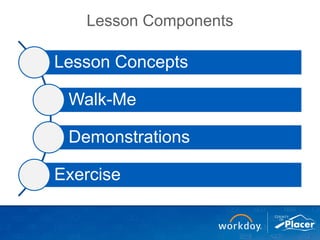
Lesson Components
Getting Started Basics
Lessons
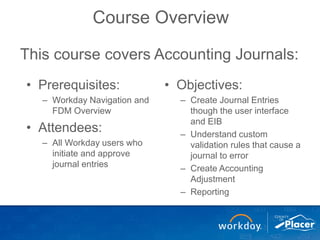
Course Overview
• Prerequisites:
– Workday Navigation and
FDM Overview
• Attendees:
– All Workday users who
initiate and approve
journal entries
• Objectives:
– Create Journal Entries
though the user interface
and EIB
– Understand custom
validation rules that cause a
journal to error
– Create Accounting
Adjustment
– Reporting
This course covers Accounting Journals:
Lesson Components
Lesson Concepts
Walk-Me
Demonstrations
Exercise
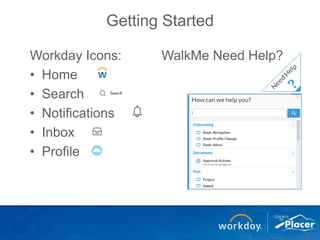
Getting Started
WalkMe Need Help?
Workday Icons:
• Home
• Search
• Notifications
• Inbox
• Profile
Lesson 1 – Journal Concepts
What’s New?
In this section you will learn:
– Differences between creating a journal in PAS vs Workday
using:
• User Interface (UI)
• Enterprise Interface Builder (EIB)
– How to run the “Find Journals” report
– How to create a journal in Workday
a) PAS numbering: JV123456 vs Workday: JE100-1234567
b) No T-Codes
c) Custom Validations
d) Attachments are required for all journals
e) All business approval processes in Workday
f) Journals (including EIB’s) post real time
g) Claim on Cash accounts
h) Accounting Journals vs. Operational Journals
Journal Concepts
Find Journals Report
• Used to find both accounting and operational
journals in the system
• Search parameters include
• Dates
• Journal Status (Completed, pending, etc.)
• Worktags and ledger Accounts used
• Originated by
• Approved by
• Can save filters and export to Excel
Instructor Demonstration 1
• Watch as your instructor
demonstrates how to run the
Find Journals Report in Workday
Training Exercise 1 – Find Journals
Report
• Log in to the Workday training tenant using
the credentials provided by the instructor
• Refer to your Exercise handout for detailed
instructions: Exercise 1: Find Journals
• Ask for assistance
Custom Validations
A set of rules and conditions which when
encountered will cause an error
Examples:
- Journals require attachments
- Journals should balance
- Income Statement Ledgers require Program, Cost Center,
Function, Fund, & Program Mandate Worktags
- Balance Sheet Ledgers only allow Fund, Project, & Grant
Worktags
Balancing Fund
• Assigning a balancing fund will automatically
create “Claim on Cash” lines for those journals that
cross funds.
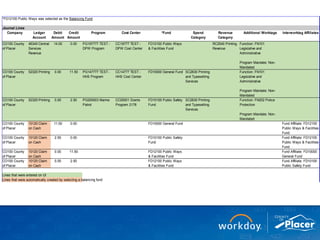
*FD12100 Public Ways was selected as the Balancing Fund
Journal Lines
Company Ledger
Account
Debit
Amount
Credit
Amount
Program Cost Center *Fund Spend
Category
Revenue
Category
Additional Worktags Interworktag Affiliates
CO100 County
of Placer
46340:Central
Services
Revenue
14.00 0.00 PG197777 TEST -
DPW Program
CC19777 TEST -
DPW Cost Center
FD12100 Public Ways
& Facilities Fund
RC2540 Printing
Revenue
Function: FN101
Legislative and
Administrative
Program Mandate: Non-
Mandated
CO100 County
of Placer
52320:Printing 0.00 11.50 PG147777 TEST -
HHS Program
CC14777 TEST -
HHS Cost Center
FD10000 General Fund SC2630 Printing
and Typesetting
Services
Function: FN101
Legislative and
Administrative
Program Mandate: Non-
Mandated
CO100 County
of Placer
52320:Printing 0.00 2.50 PG200003 Marine
Patrol
CC20001 Grants
Program 2178
FD10100 Public Safety
Fund
SC2630 Printing
and Typesetting
Services
Function: FN202 Police
Protection
Program Mandate: Non-
Mandated
CO100 County
of Placer
10120:Claim
on Cash
11.50 0.00 FD10000 General Fund Fund Affiliate: FD12100
Public Ways & Facilities
Fund
CO100 County
of Placer
10120:Claim
on Cash
2.50 0.00 FD10100 Public Safety
Fund
Fund Affiliate: FD12100
Public Ways & Facilities
Fund
CO100 County
of Placer
10120:Claim
on Cash
0.00 11.50 FD12100 Public Ways
& Facilities Fund
Fund Affiliate: FD10000
General Fund
CO100 County
of Placer
10120:Claim
on Cash
0.00 2.50 FD12100 Public Ways
& Facilities Fund
Fund Affiliate: FD10100
Public Safety Fund
Lines that were entered on UI
Lines that were automatically created by selecting a balancing fund
Instructor Demonstration 2 –
Create Journal Task
• Watch as your instructor demonstrates
how to create a basic journal in Workday
Training Exercise 2 to 4 – Create
Journal
• Refer to your Exercise handout for detailed
instructions:
• Exercise 2: Basic Journal
• Exercise 3: Journal Between Funds
• Exercise 4: Journal with Balance Sheet
• Ask for assistance
Lesson 2 – EIB’s
Enterprise Interface Builder
Instructor Demonstration 5 - EIB
• Watch as your instructor previews the
EIB file format and loads the file into
Workday
Training Exercise 5 – EIB
• Refer to your Exercise handout for detailed
instructions: Exercise 5: Upload an EIB
• Ask for assistance
Lesson 3 – Accounting
Adjustment
Accounting Adjustment
Accounting adjustment:
• Only corrects Worktags on a paid
invoice
• Does not correct dollar amounts or
quantities on supplier invoices which
have gone through the settlement
process
Instructor Demonstration 6
• Watch as your instructor performs:
finding an invoice and processing an
Accounting Adjustment
Training Exercise 6 – Process an
Accounting Adjustment
• Refer to your Exercise handout for detailed
instructions: Exercise 6: Create an
Accounting Adjustment
• Ask for assistance
Course Summary
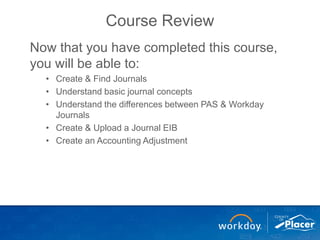
Course Review
Now that you have completed this course,
you will be able to:
• Create & Find Journals
• Understand basic journal concepts
• Understand the differences between PAS & Workday
Journals
• Create & Upload a Journal EIB
• Create an Accounting Adjustment
Survey Time
(est.120 seconds)
Thank you for attending
Workday Journal Entries

Journal entries (ppt)

  • 1.
  • 2.
    Welcome and Introductions Housekeeping •Course Length • Breaks • Safety Classroom etiquette: • Turn cell phones off or to vibrate • Refrain from e-mail and web surfing
  • 3.
  • 4.
    Course Overview • Prerequisites: –Workday Navigation and FDM Overview • Attendees: – All Workday users who initiate and approve journal entries • Objectives: – Create Journal Entries though the user interface and EIB – Understand custom validation rules that cause a journal to error – Create Accounting Adjustment – Reporting This course covers Accounting Journals:
  • 5.
  • 6.
    Getting Started WalkMe NeedHelp? Workday Icons: • Home • Search • Notifications • Inbox • Profile
  • 7.
    Lesson 1 –Journal Concepts
  • 8.
    What’s New? In thissection you will learn: – Differences between creating a journal in PAS vs Workday using: • User Interface (UI) • Enterprise Interface Builder (EIB) – How to run the “Find Journals” report – How to create a journal in Workday
  • 9.
    a) PAS numbering:JV123456 vs Workday: JE100-1234567 b) No T-Codes c) Custom Validations d) Attachments are required for all journals e) All business approval processes in Workday f) Journals (including EIB’s) post real time g) Claim on Cash accounts h) Accounting Journals vs. Operational Journals Journal Concepts
  • 10.
    Find Journals Report •Used to find both accounting and operational journals in the system • Search parameters include • Dates • Journal Status (Completed, pending, etc.) • Worktags and ledger Accounts used • Originated by • Approved by • Can save filters and export to Excel
  • 11.
    Instructor Demonstration 1 •Watch as your instructor demonstrates how to run the Find Journals Report in Workday
  • 12.
    Training Exercise 1– Find Journals Report • Log in to the Workday training tenant using the credentials provided by the instructor • Refer to your Exercise handout for detailed instructions: Exercise 1: Find Journals • Ask for assistance
  • 13.
    Custom Validations A setof rules and conditions which when encountered will cause an error Examples: - Journals require attachments - Journals should balance - Income Statement Ledgers require Program, Cost Center, Function, Fund, & Program Mandate Worktags - Balance Sheet Ledgers only allow Fund, Project, & Grant Worktags
  • 14.
    Balancing Fund • Assigninga balancing fund will automatically create “Claim on Cash” lines for those journals that cross funds.
  • 15.
    *FD12100 Public Wayswas selected as the Balancing Fund Journal Lines Company Ledger Account Debit Amount Credit Amount Program Cost Center *Fund Spend Category Revenue Category Additional Worktags Interworktag Affiliates CO100 County of Placer 46340:Central Services Revenue 14.00 0.00 PG197777 TEST - DPW Program CC19777 TEST - DPW Cost Center FD12100 Public Ways & Facilities Fund RC2540 Printing Revenue Function: FN101 Legislative and Administrative Program Mandate: Non- Mandated CO100 County of Placer 52320:Printing 0.00 11.50 PG147777 TEST - HHS Program CC14777 TEST - HHS Cost Center FD10000 General Fund SC2630 Printing and Typesetting Services Function: FN101 Legislative and Administrative Program Mandate: Non- Mandated CO100 County of Placer 52320:Printing 0.00 2.50 PG200003 Marine Patrol CC20001 Grants Program 2178 FD10100 Public Safety Fund SC2630 Printing and Typesetting Services Function: FN202 Police Protection Program Mandate: Non- Mandated CO100 County of Placer 10120:Claim on Cash 11.50 0.00 FD10000 General Fund Fund Affiliate: FD12100 Public Ways & Facilities Fund CO100 County of Placer 10120:Claim on Cash 2.50 0.00 FD10100 Public Safety Fund Fund Affiliate: FD12100 Public Ways & Facilities Fund CO100 County of Placer 10120:Claim on Cash 0.00 11.50 FD12100 Public Ways & Facilities Fund Fund Affiliate: FD10000 General Fund CO100 County of Placer 10120:Claim on Cash 0.00 2.50 FD12100 Public Ways & Facilities Fund Fund Affiliate: FD10100 Public Safety Fund Lines that were entered on UI Lines that were automatically created by selecting a balancing fund
  • 16.
    Instructor Demonstration 2– Create Journal Task • Watch as your instructor demonstrates how to create a basic journal in Workday
  • 17.
    Training Exercise 2to 4 – Create Journal • Refer to your Exercise handout for detailed instructions: • Exercise 2: Basic Journal • Exercise 3: Journal Between Funds • Exercise 4: Journal with Balance Sheet • Ask for assistance
  • 18.
    Lesson 2 –EIB’s Enterprise Interface Builder
  • 19.
    Instructor Demonstration 5- EIB • Watch as your instructor previews the EIB file format and loads the file into Workday
  • 20.
    Training Exercise 5– EIB • Refer to your Exercise handout for detailed instructions: Exercise 5: Upload an EIB • Ask for assistance
  • 21.
    Lesson 3 –Accounting Adjustment
  • 22.
    Accounting Adjustment Accounting adjustment: •Only corrects Worktags on a paid invoice • Does not correct dollar amounts or quantities on supplier invoices which have gone through the settlement process
  • 23.
    Instructor Demonstration 6 •Watch as your instructor performs: finding an invoice and processing an Accounting Adjustment
  • 24.
    Training Exercise 6– Process an Accounting Adjustment • Refer to your Exercise handout for detailed instructions: Exercise 6: Create an Accounting Adjustment • Ask for assistance
  • 25.
  • 26.
    Course Review Now thatyou have completed this course, you will be able to: • Create & Find Journals • Understand basic journal concepts • Understand the differences between PAS & Workday Journals • Create & Upload a Journal EIB • Create an Accounting Adjustment
  • 28.
  • 29.
    Thank you forattending Workday Journal Entries

Editor's Notes

  • #2 No Notes
  • #3 Say: Welcome to the Workday Journal Entries course. This course covers the Journal Entry process. The prerequisite for this course is the Workday Navigation and FDM Overview course. How many people have attended the Navigation and FDM course? My name is XXXX and I’m a XXXX with XXX Department. I will be your instructor today. First, I want to make sure that everyone is in the correct class and they have signed in This course was originally scheduled as a 2 hour class – we have a lot of content to cover and will do our best to complete on-time. We will ask if you would like to take a break, or continue on with the class halfway through Just a safety reminder – the exits are XXXXX Restrooms are located XXX We ask that everyone to please check that their cell phones are turned off or they are on vibrate. We really want you to get the most out of this session. Some final comments: Feel free to ask questions during this process – we ask you to state your name, dept and question before proceeding. We will repeat the question and then begin to answer We will make a listing all questions Some questions we will answer immediately - for those we cannot, we will post on the Parking Lot and get back to you.
  • #4 Say: Here is today’s agenda. This is the way each course will be organized. We will first share: Course overview – what the course will cover Talk about the specific lesson components We will review the “getting started basics” And then jump into the Lessons
  • #5 Say: This course focuses on Journal Entries Again, the prerequisite for this course is the Workday Navigation and FDM Overview course. Recommended attendees include all staff who will use Workday Financials for creating and managing Journal Entries The objectives of this course include: Create Journal Entries through the UI and EIB’s – We will have several exercises where you will create journals in the system Custom Validations and rules that will cause Workday errors Creating Accounting Adjustments Journal Reporting
  • #6 Say: This is the standard format for all Lessons What are Lesson components? Lesson concepts using PPT slides explain concepts, processes, and tasks. We will be using WalkMe (a digital training enhancement that sits on top of Workday) to support our demonstration. We will call out when we are using this tool so you can use it while performing your normal job after go-live. You will have access later to: the recorded session, the power point slides, the Walkme training support. For Demonstrations, we will demonstrate several processes in the Workday training tenant. And then exercises will give you a chance to do actual transactions in Workday.
  • #7 SAY: Here’s a quick refresher of the Workday Home Page icons as a reminder. On the left is: Home will always take you to the home page (save your work or you may lose it) Search allows you to enter data and get results Notifications are informational messages to you that do not require action Inbox contains message that require Action! Once the action is done, it goes in your Archive folder Your Profile allows you to see data specific to you and set various preferences On the right is: Walkme Need Help will provide interactive assistance if you choose to use it for a walkthru
  • #9 Say: In this section you will learn: The Difference between creating a journal in PAS vs Workday using: User Interface (UI) Enterprise Interface Builder (EIB) How to run the “Find Journals” report How to create a journal in Workday
  • #10 SAY: Now lets cover Journal Concepts: Lets begin by going over the difference in naming and coding standards In PAS – Journals are called Journal Vouchers. In Workday – they are called Journal Entries In PAS – the coding structure is JV123456 In Workday – the coding structure is JE100 – 1234567. The three digits after “JE” identify the Company number. Ex. CO100 = County of Placer T-Codes T-Codes will not be used. This will be a new concept, and users will need to know the correct debit and credit side of their transaction Custom Validations Custom validations are rules built behind the scenes which will cause an error to appear. Please see custom validation list. One of those custom validations is… Attachments Another new concept. Workday has the capability to add attachments to journals through the UI, and those attachments will be accessible throughout the BP, and also after completion (final post). This means that there is little to no need to print out journals and their attachments, as workday will be the system of record. SAVES PAPER! All auditing of transactions and attachments will be done in Workday Journals require attachments and will error if none is attached. For those that do not have access to Workday (mostly special districts), there is no change to the current process and you will have to submit your journal form and attachments as necessary. For confidential items – there will be no change to the current process – most confidential docs are kept within the department Business Process (the Approval process) The approval process is online. Approvers and reviewers can approve, send back, deny, save for later, etc. EIB’s post real time EIB’s = Excel Interfaces. EIB’s do not need to run through an overnight batch, and once approved at the Auditor’s office, you will be able to see the activity on the books. Claim on Cash Instead of hitting the “Cash” account (which will now be used for bank reconciliation and track cash per bank account) when moving cash between funds (and projects, grants) the “Claim on Cash” Account will be used. Accounting Journals vs. Operational Journals (terminology) Accounting Journals are journals created using the create journal task Operational Journals are journals created automatically as a result of a task being completed. (Ex. Payment of an invoice has passed final approval and posted – DR exp CR payable. Check has been cut DR payable CR cash)
  • #11 Used to find both accounting and operational journals in the system Search parameters include Dates Journal Status (Completed, pending, etc.) Worktags and ledger Accounts used Originated by Approved by Can create and save filters and export to excel as needed
  • #12 Say: I will now demo the report Follow exercise 1
  • #13  Say: Please log in. To log in: you username on the label in your training area The password is Trn@1234 There will be two parts to this exercise. First will be to run the report using a specific set of parameters Second will be to re-run the report with a different set of parameters and download two attachments which will be used for a later exercise This should take about 10 mins to complete – Including logging everyone in. Do: Walk around the room to help participants as needed.
  • #14 SAY: Another concept is Custom Validations. Validations are a set of rules and conditions which when not satisfied will cause an error Examples: Journals require attachments Journals should balance Income Statement Ledgers require Program, Cost Center, Function, Fund, & Program Mandate Worktags Balance Sheet Ledgers only allow Fund, Project, & Grant Worktags Balance Sheet Validations is a new concept for the County because we now need to know which fund the journal will hit. A tip is to use the program worktag to drive your related fund, then deleting all worktags from the line except the fund. A list of custom validation errors will be on the custom validation handout.
  • #15 SAY: Now lets talk about the Journal Concept of Balancing Funds: Assigning a balancing fund will automatically create “Claim on Cash” lines for those journals that cross funds.
  • #16 This journal transfers cash between funds, therefore, we need to use the claim on cash ledger accounts. Green Lines (top 3 lines) = Lines entered through the UI Bottom 4 lines = claim on cash lines automatically created by the system
  • #17 Do: Use exercise 2 – Create a basic journal Explain the fields as you go along Ledger – These are your different books by company Actuals = actual spent Commitment = Pre Encumbrance like Requisitions Obligation = Encumbrance like Contracts Accounting Date – Post Date Journal Source = Doc Type. You will be using “manual journal” for most journals Balancing Fund – Used to automatically create the “Claim on Cash” Lines. There will be an exercise for this later Memo & External Reference ID – Free for text fields Record Quantity – Not Used. You can leave blank Multicurrency – Not used Tax Lines – Not Used Disable optional balancing – Not used Adjustment Journal – Month 13 checkbox Create reversal – have Workday automatically create a reversal journal on a specified date. Control amount – a balancing tool to cross check one side of your journal (either debit or credit). Also, not required.
  • #18 Say: You will be creating three journals. Exercise 2 is a basic journal Exercise 3 is a journal between funds which uses the “Balancing Worktag” function Update to exercise 3 – clicking any (+) sign creates a copy of the bottom line instead of creating a new blank line. Exercise 4 is a journal with a balance sheet ledger account Follow your exercise handouts to complete the exercise. This should take about 20 mins to complete. Do: Walk around the room to help participants as needed.
  • #20 SAY: We will jump straight into a demo for this lesson. DO: Exercise 5 Open EIB Sample 1 File Explain Briefly first tab matches all the fields from the header screen on the user interface Second tab is the line item entry screen Open EIB Sample 2 File Note that the header key column denotes a unique journal. In this example, we are creating 5 unique journals. On the 2nd tab, the header ties the line items to each individual journal Note: Each JE goes through it’s own BP. In this example, there will be 5 different inbox items for each journal that will need to be approved. Upload to Workday * Follow exercise 5
  • #21 Say: Follow your exercise handouts to complete the exercise. This should take about 10 mins to complete. Do: Walk around the room to help participants as needed.
  • #23 SAY: An Accounting adjustment is a task in Workday to correct only Worktags (not dollar amounts) on supplier invoices which have gone through the settlement process This would facilitate processing reclass journals.
  • #24 Say: Let’s process an accounting adjustment Do Exercise 6
  • #25 Say: Follow your exercise handouts to complete the exercise. This should take about 5 mins to complete. There will be a printed list of invoice numbers which each person can use. Hand out one invoice number per person. If users are having issues with the invoice numbers not showing up when typing the number in the search bar, they may need to change the search results to “All of Workday” Do: Walk around the room to help participants as needed.
  • #27 Say: Now that you have completed this course, you will be able to: Create & Find Journals Understand basic journal concepts Understand the differences between PAS & Workday Journals Create & Upload a Journal EIB Create an Accounting Adjustment
  • #28 SAY: Does anyone have any questions about this course? Do: Record any additional questions or requests for information on the Parking Lot.
  • #29 SAY: It’s Survey Time! Please take a minute or two to provide your feedback on this course – we really appreciate it! Instructions: Log out of Workday or go to the Workday Login Screen On the RIGHT side of the screen is a surveymonkey link in blue – that will take you directly to the survey Select todays course: Journal Entries And answer the 10 questions
  • #30 Woot woot!