EXTENDED PROJECT,
 PROGRAM AND PORTFOLIO
MANAGEMENT FRAMEWORK
NASA Project Management Challenge 2012
                   February 22 – 23, 2012
                           Jouko Vaskimo
                    jouko.vaskimo@ixonos.com
CONCEPTS:
• The following concepts are used in this presentation as defined by the Merriam-
  Webster on-line dictionary (www.merriam-webster.com):
    •   framework: a basic conceptional structure (as of ideas); a skeletal, openwork, or
        structural frame
    •   methodology: a body of methods, rules, and postulates employed by a discipline; a
        particular procedure or set of procedures
    •   endeavor: serious determined effort; activity directed toward a goal; enterprise
• The term framework is used to refer to a conceptual structure, comprising functional
  principles, ideological arrangements and/or graphic illustrations forming a platform on
  which project, program and/or a portfolio management methodologies may be based.
• The term methodology is used to refer to a system of recognized tools, processes and
  practices, typically based on a given conceptual framework while targeting to enhance
  project and/or program and/or portfolio effectiveness and to increase the probability
  of success, applied in a coherent and coordinated way to obtain benefits not available
  from employing them individually.
• The term endeavor is used to refer to a project, a program, or a portfolio in general,
  especially when referring to any one of them. In this presentation endeavor is most
  often used to replace the expression project and/or program and/or portfolio.
                                                                            © Jouko Vaskimo 2012
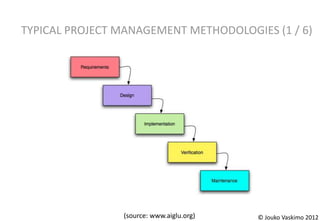
TYPICAL PROJECT MANAGEMENT METHODOLOGIES (1 / 6)


                (source: www.aiglu.org)   © Jouko Vaskimo 2012
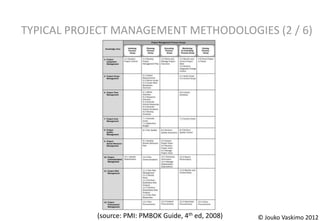
TYPICAL PROJECT MANAGEMENT METHODOLOGIES (2 / 6)


            (source: PMI: PMBOK Guide, 4th ed, 2008)   © Jouko Vaskimo 2012
TYPICAL PROJECT MANAGEMENT METHODOLOGIES (2 / 6)


      “As a foundational reference, this standard is neither complete nor
       all-inclusive. This standard is a guide rather than a methodology.
  One can use different methodologies and tools to implement the framework.”

                  (PMI: PMBOK Guide, 4th ed, 2008, page 4)


                    (source: PMI: PMBOK Guide, 4th ed, 2008)       © Jouko Vaskimo 2012
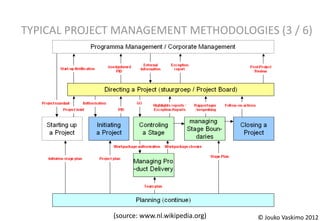
TYPICAL PROJECT MANAGEMENT METHODOLOGIES (3 / 6)


               (source: www.nl.wikipedia.org)   © Jouko Vaskimo 2012
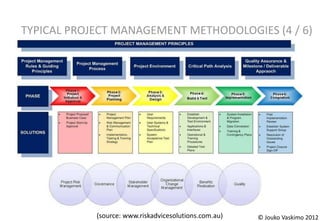
TYPICAL PROJECT MANAGEMENT METHODOLOGIES (4 / 6)


            (source: www.riskadvicesolutions.com.au)   © Jouko Vaskimo 2012
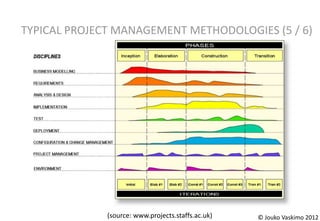
TYPICAL PROJECT MANAGEMENT METHODOLOGIES (5 / 6)


              (source: www.projects.staffs.ac.uk)   © Jouko Vaskimo 2012
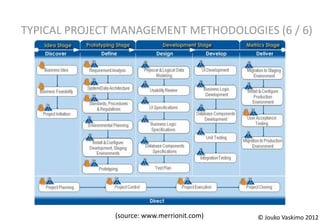
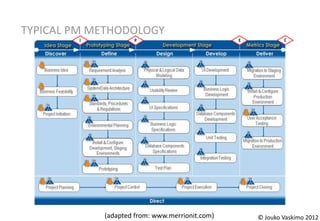
TYPICAL PROJECT MANAGEMENT METHODOLOGIES (6 / 6)


               (source: www.merrionit.com)   © Jouko Vaskimo 2012
TYPICAL CHALLENGES WITH FRAMEWORKS:
1. Challenges with the basic concepts of project management, program management
   and portfolio management deteriorate methodology foundation.
2. Challenges comprehending and communicating the differences between performing
   tasks to achieve intended results, and managing the performing of these tasks result
   in methodologies with limited capacity to distinguish between the two.
3. Challenges communicating the connection between a framework and appropriate
   components of a methodology, and how to develop, operate and maintain a
   methodology on the provided platform result in lack of connection between the
   framework and the methodology, and inadequate methodology structure.
4. Challenges understanding and communicating all pure generic project management,
   all pure generic program management, and all pure generic portfolio management is
   the same, respectively, if all business area, discipline, and life cycle related details are
   filtered out result in methodologies with highly specific and/or highly generic
   structures and contents, and a tradition of specialized endeavor management groups,
   each one assuming their concepts and procedures are unique, and impossible to
   understand, implement and develop outside the group.


                                                                            © Jouko Vaskimo 2012
TYPICAL CHALLENGES WITH METHODOLOGIES:
1. Methodologies treating and referring to the three basic concepts inconsistently and
   illogically endanger endeavor management performance.
2. Methodologies making it difficult, if not impossible for endeavor staff and
   stakeholders to distinguish between performing tasks, and managing the performing
   of tasks, jeopardize planning and controlling the time and resources for performing
   tasks and managing the performing of tasks.
3. Methodologies having less than optimum connection to a framework, and vice versa,
   result in less than optimum management performance, and frameworks beings used,
   as opposed to a methodology, to organize and support endeavor management.
4. Methodologies with highly specific structures and contents are likely to provide
   excellent organization and support, however, likely require substantial time and
   resources to establish, operate and maintain, and sometimes turn out “over specific”.
   Methodologies with highly generic structures and contents are likely to require little
   time and resources to establish, operate and maintain, however, they only provide
   limited organization and support.
   Methodologies mandating specialized endeavor management groups may create
   competing organizational subcultures and beliefs, and reduce the flexibility necessary
   to efficiently allocate management staff to endeavors.                © Jouko Vaskimo 2012
THE EXTENDED FRAMEWORK IS EXPECTED TO …
1. Enhance the understanding of the concepts of project management, program
   management and portfolio management, and especially the differences between the
   three. This offers a foundation for excellent endeavor management performance.
2. Highlight the differences between performing tasks to achieve an intended result, and
   managing the performing of these tasks. This allows balancing the time and
   resources spent on performing tasks and managing the performing of tasks.
3. Enable organizing individual methodology components in to complete methodologies.
4. Demonstrate all project management, all program management, and all portfolio
   management is alike, respectively, when all business area, discipline, and life cycle
   related issues are filtered out. This helps in providing a modular methodology
   structure, ensuring an appropriate level of organization and support, and combining
   any/all specialized endeavor management groups into one.
5. Provide a project, program and portfolio management methodology platform which:
  •   Exerts maximum explanatory power in to project, program and portfolio management
  •   Clarifies the complexity often associated with project, program and portfolio management
  •   Avoids introducing any new complexity into project, program and portfolio management
  •   Offers a platform for modular combining of framework and methodology components
  •   Paints an understandable “big picture” of project, program and portfolio management
                                                                             © Jouko Vaskimo 2012
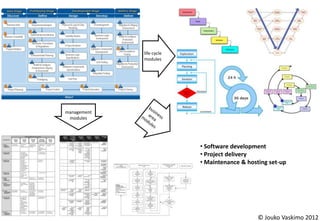
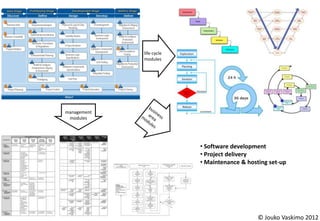
life-cycle
             modules


management
 modules


                          • Software development
                          • Project delivery
                          • Maintenance & hosting set-up


                                              © Jouko Vaskimo 2012
life-cycle
             modules


management
 modules


                          • Software development
                          • Project delivery
                          • Maintenance & hosting set-up


                                              © Jouko Vaskimo 2012
TYPICAL PM METHODOLOGY
        I           P                           E           C


            (adapted from: www.merrionit.com)       © Jouko Vaskimo 2012
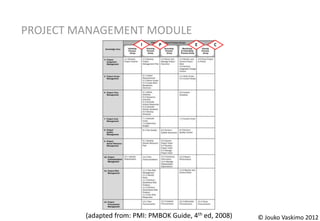
PROJECT MANAGEMENT MODULE
                          I    P           E     C


         (adapted from: PMI: PMBOK Guide, 4th ed, 2008)   © Jouko Vaskimo 2012
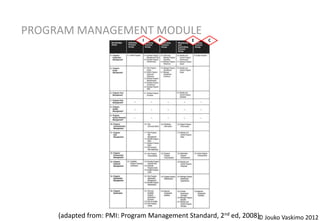
PROGRAM MANAGEMENT MODULE
                               I    P         E    C


     (adapted from: PMI: Program Management Standard, 2nd ed, 2008) Jouko Vaskimo 2012
                                                                  ©
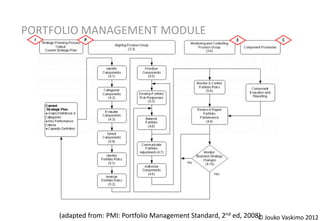
PORTFOLIO MANAGEMENT MODULE
 I           P                                               E              C


     (adapted from: PMI: Portfolio Management Standard, 2nd ed, 2008) Jouko Vaskimo 2012
                                                                    ©
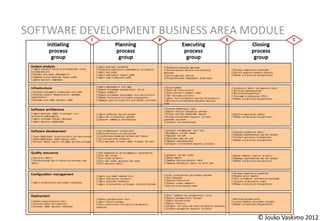
SOFTWARE DEVELOPMENT BUSINESS AREA MODULE


                                    © Jouko Vaskimo 2012
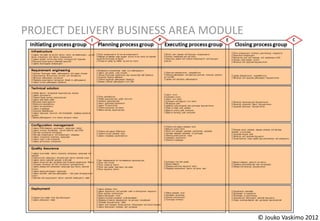
PROJECT DELIVERY BUSINESS AREA MODULE


                                        © Jouko Vaskimo 2012
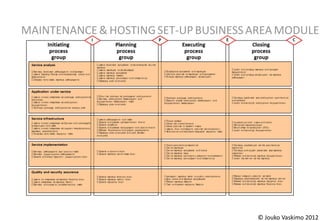
MAINTENANCE & HOSTING SET-UP BUSINESS AREA MODULE


                                      © Jouko Vaskimo 2012
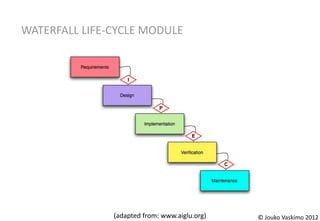
WATERFALL LIFE-CYCLE MODULE


                   I


                             P


                                       E


                                               C


               (adapted from: www.aiglu.org)       © Jouko Vaskimo 2012
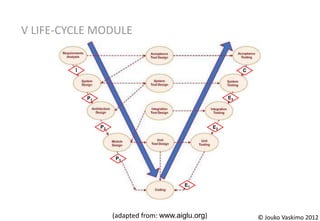
V LIFE-CYCLE MODULE


         I                                                       C


             P1                                             E3


                  P2                                   E2


                        P3


                                             E1


                       (adapted from: www.aiglu.org)                 © Jouko Vaskimo 2012
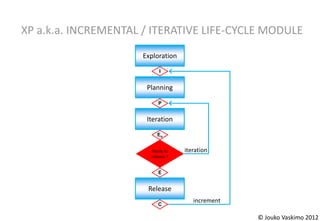
XP a.k.a. INCREMENTAL / ITERATIVE LIFE-CYCLE MODULE
                      Exploration
                            I


                       Planning

                           P


                       Iteration

                           En


                        Ready to    iteration
                        release ?


                           E


                       Release
                                       increment
                           C

                                                   © Jouko Vaskimo 2012
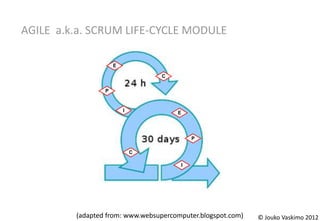
AGILE a.k.a. SCRUM LIFE-CYCLE MODULE

                     E

                                  C

                 P


                         I            E


                                           P

                             C

                                       I


         (adapted from: www.websupercomputer.blogspot.com)   © Jouko Vaskimo 2012
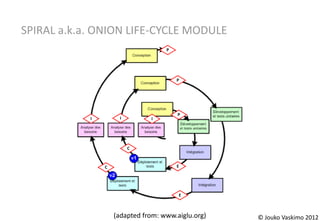
SPIRAL a.k.a. ONION LIFE-CYCLE MODULE
                                    P


                                        P


                                        P
            I        I         I


                         C


                C                       E


                                        E


                    (adapted from: www.aiglu.org)   © Jouko Vaskimo 2012
QUESTIONS ?

COMMENTS ?


              © Jouko Vaskimo 2012
THANK YOU !


In case you have further interest in this material, kindly contact me at jouko.vaskimo@ixonos.com.

                                                                                   © Jouko Vaskimo 2012

Jouko vaskimo

  • 1.
    EXTENDED PROJECT, PROGRAMAND PORTFOLIO MANAGEMENT FRAMEWORK NASA Project Management Challenge 2012 February 22 – 23, 2012 Jouko Vaskimo jouko.vaskimo@ixonos.com
  • 2.
    CONCEPTS: • The followingconcepts are used in this presentation as defined by the Merriam- Webster on-line dictionary (www.merriam-webster.com): • framework: a basic conceptional structure (as of ideas); a skeletal, openwork, or structural frame • methodology: a body of methods, rules, and postulates employed by a discipline; a particular procedure or set of procedures • endeavor: serious determined effort; activity directed toward a goal; enterprise • The term framework is used to refer to a conceptual structure, comprising functional principles, ideological arrangements and/or graphic illustrations forming a platform on which project, program and/or a portfolio management methodologies may be based. • The term methodology is used to refer to a system of recognized tools, processes and practices, typically based on a given conceptual framework while targeting to enhance project and/or program and/or portfolio effectiveness and to increase the probability of success, applied in a coherent and coordinated way to obtain benefits not available from employing them individually. • The term endeavor is used to refer to a project, a program, or a portfolio in general, especially when referring to any one of them. In this presentation endeavor is most often used to replace the expression project and/or program and/or portfolio. © Jouko Vaskimo 2012
  • 3.
    TYPICAL PROJECT MANAGEMENTMETHODOLOGIES (1 / 6) (source: www.aiglu.org) © Jouko Vaskimo 2012
  • 4.
    TYPICAL PROJECT MANAGEMENTMETHODOLOGIES (2 / 6) (source: PMI: PMBOK Guide, 4th ed, 2008) © Jouko Vaskimo 2012
  • 5.
    TYPICAL PROJECT MANAGEMENTMETHODOLOGIES (2 / 6) “As a foundational reference, this standard is neither complete nor all-inclusive. This standard is a guide rather than a methodology. One can use different methodologies and tools to implement the framework.” (PMI: PMBOK Guide, 4th ed, 2008, page 4) (source: PMI: PMBOK Guide, 4th ed, 2008) © Jouko Vaskimo 2012
  • 6.
    TYPICAL PROJECT MANAGEMENTMETHODOLOGIES (3 / 6) (source: www.nl.wikipedia.org) © Jouko Vaskimo 2012
  • 7.
    TYPICAL PROJECT MANAGEMENTMETHODOLOGIES (4 / 6) (source: www.riskadvicesolutions.com.au) © Jouko Vaskimo 2012
  • 8.
    TYPICAL PROJECT MANAGEMENTMETHODOLOGIES (5 / 6) (source: www.projects.staffs.ac.uk) © Jouko Vaskimo 2012
  • 9.
    TYPICAL PROJECT MANAGEMENTMETHODOLOGIES (6 / 6) (source: www.merrionit.com) © Jouko Vaskimo 2012
  • 10.
    TYPICAL CHALLENGES WITHFRAMEWORKS: 1. Challenges with the basic concepts of project management, program management and portfolio management deteriorate methodology foundation. 2. Challenges comprehending and communicating the differences between performing tasks to achieve intended results, and managing the performing of these tasks result in methodologies with limited capacity to distinguish between the two. 3. Challenges communicating the connection between a framework and appropriate components of a methodology, and how to develop, operate and maintain a methodology on the provided platform result in lack of connection between the framework and the methodology, and inadequate methodology structure. 4. Challenges understanding and communicating all pure generic project management, all pure generic program management, and all pure generic portfolio management is the same, respectively, if all business area, discipline, and life cycle related details are filtered out result in methodologies with highly specific and/or highly generic structures and contents, and a tradition of specialized endeavor management groups, each one assuming their concepts and procedures are unique, and impossible to understand, implement and develop outside the group. © Jouko Vaskimo 2012
  • 11.
    TYPICAL CHALLENGES WITHMETHODOLOGIES: 1. Methodologies treating and referring to the three basic concepts inconsistently and illogically endanger endeavor management performance. 2. Methodologies making it difficult, if not impossible for endeavor staff and stakeholders to distinguish between performing tasks, and managing the performing of tasks, jeopardize planning and controlling the time and resources for performing tasks and managing the performing of tasks. 3. Methodologies having less than optimum connection to a framework, and vice versa, result in less than optimum management performance, and frameworks beings used, as opposed to a methodology, to organize and support endeavor management. 4. Methodologies with highly specific structures and contents are likely to provide excellent organization and support, however, likely require substantial time and resources to establish, operate and maintain, and sometimes turn out “over specific”. Methodologies with highly generic structures and contents are likely to require little time and resources to establish, operate and maintain, however, they only provide limited organization and support. Methodologies mandating specialized endeavor management groups may create competing organizational subcultures and beliefs, and reduce the flexibility necessary to efficiently allocate management staff to endeavors. © Jouko Vaskimo 2012
  • 12.
    THE EXTENDED FRAMEWORKIS EXPECTED TO … 1. Enhance the understanding of the concepts of project management, program management and portfolio management, and especially the differences between the three. This offers a foundation for excellent endeavor management performance. 2. Highlight the differences between performing tasks to achieve an intended result, and managing the performing of these tasks. This allows balancing the time and resources spent on performing tasks and managing the performing of tasks. 3. Enable organizing individual methodology components in to complete methodologies. 4. Demonstrate all project management, all program management, and all portfolio management is alike, respectively, when all business area, discipline, and life cycle related issues are filtered out. This helps in providing a modular methodology structure, ensuring an appropriate level of organization and support, and combining any/all specialized endeavor management groups into one. 5. Provide a project, program and portfolio management methodology platform which: • Exerts maximum explanatory power in to project, program and portfolio management • Clarifies the complexity often associated with project, program and portfolio management • Avoids introducing any new complexity into project, program and portfolio management • Offers a platform for modular combining of framework and methodology components • Paints an understandable “big picture” of project, program and portfolio management © Jouko Vaskimo 2012
  • 13.
    life-cycle modules management modules • Software development • Project delivery • Maintenance & hosting set-up © Jouko Vaskimo 2012
  • 14.
    life-cycle modules management modules • Software development • Project delivery • Maintenance & hosting set-up © Jouko Vaskimo 2012
  • 15.
    TYPICAL PM METHODOLOGY I P E C (adapted from: www.merrionit.com) © Jouko Vaskimo 2012
  • 16.
    PROJECT MANAGEMENT MODULE I P E C (adapted from: PMI: PMBOK Guide, 4th ed, 2008) © Jouko Vaskimo 2012
  • 17.
    PROGRAM MANAGEMENT MODULE I P E C (adapted from: PMI: Program Management Standard, 2nd ed, 2008) Jouko Vaskimo 2012 ©
  • 18.
    PORTFOLIO MANAGEMENT MODULE I P E C (adapted from: PMI: Portfolio Management Standard, 2nd ed, 2008) Jouko Vaskimo 2012 ©
  • 19.
    SOFTWARE DEVELOPMENT BUSINESSAREA MODULE © Jouko Vaskimo 2012
  • 20.
    PROJECT DELIVERY BUSINESSAREA MODULE © Jouko Vaskimo 2012
  • 21.
    MAINTENANCE & HOSTINGSET-UP BUSINESS AREA MODULE © Jouko Vaskimo 2012
  • 22.
    WATERFALL LIFE-CYCLE MODULE I P E C (adapted from: www.aiglu.org) © Jouko Vaskimo 2012
  • 23.
    V LIFE-CYCLE MODULE I C P1 E3 P2 E2 P3 E1 (adapted from: www.aiglu.org) © Jouko Vaskimo 2012
  • 24.
    XP a.k.a. INCREMENTAL/ ITERATIVE LIFE-CYCLE MODULE Exploration I Planning P Iteration En Ready to iteration release ? E Release increment C © Jouko Vaskimo 2012
  • 25.
    AGILE a.k.a. SCRUMLIFE-CYCLE MODULE E C P I E P C I (adapted from: www.websupercomputer.blogspot.com) © Jouko Vaskimo 2012
  • 26.
    SPIRAL a.k.a. ONIONLIFE-CYCLE MODULE P P P I I I C C E E (adapted from: www.aiglu.org) © Jouko Vaskimo 2012
  • 27.
    QUESTIONS ? COMMENTS ? © Jouko Vaskimo 2012
  • 28.
    THANK YOU ! Incase you have further interest in this material, kindly contact me at jouko.vaskimo@ixonos.com. © Jouko Vaskimo 2012