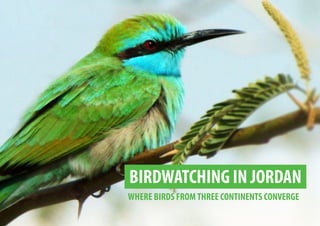
BIRDWATCHING IN JORDAN
WHERE BIRDS FROMTHREE CONTINENTS CONVERGE
Fifa
Azraq Reserve
Ajlun Reserve
Ajloun Jarash
Wadi Mujib
Dana Nature
Reserve
Rajel
Burqu
Bayer
Abu Rukbeh
Wadi Ibn Hammad
Rahmah
Rum
Qatar
Aqaba
Mountains
Yarmouk
Shaumari Wildlife Reserve
Shobak
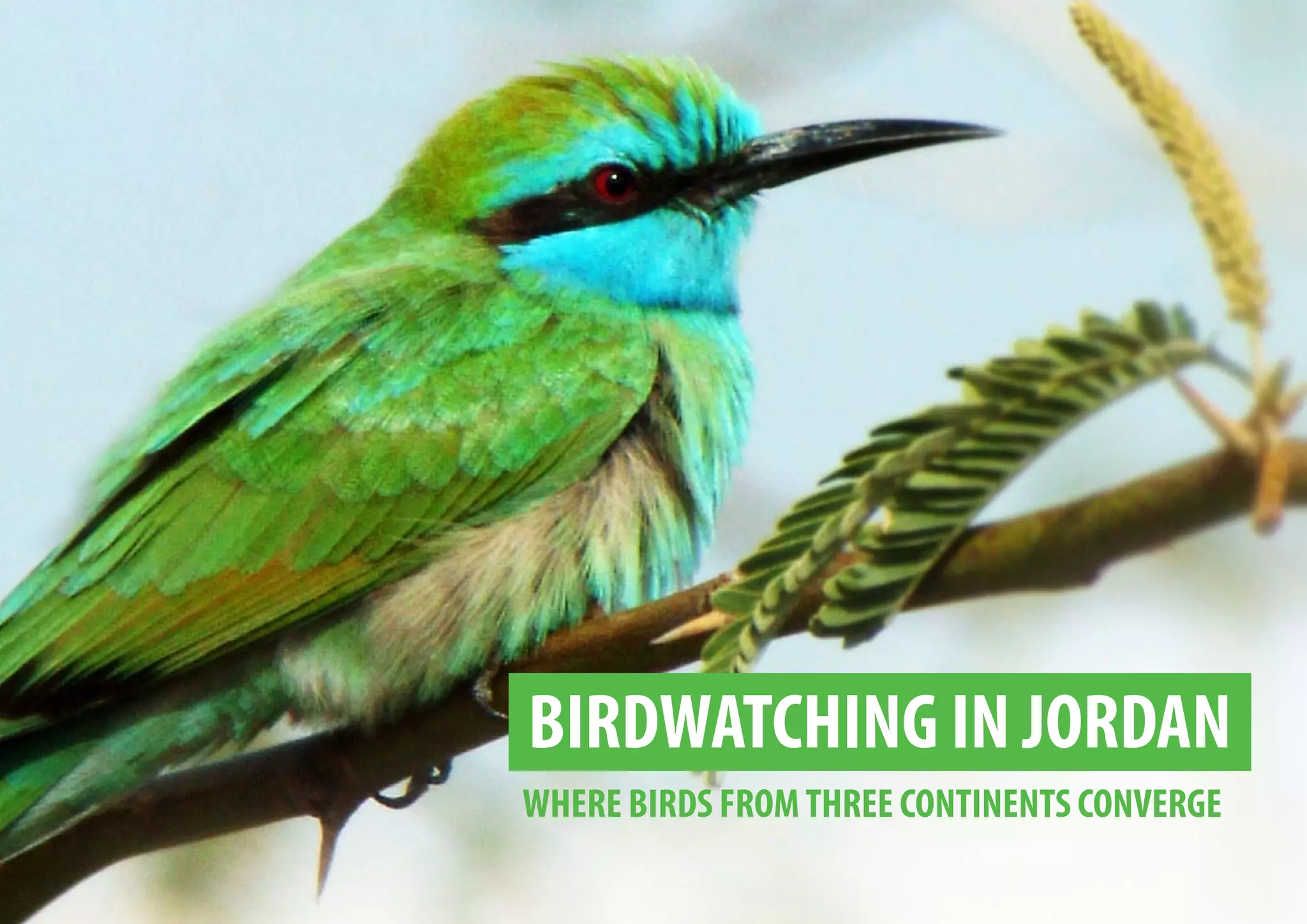
BIRDING IN JORDAN
Jordan has a unique location, nestled at the tip of the Arabian Peninsula
wheretheedgesofthreecontinentsoverlap:Asia,AfricaandEurope.This
small country lies at the heart of major bird migratory routes and has a
diversegeologyandnaturallandscapeaswell,whichhostsalargevariety
of flora and fauna including numerous bird species. Remnants of the rich
history of the area are scattered throughout the entire country, and thus
mostofthemainbirdingsitesinJordanarewithinornearmajortourism
attractions.
The people of Jordan are warm and hospitable, and they are keenly
aware of their rich natural heritage and go to great lengths to protect it
and ensure its continued well-being. For this reason, several large nature
reserves have been set up and are professionally managed, in order to
minimize negative impacts on the natural habitats and rare species of
Jordan’sfloraandfauna.
In Jordan, 27 Important Bird Areas (as per the Birdlife International
programme) have been identified by the Royal Society for Conservation
ofNature(RSCN),whichistheBirdLifePartnerinJordan.TheseIBAscover
an area of 7,600 km2
or 8.5% of Jordan’s surface area.The country’s IBAs
includeavarietyofnaturalhabitatsthatshouldorarebeingconserved
tosustainsignificantbirdpopulationsinthecountry.
JORDAN
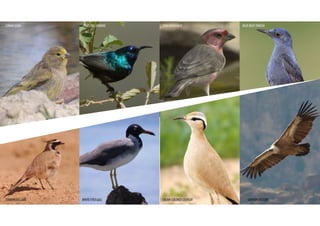
SYRIANSERIN
TEMMINCK’SLARK WHITEEYEDGULL CREAM-COLOREDCOURSER GRIFFONVULTURE
PALESTINESUNBIRD SINAIROSEFINCH BLUEROCKTHRUSH
WHATTO LOOK OUT FOR
Jordan is a great destination for bird-lovers and dedicated birdwatchers.
Its remarkable variety of habitats, from rugged mountains and evergreen
woodlands to scrubby steppe, hot dry deserts and the subtropical Jordan
valley, provide the perfect environments for many species of indigenous
birds.
Located at the crossroad of Europe, Asia and Africa means that migrating
birds funnel through the rift valley from these three continents and can
sometimes be seen together in the same general area.
Morethan435speciesofbirdshavebeenrecordedinJordan,ofwhicharound
70areresident,21aremigrantandpresentduringthenon-breedingseason,
and almost 350 are migratory, passing through between their breeding and
non-breeding grounds. Some of these migrant birds end their migration
journey in Jordan to breed. Migration is not limited to large birds; migratory
speciespassingoverJordanrangefromImperialEaglesandWhitePelicansto
GardenWarblers,WhiteWagtails and everything in between.
Two different migration periods can be distinguished. During the spring
migration, huge flocks of raptors can be observed, such as the Steppe
Buzzard, Honey Buzzard, Steppe Eagle and Levant Sparrowhawk. In the
autumn migration flocks of Steppe Eagle use the Jordan Valley to continue
their journey from Europe to Africa, in addition to hundreds of Montagu’s
Harrier and Pallid Harrier, which cross the eastern desert plateau.
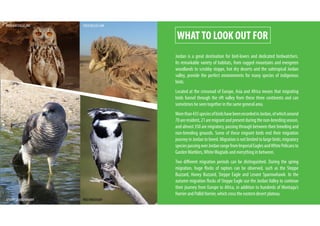
LEVANTSPARROWHAWK‫‏‬ PIEDKINGFISHER
PHARAOHEAGLEOWL THICKBILLEDLARK
THE MAIN BIRDING SITES
Most places in Jordan offer opportunities for bird watching and with
major shifts in landscape and nature within short distances, there is
much diversity as you move around the country. However, there are a
number of key sites for bird watching that together host a wide cross-
section of the country’s breeding and migrant birds.
The birdwatching sites presented here are easily accessible and
represent the main habitat types found in Jordan. Birds highlighted to
lookoutforarespecialtieswithinthesitestheyarelistedunderandare
relatively easily seen.Those listed under “Be one of the few to record”
offer a challenge to the avid birdwatcher to spot, as they are rarer and
have been reported by bird observers and anthropologists.
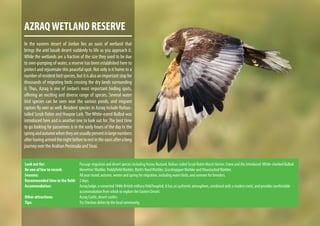
AZRAQWETLAND RESERVE
In the eastern desert of Jordan lies an oasis of wetland that
brings the arid basalt desert suddenly to life as you approach it.
While the wetlands are a fraction of the size they used to be due
to over-pumping of water, a reserve has been established here to
protect and rejuvenate this peaceful spot. Not only is it home to a
number of resident bird species, but it is also an important stop for
thousands of migrating birds crossing the dry lands surrounding
it. Thus, Azraq is one of Jordan’s most important birding spots,
offering an exciting and diverse range of species. Several water
bird species can be seen near the various ponds, and migrant
raptors fly over as well. Resident species in Azraq include Rufous-
tailed Scrub Robin and Hoopoe Lark. The White-eared Bulbul was
introduced here and is another one to look out for. The best time
to go looking for passerines is in the early hours of the day in the
springandautumnwhentheyareusuallypresentinlargenumbers
afterhavingarrivedthenightbeforetorestintheoasisafteralong
journey over the Arabian Peninsula and Sinai.
Look out for:			 Passage migration and desert species including Honey Buzzard, Rufous-tailed Scrub Robin Marsh Harrier, Crane and the introduced White-cheeked Bulbul.
Be one of few to record:		 Menetries’Warbler, PaddyfieldWarbler, Blyth’s ReedWarbler, GrasshoppperWarbler and MoustachedWarbler.
Seasons: 			 All year round; autumn, winter and spring for migration, including water birds, and summer for breeders.
Recommended time in the field: 	 2 days.
Accommodation: 		 Azraq lodge, a converted 1940s British military field hospital. It has an authentic atmosphere, combined with a modern twist, and provides comfortable
				 accommodation from which to explore the Eastern Desert.
Other attractions: 		 Azraq Castle, desert castles.
Tips: 				Try Chechan dishes by the local community.
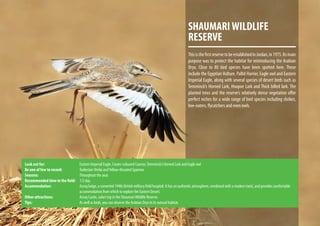
SHAUMARIWILDLIFE
RESERVE
ThisisthefirstreservetobeestablishedinJordan,in1975.Itsmain
purpose was to protect the habitat for reintroducing the Arabian
Oryx. Close to 80 bird species have been spotted here. These
include the Egyptian Vulture, Pallid Harrier, Eagle owl and Eastern
Imperial Eagle, along with several species of desert birds such as
Temminck’s Horned Lark, Hoopoe Lark and Thick billed lark. The
planted trees and the reserve’s relatively dense vegetation offer
perfect niches for a wide range of bird species including shrikes,
bee-eaters, flycatchers and even owls.
Look out for:			 Eastern Imperial Eagle, Cream-coloured Courser,Temminck’s Horned Lark and Eagle owl
Be one of few to record:		 Turkestan Shrike andYellow-throated Sparrow.
Seasons:			Throughout the year.
Recommended time in the field:	 1/2 day.
Accommodation:			 Azraq lodge, a converted 1940s British military field hospital. It has an authentic atmosphere, combined with a modern twist, and provides comfortable
				 accommodation from which to explore the Eastern Desert.
Other attractions:		 Azraq Castle, safari trip in the ShaumariWildlife Reserve.
Tips:				As well as birds, you can observe the Arabian Oryx in its natural habitat.
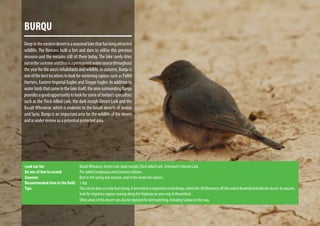
BURQU
Deepintheeasterndesertisaseasonallakethathaslongattracted
wildlife. The Romans built a fort and dam to utilize this precious
resource and the remains still sit there today. The lake rarely dries
outinthesummerandthusisapermanentwatersourcethroughout
theyearforthearea’sinhabitantsandwildlife.Inautumn,Burquis
oneofthebestlocationstolookforwinteringraptorssuchasPallid
Harriers, Eastern Imperial Eagles and Steppe Eagles. In addition to
waterbirdsthatcometothelakeitself,theareasurroundingBurqu
providesagoodopportunitytolookforsomeofJordan’sspecialties
such as the Thick-billed Lark, the dark morph Desert Lark and the
Basalt Wheatear, which is endemic to the basalt deserts of Jordan
and Syria. Burqu is an important area for the wildlife of the desert
and is under review as a potential protected area.
Look out for:			 BasaltWheatear, Desert Lark (dark morph),Thick-billed Lark,Temminck’s Horned Lark.
Be one of few to record:		 Pin-tailed Sandgrouse and CinereousVulture.
Seasons:			Best in the spring and autumn, and in the winter for raptors.
Recommended time in the field:	 1 day.
Tips:				ThiscanbedoneasatripfromAzraq.A4x4vehicleisrequiredtoreachBurqu,whichlies20kilometersofftheroadtoRuweishedinsidethedesert.Inautumn,
				 look for migratory raptors soaring along the highway on your way to Ruweished .
				 Other areas of this desert can also be explored for bird watching, including Safawi on the way.
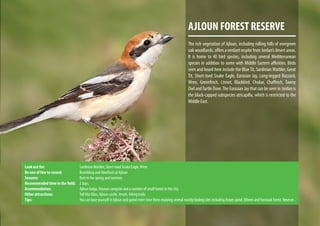
AJLOUN FOREST RESERVE
The rich vegetation of Ajloun, including rolling hills of evergreen
oak woodlands, offers a verdant respite from Jordan’s desert areas.
It is home to 40 bird species, including several Mediterranean
species in addition to some with Middle Eastern affinities. Birds
seen and heard here include the BlueTit, SardinianWarbler, Great
Tit, Short-toed Snake Eagle, Eurasian Jay, Long-legged Buzzard,
Wren, Greenfinch, Linnet, Blackbird, Chukar, Chaffinch, Tawny
Owl andTurtle Dove.The Eurasian Jay that can be seen in Jordan is
the black-capped subspecies atricapilla, which is restricted to the
Middle East.
Look out for:			 SardinianWarbler, Short-toed Snake Eagle,Wren
Be one of few to record:		 Brambling and Hawfinch at Ajloun
Seasons:			Best in the spring and summer.
Recommended time in the field:	 2 days.
Accommodation:			 Ajloun lodge, Rasoun campsite and a number of small hotels in the city.
Other attractions: 		 Tell Mar Elias, Ajloun castle, Jerash, hiking trails.
Tips:				YoucanbaseyourselfinAjlounandspendmoretimethereenjoyingseveralnearbybirdingsitesincludingArayespond,DibeenandYarmoukForest Reserve.
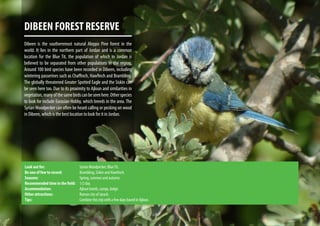
DIBEEN FOREST RESERVE
Dibeen is the southernmost natural Aleppo Pine forest in the
world. It lies in the northern part of Jordan and is a common
location for the Blue Tit, the population of which in Jordan is
believed to be separated from other populations in the region.
Around 100 bird species have been recorded in Dibeen, including
wintering passerines such as Chaffinch, Hawfinch and Brambling.
The globally threatened Greater Spotted Eagle and the Siskin can
be seen here too. Due to its proximity to Ajloun and similarities in
vegetation,manyofthesamebirdscanbeseenhere.Otherspecies
to look for include Eurasian Hobby, which breeds in the area. The
SyrianWoodpecker can often be heard calling or pecking on wood
in Dibeen, which is the best location to look for it in Jordan.
Look out for:			 SyrianWoodpecker, BlueTit.
Be one of few to record:		 Brambling, Siskin and Hawfinch.
Seasons:			Spring, summer and autumn.
Recommended time in the field:	 1/2 day.
Accommodation:			 Ajloun hotels, camps, lodge.
Other attractions:		 Roman city of Jarash.
Tips:				Combine this trip with a few days based in Ajloun.
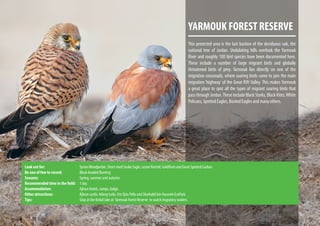
YARMOUK FOREST RESERVE
This protected area is the last bastion of the deciduous oak, the
national tree of Jordan. Undulating hills overlook the Yarmouk
River and roughly 100 bird species have been documented here.
These include a number of large migrant birds and globally
threatened birds of prey. Yarmouk lies directly on one of the
migration crossroads, where soaring birds come to join the main
migration ‘highway’ of the Great Rift Valley. This makes Yarmouk
a great place to spot all the types of migrant soaring birds that
pass through Jordan.These include Black Storks, Black Kites,White
Pelicans, Spotted Eagles, Booted Eagles and many others.
Look out for:			 SyrianWoodpecker, Short-toed Snake Eagle, Lesser Kestrel, Goldfinch and Great Spotted Cuckoo.
Be one of few to record:		 Black-headed Bunting
Seasons:			Spring, summer and autumn.
Recommended time in the field:	 1 day.
Accommodation:			 Ajloun hotels, camps, lodge.
Other attractions:		 Ajloun castle, hiking trails, Um Qais Pella and Sharhabil bin Hassneh EcoPark.
Tips:				Stop at the Bridal lake at Yarmouk Forest Reserve to watch migratory waders.
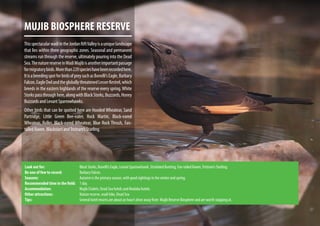
MUJIB BIOSPHERE RESERVE
ThisspectacularwadiintheJordanRiftValleyisauniquelandscape
that lies within three geographic zones. Seasonal and permanent
streams run through the reserve, ultimately pouring into the Dead
Sea.ThenaturereserveinWadiMujibisanotherimportantpassage
formigratorybirds.Morethan220specieshavebeenrecordedhere.
ItisabreedingspotforbirdsofpreysuchasBonelli’sEagle,Barbary
Falcon,EagleOwlandthegloballythreatenedLesserKestrel,which
breeds in the eastern highlands of the reserve every spring.White
Storkspassthroughhere,alongwithBlackStorks,Buzzards,Honey
Buzzards and Levant Sparrowhawks.
Other birds that can be spotted here are Hooded Wheatear, Sand
Partridge, Little Green Bee-eater, Rock Martin, Black-eared
Wheatear, Roller, Black-eared Wheatear, Blue Rock Thrush, Fan-
tailed Raven, Blackstart andTristram’s Starling.
Look out for:			 Black Storks, Bonelli’s Eagle, Levant Sparrowhawk, Striolated Bunting, Fan-tailed Raven,Tristram’s Starling.
Be one of few to record:		 Barbary Falcon.
Seasons:			Autumn is the primary season, with good sightings in the winter and spring.
Recommended time in the field:	 1 day.
Accommodation:			 Mujib Chalets, Dead Sea hotels and Madaba hotels.
Other attractions:		 Nature reserve, wadi hike, Dead Sea
Tips:				Several hotel resorts are about an hour’s drive away from Mujib Reserve Biosphere and are worth stopping at.
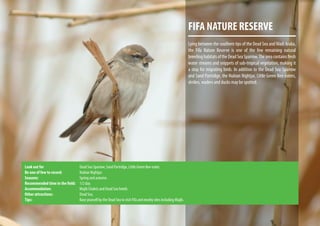
FIFA NATURE RESERVE
Lying between the southern tips of the Dead Sea andWadi Araba,
the Fifa Nature Reserve is one of the few remaining natural
breedinghabitatsoftheDeadSeaSparrow.Theareacontainsfresh
water streams and snippets of sub-tropical vegetation, making it
a stop for migrating birds. In addition to the Dead Sea Sparrow
and Sand Partridge, the Nubian Nightjar, Little Green Bee-eaters,
shrikes, waders and ducks may be spotted.
Look out for			 Dead Sea Sparrow, Sand Partridge, Little Green Bee-eater.
Be one of few to record:		 Nubian Nightjar.
Seasons:			Spring and autumn.
Recommended time in the field:	 1/2 day.
Accommodation:			 Mujib Chalets and Dead Sea hotels
Other attractions:		 Dead Sea.
Tips:				Base yourself by the Dead Sea to visit Fifa and nearby sites including Mujib.
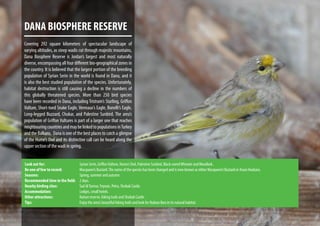
DANA BIOSPHERE RESERVE
Covering 292 square kilometers of spectacular landscape of
varying altitudes, as steep wadis cut through majestic mountains,
Dana Biosphere Reserve is Jordan’s largest and most naturally
diverse, encompassing all four different bio-geographical zones in
the country. It is believed that the largest portion of the breeding
population of Syrian Serin in the world is found in Dana, and it
is also the best studied population of the species. Unfortunately,
habitat destruction is still causing a decline in the numbers of
this globally threatened species. More than 250 bird species
have been recorded in Dana, including Tristram’s Starling, Griffon
Vulture, Short-toed Snake Eagle, Verreaux’s Eagle, Bonelli’s Eagle,
Long-legged Buzzard, Chukar, and Palestine Sunbird. The area’s
population of Griffon Vultures is part of a larger one that reaches
neighbouringcountriesandmaybelinkedtopopulationsinTurkey
and the Balkans. Dana is one of the best places to catch a glimpse
of the Hume’s Owl and its distinctive call can be heard along the
upper section of the wadi in spring.
Look out for:			 Syrian Serin, GriffonVulture, Hume’s Owl, Palestine Sunbird, Black-earedWheater andWoodlark.
Be one of few to record:		 Macqueen’s Bustard.The name of the species has been changed and is now known as either Macqueen’s Bustard or Asian Houbara.
Seasons:			Spring, summer and autumn.
Recommended time in the field:	 2 days.
Nearby birding sites:		 Sad AlTannur, Feynan, Petra, Shobak Castle.
Accommodation:			 Lodges, small hotels.
Other attractions:		 Nature reserve, hiking trails and Shobak Castle.
Tips:				Enjoy the area’s beautiful hiking trails and look for Nubian Ibex in its natural habitat.
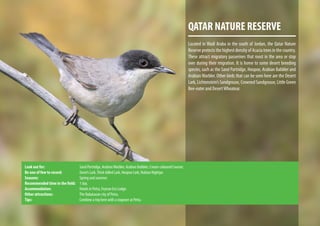
QATAR NATURE RESERVE
Located in Wadi Araba in the south of Jordan, the Qatar Nature
Reserve protects the highest density of Acacia trees in the country.
These attract migratory passerines that roost in the area or stop
over during their migration. It is home to some desert breeding
species, such as the Sand Partridge, Hoopoe, Arabian Babbler and
Arabian Warbler. Other birds that can be seen here are the Desert
Lark, Lichtenstein’s Sandgrouse, Crowned Sandgrouse, Little Green
Bee-eater and DesertWheatear.
Look out for: 			 Sand Partridge, ArabianWarbler, Arabian Babbler, Cream-coloured Courser.
Be one of few to record: 		 Dunn’s Lark,Thick-billed Lark, Hoopoe Lark, Nubian Nightjar.
Seasons: 			 Spring and summer.
Recommended time in the field:	 1 day.
Accommodation:			 Hotels in Petra, Feynan Eco Lodge.
Other attractions: 		 The Nabataean city of Petra.
Tips: 				Combine a trip here with a stopover at Petra.
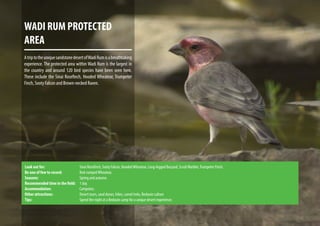
WADI RUM PROTECTED
AREA
AtriptotheuniquesandstonedesertofWadiRumisabreathtaking
experience. The protected area within Wadi Rum is the largest in
the country and around 120 bird species have been seen here.
These include the Sinai Rosefinch, Hooded Wheatear, Trumpeter
Finch, Sooty Falcon and Brown-necked Raven.
Look out for: 			 Sinai Rosefinch, Sooty Falcon, HoodedWheatear, Long-legged Buzzard, ScrubWarbler,Trumpeter Finch.
Be one of few to record: 		 Red-rumpedWheatear.
Seasons: 			 Spring and autumn.
Recommended time in the field: 	 1 day.
Accommodation: 		 Campsites.
Other attractions: 		 Desert tours, sand dunes, hikes, camel treks, Bedouin culture
Tips: 				Spend the night at a Bedouin camp for a unique desert experience.
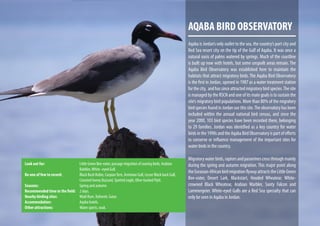
Look out for: 			 Little Green Bee-eater, passage migration of soaring birds, Arabian
				Babbler,White -eyed Gull.
Be one of few to record: 		 Black Bush Robin, CaspianTern, Arminian Gull, Lesser Black back Gull,
				 Creasted honey Buzzard, Spotted eagle, Olive-backed Pipit.
Seasons: 			 Spring and autumn.
Recommended time in the field: 	 2 days.
Nearby birding sites: 		 Wadi Rum, Rahmeh, Gatar.
Accommodation: 		 Aqaba hotels.
Other attractions: 		 Water sports, souk.
AQABA BIRD OBSERVATORY
Aqaba is Jordan’s only outlet to the sea, the country’s port city and
Red Sea resort city on the tip of the Gulf of Aqaba. It was once a
natural oasis of palms watered by springs. Much of the coastline
is built up now with hotels, but some unspoilt areas remain. The
Aqaba Bird Observatory was established here to maintain the
habitats that attract migratory birds. The Aqaba Bird Observatory
is the first in Jordan, opened in 1987 as a water treatment station
forthecity, andhassinceattractedmigratorybirdspecies.Thesite
is managed by the RSCN and one of its main goals is to sustain the
site’s migratory bird populations. More than 80% of the migratory
birdspeciesfoundinJordanusethissite.Theobservatoryhasbeen
included within the annual national bird census, and since the
year 2000, 103 bird species have been recorded there, belonging
to 29 families. Jordan was identified as a key country for water
birdsinthe1990sandtheAqabaBirdObservatoryispartofefforts
to conserve or influence management of the important sites for
water birds in the country.
Migratorywaterbirds,raptorsandpasserinescrossthroughmainly
during the spring and autumn migration. This major point along
theEurasian-AfricanbirdmigrationflywayattractstheLittleGreen
Bee-eater, Desert Lark, Blackstart, Hooded Wheatear, White-
crowned Black Wheatear, Arabian Warbler, Sooty Falcon and
Lammergeier. White-eyed Gulls are a Red Sea specialty that can
only be seen in Aqaba in Jordan.
NEARBY ATTRACTIONSTOVISIT
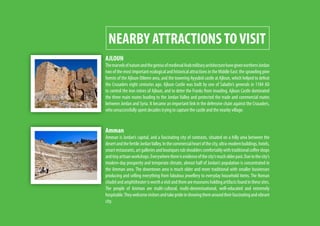
AJLOUN
ThemarvelsofnatureandthegeniusofmedievalArabmilitaryarchitecturehavegivennorthernJordan
two of the most important ecological and historical attractions in the Middle East: the sprawling pine
forests of the Ajloun-Dibeen area, and the towering Ayyubid castle at Ajloun, which helped to defeat
the Crusaders eight centuries ago. Ajloun Castle was built by one of Saladin’s generals in 1184 AD
to control the iron mines of Ajloun, and to deter the Franks from invading. Ajloun Castle dominated
the three main routes leading to the Jordan Valley and protected the trade and commercial routes
between Jordan and Syria. It became an important link in the defensive chain against the Crusaders,
who unsuccessfully spent decades trying to capture the castle and the nearby village.
Amman
Amman is Jordan’s capital, and a fascinating city of contrasts, situated on a hilly area between the
desertandthefertileJordanValley.Inthecommercialheartofthecity,ultra-modernbuildings,hotels,
smartrestaurants,artgalleriesandboutiquesrubshoulderscomfortablywithtraditionalcoffeeshops
andtinyartisanworkshops.Everywherethereisevidenceofthecity’smucholderpast.Duetothecity’s
modern-day prosperity and temperate climate, almost half of Jordan’s population is concentrated in
the Amman area. The downtown area is much older and more traditional with smaller businesses
producing and selling everything from fabulous jewellery to everyday household items. The Roman
citadelandamphitheaterisworthavisitandtherearemuseumsholdingartifactsfoundinthesesites.
The people of Amman are multi-cultural, multi-denominational, well-educated and extremely
hospitable.Theywelcomevisitorsandtakeprideinshowingthemaroundtheirfascinatingandvibrant
city.
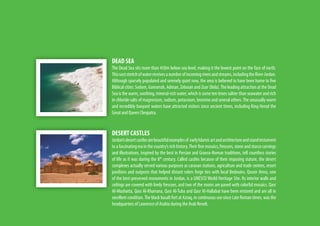
DEAD SEA
The Dead Sea sits more than 450m below sea level, making it the lowest point on the face of earth.
Thisvaststretchofwaterreceivesanumberofincomingriversandstreams,includingtheRiverJordan.
Although sparsely populated and serenely quiet now, the area is believed to have been home to five
Biblical cities: Sodom, Gomorrah, Adman, Zebouin and Zoar (Bela).The leading attraction at the Dead
Sea is the warm, soothing, mineral-rich water, which is some ten times saltier than seawater and rich
in chloride salts of magnesium, sodium, potassium, bromine and several others.The unusually warm
and incredibly buoyant waters have attracted visitors since ancient times, including King Herod the
Great and Queen Cleopatra.
DESERT CASTLES
Jordan’sdesertcastlesarebeautifulexamplesof earlyIslamicartandarchitectureandstandtestament
to a fascinating era in the country’s rich history.Their fine mosaics, frescoes, stone and stucco carvings
and illustrations, inspired by the best in Persian and Graeco-Roman traditions, tell countless stories
of life as it was during the 8th
century. Called castles because of their imposing stature, the desert
complexes actually served various purposes as caravan stations, agriculture and trade centres, resort
pavilions and outposts that helped distant rulers forge ties with local Bedouins. Quseir Amra, one
of the best-preserved monuments in Jordan, is a UNESCO World Heritage Site. Its interior walls and
ceilings are covered with lively frescoes, and two of the rooms are paved with colorful mosaics. Qasr
Al-Mushatta, Qasr Al-Kharrana, Qasr Al-Tuba and Qasr Al-Hallabat have been restored and are all in
excellent condition.The black basalt fort at Azraq, in continuous use since Late Roman times, was the
headquarters of Lawrence of Arabia during the Arab Revolt.
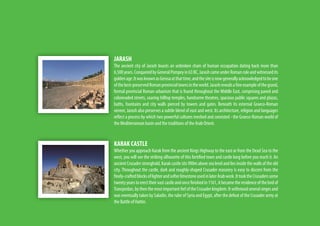
JARASH
The ancient city of Jarash boasts an unbroken chain of human occupation dating back more than
6,500years.ConqueredbyGeneralPompeyin63BC,JarashcameunderRomanruleandwitnessedits
goldenage.ItwasknownasGerasaatthattime,andthesiteisnowgenerallyacknowledgedtobeone
ofthebest-preservedRomanprovincialtownsintheworld.Jarashrevealsafineexampleofthegrand,
formal provincial Roman urbanism that is found throughout the Middle East, comprising paved and
colonnaded streets, soaring hilltop temples, handsome theatres, spacious public squares and plazas,
baths, fountains and city walls pierced by towers and gates. Beneath its external Graeco-Roman
veneer, Jarash also preserves a subtle blend of east and west. Its architecture, religion and languages
reflect a process by which two powerful cultures meshed and coexisted - the Graeco-Roman world of
the Mediterranean basin and the traditions of the Arab Orient.
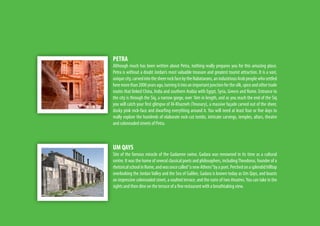
KARAK CASTLE
Whether you approach Karak from the ancient Kings Highway to the east or from the Dead Sea to the
west, you will see the striking silhouette of this fortified town and castle long before you reach it. An
ancientCrusaderstronghold,Karakcastlesits900mabovesealevelandliesinsidethewallsoftheold
city. Throughout the castle, dark and roughly-shaped Crusader masonry is easy to discern from the
finely-craftedblocksoflighterandsofterlimestoneusedinlaterArabwork.IttooktheCrusaderssome
twentyyearstoerecttheirvastcastleandoncefinishedin1161,itbecametheresidenceofthelordof
Transjordan,bythenthemostimportantfiefoftheCrusaderkingdom.Itwithstoodseveralsiegesand
was eventually taken by Saladin, the ruler of Syria and Egypt, after the defeat of the Crusader army at
the Battle of Hattin.
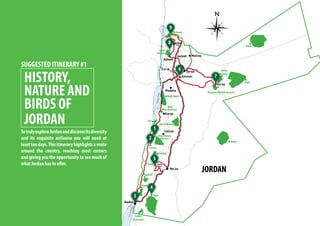
PETRA
Although much has been written about Petra, nothing really prepares you for this amazing place.
Petra is without a doubt Jordan’s most valuable treasure and greatest tourist attraction. It is a vast,
uniquecity,carvedintothesheerrockfacebytheNabataeans,anindustriousArabpeoplewhosettled
heremorethan2000yearsago,turningitintoanimportantjunctionforthesilk,spiceandothertrade
routes that linked China, India and southern Arabia with Egypt, Syria, Greece and Rome. Entrance to
the city is through the Siq, a narrow gorge, over 1km in length, and as you reach the end of the Siq
you will catch your first glimpse of Al-Khazneh (Treasury), a massive façade carved out of the sheer,
dusky pink rock-face and dwarfing everything around it. You will need at least four or five days to
really explore the hundreds of elaborate rock-cut tombs, intricate carvings, temples, altars, theatre
and colonnaded streets of Petra.
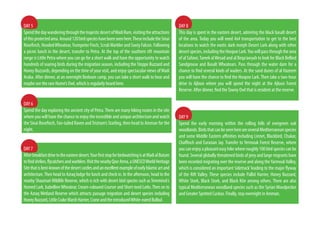
UM QAYS
Site of the famous miracle of the Gadarene swine, Gadara was renowned in its time as a cultural
centre. It was the home of several classical poets and philosophers, includingTheodorus, founder of a
rhetoricalschoolinRome,andwasoncecalled“anewAthens”byapoet.Perchedonasplendidhilltop
overlooking the Jordan Valley and the Sea of Galilee, Gadara is known today as Um Qays, and boasts
an impressive colonnaded street, a vaulted terrace, and the ruins of two theatres.You can take in the
sights and then dine on the terrace of a fine restaurant with a breathtaking view.
Fifa
Ajlun
Reserve
Wadi Mujib
Dana Nature
Reserve
Rajel
Burqu
Bayer
Abu Rukbeh
Wadi
Ibn Hammad
Rahmah
Rum
Qatar
Aqaba
Mountains
Yarmouk
Azraq
Reserve
Petra
1
2
Feynan
3
4
5
6
7
8
9
Ajloun
Jarash
Shaumari Wildlife Reserve
Shobak
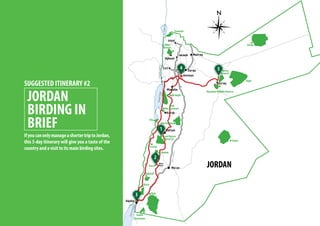
SUGGESTED ITINERARY #1
HISTORY,
NATURE AND
BIRDS OF
JORDAN
TotrulyexploreJordananddiscoveritsdiversity
and its exquisite avifauna you will need at
least ten days.This itinerary highlights a route
around the country, reaching most corners
and giving you the opportunity to see much of
what Jordan has to offer.
JORDAN
DAY 1
Spend the morning at the Mujib Biosphere Reserve, walking along a steep river gorge looking for the Bonelli’s Eagle, Little Green Bee-eater, Blue RockThrush and others. A
shortdrivesouthinthelatemorningwilltakeyoutotheFifaNatureReserve,whereyoucanlookoutforthescarceDeadSeaSparrow.ThencontinuesouthtoDanavillageand
enjoy a late afternoon walking tour around the village.This trail winds above DanaVillage through the terraced gardens, pistachio groves and orchards. Seek out the Syrian
Serin,WoodchatShrike,EasternOlivaceaousWarbler,MaskedShrikeandSteppeBuzzardsoverhead.Atsunset takeawalktolookforHume’sOwlthatisregularlyheardwhere
itnestsinthesandstonemountains.CampatRummanaCampsite,whichliesamiddramaticescarpmentsoftheJordanriftvalley.	
DAY 2
StartingfromtheluscioushighlandsofDanaBiosphereReservebeforewindingthroughtherockyslopeplains,theserenityisinterruptedonlybythesoundofbirdsong,asthe
scents of flowers permeate the crisp, cool air of the valley. Many birds can be seen throughout the valley includingTristram’s Starling, GriffonVulture, Short-toed Snake Eagle,
Long-leggedBuzzard,Chukar,White-crownedWheatearandDesertLarkandmore.Aftera14kmdownhillhikeyouwillreachFeynanwhereyoucanrelaxandspendthenight
atthecandle-litecolodgethere.
DAY 3
Spend the morning birdwatching in the Feynan area at the western edge of Dana Biosphere Reserve. En-route to Aqaba, your next birding destination, several stops can be

madetowatchbirdsoftheWadiArabaarea,includingstoppingatQatarNatureReserve,thehomeofmanydesertbreedingspeciessuchastheSandPartridge,Hoopoe,Arabian
BabblerandArabianWarbler.Youmaybeluckyenoughtowatchmigratorypasserinesthatroostintheareaorstopduringtheirmigration.Bythelateafternoonyouwillarrive
at Aqaba on the Red Sea, where you will have the opportunity to witness many birds roosting within the Aqaba mountains and watch Red Sea birds such as theWhite-eyed
GullatthesouthbeachareaaswellasSlender-billedGulls.
DAY 4
Bird migratory pathways converge in Aqaba and millions of migratory birds cross over here as it is a junction between three continents. Spend the morning at the Aqaba Bird
Observatory. Around 200 different species of birds have been recorded here,including some rare species for Jordan.You can find plenty of waders, herons and egrets on their
northwardjourney,andmigrantbirdssuchasCollaredFlycatcher,ThrushNightingaleandtheWhite-crownedBlackWheatear,ArabianWarbler,ArabianBabblerandGraceful
Prinia,thenheadtoWadiRumtospendthenight.
DAY 5
SpendthedaywanderingthroughthemajesticdesertofWadiRum,visitingtheattractions
ofthisprotectedarea.Around120birdspecieshavebeenseenhere.TheseincludetheSinai
Rosefinch, HoodedWheatear,Trumpeter Finch, ScrubWarbler and Sooty Falcon. Following
a picnic lunch in the desert, transfer to Petra. At the top of the southern rift mountain
range is Little Petra where you can go for a short walk and have the opportunity to watch
hundreds of soaring birds during the migration season, including the Steppe Buzzard and
Honey Buzzards, depending on the time of your visit, and enjoy spectacular views ofWadi
Araba. After dinner, at an overnight Bedouin camp, you can take a short walk to hear and
maybe see the rare Hume’s Owl, which is regularly heard here.
DAY 6
Spend the day exploring the ancient city of Petra.There are many hiking routes in the site
where you will have the chance to enjoy the incredible and unique architecture and watch
the Sinai Rosefinch, Fan-tailed Raven andTristram’s Starling, then head to Amman for the
night.
DAY7
Afterbreakfastdrivetotheeasterndesert.YourfirststopforbirdwatchingisatWadialButum
tofindshrikes,flycatchersandwarblers.VisitthenearbyQasrAmra,aUNESCOWorldHeritage
Sitethatisbest-knownofthedesertcastlesandanexcellentexampleofearlyIslamicartand
architecture.Then head to Azraq lodge for lunch and check in. In the afternoon, head to the
nearby ShaumariWildlife Reserve, which is rich with desert bird species such asTemminck’s
Horned Lark, IsabellineWheatear, Cream-coloured Courser and Short-toed Larks.Then on to
the Azraq Wetland Reserve which attracts passage migration and desert species including
HoneyBuzzard,LittleCrakeMarshHarrier,CraneandtheintroducedWhite-earedBulbul.
DAY 8
This day is spent in the eastern desert, admiring the black basalt desert
of the area. Today you will need 4x4 transportation to get to the best
locations to watch the exotic dark morph Desert Lark along with other
desertspecies,includingtheHoopoeLark.Youwillpassthroughthearea
of al Safawi,Tareek alWesad and al Beqa’awyah to look for Black Bellied
Sandgrouse and Basalt Wheatears. Pass through the water dam for a
chance to find several kinds of waders. At the sand dunes of al Hazeem
you will have the chance to find the Hoopoe Lark.Then take a two-hour
drive to Ajloun where you will spend the night at the Ajloun Forest
Reserve. After dinner, find theTawny Owl that is resident at the reserve.
DAY 9
Spend the early morning within the rolling hills of evergreen oak
woodlands.BirdsthatcanbeseenhereareseveralMediterraneanspecies
and some Middle Eastern affinities including Linnet, Blackbird, Chukar,
Chaffinch and Eurasian Jay. Transfer to Yermouk Forest Reserve, where
youcanenjoyapleasanteasyhikewhereroughly100birdspeciescanbe
found. Several globally threatened birds of prey and large migrants have
been recorded migrating over the reserve and along theYarmoukValley,
which is considered an important‘sidetrack’leading to the major flyway
of the Rift Valley. These species include Pallid Harrier, Honey Buzzard,
White Stork, Black Stork, and Black Kite among others. There are also
typical Mediterranean woodland species such as the SyrianWoodpecker
and Greater Spotted Cuckoo. Finally, stay overnight in Amman.
Fifa
Ajlun
Reserve
Rajel
Burqu
Bayer
Rahmah
Rum
Qatar
Aqaba
Mountains
Yarmouk
Azraq
Reserve
Petra
Wadi
Ibn Hammad
Wadi Mujib
Abu Rukbeh
Dana Nature
Reserve
1
2
3
4 5
Feynan
Ajloun
Jarash
Shaumari Wildlife Reserve
Shobak
JORDAN
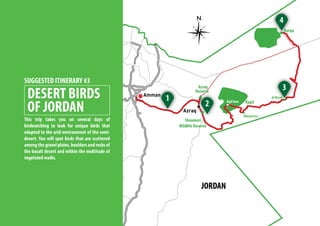
SUGGESTED ITINERARY #2
JORDAN
BIRDING IN
BRIEF
IfyoucanonlymanageashortertriptoJordan,
this 5-day itinerary will give you a taste of the
country and a visit to its main birding sites.
DAY1
Spend the morning at the Mujib Biosphere Reserve, walking along a steep river gorge looking for the
Bonelli’s Eagle, Little Green Bee-eater, Blue Rock Thrush and others. A short drive south in the late
morningwilltakeyoutoFifaNatureReserve,whereyoucanlookoutforthescarceDeadSeaSparrow.
Then continue south to Dana village and enjoy a late afternoon walking tour around the village.This
trail winds above DanaVillage through the terraced gardens, pistachio groves and orchards. Seek out
the Syrian Serin,Woodchat Shrike, Eastern OlivaceaousWarbler, Masked Shrike and Steppe Buzzards
overhead. At sunset, take a walk to look for Hume’s Owl that is regularly heard where it nests in the
sandstone mountains. Camp at Rummana Campsite, which lies amid dramatic escarpments of the
Jordan rift valley.
DAY2
Startingfromtheluscioushighlandsof DanaBiosphereReservebeforewindingthroughtherockyslope
plains,theserenityisinterruptedonlybythesoundofbirdsong,asthescentsofflowerspermeatethe
crisp,coolairofthevalley.TensofbirdscanbeseenthroughoutthevalleyincludingTristram’sStarling,
Griffon Vulture, Short-toed Snake Eagle, Long-legged Buzzard, Chukar and Desert Lark and more. In
the late afternoon transfer to Petra and spend the night at a Bedouin camp in Beidha. After dinner,
you can take a short walk to hear and maybe see the rare Hume’s Owl, which is regularly heard here.
DAY3
Inthemorning,headtoWadiRumwhereyoucanspendthedaywanderingthroughthemajesticdesert
andvisititsattractions.Around120birdspecieshavebeenseenhere,includingSinaiRosefinch,Hooded
Wheatear, Trumpeter Finch, Scrub Warbler and Sooty Falcon. In the late afternoon head to Aqaba for
overnight.
DAY4
Bird migratory pathways converge in Aqaba and millions of
migratorybirdscrossoverhere,asitisajunctionbetweenthree
continents.SpendthemorningattheAqabaBirdObservatory.
Around200differentspeciesofbirdshavebeenrecordedhere,
andanestimatedmorethan200,000birdspasshereeachyear
including some rare species for Jordan. You can find plenty of
waders, herons and egrets on their northward journey, along
with migrant birds such as the Collared Flycatcher, Thrush
Nightingale, the White-crowned Black Wheatear, Arabian
Warbler, Arabian Babbler and Graceful Prinia.Then transfer to
Amman for the night.
DAY5
Today’s day trip is to Azraq in the eastern desert of Jordan.
Your first stop for birdwatching is at Wadi al Butum to find
shrikes, flycatchers and warblers. Visit the nearby Qasr Amra,
thebest-knownofthedesertcastlesandanexcellentexample
of early Islamic art and architecture.Then head to Azraq lodge
for lunch. In the afternoon you can go to the nearby Shaumari
Wildlife Reserve, which is rich with desert bird species such as
Temminck’s Horned Lark, Isabelline Wheatear, Cream-colored
Courser and Short-toed Lark. Then on to the Azraq Wetland
Reserve which attracts passage migration and desert species
including Honey Buzzard, Little Crake Marsh Harrier, Crane,
andWhite-eared Bulbul. Finally, head back to Amman.
Burqu
Wasad Area
Shaumari
Wildlife Reserve
Rajil Dam
Al Wisad
Azraq
Reserve
Rajel
2
1
3
4
JORDAN
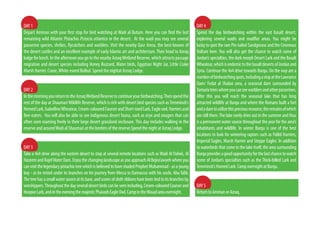
SUGGESTED ITINERARY #3
DESERT BIRDS
OF JORDAN
This trip takes you on several days of
birdwatching to look for unique birds that
adapted to the arid environment of the semi-
desert. You will spot birds that are scattered
among the gravel plains, boulders and rocks of
the basalt desert and within the multitude of
vegetated wadis.
DAY1
Depart Amman with your first stop for bird watching at Wadi al Butum. Here you can find the last
remaining wild Atlantic Pistachio Pistacia atlantica in the desert. At the wadi you may see several
passerine species, shrikes, flycatchers and warblers. Visit the nearby Qasr Amra, the best-known of
the desert castles and an excellent example of early Islamic art and architecture. Then head to Azraq
lodge for lunch. In the afternoon you go to the nearby AzraqWetland Reserve, which attracts passage
migration and desert species including Honey Buzzard, Water birds, Egyptian Night Jar, Little Crake
Marsh Harrier, Crane,White-eared Bulbul. Spend the nightat Azraq Lodge.
DAY2
InthemorningyoureturntotheAzraqWetlandReservetocontinueyourbirdwatching.Thenspendthe
rest of the day at ShaumariWildlife Reserve, which is rich with desert bird species such asTemminck’s
HornedLark,IsabellineWheatear,Cream-colouredCourserandShort-toedLark,Eagleowl,Harriersand
Bee-eaters. You will also be able to see indigenous desert fauna, such as oryx and onagers that can
often seen roaming freely in their large desert grassland enclosure. This day includes walking in the
reserve and aroundWadi al Shaumari at the borders of the reserve.Spend the night at Azraq Lodge.
DAY3
Take a 4x4 drive along the eastern desert to stop at several remote locations such as Wadi Al Dahek, Al
Hazeem and RajelWater Dam. Enjoy the changing landscape as you approach Al Bejea’awyeh where you
canvisit the legendary pistachio tree which is believedtohaveshadedProphetMuhammad-asayoung
boy - as he rested under its branches on his journey from Mecca to Damascus with his uncle, Abu Talib.
Thetreehasasmallwatersourceatitsbase,andscoresofclothribbonshavebeentiedtoitsbranchesby
worshippers.Throughoutthedayseveraldesertbirdscanbeseenincluding,Cream-colouredCourserand
HoopoeLark,andintheeveningthemajesticPharaohEagleOwl.CampintheWasadareaovernight.
DAY4
Spend the day birdwatching within the vast basalt desert,
exploring several wadis and mudflat areas. You might be
lucky to spot the rare Pin-tailed Sandgrouse and the Cinereous
Vulture here. You will also get the chance to watch some of
Jordan’s specialties, the dark morph Desert Lark and the Basalt
Wheatear,whichisendemictothebasaltdesertsofJordanand
Syria. Continue the 4x4 drive towards Burqu. On the way are a
numberofbirdwatchingspots,includingastopattheLawrance
Dam/ Fedat al Shalan area, a seasonal dam surrounded by
Tamarixtreeswhereyoucanseewarblersandotherpasserines.
After this you will reach the seasonal lake that has long
attracted wildlife at Burqu and where the Romans built a fort
andadamtoutilizethispreciousresource,theremainsofwhich
are still there.The lake rarely dries out in the summer and thus
is a permanent water source throughout the year for the area’s
inhabitants and wildlife. In winter Burqu is one of the best
locations to look for wintering raptors such as Pallid Harriers,
Imperial Eagles, Marsh Harrier and Steppe Eagles. In addition
to waterbirds that come to the lake itself, the area surrounding
Burquprovidesagoodopportunityforthelastchancetowatch
some of Jordan’s specialties such as the Thick-billed Lark and
Temminck’sHornedLark.CampovernightatBurqu.
DAY5
ReturntoAmmanorAzraq.
FOOD
Food is a cornerstone of Jordanian society, whether you are having mansaf with the Bedouins, or exploring the souqs with their
aromas of cardamom, cumin and za’atar. Popular desserts include knafeh and baklava pastries
in a myriad of forms. If you bump into a Bedouin in the remotest corner of Wadi Rum, you
will doubtless receive an invite to his tent to eat and drink sweet tea with sage or mint. Make
sure not to leave Jordan without trying a few local dishes, such as mansaf, magloubeh, falafel,
shawerma , assortments of mezza’s and knafeh.
ACCOMMODATION
PlentyofaccommodationisavailableinJordan,from5-starhotelsonthecoasttocampsitesinthedesert.
Ajloun Forest Cabins:These cabins occupy a large grassy clearing, enclosed by oak, pistachio and
strawberry trees and offer beautiful views of the reserve and as far as Jebel Sheikh in Lebanon.
There are 5 newly built cabins with private facilities and small terraces open all year round.
Azraq Lodge: A 1940s British military field hospital was renovated into this lodge in the eastern
desert and a short distance away from the Azraq and Shaumari reserves. There are 16 fully
equipped rooms overlooking the vast mud and sand flats of the Azraq Basin. The kitchen and
restaurant are under the management of a local family, providing a variety of Chechen food and
delights.The Azraq Lodge is open all year.
Dana Guesthouse: Perched on the edge of Wadi Dana, this beautifully styled building offers
breathtaking views of the reserve, comfortable rooms, traditional Arabic food, and friendly
service. It contains nine bedrooms, most with private terraces, as well as facilities for courses and
conferences.The guesthouse is open all year round.
USEFUL
INFORMATION
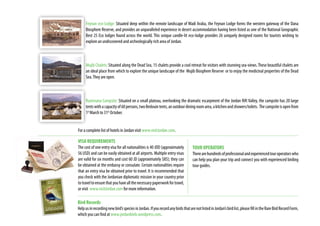
Feynan eco-Lodge: Situated deep within the remote landscape of Wadi Araba, the Feynan Lodge forms the western gateway of the Dana
Biosphere Reserve, and provides an unparalleled experience in desert accommodation having been listed as one of the National Geographic
Best 25 Eco lodges found across the world. This unique candle-lit eco-lodge provides 26 uniquely designed rooms for tourists wishing to
explore an undiscovered and archeologically rich area of Jordan.
Mujib Chalets: Situated along the Dead Sea, 15 chalets provide a cool retreat for visitors with stunning sea-views.These beautiful chalets are
an ideal place from which to explore the unique landscape of the Mujib Biosphere Reserve or to enjoy the medicinal properties of the Dead
Sea.They are open.
Rummana Campsite: Situated on a small plateau, overlooking the dramatic escarpment of the Jordan Rift Valley, the campsite has 20 large
tentswithacapacityof60persons,twoBedouintents,anoutdoordiningroomarea,akitchenandshowers/toilets. Thecampsiteisopenfrom
1st
March to 31st
October.
For a complete list of hotels in Jordan visit www.visitJordan.com.
VISA REQUIREMENTS
The cost of one entry visa for all nationalities is 40 JOD (approximately
56 USD) and can be easily obtained at all airports. Multiple entry visas
are valid for six months and cost 60 JD (approximately $85); they can
be obtained at the embassy or consulate. Certain nationalities require
that an entry visa be obtained prior to travel. It is recommended that
you check with the Jordanian diplomatic mission in your country prior
totraveltoensurethatyouhaveallthenecessarypaperworkfortravel,
or visit www.visitJordan.com for more information.
TOUR OPERATORS
Therearehundredsofprofessionalandexperiencedtouroperatorswho
can help you plan your trip and connect you with experienced birding
tour guides.
Bird Records
Helpusinrecordingnewbird’sspeciesinJordan.IfyourecordanybirdsthatarenotlistedinJordan’sbirdlist,pleasefillintheRareBirdRecordForm,
which you can find at www.jordanbirds.wordpress.com.
JORDAN’S BIRDS SPECIALTIES
Jordan is a special place for bird watching as a result of its position along the Great
Rift Valley on one side and at the edge of the Mediterranean and Arabia on the
other.Itsuniquelandscapesalsoplayarole,withtheSharahandRummountainsin
the south, the Dead Sea in the west and the Basalt Desert in the East.Thus several
species are specialties to Jordan and were selected as such based on a combination
of factors. All species on the list are special to the country, the Levant or West Asia
and/or can be relatively easily seen in certain parts of the country.The order of the
list follows the order in Collins Bird Guide Second Edition (Svensson, 1999), one of
the most widespread field bird guide books used in Jordan, if not the region.
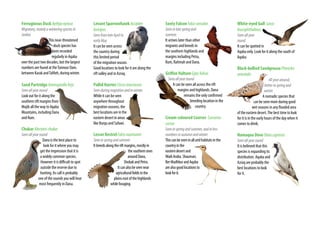
Ferruginous Duck Aythyanyroca
Migratory,mainlyawinteringspeciesin
Jordan
This near-threatened
duck species has
been recorded
regularly in Aqaba
over the past two decades, but the largest
numbers are found at theTannour Dam,
between Karak andTafileh, during winter.
Sand PartridgeAmmoperdixheyi
Seenallyearround
Look out for it along the
southern rift margins from
Mujib all the way to Aqaba
Mountains, including Dana
and Rum.
ChukarAlectorischukar
Seenallyearround
Dana is the best place to
look for it where you may
get the impression that it is
a widely common species.
However it is difficult to spot
outside the reserve due to
hunting. Its call is probably
one of the sounds you will hear
most frequently in Dana.
Levant Sparrowhawk Accipiter
brevipes
SeenfromlateAprilto
earlyMay
It can be seen across
the country during
this limited period
of the migration season.
Good locations to look for it are along the
rift valley and in Azraq.
Pallid HarrierCircusmacrourus
Seenduringmigrationandinwinter
While it can be seen
anywhere throughout
migration seasons, the
best locations are in the
eastern desert in areas
like Burqu and Safawi.
Lesser KestrelFalconaumanni
Seeninspringandsummer
Itbreedsalongtheriftmargins,mostlyin
thesouthernones
aroundDana,
ShobakandPetra.
Itcanalsobeseennear
agriculturalfieldsinthe
plainseastofthehighlands
whileforaging.
Sooty FalconFalcoconcolor
Seeninlatespringand
summer
It arrives later than other
migrants and breeds in
the southern highlands and
margins including Petra,
Rum, Rahmah and Dana.
GriffonVultureGypsfulvus
Seenallyearround
It can be seen all across the rift
margins and highlands. Dana
remains the only confirmed
breeding location in the
country.
Cream-coloured Courser Cursorius
cursor
Seeninspringandsummer,andinless
numbersinautumnandwinter
Thiscanbeseeninallaridhabitatsinthe
countryinthe
easterndesertand
WadiAraba.Shaumari,
BerMadhkurandAqaba
arealsogoodlocationsto
lookforit.
White-eyed Gull Larus
leucophthalmus
Seenallyear
round
It can be spotted in
Aqaba only. Look for it along the south of
Aqaba.
Black-bellied SandgrousePterocles
orientalis
Allyeararound,
betterinspringand
winter
A nomadic species that
can be seen more during good
wet seasons in any flooded area
of the eastern desert.The best time to look
for it is in the early hours of the day when it
comes to drink.
Namaqua Dove Oenacapensis
Seenallyearround
It is believed that this
species is expanding its
distribution. Aqaba and
Azraq are probably the
best locations to look
for it.
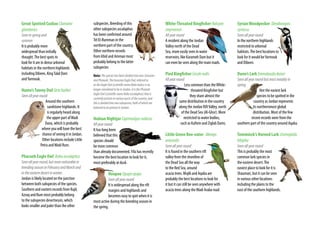
Great Spotted Cuckoo Clamator
glandarius
Seeninspringand
summer
It is probably more
widespread than initially
thought.The best spots to
look for it are in dense arboreal
habitats in the northern highlands
including Dibeen, KingTalal Dam
andYarmouk.
Hume’sTawny Owl Strixbutleri	
Seenallyearround
Around the southern
sandstone highlands. It
is regularly heard along
the upper part ofWadi
Dana, which is probably
where you will have the best
chance of seeing it in Jordan.
Other locations include Little
Petra andWadi Rum.
Pharaoh Eagle Owl Buboascalaphus
Seenallyearround,butmorenoticeablein
breedingseasoninFebruaryandMarchand
intheeasterndesertinwinter.
Jordan is likely located on the junction
between both subspecies of the species.
Southern and eastern records from Rajil,
Azraq and Rum most probably belong
to the subspecies desertorum, which
looks smaller and paler than the other
subspecies. Breeding of this
other subspecies ascalaphus
has been confirmed around
Tel El-Rumman in the
northern part of the country.
Other northern records
from Irbid and Amman most
probably belong to the latter
subspecies
Note: Thespecieshasbeendividedintotwo:Eurasian
andPharaoh.TheEurasianEagleOwl,referredto
astheEagleOwl(scientificnameBubobubo)isno
longerconsideredtobeinJordan.ItisthePharaoh
EagleOwl(scientificnameBuboascalaphus)thatis
currentlypresentinvariouspartsofthecountry,and
thisisdividedintotwosubspecies,bothofwhichare
believedtobepresentinJordan.
Nubian Nightjar Caprimulgusnubicus
Allyearround
It has long been
believed that this
species should
be more common
than already documented. Fifa has recently
become the best location to look for it,
most preferably at dusk.
Hoopoe Upupaepops
Seenallyearround
It is widespread along the rift
margins and highlands and
becomes easy to spot when it is
most active during the breeding season in
the spring.
White-Throated Kingfisher Halcyon
smyrnensis
Allyearround
A resident along the Jordan
Valley north of the Dead
Sea, more easily seen in water
reservoirs, like Karameh Dam but it
can even be seen along the main roads.
Pied Kingfisher Cerylerudis
Allyearround
Less common than theWhite-
throated Kingfisher but
they share almost the
same distribution in the country
along the Jordan RiftValley, north
of the Dead Sea (Al-Ghor). More
restricted to water bodies,
such as Kafrein and Ziglab Dams.
Little Green Bee-eater Merops
orientalis
Seenallyearround
It is found in the southern rift
valley from the shoreline of
the Dead Sea all the way
to the Red Sea, around
acacia trees. Mujib and Aqaba are
probably the best locations to look for
it but it can still be seen anywhere with
acacia trees along theWadi Araba road.
SyrianWoodpecker Dendrocopos
syriacus
Seenallyearround
In the northern highlands
restricted to arboreal
habitats.The best locations to
look for it would beYarmouk
and Dibeen.
Dunn’s Lark Eremalaudadunni
Seenallyearroundbutmostnotablyin
spring
Not the easiest lark
species to be spotted in the
country as Jordan represents
its northernmost global
distribution. Most of the few
recent records were from the
southern part of the country around Aqaba.
Temminck’s Horned Lark Eremophila
bilopha
Seenallyearround
This is probably the most
common lark species in
the eastern desert.The
easiest place to look for it is
Shaumari, but it can be seen
in various other locations
including the plains to the
east of the southern highlands.
Thick-billed LarkRamphocorisclotbey
Seenallyearlong,butmorein
springandwinter
Another nomadic
species that follows
water. It is more
widespread and commoner
than initially thought. It can be spotted
on any water pond in the eastern desert,
including Shaumari and Safawi.
Desert Lark – Dark Morph
Ammomanesdeserti
Seenallyearround
This is restricted to the
basalt desert in the east. It
has been regularly spotted
inWadi Rajil.
Bar-tailed Desert Lark Ammomanes
cincturus
Seenallyearround
It is found in the Eastern
Desert in sandy wadis and
areas with sandy patches.
It has also been recorded
alongWadi Araba.
Hoopoe Lark Alaemonalaudipes
Seenallyearround
It can be seen in the eastern
desert in sandy areas around
Hazeem and Shaumari.
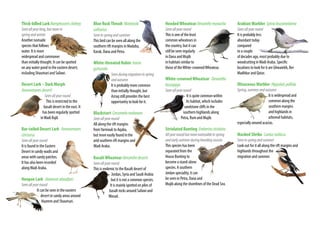
Blue RockThrush Monticola
solitarius
Seeninspringandsummer
This bird can be seen all along the
southern rift margins in Madaba,
Karak, Dana and Petra.
White-throated Robin Irania
gutturalis
Seenduringmigrationinspring
andautumn
It is probably more common
than initially thought, but
Azraq still provides the best
opportunity to look for it.
Blackstart Cercomelamelanura
Seenallyearround
All along the rift margins
fromYarmouk to Aqaba,
but more easily found in the
arid southern rift margins and
Wadi Araba.
BasaltWheatear Oenanthedeserti
Seenallyearround
This is endemic to the Basalt desert of
Jordan, Syria and Saudi Arabia
but it is not a common species.
It is mainly spotted on piles of
basalt rocks around Safawi and
Wasad.
HoodedWheatearOenanthemonacha
Seenallyearround
This is one of the least
common wheatears in
the country, but it can
still be seen regularly
in Dana and Mujib
in habitats similar to
those of theWhite-crownedWheatear.
White-crownedWheatear Oenanthe
leucopyga
Seenallyearround
It is quite common within
its habitat, which includes
sandstone cliffs in the
southern highlands along
Petra, Rum and Mujib.
Striolated Bunting Emberizastriolata
Allyearroundbutmorenoticeableinspring
andearlysummerduringbreedingseason
This species has been
separated from the
House Bunting to
become a stand-alone
species. A southern
Jordan speciality, it can
be seen in Petra, Dana and
Mujib along the shorelines of the Dead Sea.
ArabianWarbler Sylvialeucomelaena
Seenallyearround
It is probably less
abundant today
compared
to a couple
of decades ago, most probably due to
woodcutting inWadi Araba. Specific
locations to look for it are Ghwaiebh, Ber
Madhkur and Qatar.
OlivaceousWarbler Hippolaispallida
Spring,summerandautumn
It is widespread and
common along the
southern margins
and highlands in
arboreal habitats,
especially around acacias.
Masked Shrike Laniusnubicus
Seeninspringandsummer
Look out for it all along the rift margins and
highlands throughout the
migration and summer.
White- Spectacled Bulbul Pycnonotusxanthopygos
Seenallyearround
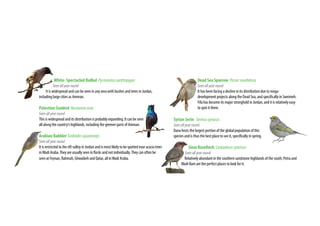
It is widespread and can be seen in any area with bushes and trees in Jordan,
including large cities as Amman.
Palestine Sunbird Nectariniaosea
Seenallyearround
This is widespread and its distribution is probably expanding. It can be seen
all along the country’s highlands, including the greener parts of Amman.
Arabian BabblerTurdoidessquamiceps
Seenallyearround
It is restricted to the rift valley in Jordan and is most likely to be spotted near acacia trees
inWadi Araba.They are usually seen in flocks and not individually.They can often be
seen at Feynan, Rahmah, Ghwaibeh and Qatar, all inWadi Araba.
Dead Sea Sparrow Passermoabiticus
Seenallyearround
It has been facing a decline in its distribution due to mega-
development projects along the Dead Sea, and specifically in Sweimeh.
Fifa has become its major stronghold in Jordan, and it is relatively easy
to spot it there.
Syrian Serin Serinussyriacus
Seenallyearround
Dana hosts the largest portion of the global population of this
species and is thus the best place to see it, specifically in spring.
Sinai Rosefinch Carpodacussynoicus
Seenallyearround
Relatively abundant in the southern sandstone highlands of the south; Petra and
Wadi Rum are the perfect places to look for it.
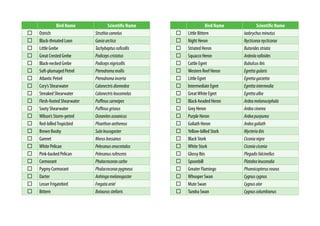
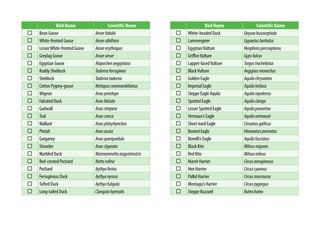
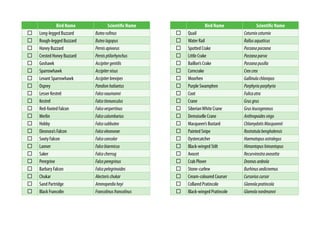
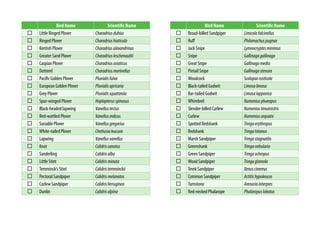
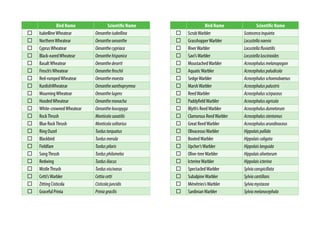
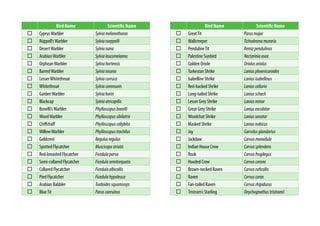
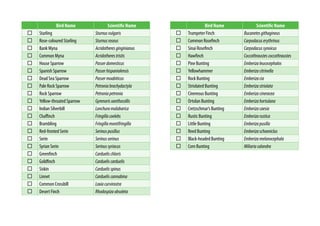
BIRDS OF JORDAN CHECK LIST
Bird Name Scientific Name
Ostrich Struthiocamelus
Black-throated Loon Gaviaarctica
Little Grebe Tachybaptusruficollis
Great Crested Grebe Podicepscristatus
Black-necked Grebe Podicepsnigricollis
Soft-plumaged Petrel Pterodromamollis
Atlantic Petrel Pterodromaincerta
Cory’s Shearwater Calonectrisdiomedea
Streaked Shearwater Calonectrisleucomelas
Flesh-footed Shearwater Puffinuscarneipes
Sooty Shearwater Puffinusgriseus
Wilson’s Storm-petrel Oceanitesoceanicus
Red-billedTropicbird Phaethonaethereus
Brown Booby Sulaleucogaster
Gannet Morusbassanus
White Pelican Pelecanusonocrotalus
Pink-backed Pelican Pelecanusrufescens
Cormorant Phalacrocoraxcarbo
Pygmy Cormorant Phalacrocoraxpygmeus
Darter Anhingamelanogaster
Lesser Frigatebird Fregataariel
Bittern Botaurusstellaris
Bird Name Scientific Name
Little Bittern Ixobrychusminutus
Night Heron Nycticoraxnycticorax
Striated Heron Butoridesstriata
Squacco Heron Ardeolaralloides
Cattle Egret Bubulcusibis
Western Reef Heron Egrettagularis
Little Egret Egrettagarzetta
Intermediate Egret Egrettaintermedia
GreatWhite Egret Egrettaalba
Black-headed Heron Ardeamelanocephala
Grey Heron Ardeacinerea
Purple Heron Ardeapurpurea
Goliath Heron Ardeagoliath
Yellow-billed Stork Mycteriaibis
Black Stork Ciconianigra
White Stork Ciconiaciconia
Glossy Ibis Plegadisfalcinellus
Spoonbill Platalealeucorodia
Greater Flamingo Phoenicopterusroseus
Whooper Swan Cygnuscygnus
Mute Swan Cygnusolor
Tundra Swan Cygnuscolumbianus
Bird Name Scientific Name
Bean Goose Anserfabalis
White-fronted Goose Anseralbifrons
LesserWhite-fronted Goose Ansererythropus
Greylag Goose Anseranser
Egyptian Goose Alopochenaegyptiaca
Ruddy Shelduck Tadornaferruginea
Shelduck Tadornatadorna
Cotton Pygmy-goose Nettapuscoromandelianus
Wigeon Anaspenelope
Falcated Duck Anasfalcata
Gadwall Anasstrepera
Teal Anascrecca
Mallard Anasplatyrhynchos
Pintail Anasacuta
Garganey Anasquerquedula
Shoveler Anasclypeata
Marbled Duck Marmaronettaangustirostris
Red-crested Pochard Nettarufina
Pochard Aythyaferina
Ferruginous Duck Aythyanyroca
Tufted Duck Aythyafuligula
Long-tailed Duck Clangulahyemalis
Bird Name Scientific Name
White-headed Duck Oxyuraleucocephala
Lammergeier Gypaetusbarbatus
EgyptianVulture Neophronpercnopterus
GriffonVulture Gypsfulvus
Lappet-facedVulture Torgostracheliotus
BlackVulture Aegypiusmonachus
Golden Eagle Aquilachrysaetos
Imperial Eagle Aquilaheliaca
Steppe Eagle Aquila Aquilanipalensis
Spotted Eagle Aquilaclanga
Lesser Spotted Eagle Aquilapomarina
Verreaux’s Eagle Aquilaverreauxii
Short-toed Eagle Circaetusgallicus
Booted Eagle Hieraaetuspennatus
Bonelli’s Eagle Aquilafasciatus
Black Kite Milvusmigrans
Red Kite Milvusmilvus
Marsh Harrier Circusaeruginosus
Hen Harrier Circuscyaneus
Pallid Harrier Circusmacrourus
Montagu’s Harrier Circuspygargus
Steppe Buzzard Buteobuteo
Bird Name Scientific Name
Long-legged Buzzard Buteorufinus
Rough-legged Buzzard Buteolagopus
Honey Buzzard Pernisapivorus
Crested Honey Buzzard Pernisptilorhynchus
Goshawk Accipitergentilis
Sparrowhawk Accipiternisus
Levant Sparrowhawk Accipiterbrevipes
Osprey Pandionhaliaetus
Lesser Kestrel Falconaumanni
Kestrel Falcotinnunculus
Red-footed Falcon Falcovespertinus
Merlin Falcocolumbarius
Hobby Falcosubbuteo
Eleonora’s Falcon Falcoeleonorae
Sooty Falcon Falcoconcolor
Lanner Falcobiarmicus
Saker Falcocherrug
Peregrine Falcoperegrinus
Barbary Falcon Falcopelegrinoides
Chukar Alectorischukar
Sand Partridge Ammoperdixheyi
Black Francolin Francolinusfrancolinus
Bird Name Scientific Name
Quail Coturnixcoturnix
Water Rail Rallusaquaticus
Spotted Crake Porzanaporzana
Little Crake Porzanaparva
Baillon’s Crake Porzanapusilla
Corncrake Crexcrex
Moorhen Gallinulachloropus
Purple Swamphen Porphyrioporphyrio
Coot Fulicaatra
Crane Grusgrus
SiberianWhite Crane Grusleucogeranus
Demoiselle Crane Anthropoidesvirgo
Macqueen’s Bustard ChlamydotisMacqueenii
Painted Snipe Rostratulabenghalensis
Oystercatcher Haematopusostralegus
Black-winged Stilt Himantopushimantopus
Avocet Recurvirostraavosetta
Crab Plover Dromasardeola
Stone-curlew Burhinusoedicnemus
Cream-coloured Courser Cursoriuscursor
Collared Pratincole Glareolapratincola
Black-winged Pratincole Glareolanordmanni
Bird Name Scientific Name
Little Ringed Plover Charadriusdubius
Ringed Plover Charadriushiaticula
Kentish Plover Charadriusalexandrinus
Greater Sand Plover Charadriusleschenaultii
Caspian Plover Charadriusasiaticus
Dotterel Charadriusmorinellus
Pacific Golden Plover Pluvialisfulva
European Golden Plover Pluvialisapricaria
Grey Plover Pluvialissquatarola
Spur-winged Plover Hoplopterusspinosus
Black-headed lapwing Vanellustectus
Red-wattled Plover Vanellusindicus
Sociable Plover Vanellusgregarius
White-tailed Plover Chettusialeucura
Lapwing Vanellusvanellus
Knot Calidriscanutus
Sanderling Calidrisalba
Little Stint Calidrisminuta
Temminck’s Stint Calidristemminckii
Pectoral Sandpiper Calidrismelanotos
Curlew Sandpiper Calidrisferruginea
Dunlin Calidrisalpina
Bird Name Scientific Name
Broad-billed Sandpiper Limicolafalcinellus
Ruff Philomachuspugnax
Jack Snipe Lymnocryptesminimus
Snipe Gallinagogallinago
Great Snipe Gallinagomedia
Pintail Snipe Gallinagostenura
Woodcock Scolopaxrusticola
Black-tailed Godwit Limosalimosa
Bar-tailed Godwit Limosalapponica
Whimbrel Numeniusphaeopus
Slender-billed Curlew Numeniustenuirostris
Curlew Numeniusarquata
Spotted Redshank Tringaerythropus
Redshank Tringatotanus
Marsh Sandpiper Tringastagnatilis
Greenshank Tringanebularia
Green Sandpiper Tringaochropus
Wood Sandpiper Tringaglareola
Terek Sandpiper Xenuscinereus
Common Sandpiper Actitishypoleucos
Turnstone Arenariainterpres
Red-necked Phalarope Phalaropuslobatus
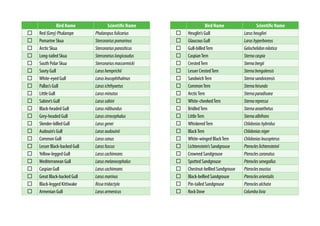
Bird Name Scientific Name
Red (Grey) Phalarope Phalaropusfulicarius
Pomarine Skua Stercorariuspomarinus
Arctic Skua Stercorariusparasiticus
Long-tailed Skua Stercorariuslongicaudus
South Polar Skua Stercorariusmaccormicki
Sooty Gull Larushemprichii
White-eyed Gull Larusleucophthalmus
Pallas’s Gull Larusichthyaetus
Little Gull Larusminutus
Sabine’s Gull Larussabini
Black-headed Gull Larusridibundus
Grey-headed Gull Laruscirrocephalus
Slender-billed Gull Larusgenei
Audouin’s Gull Larusaudouinii
Common Gull Laruscanus
Lesser Black-backed Gull Larusfuscus
Yellow-legged Gull Laruscachinnans
Mediterranean Gull Larusmelanocephalus
Caspian Gull Laruscachinnans
Great Black-backed Gull Larusmarinus
Black-legged Kittiwake Rissatridactyla
Armenian Gull Larusarmenicus
Bird Name Scientific Name
Heuglin’s Gull Larusheuglini
Glaucous Gull Larushyperboreus
Gull-billedTern Gelochelidonnilotica
CaspianTern Sternacaspia
CrestedTern Sternabergii
Lesser CrestedTern Sternabengalensis
SandwichTern Sternasandvicensis
CommonTern Sternahirundo
ArcticTern Sternaparadisaea
White-cheekedTern Sternarepressa
BridledTern Sternaanaethetus
LittleTern Sternaalbifrons
WhiskeredTern Chlidoniashybridus
BlackTern Chlidoniasniger
White-winged BlackTern Chlidoniasleucopterus
Lichtenstein’s Sandgrouse Pterocleslichtensteinii
Crowned Sandgrouse Pteroclescoronatus
Spotted Sandgrouse Pteroclessenegallus
Chestnut-bellied Sandgrouse Pteroclesexustus
Black-bellied Sandgrouse Pteroclesorientalis
Pin-tailed Sandgrouse Pteroclesalchata
Rock Dove Columbalivia
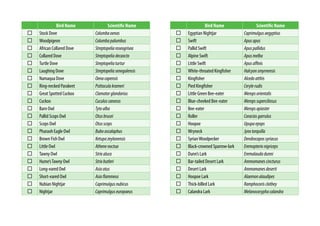
Bird Name Scientific Name
Stock Dove Columbaoenas
Woodpigeon Columbapalumbus
African Collared Dove Streptopeliaroseogrisea
Collared Dove Streptopeliadecaocto
Turtle Dove Streptopeliaturtur
Laughing Dove Streptopeliasenegalensis
Namaqua Dove Oenacapensis
Ring-necked Parakeet Psittaculakrameri
Great Spotted Cuckoo Clamatorglandarius
Cuckoo Cuculuscanorus
Barn Owl Tytoalba
Pallid Scops Owl Otusbrucei
Scops Owl Otusscops
Pharaoh Eagle Owl Buboascalaphus
Brown Fish Owl Ketupazeylonensis
Little Owl Athenenoctua
Tawny Owl Strixaluco
Hume’sTawny Owl Strixbutleri
Long-eared Owl Asiootus
Short-eared Owl Asioflammeus
Nubian Nightjar Caprimulgusnubicus
Nightjar Caprimulguseuropaeus
Bird Name Scientific Name
Egyptian Nightjar Caprimulgusaegyptius
Swift Apusapus
Pallid Swift Apuspallidus
Alpine Swift Apusmelba
Little Swift Apusaffinis
White-throated Kingfisher Halcyonsmyrnensis
Kingfisher Alcedoatthis
Pied Kingfisher Cerylerudis
Little Green Bee-eater Meropsorientalis
Blue-cheeked Bee-eater Meropssuperciliosus
Bee-eater Meropsapiaster
Roller Coraciasgarrulus
Hoopoe Upupaepops
Wryneck Jynxtorquilla
SyrianWoodpecker Dendrocopossyriacus
Black-crowned Sparrow-lark Eremopterixnigriceps
Dunn’s Lark Eremalaudadunni
Bar-tailed Desert Lark Ammomanescincturus
Desert Lark Ammomanesdeserti
Hoopoe Lark Alaemonalaudipes
Thick-billed Lark Ramphocorisclotbey
Calandra Lark Melanocoryphacalandra
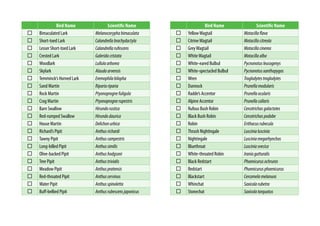
Bird Name Scientific Name
Bimaculated Lark Melanocoryphabimaculata
Short-toed Lark Calandrellabrachydactyla
Lesser Short-toed Lark Calandrellarufescens
Crested Lark Galeridacristata
Woodlark Lullulaarborea
Skylark Alaudaarvensis
Temminck’s Horned Lark Eremophilabilopha
Sand Martin Ripariariparia
Rock Martin Ptyonoprognefuligula
Crag Martin Ptyonoprognerupestris
Barn Swallow Hirundorustica
Red-rumped Swallow Hirundodaurica
House Martin Delichonurbica
Richard’s Pipit Anthusrichardi
Tawny Pipit Anthuscampestris
Long-billed Pipit Anthussimilis
Olive-backed Pipit Anthushodgsoni
Tree Pipit Anthustrivialis
Meadow Pipit Anthuspratensis
Red-throated Pipit Anthuscervinus
Water Pipit Anthusspinoletta
Buff-bellied Pipit Anthusrubescensjaponicus
Bird Name Scientific Name
YellowWagtail Motacillaflava
CitrineWagtail Motacillacitreola
GreyWagtail Motacillacinerea
WhiteWagtail Motacillaalba
White-eared Bulbul Pycnonotusleucogenys
White-spectacled Bulbul Pycnonotusxanthopygos
Wren Troglodytestroglodytes
Dunnock Prunellamodularis
Radde’s Accentor Prunellaocularis
Alpine Accentor Prunellacollaris
Rufous Bush Robin Cercotrichasgalactotes
Black Bush Robin Cercotrichaspodobe
Robin Erithacusrubecula
Thrush Nightingale Luscinialuscinia
Nightingale Lusciniamegarhynchos
Bluethroat Lusciniasvecica
White-throated Robin Iraniagutturalis
Black Redstart Phoenicurusochruros
Redstart Phoenicurusphoenicurus
Blackstart Cercomelamelanura
Whinchat Saxicolarubetra
Stonechat Saxicolatorquatus
Bird Name Scientific Name
IsabellineWheatear Oenantheisabellina
NorthernWheatear Oenantheoenanthe
CyprusWheatear Oenanthecypriaca
Black-earedWheatear Oenanthehispanica
BasaltWheatear Oenanthedeserti
Finsch’sWheatear Oenanthefinschii
Red-rumpedWheatear Oenanthemoesta
KurdishWheatear Oenanthexanthoprymna
MourningWheatear Oenanthelugens
HoodedWheatear Oenanthemonacha
White-crownedWheatear Oenantheleucopyga
RockThrush Monticolasaxatilis
Blue RockThrush Monticolasolitarius
Ring Ouzel Turdustorquatus
Blackbird Turdusmerula
Fieldfare Turduspilaris
SongThrush Turdusphilomelos
Redwing Turdusiliacus
MistleThrush Turdusviscivorus
Cetti’sWarbler Cettiacetti
Zitting Cisticola Cisticolajuncidis
Graceful Prinia Priniagracilis
Bird Name Scientific Name
ScrubWarbler Scotocercainquieta
GrasshopperWarbler Locustellanaevia
RiverWarbler Locustellafluviatilis
Savi’sWarbler Locustellaluscinioides
MoustachedWarbler Acrocephalusmelanopogon
AquaticWarbler Acrocephaluspaludicola
SedgeWarbler Acrocephalusschoenobaenus
MarshWarbler Acrocephaluspalustris
ReedWarbler Acrocephalusscirpaceus
PaddyfieldWarbler Acrocephalusagricola
Blyth’s ReedWarbler Acrocephalusdumetorum
Clamorous ReedWarbler Acrocephalusstentoreus
Great ReedWarbler Acrocephalusarundinaceus
OlivaceousWarbler Hippolaispallida
BootedWarbler Hippolaiscaligata
Upcher’sWarbler Hippolaislanguida
Olive-treeWarbler Hippolaisolivetorum
IcterineWarbler Hippolaisicterina
SpectacledWarbler Sylviaconspicillata
SubalpineWarbler Sylviacantillans
Ménétries’sWarbler Sylviamystacea
SardinianWarbler Sylviamelanocephala
Bird Name Scientific Name
CyprusWarbler Sylviamelanothorax
Rüppell’sWarbler Sylviarueppelli
DesertWarbler Sylvianana
ArabianWarbler Sylvialeucomelaena
OrpheanWarbler Sylviahortensis
BarredWarbler Sylvianisoria
LesserWhitethroat Sylviacurruca
Whitethroat Sylviacommunis
GardenWarbler Sylviaborin
Blackcap Sylviaatricapilla
Bonelli’sWarbler Phylloscopusbonelli
WoodWarbler Phylloscopussibilatrix
Chiffchaff Phylloscopuscollybita
WillowWarbler Phylloscopustrochilus
Goldcrest Regulusregulus
Spotted Flycatcher Muscicapastriata
Red-breasted Flycatcher Ficedulaparva
Semi-collared Flycatcher Ficedulasemitorquata
Collared Flycatcher Ficedulaalbicollis
Pied Flycatcher Ficedulahypoleuca
Arabian Babbler Turdoidessquamiceps
BlueTit Paruscaeruleus
Bird Name Scientific Name
GreatTit Parusmajor
Wallcreeper Tichodromamuraria
PendulineTit Remizpendulinus
Palestine Sunbird Nectariniaosea
Golden Oriole Oriolusoriolus
Turkestan Shrike Laniusphoenicuroides
Isabelline Shrike Laniusisabellinus
Red-backed Shrike Laniuscollurio
Long-tailed Shrike Laniusschach
Lesser Grey Shrike Laniusminor
Great Grey Shrike Laniusexcubitor
Woodchat Shrike Laniussenator
Masked Shrike Laniusnubicus
Jay Garrulusglandarius
Jackdaw Corvusmonedula
Indian House Crow Corvussplendens
Rook Corvusfrugilegus
Hooded Crow Corvuscorone
Brown-necked Raven Corvusruficollis
Raven Corvuscorax
Fan-tailed Raven Corvusrhipidurus
Tristram’s Starling Onychognathustristramii
Bird Name Scientific Name
Starling Sturnusvulgaris
Rose-coloured Starling Sturnusroseus
Bank Myna Acridotheresginginianus
Common Myna Acridotherestristis
House Sparrow Passerdomesticus
Spanish Sparrow Passerhispaniolensis
Dead Sea Sparrow Passermoabiticus
Pale Rock Sparrow Petroniabrachydactyla
Rock Sparrow Petroniapetronia
Yellow-throated Sparrow Gymnorisxanthocollis
Indian Silverbill Lonchuramalabarica
Chaffinch Fringillacoelebs
Brambling Fringillamontifringilla
Red-fronted Serin Serinuspusillus
Serin Serinusserinus
Syrian Serin Serinussyriacus
Greenfinch Carduelischloris
Goldfinch Cardueliscarduelis
Siskin Carduelisspinus
Linnet Cardueliscannabina
Common Crossbill Loxiacurvirostra
Desert Finch Rhodospizaobsoleta
Bird Name Scientific Name
Trumpeter Finch Bucanetesgithagineus
Common Rosefinch Carpodacuserythrinus
Sinai Rosefinch Carpodacussynoicus
Hawfinch Coccothraustescoccothraustes
Pine Bunting Emberizaleucocephalos
Yellowhammer Emberizacitrinella
Rock Bunting Emberizacia
Striolated Bunting Emberizastriolata
Cinereous Bunting Emberizacineracea
Ortolan Bunting Emberizahortulana
Cretzschmar’s Bunting Emberizacaesia
Rustic Bunting Emberizarustica
Little Bunting Emberizapusilla
Reed Bunting Emberizaschoeniclus
Black-headed Bunting Emberizamelanocephala
Corn Bunting Miliariacalandra
STARTYOUR BIRDING HOLIDAY IN JORDAN
THE ROYAL SOCIETY FORTHE CONSERVATION OF NATURE (RSCN) ANDWILD JORDAN
RSCNisanon-governmentalorganizationdevotedtotheconservationofJordan’snaturalenvironment.Createdin1966underthepatronageofHisMajestythelateKingHussein,theSocietyhas
been given responsibility by the Jordanian government for protecting the country’s wildlife and wild places.‘Wild Jordan’is a division of RSCN and the trading name for the Society’s eco-tourism
and handicraft enterprises. Protection of natural areas help create and improve livelihoods for poor rural communities. By purchasing any RSCN product or by visiting any of Jordan’s nature
reserves, you are directly contributing to the protection of nature in Jordan.
RSCN is the BirdLife International partner in Jordan. Currently RSCN is implementing the national component of the Regional Migratory Soaring Birds Project (MSB) that is funded by GEF,
supported by UNDP and implemented by BirdLife International. The MSB project aims to mainstream the conservation of migratory soaring birds among different sectors (waste management,
hunting, energy, agriculture and tourism) across the RiftValley -Red sea flyway that is the second most important flyway in the world for soaring birds.
www.migratorysoaringbirds.undp.birdlife.org
For general information, maps and booking arrangements for any of RSCN’s eco-tourism facilities, please contactWild Jordan’s tourism office.
RSCN phone: 			 +962 6 4616523
General enquiries and bookings:	 tourism@rscn.org.jo
Website:			www.rscn.org.jo
WildJordan phone:		 +962 6 4616523
Email:				wildjordan@rscn.org.jo
Website: 			www.wildjordan.com
JORDANTOURISM BOARD
Phone: 				It is open daily (08:00-16:00) except on Fridays. +962 6 5678444
Website: 			www.visitJordan.com
RSCN phone: +962 6 4616523
General enquiries and bookings: tourism@rscn.org.jo
Website: www.rscn.org.jo
WildJordan phone: +962 6 4616523
Email: wildjordan@rscn.org.jo
Website: www.wildjordan.com
BIRDWATCHING IN JORDAN
WHERE BIRDS FROMTHREE CONTINENTS CONVERGE
We would like to recognize the many partners who have contributed to the project outlined in this publication, the United Nations Development Programme (www.undp.org) and the Global Environment Facility (www.thegef.org) along with Jordan Tourism Board, The Royal Society for The Conservation of Nature and
BirdLife International for their support and financial contribution to this project.

JORDAN BIRDING BROCHURE

  • 1.
    BIRDWATCHING IN JORDAN WHEREBIRDS FROMTHREE CONTINENTS CONVERGE
  • 2.
    Fifa Azraq Reserve Ajlun Reserve AjlounJarash Wadi Mujib Dana Nature Reserve Rajel Burqu Bayer Abu Rukbeh Wadi Ibn Hammad Rahmah Rum Qatar Aqaba Mountains Yarmouk Shaumari Wildlife Reserve Shobak BIRDING IN JORDAN Jordan has a unique location, nestled at the tip of the Arabian Peninsula wheretheedgesofthreecontinentsoverlap:Asia,AfricaandEurope.This small country lies at the heart of major bird migratory routes and has a diversegeologyandnaturallandscapeaswell,whichhostsalargevariety of flora and fauna including numerous bird species. Remnants of the rich history of the area are scattered throughout the entire country, and thus mostofthemainbirdingsitesinJordanarewithinornearmajortourism attractions. The people of Jordan are warm and hospitable, and they are keenly aware of their rich natural heritage and go to great lengths to protect it and ensure its continued well-being. For this reason, several large nature reserves have been set up and are professionally managed, in order to minimize negative impacts on the natural habitats and rare species of Jordan’sfloraandfauna. In Jordan, 27 Important Bird Areas (as per the Birdlife International programme) have been identified by the Royal Society for Conservation ofNature(RSCN),whichistheBirdLifePartnerinJordan.TheseIBAscover an area of 7,600 km2 or 8.5% of Jordan’s surface area.The country’s IBAs includeavarietyofnaturalhabitatsthatshouldorarebeingconserved tosustainsignificantbirdpopulationsinthecountry. JORDAN
  • 3.
    SYRIANSERIN TEMMINCK’SLARK WHITEEYEDGULL CREAM-COLOREDCOURSERGRIFFONVULTURE PALESTINESUNBIRD SINAIROSEFINCH BLUEROCKTHRUSH
  • 4.
    WHATTO LOOK OUTFOR Jordan is a great destination for bird-lovers and dedicated birdwatchers. Its remarkable variety of habitats, from rugged mountains and evergreen woodlands to scrubby steppe, hot dry deserts and the subtropical Jordan valley, provide the perfect environments for many species of indigenous birds. Located at the crossroad of Europe, Asia and Africa means that migrating birds funnel through the rift valley from these three continents and can sometimes be seen together in the same general area. Morethan435speciesofbirdshavebeenrecordedinJordan,ofwhicharound 70areresident,21aremigrantandpresentduringthenon-breedingseason, and almost 350 are migratory, passing through between their breeding and non-breeding grounds. Some of these migrant birds end their migration journey in Jordan to breed. Migration is not limited to large birds; migratory speciespassingoverJordanrangefromImperialEaglesandWhitePelicansto GardenWarblers,WhiteWagtails and everything in between. Two different migration periods can be distinguished. During the spring migration, huge flocks of raptors can be observed, such as the Steppe Buzzard, Honey Buzzard, Steppe Eagle and Levant Sparrowhawk. In the autumn migration flocks of Steppe Eagle use the Jordan Valley to continue their journey from Europe to Africa, in addition to hundreds of Montagu’s Harrier and Pallid Harrier, which cross the eastern desert plateau. LEVANTSPARROWHAWK‫‏‬ PIEDKINGFISHER PHARAOHEAGLEOWL THICKBILLEDLARK
  • 6.
    THE MAIN BIRDINGSITES Most places in Jordan offer opportunities for bird watching and with major shifts in landscape and nature within short distances, there is much diversity as you move around the country. However, there are a number of key sites for bird watching that together host a wide cross- section of the country’s breeding and migrant birds. The birdwatching sites presented here are easily accessible and represent the main habitat types found in Jordan. Birds highlighted to lookoutforarespecialtieswithinthesitestheyarelistedunderandare relatively easily seen.Those listed under “Be one of the few to record” offer a challenge to the avid birdwatcher to spot, as they are rarer and have been reported by bird observers and anthropologists.
  • 7.
    AZRAQWETLAND RESERVE In theeastern desert of Jordan lies an oasis of wetland that brings the arid basalt desert suddenly to life as you approach it. While the wetlands are a fraction of the size they used to be due to over-pumping of water, a reserve has been established here to protect and rejuvenate this peaceful spot. Not only is it home to a number of resident bird species, but it is also an important stop for thousands of migrating birds crossing the dry lands surrounding it. Thus, Azraq is one of Jordan’s most important birding spots, offering an exciting and diverse range of species. Several water bird species can be seen near the various ponds, and migrant raptors fly over as well. Resident species in Azraq include Rufous- tailed Scrub Robin and Hoopoe Lark. The White-eared Bulbul was introduced here and is another one to look out for. The best time to go looking for passerines is in the early hours of the day in the springandautumnwhentheyareusuallypresentinlargenumbers afterhavingarrivedthenightbeforetorestintheoasisafteralong journey over the Arabian Peninsula and Sinai. Look out for: Passage migration and desert species including Honey Buzzard, Rufous-tailed Scrub Robin Marsh Harrier, Crane and the introduced White-cheeked Bulbul. Be one of few to record: Menetries’Warbler, PaddyfieldWarbler, Blyth’s ReedWarbler, GrasshoppperWarbler and MoustachedWarbler. Seasons: All year round; autumn, winter and spring for migration, including water birds, and summer for breeders. Recommended time in the field: 2 days. Accommodation: Azraq lodge, a converted 1940s British military field hospital. It has an authentic atmosphere, combined with a modern twist, and provides comfortable accommodation from which to explore the Eastern Desert. Other attractions: Azraq Castle, desert castles. Tips: Try Chechan dishes by the local community.
  • 8.
    SHAUMARIWILDLIFE RESERVE ThisisthefirstreservetobeestablishedinJordan,in1975.Itsmain purpose was toprotect the habitat for reintroducing the Arabian Oryx. Close to 80 bird species have been spotted here. These include the Egyptian Vulture, Pallid Harrier, Eagle owl and Eastern Imperial Eagle, along with several species of desert birds such as Temminck’s Horned Lark, Hoopoe Lark and Thick billed lark. The planted trees and the reserve’s relatively dense vegetation offer perfect niches for a wide range of bird species including shrikes, bee-eaters, flycatchers and even owls. Look out for: Eastern Imperial Eagle, Cream-coloured Courser,Temminck’s Horned Lark and Eagle owl Be one of few to record: Turkestan Shrike andYellow-throated Sparrow. Seasons: Throughout the year. Recommended time in the field: 1/2 day. Accommodation: Azraq lodge, a converted 1940s British military field hospital. It has an authentic atmosphere, combined with a modern twist, and provides comfortable accommodation from which to explore the Eastern Desert. Other attractions: Azraq Castle, safari trip in the ShaumariWildlife Reserve. Tips: As well as birds, you can observe the Arabian Oryx in its natural habitat.
  • 9.
    BURQU Deepintheeasterndesertisaseasonallakethathaslongattracted wildlife. The Romansbuilt a fort and dam to utilize this precious resource and the remains still sit there today. The lake rarely dries outinthesummerandthusisapermanentwatersourcethroughout theyearforthearea’sinhabitantsandwildlife.Inautumn,Burquis oneofthebestlocationstolookforwinteringraptorssuchasPallid Harriers, Eastern Imperial Eagles and Steppe Eagles. In addition to waterbirdsthatcometothelakeitself,theareasurroundingBurqu providesagoodopportunitytolookforsomeofJordan’sspecialties such as the Thick-billed Lark, the dark morph Desert Lark and the Basalt Wheatear, which is endemic to the basalt deserts of Jordan and Syria. Burqu is an important area for the wildlife of the desert and is under review as a potential protected area. Look out for: BasaltWheatear, Desert Lark (dark morph),Thick-billed Lark,Temminck’s Horned Lark. Be one of few to record: Pin-tailed Sandgrouse and CinereousVulture. Seasons: Best in the spring and autumn, and in the winter for raptors. Recommended time in the field: 1 day. Tips: ThiscanbedoneasatripfromAzraq.A4x4vehicleisrequiredtoreachBurqu,whichlies20kilometersofftheroadtoRuweishedinsidethedesert.Inautumn, look for migratory raptors soaring along the highway on your way to Ruweished . Other areas of this desert can also be explored for bird watching, including Safawi on the way.
  • 10.
    AJLOUN FOREST RESERVE Therich vegetation of Ajloun, including rolling hills of evergreen oak woodlands, offers a verdant respite from Jordan’s desert areas. It is home to 40 bird species, including several Mediterranean species in addition to some with Middle Eastern affinities. Birds seen and heard here include the BlueTit, SardinianWarbler, Great Tit, Short-toed Snake Eagle, Eurasian Jay, Long-legged Buzzard, Wren, Greenfinch, Linnet, Blackbird, Chukar, Chaffinch, Tawny Owl andTurtle Dove.The Eurasian Jay that can be seen in Jordan is the black-capped subspecies atricapilla, which is restricted to the Middle East. Look out for: SardinianWarbler, Short-toed Snake Eagle,Wren Be one of few to record: Brambling and Hawfinch at Ajloun Seasons: Best in the spring and summer. Recommended time in the field: 2 days. Accommodation: Ajloun lodge, Rasoun campsite and a number of small hotels in the city. Other attractions: Tell Mar Elias, Ajloun castle, Jerash, hiking trails. Tips: YoucanbaseyourselfinAjlounandspendmoretimethereenjoyingseveralnearbybirdingsitesincludingArayespond,DibeenandYarmoukForest Reserve.
  • 11.
    DIBEEN FOREST RESERVE Dibeenis the southernmost natural Aleppo Pine forest in the world. It lies in the northern part of Jordan and is a common location for the Blue Tit, the population of which in Jordan is believed to be separated from other populations in the region. Around 100 bird species have been recorded in Dibeen, including wintering passerines such as Chaffinch, Hawfinch and Brambling. The globally threatened Greater Spotted Eagle and the Siskin can be seen here too. Due to its proximity to Ajloun and similarities in vegetation,manyofthesamebirdscanbeseenhere.Otherspecies to look for include Eurasian Hobby, which breeds in the area. The SyrianWoodpecker can often be heard calling or pecking on wood in Dibeen, which is the best location to look for it in Jordan. Look out for: SyrianWoodpecker, BlueTit. Be one of few to record: Brambling, Siskin and Hawfinch. Seasons: Spring, summer and autumn. Recommended time in the field: 1/2 day. Accommodation: Ajloun hotels, camps, lodge. Other attractions: Roman city of Jarash. Tips: Combine this trip with a few days based in Ajloun.
  • 12.
    YARMOUK FOREST RESERVE Thisprotected area is the last bastion of the deciduous oak, the national tree of Jordan. Undulating hills overlook the Yarmouk River and roughly 100 bird species have been documented here. These include a number of large migrant birds and globally threatened birds of prey. Yarmouk lies directly on one of the migration crossroads, where soaring birds come to join the main migration ‘highway’ of the Great Rift Valley. This makes Yarmouk a great place to spot all the types of migrant soaring birds that pass through Jordan.These include Black Storks, Black Kites,White Pelicans, Spotted Eagles, Booted Eagles and many others. Look out for: SyrianWoodpecker, Short-toed Snake Eagle, Lesser Kestrel, Goldfinch and Great Spotted Cuckoo. Be one of few to record: Black-headed Bunting Seasons: Spring, summer and autumn. Recommended time in the field: 1 day. Accommodation: Ajloun hotels, camps, lodge. Other attractions: Ajloun castle, hiking trails, Um Qais Pella and Sharhabil bin Hassneh EcoPark. Tips: Stop at the Bridal lake at Yarmouk Forest Reserve to watch migratory waders.
  • 13.
    MUJIB BIOSPHERE RESERVE ThisspectacularwadiintheJordanRiftValleyisauniquelandscape thatlies within three geographic zones. Seasonal and permanent streams run through the reserve, ultimately pouring into the Dead Sea.ThenaturereserveinWadiMujibisanotherimportantpassage formigratorybirds.Morethan220specieshavebeenrecordedhere. ItisabreedingspotforbirdsofpreysuchasBonelli’sEagle,Barbary Falcon,EagleOwlandthegloballythreatenedLesserKestrel,which breeds in the eastern highlands of the reserve every spring.White Storkspassthroughhere,alongwithBlackStorks,Buzzards,Honey Buzzards and Levant Sparrowhawks. Other birds that can be spotted here are Hooded Wheatear, Sand Partridge, Little Green Bee-eater, Rock Martin, Black-eared Wheatear, Roller, Black-eared Wheatear, Blue Rock Thrush, Fan- tailed Raven, Blackstart andTristram’s Starling. Look out for: Black Storks, Bonelli’s Eagle, Levant Sparrowhawk, Striolated Bunting, Fan-tailed Raven,Tristram’s Starling. Be one of few to record: Barbary Falcon. Seasons: Autumn is the primary season, with good sightings in the winter and spring. Recommended time in the field: 1 day. Accommodation: Mujib Chalets, Dead Sea hotels and Madaba hotels. Other attractions: Nature reserve, wadi hike, Dead Sea Tips: Several hotel resorts are about an hour’s drive away from Mujib Reserve Biosphere and are worth stopping at.
  • 14.
    FIFA NATURE RESERVE Lyingbetween the southern tips of the Dead Sea andWadi Araba, the Fifa Nature Reserve is one of the few remaining natural breedinghabitatsoftheDeadSeaSparrow.Theareacontainsfresh water streams and snippets of sub-tropical vegetation, making it a stop for migrating birds. In addition to the Dead Sea Sparrow and Sand Partridge, the Nubian Nightjar, Little Green Bee-eaters, shrikes, waders and ducks may be spotted. Look out for Dead Sea Sparrow, Sand Partridge, Little Green Bee-eater. Be one of few to record: Nubian Nightjar. Seasons: Spring and autumn. Recommended time in the field: 1/2 day. Accommodation: Mujib Chalets and Dead Sea hotels Other attractions: Dead Sea. Tips: Base yourself by the Dead Sea to visit Fifa and nearby sites including Mujib.
  • 15.
    DANA BIOSPHERE RESERVE Covering292 square kilometers of spectacular landscape of varying altitudes, as steep wadis cut through majestic mountains, Dana Biosphere Reserve is Jordan’s largest and most naturally diverse, encompassing all four different bio-geographical zones in the country. It is believed that the largest portion of the breeding population of Syrian Serin in the world is found in Dana, and it is also the best studied population of the species. Unfortunately, habitat destruction is still causing a decline in the numbers of this globally threatened species. More than 250 bird species have been recorded in Dana, including Tristram’s Starling, Griffon Vulture, Short-toed Snake Eagle, Verreaux’s Eagle, Bonelli’s Eagle, Long-legged Buzzard, Chukar, and Palestine Sunbird. The area’s population of Griffon Vultures is part of a larger one that reaches neighbouringcountriesandmaybelinkedtopopulationsinTurkey and the Balkans. Dana is one of the best places to catch a glimpse of the Hume’s Owl and its distinctive call can be heard along the upper section of the wadi in spring. Look out for: Syrian Serin, GriffonVulture, Hume’s Owl, Palestine Sunbird, Black-earedWheater andWoodlark. Be one of few to record: Macqueen’s Bustard.The name of the species has been changed and is now known as either Macqueen’s Bustard or Asian Houbara. Seasons: Spring, summer and autumn. Recommended time in the field: 2 days. Nearby birding sites: Sad AlTannur, Feynan, Petra, Shobak Castle. Accommodation: Lodges, small hotels. Other attractions: Nature reserve, hiking trails and Shobak Castle. Tips: Enjoy the area’s beautiful hiking trails and look for Nubian Ibex in its natural habitat.
  • 16.
    QATAR NATURE RESERVE Locatedin Wadi Araba in the south of Jordan, the Qatar Nature Reserve protects the highest density of Acacia trees in the country. These attract migratory passerines that roost in the area or stop over during their migration. It is home to some desert breeding species, such as the Sand Partridge, Hoopoe, Arabian Babbler and Arabian Warbler. Other birds that can be seen here are the Desert Lark, Lichtenstein’s Sandgrouse, Crowned Sandgrouse, Little Green Bee-eater and DesertWheatear. Look out for: Sand Partridge, ArabianWarbler, Arabian Babbler, Cream-coloured Courser. Be one of few to record: Dunn’s Lark,Thick-billed Lark, Hoopoe Lark, Nubian Nightjar. Seasons: Spring and summer. Recommended time in the field: 1 day. Accommodation: Hotels in Petra, Feynan Eco Lodge. Other attractions: The Nabataean city of Petra. Tips: Combine a trip here with a stopover at Petra.
  • 17.
    WADI RUM PROTECTED AREA AtriptotheuniquesandstonedesertofWadiRumisabreathtaking experience.The protected area within Wadi Rum is the largest in the country and around 120 bird species have been seen here. These include the Sinai Rosefinch, Hooded Wheatear, Trumpeter Finch, Sooty Falcon and Brown-necked Raven. Look out for: Sinai Rosefinch, Sooty Falcon, HoodedWheatear, Long-legged Buzzard, ScrubWarbler,Trumpeter Finch. Be one of few to record: Red-rumpedWheatear. Seasons: Spring and autumn. Recommended time in the field: 1 day. Accommodation: Campsites. Other attractions: Desert tours, sand dunes, hikes, camel treks, Bedouin culture Tips: Spend the night at a Bedouin camp for a unique desert experience.
  • 18.
    Look out for: Little Green Bee-eater, passage migration of soaring birds, Arabian Babbler,White -eyed Gull. Be one of few to record: Black Bush Robin, CaspianTern, Arminian Gull, Lesser Black back Gull, Creasted honey Buzzard, Spotted eagle, Olive-backed Pipit. Seasons: Spring and autumn. Recommended time in the field: 2 days. Nearby birding sites: Wadi Rum, Rahmeh, Gatar. Accommodation: Aqaba hotels. Other attractions: Water sports, souk. AQABA BIRD OBSERVATORY Aqaba is Jordan’s only outlet to the sea, the country’s port city and Red Sea resort city on the tip of the Gulf of Aqaba. It was once a natural oasis of palms watered by springs. Much of the coastline is built up now with hotels, but some unspoilt areas remain. The Aqaba Bird Observatory was established here to maintain the habitats that attract migratory birds. The Aqaba Bird Observatory is the first in Jordan, opened in 1987 as a water treatment station forthecity, andhassinceattractedmigratorybirdspecies.Thesite is managed by the RSCN and one of its main goals is to sustain the site’s migratory bird populations. More than 80% of the migratory birdspeciesfoundinJordanusethissite.Theobservatoryhasbeen included within the annual national bird census, and since the year 2000, 103 bird species have been recorded there, belonging to 29 families. Jordan was identified as a key country for water birdsinthe1990sandtheAqabaBirdObservatoryispartofefforts to conserve or influence management of the important sites for water birds in the country. Migratorywaterbirds,raptorsandpasserinescrossthroughmainly during the spring and autumn migration. This major point along theEurasian-AfricanbirdmigrationflywayattractstheLittleGreen Bee-eater, Desert Lark, Blackstart, Hooded Wheatear, White- crowned Black Wheatear, Arabian Warbler, Sooty Falcon and Lammergeier. White-eyed Gulls are a Red Sea specialty that can only be seen in Aqaba in Jordan.
  • 19.
    NEARBY ATTRACTIONSTOVISIT AJLOUN ThemarvelsofnatureandthegeniusofmedievalArabmilitaryarchitecturehavegivennorthernJordan two ofthe most important ecological and historical attractions in the Middle East: the sprawling pine forests of the Ajloun-Dibeen area, and the towering Ayyubid castle at Ajloun, which helped to defeat the Crusaders eight centuries ago. Ajloun Castle was built by one of Saladin’s generals in 1184 AD to control the iron mines of Ajloun, and to deter the Franks from invading. Ajloun Castle dominated the three main routes leading to the Jordan Valley and protected the trade and commercial routes between Jordan and Syria. It became an important link in the defensive chain against the Crusaders, who unsuccessfully spent decades trying to capture the castle and the nearby village. Amman Amman is Jordan’s capital, and a fascinating city of contrasts, situated on a hilly area between the desertandthefertileJordanValley.Inthecommercialheartofthecity,ultra-modernbuildings,hotels, smartrestaurants,artgalleriesandboutiquesrubshoulderscomfortablywithtraditionalcoffeeshops andtinyartisanworkshops.Everywherethereisevidenceofthecity’smucholderpast.Duetothecity’s modern-day prosperity and temperate climate, almost half of Jordan’s population is concentrated in the Amman area. The downtown area is much older and more traditional with smaller businesses producing and selling everything from fabulous jewellery to everyday household items. The Roman citadelandamphitheaterisworthavisitandtherearemuseumsholdingartifactsfoundinthesesites. The people of Amman are multi-cultural, multi-denominational, well-educated and extremely hospitable.Theywelcomevisitorsandtakeprideinshowingthemaroundtheirfascinatingandvibrant city.
  • 20.
    DEAD SEA The DeadSea sits more than 450m below sea level, making it the lowest point on the face of earth. Thisvaststretchofwaterreceivesanumberofincomingriversandstreams,includingtheRiverJordan. Although sparsely populated and serenely quiet now, the area is believed to have been home to five Biblical cities: Sodom, Gomorrah, Adman, Zebouin and Zoar (Bela).The leading attraction at the Dead Sea is the warm, soothing, mineral-rich water, which is some ten times saltier than seawater and rich in chloride salts of magnesium, sodium, potassium, bromine and several others.The unusually warm and incredibly buoyant waters have attracted visitors since ancient times, including King Herod the Great and Queen Cleopatra. DESERT CASTLES Jordan’sdesertcastlesarebeautifulexamplesof earlyIslamicartandarchitectureandstandtestament to a fascinating era in the country’s rich history.Their fine mosaics, frescoes, stone and stucco carvings and illustrations, inspired by the best in Persian and Graeco-Roman traditions, tell countless stories of life as it was during the 8th century. Called castles because of their imposing stature, the desert complexes actually served various purposes as caravan stations, agriculture and trade centres, resort pavilions and outposts that helped distant rulers forge ties with local Bedouins. Quseir Amra, one of the best-preserved monuments in Jordan, is a UNESCO World Heritage Site. Its interior walls and ceilings are covered with lively frescoes, and two of the rooms are paved with colorful mosaics. Qasr Al-Mushatta, Qasr Al-Kharrana, Qasr Al-Tuba and Qasr Al-Hallabat have been restored and are all in excellent condition.The black basalt fort at Azraq, in continuous use since Late Roman times, was the headquarters of Lawrence of Arabia during the Arab Revolt.
  • 21.
    JARASH The ancient cityof Jarash boasts an unbroken chain of human occupation dating back more than 6,500years.ConqueredbyGeneralPompeyin63BC,JarashcameunderRomanruleandwitnessedits goldenage.ItwasknownasGerasaatthattime,andthesiteisnowgenerallyacknowledgedtobeone ofthebest-preservedRomanprovincialtownsintheworld.Jarashrevealsafineexampleofthegrand, formal provincial Roman urbanism that is found throughout the Middle East, comprising paved and colonnaded streets, soaring hilltop temples, handsome theatres, spacious public squares and plazas, baths, fountains and city walls pierced by towers and gates. Beneath its external Graeco-Roman veneer, Jarash also preserves a subtle blend of east and west. Its architecture, religion and languages reflect a process by which two powerful cultures meshed and coexisted - the Graeco-Roman world of the Mediterranean basin and the traditions of the Arab Orient. KARAK CASTLE Whether you approach Karak from the ancient Kings Highway to the east or from the Dead Sea to the west, you will see the striking silhouette of this fortified town and castle long before you reach it. An ancientCrusaderstronghold,Karakcastlesits900mabovesealevelandliesinsidethewallsoftheold city. Throughout the castle, dark and roughly-shaped Crusader masonry is easy to discern from the finely-craftedblocksoflighterandsofterlimestoneusedinlaterArabwork.IttooktheCrusaderssome twentyyearstoerecttheirvastcastleandoncefinishedin1161,itbecametheresidenceofthelordof Transjordan,bythenthemostimportantfiefoftheCrusaderkingdom.Itwithstoodseveralsiegesand was eventually taken by Saladin, the ruler of Syria and Egypt, after the defeat of the Crusader army at the Battle of Hattin.
  • 22.
    PETRA Although much hasbeen written about Petra, nothing really prepares you for this amazing place. Petra is without a doubt Jordan’s most valuable treasure and greatest tourist attraction. It is a vast, uniquecity,carvedintothesheerrockfacebytheNabataeans,anindustriousArabpeoplewhosettled heremorethan2000yearsago,turningitintoanimportantjunctionforthesilk,spiceandothertrade routes that linked China, India and southern Arabia with Egypt, Syria, Greece and Rome. Entrance to the city is through the Siq, a narrow gorge, over 1km in length, and as you reach the end of the Siq you will catch your first glimpse of Al-Khazneh (Treasury), a massive façade carved out of the sheer, dusky pink rock-face and dwarfing everything around it. You will need at least four or five days to really explore the hundreds of elaborate rock-cut tombs, intricate carvings, temples, altars, theatre and colonnaded streets of Petra. UM QAYS Site of the famous miracle of the Gadarene swine, Gadara was renowned in its time as a cultural centre. It was the home of several classical poets and philosophers, includingTheodorus, founder of a rhetoricalschoolinRome,andwasoncecalled“anewAthens”byapoet.Perchedonasplendidhilltop overlooking the Jordan Valley and the Sea of Galilee, Gadara is known today as Um Qays, and boasts an impressive colonnaded street, a vaulted terrace, and the ruins of two theatres.You can take in the sights and then dine on the terrace of a fine restaurant with a breathtaking view.
  • 23.
    Fifa Ajlun Reserve Wadi Mujib Dana Nature Reserve Rajel Burqu Bayer AbuRukbeh Wadi Ibn Hammad Rahmah Rum Qatar Aqaba Mountains Yarmouk Azraq Reserve Petra 1 2 Feynan 3 4 5 6 7 8 9 Ajloun Jarash Shaumari Wildlife Reserve Shobak SUGGESTED ITINERARY #1 HISTORY, NATURE AND BIRDS OF JORDAN TotrulyexploreJordananddiscoveritsdiversity and its exquisite avifauna you will need at least ten days.This itinerary highlights a route around the country, reaching most corners and giving you the opportunity to see much of what Jordan has to offer. JORDAN
  • 24.
    DAY 1 Spend themorning at the Mujib Biosphere Reserve, walking along a steep river gorge looking for the Bonelli’s Eagle, Little Green Bee-eater, Blue RockThrush and others. A shortdrivesouthinthelatemorningwilltakeyoutotheFifaNatureReserve,whereyoucanlookoutforthescarceDeadSeaSparrow.ThencontinuesouthtoDanavillageand enjoy a late afternoon walking tour around the village.This trail winds above DanaVillage through the terraced gardens, pistachio groves and orchards. Seek out the Syrian Serin,WoodchatShrike,EasternOlivaceaousWarbler,MaskedShrikeandSteppeBuzzardsoverhead.Atsunset takeawalktolookforHume’sOwlthatisregularlyheardwhere itnestsinthesandstonemountains.CampatRummanaCampsite,whichliesamiddramaticescarpmentsoftheJordanriftvalley. DAY 2 StartingfromtheluscioushighlandsofDanaBiosphereReservebeforewindingthroughtherockyslopeplains,theserenityisinterruptedonlybythesoundofbirdsong,asthe scents of flowers permeate the crisp, cool air of the valley. Many birds can be seen throughout the valley includingTristram’s Starling, GriffonVulture, Short-toed Snake Eagle, Long-leggedBuzzard,Chukar,White-crownedWheatearandDesertLarkandmore.Aftera14kmdownhillhikeyouwillreachFeynanwhereyoucanrelaxandspendthenight atthecandle-litecolodgethere. DAY 3 Spend the morning birdwatching in the Feynan area at the western edge of Dana Biosphere Reserve. En-route to Aqaba, your next birding destination, several stops can be madetowatchbirdsoftheWadiArabaarea,includingstoppingatQatarNatureReserve,thehomeofmanydesertbreedingspeciessuchastheSandPartridge,Hoopoe,Arabian BabblerandArabianWarbler.Youmaybeluckyenoughtowatchmigratorypasserinesthatroostintheareaorstopduringtheirmigration.Bythelateafternoonyouwillarrive at Aqaba on the Red Sea, where you will have the opportunity to witness many birds roosting within the Aqaba mountains and watch Red Sea birds such as theWhite-eyed GullatthesouthbeachareaaswellasSlender-billedGulls. DAY 4 Bird migratory pathways converge in Aqaba and millions of migratory birds cross over here as it is a junction between three continents. Spend the morning at the Aqaba Bird Observatory. Around 200 different species of birds have been recorded here,including some rare species for Jordan.You can find plenty of waders, herons and egrets on their northwardjourney,andmigrantbirdssuchasCollaredFlycatcher,ThrushNightingaleandtheWhite-crownedBlackWheatear,ArabianWarbler,ArabianBabblerandGraceful Prinia,thenheadtoWadiRumtospendthenight.
  • 25.
    DAY 5 SpendthedaywanderingthroughthemajesticdesertofWadiRum,visitingtheattractions ofthisprotectedarea.Around120birdspecieshavebeenseenhere.TheseincludetheSinai Rosefinch, HoodedWheatear,TrumpeterFinch, ScrubWarbler and Sooty Falcon. Following a picnic lunch in the desert, transfer to Petra. At the top of the southern rift mountain range is Little Petra where you can go for a short walk and have the opportunity to watch hundreds of soaring birds during the migration season, including the Steppe Buzzard and Honey Buzzards, depending on the time of your visit, and enjoy spectacular views ofWadi Araba. After dinner, at an overnight Bedouin camp, you can take a short walk to hear and maybe see the rare Hume’s Owl, which is regularly heard here. DAY 6 Spend the day exploring the ancient city of Petra.There are many hiking routes in the site where you will have the chance to enjoy the incredible and unique architecture and watch the Sinai Rosefinch, Fan-tailed Raven andTristram’s Starling, then head to Amman for the night. DAY7 Afterbreakfastdrivetotheeasterndesert.YourfirststopforbirdwatchingisatWadialButum tofindshrikes,flycatchersandwarblers.VisitthenearbyQasrAmra,aUNESCOWorldHeritage Sitethatisbest-knownofthedesertcastlesandanexcellentexampleofearlyIslamicartand architecture.Then head to Azraq lodge for lunch and check in. In the afternoon, head to the nearby ShaumariWildlife Reserve, which is rich with desert bird species such asTemminck’s Horned Lark, IsabellineWheatear, Cream-coloured Courser and Short-toed Larks.Then on to the Azraq Wetland Reserve which attracts passage migration and desert species including HoneyBuzzard,LittleCrakeMarshHarrier,CraneandtheintroducedWhite-earedBulbul. DAY 8 This day is spent in the eastern desert, admiring the black basalt desert of the area. Today you will need 4x4 transportation to get to the best locations to watch the exotic dark morph Desert Lark along with other desertspecies,includingtheHoopoeLark.Youwillpassthroughthearea of al Safawi,Tareek alWesad and al Beqa’awyah to look for Black Bellied Sandgrouse and Basalt Wheatears. Pass through the water dam for a chance to find several kinds of waders. At the sand dunes of al Hazeem you will have the chance to find the Hoopoe Lark.Then take a two-hour drive to Ajloun where you will spend the night at the Ajloun Forest Reserve. After dinner, find theTawny Owl that is resident at the reserve. DAY 9 Spend the early morning within the rolling hills of evergreen oak woodlands.BirdsthatcanbeseenhereareseveralMediterraneanspecies and some Middle Eastern affinities including Linnet, Blackbird, Chukar, Chaffinch and Eurasian Jay. Transfer to Yermouk Forest Reserve, where youcanenjoyapleasanteasyhikewhereroughly100birdspeciescanbe found. Several globally threatened birds of prey and large migrants have been recorded migrating over the reserve and along theYarmoukValley, which is considered an important‘sidetrack’leading to the major flyway of the Rift Valley. These species include Pallid Harrier, Honey Buzzard, White Stork, Black Stork, and Black Kite among others. There are also typical Mediterranean woodland species such as the SyrianWoodpecker and Greater Spotted Cuckoo. Finally, stay overnight in Amman.
  • 26.
    Fifa Ajlun Reserve Rajel Burqu Bayer Rahmah Rum Qatar Aqaba Mountains Yarmouk Azraq Reserve Petra Wadi Ibn Hammad Wadi Mujib AbuRukbeh Dana Nature Reserve 1 2 3 4 5 Feynan Ajloun Jarash Shaumari Wildlife Reserve Shobak JORDAN SUGGESTED ITINERARY #2 JORDAN BIRDING IN BRIEF IfyoucanonlymanageashortertriptoJordan, this 5-day itinerary will give you a taste of the country and a visit to its main birding sites.
  • 27.
    DAY1 Spend the morningat the Mujib Biosphere Reserve, walking along a steep river gorge looking for the Bonelli’s Eagle, Little Green Bee-eater, Blue Rock Thrush and others. A short drive south in the late morningwilltakeyoutoFifaNatureReserve,whereyoucanlookoutforthescarceDeadSeaSparrow. Then continue south to Dana village and enjoy a late afternoon walking tour around the village.This trail winds above DanaVillage through the terraced gardens, pistachio groves and orchards. Seek out the Syrian Serin,Woodchat Shrike, Eastern OlivaceaousWarbler, Masked Shrike and Steppe Buzzards overhead. At sunset, take a walk to look for Hume’s Owl that is regularly heard where it nests in the sandstone mountains. Camp at Rummana Campsite, which lies amid dramatic escarpments of the Jordan rift valley. DAY2 Startingfromtheluscioushighlandsof DanaBiosphereReservebeforewindingthroughtherockyslope plains,theserenityisinterruptedonlybythesoundofbirdsong,asthescentsofflowerspermeatethe crisp,coolairofthevalley.TensofbirdscanbeseenthroughoutthevalleyincludingTristram’sStarling, Griffon Vulture, Short-toed Snake Eagle, Long-legged Buzzard, Chukar and Desert Lark and more. In the late afternoon transfer to Petra and spend the night at a Bedouin camp in Beidha. After dinner, you can take a short walk to hear and maybe see the rare Hume’s Owl, which is regularly heard here. DAY3 Inthemorning,headtoWadiRumwhereyoucanspendthedaywanderingthroughthemajesticdesert andvisititsattractions.Around120birdspecieshavebeenseenhere,includingSinaiRosefinch,Hooded Wheatear, Trumpeter Finch, Scrub Warbler and Sooty Falcon. In the late afternoon head to Aqaba for overnight. DAY4 Bird migratory pathways converge in Aqaba and millions of migratorybirdscrossoverhere,asitisajunctionbetweenthree continents.SpendthemorningattheAqabaBirdObservatory. Around200differentspeciesofbirdshavebeenrecordedhere, andanestimatedmorethan200,000birdspasshereeachyear including some rare species for Jordan. You can find plenty of waders, herons and egrets on their northward journey, along with migrant birds such as the Collared Flycatcher, Thrush Nightingale, the White-crowned Black Wheatear, Arabian Warbler, Arabian Babbler and Graceful Prinia.Then transfer to Amman for the night. DAY5 Today’s day trip is to Azraq in the eastern desert of Jordan. Your first stop for birdwatching is at Wadi al Butum to find shrikes, flycatchers and warblers. Visit the nearby Qasr Amra, thebest-knownofthedesertcastlesandanexcellentexample of early Islamic art and architecture.Then head to Azraq lodge for lunch. In the afternoon you can go to the nearby Shaumari Wildlife Reserve, which is rich with desert bird species such as Temminck’s Horned Lark, Isabelline Wheatear, Cream-colored Courser and Short-toed Lark. Then on to the Azraq Wetland Reserve which attracts passage migration and desert species including Honey Buzzard, Little Crake Marsh Harrier, Crane, andWhite-eared Bulbul. Finally, head back to Amman.
  • 28.
    Burqu Wasad Area Shaumari Wildlife Reserve RajilDam Al Wisad Azraq Reserve Rajel 2 1 3 4 JORDAN SUGGESTED ITINERARY #3 DESERT BIRDS OF JORDAN This trip takes you on several days of birdwatching to look for unique birds that adapted to the arid environment of the semi- desert. You will spot birds that are scattered among the gravel plains, boulders and rocks of the basalt desert and within the multitude of vegetated wadis.
  • 29.
    DAY1 Depart Amman withyour first stop for bird watching at Wadi al Butum. Here you can find the last remaining wild Atlantic Pistachio Pistacia atlantica in the desert. At the wadi you may see several passerine species, shrikes, flycatchers and warblers. Visit the nearby Qasr Amra, the best-known of the desert castles and an excellent example of early Islamic art and architecture. Then head to Azraq lodge for lunch. In the afternoon you go to the nearby AzraqWetland Reserve, which attracts passage migration and desert species including Honey Buzzard, Water birds, Egyptian Night Jar, Little Crake Marsh Harrier, Crane,White-eared Bulbul. Spend the nightat Azraq Lodge. DAY2 InthemorningyoureturntotheAzraqWetlandReservetocontinueyourbirdwatching.Thenspendthe rest of the day at ShaumariWildlife Reserve, which is rich with desert bird species such asTemminck’s HornedLark,IsabellineWheatear,Cream-colouredCourserandShort-toedLark,Eagleowl,Harriersand Bee-eaters. You will also be able to see indigenous desert fauna, such as oryx and onagers that can often seen roaming freely in their large desert grassland enclosure. This day includes walking in the reserve and aroundWadi al Shaumari at the borders of the reserve.Spend the night at Azraq Lodge. DAY3 Take a 4x4 drive along the eastern desert to stop at several remote locations such as Wadi Al Dahek, Al Hazeem and RajelWater Dam. Enjoy the changing landscape as you approach Al Bejea’awyeh where you canvisit the legendary pistachio tree which is believedtohaveshadedProphetMuhammad-asayoung boy - as he rested under its branches on his journey from Mecca to Damascus with his uncle, Abu Talib. Thetreehasasmallwatersourceatitsbase,andscoresofclothribbonshavebeentiedtoitsbranchesby worshippers.Throughoutthedayseveraldesertbirdscanbeseenincluding,Cream-colouredCourserand HoopoeLark,andintheeveningthemajesticPharaohEagleOwl.CampintheWasadareaovernight. DAY4 Spend the day birdwatching within the vast basalt desert, exploring several wadis and mudflat areas. You might be lucky to spot the rare Pin-tailed Sandgrouse and the Cinereous Vulture here. You will also get the chance to watch some of Jordan’s specialties, the dark morph Desert Lark and the Basalt Wheatear,whichisendemictothebasaltdesertsofJordanand Syria. Continue the 4x4 drive towards Burqu. On the way are a numberofbirdwatchingspots,includingastopattheLawrance Dam/ Fedat al Shalan area, a seasonal dam surrounded by Tamarixtreeswhereyoucanseewarblersandotherpasserines. After this you will reach the seasonal lake that has long attracted wildlife at Burqu and where the Romans built a fort andadamtoutilizethispreciousresource,theremainsofwhich are still there.The lake rarely dries out in the summer and thus is a permanent water source throughout the year for the area’s inhabitants and wildlife. In winter Burqu is one of the best locations to look for wintering raptors such as Pallid Harriers, Imperial Eagles, Marsh Harrier and Steppe Eagles. In addition to waterbirds that come to the lake itself, the area surrounding Burquprovidesagoodopportunityforthelastchancetowatch some of Jordan’s specialties such as the Thick-billed Lark and Temminck’sHornedLark.CampovernightatBurqu. DAY5 ReturntoAmmanorAzraq.
  • 30.
    FOOD Food is acornerstone of Jordanian society, whether you are having mansaf with the Bedouins, or exploring the souqs with their aromas of cardamom, cumin and za’atar. Popular desserts include knafeh and baklava pastries in a myriad of forms. If you bump into a Bedouin in the remotest corner of Wadi Rum, you will doubtless receive an invite to his tent to eat and drink sweet tea with sage or mint. Make sure not to leave Jordan without trying a few local dishes, such as mansaf, magloubeh, falafel, shawerma , assortments of mezza’s and knafeh. ACCOMMODATION PlentyofaccommodationisavailableinJordan,from5-starhotelsonthecoasttocampsitesinthedesert. Ajloun Forest Cabins:These cabins occupy a large grassy clearing, enclosed by oak, pistachio and strawberry trees and offer beautiful views of the reserve and as far as Jebel Sheikh in Lebanon. There are 5 newly built cabins with private facilities and small terraces open all year round. Azraq Lodge: A 1940s British military field hospital was renovated into this lodge in the eastern desert and a short distance away from the Azraq and Shaumari reserves. There are 16 fully equipped rooms overlooking the vast mud and sand flats of the Azraq Basin. The kitchen and restaurant are under the management of a local family, providing a variety of Chechen food and delights.The Azraq Lodge is open all year. Dana Guesthouse: Perched on the edge of Wadi Dana, this beautifully styled building offers breathtaking views of the reserve, comfortable rooms, traditional Arabic food, and friendly service. It contains nine bedrooms, most with private terraces, as well as facilities for courses and conferences.The guesthouse is open all year round. USEFUL INFORMATION
  • 31.
    Feynan eco-Lodge: Situateddeep within the remote landscape of Wadi Araba, the Feynan Lodge forms the western gateway of the Dana Biosphere Reserve, and provides an unparalleled experience in desert accommodation having been listed as one of the National Geographic Best 25 Eco lodges found across the world. This unique candle-lit eco-lodge provides 26 uniquely designed rooms for tourists wishing to explore an undiscovered and archeologically rich area of Jordan. Mujib Chalets: Situated along the Dead Sea, 15 chalets provide a cool retreat for visitors with stunning sea-views.These beautiful chalets are an ideal place from which to explore the unique landscape of the Mujib Biosphere Reserve or to enjoy the medicinal properties of the Dead Sea.They are open. Rummana Campsite: Situated on a small plateau, overlooking the dramatic escarpment of the Jordan Rift Valley, the campsite has 20 large tentswithacapacityof60persons,twoBedouintents,anoutdoordiningroomarea,akitchenandshowers/toilets. Thecampsiteisopenfrom 1st March to 31st October. For a complete list of hotels in Jordan visit www.visitJordan.com. VISA REQUIREMENTS The cost of one entry visa for all nationalities is 40 JOD (approximately 56 USD) and can be easily obtained at all airports. Multiple entry visas are valid for six months and cost 60 JD (approximately $85); they can be obtained at the embassy or consulate. Certain nationalities require that an entry visa be obtained prior to travel. It is recommended that you check with the Jordanian diplomatic mission in your country prior totraveltoensurethatyouhaveallthenecessarypaperworkfortravel, or visit www.visitJordan.com for more information. TOUR OPERATORS Therearehundredsofprofessionalandexperiencedtouroperatorswho can help you plan your trip and connect you with experienced birding tour guides. Bird Records Helpusinrecordingnewbird’sspeciesinJordan.IfyourecordanybirdsthatarenotlistedinJordan’sbirdlist,pleasefillintheRareBirdRecordForm, which you can find at www.jordanbirds.wordpress.com.
  • 32.
    JORDAN’S BIRDS SPECIALTIES Jordanis a special place for bird watching as a result of its position along the Great Rift Valley on one side and at the edge of the Mediterranean and Arabia on the other.Itsuniquelandscapesalsoplayarole,withtheSharahandRummountainsin the south, the Dead Sea in the west and the Basalt Desert in the East.Thus several species are specialties to Jordan and were selected as such based on a combination of factors. All species on the list are special to the country, the Levant or West Asia and/or can be relatively easily seen in certain parts of the country.The order of the list follows the order in Collins Bird Guide Second Edition (Svensson, 1999), one of the most widespread field bird guide books used in Jordan, if not the region.
  • 33.
    Ferruginous Duck Aythyanyroca Migratory,mainlyawinteringspeciesin Jordan Thisnear-threatened duck species has been recorded regularly in Aqaba over the past two decades, but the largest numbers are found at theTannour Dam, between Karak andTafileh, during winter. Sand PartridgeAmmoperdixheyi Seenallyearround Look out for it along the southern rift margins from Mujib all the way to Aqaba Mountains, including Dana and Rum. ChukarAlectorischukar Seenallyearround Dana is the best place to look for it where you may get the impression that it is a widely common species. However it is difficult to spot outside the reserve due to hunting. Its call is probably one of the sounds you will hear most frequently in Dana. Levant Sparrowhawk Accipiter brevipes SeenfromlateAprilto earlyMay It can be seen across the country during this limited period of the migration season. Good locations to look for it are along the rift valley and in Azraq. Pallid HarrierCircusmacrourus Seenduringmigrationandinwinter While it can be seen anywhere throughout migration seasons, the best locations are in the eastern desert in areas like Burqu and Safawi. Lesser KestrelFalconaumanni Seeninspringandsummer Itbreedsalongtheriftmargins,mostlyin thesouthernones aroundDana, ShobakandPetra. Itcanalsobeseennear agriculturalfieldsinthe plainseastofthehighlands whileforaging. Sooty FalconFalcoconcolor Seeninlatespringand summer It arrives later than other migrants and breeds in the southern highlands and margins including Petra, Rum, Rahmah and Dana. GriffonVultureGypsfulvus Seenallyearround It can be seen all across the rift margins and highlands. Dana remains the only confirmed breeding location in the country. Cream-coloured Courser Cursorius cursor Seeninspringandsummer,andinless numbersinautumnandwinter Thiscanbeseeninallaridhabitatsinthe countryinthe easterndesertand WadiAraba.Shaumari, BerMadhkurandAqaba arealsogoodlocationsto lookforit. White-eyed Gull Larus leucophthalmus Seenallyear round It can be spotted in Aqaba only. Look for it along the south of Aqaba. Black-bellied SandgrousePterocles orientalis Allyeararound, betterinspringand winter A nomadic species that can be seen more during good wet seasons in any flooded area of the eastern desert.The best time to look for it is in the early hours of the day when it comes to drink. Namaqua Dove Oenacapensis Seenallyearround It is believed that this species is expanding its distribution. Aqaba and Azraq are probably the best locations to look for it.
  • 34.
    Great Spotted CuckooClamator glandarius Seeninspringand summer It is probably more widespread than initially thought.The best spots to look for it are in dense arboreal habitats in the northern highlands including Dibeen, KingTalal Dam andYarmouk. Hume’sTawny Owl Strixbutleri Seenallyearround Around the southern sandstone highlands. It is regularly heard along the upper part ofWadi Dana, which is probably where you will have the best chance of seeing it in Jordan. Other locations include Little Petra andWadi Rum. Pharaoh Eagle Owl Buboascalaphus Seenallyearround,butmorenoticeablein breedingseasoninFebruaryandMarchand intheeasterndesertinwinter. Jordan is likely located on the junction between both subspecies of the species. Southern and eastern records from Rajil, Azraq and Rum most probably belong to the subspecies desertorum, which looks smaller and paler than the other subspecies. Breeding of this other subspecies ascalaphus has been confirmed around Tel El-Rumman in the northern part of the country. Other northern records from Irbid and Amman most probably belong to the latter subspecies Note: Thespecieshasbeendividedintotwo:Eurasian andPharaoh.TheEurasianEagleOwl,referredto astheEagleOwl(scientificnameBubobubo)isno longerconsideredtobeinJordan.ItisthePharaoh EagleOwl(scientificnameBuboascalaphus)thatis currentlypresentinvariouspartsofthecountry,and thisisdividedintotwosubspecies,bothofwhichare believedtobepresentinJordan. Nubian Nightjar Caprimulgusnubicus Allyearround It has long been believed that this species should be more common than already documented. Fifa has recently become the best location to look for it, most preferably at dusk. Hoopoe Upupaepops Seenallyearround It is widespread along the rift margins and highlands and becomes easy to spot when it is most active during the breeding season in the spring. White-Throated Kingfisher Halcyon smyrnensis Allyearround A resident along the Jordan Valley north of the Dead Sea, more easily seen in water reservoirs, like Karameh Dam but it can even be seen along the main roads. Pied Kingfisher Cerylerudis Allyearround Less common than theWhite- throated Kingfisher but they share almost the same distribution in the country along the Jordan RiftValley, north of the Dead Sea (Al-Ghor). More restricted to water bodies, such as Kafrein and Ziglab Dams. Little Green Bee-eater Merops orientalis Seenallyearround It is found in the southern rift valley from the shoreline of the Dead Sea all the way to the Red Sea, around acacia trees. Mujib and Aqaba are probably the best locations to look for it but it can still be seen anywhere with acacia trees along theWadi Araba road. SyrianWoodpecker Dendrocopos syriacus Seenallyearround In the northern highlands restricted to arboreal habitats.The best locations to look for it would beYarmouk and Dibeen. Dunn’s Lark Eremalaudadunni Seenallyearroundbutmostnotablyin spring Not the easiest lark species to be spotted in the country as Jordan represents its northernmost global distribution. Most of the few recent records were from the southern part of the country around Aqaba. Temminck’s Horned Lark Eremophila bilopha Seenallyearround This is probably the most common lark species in the eastern desert.The easiest place to look for it is Shaumari, but it can be seen in various other locations including the plains to the east of the southern highlands.
  • 35.
    Thick-billed LarkRamphocorisclotbey Seenallyearlong,butmorein springandwinter Another nomadic speciesthat follows water. It is more widespread and commoner than initially thought. It can be spotted on any water pond in the eastern desert, including Shaumari and Safawi. Desert Lark – Dark Morph Ammomanesdeserti Seenallyearround This is restricted to the basalt desert in the east. It has been regularly spotted inWadi Rajil. Bar-tailed Desert Lark Ammomanes cincturus Seenallyearround It is found in the Eastern Desert in sandy wadis and areas with sandy patches. It has also been recorded alongWadi Araba. Hoopoe Lark Alaemonalaudipes Seenallyearround It can be seen in the eastern desert in sandy areas around Hazeem and Shaumari. Blue RockThrush Monticola solitarius Seeninspringandsummer This bird can be seen all along the southern rift margins in Madaba, Karak, Dana and Petra. White-throated Robin Irania gutturalis Seenduringmigrationinspring andautumn It is probably more common than initially thought, but Azraq still provides the best opportunity to look for it. Blackstart Cercomelamelanura Seenallyearround All along the rift margins fromYarmouk to Aqaba, but more easily found in the arid southern rift margins and Wadi Araba. BasaltWheatear Oenanthedeserti Seenallyearround This is endemic to the Basalt desert of Jordan, Syria and Saudi Arabia but it is not a common species. It is mainly spotted on piles of basalt rocks around Safawi and Wasad. HoodedWheatearOenanthemonacha Seenallyearround This is one of the least common wheatears in the country, but it can still be seen regularly in Dana and Mujib in habitats similar to those of theWhite-crownedWheatear. White-crownedWheatear Oenanthe leucopyga Seenallyearround It is quite common within its habitat, which includes sandstone cliffs in the southern highlands along Petra, Rum and Mujib. Striolated Bunting Emberizastriolata Allyearroundbutmorenoticeableinspring andearlysummerduringbreedingseason This species has been separated from the House Bunting to become a stand-alone species. A southern Jordan speciality, it can be seen in Petra, Dana and Mujib along the shorelines of the Dead Sea. ArabianWarbler Sylvialeucomelaena Seenallyearround It is probably less abundant today compared to a couple of decades ago, most probably due to woodcutting inWadi Araba. Specific locations to look for it are Ghwaiebh, Ber Madhkur and Qatar. OlivaceousWarbler Hippolaispallida Spring,summerandautumn It is widespread and common along the southern margins and highlands in arboreal habitats, especially around acacias. Masked Shrike Laniusnubicus Seeninspringandsummer Look out for it all along the rift margins and highlands throughout the migration and summer.
  • 36.
    White- Spectacled BulbulPycnonotusxanthopygos Seenallyearround It is widespread and can be seen in any area with bushes and trees in Jordan, including large cities as Amman. Palestine Sunbird Nectariniaosea Seenallyearround This is widespread and its distribution is probably expanding. It can be seen all along the country’s highlands, including the greener parts of Amman. Arabian BabblerTurdoidessquamiceps Seenallyearround It is restricted to the rift valley in Jordan and is most likely to be spotted near acacia trees inWadi Araba.They are usually seen in flocks and not individually.They can often be seen at Feynan, Rahmah, Ghwaibeh and Qatar, all inWadi Araba. Dead Sea Sparrow Passermoabiticus Seenallyearround It has been facing a decline in its distribution due to mega- development projects along the Dead Sea, and specifically in Sweimeh. Fifa has become its major stronghold in Jordan, and it is relatively easy to spot it there. Syrian Serin Serinussyriacus Seenallyearround Dana hosts the largest portion of the global population of this species and is thus the best place to see it, specifically in spring. Sinai Rosefinch Carpodacussynoicus Seenallyearround Relatively abundant in the southern sandstone highlands of the south; Petra and Wadi Rum are the perfect places to look for it.
  • 38.
    BIRDS OF JORDANCHECK LIST
  • 39.
    Bird Name ScientificName Ostrich Struthiocamelus Black-throated Loon Gaviaarctica Little Grebe Tachybaptusruficollis Great Crested Grebe Podicepscristatus Black-necked Grebe Podicepsnigricollis Soft-plumaged Petrel Pterodromamollis Atlantic Petrel Pterodromaincerta Cory’s Shearwater Calonectrisdiomedea Streaked Shearwater Calonectrisleucomelas Flesh-footed Shearwater Puffinuscarneipes Sooty Shearwater Puffinusgriseus Wilson’s Storm-petrel Oceanitesoceanicus Red-billedTropicbird Phaethonaethereus Brown Booby Sulaleucogaster Gannet Morusbassanus White Pelican Pelecanusonocrotalus Pink-backed Pelican Pelecanusrufescens Cormorant Phalacrocoraxcarbo Pygmy Cormorant Phalacrocoraxpygmeus Darter Anhingamelanogaster Lesser Frigatebird Fregataariel Bittern Botaurusstellaris Bird Name Scientific Name Little Bittern Ixobrychusminutus Night Heron Nycticoraxnycticorax Striated Heron Butoridesstriata Squacco Heron Ardeolaralloides Cattle Egret Bubulcusibis Western Reef Heron Egrettagularis Little Egret Egrettagarzetta Intermediate Egret Egrettaintermedia GreatWhite Egret Egrettaalba Black-headed Heron Ardeamelanocephala Grey Heron Ardeacinerea Purple Heron Ardeapurpurea Goliath Heron Ardeagoliath Yellow-billed Stork Mycteriaibis Black Stork Ciconianigra White Stork Ciconiaciconia Glossy Ibis Plegadisfalcinellus Spoonbill Platalealeucorodia Greater Flamingo Phoenicopterusroseus Whooper Swan Cygnuscygnus Mute Swan Cygnusolor Tundra Swan Cygnuscolumbianus
  • 40.
    Bird Name ScientificName Bean Goose Anserfabalis White-fronted Goose Anseralbifrons LesserWhite-fronted Goose Ansererythropus Greylag Goose Anseranser Egyptian Goose Alopochenaegyptiaca Ruddy Shelduck Tadornaferruginea Shelduck Tadornatadorna Cotton Pygmy-goose Nettapuscoromandelianus Wigeon Anaspenelope Falcated Duck Anasfalcata Gadwall Anasstrepera Teal Anascrecca Mallard Anasplatyrhynchos Pintail Anasacuta Garganey Anasquerquedula Shoveler Anasclypeata Marbled Duck Marmaronettaangustirostris Red-crested Pochard Nettarufina Pochard Aythyaferina Ferruginous Duck Aythyanyroca Tufted Duck Aythyafuligula Long-tailed Duck Clangulahyemalis Bird Name Scientific Name White-headed Duck Oxyuraleucocephala Lammergeier Gypaetusbarbatus EgyptianVulture Neophronpercnopterus GriffonVulture Gypsfulvus Lappet-facedVulture Torgostracheliotus BlackVulture Aegypiusmonachus Golden Eagle Aquilachrysaetos Imperial Eagle Aquilaheliaca Steppe Eagle Aquila Aquilanipalensis Spotted Eagle Aquilaclanga Lesser Spotted Eagle Aquilapomarina Verreaux’s Eagle Aquilaverreauxii Short-toed Eagle Circaetusgallicus Booted Eagle Hieraaetuspennatus Bonelli’s Eagle Aquilafasciatus Black Kite Milvusmigrans Red Kite Milvusmilvus Marsh Harrier Circusaeruginosus Hen Harrier Circuscyaneus Pallid Harrier Circusmacrourus Montagu’s Harrier Circuspygargus Steppe Buzzard Buteobuteo
  • 41.
    Bird Name ScientificName Long-legged Buzzard Buteorufinus Rough-legged Buzzard Buteolagopus Honey Buzzard Pernisapivorus Crested Honey Buzzard Pernisptilorhynchus Goshawk Accipitergentilis Sparrowhawk Accipiternisus Levant Sparrowhawk Accipiterbrevipes Osprey Pandionhaliaetus Lesser Kestrel Falconaumanni Kestrel Falcotinnunculus Red-footed Falcon Falcovespertinus Merlin Falcocolumbarius Hobby Falcosubbuteo Eleonora’s Falcon Falcoeleonorae Sooty Falcon Falcoconcolor Lanner Falcobiarmicus Saker Falcocherrug Peregrine Falcoperegrinus Barbary Falcon Falcopelegrinoides Chukar Alectorischukar Sand Partridge Ammoperdixheyi Black Francolin Francolinusfrancolinus Bird Name Scientific Name Quail Coturnixcoturnix Water Rail Rallusaquaticus Spotted Crake Porzanaporzana Little Crake Porzanaparva Baillon’s Crake Porzanapusilla Corncrake Crexcrex Moorhen Gallinulachloropus Purple Swamphen Porphyrioporphyrio Coot Fulicaatra Crane Grusgrus SiberianWhite Crane Grusleucogeranus Demoiselle Crane Anthropoidesvirgo Macqueen’s Bustard ChlamydotisMacqueenii Painted Snipe Rostratulabenghalensis Oystercatcher Haematopusostralegus Black-winged Stilt Himantopushimantopus Avocet Recurvirostraavosetta Crab Plover Dromasardeola Stone-curlew Burhinusoedicnemus Cream-coloured Courser Cursoriuscursor Collared Pratincole Glareolapratincola Black-winged Pratincole Glareolanordmanni
  • 42.
    Bird Name ScientificName Little Ringed Plover Charadriusdubius Ringed Plover Charadriushiaticula Kentish Plover Charadriusalexandrinus Greater Sand Plover Charadriusleschenaultii Caspian Plover Charadriusasiaticus Dotterel Charadriusmorinellus Pacific Golden Plover Pluvialisfulva European Golden Plover Pluvialisapricaria Grey Plover Pluvialissquatarola Spur-winged Plover Hoplopterusspinosus Black-headed lapwing Vanellustectus Red-wattled Plover Vanellusindicus Sociable Plover Vanellusgregarius White-tailed Plover Chettusialeucura Lapwing Vanellusvanellus Knot Calidriscanutus Sanderling Calidrisalba Little Stint Calidrisminuta Temminck’s Stint Calidristemminckii Pectoral Sandpiper Calidrismelanotos Curlew Sandpiper Calidrisferruginea Dunlin Calidrisalpina Bird Name Scientific Name Broad-billed Sandpiper Limicolafalcinellus Ruff Philomachuspugnax Jack Snipe Lymnocryptesminimus Snipe Gallinagogallinago Great Snipe Gallinagomedia Pintail Snipe Gallinagostenura Woodcock Scolopaxrusticola Black-tailed Godwit Limosalimosa Bar-tailed Godwit Limosalapponica Whimbrel Numeniusphaeopus Slender-billed Curlew Numeniustenuirostris Curlew Numeniusarquata Spotted Redshank Tringaerythropus Redshank Tringatotanus Marsh Sandpiper Tringastagnatilis Greenshank Tringanebularia Green Sandpiper Tringaochropus Wood Sandpiper Tringaglareola Terek Sandpiper Xenuscinereus Common Sandpiper Actitishypoleucos Turnstone Arenariainterpres Red-necked Phalarope Phalaropuslobatus
  • 43.
    Bird Name ScientificName Red (Grey) Phalarope Phalaropusfulicarius Pomarine Skua Stercorariuspomarinus Arctic Skua Stercorariusparasiticus Long-tailed Skua Stercorariuslongicaudus South Polar Skua Stercorariusmaccormicki Sooty Gull Larushemprichii White-eyed Gull Larusleucophthalmus Pallas’s Gull Larusichthyaetus Little Gull Larusminutus Sabine’s Gull Larussabini Black-headed Gull Larusridibundus Grey-headed Gull Laruscirrocephalus Slender-billed Gull Larusgenei Audouin’s Gull Larusaudouinii Common Gull Laruscanus Lesser Black-backed Gull Larusfuscus Yellow-legged Gull Laruscachinnans Mediterranean Gull Larusmelanocephalus Caspian Gull Laruscachinnans Great Black-backed Gull Larusmarinus Black-legged Kittiwake Rissatridactyla Armenian Gull Larusarmenicus Bird Name Scientific Name Heuglin’s Gull Larusheuglini Glaucous Gull Larushyperboreus Gull-billedTern Gelochelidonnilotica CaspianTern Sternacaspia CrestedTern Sternabergii Lesser CrestedTern Sternabengalensis SandwichTern Sternasandvicensis CommonTern Sternahirundo ArcticTern Sternaparadisaea White-cheekedTern Sternarepressa BridledTern Sternaanaethetus LittleTern Sternaalbifrons WhiskeredTern Chlidoniashybridus BlackTern Chlidoniasniger White-winged BlackTern Chlidoniasleucopterus Lichtenstein’s Sandgrouse Pterocleslichtensteinii Crowned Sandgrouse Pteroclescoronatus Spotted Sandgrouse Pteroclessenegallus Chestnut-bellied Sandgrouse Pteroclesexustus Black-bellied Sandgrouse Pteroclesorientalis Pin-tailed Sandgrouse Pteroclesalchata Rock Dove Columbalivia
  • 44.
    Bird Name ScientificName Stock Dove Columbaoenas Woodpigeon Columbapalumbus African Collared Dove Streptopeliaroseogrisea Collared Dove Streptopeliadecaocto Turtle Dove Streptopeliaturtur Laughing Dove Streptopeliasenegalensis Namaqua Dove Oenacapensis Ring-necked Parakeet Psittaculakrameri Great Spotted Cuckoo Clamatorglandarius Cuckoo Cuculuscanorus Barn Owl Tytoalba Pallid Scops Owl Otusbrucei Scops Owl Otusscops Pharaoh Eagle Owl Buboascalaphus Brown Fish Owl Ketupazeylonensis Little Owl Athenenoctua Tawny Owl Strixaluco Hume’sTawny Owl Strixbutleri Long-eared Owl Asiootus Short-eared Owl Asioflammeus Nubian Nightjar Caprimulgusnubicus Nightjar Caprimulguseuropaeus Bird Name Scientific Name Egyptian Nightjar Caprimulgusaegyptius Swift Apusapus Pallid Swift Apuspallidus Alpine Swift Apusmelba Little Swift Apusaffinis White-throated Kingfisher Halcyonsmyrnensis Kingfisher Alcedoatthis Pied Kingfisher Cerylerudis Little Green Bee-eater Meropsorientalis Blue-cheeked Bee-eater Meropssuperciliosus Bee-eater Meropsapiaster Roller Coraciasgarrulus Hoopoe Upupaepops Wryneck Jynxtorquilla SyrianWoodpecker Dendrocopossyriacus Black-crowned Sparrow-lark Eremopterixnigriceps Dunn’s Lark Eremalaudadunni Bar-tailed Desert Lark Ammomanescincturus Desert Lark Ammomanesdeserti Hoopoe Lark Alaemonalaudipes Thick-billed Lark Ramphocorisclotbey Calandra Lark Melanocoryphacalandra
  • 45.
    Bird Name ScientificName Bimaculated Lark Melanocoryphabimaculata Short-toed Lark Calandrellabrachydactyla Lesser Short-toed Lark Calandrellarufescens Crested Lark Galeridacristata Woodlark Lullulaarborea Skylark Alaudaarvensis Temminck’s Horned Lark Eremophilabilopha Sand Martin Ripariariparia Rock Martin Ptyonoprognefuligula Crag Martin Ptyonoprognerupestris Barn Swallow Hirundorustica Red-rumped Swallow Hirundodaurica House Martin Delichonurbica Richard’s Pipit Anthusrichardi Tawny Pipit Anthuscampestris Long-billed Pipit Anthussimilis Olive-backed Pipit Anthushodgsoni Tree Pipit Anthustrivialis Meadow Pipit Anthuspratensis Red-throated Pipit Anthuscervinus Water Pipit Anthusspinoletta Buff-bellied Pipit Anthusrubescensjaponicus Bird Name Scientific Name YellowWagtail Motacillaflava CitrineWagtail Motacillacitreola GreyWagtail Motacillacinerea WhiteWagtail Motacillaalba White-eared Bulbul Pycnonotusleucogenys White-spectacled Bulbul Pycnonotusxanthopygos Wren Troglodytestroglodytes Dunnock Prunellamodularis Radde’s Accentor Prunellaocularis Alpine Accentor Prunellacollaris Rufous Bush Robin Cercotrichasgalactotes Black Bush Robin Cercotrichaspodobe Robin Erithacusrubecula Thrush Nightingale Luscinialuscinia Nightingale Lusciniamegarhynchos Bluethroat Lusciniasvecica White-throated Robin Iraniagutturalis Black Redstart Phoenicurusochruros Redstart Phoenicurusphoenicurus Blackstart Cercomelamelanura Whinchat Saxicolarubetra Stonechat Saxicolatorquatus
  • 46.
    Bird Name ScientificName IsabellineWheatear Oenantheisabellina NorthernWheatear Oenantheoenanthe CyprusWheatear Oenanthecypriaca Black-earedWheatear Oenanthehispanica BasaltWheatear Oenanthedeserti Finsch’sWheatear Oenanthefinschii Red-rumpedWheatear Oenanthemoesta KurdishWheatear Oenanthexanthoprymna MourningWheatear Oenanthelugens HoodedWheatear Oenanthemonacha White-crownedWheatear Oenantheleucopyga RockThrush Monticolasaxatilis Blue RockThrush Monticolasolitarius Ring Ouzel Turdustorquatus Blackbird Turdusmerula Fieldfare Turduspilaris SongThrush Turdusphilomelos Redwing Turdusiliacus MistleThrush Turdusviscivorus Cetti’sWarbler Cettiacetti Zitting Cisticola Cisticolajuncidis Graceful Prinia Priniagracilis Bird Name Scientific Name ScrubWarbler Scotocercainquieta GrasshopperWarbler Locustellanaevia RiverWarbler Locustellafluviatilis Savi’sWarbler Locustellaluscinioides MoustachedWarbler Acrocephalusmelanopogon AquaticWarbler Acrocephaluspaludicola SedgeWarbler Acrocephalusschoenobaenus MarshWarbler Acrocephaluspalustris ReedWarbler Acrocephalusscirpaceus PaddyfieldWarbler Acrocephalusagricola Blyth’s ReedWarbler Acrocephalusdumetorum Clamorous ReedWarbler Acrocephalusstentoreus Great ReedWarbler Acrocephalusarundinaceus OlivaceousWarbler Hippolaispallida BootedWarbler Hippolaiscaligata Upcher’sWarbler Hippolaislanguida Olive-treeWarbler Hippolaisolivetorum IcterineWarbler Hippolaisicterina SpectacledWarbler Sylviaconspicillata SubalpineWarbler Sylviacantillans Ménétries’sWarbler Sylviamystacea SardinianWarbler Sylviamelanocephala
  • 47.
    Bird Name ScientificName CyprusWarbler Sylviamelanothorax Rüppell’sWarbler Sylviarueppelli DesertWarbler Sylvianana ArabianWarbler Sylvialeucomelaena OrpheanWarbler Sylviahortensis BarredWarbler Sylvianisoria LesserWhitethroat Sylviacurruca Whitethroat Sylviacommunis GardenWarbler Sylviaborin Blackcap Sylviaatricapilla Bonelli’sWarbler Phylloscopusbonelli WoodWarbler Phylloscopussibilatrix Chiffchaff Phylloscopuscollybita WillowWarbler Phylloscopustrochilus Goldcrest Regulusregulus Spotted Flycatcher Muscicapastriata Red-breasted Flycatcher Ficedulaparva Semi-collared Flycatcher Ficedulasemitorquata Collared Flycatcher Ficedulaalbicollis Pied Flycatcher Ficedulahypoleuca Arabian Babbler Turdoidessquamiceps BlueTit Paruscaeruleus Bird Name Scientific Name GreatTit Parusmajor Wallcreeper Tichodromamuraria PendulineTit Remizpendulinus Palestine Sunbird Nectariniaosea Golden Oriole Oriolusoriolus Turkestan Shrike Laniusphoenicuroides Isabelline Shrike Laniusisabellinus Red-backed Shrike Laniuscollurio Long-tailed Shrike Laniusschach Lesser Grey Shrike Laniusminor Great Grey Shrike Laniusexcubitor Woodchat Shrike Laniussenator Masked Shrike Laniusnubicus Jay Garrulusglandarius Jackdaw Corvusmonedula Indian House Crow Corvussplendens Rook Corvusfrugilegus Hooded Crow Corvuscorone Brown-necked Raven Corvusruficollis Raven Corvuscorax Fan-tailed Raven Corvusrhipidurus Tristram’s Starling Onychognathustristramii
  • 48.
    Bird Name ScientificName Starling Sturnusvulgaris Rose-coloured Starling Sturnusroseus Bank Myna Acridotheresginginianus Common Myna Acridotherestristis House Sparrow Passerdomesticus Spanish Sparrow Passerhispaniolensis Dead Sea Sparrow Passermoabiticus Pale Rock Sparrow Petroniabrachydactyla Rock Sparrow Petroniapetronia Yellow-throated Sparrow Gymnorisxanthocollis Indian Silverbill Lonchuramalabarica Chaffinch Fringillacoelebs Brambling Fringillamontifringilla Red-fronted Serin Serinuspusillus Serin Serinusserinus Syrian Serin Serinussyriacus Greenfinch Carduelischloris Goldfinch Cardueliscarduelis Siskin Carduelisspinus Linnet Cardueliscannabina Common Crossbill Loxiacurvirostra Desert Finch Rhodospizaobsoleta Bird Name Scientific Name Trumpeter Finch Bucanetesgithagineus Common Rosefinch Carpodacuserythrinus Sinai Rosefinch Carpodacussynoicus Hawfinch Coccothraustescoccothraustes Pine Bunting Emberizaleucocephalos Yellowhammer Emberizacitrinella Rock Bunting Emberizacia Striolated Bunting Emberizastriolata Cinereous Bunting Emberizacineracea Ortolan Bunting Emberizahortulana Cretzschmar’s Bunting Emberizacaesia Rustic Bunting Emberizarustica Little Bunting Emberizapusilla Reed Bunting Emberizaschoeniclus Black-headed Bunting Emberizamelanocephala Corn Bunting Miliariacalandra
  • 49.
    STARTYOUR BIRDING HOLIDAYIN JORDAN THE ROYAL SOCIETY FORTHE CONSERVATION OF NATURE (RSCN) ANDWILD JORDAN RSCNisanon-governmentalorganizationdevotedtotheconservationofJordan’snaturalenvironment.Createdin1966underthepatronageofHisMajestythelateKingHussein,theSocietyhas been given responsibility by the Jordanian government for protecting the country’s wildlife and wild places.‘Wild Jordan’is a division of RSCN and the trading name for the Society’s eco-tourism and handicraft enterprises. Protection of natural areas help create and improve livelihoods for poor rural communities. By purchasing any RSCN product or by visiting any of Jordan’s nature reserves, you are directly contributing to the protection of nature in Jordan. RSCN is the BirdLife International partner in Jordan. Currently RSCN is implementing the national component of the Regional Migratory Soaring Birds Project (MSB) that is funded by GEF, supported by UNDP and implemented by BirdLife International. The MSB project aims to mainstream the conservation of migratory soaring birds among different sectors (waste management, hunting, energy, agriculture and tourism) across the RiftValley -Red sea flyway that is the second most important flyway in the world for soaring birds. www.migratorysoaringbirds.undp.birdlife.org For general information, maps and booking arrangements for any of RSCN’s eco-tourism facilities, please contactWild Jordan’s tourism office. RSCN phone: +962 6 4616523 General enquiries and bookings: tourism@rscn.org.jo Website: www.rscn.org.jo WildJordan phone: +962 6 4616523 Email: wildjordan@rscn.org.jo Website: www.wildjordan.com JORDANTOURISM BOARD Phone: It is open daily (08:00-16:00) except on Fridays. +962 6 5678444 Website: www.visitJordan.com
  • 50.
    RSCN phone: +9626 4616523 General enquiries and bookings: tourism@rscn.org.jo Website: www.rscn.org.jo WildJordan phone: +962 6 4616523 Email: wildjordan@rscn.org.jo Website: www.wildjordan.com BIRDWATCHING IN JORDAN WHERE BIRDS FROMTHREE CONTINENTS CONVERGE We would like to recognize the many partners who have contributed to the project outlined in this publication, the United Nations Development Programme (www.undp.org) and the Global Environment Facility (www.thegef.org) along with Jordan Tourism Board, The Royal Society for The Conservation of Nature and BirdLife International for their support and financial contribution to this project.