Human waste disposal in the national park service backcountry
John Leffel, NPS Office Of Public Health
Public Health Consultant
July 2014
 Back Country Sanitation - wastewater
◦ Methods
◦ NPS - OPH directives
◦ Visitor Data 2012
◦ Collection methods – 2 examples
◦ Public Health
 Pathogens
 Human Exposure
 Pit toilets
 Barrel and fly out containers
 “composting toilets”
 Vermicomposting toilets
 Moldering toilets
 Cat holes
 Smear tactic
 Low tide drop zone – glacier bay
 Bag out pack out
◦ Names – wag bag, rest stop, blue bags, clean
mountain can, etc…
 The National Park Service Office of Public Health
(OPH) is an internal agency-specific public health
capability, managed, funded and operated by
NPS. This program is primarily staffed with
commissioned officers on detail to the agency from
the United States Public Health Service and is a
national activity headquartered in Washington, DC
with field staff located across the NPS system.
 Disease surveillance and response,
 on-site evaluation/hazard analysis,
 consultation, policy guidance,
 coordination with local, state and other federal health
jurisdictions,
 Assist park superintendents to protect and promote
visitor health
Directives System
Level 1 - Management Policies
Level 2 - Director’s Orders (1-94) # 83 PH
Level 3 - Reference Manuals, Handbooks etc..
 A.1. National Park Service (NPS) Park
Managers will reduce the risk of disease
transmission to park visitors, partners, and
staff while providing opportunities to enjoy
experiences in the backcountry. These
guidelines are intended for NPS partners and
NPS operations to ensure minimum standards
for public health are maintained in the
backcountry where front country standards
are not achievable.
 Reference manual 83F A.4
Human waste will be safely disposed of in an
approved manner and in compliance with the
requirements of the local National Park
Service Unit.
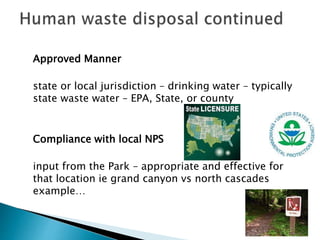
Approved Manner
state or local jurisdiction – drinking water – typically
state waste water – EPA, State, or county
Compliance with local NPS
input from the Park – appropriate and effective for
that location ie grand canyon vs north cascades
example…
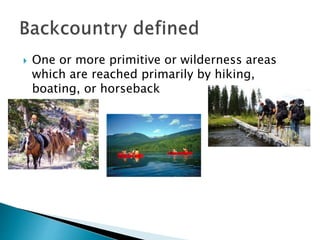
 One or more primitive or wilderness areas
which are reached primarily by hiking,
boating, or horseback
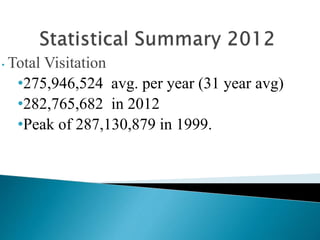
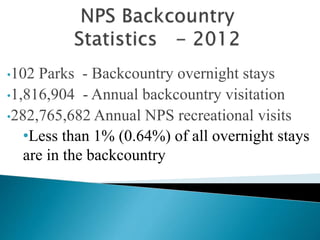
• Total Visitation
•275,946,524 avg. per year (31 year avg)
•282,765,682 in 2012
•Peak of 287,130,879 in 1999.
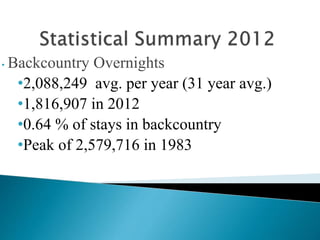
• Backcountry Overnights
•2,088,249 avg. per year (31 year avg.)
•1,816,907 in 2012
•0.64 % of stays in backcountry
•Peak of 2,579,716 in 1983
•102 Parks - Backcountry overnight stays
•1,816,904 - Annual backcountry visitation
•282,765,682 Annual NPS recreational visits
•Less than 1% (0.64%) of all overnight stays
are in the backcountry
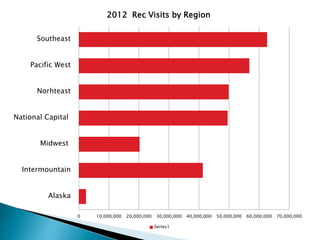
0 10,000,000 20,000,000 30,000,000 40,000,000 50,000,000 60,000,000 70,000,000
Alaska
Intermountain
Midwest
National Capital
Norhteast
Pacific West
Southeast
2012 Rec Visits by Region
Series1
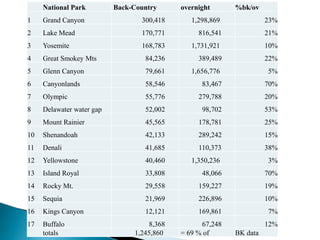
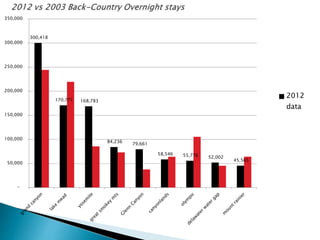
National Park Back-Country overnight %bk/ov
1 Grand Canyon 300,418 1,298,869 23%
2 Lake Mead 170,771 816,541 21%
3 Yosemite 168,783 1,731,921 10%
4 Great Smokey Mts 84,236 389,489 22%
5 Glenn Canyon 79,661 1,656,776 5%
6 Canyonlands 58,546 83,467 70%
7 Olympic 55,776 279,788 20%
8 Delawater water gap 52,002 98,702 53%
9 Mount Rainier 45,565 178,781 25%
10 Shenandoah 42,133 289,242 15%
11 Denali 41,685 110,373 38%
12 Yellowstone 40,460 1,350,236 3%
13 Island Royal 33,808 48,066 70%
14 Rocky Mt. 29,558 159,227 19%
15 Sequia 21,969 226,896 10%
16 Kings Canyon 12,121 169,861 7%
17 Buffalo 8,368 67,248 12%
totals 1,245,860 = 69 % of BK data
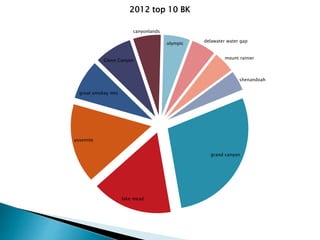
grand canyon
lake mead
yosemite
great smokey mts
Glenn Canyon
canyonlands
olympic
delawater water gap
mount rainier
shenandoah
2012 top 10 BK
300,418
170,771 168,783
84,236 79,661
58,546 55,776 52,002
45,565
-
50,000
100,000
150,000
200,000
250,000
300,000
350,000
2012
data
 Reference manual 83F A.4
Human waste will be safely disposed of in an
approved manner and in compliance with the
requirements of the local National Park
Service Unit.
◦ approved manner – state or local jurisdiction
◦ compliance with local – input from the Park –
which makes sense and is effective for that location
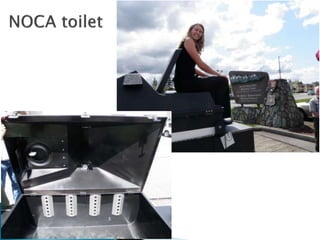
 NOCA National Park (4533 annual visitation)
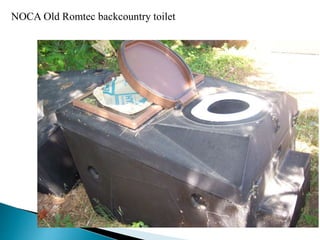
◦ Managed Collection system Romtec toilet in alpine
and sub alpine for 25 years in 16 locations.
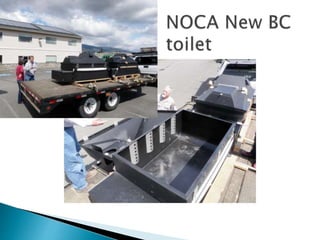
◦ NOCA - Kerri Cook’s work and developed new toilets for
collection of human waste in alpine environments.
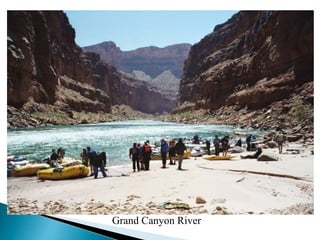
 Grand Canyon River rafters (over 35,000
annual visit.)
◦ South Cove -"SCAT Machine" - dysfunctional
during the 08/09 season
◦ Flagstaff Arizona disposal site
◦ Wildcat hill wastewater treatment facility
◦ Sandy Utah disposal site
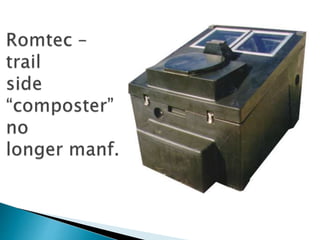
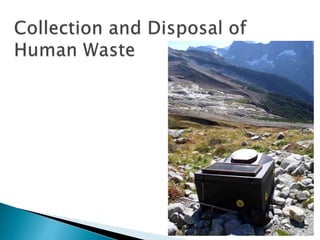
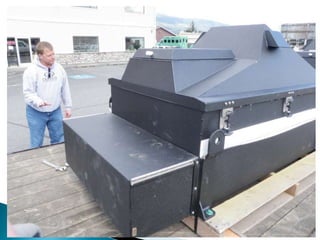
NOCA Old Romtec backcountry toilet
 Prior to 1981 - 35 gallon vaults were used to
collect waste from wallowa toilets
 Park uses Romtec tm toilets at helicopter
friendly sites
 Per 2006 study
◦ 8 of the 16 units were at 50% capacity – longer a
unit was in service the greater the Poo pile
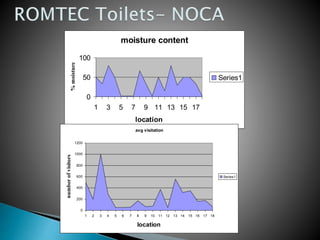
◦ As number of user increases so does the moisture
content. – see next slide
moisture content
0
50
100
1 3 5 7 9 11 13 15 17
location
%moisture
Series1
avg visitation
0
200
400
600
800
1000
1200
1 2 3 4 5 6 7 8 9 10 11 12 13 14 15 16 17 18
location
numberofvisitors
Series1
Grand Canyon River
 Flagstaff Arizona -
 Wildcat Hill Wastewater Treatment Facility
accepts solid waste from river toilets - fee of
$1.00 per river can.
 Sandy Utah ….you can clean out your poop
can's here: Cottonwood South never closed,
use the North entrance, and there is a hose on
site in the non-freezing months.
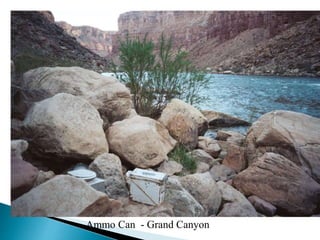
Ammo Can - Grand Canyon
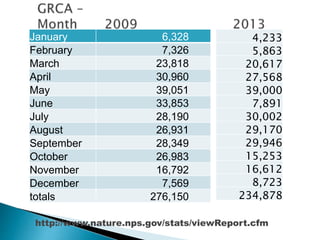
January 6,328
February 7,326
March 23,818
April 30,960
May 39,051
June 33,853
July 28,190
August 26,931
September 28,349
October 26,983
November 16,792
December 7,569
totals 276,150
http://www.nature.nps.gov/stats/viewReport.cfm
4,233
5,863
20,617
27,568
39,000
7,891
30,002
29,170
29,946
15,253
16,612
8,723
234,878
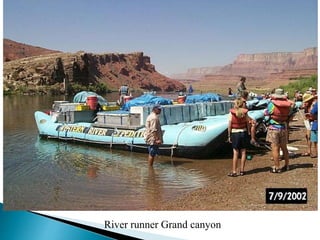
River runner Grand canyon
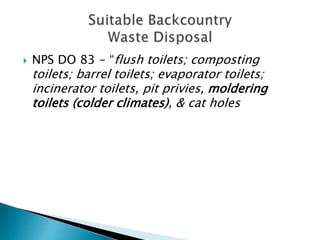
 NPS DO 83 - “flush toilets; composting
toilets; barrel toilets; evaporator toilets;
incinerator toilets, pit privies, moldering
toilets (colder climates), & cat holes
 The average person produces approx 180 lbs
of feces per year or 0.5 lbs per day.
 .44 - .77 lbs per day
 Bacteria are responsible for 1/3-1/2 of the
dry fecal weight.
 A study showed that there was a direct
correlation between gender, body weight,
age and bread consumption to fecal weight.
 grand canyon water example
◦ 35,000 visitor nights –- @ .44 lbs per day
◦ Total = 15,400 lbs
◦ Or approximately 7.7 annual tons of human waste
 NPS US average over last 31 years - 2009
 In those 31 years average annual
backcountry overnight visit was 1,983,044 x
0.44 lbs/day would equal 872,539 lbs
 or (1 pound = .45 kilograms) = 392,643
kilograms.
 Bacteria and pathogenic organisms
survival are affected by
◦ Moisture content
◦ Type of organism/Competition of species
◦ Nutrients
◦ Temperature
◦ Sunlight
 (Source - salvato-environmental
engineering and sanitation)
 Moisture content
◦ Bacteria and pathogenic organisms like a moisture
content of 10-20 percent
 Type of organism
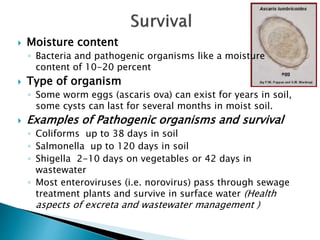
◦ Some worm eggs (ascaris ova) can exist for years in soil,
some cysts can last for several months in moist soil.
 Examples of Pathogenic organisms and survival
◦ Coliforms up to 38 days in soil
◦ Salmonella up to 120 days in soil
◦ Shigella 2-10 days on vegetables or 42 days in
wastewater
◦ Most enteroviruses (i.e. norovirus) pass through sewage
treatment plants and survive in surface water (Health
aspects of excreta and wastewater management )
 Nutrients
◦ Increase survival rates
 temperature
◦ Low temperatures favor survival. Example - The
survival of Gram-negative and Gram-positive species
was similar. Bacterial survival was shortest at 25°C
for all species studied, and in most cases longest at
4°C. (Sharron McEldowney, M. Fletcher, July 1988)
 Sunlight
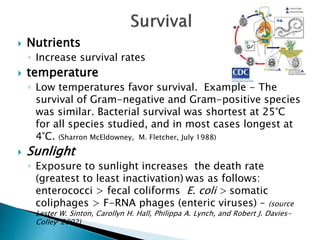
◦ Exposure to sunlight increases the death rate
(greatest to least inactivation) was as follows:
enterococci > fecal coliforms E. coli > somatic
coliphages > F-RNA phages (enteric viruses) – (source
Lester W. Sinton, Carollyn H. Hall, Philippa A. Lynch, and Robert J. Davies-
Colley, 2002)
ROUTES OF ENTRY
 INHALATION
 INGESTION
 ABSORPTION
 INJECTION
Human Exposure
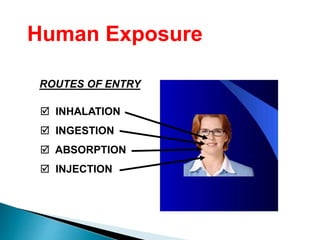
ROUTES OF ENTRY
Human exposure
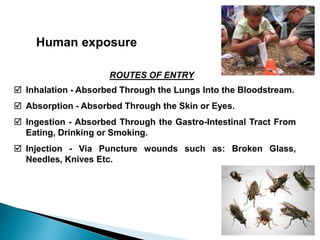
 Inhalation - Absorbed Through the Lungs Into the Bloodstream.
 Absorption - Absorbed Through the Skin or Eyes.
 Ingestion - Absorbed Through the Gastro-Intestinal Tract From
Eating, Drinking or Smoking.
 Injection - Via Puncture wounds such as: Broken Glass,
Needles, Knives Etc.
 Visitor
◦ Rely on visitor to self
monitor and obey
signage/directions
◦ Provide safe methods
for collection and
disposal
◦ Pack in and pack out
◦ Monitor disease/illness
(illness reporting
requirements RM83G1)
 NPS Backcountry
Staff
◦ Regulate PPE
◦ Recommend
vaccinations
◦ Health care provided
◦ Injury prevention and
safety requirements
(handwashing, lifting,
equipment, etc..)
 NPS/CDC
◦ Determined on case by case basis
◦ Tetanus is recommended for
maintenance workers and other
employees
◦ Hepatitis A is normally not
recommended for sewage plant
workers or others where the risks is low
◦ Occupational health division
recommends job hazard analysis
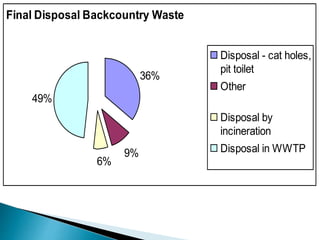
Where does it go?
Final Disposal Backcountry Waste
36%
9%
6%
49%
Disposal - cat holes,
pit toilet
Other
Disposal by
incineration
Disposal in WWTP
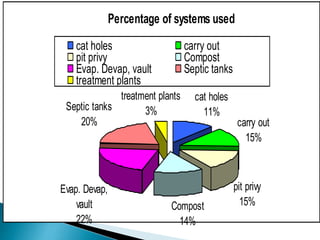
Percentage of systems used
cat holes
11%
carry out
15%
pit privy
15%Compost
14%
Evap. Devap,
vault
22%
Septic tanks
20%
treatment plants
3%
cat holes carry out
pit privy Compost
Evap. Devap, vault Septic tanks
treatment plants
 Vermicomposting toilets, an alternative to latrine
style microbial composting toilets, prove far
superior in mass reduction, pathogen
destruction, compost quality, and operational
cost – 2012-13 research
 Geoffrey B. Hill a,⇑, Susan A. Baldwin b,
 University of British Columbia, Department of
Geography
 http://sustain.ubc.ca/sites/sustain.ubc.ca/files/seedsli
brary/ubc_2013_spring_hill_geoff.pdf
 http://toilettechsolutions.com/
 Collection Method is site specific and dependent on
local conditions and resources.
 Transportation costs are an important aspect.
 Systems must be dependable (broken is not acceptable)
 NPS backcountry must remove or treat approx. 522
tons of human waste annually
 Keys to success are dependability, simplicity, funding,
personnel, education, inspection, and routine operation
& maintenance.
 Methods that reduce waste weight decrease costs
 Worm eggs & Viruses are most difficult to
eliminate/treat.
 An “out of order” sign on a backcountry toilet
is not acceptable.
John Leffel - Backcountry Sanitation

John Leffel - Backcountry Sanitation

  • 1.
    Human waste disposalin the national park service backcountry John Leffel, NPS Office Of Public Health Public Health Consultant July 2014
  • 2.
     Back CountrySanitation - wastewater ◦ Methods ◦ NPS - OPH directives ◦ Visitor Data 2012 ◦ Collection methods – 2 examples ◦ Public Health  Pathogens  Human Exposure
  • 4.
     Pit toilets Barrel and fly out containers  “composting toilets”  Vermicomposting toilets  Moldering toilets  Cat holes  Smear tactic  Low tide drop zone – glacier bay  Bag out pack out ◦ Names – wag bag, rest stop, blue bags, clean mountain can, etc…
  • 6.
     The NationalPark Service Office of Public Health (OPH) is an internal agency-specific public health capability, managed, funded and operated by NPS. This program is primarily staffed with commissioned officers on detail to the agency from the United States Public Health Service and is a national activity headquartered in Washington, DC with field staff located across the NPS system.
  • 7.
     Disease surveillanceand response,  on-site evaluation/hazard analysis,  consultation, policy guidance,  coordination with local, state and other federal health jurisdictions,  Assist park superintendents to protect and promote visitor health
  • 8.
    Directives System Level 1- Management Policies Level 2 - Director’s Orders (1-94) # 83 PH Level 3 - Reference Manuals, Handbooks etc..
  • 9.
     A.1. NationalPark Service (NPS) Park Managers will reduce the risk of disease transmission to park visitors, partners, and staff while providing opportunities to enjoy experiences in the backcountry. These guidelines are intended for NPS partners and NPS operations to ensure minimum standards for public health are maintained in the backcountry where front country standards are not achievable.
  • 10.
     Reference manual83F A.4 Human waste will be safely disposed of in an approved manner and in compliance with the requirements of the local National Park Service Unit.
  • 11.
    Approved Manner state orlocal jurisdiction – drinking water – typically state waste water – EPA, State, or county Compliance with local NPS input from the Park – appropriate and effective for that location ie grand canyon vs north cascades example…
  • 12.
     One ormore primitive or wilderness areas which are reached primarily by hiking, boating, or horseback
  • 14.
    • Total Visitation •275,946,524avg. per year (31 year avg) •282,765,682 in 2012 •Peak of 287,130,879 in 1999.
  • 15.
    • Backcountry Overnights •2,088,249avg. per year (31 year avg.) •1,816,907 in 2012 •0.64 % of stays in backcountry •Peak of 2,579,716 in 1983
  • 16.
    •102 Parks -Backcountry overnight stays •1,816,904 - Annual backcountry visitation •282,765,682 Annual NPS recreational visits •Less than 1% (0.64%) of all overnight stays are in the backcountry
  • 17.
    0 10,000,000 20,000,00030,000,000 40,000,000 50,000,000 60,000,000 70,000,000 Alaska Intermountain Midwest National Capital Norhteast Pacific West Southeast 2012 Rec Visits by Region Series1
  • 18.
    National Park Back-Countryovernight %bk/ov 1 Grand Canyon 300,418 1,298,869 23% 2 Lake Mead 170,771 816,541 21% 3 Yosemite 168,783 1,731,921 10% 4 Great Smokey Mts 84,236 389,489 22% 5 Glenn Canyon 79,661 1,656,776 5% 6 Canyonlands 58,546 83,467 70% 7 Olympic 55,776 279,788 20% 8 Delawater water gap 52,002 98,702 53% 9 Mount Rainier 45,565 178,781 25% 10 Shenandoah 42,133 289,242 15% 11 Denali 41,685 110,373 38% 12 Yellowstone 40,460 1,350,236 3% 13 Island Royal 33,808 48,066 70% 14 Rocky Mt. 29,558 159,227 19% 15 Sequia 21,969 226,896 10% 16 Kings Canyon 12,121 169,861 7% 17 Buffalo 8,368 67,248 12% totals 1,245,860 = 69 % of BK data
  • 19.
    grand canyon lake mead yosemite greatsmokey mts Glenn Canyon canyonlands olympic delawater water gap mount rainier shenandoah 2012 top 10 BK
  • 20.
    300,418 170,771 168,783 84,236 79,661 58,54655,776 52,002 45,565 - 50,000 100,000 150,000 200,000 250,000 300,000 350,000 2012 data
  • 22.
     Reference manual83F A.4 Human waste will be safely disposed of in an approved manner and in compliance with the requirements of the local National Park Service Unit. ◦ approved manner – state or local jurisdiction ◦ compliance with local – input from the Park – which makes sense and is effective for that location
  • 23.
     NOCA NationalPark (4533 annual visitation) ◦ Managed Collection system Romtec toilet in alpine and sub alpine for 25 years in 16 locations. ◦ NOCA - Kerri Cook’s work and developed new toilets for collection of human waste in alpine environments.  Grand Canyon River rafters (over 35,000 annual visit.) ◦ South Cove -"SCAT Machine" - dysfunctional during the 08/09 season ◦ Flagstaff Arizona disposal site ◦ Wildcat hill wastewater treatment facility ◦ Sandy Utah disposal site
  • 24.
    NOCA Old Romtecbackcountry toilet
  • 25.
     Prior to1981 - 35 gallon vaults were used to collect waste from wallowa toilets  Park uses Romtec tm toilets at helicopter friendly sites  Per 2006 study ◦ 8 of the 16 units were at 50% capacity – longer a unit was in service the greater the Poo pile ◦ As number of user increases so does the moisture content. – see next slide
  • 26.
    moisture content 0 50 100 1 35 7 9 11 13 15 17 location %moisture Series1 avg visitation 0 200 400 600 800 1000 1200 1 2 3 4 5 6 7 8 9 10 11 12 13 14 15 16 17 18 location numberofvisitors Series1
  • 30.
  • 31.
     Flagstaff Arizona-  Wildcat Hill Wastewater Treatment Facility accepts solid waste from river toilets - fee of $1.00 per river can.  Sandy Utah ….you can clean out your poop can's here: Cottonwood South never closed, use the North entrance, and there is a hose on site in the non-freezing months.
  • 32.
    Ammo Can -Grand Canyon
  • 33.
    January 6,328 February 7,326 March23,818 April 30,960 May 39,051 June 33,853 July 28,190 August 26,931 September 28,349 October 26,983 November 16,792 December 7,569 totals 276,150 http://www.nature.nps.gov/stats/viewReport.cfm 4,233 5,863 20,617 27,568 39,000 7,891 30,002 29,170 29,946 15,253 16,612 8,723 234,878
  • 34.
  • 35.
     NPS DO83 - “flush toilets; composting toilets; barrel toilets; evaporator toilets; incinerator toilets, pit privies, moldering toilets (colder climates), & cat holes
  • 36.
     The averageperson produces approx 180 lbs of feces per year or 0.5 lbs per day.  .44 - .77 lbs per day  Bacteria are responsible for 1/3-1/2 of the dry fecal weight.  A study showed that there was a direct correlation between gender, body weight, age and bread consumption to fecal weight.
  • 37.
     grand canyonwater example ◦ 35,000 visitor nights –- @ .44 lbs per day ◦ Total = 15,400 lbs ◦ Or approximately 7.7 annual tons of human waste  NPS US average over last 31 years - 2009  In those 31 years average annual backcountry overnight visit was 1,983,044 x 0.44 lbs/day would equal 872,539 lbs  or (1 pound = .45 kilograms) = 392,643 kilograms.
  • 39.
     Bacteria andpathogenic organisms survival are affected by ◦ Moisture content ◦ Type of organism/Competition of species ◦ Nutrients ◦ Temperature ◦ Sunlight  (Source - salvato-environmental engineering and sanitation)
  • 40.
     Moisture content ◦Bacteria and pathogenic organisms like a moisture content of 10-20 percent  Type of organism ◦ Some worm eggs (ascaris ova) can exist for years in soil, some cysts can last for several months in moist soil.  Examples of Pathogenic organisms and survival ◦ Coliforms up to 38 days in soil ◦ Salmonella up to 120 days in soil ◦ Shigella 2-10 days on vegetables or 42 days in wastewater ◦ Most enteroviruses (i.e. norovirus) pass through sewage treatment plants and survive in surface water (Health aspects of excreta and wastewater management )
  • 41.
     Nutrients ◦ Increasesurvival rates  temperature ◦ Low temperatures favor survival. Example - The survival of Gram-negative and Gram-positive species was similar. Bacterial survival was shortest at 25°C for all species studied, and in most cases longest at 4°C. (Sharron McEldowney, M. Fletcher, July 1988)  Sunlight ◦ Exposure to sunlight increases the death rate (greatest to least inactivation) was as follows: enterococci > fecal coliforms E. coli > somatic coliphages > F-RNA phages (enteric viruses) – (source Lester W. Sinton, Carollyn H. Hall, Philippa A. Lynch, and Robert J. Davies- Colley, 2002)
  • 42.
    ROUTES OF ENTRY INHALATION  INGESTION  ABSORPTION  INJECTION Human Exposure
  • 43.
    ROUTES OF ENTRY Humanexposure  Inhalation - Absorbed Through the Lungs Into the Bloodstream.  Absorption - Absorbed Through the Skin or Eyes.  Ingestion - Absorbed Through the Gastro-Intestinal Tract From Eating, Drinking or Smoking.  Injection - Via Puncture wounds such as: Broken Glass, Needles, Knives Etc.
  • 45.
     Visitor ◦ Relyon visitor to self monitor and obey signage/directions ◦ Provide safe methods for collection and disposal ◦ Pack in and pack out ◦ Monitor disease/illness (illness reporting requirements RM83G1)  NPS Backcountry Staff ◦ Regulate PPE ◦ Recommend vaccinations ◦ Health care provided ◦ Injury prevention and safety requirements (handwashing, lifting, equipment, etc..)
  • 46.
     NPS/CDC ◦ Determinedon case by case basis ◦ Tetanus is recommended for maintenance workers and other employees ◦ Hepatitis A is normally not recommended for sewage plant workers or others where the risks is low ◦ Occupational health division recommends job hazard analysis
  • 47.
  • 49.
    Final Disposal BackcountryWaste 36% 9% 6% 49% Disposal - cat holes, pit toilet Other Disposal by incineration Disposal in WWTP
  • 50.
    Percentage of systemsused cat holes 11% carry out 15% pit privy 15%Compost 14% Evap. Devap, vault 22% Septic tanks 20% treatment plants 3% cat holes carry out pit privy Compost Evap. Devap, vault Septic tanks treatment plants
  • 51.
     Vermicomposting toilets,an alternative to latrine style microbial composting toilets, prove far superior in mass reduction, pathogen destruction, compost quality, and operational cost – 2012-13 research  Geoffrey B. Hill a,⇑, Susan A. Baldwin b,  University of British Columbia, Department of Geography  http://sustain.ubc.ca/sites/sustain.ubc.ca/files/seedsli brary/ubc_2013_spring_hill_geoff.pdf  http://toilettechsolutions.com/
  • 52.
     Collection Methodis site specific and dependent on local conditions and resources.  Transportation costs are an important aspect.  Systems must be dependable (broken is not acceptable)  NPS backcountry must remove or treat approx. 522 tons of human waste annually  Keys to success are dependability, simplicity, funding, personnel, education, inspection, and routine operation & maintenance.  Methods that reduce waste weight decrease costs  Worm eggs & Viruses are most difficult to eliminate/treat.
  • 53.
     An “outof order” sign on a backcountry toilet is not acceptable.