Climbing Management Plans:
Concepts & Case Studies
Who is the Access Fund?
National advocacy organization that keeps climbing areas
open and conserves the climbing environment
-Founded in 1991
-Represents 6.8 million climbers nationwide
-Six core programs support the mission on national and local levels:
– Education
– Stewardship & conservation
– Climbing policy & advocacy
– Local support & mobilization
– Risk management & landowner support
– Land acquisition & protection
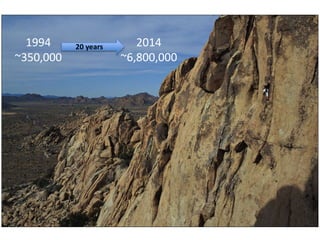
1994
~350,000
2014
~6,800,000
20 years
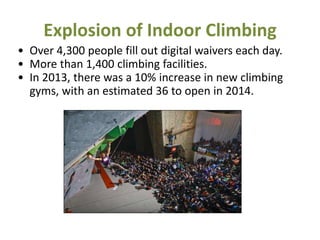
Explosion of Indoor Climbing
• Over 4,300 people fill out digital waivers each day.
• More than 1,400 climbing facilities.
• In 2013, there was a 10% increase in new climbing
gyms, with an estimated 36 to open in 2014.
Media is Embracing Climbers
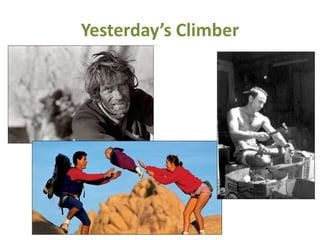
Yesterday’s Climber
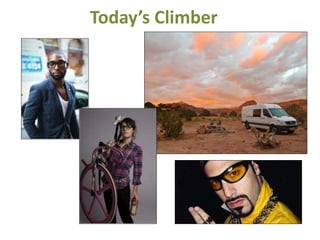
Today’s Climber
More climbers ≠ More impact
Impact is a function of Intensity, Type of Use and Ecosystem
Impact (or perceived impact) causes issues that a CMP may resolve
Current Conditions
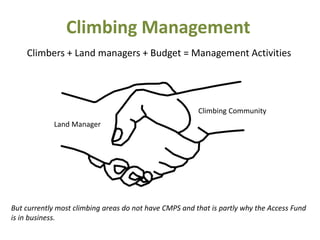
Climbers + Land managers + Budget = Management Activities
But currently most climbing areas do not have CMPS and that is partly why the Access Fund
is in business.
Land Manager
Climbing Community
Climbing Management
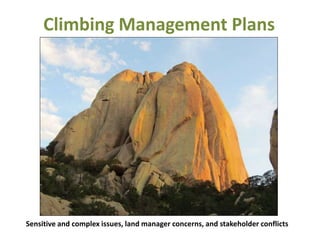
Climbing Management Plans
Sensitive and complex issues, land manager concerns, and stakeholder conflicts
Increase Compliance
Better for climbers, land managers and environment
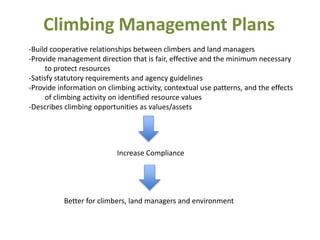
Climbing Management Plans
-Build cooperative relationships between climbers and land managers
-Provide management direction that is fair, effective and the minimum necessary
to protect resources
-Satisfy statutory requirements and agency guidelines
-Provide information on climbing activity, contextual use patterns, and the effects
of climbing activity on identified resource values
-Describes climbing opportunities as values/assets
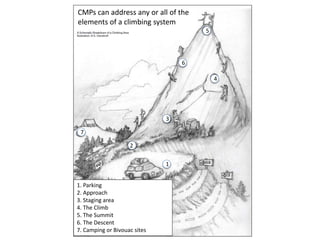
CMPs can address any or all of the
elements of a climbing system
1. Parking
2. Approach
3. Staging area
4. The Climb
5. The Summit
6. The Descent
7. Camping or Bivouac sites
7
1
2
3
4
5
6
Ecological Issues
Cultural Resources
Social Issues
Site specificity
Climbing Management Plans
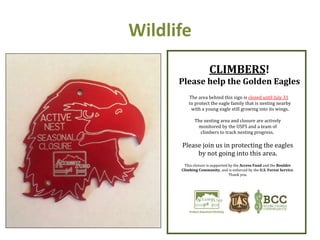
Wildlife
Wildlife
CLIMBERS!
Please help the Golden Eagles
The area behind this sign is closed until July 31
to protect the eagle family that is nesting nearby
with a young eagle still growing into its wings.
The nesting area and closure are actively
monitored by the USFS and a team of
climbers to track nesting progress.
Please join us in protecting the eagles
by not going into this area.
This closure is supported by the Access Fund and the Boulder
Climbing Community, and is enforced by the U.S. Forest Service.
Thank you.
Vegetation
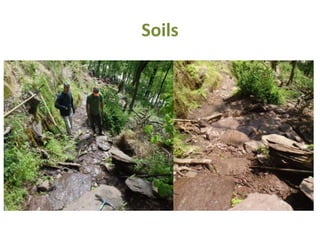
Soils
Soils
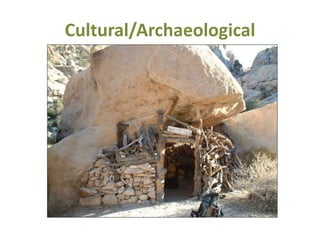
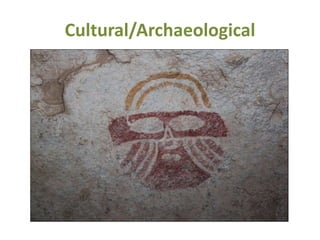
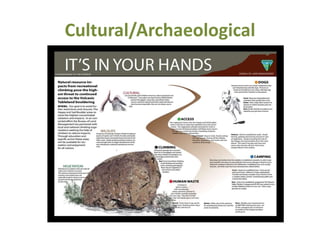
Cultural/Archaeological
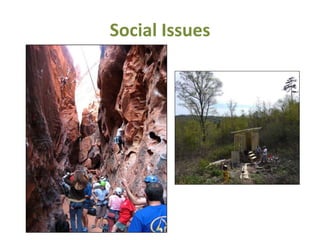
Social Issues
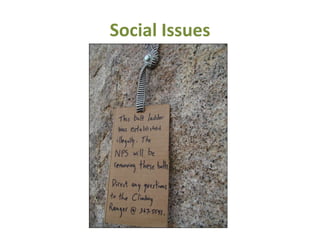
Social Issues
Social Issues
Social Issues
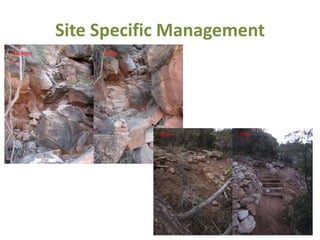
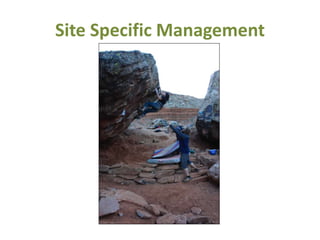
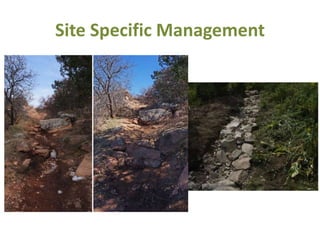
Site Specific Management
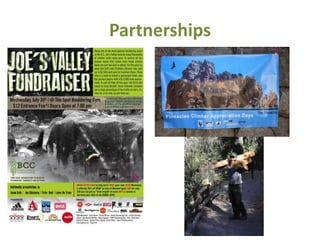
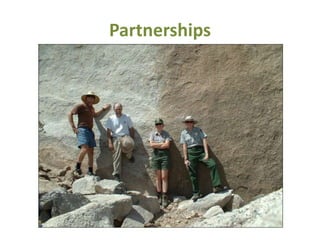
Partnerships
Partnerships
Partnerships for Stewardship
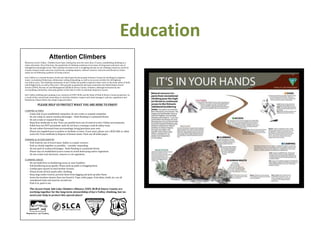
Education
Attention Climbers
Welcome to Joe’s Valley. Climbers have been visiting this area for more than 15 years, establishing climbing as a
major attraction. Since that time, the popularity of climbing continues to increase, driving more and more use at
managed & unmanaged areas. This constant increase in use is weighing heavily on our climbing resources; levels of
erosion, human waste concerns, trash levels, camping impacts, cultural resource concerns and threats to visitor
safety are all following a pattern of rising concern.
Joe’s Valley is a coveted location, loved and relied upon by the people of Emery County for drinking & irrigation
water, recreational fisherman, whitewater rafting & kayaking, as well as an access corridor for off-highway
recreation users. The climbing community in Joe’s Valley has quickly outgrown other users in the main stems of both
Left & Right Fork, as well as New Joe’s. This growth in popularity has been noticed by the United States Forest
Service (USFS), Bureau of Land Management (BLM) & Emery County. Climbers, although welcomed by the
surrounding community, must play gently on the land in order to maintain long-term access.
Joe’s Valley climbing and camping is on a mixture of USFS, BLM, and the State of Utah & Emery County properties. As
a result of this varied land ownership, its vital that climbers respect each land managers’ policies, regulations and
limitations. Please follow the simple requests below.
PLEASE HELP US PROTECT WHAT YOU ARE HERE TO ENJOY!
CAMPING & FIRES
· Camp only in pre-established campsites; do not create or expand campsites.
· Do not camp in canyon washes/drainages – flash flooding is a potential threat.
· Do not create or expand fire rings.
· Keep fires moderate in size. Fires can quickly burn out of control in Joe’s Valley environments.
· Pallet fires are NOT permitted; nails do not burn, creating a trash & safety issue.
· Do not collect firewood from surroundings, bring/purchase your own.
· Please use supplied port-a-potties or facilities in town. If you must, please use a WAG BAG or other
Leave No Trace methods to dispose of human waste. Pack-out all toilet paper.
PARKING & ACCESS ROUTES
· Park entirely out of travel lanes. Safety is a major concern.
· Park as closely together as possible – consider carpooling.
· Do not park in washes/drainages - flash flooding is a potential threat.
· Please stay on established access routes to avoid destroying native vegetation.
· Do not create trail shortcuts, remove or cut vegetation.
CLIMBING AREAS
· Do not build fires in bouldering areas or near boulders.
· Pad bouldering areas gently. Please pick-up pads vs dragging them.
· Confine gear sprawl to limit further erosion.
· Please brush off tick marks after climbing.
· Keep dogs under control, prevent them from digging and pick-up after them.
· Leave the location cleaner than you found it. Tape, toilet paper, fruit skins, chalk, etc. are all
considered trash and must be carried out.
· Pack it in, pack it out.
The Access Fund, Salt Lake Climbers Alliance, USFS, BLM & Emery County are
working together for the long-term stewardship of Joe’s Valley climbing, but we
need your help to protect this special place!
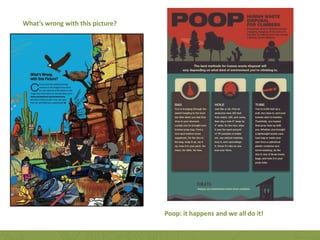
Poop: it happens and we all do it!
What’s wrong with this picture?
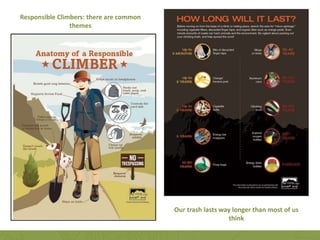
Responsible Climbers: there are common
themes
Our trash lasts way longer than most of us
think
Gym to Crag
Tread Lightly
Outreach

Ty Tyler and Erik Murdock – Climbing management plans, Access Fund

  • 1.
  • 2.
    Who is theAccess Fund? National advocacy organization that keeps climbing areas open and conserves the climbing environment -Founded in 1991 -Represents 6.8 million climbers nationwide -Six core programs support the mission on national and local levels: – Education – Stewardship & conservation – Climbing policy & advocacy – Local support & mobilization – Risk management & landowner support – Land acquisition & protection
  • 3.
  • 5.
    Explosion of IndoorClimbing • Over 4,300 people fill out digital waivers each day. • More than 1,400 climbing facilities. • In 2013, there was a 10% increase in new climbing gyms, with an estimated 36 to open in 2014.
  • 6.
  • 7.
  • 8.
  • 9.
    More climbers ≠More impact Impact is a function of Intensity, Type of Use and Ecosystem Impact (or perceived impact) causes issues that a CMP may resolve Current Conditions
  • 10.
    Climbers + Landmanagers + Budget = Management Activities But currently most climbing areas do not have CMPS and that is partly why the Access Fund is in business. Land Manager Climbing Community Climbing Management
  • 11.
  • 13.
    Climbing Management Plans Sensitiveand complex issues, land manager concerns, and stakeholder conflicts
  • 14.
    Increase Compliance Better forclimbers, land managers and environment Climbing Management Plans -Build cooperative relationships between climbers and land managers -Provide management direction that is fair, effective and the minimum necessary to protect resources -Satisfy statutory requirements and agency guidelines -Provide information on climbing activity, contextual use patterns, and the effects of climbing activity on identified resource values -Describes climbing opportunities as values/assets
  • 15.
    CMPs can addressany or all of the elements of a climbing system 1. Parking 2. Approach 3. Staging area 4. The Climb 5. The Summit 6. The Descent 7. Camping or Bivouac sites 7 1 2 3 4 5 6
  • 16.
    Ecological Issues Cultural Resources SocialIssues Site specificity Climbing Management Plans
  • 17.
  • 18.
    Wildlife CLIMBERS! Please help theGolden Eagles The area behind this sign is closed until July 31 to protect the eagle family that is nesting nearby with a young eagle still growing into its wings. The nesting area and closure are actively monitored by the USFS and a team of climbers to track nesting progress. Please join us in protecting the eagles by not going into this area. This closure is supported by the Access Fund and the Boulder Climbing Community, and is enforced by the U.S. Forest Service. Thank you.
  • 19.
  • 20.
  • 21.
  • 22.
  • 23.
  • 24.
  • 25.
  • 26.
  • 27.
  • 28.
  • 29.
  • 30.
  • 31.
  • 32.
  • 33.
  • 34.
  • 35.
  • 36.
    Education Attention Climbers Welcome toJoe’s Valley. Climbers have been visiting this area for more than 15 years, establishing climbing as a major attraction. Since that time, the popularity of climbing continues to increase, driving more and more use at managed & unmanaged areas. This constant increase in use is weighing heavily on our climbing resources; levels of erosion, human waste concerns, trash levels, camping impacts, cultural resource concerns and threats to visitor safety are all following a pattern of rising concern. Joe’s Valley is a coveted location, loved and relied upon by the people of Emery County for drinking & irrigation water, recreational fisherman, whitewater rafting & kayaking, as well as an access corridor for off-highway recreation users. The climbing community in Joe’s Valley has quickly outgrown other users in the main stems of both Left & Right Fork, as well as New Joe’s. This growth in popularity has been noticed by the United States Forest Service (USFS), Bureau of Land Management (BLM) & Emery County. Climbers, although welcomed by the surrounding community, must play gently on the land in order to maintain long-term access. Joe’s Valley climbing and camping is on a mixture of USFS, BLM, and the State of Utah & Emery County properties. As a result of this varied land ownership, its vital that climbers respect each land managers’ policies, regulations and limitations. Please follow the simple requests below. PLEASE HELP US PROTECT WHAT YOU ARE HERE TO ENJOY! CAMPING & FIRES · Camp only in pre-established campsites; do not create or expand campsites. · Do not camp in canyon washes/drainages – flash flooding is a potential threat. · Do not create or expand fire rings. · Keep fires moderate in size. Fires can quickly burn out of control in Joe’s Valley environments. · Pallet fires are NOT permitted; nails do not burn, creating a trash & safety issue. · Do not collect firewood from surroundings, bring/purchase your own. · Please use supplied port-a-potties or facilities in town. If you must, please use a WAG BAG or other Leave No Trace methods to dispose of human waste. Pack-out all toilet paper. PARKING & ACCESS ROUTES · Park entirely out of travel lanes. Safety is a major concern. · Park as closely together as possible – consider carpooling. · Do not park in washes/drainages - flash flooding is a potential threat. · Please stay on established access routes to avoid destroying native vegetation. · Do not create trail shortcuts, remove or cut vegetation. CLIMBING AREAS · Do not build fires in bouldering areas or near boulders. · Pad bouldering areas gently. Please pick-up pads vs dragging them. · Confine gear sprawl to limit further erosion. · Please brush off tick marks after climbing. · Keep dogs under control, prevent them from digging and pick-up after them. · Leave the location cleaner than you found it. Tape, toilet paper, fruit skins, chalk, etc. are all considered trash and must be carried out. · Pack it in, pack it out. The Access Fund, Salt Lake Climbers Alliance, USFS, BLM & Emery County are working together for the long-term stewardship of Joe’s Valley climbing, but we need your help to protect this special place!
  • 37.
    Poop: it happensand we all do it! What’s wrong with this picture?
  • 38.
    Responsible Climbers: thereare common themes Our trash lasts way longer than most of us think
  • 39.
  • 40.