JOHN DEWEY
AN AMERICAN PRAGMATIST
BY: SANDRA KIRWAN
JOHN DEWEY (1859- 1952)
AMERICAN PHILOSOPHER, EDUCATOR, AND WRITER
‱ Born in Burlington, Vermont on October 20, 1859
‱ Third child of four sons (one of his brothers died at infancy)
‱ Attended Burlington public schools
‱ Enrolled at the University of Vermont at the age of 15, graduated in four years and ranked #2 in his class
‱ Received his doctorate from Johns Hopkins in 1884
‱ Married Harriet Alice Chipman in 1886
‱ The couple had six children and adopted one
‱ Passed away on June 1, 1952 at the age of 92 (he died from pneumonia)
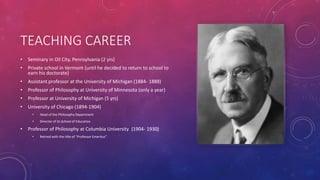
TEACHING CAREER
‱ Seminary in Oil City, Pennsylvania (2 yrs)
‱ Private school in Vermont (until he decided to return to school to
earn his doctorate)
‱ Assistant professor at the University of Michigan (1884- 1888)
‱ Professor of Philosophy at University of Minnesota (only a year)
‱ Professor at University of Michigan (5 yrs)
‱ University of Chicago (1894-1904)
‱ Head of the Philosophy Department
‱ Director of its School of Education
‱ Professor of Philosophy at Columbia University (1904- 1930)
‱ Retired with the title of “Professor Emeritus”
PHILOSOPHY EDUCATION, THEREFORE, IS A
PROCESS OF LIVING AND NOT
A PREPARATION FOR FUTURE LIVING.
JOHN DEWEY
‱ Experimentalism philosophy
‱ “Instrumentalism" - belief that thinking is an activity which, at
its best, is directed toward resolving problems
‱ Education should be based on the principle of learning
through doing
‱ A strong proponent for progressive educational reform
‱ Man behaved out of habit and that change often led to
unexpected outcomes
DEWEY’S INFLUENCES
‱ League for Independent Political Action (helped
organize)
‱ Editor of the New Republic magazine
‱ Founded the American Civil Liberties Union and
the American Association of University
Professors
‱ The "progressive education" movement of the
1920s was based on Dewey’s philosophy of
education
Influence on Education:
(How education should be)
‱ A mix of student’s interests and sharing of
knowledge from the teacher
‱ Teachers should encourage students to discover
their own understanding of a topic
‱ Hands on learning
‱ Continuity and interaction
‱ Children learn from their experiences
ACCOMPLISHMENTS
‱ Educational theories published in The School and Society
‱ Published almost 40 books and hundreds of articles
‱ John Dewey High School in Brooklyn and John Dewey Academy of Learning in Green Bay, Wisconsin
(both named after John Dewey)
‱ Books written by John Dewey
‱ How We Think
‱ Democracy and Education
‱ Experience and Education
‱ The Influence of Darwin on Philosophy
‱ A Common Faith
REFERENCES
‱ http://www.biography.com/people/john-dewey
‱ Encyclopedia of World Biography; De-Du
‱ http://www.goodtherapy.org/famous-psychologists/john-dewey
‱ Jackson, Philip W., John Dewey and the Lessons of Art, New Haven, CT: Yale University Press, 1998

John dewey

  • 1.
    JOHN DEWEY AN AMERICANPRAGMATIST BY: SANDRA KIRWAN
  • 2.
    JOHN DEWEY (1859-1952) AMERICAN PHILOSOPHER, EDUCATOR, AND WRITER ‱ Born in Burlington, Vermont on October 20, 1859 ‱ Third child of four sons (one of his brothers died at infancy) ‱ Attended Burlington public schools ‱ Enrolled at the University of Vermont at the age of 15, graduated in four years and ranked #2 in his class ‱ Received his doctorate from Johns Hopkins in 1884 ‱ Married Harriet Alice Chipman in 1886 ‱ The couple had six children and adopted one ‱ Passed away on June 1, 1952 at the age of 92 (he died from pneumonia)
  • 3.
    TEACHING CAREER ‱ Seminaryin Oil City, Pennsylvania (2 yrs) ‱ Private school in Vermont (until he decided to return to school to earn his doctorate) ‱ Assistant professor at the University of Michigan (1884- 1888) ‱ Professor of Philosophy at University of Minnesota (only a year) ‱ Professor at University of Michigan (5 yrs) ‱ University of Chicago (1894-1904) ‱ Head of the Philosophy Department ‱ Director of its School of Education ‱ Professor of Philosophy at Columbia University (1904- 1930) ‱ Retired with the title of “Professor Emeritus”
  • 4.
    PHILOSOPHY EDUCATION, THEREFORE,IS A PROCESS OF LIVING AND NOT A PREPARATION FOR FUTURE LIVING. JOHN DEWEY ‱ Experimentalism philosophy ‱ “Instrumentalism" - belief that thinking is an activity which, at its best, is directed toward resolving problems ‱ Education should be based on the principle of learning through doing ‱ A strong proponent for progressive educational reform ‱ Man behaved out of habit and that change often led to unexpected outcomes
  • 5.
    DEWEY’S INFLUENCES ‱ Leaguefor Independent Political Action (helped organize) ‱ Editor of the New Republic magazine ‱ Founded the American Civil Liberties Union and the American Association of University Professors ‱ The "progressive education" movement of the 1920s was based on Dewey’s philosophy of education Influence on Education: (How education should be) ‱ A mix of student’s interests and sharing of knowledge from the teacher ‱ Teachers should encourage students to discover their own understanding of a topic ‱ Hands on learning ‱ Continuity and interaction ‱ Children learn from their experiences
  • 6.
    ACCOMPLISHMENTS ‱ Educational theoriespublished in The School and Society ‱ Published almost 40 books and hundreds of articles ‱ John Dewey High School in Brooklyn and John Dewey Academy of Learning in Green Bay, Wisconsin (both named after John Dewey) ‱ Books written by John Dewey ‱ How We Think ‱ Democracy and Education ‱ Experience and Education ‱ The Influence of Darwin on Philosophy ‱ A Common Faith
  • 7.
    REFERENCES ‱ http://www.biography.com/people/john-dewey ‱ Encyclopediaof World Biography; De-Du ‱ http://www.goodtherapy.org/famous-psychologists/john-dewey ‱ Jackson, Philip W., John Dewey and the Lessons of Art, New Haven, CT: Yale University Press, 1998