Quick background: KeenTechnologies
● OpenAI
● Doing the reading
● Research, not product
○ There are key, fundamental discoveries to be made
● Richard Sutton and Alberta
● Six researchers today
○ Richard Sutton
○ Joseph Modayil
○ Khurram Javed
○ John Carmack
○ Gloria Kennickell
○ Lucas Nestler
6.
Where I thoughtI was going
● Not LLMs
○ LLMs can know everything without learning anything
○ Learn from experience, not an IID blender
● Virtual environments and games
○ Bot history
● Video understanding
● Infinite video wall
7.
Missteps
● Too lowlevel
● Avoided larger experiments too long
● Sega Master System
● Video can wait
8.
Settling in withAtari
● Deep research history
○ Mostly replicable, but assumptions varied
○ RL framework rot over the years
● Unbiased and diverse
● Isn’t Atari solved?
○ MEME, Muesli, BBF, etc
○ Scores are there for most games, given enough time
○ Lots of critical questions are still open!
● Why not Pokemon or Minecraft?
○ Scrolling and 3D will definitely add more challenges
○ Tempts people to look at internal data structures
9.
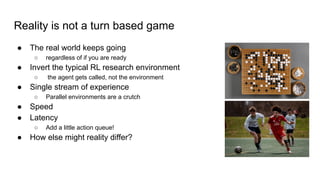
Reality is nota turn based game
● The real world keeps going
○ regardless of if you are ready
● Invert the typical RL research environment
○ the agent gets called, not the environment
● Single stream of experience
○ Parallel environments are a crutch
● Speed
● Latency
○ Add a little action queue!
● How else might reality differ?
10.
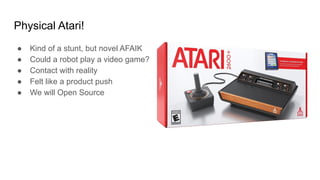
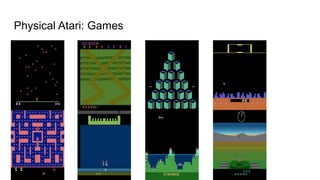
Physical Atari!
● Kindof a stunt, but novel AFAIK
● Could a robot play a video game?
● Contact with reality
● Felt like a product push
● We will Open Source
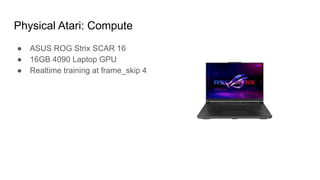
Physical Atari: Compute
●ASUS ROG Strix SCAR 16
● 16GB 4090 Laptop GPU
● Realtime training at frame_skip 4
13.
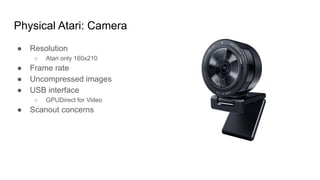
Physical Atari: Camera
●Resolution
○ Atari only 160x210
● Frame rate
● Uncompressed images
● USB interface
○ GPUDirect for Video
● Scanout concerns
14.
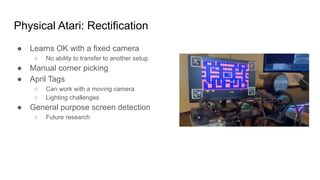
Physical Atari: Rectification
●Learns OK with a fixed camera
○ No ability to transfer to another setup
● Manual corner picking
● April Tags
○ Can work with a moving camera
○ Lighting challenges
● General purpose screen detection
○ Future research
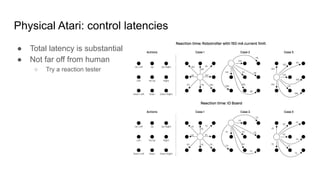
Physical Atari: controllatencies
● Total latency is substantial
● Not far off from human
○ Try a reaction tester
19.
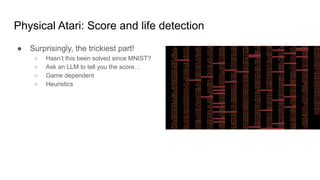
Physical Atari: Scoreand life detection
● Surprisingly, the trickiest part!
○ Hasn’t this been solved since MNIST?
○ Ask an LLM to tell you the score…
○ Game dependent
○ Heuristics
20.
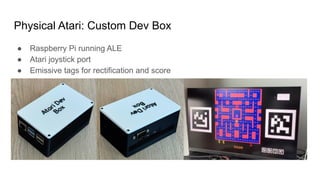
Physical Atari: CustomDev Box
● Raspberry Pi running ALE
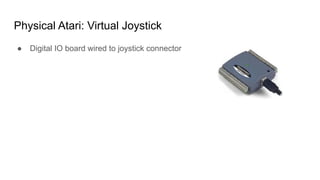
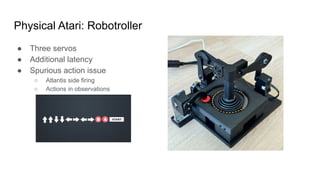
● Atari joystick port
● Emissive tags for rectification and score
21.
Physical Atari: Lessons
●ConvNets tolerate a wide range of image distortions
○ Not yet clear how well the models transfer across lighting conditions
● TD learning tolerates system latency
● Top simulation agents perform poorly with added latency
○ SPR and world models that condition on action taken
○ Need a robust fix for this, not just a matching delay
● Action-to-action paths can be a problem
● Decent learning in a few hours of experience
● Achieving human level performance looks feasible
○ Especially if talking to a remote big GPU
22.
Sequential Multi-Task Learning
●Sequential is much harder than parallel
● No TaskID or weight switching
● No hyperparameter ramp alignment
○ Exploration, optimizer, model reset
● The global weight impact of online learning
● Is a giant replay buffer enough?
○ Using TB of storage isn’t crazy
● Offline RL can bootstrap into a coherent fantasy untested by reality
23.
Transfer Learning
● Don’tplay like an idiot at the start
○ After years of subjective time playing game, should do better
● OpenAI’s Gotta Learn Fast
○ 1M steps is plenty to learn without any transfer learning
● GATO: More effective to learn a game from scratch than to fine tune
○ Negative transfer learning
● Distinct from continuous forgetting
24.
New Benchmark
● Eightgames?
● Three cycles through all the games?
● 400k frames per cycle?
○ Handle truncation, or only switch at end of episode?
● Close to the compute for 26 games of Atari100k
● No dedicated evaluation phase, sum over last cycle
● Full action set
● Sticky actions
● Add a control latency?
● Real time?
● BBF from scratch as baseline performance
● Standard benchmark harness
25.
Sparse rewards
● Individualscores isn’t the driver for humans like it is for RL agents
○ Often don’t even look at score until the end!
● The “hard exploration games” – Pitfall, Montezuma’s Revenge, etc
○ Make any game into hard exploration by only giving reward at loss of life or game over
● Dense rewards for human tasks are the exception, not the rule
● Intrinsic rewards
● Curiosity
● Meta-curiosity across games
○ How would a human play a library of arcade games?
26.
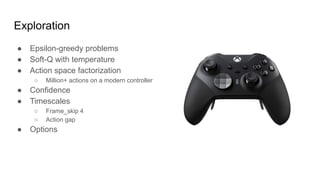
Exploration
● Epsilon-greedy problems
●Soft-Q with temperature
● Action space factorization
○ Million+ actions on a modern controller
● Confidence
● Timescales
○ Frame_skip 4
○ Action gap
● Options
27.
Recurrence vs FrameStacks
● Frame stacks are unfortunately effective for Atari
● Brains are recurrent neural networks
28.
Function Approximation DominatesPerformance
● Just a black box in classic RL
● Many duties, surprising it works as well as it does!
○ Learning new results for novel inputs
○ Generalizing across similar inputs
○ Averaging stochastic processes
○ Updating non-stationary processes
● Supervised learning practices don’t always transfer
● Adam is still very hard to beat
● Auxiliary losses just tweak the value / policy approximation
● Are neural nets and backprop even the right thing?
29.
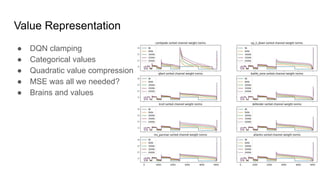
Value Representation
● DQNclamping
● Categorical values
● Quadratic value compression
● MSE was all we needed?
● Brains and values
30.
Plasticity vs Generalization
●Generalization is ignoring details
● Plasticity involves noticing new details
● Every new online sample is a held-out validation sample
○ But how do we use it to improve?




![[Cryptica 22] Tenderly - Your Lens To Blockchain - Nebojsa Urosevic](https://cdn.slidesharecdn.com/ss_thumbnails/nebojsaurosevic-yourlenstoblockchain-221129210142-6128d1f2-thumbnail.jpg?width=640&height=640&fit=bounds)


![[Pandora 22] ...Deliberately Unsupervised Playground - Milan Licina](https://cdn.slidesharecdn.com/ss_thumbnails/milanlicina-deliberatelyunsupervisedplaground-221129222351-d3fdf8ef-thumbnail.jpg?width=640&height=640&fit=bounds)


![State of the VC Market - Untapped Capital [Redacted]](https://cdn.slidesharecdn.com/ss_thumbnails/stateofthevcmarket-untappedcapitalredacted-251121032845-0feab568-thumbnail.jpg?width=640&height=640&fit=bounds)


