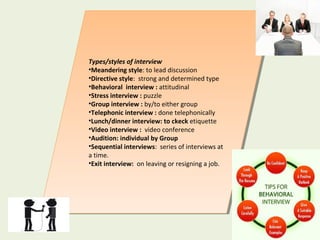
Types/styles of interview
•Meandering style: to lead discussion
•Directive style: strong and determined type
•Behavioral interview : attitudinal
•Stress interview : puzzle
•Group interview : by/to either group
•Telephonic interview : done telephonically
•Lunch/dinner interview: to ckeck etiquette
•Video interview : video conference
•Audition: individual by Group
•Sequential interviews: series of interviews at
a time.
•Exit interview: on leaving or resigning a job.
Types/styles of interview
•Meandering style: to lead discussion
•Directive style: strong and determined type
•Behavioral interview : attitudinal
•Stress interview : puzzle
•Group interview : by/to either group
•Telephonic interview : done telephonically
•Lunch/dinner interview: to ckeck etiquette
•Video interview : video conference
•Audition: individual by Group
•Sequential interviews: series of interviews at
a time.
•Exit interview: on leaving or resigning a job.
You should:
•Breath slowly and consistently
•Drink little water
•Laughing or joking reduces stress
Body language
•Wide gesture.
•Hands free of your sides s.a. out of pockets.
•Open handed gestures.
•Don’t cross arms across the body
•Avoid half hug i.e. putting your hand on
shoulder at other side.
•Don’t show pointing finger towards members of
panel
•Avoid anger
•Avoid excitement
You should:
•Breath slowly and consistently
•Drink little water
•Laughing or joking reduces stress
Body language
•Wide gesture.
•Hands free of your sides s.a. out of pockets.
•Open handed gestures.
•Don’t cross arms across the body
•Avoid half hug i.e. putting your hand on
shoulder at other side.
•Don’t show pointing finger towards members of
panel
•Avoid anger
•Avoid excitement
pnrao 3
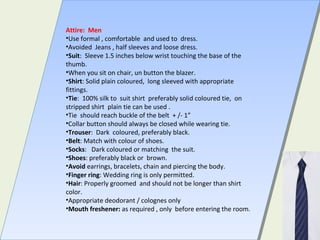
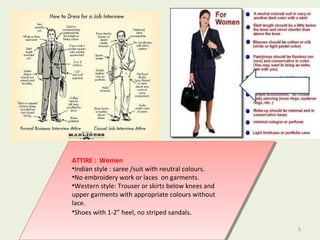
Attire: Men
•Use formal , comfortable and used to dress.
•Avoided Jeans , half sleeves and loose dress.
•Suit: Sleeve 1.5 inches below wrist touching the base of the
thumb.
•When you sit on chair, un button the blazer.
•Shirt: Solid plain coloured, long sleeved with appropriate
fittings.
•Tie: 100% silk to suit shirt preferably solid coloured tie, on
stripped shirt plain tie can be used .
•Tie should reach buckle of the belt + /- 1”
•Collar button should always be closed while wearing tie.
•Trouser: Dark coloured, preferably black.
•Belt: Match with colour of shoes.
•Socks: Dark coloured or matching the suit.
•Shoes: preferably black or brown.
•Avoid earrings, bracelets, chain and piercing the body.
•Finger ring: Wedding ring is only permitted.
•Hair: Properly groomed and should not be longer than shirt
color.
•Appropriate deodorant / colognes only
•Mouth freshener: as required , only before entering the room.
Attire: Men
•Use formal , comfortable and used to dress.
•Avoided Jeans , half sleeves and loose dress.
•Suit: Sleeve 1.5 inches below wrist touching the base of the
thumb.
•When you sit on chair, un button the blazer.
•Shirt: Solid plain coloured, long sleeved with appropriate
fittings.
•Tie: 100% silk to suit shirt preferably solid coloured tie, on
stripped shirt plain tie can be used .
•Tie should reach buckle of the belt + /- 1”
•Collar button should always be closed while wearing tie.
•Trouser: Dark coloured, preferably black.
•Belt: Match with colour of shoes.
•Socks: Dark coloured or matching the suit.
•Shoes: preferably black or brown.
•Avoid earrings, bracelets, chain and piercing the body.
•Finger ring: Wedding ring is only permitted.
•Hair: Properly groomed and should not be longer than shirt
color.
•Appropriate deodorant / colognes only
•Mouth freshener: as required , only before entering the room.
pnrao 5
ATTIRE : Women
•Indian style : saree /suit with neutral colours.
•No embroidery work or laces on garments.
•Western style: Trouser or skirts below knees and
upper garments with appropriate colours without
lace.
•Shoes with 1-2” heel, no striped sandals.
ATTIRE : Women
•Indian style : saree /suit with neutral colours.
•No embroidery work or laces on garments.
•Western style: Trouser or skirts below knees and
upper garments with appropriate colours without
lace.
•Shoes with 1-2” heel, no striped sandals.
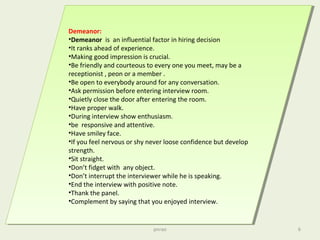
Demeanor:
•Demeanor is an influential factor in hiring decision
•It ranks ahead of experience.
•Making good impression is crucial.
•Be friendly and courteous to every one you meet, may be a
receptionist , peon or a member .
•Be open to everybody around for any conversation.
•Ask permission before entering interview room.
•Quietly close the door after entering the room.
•Have proper walk.
•During interview show enthusiasm.
•be responsive and attentive.
•Have smiley face.
•If you feel nervous or shy never loose confidence but develop
strength.
•Sit straight.
•Don’t fidget with any object.
•Don’t interrupt the interviewer while he is speaking.
•End the interview with positive note.
•Thank the panel.
•Complement by saying that you enjoyed interview.
Demeanor:
•Demeanor is an influential factor in hiring decision
•It ranks ahead of experience.
•Making good impression is crucial.
•Be friendly and courteous to every one you meet, may be a
receptionist , peon or a member .
•Be open to everybody around for any conversation.
•Ask permission before entering interview room.
•Quietly close the door after entering the room.
•Have proper walk.
•During interview show enthusiasm.
•be responsive and attentive.
•Have smiley face.
•If you feel nervous or shy never loose confidence but develop
strength.
•Sit straight.
•Don’t fidget with any object.
•Don’t interrupt the interviewer while he is speaking.
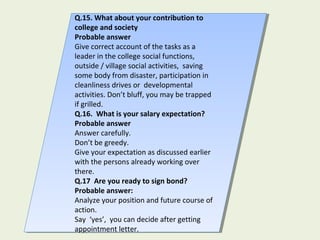
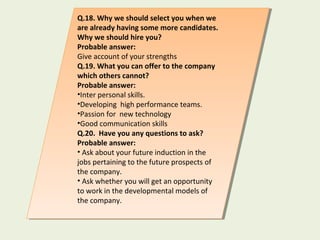
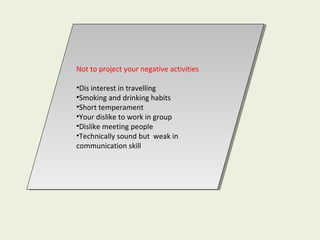
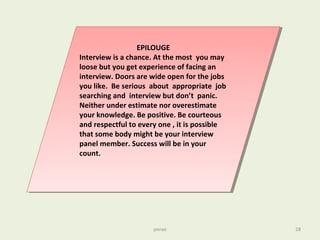
•End the interview with positive note.
•Thank the panel.
•Complement by saying that you enjoyed interview.
pnrao 6
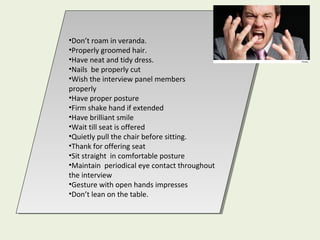
•Don’t roam in veranda.
•Properly groomed hair.
•Have neat and tidy dress.
•Nails be properly cut
•Wish the interview panel members
properly
•Have proper posture
•Firm shake hand if extended
•Have brilliant smile
•Wait till seat is offered
•Quietly pull the chair before sitting.
•Thank for offering seat
•Sit straight in comfortable posture
•Maintain periodical eye contact throughout
the interview
•Gesture with open hands impresses
•Don’t lean on the table.
•Don’t roam in veranda.
•Properly groomed hair.
•Have neat and tidy dress.
•Nails be properly cut
•Wish the interview panel members
properly
•Have proper posture
•Firm shake hand if extended
•Have brilliant smile
•Wait till seat is offered
•Quietly pull the chair before sitting.
•Thank for offering seat
•Sit straight in comfortable posture
•Maintain periodical eye contact throughout
the interview
•Gesture with open hands impresses
•Don’t lean on the table.
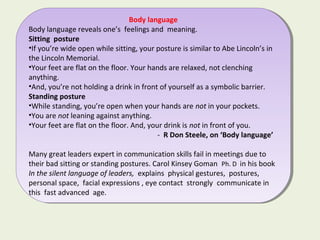
Body language
Body language reveals one’s feelings and meaning.
Sitting posture
•If you’re wide open while sitting, your posture is similar to Abe Lincoln’s in
the Lincoln Memorial.
•Your feet are flat on the floor. Your hands are relaxed, not clenching
anything.
•And, you’re not holding a drink in front of yourself as a symbolic barrier.
Standing posture
•While standing, you’re open when your hands are not in your pockets.
•You are not leaning against anything.
•Your feet are flat on the floor. And, your drink is not in front of you.
- R Don Steele, on ‘Body language’
Many great leaders expert in communication skills fail in meetings due to
their bad sitting or standing postures. Carol Kinsey Goman Ph. D in his book
In the silent language of leaders, explains physical gestures, postures,
personal space, facial expressions , eye contact strongly communicate in
this fast advanced age.
Body language
Body language reveals one’s feelings and meaning.
Sitting posture
•If you’re wide open while sitting, your posture is similar to Abe Lincoln’s in
the Lincoln Memorial.
•Your feet are flat on the floor. Your hands are relaxed, not clenching
anything.
•And, you’re not holding a drink in front of yourself as a symbolic barrier.
Standing posture
•While standing, you’re open when your hands are not in your pockets.
•You are not leaning against anything.
•Your feet are flat on the floor. And, your drink is not in front of you.
- R Don Steele, on ‘Body language’
Many great leaders expert in communication skills fail in meetings due to
their bad sitting or standing postures. Carol Kinsey Goman Ph. D in his book
In the silent language of leaders, explains physical gestures, postures,
personal space, facial expressions , eye contact strongly communicate in
this fast advanced age.
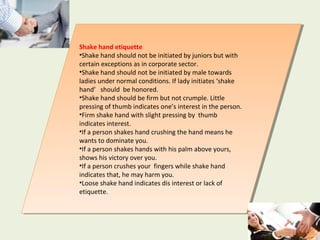
Shake hand etiquette
•Shake hand should not be initiated by juniors but with
certain exceptions as in corporate sector.
•Shake hand should not be initiated by male towards
ladies under normal conditions. If lady initiates ‘shake
hand’ should be honored.
•Shake hand should be firm but not crumple. Little
pressing of thumb indicates one’s interest in the person.
•Firm shake hand with slight pressing by thumb
indicates interest.
•If a person shakes hand crushing the hand means he
wants to dominate you.
•If a person shakes hands with his palm above yours,
shows his victory over you.
•If a person crushes your fingers while shake hand
indicates that, he may harm you.
•Loose shake hand indicates dis interest or lack of
etiquette.
Shake hand etiquette
•Shake hand should not be initiated by juniors but with
certain exceptions as in corporate sector.
•Shake hand should not be initiated by male towards
ladies under normal conditions. If lady initiates ‘shake
hand’ should be honored.
•Shake hand should be firm but not crumple. Little
pressing of thumb indicates one’s interest in the person.
•Firm shake hand with slight pressing by thumb
indicates interest.
•If a person shakes hand crushing the hand means he
wants to dominate you.
•If a person shakes hands with his palm above yours,
shows his victory over you.
•If a person crushes your fingers while shake hand
indicates that, he may harm you.
•Loose shake hand indicates dis interest or lack of
etiquette.
Presenting Resume
•Resume should be taken out of the folder such as to be visible to members of the
panel.
•Present the Resume with both hands, neither folded nor crumpled.
•Resume presented in person should be pre signed.
•Not to title as ‘Resume’ on top of the sheet
•Polite language should be used in resume and cover letter.
•Paper should not be folded or crumpled.
•Staple the paper diagonally; left side top corner.
•Envelop should match the size of resume sheets.
•Cover letter should slide over resume in the envelop.
•Cover letter should have your specific introduction, your suitability for the job, and
indicate purpose of your joining the job.
•Off line cover letter should precede resume on line.
•Cover letter should be sent as an attachment with resume sent in email.
Presenting Resume
•Resume should be taken out of the folder such as to be visible to members of the
panel.
•Present the Resume with both hands, neither folded nor crumpled.
•Resume presented in person should be pre signed.
•Not to title as ‘Resume’ on top of the sheet
•Polite language should be used in resume and cover letter.
•Paper should not be folded or crumpled.
•Staple the paper diagonally; left side top corner.
•Envelop should match the size of resume sheets.
•Cover letter should slide over resume in the envelop.
•Cover letter should have your specific introduction, your suitability for the job, and
indicate purpose of your joining the job.
•Off line cover letter should precede resume on line.
•Cover letter should be sent as an attachment with resume sent in email.
Dos
•Come alone
•Reach early
•Take light and nourishing diet
•Feel energetic
•Carry enough copies of resume, references,
attested and original copies of mark sheets,
experience certificates etc.
•Wear neat and sober dress
•Ask permission to enter the room
•Maintain decorum
•Greet the panel
•Thank on offering seat before you seat
•Pause and think before answering questions
•Clear doubts if any before answering
•if required ask clarification after completing
dialogue
•Have eye contact
•Be polite
•Bid courteous farewell
Dos
•Come alone
•Reach early
•Take light and nourishing diet
•Feel energetic
•Carry enough copies of resume, references,
attested and original copies of mark sheets,
experience certificates etc.
•Wear neat and sober dress
•Ask permission to enter the room
•Maintain decorum
•Greet the panel
•Thank on offering seat before you seat
•Pause and think before answering questions
•Clear doubts if any before answering
•if required ask clarification after completing
dialogue
•Have eye contact
•Be polite
•Bid courteous farewell
Don’ts
•Smoke
•Let your breath betray what you ate
•Appolize for lack of experience
•Ask about salary and days off
•Use strong smelling perfume
•Discuss personal matters
•Take tea or snacks offered,
•Criticize former employer
•Beg for job
•Glance wall papers or displays on walls.
•Look at your wrist watch
•Act offended if so
•Hide facts
•Use long sentences
•Discuss about job
•Linger after interview is over
Don’ts
•Smoke
•Let your breath betray what you ate
•Appolize for lack of experience
•Ask about salary and days off
•Use strong smelling perfume
•Discuss personal matters
•Take tea or snacks offered,
•Criticize former employer
•Beg for job
•Glance wall papers or displays on walls.
•Look at your wrist watch
•Act offended if so
•Hide facts
•Use long sentences
•Discuss about job
•Linger after interview is over
Probable Questions PatternProbable Questions Pattern
pnrao 14
Types of interview questions
•Probing questions: deep in subject, explanation
and clarification.
•Stress questions: creates stress to check
patience
•Reflective questions: to confirm the statement
•Open ended questions: scope to express
opinion, and depth thinking
•Closed ended questions: limited to alternatives
given . Answers in short phrases or with ‘Yes’ or
‘No’
•Loaded questions: response to sensitive
questions
•Leading questions; to obtain desired response.
•Hypothetical questions: imaginary , asumed ,
may not be relevant to the job
Types of interview questions
•Probing questions: deep in subject, explanation
and clarification.
•Stress questions: creates stress to check
patience
•Reflective questions: to confirm the statement
•Open ended questions: scope to express
opinion, and depth thinking
•Closed ended questions: limited to alternatives
given . Answers in short phrases or with ‘Yes’ or
‘No’
•Loaded questions: response to sensitive
questions
•Leading questions; to obtain desired response.
•Hypothetical questions: imaginary , asumed ,
may not be relevant to the job
pnrao 16
Developing rapport:
Isopraxis or Behavioral Mirroring :
•Posture reading
•To Bring to position and pace
•Interviewer listens and judges pitch, speech rate
and volume of answering.
•Interviewer should be subtle.
•interviewer. Should not mimic or mock the
interviewee
Active listening involve s numerous non verbal
communications , such as reflecting eye gaze
behavior, sitting attentively ( leaning forward),
listening to words used and registering their
frequency and priority, mirroring body behavior to
complement the transmitter of information, using
head tilt to indicate receptiveness and restraining
facial indicators of disagreement or contempt.
- FBI Law Enforcement Bulletin DEC 09
Developing rapport:
Isopraxis or Behavioral Mirroring :
•Posture reading
•To Bring to position and pace
•Interviewer listens and judges pitch, speech rate
and volume of answering.
•Interviewer should be subtle.
•interviewer. Should not mimic or mock the
interviewee
Active listening involve s numerous non verbal
communications , such as reflecting eye gaze
behavior, sitting attentively ( leaning forward),
listening to words used and registering their
frequency and priority, mirroring body behavior to
complement the transmitter of information, using
head tilt to indicate receptiveness and restraining
facial indicators of disagreement or contempt.
- FBI Law Enforcement Bulletin DEC 09
pnrao 17
Neuro Linguistic programming NLP
Neuro: 5 senses behaviour : Seeing, hearing,
tasting, smelling, and feeling
Linguistic : language to communicate thoughts.
Progrmming: To choose, organize ideas and
actions to yield result
It is the latest technique to avoided
discrimination and un equality: of ageism,
gender, racial, disability, ethnicity, diversity
implications and law should be
Neuro Linguistic programming NLP
Neuro: 5 senses behaviour : Seeing, hearing,
tasting, smelling, and feeling
Linguistic : language to communicate thoughts.
Progrmming: To choose, organize ideas and
actions to yield result
It is the latest technique to avoided
discrimination and un equality: of ageism,
gender, racial, disability, ethnicity, diversity
implications and law should be
Common Questions asked
•Tell me in brief about your extra
curriculum activities at your college.
•Have you initiated in any college
events/tours.
•Tell me about any project you handled
•What is your future thought about your
future position in this company ; say after
five years or so.
•How you see your career growth in this
company .
•What is the important characteristic of
the job you want to join.
Pattern:
•Answer in brief explain only if asked.
•Don’t drag the answers.
•Answer to the point.
Common Questions asked
•Tell me in brief about your extra
curriculum activities at your college.
•Have you initiated in any college
events/tours.
•Tell me about any project you handled
•What is your future thought about your
future position in this company ; say after
five years or so.
•How you see your career growth in this
company .
•What is the important characteristic of
the job you want to join.
Pattern:
•Answer in brief explain only if asked.
•Don’t drag the answers.
•Answer to the point.
pnrao 18
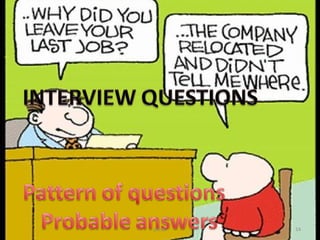
Q.1. Tell me something about yourself.
Probable answers.
Tell some thing job related and
achievements . Tell
about academic achievements which will
be helpful for organization.
Q.2. what were you achievements and
success in your past job?
Probable answers.
Give correct account of your success.
Don’t exaggerate , you may be grilled.
Q.3. What is your thought about your
future position in this company , say after
five years or so.
Probable answer:
•Answer about Your future plan
•your initiatives
•Justice to responsible position
•Utilization of talent
•Team work
Q.1. Tell me something about yourself.
Probable answers.
Tell some thing job related and
achievements . Tell
about academic achievements which will
be helpful for organization.
Q.2. what were you achievements and
success in your past job?
Probable answers.
Give correct account of your success.
Don’t exaggerate , you may be grilled.
Q.3. What is your thought about your
future position in this company , say after
five years or so.
Probable answer:
•Answer about Your future plan
•your initiatives
•Justice to responsible position
•Utilization of talent
•Team work
Q.4What is your future strategy for
further studies?
Probable answer:
I have learnt from my colleagues that your
company promotes further studies.
If I study I will utilize my knowledge in
developmental activities of the company
and also accelerate my growth in the
organization.
Q.5Will you be ready to join job offered
elsewhere away from your home town?
Probable answer:
Say positive, you can decide later after
getting the job.
This is a trap question to check your home
sickness.
Q.4What is your future strategy for
further studies?
Probable answer:
I have learnt from my colleagues that your
company promotes further studies.
If I study I will utilize my knowledge in
developmental activities of the company
and also accelerate my growth in the
organization.
Q.5Will you be ready to join job offered
elsewhere away from your home town?
Probable answer:
Say positive, you can decide later after
getting the job.
This is a trap question to check your home
sickness.
Q.6. What are your strengths?
Probable answer
Project your strengths as:
•Fluency in English and other languages
•Tendency of hard working
•Good ethics
•Ease in working with team
•Ready to shoulder responsibility
•Good programming ability
•Logical thinking
•Ability to learn fast and exposure to latest
technology
•Good marketing skills
•Thorough knowledge in the field
•Ability in soft skills and communication skills.
•Good decision making
•Ability to interact with foreign clients too.
Q.6. What are your strengths?
Probable answer
Project your strengths as:
•Fluency in English and other languages
•Tendency of hard working
•Good ethics
•Ease in working with team
•Ready to shoulder responsibility
•Good programming ability
•Logical thinking
•Ability to learn fast and exposure to latest
technology
•Good marketing skills
•Thorough knowledge in the field
•Ability in soft skills and communication skills.
•Good decision making
•Ability to interact with foreign clients too.
Q.7. Every body has some major
weakness, what about yours and how
will you overcome it.
Probable answer:
You need not disclose all your weaknesses.
Disclose such a weakness which doesn't
affect you getting the job.
Q.8. Had you any failure in your job and
how you overcame?
Probable answer:
You tell about such a failure which didn’t
affect the job much. Tell how you over
came.
Q.9. Were you having any issue to tackle
in late hours or holidays?
Probable answer:
Say yes , I have tackled problems during
holidays too.
This question is to trap you about your
keenness in the task you take in hand.
Q.7. Every body has some major
weakness, what about yours and how
will you overcome it.
Probable answer:
You need not disclose all your weaknesses.
Disclose such a weakness which doesn't
affect you getting the job.
Q.8. Had you any failure in your job and
how you overcame?
Probable answer:
You tell about such a failure which didn’t
affect the job much. Tell how you over
came.
Q.9. Were you having any issue to tackle
in late hours or holidays?
Probable answer:
Say yes , I have tackled problems during
holidays too.
This question is to trap you about your
keenness in the task you take in hand.
Q.10. What are your hobbies?
Probable answer:
Give correct account of your hobbies. You
may be trapped if grilled further.
Q.11. How you project your personality?
Probable answer
•Punctual
•Positive attitude
•Ambitious
•Work hard
•Ready to work extra hours
•Honesty in job
•Like planning ahead
•Enjoy working under pressure
•Systematic working
•Comfortable and positive to work in team
•Interested in travelling
Q.10. What are your hobbies?
Probable answer:
Give correct account of your hobbies. You
may be trapped if grilled further.
Q.11. How you project your personality?
Probable answer
•Punctual
•Positive attitude
•Ambitious
•Work hard
•Ready to work extra hours
•Honesty in job
•Like planning ahead
•Enjoy working under pressure
•Systematic working
•Comfortable and positive to work in team
•Interested in travelling
pnrao 24
Q.12. What are your short time and
longtime goals?
Probable answer
To join your organization and to attain highest
position in it.
Q.13. Why you chose this particular job?
Probable answer:
This is the field that I believe can take my
ideas, knowledge and thoughts to give a
concrete shape.
Q.14 Why you want to join this particular
job?
Probable answer:
Your company is a reputed and technically
advanced company. I find my better future in
the organization.
Q.12. What are your short time and
longtime goals?
Probable answer
To join your organization and to attain highest
position in it.
Q.13. Why you chose this particular job?
Probable answer:
This is the field that I believe can take my
ideas, knowledge and thoughts to give a
concrete shape.
Q.14 Why you want to join this particular
job?
Probable answer:
Your company is a reputed and technically
advanced company. I find my better future in
the organization.
Q.15. What about your contribution to
college and society
Probable answer
Give correct account of the tasks as a
leader in the college social functions,
outside / village social activities, saving
some body from disaster, participation in
cleanliness drives or developmental
activities. Don’t bluff, you may be trapped
if grilled.
Q.16. What is your salary expectation?
Probable answer
Answer carefully.
Don’t be greedy.
Give your expectation as discussed earlier
with the persons already working over
there.
Q.17 Are you ready to sign bond?
Probable answer:
Analyze your position and future course of
action.
Say ‘yes’, you can decide after getting
appointment letter.
Q.15. What about your contribution to
college and society
Probable answer
Give correct account of the tasks as a
leader in the college social functions,
outside / village social activities, saving
some body from disaster, participation in
cleanliness drives or developmental
activities. Don’t bluff, you may be trapped
if grilled.
Q.16. What is your salary expectation?
Probable answer
Answer carefully.
Don’t be greedy.
Give your expectation as discussed earlier
with the persons already working over
there.
Q.17 Are you ready to sign bond?
Probable answer:
Analyze your position and future course of
action.
Say ‘yes’, you can decide after getting
appointment letter.
Q.18. Why we should select you when we
are already having some more candidates.
Why we should hire you?
Probable answer:
Give account of your strengths
Q.19. What you can offer to the company
which others cannot?
Probable answer:
•Inter personal skills.
•Developing high performance teams.
•Passion for new technology
•Good communication skills
Q.20. Have you any questions to ask?
Probable answer:
• Ask about your future induction in the
jobs pertaining to the future prospects of
the company.
• Ask whether you will get an opportunity
to work in the developmental models of
the company.
Q.18. Why we should select you when we
are already having some more candidates.
Why we should hire you?
Probable answer:
Give account of your strengths
Q.19. What you can offer to the company
which others cannot?
Probable answer:
•Inter personal skills.
•Developing high performance teams.
•Passion for new technology
•Good communication skills
Q.20. Have you any questions to ask?
Probable answer:
• Ask about your future induction in the
jobs pertaining to the future prospects of
the company.
• Ask whether you will get an opportunity
to work in the developmental models of
the company.
Not to project your negative activities
•Dis interest in travelling
•Smoking and drinking habits
•Short temperament
•Your dislike to work in group
•Dislike meeting people
•Technically sound but weak in
communication skill
Not to project your negative activities
•Dis interest in travelling
•Smoking and drinking habits
•Short temperament
•Your dislike to work in group
•Dislike meeting people
•Technically sound but weak in
communication skill
pnrao 28
EPILOUGE
Interview is a chance. At the most you may
loose but you get experience of facing an
interview. Doors are wide open for the jobs
you like. Be serious about appropriate job
searching and interview but don’t panic.
Neither under estimate nor overestimate
your knowledge. Be positive. Be courteous
and respectful to every one , it is possible
that some body might be your interview
panel member. Success will be in your
count.
EPILOUGE
Interview is a chance. At the most you may
loose but you get experience of facing an
interview. Doors are wide open for the jobs
you like. Be serious about appropriate job
searching and interview but don’t panic.
Neither under estimate nor overestimate
your knowledge. Be positive. Be courteous
and respectful to every one , it is possible
that some body might be your interview
panel member. Success will be in your
count.
Acknowledgement and Sources for reference :
wwwthinkstockphotos
Goman, Carol Kinsey. The Silent Language of
Leaders: How Body Language Can Help--or Hurt--
How You Lead –Book , April 19, 2011
www.steelballs.com/body_language_secrets.pdf
By R. Don Steele
Various interview analyses
Willhelm Wundt, The Language of Gestures, book,
1921
Darwin, Charles. The Expressions of the Emotions
in Man and Animals, book 1872, Murray
Hall, Edward Twitchell Hall. The Silent Language,
Doubleday, book, 1959
LIFEadvice: How to overcome fear during an
important job interview
By Kimberly Giles, ksl.com contributor
http://www.ksl.com/?sid=18083756
This is only an informative presentation. Please
read references.
Please comment and share.
Acknowledgement and Sources for reference :
wwwthinkstockphotos
Goman, Carol Kinsey. The Silent Language of
Leaders: How Body Language Can Help--or Hurt--
How You Lead –Book , April 19, 2011
www.steelballs.com/body_language_secrets.pdf
By R. Don Steele
Various interview analyses
Willhelm Wundt, The Language of Gestures, book,
1921
Darwin, Charles. The Expressions of the Emotions
in Man and Animals, book 1872, Murray
Hall, Edward Twitchell Hall. The Silent Language,
Doubleday, book, 1959
LIFEadvice: How to overcome fear during an
important job interview
By Kimberly Giles, ksl.com contributor
http://www.ksl.com/?sid=18083756
This is only an informative presentation. Please
read references.
Please comment and share.
Power point presentations by P N RaoPower point presentations by P N Rao
•Golden hour in Railway Disaster Management ( English, Hindi)Golden hour in Railway Disaster Management ( English, Hindi)
•Corporate Safety Plan (English, Hindi)Corporate Safety Plan (English, Hindi)
•Modern trend in Railway safety (English, Hindi)Modern trend in Railway safety (English, Hindi)
•Media Management in Disaster ManagementMedia Management in Disaster Management
•Role of NGOs in Disaster Management,Role of NGOs in Disaster Management,
•Role of NSS in Disaster Management,Role of NSS in Disaster Management,
•Multiple Hazards by Potlacharla N RaoMultiple Hazards by Potlacharla N Rao
Google search: PPTs by P N RaoGoogle search: PPTs by P N Rao
•Tourism Disaster Management by P N RaoTourism Disaster Management by P N Rao
http://webcache.googleusercontent.com/search?http://webcache.googleusercontent.com/search?
q=cache:9oCzu0zPOkgJ:www.slideshare.net/psubramanyamrao/tourism-q=cache:9oCzu0zPOkgJ:www.slideshare.net/psubramanyamrao/tourism-
dmgt+&cd=1&hl=en&ct=clnk&gl=indmgt+&cd=1&hl=en&ct=clnk&gl=in
•Industrial Disaster Management by P N RaoIndustrial Disaster Management by P N Rao
http://www.slideshare.net/suni744/industrial-disaster-management-14177395http://www.slideshare.net/suni744/industrial-disaster-management-14177395
•Disaster Management awarenessDisaster Management awareness by P N Raoby P N Rao
http://www.slideshare.net/psubramanyamrao/disaster-management-an-awareness-i-http://www.slideshare.net/psubramanyamrao/disaster-management-an-awareness-i-
by-pnrao20-may13by-pnrao20-may13
•Table Manners ( Corporate meetings/Restaurents)Table Manners ( Corporate meetings/Restaurents) by Potlacharla N Rao ( P N Rao)by Potlacharla N Rao ( P N Rao)
•http://www.slideshare.net/potlacharla/revised-dining-table-etiquettehttp://www.slideshare.net/potlacharla/revised-dining-table-etiquette
•Job Interview, by Potlacharla N Rao ( P N Rao)Job Interview, by Potlacharla N Rao ( P N Rao)
Power point presentations by P N RaoPower point presentations by P N Rao
•Golden hour in Railway Disaster Management ( English, Hindi)Golden hour in Railway Disaster Management ( English, Hindi)
•Corporate Safety Plan (English, Hindi)Corporate Safety Plan (English, Hindi)
•Modern trend in Railway safety (English, Hindi)Modern trend in Railway safety (English, Hindi)
•Media Management in Disaster ManagementMedia Management in Disaster Management
•Role of NGOs in Disaster Management,Role of NGOs in Disaster Management,
•Role of NSS in Disaster Management,Role of NSS in Disaster Management,
•Multiple Hazards by Potlacharla N RaoMultiple Hazards by Potlacharla N Rao
Google search: PPTs by P N RaoGoogle search: PPTs by P N Rao
•Tourism Disaster Management by P N RaoTourism Disaster Management by P N Rao
http://webcache.googleusercontent.com/search?http://webcache.googleusercontent.com/search?
q=cache:9oCzu0zPOkgJ:www.slideshare.net/psubramanyamrao/tourism-q=cache:9oCzu0zPOkgJ:www.slideshare.net/psubramanyamrao/tourism-
dmgt+&cd=1&hl=en&ct=clnk&gl=indmgt+&cd=1&hl=en&ct=clnk&gl=in
•Industrial Disaster Management by P N RaoIndustrial Disaster Management by P N Rao
http://www.slideshare.net/suni744/industrial-disaster-management-14177395http://www.slideshare.net/suni744/industrial-disaster-management-14177395
•Disaster Management awarenessDisaster Management awareness by P N Raoby P N Rao
http://www.slideshare.net/psubramanyamrao/disaster-management-an-awareness-i-http://www.slideshare.net/psubramanyamrao/disaster-management-an-awareness-i-
by-pnrao20-may13by-pnrao20-may13
•Table Manners ( Corporate meetings/Restaurents)Table Manners ( Corporate meetings/Restaurents) by Potlacharla N Rao ( P N Rao)by Potlacharla N Rao ( P N Rao)
•http://www.slideshare.net/potlacharla/revised-dining-table-etiquettehttp://www.slideshare.net/potlacharla/revised-dining-table-etiquette
•Job Interview, by Potlacharla N Rao ( P N Rao)Job Interview, by Potlacharla N Rao ( P N Rao)
pnrao 31
by
Potlacharla Nageshwar Rao ( P. N Rao)
B.Sc.; M A; D R T M; D T E M;
Life Associate IRT (LA244)
STM Safety (Gaz.) Rtd.
Rao7sai@yahoo.co.in
END

Job Interview II

  • 2.
    Types/styles of interview •Meanderingstyle: to lead discussion •Directive style: strong and determined type •Behavioral interview : attitudinal •Stress interview : puzzle •Group interview : by/to either group •Telephonic interview : done telephonically •Lunch/dinner interview: to ckeck etiquette •Video interview : video conference •Audition: individual by Group •Sequential interviews: series of interviews at a time. •Exit interview: on leaving or resigning a job. Types/styles of interview •Meandering style: to lead discussion •Directive style: strong and determined type •Behavioral interview : attitudinal •Stress interview : puzzle •Group interview : by/to either group •Telephonic interview : done telephonically •Lunch/dinner interview: to ckeck etiquette •Video interview : video conference •Audition: individual by Group •Sequential interviews: series of interviews at a time. •Exit interview: on leaving or resigning a job.
  • 3.
    You should: •Breath slowlyand consistently •Drink little water •Laughing or joking reduces stress Body language •Wide gesture. •Hands free of your sides s.a. out of pockets. •Open handed gestures. •Don’t cross arms across the body •Avoid half hug i.e. putting your hand on shoulder at other side. •Don’t show pointing finger towards members of panel •Avoid anger •Avoid excitement You should: •Breath slowly and consistently •Drink little water •Laughing or joking reduces stress Body language •Wide gesture. •Hands free of your sides s.a. out of pockets. •Open handed gestures. •Don’t cross arms across the body •Avoid half hug i.e. putting your hand on shoulder at other side. •Don’t show pointing finger towards members of panel •Avoid anger •Avoid excitement pnrao 3
  • 4.
    Attire: Men •Use formal, comfortable and used to dress. •Avoided Jeans , half sleeves and loose dress. •Suit: Sleeve 1.5 inches below wrist touching the base of the thumb. •When you sit on chair, un button the blazer. •Shirt: Solid plain coloured, long sleeved with appropriate fittings. •Tie: 100% silk to suit shirt preferably solid coloured tie, on stripped shirt plain tie can be used . •Tie should reach buckle of the belt + /- 1” •Collar button should always be closed while wearing tie. •Trouser: Dark coloured, preferably black. •Belt: Match with colour of shoes. •Socks: Dark coloured or matching the suit. •Shoes: preferably black or brown. •Avoid earrings, bracelets, chain and piercing the body. •Finger ring: Wedding ring is only permitted. •Hair: Properly groomed and should not be longer than shirt color. •Appropriate deodorant / colognes only •Mouth freshener: as required , only before entering the room. Attire: Men •Use formal , comfortable and used to dress. •Avoided Jeans , half sleeves and loose dress. •Suit: Sleeve 1.5 inches below wrist touching the base of the thumb. •When you sit on chair, un button the blazer. •Shirt: Solid plain coloured, long sleeved with appropriate fittings. •Tie: 100% silk to suit shirt preferably solid coloured tie, on stripped shirt plain tie can be used . •Tie should reach buckle of the belt + /- 1” •Collar button should always be closed while wearing tie. •Trouser: Dark coloured, preferably black. •Belt: Match with colour of shoes. •Socks: Dark coloured or matching the suit. •Shoes: preferably black or brown. •Avoid earrings, bracelets, chain and piercing the body. •Finger ring: Wedding ring is only permitted. •Hair: Properly groomed and should not be longer than shirt color. •Appropriate deodorant / colognes only •Mouth freshener: as required , only before entering the room.
  • 5.
    pnrao 5 ATTIRE :Women •Indian style : saree /suit with neutral colours. •No embroidery work or laces on garments. •Western style: Trouser or skirts below knees and upper garments with appropriate colours without lace. •Shoes with 1-2” heel, no striped sandals. ATTIRE : Women •Indian style : saree /suit with neutral colours. •No embroidery work or laces on garments. •Western style: Trouser or skirts below knees and upper garments with appropriate colours without lace. •Shoes with 1-2” heel, no striped sandals.
  • 6.
    Demeanor: •Demeanor is aninfluential factor in hiring decision •It ranks ahead of experience. •Making good impression is crucial. •Be friendly and courteous to every one you meet, may be a receptionist , peon or a member . •Be open to everybody around for any conversation. •Ask permission before entering interview room. •Quietly close the door after entering the room. •Have proper walk. •During interview show enthusiasm. •be responsive and attentive. •Have smiley face. •If you feel nervous or shy never loose confidence but develop strength. •Sit straight. •Don’t fidget with any object. •Don’t interrupt the interviewer while he is speaking. •End the interview with positive note. •Thank the panel. •Complement by saying that you enjoyed interview. Demeanor: •Demeanor is an influential factor in hiring decision •It ranks ahead of experience. •Making good impression is crucial. •Be friendly and courteous to every one you meet, may be a receptionist , peon or a member . •Be open to everybody around for any conversation. •Ask permission before entering interview room. •Quietly close the door after entering the room. •Have proper walk. •During interview show enthusiasm. •be responsive and attentive. •Have smiley face. •If you feel nervous or shy never loose confidence but develop strength. •Sit straight. •Don’t fidget with any object. •Don’t interrupt the interviewer while he is speaking. •End the interview with positive note. •Thank the panel. •Complement by saying that you enjoyed interview. pnrao 6
  • 7.
    •Don’t roam inveranda. •Properly groomed hair. •Have neat and tidy dress. •Nails be properly cut •Wish the interview panel members properly •Have proper posture •Firm shake hand if extended •Have brilliant smile •Wait till seat is offered •Quietly pull the chair before sitting. •Thank for offering seat •Sit straight in comfortable posture •Maintain periodical eye contact throughout the interview •Gesture with open hands impresses •Don’t lean on the table. •Don’t roam in veranda. •Properly groomed hair. •Have neat and tidy dress. •Nails be properly cut •Wish the interview panel members properly •Have proper posture •Firm shake hand if extended •Have brilliant smile •Wait till seat is offered •Quietly pull the chair before sitting. •Thank for offering seat •Sit straight in comfortable posture •Maintain periodical eye contact throughout the interview •Gesture with open hands impresses •Don’t lean on the table.
  • 8.
    Body language Body languagereveals one’s feelings and meaning. Sitting posture •If you’re wide open while sitting, your posture is similar to Abe Lincoln’s in the Lincoln Memorial. •Your feet are flat on the floor. Your hands are relaxed, not clenching anything. •And, you’re not holding a drink in front of yourself as a symbolic barrier. Standing posture •While standing, you’re open when your hands are not in your pockets. •You are not leaning against anything. •Your feet are flat on the floor. And, your drink is not in front of you. - R Don Steele, on ‘Body language’ Many great leaders expert in communication skills fail in meetings due to their bad sitting or standing postures. Carol Kinsey Goman Ph. D in his book In the silent language of leaders, explains physical gestures, postures, personal space, facial expressions , eye contact strongly communicate in this fast advanced age. Body language Body language reveals one’s feelings and meaning. Sitting posture •If you’re wide open while sitting, your posture is similar to Abe Lincoln’s in the Lincoln Memorial. •Your feet are flat on the floor. Your hands are relaxed, not clenching anything. •And, you’re not holding a drink in front of yourself as a symbolic barrier. Standing posture •While standing, you’re open when your hands are not in your pockets. •You are not leaning against anything. •Your feet are flat on the floor. And, your drink is not in front of you. - R Don Steele, on ‘Body language’ Many great leaders expert in communication skills fail in meetings due to their bad sitting or standing postures. Carol Kinsey Goman Ph. D in his book In the silent language of leaders, explains physical gestures, postures, personal space, facial expressions , eye contact strongly communicate in this fast advanced age.
  • 9.
    Shake hand etiquette •Shakehand should not be initiated by juniors but with certain exceptions as in corporate sector. •Shake hand should not be initiated by male towards ladies under normal conditions. If lady initiates ‘shake hand’ should be honored. •Shake hand should be firm but not crumple. Little pressing of thumb indicates one’s interest in the person. •Firm shake hand with slight pressing by thumb indicates interest. •If a person shakes hand crushing the hand means he wants to dominate you. •If a person shakes hands with his palm above yours, shows his victory over you. •If a person crushes your fingers while shake hand indicates that, he may harm you. •Loose shake hand indicates dis interest or lack of etiquette. Shake hand etiquette •Shake hand should not be initiated by juniors but with certain exceptions as in corporate sector. •Shake hand should not be initiated by male towards ladies under normal conditions. If lady initiates ‘shake hand’ should be honored. •Shake hand should be firm but not crumple. Little pressing of thumb indicates one’s interest in the person. •Firm shake hand with slight pressing by thumb indicates interest. •If a person shakes hand crushing the hand means he wants to dominate you. •If a person shakes hands with his palm above yours, shows his victory over you. •If a person crushes your fingers while shake hand indicates that, he may harm you. •Loose shake hand indicates dis interest or lack of etiquette.
  • 10.
    Presenting Resume •Resume shouldbe taken out of the folder such as to be visible to members of the panel. •Present the Resume with both hands, neither folded nor crumpled. •Resume presented in person should be pre signed. •Not to title as ‘Resume’ on top of the sheet •Polite language should be used in resume and cover letter. •Paper should not be folded or crumpled. •Staple the paper diagonally; left side top corner. •Envelop should match the size of resume sheets. •Cover letter should slide over resume in the envelop. •Cover letter should have your specific introduction, your suitability for the job, and indicate purpose of your joining the job. •Off line cover letter should precede resume on line. •Cover letter should be sent as an attachment with resume sent in email. Presenting Resume •Resume should be taken out of the folder such as to be visible to members of the panel. •Present the Resume with both hands, neither folded nor crumpled. •Resume presented in person should be pre signed. •Not to title as ‘Resume’ on top of the sheet •Polite language should be used in resume and cover letter. •Paper should not be folded or crumpled. •Staple the paper diagonally; left side top corner. •Envelop should match the size of resume sheets. •Cover letter should slide over resume in the envelop. •Cover letter should have your specific introduction, your suitability for the job, and indicate purpose of your joining the job. •Off line cover letter should precede resume on line. •Cover letter should be sent as an attachment with resume sent in email.
  • 11.
    Dos •Come alone •Reach early •Takelight and nourishing diet •Feel energetic •Carry enough copies of resume, references, attested and original copies of mark sheets, experience certificates etc. •Wear neat and sober dress •Ask permission to enter the room •Maintain decorum •Greet the panel •Thank on offering seat before you seat •Pause and think before answering questions •Clear doubts if any before answering •if required ask clarification after completing dialogue •Have eye contact •Be polite •Bid courteous farewell Dos •Come alone •Reach early •Take light and nourishing diet •Feel energetic •Carry enough copies of resume, references, attested and original copies of mark sheets, experience certificates etc. •Wear neat and sober dress •Ask permission to enter the room •Maintain decorum •Greet the panel •Thank on offering seat before you seat •Pause and think before answering questions •Clear doubts if any before answering •if required ask clarification after completing dialogue •Have eye contact •Be polite •Bid courteous farewell
  • 12.
    Don’ts •Smoke •Let your breathbetray what you ate •Appolize for lack of experience •Ask about salary and days off •Use strong smelling perfume •Discuss personal matters •Take tea or snacks offered, •Criticize former employer •Beg for job •Glance wall papers or displays on walls. •Look at your wrist watch •Act offended if so •Hide facts •Use long sentences •Discuss about job •Linger after interview is over Don’ts •Smoke •Let your breath betray what you ate •Appolize for lack of experience •Ask about salary and days off •Use strong smelling perfume •Discuss personal matters •Take tea or snacks offered, •Criticize former employer •Beg for job •Glance wall papers or displays on walls. •Look at your wrist watch •Act offended if so •Hide facts •Use long sentences •Discuss about job •Linger after interview is over
  • 13.
  • 14.
  • 15.
    Types of interviewquestions •Probing questions: deep in subject, explanation and clarification. •Stress questions: creates stress to check patience •Reflective questions: to confirm the statement •Open ended questions: scope to express opinion, and depth thinking •Closed ended questions: limited to alternatives given . Answers in short phrases or with ‘Yes’ or ‘No’ •Loaded questions: response to sensitive questions •Leading questions; to obtain desired response. •Hypothetical questions: imaginary , asumed , may not be relevant to the job Types of interview questions •Probing questions: deep in subject, explanation and clarification. •Stress questions: creates stress to check patience •Reflective questions: to confirm the statement •Open ended questions: scope to express opinion, and depth thinking •Closed ended questions: limited to alternatives given . Answers in short phrases or with ‘Yes’ or ‘No’ •Loaded questions: response to sensitive questions •Leading questions; to obtain desired response. •Hypothetical questions: imaginary , asumed , may not be relevant to the job
  • 16.
    pnrao 16 Developing rapport: Isopraxisor Behavioral Mirroring : •Posture reading •To Bring to position and pace •Interviewer listens and judges pitch, speech rate and volume of answering. •Interviewer should be subtle. •interviewer. Should not mimic or mock the interviewee Active listening involve s numerous non verbal communications , such as reflecting eye gaze behavior, sitting attentively ( leaning forward), listening to words used and registering their frequency and priority, mirroring body behavior to complement the transmitter of information, using head tilt to indicate receptiveness and restraining facial indicators of disagreement or contempt. - FBI Law Enforcement Bulletin DEC 09 Developing rapport: Isopraxis or Behavioral Mirroring : •Posture reading •To Bring to position and pace •Interviewer listens and judges pitch, speech rate and volume of answering. •Interviewer should be subtle. •interviewer. Should not mimic or mock the interviewee Active listening involve s numerous non verbal communications , such as reflecting eye gaze behavior, sitting attentively ( leaning forward), listening to words used and registering their frequency and priority, mirroring body behavior to complement the transmitter of information, using head tilt to indicate receptiveness and restraining facial indicators of disagreement or contempt. - FBI Law Enforcement Bulletin DEC 09
  • 17.
    pnrao 17 Neuro Linguisticprogramming NLP Neuro: 5 senses behaviour : Seeing, hearing, tasting, smelling, and feeling Linguistic : language to communicate thoughts. Progrmming: To choose, organize ideas and actions to yield result It is the latest technique to avoided discrimination and un equality: of ageism, gender, racial, disability, ethnicity, diversity implications and law should be Neuro Linguistic programming NLP Neuro: 5 senses behaviour : Seeing, hearing, tasting, smelling, and feeling Linguistic : language to communicate thoughts. Progrmming: To choose, organize ideas and actions to yield result It is the latest technique to avoided discrimination and un equality: of ageism, gender, racial, disability, ethnicity, diversity implications and law should be
  • 18.
    Common Questions asked •Tellme in brief about your extra curriculum activities at your college. •Have you initiated in any college events/tours. •Tell me about any project you handled •What is your future thought about your future position in this company ; say after five years or so. •How you see your career growth in this company . •What is the important characteristic of the job you want to join. Pattern: •Answer in brief explain only if asked. •Don’t drag the answers. •Answer to the point. Common Questions asked •Tell me in brief about your extra curriculum activities at your college. •Have you initiated in any college events/tours. •Tell me about any project you handled •What is your future thought about your future position in this company ; say after five years or so. •How you see your career growth in this company . •What is the important characteristic of the job you want to join. Pattern: •Answer in brief explain only if asked. •Don’t drag the answers. •Answer to the point. pnrao 18
  • 19.
    Q.1. Tell mesomething about yourself. Probable answers. Tell some thing job related and achievements . Tell about academic achievements which will be helpful for organization. Q.2. what were you achievements and success in your past job? Probable answers. Give correct account of your success. Don’t exaggerate , you may be grilled. Q.3. What is your thought about your future position in this company , say after five years or so. Probable answer: •Answer about Your future plan •your initiatives •Justice to responsible position •Utilization of talent •Team work Q.1. Tell me something about yourself. Probable answers. Tell some thing job related and achievements . Tell about academic achievements which will be helpful for organization. Q.2. what were you achievements and success in your past job? Probable answers. Give correct account of your success. Don’t exaggerate , you may be grilled. Q.3. What is your thought about your future position in this company , say after five years or so. Probable answer: •Answer about Your future plan •your initiatives •Justice to responsible position •Utilization of talent •Team work
  • 20.
    Q.4What is yourfuture strategy for further studies? Probable answer: I have learnt from my colleagues that your company promotes further studies. If I study I will utilize my knowledge in developmental activities of the company and also accelerate my growth in the organization. Q.5Will you be ready to join job offered elsewhere away from your home town? Probable answer: Say positive, you can decide later after getting the job. This is a trap question to check your home sickness. Q.4What is your future strategy for further studies? Probable answer: I have learnt from my colleagues that your company promotes further studies. If I study I will utilize my knowledge in developmental activities of the company and also accelerate my growth in the organization. Q.5Will you be ready to join job offered elsewhere away from your home town? Probable answer: Say positive, you can decide later after getting the job. This is a trap question to check your home sickness.
  • 21.
    Q.6. What areyour strengths? Probable answer Project your strengths as: •Fluency in English and other languages •Tendency of hard working •Good ethics •Ease in working with team •Ready to shoulder responsibility •Good programming ability •Logical thinking •Ability to learn fast and exposure to latest technology •Good marketing skills •Thorough knowledge in the field •Ability in soft skills and communication skills. •Good decision making •Ability to interact with foreign clients too. Q.6. What are your strengths? Probable answer Project your strengths as: •Fluency in English and other languages •Tendency of hard working •Good ethics •Ease in working with team •Ready to shoulder responsibility •Good programming ability •Logical thinking •Ability to learn fast and exposure to latest technology •Good marketing skills •Thorough knowledge in the field •Ability in soft skills and communication skills. •Good decision making •Ability to interact with foreign clients too.
  • 22.
    Q.7. Every bodyhas some major weakness, what about yours and how will you overcome it. Probable answer: You need not disclose all your weaknesses. Disclose such a weakness which doesn't affect you getting the job. Q.8. Had you any failure in your job and how you overcame? Probable answer: You tell about such a failure which didn’t affect the job much. Tell how you over came. Q.9. Were you having any issue to tackle in late hours or holidays? Probable answer: Say yes , I have tackled problems during holidays too. This question is to trap you about your keenness in the task you take in hand. Q.7. Every body has some major weakness, what about yours and how will you overcome it. Probable answer: You need not disclose all your weaknesses. Disclose such a weakness which doesn't affect you getting the job. Q.8. Had you any failure in your job and how you overcame? Probable answer: You tell about such a failure which didn’t affect the job much. Tell how you over came. Q.9. Were you having any issue to tackle in late hours or holidays? Probable answer: Say yes , I have tackled problems during holidays too. This question is to trap you about your keenness in the task you take in hand.
  • 23.
    Q.10. What areyour hobbies? Probable answer: Give correct account of your hobbies. You may be trapped if grilled further. Q.11. How you project your personality? Probable answer •Punctual •Positive attitude •Ambitious •Work hard •Ready to work extra hours •Honesty in job •Like planning ahead •Enjoy working under pressure •Systematic working •Comfortable and positive to work in team •Interested in travelling Q.10. What are your hobbies? Probable answer: Give correct account of your hobbies. You may be trapped if grilled further. Q.11. How you project your personality? Probable answer •Punctual •Positive attitude •Ambitious •Work hard •Ready to work extra hours •Honesty in job •Like planning ahead •Enjoy working under pressure •Systematic working •Comfortable and positive to work in team •Interested in travelling
  • 24.
    pnrao 24 Q.12. Whatare your short time and longtime goals? Probable answer To join your organization and to attain highest position in it. Q.13. Why you chose this particular job? Probable answer: This is the field that I believe can take my ideas, knowledge and thoughts to give a concrete shape. Q.14 Why you want to join this particular job? Probable answer: Your company is a reputed and technically advanced company. I find my better future in the organization. Q.12. What are your short time and longtime goals? Probable answer To join your organization and to attain highest position in it. Q.13. Why you chose this particular job? Probable answer: This is the field that I believe can take my ideas, knowledge and thoughts to give a concrete shape. Q.14 Why you want to join this particular job? Probable answer: Your company is a reputed and technically advanced company. I find my better future in the organization.
  • 25.
    Q.15. What aboutyour contribution to college and society Probable answer Give correct account of the tasks as a leader in the college social functions, outside / village social activities, saving some body from disaster, participation in cleanliness drives or developmental activities. Don’t bluff, you may be trapped if grilled. Q.16. What is your salary expectation? Probable answer Answer carefully. Don’t be greedy. Give your expectation as discussed earlier with the persons already working over there. Q.17 Are you ready to sign bond? Probable answer: Analyze your position and future course of action. Say ‘yes’, you can decide after getting appointment letter. Q.15. What about your contribution to college and society Probable answer Give correct account of the tasks as a leader in the college social functions, outside / village social activities, saving some body from disaster, participation in cleanliness drives or developmental activities. Don’t bluff, you may be trapped if grilled. Q.16. What is your salary expectation? Probable answer Answer carefully. Don’t be greedy. Give your expectation as discussed earlier with the persons already working over there. Q.17 Are you ready to sign bond? Probable answer: Analyze your position and future course of action. Say ‘yes’, you can decide after getting appointment letter.
  • 26.
    Q.18. Why weshould select you when we are already having some more candidates. Why we should hire you? Probable answer: Give account of your strengths Q.19. What you can offer to the company which others cannot? Probable answer: •Inter personal skills. •Developing high performance teams. •Passion for new technology •Good communication skills Q.20. Have you any questions to ask? Probable answer: • Ask about your future induction in the jobs pertaining to the future prospects of the company. • Ask whether you will get an opportunity to work in the developmental models of the company. Q.18. Why we should select you when we are already having some more candidates. Why we should hire you? Probable answer: Give account of your strengths Q.19. What you can offer to the company which others cannot? Probable answer: •Inter personal skills. •Developing high performance teams. •Passion for new technology •Good communication skills Q.20. Have you any questions to ask? Probable answer: • Ask about your future induction in the jobs pertaining to the future prospects of the company. • Ask whether you will get an opportunity to work in the developmental models of the company.
  • 27.
    Not to projectyour negative activities •Dis interest in travelling •Smoking and drinking habits •Short temperament •Your dislike to work in group •Dislike meeting people •Technically sound but weak in communication skill Not to project your negative activities •Dis interest in travelling •Smoking and drinking habits •Short temperament •Your dislike to work in group •Dislike meeting people •Technically sound but weak in communication skill
  • 28.
    pnrao 28 EPILOUGE Interview isa chance. At the most you may loose but you get experience of facing an interview. Doors are wide open for the jobs you like. Be serious about appropriate job searching and interview but don’t panic. Neither under estimate nor overestimate your knowledge. Be positive. Be courteous and respectful to every one , it is possible that some body might be your interview panel member. Success will be in your count. EPILOUGE Interview is a chance. At the most you may loose but you get experience of facing an interview. Doors are wide open for the jobs you like. Be serious about appropriate job searching and interview but don’t panic. Neither under estimate nor overestimate your knowledge. Be positive. Be courteous and respectful to every one , it is possible that some body might be your interview panel member. Success will be in your count.
  • 29.
    Acknowledgement and Sourcesfor reference : wwwthinkstockphotos Goman, Carol Kinsey. The Silent Language of Leaders: How Body Language Can Help--or Hurt-- How You Lead –Book , April 19, 2011 www.steelballs.com/body_language_secrets.pdf By R. Don Steele Various interview analyses Willhelm Wundt, The Language of Gestures, book, 1921 Darwin, Charles. The Expressions of the Emotions in Man and Animals, book 1872, Murray Hall, Edward Twitchell Hall. The Silent Language, Doubleday, book, 1959 LIFEadvice: How to overcome fear during an important job interview By Kimberly Giles, ksl.com contributor http://www.ksl.com/?sid=18083756 This is only an informative presentation. Please read references. Please comment and share. Acknowledgement and Sources for reference : wwwthinkstockphotos Goman, Carol Kinsey. The Silent Language of Leaders: How Body Language Can Help--or Hurt-- How You Lead –Book , April 19, 2011 www.steelballs.com/body_language_secrets.pdf By R. Don Steele Various interview analyses Willhelm Wundt, The Language of Gestures, book, 1921 Darwin, Charles. The Expressions of the Emotions in Man and Animals, book 1872, Murray Hall, Edward Twitchell Hall. The Silent Language, Doubleday, book, 1959 LIFEadvice: How to overcome fear during an important job interview By Kimberly Giles, ksl.com contributor http://www.ksl.com/?sid=18083756 This is only an informative presentation. Please read references. Please comment and share.
  • 30.
    Power point presentationsby P N RaoPower point presentations by P N Rao •Golden hour in Railway Disaster Management ( English, Hindi)Golden hour in Railway Disaster Management ( English, Hindi) •Corporate Safety Plan (English, Hindi)Corporate Safety Plan (English, Hindi) •Modern trend in Railway safety (English, Hindi)Modern trend in Railway safety (English, Hindi) •Media Management in Disaster ManagementMedia Management in Disaster Management •Role of NGOs in Disaster Management,Role of NGOs in Disaster Management, •Role of NSS in Disaster Management,Role of NSS in Disaster Management, •Multiple Hazards by Potlacharla N RaoMultiple Hazards by Potlacharla N Rao Google search: PPTs by P N RaoGoogle search: PPTs by P N Rao •Tourism Disaster Management by P N RaoTourism Disaster Management by P N Rao http://webcache.googleusercontent.com/search?http://webcache.googleusercontent.com/search? q=cache:9oCzu0zPOkgJ:www.slideshare.net/psubramanyamrao/tourism-q=cache:9oCzu0zPOkgJ:www.slideshare.net/psubramanyamrao/tourism- dmgt+&cd=1&hl=en&ct=clnk&gl=indmgt+&cd=1&hl=en&ct=clnk&gl=in •Industrial Disaster Management by P N RaoIndustrial Disaster Management by P N Rao http://www.slideshare.net/suni744/industrial-disaster-management-14177395http://www.slideshare.net/suni744/industrial-disaster-management-14177395 •Disaster Management awarenessDisaster Management awareness by P N Raoby P N Rao http://www.slideshare.net/psubramanyamrao/disaster-management-an-awareness-i-http://www.slideshare.net/psubramanyamrao/disaster-management-an-awareness-i- by-pnrao20-may13by-pnrao20-may13 •Table Manners ( Corporate meetings/Restaurents)Table Manners ( Corporate meetings/Restaurents) by Potlacharla N Rao ( P N Rao)by Potlacharla N Rao ( P N Rao) •http://www.slideshare.net/potlacharla/revised-dining-table-etiquettehttp://www.slideshare.net/potlacharla/revised-dining-table-etiquette •Job Interview, by Potlacharla N Rao ( P N Rao)Job Interview, by Potlacharla N Rao ( P N Rao) Power point presentations by P N RaoPower point presentations by P N Rao •Golden hour in Railway Disaster Management ( English, Hindi)Golden hour in Railway Disaster Management ( English, Hindi) •Corporate Safety Plan (English, Hindi)Corporate Safety Plan (English, Hindi) •Modern trend in Railway safety (English, Hindi)Modern trend in Railway safety (English, Hindi) •Media Management in Disaster ManagementMedia Management in Disaster Management •Role of NGOs in Disaster Management,Role of NGOs in Disaster Management, •Role of NSS in Disaster Management,Role of NSS in Disaster Management, •Multiple Hazards by Potlacharla N RaoMultiple Hazards by Potlacharla N Rao Google search: PPTs by P N RaoGoogle search: PPTs by P N Rao •Tourism Disaster Management by P N RaoTourism Disaster Management by P N Rao http://webcache.googleusercontent.com/search?http://webcache.googleusercontent.com/search? q=cache:9oCzu0zPOkgJ:www.slideshare.net/psubramanyamrao/tourism-q=cache:9oCzu0zPOkgJ:www.slideshare.net/psubramanyamrao/tourism- dmgt+&cd=1&hl=en&ct=clnk&gl=indmgt+&cd=1&hl=en&ct=clnk&gl=in •Industrial Disaster Management by P N RaoIndustrial Disaster Management by P N Rao http://www.slideshare.net/suni744/industrial-disaster-management-14177395http://www.slideshare.net/suni744/industrial-disaster-management-14177395 •Disaster Management awarenessDisaster Management awareness by P N Raoby P N Rao http://www.slideshare.net/psubramanyamrao/disaster-management-an-awareness-i-http://www.slideshare.net/psubramanyamrao/disaster-management-an-awareness-i- by-pnrao20-may13by-pnrao20-may13 •Table Manners ( Corporate meetings/Restaurents)Table Manners ( Corporate meetings/Restaurents) by Potlacharla N Rao ( P N Rao)by Potlacharla N Rao ( P N Rao) •http://www.slideshare.net/potlacharla/revised-dining-table-etiquettehttp://www.slideshare.net/potlacharla/revised-dining-table-etiquette •Job Interview, by Potlacharla N Rao ( P N Rao)Job Interview, by Potlacharla N Rao ( P N Rao)
  • 31.
    pnrao 31 by Potlacharla NageshwarRao ( P. N Rao) B.Sc.; M A; D R T M; D T E M; Life Associate IRT (LA244) STM Safety (Gaz.) Rtd. Rao7sai@yahoo.co.in END