ACING THE JOB INTERVIEW


            Presented by
    Peggy G. Hutcheson, Ph.D.
      The Odyssey Group, Inc.
     www.odysseygroupinc.com
WHAT WILL YOU DO?

• The real purpose of interviews
• Types of interviews and how to succeed
  with each
• Steps to prepare for an interview
• How to deal with difficult questions
• Tips to make your interview stand out
PURPOSE OF AN
           INTERVIEW
• For you
   – Showcase your strengths
   – Demonstrate your fit in the
     organization
   – Learn about the job
   – Learn about the company
PURPOSE OF AN
INTERVIEW

 • For the interviewer
    – Assess skills
    – Assess fit
    – Determine next steps
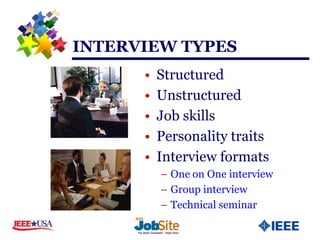
INTERVIEW TYPES
      •   Structured
      •   Unstructured
      •   Job skills
      •   Personality traits
      •   Interview formats
          – One on One interview
          – Group interview
          – Technical seminar
INTERVIEW PREPARATION

• Behavioral Interviews
• Self assessment
• Preparation of “instances”
• One-Minute Professional
  Autobiography
• Company & Salary Research
SELF ASSESSMENT

•   What can you do?
•   What do you like to do?
•   What are your core values?
•   What type of person are you?
•   In what kind of work environment
    are you at your best?
PREPARATION

• Gather Important Experiences
• Convert Experiences into Stories
  – A situation with a problem, and the potential for
    conflict of some type
  – The actions taken by the main character (you) to
    solve the problem
  – The resolution
  – Append a moral or a “lesson learned”
COMPANY RESEARCH
• The Industry as a whole
  – Stock Points (www.stockpoint.com)
• The company
  – Yahoo financial (www.yahoo.com)
  – Wall Street Journal Research Net (www.wsrn.com)
  – Companies online (www.companiesonline.com)
  – Hoovers (www.hoovers.com)
  – Biz Web (www.bizweb.com)
• The specific position
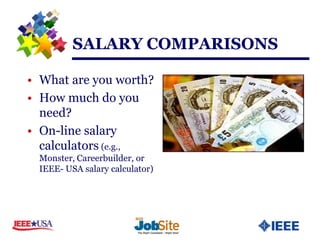
SALARY COMPARISONS

• What are you worth?
• How much do you
  need?
• On-line salary
  calculators (e.g.,
 Monster, Careerbuilder, or
 IEEE- USA salary calculator)
DURING THE INTERVIEW

• What really matters   •   Topics to avoid
• Appearance            •   Questions to ask
• Behavior, good and    •   Salary negotiations
  bad                   •   Afterwards
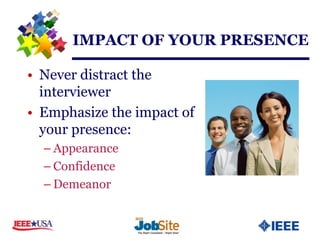
IMPACT OF YOUR PRESENCE

• Never distract the
  interviewer
• Emphasize the impact of
  your presence:
  – Appearance
  – Confidence
  – Demeanor
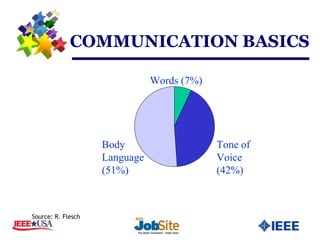
COMMUNICATION BASICS
.


                                   Words (7%)


                        Body                    Tone of
                        Language                Voice
                        (51%)                   (42%)


    Source: R. Flesch
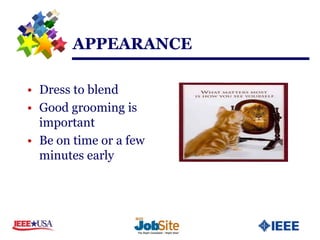
APPEARANCE

• Dress to blend
• Good grooming is
  important
• Be on time or a few
  minutes early
NON-VERBAL CUES
•   Lean forward to show interest
•   Keep your hands away from face and head
•   Avoid folding your arms across your chest
•   Make eye contact, but don’t stare
•   Smile periodically
•   Show enthusiasm
THINGS TO AVOID

•   Over-talking
•   Displaying arrogance
•   Using profanity or risqué humor
•   Distracting physical habits
•   Complaining
•   Making negative references to others
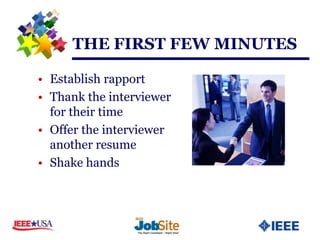
THE FIRST FEW MINUTES

• Establish rapport
• Thank the interviewer
  for their time
• Offer the interviewer
  another resume
• Shake hands
TOPICS TO AVOID

•   Sex
•   Race and ethnicity
•   Religion
•   Money
•   Who you know in the organization
INTERVIEW ISSUES

• Requests for negative information
• Questions to put you “on the spot”
  – Interviewer advances an unusual
    theory and asks for your opinion
  – Interviewer poses a difficult
    hypothetical question
NEGATIVE QUESTIONS -
          COPING
• Restate the question in your own words, and ask if your
  interpretation is correct
• Tactfully disagree OR admit to the flaw
• Highlight a compensating strength
• Show how you learned from the experience
• Try to show the good side of weakness
• Distinguish between personality trait and behavior
• Back it up with an example, if you can
ILLEGAL QUESTIONS
• Answer the question?
• Don’t answer the questions?
• Get a lawyer?
QUESTIONS TO ASK

• What is it like to work for the group manager?
• What is the corporate culture? The group culture?
• What training is available?
• What is needed for success in the job? In the company?
• Describe the group structure & prospects for
  advancement.
• What is the turnover rate in this job? In the company?
• Why did the previous person leave?
• Is a detailed job description available?
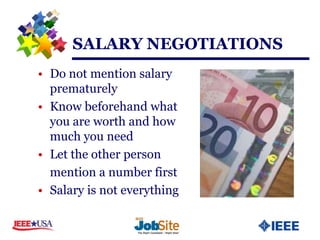
SALARY NEGOTIATIONS
• Do not mention salary
  prematurely
• Know beforehand what
  you are worth and how
  much you need
• Let the other person
  mention a number first
• Salary is not everything
THE LAST FEW MINUTES

•   Verify the next step.
•   Restate why you are the best candidate
•   Say “Thank you” and smile
•   Exit professionally
AFTER THE INTERVIEW


• Send Thank-You letter
• Debrief yourself
• Keep records
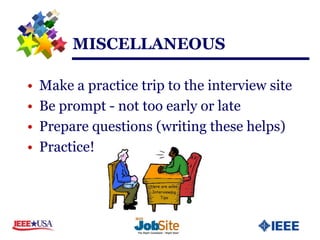
MISCELLANEOUS

•   Make a practice trip to the interview site
•   Be prompt - not too early or late
•   Prepare questions (writing these helps)
•   Practice!
SOURCES

• “Get Hired!” by Paul Green - Bard Books, Inc.
  ISBN 1885167148
• “Engineer’s Guide to Lifelong Employability”
  - IEEE Press ISBN 0879423145
• “What Color is Your Parachute?” by Richard
  Bolles - Ten Speed Press ISBN 0898156335
• “Winning Through Intimidation” by Robert
  Ringer - Fawcett Books ISBN 0449207862

Job Interview

  • 1.
    ACING THE JOBINTERVIEW Presented by Peggy G. Hutcheson, Ph.D. The Odyssey Group, Inc. www.odysseygroupinc.com
  • 2.
    WHAT WILL YOUDO? • The real purpose of interviews • Types of interviews and how to succeed with each • Steps to prepare for an interview • How to deal with difficult questions • Tips to make your interview stand out
  • 3.
    PURPOSE OF AN INTERVIEW • For you – Showcase your strengths – Demonstrate your fit in the organization – Learn about the job – Learn about the company
  • 4.
    PURPOSE OF AN INTERVIEW • For the interviewer – Assess skills – Assess fit – Determine next steps
  • 5.
    INTERVIEW TYPES • Structured • Unstructured • Job skills • Personality traits • Interview formats – One on One interview – Group interview – Technical seminar
  • 6.
    INTERVIEW PREPARATION • BehavioralInterviews • Self assessment • Preparation of “instances” • One-Minute Professional Autobiography • Company & Salary Research
  • 7.
    SELF ASSESSMENT • What can you do? • What do you like to do? • What are your core values? • What type of person are you? • In what kind of work environment are you at your best?
  • 8.
    PREPARATION • Gather ImportantExperiences • Convert Experiences into Stories – A situation with a problem, and the potential for conflict of some type – The actions taken by the main character (you) to solve the problem – The resolution – Append a moral or a “lesson learned”
  • 9.
    COMPANY RESEARCH • TheIndustry as a whole – Stock Points (www.stockpoint.com) • The company – Yahoo financial (www.yahoo.com) – Wall Street Journal Research Net (www.wsrn.com) – Companies online (www.companiesonline.com) – Hoovers (www.hoovers.com) – Biz Web (www.bizweb.com) • The specific position
  • 10.
    SALARY COMPARISONS • Whatare you worth? • How much do you need? • On-line salary calculators (e.g., Monster, Careerbuilder, or IEEE- USA salary calculator)
  • 11.
    DURING THE INTERVIEW •What really matters • Topics to avoid • Appearance • Questions to ask • Behavior, good and • Salary negotiations bad • Afterwards
  • 12.
    IMPACT OF YOURPRESENCE • Never distract the interviewer • Emphasize the impact of your presence: – Appearance – Confidence – Demeanor
  • 13.
    COMMUNICATION BASICS . Words (7%) Body Tone of Language Voice (51%) (42%) Source: R. Flesch
  • 14.
    APPEARANCE • Dress toblend • Good grooming is important • Be on time or a few minutes early
  • 15.
    NON-VERBAL CUES • Lean forward to show interest • Keep your hands away from face and head • Avoid folding your arms across your chest • Make eye contact, but don’t stare • Smile periodically • Show enthusiasm
  • 16.
    THINGS TO AVOID • Over-talking • Displaying arrogance • Using profanity or risqué humor • Distracting physical habits • Complaining • Making negative references to others
  • 17.
    THE FIRST FEWMINUTES • Establish rapport • Thank the interviewer for their time • Offer the interviewer another resume • Shake hands
  • 18.
    TOPICS TO AVOID • Sex • Race and ethnicity • Religion • Money • Who you know in the organization
  • 19.
    INTERVIEW ISSUES • Requestsfor negative information • Questions to put you “on the spot” – Interviewer advances an unusual theory and asks for your opinion – Interviewer poses a difficult hypothetical question
  • 20.
    NEGATIVE QUESTIONS - COPING • Restate the question in your own words, and ask if your interpretation is correct • Tactfully disagree OR admit to the flaw • Highlight a compensating strength • Show how you learned from the experience • Try to show the good side of weakness • Distinguish between personality trait and behavior • Back it up with an example, if you can
  • 21.
    ILLEGAL QUESTIONS • Answerthe question? • Don’t answer the questions? • Get a lawyer?
  • 22.
    QUESTIONS TO ASK •What is it like to work for the group manager? • What is the corporate culture? The group culture? • What training is available? • What is needed for success in the job? In the company? • Describe the group structure & prospects for advancement. • What is the turnover rate in this job? In the company? • Why did the previous person leave? • Is a detailed job description available?
  • 23.
    SALARY NEGOTIATIONS • Donot mention salary prematurely • Know beforehand what you are worth and how much you need • Let the other person mention a number first • Salary is not everything
  • 24.
    THE LAST FEWMINUTES • Verify the next step. • Restate why you are the best candidate • Say “Thank you” and smile • Exit professionally
  • 25.
    AFTER THE INTERVIEW •Send Thank-You letter • Debrief yourself • Keep records
  • 26.
    MISCELLANEOUS • Make a practice trip to the interview site • Be prompt - not too early or late • Prepare questions (writing these helps) • Practice!
  • 27.
    SOURCES • “Get Hired!”by Paul Green - Bard Books, Inc. ISBN 1885167148 • “Engineer’s Guide to Lifelong Employability” - IEEE Press ISBN 0879423145 • “What Color is Your Parachute?” by Richard Bolles - Ten Speed Press ISBN 0898156335 • “Winning Through Intimidation” by Robert Ringer - Fawcett Books ISBN 0449207862