Teaser Trailer Analysis
’Jigsaw Official Movie Trailer #2’ – Released 24th
July, 2017
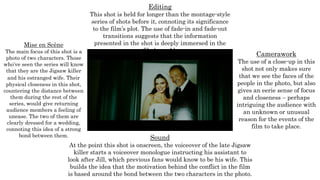
Mise en Scène
The lighting in this shot is
very low-key, connoting that
the character is an
antagonist. In addition, they
are dressed in dark colours,
adding to the connotations of
him being a villain. The tools
on the desk add to the
sinister atmosphere of the
shot.
Editing
This shot is held for about a second, one of the
longer ones in the trailer, connoting that the
character is important to the plot of the film, and
has a higher level of control to the other
characters.
Camerawork
The use of a long shot helps
to distance the audience from
the onscreen character and
position them against them.
In addition, the smooth
tracking of the shot creates a
somewhat unnatural, overly-
controlled feeling, adding to
the uneasy atmosphere of the
shot.
Sound
An electronic soundtrack is used at this point, juxtaposed with the low-
grade technology in the shot. This helps to inform the audience of the time
period the film is set it, as it connotes a modern setting. The only sound
effects are the character’s footsteps, which stick out from the soundtrack
quite strongly. This gives the effect of the character seeming powerful.
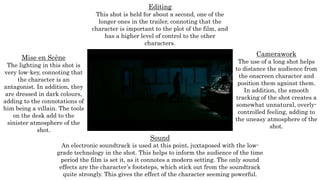
Mise en Scène
The main focus of this shot is a
photo of two characters. Those
who’ve seen the series will know
that they are the Jigsaw killer
and his estranged wife. Their
physical closeness in this shot,
countering the distance between
them during the rest of the
series, would give returning
audience members a feeling of
unease. The two of them are
clearly dressed for a wedding,
connoting this idea of a strong
bond between them.
Editing
This shot is held for longer than the montage-style
series of shots before it, connoting its significance
to the film’s plot. The use of fade-in and fade-out
transitions suggests that the information
presented in the shot is deeply immersed in the
film’s world.
Camerawork
The use of a close-up in this
shot not only makes sure
that we see the faces of the
people in the photo, but also
gives an eerie sense of focus
and closeness – perhaps
intriguing the audience with
an unknown or unusual
reason for the events of the
film to take place.
Sound
At the point this shot is onscreen, the voiceover of the late Jigsaw
killer starts a voiceover monologue instructing his assistant to
look after Jill, which previous fans would know to be his wife. This
builds the idea that the motivation behind the conflict in the film
is based around the bond between the two characters in the photo.
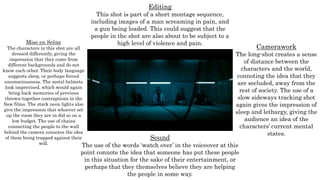
Mise en Scène
The characters in this shot are all
dressed differently, giving the
impression that they come from
different backgrounds and do not
know each other. Their body language
suggests sleep, or perhaps forced
unconsciousness. The metal helmets
look improvised, which would again
bring back memories of previous
thrown-together contraptions in the
Saw films. The stark neon lights also
give the impression that whoever set
up the room they are in did so on a
low budget. The use of chains
connecting the people to the wall
behind the camera connotes the idea
of them being trapped against their
will.
Editing
This shot is part of a short montage sequence,
including images of a man screaming in pain, and
a gun being loaded. This could suggest that the
people in the shot are also about to be subject to a
high level of violence and pain.
Camerawork
The long-shot creates a sense
of distance between the
characters and the world,
connoting the idea that they
are secluded, away from the
rest of society. The use of a
slow sideways tracking shot
again gives the impression of
sleep and lethargy, giving the
audience an idea of the
characters’ current mental
states.
Sound
The use of the words ‘watch over’ in the voiceover at this
point connote the idea that someone has put these people
in this situation for the sake of their entertainment, or
perhaps that they themselves believe they are helping
the people in some way.
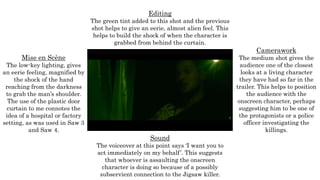
Mise en Scène
The low-key lighting, gives
an eerie feeling, magnified by
the shock of the hand
reaching from the darkness
to grab the man’s shoulder.
The use of the plastic door
curtain to me connotes the
idea of a hospital or factory
setting, as was used in Saw 3
and Saw 4.
Editing
The green tint added to this shot and the previous
shot helps to give an eerie, almost alien feel. This
helps to build the shock of when the character is
grabbed from behind the curtain.
Camerawork
The medium shot gives the
audience one of the closest
looks at a living character
they have had so far in the
trailer. This helps to position
the audience with the
onscreen character, perhaps
suggesting him to be one of
the protagonists or a police
officer investigating the
killings.
Sound
The voiceover at this point says ‘I want you to
act immediately on my behalf’. This suggests
that whoever is assaulting the onscreen
character is doing so because of a possibly
subservient connection to the Jigsaw killer.
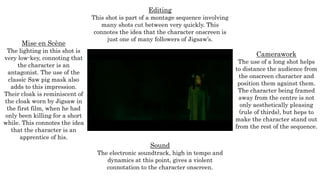
Mise en Scène
The lighting in this shot is
very low-key, connoting that
the character is an
antagonist. The use of the
classic Saw pig mask also
adds to this impression.
Their cloak is reminiscent of
the cloak worn by Jigsaw in
the first film, when he had
only been killing for a short
while. This connotes the idea
that the character is an
apprentice of his.
Editing
This shot is part of a montage sequence involving
many shots cut between very quickly. This
connotes the idea that the character onscreen is
just one of many followers of Jigsaw’s.
Camerawork
The use of a long shot helps
to distance the audience from
the onscreen character and
position them against them.
The character being framed
away from the centre is not
only aesthetically pleasing
(rule of thirds), but heps to
make the character stand out
from the rest of the sequence.
Sound
The electronic soundtrack, high in tempo and
dynamics at this point, gives a violent
connotation to the character onscreen.
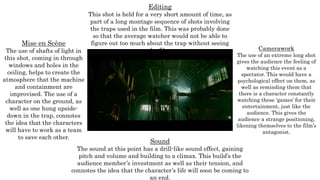
Mise en Scène
The use of shafts of light in
this shot, coming in through
windows and holes in the
ceiling, helps to create the
atmosphere that the machine
and containment are
improvised. The use of a
character on the ground, as
well as one hung upside-
down in the trap, connotes
the idea that the characters
will have to work as a team
to save each other.
Editing
This shot is held for a very short amount of time, as
part of a long montage sequence of shots involving
the traps used in the film. This was probably done
so that the average watcher would not be able to
figure out too much about the trap without seeing
the film. Camerawork
The use of an extreme long shot
gives the audience the feeling of
watching this event as a
spectator. This would have a
psychological effect on them, as
well as reminding them that
there is a character constantly
watching these ‘games’ for their
entertainment, just like the
audience. This gives the
audience a strange positioning,
likening themselves to the film’s
antagonist.
Sound
The sound at this point has a drill-like sound effect, gaining
pitch and volume and building to a climax. This build’s the
audience member’s investment as well as their tension, and
connotes the idea that the character’s life will soon be coming to
an end.
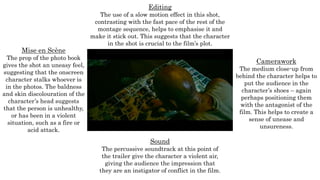
Mise en Scène
The prop of the photo book
gives the shot an uneasy feel,
suggesting that the onscreen
character stalks whoever is
in the photos. The baldness
and skin discolouration of the
character’s head suggests
that the person is unhealthy,
or has been in a violent
situation, such as a fire or
acid attack.
Editing
The use of a slow motion effect in this shot,
contrasting with the fast pace of the rest of the
montage sequence, helps to emphasise it and
make it stick out. This suggests that the character
in the shot is crucial to the film’s plot.
Camerawork
The medium close-up from
behind the character helps to
put the audience in the
character’s shoes – again
perhaps positioning them
with the antagonist of the
film. This helps to create a
sense of unease and
unsureness.
Sound
The percussive soundtrack at this point of
the trailer give the character a violent air,
giving the audience the impression that
they are an instigator of conflict in the film.
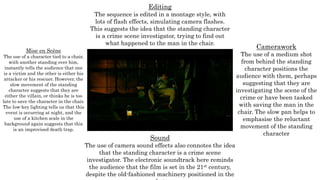
Mise en Scène
The use of a character tied to a chair,
with another standing over him,
instantly tells the audience that one
is a victim and the other is either his
attacker or his rescuer. However, the
slow movement of the standing
character suggests that they are
either the villain, or thinks he is too
late to save the character in the chair.
The low-key lighting tells us that this
event is occurring at night, and the
use of a kitchen scale in the
background again suggests that this
is an improvised death trap.
Editing
The sequence is edited in a montage style, with
lots of flash effects, simulating camera flashes.
This suggests the idea that the standing character
is a crime scene investigator, trying to find out
what happened to the man in the chair.
Camerawork
The use of a medium shot
from behind the standing
character positions the
audience with them, perhaps
suggesting that they are
investigating the scene of the
crime or have been tasked
with saving the man in the
chair. The slow pan helps to
emphasise the reluctant
movement of the standing
character
Sound
The use of camera sound effects also connotes the idea
that the standing character is a crime scene
investigator. The electronic soundtrack here reminds
the audience that the film is set in the 21st century,
despite the old-fashioned machinery positioned in the
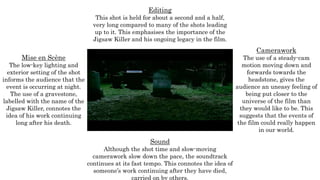
Mise en Scène
The low-key lighting and
exterior setting of the shot
informs the audience that the
event is occurring at night.
The use of a gravestone,
labelled with the name of the
Jigsaw Killer, connotes the
idea of his work continuing
long after his death.
Editing
This shot is held for about a second and a half,
very long compared to many of the shots leading
up to it. This emphasises the importance of the
Jigsaw Killer and his ongoing legacy in the film.
Camerawork
The use of a steady-cam
motion moving down and
forwards towards the
headstone, gives the
audience an uneasy feeling of
being put closer to the
universe of the film than
they would like to be. This
suggests that the events of
the film could really happen
in our world.
Sound
Although the shot time and slow-moving
camerawork slow down the pace, the soundtrack
continues at its fast tempo. This connotes the idea of
someone’s work continuing after they have died,
carried on by others.
Usingmy
findings
 The use of split-second action happening after a short
time of uneasy and slow-paced movement seems to be a
very good way to build tension towards the start of a
trailer. I think this is something my group could easily
achieve in our trailer.
 Also, I like the use of a steady-cam in the graveyard
shot – I would like to use a similar technique in the
graveyard scene in my teaser trailer.
 Especially, I think the use of a close-up of an object
representing an important aspect of the film’s
motivation is a very clever way to tell people a lot
about how the film will work. This is a very achievable
technique to use, too, so I think my group will use it in
our own teaser trailer.

Jigsaw (2017) Trailer Analysis

  • 1.
    Teaser Trailer Analysis ’JigsawOfficial Movie Trailer #2’ – Released 24th July, 2017
  • 3.
    Mise en Scène Thelighting in this shot is very low-key, connoting that the character is an antagonist. In addition, they are dressed in dark colours, adding to the connotations of him being a villain. The tools on the desk add to the sinister atmosphere of the shot. Editing This shot is held for about a second, one of the longer ones in the trailer, connoting that the character is important to the plot of the film, and has a higher level of control to the other characters. Camerawork The use of a long shot helps to distance the audience from the onscreen character and position them against them. In addition, the smooth tracking of the shot creates a somewhat unnatural, overly- controlled feeling, adding to the uneasy atmosphere of the shot. Sound An electronic soundtrack is used at this point, juxtaposed with the low- grade technology in the shot. This helps to inform the audience of the time period the film is set it, as it connotes a modern setting. The only sound effects are the character’s footsteps, which stick out from the soundtrack quite strongly. This gives the effect of the character seeming powerful.
  • 4.
    Mise en Scène Themain focus of this shot is a photo of two characters. Those who’ve seen the series will know that they are the Jigsaw killer and his estranged wife. Their physical closeness in this shot, countering the distance between them during the rest of the series, would give returning audience members a feeling of unease. The two of them are clearly dressed for a wedding, connoting this idea of a strong bond between them. Editing This shot is held for longer than the montage-style series of shots before it, connoting its significance to the film’s plot. The use of fade-in and fade-out transitions suggests that the information presented in the shot is deeply immersed in the film’s world. Camerawork The use of a close-up in this shot not only makes sure that we see the faces of the people in the photo, but also gives an eerie sense of focus and closeness – perhaps intriguing the audience with an unknown or unusual reason for the events of the film to take place. Sound At the point this shot is onscreen, the voiceover of the late Jigsaw killer starts a voiceover monologue instructing his assistant to look after Jill, which previous fans would know to be his wife. This builds the idea that the motivation behind the conflict in the film is based around the bond between the two characters in the photo.
  • 5.
    Mise en Scène Thecharacters in this shot are all dressed differently, giving the impression that they come from different backgrounds and do not know each other. Their body language suggests sleep, or perhaps forced unconsciousness. The metal helmets look improvised, which would again bring back memories of previous thrown-together contraptions in the Saw films. The stark neon lights also give the impression that whoever set up the room they are in did so on a low budget. The use of chains connecting the people to the wall behind the camera connotes the idea of them being trapped against their will. Editing This shot is part of a short montage sequence, including images of a man screaming in pain, and a gun being loaded. This could suggest that the people in the shot are also about to be subject to a high level of violence and pain. Camerawork The long-shot creates a sense of distance between the characters and the world, connoting the idea that they are secluded, away from the rest of society. The use of a slow sideways tracking shot again gives the impression of sleep and lethargy, giving the audience an idea of the characters’ current mental states. Sound The use of the words ‘watch over’ in the voiceover at this point connote the idea that someone has put these people in this situation for the sake of their entertainment, or perhaps that they themselves believe they are helping the people in some way.
  • 6.
    Mise en Scène Thelow-key lighting, gives an eerie feeling, magnified by the shock of the hand reaching from the darkness to grab the man’s shoulder. The use of the plastic door curtain to me connotes the idea of a hospital or factory setting, as was used in Saw 3 and Saw 4. Editing The green tint added to this shot and the previous shot helps to give an eerie, almost alien feel. This helps to build the shock of when the character is grabbed from behind the curtain. Camerawork The medium shot gives the audience one of the closest looks at a living character they have had so far in the trailer. This helps to position the audience with the onscreen character, perhaps suggesting him to be one of the protagonists or a police officer investigating the killings. Sound The voiceover at this point says ‘I want you to act immediately on my behalf’. This suggests that whoever is assaulting the onscreen character is doing so because of a possibly subservient connection to the Jigsaw killer.
  • 7.
    Mise en Scène Thelighting in this shot is very low-key, connoting that the character is an antagonist. The use of the classic Saw pig mask also adds to this impression. Their cloak is reminiscent of the cloak worn by Jigsaw in the first film, when he had only been killing for a short while. This connotes the idea that the character is an apprentice of his. Editing This shot is part of a montage sequence involving many shots cut between very quickly. This connotes the idea that the character onscreen is just one of many followers of Jigsaw’s. Camerawork The use of a long shot helps to distance the audience from the onscreen character and position them against them. The character being framed away from the centre is not only aesthetically pleasing (rule of thirds), but heps to make the character stand out from the rest of the sequence. Sound The electronic soundtrack, high in tempo and dynamics at this point, gives a violent connotation to the character onscreen.
  • 8.
    Mise en Scène Theuse of shafts of light in this shot, coming in through windows and holes in the ceiling, helps to create the atmosphere that the machine and containment are improvised. The use of a character on the ground, as well as one hung upside- down in the trap, connotes the idea that the characters will have to work as a team to save each other. Editing This shot is held for a very short amount of time, as part of a long montage sequence of shots involving the traps used in the film. This was probably done so that the average watcher would not be able to figure out too much about the trap without seeing the film. Camerawork The use of an extreme long shot gives the audience the feeling of watching this event as a spectator. This would have a psychological effect on them, as well as reminding them that there is a character constantly watching these ‘games’ for their entertainment, just like the audience. This gives the audience a strange positioning, likening themselves to the film’s antagonist. Sound The sound at this point has a drill-like sound effect, gaining pitch and volume and building to a climax. This build’s the audience member’s investment as well as their tension, and connotes the idea that the character’s life will soon be coming to an end.
  • 9.
    Mise en Scène Theprop of the photo book gives the shot an uneasy feel, suggesting that the onscreen character stalks whoever is in the photos. The baldness and skin discolouration of the character’s head suggests that the person is unhealthy, or has been in a violent situation, such as a fire or acid attack. Editing The use of a slow motion effect in this shot, contrasting with the fast pace of the rest of the montage sequence, helps to emphasise it and make it stick out. This suggests that the character in the shot is crucial to the film’s plot. Camerawork The medium close-up from behind the character helps to put the audience in the character’s shoes – again perhaps positioning them with the antagonist of the film. This helps to create a sense of unease and unsureness. Sound The percussive soundtrack at this point of the trailer give the character a violent air, giving the audience the impression that they are an instigator of conflict in the film.
  • 10.
    Mise en Scène Theuse of a character tied to a chair, with another standing over him, instantly tells the audience that one is a victim and the other is either his attacker or his rescuer. However, the slow movement of the standing character suggests that they are either the villain, or thinks he is too late to save the character in the chair. The low-key lighting tells us that this event is occurring at night, and the use of a kitchen scale in the background again suggests that this is an improvised death trap. Editing The sequence is edited in a montage style, with lots of flash effects, simulating camera flashes. This suggests the idea that the standing character is a crime scene investigator, trying to find out what happened to the man in the chair. Camerawork The use of a medium shot from behind the standing character positions the audience with them, perhaps suggesting that they are investigating the scene of the crime or have been tasked with saving the man in the chair. The slow pan helps to emphasise the reluctant movement of the standing character Sound The use of camera sound effects also connotes the idea that the standing character is a crime scene investigator. The electronic soundtrack here reminds the audience that the film is set in the 21st century, despite the old-fashioned machinery positioned in the
  • 11.
    Mise en Scène Thelow-key lighting and exterior setting of the shot informs the audience that the event is occurring at night. The use of a gravestone, labelled with the name of the Jigsaw Killer, connotes the idea of his work continuing long after his death. Editing This shot is held for about a second and a half, very long compared to many of the shots leading up to it. This emphasises the importance of the Jigsaw Killer and his ongoing legacy in the film. Camerawork The use of a steady-cam motion moving down and forwards towards the headstone, gives the audience an uneasy feeling of being put closer to the universe of the film than they would like to be. This suggests that the events of the film could really happen in our world. Sound Although the shot time and slow-moving camerawork slow down the pace, the soundtrack continues at its fast tempo. This connotes the idea of someone’s work continuing after they have died, carried on by others.
  • 12.
    Usingmy findings  The useof split-second action happening after a short time of uneasy and slow-paced movement seems to be a very good way to build tension towards the start of a trailer. I think this is something my group could easily achieve in our trailer.  Also, I like the use of a steady-cam in the graveyard shot – I would like to use a similar technique in the graveyard scene in my teaser trailer.  Especially, I think the use of a close-up of an object representing an important aspect of the film’s motivation is a very clever way to tell people a lot about how the film will work. This is a very achievable technique to use, too, so I think my group will use it in our own teaser trailer.