
Sidh                       Vikash Kumar
       a   r th
                  Vai                                    t
San                     sh
                                               Ravi Dixi
    c hi   Mal
               ho   tra                                 L uthra
                                                 T imsi
                              Prashant Kumar
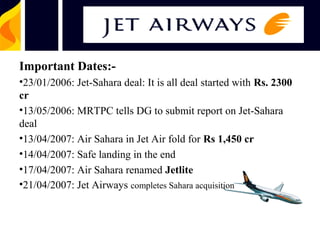
Important Dates:-
•23/01/2006: Jet-Sahara deal: It is all deal started with Rs. 2300
cr
•13/05/2006: MRTPC tells DG to submit report on Jet-Sahara
deal
•13/04/2007: Air Sahara in Jet Air fold for Rs 1,450 cr
•14/04/2007: Safe landing in the end
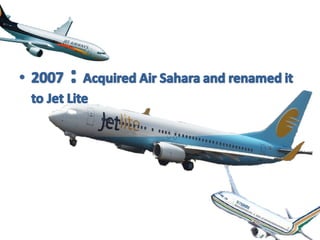
•17/04/2007: Air Sahara renamed Jetlite
•21/04/2007: Jet Airways completes Sahara acquisition
Acuirer


Target
d
• Jet Airways had valued Air Sahara at about 500 million
  dollars (Rs2300crores) initially. However, subsequent
  negotiations between Jet Airways owner, Mr. Naresh
  Goyal and the Air Sahara team settled the deal at 450
  million dollars (Rs2100crores). The initial valuation of
  Air-Sahara seemed to be very high, given that the
  carrier was sitting on Rs 96 lakhs of loss in the just
  concluded financial year. This feeling among the
  industry analysts were reflected when the Jet Airways
  share experienced a sharp decline with the
  announcement of the deal. Finally deal was closed on
  1450 crore.
MOTIVES FOR ACQUISITION
• The merger of Jet and Sahara gave Jet Airways access to the entire
  leased fleet of 27 aircrafts of Air Sahara along with its infrastructure
  and logistics. It also gave Jet Airways presence in those areas in
  India where they were not there but Air Sahara was. Air Sahara
  proved to be complementary to Jet even in the international arena.
  While Jet was operating on long haul routes such as US and Europe,
  Air sahara operated to neighboring countries such as Sri Lanka,
  Nepal and Thailand. Jet had about 62 aircrafts and operated 320
  flights to 44 domestic destinations and 6 foreign destinations at the
  time of the deal.
• One major gain for Jet in the deal was that it could gain access to
  Sahara’s parking slots in London’s Heathrow airport as well as in
  Delhi and Mumbai. Another factor was that there was a huge
  shortage of airline pilots. Hence, it could utilize Air Sahara’s pilots.
  The maintenance facilities of the smaller carrier would also be
  available within the country.
MOTIVES FOR ACQUISITION CONT..
•Since Air Sahara had leased all of its 27 aircrafts, so there was
not much gain in terms of tangible assets especially since Air
Sahara was not transferring its real estate and helicopters.
However when the deal was announced in January 2006, the
plan was to take over all of Air Sahara’s assets for $545 million.
•Jet Airways was also looking at capturing more market share
post the deal. It used to have a 40 percent market share which
fell down to 27 percent at the time of the deal. The major reason
was Jet’s intention of becoming the king of Indian skies by
becoming the number 1 private airlines in the industry
i
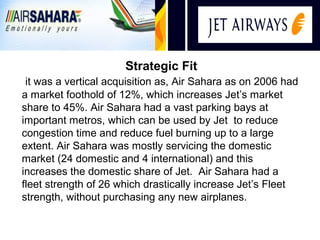
                      Strategic Fit
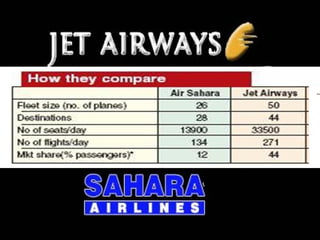
 it was a vertical acquisition as, Air Sahara as on 2006 had
a market foothold of 12%, which increases Jet’s market
share to 45%. Air Sahara had a vast parking bays at
important metros, which can be used by Jet to reduce
congestion time and reduce fuel burning up to a large
extent. Air Sahara was mostly servicing the domestic
market (24 domestic and 4 international) and this
increases the domestic share of Jet. Air Sahara had a
fleet strength of 26 which drastically increase Jet’s Fleet
strength, without purchasing any new airplanes.
i
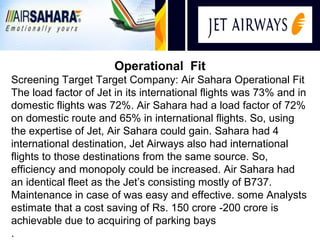
                       Operational Fit
Screening Target Target Company: Air Sahara Operational Fit
The load factor of Jet in its international flights was 73% and in
domestic flights was 72%. Air Sahara had a load factor of 72%
on domestic route and 65% in international flights. So, using
the expertise of Jet, Air Sahara could gain. Sahara had 4
international destination, Jet Airways also had international
flights to those destinations from the same source. So,
efficiency and monopoly could be increased. Air Sahara had
an identical fleet as the Jet’s consisting mostly of B737.
Maintenance in case of was easy and effective. some Analysts
estimate that a cost saving of Rs. 150 crore -200 crore is
achievable due to acquiring of parking bays
.
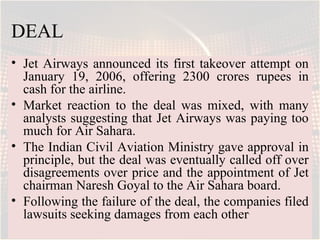
DEAL
• Jet Airways announced its first takeover attempt on
  January 19, 2006, offering 2300 crores rupees in
  cash for the airline.
• Market reaction to the deal was mixed, with many
  analysts suggesting that Jet Airways was paying too
  much for Air Sahara.
• The Indian Civil Aviation Ministry gave approval in
  principle, but the deal was eventually called off over
  disagreements over price and the appointment of Jet
  chairman Naresh Goyal to the Air Sahara board.
• Following the failure of the deal, the companies filed
  lawsuits seeking damages from each other.
i
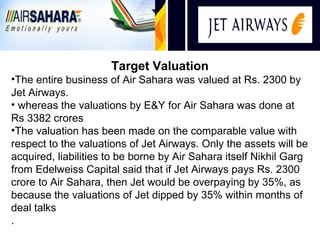
                      Target Valuation
•The entire business of Air Sahara was valued at Rs. 2300 by
Jet Airways.
• whereas the valuations by E&Y for Air Sahara was done at
Rs 3382 crores
•The valuation has been made on the comparable value with
respect to the valuations of Jet Airways. Only the assets will be
acquired, liabilities to be borne by Air Sahara itself Nikhil Garg
from Edelweiss Capital said that if Jet Airways pays Rs. 2300
crore to Air Sahara, then Jet would be overpaying by 35%, as
because the valuations of Jet dipped by 35% within months of
deal talks
.
i
               Target Valuation(Revised)

•Valuations made are comparable with the Jet’s market
valuation. After the talk of deal Jet’s valuation slipped by
around 35%, so the new valuation of Air Sahara was done at
35% lower valuation of Rs. 2300 crore i.e. Rs. 1450 crore
•Rs. 900 crore were paid immidietly but . The balance of INR
550 crores were payable in four interest free annual equal
installments .
•The entire deal was done through debt, majority from IDFC,
the company’s long standing banker.
i
                          Synergy

•cost saving of Rs. 150 crore -200 crore was achieved due to
acquiring of parking bays
•The ticketing costs were reduced for JetLite by moving to web
platform
•Increased customer based helped them reduce cost of
operation

•50% Reduction of staff due to synergies
HUMAN RESOURCES RELATED ISSUES
• In case of Staffs integration, Jet Airways was
  quick to lead the Air Sahara employees through a
  90 day period training.
• Lufthansa Technik team provided support Deal to
  absorb any excess employee back to Sahara
  Group To avoid Cultural Clashes, Air Sahara was
  converted to Jet Lite , having a different
  philosophy from its parent, so that a low cost
  structure can be developed.
HUMAN RESOURCES RELATED ISSUES
          (CONT…)
• Reduction of staffs due to synergies was made
  close to 50% reduction in headcount for the
  entire group.
• Jet was faced with immense criticism and
  opposition by various organizations and
  political parties Jet’s chairman, Naresh Goyal
  reinstated the employees a day later saying he
  was not aware of these sackings. So, the HR
  integration was not smooth enough.
POST MERGER INTEGRATION
• Jet Airways and Air Sahara had an identical fleet
  consisting of B737. So, after the merger the Air
  Sahara planes were immediately brought into
  service.
• Only 20 of the 26 of Sahara are actually flying. So,
  Jet infused another Rs. 200 crore for refurbishing
  the entire fleet Bulky insurance policies were
  removed to short term cost efficient policies.
• Released premises and office spaces not required
POST MERGER
        INTEGRATION(CONT…)
• 2 CRJs(Canadair regional jet) which has 70 to
  100 seater were removed and ATRs(Avione de
  transport regional)- Airbus were leased to
  reduce maintenance costs of a different
  aircraft.
• The ticketing costs were reduced for Jet Lite
  by moving to web platform Food and Cabin
  Amenities were reduced
• Loss making flights discontinued Business class
  services withdrawn.
The Joy of Flying….

Jet sahara merger

  • 2.
    Sidh Vikash Kumar a r th Vai t San sh Ravi Dixi c hi Mal ho tra L uthra T imsi Prashant Kumar
  • 3.
    Important Dates:- •23/01/2006: Jet-Saharadeal: It is all deal started with Rs. 2300 cr •13/05/2006: MRTPC tells DG to submit report on Jet-Sahara deal •13/04/2007: Air Sahara in Jet Air fold for Rs 1,450 cr •14/04/2007: Safe landing in the end •17/04/2007: Air Sahara renamed Jetlite •21/04/2007: Jet Airways completes Sahara acquisition
  • 4.
  • 5.
    d • Jet Airwayshad valued Air Sahara at about 500 million dollars (Rs2300crores) initially. However, subsequent negotiations between Jet Airways owner, Mr. Naresh Goyal and the Air Sahara team settled the deal at 450 million dollars (Rs2100crores). The initial valuation of Air-Sahara seemed to be very high, given that the carrier was sitting on Rs 96 lakhs of loss in the just concluded financial year. This feeling among the industry analysts were reflected when the Jet Airways share experienced a sharp decline with the announcement of the deal. Finally deal was closed on 1450 crore.
  • 6.
    MOTIVES FOR ACQUISITION •The merger of Jet and Sahara gave Jet Airways access to the entire leased fleet of 27 aircrafts of Air Sahara along with its infrastructure and logistics. It also gave Jet Airways presence in those areas in India where they were not there but Air Sahara was. Air Sahara proved to be complementary to Jet even in the international arena. While Jet was operating on long haul routes such as US and Europe, Air sahara operated to neighboring countries such as Sri Lanka, Nepal and Thailand. Jet had about 62 aircrafts and operated 320 flights to 44 domestic destinations and 6 foreign destinations at the time of the deal. • One major gain for Jet in the deal was that it could gain access to Sahara’s parking slots in London’s Heathrow airport as well as in Delhi and Mumbai. Another factor was that there was a huge shortage of airline pilots. Hence, it could utilize Air Sahara’s pilots. The maintenance facilities of the smaller carrier would also be available within the country.
  • 7.
    MOTIVES FOR ACQUISITIONCONT.. •Since Air Sahara had leased all of its 27 aircrafts, so there was not much gain in terms of tangible assets especially since Air Sahara was not transferring its real estate and helicopters. However when the deal was announced in January 2006, the plan was to take over all of Air Sahara’s assets for $545 million. •Jet Airways was also looking at capturing more market share post the deal. It used to have a 40 percent market share which fell down to 27 percent at the time of the deal. The major reason was Jet’s intention of becoming the king of Indian skies by becoming the number 1 private airlines in the industry
  • 9.
    i Strategic Fit it was a vertical acquisition as, Air Sahara as on 2006 had a market foothold of 12%, which increases Jet’s market share to 45%. Air Sahara had a vast parking bays at important metros, which can be used by Jet to reduce congestion time and reduce fuel burning up to a large extent. Air Sahara was mostly servicing the domestic market (24 domestic and 4 international) and this increases the domestic share of Jet. Air Sahara had a fleet strength of 26 which drastically increase Jet’s Fleet strength, without purchasing any new airplanes.
  • 10.
    i Operational Fit Screening Target Target Company: Air Sahara Operational Fit The load factor of Jet in its international flights was 73% and in domestic flights was 72%. Air Sahara had a load factor of 72% on domestic route and 65% in international flights. So, using the expertise of Jet, Air Sahara could gain. Sahara had 4 international destination, Jet Airways also had international flights to those destinations from the same source. So, efficiency and monopoly could be increased. Air Sahara had an identical fleet as the Jet’s consisting mostly of B737. Maintenance in case of was easy and effective. some Analysts estimate that a cost saving of Rs. 150 crore -200 crore is achievable due to acquiring of parking bays .
  • 11.
    DEAL • Jet Airwaysannounced its first takeover attempt on January 19, 2006, offering 2300 crores rupees in cash for the airline. • Market reaction to the deal was mixed, with many analysts suggesting that Jet Airways was paying too much for Air Sahara. • The Indian Civil Aviation Ministry gave approval in principle, but the deal was eventually called off over disagreements over price and the appointment of Jet chairman Naresh Goyal to the Air Sahara board. • Following the failure of the deal, the companies filed lawsuits seeking damages from each other.
  • 12.
    i Target Valuation •The entire business of Air Sahara was valued at Rs. 2300 by Jet Airways. • whereas the valuations by E&Y for Air Sahara was done at Rs 3382 crores •The valuation has been made on the comparable value with respect to the valuations of Jet Airways. Only the assets will be acquired, liabilities to be borne by Air Sahara itself Nikhil Garg from Edelweiss Capital said that if Jet Airways pays Rs. 2300 crore to Air Sahara, then Jet would be overpaying by 35%, as because the valuations of Jet dipped by 35% within months of deal talks .
  • 14.
    i Target Valuation(Revised) •Valuations made are comparable with the Jet’s market valuation. After the talk of deal Jet’s valuation slipped by around 35%, so the new valuation of Air Sahara was done at 35% lower valuation of Rs. 2300 crore i.e. Rs. 1450 crore •Rs. 900 crore were paid immidietly but . The balance of INR 550 crores were payable in four interest free annual equal installments . •The entire deal was done through debt, majority from IDFC, the company’s long standing banker.
  • 16.
    i Synergy •cost saving of Rs. 150 crore -200 crore was achieved due to acquiring of parking bays •The ticketing costs were reduced for JetLite by moving to web platform •Increased customer based helped them reduce cost of operation •50% Reduction of staff due to synergies
  • 17.
    HUMAN RESOURCES RELATEDISSUES • In case of Staffs integration, Jet Airways was quick to lead the Air Sahara employees through a 90 day period training. • Lufthansa Technik team provided support Deal to absorb any excess employee back to Sahara Group To avoid Cultural Clashes, Air Sahara was converted to Jet Lite , having a different philosophy from its parent, so that a low cost structure can be developed.
  • 18.
    HUMAN RESOURCES RELATEDISSUES (CONT…) • Reduction of staffs due to synergies was made close to 50% reduction in headcount for the entire group. • Jet was faced with immense criticism and opposition by various organizations and political parties Jet’s chairman, Naresh Goyal reinstated the employees a day later saying he was not aware of these sackings. So, the HR integration was not smooth enough.
  • 19.
    POST MERGER INTEGRATION •Jet Airways and Air Sahara had an identical fleet consisting of B737. So, after the merger the Air Sahara planes were immediately brought into service. • Only 20 of the 26 of Sahara are actually flying. So, Jet infused another Rs. 200 crore for refurbishing the entire fleet Bulky insurance policies were removed to short term cost efficient policies. • Released premises and office spaces not required
  • 20.
    POST MERGER INTEGRATION(CONT…) • 2 CRJs(Canadair regional jet) which has 70 to 100 seater were removed and ATRs(Avione de transport regional)- Airbus were leased to reduce maintenance costs of a different aircraft. • The ticketing costs were reduced for Jet Lite by moving to web platform Food and Cabin Amenities were reduced • Loss making flights discontinued Business class services withdrawn.
  • 21.
    The Joy ofFlying….