 A JDBC driver is a software component enabling a Java
application to interact with a database. JDBC drivers are
analogous to ODBC drivers, ADO.NET data providers, and OLE
DB providers.
 To connect with individual databases, JDBC (the Java Database
Connectivity API) requires drivers for each database. The JDBC
driver gives out the connection to the database and implements
the protocol for transferring the query and result between client
and database.
 Think of a database as just another device connected to your
computer
 like other devices it has a driver program to relieves you of
having to do low level programming to use the database
 the driver provides you with a high level api to the database
 Open Data Base Connectivity
 Developed by Microsoft for the Windows platform
as the way for Windows applications to access
Microsoft databases (SQL Server, FoxPro,
Access)
 Has become an industry standard
 Most data base vendors supply native, odbc, and
jdbc drivers for their data base products
Java Application
JDBC API
Data Base Drivers
Access SQL
Server
DB2 Informix MySQL Sybase
 Type 1
◦ JDBC-ODBC Bridge
 Type 2
◦ Native API, partially java
 Type 3
◦ JDBC Network Driver, partially java
 Type 4
◦ 100% Java
 Translate JDBC into ODBC and use Windows
ODBC built in drivers
 ODBC must be set up on every client
◦ driver must be physically on each machine for both java
applications and applets
◦ for server side servlets ODBC must be set up on web
server
 driver sun.jdbc.odbc.JdbcOdbc provided by
JavaSoft with JDK
 Functions
◦ Translates a query by JDBC into a corresponding
ODBC query, which is then handled by the
ODBC driver.
 Advantages
◦ Almost any database for which ODBC driver is
installed, can be accessed.
 Disadvantages
◦ Performance overhead since the calls have to go
through the jdbc Overhead bridge to the ODBC
driver, then to the native db connectivity interface
(thus may be slower than other types of drivers).
◦ The ODBC driver needs to be installed on the
client machine.
◦ Not suitable for applets, because the ODBC
driver needs to be installed on the client
Client JDBC-
ODBC
ODBC DB
Vendor
Library
 Converts JDBC to data base vendors native SQL
calls
 like Type 1 drivers; requires installation of binaries
on each client
 The JDBC type 2 driver, also known as the
Native-API driver, is a database driver
implementation that uses the client-side
libraries of the database. The driver
converts JDBC method calls into native
calls of the database API.
 Advantages
◦ As there is no implementation of jdbc-odbc
bridge, its considerably faster than a type 1
driver.
 Disadvantages
◦ The vendor client library needs to be installed on
the client machine.
◦ Not all databases have a client side library
◦ This driver is platform dependent
◦ This driver supports all java applications except
Applets
Client JDBC
Vendor
Library
DB
 Translates JDBC to a DBMS independent network
protocol
 Typically talks directly with a middleware product
which in turn talks to the RDBMS
◦ Jaguar, DBAnywhere, SequeLink
 Most flexible driver type
 all java
 Functions
◦ Follows a three tier communication approach.
◦ Can interface to multiple databases - Not vendor specific.
◦ The JDBC Client driver written in java, communicates with a
middleware-net-server using a database independent protocol, and
then this net server translates this request into database commands for
that database.
◦ Thus the client driver to middleware communication is database
independent.
 Advantages
◦ Since the communication between client and the middleware server is
database independent, there is no need for the database vendor library
on the client. The client need not be changed for a new database.
◦ The middleware server (which can be a full fledged J2EE Application
server) can provide typical middleware services like caching (of
connections, query results, etc.), load balancing, logging, and auditing.
◦ A single driver can handle any database, provided the middleware
supports it.
◦ Eg:-IDA Server
 Disadvantages
◦ Requires database-specific coding to be done in the middle tier.
◦ The middleware layer added may result in additional latency, but is
typically overcome by using better middleware services.
Client JDBC Vendor
Middleware
DB
Tier 1 Tier 2 Tier 3
 Converts JDBC directly to native API used by the
RDBMS
 compiles into the application , applet or servlet;
doesn’t require anything to be installed on client
machine, except JVM
 handiest driver type
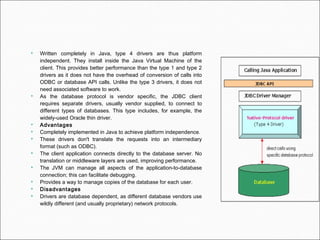
 Written completely in Java, type 4 drivers are thus platform
independent. They install inside the Java Virtual Machine of the
client. This provides better performance than the type 1 and type 2
drivers as it does not have the overhead of conversion of calls into
ODBC or database API calls. Unlike the type 3 drivers, it does not
need associated software to work.
 As the database protocol is vendor specific, the JDBC client
requires separate drivers, usually vendor supplied, to connect to
different types of databases. This type includes, for example, the
widely-used Oracle thin driver.
 Advantages
 Completely implemented in Java to achieve platform independence.
 These drivers don't translate the requests into an intermediary
format (such as ODBC).
 The client application connects directly to the database server. No
translation or middleware layers are used, improving performance.
 The JVM can manage all aspects of the application-to-database
connection; this can facilitate debugging.
 Provides a way to manage copies of the database for each user.
 Disadvantages
 Drivers are database dependent, as different database vendors use
wildly different (and usually proprietary) network protocols.
Client JDBC DB
 Developed by C. Date for Relational Data Base
Management Systems (RDBMS)
 Simple Declarative Language
◦ has no program control statements
 Two categories of commands
◦ Data Manipulation Commands
 deal with:
 RETRIEVING DATA
 MAINTAINING DATA (ADDING, UPDATING,DELETING
◦ Data Definition Commands
 DEAL WITH:
 CREATING DATABASE OBJECTS (TABLES,VIEWS)
 Object organization and attributes
 Rules to insure that table data stays accurate and
accessible
◦ rows in a table should be unique
 one column should contain no duplicate data
 primary key
◦ column values cannot contain repeating groups or arrays
◦ null is different than space and zero, 2 null values are not
considered equal
 Select - query and display data from a database
 Insert - a new row into a table
 Update - modify a column in a table
 Delete a row from a table
 Select (column list) from (sources) where (conditions) order by (ocolumn list)
 column list - comma separated list of names of columns to be in output
◦ Ex. ssn , lastname , firstname,gpa
◦ can contain literals to be included in output
 Ex. Ssn,”~”,lastname,”~”,firstname
 sources - name(s) of table(s) to retrieve data from
 conditions (optional) - conditions for selections
◦ lastname like “S%”
◦ (lastname = “Steflik) and (firstname like “R%”)
 ocolumn list (optional)- list of columns that output should be ordered by
 Ex
◦ select * from student
◦ select lastname,fristname from student where gpa > 3.0
◦ select lastname,firstname from student order by lastname,firstname
 Two tables may be joined and viewed as a single
data source is the both have a common column
 suppose we have 2 tables: Inventory and category
and each has a column called catg_code
 In category catg_code is unique and is the primary
key
P_no Catg_code qty Catg_code descr
Inventory Category
join
 To retrieve all of the part numbers and the name
of the category to which the part belongs:
◦ select inventory.p_no category.descr from inventroy , category
◦ select a.p_no,” “,b.descr from a inventory , b category
 Add a row to a table
◦ insert into category values(“IGN”,”Ignition System”)
 use jdbc execute Update method
◦ ex. Stmt.executeUpdate(“insert into Category values(‘IGN’,’Ignition System’)”);
 Modify an existing row in a table
◦ update category set descr = “Ignition Subsystem” where catg_code = “IGN”
 Use jdbc executeUpdate method
◦ String s = “update category set descr = ‘Ignition Subsystem’ where catg_code =
‘IGN’ ”;
◦ stmt.executeUpdate(s);
 Remove a row from a table
◦ delete from category where catg_code = “IGN”
 remove the IGN category
◦ delete from category where catg_code like “I%”
 remove all rows where catg_code starts with an “I”
 Create table
◦ add a table to a database
 Drop Table
◦ remove a table from a database
 Alter Table
◦ add or delete column(s)

Jdbcdriver

  • 2.
     A JDBCdriver is a software component enabling a Java application to interact with a database. JDBC drivers are analogous to ODBC drivers, ADO.NET data providers, and OLE DB providers.  To connect with individual databases, JDBC (the Java Database Connectivity API) requires drivers for each database. The JDBC driver gives out the connection to the database and implements the protocol for transferring the query and result between client and database.  Think of a database as just another device connected to your computer  like other devices it has a driver program to relieves you of having to do low level programming to use the database  the driver provides you with a high level api to the database
  • 3.
     Open DataBase Connectivity  Developed by Microsoft for the Windows platform as the way for Windows applications to access Microsoft databases (SQL Server, FoxPro, Access)  Has become an industry standard  Most data base vendors supply native, odbc, and jdbc drivers for their data base products
  • 4.
    Java Application JDBC API DataBase Drivers Access SQL Server DB2 Informix MySQL Sybase
  • 5.
     Type 1 ◦JDBC-ODBC Bridge  Type 2 ◦ Native API, partially java  Type 3 ◦ JDBC Network Driver, partially java  Type 4 ◦ 100% Java
  • 6.
     Translate JDBCinto ODBC and use Windows ODBC built in drivers  ODBC must be set up on every client ◦ driver must be physically on each machine for both java applications and applets ◦ for server side servlets ODBC must be set up on web server  driver sun.jdbc.odbc.JdbcOdbc provided by JavaSoft with JDK
  • 7.
     Functions ◦ Translatesa query by JDBC into a corresponding ODBC query, which is then handled by the ODBC driver.  Advantages ◦ Almost any database for which ODBC driver is installed, can be accessed.  Disadvantages ◦ Performance overhead since the calls have to go through the jdbc Overhead bridge to the ODBC driver, then to the native db connectivity interface (thus may be slower than other types of drivers). ◦ The ODBC driver needs to be installed on the client machine. ◦ Not suitable for applets, because the ODBC driver needs to be installed on the client
  • 8.
  • 9.
     Converts JDBCto data base vendors native SQL calls  like Type 1 drivers; requires installation of binaries on each client
  • 10.
     The JDBCtype 2 driver, also known as the Native-API driver, is a database driver implementation that uses the client-side libraries of the database. The driver converts JDBC method calls into native calls of the database API.  Advantages ◦ As there is no implementation of jdbc-odbc bridge, its considerably faster than a type 1 driver.  Disadvantages ◦ The vendor client library needs to be installed on the client machine. ◦ Not all databases have a client side library ◦ This driver is platform dependent ◦ This driver supports all java applications except Applets
  • 11.
  • 12.
     Translates JDBCto a DBMS independent network protocol  Typically talks directly with a middleware product which in turn talks to the RDBMS ◦ Jaguar, DBAnywhere, SequeLink  Most flexible driver type  all java
  • 13.
     Functions ◦ Followsa three tier communication approach. ◦ Can interface to multiple databases - Not vendor specific. ◦ The JDBC Client driver written in java, communicates with a middleware-net-server using a database independent protocol, and then this net server translates this request into database commands for that database. ◦ Thus the client driver to middleware communication is database independent.  Advantages ◦ Since the communication between client and the middleware server is database independent, there is no need for the database vendor library on the client. The client need not be changed for a new database. ◦ The middleware server (which can be a full fledged J2EE Application server) can provide typical middleware services like caching (of connections, query results, etc.), load balancing, logging, and auditing. ◦ A single driver can handle any database, provided the middleware supports it. ◦ Eg:-IDA Server  Disadvantages ◦ Requires database-specific coding to be done in the middle tier. ◦ The middleware layer added may result in additional latency, but is typically overcome by using better middleware services.
  • 14.
  • 15.
     Converts JDBCdirectly to native API used by the RDBMS  compiles into the application , applet or servlet; doesn’t require anything to be installed on client machine, except JVM  handiest driver type
  • 16.
     Written completelyin Java, type 4 drivers are thus platform independent. They install inside the Java Virtual Machine of the client. This provides better performance than the type 1 and type 2 drivers as it does not have the overhead of conversion of calls into ODBC or database API calls. Unlike the type 3 drivers, it does not need associated software to work.  As the database protocol is vendor specific, the JDBC client requires separate drivers, usually vendor supplied, to connect to different types of databases. This type includes, for example, the widely-used Oracle thin driver.  Advantages  Completely implemented in Java to achieve platform independence.  These drivers don't translate the requests into an intermediary format (such as ODBC).  The client application connects directly to the database server. No translation or middleware layers are used, improving performance.  The JVM can manage all aspects of the application-to-database connection; this can facilitate debugging.  Provides a way to manage copies of the database for each user.  Disadvantages  Drivers are database dependent, as different database vendors use wildly different (and usually proprietary) network protocols.
  • 17.
  • 18.
     Developed byC. Date for Relational Data Base Management Systems (RDBMS)  Simple Declarative Language ◦ has no program control statements
  • 19.
     Two categoriesof commands ◦ Data Manipulation Commands  deal with:  RETRIEVING DATA  MAINTAINING DATA (ADDING, UPDATING,DELETING ◦ Data Definition Commands  DEAL WITH:  CREATING DATABASE OBJECTS (TABLES,VIEWS)  Object organization and attributes
  • 20.
     Rules toinsure that table data stays accurate and accessible ◦ rows in a table should be unique  one column should contain no duplicate data  primary key ◦ column values cannot contain repeating groups or arrays ◦ null is different than space and zero, 2 null values are not considered equal
  • 21.
     Select -query and display data from a database  Insert - a new row into a table  Update - modify a column in a table  Delete a row from a table
  • 22.
     Select (columnlist) from (sources) where (conditions) order by (ocolumn list)  column list - comma separated list of names of columns to be in output ◦ Ex. ssn , lastname , firstname,gpa ◦ can contain literals to be included in output  Ex. Ssn,”~”,lastname,”~”,firstname  sources - name(s) of table(s) to retrieve data from  conditions (optional) - conditions for selections ◦ lastname like “S%” ◦ (lastname = “Steflik) and (firstname like “R%”)  ocolumn list (optional)- list of columns that output should be ordered by  Ex ◦ select * from student ◦ select lastname,fristname from student where gpa > 3.0 ◦ select lastname,firstname from student order by lastname,firstname
  • 23.
     Two tablesmay be joined and viewed as a single data source is the both have a common column  suppose we have 2 tables: Inventory and category and each has a column called catg_code  In category catg_code is unique and is the primary key
  • 24.
    P_no Catg_code qtyCatg_code descr Inventory Category join
  • 25.
     To retrieveall of the part numbers and the name of the category to which the part belongs: ◦ select inventory.p_no category.descr from inventroy , category ◦ select a.p_no,” “,b.descr from a inventory , b category
  • 26.
     Add arow to a table ◦ insert into category values(“IGN”,”Ignition System”)  use jdbc execute Update method ◦ ex. Stmt.executeUpdate(“insert into Category values(‘IGN’,’Ignition System’)”);
  • 27.
     Modify anexisting row in a table ◦ update category set descr = “Ignition Subsystem” where catg_code = “IGN”  Use jdbc executeUpdate method ◦ String s = “update category set descr = ‘Ignition Subsystem’ where catg_code = ‘IGN’ ”; ◦ stmt.executeUpdate(s);
  • 28.
     Remove arow from a table ◦ delete from category where catg_code = “IGN”  remove the IGN category ◦ delete from category where catg_code like “I%”  remove all rows where catg_code starts with an “I”
  • 29.
     Create table ◦add a table to a database  Drop Table ◦ remove a table from a database  Alter Table ◦ add or delete column(s)