Introduction
        Construction Design
                &
     Management Regulations
            1994 - 2007
Key Changes and Practical Applications
          By John Curry
       Health & Safety Officer
Background – CDM 1994

   Construction (Design & Management) Regulations 1994 implemented
    key aspects of a construction European Directive 92/57/EEC

   It identified the need to reduce risk by better co-ordination,
    management and co-operation

   For the first time the duties on clients and designers were made more
    explicit

   CDM 1994 led to a major change in how the Construction industry
    managed health and safety


                                                          CDM 2007 Overview – Slide
CDM 1994 – Why Change?
   Concerns from industry and HSE that CDM 1994 was not delivering
    the improvements in health and safety that were expected of it

   Slow acceptance, particularly amongst clients and designers

   Effective planning, management, communications and co-
    ordination was less than expected

   Competence of organisations and individuals was slow to improve

   Defensive verification approach adopted by many – led to
    complexity, bureaucracy and an abundance of paperwork.


                                                  CDM 2007 Overview – Slide
Problems with existing system

•   Too much paperwork distracted attention from the project in
    hand, especially Pre-tender Health & Safety Plans

· Client offloading his duties

· Designers paying lip-service to Health & Safety in design

· Insufficient notice for parties to carry out their duties

· Information not early enough or good enough

   Competencency at all levels
HSE’s Expectations on the
           Construction Industry
   A change in attitude is needed to deliver the much needed
    improvements in construction health and safety

   A ‘business as usual’ approach is not acceptable

   Industry needs to take ownership of the management of health and
    safety risks, show leadership and work in partnership

   Focus on effective planning and managing risk

   Ensure people are competent

   Reduce bureaucracy & paperwork
                                                 CDM 2007 Overview – Slide
History of CDM 2007

   Through extensive consultation and partnership working between
    industry and HSE The following changes came about:-

   September 2002 - Discussion Document ‘Revitalising Health and
    Safety in Construction’

   March 2005 - HSC publish Consultation Document with draft
    Regulations – which combine CDM 1994 and Construction (Health,
    Safety & Welfare) Regulations 1996

   December 2005 - HSC agreed Regulations were to be supported by
    an Approved Code of Practice and industry produced guidance

   CDM 2007 came into force on the 6th April 2007
                                                     CDM 2007 Overview – Slide
The objectives of CDM 2007
Simplify the regulations and improve clarity

   Maximise their flexibility

   Focus on planning and management, not ‘The Plan’ and other
    paperwork

   Strengthen requirements on co-operation and co-ordination-
    encourage better integration of co-workers

   Simplify competence assessment, reduce bureaucracy and raise
    industry standards


                                                  CDM 2007 Overview – Slide
Basic Aims Unchanged, but now focus on

 Principal duties on the Client

 · Each project requires proper planning at an early stage

 · Designers to consider Health & Safety issues at design stage
    Inclusive of maintenance

    Contractor to have more responsibilities
Structure of CDM 2007
   Five Key parts
       Part 1: Introduction
       Part 2: General management duties applying to all
                construction projects
       Part 3: Additional duties where projects are notifiable
       Part 4: Worksite health and safety requirements
       Part 5: General

   Supported by a CDM 2007 Approved Code of Practice (ACoP)

                                                CDM 2007 Overview – Slide
CDM 2007 – key points
   Regulations apply to all construction work

   Notification triggers appointment of additional duty holders and
    duties in Part 3 of the Regulations
        Principal contractor (PC)
        CDM co-ordinator (92/57/EEC) role of planning supervisor under
         CDM 1994 has been removed
        Notification to HSE (F10 Revised Form)
        Construction phase plan requirement for pre-construction plan
         under CDM 1994 removed
        Health and safety file requirements simplified
   Most duties remain on clients, designers & contractors regardless
    of notification, the accent is on Planning & Management
   Greater clarity in relation to competence assessment and new
    competence criteria in the ACoP                  CDM 2007 Overview – Slide
Trigger for Appointments
   Notifiable construction work under CDM 2007 are construction
    projects with a:

       Non-domestic client and involve:-

       Construction work lasting longer than 30 days

                          or
       Construction work involving 500 person days

Note – Trigger under CDM 1994 had been more complex
       five men on site rule

                                                 CDM 2007 Overview – Slide
New Regulations

Planning Supervisor role Relinquished & becomes the co-ordinator

   Co-ordinators job is also to assist the client to carry out his duties

   Construction Phase Health & Safety Plan produced by the Principal
    Contractor will be the main document. (Simplified Version)

   CDM no longer automatically applies to any demolition contract –
    but method statement and detailed safe method of work still
    applies
New Regulations (cont)

•   The “five or more” workers on site rule no longer applies, i.e..
    CDM applies to all non-domestic work in excess of 30 days
    duration and/or excess of 500 person days

CDM duties on designers always apply (as they do at present).

   An information pack is to be prepared in lieu of a Pre-tender
    Health & Safety Plan. This is should be a much shorter and
    concise document than the previous pre-tender Health & Safety
    Plan. Items which are obvious from the drawings and
    specification need not be included.
Principal Contractors

•   Must not accept an appointment unless a CDM co-ordinator
    has been appointed

· Develop, update and implement Health & Safety Plan

· Consultation (Plan and Manage)

· Ensure site welfare meets required standard

   Control of contractors clarified
Designer’s Duties

•   Offence to accept an appointment unless competent

· Must consider Health & Safety as part of design process

   Consider all Health & Safety risks involved in constructing the
    building and all future maintenance & Repair works

   Pass on information of risks that cannot be eliminated

   Designer cannot accept an appointment (other than initial
    work) unless the Client has appointed a co-ordinator and the
    HSE are notified.
Please note…..

    Both Principal Contractor and Designers have a duty to
    point out the law to a client regarding appointment of a
    CDM Co-ordinator and notification, as it is accepted that
    clients could be completely ignorant of their duties under
    the regulations.

   Regulations 4, 5,6 and 22-24 and Part 4 of the
    Regulations. HSE ACOP.
Time!!!


   Time is now recognised as a resource.
    This is explicitly referred to in new CDM
    Regulations.

   The right information, for the right people, at the
    right time. HSE ACOP
CDM 2007 – Key messages
   Industry and HSE have worked in partnership to revise and simply
    the CDM Regulations and combine them with the CHSW
    Regulations

   The new regulations apply if you are involved in construction and
    will help you to improve health and safety in the industry

   The aims of the new regulations are to have the right people for the
    right job at the right time to manage risks on site, reduce paperwork
    and encourage teamwork

   Focus on effective planning and managing risk


                                                     CDM 2007 Overview – Slide
CDM Key Changes Introduction
Clients Increased Duty for Management

   Expansion on Designers Duties

   New Duty Holder Co-ordinator

   CHSWR Revoked Included in CDM Part 4

   Some Transitional Arrangements Agents/Clients Co-
   Ordinator

   Notification Simplified 30 working days or 500 person days

   Demolition/High Risk Requires Written Plan Regardless
CDM Key Changes For Clients
         All Projects
Clients no right to contract out liability

•Can rely on Coordinator for advice but duty to check
competence & liability remains

•Ensure Sufficient Time and Resources Allocated

•Duty to provide relevant information not Pre-tender

•E.G Site Survey, Services Information, Existing
Conditions, Asbestos, Ground Conditions
CDM Key Changes For Clients
           All Projects
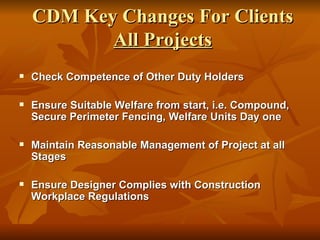
   Check Competence of Other Duty Holders

   Ensure Suitable Welfare from start, i.e. Compound,
    Secure Perimeter Fencing, Welfare Units Day one

   Maintain Reasonable Management of Project at all
    Stages

   Ensure Designer Complies with Construction
    Workplace Regulations
CDM Key Changes For Clients
        Notifiable Projects

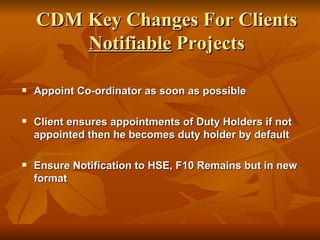
   Appoint Co-ordinator as soon as possible

   Client ensures appointments of Duty Holders if not
    appointed then he becomes duty holder by default

   Ensure Notification to HSE, F10 Remains but in new
    format
CDM Key Changes New Role
            Co-ordinator

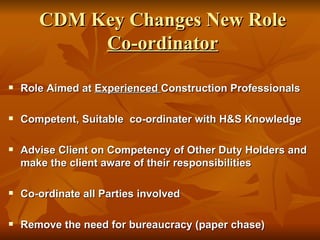
   Role Aimed at Experienced Construction Professionals

   Competent, Suitable co-ordinater with H&S Knowledge

   Advise Client on Competency of Other Duty Holders and
    make the client aware of their responsibilities

   Co-ordinate all Parties involved

   Remove the need for bureaucracy (paper chase)
CDM Key Change New Role
             Co-ordinator

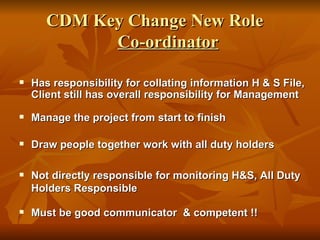
   Has responsibility for collating information H & S File,
    Client still has overall responsibility for Management
   Manage the project from start to finish

   Draw people together work with all duty holders

   Not directly responsible for monitoring H&S, All Duty
    Holders Responsible

   Must be good communicator & competent !!
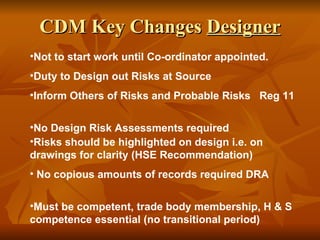
CDM Key Changes Designer
•Not to start work until Co-ordinator appointed.
•Duty to Design out Risks at Source
•Inform Others of Risks and Probable Risks Reg 11


•No Design Risk Assessments required
•Risks should be highlighted on design i.e. on
drawings for clarity (HSE Recommendation)
• No copious amounts of records required DRA


•Must be competent, trade body membership, H & S
competence essential (no transitional period)
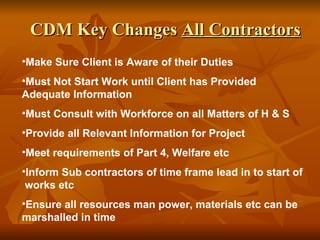
CDM Key Changes All Contractors
•Make Sure Client is Aware of their Duties
•Must Not Start Work until Client has Provided
Adequate Information
•Must Consult with Workforce on all Matters of H & S
•Provide all Relevant Information for Project
•Meet requirements of Part 4, Welfare etc
•Inform Sub contractors of time frame lead in to start of
 works etc
•Ensure all resources man power, materials etc can be
marshalled in time
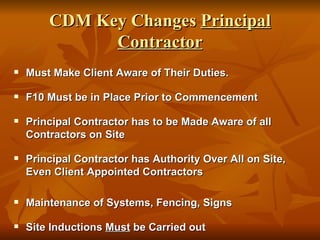
CDM Key Changes Principal
              Contractor
   Must Make Client Aware of Their Duties.

   F10 Must be in Place Prior to Commencement

   Principal Contractor has to be Made Aware of all
    Contractors on Site

   Principal Contractor has Authority Over All on Site,
    Even Client Appointed Contractors

   Maintenance of Systems, Fencing, Signs

   Site Inductions Must be Carried out
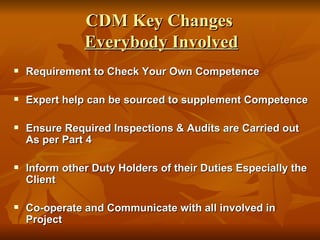
CDM Key Changes
               Everybody Involved
   Requirement to Check Your Own Competence

   Expert help can be sourced to supplement Competence

   Ensure Required Inspections & Audits are Carried out
    As per Part 4

   Inform other Duty Holders of their Duties Especially the
    Client

   Co-operate and Communicate with all involved in
    Project
CDM Key Changes
             Competency Requirements
   As Specified in ACOP

   Duty Holders Must Have Good Understanding, Task
    Knowledge & Experience

   Assessment of Competency Essential i.e. Stage one or two

   Duty Holders Need Proof of Health and Safety
    Competency, Minimum NEBOSH Construction Certificate

   Transitional period for Co-ordinator none for Designer
CDM Key Changes
         Competency Requirements
•Supervisors and Managers Require CSCS with S/NVQ
•General Workers will require relevant CSCS, CPCS with
S/NVQ or equivalent?
•Monitoring of Competency Still Required with Adequate
Supervision and Checks Carried Out
•No Transitional Period
•Potential Problems with Foreign Workers
CDM Key Changes
       CHSWR Now Part 4 of CDM

   Majority of Original Regulations Remain Same

   Some Dialogue Changes to Promote Clearer
    Understanding

   Demarcation of Site Changed to Include Fenced
    and Signed to the Perimeter

   Temporary Supports/Structures Requirements
    More Specific

   Demolition More Specific
CDM Key Changes
           CHSWR Now Part 4 of CDM
   Explosives Requirement Specified

   Alteration to the Requirement for Excavation/Inspections

   Additional Requirements for Working close to Electricity

   Changes to Working Close to Water (some now covered
    by PUWER)

   Doors and Gates Covered by Workplace Regulations

   Changes to Provision of Personal Welfare on Site
Good News Health & Safety, Works!!
       But We Still Need to Improve
   HSE Figures for 2005-2006
   59 Deaths in Construction
   lowest ever. With 2.2 Million Employees

   24 Falls From Height
   8 Hit by Moving Vehicles
   Big Reduction in Major Injuries
   Main Cause of Accident Slips, Trips & Falls
   Lowest Rates of Stress Incidents of all
    Industries
However This Year HSE Report

   78 Reported deaths so far in Construction

   10-15% Not Classed as Workplace so actual figure
    expected to be about 67?

   But reported major injuries still falling

Reference Sources:- Construction (Design and Management) Regulations 2007
                    CDM Approved Code of Practise 2007.
                    HSE Web Site, CDM Making a Difference Jeanette Reuben Jan 07
Thank You!!

Jc Cdm Presentation May 08

  • 1.
    Introduction Construction Design & Management Regulations 1994 - 2007 Key Changes and Practical Applications By John Curry Health & Safety Officer
  • 2.
    Background – CDM1994  Construction (Design & Management) Regulations 1994 implemented key aspects of a construction European Directive 92/57/EEC  It identified the need to reduce risk by better co-ordination, management and co-operation  For the first time the duties on clients and designers were made more explicit  CDM 1994 led to a major change in how the Construction industry managed health and safety CDM 2007 Overview – Slide
  • 3.
    CDM 1994 –Why Change?  Concerns from industry and HSE that CDM 1994 was not delivering the improvements in health and safety that were expected of it  Slow acceptance, particularly amongst clients and designers  Effective planning, management, communications and co- ordination was less than expected  Competence of organisations and individuals was slow to improve  Defensive verification approach adopted by many – led to complexity, bureaucracy and an abundance of paperwork. CDM 2007 Overview – Slide
  • 4.
    Problems with existingsystem • Too much paperwork distracted attention from the project in hand, especially Pre-tender Health & Safety Plans · Client offloading his duties · Designers paying lip-service to Health & Safety in design · Insufficient notice for parties to carry out their duties · Information not early enough or good enough  Competencency at all levels
  • 5.
    HSE’s Expectations onthe Construction Industry  A change in attitude is needed to deliver the much needed improvements in construction health and safety  A ‘business as usual’ approach is not acceptable  Industry needs to take ownership of the management of health and safety risks, show leadership and work in partnership  Focus on effective planning and managing risk  Ensure people are competent  Reduce bureaucracy & paperwork CDM 2007 Overview – Slide
  • 6.
    History of CDM2007  Through extensive consultation and partnership working between industry and HSE The following changes came about:-  September 2002 - Discussion Document ‘Revitalising Health and Safety in Construction’  March 2005 - HSC publish Consultation Document with draft Regulations – which combine CDM 1994 and Construction (Health, Safety & Welfare) Regulations 1996  December 2005 - HSC agreed Regulations were to be supported by an Approved Code of Practice and industry produced guidance  CDM 2007 came into force on the 6th April 2007 CDM 2007 Overview – Slide
  • 7.
    The objectives ofCDM 2007 Simplify the regulations and improve clarity  Maximise their flexibility  Focus on planning and management, not ‘The Plan’ and other paperwork  Strengthen requirements on co-operation and co-ordination- encourage better integration of co-workers  Simplify competence assessment, reduce bureaucracy and raise industry standards CDM 2007 Overview – Slide
  • 8.
    Basic Aims Unchanged,but now focus on Principal duties on the Client · Each project requires proper planning at an early stage · Designers to consider Health & Safety issues at design stage Inclusive of maintenance  Contractor to have more responsibilities
  • 9.
    Structure of CDM2007  Five Key parts  Part 1: Introduction  Part 2: General management duties applying to all construction projects  Part 3: Additional duties where projects are notifiable  Part 4: Worksite health and safety requirements  Part 5: General  Supported by a CDM 2007 Approved Code of Practice (ACoP) CDM 2007 Overview – Slide
  • 10.
    CDM 2007 –key points  Regulations apply to all construction work  Notification triggers appointment of additional duty holders and duties in Part 3 of the Regulations  Principal contractor (PC)  CDM co-ordinator (92/57/EEC) role of planning supervisor under CDM 1994 has been removed  Notification to HSE (F10 Revised Form)  Construction phase plan requirement for pre-construction plan under CDM 1994 removed  Health and safety file requirements simplified  Most duties remain on clients, designers & contractors regardless of notification, the accent is on Planning & Management  Greater clarity in relation to competence assessment and new competence criteria in the ACoP CDM 2007 Overview – Slide
  • 11.
    Trigger for Appointments  Notifiable construction work under CDM 2007 are construction projects with a:  Non-domestic client and involve:-  Construction work lasting longer than 30 days or  Construction work involving 500 person days Note – Trigger under CDM 1994 had been more complex five men on site rule CDM 2007 Overview – Slide
  • 12.
    New Regulations Planning Supervisorrole Relinquished & becomes the co-ordinator  Co-ordinators job is also to assist the client to carry out his duties  Construction Phase Health & Safety Plan produced by the Principal Contractor will be the main document. (Simplified Version)  CDM no longer automatically applies to any demolition contract – but method statement and detailed safe method of work still applies
  • 13.
    New Regulations (cont) • The “five or more” workers on site rule no longer applies, i.e.. CDM applies to all non-domestic work in excess of 30 days duration and/or excess of 500 person days CDM duties on designers always apply (as they do at present).  An information pack is to be prepared in lieu of a Pre-tender Health & Safety Plan. This is should be a much shorter and concise document than the previous pre-tender Health & Safety Plan. Items which are obvious from the drawings and specification need not be included.
  • 14.
    Principal Contractors • Must not accept an appointment unless a CDM co-ordinator has been appointed · Develop, update and implement Health & Safety Plan · Consultation (Plan and Manage) · Ensure site welfare meets required standard  Control of contractors clarified
  • 15.
    Designer’s Duties • Offence to accept an appointment unless competent · Must consider Health & Safety as part of design process  Consider all Health & Safety risks involved in constructing the building and all future maintenance & Repair works  Pass on information of risks that cannot be eliminated  Designer cannot accept an appointment (other than initial work) unless the Client has appointed a co-ordinator and the HSE are notified.
  • 16.
    Please note….. Both Principal Contractor and Designers have a duty to point out the law to a client regarding appointment of a CDM Co-ordinator and notification, as it is accepted that clients could be completely ignorant of their duties under the regulations.  Regulations 4, 5,6 and 22-24 and Part 4 of the Regulations. HSE ACOP.
  • 17.
    Time!!!  Time is now recognised as a resource. This is explicitly referred to in new CDM Regulations.  The right information, for the right people, at the right time. HSE ACOP
  • 18.
    CDM 2007 –Key messages  Industry and HSE have worked in partnership to revise and simply the CDM Regulations and combine them with the CHSW Regulations  The new regulations apply if you are involved in construction and will help you to improve health and safety in the industry  The aims of the new regulations are to have the right people for the right job at the right time to manage risks on site, reduce paperwork and encourage teamwork  Focus on effective planning and managing risk CDM 2007 Overview – Slide
  • 19.
    CDM Key ChangesIntroduction Clients Increased Duty for Management  Expansion on Designers Duties  New Duty Holder Co-ordinator  CHSWR Revoked Included in CDM Part 4  Some Transitional Arrangements Agents/Clients Co-  Ordinator  Notification Simplified 30 working days or 500 person days  Demolition/High Risk Requires Written Plan Regardless
  • 20.
    CDM Key ChangesFor Clients All Projects Clients no right to contract out liability •Can rely on Coordinator for advice but duty to check competence & liability remains •Ensure Sufficient Time and Resources Allocated •Duty to provide relevant information not Pre-tender •E.G Site Survey, Services Information, Existing Conditions, Asbestos, Ground Conditions
  • 21.
    CDM Key ChangesFor Clients All Projects  Check Competence of Other Duty Holders  Ensure Suitable Welfare from start, i.e. Compound, Secure Perimeter Fencing, Welfare Units Day one  Maintain Reasonable Management of Project at all Stages  Ensure Designer Complies with Construction Workplace Regulations
  • 22.
    CDM Key ChangesFor Clients Notifiable Projects  Appoint Co-ordinator as soon as possible  Client ensures appointments of Duty Holders if not appointed then he becomes duty holder by default  Ensure Notification to HSE, F10 Remains but in new format
  • 23.
    CDM Key ChangesNew Role Co-ordinator  Role Aimed at Experienced Construction Professionals  Competent, Suitable co-ordinater with H&S Knowledge  Advise Client on Competency of Other Duty Holders and make the client aware of their responsibilities  Co-ordinate all Parties involved  Remove the need for bureaucracy (paper chase)
  • 24.
    CDM Key ChangeNew Role Co-ordinator  Has responsibility for collating information H & S File, Client still has overall responsibility for Management  Manage the project from start to finish  Draw people together work with all duty holders  Not directly responsible for monitoring H&S, All Duty Holders Responsible  Must be good communicator & competent !!
  • 25.
    CDM Key ChangesDesigner •Not to start work until Co-ordinator appointed. •Duty to Design out Risks at Source •Inform Others of Risks and Probable Risks Reg 11 •No Design Risk Assessments required •Risks should be highlighted on design i.e. on drawings for clarity (HSE Recommendation) • No copious amounts of records required DRA •Must be competent, trade body membership, H & S competence essential (no transitional period)
  • 26.
    CDM Key ChangesAll Contractors •Make Sure Client is Aware of their Duties •Must Not Start Work until Client has Provided Adequate Information •Must Consult with Workforce on all Matters of H & S •Provide all Relevant Information for Project •Meet requirements of Part 4, Welfare etc •Inform Sub contractors of time frame lead in to start of works etc •Ensure all resources man power, materials etc can be marshalled in time
  • 27.
    CDM Key ChangesPrincipal Contractor  Must Make Client Aware of Their Duties.  F10 Must be in Place Prior to Commencement  Principal Contractor has to be Made Aware of all Contractors on Site  Principal Contractor has Authority Over All on Site, Even Client Appointed Contractors  Maintenance of Systems, Fencing, Signs  Site Inductions Must be Carried out
  • 28.
    CDM Key Changes Everybody Involved  Requirement to Check Your Own Competence  Expert help can be sourced to supplement Competence  Ensure Required Inspections & Audits are Carried out As per Part 4  Inform other Duty Holders of their Duties Especially the Client  Co-operate and Communicate with all involved in Project
  • 29.
    CDM Key Changes Competency Requirements  As Specified in ACOP  Duty Holders Must Have Good Understanding, Task Knowledge & Experience  Assessment of Competency Essential i.e. Stage one or two  Duty Holders Need Proof of Health and Safety Competency, Minimum NEBOSH Construction Certificate  Transitional period for Co-ordinator none for Designer
  • 30.
    CDM Key Changes Competency Requirements •Supervisors and Managers Require CSCS with S/NVQ •General Workers will require relevant CSCS, CPCS with S/NVQ or equivalent? •Monitoring of Competency Still Required with Adequate Supervision and Checks Carried Out •No Transitional Period •Potential Problems with Foreign Workers
  • 31.
    CDM Key Changes CHSWR Now Part 4 of CDM  Majority of Original Regulations Remain Same  Some Dialogue Changes to Promote Clearer Understanding  Demarcation of Site Changed to Include Fenced and Signed to the Perimeter  Temporary Supports/Structures Requirements More Specific  Demolition More Specific
  • 32.
    CDM Key Changes CHSWR Now Part 4 of CDM  Explosives Requirement Specified  Alteration to the Requirement for Excavation/Inspections  Additional Requirements for Working close to Electricity  Changes to Working Close to Water (some now covered by PUWER)  Doors and Gates Covered by Workplace Regulations  Changes to Provision of Personal Welfare on Site
  • 33.
    Good News Health& Safety, Works!! But We Still Need to Improve  HSE Figures for 2005-2006  59 Deaths in Construction  lowest ever. With 2.2 Million Employees  24 Falls From Height  8 Hit by Moving Vehicles  Big Reduction in Major Injuries  Main Cause of Accident Slips, Trips & Falls  Lowest Rates of Stress Incidents of all Industries
  • 34.
    However This YearHSE Report  78 Reported deaths so far in Construction  10-15% Not Classed as Workplace so actual figure expected to be about 67?  But reported major injuries still falling Reference Sources:- Construction (Design and Management) Regulations 2007 CDM Approved Code of Practise 2007. HSE Web Site, CDM Making a Difference Jeanette Reuben Jan 07
  • 35.

Editor's Notes

  • #4 .
  • #8 Why Change CDM? Five key objectives agreed by the HSC at the outset; Simplify - make it easier for the dutyholders to know what is expected of them; Flexibility - the regs need to work across the vast range of contractual arrangements; Planning and Management- emphasise active management and effective risk control rather than endless paper chases and unread plans; Better integration -particularly between designers and contractors- sharing problems and finding solutions before they materialise on site; Improve Competence- both of companies and individuals to raise standards and reduce bureaucracy