New words
•   Felt – войлок, фетр
•   Recreational – развлекательный
•   Array – набор
•   Flat – плоский
•   Clay – глина
•   Overrun – переходить через границы
•   Delineate – чертить, намечать
•   Baseline – задняя площадка теннисного
    корта
New words

•   Service line – линия подачи
•   Sideline – боковая линия игрового поля
•   Server – подающий
•   Receiver – принимающий
•   Deuce – равный счет 40:40
•   Advantage – счет «больше»
New words
• Love – ноль
• At love – всухую, не дав заработать ни очка
• By two to love – со счетом 2:0
• Love all – сухая ничья
• Break point – серия удачных ударов
• Tie – break – дополнительная игра для
  выявления победителя
• Foot fault – потеря подачи из-за
  неправильного положения ног подающего
TENNIS
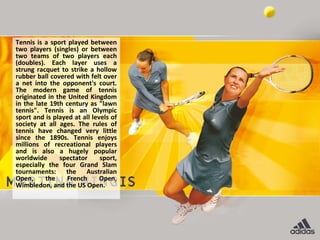
Tennis is a sport played between
two players (singles) or between
two teams of two players each
(doubles). Each layer uses a
strung racquet to strike a hollow
rubber ball covered with felt over
a net into the opponent's court.
The modern game of tennis
originated in the United Kingdom
in the late 19th century as "lawn
tennis". Tennis is an Olympic
sport and is played at all levels of
society at all ages. The rules of
tennis have changed very little
since the 1890s. Tennis enjoys
millions of recreational players
and is also a hugely popular
worldwide      spectator      sport,
especially the four Grand Slam
tournaments: the Australian
Open,     the     French      Open,
Wimbledon, and the US Open.
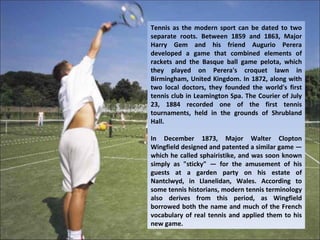
Tennis as the modern sport can be dated to two
separate roots. Between 1859 and 1863, Major
Harry Gem and his friend Augurio Perera
developed a game that combined elements of
rackets and the Basque ball game pelota, which
they played on Perera's croquet lawn in
Birmingham, United Kingdom. In 1872, along with
two local doctors, they founded the world's first
tennis club in Leamington Spa. The Courier of July
23, 1884 recorded one of the first tennis
tournaments, held in the grounds of Shrubland
Hall.

In December 1873, Major Walter Clopton
Wingfield designed and patented a similar game —
which he called sphairistike, and was soon known
simply as "sticky" — for the amusement of his
guests at a garden party on his estate of
Nantclwyd, in Llanelidan, Wales. According to
some tennis historians, modern tennis terminology
also derives from this period, as Wingfield
borrowed both the name and much of the French
vocabulary of real tennis and applied them to his
new game.
•The first championships at Wimbledon in London were played in 1877.
It culminated a significant debate on how to standardize the rules. There
were different rules at each club. The ball in Boston was larger than the
one normally used in NY. On May 21, 1881, the United States National
Lawn Tennis Association(now the United States Tennis Association) was
formed to standardize the rules and organize competitions.
• The U.S. National Men's Singles Championship, now the US Open, was
first held in 1881 at Newport, Rhode Island.
•The U.S. National Women's Singles Championships were first held in
1887.
•Tennis was also popular in France, where the French Open dates to
1891. Thus, Wimbledon, the US Open, the French Open, and the
Australian Open (dating to 1905) became and have remained the most
prestigious events in tennis. Together these four events are called the
Majors or Slams.
•The Davis Cup, an annual competition between men's national teams,
dates to 1900.
The analogous competition for women's national teams, the Fed Cup,
was founded as the Federation Cup in 1963 to celebrate the 50th
anniversary of the founding of the ITF.
EQUIPMENT
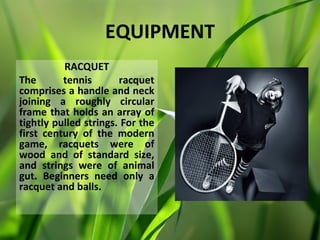
          RACQUET
The       tennis       racquet
comprises a handle and neck
joining a roughly circular
frame that holds an array of
tightly pulled strings. For the
first century of the modern
game, racquets were of
wood and of standard size,
and strings were of animal
gut. Beginners need only a
racquet and balls.
EQUIPMENT
         TENNIS BALL
Tennis balls are of hollow
rubber with a felt coating.
Traditionally white, the
predominant color was
gradually changed to Optic
Yellow in the latter part of
the twentieth century to
allow       for   improved
visibility.
EQUIPMENT
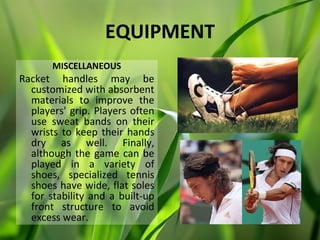
       MISCELLANEOUS
Racket handles may be
  customized with absorbent
  materials to improve the
  players' grip. Players often
  use sweat bands on their
  wrists to keep their hands
  dry as well. Finally,
  although the game can be
  played in a variety of
  shoes, specialized tennis
  shoes have wide, flat soles
  for stability and a built-up
  front structure to avoid
  excess wear.
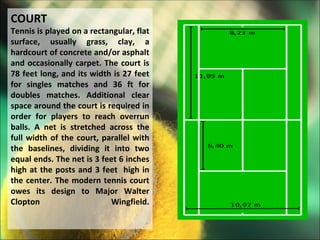
COURT
Tennis is played on a rectangular, flat
surface, usually grass, clay, a
hardcourt of concrete and/or asphalt
and occasionally carpet. The court is
78 feet long, and its width is 27 feet
for singles matches and 36 ft for
doubles matches. Additional clear
space around the court is required in
order for players to reach overrun
balls. A net is stretched across the
full width of the court, parallel with
the baselines, dividing it into two
equal ends. The net is 3 feet 6 inches
high at the posts and 3 feet high in
the center. The modern tennis court
owes its design to Major Walter
Clopton                    Wingfield.
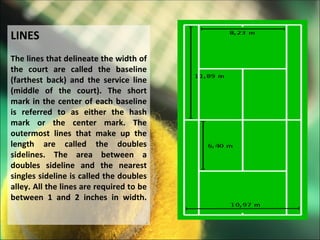
LINES
The lines that delineate the width of
the court are called the baseline
(farthest back) and the service line
(middle of the court). The short
mark in the center of each baseline
is referred to as either the hash
mark or the center mark. The
outermost lines that make up the
length are called the doubles
sidelines. The area between a
doubles sideline and the nearest
singles sideline is called the doubles
alley. All the lines are required to be
between 1 and 2 inches in width.
Play of a single point


The players start on opposite sides of the net. One player is designated the
server, and the opposing player is the receiver. Service alternates between
the two halves of the court. For each point, the server starts behind his
baseline, between the center mark and the sideline. The receiver may start
anywhere on their side of the net. A game is won by the first player to have
won at least four points in total and at least two points more than the
opponent. The running score of each game is described in a manner peculiar
to tennis: scores from zero to three points are described as "love", "fifteen",
"thirty", and "forty" respectively. If at least three points have been scored
by each player, and the scores are equal, the score is "deuce". If at least
three points have been scored by each side and a player has one more point
than his opponent, the score of the game is "advantage" for the player in
the lead. During informal games, "advantage" can also be called "ad in" or
"ad out", depending on whether the serving player or receiving player is
ahead, respectively. A break point occurs if the receiver, not the server, has
a game point.
Play of a single point


In tournament play, the chair umpire announces the
end of the match with the well-known phrase "Game,
set, match" followed by the winning person's or
team's name. In most professional play and some
amateur competition, there is an officiating head
judge or chair umpire, who sits in a raised chair to
one side of the court. The umpire has absolute
authority to make factual determinations. The
umpire may be assisted by line judges, who
determine whether the ball has landed within the
required part of the court and who also call foot
faults. There also may be a net judge who determines
whether the ball has touched the net during service.
Some famous
 sportsmen
Steffi Graf
Serena Williams
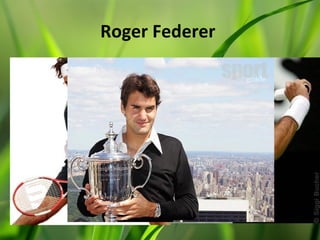
Roger Federer
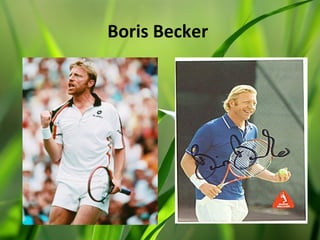
Boris Becker
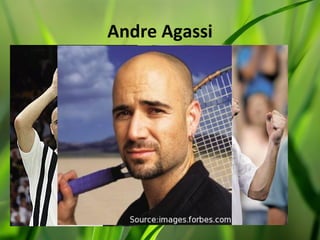
Andre Agassi
Marat Safin
Play Tennis! Be Healthy!

Tennis

  • 1.
    New words • Felt – войлок, фетр • Recreational – развлекательный • Array – набор • Flat – плоский • Clay – глина • Overrun – переходить через границы • Delineate – чертить, намечать • Baseline – задняя площадка теннисного корта
  • 2.
    New words • Service line – линия подачи • Sideline – боковая линия игрового поля • Server – подающий • Receiver – принимающий • Deuce – равный счет 40:40 • Advantage – счет «больше»
  • 3.
    New words • Love– ноль • At love – всухую, не дав заработать ни очка • By two to love – со счетом 2:0 • Love all – сухая ничья • Break point – серия удачных ударов • Tie – break – дополнительная игра для выявления победителя • Foot fault – потеря подачи из-за неправильного положения ног подающего
  • 4.
  • 5.
    Tennis is asport played between two players (singles) or between two teams of two players each (doubles). Each layer uses a strung racquet to strike a hollow rubber ball covered with felt over a net into the opponent's court. The modern game of tennis originated in the United Kingdom in the late 19th century as "lawn tennis". Tennis is an Olympic sport and is played at all levels of society at all ages. The rules of tennis have changed very little since the 1890s. Tennis enjoys millions of recreational players and is also a hugely popular worldwide spectator sport, especially the four Grand Slam tournaments: the Australian Open, the French Open, Wimbledon, and the US Open.
  • 6.
    Tennis as themodern sport can be dated to two separate roots. Between 1859 and 1863, Major Harry Gem and his friend Augurio Perera developed a game that combined elements of rackets and the Basque ball game pelota, which they played on Perera's croquet lawn in Birmingham, United Kingdom. In 1872, along with two local doctors, they founded the world's first tennis club in Leamington Spa. The Courier of July 23, 1884 recorded one of the first tennis tournaments, held in the grounds of Shrubland Hall. In December 1873, Major Walter Clopton Wingfield designed and patented a similar game — which he called sphairistike, and was soon known simply as "sticky" — for the amusement of his guests at a garden party on his estate of Nantclwyd, in Llanelidan, Wales. According to some tennis historians, modern tennis terminology also derives from this period, as Wingfield borrowed both the name and much of the French vocabulary of real tennis and applied them to his new game.
  • 8.
    •The first championshipsat Wimbledon in London were played in 1877. It culminated a significant debate on how to standardize the rules. There were different rules at each club. The ball in Boston was larger than the one normally used in NY. On May 21, 1881, the United States National Lawn Tennis Association(now the United States Tennis Association) was formed to standardize the rules and organize competitions. • The U.S. National Men's Singles Championship, now the US Open, was first held in 1881 at Newport, Rhode Island. •The U.S. National Women's Singles Championships were first held in 1887. •Tennis was also popular in France, where the French Open dates to 1891. Thus, Wimbledon, the US Open, the French Open, and the Australian Open (dating to 1905) became and have remained the most prestigious events in tennis. Together these four events are called the Majors or Slams. •The Davis Cup, an annual competition between men's national teams, dates to 1900. The analogous competition for women's national teams, the Fed Cup, was founded as the Federation Cup in 1963 to celebrate the 50th anniversary of the founding of the ITF.
  • 9.
    EQUIPMENT RACQUET The tennis racquet comprises a handle and neck joining a roughly circular frame that holds an array of tightly pulled strings. For the first century of the modern game, racquets were of wood and of standard size, and strings were of animal gut. Beginners need only a racquet and balls.
  • 10.
    EQUIPMENT TENNIS BALL Tennis balls are of hollow rubber with a felt coating. Traditionally white, the predominant color was gradually changed to Optic Yellow in the latter part of the twentieth century to allow for improved visibility.
  • 11.
    EQUIPMENT MISCELLANEOUS Racket handles may be customized with absorbent materials to improve the players' grip. Players often use sweat bands on their wrists to keep their hands dry as well. Finally, although the game can be played in a variety of shoes, specialized tennis shoes have wide, flat soles for stability and a built-up front structure to avoid excess wear.
  • 12.
    COURT Tennis is playedon a rectangular, flat surface, usually grass, clay, a hardcourt of concrete and/or asphalt and occasionally carpet. The court is 78 feet long, and its width is 27 feet for singles matches and 36 ft for doubles matches. Additional clear space around the court is required in order for players to reach overrun balls. A net is stretched across the full width of the court, parallel with the baselines, dividing it into two equal ends. The net is 3 feet 6 inches high at the posts and 3 feet high in the center. The modern tennis court owes its design to Major Walter Clopton Wingfield.
  • 13.
    LINES The lines thatdelineate the width of the court are called the baseline (farthest back) and the service line (middle of the court). The short mark in the center of each baseline is referred to as either the hash mark or the center mark. The outermost lines that make up the length are called the doubles sidelines. The area between a doubles sideline and the nearest singles sideline is called the doubles alley. All the lines are required to be between 1 and 2 inches in width.
  • 14.
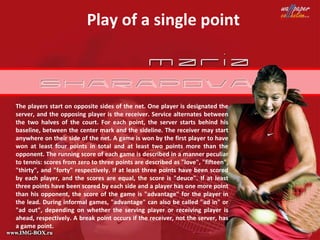
    Play of asingle point The players start on opposite sides of the net. One player is designated the server, and the opposing player is the receiver. Service alternates between the two halves of the court. For each point, the server starts behind his baseline, between the center mark and the sideline. The receiver may start anywhere on their side of the net. A game is won by the first player to have won at least four points in total and at least two points more than the opponent. The running score of each game is described in a manner peculiar to tennis: scores from zero to three points are described as "love", "fifteen", "thirty", and "forty" respectively. If at least three points have been scored by each player, and the scores are equal, the score is "deuce". If at least three points have been scored by each side and a player has one more point than his opponent, the score of the game is "advantage" for the player in the lead. During informal games, "advantage" can also be called "ad in" or "ad out", depending on whether the serving player or receiving player is ahead, respectively. A break point occurs if the receiver, not the server, has a game point.
  • 15.
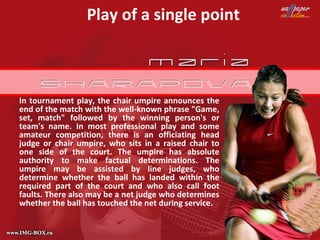
    Play of asingle point In tournament play, the chair umpire announces the end of the match with the well-known phrase "Game, set, match" followed by the winning person's or team's name. In most professional play and some amateur competition, there is an officiating head judge or chair umpire, who sits in a raised chair to one side of the court. The umpire has absolute authority to make factual determinations. The umpire may be assisted by line judges, who determine whether the ball has landed within the required part of the court and who also call foot faults. There also may be a net judge who determines whether the ball has touched the net during service.
  • 16.
  • 17.
  • 18.
  • 19.
  • 20.
  • 21.
  • 22.
  • 23.
    Play Tennis! BeHealthy!