Java/J2ee Programming Training
Polymorphism
Page 2Classification: Restricted
Agenda
• Poly- many
• morphism –forms.
• An entity existing in more than one form.
• methods,
• objects.
Page 3Classification: Restricted
Polymorphism
• polymorphism
• static polymorphism
• entity exists in more than one form physically
• implemented in java using method overloading concept
• dynamic polymorphism
• type of the object is decided at run time
• implemented using
• method overriding
• polymorphic arguments, return types
• abstract classes
• interfaces.
Page 4Classification: Restricted
Polymorphism
• Method overloading
• method physically exists in more than one form.
• method with the same name but different signature list.
• signature of the method should differ atleast
• number of arguments
• data type of arguments
• order of arguments.
• which function to invoke is decided at compile time( early binding )
Page 5Classification: Restricted
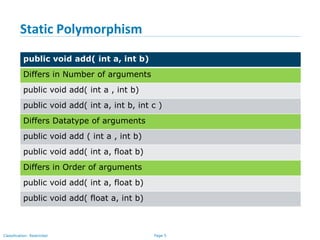
Static Polymorphism
public void add( int a, int b)
Differs in Number of arguments
public void add( int a , int b)
public void add( int a, int b, int c )
Differs Datatype of arguments
public void add ( int a , int b)
public void add( int a, float b)
Differs in Order of arguments
public void add( int a, float b)
public void add( float a, int b)
Page 6Classification: Restricted
public void add( int a, int b)
{
System.out.println( “sum = “+(a + b) );
}
public void add( int a, int b, int c)
{
System.out.println( “sum = “+(a + b +c ) );
}
public void add( int a, float b)
{
System.out.println( “sum = “+(a + b) );
}
public void add( float a, int b)
{
System.out.println( “sum = “+(a + b) );
}
public static void main(String args[] ) {
int a = 10; int b = 20;
add( a, b);
}
Page 7Classification: Restricted
public void add( int a, int b)
{
System.out.println( “sum = “+(a + b) );
}
public void add( int a, int b, int c)
{
System.out.println( “sum = “+(a + b +c ) );
}
public static void main(String args[] ) {
int a = 10; int b = 20; int c = 30
add( a, b, c );
}
number of
argument
s varies
Page 8Classification: Restricted
public void add( int a, int b, int c)
{
System.out.println( “sum = “+(a + b +c ) );
}
public void add( int a, int b)
{
System.out.println( “sum = “+(a + b) );
}
public void add( int a, float b)
{
System.out.println( “sum = “+(a + b) );
}
public static void main(String args[] ) {
int a = 10; float b = 30.5;
add( a, b);
}
datatype of
arguments varies
Page 9Classification: Restricted
public void add( int a, int b)
{
System.out.println( “sum = “+(a + b) );
}
public void add( int a, float b)
{
System.out.println( “sum = “+(a + b) );
}
public void add( float a, int b)
{
System.out.println( “sum = “+(a + b) );
}
public static void main(String args[] ) {
float a = 10; int b = 30.5;
add( a, b);
}
order of arguments
varies
Page 10Classification: Restricted
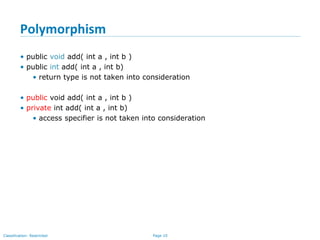
Polymorphism
• public void add( int a , int b )
• public int add( int a , int b)
• return type is not taken into consideration
• public void add( int a , int b )
• private int add( int a , int b)
• access specifier is not taken into consideration
Page 11Classification: Restricted
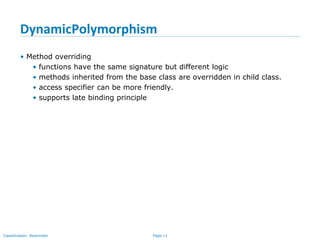
DynamicPolymorphism
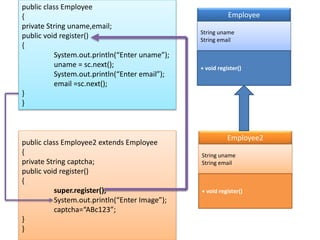
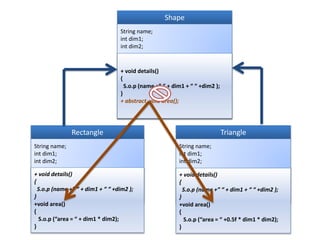
• Method overriding
• functions have the same signature but different logic
• methods inherited from the base class are overridden in child class.
• access specifier can be more friendly.
• supports late binding principle
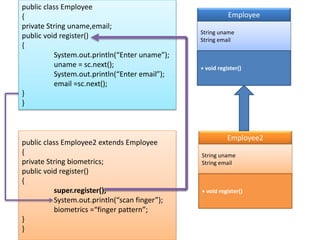
public class Employee
{
private String uname,email;
public void register()
{
System.out.println(“Enter uname”);
uname = sc.next();
System.out.println(“Enter email”);
email =sc.next();
}
}
public class Employee2 extends Employee
{
private String biometrics;
public void register()
{
super.register();
System.out.println(“scan finger”);
biometrics =“finger pattern”;
}
}
Employee
String uname
String email
+ void register()
Employee2
String uname
String email
+ void register()
public class Employee
{
private String uname,email;
public void register()
{
System.out.println(“Enter uname”);
uname = sc.next();
System.out.println(“Enter email”);
email =sc.next();
}
}
public class Employee2 extends Employee
{
private String captcha;
public void register()
{
super.register();
System.out.println(“Enter Image”);
captcha=“ABc123”;
}
}
Employee
String uname
String email
+ void register()
Employee2
String uname
String email
+ void register()
Shape
String name;
int dim1;
int dim2;
Rectangle
String name;
int dim1;
int dim2;
+ void details()
+void area();
Triangle
String name;
int dim1;
int dim2;
+void details();
+void area();
+ void details()
{
S.o.p (name +” “ + dim1 + “ “ +dim2 );
}
+void area()
{
S.o.p (“area = “ + dim1 * dim2);
}
+ void details()
{
S.o.p (name +” “ + dim1 + “ “ +dim2 );
}
+void area()
{
S.o.p (“area = “ +0.5f * dim1 * dim2);
}
+ void details()
{
S.o.p (name +” “ + dim1 + “ “ +dim2 );
}
+void area()
{
S.o.p (“area = “ +0.5f * dim1 * dim2);
}
+ void details()
{
S.o.p (name +” “ + dim1 + “ “ +dim2 );
}
+ abstract void area();
Animal
String name;
int height;
int weight;
Cat
String name;
int height;
int weight;
+ void details()
+void makeNoise();
Dog
String name;
int height;
int weight;
+void details();
+void makeNoise();
+ void details()
{
S.o.p (name +” “ + height+ “ “ +weight);
}
+void makeNoise()
{
S.o.p (“cat meow meow“);
}
+ void details()
{
S.o.p (name +” “ + height+ “ “ +weight);
}
+void makeNoise()
{
S.o.p(“Dog’s bow”);
}
+ void details()
{
S.o.p (name +” “ + height+ “ “ +weight);
}
+void makeNoise()
{
S.o.p (“whattype of noise????”);
}
+ void details()
{
S.o.p (name +” “ + height+ “ “ +weight);
}
+ abstract void makeNoise();
Animal
String name;
int height;
int weight;
Cat
String name;
int height;
int weight;
+ void details()
+void area();
Dog
String name;
int height;
int weight;
+void details();
+void area();
+ void details()
{
S.o.p (name +” “ + height+ “ “ +weight);
}
+void makeNoise()
{
S.o.p (“cat meow meow“);
}
+ void details()
{
S.o.p (name +” “ + height+ “ “ +weight);
}
+void makeNoise()
{
S.o.p(“Dog’s bow”);
}
+ void details()
{
S.o.p (name +” “ + height+ “ “ +weight);
}
+void area()
{
S.o.p (“whattype of noise????”);
}
+ void details()
{
S.o.p (name +” “ + height+ “ “ +weight);
}
+ abstract void makeNoise();
Animal is an abstract
class
Cat is
concrete
Dog is
concrete
Concrete
method
Concrete
method
Page 17Classification: Restricted
Abstract
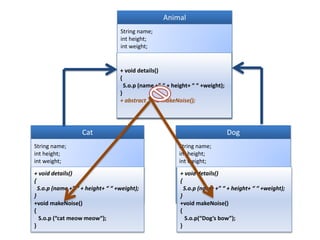
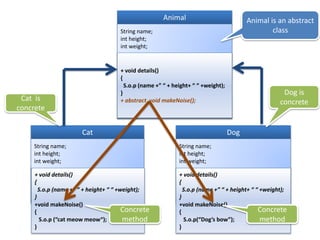
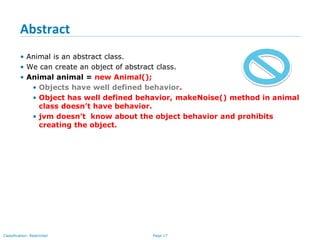
• Animal is an abstract class.
• We can create an object of abstract class.
• Animal animal = new Animal();
• Objects have well defined behavior.
• Object has well defined behavior, makeNoise() method in animal
class doesn’t have behavior.
• jvm doesn’t know about the object behavior and prohibits
creating the object.
Page 18Classification: Restricted
Abstract Classes
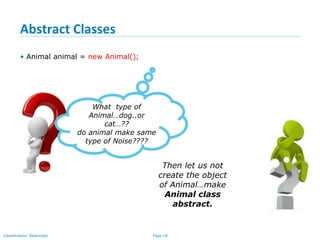
• Animal animal = new Animal();
What type of
Animal…dog..or
cat…??
do animal make same
type of Noise????
Then let us not
create the object
of Animal…make
Animal class
abstract.
Page 19Classification: Restricted
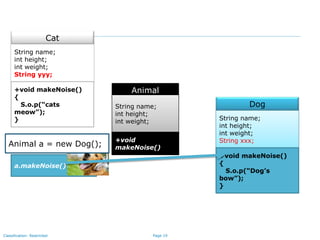
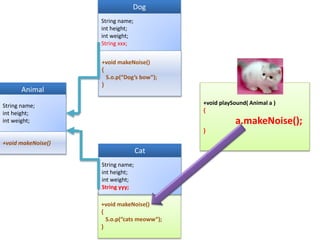
a.makeNoise()
Dog
String name;
int height;
int weight;
String xxx;
+void makeNoise()
{
S.o.p(“Dog’s
bow”);
}
Cat
String name;
int height;
int weight;
String yyy;
+void makeNoise()
{
S.o.p(“cats
meow”);
}
Animal
String name;
int height;
int weight;
+void
makeNoise()Animal a = new Dog();
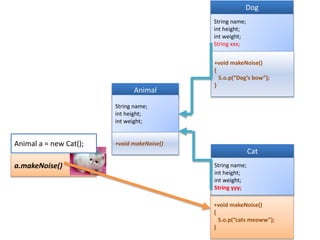
a.makeNoise()
Dog
String name;
int height;
int weight;
String xxx;
+void makeNoise()
{
S.o.p(“cats meoww”);
}
Cat
String name;
int height;
int weight;
String yyy;
+void makeNoise()
{
S.o.p(“Dog’s bow”);
}
Animal
String name;
int height;
int weight;
+void makeNoise()Animal a = new Cat();
Dog
String name;
int height;
int weight;
String xxx;
+void makeNoise()
{
S.o.p(“cats meoww”);
}
Cat
String name;
int height;
int weight;
String yyy;
+void makeNoise()
{
S.o.p(“Dog’s bow”);
}
Animal
String name;
int height;
int weight;
+void makeNoise()
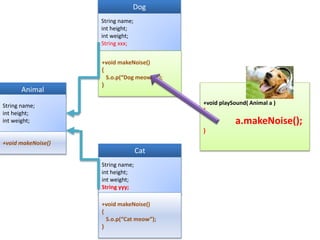
+void playSound( Animal a )
{
a.makeNoise();
}
Dog
String name;
int height;
int weight;
String xxx;
+void makeNoise()
{
S.o.p(“Dog meoww”);
}
Cat
String name;
int height;
int weight;
String yyy;
+void makeNoise()
{
S.o.p(“Cat meow”);
}
Animal
String name;
int height;
int weight;
+void makeNoise()
+void playSound( Animal a )
{
a.makeNoise();
}
Page 23Classification: Restricted
Interfaces
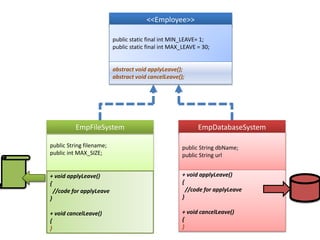
• Interfaces – prototype
• all methods declared in an interface are by default abstract
• member variables are static and final
<<Employee>>
public static final int MIN_LEAVE= 1;
public static final int MAX_LEAVE = 30;
abstract void applyLeave();
abstract void cancelLeave();
EmpFileSystem
public String filename;
public int MAX_SIZE;
+ void applyLeave()
{
//code for applyLeave
}
+ void cancelLeave()
{
}
EmpDatabaseSystem
public String dbName;
public String url
+ void applyLeave()
{
//code for applyLeave
}
+ void cancelLeave()
{
}
Page 25Classification: Restricted
Thank You

Java Polymorphism Part 2

  • 1.
  • 2.
    Page 2Classification: Restricted Agenda •Poly- many • morphism –forms. • An entity existing in more than one form. • methods, • objects.
  • 3.
    Page 3Classification: Restricted Polymorphism •polymorphism • static polymorphism • entity exists in more than one form physically • implemented in java using method overloading concept • dynamic polymorphism • type of the object is decided at run time • implemented using • method overriding • polymorphic arguments, return types • abstract classes • interfaces.
  • 4.
    Page 4Classification: Restricted Polymorphism •Method overloading • method physically exists in more than one form. • method with the same name but different signature list. • signature of the method should differ atleast • number of arguments • data type of arguments • order of arguments. • which function to invoke is decided at compile time( early binding )
  • 5.
    Page 5Classification: Restricted StaticPolymorphism public void add( int a, int b) Differs in Number of arguments public void add( int a , int b) public void add( int a, int b, int c ) Differs Datatype of arguments public void add ( int a , int b) public void add( int a, float b) Differs in Order of arguments public void add( int a, float b) public void add( float a, int b)
  • 6.
    Page 6Classification: Restricted publicvoid add( int a, int b) { System.out.println( “sum = “+(a + b) ); } public void add( int a, int b, int c) { System.out.println( “sum = “+(a + b +c ) ); } public void add( int a, float b) { System.out.println( “sum = “+(a + b) ); } public void add( float a, int b) { System.out.println( “sum = “+(a + b) ); } public static void main(String args[] ) { int a = 10; int b = 20; add( a, b); }
  • 7.
    Page 7Classification: Restricted publicvoid add( int a, int b) { System.out.println( “sum = “+(a + b) ); } public void add( int a, int b, int c) { System.out.println( “sum = “+(a + b +c ) ); } public static void main(String args[] ) { int a = 10; int b = 20; int c = 30 add( a, b, c ); } number of argument s varies
  • 8.
    Page 8Classification: Restricted publicvoid add( int a, int b, int c) { System.out.println( “sum = “+(a + b +c ) ); } public void add( int a, int b) { System.out.println( “sum = “+(a + b) ); } public void add( int a, float b) { System.out.println( “sum = “+(a + b) ); } public static void main(String args[] ) { int a = 10; float b = 30.5; add( a, b); } datatype of arguments varies
  • 9.
    Page 9Classification: Restricted publicvoid add( int a, int b) { System.out.println( “sum = “+(a + b) ); } public void add( int a, float b) { System.out.println( “sum = “+(a + b) ); } public void add( float a, int b) { System.out.println( “sum = “+(a + b) ); } public static void main(String args[] ) { float a = 10; int b = 30.5; add( a, b); } order of arguments varies
  • 10.
    Page 10Classification: Restricted Polymorphism •public void add( int a , int b ) • public int add( int a , int b) • return type is not taken into consideration • public void add( int a , int b ) • private int add( int a , int b) • access specifier is not taken into consideration
  • 11.
    Page 11Classification: Restricted DynamicPolymorphism •Method overriding • functions have the same signature but different logic • methods inherited from the base class are overridden in child class. • access specifier can be more friendly. • supports late binding principle
  • 12.
    public class Employee { privateString uname,email; public void register() { System.out.println(“Enter uname”); uname = sc.next(); System.out.println(“Enter email”); email =sc.next(); } } public class Employee2 extends Employee { private String biometrics; public void register() { super.register(); System.out.println(“scan finger”); biometrics =“finger pattern”; } } Employee String uname String email + void register() Employee2 String uname String email + void register()
  • 13.
    public class Employee { privateString uname,email; public void register() { System.out.println(“Enter uname”); uname = sc.next(); System.out.println(“Enter email”); email =sc.next(); } } public class Employee2 extends Employee { private String captcha; public void register() { super.register(); System.out.println(“Enter Image”); captcha=“ABc123”; } } Employee String uname String email + void register() Employee2 String uname String email + void register()
  • 14.
    Shape String name; int dim1; intdim2; Rectangle String name; int dim1; int dim2; + void details() +void area(); Triangle String name; int dim1; int dim2; +void details(); +void area(); + void details() { S.o.p (name +” “ + dim1 + “ “ +dim2 ); } +void area() { S.o.p (“area = “ + dim1 * dim2); } + void details() { S.o.p (name +” “ + dim1 + “ “ +dim2 ); } +void area() { S.o.p (“area = “ +0.5f * dim1 * dim2); } + void details() { S.o.p (name +” “ + dim1 + “ “ +dim2 ); } +void area() { S.o.p (“area = “ +0.5f * dim1 * dim2); } + void details() { S.o.p (name +” “ + dim1 + “ “ +dim2 ); } + abstract void area();
  • 15.
    Animal String name; int height; intweight; Cat String name; int height; int weight; + void details() +void makeNoise(); Dog String name; int height; int weight; +void details(); +void makeNoise(); + void details() { S.o.p (name +” “ + height+ “ “ +weight); } +void makeNoise() { S.o.p (“cat meow meow“); } + void details() { S.o.p (name +” “ + height+ “ “ +weight); } +void makeNoise() { S.o.p(“Dog’s bow”); } + void details() { S.o.p (name +” “ + height+ “ “ +weight); } +void makeNoise() { S.o.p (“whattype of noise????”); } + void details() { S.o.p (name +” “ + height+ “ “ +weight); } + abstract void makeNoise();
  • 16.
    Animal String name; int height; intweight; Cat String name; int height; int weight; + void details() +void area(); Dog String name; int height; int weight; +void details(); +void area(); + void details() { S.o.p (name +” “ + height+ “ “ +weight); } +void makeNoise() { S.o.p (“cat meow meow“); } + void details() { S.o.p (name +” “ + height+ “ “ +weight); } +void makeNoise() { S.o.p(“Dog’s bow”); } + void details() { S.o.p (name +” “ + height+ “ “ +weight); } +void area() { S.o.p (“whattype of noise????”); } + void details() { S.o.p (name +” “ + height+ “ “ +weight); } + abstract void makeNoise(); Animal is an abstract class Cat is concrete Dog is concrete Concrete method Concrete method
  • 17.
    Page 17Classification: Restricted Abstract •Animal is an abstract class. • We can create an object of abstract class. • Animal animal = new Animal(); • Objects have well defined behavior. • Object has well defined behavior, makeNoise() method in animal class doesn’t have behavior. • jvm doesn’t know about the object behavior and prohibits creating the object.
  • 18.
    Page 18Classification: Restricted AbstractClasses • Animal animal = new Animal(); What type of Animal…dog..or cat…?? do animal make same type of Noise???? Then let us not create the object of Animal…make Animal class abstract.
  • 19.
    Page 19Classification: Restricted a.makeNoise() Dog Stringname; int height; int weight; String xxx; +void makeNoise() { S.o.p(“Dog’s bow”); } Cat String name; int height; int weight; String yyy; +void makeNoise() { S.o.p(“cats meow”); } Animal String name; int height; int weight; +void makeNoise()Animal a = new Dog();
  • 20.
    a.makeNoise() Dog String name; int height; intweight; String xxx; +void makeNoise() { S.o.p(“cats meoww”); } Cat String name; int height; int weight; String yyy; +void makeNoise() { S.o.p(“Dog’s bow”); } Animal String name; int height; int weight; +void makeNoise()Animal a = new Cat();
  • 21.
    Dog String name; int height; intweight; String xxx; +void makeNoise() { S.o.p(“cats meoww”); } Cat String name; int height; int weight; String yyy; +void makeNoise() { S.o.p(“Dog’s bow”); } Animal String name; int height; int weight; +void makeNoise() +void playSound( Animal a ) { a.makeNoise(); }
  • 22.
    Dog String name; int height; intweight; String xxx; +void makeNoise() { S.o.p(“Dog meoww”); } Cat String name; int height; int weight; String yyy; +void makeNoise() { S.o.p(“Cat meow”); } Animal String name; int height; int weight; +void makeNoise() +void playSound( Animal a ) { a.makeNoise(); }
  • 23.
    Page 23Classification: Restricted Interfaces •Interfaces – prototype • all methods declared in an interface are by default abstract • member variables are static and final
  • 24.
    <<Employee>> public static finalint MIN_LEAVE= 1; public static final int MAX_LEAVE = 30; abstract void applyLeave(); abstract void cancelLeave(); EmpFileSystem public String filename; public int MAX_SIZE; + void applyLeave() { //code for applyLeave } + void cancelLeave() { } EmpDatabaseSystem public String dbName; public String url + void applyLeave() { //code for applyLeave } + void cancelLeave() { }
  • 25.