Java Performance Tuning Second Edition Jack Shirazi
Java Performance Tuning Second Edition Jack Shirazi
Java Performance Tuning Second Edition Jack Shirazi
Java Performance Tuning Second Edition Jack Shirazi
Java Performance Tuning Second Edition Jack Shirazi
1.
Visit ebookfinal.com todownload the full version and
explore more ebooks or textbooks
Java Performance Tuning Second Edition Jack
Shirazi
_____ Click the link below to download _____
https://ebookfinal.com/download/java-performance-tuning-
second-edition-jack-shirazi/
Explore and download more ebooks or textbook at ebookfinal.com
2.
Here are somerecommended products that we believe you will be
interested in. You can click the link to download.
Oracle Performance Tuning for 10g R2 2nd Edition Gavin
Powell (Auth.)
https://ebookfinal.com/download/oracle-performance-tuning-
for-10g-r2-2nd-edition-gavin-powell-auth/
Java Performance 1st Edition Charlie Hunt
https://ebookfinal.com/download/java-performance-1st-edition-charlie-
hunt/
OCP Oracle9i Performance Tuning Study Guide with CDROM 1st
Edition Joseph C. Johnson
https://ebookfinal.com/download/ocp-oracle9i-performance-tuning-study-
guide-with-cdrom-1st-edition-joseph-c-johnson/
The Veil Unveiled 1st Edition Faegheh Shirazi
https://ebookfinal.com/download/the-veil-unveiled-1st-edition-faegheh-
shirazi/
3.
Java Servlet ProgrammingSecond Edition Jason Hunter
https://ebookfinal.com/download/java-servlet-programming-second-
edition-jason-hunter/
Java Message Service Second Edition Mark Richards
https://ebookfinal.com/download/java-message-service-second-edition-
mark-richards/
NATEF Standards Job Sheets Engine Performance A8 Third
Edition Jack Erjavec
https://ebookfinal.com/download/natef-standards-job-sheets-engine-
performance-a8-third-edition-jack-erjavec/
Object Oriented Programming and Java Second Edition Danny
Poo
https://ebookfinal.com/download/object-oriented-programming-and-java-
second-edition-danny-poo/
Developing Performance Indicators for Managing Maintenance
Second Edition Wireman
https://ebookfinal.com/download/developing-performance-indicators-for-
managing-maintenance-second-edition-wireman/
5.
Java Performance TuningSecond Edition Jack Shirazi
Digital Instant Download
Author(s): Jack Shirazi
ISBN(s): 9780596003777, 0596003773
Edition: Second Edition
File Details: PDF, 1.79 MB
Year: 2003
Language: english
O’reilly - JavaPerformance Tuning
- 4 -
10.1 User-Interface Thread and Other Threads
10.2 Race Conditions
10.3 Deadlocks
10.4 Synchronization Overheads
10.5 Timing Multithreaded Tests
10.6 Atomic Access and Assignment
10.7 Thread Pools
10.8 Load Balancing
10.9 Threaded Problem-Solving Strategies
10.10 Performance Checklist
11. Appropriate Data Structures and Algorithms - 233
11.1 Collections
11.2 Java 2 Collections
11.3 Hashtables and HashMaps
11.4 Cached Access
11.5 Caching Example I
11.6 Caching Example II
11.7 Finding the Index for Partially Matched Strings
11.8 Search Trees
11.9 Performance Checklist
12. Distributed Computing - 264
12.1 Tools
12.2 Message Reduction
12.3 Comparing Communication Layers
12.4 Caching
12.5 Batching I
12.6 Application Partitioning
12.7 Batching II
12.8 Low-Level Communication Optimizations
12.9 Distributed Garbage Collection
12.10 Databases
12.11 Performance Checklist
13. When to Optimize - 281
13.1 When Not to Optimize
13.2 Tuning Class Libraries and Beans
13.3 Analysis
13.4 Design and Architecture
13.5 Tuning After Deployment
13.6 More Factors That Affect Performance
13.7 Performance Checklist
14. Underlying Operating System and Network Improvements - 304
14.1 Hard Disks
14.2 CPU
14.3 RAM
14.4 Network I/O
14.5 Performance Checklist
15. Further Resources - 315
15.1 Books
15.2 Magazines
15.3 URLs
15.4 Profilers
15.5 Optimizers
Colophon - 317
10.
O’reilly - JavaPerformance Tuning
- 5 -
Preface
Performance has been an important issue with Java™ since the first version hit the Web years ago.
Making those first interpreted programs run fast enough was a huge challenge for many developers.
Since then, Java performance has improved enormously, and any Java program can now be made to
run fast enough provided you avoid the main performance pitfalls.
This book provides all the details a developer needs to performance-tune any type of Java program.
I give step-by-step instructions on all aspects of the performance-tuning process, right from early
considerations such as setting goals, measuring performance, and choosing a compiler, to detailed
examples on using profiling tools and applying the results to tune the code. This is not an entry-
level book about Java, but you do not need any previous tuning knowledge to benefit from reading
it.
Many of the tuning techniques presented in this book lead to an increased maintenance cost, so they
should not be applied arbitrarily. Change your code only when a bottleneck has been identified, and
never change the design of your application for minor performance gains.
Contents of This Book
Chapter 1 gives general guidelines on how to tune. If you do not yet have a tuning strategy, this
chapter provides a methodical tuning process.
Chapter 2 covers the tools you need to use while tuning. Chapter 3 looks at the Java Development
Kit™ ( JDK, now Java SDK), including VMs and compilers.
Chapter 4 through Chapter 12 cover various techniques you can apply to Java code. Chapter 12
looks at tuning techniques specific to distributed applications.
Chapter 13 steps back from the low-level code-tuning techniques examined throughout most of the
book and considers tuning at all other stages of the development process.
Chapter 14 is a quick look at some operating system-level tuning techniques.
Each chapter has a performance tuning checklist at its end. Use these lists to ensure that you have
not missed any core tuning techniques while you are tuning.
Virtual Machine (VM) Versions
I have focused on the Sun VMs since there is enough variation within these to show interesting
results. I have shown the time variation across different VMs for many of the tests. However, your
main focus should be on the effects that tuning has on any one VM, as this identifies the usefulness
of a tuning technique. Differences between VMs are interesting, but are only indicative and need to
be verified for your specific application. Where I have shown the results of timed tests, the VM
versions I have used are:
1.1.6
Version 1.1.x VMs do less VM-level work than later Java 2 VMs, so I have used a 1.1.x VM
that includes a JIT. Version 1.1.6 was the earliest 1.1.x JDK that included enough
optimizations to be a useful base. Despite many later improvements throughout the JDK, the
11.
O’reilly - JavaPerformance Tuning
- 6 -
1.1.x VMs from 1.1.6 still show the fastest results for some types of tests. Version 1.1.6
supports running with and without a JIT. The default is with a JIT, and this is the mode used
for all measurements in the book.
1.2
I have used the 1.2.0 JDK for the 1.2 tests. Java 2 VMs have more work to do than prior
VMs because of additional features such as Reference objects, and 1.2.0 is the first Java 2
VM. Version 1.2 supports running with and without a JIT. The default is with a JIT, and this
is the mode used for measurements labeled "1.2." Where I've labeled a measurement "1.2 no
JIT," it uses the 1.2 VM in interpreted mode with the -Djava.compiler=NONE option to set
that property.
1.3
I have used both the 1.3.0 full release and the 1.3 prerelease, as the 1.3 full release came out
very close to the publication time of the book. Version 1.3 supports running in interpreted
mode or with client-tuned HotSpot technology (termed "mixed" mode). Version 1.3 does not
support a pure JIT mode. The default is the HotSpot technology, and this is the mode I've
used for measurements labeled simply "1.3."
HotSpot 1.0
HotSpot 1.0 VM was run with the 1.2.0 JDK classes. Because HotSpot optimizations
frequently do not kick in until after the program has run for a little while, I sometimes show
measurements labeled "HotSpot 2nd Run." This set of measurements is the result from
repeating the particular test within the same VM session, i.e., the VM does not exit between
the first and second runs of the test.
Conventions Used in This Book
The following font conventions are used in this book:
Italic is used for:
• Pathnames, filenames, and program names
• Internet addresses, such as domain names and URLs
• New terms where they are defined
Constant width is used for:
• All Java code
• Command lines and options that should be typed verbatim
• Names and keywords in Java programs, including method names, variable names, and class
names
Constant width bold is used for emphasis in some code examples.
12.
O’reilly - JavaPerformance Tuning
- 7 -
Comments and Questions
The information in this book has been tested and verified, but you may find that features have
changed (or you may even find mistakes!). You can send any errors you find, as well as suggestions
for future editions, to:
O'Reilly & Associates, Inc.
101 Morris Street
Sebastopol, CA 95472
(800) 998-9938 (in the United States or Canada)
(707) 829-0515 (international/local)
(707) 829-0104 (fax)
You can also send messages electronically. To be put on the mailing list or request a catalog, send
email to:
info@oreilly.com
To ask technical questions or comment on the book, send email to:
bookquestions@oreilly.com
There is a web site for the book, where examples, errata, and any plans for future editions are listed.
You can access this site at:
http://www.oreilly.com/catalog/javapt/
For more information about this book and others, see the O'Reilly web site:
http://www.oreilly.com
Acknowledgments
A huge thank you to my wonderful wife Ava, for her unending patience with me. This book would
have been considerably poorer without her improvements in clarity and consistency throughout. I
am also very grateful to Mike Loukides and Kirk Pepperdine for the enormously helpful assistance I
received from them while writing this book. Their many notes have helped to make this book much
clearer and complete.
Thanks also to my reviewers, Patrick Killelea, Ethan Henry, Eric Brower, and Bill Venners, who
provided many useful comments. They identified several errors and added good advice that makes
this book more useful.
I am, of course, responsible for the final text of this book, including any erroors tthat rremain.
Chapter 1. Introduction
The trouble with doing something right the first time is that nobody appreciates how difficult it was.
—Fortune
13.
O’reilly - JavaPerformance Tuning
- 8 -
There is a general perception that Java programs are slow. Part of this perception is pure
assumption: many people assume that if a program is not compiled, it must be slow. Part of this
perception is based in reality: many early applets and applications were slow, because of
nonoptimal coding, initially unoptimized Java Virtual Machines (VMs), and the overheads of the
language.
In earlier versions of Java, you had to struggle hard and compromise a lot to make a Java
application run quickly. More recently, there have been fewer reasons why an application should be
slow. The VM technology and Java development tools have progressed to the point where a Java
application (or applet, servlet, etc.) is not particularly handicapped. With good designs and by
following good coding practices and avoiding bottlenecks, applications usually run fast enough.
However, the truth is that the first (and even several subsequent) versions of a program written in
any language are often slower than expected, and the reasons for this lack of performance are not
always clear to the developer.
This book shows you why a particular Java application might be running slower than expected, and
suggests ways to avoid or overcome these pitfalls and improve the performance of your application.
In this book I've gathered several years of tuning experiences in one place. I hope you will find it
useful in making your Java application, applet, servlet, and component run as fast as you need.
Throughout the book I use the generic words "application" and "program" to cover Java
applications, applets, servlets, beans, libraries, and really any use of Java code. Where a technique
can be applied only to some subset of these various types of Java programs, I say so. Otherwise, the
technique applies across all types of Java programs.
1.1 Why Is It Slow?
This question is always asked as soon as the first tests are timed: "Where is the time going? I did
not expect it to take this long." Well, the short answer is that it's slow because it has not been
performance-tuned. In the same way the first version of the code is likely to have bugs that need
fixing, it is also rarely as fast as it can be. Fortunately, performance tuning is usually easier than
debugging. When debugging, you have to fix bugs throughout the code; in performance tuning , you
can focus your effort on the few parts of the application that are the bottlenecks.
The longer answer? Well, it's true that there are overheads in the Java runtime system, mainly due
to its virtual machine layer that abstracts Java away from the underlying hardware. It's also true that
there are overheads from Java's dynamic nature. These overhead s can cause a Java application to
run slower than an equivalent application written in a lower-level language ( just as a C program is
generally slower than the equivalent program written in assembler). Java's advantages—namely, its
platform-independence, memory management, powerful exception checking, built-in
multithreading, dynamic resource loading, and security checks—add costs in terms of an
interpreter, garbage collector, thread monitors, repeated disk and network accessing, and extra
runtime checks.
For example, hierarchical method invocation requires an extra computation for every method call,
because the runtime system has to work out which of the possible methods in the hierarchy is the
actual target of the call. Most modern CPU s are designed to be optimized for fixed call and branch
targets and do not perform as well when a significant percentage of calls need to be computed on
the fly. On the other hand, good object-oriented design actually encourages many small methods
and significant polymorphism in the method hierarchy. Compiler inlining is another frequently used
technique that can significantly improve compiled code. However, this technique cannot be applied
14.
O’reilly - JavaPerformance Tuning
- 9 -
when it is too difficult to determine method calls at compile time, as is the case for many Java
methods.
Of course, the same Java language features that cause these overheads may be the features that
persuaded you to use Java in the first place. The important thing is that none of these overheads
slows the system down too much. Naturally, "too much" is different depending on the application,
and the users of the application usually make this choice. But the key point with Java is that a good
round of performance tuning normally makes your application run as fast as you need it to run.
There are already plenty of nontrivial Java applications, applets, and servlets that run fast enough to
show that Java itself is not too slow. So if your application is not running fast enough, chances are
that it just needs tuning.
1.2 The Tuning Game
Performance tuning is similar to playing a strategy game (but happily, you are usually paid to do
it!). Your target is to get a better score (lower time) than the last score after each attempt. You are
playing with, not against, the computer, the programmer, the design and architecture, the compiler,
and the flow of control. Your opponents are time, competing applications, budgetary restrictions,
etc. (You can complete this list better than I can for your particular situation.)
I once attended a customer who wanted to know if there was a "go faster" switch somewhere that he
could just turn on and make the whole application go faster. Of course, he was not really expecting
one, but checked just in case he had missed a basic option somewhere.
There isn't such a switch, but very simple techniques sometimes provide the equivalent. Techniques
include switching compilers , turning on optimizations, using a different runtime VM, finding two
or three bottlenecks in the code or architecture that have simple fixes, and so on. I have seen all of
these give huge improvements to applications, sometimes a 20-fold speedup. Order-of-magnitude
speedups are typical for the first round of performance tuning.
1.3 System Limitations and What to Tune
Three resource s limit all applications:
• CPU speed and availability
• System memory
• Disk (and network) input/output (I/O)
When tuning an application, the first step is to determine which of these is causing your application
to run too slowly.
If your application is CPU -bound, you need to concentrate your efforts on the code, looking for
bottlenecks, inefficient algorithms, too many short-lived objects (object creation and garbage
collection are CPU-intensive operations), and other problems, which I will cover in this book.
If your application is hitting system-memory limits, it may be paging sections in and out of main
memory. In this case, the problem may be caused by too many objects, or even just a few large
objects, being erroneously held in memory; by too many large arrays being allocated (frequently
used in buffered applications); or by the design of the application, which may need to be
reexamined to reduce its running memory footprint.
15.
O’reilly - JavaPerformance Tuning
- 10 -
On the other hand, external data access or writing to the disk can be slowing your application. In
this case, you need to look at exactly what you are doing to the disks that is slowing the application:
first identify the operations, then determine the problems, and finally eliminate or change these to
improve the situation.
For example, one program I know of went through web server logs and did reverse lookups on the
IP addresses. The first version of this program was very slow. A simple analysis of the activity
being performed determined that the major time component of the reverse lookup operation was a
network query. These network queries do not have to be done sequentially. Consequently, the
second version of the program simply multithreaded the lookups to work in parallel, making
multiple network queries simultaneously, and was much, much faster.
In this book we look at the causes of bad performance. Identifying the causes of your performance
problems is an essential first step to solving those problems. There is no point in extensively tuning
the disk-accessing component of an application because we all know that "disk access is much
slower than memory access" when, in fact, the application is CPU-bound.
Once you have tuned the application's first bottleneck, there may be (and typically is) another
problem, causing another bottleneck. This process often continues over several tuning iterations. It
is not uncommon for an application to have its initial "memory hog" problems solved, only to
become disk-bound, and then in turn CPU-bound when the disk-access problem is fixed. After all,
the application has to be limited by something, or it would take no time at all to run.
Because this bottleneck-switching sequence is normal—once you've solved the existing bottleneck,
a previously hidden or less important one appears—you should attempt to solve only the main
bottlenecks in an application at any one time. This may seem obvious, but I frequently encounter
teams that tackle the main identified problem, and then instead of finding the next real problem,
start applying the same fix everywhere they can in the application.
One application I know of had a severe disk I/O problem caused by using unbuffered streams (all
disk I/O was done byte by byte, which led to awful performance). After fixing this, some members
of the programming team decided to start applying buffering everywhere they could, instead of
establishing where the next bottleneck was. In fact, the next bottleneck was in a data-conversion
section of the application that was using inefficient conversion methods, causing too many
temporary objects and hogging the CPU. Rather than addressing and solving this bottleneck, they
instead created a large memory allocation problem by throwing an excessive number of buffers into
the application.
1.4 A Tuning Strategy
Here's a strategy I have found works well when attacking performance problems:
1. Identify the main bottlenecks (look for about the top five bottlenecks, but go higher or lower
if you prefer).
2. Choose the quickest and easiest one to fix, and address it (except for distributed applications
where the top bottleneck is usually the one to attack: see the following paragraph).
3. Repeat from Step 1.
This procedure will get your application tuned the quickest. The advantage of choosing the
"quickest to fix" of the top few bottlenecks rather than the absolute topmost problem is that once a
bottleneck has been eliminated, the characteristics of the application change, and the topmost
bottleneck may not even need to be addressed any longer. However, in distributed applications I
16.
O’reilly - JavaPerformance Tuning
- 11 -
advise you target the topmost bottleneck. The characteristics of distributed applications are such
that the main bottleneck is almost always the best to fix and, once fixed, the next main bottleneck is
usually in a completely different component of the system.
Although this strategy is simple and actually quite obvious, I nevertheless find that I have to repeat
it again and again: once programmers get the bit between their teeth, they just love to apply
themselves to the interesting parts of the problems. After all, who wants to unroll loop after boring
loop when there's a nice juicy caching technique you're eager to apply?
You should always treat the actual identification of the cause of the performance bottleneck as a
science, not an art. The general procedure is straightforward:
1. Measure the performance using profilers and benchmark suites, and by instrumenting code.
2. Identify the locations of any bottlenecks.
3. Think of a hypothesis for the cause of the bottleneck.
4. Consider any factors that may refute your hypothesis.
5. Create a test to isolate the factor identified by the hypothesis.
6. Test the hypothesis.
7. Alter the application to reduce the bottleneck.
8. Test that the alteration improves performance, and measure the improvement (include
regression testing the affected code).
9. Repeat from Step 1.
Here's the procedure for a particular example:
1. Run the application through your standard profiler (measurement).
2. You find that the code spends a huge 11% of time in one method (identification of
bottleneck).
3. Looking at the code, you find a complex loop and guess this is the problem (hypothesis).
4. You see that it is not iterating that many times, so possibly the bottleneck could be outside
the loop (confounding factor).
5. You could vary the loop iteration as a test to see if that identifies the loop as the bottleneck.
However, you instead try to optimize the loop by reducing the number of method calls it
makes: this provides a test to identify the loop as the bottleneck and at the same time
provides a possible solution. In doing this, you are combining two steps, Steps 5 and 7.
Although this is frequently the way tuning actually goes, be aware that this can make the
tuning process longer: if there is no speedup, it may be because your optimization did not
actually make things faster, in which case you have neither confirmed nor eliminated the
loop as the cause of the bottleneck.
6. Rerunning the profile on the altered application finds that this method has shifted its
percentage time down to just 4%. This may still be a candidate bottleneck for further
optimization, but nevertheless it's confirmed as the bottleneck and your change has
improved performance.
7. (Already done, combined with Step 5).
8. (Already done, combined with Step 6).
1.5 Perceived Performance
It is important to understand that the user has a particular view of performance that allows you to
cut some corners. The user of an application sees changes as part of the performance. A browser
that gives a running countdown of the amount left to be downloaded from a server is seen to be
faster than one that just sits there, apparently hung, until all the data is downloaded. People expect
17.
O’reilly - JavaPerformance Tuning
- 12 -
to see something happening, and a good rule of thumb is that if an application is unresponsive for
more than three seconds, it is seen to be slow. Some Human Computer Interface authorities put the
user-patience limit at just two seconds; an IBM study from the early '70s suggested people's
attention began to wander after waiting for more than just one second. For performance
improvements, it is also useful to know that users are not generally aware of response time
improvements of less than 20%. This means that when tuning for user perception, you should not
deliver any changes to the users until you have made improvements that add more than a 20%
speedup.
A few long response times make a bigger impression on the memory than many shorter ones.
According to Arnold Allen,[1]
the perceived value of the average response time is not the average,
but the 90th percentile value: the value that is greater than 90% of all observed response times. With
a typical exponential distribution, the 90th percentile value is 2.3 times the average value.
Consequently, so long as you reduce the variation in response times so that the 90th percentile value
is smaller than before, you can actually increase the average response time, and the user will still
perceive the application as faster. For this reason, you may want to target variation in response
times as a primary goal. Unfortunately, this is one of the more complex targets in performance
tuning: it can be difficult to determine exactly why response times are varying.
[1]
Introduction to Computer Performance Analysis with Mathematica (Academic Press).
If the interface provides feedback and allows the user to carry on other tasks or abort and start
another function (preferably both), the user sees this as a responsive interface and doesn't consider
the application as slow as he might otherwise. If you give users an expectancy of how long a
particular task might take and why, they often accept that this is as long as it has to take and adjust
their expectations. Modern web browsers provide an excellent example of this strategy in practice.
People realize that the browser is limited by the bandwidth of their connection to the Internet, and
that downloading cannot happen faster than a given speed. Good browsers always try to show the
parts they have already received so that the user is not blocked, and they also allow the user to
terminate downloading or go off to another page at any time, even while a page is partly
downloaded. Generally, it is not the browser that is seen to be slow, but rather the Internet or the
server site. In fact, browser creators have made a number of tradeoffs so that their browsers appear
to run faster in a slow environment. I have measured browser display of identical pages under
identical conditions and found browsers that are actually faster at full page display, but seem slower
because they do not display partial pages, or download embedded links concurrently, etc. Modern
web browsers provide a good example of how to manage user expectations and perceptions of
performance.
However, one area in which some web browsers have misjudged user expectation is when they give
users a momentary false expectation that operations have finished when in fact another is to start
immediately. This false expectation is perceived as slow performance. For example, when
downloading a page with embedded links such as images, the browser status bar often shows
reports like "20% of 34K," which moves up to "56% of 34K," etc., until it reaches 100% and
indicates that the page has finished downloading. However, at this point, when the user expects that
all the downloading has finished, the status bar starts displaying "26% of 28K" and so on, as the
browser reports separately on each embedded graphic as it downloads them. This causes frustration
to users who initially expected the completion time from the first download report and had geared
themselves up to do something, only to have to wait again (often repeatedly). A better practice
would be to report on how many pages need to be downloaded as well as the current download
status, giving the user a clearer expectation of the full download time.
Where there are varying possibilities for performance tradeoffs (e.g., resolution versus frame rate
for animation, compression size versus speed of compression for compression utilities, etc.), the
18.
O’reilly - JavaPerformance Tuning
- 13 -
best strategy is to put the user in control. It is better to provide the option to choose between faster
performance and better functionality. When users have made the choice themselves, they are often
more willing to put up with actions taking longer in return for better functionality. When users do
not have this control, their response is usually less tolerant.
This strategy also allows those users who have strong performance requirements to be provided for
at their own cost. But it is always important to provide a reasonable default in the absence of any
choice from the user. Where there are many different parameters, consider providing various levels
of user-controlled tuning parameters, e.g., an easy set of just a few main parameters, a middle level,
and an expert level with access to all parameters. This must, of course, be well documented to be
really useful.
1.5.1 Threading to Appear Quicker
A lot of time (in CPU cycles) passes while the user is reacting to the application interface. This time
can be used to anticipate what the user wants to do (using a background low priority thread), so that
precalculated results are ready to assist the user immediately. This makes an application appear
blazingly fast.
Similarly, ensuring that your application remains responsive to the user, even while it is executing
some other function, makes it seem fast and responsive. For example, I always find that when
starting up an application, applications that draw themselves on screen quickly and respond to
repaint requests even while still initializing (you can test this by putting the window in the
background and then bringing it to the foreground) give the impression of being much faster than
applications that seem to be chugging away unresponsively. Starting different word-processing
applications with a large file to open can be instructive, especially if the file is on the network or a
slow (removable) disk. Some act very nicely, responding almost immediately while the file is still
loading; others just hang unresponsively with windows only partially refreshed until the file is
loaded; others don't even fully paint themselves until the file has finished loading. This illustrates
what can happen if you do not use threads appropriately.
In Java, the key to making an application responsive is multithreading. Use threads to ensure that
any particular service is available and unblocked when needed. Of course this can be difficult to
program correctly and manage. Handling interthread communication with maximal responsiveness
(and minimal bugs) is a complex task, but it does tend to make for a very snappily built application.
1.5.2 Streaming to Appear Quicker
When you display the results of some activity on the screen, there is often more information than
can fit on a single screen. For example, a request to list all the details on all the files in a particular
large directory may not fit on one display screen. The usual way to display this is to show as much
as will fit on a single screen and indicate that there are more items available with a scrollbar. Other
applications or other information may use a "more" button or have other ways of indicating how to
display or move on to the extra information.
In these cases, you initially need to display only a partial result of the activity. This tactic can work
very much in your favor. For activities that take too long and for which some of the results can be
returned more quickly than others, it is certainly possible to show just the first set of results while
continuing to compile more results in the background. This gives the user an apparently much
quicker response than if you were to wait for all the results to be available before displaying them.
19.
O’reilly - JavaPerformance Tuning
- 14 -
This situation is often the case for distributed applications. A well-known example is (again!) found
in web browsers that display the initial screenful of a page as soon as it is available, without waiting
for the whole page to be downloaded. The general case is when you have a long activity that can
provide results in a stream, so that the results can be accessed a few at a time. For distributed
applications, sending all the data is often what takes a long time; in this case, you can build
streaming into the application by sending one screenful of data at a time. Also, bear in mind that
when there is a really large amount of data to display, the user often views only some of it and
aborts, so be sure to build in the ability to stop the stream and restore its resources at any time.
1.5.3 Caching to Appear Quicker
This section briefly covers the general principles of caching. Caching is an optimization technique I
return to in several different sections of this book, when it is appropriate to the problem under
discussion. For example, in the area of disk access, there are several caches that apply: from the
lowest-level hardware cache up through the operating-system disk read and write caches, cached
filesystems, and file reading and writing classes that provide buffered I/O. Some caches cannot be
tuned at all; others are tuneable at the operating-system level or in Java. Where it is possible for a
developer to take advantage of or tune a particular cache, I provide suggestions and approaches that
cover the caching technique appropriate to that area of the application. In some cases where caches
are not directly tuneable, it is still worth knowing the effect of using the cache in different ways and
how this can affect performance. For example, disk hardware caches almost always apply a read-
ahead algorithm : the cache is filled with the next block of data after the one just read. This means
that reading backward through a file (in chunks) is not as fast as reading forward through the file.
Caches are effective because it is expensive to move data from one place to another or to calculate
results. If you need to do this more than once to the same piece of data, it is best to hang on to it the
first time and refer to the local copy in the future. This applies, for example, to remote access of
files such as browser downloads. The browser caches locally on disk the file that was downloaded,
to ensure that a subsequent access does not have to reach across the network to reread the file, thus
making it much quicker to access a second time. It also applies, in a different way, to reading bytes
from the disk. Here, the cost of reading one byte for operating systems is the same as reading a page
(usually 4 or 8 KB), as data is read into memory a page at a time by the operating system. If you are
going to read more than one byte from a particular disk area, it is better to read in a whole page (or
all the data if it fits on one page) and access bytes through your local copy of the data.
General aspects of caching are covered in more detail in the section Section 11.4. Caching is an
important performance-tuning technique that trades space for time, and it should be used whenever
extra memory space is available to the application.
1.6 Starting to Tune
Before diving into the actual tuning, there are a number of considerations that will make your
tuning phase run more smoothly and result in clearly achieved objectives.
1.6.1 User Agreements
Any application must meet the needs and expectations of its users, and a large part of those needs
and expectations is performance. Before you start tuning, it is crucial to identify the target response
times for as much of the system as possible. At the outset, you should agree with your users
(directly if you have access to them, or otherwise through representative user profiles, market
information, etc.) what the performance of the application is expected to be.
20.
O’reilly - JavaPerformance Tuning
- 15 -
The performance should be specified for as many aspects of the system as possible, including:
• Multiuser response times depending on the number of users (if applicable)
• Systemwide throughput (e.g., number of transactions per minute for the system as a whole,
or response times on a saturated network, again if applicable)
• The maximum number of users, data, files, file sizes, objects, etc., the application supports
• Any acceptable and expected degradation in performance between minimal, average, and
extreme values of supported resources
Agree on target values and acceptable variances with the customer or potential users of the
application (or whoever is responsible for performance) before starting to tune. Otherwise, you will
not know where to target your effort, how far you need to go, whether particular performance
targets are achievable at all, and how much tuning effort those targets may require. But most
importantly, without agreed targets, whatever you achieve tends to become the starting point.
The following scenario is not unusual: a manager sees horrendous performance, perhaps a function
that was expected to be quick, but takes 100 seconds. His immediate response is, "Good grief, I
expected this to take no more than 10 seconds." Then, after a quick round of tuning that identifies
and removes a huge bottleneck, function time is down to 10 seconds. The manager's response is
now, "Ah, that's more reasonable, but of course I actually meant to specify 3 seconds—I just never
believed you could get down so far after seeing it take 100 seconds. Now you can start tuning." You
do not want your initial achievement to go unrecognized (especially if money depends on it), and it
is better to know at the outset what you need to reach. Agreeing on targets before tuning makes
everything clear to everyone.
1.6.2 Setting Benchmarks
After establishing targets with the users, you need to set benchmarks. These are precise
specifications stating what part of the code needs to run in what amount of time. Without first
specifying benchmarks, your tuning effort is driven only by the target, "It's gotta run faster," which
is a recipe for a wasted return. You must ask, "How much faster and in which parts, and for how
much effort?" Your benchmarks should target a number of specific functions of the application,
preferably from the user perspective (e.g., from the user pressing a button until the reply is returned,
or the function being executed is completed).
You must specify target times for each benchmark. You should specify ranges: for example, best
times, acceptable times, etc. These times are often specified in frequencies of achieving the targets.
For example, you might specify that function A takes not more than 3 seconds to execute from user
click to response received for 80% of executions, with another 15% of response times allowed to
fall in the 3- to 5-second range, and 5% allowed to fall in the 5- to 10-second range. Note that the
earlier section on user perceptions indicates that the user will see this function as having a 5-second
response time (the 90th percentile value) if you achieve the specified ranges.
You should also have a range of benchmarks that reflect the contributions of different components
of the application. If possible, it is better to start with simple tests so that the system can be
understood at its basic levels, and then work up from these tests. In a complex application, this
helps to determine the relative costs of subsystems and which components are most in need of
performance-tuning.
The following point is critical: Without clear performance objectives, tuning will never be
completed. This is a common syndrome on single or small group projects, where code keeps on
being tweaked as better implementations or cleverer code is thought up.
21.
O’reilly - JavaPerformance Tuning
- 16 -
Your general benchmark suite should be based on real functions used in the end application, but at
the same time should not rely on user input, as this can make measurements difficult. Any
variability in input times or any other part of the application should either be eliminated from the
benchmarks or precisely identified and specified within the performance targets. There may be
variability, but it must be controlled and reproducible.
1.6.3 The Benchmark Harness
There are tools for testing applications in various ways.[2]
These tools focus mostly on testing the
robustness of the application, but as long as they measure and report times, they can also be used for
performance testing. However, because their focus tends to be on robustness testing, many tools
interfere with the application's performance, and you may not find a tool you can use adequately or
cost-effectively. If you cannot find an acceptable tool, the alternative is to build your own harness.
[2]
You can search the Web for java+perf+test to find performance-testing tools. In addition, some Java profilers are listed in Chapter 15.
Your benchmark harness can be as simple as a class that sets some values and then starts the main(
) method of your application. A slightly more sophisticated harness might turn on logging and
timestamp all output for later analysis. GUI-run applications need a more complex harness and
require either an alternative way to execute the graphical functionality without going through the
GUI (which may depend on whether your design can support this), or a screen event capture and
playback tool (several such tools exist[3]
). In any case, the most important requirement is that your
harness correctly reproduces user activity and data input and output. Normally, whatever
regression-testing apparatus you have (and presumably are already using) can be adapted to form a
benchmark harness.
[3]
JDK 1.3 introduced a new java.awt.Robot class, which provides for generating native system-input events, primarily to support automated
testing of Java GUIs.
The benchmark harness should not test the quality or robustness of the system. Operations should
be normal: startup, shutdown, noninterrupted functionality. The harness should support the different
configurations your application operates under, and any randomized inputs should be controlled;
but note that the random sequence used in tests should be reproducible. You should use a realistic
amount of randomized data and input. It is helpful if the benchmark harness includes support for
logging statistics and easily allows new tests to be added. The harness should be able to reproduce
and simulate all user input, including GUI input, and should test the system across all scales of
intended use, up to the maximum numbers of users, objects, throughputs, etc. You should also
validate your benchmarks, checking some of the values against actual clock time to ensure that no
systematic or random bias has crept into the benchmark harness.
For the multiuser case, the benchmark harness must be able to simulate multiple users working,
including variations in user access and execution patterns. Without this support for variations in
activity, the multiuser tests inevitably miss many bottlenecks encountered in actual deployment and,
conversely, do encounter artificial bottlenecks that are never encountered in deployment, wasting
time and resources. It is critical in multiuser and distributed applications that the benchmark harness
correctly reproduces user-activity variations, delays, and data flows.
1.6.4 Taking Measurements
Each run of your benchmarks needs to be under conditions that are as identical as possible;
otherwise it becomes difficult to pinpoint why something is running faster (or slower) than in
another test. The benchmarks should be run multiple times, and the full list of results retained, not
just the average and deviation or the ranged percentages. Also note the time of day that benchmarks
22.
O’reilly - JavaPerformance Tuning
- 17 -
are being run and any special conditions that apply, e.g., weekend or after hours in the office.
Sometimes the variation can give you useful information. It is essential that you always run an
initial benchmark to precisely determine the initial times. This is important because, together with
your targets, the initial benchmarks specify how far you need to go and highlight how much you
have achieved when you finish tuning.
It is more important to run all benchmarks under the same conditions than to achieve the end-user
environment for those benchmarks, though you should try to target the expected environment. It is
possible to switch environments by running all benchmarks on an identical implementation of the
application in two environments, thus rebasing your measurements. But this can be problematic: it
requires detailed analysis because different environments usually have different relative
performance between functions (thus your initial benchmarks could be relatively skewed compared
with the current measurements).
Each set of changes (and preferably each individual change) should be followed by a run of
benchmarks to precisely identify improvements (or degradations) in the performance across all
functions. A particular optimization may improve the performance of some functions while at the
same time degrading the performance of others, and obviously you need to know this. Each set of
changes should be driven by identifying exactly which bottleneck is to be improved and how much
a speedup is expected. Using this methodology rigorously provides a precise target of your effort.
You need to verify that any particular change does improve performance. It is tempting to change
something small that you are sure will give an "obvious" improvement, without bothering to
measure the performance change for that modification (because "it's too much trouble to keep
running tests"). But you could easily be wrong. Jon Bentley once discovered that eliminating code
from some simple loops can actually slow them down.[4]
If a change does not improve performance,
you should revert back to the previous version.
[4]
"Code Tuning in Context" by Jon Bentley, Dr. Dobb's Journal, May 1999. An empty loop in C ran slower than one that contained an integer increment
operation.
The benchmark suite should not interfere with the application. Be on the lookout for artificial
performance problems caused by the benchmarks themselves. This is very common if no thought is
given to normal variation in usage. A typical situation might be benchmarking multiuser systems
with lack of user simulation (e.g., user delays not simulated causing much higher throughput than
would ever be seen; user data variation not simulated causing all tests to try to use the same data at
the same time; activities artificially synchronized giving bursts of activity and inactivity; etc.). Be
careful not to measure artificial situations, such as full caches with exactly the data needed for the
test (e.g., running the test multiple times sequentially without clearing caches between runs). There
is little point in performing tests that hit only the cache, unless this is the type of work the users will
always perform.
When tuning, you need to alter any benchmarks that are quick (under five seconds) so that the code
applicable to the benchmark is tested repeatedly in a loop to get a more consistent measure of where
any problems lie. By comparing timings of the looped version with a single-run test, you can
sometimes identify whether caches and startup effects are altering times in any significant way.
Optimizing code can introduce new bugs, so the application should be tested during the
optimization phase. A particular optimization should not be considered valid until the application
using that optimization's code path has passed quality assessment.
23.
O’reilly - JavaPerformance Tuning
- 18 -
Optimizations should also be completely documented. It is often useful to retain the previous code
in comments for maintenance purposes, especially as some kinds of optimized code can be more
difficult to understand (and therefore to maintain).
It is typically better (and easier) to tune multiuser applications in single-user mode first. Many
multiuser applications can obtain 90% of their final tuned performance if you tune in single-user
mode and then identify and tune just a few major multiuser bottlenecks (which are typically a sort
of give-and-take between single-user performance and general system throughput). Occasionally,
though, there will be serious conflicts that are revealed only during multiuser testing, such as
transaction conflicts that can slow an application to a crawl. These may require a redesign or
rearchitecting of the application. For this reason, some basic multiuser tests should be run as early
as possible to flush out potential multiuser-specific performance problems.
Tuning distributed applications requires access to the data being transferred across the various parts
of the application. At the lowest level, this can be a packet sniffer on the network or server machine.
One step up from this is to wrap all the external communication points of the application so that you
can record all data transfers. Relay servers are also useful. These are small applications that just re-
route data between two communication points. Most useful of all is a trace or debug mode in the
communications layer that allows you to examine the higher-level calls and communication
between distributed parts.
1.7 What to Measure
The main measurement is always wall-clock time. You should use this measurement to specify
almost all benchmarks, as it's the real-time interval that is most appreciated by the user. (There are
certain situations, however, in which system throughput might be considered more important than
the wall-clock time; e.g., servers, enterprise transaction systems, and batch or background systems.)
The obvious way to measure wall-clock time is to get a timestamp using
System.currentTimeMillis( ) and then subtract this from a later timestamp to determine the
elapsed time. This works well for elapsed time measurements that are not short.[5]
Other types of
measurements have to be system-specific and often application-specific. You can measure:
[5]
System.currentTimeMillis( ) can take up to half a millisecond to execute. Any measurement including the two calls needed to
measure the time difference should be over an interval greater than 100 milliseconds to ensure that the cost of the
System.currentTimeMillis( ) calls are less than 1% of the total measurement. I generally recommend that you do not make more than
one time measurement (i.e., two calls to System.currentTimeMillis( )) per second.
• CPU time (the time allocated on the CPU for a particular procedure)
• The number of runnable processes waiting for the CPU (this gives you an idea of CPU
contention)
• Paging of processes
• Memory sizes
• Disk throughput
• Disk scanning times
• Network traffic, throughput, and latency
• Transaction rates
• Other system values
However, Java doesn't provide mechanisms for measuring these values directly, and measuring
them requires at least some system knowledge, and usually some application-specific knowledge
(e.g., what is a transaction for your application?).
24.
O’reilly - JavaPerformance Tuning
- 19 -
You need to be careful when running tests that have small differences in timings. The first test is usually
slightly slower than any other tests. Try doubling the test run so that each test is run twice within the VM
(e.g., rename main( ) to maintest( ), and call maintest( ) twice from a new main( )).
There are almost always small variations between test runs, so always use averages to measure
differences and consider whether those differences are relevant by calculating the variance in the results.
For distributed applications , you need to break down measurements into times spent on each
component, times spent preparing data for transfer and from transfer (e.g., marshalling and
unmarshalling objects and writing to and reading from a buffer), and times spent in network
transfer. Each separate machine used on the networked system needs to be monitored during the test
if any system parameters are to be included in the measurements. Timestamps must be
synchronized across the system (this can be done by measuring offsets from one reference machine
at the beginning of tests). Taking measurements consistently from distributed systems can be
challenging, and it is often easier to focus on one machine, or one communication layer, at a time.
This is usually sufficient for most tuning.
1.8 Don't Tune What You Don't Need to Tune
The most efficient tuning you can do is not to alter what works well. As they say, "If it ain't broke,
don't fix it." This may seem obvious, but the temptation to tweak something just because you have
thought of an improvement has a tendency to override this obvious statement.
The second most efficient tuning is to discard work that doesn't need doing. It is not at all
uncommon for an application to be started with one set of specifications and to have some of the
specifications change over time. Many times the initial specifications are much more generic than
the final product. However, the earlier generic specifications often still have their stamps in the
application. I frequently find routines, variables, objects, and subsystems that are still being
maintained but are never used and never will be used, since some critical aspect of these resources
is no longer supported. These redundant parts of the application can usually be chopped without any
bad consequences, often resulting in a performance gain.
In general, you need to ask yourself exactly what the application is doing and why. Then question
whether it needs to do it in that way, or even if it needs to do it at all. If you have third-party
products and tools being used by the application, consider exactly what they are doing. Try to be
aware of the main resources they use (from their documentation). For example, a zippy DLL
(shared library) that is speeding up all your network transfers is using some resources to achieve
that speedup. You should know that it is allocating larger and larger buffers before you start trying
to hunt down the source of your mysteriously disappearing memory. Then you can realize that you
need to use the more complicated interface to the DLL that restricts resource usage, rather than a
simple and convenient interface. And you will have realized this before doing extensive (and
useless) object profiling, because you would have been trying to determine why your application is
being a memory hog.
When benchmarking third-party components, you need to apply a good simulation of exactly how
you will use those products. Determine characteristics from your benchmarks and put the numbers
into your overall model to determine if performance can be reached. Be aware that vendor
benchmarks are typically useless for a particular application. Break your application down into a
hugely simplified version for a preliminary benchmark implementation to test third-party
components. You should make a strong attempt to include all the scaling necessary so that you are
benchmarking a fully scaled usage of the components, not some reduced version that will reveal
little about the components in full use.
25.
O’reilly - JavaPerformance Tuning
- 20 -
1.9 Performance Checklist
• Specify the required performance.
o Ensure performance objectives are clear.
o Specify target response times for as much of the system as possible.
o Specify all variations in benchmarks, including expected response ranges (e.g., 80%
of responses for X must fall within 3 seconds).
o Include benchmarks for the full range of scaling expected (e.g., low to high numbers
of users, data, files, file sizes, objects, etc.).
o Specify and use a benchmark suite based on real user behavior. This is particularly
important for multiuser benchmarks.
o Agree on all target times with users, customers, managers, etc., before tuning.
• Make your benchmarks long enough: over five seconds is a good target.
o Use elapsed time (wall-clock time) for the primary time measurements.
o Ensure the benchmark harness does not interfere with the performance of the
application.
o Run benchmarks before starting tuning, and again after each tuning exercise.
o Take care that you are not measuring artificial situations, such as full caches
containing exactly the data needed for the test.
• Break down distributed application measurements into components, transfer layers, and
network transfer times.
• Tune systematically: understand what affects the performance; define targets; tune; monitor
and redefine targets when necessary.
o Approach tuning scientifically: measure performance; identify bottlenecks;
hypothesize on causes; test hypothesis; make changes; measure improved
performance.
o Determine which resources are limiting performance: CPU, memory, or I/O.
o Accurately identify the causes of the performance problems before trying to tune
them.
o Use the strategy of identifying the main bottlenecks, fixing the easiest, then
repeating.
o Don't tune what does not need tuning. Avoid "fixing" nonbottlenecked parts of the
application.
o Measure that the tuning exercise has improved speed.
o Target one bottleneck at a time. The application running characteristics can change
after each alteration.
o Improve a CPU limitation with faster code and better algorithms, and fewer short-
lived objects.
o Improve a system-memory limitation by using fewer objects or smaller long-lived
objects.
o Improve I/O limitations by targeted redesigns or speeding up I/O, perhaps by
multithreading the I/O.
• Work with user expectations to provide the appearance of better performance.
o Hold back releasing tuning improvements until there is at least a 20% improvement
in response times.
o Avoid giving users a false expectation that a task will be finished sooner than it will.
o Reduce the variation in response times. Bear in mind that users perceive the mean
response time as the actual 90th percentile value of the response times.
o Keep the user interface responsive at all times.
o Aim to always give user feedback. The interface should not be dead for more than
two seconds when carrying out tasks.
o Provide the ability to abort or carry on alternative tasks.
Old Rance wassilent for several moments.
“I don’t reckon Angel got the truth of the matter,” he said softly.
“You forget it, Lila. Goodnight.”
He turned and faded out in the darkness, going back to the main
street. The bulk of the crowd had gone back to the Red Arrow, and
there was much speculation regarding what had happened at the
Eagle.
Old Chuckwalla Ike had gone back there with the crowd, and was
drinking prodigious quantities of raw liquor. One of the men asked
him what Angel had meant by telling the girl what he did. But
Chuckwalla swore he didn’t know.
“Angel’s crazy,” he declared. “Allus been crazy. Never did have the
sense that God gave geese in Ireland.”
“Well, he shore got trimmed,” declared Jim Langley. “Think of
dealin’ first ace for five thousand! I figure old Rance won pretty close
to eight thousand from Angel; and if Angel can pay him off, I’m an
Eskimo in Florida.”
“Old Rance owns the Eagle right now,” stated another. “He shore
paid Angel for his crooked dealin’.”
Old Chuckwalla got pretty drunk before he left the Red Arrow and
went on a hunt for old Rance. The Eagle was dark. Chuckwalla
managed to paw his way along the hitch-rack and to locate his
horse. It was only after several tries that he was able to get into the
saddle. Once he went all the way over the horse, but had presence
of mind enough to cling to the reins.
“Shore gettin’ active in m’ old age,” he told himself as he tried to
get his foot out of his hat. “Ain’t many men of my age that can leap
plumb over a bronc in the dark.”
He finally got seated and rode out of town, swaying in his saddle,
and trying to sing. It was about eleven o’clock when he reached the
Circle Spade. By this time he was sober enough to unsaddle his
horse, turn it loose in a corral, and go up to the ranch-house, where
he went to bed. His horse had picked up a small stone in the frog of
its right front foot, and was limping badly, but Chuckwalla didn’t
know it.
28.
CHAPTER VIII—THE OVERLANDMAKES AN
UNEXPECTED STOP
It was near midnight when the Overland train, traveling north, came
in sight of Curlew Spur. The Overland did not stop at Curlew Spur,
nor did it stop at Red Arrow except on a flag, but this night, from
beside the track at Curlew Spur, blinked a tiny red light.
It was something that no engineer would ignore. The big
passenger train, roaring up through the Red Arrow Valley, suddenly
slackened speed, and the engineer swore inwardly at the signal that
would put him off his schedule.
The train ground to a stop, with the pilot of the engine just past
the red lantern, which was sitting on a block of wood. There was no
one in sight. On the right-hand side of the train was the shadowy
bulk of the loading-pens. On the other side was nothing but open
country. Here the track ran straight for nearly a mile, and as far as
the powerful headlight bored out through the night, the track was
open.
The engineer swung down from his cab and walked over to the
lantern, where he was joined in a few minutes by the conductor and
one of the brakemen. It was a common lantern, with an old red
bandanna handkerchief wrapped around it.
“What’s it all about?” asked the conductor angrily. He was a portly
individual, inclined to wheeze heavily.
“I dunno,” grunted the engineer. “You see it, don’t you?”
The conductor picked up the lantern, turning it slowly in his
hands.
“Some smart jigger playing a joke,” decided the brakeman.
“Maybe some bo flagged us down for a ride.”
“I’d like to get my hands on him!” snapped the engineer.
The brakeman turned to the conductor.
29.
“You go downthis side and I’ll go down the other. Unless he’s on
top, we’ll find him.”
The brakeman circled the engine and walked down the other side
of the train, flashing his lantern beneath the trucks of the coaches,
but without any success. He and the portly conductor met on the
right-hand side of the train.
“Nobody in sight,” said the brakeman wearily. “Might as well high-
ball, Charley.”
The engineer had climbed back into his cab, and he saw one of
the men signal him to go ahead. It was slightly upgrade, and the
staccato exhaust echoed across the hills as the big drivers spinned
ahead of the sand stream. Then the drivers gripped heavily and the
engine surged ahead.
They had proceeded about a hundred yards, when the fireman,
looking back toward the rear, noticed that the lights of the rear
coach were getting farther away all the time.
He turned quickly and yelled at the engineer:
“Hey! We’re broke in two, Frank!”
But before the engineer could grasp the import of his words a man
was standing in the gangway behind them, covering them with a
heavy six-shooter. The man was masked with a black cloth that
covered all of his head and neck. The engineer started to retard the
throttle.
“Pull her open!” snapped the masked man. “Git back there on yore
seat and look ahead.”
The fireman obeyed. There was nothing else for him to do. For
about a mile and a half the engineer ran at about twenty-five miles
per hour.
“Cut her down,” ordered the masked man. They were entering a
deep cut, where the road turned sharply to the left.
“Slow down and stop here at the end of the cut.”
The man was brisk and business-like, wasting no words. The
engine slowed and stopped, and the engineer waited for the next
order.
“Both of yuh go down ahead of me. No funny business. I’m not
takin’ any chances.”
30.
The engine crewdescended, and close on their heels came the
masked man. It was then that they realized that the express car was
still attached to the engine.
“March back to the express car—single-file. Remember it’s light
enough for good shootin’.”
They went back along the track, stumbling over stones and tie-
ends, until they were at the door of the car.
“You know this messenger?” asked the bandit.
“I don’t,” said the engineer.
“All right. Knock on the door, tell him who yuh are, and that if he
don’t open the door, I’ll blow it open. I’ll give him just five seconds
to make up his mind. I’m ready to do the job up right.”
The engineer hammered heavily on the door and was greeted by
an instant response. The door rolled open and a sleepy-eyed
messenger stared out at them. He was looking down into the muzzle
of a heavy revolver.
“Slip yore gun loose and drop it,” he ordered.
The messenger drew out his gun and dropped it on the car floor.
The bandit motioned for the engineer and fireman to climb into the
car, but before they were both inside, the bandit swung up the other
side and was facing them.
“I—I was asleep,” faltered the messenger. “Thought we’d made a
stop at Red Arrow.”
“Lucky thing yuh did,” growled the bandit. “Open yore safe.”
The messenger shook his head.
“I can’t unlock it.”
“All right.”
The bandit kicked the messenger’s revolver toward the upper end
of the car.
“Three of yuh set on that trunk,” he ordered. After they were
perched together on a sample trunk, he went over to the through
safe and proceeded to set his explosives. He had the light behind
him; so they were unable to see just how he prepared the charge. It
was ready inside of twenty seconds.
“Get behind those trunks,” he said, and they lost no time.
31.
On the wallnear him hung the messenger’s sawed-off shotgun,
and he took it off the wall, pumped out the cartridges, and tossed
the gun aside, before he lighted the short fuse and stepped farther
back against the wall.
The car jarred heavily from the explosion, and a gust of smoke
billowed toward the open doorway. Before the three men dared lift
their heads, the bandit was squatting at the wrecked safe, facing
them, as he looted it of package and canvas sack. He stuffed the
packages in his pocket and inside his shirt, while the three men
choked in the fumes of nitroglycerine.
Then the bandit got quickly to his feet and stepped to the
doorway. For a moment he looked back at the three men before he
dropped to the ground.
“Can you beat that?” choked the messenger. “The nerve of the
devil!” He choked from the smoke, stooped quickly and swept up his
revolver. Running to the door of the car, he leaned out.
From out in the darkness came a streak of flame and a bullet
struck the opposite side of the doorway. As fast as he could pull the
trigger the messenger sent six shots into the darkness.
But there was no reply from the bandit. It was a full minute before
any of them would dare to venture to the open doorway. But
everything was serene.
“How much was in the safe?” asked the engineer.
“I don’t know—plenty. Let’s go.”
As quickly as possible they backed to the spur, where they picked
up the rest of the train. The wheezy conductor was almost
incoherent, acting as though the engineer was personally to blame
for running away without the rest of the train.
They did not need a flag to stop them at Red Arrow. The lethargic
telegraph operator woke up and fairly burned up the wires, while
another man ran down the street to the sheriff’s office, where he
hammered on the door.
“Git away fr-rom there, ye dr-r-runken bum!” wailed the sleepy
voice of Scotty McKay. “Don’t ye know a jail when ye see one?”
“The Overland train has just been held up!” yelled the man
outside.
32.
“Aye—by the RedArrow bridge,” grunted Scotty, who thought a
smart cowboy was trying to be funny. “Git away fr-rom that door
before I——”
“I’m not kiddin’ yuh, Scotty! This is Dan Shipley. I tell yuh, there’s
been a holdup.”
“Chuck! Wake up, ye sleepin’ angel! Don’t ye hear the man yellin’
bad news? Git up and find Slim, can’t ye?”
“What the hell is wrong with yuh, yuh kilt-wearin’ bog-trotter?”
demanded Chuck Ring sleepily. “Lemme ’lone.”
“Where’ll I find Slim Caldwell?” asked Shipley anxiously.
“Sweatin’ blood at the Red Arrow Saloon,” grunted Scotty. “He was
seven dollars loser when I left him.”
The man went running up the wooden sidewalk and Scotty fell
back into his blankets.
“Holdup, eh?” grunted Chuck. “I’ll bet they got a million dollars.
The Overland carries millions.”
“Millions!” snorted Scotty. “There ain’t that much.”
“Oh, yes, there is. That Overland carries——”
“Where to? Do ye think the millionaires send their money out for a
ride? Mebby we better git up, eh?”
“Which way did they go, Scotty?”
“Which way did who go?”
“The robbers.”
“How in hell would I know?”
“Yuh hadn’t ought to overlook little details like that.”
“Ye make me tired, Chuck.”
“Ho-o-o—hum-m-m-m-m! I hope Slim decides to wait until
mornin’. Yuh can’t do nothin’ in the dark, anyway.”
And that was just what Slim Caldwell decided to do. He went to
the depot and talked with the train crew and messenger, getting all
the details as they had seen them, and then came back.
The train went on, all of an hour off its regular schedule.
Slim didn’t have the slightest hope of catching the lone bandit,
who had had over half of the night to make his getaway. To the east
of the tracks, only a couple of miles away, was the lava country, a
33.
land of brokenlava where little grew, and where a man might hide
away for an indefinite length of time.
The man was alone on the job, which would make it even more
difficult than if it had been done by a gang. The description given by
the three men might cover half of the men in the valley. There had
been nothing conspicuous about the man’s actions or apparel. He
wore a large black hat, dark shirt, overalls tucked in the tops of his
boots.
“Sweet chance to find that whipperwill,” sighed Slim. “Half the
men in the valley dress thataway, and they all pack guns.”
“Look for a man wearin’ a black mask,” suggested Chuck.
“And carryin’ a million dollars,” grinned Scotty. “How much did he
get, Slim?”
“Nobody knows. The messenger didn’t talk much, but the
engineer told me that the man was loaded down with stuff—and
they don’t ship pig-iron nor spuds in that through safe.”
“I tell yuh they carry millions in that safe,” said Chuck.
“Aw, go to sleep,” said Slim. “We hit the grit at daylight, and we’ll
be a long time on a horse.”
34.
CHAPTER IX—AT THECIRCLE SPADE
Chuckwalla Ike was up a little after daylight. He had a headache and
a dark-brown taste in his mouth, which caused his long mustaches
to assume a forlorn angle. He spilled the hot cake batter on the floor
and cut himself in slicing the bacon.
Monty Adams and Steve Winchell had not been to town the night
before, for the simple reason that it had not been payday on the
Circle Spade, and because they were both broke. They joked with
Chuckwalla, who was in no mood to joke, and ate their breakfast.
“Did the old man get drunk?” asked Steve, mopping off his plate
with a hunk of bread.
“Not to my knowledge. I lost him early in the game. But I got
drunk ’f anybody stops to ask yuh. But I’m all through. Feller’s a fool
to drink.”
“Was anybody playin’ the games at the Eagle?” queried Monty.
“Everybody. Rance won—gosh, I dunno how much. Why, him and
Angel dealt first ace for five thousand, and Rance won. First card off
the deck was an ace. Jim Langley dealt ’em. And I seen Rance win
eight one-hundred-dollar bets, hand-runnin’, on the black-jack. He
busted the game. Fact. And then he set in on the stud game and
won thirteen hundred on one hand. Had an ace in the hole and
three more in sight, while Angel held a ten-full on queens.”
“Holy cats! And did he quit with all that money?”
“I per-sume he did, Monty. If Angel ain’t busted, he’s sure bent
like a pretzel.”
“Rance ain’t up yet, eh?”
Chuckwalla shook his head slowly.
“I ain’t seen hide ner horn of him since he left the Eagle, but I
think he’s in bed upstairs.”
“Well, we shore missed a good evenin’,” sighed Steve, shoving
away from the table. They went down toward the corral, and
35.
Chuckwalla sat downto drink a cup of black coffee. It was about the
only thing that appealed to his appetite just now.
He heard a step in the doorway, and turned to see old Rance. The
old man was bootless, his hair uncombed, and over his right temple
was a bruised lump almost as large as an egg. His eyes were
bloodshot, and he seemed unsteady.
“Well, f’r God’s sake!” blurted Chuckwalla.
“Rance, you’re a mess!”
“Yeah,” nodded Rance wearily. “Mess.”
He came over to the table and sank down in a chair, feeling
tenderly of the lump on his head, while Chuckwalla looked him over
seriously.
“Somebody must ’a’ petted yuh right smart,” was his verdict. “I’ll
heat up some water and see if it won’t take some of the swellin’ out
of the pinnacle.”
He bustled back to the stove and filled the kettle.
“I lost yuh last night, Rance. Climbed plumb over my bronc, jist
tryin’ to get aboard. Mamma, I shore was drunk! A feller of my age
ort to be more careful. Did you git here ahead of me?”
“I dunno, Chuckwalla.”
“Well, I don’t. Who hit yuh, Rance?”
Rance blinked slowly, his eyes focussed on the oilcloth covering of
the table.
“I dunno.”
“No? You must ’a’ been pretty drunk yoreself. I’m goin’ to put a
little vinegar in this water. They say it’s good to pull down a swellin’.
Sore, ain’t it? Uh-huh. Looks like it might ’a’ been caused with a six-
gun bar’l. I pistol-whipped a feller once, and he was thataway all
over. Figurin’ his normal skin as sea-level, I shore gave him altitude.”
“That warm water feels good, Chuckwalla.”
“You must ’a’ got hit hard, Rance.”
“Why?”
“You ain’t swore once.”
“Guess I’m gittin’ old.”
“We both are—too dam’ old to be foolish. I looked for yuh to kill
Billy DuMond.”
36.
“I didn’t. He’sa coward, Chuckwalla. I used to be a gunman. But
I’m old now. They don’t realize I’m old. Most any man in the valley
could beat me to a gun, but they don’t know it.”
“Do yuh think that’s too sore to use horse-liniment on? Mebby it
is. Skin’s busted. Funny about Lila comin’ to warn yuh, Rance.”
“Funny?”
“Queer, I meant.”
“Queer—yeah.”
“Wish you’d saved that letter, Rance.”
“Yeah. Don’t squeeze that swellin’.”
Came the sound of horses walking on the hard-packed ground of
the ranch-yard. Chuckwalla stepped to the door and looked outside.
Slim Caldwell, the sheriff, Chuck Ring and Scotty McKay were
dismounting near the kitchen door. Chuckwalla turned his head and
glanced quickly at Rance, who was holding the wet compress to his
temple.
“Got company,” said Chuckwalla softly. “Officially.”
Old Rance did not look up until the three officers were in the
doorway. Slim Caldwell looked curiously at old Rance.
“What have yuh been doin’ to yoreself, Rance?” he asked.
“Gittin’ bumped,” shortly.
“Shore looks like it.”
“You fellers must ’a’ got up before breakfast,” said Chuckwalla,
grinning.
“Ye guessed it,” nodded McKay, sniffing at the odors of coffee.
Chuckwalla knew that was an acceptance of his unvoiced invitation,
and he proceeded to add to the pot of coffee and to slice more
bacon.
Old Rance wiped his face with a towel, threw the compress into
the wash-basin, and leaned back wearily in his chair. The three
officers sat down around the table and rolled smokes, while
Chuckwalla prepared breakfast.
“Quite a night, wasn’t it?” boomed Chuck Ring. “The last I seen of
Chuckwalla he was imitatin’ a goat with blind-staggers.”
“I shore got wobbly,” grinned Chuckwalla.
“You didn’t drink much, didja, Rance?” queried Caldwell.
37.
Rance shook hishead. “I never do, Slim.”
“I never did see yuh drunk.”
“A man is a fool to git drunk, Slim.”
“Aw, yuh don’t need to preach,” said Chuckwalla quickly, jerking
back from the explosive splatter of an egg in hot grease.
“I’m not preachin’,” said Rance. “Some folks can’t carry their
liquor.”
“That’s me,” laughed Chuckwalla. “How do yuh like yore aigs,
Slim?”
“Fresh.”
“All right, sheriff. But I warn yuh, they’re tasteless. Set up ag’in’
the table, will yuh? There’s milk in the can. Say, I hope some day I’ll
work on a cow-ranch where they have cow-milk. Been a cowhand all
m’ life, and all the milk I’ve ever seen was in cans. And that butter
was shipped from Nebrasky. Sometimes we do accidently eat our
own beef.”
There was plenty of good-natured banter during the breakfast,
except from old Rance, who smoked his pipe and shot an occasional
quizzical glance at the sheriff. It was unusual for the entire force of
officers to be riding together at that time in the morning.
They finished their breakfast and shoved back from the table to
enjoy their cigarettes. Old Chuckwalla gathered up the dishes and
swept the table clean with a wet cloth. He knew something was
wrong.
“Where’s Monty and Steve?” asked Slim.
“Gone to work,” said Chuckwalla.
“They wasn’t in town last night, was they?”
“They’re broke.”
“Good and sufficient reason,” grinned Chuck Ring. “Lot more cow-
rasslers are broke this mornin’.”
Old Rance knocked the dottle out of his pipe, shoved the pipe in
his pocket, and leaned forward on the table, facing the sheriff.
“What’s wrong, Slim?” he asked abruptly.
“Wrong?” Slim rubbed his nose thoughtfully.
“You three ain’t ridin’ for yore health.”
38.
“We-e-ell, we ain’t—exactly,Rance. Last night about midnight the
Overland was held up at Curlew Spur. Flagged ’em down with a red
lantern, broke the express car and engine loose, ran up to the end
of the big cut near the bridge, and blowed the express car safe.
One-man job. Knowed how to do it, I reckon. We was down there at
daylight, lookin’ the place over and kinda thought we’d drop in for
breakfast with yuh.”
“Blew the Overland safe, eh?” snorted Chuckwalla. “Well, sir, I’ve
often wondered why somebody——”
Chuckwalla shrugged his shoulders and turned back to the dish-
pan.
“One man,” said Slim thoughtfully. “It takes nerve to do a job of
that kind, Rance.”
“How much did they git, Slim?”
“We don’t know yet. The messenger says there was a lot of stuff
in the safe, but he don’t know what it was worth.”
“Prob’ly got well paid for a few minutes’ work,” said Chuck Ring.
“That’s the way to pull a job—alone.”
“Safest way,” nodded old Rance. “Split with nobody and keep yore
mouth shut.”
“What was his description?” asked Chuckwalla.
“Not worth repeatin’,” said Slim. “It would cover half of the men in
the Valley.”
“Nobody got hurt, eh?” questioned old Rance.
“Not that we know about. The messenger got his gun and
emptied it, after the robber left the car, and they said the robber
fired a shot or two back at him. Just shootin’ in the dark.”
“It wasn’t done by a gr-r-reenhorn,” declared Scotty. “That job was
done by a man who knew what to do; a man who had plenty of
nerve.”
“No reward yet, is there?” asked Chuckwalla.
“Too soon,” said Slim. “But there will be. I’ve got a hunch that it
was a big haul.”
“The Overland carries millions a day,” said Chuck seriously.
“Let’s be goin’,” suggested Scotty, getting to his feet. “Chuck’s
imagination will get the best of him some day.”
39.
“I reckon wemight as well drift along,” agreed the sheriff. “Much
obliged for the breakfast, boys.”
“You’re always welcome,” said old Rance, following them to the
doorway, where he watched them mount and ride away.
40.
CHAPTER X—SCOTTY GETSAN EARFUL OF DIRT
The three officers rode back toward Red Arrow, riding knee-to-knee
along the dusty road.
“Well, what do yuh think, Slim?” asked Chuck, after a long period
of silent riding.
The sheriff shook his head slowly, his eyes fixed on the bobbing
ears of his mount.
“Looks bad,” he said seriously. “That bump on his head might ’a’
been caused by a fall from a horse.”
“That’s what I thought of, Slim. But, by golly, he’s cool. His face
didn’t show nothin’ when yuh told him. I watched him close.”
Slim drew up his horse and looked back, his brows drawn together
in a thoughtful frown. Then—
“Scotty, you go back to the end of that cut, and camp where yuh
can watch things. If old Rance knows his saddle horse is lyin’ dead
near the end of that cut, still wearin’ his saddle, he’ll prob’ly try to
get it away.”
“That’s a chance we don’t want to take,” agreed Scotty. “If he
comes, what’ll I do, Slim?”
“Stop him, Scotty.”
“The proper thing to have done would have been to arrest him on
the evidence we’ve already got,” said Chuck.
“Mebby you’re right,” agreed Slim. “But there’s two ways of lookin’
at it. If he got one of the millions you talk about, arrestin’ him won’t
get it back. He won’t run away and leave his ranch; so we don’t
need to be in a big hurry.”
“That’s sense,” agreed Scotty. “I’ll see yuh later.”
He turned his horse and rode back toward the south, while Slim
Caldwell and Chuck Ring continued on toward Red Arrow.
Scotty McKay didn’t like the idea of spending the day out there,
standing guard over the body of a dead horse, but he realized the
41.
wisdom of protectingtheir main exhibit. He had turned back just
short of the old wagon bridge across the Red Arrow River and
headed back toward Curlew Spur. The going was very rough through
the brushy hills, but Scotty was not in any great hurry.
He was about five hundred yards from the end of the big cut,
following fairly close to the right-of-way fence, when a bullet droned
so close to his ear that he almost fell off his horse. The hills echoed
back the rattling report of the rifle, but there was no question in
Scotty’s mind as to which direction the bullet came from. He slid
quickly off his saddle, jerked his rifle from the boot, and ducked low
in the tangle of brush. The horse turned and trotted back along the
fence, hooked the reins around a snag, and stopped short.
Scotty squatted on his heels and debated thoughtfully.
“Not over two hundred yards away,” he decided. “Report of gun
was plenty audible.”
He put his hat on the end of his rifle barrel and lifted it above the
brush, jiggling it from side to side. But there was no shooting. He
put the hat back on his head, scratched his chin reflectively. Scotty
was no reckless fool. He realized that he had everything to lose and
nothing to gain by exposing himself.
He considered his next move carefully. To his left was a wide
expanse of small, brush-filled ravines where he would be able to find
plenty of cover. So much cover, in fact, that he would be unable to
see anything himself. To his right was the right-of-way fence, a steep
bank—and the railroad track.
To crawl through this fence and slide down the bank would be a
simple matter. And once in the wide open space of the railroad cut it
would also be a simple matter for the other man to fill him full of
lead. But, reasoned Scotty, the other man might think the same
thing, and not expect him to take such a big chance.
He crawled under the lower wire and out to the edge of the cut,
where he leaned out as far as he dared, scanning the bank along the
tracks. As far as he could see there was no one in sight. After a
minute of deliberation he turned around and lowered his legs over
the steep bank.
42.
Slowly he lethimself down, gripping the top of the bank with his
elbows. He was almost stretched out full length down that bank,
working his knees into the soft dirt, getting all ready to let loose and
slide to the bottom, when——
Whap!
A bullet thudded into the dirt just under his right hip.
Splug!
Another ripped into the dirt, higher up, and filled his right ear with
a spray of gravel. Scotty was stretched out so completely that he
was unable to act quickly for a moment, but when he did get going
he rolled clear under the right-of-way fence, tearing a great rip
across the back of his shirt.
“Whew!”
He sat up and shook the dirt out of his ear, before reaching back
to get his rifle. His nose was beaded with perspiration, and the hand
that reached for his cigarette-papers trembled exceedingly.
“For a moment I was what an insurance agent would call a bad r-
risk,” he muttered aloud. “What a fool a man may be! And still, all I
got was a dir-r-rty ear and the scare of me young life.”
He laid the rifle across his lap, lighted his cigarette and inhaled
deeply.
“If ye want me,” he grinned softly, “ye know where I am.”
For the better part of fifteen minutes Scotty McKay remained
motionless. He heard a locomotive whistling for Curlew Spur, and in
a few minutes a freight train came along, creaking and groaning, the
single engine working hard to pull the long train up the grade. Scotty
pinched out the light of his second cigarette, stretched his arms,
picked up his rifle and sneaked down through the brush.
Inaction had palled upon him, and he was going to try to find out
who had been shooting at him. Slowly he moved ahead, most of the
time on his hands and knees. It took him at least thirty minutes to
cover a hundred yards, where he came out on the top of a little
knoll, heaped high with boulders.
From this vantage-point he could get a good view of the
surrounding country. As far as he could see, everything was serene.
Farther ahead and to the right was an open swale with the railroad
43.
fence across theupper end of it. On the other side of that fence was
the end of the big cut, and just beyond the swale, in a clump of
brush, was Rance McCoy’s saddle horse, dead. A bullet had smashed
through its head.
Scotty could not see the horse, but he knew where it was, and he
was in a position to see if any one came to molest it. He squinted at
the sun, estimated that it would be some time before Slim or Chuck
would come to relieve him, made himself as comfortable as possible
and prepared to watch.
Slim Caldwell and Chuck Ring went straight back to Red Arrow and
dismounted at the depot, where the telegraph operator handed Slim
a telegram, which read:
MOVE CAREFULLY FIVE THOUSAND REWARD FOR RETURN OF STOLEN
PACKAGES SENDING OPERATIVE AND DETAILS
WELLS FARGO
“Didn’t I tell yuh?” said Chuck. “I said all along that we ought to
go careful. They want them packages back. Betcha anythin’ yuh
want to bet, they got away with a million.”
“With all yore hindsight, it’s a wonder to me that you never
amounted to somethin’,” growled Slim. “They never got any million
dollars, but they did get enough for the express company to advise
movin’ carefully.”
They mounted their horses and rode back to the courthouse,
where Slim had a conference with Albert Merkle, the prosecuting
attorney. Merkle was as round as a barrel, with a face like a full
moon, serving his first term as county prosecutor and taking his
position very seriously.
Merkle read the telegram, listened closely to what Slim had to tell
him, and then propounded wisely:
“That evidence won’t last long unless we take steps to protect it,
Slim. A couple of nights, and the coyotes will ruin it for our use.”
“Well, we can’t file it away in my office,” protested Slim.
“No, that’s true. I’ll go out with you and look at it.”
They secured a horse for Merkle at the livery stable, and headed
back toward the scene of the robbery. Merkle wanted to have Rance
44.
McCoy arrested atonce, but Slim demurred.
“Wait’ll we find out what he got, Al. It was a one-man job, and if
he got a big haul, he’s got it planted. He’ll never confess, and he’ll
never tell where the stuff is hid.”
“My end of the affair is only interested in a conviction, Slim.”
“Yore end of the affair is only interested in justice,” corrected
Chuck Ring. “Don’t be so civilized, Al.”
“I guess that’s right,” laughed Merkle. “It’s easy to overlook that
angle of it.”
They made no attempt at concealment, but rode in at the lower
end of the swale. Scotty saw them and stood up among the rocks,
calling to them; after which he clawed his way through the brush to
the clearing.
“Where’s yore horse?” asked Slim.
“Aw, he’s back along the railroad fence. Anyway, that’s where he
was the last time I seen him.”
As rapidly as possible Scotty told them what had happened to him.
“Were they trying to kill you, McKay?” asked Merkle.
“Well, I dunno what was on their mind at the time,” said Scotty
seriously. “It had all the earmarks of intent to kill, Mer-r-rkle.”
“And yuh didn’t see anybody, eh?” queried Slim anxiously.
“I did not. Ye missed the sight of your life. I tell ye, I was hangin’
by my elbows, without any foothold whatever, and I upended myself
over the bank and under that wire so fast that I surprised myself.
Look at the back of me shirt, will yuh?”
Slim scratched his chin reflectively and scanned the surrounding
country, while Merkle shifted uneasily in his saddle.
“We might as well look at the evidence,” said Slim.
“Yes; let’s get it over with,” agreed Merkle heartily.
They rode up to the fence, accompanied by Scotty on foot, and
tied their horses. Slim led the way over to where the horse was
stretched out in the low brush.
“F’r the love of gosh!” exploded Slim. “Look at that!”
The saddle was missing, and from the upturned rump, which had
been graced with the Circle Spade brand, had been skinned a spot
about twelve inches square. On the shoulder was another skinned
45.
patch, one earhad been cut off close to the head, and the left front
leg had been skinned from knee to fetlock.
“And the shoes have been yanked off!” snorted Scotty. “I
remember that the animal was shod.”
“And there goes yore old evidence,” said Chuck dolefully.
Slim whistled unmusically between his teeth.
“They kept me away while they destroyed evidence,” said Scotty.
“That was the idea,” admitted Slim sadly. He twisted his neck and
looked toward the Circle Spade ranch.
“But even at that, you three men saw the animal,” said the
prosecutor. “You can swear it was a Circle Spade horse; the riding
horse of Rance McCoy.”
“Sure,” nodded Slim quickly. “We saw it, Al. And not only that, but
we recognized the old man’s saddle.”
“What kind of a saddle was it?”
Slim looked quickly at Chuck, who scratched his nose and looked
at Scotty.
“I can’t tell yuh,” said Scotty. “I seen it, too.”
“Pshaw!” snorted Slim. “We all seen it, Al; but there ain’t a
damned one of us that can describe it. I could pick it out, but I can’t
describe it.”
“Not such good evidence,” admitted the attorney. “Maybe we
better go back to town.”
“Yea-a-ah,” drawled Slim. “Go get yore bronc, Scotty.”
46.
CHAPTER XI—A HORSETRADE
It was early morning in the town of Welcome; the cold gray dawn of
a fall morning, with a brisk breeze, which caused the livery-stable
keeper to slap his hands violently against his thigh, as he watered a
team of horses at the trough in front of the stable.
On the rough porch of a saloon a swamper swept away an
accumulation of playing-cards, cigarette-butts, and other litter of a
gambling-house and saloon. The cards slithered away in the breeze
like autumn leaves. From a blacksmith shop came the musical clank
of a hammer on anvil, as the smithy tuned up for his morning task.
Two cowboys came from the doorway of a small hotel, pausing for
a moment on the edge of the sidewalk, before crossing the street
toward a cafe. They walked with the peculiar rolling gait of men who
wear high-heeled boots, their elbows held closely to their sides, as is
the habit of men who spend most of their lives in the saddle.
One cowboy was well over six feet tall, thin, angular. His features
were heavily lined, nose rather large, wide mouth, and gray eyes.
The other cowboy was less than six feet tall, broad of shoulder, with
a square face, out of which beamed a pair of blue eyes, now slightly
clouded with sleep. His face was grin-wrinkled and his eyes were
nested in a mass of tiny lines, caused from their owner’s propensity
for seeing the funny side of life.
The tall one was “Hashknife” Hartley, and the other was “Sleepy”
Stevens, strangers to Welcome town.
“The wind she blow, pretty soon we have snow, and what will
poor robin do then, poor thing?” grinned Sleepy.
“Yu-u-uh betcha!” grunted Hashknife. “She’s gettin’ a long ways
north for summer clothes.”
They entered the restaurant and sat down. Just behind them
came Bill Warren, former dealer for Angel McCoy at Red Arrow.
Warren nodded to them and sat down at their table.
47.
“Been dealin’ allnight,” he said briskly. “Some fellers never know
when to quit playin’. Strangers here, ain’t yuh?”
“Came in late last night,” said Hashknife.
“Goin’ to stay?”
“Prob’ly not.”
They ceased the conversation long enough to order their
breakfast.
“Do they play pretty heavy around here?” asked Sleepy.
“Well, pretty good. Welcome ain’t as good as Red Arrow, but we
get a pretty fair play here. I’ve only been here a few days. I’m from
Red Arrow. That’s northwest of here, less than twenty miles. Pretty
good place.”
“Good play up there, eh?”
“You bet. Say, you boys don’t happen to be lookin’ for an
investment, do yuh?”
“All depends,” said Hashknife seriously.
“I see. Well, what made me ask was the fact that there’s a bargain
in Red Arrow. Feller by the name of McCoy has kinda broke his pick
up there. Owns the Eagle Saloon and gamblin’-house. Pulled a funny
deal on his own father, and aced him out of a lot of money. Queered
his own game. Fact. I hear he’s had to close the place. And he sure
had a big play.”
“Would he sell cheap?” asked Hashknife, attacking his ham and
eggs.
“I’ll bet he would. Somewhat of a fool, this McCoy. His father is a
tough old gunman, and they never got along. Oh, it’s a salty place
up there. Some lone wolf held up the train the other night and got
away with a fortune.”
“They did, eh?”
Hashknife paused and stared at Warren. Sleepy snorted softly,
gazing disconsolately at his platter of food.
“Yuh bet they did,” said Warren. “One man pulled it all alone.
Broke the train at Curlew Spur, took the engine and express car up
the track a ways and blew the safe. I don’t know how much he got,
but they say he got plenty.”
48.
“Prob’ly,” nodded Hashknife,stirring his coffee with the handle of
his knife.
“And they won’t catch him,” declared Warren. “Too many places to
hide—and one man don’t talk, except to himself.”
“Prob’ly not,” said Hashknife absently.
“But that Eagle Saloon would be a mint if it was run right. Angel
McCoy is all through. The fixtures are all first-class, and I could help
yuh—yuh know what I mean. I know most everybody up there.
“Me and Angel always got along good. He had to turn me loose,
because business was pretty bad. Not that I care a damn about
Angel. He’s salty. His old man ain’t very well liked either. Got a bad
reputation. Him and Angel never got along, And there’s a girl—sister
of Angel’s. Name’s Lila. She just got back from school, I understand.
She’s about twenty years old. I ain’t never met the lady, but I can
say she’s a mighty pretty girl. I heard a rumor that she wasn’t
Angel’s sister, and that she just found out that old Rance ain’t her
father. Anyway, she had quit the ranch and was livin’ in town when I
left there. They say Angel is stuck on her, but she’d be a fool to
marry him. He’s crooked; and it don’t pay to play crooked in that
town. Them cattlemen sabe poker, and they sure declare an open
season on yuh the first time yuh make a break.”
“Pretty near time for the fall roundup, ain’t it?” asked Hashknife.
“Sure. If you go up there, look into that proposition. I’ll bet you
could buy Angel out for a song. He’s all through in that country.”
They finished their breakfast and walked out to the main street of
Welcome.
“Well, we might as well start, I suppose,” said Sleepy dolefully.
“Start where?”
“Don’t try to be funny, Hashknife. Yore neck stretched a foot when
he mentioned that holdup.”
“Oh, yeah.”
“Oh, yeah,” mimicked Sleepy. “Now, don’t tell me you’re interested
in their fall roundup.”
“With twenty dollars between us—I ought to.”
“And you talkin’ about investin’ in a saloon.”
49.
“I didn’t. Heasked me if we was lookin’ over the place, and I
intimated we was interested enough to invest what we had in a
payin’ proposition. He didn’t need to know we had only twenty
dollars, did he? And yuh learn a lot more about conditions if they
think you’ve got money.”
“That may be true, but just the same I don’t know of any good
reason why we should go to Red Arrow. It’s only a little range,
Hashknife. It won’t be long before the old snow will be cuttin’ across
this country, and it’ll shore catch two unworthy punchers with thin
seats in their pants, if them two punchers don’t do somethin’. We
started out for Arizona, if yuh remember. It’s summer down there,
cowboy. I want to read about my snow this winter. And as far as that
train robbery is concerned—nobody got hurt.”
Hashknife leaned against a post and rolled a cigarette, a half-smile
on his thin lips, as he glanced at the serious face of Sleepy Stevens.
“Sleepy, I’m goin’ to foller you this time. You’ve always trailed my
bets, and for once in our lives I’m goin’ to foller you. Head for
Arizona, cowboy; and I’ll rub knees with yuh. C’mon.”
“My God!” exclaimed Sleepy. “I’ll betcha you’re sick. Don’tcha feel
kinda faint? Any spots in front of yore eyes? Kinda ache all over?
No?”
“I feel normal,” grinned Hashknife.
“Yuh shore don’t act it. Huh! Well, mebby I’m dreamin’. After while
I’ll wake up and find myself bein’ shot at by somebody you’re trailin’.
Let’s go, before yuh suffer a relapse.”
They went down to the livery stable, where an unkempt, sleepy-
eyed stable-man met them. He squinted at Hashknife, spat violently,
and glanced back along the row of stalls.
“We’re pullin’ out,” said Hashknife. “What’s our bill?”
“Oh, about fo’ bits. Say”—he squinted at Hashknife—“one of you
fellers was a-ridin’ a tall, gray bronc, wasn’t yuh?”
“I ride him,” said Hashknife.
“Uh-huh. Well, I shore wondered about it. Seemed to me I
remembered yuh did, but I wasn’t sure. I don’t like to say too much,
but I’m plumb scared that somebody got color-blind early this
mornin’.”
50.
“What do yuhmean?” asked Hashknife quickly.
“C’mere and take a look.”
He led them farther down the stable, halting behind Sleepy’s
sorrel gelding. On the left was an empty stall and on the right stood
a rough-looking, dark bay horse, with one cropped ear and a
hammer-head. It turned and looked at the men, an evil glint in its
eyes.
“That’s where yore gray stood,” declared the stable-man. “I put
yore broncs together. Early this mornin’ I heard somebody ride in
and put up a horse. I didn’t git up. Folks usually take care of their
own bronc at that time in the mornin’. But when I got up I didn’t find
no extra horse in here, and when I went to feed ’em, I shore noticed
that yore horse has turned color quite a bit.”
“That’s not my horse,” said Hashknife.
“Shore it ain’t. And it’s lame, too. Picked up a stone. I dug it out a
while ago and filled the place with some axle-grease.”
“What’s the brand on it?”
“Half-Box R.”
“Who owns that brand?”
“Feller by the name of Reimer—Butch Reimer. His ranch is about
eight miles from here, between here and Red Arrer. Yuh can’t tell
who owns the horse now, of course.”
“He’d probably know who owns it,” said Sleepy.
“Prob’ly might.”
“What kind of a feller?” asked Hashknife.
“Plumb forked, Butch is, and he hires a forked crew. Honest, as far
as I know, though. That ain’t such a bad animal, at that. Betcha he’d
stand a lot.”
“Betcha he’d give a lot, too,” smiled Hashknife. “Is he too lame to
travel?”
“Might be. Be all right t’morrow.”
Hashknife and Sleepy went outside, sat down on the sidewalk and
considered the situation. While Hashknife voiced no complaint,
Sleepy knew that the tall cowboy would go through fire to get that
gray horse back again.
51.
“We’ll wait untilthat bronc is able to travel, Sleepy. One more day
won’t make nor break us.”
“You mean to say you’d pull out and leave some danged thief to
own Ghost?”
“Well, it—it can’t be helped, Sleepy. It would take a long time to
hunt down a horse-thief in this country. We’ll rest up until tomorrow
and then head for Arizona.”
“We will like hell! We’ll head for the Half-Box R ranch and find out
who owns that crowbait.”
Hashknife smiled thoughtfully at Sleepy. “You ain’t just tryin’ to
play the game back at me, are yuh?”
“Not a bit.”
“Well, I’m really glad, Sleepy. It’s time we quit foolin’ around.
We’re gettin’ old, me and you; kinda mellow. Why, a few years ago,
I’d ’a’ started out after that horse-thief on foot. But I’m slowin’ up, I
tell yuh.”
“Yea-a-ah, I’ll betcha. You’ll prob’ly kiss him when we find him.
Trade yore gun for a cane, grandpa. Let’s go and get us a drink.”
Welcome was a smaller town than Red Arrow, and it did not take
the stable-man long to spread the news that somebody had stolen a
horse from one of the strange cowboys.
A number of people went down to look at the Half-Box R horse,
but none of them seemed to be able to tell who owned it. Butch
Reimer was well known in Welcome, and as far as Hashknife was
able to find out, he bore a fairly good reputation as a cattleman.
The thief had been thoughtful enough to take his own saddle,
which was something for Hashknife to be thankful for, as his saddle
had been made to order. There was no further news of the robbery,
although they heard several people discussing it during the day.
They spent the day playing pool, which was a favorite diversion
with both of them. During one of the games Sleepy grew thoughtful,
which was unusual with him.
“I was thinkin’ about that big robbery,” he said, when they were in
their room that night. “They ought to pay a good reward for the
return of that much money.”
Hashknife’s indifference nettled Sleepy.
52.
“Oh, ... allright!” he snorted. “For once in our misguided lives,
let’s show a little sense.”
“I’m with yuh—if I never see the back of my neck.”
“Then you’re a changed man,” declared Sleepy.
“Gettin’ old, I reckon.”
Hashknife stretched wearily, but his thin lips were smiling as he
stripped off his thin, much-washed blue shirt, disclosing a lean,
muscular torso. He had long arms, big hands; and his muscles
rippled under his bronzed skin, as he snapped his arms back and
forth in short arm punches which would have floored a man.
His waist was narrow, hips long and lean, and with his high-heeled
boots off he moved with the grace of a cat.
Sleepy watched him admiringly.
“Too bad yuh didn’t take up prize-fightin’, Hashknife.”
“Yeah, I suppose,” smiled Hashknife. “How about you?”
“I don’t think fast enough.”
“And I’d probably sit down to think, durin’ a fight.”
“I’ll bet yuh would. If somebody mentioned a mystery, it’s a cinch
you’d forget what yuh was doin’, Hashknife.”
“It’s a failin’, I suppose. Ho-o-o-hum! We better hit the hay if we’re
startin’ early.”
And Sleepy knew that it was not a job at the roundup that was
calling Hashknife. The moment the gambler had mentioned the train
robbery Sleepy knew what would happen. He had been Hashknife’s
partner long enough to know the inner workings of that long
cowboy’s mind, and he knew the mention of that holdup to
Hashknife was like a spur to a bronco.
It meant a chance to pit his mind against crime and criminals; not
so much because he disliked criminals, but because of the
dangerous game.
Hashknife had never studied psychology, nor had he ever tried to
analyze crime. Born of poor parents—his father had been an
itinerant minister in the Milk River country, in Montana—he had had
little schooling. At an early age he had started out to make his own
way in the world, working as a cowboy, the only profession he knew.
53.
But he hada receptive mind, and in the years that followed he
had picked up a varied education, absorbing the things that are
often overlooked by other men, more fortunate in their earlier years;
studying human nature, but always analyzing things. He wanted to
know the why of everything.
Drifting one day to the ranch, the brand of which gave him his
nickname, he met Dave Stevens, another wandering cowboy, who
became “Sleepy” because he seemed always wide awake, and these
two mounted their horses one day, strapped on their war-bags and
bed-rolls, and started out to see the other side of the hill.
And since that day they had seen many ranges and the other side
of many hills; but there were always more ranges ahead—more hills
to cross. It had not been a profitable partnership as far as money
was concerned. Right now they had less money than they had the
day they left the old Hashknife ranch; but behind them were
memories that money could not buy; memories of people who
prayed that some day these two cowboys might come back and help
enjoy the happiness their work had wrought.
Life had made them fatalists. Death had struck at them many
times, but missed. Sometimes it was very close. They both bore
scars of conflict, and they fully realized the danger of their work;
realized that some day the pendulum of fortune might swing the
wrong way.
In many localities they were marked men. Their reputation was
well known, and among those who worked outside the law, they
were spoken of as something to be avoided. Neither of them was a
split-second gunman, nor were they of the dead-shot variety; but
many times had they walked out of a powder-smoke haze
unscathed, while gun-men had to be carried out feet-first.
54.
CHAPTER XII—THE HALF-BOXR
“A hundred and thirty-two thousand dollars!” exploded Chuck Ring.
“Didn’t I tell yuh, Slim? Didn’t I? By golly, I knew what I was talkin’
about, didn’t I?”
“You said a million,” reminded Scotty McKay.
“What’s the difference? Dang near a million, ain’t it? I’ll betcha
you wouldn’t know the difference, if yuh saw the two amounts
together. Just think of a hundred and thirty-two thousand! Why, yuh
can’t ee-magine it!”
“Takes brains,” admitted Scotty seriously.
The representative of the express company nodded gravely,
sucking heavily on his cigar. He was seated in the sheriff’s office,
occupying the extra chair, while the two deputies squatted against
the wall. Slim Caldwell leaned back in his chair, feet crossed on top
of his desk, a frown between his eyes.
“That’s what it amounts to,” said the Wells Fargo man. “There’s a
five-thousand-dollar reward.”
“And who in hell,” said Chuck querulously, “would be fool enough
to trade yuh a hundred and thirty-two thousand dollars for five
thousand?”
“That all depends on the point of view.”
“Well, I know what mine would be.”
“Yuh spoke of valuable packages,” said Slim.
“Yes, I did. There are two packages, each containing fifty cut
diamonds. These packages are worth twenty-five thousand each.
There is one small package containing a single diamond ring, worth
ten thousand dollars. Another package contains five platinum and
diamond watches, valued at seven thousand. A package of currency
worth thirty-five thousand, a canvas sack of gold worth ten
thousand, and a package of negotiable bonds, worth twenty
thousand. In all there were seven packages.”
55.
“Good God!” snortedChuck. “Some fellers shore do have all the
luck. If I held up that train, I’d prob’ly get a mail-order catalogue.”
“You say you are not a detective,” said Slim.
“I am not; I merely represent the company. I don’t know what
good a detective would do in a case of this kind. It is merely a case
of a lone bandit holding up the train and making his getaway. His
capture would consist more of luck than anything else. As you have
said, the description of the robber would fit half the men in the
Valley. And as far as that is concerned, any one man in the Valley
could have done the job.”
“And he’d be a sucker to give it back,” declared Chuck.
“We don’t expect him to give it back. But to the man who can
recover that money—or rather the packages, intact—we will give five
thousand dollars.”
Slim did not tell the Wells Fargo man about his suspicions in
regard to Rance McCoy, but Merkle, the prosecutor, did, and the man
came straight back to Slim about it.
“With all that evidence, why don’t you arrest him, sheriff?”
“I can,” said Slim. “But you’ll never get yore stuff back. Old Rance
McCoy would see you and yore company in hell before he’d squawk.
If you want to pay a hundred and thirty-two thousand dollars for
puttin’ him in jail—it’s yore money. And if Merkle don’t quit blattin’
about what he knows, we’ll never get it.”
“The prosecutor wants a conviction, of course.”
“And you want the money back,” said Slim dryly. “Mebby you
better tell Merkle to keep his mouth shut, eh?”
“Might be a good idea, sheriff.”
“Best in the world.”
Slim Caldwell left Chuck and Scotty at the office, saddled his horse
and rode away. He thought of going down to the Circle Spade and
having a heart-to-heart talk with old Rance, and was almost to the
ranch before he decided to postpone it for a while.
And instead of going to see old Rance, he swung off to the right
and went down to the big cut along the railroad. The coyotes and
magpies had been busy at the carcass of their Exhibit A, and there
was little left of it. Below the big cut, near Curlew Spur, was a
56.
crossing, where Slimcrossed the tracks and headed for the Half-Box
R. It was not over two miles to Butch Reimer’s ranch, and Slim found
Butch at home with Billy DuMond. The rest of the crew were
working.
Butch greeted the sheriff pleasantly enough, but his small eyes
showed a certain curiosity over the sheriff’s visit. DuMond had not
been to Red Arrow since Rance McCoy had practically run him out of
town, and Slim thought he acted a trifle sheepish about it, although
nothing was said about the incident.
“What’s new on the robbery?” asked Butch.
“Nothin’ much, Butch. He got a hundred and thirty-two thousand
dollars’ worth.”
“What do yuh know about that! Gosh, that was worth goin’ after,
Slim.”
“Shore was.”
“Who have we here?” grunted DuMond.
Hashknife and Sleepy were riding up through the big gate,
heading directly to the ranch-house.
“I never seen them two before,” said DuMond.
“Howdy,” greeted Butch, getting to his feet.
The two cowboys dismounted and led their horses up to the
porch.
“Howdy, folks,” smiled Hashknife. “Is this the Half-Box R outfit?”
“This is her,” nodded Butch.
“Fine. Take a look at that bay and see if yuh can remember who
owned it last.”
Butch walked down the steps and looked the animal over. Slim
also moved down and examined the animal.
“Wears my brand,” said Butch thoughtfully. “I don’t just remember
that particular animal. What about him, stranger?”
“That particular animal,” said Hashknife slowly, “was left in place
of my horse, night before last, in Welcome.”
“Yea-a-ah? Well, I’ll be darned!”
“And I thought yuh might know who owned the animal.”
“No-o-o-o, I can’t say I do. Funny he’d leave this horse and take
yore animal.”
57.
Welcome to ourwebsite – the ideal destination for book lovers and
knowledge seekers. With a mission to inspire endlessly, we offer a
vast collection of books, ranging from classic literary works to
specialized publications, self-development books, and children's
literature. Each book is a new journey of discovery, expanding
knowledge and enriching the soul of the reade
Our website is not just a platform for buying books, but a bridge
connecting readers to the timeless values of culture and wisdom. With
an elegant, user-friendly interface and an intelligent search system,
we are committed to providing a quick and convenient shopping
experience. Additionally, our special promotions and home delivery
services ensure that you save time and fully enjoy the joy of reading.
Let us accompany you on the journey of exploring knowledge and
personal growth!
ebookfinal.com




![Team[oR] 2001
[x] java](https://image.slidesharecdn.com/56092-250314190837-806378f0/85/Java-Performance-Tuning-Second-Edition-Jack-Shirazi-6-320.jpg)




![O’reilly - Java Performance Tuning
- 12 -
to see something happening, and a good rule of thumb is that if an application is unresponsive for
more than three seconds, it is seen to be slow. Some Human Computer Interface authorities put the
user-patience limit at just two seconds; an IBM study from the early '70s suggested people's
attention began to wander after waiting for more than just one second. For performance
improvements, it is also useful to know that users are not generally aware of response time
improvements of less than 20%. This means that when tuning for user perception, you should not
deliver any changes to the users until you have made improvements that add more than a 20%
speedup.
A few long response times make a bigger impression on the memory than many shorter ones.
According to Arnold Allen,[1]
the perceived value of the average response time is not the average,
but the 90th percentile value: the value that is greater than 90% of all observed response times. With
a typical exponential distribution, the 90th percentile value is 2.3 times the average value.
Consequently, so long as you reduce the variation in response times so that the 90th percentile value
is smaller than before, you can actually increase the average response time, and the user will still
perceive the application as faster. For this reason, you may want to target variation in response
times as a primary goal. Unfortunately, this is one of the more complex targets in performance
tuning: it can be difficult to determine exactly why response times are varying.
[1]
Introduction to Computer Performance Analysis with Mathematica (Academic Press).
If the interface provides feedback and allows the user to carry on other tasks or abort and start
another function (preferably both), the user sees this as a responsive interface and doesn't consider
the application as slow as he might otherwise. If you give users an expectancy of how long a
particular task might take and why, they often accept that this is as long as it has to take and adjust
their expectations. Modern web browsers provide an excellent example of this strategy in practice.
People realize that the browser is limited by the bandwidth of their connection to the Internet, and
that downloading cannot happen faster than a given speed. Good browsers always try to show the
parts they have already received so that the user is not blocked, and they also allow the user to
terminate downloading or go off to another page at any time, even while a page is partly
downloaded. Generally, it is not the browser that is seen to be slow, but rather the Internet or the
server site. In fact, browser creators have made a number of tradeoffs so that their browsers appear
to run faster in a slow environment. I have measured browser display of identical pages under
identical conditions and found browsers that are actually faster at full page display, but seem slower
because they do not display partial pages, or download embedded links concurrently, etc. Modern
web browsers provide a good example of how to manage user expectations and perceptions of
performance.
However, one area in which some web browsers have misjudged user expectation is when they give
users a momentary false expectation that operations have finished when in fact another is to start
immediately. This false expectation is perceived as slow performance. For example, when
downloading a page with embedded links such as images, the browser status bar often shows
reports like "20% of 34K," which moves up to "56% of 34K," etc., until it reaches 100% and
indicates that the page has finished downloading. However, at this point, when the user expects that
all the downloading has finished, the status bar starts displaying "26% of 28K" and so on, as the
browser reports separately on each embedded graphic as it downloads them. This causes frustration
to users who initially expected the completion time from the first download report and had geared
themselves up to do something, only to have to wait again (often repeatedly). A better practice
would be to report on how many pages need to be downloaded as well as the current download
status, giving the user a clearer expectation of the full download time.
Where there are varying possibilities for performance tradeoffs (e.g., resolution versus frame rate
for animation, compression size versus speed of compression for compression utilities, etc.), the](https://image.slidesharecdn.com/56092-250314190837-806378f0/85/Java-Performance-Tuning-Second-Edition-Jack-Shirazi-17-320.jpg)


![O’reilly - Java Performance Tuning
- 16 -
Your general benchmark suite should be based on real functions used in the end application, but at
the same time should not rely on user input, as this can make measurements difficult. Any
variability in input times or any other part of the application should either be eliminated from the
benchmarks or precisely identified and specified within the performance targets. There may be
variability, but it must be controlled and reproducible.
1.6.3 The Benchmark Harness
There are tools for testing applications in various ways.[2]
These tools focus mostly on testing the
robustness of the application, but as long as they measure and report times, they can also be used for
performance testing. However, because their focus tends to be on robustness testing, many tools
interfere with the application's performance, and you may not find a tool you can use adequately or
cost-effectively. If you cannot find an acceptable tool, the alternative is to build your own harness.
[2]
You can search the Web for java+perf+test to find performance-testing tools. In addition, some Java profilers are listed in Chapter 15.
Your benchmark harness can be as simple as a class that sets some values and then starts the main(
) method of your application. A slightly more sophisticated harness might turn on logging and
timestamp all output for later analysis. GUI-run applications need a more complex harness and
require either an alternative way to execute the graphical functionality without going through the
GUI (which may depend on whether your design can support this), or a screen event capture and
playback tool (several such tools exist[3]
). In any case, the most important requirement is that your
harness correctly reproduces user activity and data input and output. Normally, whatever
regression-testing apparatus you have (and presumably are already using) can be adapted to form a
benchmark harness.
[3]
JDK 1.3 introduced a new java.awt.Robot class, which provides for generating native system-input events, primarily to support automated
testing of Java GUIs.
The benchmark harness should not test the quality or robustness of the system. Operations should
be normal: startup, shutdown, noninterrupted functionality. The harness should support the different
configurations your application operates under, and any randomized inputs should be controlled;
but note that the random sequence used in tests should be reproducible. You should use a realistic
amount of randomized data and input. It is helpful if the benchmark harness includes support for
logging statistics and easily allows new tests to be added. The harness should be able to reproduce
and simulate all user input, including GUI input, and should test the system across all scales of
intended use, up to the maximum numbers of users, objects, throughputs, etc. You should also
validate your benchmarks, checking some of the values against actual clock time to ensure that no
systematic or random bias has crept into the benchmark harness.
For the multiuser case, the benchmark harness must be able to simulate multiple users working,
including variations in user access and execution patterns. Without this support for variations in
activity, the multiuser tests inevitably miss many bottlenecks encountered in actual deployment and,
conversely, do encounter artificial bottlenecks that are never encountered in deployment, wasting
time and resources. It is critical in multiuser and distributed applications that the benchmark harness
correctly reproduces user-activity variations, delays, and data flows.
1.6.4 Taking Measurements
Each run of your benchmarks needs to be under conditions that are as identical as possible;
otherwise it becomes difficult to pinpoint why something is running faster (or slower) than in
another test. The benchmarks should be run multiple times, and the full list of results retained, not
just the average and deviation or the ranged percentages. Also note the time of day that benchmarks](https://image.slidesharecdn.com/56092-250314190837-806378f0/85/Java-Performance-Tuning-Second-Edition-Jack-Shirazi-21-320.jpg)
![O’reilly - Java Performance Tuning
- 17 -
are being run and any special conditions that apply, e.g., weekend or after hours in the office.
Sometimes the variation can give you useful information. It is essential that you always run an
initial benchmark to precisely determine the initial times. This is important because, together with
your targets, the initial benchmarks specify how far you need to go and highlight how much you
have achieved when you finish tuning.
It is more important to run all benchmarks under the same conditions than to achieve the end-user
environment for those benchmarks, though you should try to target the expected environment. It is
possible to switch environments by running all benchmarks on an identical implementation of the
application in two environments, thus rebasing your measurements. But this can be problematic: it
requires detailed analysis because different environments usually have different relative
performance between functions (thus your initial benchmarks could be relatively skewed compared
with the current measurements).
Each set of changes (and preferably each individual change) should be followed by a run of
benchmarks to precisely identify improvements (or degradations) in the performance across all
functions. A particular optimization may improve the performance of some functions while at the
same time degrading the performance of others, and obviously you need to know this. Each set of
changes should be driven by identifying exactly which bottleneck is to be improved and how much
a speedup is expected. Using this methodology rigorously provides a precise target of your effort.
You need to verify that any particular change does improve performance. It is tempting to change
something small that you are sure will give an "obvious" improvement, without bothering to
measure the performance change for that modification (because "it's too much trouble to keep
running tests"). But you could easily be wrong. Jon Bentley once discovered that eliminating code
from some simple loops can actually slow them down.[4]
If a change does not improve performance,
you should revert back to the previous version.
[4]
"Code Tuning in Context" by Jon Bentley, Dr. Dobb's Journal, May 1999. An empty loop in C ran slower than one that contained an integer increment
operation.
The benchmark suite should not interfere with the application. Be on the lookout for artificial
performance problems caused by the benchmarks themselves. This is very common if no thought is
given to normal variation in usage. A typical situation might be benchmarking multiuser systems
with lack of user simulation (e.g., user delays not simulated causing much higher throughput than
would ever be seen; user data variation not simulated causing all tests to try to use the same data at
the same time; activities artificially synchronized giving bursts of activity and inactivity; etc.). Be
careful not to measure artificial situations, such as full caches with exactly the data needed for the
test (e.g., running the test multiple times sequentially without clearing caches between runs). There
is little point in performing tests that hit only the cache, unless this is the type of work the users will
always perform.
When tuning, you need to alter any benchmarks that are quick (under five seconds) so that the code
applicable to the benchmark is tested repeatedly in a loop to get a more consistent measure of where
any problems lie. By comparing timings of the looped version with a single-run test, you can
sometimes identify whether caches and startup effects are altering times in any significant way.
Optimizing code can introduce new bugs, so the application should be tested during the
optimization phase. A particular optimization should not be considered valid until the application
using that optimization's code path has passed quality assessment.](https://image.slidesharecdn.com/56092-250314190837-806378f0/85/Java-Performance-Tuning-Second-Edition-Jack-Shirazi-22-320.jpg)
![O’reilly - Java Performance Tuning
- 18 -
Optimizations should also be completely documented. It is often useful to retain the previous code
in comments for maintenance purposes, especially as some kinds of optimized code can be more
difficult to understand (and therefore to maintain).
It is typically better (and easier) to tune multiuser applications in single-user mode first. Many
multiuser applications can obtain 90% of their final tuned performance if you tune in single-user
mode and then identify and tune just a few major multiuser bottlenecks (which are typically a sort
of give-and-take between single-user performance and general system throughput). Occasionally,
though, there will be serious conflicts that are revealed only during multiuser testing, such as
transaction conflicts that can slow an application to a crawl. These may require a redesign or
rearchitecting of the application. For this reason, some basic multiuser tests should be run as early
as possible to flush out potential multiuser-specific performance problems.
Tuning distributed applications requires access to the data being transferred across the various parts
of the application. At the lowest level, this can be a packet sniffer on the network or server machine.
One step up from this is to wrap all the external communication points of the application so that you
can record all data transfers. Relay servers are also useful. These are small applications that just re-
route data between two communication points. Most useful of all is a trace or debug mode in the
communications layer that allows you to examine the higher-level calls and communication
between distributed parts.
1.7 What to Measure
The main measurement is always wall-clock time. You should use this measurement to specify
almost all benchmarks, as it's the real-time interval that is most appreciated by the user. (There are
certain situations, however, in which system throughput might be considered more important than
the wall-clock time; e.g., servers, enterprise transaction systems, and batch or background systems.)
The obvious way to measure wall-clock time is to get a timestamp using
System.currentTimeMillis( ) and then subtract this from a later timestamp to determine the
elapsed time. This works well for elapsed time measurements that are not short.[5]
Other types of
measurements have to be system-specific and often application-specific. You can measure:
[5]
System.currentTimeMillis( ) can take up to half a millisecond to execute. Any measurement including the two calls needed to
measure the time difference should be over an interval greater than 100 milliseconds to ensure that the cost of the
System.currentTimeMillis( ) calls are less than 1% of the total measurement. I generally recommend that you do not make more than
one time measurement (i.e., two calls to System.currentTimeMillis( )) per second.
• CPU time (the time allocated on the CPU for a particular procedure)
• The number of runnable processes waiting for the CPU (this gives you an idea of CPU
contention)
• Paging of processes
• Memory sizes
• Disk throughput
• Disk scanning times
• Network traffic, throughput, and latency
• Transaction rates
• Other system values
However, Java doesn't provide mechanisms for measuring these values directly, and measuring
them requires at least some system knowledge, and usually some application-specific knowledge
(e.g., what is a transaction for your application?).](https://image.slidesharecdn.com/56092-250314190837-806378f0/85/Java-Performance-Tuning-Second-Edition-Jack-Shirazi-23-320.jpg)

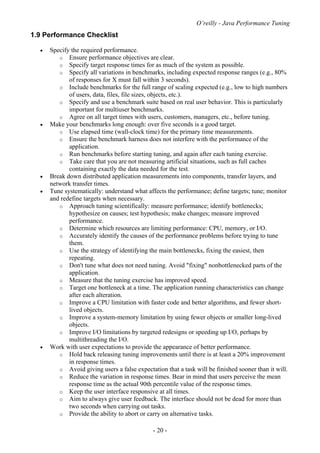












![[Ebooks PDF] download Java Performance Tuning Second Edition Jack Shirazi ful...](https://cdn.slidesharecdn.com/ss_thumbnails/56092-250220200533-cdee41b4-thumbnail.jpg?width=640&height=640&fit=bounds)


