Optimizing Java Chris Newland James Gough Benjamin J Evans
Optimizing Java Chris Newland James Gough Benjamin J Evans
Optimizing Java Chris Newland James Gough Benjamin J Evans
Optimizing Java Chris Newland James Gough Benjamin J Evans
Optimizing Java Chris Newland James Gough Benjamin J Evans
1.
Optimizing Java ChrisNewland James Gough
Benjamin J Evans download
https://ebookbell.com/product/optimizing-java-chris-newland-
james-gough-benjamin-j-evans-50195130
Explore and download more ebooks at ebookbell.com
2.
Here are somerecommended products that we believe you will be
interested in. You can click the link to download.
Optimizing Java Practical Techniques For Improved Performance Tuning
Benjamin J Evans
https://ebookbell.com/product/optimizing-java-practical-techniques-
for-improved-performance-tuning-benjamin-j-evans-5472050
Optimizing Java Benjamin J Evans James Gough Chris Newland
https://ebookbell.com/product/optimizing-java-benjamin-j-evans-james-
gough-chris-newland-7261934
Optimizing Java Benjamin J Evans
https://ebookbell.com/product/optimizing-java-benjamin-j-
evans-170703390
Optimizing Cloud Native Java Practical Techniques For Improving Jvm
Application Performance 2nd Edition First Early Release 2nd First
Early Release Ben Evans
https://ebookbell.com/product/optimizing-cloud-native-java-practical-
techniques-for-improving-jvm-application-performance-2nd-edition-
first-early-release-2nd-first-early-release-ben-evans-53521098
3.
Optimizing Cloud NativeJava Practical Techniques For Improving Jvm
Application Performance 2nd Edition Benjamin J Evans
https://ebookbell.com/product/optimizing-cloud-native-java-practical-
techniques-for-improving-jvm-application-performance-2nd-edition-
benjamin-j-evans-63479180
Optimizing Cloud Native Java Benjamin J Evans
https://ebookbell.com/product/optimizing-cloud-native-java-benjamin-j-
evans-200630216
Optimizing The Management Of Fertility In Women Over 40 Dimitrios S
Nikolaou
https://ebookbell.com/product/optimizing-the-management-of-fertility-
in-women-over-40-dimitrios-s-nikolaou-46170320
Optimizing Online English Language Learning And Teaching Mariadelmar
Surez
https://ebookbell.com/product/optimizing-online-english-language-
learning-and-teaching-mariadelmar-surez-48625696
Optimizing Medical Education With Instructional Technology Demiroz
https://ebookbell.com/product/optimizing-medical-education-with-
instructional-technology-demiroz-50243206
6.
1. Foreword
2. Preface
a.Conventions Used in This Book
b. Using Code Examples
c. O’Reilly Safari
d. How to Contact Us
e. Acknowledgments
3. 1. Optimization and Performance Defined
a. Java Performance—The Wrong Way
b. Java Performance Overview
7.
c. Performance asan Experimental Science
d. A Taxonomy for Performance
i. Throughput
ii. Latency
iii. Capacity
iv. Utilization
v. Efficiency
vi. Scalability
vii. Degradation
viii. Connections Between the Observables
8.
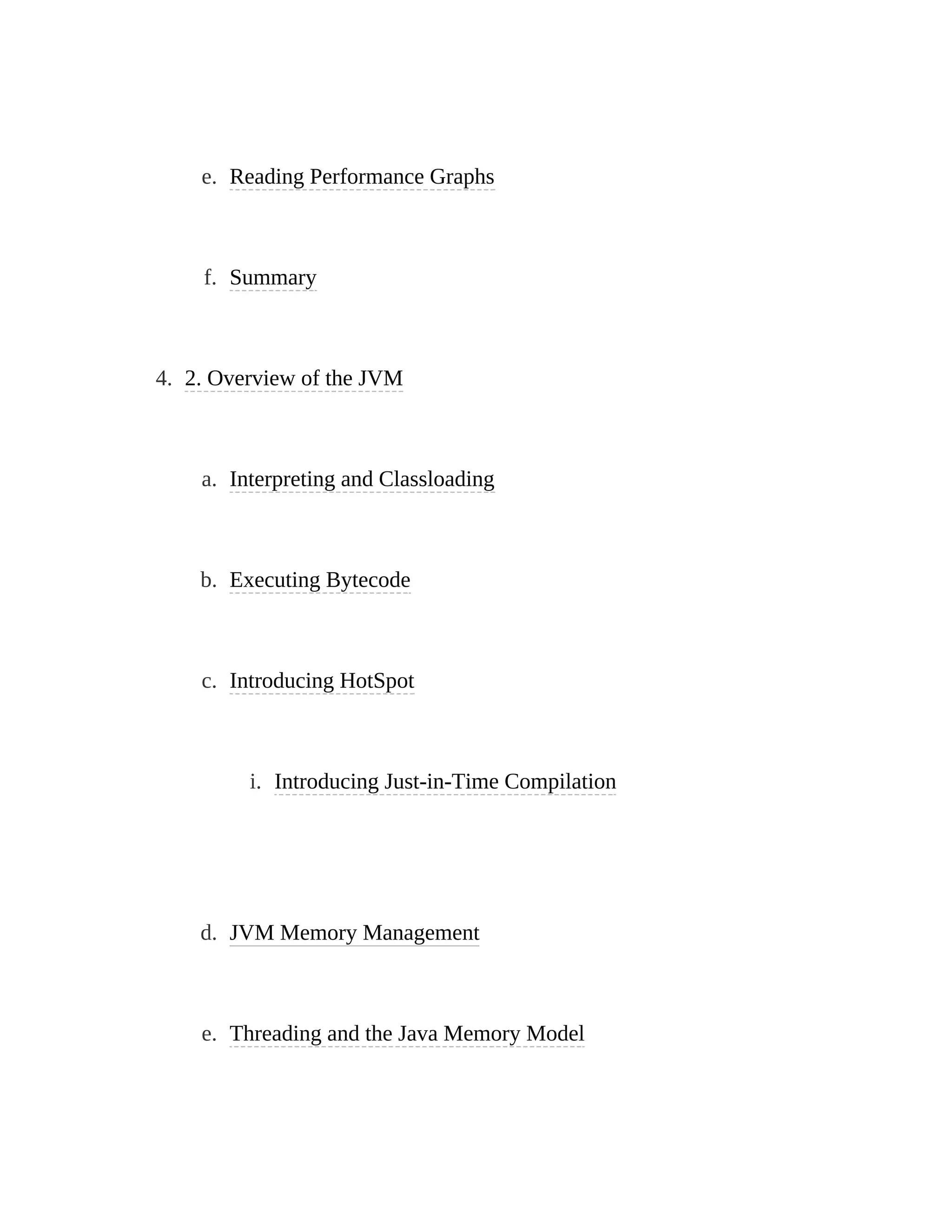
e. Reading PerformanceGraphs
f. Summary
4. 2. Overview of the JVM
a. Interpreting and Classloading
b. Executing Bytecode
c. Introducing HotSpot
i. Introducing Just-in-Time Compilation
d. JVM Memory Management
e. Threading and the Java Memory Model
9.
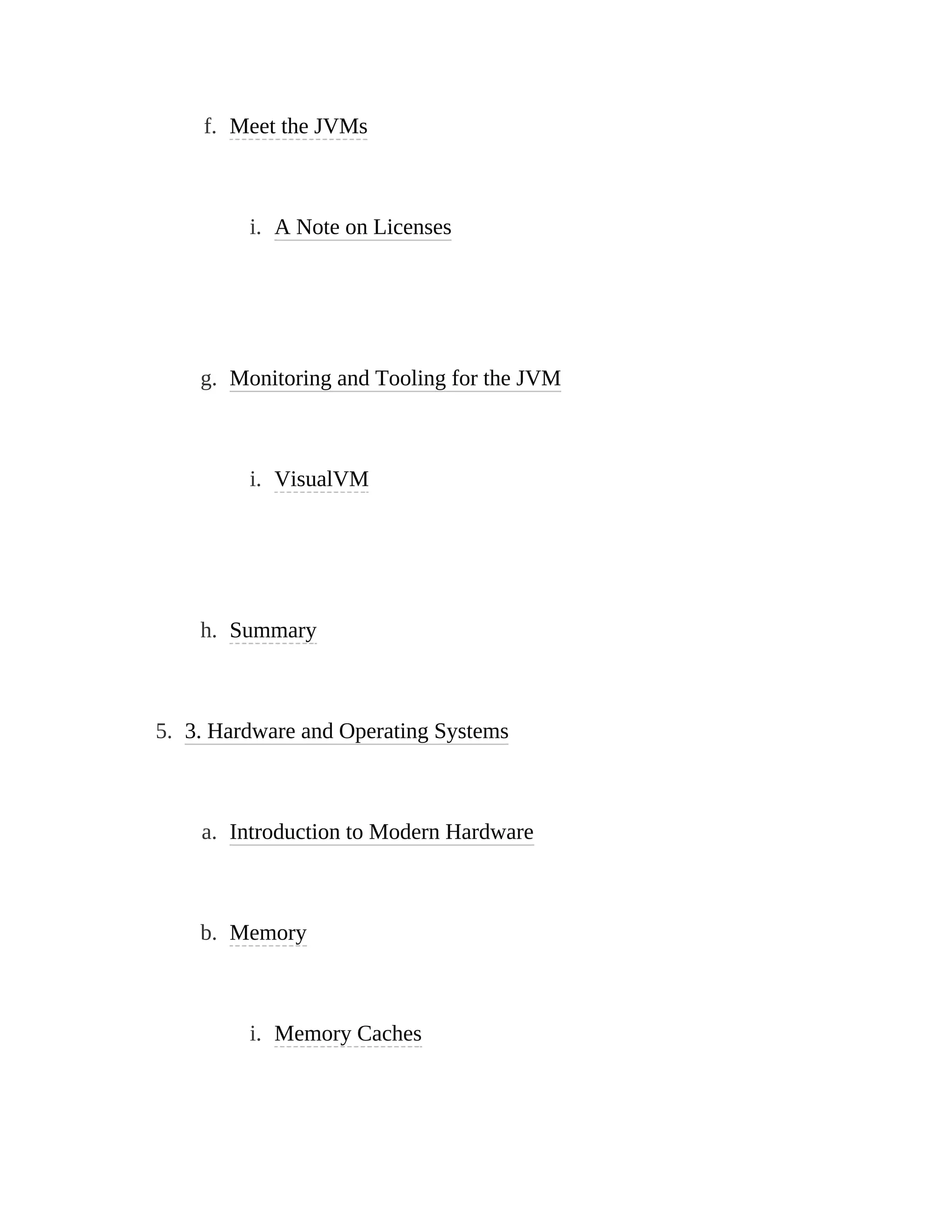
f. Meet theJVMs
i. A Note on Licenses
g. Monitoring and Tooling for the JVM
i. VisualVM
h. Summary
5. 3. Hardware and Operating Systems
a. Introduction to Modern Hardware
b. Memory
i. Memory Caches
10.
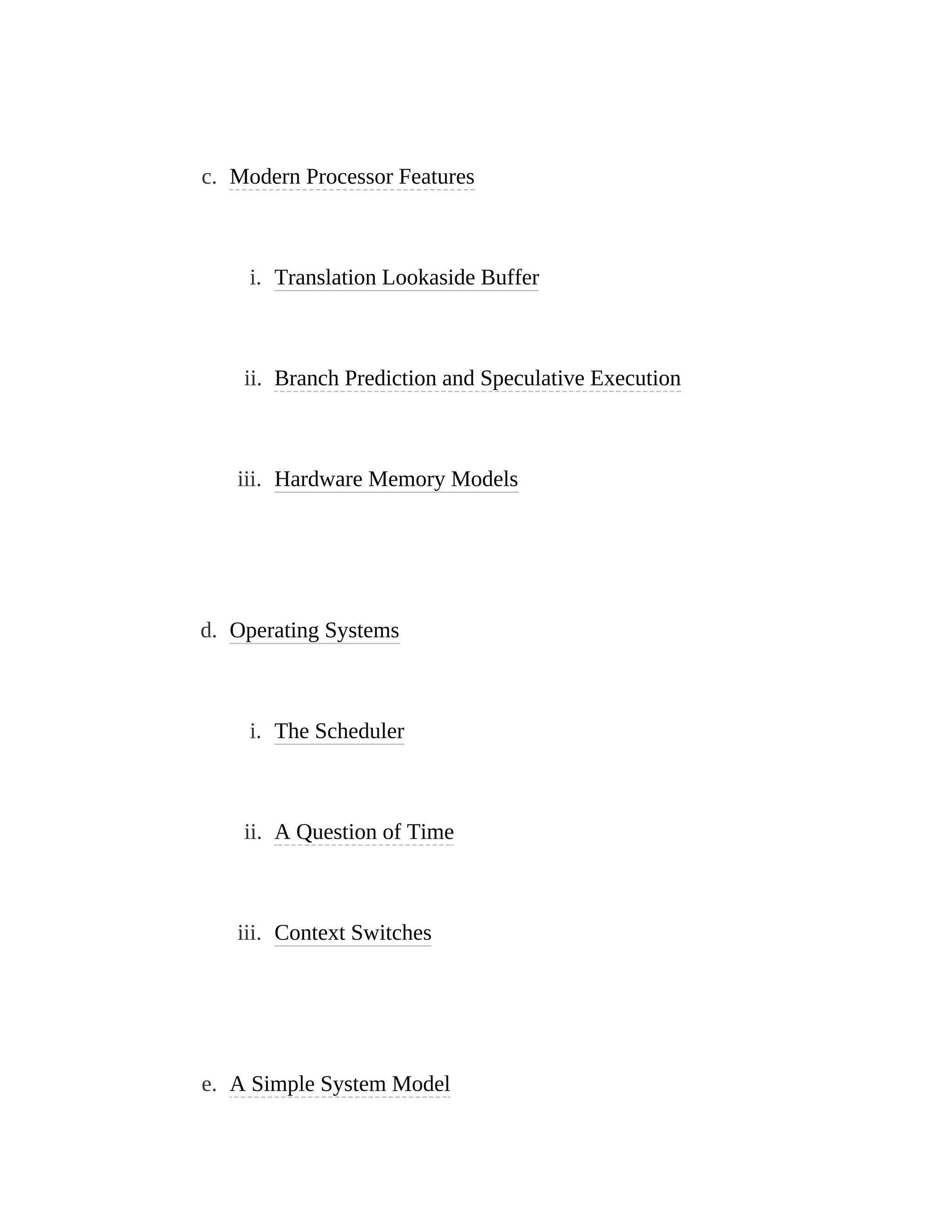
c. Modern ProcessorFeatures
i. Translation Lookaside Buffer
ii. Branch Prediction and Speculative Execution
iii. Hardware Memory Models
d. Operating Systems
i. The Scheduler
ii. A Question of Time
iii. Context Switches
e. A Simple System Model
11.
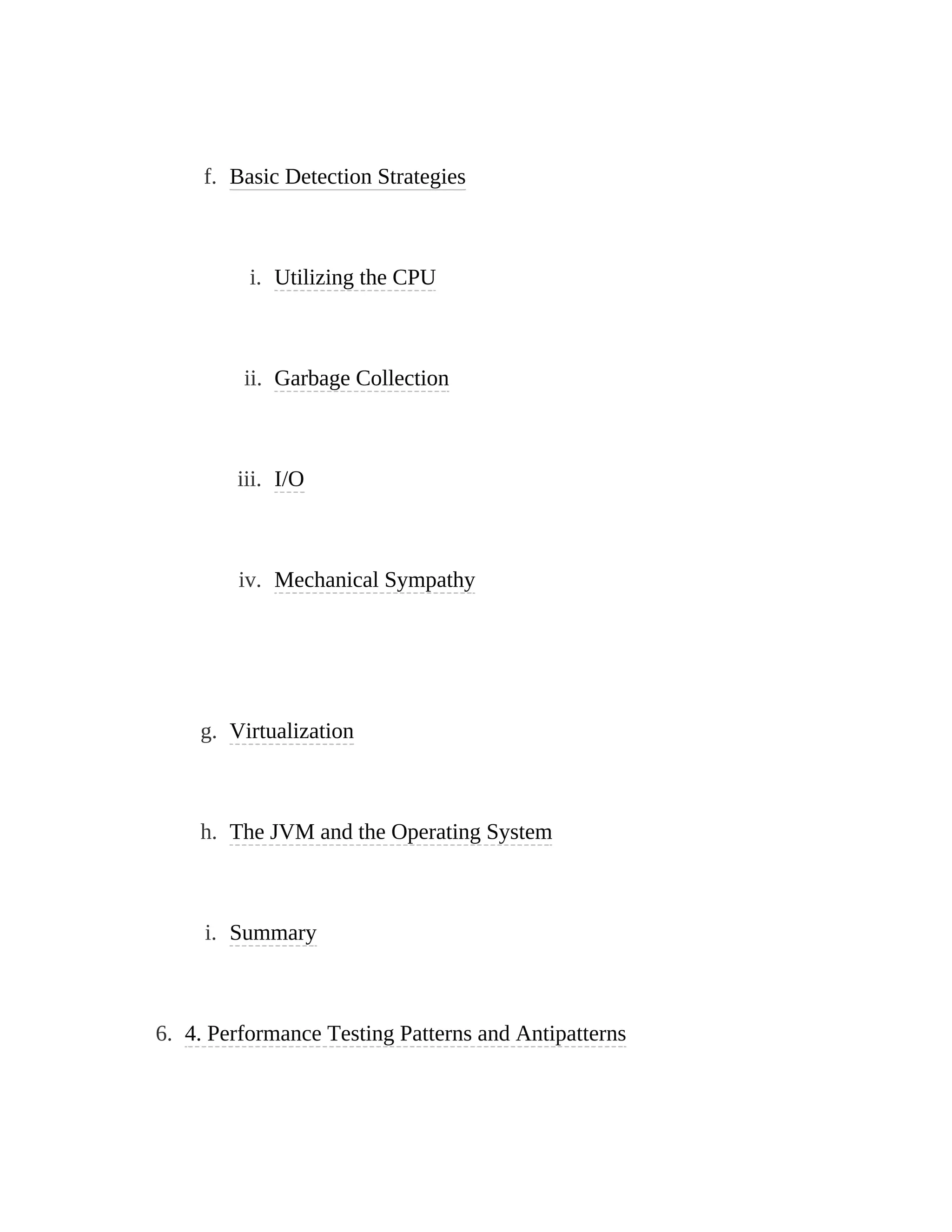
f. Basic DetectionStrategies
i. Utilizing the CPU
ii. Garbage Collection
iii. I/O
iv. Mechanical Sympathy
g. Virtualization
h. The JVM and the Operating System
i. Summary
6. 4. Performance Testing Patterns and Antipatterns
12.
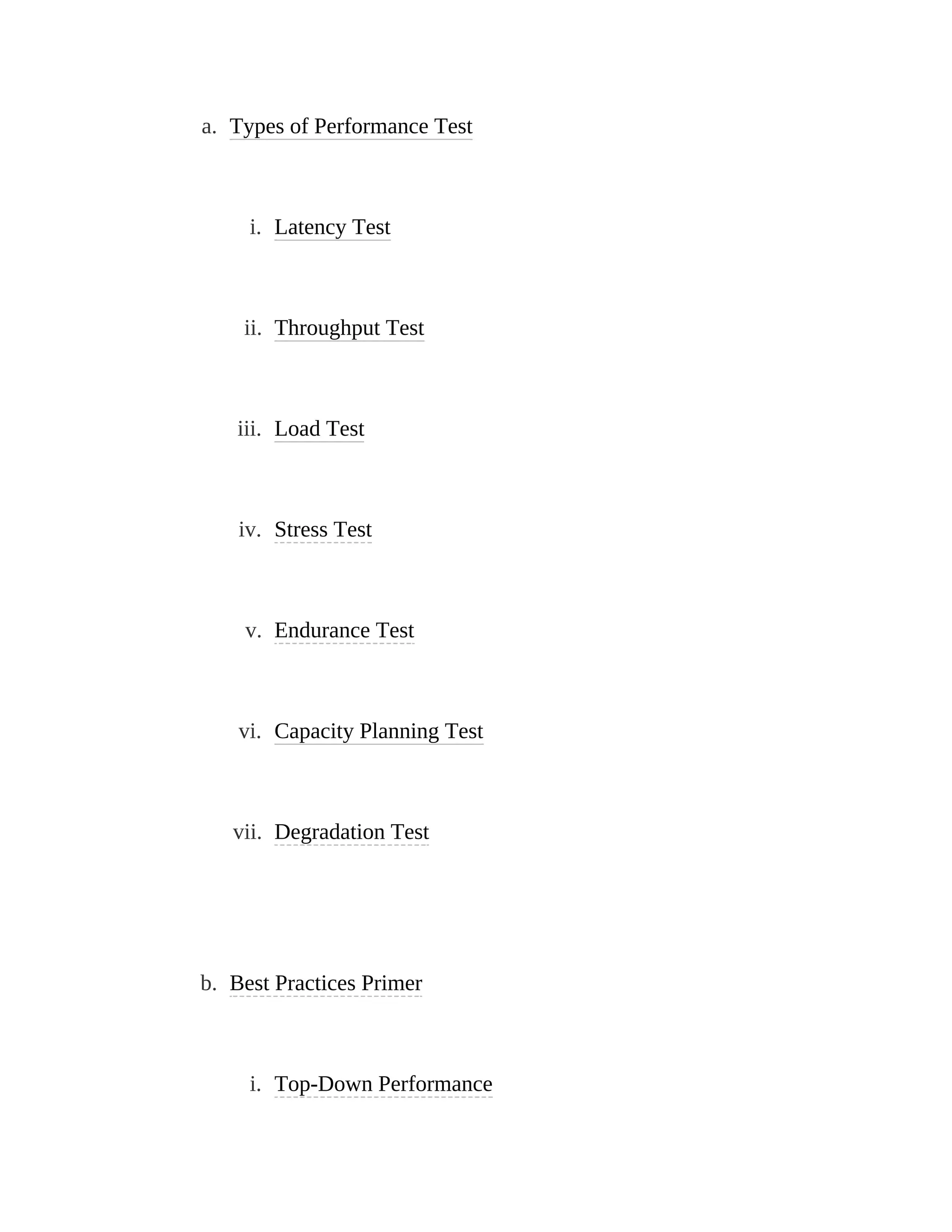
a. Types ofPerformance Test
i. Latency Test
ii. Throughput Test
iii. Load Test
iv. Stress Test
v. Endurance Test
vi. Capacity Planning Test
vii. Degradation Test
b. Best Practices Primer
i. Top-Down Performance
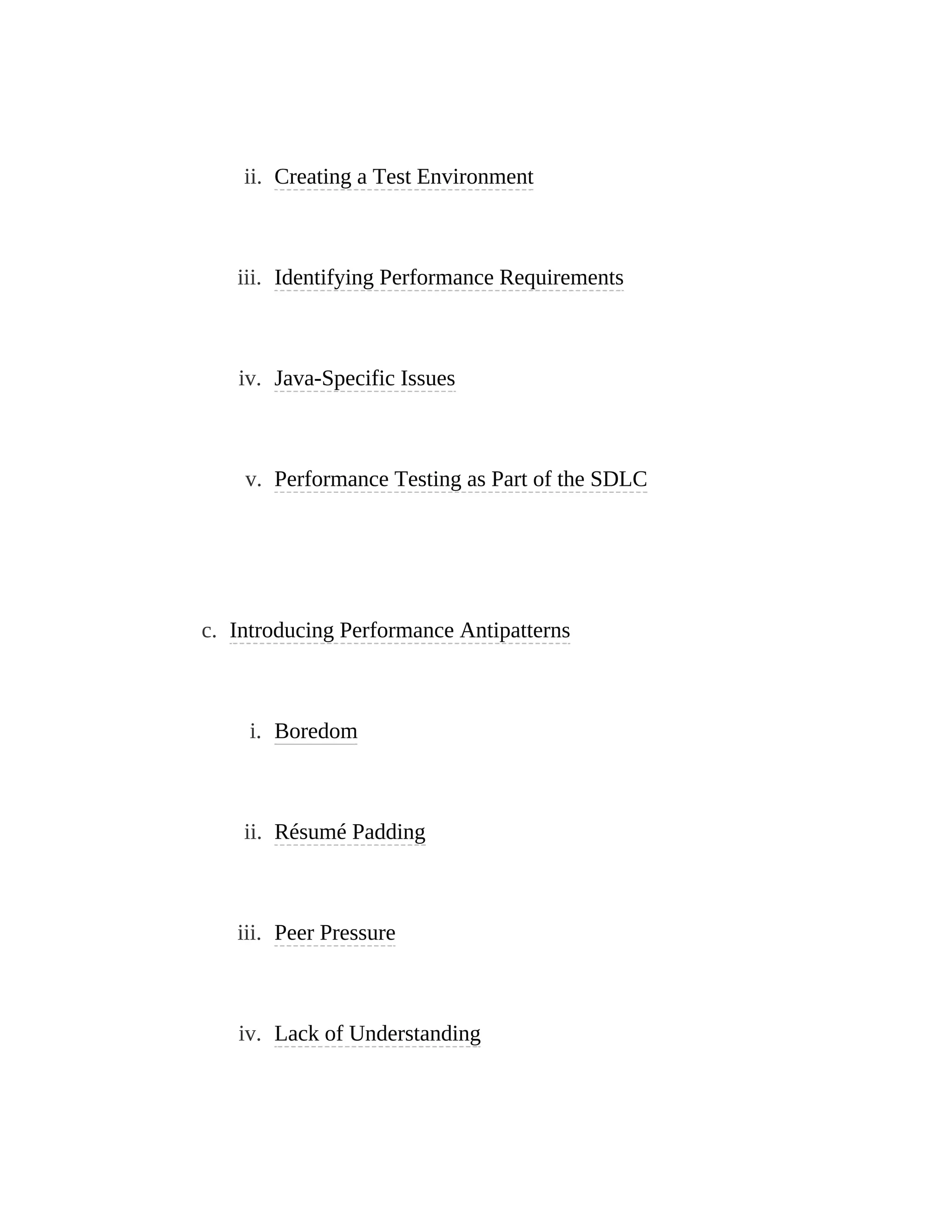
13.
ii. Creating aTest Environment
iii. Identifying Performance Requirements
iv. Java-Specific Issues
v. Performance Testing as Part of the SDLC
c. Introducing Performance Antipatterns
i. Boredom
ii. Résumé Padding
iii. Peer Pressure
iv. Lack of Understanding
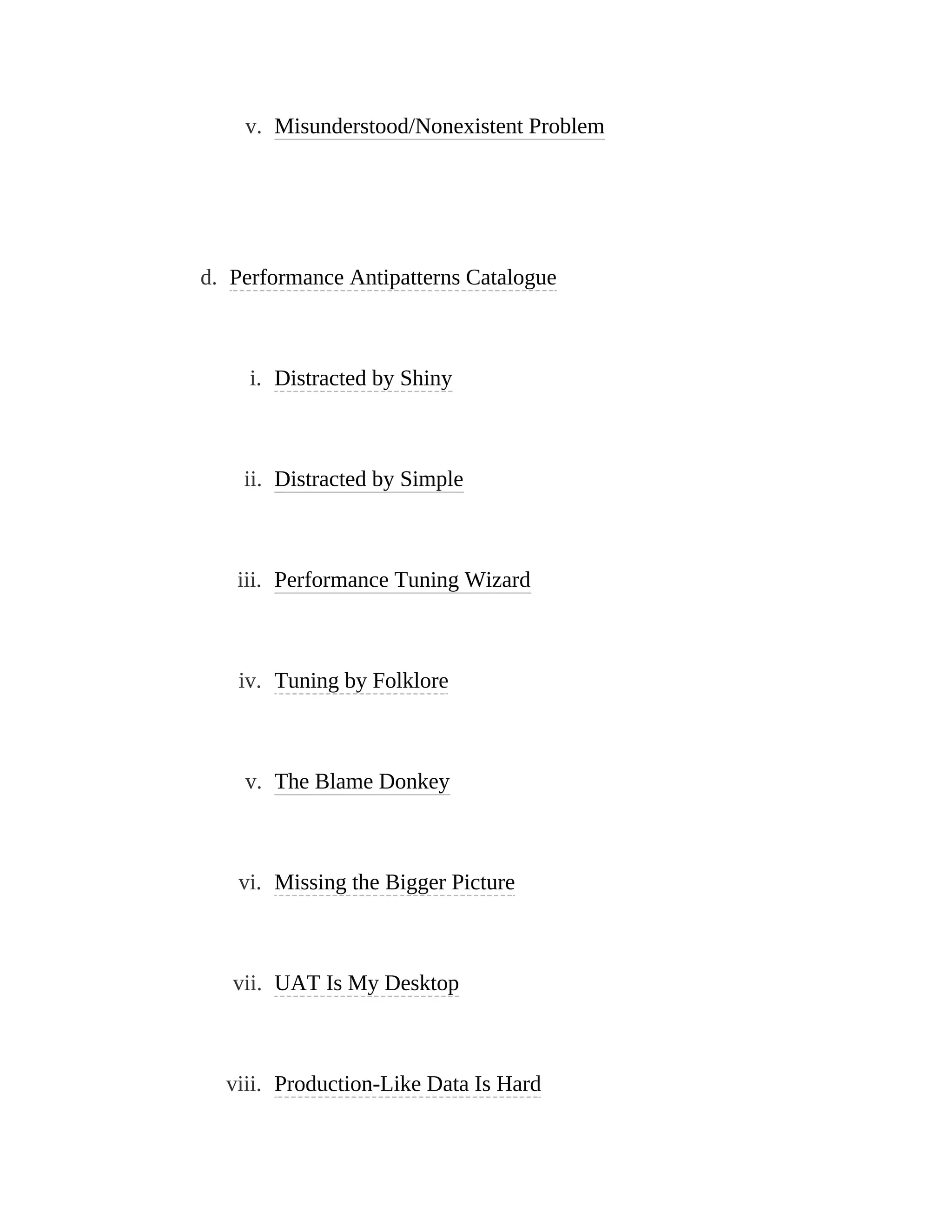
14.
v. Misunderstood/Nonexistent Problem
d.Performance Antipatterns Catalogue
i. Distracted by Shiny
ii. Distracted by Simple
iii. Performance Tuning Wizard
iv. Tuning by Folklore
v. The Blame Donkey
vi. Missing the Bigger Picture
vii. UAT Is My Desktop
viii. Production-Like Data Is Hard
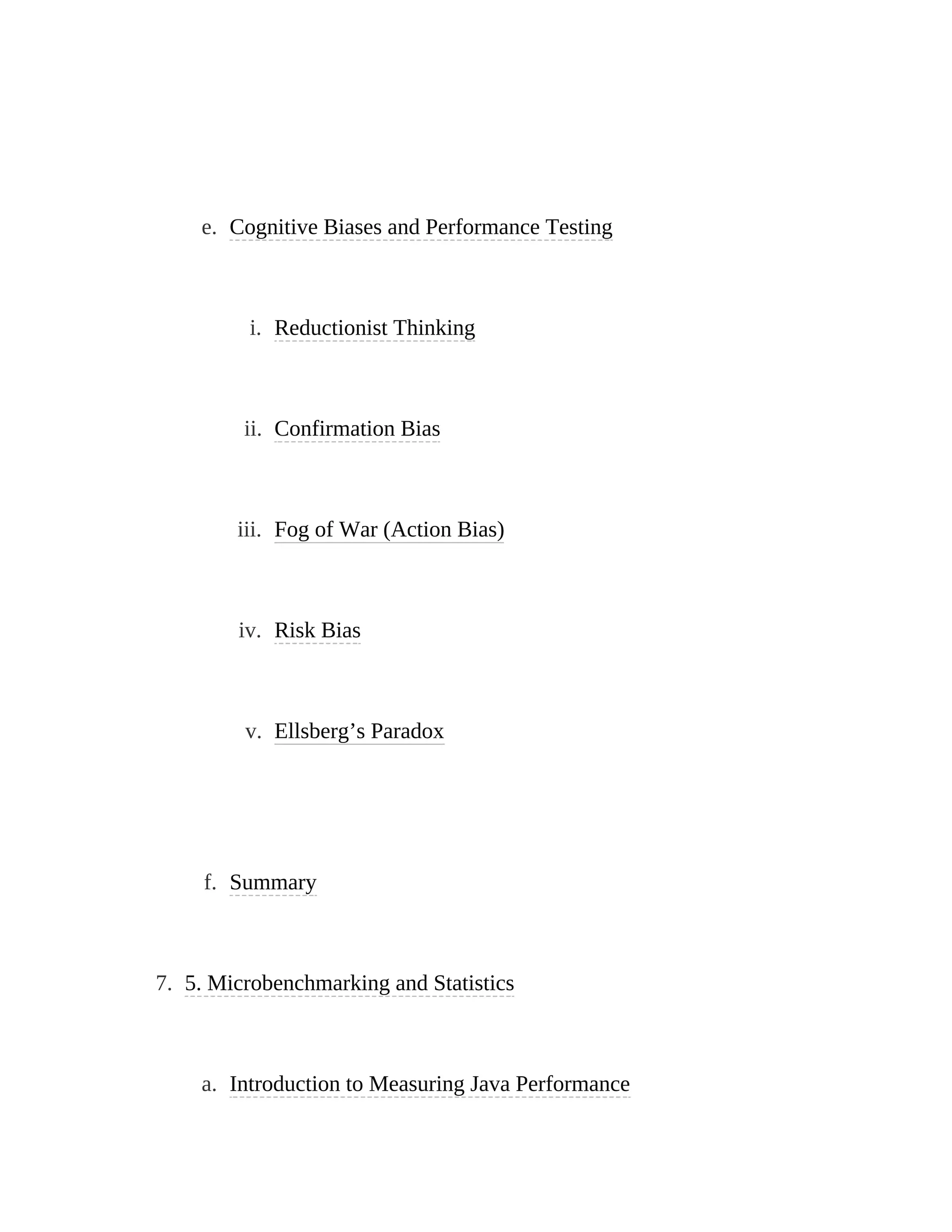
15.
e. Cognitive Biasesand Performance Testing
i. Reductionist Thinking
ii. Confirmation Bias
iii. Fog of War (Action Bias)
iv. Risk Bias
v. Ellsberg’s Paradox
f. Summary
7. 5. Microbenchmarking and Statistics
a. Introduction to Measuring Java Performance
16.
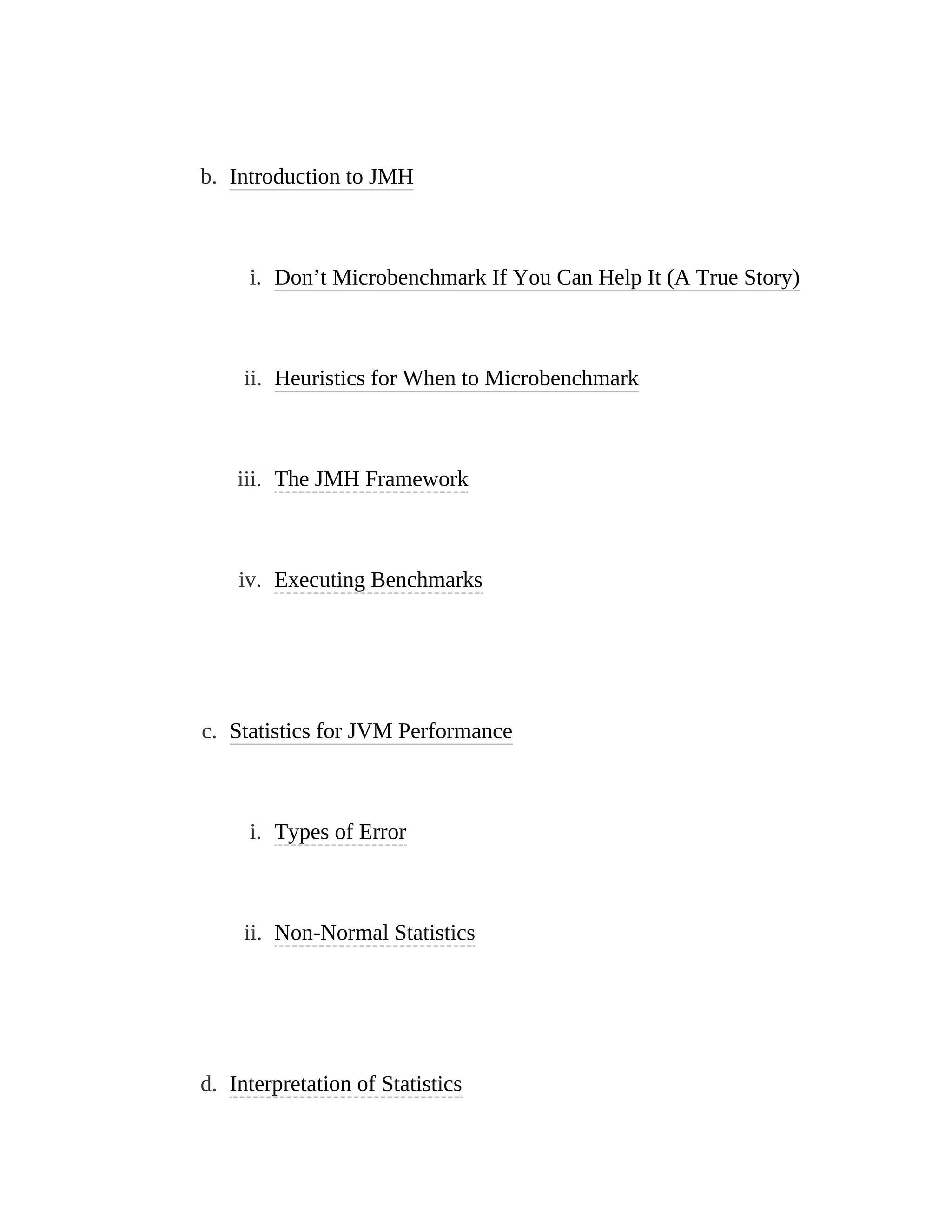
b. Introduction toJMH
i. Don’t Microbenchmark If You Can Help It (A True Story)
ii. Heuristics for When to Microbenchmark
iii. The JMH Framework
iv. Executing Benchmarks
c. Statistics for JVM Performance
i. Types of Error
ii. Non-Normal Statistics
d. Interpretation of Statistics
17.
e. Summary
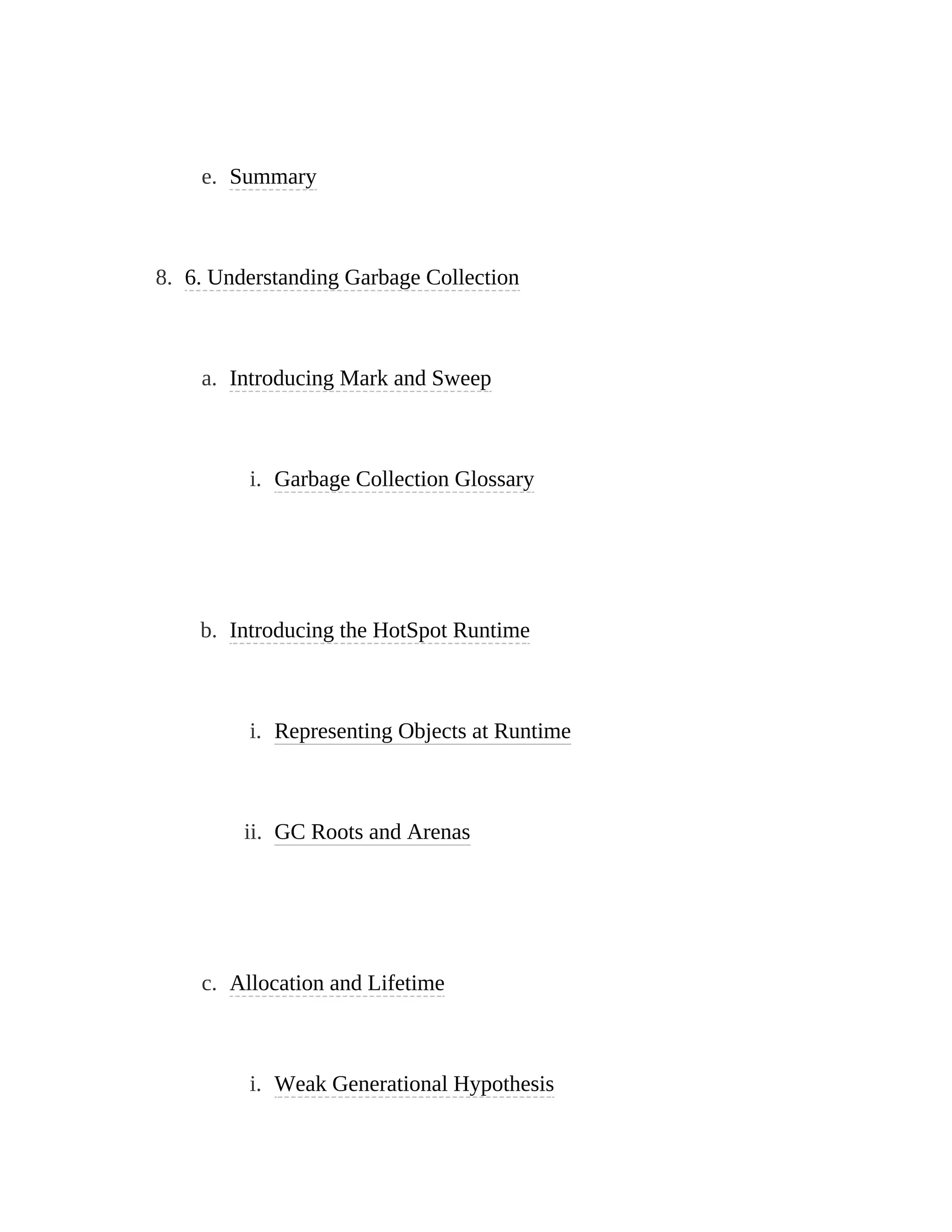
8. 6.Understanding Garbage Collection
a. Introducing Mark and Sweep
i. Garbage Collection Glossary
b. Introducing the HotSpot Runtime
i. Representing Objects at Runtime
ii. GC Roots and Arenas
c. Allocation and Lifetime
i. Weak Generational Hypothesis
18.
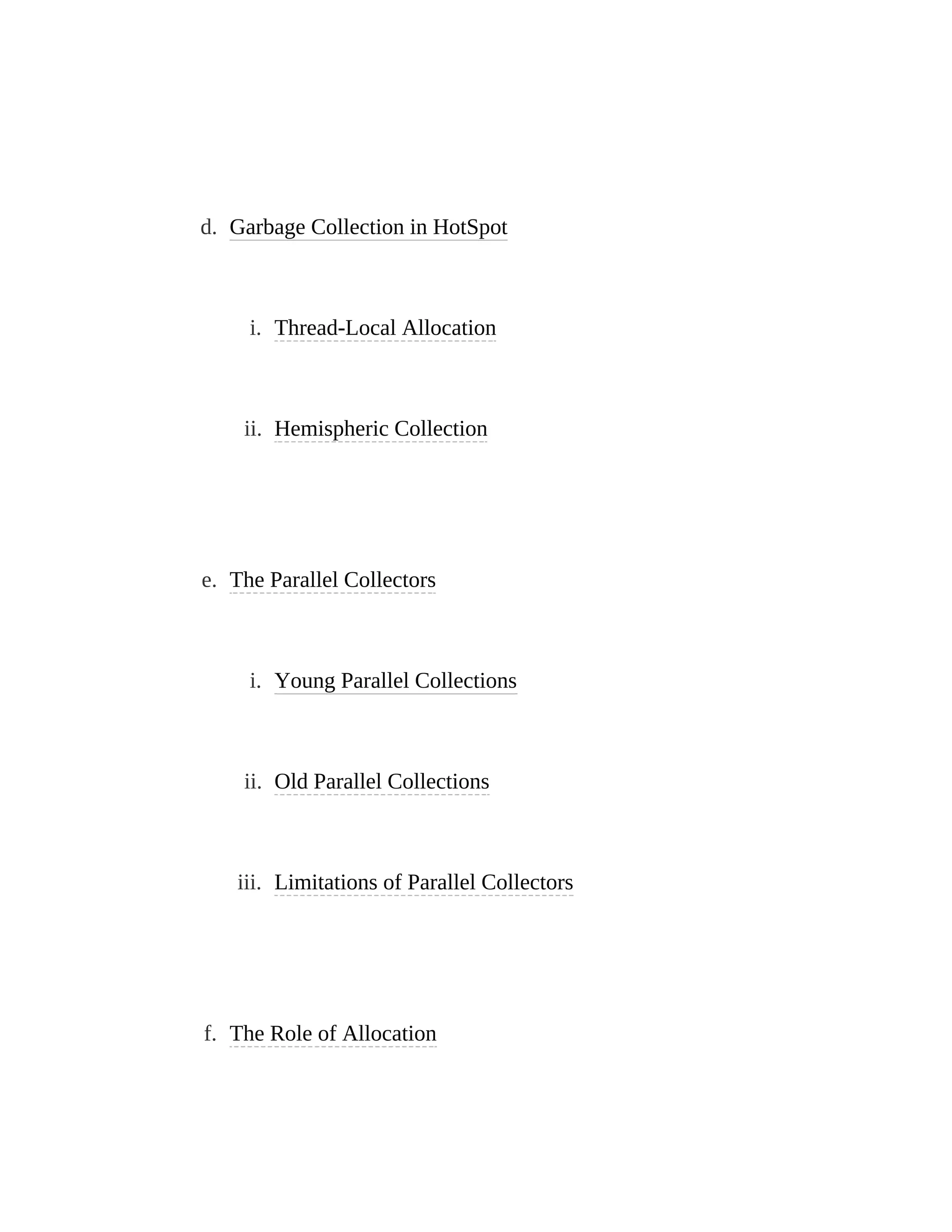
d. Garbage Collectionin HotSpot
i. Thread-Local Allocation
ii. Hemispheric Collection
e. The Parallel Collectors
i. Young Parallel Collections
ii. Old Parallel Collections
iii. Limitations of Parallel Collectors
f. The Role of Allocation
19.
g. Summary
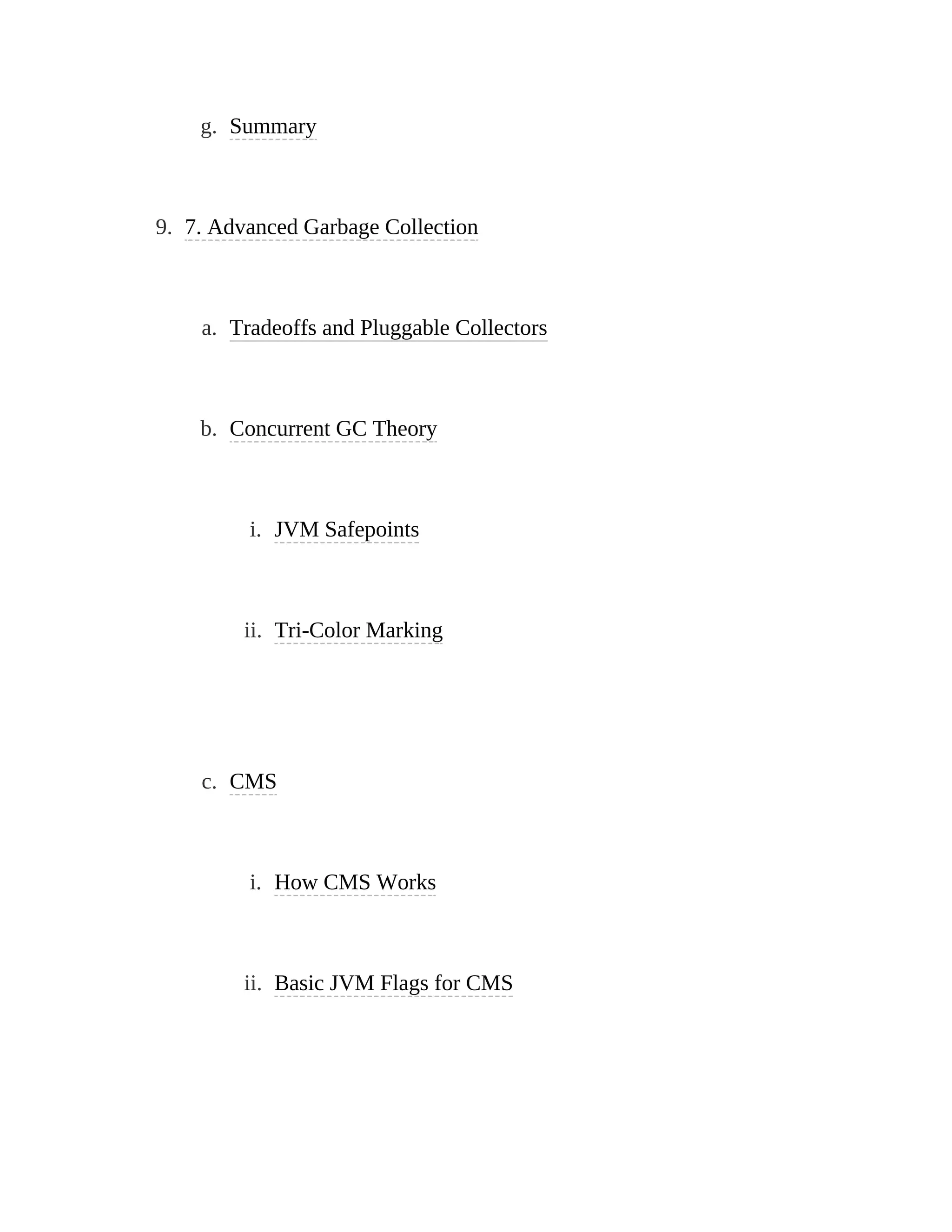
9. 7.Advanced Garbage Collection
a. Tradeoffs and Pluggable Collectors
b. Concurrent GC Theory
i. JVM Safepoints
ii. Tri-Color Marking
c. CMS
i. How CMS Works
ii. Basic JVM Flags for CMS
20.
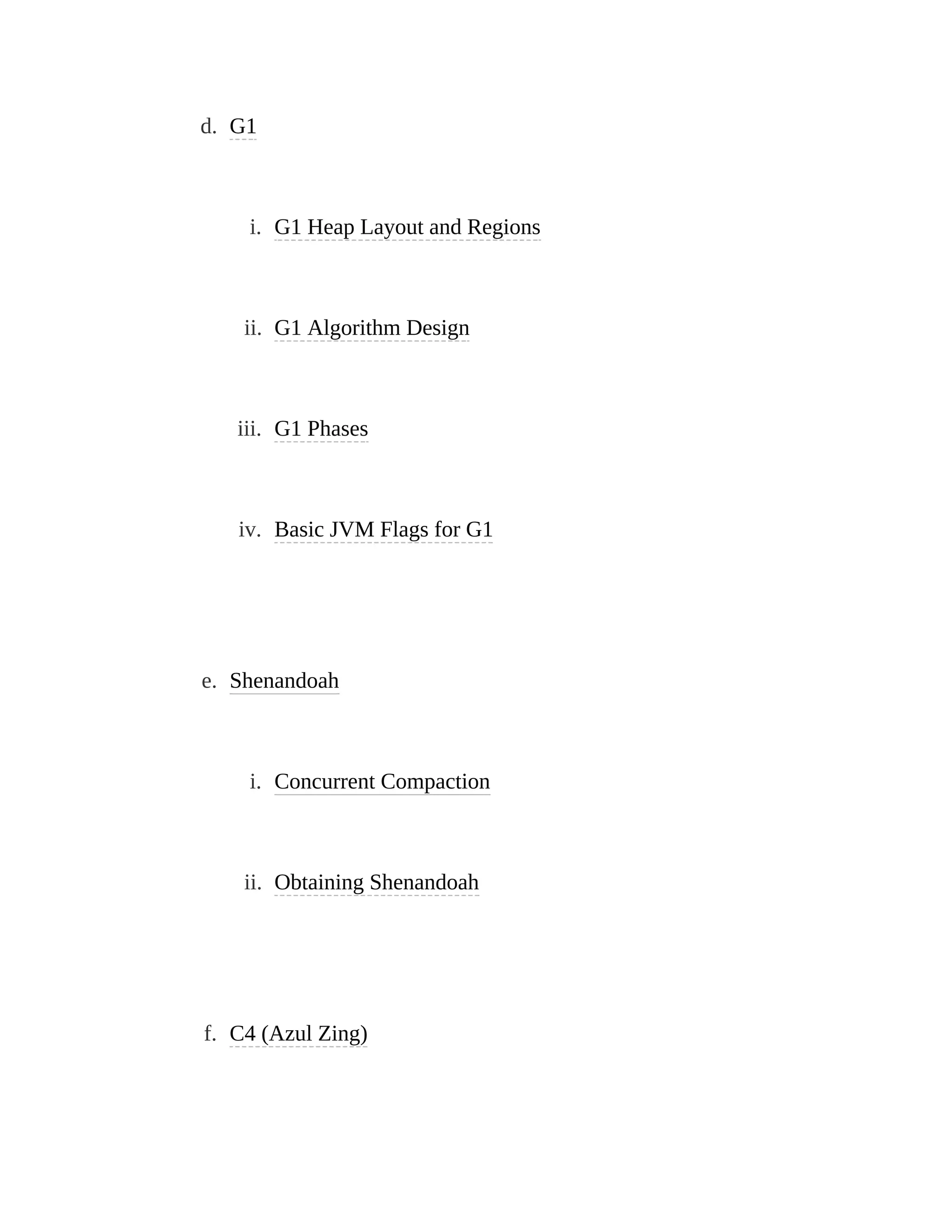
d. G1
i. G1Heap Layout and Regions
ii. G1 Algorithm Design
iii. G1 Phases
iv. Basic JVM Flags for G1
e. Shenandoah
i. Concurrent Compaction
ii. Obtaining Shenandoah
f. C4 (Azul Zing)
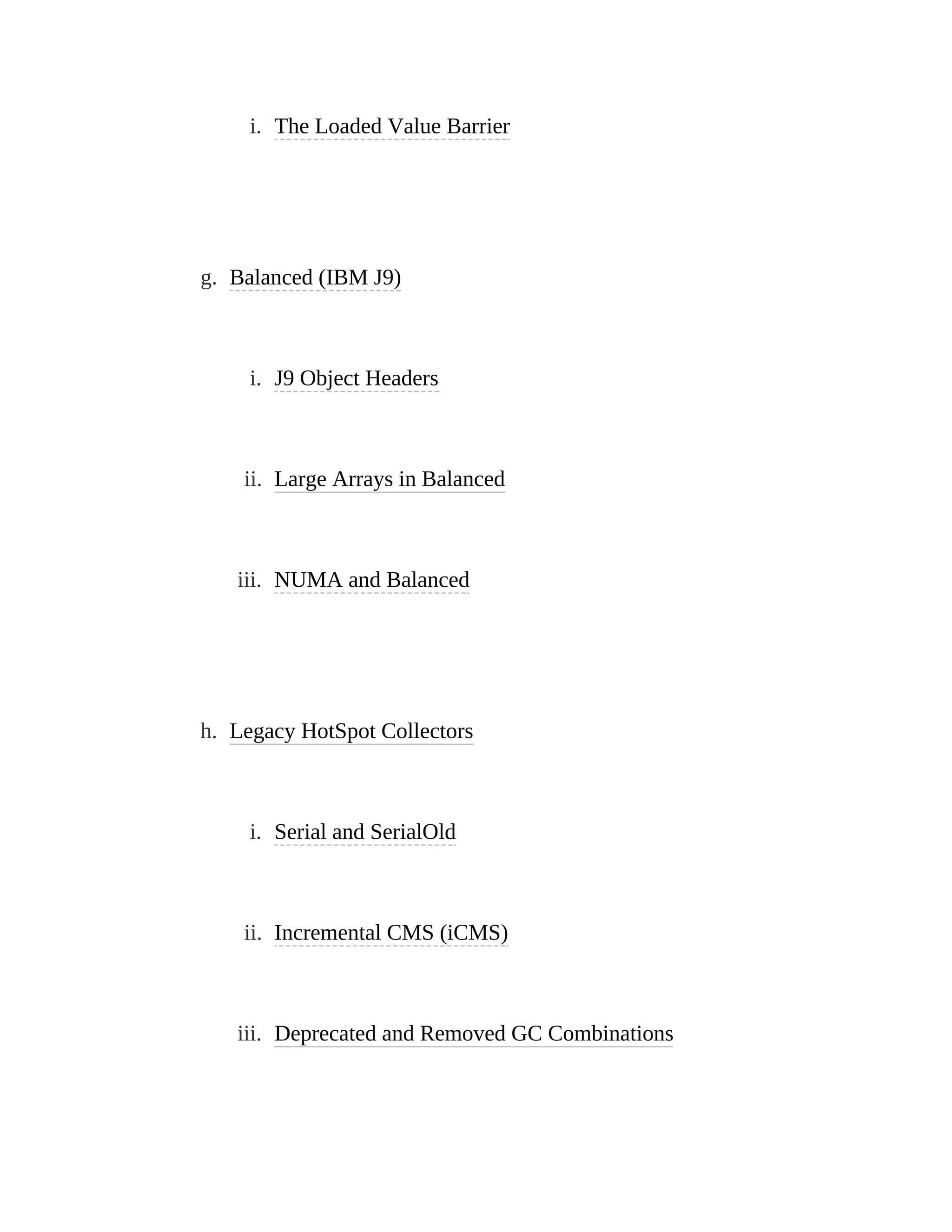
21.
i. The LoadedValue Barrier
g. Balanced (IBM J9)
i. J9 Object Headers
ii. Large Arrays in Balanced
iii. NUMA and Balanced
h. Legacy HotSpot Collectors
i. Serial and SerialOld
ii. Incremental CMS (iCMS)
iii. Deprecated and Removed GC Combinations
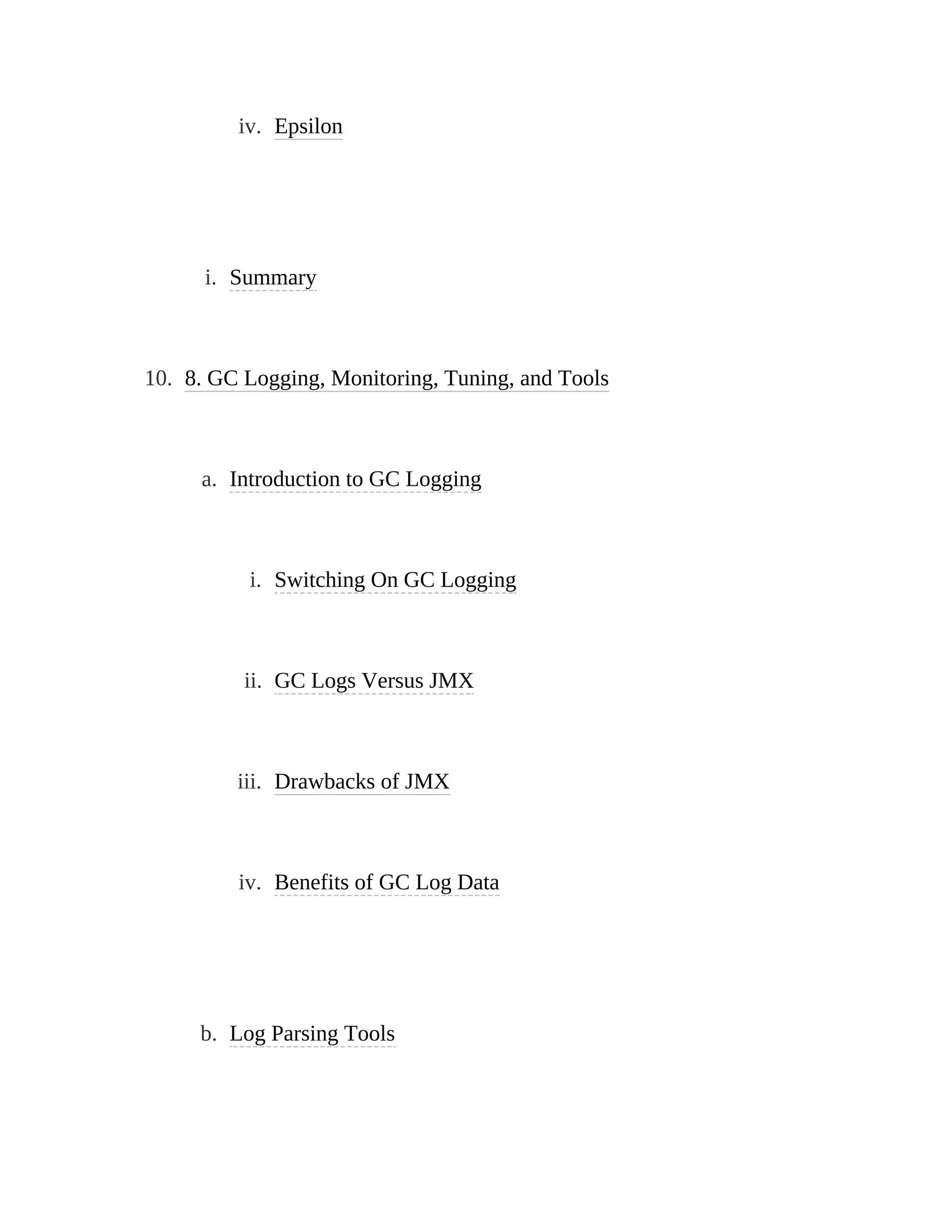
22.
iv. Epsilon
i. Summary
10.8. GC Logging, Monitoring, Tuning, and Tools
a. Introduction to GC Logging
i. Switching On GC Logging
ii. GC Logs Versus JMX
iii. Drawbacks of JMX
iv. Benefits of GC Log Data
b. Log Parsing Tools
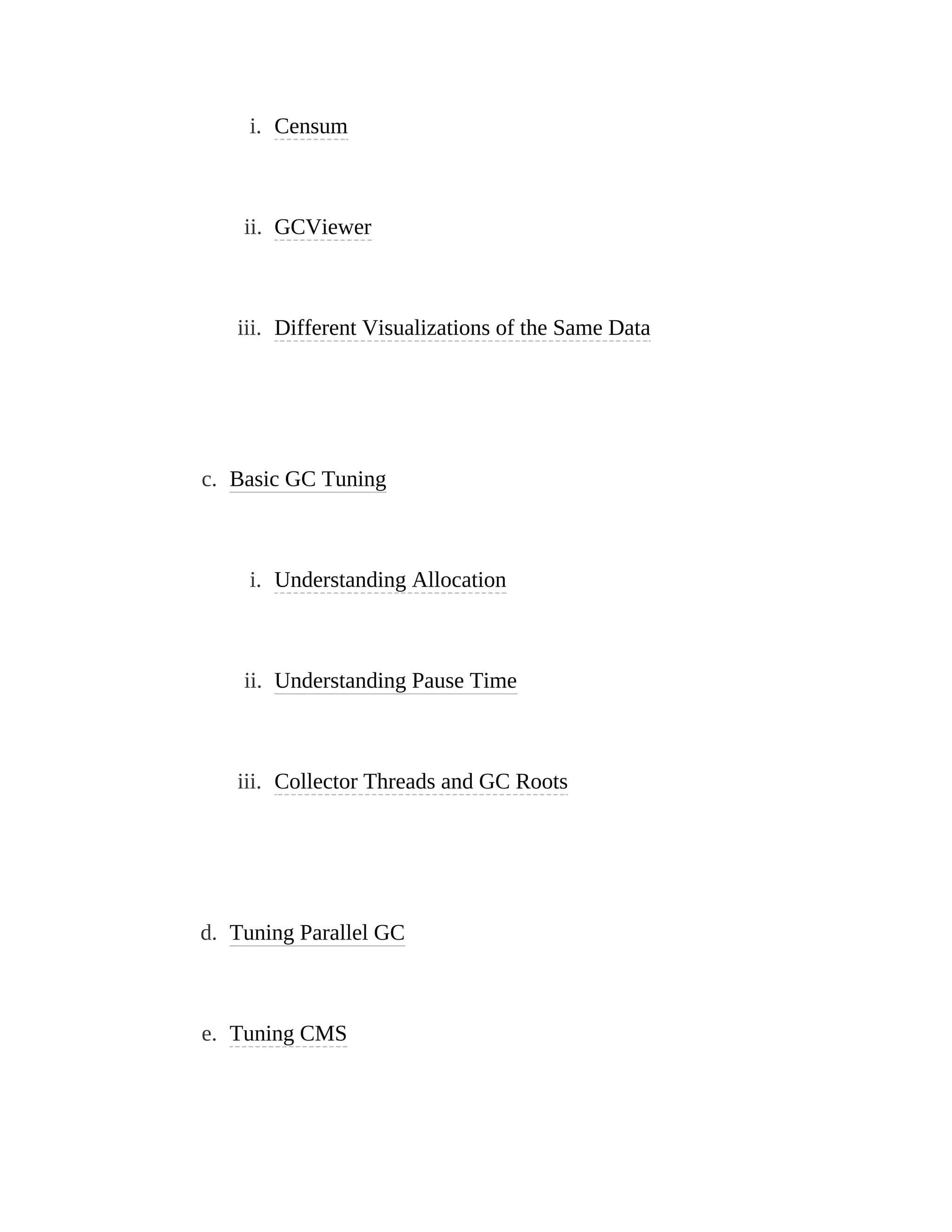
23.
i. Censum
ii. GCViewer
iii.Different Visualizations of the Same Data
c. Basic GC Tuning
i. Understanding Allocation
ii. Understanding Pause Time
iii. Collector Threads and GC Roots
d. Tuning Parallel GC
e. Tuning CMS
24.
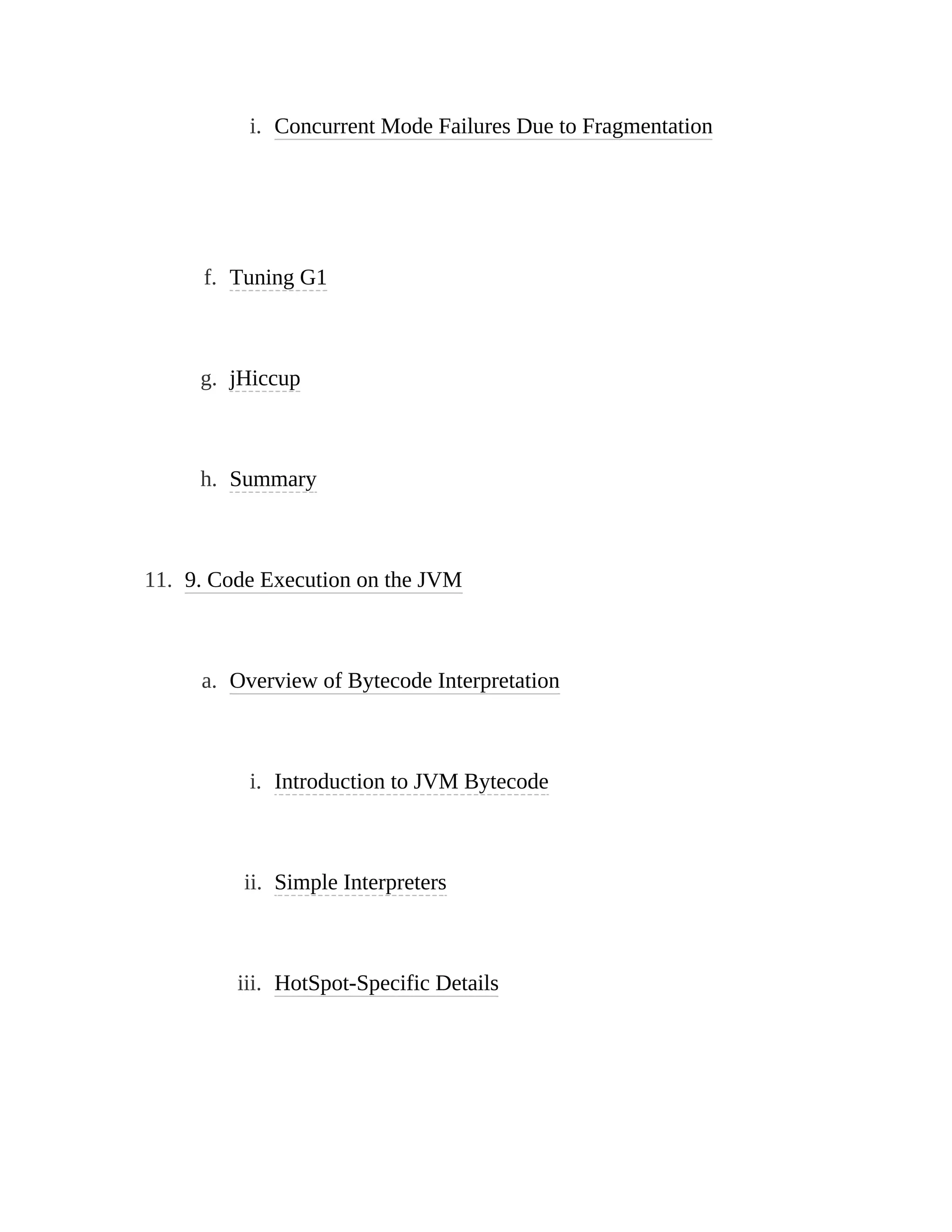
i. Concurrent ModeFailures Due to Fragmentation
f. Tuning G1
g. jHiccup
h. Summary
11. 9. Code Execution on the JVM
a. Overview of Bytecode Interpretation
i. Introduction to JVM Bytecode
ii. Simple Interpreters
iii. HotSpot-Specific Details
25.
b. AOT andJIT Compilation
i. AOT Compilation
ii. JIT Compilation
iii. Comparing AOT and JIT Compilation
c. HotSpot JIT Basics
i. Klass Words, Vtables, and Pointer Swizzling
ii. Logging JIT Compilation
iii. Compilers Within HotSpot
iv. Tiered Compilation in HotSpot
26.
d. The CodeCache
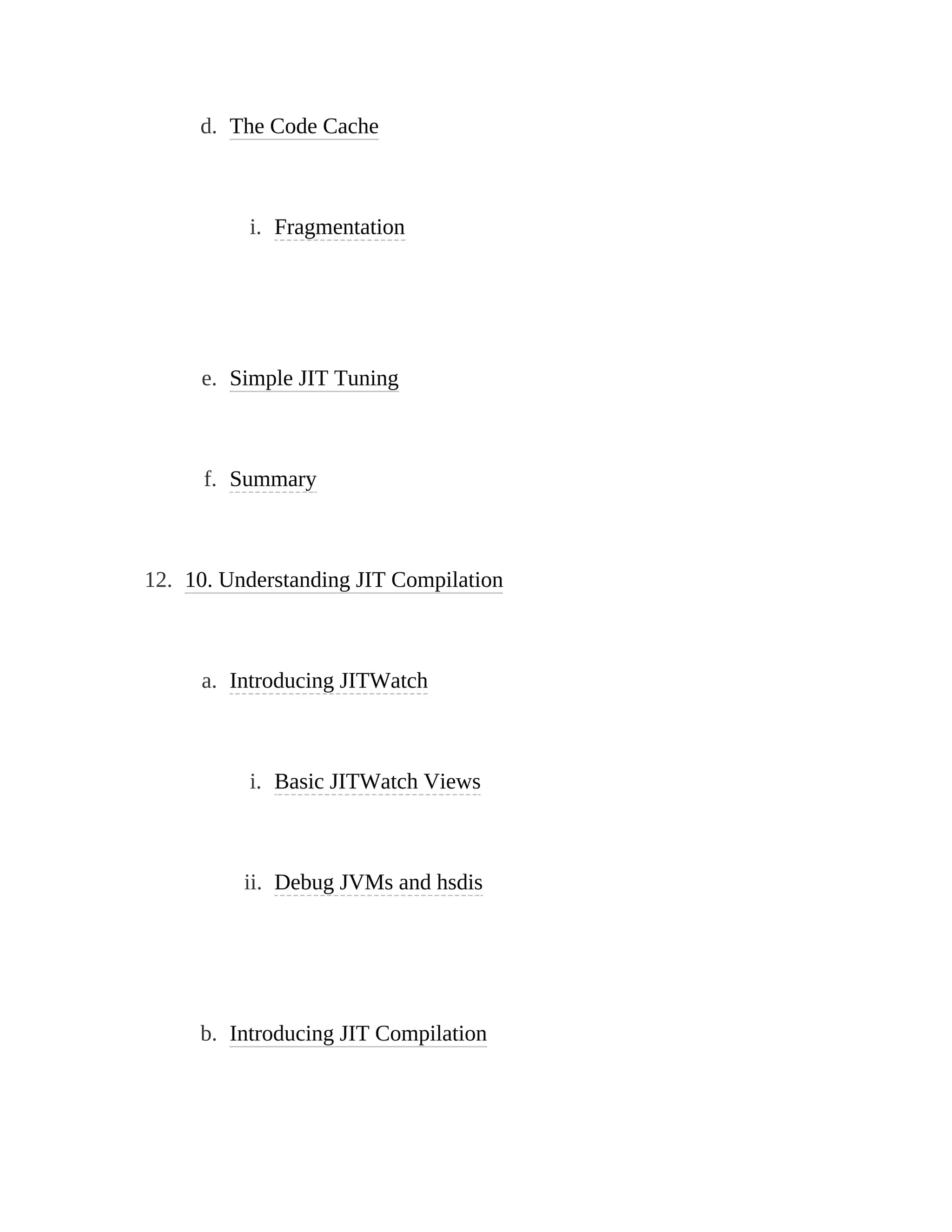
i. Fragmentation
e. Simple JIT Tuning
f. Summary
12. 10. Understanding JIT Compilation
a. Introducing JITWatch
i. Basic JITWatch Views
ii. Debug JVMs and hsdis
b. Introducing JIT Compilation
27.
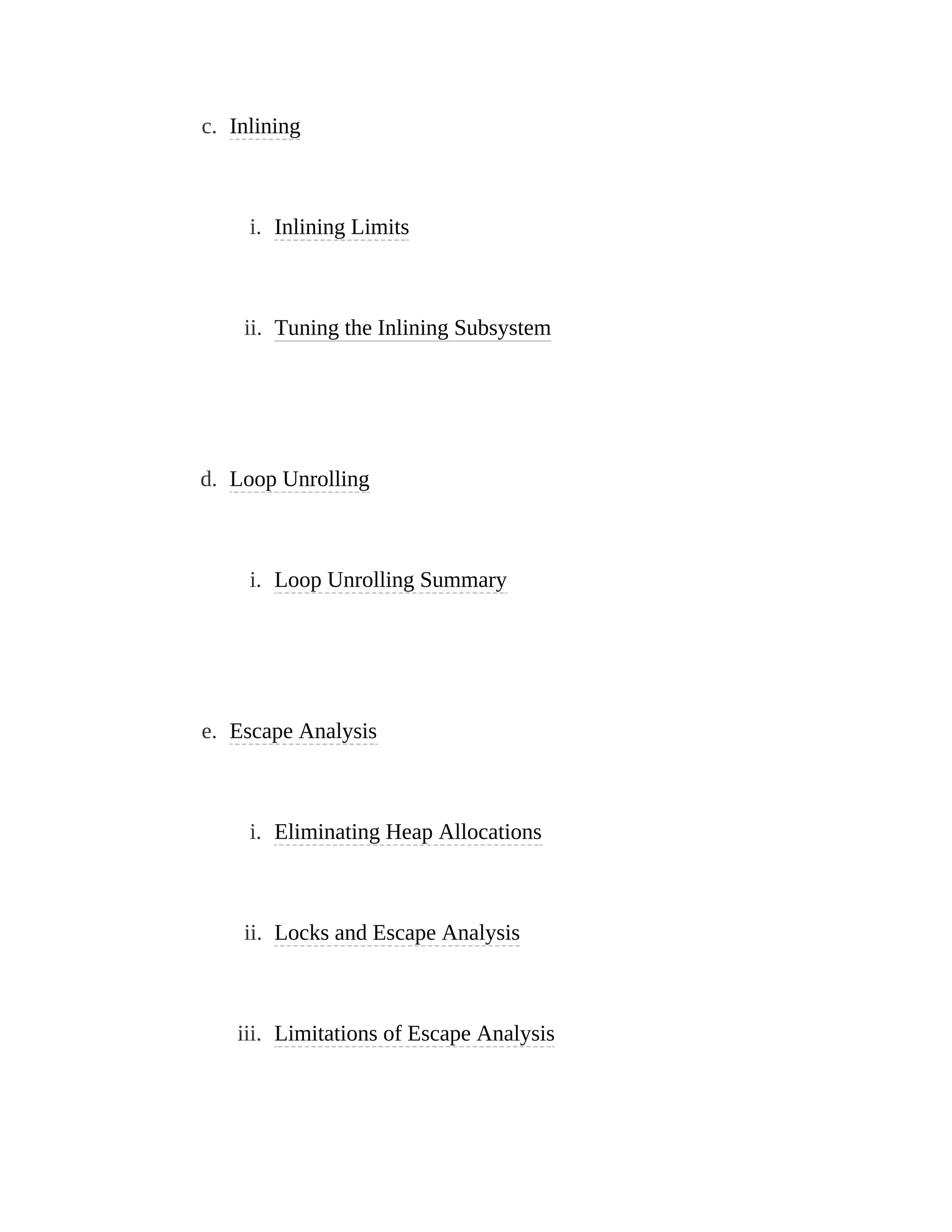
c. Inlining
i. InliningLimits
ii. Tuning the Inlining Subsystem
d. Loop Unrolling
i. Loop Unrolling Summary
e. Escape Analysis
i. Eliminating Heap Allocations
ii. Locks and Escape Analysis
iii. Limitations of Escape Analysis
28.
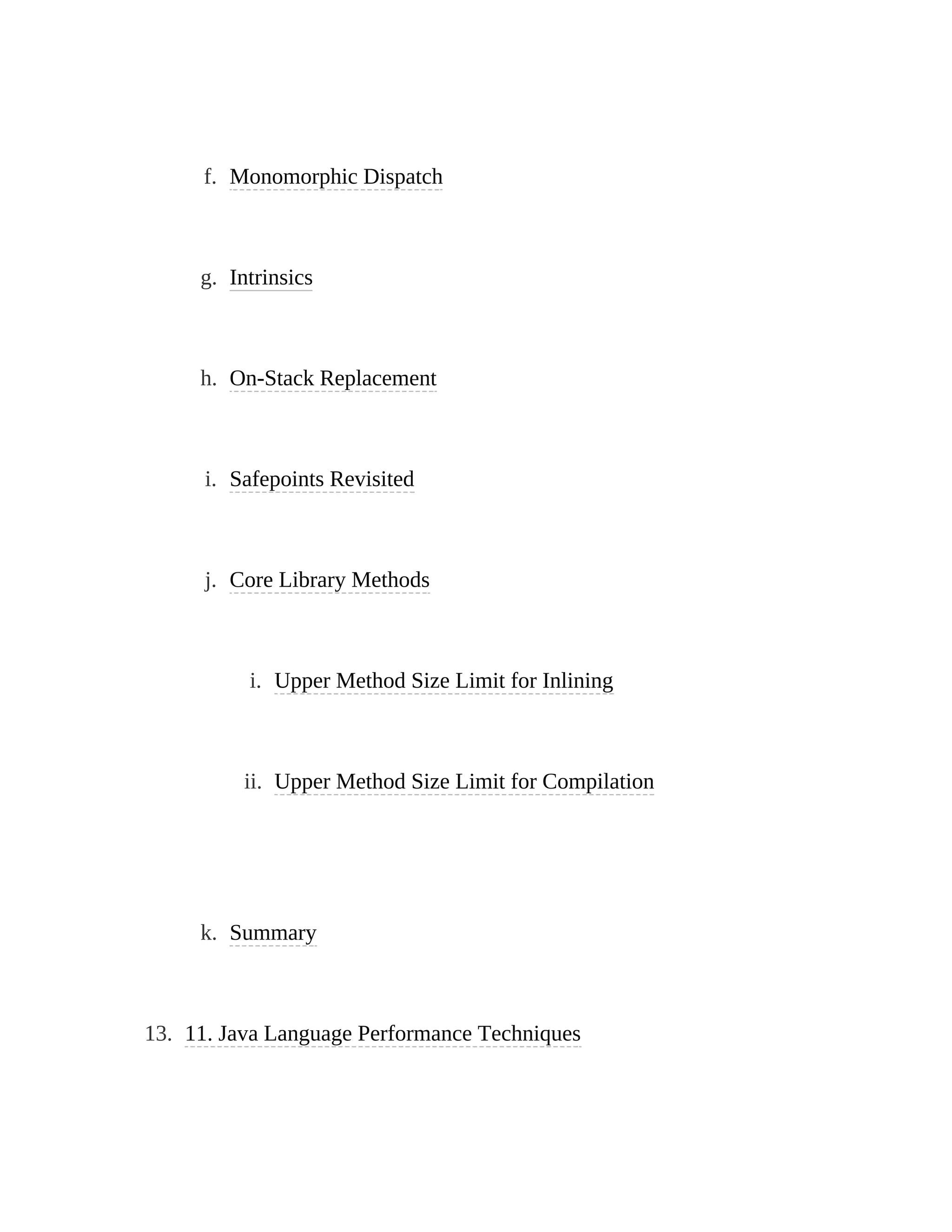
f. Monomorphic Dispatch
g.Intrinsics
h. On-Stack Replacement
i. Safepoints Revisited
j. Core Library Methods
i. Upper Method Size Limit for Inlining
ii. Upper Method Size Limit for Compilation
k. Summary
13. 11. Java Language Performance Techniques
29.
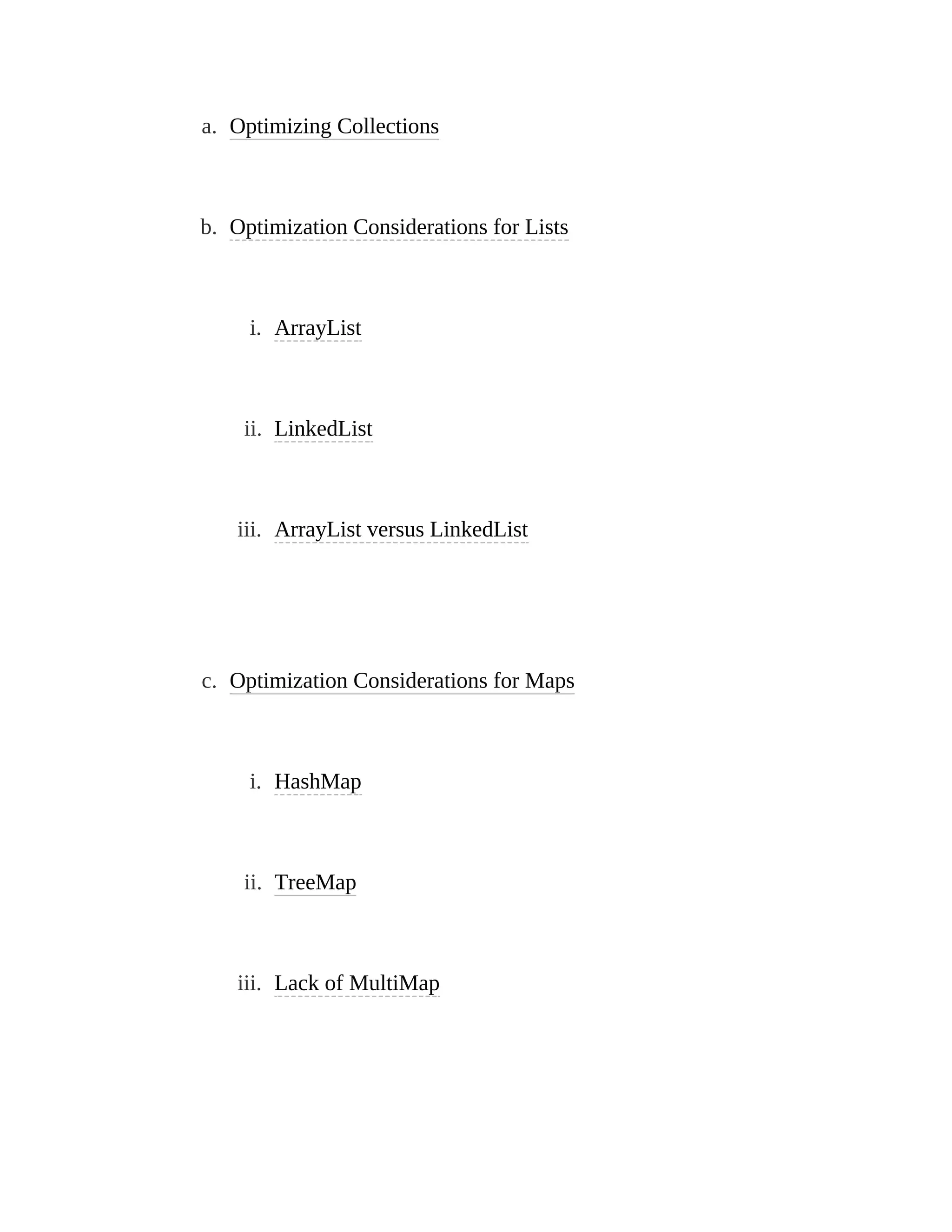
a. Optimizing Collections
b.Optimization Considerations for Lists
i. ArrayList
ii. LinkedList
iii. ArrayList versus LinkedList
c. Optimization Considerations for Maps
i. HashMap
ii. TreeMap
iii. Lack of MultiMap
30.
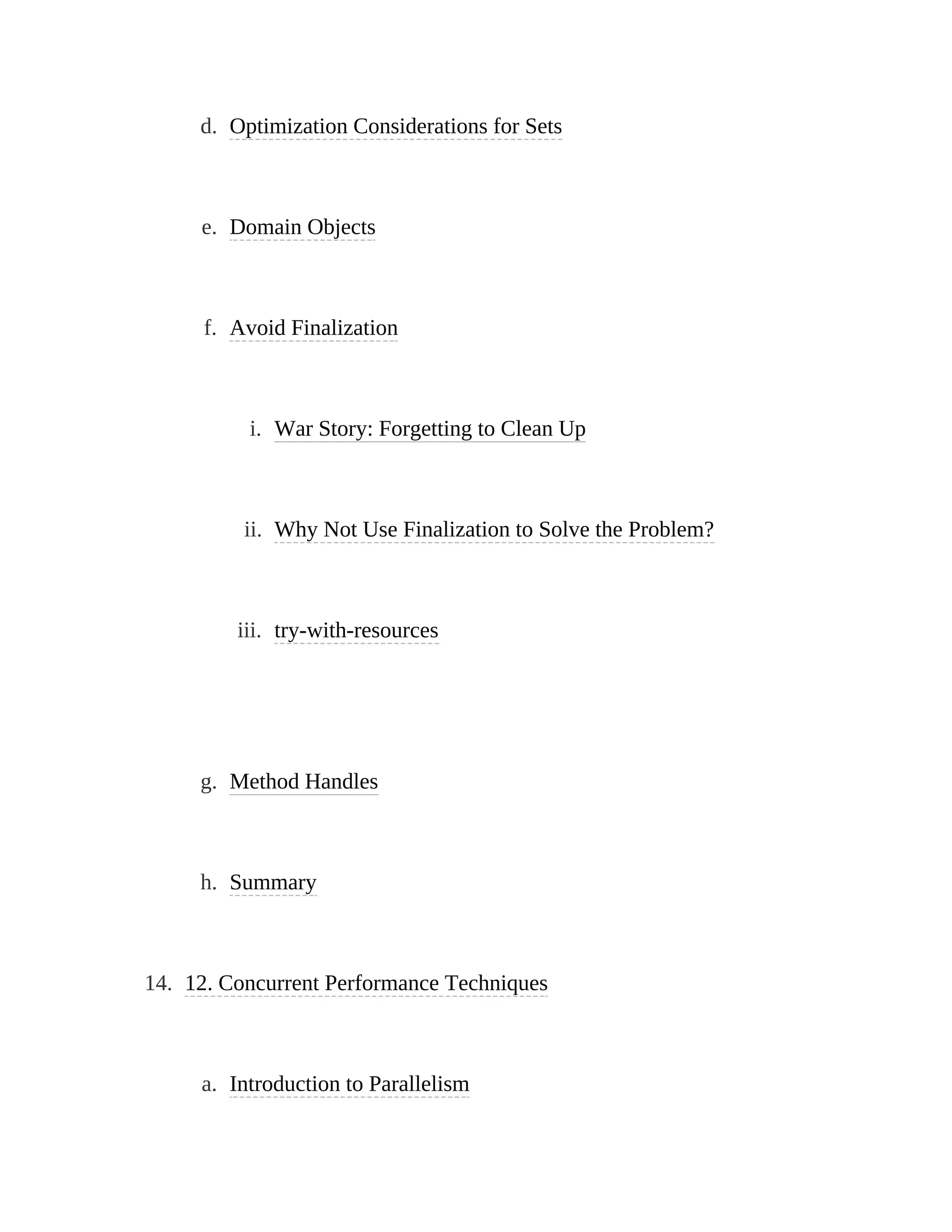
d. Optimization Considerationsfor Sets
e. Domain Objects
f. Avoid Finalization
i. War Story: Forgetting to Clean Up
ii. Why Not Use Finalization to Solve the Problem?
iii. try-with-resources
g. Method Handles
h. Summary
14. 12. Concurrent Performance Techniques
a. Introduction to Parallelism
31.
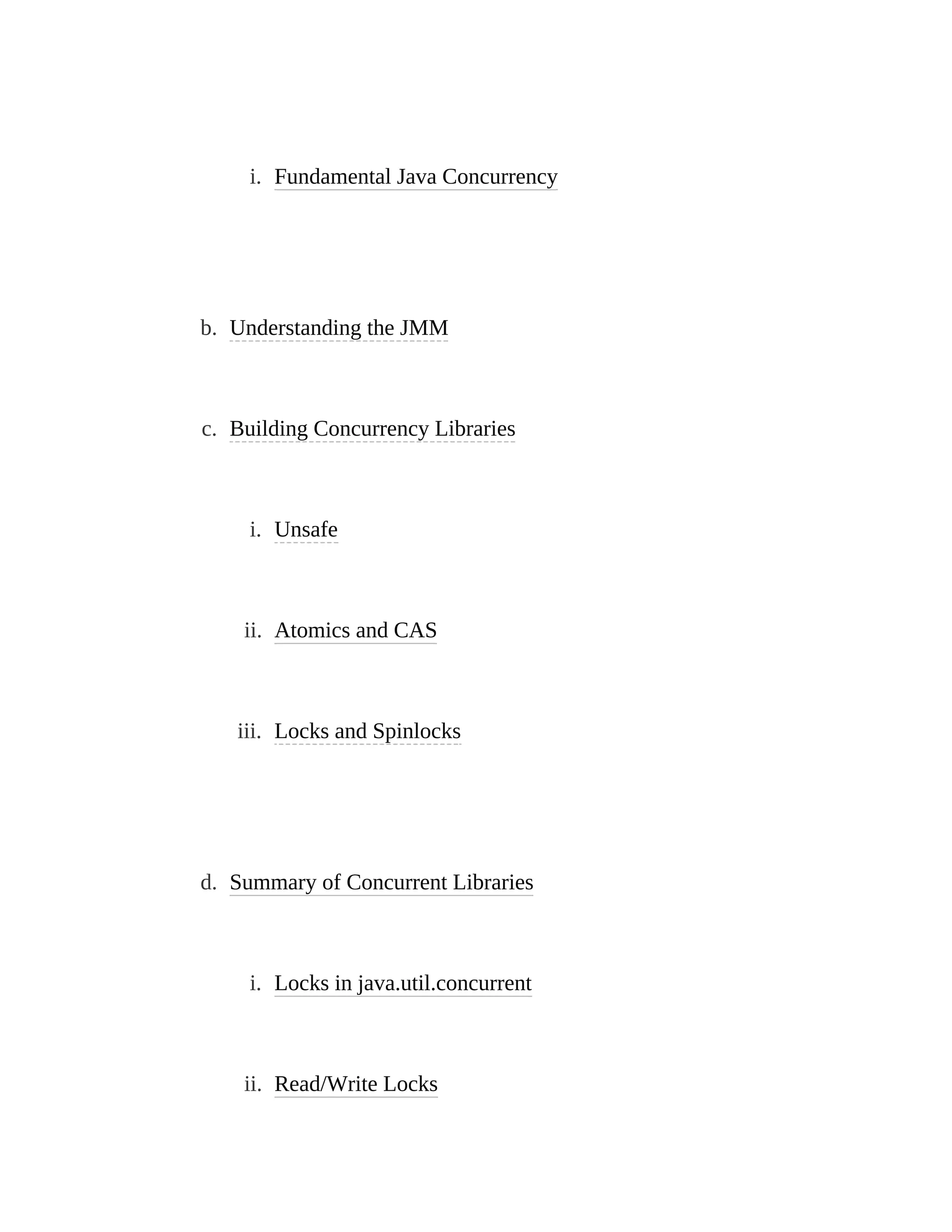
i. Fundamental JavaConcurrency
b. Understanding the JMM
c. Building Concurrency Libraries
i. Unsafe
ii. Atomics and CAS
iii. Locks and Spinlocks
d. Summary of Concurrent Libraries
i. Locks in java.util.concurrent
ii. Read/Write Locks
32.
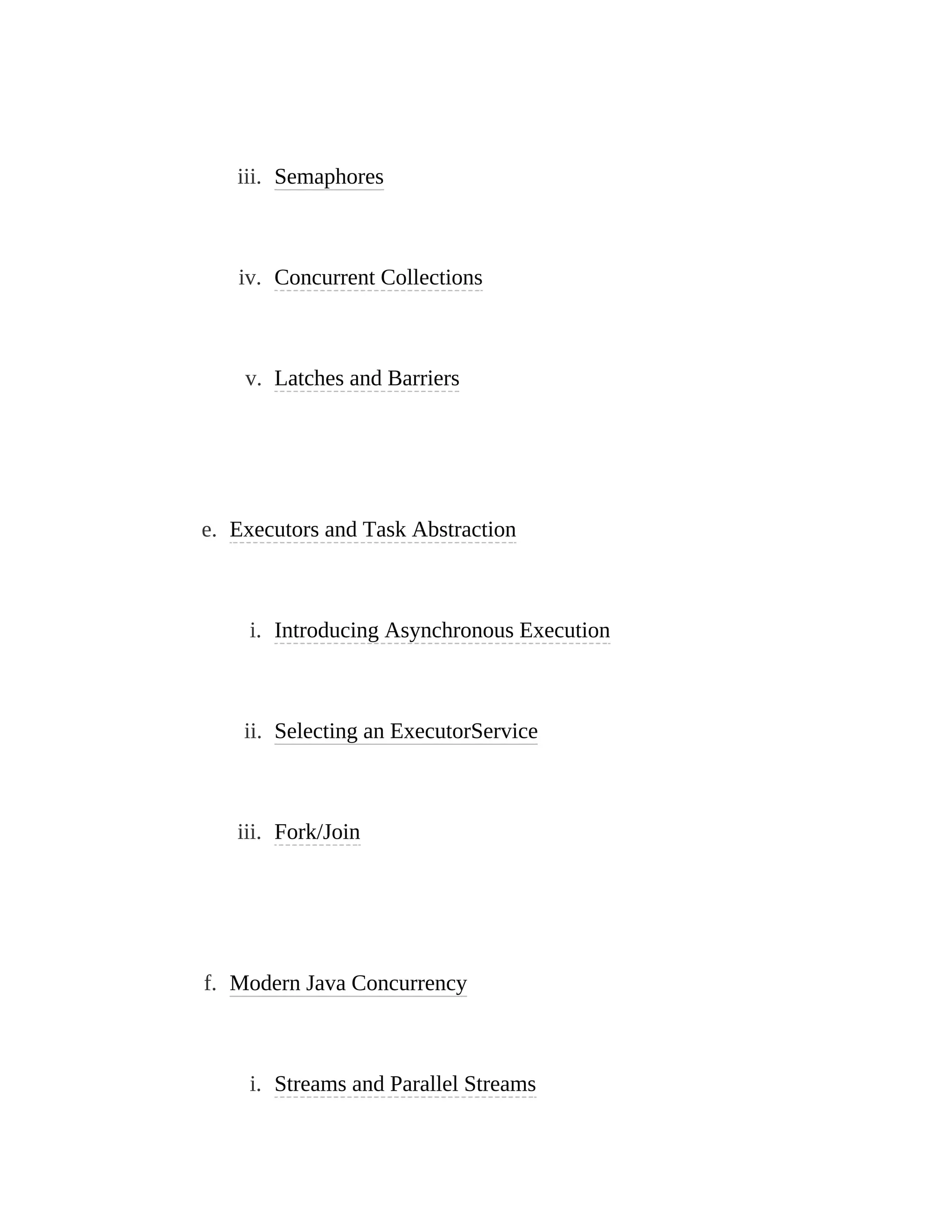
iii. Semaphores
iv. ConcurrentCollections
v. Latches and Barriers
e. Executors and Task Abstraction
i. Introducing Asynchronous Execution
ii. Selecting an ExecutorService
iii. Fork/Join
f. Modern Java Concurrency
i. Streams and Parallel Streams
33.
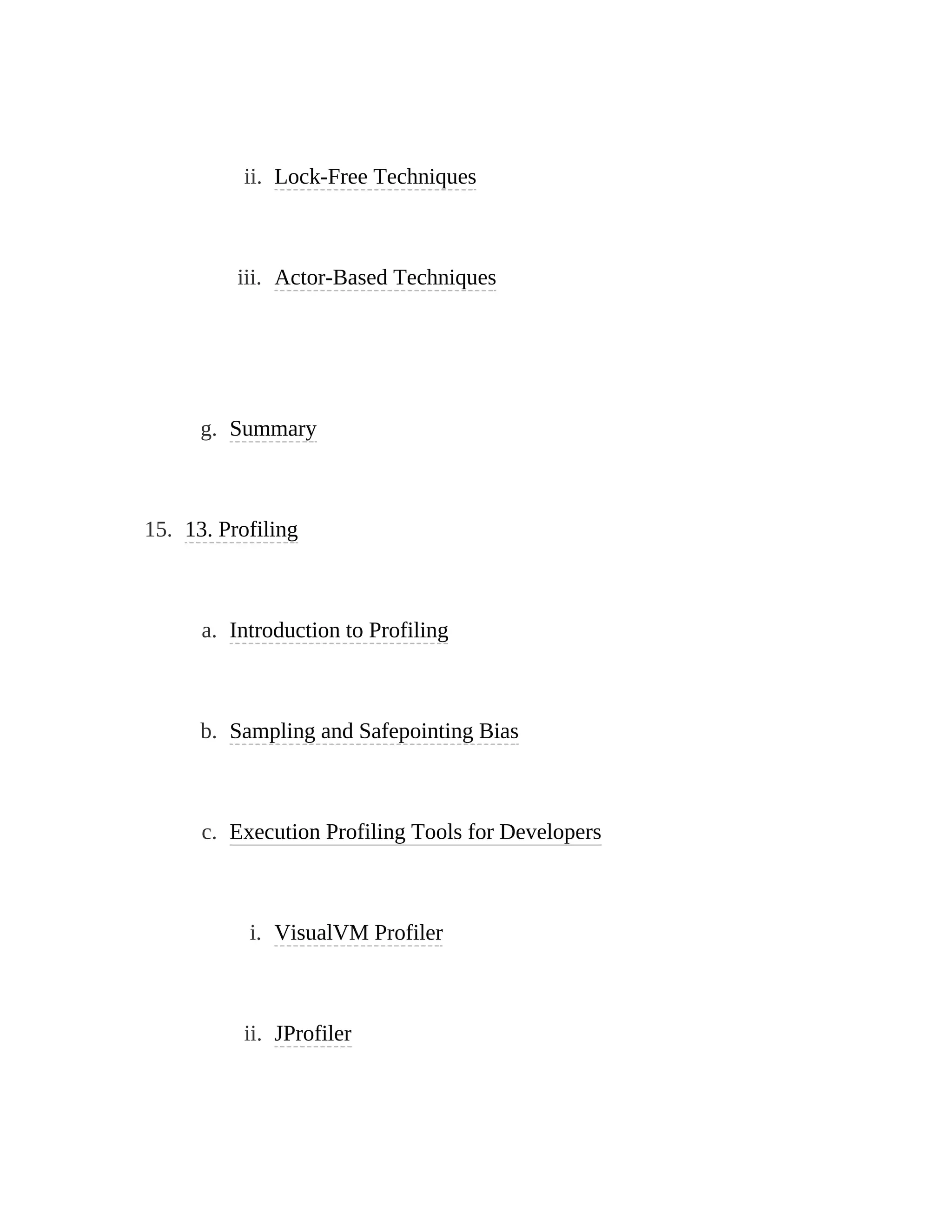
ii. Lock-Free Techniques
iii.Actor-Based Techniques
g. Summary
15. 13. Profiling
a. Introduction to Profiling
b. Sampling and Safepointing Bias
c. Execution Profiling Tools for Developers
i. VisualVM Profiler
ii. JProfiler
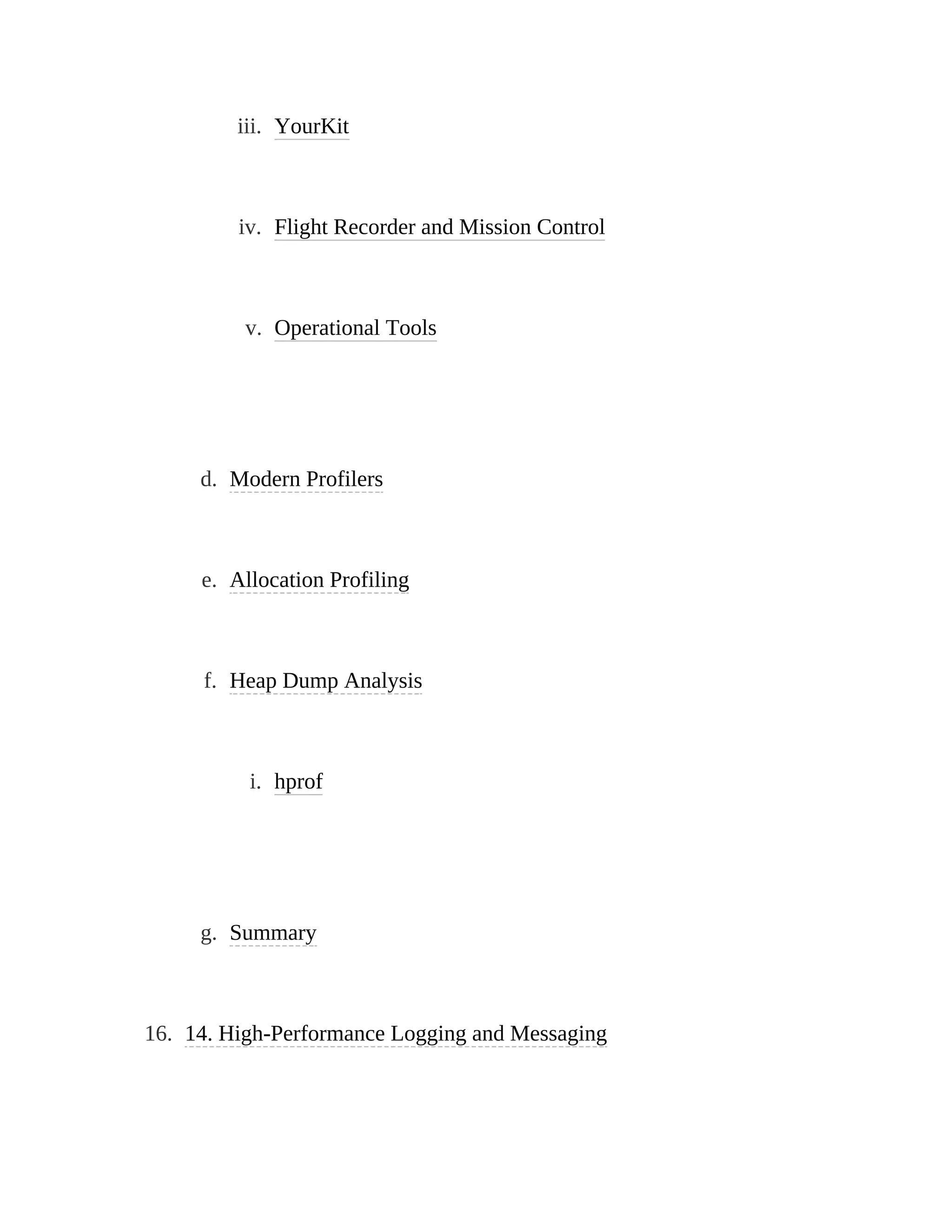
34.
iii. YourKit
iv. FlightRecorder and Mission Control
v. Operational Tools
d. Modern Profilers
e. Allocation Profiling
f. Heap Dump Analysis
i. hprof
g. Summary
16. 14. High-Performance Logging and Messaging
35.
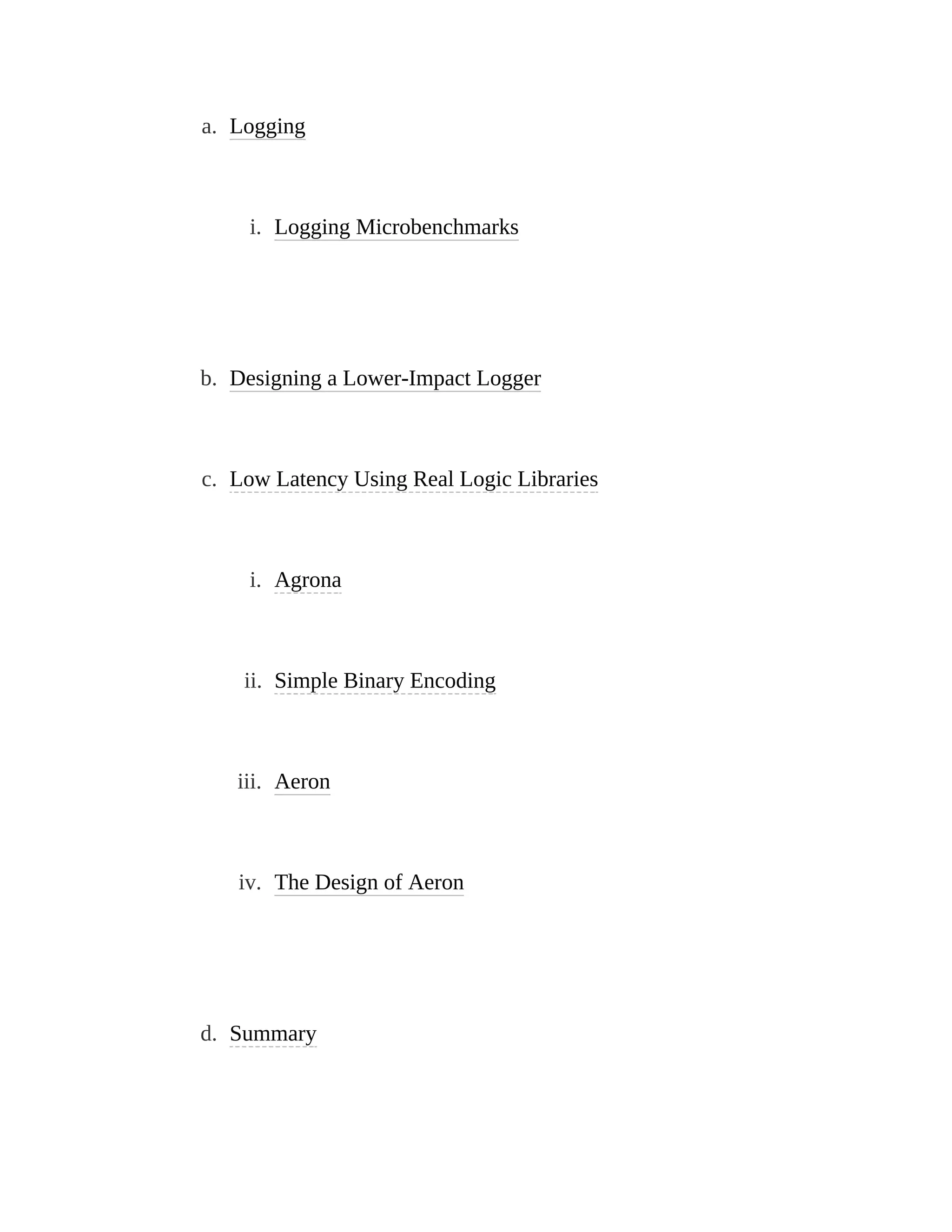
a. Logging
i. LoggingMicrobenchmarks
b. Designing a Lower-Impact Logger
c. Low Latency Using Real Logic Libraries
i. Agrona
ii. Simple Binary Encoding
iii. Aeron
iv. The Design of Aeron
d. Summary
36.
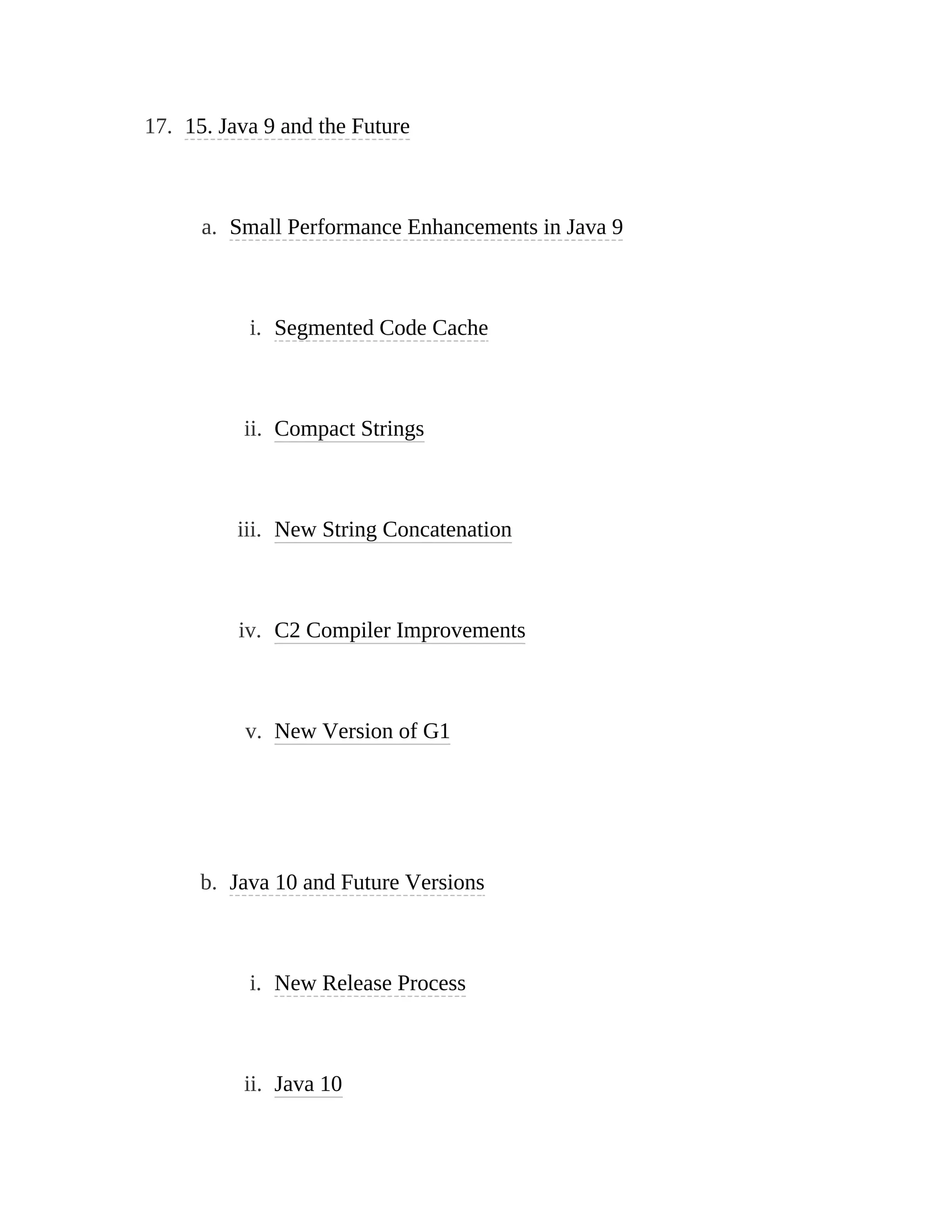
17. 15. Java9 and the Future
a. Small Performance Enhancements in Java 9
i. Segmented Code Cache
ii. Compact Strings
iii. New String Concatenation
iv. C2 Compiler Improvements
v. New Version of G1
b. Java 10 and Future Versions
i. New Release Process
ii. Java 10
37.
c. Unsafe inJava 9 and Beyond
i. VarHandles in Java 9
d. Project Valhalla and Value Types
e. Graal and Truffle
f. Future Directions in Bytecode
g. Future Directions in Concurrency
h. Conclusion
18. Index
Technical Reviewers: JulianTempleman, Michael Hsu, Alex Blewitt,
Dmitry Vyazelenko
May 2018: First Edition
Revision History for the First Edition
2018-04-12: First Release
See http://oreilly.com/catalog/errata.csp?isbn=9781492025795 for release
details.
The O’Reilly logo is a registered trademark of O’Reilly Media, Inc.
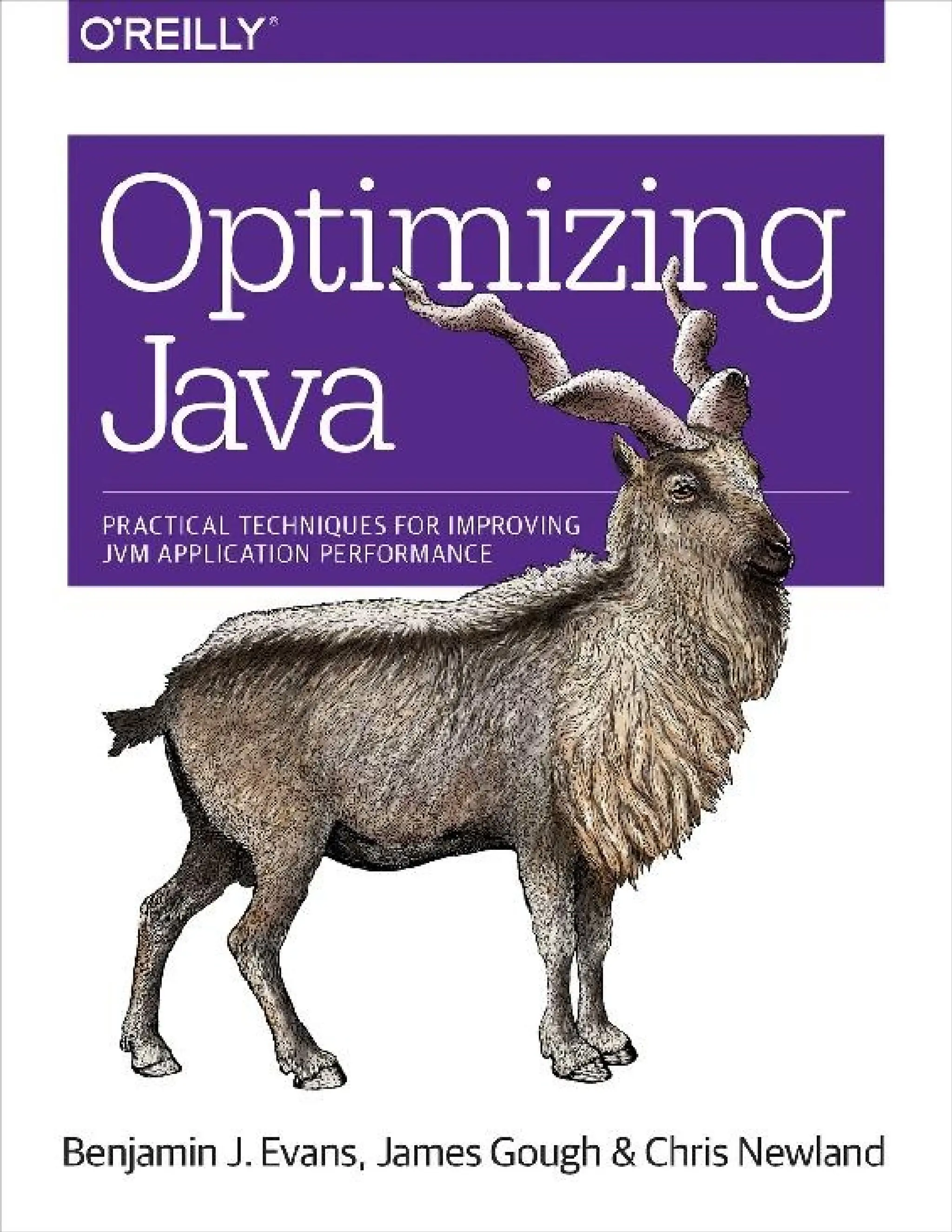
Optimizing Java, the cover image, and related trade dress are trademarks
of O’Reilly Media, Inc.
While the publisher and the authors have used good faith efforts to ensure
that the information and instructions contained in this work are accurate,
the publisher and the authors disclaim all responsibility for errors or
omissions, including without limitation responsibility for damages
resulting from the use of or reliance on this work. Use of the information
and instructions contained in this work is at your own risk. If any code
samples or other technology this work contains or describes is subject to
open source licenses or the intellectual property rights of others, it is your
responsibility to ensure that your use thereof complies with such licenses
and/or rights.
978-1-49202579-5
[LSI]
41.
Dedication
This book isdedicated to my wife, Anna, who not only illustrated it
beautifully, but also helped edit portions and, crucially, was often the first
person I bounced ideas off.
—Benjamin J. Evans
This book is dedicated to my incredible family Megan, Emily, and Anna.
Writing would not have been possible without their help and support. I’d
also like to thank my parents, Heather and Paul, for encouraging me to
learn and their constant support.
I’d also like to thank Benjamin Evans for his guidance and friendship—
it’s been a pleasure working together again.
—James Gough
This book is dedicated to my wife, Reena, who supported and encouraged
my efforts and to my sons, Joshua and Hugo, may they grow up with
inquisitive minds.
—Chris Newland
42.
Foreword
How do youdefine performance?
Most developers, when asked about the performance of their application,
will assume some measure of speed is requested. Something like
transactions per second, or gigabytes of data processed…getting a lot of
work done in the shortest amount of time possible. If you’re an application
architect, you may measure performance in broader metrics. You may be
more concerned about resource utilization than straight-line execution.
You might pay more attention to the performance of connections between
services than of the services themselves. If you make business decisions
for your company, application performance will probably not be measured
in time as often as it is measured in dollars. You may argue with
developers and architects about resource allocation, weighing the cost of
devops against the time it takes to do the company’s work.
And regardless of which role you identify with, all these metrics are
important.
I started out developing Java applications in 1996. I had just moved from
my first job writing AppleScript CGIs for the University of Minnesota’s
business school to maintaining server-side Perl applications for the web
development team. Java was very new then—the first stable version, 1.0.2,
was released earlier that year—and I was tasked with finding something
useful to build.
Back in those days, the best way to get performance out of a Java
application was to write it in some other language. This was before Java
had a Just-in-Time (JIT) compiler, before parallel and concurrent garbage
43.
collectors, and longbefore the server side would become dominated by
Java technology. But many of us wanted to use Java, and we developed all
sorts of tricks to make our code run well. We wrote gigantic methods to
avoid method dispatch overhead. We pooled and reused objects because
garbage collection was slow and disruptive. We used lots of global state
and static methods. We wrote truly awful Java code, but it worked…for a
little while.
In 1999, things started to change.
After years struggling to use Java for anything demanding speed, JIT
technologies started to reach us. With compilers that could inline methods,
the number of method calls became less important than breaking up our
giant monoliths into smaller pieces. We gleefully embraced object-
oriented design, splitting our methods into tiny chunks and wrapping
interfaces around everything. We marveled at how every release of Java
would run things just a little bit better, because we were writing good Java
code and the JIT compiler loved it. Java soared past other technologies on
the server, leading us to build larger and more complex apps with richer
abstractions.
At the same time, garbage collectors were rapidly improving. Now the
overhead of pooling would very frequently overshadow the cost of
allocation. Many garbage collectors offered multithreaded operation, and
we started to see low-pause, nearly concurrent GCs that stayed out of our
applications’ way. The standard practice moved toward a carefree creating
and throwing away of objects with the promise that a sufficiently smart
GC would eventually make it all OK. And it worked…for a little while.
The problem with technology is that it always invalidates itself. As JIT
44.
and GC technologieshave improved, the paths to application performance
have become tricky to navigate. Even though JVMs can optimize our code
and make objects almost free, the demands of applications and users
continue to grow.
Some of the time, maybe even most of the time, the “good” coding
patterns prevail: small methods inline properly, interface and type checks
become inexpensive, native code produced by the JIT compiler is compact
and efficient. But other times we need to hand-craft our code, dial back
abstractions and architecture in deference to the limitations of the compiler
and CPU. Some of the time, objects really are free and we can ignore the
fact that we’re consuming memory bandwidth and GC cycles. Other times
we’re dealing with terabyte-scale (or larger) datasets that put stress on
even the best garbage collectors and memory subsystems.
The answer to the performance question these days is to know your tools.
And frequently, that means knowing not just how Java the language
works, but also how JVM libraries, memory, the compiler, GCs, and the
hardware your apps run on are interacting. In my work on the JRuby
project, I’ve learned an immutable truth about the JVM: there’s no single
solution for all performance problems, but for all performance problems
there are solutions. The trick is finding those solutions and piecing
together the ones that meet your needs best. Now you have a secret
weapon in these performance battles: the book you are about to read.
Turn the page, friends, and discover the wealth of tools and techniques
available to you. Learn how to balance application design with available
resources. Learn how to monitor and tune the JVM. Learn how to make
use of the latest Java technologies that are more efficient than old libraries
and patterns. Learn how to make Java fly.
45.
It’s an excitingtime to be a Java developer, and there have never been so
many opportunities to build efficient and responsive applications on the
Java platform. Let’s get started.
Charlie Nutter
Principal Software Engineer,
Red Hat Middleware
46.
Preface
Conventions Used inThis Book
The following typographical conventions are used in this book:
Italic
Indicates new terms, URLs, email addresses, filenames, and file
extensions.
Constant width
Used for program listings, as well as within paragraphs to refer to
program elements such as variable or function names, databases, data
types, environment variables, statements, and keywords.
<constant width> in angle brackets
Shows text that should be replaced with user-supplied values or by
values determined by context.
TIP
This element signifies a tip or suggestion.
NOTE
This element signifies a general note.
WARNING
47.
WARNING
This element indicatesa warning or caution.
Using Code Examples
Supplemental material (code examples, exercises, etc.) is available for
download at http://bit.ly/optimizing-java-1e-code-examples.
This book is here to help you get your job done. In general, if example
code is offered with this book, you may use it in your programs and
documentation. You do not need to contact us for permission unless
you’re reproducing a significant portion of the code. For example, writing
a program that uses several chunks of code from this book does not
require permission. Selling or distributing a CD-ROM of examples from
O’Reilly books does require permission. Answering a question by citing
this book and quoting example code does not require permission.
Incorporating a significant amount of example code from this book into
your product’s documentation does require permission.
We appreciate, but do not require, attribution. An attribution usually
includes the title, author, publisher, and ISBN. For example: “Optimizing
Java by Benjamin J. Evans, James Gough, and Chris Newland (O’Reilly).
Copyright 2018 Benjamin J. Evans, James Gough, and Chris Newland,
978-1-492-02579-5.”
If you feel your use of code examples falls outside fair use or the
permission given above, feel free to contact us at
permissions@oreilly.com.
O’Reilly Safari
48.
O’Reilly Safari
Safari (formerlySafari Books Online) is a membership-based training and
reference platform for enterprise, government, educators, and individuals.
Members have access to thousands of books, training videos, Learning
Paths, interactive tutorials, and curated playlists from over 250 publishers,
including O’Reilly Media, Harvard Business Review, Prentice Hall
Professional, Addison-Wesley Professional, Microsoft Press, Sams, Que,
Peachpit Press, Adobe, Focal Press, Cisco Press, John Wiley & Sons,
Syngress, Morgan Kaufmann, IBM Redbooks, Packt, Adobe Press, FT
Press, Apress, Manning, New Riders, McGraw-Hill, Jones & Bartlett, and
Course Technology, among others.
For more information, please visit http://oreilly.com/safari.
How to Contact Us
Please address comments and questions concerning this book to the
publisher:
O’Reilly Media, Inc.
1005 Gravenstein Highway North
Sebastopol, CA 95472
800-998-9938 (in the United States or Canada)
707-829-0515 (international or local)
707-829-0104 (fax)
49.
We have aweb page for this book, where we list errata, examples, and any
additional information. You can access this page at http://bit.ly/optimizing-
java.
To comment or ask technical questions about this book, send email to
bookquestions@oreilly.com.
For more information about our books, courses, conferences, and news,
see our website at http://www.oreilly.com.
Find us on Facebook: http://facebook.com/oreilly
Follow us on Twitter: http://twitter.com/oreillymedia
Watch us on YouTube: http://www.youtube.com/oreillymedia
Acknowledgments
The authors would like to thank a large number of people for their
invaluable assistance.
For writing the foreword:
Charlie Nutter
For providing highly specialist technical help, including information and
knowledge not available anywhere else:
Christine Flood
Chris Seaton
Kirk Pepperdine
50.
Simon Ritter
Monica Beckwith
DavidJones
Richard Warburton
Stephen Connolly
Jaroslav Tulach
For general detail, encouragement, advice and introductions:
George Ball
Steve Poole
Richard Pollock
Andrew Binstock
Our technical reviewers:
Michael Hsu
Dmitry Vyazelenko
Julian Templeman
Alex Blewitt
The O’Reilly Team:
Virginia Wilson
Susan Conant
Colleen Cole
Rachel Monaghan
Nan Barber
Chapter 1. Optimizationand
Performance Defined
Optimizing the performance of Java (or any other sort of code) is often
seen as a Dark Art. There’s a mystique about performance analysis—it’s
commonly viewed as a craft practiced by the “lone hacker, who is tortured
and deep thinking” (one of Hollywood’s favorite tropes about computers
and the people who operate them). The image is one of a single individual
who can see deeply into a system and come up with a magic solution that
makes the system work faster.
This image is often coupled with the unfortunate (but all-too-common)
situation where performance is a second-class concern of the software
teams. This sets up a scenario where analysis is only done once the system
is already in trouble, and so needs a performance “hero” to save it. The
reality, however, is a little different.
The truth is that performance analysis is a weird blend of hard empiricism
and squishy human psychology. What matters is, at one and the same
time, the absolute numbers of observable metrics and how the end users
and stakeholders feel about them. The resolution of this apparent paradox
is the subject of the rest of this book.
Java Performance—The Wrong Way
For many years, one of the top three hits on Google for “Java performance
tuning” was an article from 1997–8, which had been ingested into the
53.
index very earlyin Google’s history. The page had presumably stayed
close to the top because its initial ranking served to actively drive traffic to
it, creating a feedback loop.
The page housed advice that was completely out of date, no longer true,
and in many cases detrimental to applications. However, its favored
position in the search engine results caused many, many developers to be
exposed to terrible advice.
For example, very early versions of Java had terrible method dispatch
performance. As a workaround, some Java developers advocated avoiding
writing small methods and instead writing monolithic methods. Of course,
over time, the performance of virtual dispatch greatly improved. Not only
that, but with modern Java Virtual Machines (JVMs) and especially
automatic managed inlining, virtual dispatch has now been eliminated at
the majority of call sites. Code that followed the “lump everything into
one method” advice is now at a substantial disadvantage, as it is very
unfriendly to modern Just-in-Time (JIT) compilers.
There’s no way of knowing how much damage was done to the
performance of applications that were subjected to the bad advice, but this
case neatly demonstrates the dangers of not using a quantitative and
verifiable approach to performance. It also provides another excellent
example of why you shouldn’t believe everything you read on the internet.
NOTE
The execution speed of Java code is highly dynamic and fundamentally depends on the
underlying Java Virtual Machine. An old piece of Java code may well execute faster on a more
recent JVM, even without recompiling the Java source code.
54.
As you mightimagine, for this reason (and others we will discuss later)
this book is not a cookbook of performance tips to apply to your code.
Instead, we focus on a range of aspects that come together to produce
good performance engineering:
Performance methodology within the overall software lifecycle
Theory of testing as applied to performance
Measurement, statistics, and tooling
Analysis skills (both systems and data)
Underlying technology and mechanisms
Later in the book, we will introduce some heuristics and code-level
techniques for optimization, but these all come with caveats and tradeoffs
that the developer should be aware of before using them.
TIP
Please do not skip ahead to those sections and start applying the techniques detailed without
properly understanding the context in which the advice is given. All of these techniques are
capable of doing more harm than good if you lack a proper understanding of how they should be
applied.
In general, there are:
No magic “go faster” switches for the JVM
No “tips and tricks” to make Java run faster
No secret algorithms that have been hidden from you
As we explore our subject, we will discuss these misconceptions in more
detail, along with some other common mistakes that developers often
I mean therigid suspension of all hypotheses, setting to work by
collecting all the facts in relation to the subject, and dealing with
them in strict compliance with the precepts of common sense—or,
what is the same thing, Inductive philosophy.
This will soon show us the just amount of the debt we owe to
Hunter and Abernethy; and, in leading us onwards, instructively
point out why these great men did not farther increase our
obligations.
We shall see how the industry and circumspection of the Argus-
eyed Hunter, as Abernethy used to call him, enabled him to unfold a
legend in nature, which he had neither length of days, sufficient
opportunity, nor perhaps aptitude, wholly to decipher; and how far it
was developed into practical usefulness by the penetrative sagacity
and happy genius of Abernethy; which, like light in darkness, guides
and sustains immediate research, and animates and encourages
onward inquiry. To appreciate Abernethy, however, it is necessary
that the public should have correct views at least of the general
nature and objects of Medical Science.
The public have not only a very real interest in acquiring a sound
common-sense view of the objects of medicine and surgery, but a
far deeper interest than it is possible for any one medical man to
have, merely as such, or all medical men put together. This may, for
the moment, appear startling to those who have not been compelled
to consider the subject; but the reader may glean even from this
volume, that so long as life or health, or even money, has value, the
remark is strictly true. From all sides mankind have hitherto imbibed
little but error. They have been taught or induced to believe that the
only objects of medicine and surgery are to prevent or relieve
diseases and accidents by the astute employment of drugs, or by
certain adroit manipulatory or mechanical proceedings, and par
excellence by "operations." Now here is a great mistake—an idea so
far from true, that nothing can more delusively define, or more
entirely conceal, the higher objects of the science.
57.
The direct contraryof the proposition would be nearer the truth.
It would be more correct to say that the object was to relieve
diseases and accidents by removing all interferences with the
reparative powers of nature; and that this was accomplished more
perfectly in proportion as we were enabled to dispense with the
employment of drugs, or the performance of operations.
The making the lame to walk, the blind to see, and the deaf to
hear, were chosen amongst the appropriate symbols of a Divine
Mission; and we need scarcely observe, that, in the restricted sphere
of human capacity, this is a portion of the mission of every
conscientious surgeon.
We may well, therefore, be dissatisfied with the narrow, not to
say degrading, definition of our duties too generally entertained;
but, on the other hand, if we would realize our claims to these
higher views of our calling, and enlarge the sphere of its practical
usefulness, we should recollect there is only one way of attaining
that object; and that is, by the applied interpretation of those
symbols, no less miraculous, no less certain manifestations of Divine
Power, the "Laws of Nature." To name a science from something not
essential to it, is like naming a class of animals from some
exceptional peculiarity in an individual. It is as if we would infer the
mission of the ocean wave from the scum sometimes seen on its
surface; or the purposes served by a feather, from the use we make
of it in writing, rather than from its common character of levity and
toughness; as if we treated an exception as a rule, or any other
manifest absurdity.
We have no opportunity of entering more fully into this
important distinction of the more lofty objects of our profession, as
contrasted with those usually assigned to it; we must therefore rest
satisfied in having awakened the reader's attention to the subject,
and proceed to the more ordinary objects of Biographical Memoir.
John Abernethy was born in London, in the parish of St.
Stephen's, Coleman Street, on the 3rd of April, 1764, exactly one
year after John Hunter settled in London. It is also interesting to
58.
remark, that Abernethy'sfirst work, his "Surgical and Physiological
Essays"—Part I—was published the same year that Hunter died,
1793; so that, whilst his birth occurred nearly at the same time as
the commencement of the more sustained investigations of Hunter,
his opening contribution to science was coincident with the close of
the labours of his illustrious friend and predecessor.
The Abernethy family in their origin were possibly Scotch, and
formed one of those numerous inter-migrations between Scotland
and the north of Ireland, which, after lapse of time, frequently
render it difficult to trace the original stock. There seems little doubt
they had resided for some generations in Ireland. John Abernethy,
who was the pastor of a Coleraine congregation, in 1688, was an
eminent Protestant dissenting minister, and the father of one still
more distinguished. The son (also named John) had been for some
time pastor of the old congregation of Antrim, whence he removed
to Dublin about the year 1733, to take charge of the Wood Street,
now Strand Street, Dublin. He is the author of several volumes of
sermons, which are not a little remarkable for clearness of thought,
and the earnestness of purpose, with which they inculcate practical
piety. He had a son who was a merchant, who subsequently
removed to London, and traded under the firm of Abernethy and
Donaldson, in Rood Lane, Fenchurch Street. This gentleman married
a lady whose name was Elizabeth Weir, daughter of Henry and
Margaret Weir, of the town of Antrim, and they had two sons and
three daughters.
James5, the elder brother, was also in business as a merchant,
and died about the year 1823. He was a man of considerable talent,
spoke with an accent suggestive of an Irish origin, and was
remarkable for his admiration and critical familiarity with our
immortal Shakspeare. He was probably born before his father left
Ireland. John, the second son, the subject of our Memoir, was, as we
have already said, born in London. The register of his christening at
St. Stephen's is as follows:
59.
Abernethy {
1765.
John, sonof
John and
Elizabeth,
April, 24.
This register would suggest that he was born a year later than I
have stated. I have, however, preferred 1764, as the year adopted
by his family; for although a man's birth is an occurrence respecting
the date of which he is not the very best authority, he usually gets
his information from those who are. Besides, it was no uncommon
thing at that time to defer the christening of children for a much
longer period. The education of his early childhood was, most likely,
altogether conducted at home; but it is certain that, while yet very
young, he was sent to the Grammar School at Wolverhampton. Here
he received the principal part of his education; and though the
records are somewhat meagre, yet they tend to show that at an
early age he manifested abilities, both general and peculiar, which
were indicative of no ordinary mind; and which, though they do not
necessarily prefigure the future eminence at which he arrived, were
sufficiently suggestive of the probability that, whatever his career
might be, he would occupy a distinguished position.
[1]
Born. Died.
2Galileo 1564 1642.
Kepler 1571 1630.
Bacon 1561 1626.
Newton 1642 1727.
60.
[2] The sameyear that Galileo died.
[3]
Born. Died.
Priestly 1733 1804.
Galvani 1737 1798.
Volta 1745 1826.
Lavoisier 1743 1794.
Crauford 1749 1795.
Hunter 1728 1793.
Davy 1778 1829.
[4] The valvular contrivances in the veins and
heart, which showed that the blood could move
in only one direction, had been either observed,
described, or their effects respectively remarked
on, by Paul, Sylvius, Michael Servetus, Realdus
Columbus, Andreas Cesalpinus, and especially by
Fabricius ab Aquapendente, of whom Harvey was
a pupil.
[5] In a polite letter which I recently received
from a distinguished pupil of Abernethy's (Dr.
Butter, of Plymouth), I find that James Abernethy
died of apoplexy, at Plymouth.
62.
CHAPTER II.
"Ah, happyhills! ah, pleasing shade!
Ah, fields beloved in vain,
Where once my careless childhood stray'd,
A stranger yet to pain."
Gray.
Mankind naturally feel an interest in the boyhood of men of
genius; but it often happens that very little attention is paid to early
indications; and, when observed, it is certain that they are often
interpreted very falsely.
Nothing more emphatically suggests how much we have to learn
on this subject, than the obscurity which so often hangs over the
earlier years of distinguished men. At school, a number of variable
organizations are subjected to very much the same influences; the
necessity for generalization affords little opportunity for individual
analysis. The main road is broad and familiar; there is no time for
indulging in bye-paths, even should the master have the penetration
to perceive, in individual cases, the expediency of such selection.
Hence the quickening of those impulses, on which the development
of character so much depends, is greatly a matter of uncertainty.
The moment boys leave school, on the contrary, this uniformity of
external influences is replaced by an interminable diversity; at home,
scarcely two boys being subjected to exactly the same. Thus, in
many instances, it would be easier to deduce the character of the
boy from the man, than to have predicted the man from the boy.
The evidences of the one are present to us, those of the other may
have been entirely unelicited, unobserved, or forgotten.
63.
We cannot wonder,then, that expectation should have been so
often disappointed in the boy, or that excellences little dreamt of
should have been developed in the man.
Dryden, who, regarded in the triple capacity of poet, prose-
writer, and critic, is hardly second to any English author, took no
honour at the University. Swift, perhaps our best writer of pure
English, whose talents proved scarcely less versatile and
extraordinary than they had appeared restricted and deficient, was
"plucked" for his degree, in Dublin, and only obtained his
recommendation to Oxford "speciali gratia" as it was termed. The
phrase, however, being obviously equivocal, and used only in the
bad sense at Dublin, was, fortunately for Swift, interpreted in a good
sense at Oxford—a misapprehension which Swift, of course, was at
no pains to remove.
Sheridan was remarkable for his readiness, his invention, and his
wit; as a writer, he showed considerable powers of sustained
thought also. He had an habitual eloquence, and, on one occasion,
delivered an oration before one of the most distinguished audiences
that the world ever saw6, with an effect that seems to have rivalled
the most successful efforts of Cicero, or even Demosthenes. Yet he
had shown so little capacity as a boy, that he was presented to a
tutor by his own mother with the complimentary accompaniment
that he was an incorrigible dunce.
Some boys live on encouragement, others seem to work best
"up stream." Niebuhr, the traveller, the father of a son no less
illustrious, with anything but an originally acute mind, seems to have
overcome every disadvantage which the almost constant absence of
opportunity could combine. Those who are curious in such matters
might easily multiply examples of the foregoing description, and add
others where—as in the case of Galileo, Newton, Wren, and many
others—the predictions suggested by early physical organization
proved as erroneous as the intellectual indications to which we have
just adverted.
64.
The truth is,we have a great deal to learn on the subject of
mind, although there is no want of materials for instruction.
Medicine and surgery are not the only branches of knowledge which
require the aid of strictly inductive inquiry. In all, the materials
(facts) are abundant.
In Abernethy there was a polarity of character, an individuality, a
positiveness of type, which would have made the boy a tolerably
intelligible outline of the future man. The evidence is imperfect; it is
chiefly drawn from the recollections of a living few, who, though
living, have become the men of former days; but still the evidence
all inclines one way.
We can quite imagine a little boy, "careless in his dress, not
slovenly," with his hands in his pockets, some morning about the
year 1774, standing under the sunny side of the wall, at
Wolverhampton Grammar School7; his pockets containing, perhaps,
a few shillings, some halfpence, and a knife with the point broken, a
pencil, together with a tolerably accurate sketch of "Old Robertson's"
wig. This article, as shown in an accredited portrait8 now lying
before us, was one of those enormous bygone bushes which
represented a sort of impenetrable fence round the cranium, as if to
guard the precious material within. The said boy just finishing a
story to his laughing companions, though no sign of fun appeared in
him, save a little curl of the lip, and a smile which would creep out of
the corner of his eye in spite of him. I have had the good fortune to
find no less than three schoolfellows of Abernethy, who are still
living: John Fowler, Esq. of Datchet, a gentleman whom I have had
the pleasure of knowing for many years, and who enjoys, in
honourable retirement at his country seat, at the age of eighty-two,
the perfect possession of all his faculties; William Thacker9
, Esq. of
Muchall, about two miles from Wolverhampton, who is in his eighty-
fifth year; T. Tummins, Esq. of King Street, Wolverhampton, who is
in his eighty-seventh year. To these gentlemen, and to J. Wynn, Esq.
also of Wolverhampton, I am principally indebted for the few
65.
reminiscences I havebeen able to collect of the boyish days of
Abernethy.
The information which I gained from Mr. Fowler, he gave me
himself; he also kindly procured me a long letter from Mr. Wynn. The
reminiscences of Mr. Tummins and Mr. Thacker, I have obtained
through the very courteous and kind assistance of the Rev. W.
White, the late10 distinguished head master of the Wolverhampton
School.
To all of these gentlemen I cannot too strongly express my
thanks, for the prompt and kind manner in which they have replied
to all the enquiries which have been addressed to them. The
following are the principal facts which their letters contain, or the
conclusions they justify. Abernethy must have gone to
Wolverhampton when very young, probably; I should say certainly
before 1774. He was brought by Dr. Robertson from London, with
another pupil, "his friend Thomas;" and the "two Londoners"
boarded with Dr. Robertson. When Mr. Fowler went there in 1778,
Abernethy was high up in the school, and ultimately got to the head
of the senior form. He must have left Wolverhampton in all
probability not later than 1778, because Dr. Robertson resigned the
head mastership in that year; and we know that in the following
(1779), when he was fifteen, Abernethy was apprenticed to Sir
Charles Blicke.
Mr. Thacker says he was very studious, clever, a good scholar,
humorous, but very passionate. Mr. Tummins, Mr. Thacker says,
knew Abernethy well. Abernethy used to go and dine frequently with
Mr. Tummins's father. Mr. Tummins says "Abernethy was a sharp boy,
a very sharp boy, and a very passionate one too. Dr. Robertson," he
says, "was also a very passionate man."
One day, Abernethy had to "do" some Greek Testament; and it
appeared that he set off very glibly, having a "crib" in the shape of a
Greek Testament, with a Latin version on the other side. The old
Doctor, suspecting the case, discovered the crib, and the pupil was
instantly "levelled with the earth." This fortiter in re plan of carrying
66.
the intellect bya coup-de-main, has, as the late head master
observed, been replaced by more refined modes of proceeding. The
more energetic plan was (however coarse and objectionable) not
always unsuccessful in implanting a certain quantity of Latin and
Greek. Abernethy was a very fair Latin scholar, and he certainly had
not, at one period, a bad knowledge of Greek also.
There are, however, many other things to be learnt besides Latin
and Greek; and it is probable that the more measured reliance on
such violent appeals, which characterizes modern education, might
have been better suited to Abernethy. To a boy who was naturally
shy, and certainly passionate, such mechanical illustrations of his
duty were likely to augment shyness into distrust, and to exacerbate
an excitable temper into an irritable disposition.
Abernethy, in chatting over matters, was accustomed jocularly to
observe that, for his part, he thought his mind had, on some
subjects, what he called a "punctum saturationis;" so that "if you put
anything more into his head, you pushed something out." If so, we
may readily conceive that this plan of forcing in the Greek, might
have forced out an equivalent quantity of patience or self-
possession. It is difficult to imagine anything less appropriate to a
disposition like Abernethy's than the discipline in question. It was, in
fact, calculated to create those very infirmities of character which it
is the object of education to correct or remove.
It seems that neither writing nor arithmetic were taught in the
school; and "Tummins and Abernethy" used to go to learn these
matters at the school of a Miss Ready, in King Street,
Wolverhampton. This lady appears to have had, like Dr. Robertson, a
high opinion of what the profession usually term "local applications"
in the conduct of education. Many years afterwards, she called upon
Mr. Abernethy. He was then in full practice in London. He received
her with the greatest kindness, begged her to come and dine with
him as often as she could while she stayed in London; and,
introducing her to Mrs. Abernethy, said: "I beg to introduce to you a
lady who has boxed my years many a time."
67.
Had Miss Ready,however, heard us call in question the necessity
of this association of boxing ears and quill-driving, she would
probably have retorted on us, that few men wrote so good a hand as
John Abernethy. It is certain that, brusque as the discipline might
have been, or ill-suited to the disposition of Abernethy, it did not
interfere with the happiness of his schoolboy life. He always looked
back to his days at Wolverhampton with peculiar pleasure, and
seemed to regard every association with the place with affectionate
remembrance.
Mr. Wynn observes, in his letter: "About twenty years ago I
accompanied a patient to Mr. Abernethy. After prescribing, he said,
'let me see you again in about a week,' 'We cannot, for we are
returning into the country.' 'Why, where do you live?'
'Wolverhampton.' 'Wolverhampton? Why, I went to school there.
Come, sit down, and tell me who's alive and who's dead.' After
running over the names of some of the old families, their health,
circumstances, &c. he wished us good morning, saying, 'Ah! I cannot
forget Wolverhampton!'"
Mr. Thacker's note I subjoin, written in a good firm hand, at
eighty-five.
"Muchall, near Wolverhampton,
"May 17, 1852.
"Sir,
"As a boy, I remember John Abernethy and William Thomas coming
from London to board with, and as scholars to, Dr. Robertson, the head
master of the Wolverhampton School, in which there were two masters,
both clergymen. We were formed into several classes, in which John
Abernethy, William Thomas, Walter Acton Mosely, and myself, formed one.
Abernethy took the head or top of the class; but the boys used to change
places in the classes according to their proficiency; but I do not recollect
that Abernethy ever took a third place in the class. So also in his sports,
he usually made a strong side, for he was remarkably quick and active,
and soon learned a new game. He had but one fault that I knew of—he
was rather hasty and impetuous in his manner, but it was soon over and
forgotten.
68.
"The 'Doctor,' aswe used to call him (Robertson), had a daughter
grown up, and she used to hear the boarders in the house read plays
before her father, in which, in particular passages, she showed where the
emphasis should be laid, and how to pronounce the same properly; this
occasioned the use of the play of 'Cato,' and originated the boys'
performance of that play in the school-room before their fathers and
friends. I do not remember the part that Abernethy took in that play. I
have applied to Mr. Tummins of Wolverhampton, but his memory does not
supply information. He knew Mr. Abernethy well.
"If I recollect any others of my schoolfellows who knew him, I will
apply to them for information, and communicate the same to you
immediately.
"I am, Sir,
"Your obedient servant,
"William Thacker.
To George Macilwain, Esq."
We learn from another reminiscent, that in the play at
Wolverhampton Abernethy took a "principal part." He certainly had a
good deal of dramatic talent, in the highest sense of the word; and,
as will be seen in the sequel, could light up a story with rich humour,
or clothe it with pathos, as suited the occasion, with equal facility.
Scanty as they are, there is much in these school reminiscences
significant of his future character.
As we have observed, Abernethy left Wolverhampton in 1778.
He was then head of the school, a quick, clever boy, and more that
an average scholar. He returned to London, that world of hopes,
fears, and anxieties; that spacious arena, on which all are desirous
of entering as competitors who are ambitious of professional or
commercial distinction.
[6] We allude to his first speech on the trial of
Warren Hastings.
[7] Wolverhampton School, founded by Sir
Stephen Jermyn, Alderman and Knight of the
69.
City of London,in the reign of Henry VIII, for the
"Instruction of youth in morals and learning."
Many distinguished men were educated at the
School; as Abernethy; Mr. Tork, fellow of Trinity
College, Cambridge; Sir William Congreve; and
others.
[8] Kindly sent us by Mr. Fowler, of Datchet.
[9] This gentleman died last year. He had
retired to his seat at Muchall, from
Wolverhampton, where he had practised as a
solicitor of great eminence and respectability.
[10] Since the last edition, I have to regret the
death of this gentleman. He was an excellent
man, a good mathematician, and an
accomplished scholar. He graduated at
Cambridge, and took honors in 1815.
70.
CHAPTER III.
"Nunquam itaquisquam bene subductâ ratione ad vitam fuit
Quin res, ætas, usus, semper aliquid apportet novi
Aliquid moneat; ut illâ quæ te scire credas, nescias:
Et quæ tibi putâris primâ, in experiundo repudias."
Ter. ad. a. 5, sc. 4.
"Never did man lay down so fair a plan,
So wise a rule of life, but fortune, age,
Or long experience made some change in it,
And taught him that those things he thought he knew,
He did not know, and what he held as best
In practice, he threw by."
Colman.
Circumstances, in themselves apparently unimportant, often
determine the selection of a profession. Few boys can do exactly
what they please, and the pros and cons are seldom placed before
them in a way to assist them in determining the just value of the
reasons on which their choice may have proceeded. They are not,
indeed, unfrequently dealt with as if, whilst not incompetent to make
choice of a profession, they were held incapable of weighing the
circumstances by which alone such choice could be judiciously
directed. The absurdity of this appears, when we think a moment of
what it involves, which is nothing less than expecting them to do
what is impossible; viz. to form an opinion on a subject when the
main facts in relation to it are withheld from them. Be this as it may,
71.
every day showsus that men are too frequently dissatisfied with the
profession which they follow. The question of our boyhood
recollections—
"Qui fit Mæcenas ut nemo quam sibi sortem,
Seu ratio dederit seu fors objecerit, illâ,
Contentus vivat?"11
is just as applicable as ever; and although human nature has almost
everything ascribed to its natural infirmities, yet it appears quite as
sensible, and not a whit less humble, to conclude, that paths chosen
without consideration naturally lead to disappointment. The evil, like
most others, carries with it the elements of self correction.
Parents are slow to encourage their children to select paths
which they themselves have trodden with regret. This tends to
distribute their professions to other families. Mutual interchanges of
this kind serve to protect the interests of society, by, in some degree,
limiting the number of cases in which men have failed to select the
pursuits best adapted to them.
In almost all pursuits of life, success is determined, much more
than many are disposed to imagine, by the homely qualities of
steadiness and industry. We are apt—and sometimes not improperly
—to ascribe peculiar excellence to peculiar powers. Yet the more
insight we obtain into the histories of men, the more we perceive
how constantly the most brilliant have been aided by the more
homely qualifications to which we have adverted.
No doubt some minds are so constituted as to be moderately
certain of success or distinction in almost any pursuit to which they
might have been directed; and we are disposed to think that
Abernethy's was a mind of that order; but there is abundant
evidence to show that his talents were at least equalled by his
industry. One paper of his, which contains a beautiful and
discriminative adjustment of a difficult point of practice in Injuries of
the Head—which contains no intrinsic evidence of such industry—
72.
was not publisheduntil after he had attended to every serious injury
of the head in a large hospital for almost twenty years; besides
examining the bodies of all the fatal cases. Nor can we estimate this
industry properly, without recollecting that all this time he was only
an assistant surgeon, whose duties, for the most part, neither
required nor permitted him to do more than to observe the
treatment; and that, therefore, the whole of this industry was simply
in the character of a student of his profession12. All biography is full
of this kind of evidence; and art, as well as science, furnishes its
contribution. Who could have imagined that the peculiar, chaste
composition, the easy and graceful touch of Sir Augustus Callcott,
could have owed so much to industry as it undoubtedly must have
done? It is known, for example, that he made no less than forty
different sketches in the composition of one picture. We allude to his
"Rochester." Had Abernethy been allowed to choose his profession,
he, no doubt, would have selected the Bar. It is impossible to reflect
on the various powers he evinced, without feeling that, had he
followed the law, he would have arrived at a very distinguished
position. "Had my father let me be a lawyer," he would say, "I should
have known every Act of Parliament by heart." This, though no
doubt intended as a mere figure of speech, was not so far from
possibility as might be imagined, for it referred to one of his most
striking characteristics; viz. a memory alike marvellously ready,
capacious, and retentive—qualities common enough separately, but
rare in powerful combination.
We may have opportunities by and by, perhaps, of further
illustrating it. We will give one anecdote here. A gentleman, dining
with him on a birthday of Mrs. Abernethy's, had composed a long
copy of verses in honour of the occasion, which he repeated to the
family circle after dinner. "Ah!" said Abernethy, smiling, "that is a
good joke, now, your pretending to have written those verses." His
friend simply rejoined, that, such as they were, they were certainly
his own. After a little good-natured bantering, his friend began to
evince something like annoyance at Abernethy's apparent
incredulity; so, thinking it was time to finish the joke, "Why," said
73.
Abernethy, "I knowthose verses very well, and could say them by
heart13." His friend declared it to be impossible; when Abernethy
immediately repeated them throughout correctly, and with the
greatest apparent ease. To return. However useful this quality might
have been at the Bar, Abernethy was destined to another course of
life—a pathway more in need, perhaps, of that light which his higher
qualifications enabled him to throw over it, and which "his position"
"in time" afforded him an opportunity of doing just when it seemed
most required. He probably thus became, both during life and
prospectively, the instrument of greater good to his fellow-creatures
than he would have been in any other station whatever.
I have not been able to discover what the particular
circumstances were which determined his choice of the medical
profession. It is probable that they were not very peculiar. A boy
thwarted in his choice of a profession, is generally somewhat
indifferent as to the course which is next presented to him; besides,
as his views would not have been opposed but for some good
reason, a warm and affectionate disposition would induce him to
favour any suggestion from his parents. Sir Charles Blicke was a
surgeon in large practice; he lived at that time in Mildred's Court,
and Abernethy's father was a near neighbour, probably in Coleman
Street.
Abernethy had shown himself a clever boy, a good scholar; and
he was at the top of Wolverhampton School before he was fifteen.
Sir Charles Blicke was quick-sighted, and would easily discover that
Abernethy was a "sharp boy." All that Abernethy probably knew of
Sir Charles, was, that he rode about in his carriage, saw a good
many people, and took a good many fees, all of which, though
perhaps presenting no particular attractions for Abernethy, made a
primâ facie case, which was not repulsive. Accordingly, in the year
1779, being then fifteen years of age, he became bound an
apprentice to Sir Charles, and, probably, for about five years.
This first step, this apprenticing, has a questionable tendency as
regards the interests of the public and the profession. It exerts, also,
74.
a considerable influenceon the character and disposition of the boy,
which we must by and by consider. It is a mode of proceeding
which, we fear, has done not a little to impede the progress of
surgery as a science, and to maintain that handicraft idea of it
suggested by the etymology of the word. Where one man strikes out
a new path, thousands follow the beaten track. A boy, with his mind
ill-prepared, having no definite ideas of the nature and objects of
scientific inquiries, and almost certainly uninstructed as to the rules
to be observed in conducting them—knowing neither any distinction
between an art and a science—a boy thus conditioned is bound for a
certain number of years! to a man of whom he knows little, and to a
profession of which he knows nothing. He takes his ideas and his
tone from his master; or, if these be repulsive to him, he probably
adopts an opposite extreme. If the master practise his profession
merely as an art, he furnishes his pupil with little more than a string
of conventionalisms; of which, if the pupil has talent enough to do
anything for himself, he is tolerably certain to have a great deal to
unlearn.
We believe the system is in course of improvement; it is high
time it was put an end to altogether. Apprenticeships might not have
been an inauspicious mode of going to work in former times, when
there existed barber-surgeons. This alliance of surgery and shaving,
to say nothing of the numerous other qualifications with which they
were sometimes associated, might conceivably enough have
furnished some pretext for apprenticeships; since Dickey Gossip's
definition of
"Shaving and tooth-drawing,
Bleeding, cabbaging, and sawing,"
was by no means always sufficiently comprehensive to include the
multifarious accomplishments of "the doctor." I have myself seen, in
a distant part of this island, within twenty-five years, chemist,
druggist, surgeon, apothecary, and the significant &c. followed by
the hatter, hosier, and linen-draper, in one establishment; but as we
75.
shall have todiscuss this subject more fully in relation to Abernethy
in another place, we may proceed.
Sir Charles Blicke had a large and lucrative practice. He had the
character of taking care to be well remunerated for his services. He
amassed a considerable fortune; but we incline to think that the
ideas of the profession which Abernethy derived from his experience
of his apprenticeship were not very favourable. The astute, business-
like mode of carrying on the profession, which seems to have
characterized Sir Charles Blicke's practice, could have had few
charms for Abernethy. Mere money-making had never at any time
much attraction for him, and, at that period of his life, probably none
at all; whilst the measured pretensions of surgery to anything like a
science could hardly have been, at times, otherwise than repulsive.
The tone in which he usually spoke of Sir Charles's practice did
not convey a very favourable idea of the impression which it had left
on him. In relating a case, he would say: "Sir Charles was at his
house in the country, where he was always on the look out for
patients." On another occasion, speaking of patients becoming faint
under peculiar circumstances, he observed: "When I was an
apprentice, my master used to say: 'Oh, Sir! you are faint; pray drink
some of this water.' And what do you think was the effect of his
putting cold water into a man's stomach under these circumstances?
Why, of course, that it was often rejected in his face."
Sir Charles's manipulatory and operative proceedings seem,
however, to have represented a tolerably adroit adoption of the
prevailing modes of practice; while his medical surgery consisted
chiefly of the empirical employment of such remedies as he had
found most frequently successful, or, at all events, somehow or other
associated with a successful issue; with the usual absence of any
investigation of the cause of either success or failure. By a mind like
Abernethy's, this sort of routine would be very soon acquired, and,
in a short time, estimated at its real value. Still, while a clear head is
all that is necessary to the reception of what may be positive and
truthful, it requires a vivid perception and a cultivated understanding
76.
Welcome to ourwebsite – the perfect destination for book lovers and
knowledge seekers. We believe that every book holds a new world,
offering opportunities for learning, discovery, and personal growth.
That’s why we are dedicated to bringing you a diverse collection of
books, ranging from classic literature and specialized publications to
self-development guides and children's books.
More than just a book-buying platform, we strive to be a bridge
connecting you with timeless cultural and intellectual values. With an
elegant, user-friendly interface and a smart search system, you can
quickly find the books that best suit your interests. Additionally,
our special promotions and home delivery services help you save time
and fully enjoy the joy of reading.
Join us on a journey of knowledge exploration, passion nurturing, and
personal growth every day!
ebookbell.com





![Technical Reviewers: Julian Templeman, Michael Hsu, Alex Blewitt,
Dmitry Vyazelenko
May 2018: First Edition
Revision History for the First Edition
2018-04-12: First Release
See http://oreilly.com/catalog/errata.csp?isbn=9781492025795 for release
details.
The O’Reilly logo is a registered trademark of O’Reilly Media, Inc.
Optimizing Java, the cover image, and related trade dress are trademarks
of O’Reilly Media, Inc.
While the publisher and the authors have used good faith efforts to ensure
that the information and instructions contained in this work are accurate,
the publisher and the authors disclaim all responsibility for errors or
omissions, including without limitation responsibility for damages
resulting from the use of or reliance on this work. Use of the information
and instructions contained in this work is at your own risk. If any code
samples or other technology this work contains or describes is subject to
open source licenses or the intellectual property rights of others, it is your
responsibility to ensure that your use thereof complies with such licenses
and/or rights.
978-1-49202579-5
[LSI]](https://image.slidesharecdn.com/25097565-250522070631-6751ecca/75/Optimizing-Java-Chris-Newland-James-Gough-Benjamin-J-Evans-40-2048.jpg)



![Abernethy {
1765.
John, son of
John and
Elizabeth,
April, 24.
This register would suggest that he was born a year later than I
have stated. I have, however, preferred 1764, as the year adopted
by his family; for although a man's birth is an occurrence respecting
the date of which he is not the very best authority, he usually gets
his information from those who are. Besides, it was no uncommon
thing at that time to defer the christening of children for a much
longer period. The education of his early childhood was, most likely,
altogether conducted at home; but it is certain that, while yet very
young, he was sent to the Grammar School at Wolverhampton. Here
he received the principal part of his education; and though the
records are somewhat meagre, yet they tend to show that at an
early age he manifested abilities, both general and peculiar, which
were indicative of no ordinary mind; and which, though they do not
necessarily prefigure the future eminence at which he arrived, were
sufficiently suggestive of the probability that, whatever his career
might be, he would occupy a distinguished position.
[1]
Born. Died.
2Galileo 1564 1642.
Kepler 1571 1630.
Bacon 1561 1626.
Newton 1642 1727.](https://image.slidesharecdn.com/25097565-250522070631-6751ecca/75/Optimizing-Java-Chris-Newland-James-Gough-Benjamin-J-Evans-59-2048.jpg)
![[2] The same year that Galileo died.
[3]
Born. Died.
Priestly 1733 1804.
Galvani 1737 1798.
Volta 1745 1826.
Lavoisier 1743 1794.
Crauford 1749 1795.
Hunter 1728 1793.
Davy 1778 1829.
[4] The valvular contrivances in the veins and
heart, which showed that the blood could move
in only one direction, had been either observed,
described, or their effects respectively remarked
on, by Paul, Sylvius, Michael Servetus, Realdus
Columbus, Andreas Cesalpinus, and especially by
Fabricius ab Aquapendente, of whom Harvey was
a pupil.
[5] In a polite letter which I recently received
from a distinguished pupil of Abernethy's (Dr.
Butter, of Plymouth), I find that James Abernethy
died of apoplexy, at Plymouth.](https://image.slidesharecdn.com/25097565-250522070631-6751ecca/75/Optimizing-Java-Chris-Newland-James-Gough-Benjamin-J-Evans-60-2048.jpg)

!["The 'Doctor,' as we used to call him (Robertson), had a daughter
grown up, and she used to hear the boarders in the house read plays
before her father, in which, in particular passages, she showed where the
emphasis should be laid, and how to pronounce the same properly; this
occasioned the use of the play of 'Cato,' and originated the boys'
performance of that play in the school-room before their fathers and
friends. I do not remember the part that Abernethy took in that play. I
have applied to Mr. Tummins of Wolverhampton, but his memory does not
supply information. He knew Mr. Abernethy well.
"If I recollect any others of my schoolfellows who knew him, I will
apply to them for information, and communicate the same to you
immediately.
"I am, Sir,
"Your obedient servant,
"William Thacker.
To George Macilwain, Esq."
We learn from another reminiscent, that in the play at
Wolverhampton Abernethy took a "principal part." He certainly had a
good deal of dramatic talent, in the highest sense of the word; and,
as will be seen in the sequel, could light up a story with rich humour,
or clothe it with pathos, as suited the occasion, with equal facility.
Scanty as they are, there is much in these school reminiscences
significant of his future character.
As we have observed, Abernethy left Wolverhampton in 1778.
He was then head of the school, a quick, clever boy, and more that
an average scholar. He returned to London, that world of hopes,
fears, and anxieties; that spacious arena, on which all are desirous
of entering as competitors who are ambitious of professional or
commercial distinction.
[6] We allude to his first speech on the trial of
Warren Hastings.
[7] Wolverhampton School, founded by Sir
Stephen Jermyn, Alderman and Knight of the](https://image.slidesharecdn.com/25097565-250522070631-6751ecca/75/Optimizing-Java-Chris-Newland-James-Gough-Benjamin-J-Evans-68-2048.jpg)
![City of London, in the reign of Henry VIII, for the
"Instruction of youth in morals and learning."
Many distinguished men were educated at the
School; as Abernethy; Mr. Tork, fellow of Trinity
College, Cambridge; Sir William Congreve; and
others.
[8] Kindly sent us by Mr. Fowler, of Datchet.
[9] This gentleman died last year. He had
retired to his seat at Muchall, from
Wolverhampton, where he had practised as a
solicitor of great eminence and respectability.
[10] Since the last edition, I have to regret the
death of this gentleman. He was an excellent
man, a good mathematician, and an
accomplished scholar. He graduated at
Cambridge, and took honors in 1815.](https://image.slidesharecdn.com/25097565-250522070631-6751ecca/75/Optimizing-Java-Chris-Newland-James-Gough-Benjamin-J-Evans-69-2048.jpg)



![[Ebooks PDF] download Java Performance Tuning Second Edition Jack Shirazi ful...](https://cdn.slidesharecdn.com/ss_thumbnails/56092-250220200533-cdee41b4-thumbnail.jpg?width=640&height=640&fit=bounds)


