Java Best
Practices
@rtoal
2013-06-12
Why?
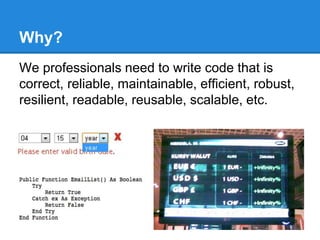
We professionals need to write code that is
correct, reliable, maintainable, efficient, robust,
resilient, readable, reusable, scalable, etc.
How do we learn best practices?
By understanding bad code
Okay, maybe not as bad as
CodingHorror, SerialDate,
and the thedailywtf (e.g.,this
and this and this and this and
this and this and this and
this) ...
We mean innocent-looking code arising from
misconceptions and inexperience
What will we look at?
Immutability
Collections
Guava
Exceptions
Polymorphism
Null
Exceptions
Concurrency
Formatting
Serialization
I/O
Comments
Validation
Logging
Generics
Security
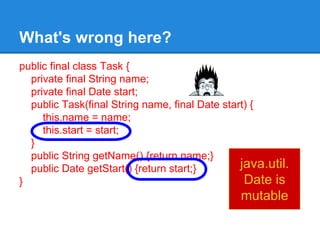
What's wrong here?
public final class Task {
private final String name;
private final Date start;
public Task(final String name, final Date start) {
this.name = name;
this.start = start;
}
public String getName() {return name;}
public Date getStart() {return start;}
}
java.util.
Date is
mutable
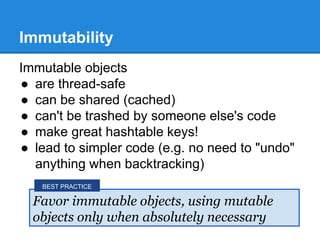
Immutability
Immutable objects
● are thread-safe
● can be shared (cached)
● can't be trashed by someone else's code
● make great hashtable keys!
● lead to simpler code (e.g. no need to "undo"
anything when backtracking)
Favor immutable objects, using mutable
objects only when absolutely necessary
BEST PRACTICE
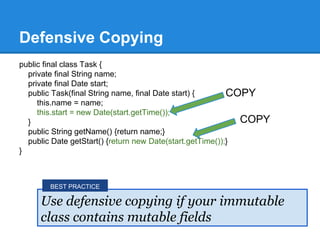
Defensive Copying
public final class Task {
private final String name;
private final Date start;
public Task(final String name, final Date start) {
this.name = name;
this.start = new Date(start.getTime());
}
public String getName() {return name;}
public Date getStart() {return new Date(start.getTime());}
}
Use defensive copying if your immutable
class contains mutable fields
BEST PRACTICE
COPY
COPY
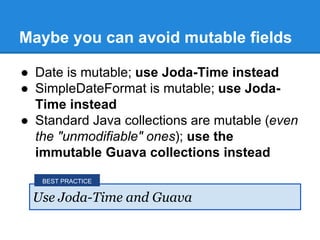
Maybe you can avoid mutable fields
● Date is mutable; use Joda-Time instead
● SimpleDateFormat is mutable; use Joda-
Time instead
● Standard Java collections are mutable (even
the "unmodifiable" ones); use the
immutable Guava collections instead
Use Joda-Time and Guava
BEST PRACTICE
Speaking of Guava
Why Guava?
● It's already written (reinventing takes too
long and you make mistakes)
● It's extensively tested
● It's optimized
● It's constantly being evolved and improved
Know and use the libraries — especially
Guava
BEST PRACTICE
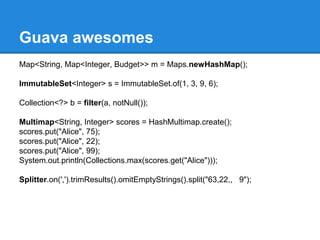
Guava awesomes
Map<String, Map<Integer, Budget>> m = Maps.newHashMap();
ImmutableSet<Integer> s = ImmutableSet.of(1, 3, 9, 6);
Collection<?> b = filter(a, notNull());
Multimap<String, Integer> scores = HashMultimap.create();
scores.put("Alice", 75);
scores.put("Alice", 22);
scores.put("Alice", 99);
System.out.println(Collections.max(scores.get("Alice")));
Splitter.on(',').trimResults().omitEmptyStrings().split("63,22,, 9");
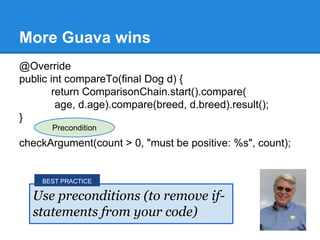
More Guava wins
@Override
public int compareTo(final Dog d) {
return ComparisonChain.start().compare(
age, d.age).compare(breed, d.breed).result();
}
checkArgument(count > 0, "must be positive: %s", count);
Use preconditions (to remove if-
statements from your code)
BEST PRACTICE
Precondition
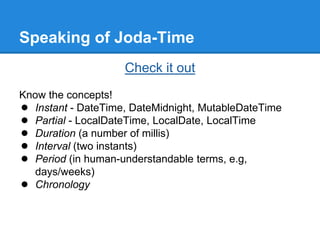
Speaking of Joda-Time
Check it out
Know the concepts!
● Instant - DateTime, DateMidnight, MutableDateTime
● Partial - LocalDateTime, LocalDate, LocalTime
● Duration (a number of millis)
● Interval (two instants)
● Period (in human-understandable terms, e.g,
days/weeks)
● Chronology
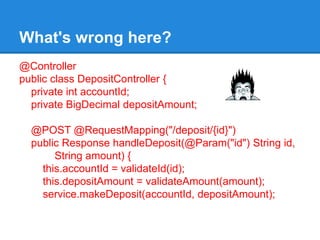
@Controller
public class DepositController {
private int accountId;
private BigDecimal depositAmount;
@POST @RequestMapping("/deposit/{id}")
public Response handleDeposit(@Param("id") String id,
String amount) {
this.accountId = validateId(id);
this.depositAmount = validateAmount(amount);
service.makeDeposit(accountId, depositAmount);
What's wrong here?
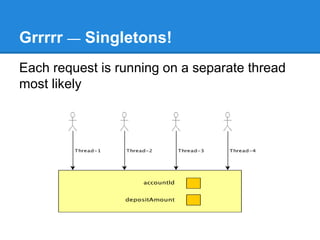
Grrrrr — Singletons!
Each request is running on a separate thread
most likely
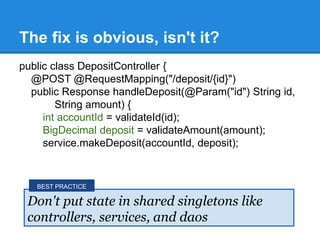
public class DepositController {
@POST @RequestMapping("/deposit/{id}")
public Response handleDeposit(@Param("id") String id,
String amount) {
int accountId = validateId(id);
BigDecimal deposit = validateAmount(amount);
service.makeDeposit(accountId, deposit);
The fix is obvious, isn't it?
Don't put state in shared singletons like
controllers, services, and daos
BEST PRACTICE
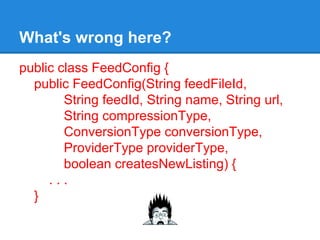
What's wrong here?
public class FeedConfig {
public FeedConfig(String feedFileId,
String feedId, String name, String url,
String compressionType,
ConversionType conversionType,
ProviderType providerType,
boolean createsNewListing) {
. . .
}
Too Many Parameters!
● When you call a constructor (or any method,
for that matter) with a zillion arguments, what
do they all mean?
● In dynamic languages, we pass hashes
(usually)
● Can we do that in Java?
● What is wrong with you?
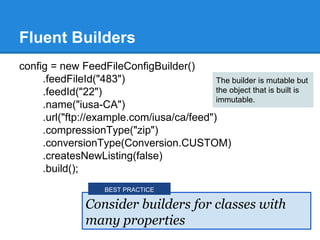
Fluent Builders
config = new FeedFileConfigBuilder()
.feedFileId("483")
.feedId("22")
.name("iusa-CA")
.url("ftp://example.com/iusa/ca/feed")
.compressionType("zip")
.conversionType(Conversion.CUSTOM)
.createsNewListing(false)
.build();
The builder is mutable but
the object that is built is
immutable.
Consider builders for classes with
many properties
BEST PRACTICE
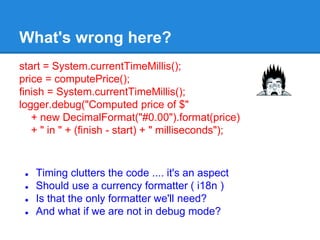
What's wrong here?
start = System.currentTimeMillis();
price = computePrice();
finish = System.currentTimeMillis();
logger.debug("Computed price of $"
+ new DecimalFormat("#0.00").format(price)
+ " in " + (finish - start) + " milliseconds");
● Timing clutters the code .... it's an aspect
● Should use a currency formatter ( i18n )
● Is that the only formatter we'll need?
● And what if we are not in debug mode?
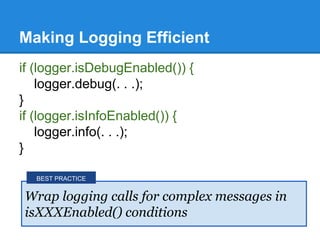
Making Logging Efficient
if (logger.isDebugEnabled()) {
logger.debug(. . .);
}
if (logger.isInfoEnabled()) {
logger.info(. . .);
}
Wrap logging calls for complex messages in
isXXXEnabled() conditions
BEST PRACTICE
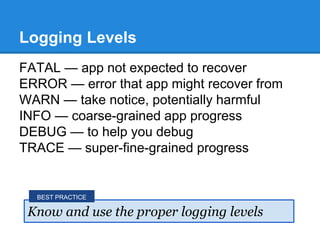
FATAL — app not expected to recover
ERROR — error that app might recover from
WARN — take notice, potentially harmful
INFO — coarse-grained app progress
DEBUG — to help you debug
TRACE — super-fine-grained progress
Logging Levels
Know and use the proper logging levels
BEST PRACTICE
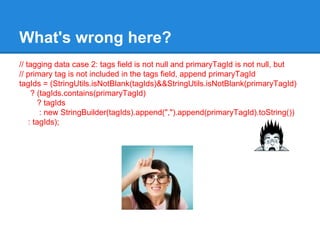
// tagging data case 2: tags field is not null and primaryTagId is not null, but
// primary tag is not included in the tags field, append primaryTagId
tagIds = (StringUtils.isNotBlank(tagIds)&&StringUtils.isNotBlank(primaryTagId)
? (tagIds.contains(primaryTagId)
? tagIds
: new StringBuilder(tagIds).append(",").append(primaryTagId).toString())
: tagIds);
What's wrong here?
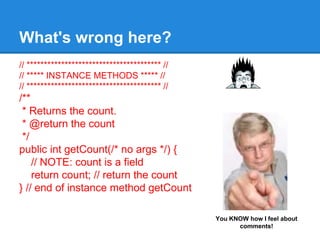
// *************************************** //
// ***** INSTANCE METHODS ***** //
// *************************************** //
/**
* Returns the count.
* @return the count
*/
public int getCount(/* no args */) {
// NOTE: count is a field
return count; // return the count
} // end of instance method getCount
What's wrong here?
You KNOW how I feel about
comments!
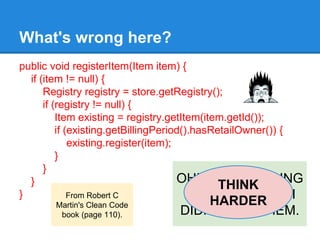
public void registerItem(Item item) {
if (item != null) {
Registry registry = store.getRegistry();
if (registry != null) {
Item existing = registry.getItem(item.getId());
if (existing.getBillingPeriod().hasRetailOwner()) {
existing.register(item);
}
}
}
}
What's wrong here?
From Robert C
Martin's Clean Code
book (page 110).
OH! SOME MISSING
NULL CHECKS? I
DIDN'T SEE THEM.
THINK
HARDER
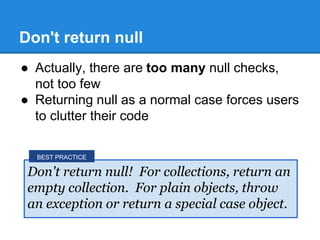
Don't return null
● Actually, there are too many null checks,
not too few
● Returning null as a normal case forces users
to clutter their code
Don't return null! For collections, return an
empty collection. For plain objects, throw
an exception or return a special case object.
BEST PRACTICE
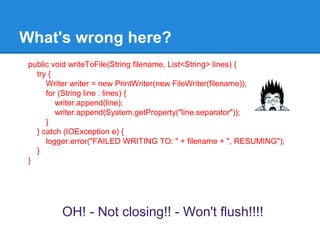
public void writeToFile(String filename, List<String> lines) {
try {
Writer writer = new PrintWriter(new FileWriter(filename));
for (String line : lines) {
writer.append(line);
writer.append(System.getProperty("line.separator"));
}
} catch (IOException e) {
logger.error("FAILED WRITING TO: " + filename + ", RESUMING");
}
}
What's wrong here?
OH! - Not closing!! - Won't flush!!!!
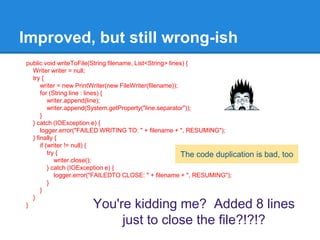
Improved, but still wrong-ish
public void writeToFile(String filename, List<String> lines) {
Writer writer = null;
try {
writer = new PrintWriter(new FileWriter(filename));
for (String line : lines) {
writer.append(line);
writer.append(System.getProperty("line.separator"));
}
} catch (IOException e) {
logger.error("FAILED WRITING TO: " + filename + ", RESUMING");
} finally {
if (writer != null) {
try {
writer.close();
} catch (IOException e) {
logger.error("FAILEDTO CLOSE: " + filename + ", RESUMING");
}
}
}
} You're kidding me? Added 8 lines
just to close the file?!?!?
The code duplication is bad, too
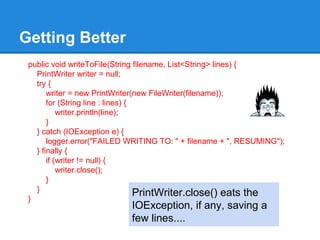
Getting Better
public void writeToFile(String filename, List<String> lines) {
PrintWriter writer = null;
try {
writer = new PrintWriter(new FileWriter(filename));
for (String line : lines) {
writer.println(line);
}
} catch (IOException e) {
logger.error("FAILED WRITING TO: " + filename + ", RESUMING");
} finally {
if (writer != null) {
writer.close();
}
}
}
PrintWriter.close() eats the
IOException, if any, saving a
few lines....
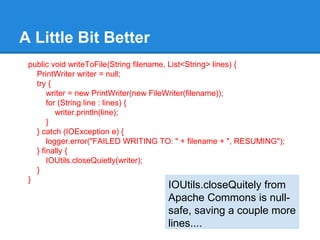
A Little Bit Better
public void writeToFile(String filename, List<String> lines) {
PrintWriter writer = null;
try {
writer = new PrintWriter(new FileWriter(filename));
for (String line : lines) {
writer.println(line);
}
} catch (IOException e) {
logger.error("FAILED WRITING TO: " + filename + ", RESUMING");
} finally {
IOUtils.closeQuietly(writer);
}
}
IOUtils.closeQuitely from
Apache Commons is null-
safe, saving a couple more
lines....
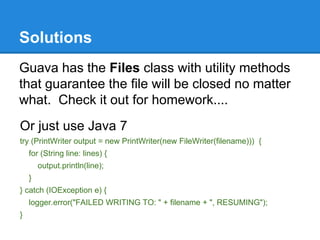
Solutions
Guava has the Files class with utility methods
that guarantee the file will be closed no matter
what. Check it out for homework....
Or just use Java 7
try (PrintWriter output = new PrintWriter(new FileWriter(filename))) {
for (String line: lines) {
output.println(line);
}
} catch (IOException e) {
logger.error("FAILED WRITING TO: " + filename + ", RESUMING");
}
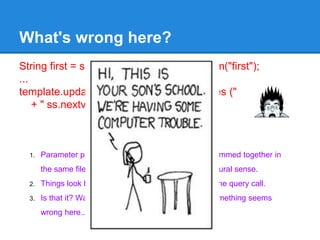
String first = servlet.getRequest().getParam("first");
...
template.update("insert into students values ("
+ " ss.nextval,'" + last + "','" + first + "')");
What's wrong here?
1. Parameter processing and database access are jammed together in
the same file, showing a complete lack of architectural sense.
2. Things look better when the SQL is moved out of the query call.
3. Is that it? Wait, there's something else, I think? Something seems
wrong here....
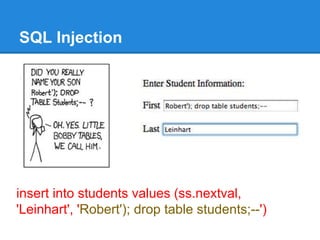
SQL Injection
insert into students values (ss.nextval,
'Leinhart', 'Robert'); drop table students;--')
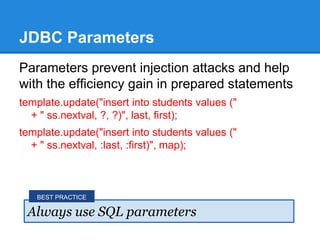
JDBC Parameters
Parameters prevent injection attacks and help
with the efficiency gain in prepared statements
template.update("insert into students values ("
+ " ss.nextval, ?, ?)", last, first);
template.update("insert into students values ("
+ " ss.nextval, :last, :first)", map);
Always use SQL parameters
BEST PRACTICE
public class SuperImportantJob {
public static void main(String[] args) {
try {
doSomething();
doTheNextThing();
doTheLastThing();
} catch (Exception e) {
logger.fatal("Job Failed", e);
}
}
}
What's wrong here?
HINT: THE CONFIGURATION
MANAGEMENT TEAM IS NOT HAPPY WITH
YOU TODAY
(Job = standalone
application)
public static void main(String[] args) {
try {
....
} catch (Exception e) {
logger.fatal("Job Failed", e);
System.exit(1);
}
}
You are not the center of the
universe
Return non-zero status codes from failing
jobs (via System.exit or exception)
BEST PRACTICE
Your app got called by a bash
script or was launched by a
Jenkins job. And someone
else's job is gonna follow yours.
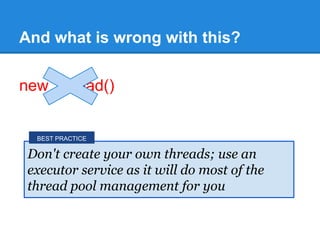
And what is wrong with this?
new Thread()
Don't create your own threads; use an
executor service as it will do most of the
thread pool management for you
BEST PRACTICE
Serialization
Some serialization questions for homework...
● What is the serialVersionUID?
● What happens if you don't explicitly specify a
value for this field?
● Why is it a best practice to always specify a
value for this field?
● What happens if you do specify a value, then
change your class, but do not change it?
● What does Josh Bloch say about all this?
A few more practices
● Write DRY code and DAMP tests
● Put calls in the proper place, e.g., don't
formulate response JSON or HTML in a dao
● Avoid magic numbers (except maybe 0, 1);
use private static final (constants)
● Superclasses should not know about their
subclasses
● Consider domain-specific exceptions over
built-in general purpose exceptions
● Avoid double negatives, e.g., if (!notFound())
● Use BigDecimal, not double, for money
But wait, there are more!
● Comment only when you must
● Get rid of obsolete, redundant, inappropriate,
rambling, crappily written comments
● DELETE COMMENTED OUT CODE
● Follow Uncle Bob's naming guidelines
● No Hungarian Notation, please
● Avoid bad names: tmp, dummy, flag
● Don't write functions that expect booleans or
nulls or things to switch on
● Avoid "out parameters", return things instead
● Prefer the single-return style
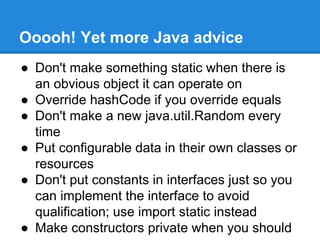
Ooooh! Yet more Java advice
● Don't make something static when there is
an obvious object it can operate on
● Override hashCode if you override equals
● Don't make a new java.util.Random every
time
● Put configurable data in their own classes or
resources
● Don't put constants in interfaces just so you
can implement the interface to avoid
qualification; use import static instead
● Make constructors private when you should
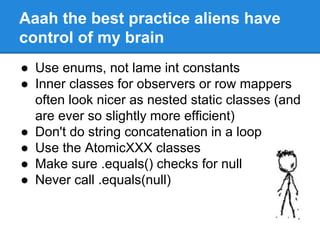
Aaah the best practice aliens have
control of my brain
● Use enums, not lame int constants
● Inner classes for observers or row mappers
often look nicer as nested static classes (and
are ever so slightly more efficient)
● Don't do string concatenation in a loop
● Use the AtomicXXX classes
● Make sure .equals() checks for null
● Never call .equals(null)
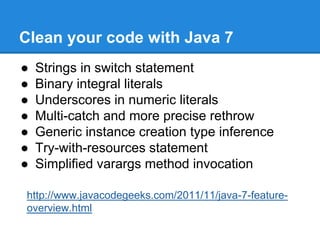
Clean your code with Java 7
● Strings in switch statement
● Binary integral literals
● Underscores in numeric literals
● Multi-catch and more precise rethrow
● Generic instance creation type inference
● Try-with-resources statement
● Simplified varargs method invocation
http://www.javacodegeeks.com/2011/11/java-7-feature-
overview.html
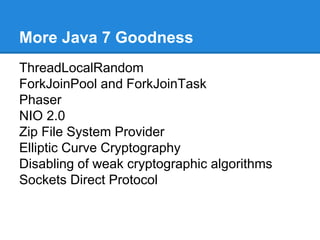
More Java 7 Goodness
ThreadLocalRandom
ForkJoinPool and ForkJoinTask
Phaser
NIO 2.0
Zip File System Provider
Elliptic Curve Cryptography
Disabling of weak cryptographic algorithms
Sockets Direct Protocol
Where can you find more info?
http://findbugs.sourceforge.net/b
ugDescriptions.html
http://checkstyle.sourceforge.net
/availablechecks.html
http://pmd.sourceforge.net/pmd-
5.0.4/rules/index.html
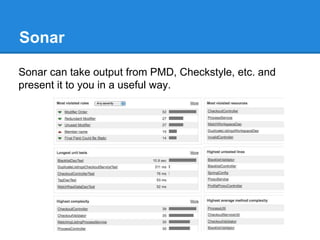
Sonar
Sonar can take output from PMD, Checkstyle, etc. and
present it to you in a useful way.
Homework (Hey why not?)
1. Skim the list of FindBugs Bug Descriptions
2. Find an item on JavaPractices.com that you
disagree with
3. Read an article on serialization
4. Run FindBugs, using the highest possible
analysis settings, on a Java Project that you
worked on
5. Refactor some existing code using Guava
and Java 7
That's it
Questions or comments?

Java best practices

  • 1.
  • 2.
    Why? We professionals needto write code that is correct, reliable, maintainable, efficient, robust, resilient, readable, reusable, scalable, etc.
  • 3.
    How do welearn best practices? By understanding bad code Okay, maybe not as bad as CodingHorror, SerialDate, and the thedailywtf (e.g.,this and this and this and this and this and this and this and this) ... We mean innocent-looking code arising from misconceptions and inexperience
  • 4.
    What will welook at? Immutability Collections Guava Exceptions Polymorphism Null Exceptions Concurrency Formatting Serialization I/O Comments Validation Logging Generics Security
  • 5.
    What's wrong here? publicfinal class Task { private final String name; private final Date start; public Task(final String name, final Date start) { this.name = name; this.start = start; } public String getName() {return name;} public Date getStart() {return start;} } java.util. Date is mutable
  • 6.
    Immutability Immutable objects ● arethread-safe ● can be shared (cached) ● can't be trashed by someone else's code ● make great hashtable keys! ● lead to simpler code (e.g. no need to "undo" anything when backtracking) Favor immutable objects, using mutable objects only when absolutely necessary BEST PRACTICE
  • 7.
    Defensive Copying public finalclass Task { private final String name; private final Date start; public Task(final String name, final Date start) { this.name = name; this.start = new Date(start.getTime()); } public String getName() {return name;} public Date getStart() {return new Date(start.getTime());} } Use defensive copying if your immutable class contains mutable fields BEST PRACTICE COPY COPY
  • 8.
    Maybe you canavoid mutable fields ● Date is mutable; use Joda-Time instead ● SimpleDateFormat is mutable; use Joda- Time instead ● Standard Java collections are mutable (even the "unmodifiable" ones); use the immutable Guava collections instead Use Joda-Time and Guava BEST PRACTICE
  • 9.
    Speaking of Guava WhyGuava? ● It's already written (reinventing takes too long and you make mistakes) ● It's extensively tested ● It's optimized ● It's constantly being evolved and improved Know and use the libraries — especially Guava BEST PRACTICE
  • 10.
    Guava awesomes Map<String, Map<Integer,Budget>> m = Maps.newHashMap(); ImmutableSet<Integer> s = ImmutableSet.of(1, 3, 9, 6); Collection<?> b = filter(a, notNull()); Multimap<String, Integer> scores = HashMultimap.create(); scores.put("Alice", 75); scores.put("Alice", 22); scores.put("Alice", 99); System.out.println(Collections.max(scores.get("Alice"))); Splitter.on(',').trimResults().omitEmptyStrings().split("63,22,, 9");
  • 11.
    More Guava wins @Override publicint compareTo(final Dog d) { return ComparisonChain.start().compare( age, d.age).compare(breed, d.breed).result(); } checkArgument(count > 0, "must be positive: %s", count); Use preconditions (to remove if- statements from your code) BEST PRACTICE Precondition
  • 12.
    Speaking of Joda-Time Checkit out Know the concepts! ● Instant - DateTime, DateMidnight, MutableDateTime ● Partial - LocalDateTime, LocalDate, LocalTime ● Duration (a number of millis) ● Interval (two instants) ● Period (in human-understandable terms, e.g, days/weeks) ● Chronology
  • 13.
    @Controller public class DepositController{ private int accountId; private BigDecimal depositAmount; @POST @RequestMapping("/deposit/{id}") public Response handleDeposit(@Param("id") String id, String amount) { this.accountId = validateId(id); this.depositAmount = validateAmount(amount); service.makeDeposit(accountId, depositAmount); What's wrong here?
  • 14.
    Grrrrr — Singletons! Eachrequest is running on a separate thread most likely
  • 15.
    public class DepositController{ @POST @RequestMapping("/deposit/{id}") public Response handleDeposit(@Param("id") String id, String amount) { int accountId = validateId(id); BigDecimal deposit = validateAmount(amount); service.makeDeposit(accountId, deposit); The fix is obvious, isn't it? Don't put state in shared singletons like controllers, services, and daos BEST PRACTICE
  • 16.
    What's wrong here? publicclass FeedConfig { public FeedConfig(String feedFileId, String feedId, String name, String url, String compressionType, ConversionType conversionType, ProviderType providerType, boolean createsNewListing) { . . . }
  • 17.
    Too Many Parameters! ●When you call a constructor (or any method, for that matter) with a zillion arguments, what do they all mean? ● In dynamic languages, we pass hashes (usually) ● Can we do that in Java? ● What is wrong with you?
  • 18.
    Fluent Builders config =new FeedFileConfigBuilder() .feedFileId("483") .feedId("22") .name("iusa-CA") .url("ftp://example.com/iusa/ca/feed") .compressionType("zip") .conversionType(Conversion.CUSTOM) .createsNewListing(false) .build(); The builder is mutable but the object that is built is immutable. Consider builders for classes with many properties BEST PRACTICE
  • 19.
    What's wrong here? start= System.currentTimeMillis(); price = computePrice(); finish = System.currentTimeMillis(); logger.debug("Computed price of $" + new DecimalFormat("#0.00").format(price) + " in " + (finish - start) + " milliseconds"); ● Timing clutters the code .... it's an aspect ● Should use a currency formatter ( i18n ) ● Is that the only formatter we'll need? ● And what if we are not in debug mode?
  • 20.
    Making Logging Efficient if(logger.isDebugEnabled()) { logger.debug(. . .); } if (logger.isInfoEnabled()) { logger.info(. . .); } Wrap logging calls for complex messages in isXXXEnabled() conditions BEST PRACTICE
  • 21.
    FATAL — appnot expected to recover ERROR — error that app might recover from WARN — take notice, potentially harmful INFO — coarse-grained app progress DEBUG — to help you debug TRACE — super-fine-grained progress Logging Levels Know and use the proper logging levels BEST PRACTICE
  • 22.
    // tagging datacase 2: tags field is not null and primaryTagId is not null, but // primary tag is not included in the tags field, append primaryTagId tagIds = (StringUtils.isNotBlank(tagIds)&&StringUtils.isNotBlank(primaryTagId) ? (tagIds.contains(primaryTagId) ? tagIds : new StringBuilder(tagIds).append(",").append(primaryTagId).toString()) : tagIds); What's wrong here?
  • 23.
    // *************************************** // //***** INSTANCE METHODS ***** // // *************************************** // /** * Returns the count. * @return the count */ public int getCount(/* no args */) { // NOTE: count is a field return count; // return the count } // end of instance method getCount What's wrong here? You KNOW how I feel about comments!
  • 24.
    public void registerItem(Itemitem) { if (item != null) { Registry registry = store.getRegistry(); if (registry != null) { Item existing = registry.getItem(item.getId()); if (existing.getBillingPeriod().hasRetailOwner()) { existing.register(item); } } } } What's wrong here? From Robert C Martin's Clean Code book (page 110). OH! SOME MISSING NULL CHECKS? I DIDN'T SEE THEM. THINK HARDER
  • 25.
    Don't return null ●Actually, there are too many null checks, not too few ● Returning null as a normal case forces users to clutter their code Don't return null! For collections, return an empty collection. For plain objects, throw an exception or return a special case object. BEST PRACTICE
  • 26.
    public void writeToFile(Stringfilename, List<String> lines) { try { Writer writer = new PrintWriter(new FileWriter(filename)); for (String line : lines) { writer.append(line); writer.append(System.getProperty("line.separator")); } } catch (IOException e) { logger.error("FAILED WRITING TO: " + filename + ", RESUMING"); } } What's wrong here? OH! - Not closing!! - Won't flush!!!!
  • 27.
    Improved, but stillwrong-ish public void writeToFile(String filename, List<String> lines) { Writer writer = null; try { writer = new PrintWriter(new FileWriter(filename)); for (String line : lines) { writer.append(line); writer.append(System.getProperty("line.separator")); } } catch (IOException e) { logger.error("FAILED WRITING TO: " + filename + ", RESUMING"); } finally { if (writer != null) { try { writer.close(); } catch (IOException e) { logger.error("FAILEDTO CLOSE: " + filename + ", RESUMING"); } } } } You're kidding me? Added 8 lines just to close the file?!?!? The code duplication is bad, too
  • 28.
    Getting Better public voidwriteToFile(String filename, List<String> lines) { PrintWriter writer = null; try { writer = new PrintWriter(new FileWriter(filename)); for (String line : lines) { writer.println(line); } } catch (IOException e) { logger.error("FAILED WRITING TO: " + filename + ", RESUMING"); } finally { if (writer != null) { writer.close(); } } } PrintWriter.close() eats the IOException, if any, saving a few lines....
  • 29.
    A Little BitBetter public void writeToFile(String filename, List<String> lines) { PrintWriter writer = null; try { writer = new PrintWriter(new FileWriter(filename)); for (String line : lines) { writer.println(line); } } catch (IOException e) { logger.error("FAILED WRITING TO: " + filename + ", RESUMING"); } finally { IOUtils.closeQuietly(writer); } } IOUtils.closeQuitely from Apache Commons is null- safe, saving a couple more lines....
  • 30.
    Solutions Guava has theFiles class with utility methods that guarantee the file will be closed no matter what. Check it out for homework.... Or just use Java 7 try (PrintWriter output = new PrintWriter(new FileWriter(filename))) { for (String line: lines) { output.println(line); } } catch (IOException e) { logger.error("FAILED WRITING TO: " + filename + ", RESUMING"); }
  • 31.
    String first =servlet.getRequest().getParam("first"); ... template.update("insert into students values (" + " ss.nextval,'" + last + "','" + first + "')"); What's wrong here? 1. Parameter processing and database access are jammed together in the same file, showing a complete lack of architectural sense. 2. Things look better when the SQL is moved out of the query call. 3. Is that it? Wait, there's something else, I think? Something seems wrong here....
  • 32.
    SQL Injection insert intostudents values (ss.nextval, 'Leinhart', 'Robert'); drop table students;--')
  • 33.
    JDBC Parameters Parameters preventinjection attacks and help with the efficiency gain in prepared statements template.update("insert into students values (" + " ss.nextval, ?, ?)", last, first); template.update("insert into students values (" + " ss.nextval, :last, :first)", map); Always use SQL parameters BEST PRACTICE
  • 34.
    public class SuperImportantJob{ public static void main(String[] args) { try { doSomething(); doTheNextThing(); doTheLastThing(); } catch (Exception e) { logger.fatal("Job Failed", e); } } } What's wrong here? HINT: THE CONFIGURATION MANAGEMENT TEAM IS NOT HAPPY WITH YOU TODAY (Job = standalone application)
  • 35.
    public static voidmain(String[] args) { try { .... } catch (Exception e) { logger.fatal("Job Failed", e); System.exit(1); } } You are not the center of the universe Return non-zero status codes from failing jobs (via System.exit or exception) BEST PRACTICE Your app got called by a bash script or was launched by a Jenkins job. And someone else's job is gonna follow yours.
  • 36.
    And what iswrong with this? new Thread() Don't create your own threads; use an executor service as it will do most of the thread pool management for you BEST PRACTICE
  • 37.
    Serialization Some serialization questionsfor homework... ● What is the serialVersionUID? ● What happens if you don't explicitly specify a value for this field? ● Why is it a best practice to always specify a value for this field? ● What happens if you do specify a value, then change your class, but do not change it? ● What does Josh Bloch say about all this?
  • 38.
    A few morepractices ● Write DRY code and DAMP tests ● Put calls in the proper place, e.g., don't formulate response JSON or HTML in a dao ● Avoid magic numbers (except maybe 0, 1); use private static final (constants) ● Superclasses should not know about their subclasses ● Consider domain-specific exceptions over built-in general purpose exceptions ● Avoid double negatives, e.g., if (!notFound()) ● Use BigDecimal, not double, for money
  • 39.
    But wait, thereare more! ● Comment only when you must ● Get rid of obsolete, redundant, inappropriate, rambling, crappily written comments ● DELETE COMMENTED OUT CODE ● Follow Uncle Bob's naming guidelines ● No Hungarian Notation, please ● Avoid bad names: tmp, dummy, flag ● Don't write functions that expect booleans or nulls or things to switch on ● Avoid "out parameters", return things instead ● Prefer the single-return style
  • 40.
    Ooooh! Yet moreJava advice ● Don't make something static when there is an obvious object it can operate on ● Override hashCode if you override equals ● Don't make a new java.util.Random every time ● Put configurable data in their own classes or resources ● Don't put constants in interfaces just so you can implement the interface to avoid qualification; use import static instead ● Make constructors private when you should
  • 41.
    Aaah the bestpractice aliens have control of my brain ● Use enums, not lame int constants ● Inner classes for observers or row mappers often look nicer as nested static classes (and are ever so slightly more efficient) ● Don't do string concatenation in a loop ● Use the AtomicXXX classes ● Make sure .equals() checks for null ● Never call .equals(null)
  • 42.
    Clean your codewith Java 7 ● Strings in switch statement ● Binary integral literals ● Underscores in numeric literals ● Multi-catch and more precise rethrow ● Generic instance creation type inference ● Try-with-resources statement ● Simplified varargs method invocation http://www.javacodegeeks.com/2011/11/java-7-feature- overview.html
  • 43.
    More Java 7Goodness ThreadLocalRandom ForkJoinPool and ForkJoinTask Phaser NIO 2.0 Zip File System Provider Elliptic Curve Cryptography Disabling of weak cryptographic algorithms Sockets Direct Protocol
  • 44.
    Where can youfind more info? http://findbugs.sourceforge.net/b ugDescriptions.html http://checkstyle.sourceforge.net /availablechecks.html http://pmd.sourceforge.net/pmd- 5.0.4/rules/index.html
  • 45.
    Sonar Sonar can takeoutput from PMD, Checkstyle, etc. and present it to you in a useful way.
  • 46.
    Homework (Hey whynot?) 1. Skim the list of FindBugs Bug Descriptions 2. Find an item on JavaPractices.com that you disagree with 3. Read an article on serialization 4. Run FindBugs, using the highest possible analysis settings, on a Java Project that you worked on 5. Refactor some existing code using Guava and Java 7
  • 47.