UTILITIES @ WORK
           - don’t reinvent when it is ready to use
AGENDA
 Discussion on apache commons utilities
 Java Concurrency Framework

 Mutable vs. Immutable


                                           2
APACHE COMMONS UTILITIES
 Configuration
 Lang

 IO

 BeanUtils


                           3
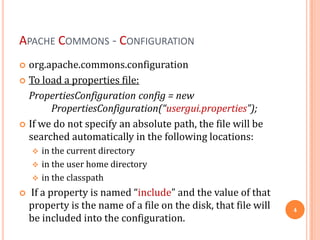
APACHE COMMONS - CONFIGURATION
 org.apache.commons.configuration
 To load a properties file:

  PropertiesConfiguration config = new
       PropertiesConfiguration(“usergui.properties”);
 If we do not specify an absolute path, the file will be
  searched automatically in the following locations:
     in the current directory
     in the user home directory
     in the classpath

   If a property is named “include” and the value of that
    property is the name of a file on the disk, that file will   4
    be included into the configuration.
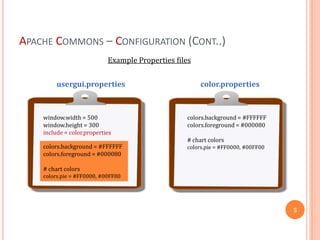
APACHE COMMONS – CONFIGURATION (CONT..)
                            Example Properties files


         usergui.properties                            color.properties


    window.width = 500                            colors.background = #FFFFFF
    window.height = 300                           colors.foreground = #000080
    include = color.properties
                                                  # chart colors
    colors.background = #FFFFFF                   colors.pie = #FF0000, #00FF00
    colors.foreground = #000080

    # chart colors
    colors.pie = #FF0000, #00FF00


                                                                                  5
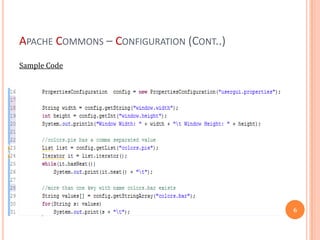
APACHE COMMONS – CONFIGURATION (CONT..)
Sample Code


                                          6
7
APACHE COMMONS – LANG
 StringUtils
 ToStringBuilder

 ArrayUtils


                        8
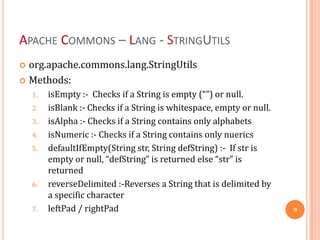
APACHE COMMONS – LANG - STRINGUTILS
 org.apache.commons.lang.StringUtils
 Methods:
    1.   isEmpty :- Checks if a String is empty (“”) or null.
    2.   isBlank :- Checks if a String is whitespace, empty or null.
    3.   isAlpha :- Checks if a String contains only alphabets
    4.   isNumeric :- Checks if a String contains only nuerics
    5.   defaultIfEmpty(String str, String defString) :- If str is
         empty or null, “defString” is returned else “str” is
         returned
    6.   reverseDelimited :-Reverses a String that is delimited by
         a specific character
    7.   leftPad / rightPad                                            9
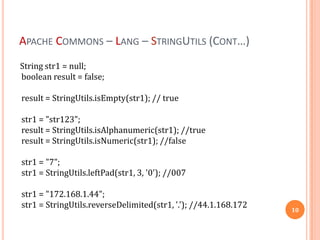
APACHE COMMONS – LANG – STRINGUTILS (CONT…)
String str1 = null;
boolean result = false;

result = StringUtils.isEmpty(str1); // true

str1 = "str123";
result = StringUtils.isAlphanumeric(str1); //true
result = StringUtils.isNumeric(str1); //false

str1 = "7";
str1 = StringUtils.leftPad(str1, 3, '0'); //007

str1 = "172.168.1.44";
str1 = StringUtils.reverseDelimited(str1, '.'); //44.1.168.172
                                                                 10
APACHE COMMONS – LANG - TOSTRINGBUILDER
public class ToStringBuilderDemo {
  public static void main(String args[]){
    System.out.println(new Emp(7,"Java",99.99));
  }
}
class Emp{
  int id;
  String name;
  double salary;
  public Emp(int id, String name, double salary){
    this.id = id; this.name = name; this.salary = salary;
  }
  /* here comes accessors and mutators */

    public String toString(){
      return ToStringBuilder.reflectionToString(this);
                                                                   11
    }
}
OUTPUT: com.commons.examples.Emp@10b30a7[id=7,name=Java,salary=99.99]
APACHE COMMONS – LANG - ARRAYUTILS
import java.util.Arrays;
import org.apache.commons.lang.ArrayUtils;
public class ArrayUtilsDemo {
  public static void main(String args[]){
    String weekends[] = {"friday","saturday","sunday"};
    String weekdays[] = {"monday", "tuesday", "wednesday", "thursday"};

        String days[] = (String[])ArrayUtils.addAll(weekends, weekdays);
        System.out.println(ArrayUtils.isEmpty(days));
        System.out.println(ArrayUtils.isSameLength(weekends, weekdays));

        Integer values[] = new Integer[10];
        Arrays.fill(values, 1);
        int intValues[] = ArrayUtils.toPrimitive(values,0);
    }
}
                                                                           12
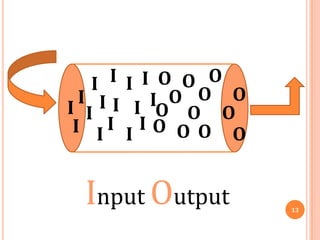
I I I I O O O
  I II
I I       I O O O
        I O O O
 I II I I O O O O


 Input Output       13
APACHE COMMONS – IO
 IOUtils
 FileUtils

 FileSystemUtils

 FileFilter

 LineIterator


                      14
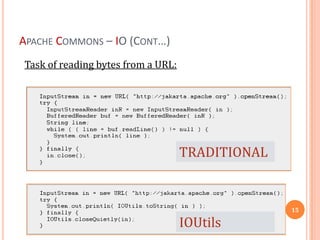
APACHE COMMONS – IO (CONT…)
Task of reading bytes from a URL:


                                    TRADITIONAL


                                                  15

                                    IOUtils
APACHE COMMONS – IO (CONT…)


   File dir = new File(".");
   String[] files = dir.list( new
                  PrefixFileFilter("Test") );

   for ( int i = 0; i < files.length; i++ ) {   16
   System.out.println(files[i]);
   }
17
Executor
Framework
            18
SEQUENTIAL WEB SERVER
class SingleThreadWebServer{
  public static void main(String args[]){
    ServerSocket socket = new ServerSocket(80);
    while(true){
      Socket connection = socket.accept();
       handleRequest(connection);
    }
  }
}


Drawback: thread “main” is responsible for handling all
requests one after the other
                                                          19
WEB SERVER THAT STARTS A NEW THREAD FOR EACH REQUEST
class ThreadPerTaskWebServer{
  public static void main(String args[]){
    ServerSocket socket = new ServerSocket(80);
    while(true){
      final Socket connection = socket.accept();
      Runnable r = new Runnable(){
                  public void run(){
                        handleRequest(connection);
                  }
            };
      new Thread(r).start();
    }
}
}
                                                       20
Drawback: may cause “OutOfMemory” error as there is
no boundary on thread creation.
WEB SERVER USING A THREAD POOL
class TaskExecutionWebServer{
  private static final int NTHREADS = 100;
  private static final Executor exec =
            Executors.newFixedThreadPool(NTHREADS);
  public static void main(String args[]){
    ServerSocket socket = new ServerSocket(80);
    while(true){
      final Socket connection = socket.accept();
      Runnable task = new Runnable(){
                  public void run(){
                        handleRequest(connection);
                  }
            };
      exec.execute(task);
    }                                              21
  }
}
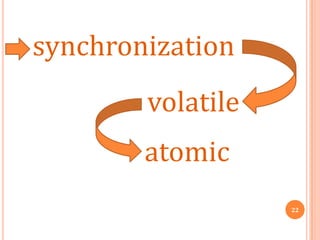
synchronization
        volatile
        atomic
                   22
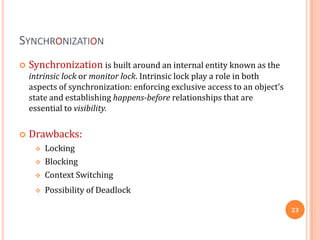
SYNCHRONIZATION
   Synchronization is built around an internal entity known as the
    intrinsic lock or monitor lock. Intrinsic lock play a role in both
    aspects of synchronization: enforcing exclusive access to an object’s
    state and establishing happens-before relationships that are
    essential to visibility.

   Drawbacks:
        Locking
        Blocking
        Context Switching
        Possibility of Deadlock

                                                                            23
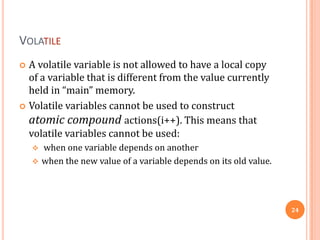
VOLATILE
 A volatile variable is not allowed to have a local copy
  of a variable that is different from the value currently
  held in “main” memory.
 Volatile variables cannot be used to construct
  atomic compound actions(i++). This means that
  volatile variables cannot be used:
     when one variable depends on another
     when the new value of a variable depends on its old value.


                                                                   24
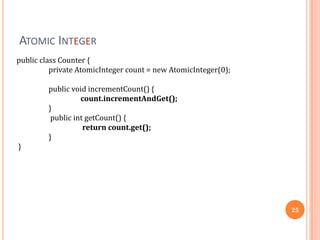
ATOMIC INTEGER
public class Counter {
          private AtomicInteger count = new AtomicInteger(0);

         public void incrementCount() {
                   count.incrementAndGet();
         }
          public int getCount() {
                    return count.get();
         }
}


                                                                25
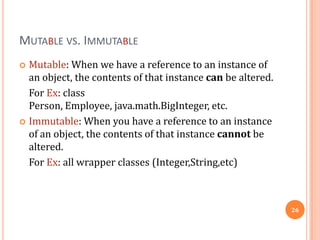
MUTABLE VS. IMMUTABLE
 Mutable: When we have a reference to an instance of
  an object, the contents of that instance can be altered.
  For Ex: class
  Person, Employee, java.math.BigInteger, etc.
 Immutable: When you have a reference to an instance
  of an object, the contents of that instance cannot be
  altered.
  For Ex: all wrapper classes (Integer,String,etc)


                                                             26
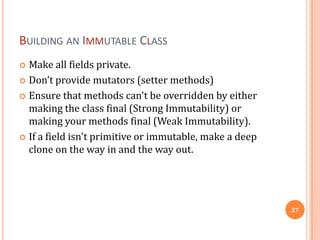
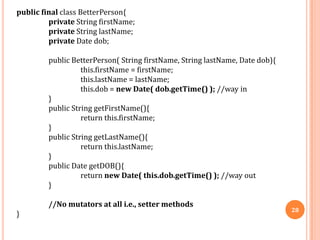
BUILDING AN IMMUTABLE CLASS
 Make all fields private.
 Don’t provide mutators (setter methods)

 Ensure that methods can't be overridden by either
  making the class final (Strong Immutability) or
  making your methods final (Weak Immutability).
 If a field isn't primitive or immutable, make a deep
  clone on the way in and the way out.


                                                         27
public final class BetterPerson{
         private String firstName;
         private String lastName;
         private Date dob;

         public BetterPerson( String firstName, String lastName, Date dob){
                   this.firstName = firstName;
                   this.lastName = lastName;
                   this.dob = new Date( dob.getTime() ); //way in
         }
         public String getFirstName(){
                   return this.firstName;
         }
         public String getLastName(){
                   return this.lastName;
         }
         public Date getDOB(){
                   return new Date( this.dob.getTime() ); //way out
         }

         //No mutators at all i.e., setter methods
                                                                              28
}
29
- PRAMOD

           30

Use of Apache Commons and Utilities

  • 1.
    UTILITIES @ WORK - don’t reinvent when it is ready to use
  • 2.
    AGENDA  Discussion onapache commons utilities  Java Concurrency Framework  Mutable vs. Immutable 2
  • 3.
    APACHE COMMONS UTILITIES Configuration  Lang  IO  BeanUtils 3
  • 4.
    APACHE COMMONS -CONFIGURATION  org.apache.commons.configuration  To load a properties file: PropertiesConfiguration config = new PropertiesConfiguration(“usergui.properties”);  If we do not specify an absolute path, the file will be searched automatically in the following locations:  in the current directory  in the user home directory  in the classpath  If a property is named “include” and the value of that property is the name of a file on the disk, that file will 4 be included into the configuration.
  • 5.
    APACHE COMMONS –CONFIGURATION (CONT..) Example Properties files usergui.properties color.properties window.width = 500 colors.background = #FFFFFF window.height = 300 colors.foreground = #000080 include = color.properties # chart colors colors.background = #FFFFFF colors.pie = #FF0000, #00FF00 colors.foreground = #000080 # chart colors colors.pie = #FF0000, #00FF00 5
  • 6.
    APACHE COMMONS –CONFIGURATION (CONT..) Sample Code 6
  • 7.
  • 8.
    APACHE COMMONS –LANG  StringUtils  ToStringBuilder  ArrayUtils 8
  • 9.
    APACHE COMMONS –LANG - STRINGUTILS  org.apache.commons.lang.StringUtils  Methods: 1. isEmpty :- Checks if a String is empty (“”) or null. 2. isBlank :- Checks if a String is whitespace, empty or null. 3. isAlpha :- Checks if a String contains only alphabets 4. isNumeric :- Checks if a String contains only nuerics 5. defaultIfEmpty(String str, String defString) :- If str is empty or null, “defString” is returned else “str” is returned 6. reverseDelimited :-Reverses a String that is delimited by a specific character 7. leftPad / rightPad 9
  • 10.
    APACHE COMMONS –LANG – STRINGUTILS (CONT…) String str1 = null; boolean result = false; result = StringUtils.isEmpty(str1); // true str1 = "str123"; result = StringUtils.isAlphanumeric(str1); //true result = StringUtils.isNumeric(str1); //false str1 = "7"; str1 = StringUtils.leftPad(str1, 3, '0'); //007 str1 = "172.168.1.44"; str1 = StringUtils.reverseDelimited(str1, '.'); //44.1.168.172 10
  • 11.
    APACHE COMMONS –LANG - TOSTRINGBUILDER public class ToStringBuilderDemo { public static void main(String args[]){ System.out.println(new Emp(7,"Java",99.99)); } } class Emp{ int id; String name; double salary; public Emp(int id, String name, double salary){ this.id = id; this.name = name; this.salary = salary; } /* here comes accessors and mutators */ public String toString(){ return ToStringBuilder.reflectionToString(this); 11 } } OUTPUT: com.commons.examples.Emp@10b30a7[id=7,name=Java,salary=99.99]
  • 12.
    APACHE COMMONS –LANG - ARRAYUTILS import java.util.Arrays; import org.apache.commons.lang.ArrayUtils; public class ArrayUtilsDemo { public static void main(String args[]){ String weekends[] = {"friday","saturday","sunday"}; String weekdays[] = {"monday", "tuesday", "wednesday", "thursday"}; String days[] = (String[])ArrayUtils.addAll(weekends, weekdays); System.out.println(ArrayUtils.isEmpty(days)); System.out.println(ArrayUtils.isSameLength(weekends, weekdays)); Integer values[] = new Integer[10]; Arrays.fill(values, 1); int intValues[] = ArrayUtils.toPrimitive(values,0); } } 12
  • 13.
    I I II O O O I II I I I O O O I O O O I II I I O O O O Input Output 13
  • 14.
    APACHE COMMONS –IO  IOUtils  FileUtils  FileSystemUtils  FileFilter  LineIterator 14
  • 15.
    APACHE COMMONS –IO (CONT…) Task of reading bytes from a URL: TRADITIONAL 15 IOUtils
  • 16.
    APACHE COMMONS –IO (CONT…) File dir = new File("."); String[] files = dir.list( new PrefixFileFilter("Test") ); for ( int i = 0; i < files.length; i++ ) { 16 System.out.println(files[i]); }
  • 17.
  • 18.
  • 19.
    SEQUENTIAL WEB SERVER classSingleThreadWebServer{ public static void main(String args[]){ ServerSocket socket = new ServerSocket(80); while(true){ Socket connection = socket.accept(); handleRequest(connection); } } } Drawback: thread “main” is responsible for handling all requests one after the other 19
  • 20.
    WEB SERVER THATSTARTS A NEW THREAD FOR EACH REQUEST class ThreadPerTaskWebServer{ public static void main(String args[]){ ServerSocket socket = new ServerSocket(80); while(true){ final Socket connection = socket.accept(); Runnable r = new Runnable(){ public void run(){ handleRequest(connection); } }; new Thread(r).start(); } } } 20 Drawback: may cause “OutOfMemory” error as there is no boundary on thread creation.
  • 21.
    WEB SERVER USINGA THREAD POOL class TaskExecutionWebServer{ private static final int NTHREADS = 100; private static final Executor exec = Executors.newFixedThreadPool(NTHREADS); public static void main(String args[]){ ServerSocket socket = new ServerSocket(80); while(true){ final Socket connection = socket.accept(); Runnable task = new Runnable(){ public void run(){ handleRequest(connection); } }; exec.execute(task); } 21 } }
  • 22.
    synchronization volatile atomic 22
  • 23.
    SYNCHRONIZATION  Synchronization is built around an internal entity known as the intrinsic lock or monitor lock. Intrinsic lock play a role in both aspects of synchronization: enforcing exclusive access to an object’s state and establishing happens-before relationships that are essential to visibility.  Drawbacks:  Locking  Blocking  Context Switching  Possibility of Deadlock 23
  • 24.
    VOLATILE  A volatilevariable is not allowed to have a local copy of a variable that is different from the value currently held in “main” memory.  Volatile variables cannot be used to construct atomic compound actions(i++). This means that volatile variables cannot be used:  when one variable depends on another  when the new value of a variable depends on its old value. 24
  • 25.
    ATOMIC INTEGER public classCounter { private AtomicInteger count = new AtomicInteger(0); public void incrementCount() { count.incrementAndGet(); } public int getCount() { return count.get(); } } 25
  • 26.
    MUTABLE VS. IMMUTABLE Mutable: When we have a reference to an instance of an object, the contents of that instance can be altered. For Ex: class Person, Employee, java.math.BigInteger, etc.  Immutable: When you have a reference to an instance of an object, the contents of that instance cannot be altered. For Ex: all wrapper classes (Integer,String,etc) 26
  • 27.
    BUILDING AN IMMUTABLECLASS  Make all fields private.  Don’t provide mutators (setter methods)  Ensure that methods can't be overridden by either making the class final (Strong Immutability) or making your methods final (Weak Immutability).  If a field isn't primitive or immutable, make a deep clone on the way in and the way out. 27
  • 28.
    public final classBetterPerson{ private String firstName; private String lastName; private Date dob; public BetterPerson( String firstName, String lastName, Date dob){ this.firstName = firstName; this.lastName = lastName; this.dob = new Date( dob.getTime() ); //way in } public String getFirstName(){ return this.firstName; } public String getLastName(){ return this.lastName; } public Date getDOB(){ return new Date( this.dob.getTime() ); //way out } //No mutators at all i.e., setter methods 28 }
  • 29.
  • 30.