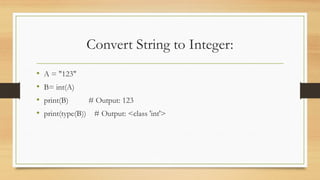
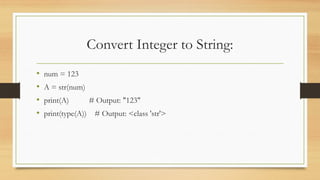
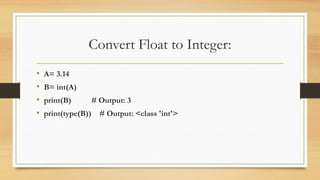
Type conversion in Python involves converting a variable from one data type to another, utilizing built-in functions for both implicit and explicit conversions. Implicit conversion happens automatically, while explicit conversion requires the programmer's intervention using functions like int(), float(), and str(). It is essential to note that data loss can occur during conversion and some conversions between incompatible types may result in errors.

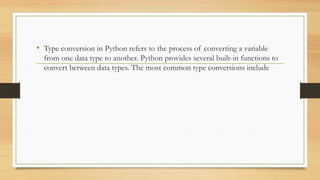
• Type conversionin Python refers to the process of converting a variable
from one data type to another. Python provides several built-in functions to
convert between data types. The most common type conversions include
3.
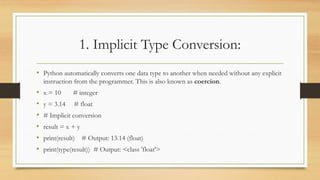
1. Implicit TypeConversion:
• Python automatically converts one data type to another when needed without any explicit
instruction from the programmer. This is also known as coercion.
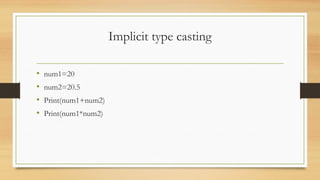
• x = 10 # integer
• y = 3.14 # float
• # Implicit conversion
• result = x + y
• print(result) # Output: 13.14 (float)
• print(type(result)) # Output: <class 'float'>
4.
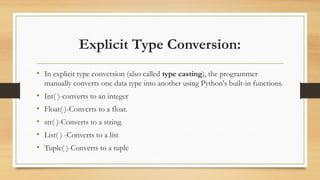
Explicit Type Conversion:
•In explicit type conversion (also called type casting), the programmer
manually converts one data type into another using Python's built-in functions.
• Int( )-converts to an integer
• Float( )-Converts to a float.
• str( )-Converts to a string.
• List( ) -Converts to a list
• Tuple( )-Converts to a tuple
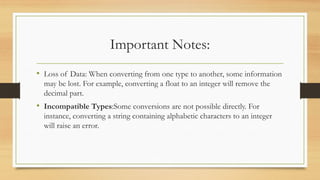
Important Notes:
• Lossof Data: When converting from one type to another, some information
may be lost. For example, converting a float to an integer will remove the
decimal part.
• Incompatible Types:Some conversions are not possible directly. For
instance, converting a string containing alphabetic characters to an integer
will raise an error.
10.
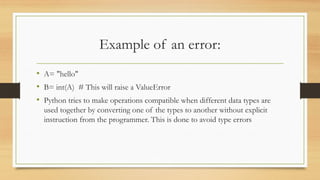
Example of anerror:
• A= "hello"
• B= int(A) # This will raise a ValueError
• Python tries to make operations compatible when different data types are
used together by converting one of the types to another without explicit
instruction from the programmer. This is done to avoid type errors
11.
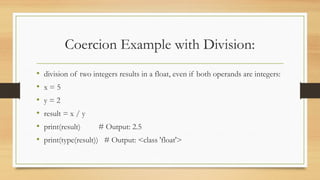
Coercion Example withDivision:
• division of two integers results in a float, even if both operands are integers:
• x = 5
• y = 2
• result = x / y
• print(result) # Output: 2.5
• print(type(result)) # Output: <class 'float'>
12.
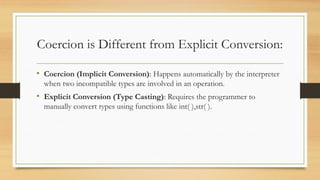
Coercion is Differentfrom Explicit Conversion:
• Coercion (Implicit Conversion): Happens automatically by the interpreter
when two incompatible types are involved in an operation.
• Explicit Conversion (Type Casting): Requires the programmer to
manually convert types using functions like int( ),str( ).
13.
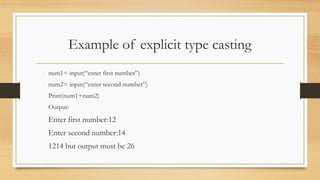
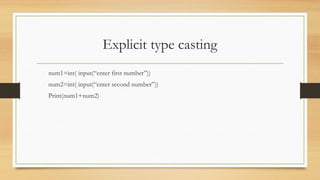
Example of explicittype casting
num1= input(“enter first number”)
num2= input(“enter second number”)
Print(num1+num2)
Output:
Enter first number:12
Enter second number:14
1214 but output must be 26