

Why Gambling Theory Matters
Expected Value (EV)
   Weighted average of all possible outcomes
   Quantifies what you can expect to gain, on average
   A fundamental concept in gambling theory...
   And in life
Example 1: A Coin Flip Game

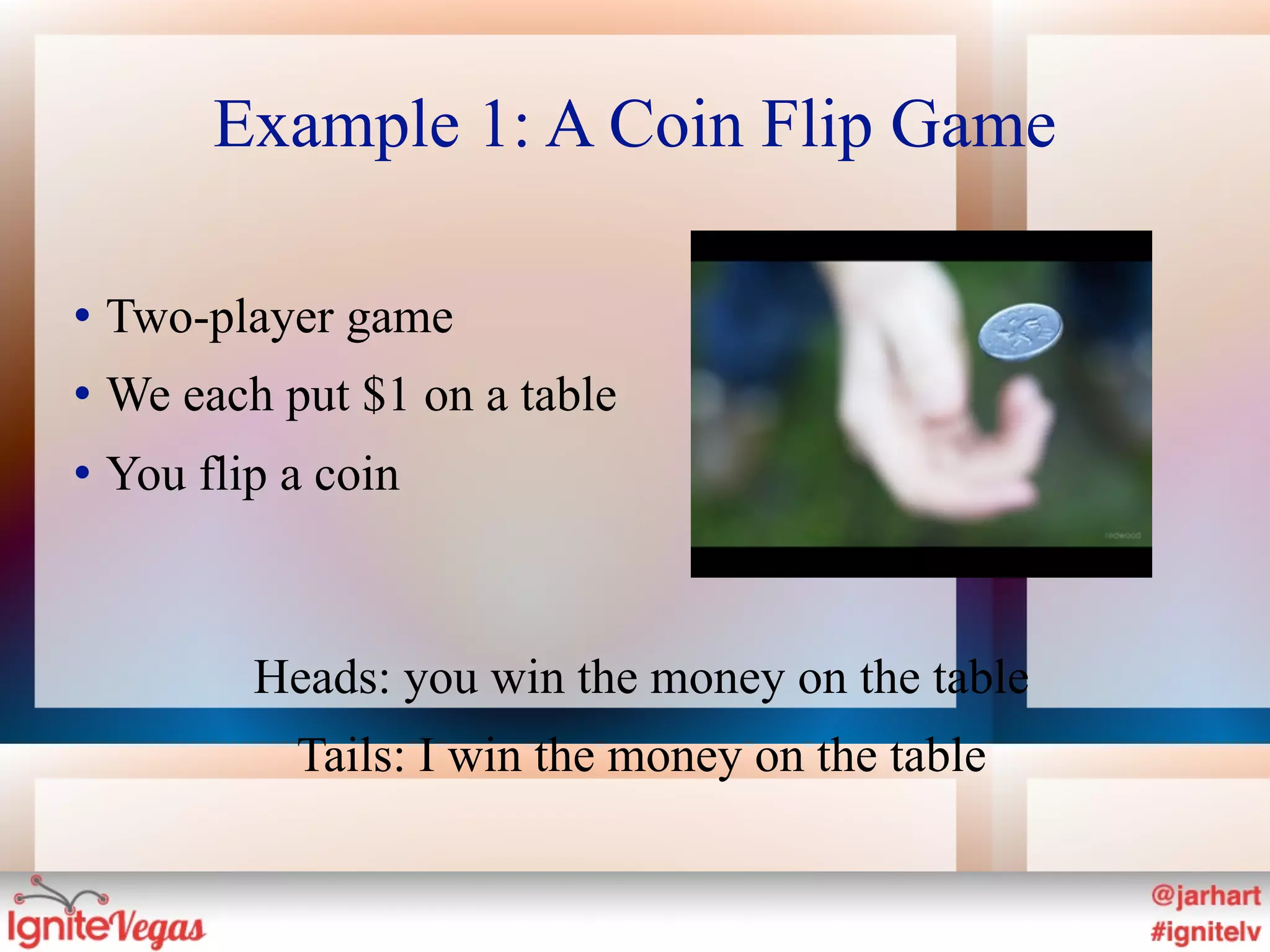
   Two-player game
   We each put $1 on a table
   You flip a coin


           Heads: you win the money on the table
             Tails: I win the money on the table
Example 1: A Coin Flip Game

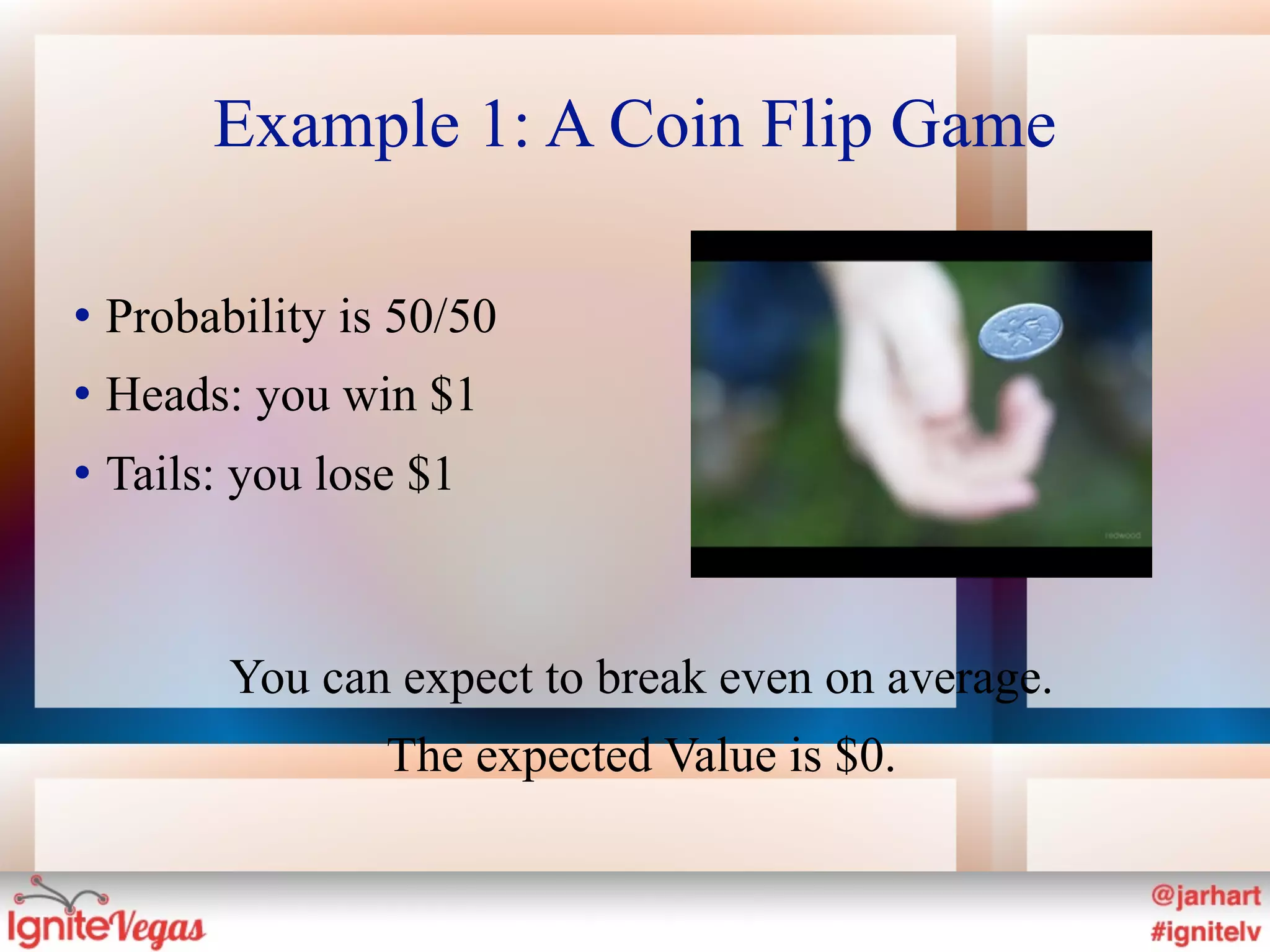
   Probability is 50/50
   Heads: you win $1
   Tails: you lose $1


          You can expect to break even on average.
                  The expected Value is $0.
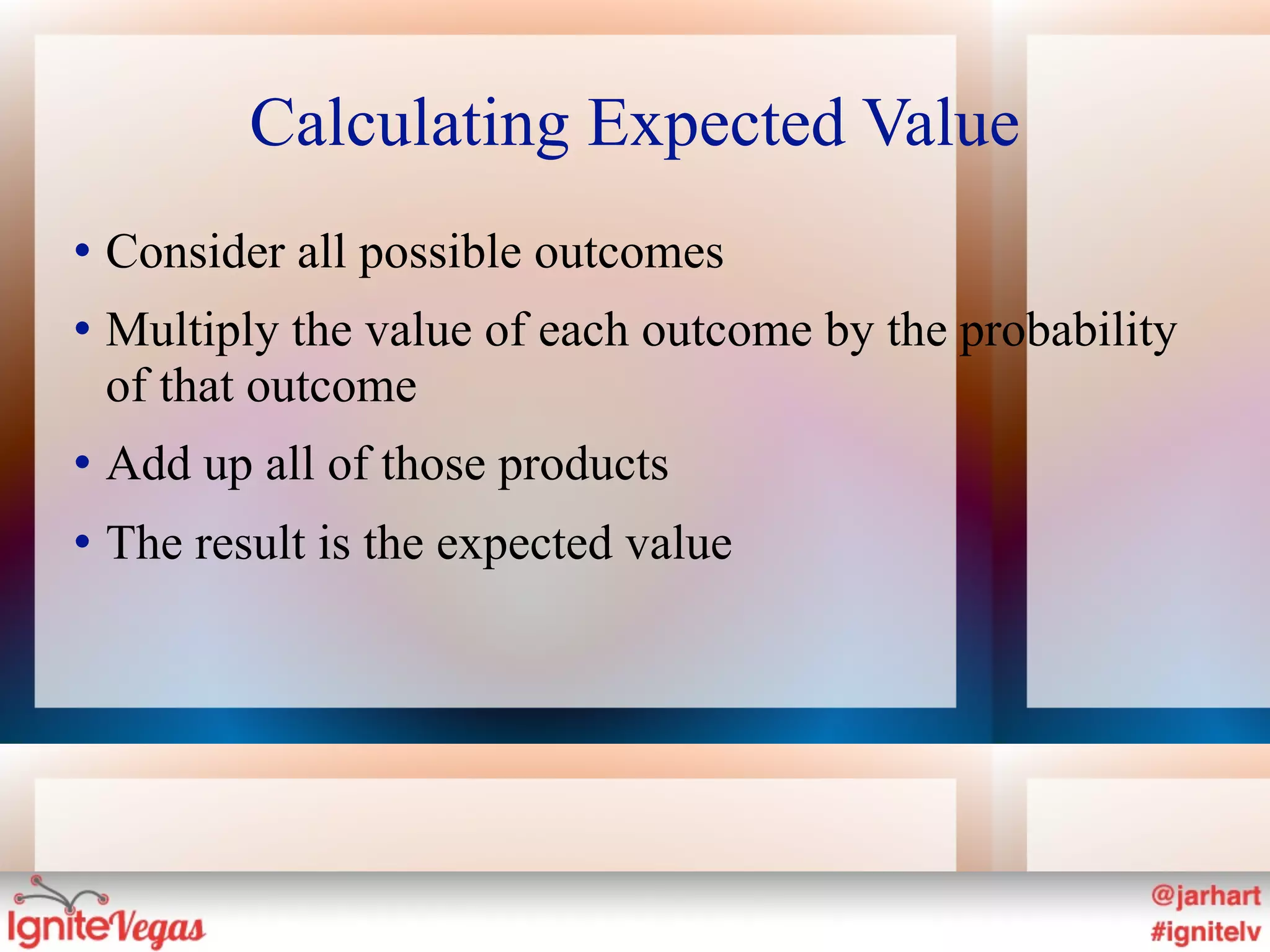
Calculating Expected Value
   Consider all possible outcomes
   Multiply the value of each outcome by the probability
    of that outcome
   Add up all of those products
   The result is the expected value
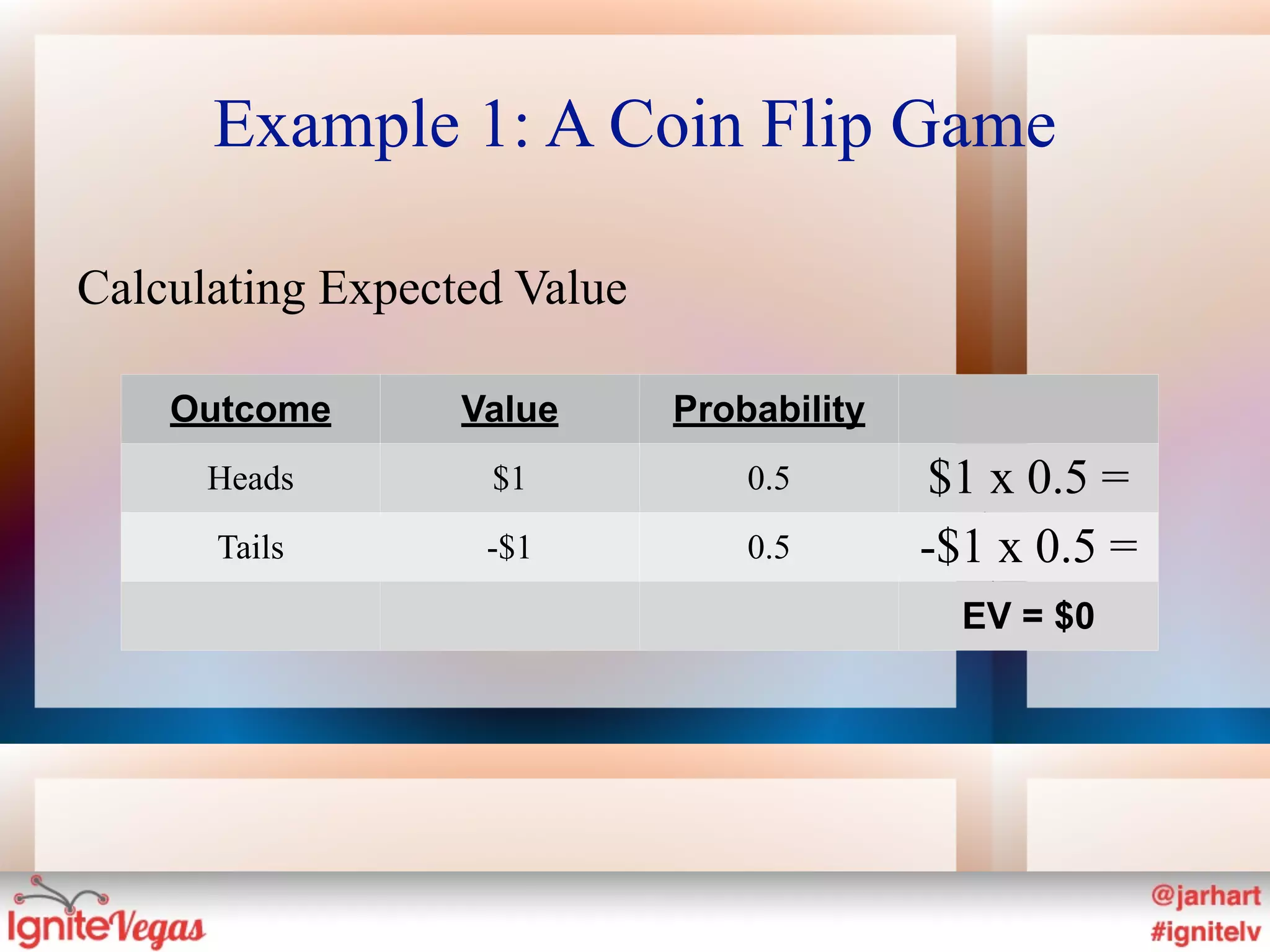
Example 1: A Coin Flip Game

Calculating Expected Value

    Outcome       Value      Probability
      Heads        $1            0.5        $1 x 0.5 =
      Tails        -$1           0.5          $0.50
                                           -$1 x 0.5 =
                                             -$0.50
                                             EV = $0
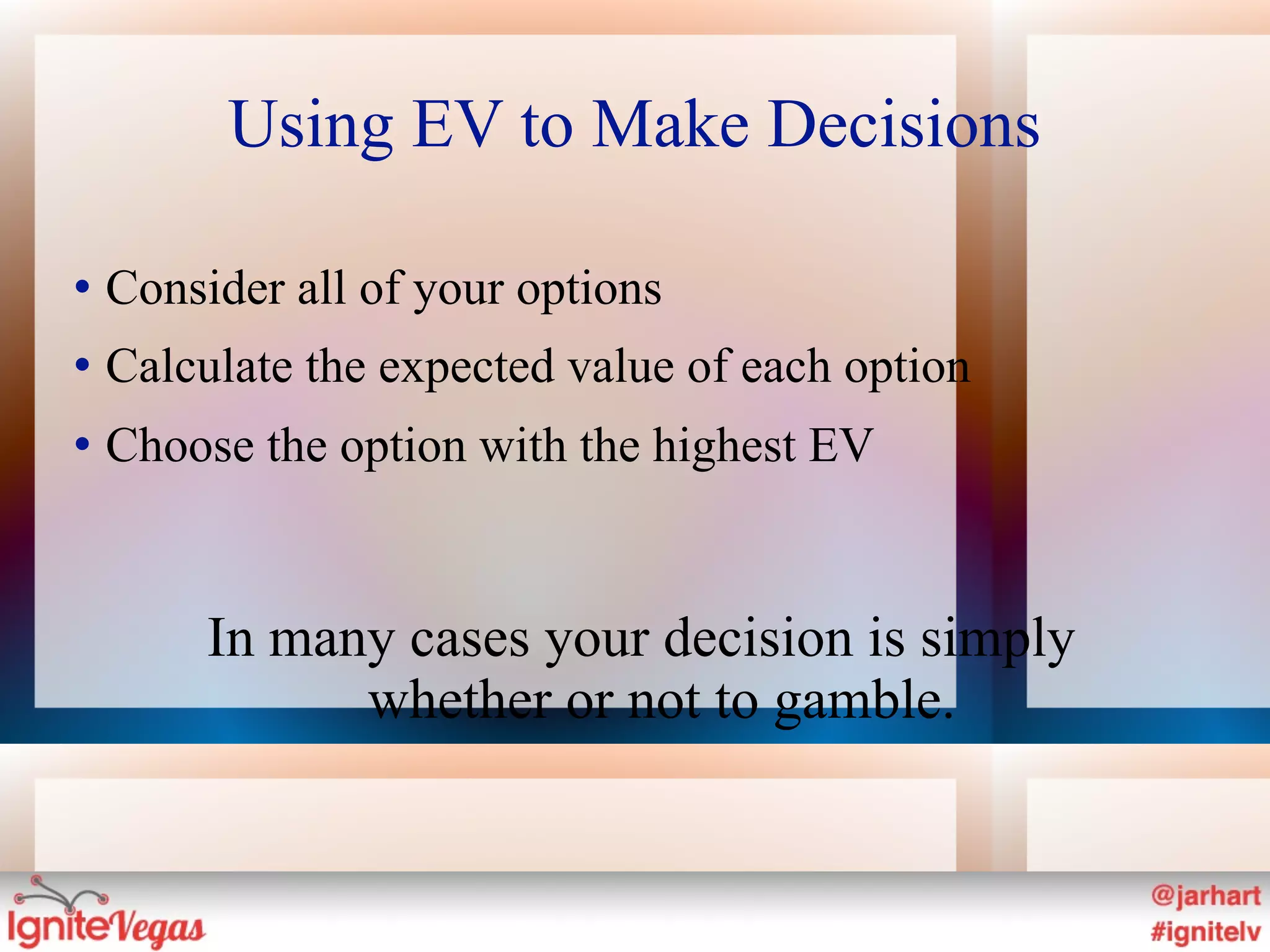
Using EV to Make Decisions

   Consider all of your options
   Calculate the expected value of each option
   Choose the option with the highest EV


         In many cases your decision is simply
               whether or not to gamble.
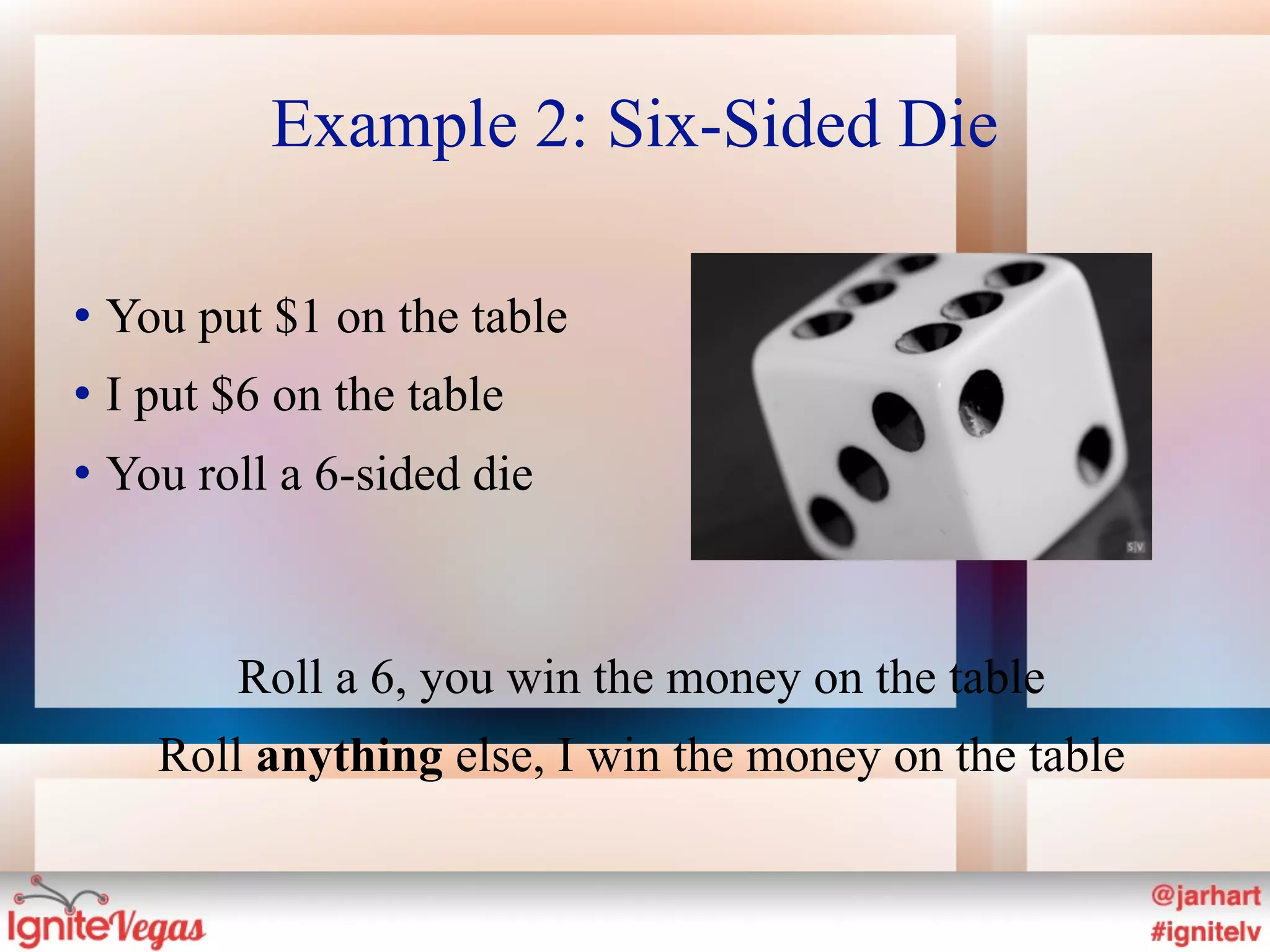
Example 2: Six-Sided Die

   You put $1 on the table
   I put $6 on the table
   You roll a 6-sided die


          Roll a 6, you win the money on the table
      Roll anything else, I win the money on the table
Example 2: Six-Sided Die

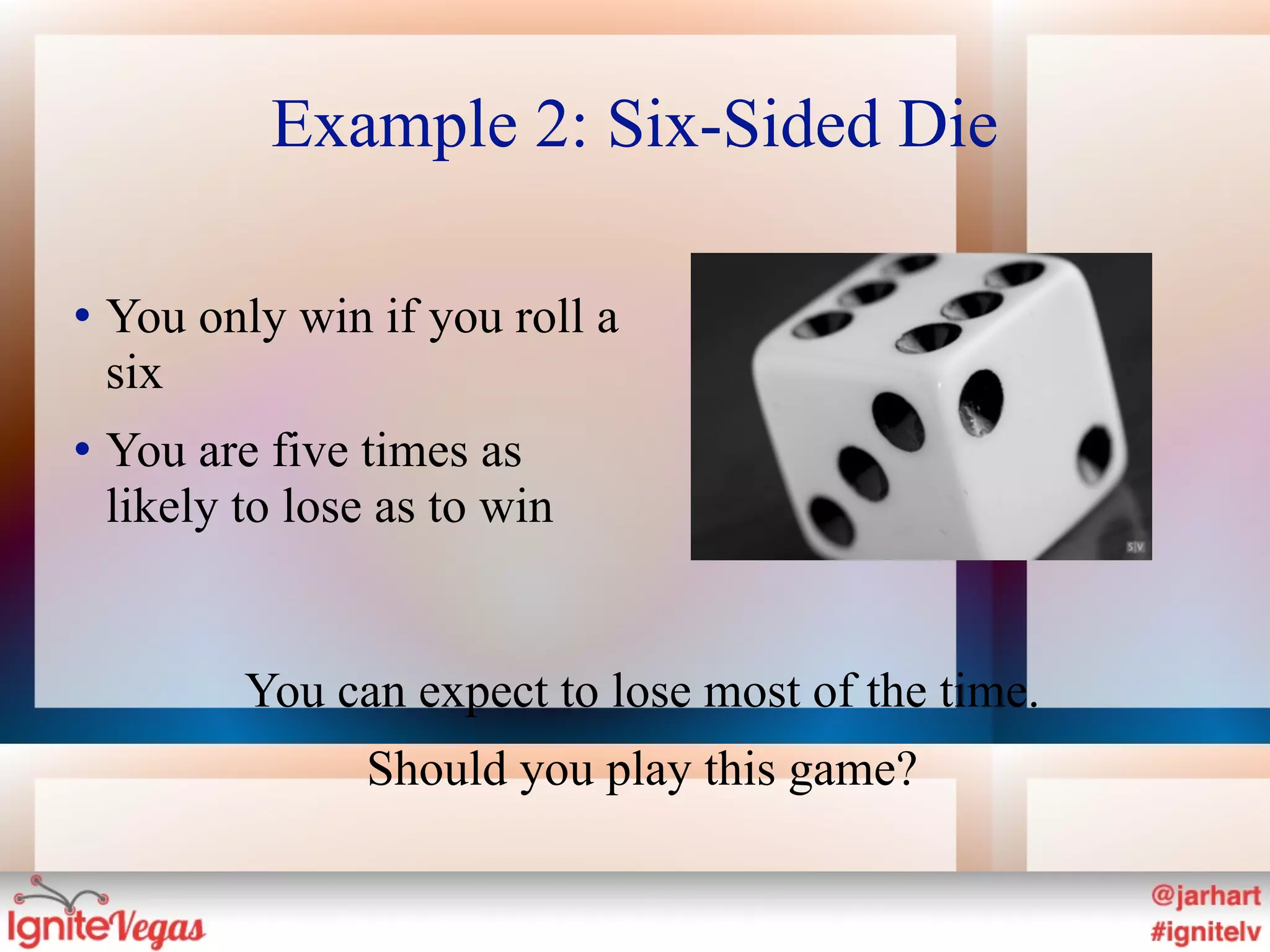
   You only win if you roll a
    six
   You are five times as
    likely to lose as to win


           You can expect to lose most of the time.
                 Should you play this game?
Example 2: Six-Sided Die

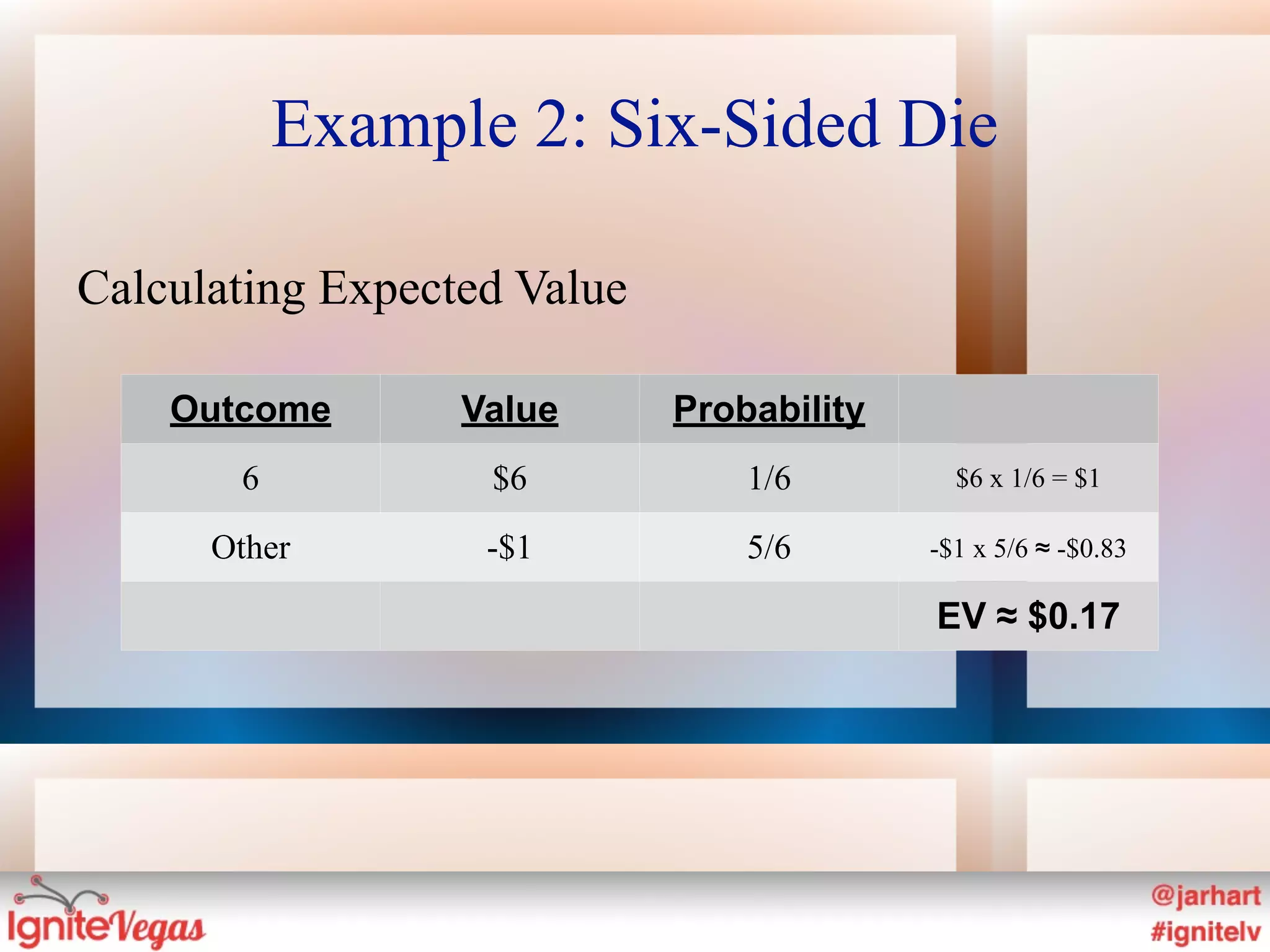
Calculating Expected Value

    Outcome       Value      Probability
       6           $6            1/6         $6 x 1/6 = $1

      Other        -$1           5/6       -$1 x 5/6 ≈ -$0.83

                                           EV ≈ $0.17
Life Is Gambling
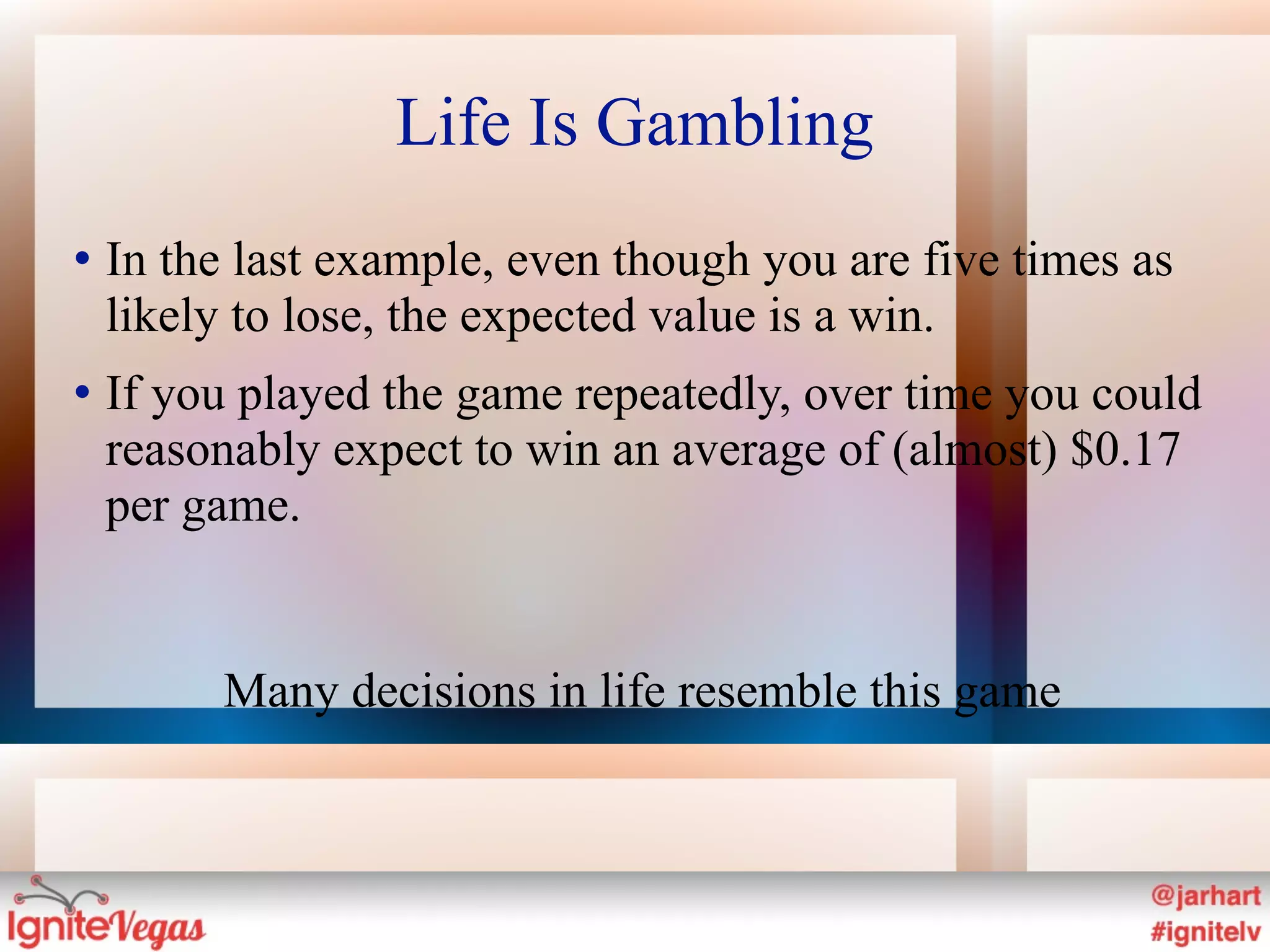
   In the last example, even though you are five times as
    likely to lose, the expected value is a win.
   If you played the game repeatedly, over time you could
    reasonably expect to win an average of (almost) $0.17
    per game.


         Many decisions in life resemble this game
Life Is Gambling
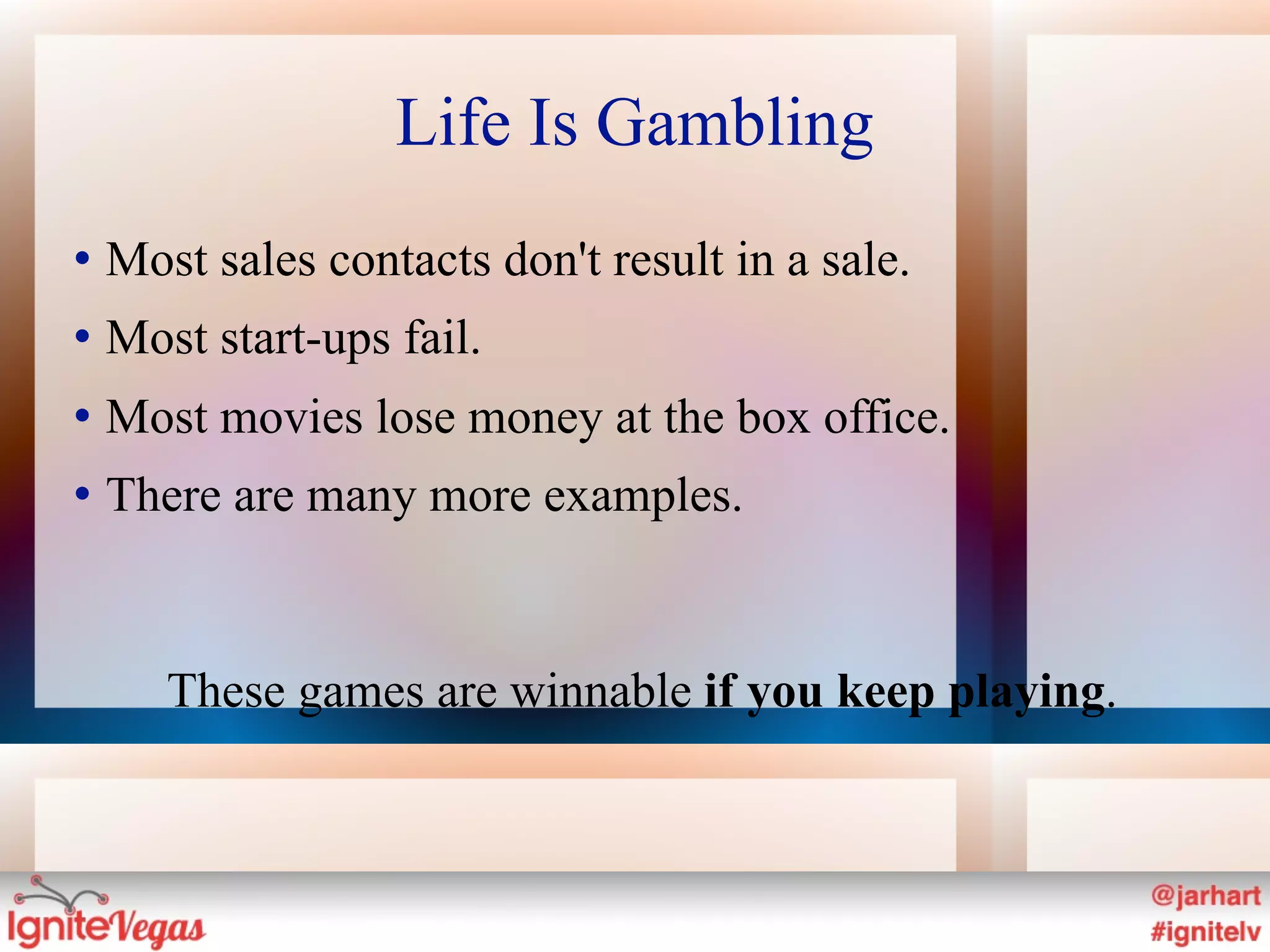
   Most sales contacts don't result in a sale.
   Most start-ups fail.
   Most movies lose money at the box office.
   There are many more examples.


       These games are winnable if you keep playing.
Insurance
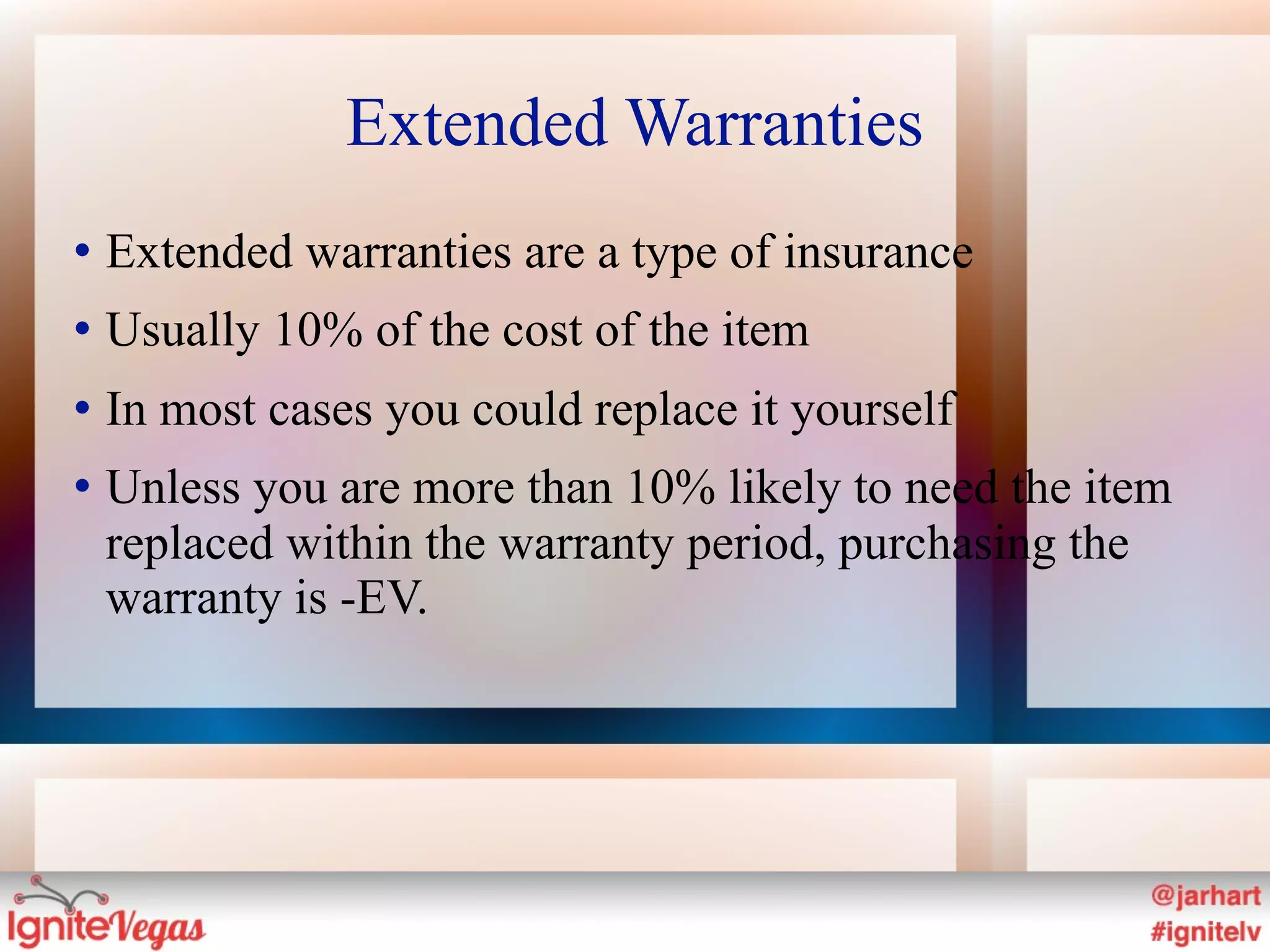
   For when the worst case is unacceptable
   You accept a lower EV in exchange for a better worst
    case scenario
   It is almost always a mistake to insure what you can
    reasonably cover yourself
Insurance
   For when the worst case is unacceptable
   You accept a lower EV in exchange for a better worst
    case scenario
   It is almost always a mistake to insure what you can
    reasonably cover yourself


        Not all insurance is called insurance!
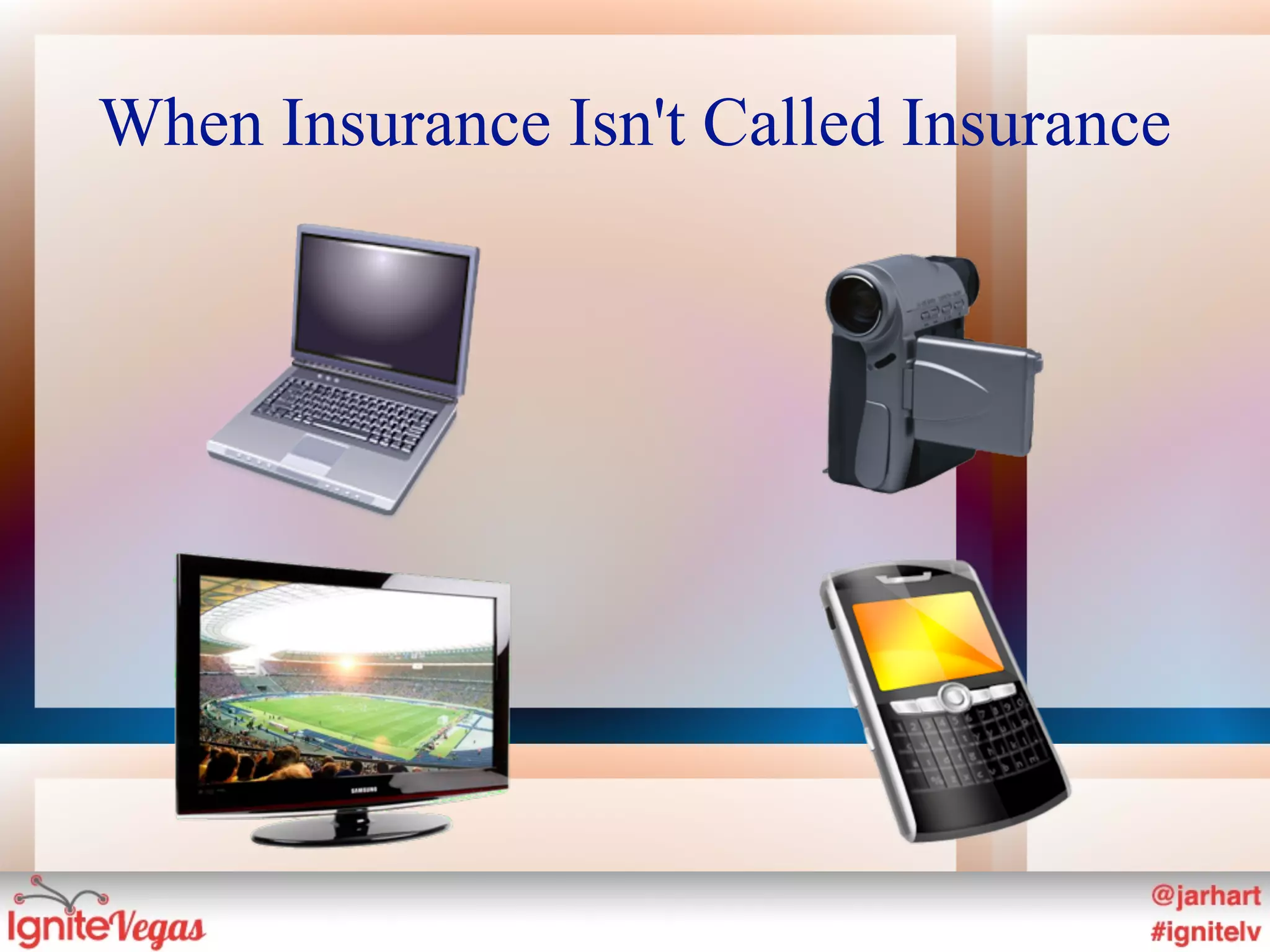
When Insurance Isn't Called Insurance
Extended Warranties
   Extended warranties are a type of insurance
   Usually 10% of the cost of the item
   In most cases you could replace it yourself
   Unless you are more than 10% likely to need the item
    replaced within the warranty period, purchasing the
    warranty is -EV.
Extended Warranties
   Extended warranties are a type of insurance
   Usually 10% of the cost of the item
   In most cases you could replace it yourself
   Unless you are more than 10% likely to need the item
    replaced within the warranty period, purchasing the
    warranty is -EV.
   Selling extended warranties is +EV for the stores,
    otherwise they wouldn't sell them.
Gambling Theory Matters

Jason Arhart: Why Gambling Theory Matters

  • 1.
  • 2.
    Expected Value (EV)  Weighted average of all possible outcomes  Quantifies what you can expect to gain, on average  A fundamental concept in gambling theory...  And in life
  • 3.
    Example 1: ACoin Flip Game  Two-player game  We each put $1 on a table  You flip a coin Heads: you win the money on the table Tails: I win the money on the table
  • 4.
    Example 1: ACoin Flip Game  Probability is 50/50  Heads: you win $1  Tails: you lose $1 You can expect to break even on average. The expected Value is $0.
  • 5.
    Calculating Expected Value  Consider all possible outcomes  Multiply the value of each outcome by the probability of that outcome  Add up all of those products  The result is the expected value
  • 6.
    Example 1: ACoin Flip Game Calculating Expected Value Outcome Value Probability Heads $1 0.5 $1 x 0.5 = Tails -$1 0.5 $0.50 -$1 x 0.5 = -$0.50 EV = $0
  • 8.
    Using EV toMake Decisions  Consider all of your options  Calculate the expected value of each option  Choose the option with the highest EV In many cases your decision is simply whether or not to gamble.
  • 9.
    Example 2: Six-SidedDie  You put $1 on the table  I put $6 on the table  You roll a 6-sided die Roll a 6, you win the money on the table Roll anything else, I win the money on the table
  • 10.
    Example 2: Six-SidedDie  You only win if you roll a six  You are five times as likely to lose as to win You can expect to lose most of the time. Should you play this game?
  • 11.
    Example 2: Six-SidedDie Calculating Expected Value Outcome Value Probability 6 $6 1/6 $6 x 1/6 = $1 Other -$1 5/6 -$1 x 5/6 ≈ -$0.83 EV ≈ $0.17
  • 12.
    Life Is Gambling  In the last example, even though you are five times as likely to lose, the expected value is a win.  If you played the game repeatedly, over time you could reasonably expect to win an average of (almost) $0.17 per game. Many decisions in life resemble this game
  • 13.
    Life Is Gambling  Most sales contacts don't result in a sale.  Most start-ups fail.  Most movies lose money at the box office.  There are many more examples. These games are winnable if you keep playing.
  • 15.
    Insurance  For when the worst case is unacceptable  You accept a lower EV in exchange for a better worst case scenario  It is almost always a mistake to insure what you can reasonably cover yourself
  • 16.
    Insurance  For when the worst case is unacceptable  You accept a lower EV in exchange for a better worst case scenario  It is almost always a mistake to insure what you can reasonably cover yourself Not all insurance is called insurance!
  • 17.
    When Insurance Isn'tCalled Insurance
  • 18.
    Extended Warranties  Extended warranties are a type of insurance  Usually 10% of the cost of the item  In most cases you could replace it yourself  Unless you are more than 10% likely to need the item replaced within the warranty period, purchasing the warranty is -EV.
  • 19.
    Extended Warranties  Extended warranties are a type of insurance  Usually 10% of the cost of the item  In most cases you could replace it yourself  Unless you are more than 10% likely to need the item replaced within the warranty period, purchasing the warranty is -EV.  Selling extended warranties is +EV for the stores, otherwise they wouldn't sell them.
  • 20.