Copyright © Cengage Learning. All rights reserved.
CHAPTER
Combinatorics
and Probability
12
Copyright © Cengage Learning. All rights reserved.
Expectation
Section12.6
3
Expectation
Suppose a barrel contains a large number of balls, half of
which have the number 1000 painted on them and the
other half of which have the number 500 painted on them.
As the grand prize winner of a contest, you get to reach
into the barrel (blindfolded, of course) and select 10 balls.
Your prize is the sum of the numbers on the balls in cash.
If you are very lucky, all of the balls will have 1000 painted
on them, and you will win $10,000. If you are very unlucky,
all of the balls will have 500 painted on them, and you will
win $5000.
4
Expectation
Most likely, however, approximately one-half of the balls
will have 1000 painted on them and one-half will have
500 painted on them.
The amount of your winnings in this case will be
5(1000) + 5(500), or $7500. Because 10 balls are drawn,
your amount of winnings per ball is .
The number $750 is called the expected value or
expectation of the game. You cannot win $750 on one
draw, but if given the opportunity to draw many times, you
will win, on average, $750 per ball.
5
Expectation
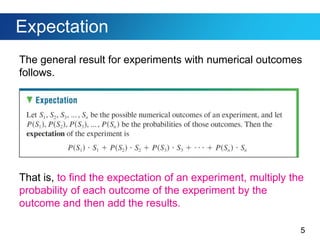
The general result for experiments with numerical outcomes
follows.
That is, to find the expectation of an experiment, multiply the
probability of each outcome of the experiment by the
outcome and then add the results.
6
Example 1 – Expectation in Gambling
One of the wagers in roulette is to place a bet on 1 of the
numbers from 0 to 36 or on 00. If that number comes up,
the player wins 35 times the amount bet (and keeps the
original bet). Suppose a player bets $1 on a number. What
is the player’s expectation?
Solution:
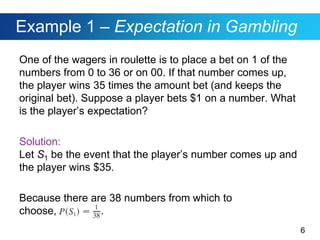
Let S1 be the event that the player’s number comes up and
the player wins $35.
Because there are 38 numbers from which to
choose, .
7
Example 1 – Solution
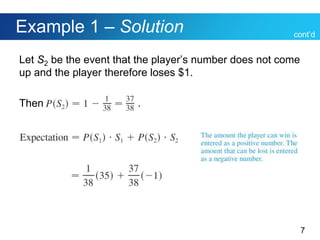
Let S2 be the event that the player’s number does not come
up and the player therefore loses $1.
Then .
cont’d
8
Example 1 – Solution
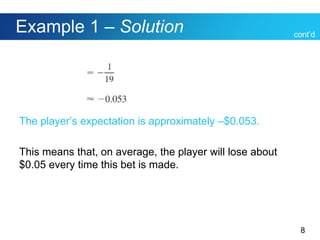
The player’s expectation is approximately –$0.053.
This means that, on average, the player will lose about
$0.05 every time this bet is made.
cont’d
9
Business Applications of
Expectation
10
Business Applications of Expectation
When an insurance company sells a life insurance policy,
the premium (the cost to purchase the policy) is based to a
large extent on the probability that the insured person will
outlive the term of the policy.
Such probabilities are found in mortality tables, which give
the probability that a person of a certain age will live 1 more
year.
The insurance company wants to know its expectation on a
policy—that is, how much it will have to pay out, on
average, for each policy it writes.
11
Example 2 – Expectation in Insurance
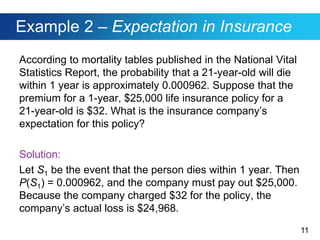
According to mortality tables published in the National Vital
Statistics Report, the probability that a 21-year-old will die
within 1 year is approximately 0.000962. Suppose that the
premium for a 1-year, $25,000 life insurance policy for a
21-year-old is $32. What is the insurance company’s
expectation for this policy?
Solution:
Let S1 be the event that the person dies within 1 year. Then
P(S1) = 0.000962, and the company must pay out $25,000.
Because the company charged $32 for the policy, the
company’s actual loss is $24,968.
12
Example 2 – Solution
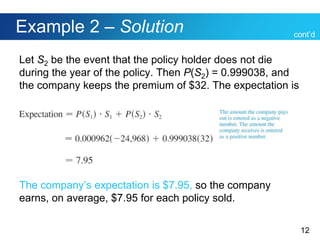
Let S2 be the event that the policy holder does not die
during the year of the policy. Then P(S2) = 0.999038, and
the company keeps the premium of $32. The expectation is
The company’s expectation is $7.95, so the company
earns, on average, $7.95 for each policy sold.
cont’d

AufEx4_12_06.ppt

  • 1.
    Copyright © CengageLearning. All rights reserved. CHAPTER Combinatorics and Probability 12
  • 2.
    Copyright © CengageLearning. All rights reserved. Expectation Section12.6
  • 3.
    3 Expectation Suppose a barrelcontains a large number of balls, half of which have the number 1000 painted on them and the other half of which have the number 500 painted on them. As the grand prize winner of a contest, you get to reach into the barrel (blindfolded, of course) and select 10 balls. Your prize is the sum of the numbers on the balls in cash. If you are very lucky, all of the balls will have 1000 painted on them, and you will win $10,000. If you are very unlucky, all of the balls will have 500 painted on them, and you will win $5000.
  • 4.
    4 Expectation Most likely, however,approximately one-half of the balls will have 1000 painted on them and one-half will have 500 painted on them. The amount of your winnings in this case will be 5(1000) + 5(500), or $7500. Because 10 balls are drawn, your amount of winnings per ball is . The number $750 is called the expected value or expectation of the game. You cannot win $750 on one draw, but if given the opportunity to draw many times, you will win, on average, $750 per ball.
  • 5.
    5 Expectation The general resultfor experiments with numerical outcomes follows. That is, to find the expectation of an experiment, multiply the probability of each outcome of the experiment by the outcome and then add the results.
  • 6.
    6 Example 1 –Expectation in Gambling One of the wagers in roulette is to place a bet on 1 of the numbers from 0 to 36 or on 00. If that number comes up, the player wins 35 times the amount bet (and keeps the original bet). Suppose a player bets $1 on a number. What is the player’s expectation? Solution: Let S1 be the event that the player’s number comes up and the player wins $35. Because there are 38 numbers from which to choose, .
  • 7.
    7 Example 1 –Solution Let S2 be the event that the player’s number does not come up and the player therefore loses $1. Then . cont’d
  • 8.
    8 Example 1 –Solution The player’s expectation is approximately –$0.053. This means that, on average, the player will lose about $0.05 every time this bet is made. cont’d
  • 9.
  • 10.
    10 Business Applications ofExpectation When an insurance company sells a life insurance policy, the premium (the cost to purchase the policy) is based to a large extent on the probability that the insured person will outlive the term of the policy. Such probabilities are found in mortality tables, which give the probability that a person of a certain age will live 1 more year. The insurance company wants to know its expectation on a policy—that is, how much it will have to pay out, on average, for each policy it writes.
  • 11.
    11 Example 2 –Expectation in Insurance According to mortality tables published in the National Vital Statistics Report, the probability that a 21-year-old will die within 1 year is approximately 0.000962. Suppose that the premium for a 1-year, $25,000 life insurance policy for a 21-year-old is $32. What is the insurance company’s expectation for this policy? Solution: Let S1 be the event that the person dies within 1 year. Then P(S1) = 0.000962, and the company must pay out $25,000. Because the company charged $32 for the policy, the company’s actual loss is $24,968.
  • 12.
    12 Example 2 –Solution Let S2 be the event that the policy holder does not die during the year of the policy. Then P(S2) = 0.999038, and the company keeps the premium of $32. The expectation is The company’s expectation is $7.95, so the company earns, on average, $7.95 for each policy sold. cont’d