2
JAPCC Journal Edition 3, 2006
Jointly developed by Alenia Aeronautica and Lockheed Martin as a true military airlifter, the C-27J
Spartan is the right option for personnel transport, material supply, medevac, and more - anytime,
anywhere, in any weather.
Able to operate from short, unprepared strips, the airlifter’s flexibility, inter-operability
and exceptional value make it the ideal choice for many air forces worldwide.
Created by the vast military transport experience of Alenia and Lockheed Martin – and backed
by their dedicated global support and maintenance network - the C-27J Spartan takes airlifting
to a different plane.
Above and Beyond.www.alenia-aeronautica.it
The C-27J Spartan.
Because the real world demands a real military airlifter.
3
JAPCC Journal Edition 3, 2006
Editorial
As the process of NATO Transformation moves forward, it is clear that a
number of key capability areas are now being tackled, including a wide
range of air power related topics. However, perhaps one area that has yet
to be addressed fully is that of Unmanned Aircraft Systems (UAS).
Undoubtedly, the technology in this area has made rapid advances in
recent years and, whilst individual NATO nations have developed a
range of UAS related programmes, we have yet to develop any detailed
NATO policy and doctrine to guide the future development of UAS
and fully integrate them into future combined operations. This needs
early resolution if NATO is to make best use of UAS within its force
structure and also reap maximum operational benefit from this exciting
new technology.
To try and take this work forward, the JAPCC has made the UAS
topic its top priority theme for 2006. Our intention is to engage with
all UAS stakeholders, including NATO staff, industry and academia
to identify what NATO needs to do to exploit the UAS potential
properly. We plan to do this through a variety of different fora,
including meetings and conferences. This JAPCC Journal is a further
major strand in this approach. Based upon all these different discussions
and feedback, our aim is to develop a NATO UAS “Flightplan”, setting
out what topics need to be tackled in order to transform the NATO
UAS capability.
Reflecting the growing importance of UAS, this issue of the JAPCC
Journal offers a range of viewpoints, beginning with an article from
our new Director, General Tom Hobbins. Also included are inputs
from a cross-section of NATO Chiefs of Air Staff summarizing their
current UAS operations and their future national plans in this area.
Beyond that, articles are also provided on the UAS experience in current
operations, including that from an Israeli perspective, together with
academic and industry views. Taken as a whole, I believe this provides
a comprehensive insight into all aspects of UAS operation, which I
hope will serve to stimulate debate across the NATO air community.
Following on from the last edition, I am grateful to the new Chief of Air
Staff, RAF, for his personal interview that gives us all a good insight into
future RAF plans within the NATO context. I am also pleased to have
received an unsolicited article from Dr Andrea Nativi, which I hope may
be the first of many from our elite readership.
I hope you enjoy this edition of the JAPCC Journal.
Hans-Joachim Schubert
Lieutenant General, DEU A
Executive Director,
Joint Air Power Competence Centre
The Journal of the JAPCC welcomes
unsolicited manuscripts of up to 1000
words in length. Please e-mail your
manuscript as an electronic file in MS
Word to journalads@japcc.de
We encourage comments on the
articles in order to promote
discussion concerning Air and Space
Power inside NATO’s Joint Air
community. All comments should be
sent to journalads@japcc.de
The Journal of the JAPCC,
Roemerstrasse 140, D-47546 Kalkar Germany
4
JAPCC Journal Edition 3, 2006
Transforming Joint Air Power:
The Journal of the JAPCC
Director
Joint Air Power Competence Centre
Gen Tom Hobbins
Executive Director
Joint Air Power Competence Centre
Lt Gen Hans-Joachim Schubert
Editor
Air Cdre Dai Williams
Deputy Editor
Wg Cdr Richard Duance
Editorial Board
Col Valentino Savoldi
Lt Col Terje Fagerli
Lt Col Kenneth Kerr
Wg Cdr Peter York
Maj Gert-Jan Wolkers
Maj Panagiotis Akinosoglou
Maj Patrick Piana
MSgt Richard Bago
Sponsor Manager
Maj Frank Weißkirchen
Production Manager
Mr Simon Ingram
Design and Art Production
SSgt Duane White
Distribution
SMSgt Edgar Hersemeyer
The Journal of the JAPCC is the professional
publication of NATO’s Joint Air Power
Competence Centre aiming to serve as a forum for
the presentation and stimulation of innovative
thinking on NATO air power related issues such as
doctrine, strategy, force structure and readiness.
The views and opinions expressed or implied in
The Journal of the JAPCC are those of the authors
and should not be construed as carrying the official
sanction of NATO.
All articles within this issue not bearing a copyright
notice may be reproduced in whole or in part
without further permission. Articles bearing a
copyright notice may be reproduced for any NATO
purpose without permission. If any article is being
reproduced, The Journal of the JAPCC requests a
courtesy line. To obtain permission for the
reproduction of material bearing a copyright notice
for other than NATO purposes, contact the author
of the material rather than The Journal of the JAPCC.
6 Unmanned Aircraft Systems:
Refocusing the Integration of
Air & Space Power
10 The Evolving Capability of
UAV Systems
14 Integrating UAVs with Other
Airspace Users
18 Exploiting a New High
Ground
22 Beyond Technology:
Successful Unmanned Aircraft
System Employment
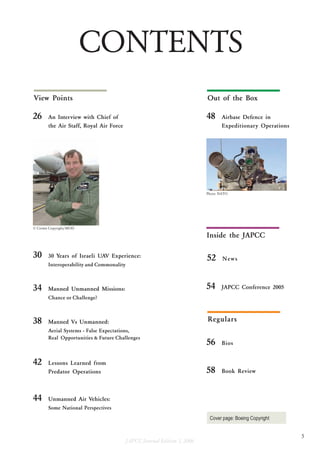
© Crown Copyright/MOD
Transformation & Capabilities
4
5
JAPCC Journal Edition 3, 2006
Inside the JAPCC
Regulars
CONTENTS
Cover page: Boeing Copyright
26 An Interview with Chief of
the Air Staff, Royal Air Force
34 Manned Unmanned Missions:
Chance or Challenge?
38 Manned Vs Unmanned:
Aerial Systems - False Expectations,
Real Opportunities & Future Challenges
42 Lessons Learned from
Predator Operations
52 News
56 Bios
30 30 Years of Israeli UAV Experience:
Interoperability and Commonality
44 Unmanned Air Vehicles:
Some National Perspectives
48 Airbase Defence in
Expeditionary Operations
54 JAPCC Conference 2005
58 Book Review
© Crown Copyright/MOD
Photo NATO
Out of the BoxView Points
6
JAPCC Journal Edition 3, 2006
U
nmanned Aircraft Systems
(UAS) of all types and sizes
are proving their worth
everyday in operations around the
world. From hurricane relief in
New Orleans to combat operations
in Afghanistan and Iraq, they are
extremely flexible. They can be
designed and built for small
reconnaissance ground-teams, for
strategic level commanders and any
level between. Besides being
flexible, they are also cost effective.
Compared to other assets, UAS can
complete their missions at relatively
lower costs. The tremendous
advances in technology and the
exploding numbers of UAS offer
even greater opportunities for
aerospace power. But, unless these
systems are properly integrated into
a comprehensive command and
control system, UAS will not meet
their full potential.
UAS Boom
Joint air and space power is in the
midst of a proliferation of UAS.
As recently reported by the US
Department of Defense, over 32
nations are developing or
manufacturing more than 250
different models, and 41 countries
are operating over 80 types of
UAS.1
By the latest count, the US
alone is operating over 1,000
unmanned systems. Added to this
explosion in the number of systems,
there has been a similar expansion
in the diversity of UAS’ size and
capabilities. At the low-end of the
spectrum there are micro unmanned
systems like the Wasp. This mico-
UAV weighs less than 225 grams, is
just over 20 centimeters long with
Hawk and Euro Hawk that weigh
more than 14,500 kilograms, are
over 15 meters long and have a
wingspan of 40 meters.4
The
Global Hawk capabilities include a
ceiling of 65,000 feet, an
intercontinental range of 5,400
Unmanned Aircraft Systems:
Refocusing the Integration of
Air & Space Power
a wingspan of approximately 30
centimeters.2
It has a ceiling of 1,200
feet, a range of less than 5 nautical
miles and an endurance that is
measured in minutes.3
At the other
end of the spectrum, there are long-
endurance systems like Global
By General Tom Hobbins, USA A
Director of the JAPCC
Northrop Grumman Copyright
Global Hawk
Transformation & Capabilities
The US Department of Defense adopted the
UAS terminology rather than unmanned aerial
vehicle (UAV) to “more clearly emphasize that
the aircraft is only one component of the system,
and is in line with the Federal Aviation Administration’s
decision to treat ‘UAVs’ as
aircraft for regulatory purposes”.
7
JAPCC Journal Edition 3, 2006
nautical miles and an endurance of
32 hours.5
By 2015, the number of
UAS will increase by more than
3,000.6
The introduction of new
UAS will continue for many years
to come. When unmanned balloons
and near-space systems with ceilings
of over 120,000 feet are added to the
mix, endurance can be measured in
months and the diversity of
capabilities and options available to
commanders are incalculable.7
Segregation
Currently, however, this
proliferation and diversity of UAS
have led to developments that are
segregating airspace and aircraft and
hampering the application of
aerospace power. Even more
troubling is that this is happening
counter to the transformational
efforts of NATO nations to
integrate their forces better and
make them more interoperable for
both joint and combined operations.
Two “pressures” are driving the
segregation. The first is the “bottom-
up” tactical development of UAS
without an overall strategic vision
or concept of operations and second
is the corresponding lack of
procedures to integrate these diverse
systems into a network of systems.
It is not surprising that each nation
and its independent services are
focused on fielding unmanned
systems to provide new capabilities
to meet their own very specific
needs. For example, the US Army
has acquired a small tactical UAS
known as BUSTER (Backpack
Unmanned Surveillance Targeting
and Enhanced Reconnaissance), to
meet its requirement for a system
to provide warfighters with critical,
real-time battlefield information in
high-risk areas such as Iraq and
Afghanistan. The purpose of this
system is to increase the warfighters’
situational awareness and provide
them with force protection. These
systems weigh only 4.5 kilograms
and can be carried in a backpack,
launched by soldiers and reach
altitudes up to 10,000 feet. The
system provides soldiers with
extraordinary capabilities. This
example can be repeated in many
other Services of the NATO
nations. Each Service and the
industries that support them are
scrambling to field UAS to tackle
the many difficult problems each
face.
However, little is being done to
establish the means to integrate these
unmanned systems with other forces
and systems, be it between manned
and unmanned, interservice, or
international systems. The high
demand for current and planned
UAS, the diversity in their
capabilities and the lack of an
integrating concept of operations,
across all these systems, is putting
pressure on command and control
measures to operate these systems
safely in crowded airspace.
According to the USAF Joint Air-
Ground Operations Center, there
have been three midair collisions
between small unmanned aircraft
and helicopters during current
combat operations making airspace
control and deconfliction serious
issues.8
Lt Gen Walter Buchanan,
Commander of US Central
Command Air Forces, has stated
“What I worry about is the day
when I have a C-130 down low with
a cargo-load full of soldiers and a
UAV, it won’t have to be a big one,
comes right through the cockpit
windshield”.9
These problems have
led to increased procedural airspace
control measures in an attempt to
deconflict aircraft and increase
safety. Although procedural
airspace control measures provide
some increased level of safety for
aircraft over what is provided by
uncontrolled airspace, it is far from
optimal and does little to optimize
support to the joint fight. Airmen
from all Services and nations must
address this and other issues
segregating airpower and develop
solutions to improve the integration
of all its assets. We must also ensure
our army and navy forces are
involved in the solution to this issue.
JointIntegration
Although current and future
unmanned systems may be quick
to solve individual Service and
tactical problems, more must be
done to develop the means to
integrate these systems beyond
The BUSTER
Mission Technologies Copyright
8
JAPCC Journal Edition 3, 2006
their stove-pipe functions into the
joint and combined force team.
Optimization of UAS as part of
joint/combined forces requires a
wider perspective. It is incumbent
upon each nation and the Alliance
to develop the doctrine, concept of
operations, standards, and tactics,
techniques and procedures (TTP)
necessary to integrate UAS and
other systems into our force
structure. NATO should take the
lead to standardize national efforts
to the maximum extent possible.
Doctrine
At the doctrinal level there are a
number of issues that must be
addressed. A major doctrinal
challenge centres on how to integrate
these systems into the airspace that is
typically above what is controlled by
the ground component commander.
Some examples of this type of
procedural control include
segregating airspace into restricted
areas and coordination zones as well
as providing altitude blocks for
different types of aircraft. Currently,
procedural airspace control measures
are being employed to deconflict
aircraft and the components. The
proliferation of unmanned systems
only highlights existing problems in
attempting to apply existing linear
battlefield doctrine to non-linear
situations, like urban operations,
which joint forces face today. In an
attempt to employ various joint
forces safely in the tight and difficult
confines of urban operations,
commanders are forced to increase
procedural deconfliction measures.
When unmanned systems are added
to the dense concentration of
different assets, the situation is
further exacerbated, leading to more
restrictive procedural measures.
Although this provides increased
safety to those assets in the air, it
only further limits the application
of aerospace power, handicapping
its many strengths and ultimately
decreasing the air support available
to those who need it most. Joint
doctrine must move away from
procedures that only serve to
deconflict joint forces. New joint
doctrine must allow and provide the
positive means necessary to allow
airmen to integrate air assets in
order to meet the Joint Force
Commander’s priorities.
Concepts of Operation
It is time for airmen to take the lead
and aggressively develop the
concepts of operation where UAS
are integrated into the joint force in
“value-added” roles. UAS can add
value by increasing military
capability, decreasing cost, or
reducing risk. If systems do not add
value to a particular mission, nations
should not pursue them until they
would add value. Generally, UAS
show great promise as a tool for
missions that are dull, dirty, or
dangerous. Regardless of the roles
they serve, and to the maximum
extent possible, UAS must be
interconnected with other systems
and forces throughout the
battlespace to exchange information
and help correlate this information
more quickly, precisely, and
efficiently. The networking of
systems will improve situational
awareness and battlespace
knowledge. The networking of
systems and appropriate sharing of
knowledge must occur at all levels
from the tactical: for the company
fighting the 3-block urban war; to
the operational: for commanders
The networking of systems will improve situational awareness and battlespace knowledge at all levels of command.
Photo NATO
Transformation & Capabilities
9
JAPCC Journal Edition 3, 2006
who must allocate limited resources
and monitor, adjust and
communicate their operational
intent; to the strategic: for our
political masters who must provide
political guidance and civilian
control.
Force Development
High-level doctrine and concepts
of operations are simply not
enough to bring UAS integrated
capabilities to the joint fight. A
cadre of professionals must be
trained to maintain and operate
these systems as part of an
interconnected joint/combined
team. For each concept of
operation, TTP must be developed.
Currently, due to a lack of
resources and out of necessity,
development of UAS TTP has been
left primarily to the warfighters
engaged in operations. Although
this has produced results, just as in
other aerial platforms, it is
preferable to have the resources
necessary to develop, test and refine
TTP, and train personnel prior to
their employment on the
battlefield. This will require nations
to not only purchase relatively
inexpensive unmanned systems but
also to secure the necessary
manpower and other resources to
serve as the cadre that will nurture,
develop and refine the application
of airpower through UAS.
Conclusion
The efficient and effective
integration and interoperability of
air and space forces into joint and
combined operations is the
keystone of aerospace
transformation. The integration of
unmanned aerial systems is a
microcosm of the effort that must
be made to improve joint forces
interconnectedness. Airmen must
critically challenge the status quo
and provide comprehensive
recommendations to improve air
and space power’s contribution to
joint and combined operations.
They must judiciously review
standing air and joint doctrine in
the context of today’s strategic
environment and push necessary
changes forward. Concepts of
Operations and the TTPs to
support them must be established
for the missions where UAS can
add value. Finally, additional
resources, beyond merely
acquiring equipment, to include
investments in personnel,
organizational structure, training
and facilities, among others, are
necessary to develop UAS’
contribution to joint/combined
forces. As airmen develop the road
forward for unmanned systems in
particular, and aerospace power as
a whole, they must remember to
think jointly and work with the
ground and maritime components
to provide solutions to the
problems that have driven the rapid
development of unmanned aircraft
systems of all shapes, sizes and
capabilities.
1
Office of the Secretary of Defense (OSD), -The
Unmanned Aircraft Systems Roadmap: 2005-2030,
20 July 2005, p. 38, http://www.acq.osd.mil/usd/
Roadmap%20Final2.pdf.
2
Ibid., 29.
3
Ibid.
4
Ibid., 6.
5
Ibid.
6
Frost and Sullivan research study findings for the
European and Asian markets, combined with
JAPCC research on US UAS acquisition programs.
Frost and Sullivan data was presented at the Future
of Unmanned Vehicles conference held in London
in November 2005.
7
OSD Roadmap, 35.
8
Rebecca Grant, “The Clash of UAV Tribes”, Air
Force Magazine Online, Vol. 88, no. 9 (September
2005): http://www.afa.org/magazine/sept2005/
0905UAV.asp.
9
Lt Gen Walter Buchanan, presentation at Defense
News Media Group’s Joint Warfare Conference
on 26 Oct 2005, reported by Glenn W. Goodman
Jr., “Congested Airspace: Hand launched UAVs
Create Hazards for Manned Aircraft”, C4ISR: The
Journal of Net-Centric Warfare, 9 January 2006,
http://www.isrjournal.com/story.php?F=1379999
Mission Technologies Copyright
“The system provides soldiers with extraordinary capabilities”.
10
JAPCC Journal Edition 3, 2006
The uninhabited air vehicle (UAV)
is a concept whose origins can
be traced back over 100 years.
Professor Samuel Langley, the
Secretary of the Smithsonian
Institution in Washington DC, began
a serious scientific study of the issues
relating to heavier than air flying
machines in 1886 and between 1890
and 1896, he built a number of
experimental, steam powered air
vehicles, which he called
“aerodromes”. The culmination of
his work was Aerodrome Number
5. This had two wings, each with a
span of 4.2 m, arranged in tandem
and it had a mass of 11 kg, including
the mass of the 0.75 kW steam
engine. On the 6th
of May 1896,
following a catapult launch, Number
5 covered a distance of over 1 km,
at a height of 35 m and a speed of
over 20mph. The event was
witnessed, and photographed, by
Alexander Graham Bell and it was
the first sustained flight of an un-
piloted, powered, stable, heavier-
than-air machine of substantial size.
Ground Breaking Flight
Even before this ground breaking
flight, visionaries (and cranks) were
proposing the use of radio signals
to guide vehicles and some with
military interests were proposing the
concept of aerial torpedoes. By the
beginning of WW1, Elmer Sperry
had demonstrated gyro-stabilization
in flight, paving the way for flight
By Professor Ian Poll OBE FREng FCGI FAIAA FRAeS
The Evolving Capability of
UAV Systems
However, these were unsuccessful
largely due to the primitive radio
control technology and were not
pursued because the rapidly
developing manned aviation was
carrying all before it. Between the
wars, the principal driver for UAV
technology was the requirement for
low cost, but realistic, target practice
for anti-aircraft gunners.
Nevertheless, the key enabling
technologies continued to be
developed for reasons that had very
little to do with unmanned aviation.
Coming of Age
During WW2 the aerial torpedo
concept was used by Germany in
the form of the V1 “flying bomb”
and many of the UAV enabling
technologies received a terrific
boost; notably propulsion,
guidance, navigation, electronics and
computation. Post WW2, in parallel
with the rapid development of
manned aviation, it was recognized
that the UAV could be used to
extend military operational
capability. UAVs began to be
considered for reconnaissance,
decoying, suppression of enemy air
defences (SEAD) and long range
control systems that did not rely on
human senses, or skill, and which
could be pre-programmed to
eliminate the need for human
intervention. During WW1, there
were a number of experimental
aerial torpedo programmes.
Professor Samuel Langley
Transformation & Capabilities
11
JAPCC Journal Edition 3, 2006
delivery of weapons (stand-off
bombs). However, progress was
still hampered by the lack of
maturity of some of the key
technologies. This was especially true
in the areas of guidance and
navigation.
It is generally acknowledged that
the UAV “came of age” during the
Vietnam conflict. This was the first
time that UAVs were used in action
and a very large number of missions
were flown. UAVs were used to
gather images and electronic and
communications intelligence. They
were also used for SEAD. In the
1980s, as a result of repeated
conflicts in the Middle East, Israel
and the internet have driven
developments in information
processing, imaging, simulation,
encryption, and data management,
analysis and compression. Arguably,
the most significant development of
all has been the establishment of the
global positioning system (GPS).
Aviation Development
From the beginning of aviation, the
navigation task has been performed
by humans. The availability of
secure GPS is revolutionizing
navigation and it allows the
complete removal of the human
from the cockpit. Over the past one
hundred years, there have been
became a major user and developer
of UAV systems and their
associated technologies.
Enabling Technologies
The past 20 years have seen
tremendous progress in the
enabling technologies, largely thanks
to growth in non-aerospace
markets. The mobile phone boom
has driven communications, display
and energy storage technology. The
personal computer market has
driven processing power and data
storage capacity to ever increasing
levels, whilst power consumption,
size and cost have been dramatically
reduced. The video games market
“The aerial torpedo concept was used by Germany in the form of the V1 Flying Bomb”.
“Military options can be constrained by the potential cost in lives”.
Photo US DoD
12
JAPCC Journal Edition 3, 2006
tremendous developments in
military, manned aviation. However,
in many ways, the potential of
aviation to deliver military benefit
and advantage is severely limited by
the human in the cockpit. Air
vehicles are subjected to very severe
biological limitations. The human
puts clear limits on the size, speed,
altitude, manoeuvrability, endurance,
configuration, complexity and
methods of launch and recovery.
When these limits are removed a
whole new spectrum of operational
capability is released. Added to this
is the fact that human life has
become a huge political issue.
Military options can be constrained
by the potential cost in lives. In a
world where news travels in all
directions at the speed of light, even
the loss of a single life can have a
major impact on public opinion.
With no humans in the cockpit, a
great many things change.
System Development
After a century of manned military
aviation, we have the opportunity
to open a completely new line of
development for airborne systems.
However, progress is being
inhibited by a number of pressing
issues that need to be addressed and
solved quickly. Arguably, the most
serious problem is that of
airworthiness and certification.
Military and civil regulations have
been developed to cover manned
systems and manned operations and
the regulators have not yet provided
a framework that will allow UAV
operators to “file and fly” in all
types of airspace. UAV systems that
can only operate on ranges are of
no operational value. In technology
terms, there are serious gaps in
propulsion and actuation
technology for small vehicles. UAVs
in the Tactical Class offer the
greatest number of new operational
opportunities, but without robust
and reliable sub-systems the
potential cannot be released.
Challenges
Beyond these teething problems,
the principal challenge is the
development of new concepts of
operation. At this early evolutionary
stage, the operational emphasis is on
intelligence gathering, mirroring
almost perfectly the initial stages in
the development of manned
aircraft. However, as awareness of
the potential grows so will the
demand for other capability. At
present, unmanned systems are
being used to complement and
augment legacy manned systems,
whose service lives are measured in
decades and which are sometimes
ill-suited to the tasks that they are
required to perform. UAVs offer
more capability, less risk, lower cost,
shorter service lives and faster and
more frequent upgrades. This
means that UAV equipment can be
matched to the existing threats and,
with greater flexibility than manned
systems, be able to adapt more
readily to changes in the nature of
the threats or to completely new
threats.
Whole military strategies can be
built around new UAV system
capability, in much the same way as
happened with manned aircraft in
the last century and, although there
may be some reluctance to accept
the view that UAV systems will
revolutionize military thinking in the
21st
century, it can be argued that
manned aircraft systems are now in
the same position as battleships
were in the early years of the 20th
century and we know what
happened to them!Singapore Technologies Aerospace Copyright(ST Aero) FanTail
Transformation & Capabilities
13
JAPCC Journal Edition 3, 2006
14
JAPCC Journal Edition 3, 2006
By Wing Commander Mike Strong, RAF, EUROCONTROL Military Unit
Integrating UAVs With
Other Airspace Users
Background
The concept of an aircraft without a pilot in the cockpit mixing with other airspace
users is an anathema to many people and a challenge to regulators. Nevertheless,
this is exactly what EUROCONTROL is seeking to address with regard to UAVs.
EUROCONTROL is the European organization for the safety of air navigation.
Although predominantly civil-staffed, it includes a Military Unit, is based in Brussels,
comprises 35 member states and is responsible inter alia for developing a seamless,
pan-European air traffic management (ATM) system.
Transformation & Capabilities
14
15
JAPCC Journal Edition 3, 2006
15
Photo by SAAB AD
16
JAPCC Journal Edition 3, 2006
The Need
At present, most military UAVs in
Europe are restricted to airspace
that is segregated for the purpose
from other aircraft or they are
flown over the sea using special
arrangements. Where operations are
permitted outside segregated
airspace, numerous restrictions to
ensure the safety of other airspace
users normally apply. This is
extremely limiting. To exploit fully
the unique operational capabilities
of current and future UAV
platforms and to undertake the
training necessary for the safe
conduct of UAV operations,
European military authorities
require UAVs to be able to access
all classes of airspace and to be able
to operate across national borders.
This need was articulated during
the autumn 2003 session of the
European Air Chief Conference,
which suggested an investigation
should be made into the possible
harmonization of ATM procedures
for the use of military UAVs outside
segregated airspace in peacetime.
EUROCONTROL was invited to
undertake the work required
because of its pre-eminence in
ATM in Europe and the task was
then assigned to the Military Unit
within the Agency. The work itself,
recognized this and were,
accordingly, extremely supportive.
Principles
The TF followed three basic
principles. Firstly, UAV operations
should not increase the risk to other
airspace users; secondly, ATM
procedures should mirror those
applicable to manned aircraft; and
thirdly, the provision of air traffic
services to UAVs should be
transparent to ATC controllers. The
TF also sought to be innovative by
not accepting any constraint
imposed by limitations in current
UAV capability. Instead, it took the
view that technical issues were
something for industry to address.
Notwithstanding, the TF paid
particular attention to collision
avoidance, sense and avoid, and
separation minima, since these are
areas of understandable concern to
other airspace users.
Specifications
The TF initially identified 26 draft
EUROCONTROL specifications,
covering areas such as:
· Categorization of UAV
operations.
· Mode of operation.
· Flight rules.
to develop EUROCONTROL
specifications for the use of
military UAVs as Operational Air
Traffic (OAT) outside segregated
airspace, was undertaken by a
specially formed task force (the
UAV-OAT TF) comprising military
and civilian members with
experience in the ATM practicalities
of UAV operations. NATO also
participated.
Why Specifications?
Early on, the TF opted for
Specifications as the most
appropriate category from the
EUROCONTROL regulatory and
advisory framework, rather than
Rules or Guidelines. Specifications had
voluntary status; individual states
would therefore be free to decide
whether or not to incorporate the
EUROCONTROL specifications
into their own national regulations.
The TF sought to avoid
reinventing the wheel by identifying
best practice and building upon
existing material. That said, in
reality, there were no extant national
procedures just waiting to be
adopted and adapted for
implementation throughout
Europe. Instead, the TF had to start
with something very close to a
clean sheet of paper. Nations
nEUROn artistic-drawing
Dassault Aviation / Infographie
Transformation & Capabilities
17
JAPCC Journal Edition 3, 2006
· Separation from other
airspace users.
· Sense and avoid.
· Separation minima.
· Airfield operations.
· Emergency procedures.
· Interface with ATC.
· Equipment requirements.
These were then subjected to a
safety assurance process by an
external contractor, intended to
support the argument that, by
application of the draft
specifications, military UAV
OAT operations in non-
segregated airspace will be
acceptably safe. The approach
taken was to demonstrate that
the risks to other airspace users
from UAV operations would be
no greater than for manned
military OAT in non-segregated
airspace and would be reduced
as far as reasonably possible.
Recommendations arising from this
process were then incorporated
into the specification document,
resulting in an increase in the
number of specifications to 33.
The specifications are high-level,
generic and standalone, so they can
be understood without supporting
detail and thereby be more
amenable to incorporation into
national regulations. For example,
they envisage a primary mode of
operation that entails oversight by
a pilot-in-command and a back-up
mode that enables a UAV to revert
to autonomous flight in the event
of loss of data-link. A similar
hierarchy is followed with regard to
separation provision and collision
avoidance. Thus, where ATC is not
available to separate a UAV from
service provided to UAVs should
accord with that provided to
manned aircraft, and UAVs should
carry similar equipment for flight,
navigation and communication as
required for manned aircraft when
flying VFR and IFR except for Anti-
Collision Avoidance System, which
is currently predicated on having a
pilot in the cockpit.
In short, if UAVs require
integration with other airspace users,
they must fit in with those other
users and with current procedures,
rather than existing ATM having to
adjust to accommodate UAVs.
The Way Ahead
The draft specifications are presently
being progressed through the
EUROCONTROL consultative
and approval process, with the aim
of presenting them to the
Provisional Council (a
EUROCONTROL governing
body) by the end of 2006. The TF
has maintained links with other
agencies, helped by the fact that most
TF members were at the heart of
their own nations’ policy-making on
UAVs. In addition, the TF
Chairman participates in the NATO
UAV FINAS (Flight in Non-
Segregated Airspace) Military
Working Group, which is likely to
adopt the EUROCONTROL
specifications for the ATM aspect
of its work.
There is no doubting the collective
wish for a successful outcome to
the work of the UAV-OAT TF.
However, because this is focussed
on ATM, it is just one part of the
bigger jig-saw that must fit together
before military UAVs will be
allowed to fly routinely outside
segregated airspace. Other agencies
working on airworthiness, security,
operator training and other such
aspects must all perforce play their
part.
“The specifications are
high-level, generic and
standalone, so they can be
understood without
supporting detail and
thereby be more amenable
to incorporation into
national regulations”.
other airspace users, the pilot-in-
command will assume this
responsibility using available
surveillance information and
technical assistance in the form of
a sense-and-avoid system. The
latter will also initiate last-ditch
autonomous collision avoidance
should circumstances warrant.
Other specifications are even more
pragmatic. Thus, the air traffic
SAAB Aerosystems Copyright
18
JAPCC Journal Edition 3, 2006
Exploiting a New High GroundExploiting a New High Ground
Using the Airspace Above Flight Level 650
By Colonel (S) Dan Lewandowski, USA A, JAPCC
Transformation & Capabilities
18
19
JAPCC Journal Edition 3, 2006
400 km
100 km
50 km
10 km
Exosphere
Thermosphere
Mesophere
Stratosphere
Troposphere
Image courtesy of NASA
In some circles, it’s called ‘Near Space’. Others call it ‘Very High Altitude’.
Whatever you call it, the airspace from 65,000 feet to 325,000 feet
AMSL (20 to 100 km) is a part of the Earth’s atmosphere that almost
no one uses. With technological advances, particularly in the area of
Unmanned Aircraft Systems (UAS), exploitation of the Stratosphere
and Mesosphere is now becoming affordable and a real possibility for
military operations.
Why So High?
The desire to go above flight level 650 (above 20 km) is driven by
security, weather avoidance, cost, and persistence. Security at such high
flight levels is increased because of the almost non-existence of threat
weapons that can operate at such high altitudes. Security is further
enhanced by the fact that from such a height, most adversaries won’t
even know the collection platform is in the area. As for weather, once
the UAS passes through the Troposphere, it is above all normal weather
considerations. Temperatures are, relatively speaking, rather constant.
The new environmental consideration is that of exposure to the Sun’s
radiation. This is not difficult or costly to deal with, especially when no
human is in the vehicle. Very high altitude UAS are expected to have
the additional advantage of being much less expensive when compared
to satellites.
19
20
JAPCC Journal Edition 3, 2006
Persistence is the single most
important benefit of operating in
the Stratosphere. A commander
desires persistence so that he or she
can maximize situational awareness,
collect information and increase
knowledge. As an example, imagine
the power of being able to track
every moving ground vehicle in a
theatre from a single very high
altitude UAS utilizing a ground
moving target indicator radar.
Combine that radar with change
detection software and computer
computation capabilities that can
provide speed of vehicles,
groupings of vehicles and tracking
of individual high visibility vehicles,
then a single asset can enable
information dominance on the
battlefield.
Aircraft or satellites have
normally provided collection
capabilities over the battlespace.
The persistence of aircraft over a
location has been mostly limited by
the pilot. Due to long mean times
between mechanical failures, and
the development of air-to-air
refuelling, the ability of collection-
type aircraft to stay on station has
greatly increased over time. These
aircraft are now only limited by the
endurance of the human in the
cockpit. Satellites have the advantage
of no over-flight restrictions which
enables collection over otherwise
denied airspace. And from
geostationary orbit, satellites can
‘stare’ at a location for years at a
time. Satellites have their limits
though. From geostationary orbit
approximately 22,240 statute miles
and flight path of the satellite over
the location being viewed. With
UAS advances, the limitation of the
human is gone and the advantage
of persistence remains for extended
periods of time. The Euro Hawk,
for example, is expected to have an
endurance of 32 hours. Although
not at an altitude above 65,000 feet,
this demonstrates the advances
already made in high altitude
persistence. Going into the
Stratosphere is where Very High
Altitude platforms really could
earn their place in the military
Order of Battle. For example,
Lockheed Martin is currently
developing a test model High
Altitude Airship (HAA) that is
scheduled for launch in 2011. If
successful, the HAA will remain in
flight for 90 to 180 days, with a
4,000 pound (1,800 kg) payload.
What Would We Use At
Very High Altitudes?
The missions and capabilities of
UAS range from the smallest micro
systems, weighing less than half of
one pound, to the large Global
Hawk that has a wingspan 1.3
metres wider than an Airbus 320,
and 6 feet wider than that of a
Boeing 757. What this wide array
of UAS lack though, is the ability
to go to the highest levels of flight.
Only airships and vehicles equipped
with rocket-type engines can go to
flight levels of 70,000 feet and
higher. The ‘explosion’ of UAS
capabilities is fuelling efforts to go
even higher, to go regularly through
the Tropopause and into the
Stratosphere. The hope is that Very
High Altitude UAS could one day
even fly into the Mesosphere. From
these altitudes, the main missions
of UAS would be Intelligence,
Surveillance & Reconnaissance
(ISR) by an array of electro-optical,
electronic emission, synthetic
aperture, infra-red and weather
sensors, and communication relay
or broadcast.
Image courtesy of NASA
“A commander desires
persistence so that he or
she can maximize
situational awareness,
collect information and
increase knowledge”.
(35,786 km) above the Earth’s
surface, it is difficult to see small
objects, because the resolution of
various sensors is poor. From
lower orbiting satellites, you get
much better resolution, but the time
over target is reduced to 15 minutes
or less, depending on the exact orbit
“Satellites have normally provided collection capabilities over the battlespace”.
Transformation & Capabilities
21
JAPCC Journal Edition 3, 2006
Why Is An Easy Concept
So Difficult To Achieve?
Probably the most asked question
is why are we trying to use an
Airship? Why not just make an
aeroplane to fly that high, or a
satellite to fly that low? The basic
reason we can’t use aeroplanes is
because we can’t get the lifting force
needed. Given that below the
Tropopause, air density decreases
by half every 20,000 feet (6 km) and
above the Tropopause it decreases
by half every 15,000 feet (4.5 km),
it is easy to see that over 90% of
the Earth’s air mass is below 10 km
in altitude. When you reach an
altitude of 75,000 feet, the surface
area of the wing needs to be 16
times larger than at sea level. At an
altitude of 150,000 feet, the surface
area would need to be over 500
times greater, in order to achieve the
same lifting force. These numbers
are just not possible for an aircraft.
Spacecraft have a minimum
altitude requirement or they are
forced to re-enter the Earth’s
atmosphere. Once a satellite falls
below an altitude of 100 km
(325,000 feet), the drag of the
atmosphere is so great that the
satellite will return to Earth in a
matter of a few days. Thus, putting
satellites into this part of the
atmosphere is just not possible.
Airships are the only viable option
with today’s technology, but even
they have their limitations. In the
Stratosphere and beyond, there are
generally increasing temperatures as
the altitude increases and this causes
problems for electronics as well as
the expansion of gases. A lack of
air cooling capability due to the
reduced air density is another
limitation. Finally, the problem of
flying through weather and the jet
stream, in order to get to the desired
altitude, must be dealt with. There
are challenges for the very high
altitude ‘High Ground’ but they
are not so great that they should
prevent us from addressing them.
The Future of Very High
Altitude
The High Altitude Airship is one
glimpse into the future. With an
interior volume of about 5.2 million
cubic feet, it will be about 16 times
larger than the Goodyear blimp
and seems huge by today’s
standards. Mankind has built such
large airships in the past though;
the Hindenburg was an amazing 7.1
million cubic feet in volume. If
successful, this UAS could carry
traditional payloads such as sensors
and communications equipment.
With a bit of innovation,
exploitation of this new high
ground could also include the use
of small directional mirrors, which
would redirect lasers from ground
stations onto targets at very great
distances. Armed with solar panels
on such an Airship, energy could
be produced for years providing
the operational commander a
robust persistent ISR and
communication relay platform that
would most likely reduce his
demand for satellite and aircraft
assets. Flight level 650 and beyond
is ready for us to exploit.
Are we ready to make it happen?
Image courtesy of NASA
Copyright Lockheed Martin
“The High Altitude Airship is one glimpse into the future”.
“Spacecraft have a minimum altitude requirement”.
22
JAPCC Journal Edition 3, 2006
F
requently, there are stories
published that advocate
unmanned aircraft systems
(UAS) as the way of the future.
These stories espouse how much
cheaper and safer these unpiloted
drones are for conducting military
missions over their manned
counterparts. Most visionary and
conceptional work focuses on
technology. However, based on
my two-year experience as a
Predator squadron commander,
the success of these “unmanned”
systems depends more on the men
and women that provide the
leadership, testing, training,
operation, and maintenance of
these systems, than the technology
itself.
The major focus on technology
and cost comes at the expense of
these other factors that are at least
as important. The current emphasis
on issues such as computer
processing speed, levels of UAS
autonomy, sensor technology, and
communications architectures can
diminish the importance of other
critical issues including the manning
and organizational structure
required to support and advance
“unmanned” systems.
Technological innovation is only
one part of the transformation
process. Transformation involves
improvements in the areas of
doctrine, organization, training,
materiel, logistics, personnel,
facilities and integration
(DOTMLPFI). Some level of
transformation is necessary across
all these areas to maximize the
military advantage UAS represent.
The focus of this article is on
transformation supported by
personnel and organizational
change.
Inhiswork,InnovationandtheModern
Military: Winning the Next War,
Stephen Rosen, backs the position
that there are many important
drivers and aspects to military
innovation. One of his many
conclusions is that it is not money
that is the key to innovation but
talented military personnel.1
More
importantly, he concludes that a
Transformation & Capabilities
F
22
BEYOND TECHNOLOGY:BEYOND TECHNOLOGY:
Successful Unmanned Aircraft System Employment
By Colonel Stephen P. Luxion, USA A, JAPCC
23
JAPCC Journal Edition 3, 2006
“failure to redirect human resources
resulted in the abortion of several
promising innovations”.2
History
shows talented manpower is critical
to innovation. Our current
experience with UAS demonstrates
similar results.
Predator
Clearly, the integration of various
technologies is important to the
development of UAS. Advances in
computing power, communications
bandwidth, composite material
manufacturing, sensor technologies
as well as numerous other
technological developments all
combined to provide a military
application in the Predator aircraft.
But, the Predator UAS was a
component of the US Air Force for
years, with minimal operational
success, until senior leadership saw
the potential and provided the
vision and a way ahead.
Predator, from the beginning, had
the endurance and sensor capability
necessary to provide commanders
persistent near real-time full-
motion video of the battlespace.
What was lacking was the ability
to do something quickly with the
information Predator provided on
time sensitive and high-value targets.
The vision was to have in one UAS,
the means to find, fix, target, track,
engage and assess targets.
However, the implementation of
this vision met resistance until the
USAF made the decision to employ
more aggressive fighter, attack,
bomber and special operations’
pilots with experience in weapons’
employment. It was these officers
trained in the employment of air-
to-ground weapons and large force
packages that were able to fulfill the
vision of senior officers.
Most military professionals have
heard the stories of how a laser was
added to the reconnaissance pod to
“buddy-guide” laser-guided bombs
delivered from other fighter aircraft
onto targets. Also well known is
the fact that the Hellfire missile was
modified for employment from the
Predator and how radios were
General Atomics Aeronautical Systems Copyright
23
24
JAPCC Journal Edition 3, 2006
added to provide communications
between the Predator and other
aircraft in its vicinity. The integration
of all these new technologies into
the UAS was truly remarkable and
tends to be the focus of many road
ahead and visionary documents
pushing the virtues of unmanned
systems. However, it was the
efforts of experienced aircrews,
maintainers, and weapons experts
that were at least as important to
the successful integration of
technology into the Predator and
the development of the concepts of
operation and tactics, techniques,
and procedures (TTP) that made it
all work on the battlefield.
The new breed of Predator pilot,
with their air-to-ground expertise,
worked with engineers to develop
the procedures, displays, and
checklists necessary for the
successful employment of weapons
from the aircraft. This was no
easy task. Developing reliable
procedures and displays that would
work, despite the distance between
aircraft and pilot and the time delay
caused by satellite communications,
was fraught with challenge.
Concurrently, Predator pilots
with forward air controller (FAC)
expertise, advanced current close air
support (CAS) TTP to integrate
the Predator with other weapons’
systems. The Predator had proven
its worth at finding targets, but
more was needed to effectively
engage the targets. These pilots
developed the procedures to safely
operate UAS in the same airspace
as manned aircraft, in order to
effectively identify and engage
targets as a Hunter-Killer team.
Developing these procedures and
technical solutions was simply not
enough; training and the full
integration with manned aircraft
were also necessary. These Predator
experts acquired the assets
necessary to train manned aircraft
pilots and Predator crews together
on the procedures. They built
leadership confidence through the
development and enforcement of
training and performance standards
and convinced senior staff to
allocate valuable resources such as
range airspace and manned tactical
assets for training and further
development. Following the events
of September 11, this initial cadre
of innovative Predator aircrews
played an important role in
convincing wartime commanders
to employ and to continue to
improve these new capabilities in
combat when lives were at stake.
Organizational Change
Although the Predator capability
has been validated through
operations in Afghanistan and Iraq,
more must be done. Predator and
Global Hawk assignments,
historically, have been two to three-
year assignments for pilots away
“The new breed of Predator
pilot, with their air-to-
ground expertise, worked
with engineers to develop
the procedures, displays,
and checklists necessary
for the successful
employment of weapons
from the aircraft”.
MQ-1B Predator
Transformation & Capabilities
Photo by USAF
25
JAPCC Journal Edition 3, 2006
1
Stephen Peter Rosen, Innovation and the
Modern Military: Winning the Next War,
(Ithaca: Cornell Press, 1991), 252.
2
Ibid., 252-253.
3
Ibid., 20.
4
Ibid., 20-21.
from their primary weapon system.
Following their UAS assignment,
these experienced aircrew return to
their previous aircraft. The USAF
has now determined that this is not
sufficient for the long-term
development of unmanned
systems. It is now in the process of
implementing the organizational
changes that Rosen documented as
necessary for successful innovation.
The USAF has committed to the
development of a career path for
young officers to learn and practise
the new ways of unmanned aerial
warfare.3
Rosen states that such
changes are “necessary to ensure
that the new skills are not relegated
to professional oblivion”.4
By
providing a UAS career path, the
USAF will ensure a pool of
unmanned aircraft experts to work
all levels and aspects of UAS
development are maintained.
Conclusion
The ability of pilots to conduct
operations remotely from halfway
around the world is truly a
technological marvel. Still, these
systems and the TTP to employ
them are being developed, tested,
and flown by skilled airmen.
Discussions of drones operating
autonomously throughout the
world, without a man-in-the-loop,
are premature. Even if this becomes
technically feasible, it is unlikely
that it will be politically acceptable
to remove the human from the
command and control of the
mission. Although it is likely that
technology will make pilots’ stick
and rudder skills less important,
their skills as professional aviators,
accompanied by their situation
Photo by USAF
Photo by USAF
Predator being prepared for operations
The new breed of Predator pilot
awareness, will remain critical.
UAS, even those with an
autonomous capability, will still
require a pilot to be responsible for
the aircraft or flight of multiple
aircraft, the implementation of rules
of engagement and overall mission
management. More importantly,
UAS operations and the continued
innovation required needs more
than technological solutions.
Doctrine, organization, the training
of highly proficient aircrew/
operators, materiel, logistics and the
integration with other joint
systems will all play an important
role. Some may ask what then
makes UAS so different than
manned systems.
Very little and that is the point!
“By providing a UAS career path, the USAF
will ensure a pool of unmanned aircraft
experts to work all levels and aspects of UAS
development are maintained”.
26
JAPCC Journal Edition 3, 2006
Sir, Congratulations on your recent
appointment as Chief of the Air
Staff, Royal Air Force. On taking
up this post, what do you see as
the key challenges facing the
Service and what are your key
priorities?
I see myself building on the
foundations set by Sir Jock Stirrup
and his predecessors. We’ve made
excellent progress towards
generating an agile and adaptable
An Interview with Chief of the Air Staff
Royal Air Force
Air Chief Marshal Sir Glenn Torpy, KCB, CBE, DSO, BSc(Eng), FRAeS, RAF
force structure, more suited to
today’s security environment. The
shift from a Cold War orientated
Main Operating Base culture has
not been easy but I genuinely
believe that we now have a balanced
Air Force, which is structured and
orientated towards expeditionary
operations. Agility is at the heart
of our capability. Our aim is to
achieve rapid effect across the
battlespace, but we also need to be
able to adapt swiftly to changes in
the overall security environment.
We need to keep pace with that
change, intellectually and
doctrinally, and our equipment
needs to have the embedded
flexibility to be capable of adapting
to new demands. As a
consequence, single role platforms
will, I believe, become increasingly
something of the past; from both a
financial and operational
perspective, multi-role must be the
way forward. We must also make
sure that we have the right people
to support the frontline and ensure
that they are just as agile and
adaptable as our equipment.
In terms of priorities, further
development of our expeditionary
capability must lie at the top of the
list, especially in the areas of
Command and Control (C2) and
expeditionary logistics. Secondly,
I want to reduce operating costs.
HQs need to be smaller and more
agile and fit more closely with the
reduced size of our frontline; this
is already underway with the
collocation of HQ Strike
Command and HQ Personnel and
Training Command. But we also
have to streamline our processes.
Here I believe we can draw on the
lessons from operations where we
have small, relatively flat, HQ
structures in which responsibility
is genuinely delegated; we need to
translate that experience into our
peacetime HQs, rigorously
shedding tasks that are no longer
relevant. On the equipment front,
Typhoon has to be our main
equipment priority; it will be the
backbone of our fast jet force for
the future. We also need to develop
our UAV and UCAV capability,
both of which offer significant
capabilities for the future. That said,
© Crown Copyright/MOD
Conducted by Wing Commander Richard Duance, GBR A,
and Wing Commander Pete York, GBR A, of the JAPCC.
View Points
27
JAPCC Journal Edition 3, 2006
we need to gain a better
understanding of how these
platforms can contribute most
effectively, and the associated costs.
I also believe greater priority
should be given to integrated air-
land operations. Op DESERT
STORM and Op ALLIED
FORCE involved distinct air
campaigns followed by discrete
land campaigns. On the other
hand, Op ENDURING
FREEDOM and Op IRAQI
FREEDOM (OIF) demonstrated
the need for, and value of, truly
integrated operations, with the Air
Component providing significant
support to the Land Component.
This must continue in the future.
To support that, more realistic
training is required, particularly
through the use of synthetics and
distributed mission training. This
will help to reduce costs but, more
importantly, as we move into an
increasingly networked
environment, it will be the only
way to deliver effective, joined-up
training.
Would you care to comment at this
stage on the Lessons Learnt from
Iraq and Afghanistan?
Yes, I think one of the main lessons
we have learnt is the need to be able
to respond quickly to
unpredictable events, often over
strategic distances. Balanced forces,
held at high readiness, with robust
strategic mobility and appropriate
C2, are essential for today’s security
environment. As an example,
during Op TELIC we established
8 Forward Operating Bases and
associated C2 – in 7 different
countries – in just 6 weeks; this was
a significant achievement.
Additionally, Iraq and Afghanistan
have both emphasised the complex,
ambiguous and non-linear nature
of the modern battlespace, in which
asymmetric threats feature heavily
and engagement opportunities may
be brief and unpredictable. Speed,
therefore, will be of the essence.
The other thing we have seen very
clearly in Iraq and Afghanistan is
that the military - during many
phases of an operation – will be
playing a supporting role.
Although there may be periods of
high intensity warfare, Other
Government Departments and
Non-Governmental Organisations
will have a vital role to play from
the very start, not least in delivering
humanitarian relief and
reconstruction. This makes life
more complex and increases the
need for a fully integrated
campaign plan, which draws
together all the levers of
government. The task is made all
the more challenging when the
efforts of other Coalition partners
have to be integrated into the plan.
In that respect, do you see a need
to shift away from combat aircraft
like Typhoon more towards
support platforms like Support
Helicopters (SH) and Strategic
Air Transport (AT)?
No, I don’t. I see maintaining a
coherent force structure, which
places appropriate emphasis on
enabling capabilities – such as AT
and SH - as the most important
task. Both of these capabilities are
being fully utilised in current
operations, but C2 and ISTAR are
also absolutely fundamental to the
way we conduct business. It would
be too easy – and convenient – to
reshape our force structure to suit
the environments we are dealing
with today in Iraq and Afghanistan,
to the detriment of being able to
cope with the unpredictable. More
to the point, our fast-jets – like
Tornado GR4 and Harrier GR7 –
are playing a vital role in delivering
CAS and ISR to Coalition ground
forces. It’s worth noting that
during OIF, 80% of the air effort
went to the Land Component and
I see this trend continuing in the
future. The other significant lesson
to come out of operations in Iraq
and Afghanistan is the need for Air
Dominance. The Coalition’s
complete control of the air
provided freedom of manoeuvre
and action to each of the
Components; this allowed the
Coalition to use relatively light
ground forces – because firepower
© Crown Copyright/MOD
“Greater priority should be given to integrated air-land operations”.
28
JAPCC Journal Edition 3, 2006
was available from the air – and
meant that key enabling capabilities,
such as tankers, ISTAR and C2
platforms, could operate well
forward in order to maximize their
effectiveness. Another area that
requires further investment is our
ability to generate and maintain a
shared picture of the battlespace;
without that we will not be able to
effectively conduct collaborative
planning and deliver truly joint
effects. At the moment, we still rely
too much on the procedural
separation of activities and forces –
in time and space – in order to
prevent fratricide.
Recent operations have
confirmed the need for precision.
But what we lack is persistence over
the battlespace – both in terms of
ISTAR and a striking capability.
This is where UAV and UCAV are
likely to play a crucial role,
particularly as more sophisticated
weapons - like directed energy
weapons - become available. This
will allow platforms to remain
airborne for many hours or even
days without rearming. Having a
persistent ISTAR and striking
capability offers significant
opportunities for increasing the
speed and tempo of operations and,
of course, our ability to engage
small, fleeting targets. But going
back to your original question, I
firmly believe that we must remain
postured for the unexpected, which
means maintaining a coherent and
balanced force structure, including
high-end capabilities like Typhoon.
Surely a challenge for today is how
we get the right capabilities to the
front-line, on time and within
budget. What is the RAF doing
to make sure this occurs?
You are absolutely correct. Central
to achieving this objective is the
development of an agile
© Crown Copyright/MOD
“Typhoon has to be our main equipment priority; it will be the backbone of our fast jet force for the future”.
View Points
29
JAPCC Journal Edition 3, 2006
procurement process, which is able
to keep pace with changes in the
operational environment and,
importantly, exploit the rapid
advances in technology that we see
today. The recent announcement
of the UK’s Defence Industrial
Strategy, which proposes a closer
partnership between the MOD and
Industry, will, I hope, be one of
the mechanisms for delivering this
agility. If you look back over the
past 15 years, the UK’s Armed
Forces have been committed almost
continuously on operations, and
we owe it to our servicemen and
women to provide them with the
best possible capability from the
resources of the Defence Budget.
A better partnership will allow
industry to focus their resources,
especially in areas such as Research
and Development, and create an
environment where industry is
much more involved in the
through-life support of platforms.
Incorporating the potential for
growth and incremental capability
enhancements need to be key
features of this strategy.
On the military front, we need
to be a lot more rigorous in setting
requirements – we need to say
what we need, rather than what we
would like. Regrettably,
technology is seductive, and we are
all prone to asking for the moon!!
We also need to make more use of
experimentation and, where
appropriate, the early introduction
of possibly immature technology
which, in the hands of the war
fighter, can be incrementally
developed. The introduction of
Predator by the USAF is a classic
example of how this can work and
the enormous benefits that result,
both in delivering an early
operational capability and steering
future development.
The NATO Response Force
(NRF) is one of the drivers for
NATO’s military transformation.
In the last edition of the JAPCC
Journal, Lt Gen Gaviard, Chief of
Air Defence and Air Operations,
French Air Force suggested that
national air components should
increasingly take responsibility for
providing the complete ACC, air
forces and support. What is your
view?
I can understand why Gen Gaviard
takes that view. From both a
training and execution perspective,
drawing from one nation is the
simplest solution. That said, I think
it’s probably a bit of a tall order to
expect a single nation to take on the
complete task, especially with the
number of other commitments we
face. At the moment, the US, UK
and France are probably the only
nations that have the complete
range of capabilities required to
fulfil this role singly. I believe,
therefore, that a more likely option
could be, perhaps, 2 or 3 nations
in conjunction with NATO,
getting together to fill a particular
NRF period – or back-to-back
periods - with one leading as the
framework nation. This worked
well for NRF 5 and 6, and provides
a useful framework to improve
interoperability and burden share.
And finally, a very important
question. If they meet in the
competition, do you think
England will beat Germany in the
World Cup?
I’m sure it will be a highly
competitive match!
Sir, thank you for your time.
© Crown Copyright/MOD
“Further development of our expeditionary capability must lie at the top of the list”.
“We also need to be able to adapt swiftly to changes in the overall security environment.”
30
JAPCC Journal Edition 3, 2006
30Years of Israeli UAV
Experience
Interoperability and Commonality
By Yair Dubester – Israel Aircraft Industries(IAI)/MALAT General Manager
Ido Pickel (IAF Capt. Res.) – IAI/MALAT UAV Operator
This article presents a brief overview of the Israeli experience in the
domain of Unmanned Air Vehicles (UAV) based on numerous operational
challenges from 1973 to the present day. The various UAV solutions,
which were conceived over the years, are presented below detailing the
operational requirements, technologies and design principles used.
Over these 33 years, we have seen an evolution from simple, proof-of-
concept Remotely Piloted Vehicles (RPVs) to a multiplicity of advanced,
fully operational UAV systems responding to the demands of practically
all military forces and echelons. The 1973 Yom Kippur War was the
impetus for raising the operational level of the UAV by incorporating
real-time video assets capable of tracking mobile SAM batteries in
threatened areas. The R&D matured even further resulting in the “Scout”
UAV system which first saw operational use with the Israeli forces during
the “Peace for Galilee” campaign in the early 1980’s. Since then, the
operational mission use of UAV has only intensified with a continuous
and significant increase in flight hours around the world.
View Points
30
31
JAPCC Journal Edition 3, 2006
The Scout UAV were used with unparalleled success during the 1982 “Peace for Galilee”
campaign. The strikes against Syrian missile batteries in the Bekaa Valley are excellent
examples of effective UAV use in combat, both in a SEAD scenario and as close
support to ground forces. The UAVs were used to detect, identify, and perform
target acquisition for strike aircraft followed by immediate real-time BDA.
The Combat in the Bekaa Valley
The results were impressive. Most
of the SAM batteries in the Bekaa
Valley were destroyed, and a large
number of fighters defending the
SAMs shot down. Israel had
achieved air supremacy of the
region in but a single afternoon.
The Scout UAV was removed
from service in 2004 after almost
25 years of successful operations.
During that period this tactical
UAV system saw numerous
upgrades, improvements and
adaptations, in order to respond
to continuously sophisticated
operational requirements.
31
SCOUT – 25 years of Operational ServiceAll images Israel Aircraft Industries, Ltd. (IAI)
32
JAPCC Journal Edition 3, 2006
Enlarging The Envelope
A direct consequence of the
successful UAV operation in the
1982 campaign supporting SEAD
operations was the US Navy’s
interest in adapting the Israeli UAV
to their requirements. The result of
this effort was the highly successful
and still operational (with the US
Marines) Pioneer UAV, a direct
derivative of the Scout. The
Pioneer UAV was originally adapted
for Navy operations by
implementing point rocket launch
and point recovery by means of a
net set up on the ship’s deck. Several
Pioneer systems saw extensive use
during the 1991 “Desert Storm”
campaign in Iraq, once again
proving its capabilities and reliability
and dedicated capabilities for
specific missions on the edge of
that envelope. To state just a few
examples: the ability to operate
Smaller, Lower, Affordable
Now that the tactical UAVs had
proven themselves worthy at the
division level and higher, the need
arose towards providing the UAV
asset to all forces. Independent real-
time ISR capability was now to
come to the lower echelons such as
the brigade, company or Special
Forces. This was especially needed
for missions such as urban warfare
and homeland security which
became ever more common.
This requirement generated the
development of two new
“families” of UAVs, the small
Tactical UAV (TUAV) and the mini
UAV. In fact, this family approach
was chosen in order to provide each
with great success. In accordance
with the US UAV Roadmap,
operation of the Pioneer with the
US Marines is planned to extend up
to 2015.
Bigger, Longer, Higher
After proving itself operationally in
SEAD, Targeting and general ISR
missions, the evolving requirements
led to the gradual fielding of UAV
systems with enlarged operational
envelopes. That meant growing not
only from a mission perspective,
from which also evolved new
payloads and concepts of
operation, but also from other
perspectives, such as flight
performance, around-the-clock/
all-weather operational availability
around-the-clock without landing
and with combined Colour Electro
Optical/Infra Red payloads, in
adverse weather conditions with
Synthetic Aperture Radar/Ground
Moving Target Indicator payloads,
and to perform SIGINT missions,
such as ELINT and COMINT. The
increase in requirements and
missions led to the fielding of the
even larger systems, e.g. Hunter,
Searcher and Ranger UAV systems.
UAV level with its own optimal
solution while maintaining
maximum commonality and
interoperability within the various
systems with a minimum logistics
effort. The most important lesson
learned over the years regarding
TUAV was the importance of
pinpoint landing in any terrain and
a parafoil for controlled landing.
The parafoil was tested along with
the parachute and was selected due
to its ability to allow the TUAV to
land safely at a predefined point.
The I-View Small TUAV was
designed according to that lesson.
The small TUAV offers tactical
intelligence at the battalion and
brigade levels. The focus here is to
offer a low-footprint, all weather/
all terrain operating capability with
View Points
I-View TUAV performing pinpoint landing
with parafoil
Hunter - “The most reliable tactical UAV in
the US”
Searcher UAV with SAR Capability
Pioneer – The Sea Master Ranger – Features skid-landing on grass
and snow
33
JAPCC Journal Edition 3, 2006
dedicated functions, such as
pinpoint automatic recovery.
When analyzing the requirements
for optimized over-the-hill
observation and all terrain
operation, the most important
requirement is a 360° day or night
under the belly payload installation,
in order to have a steady, with no
limits, real time ISR image at all
times. The other requirement is to
protect the payload in rough terrain
by allowing the Mini UAV to land
on its back. The Bird-Eye Mini
UAV offers a modular solution for
tactical intelligence gathering at the
battalion, company and Special
Forces levels. It enables offset
observation patterns for maximum
operating force flexibility.
All In One
Alternatively, the demand arose for
UAV capable of longer flights
capable of carrying multiple sensors
at extended range. For example,
Maritime Patrol missions require
heavier payloads, greater electrical
power capacity, higher flight
altitude, longer endurance and
greater system reliability. The
required system should include a
platform, which will be the best
“Truck” to carry several sensors
simultaneously, that are not sensitive
to electromagnetic interference
(EMI) and have full interoperability.
This concept was implemented in
the Eagle/Heron UAV that was
conceived as a multi-payload, multi-
mission UAV. The classical twin-
boom design enabled the re-
positioning of multiple and
separately placed antennas away
from the engine for minimal or no
EMI. The retractable landing gears
were put inside the booms freeing
up considerable space for various
payloads in or under the fuselage.
Accordingly, the Navy requirement
for offshore maritime ISR gathering
resulted in the Advanced Ship
Control Station that enables direct
system operation from the ship fire
control centre. Once a de-icing
system was integrated on the
“Eagle/Heron” the operational
envelope was enlarged even further
to include flights in icing conditions.
Where Are We Going?
The use and application of UAV is
spreading throughout the world,
mainly on military missions. Based
on IAI’s experience this includes 27
different customers and over
270,000 flight hours. The general
direction of development has been
based on integrating maturing
technologies with continuously
evolving user requirements.
operational outcome for each
UAV operator. Nevertheless, an
Air Traffic qualification is
required.
· A “UAV Family” approach
should be adopted in order to
offer each level of operation
with its optimal solution, at the
same time maintaining
maximum commonality and
interoperability.
· For short-term operational
requirements or when a fast
response is needed, UAV services
like System Lease or Power by
the Hour should be offered for
all UAV platform sizes and
payloads.
· The basics of effective ISR
collection are similar for large,
as well as small, UAV platforms.
· The Safety level of UAV should
meet and even exceed General
Aviation safety levels.
· Automatic Taxi, Take-Off and
Landing, mission planning and
execution capabilities are critical
to enhance safety.
· Human Machine Interface and
system operations tailored to the
level of the enlisted soldier are
essential. Simple training and a
qualification process is achieved
(not requiring certified aircraft
pilots) with significant gains in
cost and with an optimized
· Integration of the UAV
capability into the C4
I system is
essential in order to link the
“Sensor to the shooter” (or
user) in real time.
· All systems regardless of their
size must meet all airworthiness
criteria in order to operate not
only in military airspace but also
in civil airspace.
There should be two principles for
Airspace management. Flying to and
from the mission area should be
monitored on general aviation flight
paths after all means of ensuring
safety, such as IFF, have been taken.
Flying in the mission area should be
in a defined flight segment in a
closed military airspace.
Bird-Eye Mini UAV
34
JAPCC Journal Edition 3, 2006
When thinking of the co-existence
of humans and unmanned combat
robots furnished with technologies
such as artificial intelligence,
machine learning and emergent
behaviours, our Hollywood-
movie-conditioned minds are likely
to dwell on visions of
uncontrollable, super-intelligent
killing machines, turning against
their human creators. With this
mental picture in mind, the
following questions might be worth
considering: What are current
technologies truly capable of? Can
human/machine co-agency be achieved?
Would it be a concept to benefit
NATO war fighters? While trying
to answer these questions, I wish to
focus on the airborne application,
one of the most developing
domains in this field as the
battlefield deployment of so called
Uninhabited Aerial Vehicles (UAVs)
is commonplace today.
Today’s UAV Guidance
Approach
The required automation
technology for UAV flight
management, guidance, navigation
and control has been rapidly
developed in the last decade. The
general principle of integrating man
selection and demand value setting
as the observable outcome of
planning, decision-making, human
deliberation and anticipation of the
level of mission management.
Thereby, a hierarchically organised work
system is established, which may fail
due to human or machine error, but
it can be assumed that the
automation will never intentionally
act against the human operator’s
goals. No one would seriously
speak of such an automated UAV
being smart or intelligent. The
“intelligence” as a result of mental,
i.e. cognitive performance, is solely
that provided by the human
operator.
The inadequacy of this approach
becomes obvious when the
supervision of multiple vehicles by
a single operator is required. Such
ideas are currently being discussed
in various NATO fora under the
“What are current
technologies truly capable
of? Can human/machine
co-agency be achieved?”
and such machinery is known as
supervisory control. While the on-
board automation typically
performs fast inner control loops
(e.g. stabilization and trajectory
guidance), the ground-based human
operator is responsible for mode
By Prof. Dr. Axel Schulte
Flight Mechanics, Guidance & Control
Institute of System Dynamics and Flight Mechanics, Munich University of the German Armed Forces.
Manned-Unmanned Missions:
Chance or Challenge?
Manned-Unmanned Missions:
View Points
Aeronautics Defense Systems
35
JAPCC Journal Edition 3, 2006
term Manned-unmanned Teaming
(MUM-T). This is an approach to
control multiple UAVs and their
payloads simultaneously from a
manned aircraft, in order to increase
the effectiveness of the manned
system in performing its mission.
However, while this concept
appears clever, there is a likelihood
of the human operator reaching
cognitive overload whilst controlling
multiple platforms. Inevitably, this
would lead to errors and
performance decline.
How to bring in more
cognition
How then do we bring in sufficient
cognitive capacity to cope with the
task of supervising and steering
more than one unmanned remote
platform in a co-ordinated manner
while maintaining control of the
parent (manned) aircraft? The
obvious answer is to increase
manpower by providing at least 1
operator per UAV and placing him
somewhere central, e.g. in an
AWACS. Task each operator
centrally and make the output results
attainable via “Internet” for
download. This aspect of Network
Centric Warfare (NCW) is currently
being investigated in conjunction
with multiple decentralized options,
MUM-T being one of them,
(Figure 1). The advanced
technology involved in the NCW
solution is mainly in the field of
information technology whereas
MUM-T highlights human factors
research and autonomous flight
guidance issues, the latter being the
focus of this article.
Autonomy, Co-agency or
Both?
The question remains how to build
enough cognition into a MUM-T
setup. From a purely technology-
driven stance, the simple answer
could probably be to make the
UAVs autonomous! So, what are
the requirements of an appropriate
autonomous system and what are its
differences to the aforementioned
automated system? Commonly, an
autonomous system would be
expected to pursue the overall goals
of the considered mission, be
reactive to perceived external
situational dynamics, generate
Figure 1: NCW approach with centrally controlled UAVs (left) and MUM-T approach with decentralized UAV operator (right)
environment of a MUM scenario,
incorporating teamwork is
compulsory, the basis of which is
the appreciation of the behaviour
of teammates, humans and
machines alike. Establishing the
capability of teaming between
humans and machines will be
referred to as co-operative control, as
opposed to the classical paradigm
of supervisory control. Interaction
shall no longer occur at the level of
mode selection and demand value
settings but through the negotiation
of requests and commitments at the
task level. This will be based upon
a common current situational
understanding by both humans and
machines. Although the final
decision authority (e.g. for weapon
deployment) stays with the human
operating element, there will be
established a peer team of the
human and several artificial cognitive
units on-board each UAV and an
intelligent operator assistant system on-
board the manned aircraft (see
Figure 2 for the architecture).
Therefore, various machine
capabilities have to be
implemented, for instance:
· Mission accomplishment to
autonomously comply with the
mission objective.
· Operator assistance to direct the
human’s attention, by technical
means, to the most urgent task
and to balance his workload
whenever demanded by the
situation.
· Human-machine and machine-
machine co-operation in order to
“Obviously, making the
UAVs autonomous in
this limited sense is not
the solution!”
solutions by means of anticipation,
deliberation and planning and
execute them without human
intervention; in short to be an
artificial cognitive system. But, what use
might such a system be, performing
completely detached from human
input? Imagine a member of a
purely human team who is
unapproachable to his teammates
and you have the answer!
Obviously, making the UAVs
autonomous in this limited sense is
not the solution!
In order to embed the UAVs into
the highly interactive work
36
JAPCC Journal Edition 3, 2006
achieve common top-level
goals, such as team building and
the co-ordinated pursuit of a
common mission objective.
Approaching Artificial
Cognition
In order to implement such
functionalities there are several
approaches available. Artificial
intelligence, expert systems, soft
computing, machine learning and
genetic algorithms are just a few up-
to-date keywords, predominantly
denoting methodological approaches
to process knowledge. Most are
poor from an architectural
viewpoint. The theory of agents
offers such a conceptual
perspective, though mostly leaving
out the method aspect. One
promising approach combining
both has been developed at the
Bundeswehr University located in
Munich, the so-called Cognitive
Process (CP). The CP comprises a
layered architecture of capabilities,
all of which are structured
according to the CP blueprint of
the sub-processes, namely, situation
gathering and interpretation, goal
determination and planning and
plan execution (see Figure 3). It is
strictly structured along the line of a
knowledge-based architecture, separating
an application-independent inference
(i.e. processing) engine from the
explicit, central representation of
static a-priori knowledge and
dynamic situational knowledge.
The a-priori knowledge will be
implemented by a knowledge
engineer on the abstract level of so
called mental notions, whereby the
modelling of e.g. goals to be
pursued or action alternatives and
their related behaviour will be
possible.
On the basis of the CP, an
engineering framework for
implementing artificial cognitive
units in an efficient manner has been
developed, the so-called Cognitive
System Architecture (COSA). On the
basis of the rule-based architecture
Soar (State Operator and Result), an
object-oriented layer has been
designed with Cognitive Programming
Language (CPL). Currently, further
work is planned to advance the
system for future operation on
embedded real-time computing
platforms.
Applied Research
Researchers at the Bundeswehr
University have been working on
co-operative automation
technology in the field of aircraft
guidance for almost 20 years. Early
approaches were on knowledge-
based systems assisting airline pilots
in IFR flight. The Cockpit Assistant
System (CASSY) was successfully
flight tested in 1994; it was the first
prototype of its kind. The Crew
Assistant Military Aircraft (CAMA)
followed in the late 1990s,
incorporating technology capable
of autonomously performing
mission tasks (e.g. tactical situation
analysis, tactical re-planning) on the
basis of goal-oriented behaviours,
while keeping up a situation adapted
dialogue with the pilot, in order to
balance his workload. More recent
work focuses on the co-agency of
autonomously co-operating
Unmanned Combat Aerial Vehicles
(UCAVs) in a Suppression of
Figure 2: MUM-T architecture with intelligent operator assistant system
and artificial cognition on-board the UAVs
Figure 3: The Cognitive Process
View Points
37
JAPCC Journal Edition 3, 2006
s
Enemy Air Defence (SEAD)
scenario. The scope of this research
is on the co-ordination of machine
agents, i.e. the UCAVs, on the basis
of goal-driven dialogues
negotiating for task allocation.
Upcoming activities will cover
adaptive automation, to provide
intelligent crew assistance in military
helicopter guidance and manned-
unmanned teaming for airborne army
missions, both of which involve
technologies of cognitive automation
and human-machine as well as
machine-machine co-operation and
co-agency. The technologies will be
field tested on the Bundeswehr
University UAV demonstrator
platforms, currently under
construction.
Rotorcraft UAV Demonstrator
Fixed-Wing UAV Demonstrator
“Researchers at the
Bundeswehr University
have been working on
co-operative automation
technology in the field of
aircraft guidance for
almost 20 years”.
Bundeswehr University
38
JAPCC Journal Edition 3, 2006
Aerial Systems -
False Expectations,
Real Opportunities &
Future Challenges.
VsVs
ByDrAndreaNativi
MANNEDMANNED
UNMANNEDUNMANNED
Photo USAF
View Points
39
JAPCC Journal Edition 3, 2006
T
he United States currently
has around 250 Unmanned
Aerial Vehicles (UAVs)/
Unmanned Combat Aerial Vehicles
(UCAVs) in service. By 2015, that
number will rise to 1,400 excluding
the smaller types. Before 2011, the
US also plans to spend US$13
Billion1
developing unmanned aerial
system technology. From these
figures alone, we could conclude
that the days of the manned aircraft,
both fixed and rotary wing, are
numbered. However, we should
not forget the number and variety
of manned aircraft currently in use,
which yet have extensive flying lives
remaining. Neither should we
ignore the fact that much more
money than that stated above is
being invested in a variety of major
manned aircraft programmes,
some of which will be in service
for the next 25-35 years. The
demise of the pilot, therefore, may
not be such an imminent issue. In
this article I will investigate this
discussion by examining some of
the pros and cons of unmanned
aerial systems in the military
context with a view to predicting
the likely future development of
this technology.
systems. While a pilot may need to
fly his aircraft for a minimum of
150 hours per year to remain current,
an unmanned aerial system (UAS)
can remain stored in its hangar for
most of that time, with the vast
majority of UAS controller training
conducted on flight simulators.
Furthermore, UAS can be designed
to operate in extreme conditions;
flight envelopes can be stretched
without risk to human life and UAS
can be sent to places where it would
be too dangerous to send a live crew.
This is particularly advantageous in
combat zones and for intelligence
gathering. Yet, although UAS have
been widely used since the Vietnam
War, they have all too often been
quickly put aside. Why is this?
Firstly, many UAS currently in
service are little more than
conventional aircraft without a
pilot. Although some UAS are
making possible missions that were
never considered before1
e.g. very
long and dangerous Intelligence,
There are, of course, numerous
advantages in operating without the
pilot. Flight endurance is no longer
limited by the capabilities of the
human being and weight and
volume savings accrue from the
omission of crew related support
“While a pilot may need to
fly his aircraft for a
minimum of 150 hours per
year to remain current,
a UAS can remain stored
in its hangar for most of
that time, with the vast
majority of UAS controller
training conducted
on flight simulators”.
Photo USAF
“The demise of the pilot, therefore, may not be such an imminent issue”.
40
JAPCC Journal Edition 3, 2006
Surveillance and Reconnaissance
(ISR) flights over unfriendly
terrain, or attack missions against
heavily defended enemy assets into
which it would be too dangerous
to risk a manned aircraft, no
UCAV currently in development
or design is offering capabilities
that a conventional aircraft or anti-
aircraft SAM or air-to-air missile
cannot match. In short, UAS have
yet to bring any new capabilities
to the Air Commander.
Secondly, UAS were touted as a
much cheaper alternative to
piloted aircraft. Instead, R&D
costs, IT development limitations
and technical advances have
brought with them costs, which
are as high, if not higher, than the
costs of operating conventional
aircraft.
Thirdly, experience with UAS
has shown an unwelcome
tendency of increased levels of
operational failure, much of it
associated to technical and
controller error mishaps2
. Such
sortie loss, failure and UAS
attrition rates may be acceptable
for small and inexpensive tactical
systems but this is not so for the
bigger, more complex and costly
models. Training controllers to
operate UAS, including mission
control systems, is more complex
and expensive than envisioned. In
addition, parallel advances in flight
simulator technology and their
resultant economies in pilot
training plus a very real need
regularly to integrate UAS sorties
with manned aircraft missions in
busy airspace, have soaked up
much of the expected financial
savings from omitting pilots from
the cockpit. Finally, there are
political difficulties. Less wealthy
countries cannot afford the R &
D costs associated with developing
UAS, nor can they afford to buy
the tested technology. However,
a wealthy nation may be able to
absorb the cost of an UAV crash
but other countries could perhaps
more readily face the political cost
of the loss of a pilot than the
perceived waste of money in
crashing a valuable unmanned
vehicle.
The Future
We must not forget that UAS are
still in their infancy and their
growth rate is much faster than is
the case for manned aircraft, so a
far brighter future is probably
within reach. However, users
should not sit and wait for truly
reliable UAS that can simply
duplicate what manned aircraft can
do now. Already, accumulated
experience with UAS has shown
that there is no magical economic
advantage in retiring current
aircraft just because an UAS can
perform the same mission with the
same results. UAS need to become
much better in every single
respect.
Engineers have long complained
that the human body is limiting
the performance of aircraft. UAV
development presents an
opportunity to explore new
materials and much stronger
structures that can withstand
1
US Dept. of Defence, Office of the Secretary of
Defense, Unmanned Aircraft Systems Roadmap
2005 – 2030, July 2005, Washington DC.
2
US DAB Study, Unmanned Aerial Vehicles and
Uninhabited Combat Aerial Vehicles, February
2004, Washington DC.
3
As demonstrated by many research programs, such
as HIMAT, X-29, X-31.
higher loads or extreme
temperatures. New engines can be
developed that are conceived to
operate for days in the most
demanding ambient conditions, as
can more advanced aircraft systems
and new sets of control laws that
allow UAVs to operate in a much
different way to conventional
aircraft3
. It is conceivable that
future UAVs will be able to
outperform every “traditional”
aircraft or missile in combat,
facing perhaps a threat only from
directed energy weapons.
In summary, promoting the UAS
revolution to achieve economies
simply by eliminating human
cockpits does not seem a sound
approach. In order to achieve or
at least to explore the limits and
the viability of a realistic future
UAS concept, there is a need for
vision, a willingness to take risk
and to invest.
Northrop Grumman Copyright
“UAS are still in their infancy”.
View Points
41
JAPCC Journal Edition 3, 2006
www.ila-berlin.com
Berlin Air Show
Y O U R T O N E W M A R K E T S .
G
AT E W AY
German Aerospace
Industries Association
42
JAPCC Journal Edition 3, 2006
The Italian Air Force (IAF)
currently has 4 RQ-1A
Predator UAVs in service. They
were bought from General
Atomics Aeronautical Systems (GA-
ASI) and assembled by METEOR
(Italy). The system was deployed
in Tallil (Iraq) in January 2005, in
support of the Italian Joint Task
Force in the Dhi Qar province. A
few days after deployment, the
system was ready to fly its first
mission. Just 1 year later, the aircraft
have accumulated over 1000 flying
hours, achieving Initial Operational
Capability in a very short time. The
aim of this article is to highlight
some of the lessons the IAF has
learned from its early experience
with the Predator.
“System”
The word “system” has been
intentionally used to underline that,
unlike “manned” aircraft, UAVs
need an integrated combination of
a Ground Control Station (GCS),
a datalink system, Line Of Sight
(LOS) or Beyond LOS (BLOS)
antennas, an exploitation cell and the
aircraft themselves. If any one of
these components fails, the entire
asset would be useless. This simple
By AIR COMPONENT COMMANDER – UAV “PREDATOR”
Colonel Ludovico Chianese, ITAF
Lessons Learned from
Predator Operations
on the flow of information, how
you use that flow of information
and how quickly you are able to
make decisions based upon it. The
achievement of this different system
could well be considered the first
step towards a net centric system,
consisting of a decision maker,
sensors and shooters net, including
the various sub-systems. This is one
of the goals being pursued by the
Italian Defence Strategic Concept.
This is not an easy process and it is
still undergoing strategic analysis by
our Headquarters.
The staff’s job is made the more
difficult by the UAVs’ relatively new
concept of operations and because
few countries have UAV experience
on which we can rely. Similarly, the
jointness of the programme is a
challenge in itself since all users, Air
Force, Navy, Army and police
forces, have different needs and
expectations. State of the Art
technological requirements, such as
Lessons Learned from
Predator Operations
statement can be considered one
of the most important “lessons
learned” that implied a change of
mentality. There was a need to
switch from a traditional system,
where the aircraft is the core business,
to a different system, which focuses
Photo ITAF
View Points
“The staff’s job is made
the more difficult by the
UAVs’ relatively new
concept of operations and
because few countries have
UAV experience on which
we can rely”.
43
JAPCC Journal Edition 3, 2006
Ku Band Satellites, sophisticated
Optic, IR and radar sensors, all
require highly trained and
specialized operating and servicing
personnel. Last but not least,
universal reductions in national
defence budgets will really challenge
Military HQs to find the best way
to allow these programmes to
survive.
Programme Development
Programme development must also
integrate civilian companies working
within the Defence environment and
take into consideration their
capabilities, interests, know-how
and so on. L3 COM, GA-ASI
subcontractor for satellite aspects,
is working to provide fine-tuning
to the chosen satellite for BLOS
capability, which will be needed to
reach Full Operational Capability
(FOC). TELESPAZIO, the Italian
contractor with the Armed Forces
for satellite services, is providing the
appropriate channels and
bandwidth on the satellite
constellation. SELEX, another
Italian company, is the actual
provider for the aircraft spare parts.
If we now look to the future, the
situation is even more complicated.
The Predator will receive a system
upgrade to improve its
performance. All these upgrades
are intended to support the interests
of the Italian Armed Forces to
exploit the full potential of UAVs.
That is to improve our ability to use
UAVs to replace high value assets
in routine or even dangerous jobs
and to save human lives.
From an operational point of
view, LOS only enables less than
optimum utilization of the UAV
system. When BLOS is
implemented, there will be
virtually no range limitations due
to high endurance (about 30
flying hours) and wide satellite
area coverage. However,
limitations are arising from
manning, due to high training
costs and the small numbers of
qualified personnel. Moreover,
very intense operational
workloads during on-shift
periods limit duty times for those
personnel who are qualified. The
spare part logistic cycle also needs
to be improved to reduce
Estimate Time Replaceable
Operatives.
Weather limitations are also a
significant factor. Moderate to
severe precipitation, crosswinds
over 14 kts, surface winds over 29
kts, ceilings below 800 ft, visibility
below 3200 m, moderate to severe
icing or turbulence, lightning closer
than 18 km or ground temperatures
over 40°C are all limitations, some
of which will be overcome by the
system upgrade.
Moreover, the pre-take-off
procedures for each flight take up
to 90 minutes. In tactical
situations, where UAVs may be
needed for short notice tasking, it
is necessary to fly the UAVs either
on Combat Air Patrol or hold
them on the ground on Quick
Readiness Alert, either of which
is expensive in terms of flying
hours and/or personnel effort.
The Unit that operates Italian
Predators is the 28th
UAV Sqn,
based in Amendola. A former
recce Sqn operating the F-104,
then the AMX, the Sqn has been
converted to UAVs through
pilot and payloader training in
the US. Mission Monitors are
recruited from officers with an
Intel background after a system
software course. Exploitation cell
personnel are recruited from
photo interpreter and intelligence
courses. Personnel are drawn
from Army, Navy and Air Force
Branches. Pilots keep their flying
currency on the aircraft they used
to fly before joining UAVs in
order to retain their currency and
motivation.
Complex New World
In conclusion, UAVs are a complex
new world and their operation has
brought considerable success but
also some unexpected challenges.
Technological developments and the
need to work closely with industry
have been unfamiliar areas. Trained
manpower requirements and the
intense workload on operators have
also been higher than expected.
Surprisingly restrictive weather
limitations have also hampered
operations, as have the respective
times taken for planning and
preparing the UAVs for flight.
The Italian Air Force has made
considerable progress with the
RQ-1A Predator during their
early operation and we continue to
move forward towards FOC.
Photo ITAF
RQ-1A Predator on final approach.
The JAPCC is promoting 2006 as the year of the Unmanned Aerial Vehicle (UAV). The UAV is recognized as
a major contributor to transformation in our nations’ Services and NATO as a whole. In March 2006, the
JAPCC hosted a UAV Forum at CC-Air Ramstein; the theme of this edition of the JAPCC Journal is but
another example of the importance of this fast developing area of joint air power. NATO has much work to
do to properly exploit this capability. Therefore, Lt Gen Schubert, Executive Director of the JAPCC, invited
the Air Chiefs of the JAPCC sponsoring nations to provide an insight into their nation’s experience with UAVs,
both now and for the future.
The extracts here illustrate the broad nature of UAV experience.
Canada has found UAVs to be highly significant in reorienting our ideas
and the architecture of a truly joint C4ISR system. Instead of considering
these machines as individual aviation assets with unique functions, they
are more critically viewed as specialized components of a larger
information grid. This simple observation suggests that our lessons
learned in this new capability area will rapidly accumulate; our emerging
UAV doctrine will undergo significant modification as a result.
UnmannedAirVehicles:
SomeNationalPerspectives
For its future UAV development programme, the French Air Force
favours a step-by-step approach based on the lessons learned operating
the HUNTER and the commissioning of the Medium Altitude Long
Endurance (MALE) system. Today, the EUROMALE programme is
underway through a European cooperation programme, which should
permit France to reach its fundamental capability by 2015. For offensive
missions, the NEURON European Demonstrator Programme will allow
the French Air Force to evaluate the UCAV concept within the scope of
the renewal of its combat fleet by 2025.
View Points
44
45
JAPCC Journal Edition 3, 2006
By 2009, Germany plans to introduce MALE UAV to provide all-
weather reconnaissance; by 2010, we will add EUROHAWK to
provide SIGINT and, by 2013, we intend to procure the GLOBAL
HAWK IMINT UAV within NATO’s AGS concept. We are also
monitoring closely R&D into UCAVs.
The Hungarian Air Force NATO/EU contribution is modular and
there is no UAV planned in their Table of Establishment, although
in some cases small platforms could be useful for force protection. If
the ongoing development projects of the MoD Technology Agency
and the National Defence University produce available assets, we
will consider their operational use.
The Hellenic Air Force (HAF) is currently in the development-production
phase of a MALE UAV “PEGASUS”, destined for tactical and operational
needs. Even though the programme started for Tactical Reconnaissance,
other possible applications are being examined including area and
installation surveillance, communications relay, IMINT-SIGINT intelligence
collection and support of special operations. In parallel, the Hellenic Air
Industry has declared participation in the French “NEURON” UCAV
initiative. The main problem concerning the use of the above systems lies
in the absence of air traffic regulations, both nationally and internationally,
making flight trials and missions, such as sea surveillance and border control,
difficult. In the medium term, the HAF is planning the acquisition of
more MALE UAVs, MINI UAVs and UCAV, while, at the same time,
monitoring international trends.
The Italian experience gathered in Iraq confirmed that UAV have
great potential. Predator’s surveillance capabilities have been used to
enhance Force Protection and to increase precision engagement, both
on the ground and from the air, while improving overall awareness.
The full implementation of Beyond Line of Sight Operations is
expanding the field of view. Glancing into future operations, multi-
role UAV will provide the best combination of effectiveness and
flexibility to unravel the uncertainty of modern scenarios.
45
46
JAPCC Journal Edition 3, 2006
The Royal Netherlands Armed Forces aim for a nationally owned
air-ground surveillance capability with the procurement of MALE
UAV systems. Initial operational capability is expected in 2011. With
this AGS capability, the Netherlands Armed Forces can offer a
meaningful contribution both within NATO or coalition alliances.
The MALE UAV missions can vary from homeland defence, disaster
relief to ISR data-gathering in warfighting mission types.
View Points
By 2012, Poland plans to equip her Air Force with at least two MALE
UAV. In the intervening years, we will work on the safe exploitation of
non-segregated airspace, a national communication system to distribute
data collected and compatibility with the NATO Alliance Ground
Surveillance programme.
Norway is acquiring a tactical UAV capability. The Royal Norwegian
Air Force (RNoAF) will declare their UAV squadron operational in
2009. The UAV capability is designated for the support of ground
operations, primarily as an ISTAR-asset. UAVs establish a capacity
enabling a true situational awareness for ground forces manoeuvring
in future areas of operations. The upcoming Defence Study will
consider increased utilization of UAV in the full spectrum of future
tasks for the Norwegian Defence Organisation.
The Portugese Air Force aims to operate, in the future, one UAV MALE
System, composed of three to four air platforms, associated set of sensors,
one Ground Control Station and support personnel. The main objective
is to obtain the capability to provide long-range strategic Reconnaissance,
Surveillance and Target Acquisition for the full range of NATO missions,
using UAV’s.
46
47
JAPCC Journal Edition 3, 2006
Romania started to operate UAVs 8 years ago. Presently, there are 2
Shadow 600 systems in use by the Romanian Armed Forces. One of
them is used for domestic purposes and training, the other is deployed
with Coalition Forces in Operation IRAQI FREEDOM. During these
years of operation, the UAV systems have proved their capabilities in the
service of the Romanian Army, so that we plan to enlarge the Romanian
military UAV family, in order to have a good response to the new kind of
threats against democratic values.
The RAF’s operation of Predator A has offered a unique insight
into the complexities of operating a persistent, armed UAV, thereby
elevating the RAF to the forefront of high-tech UAV operations.
This is exemplified further by our UAV experimentation programme
- integrating the wide-area surveillance capability of the RAPTOR
sensor with the impressive performance of the Predator B. We now
aim to set the conditions for UAV operations outside of UK segregated
airspace. From simple beginnings, the UAV is fast carving a core role
in the future force and sensor mix, which will ensure Air Power’s
continued relevance across the whole spectrum of future offensive
and support operations.
The Spanish Air Force is involved in several programmes related to
the development of Unmanned Aerial Systems (UAS) with the
objective of improving some already existing ISTAR capabilities. The
procurement of MALE type UAS is the fourth phase of a programme
that will cater for all national requirements. In addition to the value
support to the traditional warfare areas, UAS are considered to
improve the ability to adequately face new challenges in many other
fields, like deployments and peacekeeping, control of illegal
immigration and drug traffic, anti-terrorism, environmental activities,
SAR/CSAR and ISTAR.
47
Attributes such as persistence and versatility contribute to highly capable
systems improving the way we currently operate and allow us to do
things previously impossible or impractical. The Air Force will integrate
unmanned aviation with existing and future air and space systems to
provide a more capable force, implement Human Systems Integration,
and continue to lead and innovate Remotely Piloted Aircraft (RPA) and
UAV development and employment. As RPAs and UAVs prove their
worth, lessons learned will be applied to enhancing the next generation of
unmanned systems.
48
JAPCC Journal Edition 3, 2006
The vulnerability of air power
when on the ground has been
recognized as long as combat air
operations have been conducted
and is encapsulated by General
Douhet’s observation in 1921 that
‘it is easier and more effective to
destroy the enemy’s aerial power
by destroying his nests and eggs on
the ground than to hunt his flying
birds in the air’1
. In current NATO
operations, the reality of facing the
asymmetric threat in a non-linear
battlespace is that there is no front
line. Airbases supporting NATO
stability and security operations,
such as ISAF in Afghanistan, may
be in the midst of the land
component’s AO. Their size and
relative concentration of personnel,
aircraft and other materiel, make
them attractive targets for our
adversaries, particularly through
stand-off indirect fire or the use of
MANPADs against aircraft taking
off or landing.
In principle, the key to providing
effective air base defence against the
asymmetric threat, both current
and emerging, is to include elements
of defence in depth and a layered
defence, together with the close
defence of our vital assets.
Additionally, we need to mount a
number of patrols (both foot and
Airbase Defence In
Expeditionary
Operations
By Wing Commander Andy Ingham
GBR A, JAPCC
NRF Demonstration - 2003
Photo NATO
“WHO IS GUARDING THE BACK DOOR”?
Photo Defensiekrant
Out of the Box
49
JAPCC Journal Edition 3, 2006
vehicle), provide a Quick Response
Force (QRF) and ideally have a
mobile reserve on-call. Moreover,
when the need arises, we need to
possess the ability to fight back,
projecting our force into our
Ground Defence Area (GDA)
using a variety of support weapons.
Whilst many European nations
and the US possess dedicated and
well trained personnel to carry out
air base defence, recent experience
has shown that when deployed, we
are particularly vulnerable to the
stand-off weapon attack and, more
recently, the use of MANPADS.
We tend to be very good at
providing the close defence of our
assets, control of entry and
maintaining a highly visible
patrolling profile within the base,
or within the base perimeter
defences. However, where we tend
to let ourselves down is in the
domination of the immediate area
of tactical importance just outside
the base, where stand-off weapons
(and MANPADS) are most likely
to be launched or fired from. To
effectively dominate this area we
would need to be able to project
our FP forces up to 10 km out from
the base perimeter. To successfully
achieve this, we require a dedicated,
well-trained, lightly equipped and
highly mobile force. Additionally,
national caveats often restrict the
deployment of FP forces off-base,
“The vulnerability of air power when on the ground has been recognized as long as combat air operations have been conducted”.
“We require a dedicated,
well-trained,
lightly equipped and
highly mobile force”.
© Crown Copyright/MOD
contributes to a delay in an effective
response to incidents.
Of course, as part of his risk
assessment, the commander may
decide that this sort of attack is
unlikely and therefore allocate his
FP resources to other, higher
priority tasks. Historically however,
the statistics show us that the risk
of a stand-off weapon attack against
an air base has never been higher.
In the mid 1980s, on behalf of the
USAF, the Rand Corporation
undertook a study to examine the
vulnerabilities of air bases. When
published the study concluded that
since WWII, over 75% of all ground
attacks against air bases were in the
form of a stand-off attack. Most
recently, in late 2005, the Royal Air
Force suffered damage to two GR7
Harriers at Kandahar in Afghanistan.
Open news sources reported that
these losses were directly attributed
to ground fire; clearly some form
of mortar or artillery shell was used
against the Harriers.
relying on other coalition forces or,
in some cases, the host nation (HN)
forces to carry out this essential
task. Inevitably, co-ordination and
command and control can then
become very difficult, lines of
communication tenuous and a
breakdown in language often
50
JAPCC Journal Edition 3, 2006
So, stand-off weapons pose a
major threat to deployed air bases.
Why then do they? Because they
are simple to use and are widely
available at relatively low cost on
the international armaments black
market. Furthermore, they are ideal
weapons of choice for insurgents
and terrorists who, apart from the
suicide bombers, prefer not to be
caught. They can blend in with the
local population and probably have
very good knowledge of the local
area. Furthermore, they can pick
the time and place of the attack,
most likely using the “shoot and
scoot” technique. Stand-off
weapons characteristics include:
· Ease of use. Personnel can be
quickly trained on these systems
– most are low tech, some are
fire and forget. Systems can
come pre-loaded or can be easily
assembled.
· Small size. These weapons can
be easily stored and moved
The provision of sufficient
Force Protection assets
needs to be assessed
at the outset and the
threat from stand-off
weapons should
not be overlooked.
covertly into position. If
required they can be cached
close to the firing point for ease
of use at a later date. In most
cases, a two-man team is all that
is required to operate them.
· Readiness. During a window of
opportunity, only a few minutes
are required to make these
weapons combat ready.
· Ease of Employment. Often,
unlimited firing points are
available, such as the roof of a
building, a clearing in a wood
or even from a pre-positioned
static vehicle; the IRA achieved
a huge propaganda success when
they targeted Downing Street in
London in 1991 with this type
of device.
· Availability. Unclassified sources
estimate that there are thousands
of stand-off weapons and
MANPADS around the world
with a considerable number
available on the black market,
if the price is right.
So what can the defender do to
combat this threat? Firstly, the
commander must conduct his risk
assessment based on the most
accurate and up-to-date intelligence,
“We need to mount a number of patrols”.
Photo NATO
and if the threat from stand-off
weapons exists, allocate sufficient
priority to provide forces to counter
the threat. The FP Commander
must be in tactical command of all
Out of the Box
51
JAPCC Journal Edition 3, 2006
“We are particularly vulnerable to the stand-off weapon attack”.
“Stand-off weapons pose a major threat to deployed air bases”.
AP Photo/Dimitri Messinis
Photo USAF
forces allocated to Active Defence,
and in cases where this is not
possible, due to HN or National
constraints, establish effective
Liaison Officers with the other
supporting forces. Moreover, the
Active Defence forces need to
project their presence out into the
stand-off weapon footprint by
adopting a proactive patrolling
posture throughout the GDA.
Furthermore, modern technical
resources such as infantry ground
radars and sensors, need to be
procured to provide the FP
Commander with timely warnings,
so that a counter-attack with
support weapons (if local ROE
permit their use) or the
deployment of the QRF, as
appropriate, to follow up the
attack. Local intelligence sources
should not be overlooked.
In conclusion, during
expeditionary operations, air assets
and in particular aircraft, provide
a target rich environment for any
opposing force. The provision of
sufficient Force Protection assets
needs to be assessed at the outset
and the threat from stand-off
weapons should not be overlooked.
This threat needs to be countered
by the provision of robust forces,
familiar with air operations and
capable of dominating the GDA.
1
Guilio Douhet, The Command of the Air,
Washington DC, Office of Air Force History 1983
(orginally published in 1921, pp 53-54).
Interested in
Force Protection (FP)?
Check out the FP Courses
run at the NATO School,
Oberammergau.
The FP Orientation Course
and
The FP Officers’ Course.
52
JAPCC Journal Edition 3, 2006
Overview
In 2006, the priority for the JAPCC
is to deliver a range of important
projects that will aid the
transformation of NATO air and
space power. These projects, in
support of HQ SACT, have been
formalized into an agreed
Programme of Work (POW),
which sets out the JAPCC
deliverables and timescales. In
addition, JAPCC is developing
projects for a number of other
NATO customers that includes
NATO HQ, SHAPE, CC-Air HQ
Izmir and CC-Air HQ Ramstein.
We believe the overall 2006 POW
will make a major contribution to
NATO’s transformation agenda.
Unmanned Air System
(UAS) Development
The JAPCC has made the UAV/
UAS its top priority theme for 2006.
The subject of UAS will feature
prominently in our JAPCC
sponsored workshops and fora
throughout the year, including the
2006 JAPCC Conference. Our
intention is to bring together all UAS
stakeholders such as NATO staff,
nations, industry and academia to
identify what NATO needs to do
to fully exploit the airpower
capabilities offered by UAS
technologies. Issues relating to
airspace management, command
and control, integration and
interoperability are challenges faced
by all NATO nations.
To meet these challenges, the
JAPCC aims to develop a
“flightplan” that identifies what
NATO needs to do, as an Alliance,
to exploit the UAS potential.
NEWS
NATOAir Defence
The JAPCC has been asked by
NATO HQ to lead a study group
to examine future NATO Air
Defence (AD) requirements and
capabilities. This project, looking
to the year 2020, will analyze the
future capability requirements for
NATO AD in a holistic manner
to identify any capability gaps and
to develop a roadmap to address
them. This project should be
completed by Autumn 2006.
C4ISTAR
The JAPCC is supporting HQ
SACT to develop a Joint ISR
(JISR) concept, a transformational
project that will ensure NATO is
able to meet its aspirations across
the full range of effects based
operations. The JAPCC is also
playing a significant role on behalf
of ACO in the NATO Alliance
Ground Surveillance project.
Working closely with the NAEW
community, including Force
Command and NAPMA, JAPCC
has helped to develop a CONOP
and to provide specialist assessment
for the Main Operating Base
decision process. The JAPCC is
also contributing to the
development of the ‘Concept for
Future E-3A NATO Mid-Term
Employment’ that incorporates an
assessment of the likely expanded
roles and missions such as Time
Sensitive Targeting, Airborne
Command Element, UAS
operations and overall Air Battle
Management.
Air toAir Refuelling
The JAPCC supports the
transformation of the AAR
capability, by developing
interoperability and promoting a
more coherent management, by the
Alliance, of AAR assets. The
JAPCC is also leading to develop a
long term NATO vision for this
critical capability.
The JAPCC is enhancing
interoperability through the
development of AAR doctrine,
procedures, STANAGs and
planning methodologies. This
project has resulted in 2 significant
improvements:
· The production of a new
Alliance Joint AAR manual that
harmonizes and standardizes
© Crown Copyright/MOD
“The JAPCC is enhancing interoperability through the development of AAR doctrine”.
Inside the JAPCC
By Air Commodore Dai Williams,
GBR A, JAPCC
52
53
JAPCC Journal Edition 3, 2006
procedures currently found in
more than 20 different manuals.
· The drafting of an updated
NATO AAR concept that
provides a coherent structure
for planning and directing
Alliance AAR.
Looking longer term, the JAPCC
is developing a future NATO AAR
concept. This work, with a 15-year
time horizon, seeks to identify
future AAR requirements,
resources and technologies and to
establish future operating and
employment concepts for AAR.
This project incorporates the
integration of AAR into network
centric operations and new
concepts, such as unmanned air
refuellers. This work should be
complete by the end of 2006.
SimulatedMissionAnd
Rehearsal Training
(SMART)
NATO SMART is a distributed
simulation project involving JAPCC
in collaboration with HQ SACT.
The JAPCC chairs both the
SMART Steering Group and the
Operations and Training Group.
With the initial scoping effort
complete, the JAPCC is now
working with HQ SACT to
provide a Phase 1 report to the HQ
SACT Management Board. The
next steps involve gaining formal
commitment of national and NCS
assets for a SMART exercise event,
which has been scheduled for 2008.
FutureAir Exercises
The JAPCC is currently
developing a project to identify a
future NRF Air training and
exercise concept. The aim of the
project will be to examine the value
and relevance of current air training
programmes to support the broad
range of missions and threats that
the NRF faces.
The detailed objectives and
milestones of this study are currently
being identified. The JAPCC aims
to complete the project by the end
of 2006, working closely with the
main stakeholders in the JFC’s and
ACC’s.
AirLogistics
The JAPCC continues to provide
strong support to the SACT
Integrated Capability Teams on
logistics transformation issues. This
work includes the further
development of the Deployable
Airfield Activation Wing (DAAW)
concept described in JAPCC
Journal Edition 1. The JAPCC has
been asked to develop a NATO
force proposal to cover the DAAW
capability and to lead on the
assessment of the DAAW concept
as part of the Defence
Requirements Review 07 process.
HQ SACT has also been requested
to support an exercise in 2007 to test
the DAAW concept.
Force Protection
Recent SHAPE TACEVALS have
highlighted nations are increasingly
adopting different approaches to
deployed operations in a chemical,
biological, radiological and nuclear
(CBRN) environment. With the
advent of the NRF, and the focus
on multinational operations within
the same deployed airbase, current
NATO policy and doctrine in this
area needs to be reviewed.
The JAPCC is leading with this
work in consultation with SHAPE,
the ACC’s and the NATO
AEW&C Force Command. The
aim is to develop a new Concept of
Operations for NRF air operations
in a CBRN environment to be
complete by June 2006.
JAPCC Website
If you want to know more about
any of the JAPCC’s projects, please
visit our new website at
www.japcc.de The website gives
you the opportunity to add your
own comments and suggestions,
including any ideas on new
projects that could be undertaken
by the JAPCC.www.japcc.de
53
54
JAPCC Journal Edition 3, 2006
The JAPCC held its first air
power conference in Kleve,
Germany in November 2005.
The theme of the Conference was
to question, “How do we ensure
that NATO joint air and space
power remains relevant?”. Over
180 delegates including high-
ranking NATO military officers,
academics and Defence
Industrialists attended. The
Conference was opened by
General Henault, Chairman of
the Military Committee, who
addressed the issue of air power
within the context of NATO’s
transformation process and the
part played by Centres of
Excellence like the JAPCC.
Key Note Address
Gen Henault emphasized the vital
role of airpower in today’s military
operations, particularly the
determining contribution it can play
in the early part of a campaign. He
highlighted the great changes in the
way air power is now applied with
the focus on Joint and Combined
operations and the differing scale
and types of interventions. The
General stressed the importance of
the NATO Transformation initiative
and the value of the NRF concept
as the catalyst for delivering the
necessary changes. Although NATO
faces many challenges in making the
best possible use of air power,
Gen Henault believes the Alliance
will continue to require a
substantial and diverse set of air
and space power capabilities. He
argued that efforts needed to be
focused, emphasizing that the
challenge to the air community
was to go on improving air
power capabilities with continued
development of new ideas and
concepts.
Gen Henault concluded by paying
tribute to the work done by SACT
in leading the Transformation
process, but he also emphasised the
major role to be played by the new
Centres of Excellence, which he
saw as vital for the development of
new ideas and concepts. He said
that the work done by the
JAPCC was vital to the Alliance’s
overall capabilities, not least
because air power would remain
a key element for the future
success of NATO.
Panel Discussions
The remainder of the Conference
consisted of a series of
presentations and panel discussions
with full involvement of the
delegates. These discussions
concluded that air and space power
has much to offer in tackling
terrorist and insurgent threats, where
there are no front lines and where
ground units cannot control the
ground with any degree of
permanence. Air platforms have
JAPCC
CONFERENCE 2005
“General Henault emphasized the vital role of airpower”.
Inside the JAPCC
By Air Commodore Dai Williams, GBR A, JAPCC
54
55
JAPCC Journal Edition 3, 2006
the perspectives of height and
endurance and, due to their speed,
they also have the necessary
flexibility for dynamic re-tasking.
New technology now also offers
the potential for air power to
operate with an increased degree
of “sensitivity” when interacting
with the ground environment.
Developing new technologies will
further enable air power by
assuming an increasingly prominent
role in missions that require non-
kinetic and non-lethal effects.
The panels, looking at the future,
identified a range of areas where
NATO air power needs to continue
to evolve and to transform. These
include:
· Avoiding a dual class military
Alliance in which specific nations
can only operate with the ones
that have similar capabilities.
· Introducing new platforms and
command and control systems
not based on system centric or
a Service centric approach, but
with a holistic capability based
approach.
· Recognizing a harmonized
evolution versus a revolutionary
approach as a pragmatic way
forward – focusing on role
specialization and national niche
capabilities.
· Improving interoperability
through broader NATO
common funding, which should
be viewed as an important tool
for Transformation.
· NATO working to develop
greater capability within space or
near-space and to be less reliant
on purely national sensors.
· Exploiting the potential of
UAVs. There is a pressing need
for policy and doctrine relating
to airspace control, the
integration of UAVs and the
associated command and
control issues.
· Introducing a new concept for
future exercises, by moving
away from the old legacy style
of counting missions and
airframes towards evaluating
the operational and tactical
requirements for the NRF.
This must include a stronger
joint approach, less focused at
the Component level, and with
more priority to enabling
activities such as airlift, logistics
and CIS.
· Releasing the potential of
modelling and simulation to
allow NATO to conduct realistic
and cost effective training.
· Promoting an effects-based
mindset with the formulation of
NATO policy on EBAO.
· Development of air land
integration procedures to meet
the operational challenges.
Conclusion
The first JAPCC Conference
identified the continued need to
persuade others, especially national
decision-makers, about the
importance and utility of air and
space power. Despite prominence
of late, air power is not generally
well understood outside the air
community; therefore we must be
ready and able to demonstrate its
value if air power is to remain
relevant and properly resourced.
In closing the 2005 Conference,
Lt Gen Schubert, the JAPCC
Executive Director, expressed his
gratitude for the open exchange of
information and knowledge that
had stimulated all the discussions.
The Conference had been
invaluable in helping determine the
JAPCC 2006 programme of
work, where the JAPCC could
address the most pressing issues
identified by the NATO air
community, together with tasks
that would contribute most to the
transformation of joint air and
space power.
55
56
JAPCC Journal Edition 3, 2006
BiosRegulars
56
General Tom
Hobbins,
USA A, is Director
JAPCC Kalkar
G e r m a n y ,
Commander, U.S.
Air Forces in
E u r o p e ;
C o m m a n d e r ,
Allied Component Command - Air
Ramstein; and Air Component
Commander, U.S. European
Command, Ramstein Air Base,
Germany. Gen Hobbins entered the
Air Force in Dec 1969 as a graduate of
Officer Training School. He has
commanded two tactical fighter wings
and a composite air group. He has
served as the Director of Plans and
Operations for U.S. Forces Japan,
Director of Plans and Policy for U.S.
Atlantic Command, and Director of
Operations for U.S. Air Forces in
Europe. As the USAFE Director of
Operations, Gen Hobbins was
responsible for the planning, beddown
and execution of combat forces in
Europe for Operation ALLIED
FORCE. As 12th Air Force
Commander, Gen Hobbins deployed
the 12th Air Force’s AOC to Southwest
Asia as Operations ENDURING
FREEDOM and IRAQI FREEDOM’s
alternate AOC. A command pilot, Gen
Hobbins has flown more than 4,275
flying hrs, primarily in fighter aircraft.
Wing
C o m m a n d e r
Mike Strong,
RAF, joined the
RAF in 1966 as a
military air traffic
controller. He
has served at RAF
and RN airfields
worldwide and at joint civil/military
ATC centres. He has broad experience
in a variety of air traffic management
posts in military and civilian HQs.
Since 2003, he has been on secondment
to EUROCONTROL as a military
expert, specializing in airspace and air
traffic management matters.
Colonel Stephen
P.Luxion,USAA,
is the Director of
Staff at the
JAPCC. A 1984
USAF Academy
graduate, Col
Luxion spent 10
yrs flying the F-
111 and 2 yrs flying the F-14A and EA-
6B . He flew the MQ-1B Predator for 3
yrs and commanded the 17th
Reconnaissance Sqn. He has 2,500 hrs
flying time with 700 hrs combat time.
Col Luxion is a distinguished graduate
of the USAF Fighter Weapons School
and Air Command and Staff College.
He is also a graduate of the School of
Advanced Airpower Studies and the
National War College.
Air Chief
MarshalSirGlenn
Torpy,KCB,CBE,
DSO, BSc(Eng),
FRAeS, RAF, has
flown the Jaguar
and Tornado
GR1A aircraft in
the reconnaissance
role. He commanded No 13 Sqn during
the 1991 Gulf War where he was
awarded the Distinguished Service
Order. He has served as the Station
Commander RAF Bruggen, Germany,
and has attended both Royal College of
Defence Studies and the Higher
Command and Staff Course. He has held
a number of senior national staff
positions including Director Air
Operations in the MOD and Assistant
Chief of the Defence Staff (Operations).
In 2001 he became Air Officer
Commanding No 1 Gp and during this
period, he was the UK Air Contingent
Commander for Operation IRAQI
FREEDOM, for which he was awarded
the US Legion of Merit. Following a
tour as Deputy Commander in Chief
Strike Command, he was posted as
Chief of Joint Operations in the
Permanent Joint Headquarters. In Jan
2005, he was made a Knight Commander
and on 13 Apr 2006 took up his current
appointment as Chief of the Air Staff.
Colonel(S) Dan
Lewandowski,
USA A, is the
JAPCC Combat
Air Branch Head.
He was one of the
first career space
operations officers
in the USAF. He
was the Branch Chief for space and
C4ISR programs for the Deputy Under
Secretary of the Air Force for
International Affairs. In 2002, he took
command of the 50th
Operations
Support Squadron, responsible for 130
personnel and the combat readiness
training of over 530 crew personnel,
operating over 140 satellites. He has four
masters degrees in Strategic Studies,
Military Operational Art and Science,
Space Systems and Business
Administration.
Professor Ian
Poll, OBE
FREng, FCGI
FAIAA , FRAeS,
is Professor of
A e r o s p a c e
Engineering and
B u s i n e s s
Development and
Technical Director of Cranfield
Aerospace Limited. A graduate of
Imperial College, London, he has 30
yrs experience in aerospace and
aviation gained in both the academic
and commercial domains. A Fellow
of the Royal Academy of Engineering,
The City and Guilds Institute, the
American Institute of Aeronautics and
Astronautics and the Royal
Aeronautical Society, he was awarded
the OBE in 2002 in recognition of his
contribution to the Cranfield College
of Aeronautics.
Wing
C o m m a n d e r
Richard Duance,
GBR A, joined the
RAF in 1982 as a
Fighter Controller.
Within 3 yrs, he
transferred to the
Navigator Branch
and qualified on the Tornado F3 in 1987.
He has flown over 2000 flying hrs,
primarily in the Tornado F3, and is a
graduate of the Advanced Command
and Staff Course at JSCSC Shrivenham.
In 2005, he joined JAPCC from a tour
as Commanding Officer Falkland
Islands Air Wing. He works in the
Policy, Concepts & Co-ordination
branch responsible for Interoperability,
Doctrine and Integration.
57
JAPCC Journal Edition 3, 2006
Wing
Commander Pete
York, OBE,
GBR A, is a VIP
T r a n s p o r t
navigator who
arrived at JAPCC
in 2005 from CC-
Air Izmir, Turkey
where he was the Director of Staff. Prior
to that, he was CC-Air Izmir’s CJFACC
Planning Chief and responsible for the
implementation of NATO’s CJFACC
and NRF Concepts. He has experience
in planning and execution of the flying
schedules for RAF AT, AAR and VIP
Transport fleets during peacetime
routine and crisis operations. Pete has
also been a tutor in the Muharraq Al-
Abdullah Command and Staff College
in Kuwait.
Professor
Dr.-Ing. Axel
Schulte, is
Professor of
Flight Mechanics
and Flight
Guidance at the
Institute of System
Dynamics and
Flight Mechanics, Munich University
of the German Armed Forces,
Aerospace Engineering Department.
His research focus is on automation in
vehicle guidance, human-automation
interaction in aviation and intelligent
systems based on cognitive models of
human operators. In teaching, he covers
the aeronautical disciplines of flight
mechanics, guidance and control.
Wing
C o m m a n d e r
Andy Ingham,
GBR A, transferred
to the Combat
Service Support
Branch at JAPCC
from the Reaction
Force Air Staff. He
is an RAF Regiment officer with a
background in Survive-to-Operate and
Force Protection. He has commanded a
UK SHORAD sqn in Germany, served
as a GBAD/SHORAD staff officer and
as the air force member of a joint service
communications project team. He has
also served as an Exchange Officer with
the USAF at the USAF Security Forces
Academy as an airbase defence instructor.
57
Mr. Yair
Dubester, is the
General Manager
of MALAT, the
UAV division of
Israel Aircraft
Industries (IAI).
He completed his
BSc. in Electrical
Engineering at the Technion, Israel
Institute of Technology, Israel in 1975.
In that year he joined IAI as a design
engineer on Israel’s first UAV, the
“Scout”.
Mr. Ido Pickel, is
the marketing
manager in the
MALAT division
of Israel Aircraft
Industries Ltd for
Southern Europe.
He is a senior
qualified UAV
operator and mission commander with
service in the Israel Air Force UAV Sqn.
He holds a Bachelor Degree in Business
Administration (B.A.) specializing in
Information Technology from the
Interdisciplinary Center Herzliya, Israel.
DrAndrea
Nativi, acquired a
degree in
Financial Law,
Summa cum
lauda, in Genoa
University in 1984
and served as a
R e s e r v e
Lieutenant in the Guardia Di Finanza
from 1985-86. He became a professional
journalist in 1985 and joined the Rivista
Italiana Difesa in 1987; he became their
Editor in Chief in 2000. He is a member
of the Italian MoD sponsored Strategic
Studies Centre and Military Research
Centre and a respected Air Power
Lecturer at the Italian MoD Joint and
Air Force War Colleges.
Air Commodore
Dai Williams,
GBR A, joined the
RAF as a Supply
Officerin1980. He
has an MA in
Defence Studies
and was awarded
an OBE in 1996.
He has been a Military Assistant to Air
Officer Maintenance and COS in the
Tri-service HQ Defence Supply Chain.
In 2002 he commanded the UK’s largest
supply depot where he merged the
former air depot at Stafford with the
Army depot at Donnington to create a
unified tri-Service depot. He was posted
to the JAPCC in Jan 2005 as Branch
Head, Combat Service Support.
Promoted to Air Commodore in
January 2006, he assumed the role of
Assistant Director Transformation. He
left JAPCC in Apr 2006 to be Director
(Supply Chain) within the UK Defence
Logistics Organisation.
ColonelLudovico
Chianese, ITAF,is
the Air
C o m p o n e n t
Commander of
the “Predator”
UAV in Tallil,
Iraq. He is
responsible for the
Air Task Order of the Italian UAV
Squadron as Tactical Commander. The
Squadron conducts ISR missions in
support of the Italian Joint Task Force
in the Dhi-Qar area. Col Chianese
entered the Air Force in 1984, graduating
from the Academy in 1988. He has
served as a helicopter pilot in the SAR
and CSAR role and is a flight instructor
and examiner.
Lt Col Jens C
Fehler, DEU L,
joined the German
Army Artillery
branch in 1978. He
is a qualified UAV
operations officer
and graduated
from Hamburg
Military University and German Forces
Staff Academy. In the beginning of 2006,
he joined JAPCC from a post as the UAV
flight safety advisor at the German
ArtillerySchool.WorkingintheC4ISTAR
Branch, he is responsible for UAS.
58
JAPCC Journal Edition 3, 2006
Soviet/Russian Unmanned Aerial Vehicles
by Yefim Gordon, original translation by Dmitriy Kommissarov
Midland Publishing, Hinckley, England, 2005, 127 pages
Available as ISBN 1-85780-193-8
In the past, Soviet Unmanned Aerial Vehicles (UAV) were barely
recognized by the West. However, a great number of flying target decoys
and reconnaissance drone systems have been produced, and today Russian
industry develops many Unmanned Aerial Systems (UAS) including
Unmanned Combat Aerial Vehicles (UCAV).
The author provides an extensive overview of research and development
as well as operations from the beginning to the present. Starting with an
assessment of the Soviet Airspace Industry after World War II, individual
chapters deal with the UAS of the four development bureaus. The chapters
contain detailed descriptions and construction plans augmented by technical
data sheets and photographs of the systems. The concluding chapter
presents the current status of Russian UAS Technology and gives a detailed
forecast of planned projects.
Reviewer: Jens Fehler, Lt Col, DEU L
Attack of the Drones – A History of Unmanned Aerial Combat
by Bill Yenne
Zenith Press, MBI Publishing Company, St. Paul MN USA, 2004, 127
pages
Available as ISBN 0-7603-1825-5
Research and development of UAV in the USA started at the beginning
of the 20th
century. The first tangible steps towards the new technology
were “aircraft models”, unmanned target aircraft and reconnaissance
drones. The progress in technology fields like wireless communication,
miniaturization and materiel, facilitated control systems for precise
navigation and secure recovery. Meanwhile, many applications for UAS
operations could be identified and the significance of air based sensor
platforms increased. The use of satellites to enable beyond line of sight
communication between a ground control station and the UAV facilitated
the development of the new concept of an UCAV. Air to surface attack
has been revolutionized, and this technology has led to USA superiority
in the field.
The author gives a description of development, performance and
specialities of the different techniques as well as future development
programmes accompanied by many impressive photographs.
Reviewer: Jens Fehler, Lt Col, DEU L
Photo Unavailable
Regulars Book Review
Courtesy of Midland Counties Publications
59
JAPCC Journal Edition 3, 2006
60
JAPCC Journal Edition 3, 2006

japcc_journal_Edition_3

  • 2.
    2 JAPCC Journal Edition3, 2006 Jointly developed by Alenia Aeronautica and Lockheed Martin as a true military airlifter, the C-27J Spartan is the right option for personnel transport, material supply, medevac, and more - anytime, anywhere, in any weather. Able to operate from short, unprepared strips, the airlifter’s flexibility, inter-operability and exceptional value make it the ideal choice for many air forces worldwide. Created by the vast military transport experience of Alenia and Lockheed Martin – and backed by their dedicated global support and maintenance network - the C-27J Spartan takes airlifting to a different plane. Above and Beyond.www.alenia-aeronautica.it The C-27J Spartan. Because the real world demands a real military airlifter.
  • 3.
    3 JAPCC Journal Edition3, 2006 Editorial As the process of NATO Transformation moves forward, it is clear that a number of key capability areas are now being tackled, including a wide range of air power related topics. However, perhaps one area that has yet to be addressed fully is that of Unmanned Aircraft Systems (UAS). Undoubtedly, the technology in this area has made rapid advances in recent years and, whilst individual NATO nations have developed a range of UAS related programmes, we have yet to develop any detailed NATO policy and doctrine to guide the future development of UAS and fully integrate them into future combined operations. This needs early resolution if NATO is to make best use of UAS within its force structure and also reap maximum operational benefit from this exciting new technology. To try and take this work forward, the JAPCC has made the UAS topic its top priority theme for 2006. Our intention is to engage with all UAS stakeholders, including NATO staff, industry and academia to identify what NATO needs to do to exploit the UAS potential properly. We plan to do this through a variety of different fora, including meetings and conferences. This JAPCC Journal is a further major strand in this approach. Based upon all these different discussions and feedback, our aim is to develop a NATO UAS “Flightplan”, setting out what topics need to be tackled in order to transform the NATO UAS capability. Reflecting the growing importance of UAS, this issue of the JAPCC Journal offers a range of viewpoints, beginning with an article from our new Director, General Tom Hobbins. Also included are inputs from a cross-section of NATO Chiefs of Air Staff summarizing their current UAS operations and their future national plans in this area. Beyond that, articles are also provided on the UAS experience in current operations, including that from an Israeli perspective, together with academic and industry views. Taken as a whole, I believe this provides a comprehensive insight into all aspects of UAS operation, which I hope will serve to stimulate debate across the NATO air community. Following on from the last edition, I am grateful to the new Chief of Air Staff, RAF, for his personal interview that gives us all a good insight into future RAF plans within the NATO context. I am also pleased to have received an unsolicited article from Dr Andrea Nativi, which I hope may be the first of many from our elite readership. I hope you enjoy this edition of the JAPCC Journal. Hans-Joachim Schubert Lieutenant General, DEU A Executive Director, Joint Air Power Competence Centre The Journal of the JAPCC welcomes unsolicited manuscripts of up to 1000 words in length. Please e-mail your manuscript as an electronic file in MS Word to journalads@japcc.de We encourage comments on the articles in order to promote discussion concerning Air and Space Power inside NATO’s Joint Air community. All comments should be sent to journalads@japcc.de The Journal of the JAPCC, Roemerstrasse 140, D-47546 Kalkar Germany
  • 4.
    4 JAPCC Journal Edition3, 2006 Transforming Joint Air Power: The Journal of the JAPCC Director Joint Air Power Competence Centre Gen Tom Hobbins Executive Director Joint Air Power Competence Centre Lt Gen Hans-Joachim Schubert Editor Air Cdre Dai Williams Deputy Editor Wg Cdr Richard Duance Editorial Board Col Valentino Savoldi Lt Col Terje Fagerli Lt Col Kenneth Kerr Wg Cdr Peter York Maj Gert-Jan Wolkers Maj Panagiotis Akinosoglou Maj Patrick Piana MSgt Richard Bago Sponsor Manager Maj Frank Weißkirchen Production Manager Mr Simon Ingram Design and Art Production SSgt Duane White Distribution SMSgt Edgar Hersemeyer The Journal of the JAPCC is the professional publication of NATO’s Joint Air Power Competence Centre aiming to serve as a forum for the presentation and stimulation of innovative thinking on NATO air power related issues such as doctrine, strategy, force structure and readiness. The views and opinions expressed or implied in The Journal of the JAPCC are those of the authors and should not be construed as carrying the official sanction of NATO. All articles within this issue not bearing a copyright notice may be reproduced in whole or in part without further permission. Articles bearing a copyright notice may be reproduced for any NATO purpose without permission. If any article is being reproduced, The Journal of the JAPCC requests a courtesy line. To obtain permission for the reproduction of material bearing a copyright notice for other than NATO purposes, contact the author of the material rather than The Journal of the JAPCC. 6 Unmanned Aircraft Systems: Refocusing the Integration of Air & Space Power 10 The Evolving Capability of UAV Systems 14 Integrating UAVs with Other Airspace Users 18 Exploiting a New High Ground 22 Beyond Technology: Successful Unmanned Aircraft System Employment © Crown Copyright/MOD Transformation & Capabilities 4
  • 5.
    5 JAPCC Journal Edition3, 2006 Inside the JAPCC Regulars CONTENTS Cover page: Boeing Copyright 26 An Interview with Chief of the Air Staff, Royal Air Force 34 Manned Unmanned Missions: Chance or Challenge? 38 Manned Vs Unmanned: Aerial Systems - False Expectations, Real Opportunities & Future Challenges 42 Lessons Learned from Predator Operations 52 News 56 Bios 30 30 Years of Israeli UAV Experience: Interoperability and Commonality 44 Unmanned Air Vehicles: Some National Perspectives 48 Airbase Defence in Expeditionary Operations 54 JAPCC Conference 2005 58 Book Review © Crown Copyright/MOD Photo NATO Out of the BoxView Points
  • 6.
    6 JAPCC Journal Edition3, 2006 U nmanned Aircraft Systems (UAS) of all types and sizes are proving their worth everyday in operations around the world. From hurricane relief in New Orleans to combat operations in Afghanistan and Iraq, they are extremely flexible. They can be designed and built for small reconnaissance ground-teams, for strategic level commanders and any level between. Besides being flexible, they are also cost effective. Compared to other assets, UAS can complete their missions at relatively lower costs. The tremendous advances in technology and the exploding numbers of UAS offer even greater opportunities for aerospace power. But, unless these systems are properly integrated into a comprehensive command and control system, UAS will not meet their full potential. UAS Boom Joint air and space power is in the midst of a proliferation of UAS. As recently reported by the US Department of Defense, over 32 nations are developing or manufacturing more than 250 different models, and 41 countries are operating over 80 types of UAS.1 By the latest count, the US alone is operating over 1,000 unmanned systems. Added to this explosion in the number of systems, there has been a similar expansion in the diversity of UAS’ size and capabilities. At the low-end of the spectrum there are micro unmanned systems like the Wasp. This mico- UAV weighs less than 225 grams, is just over 20 centimeters long with Hawk and Euro Hawk that weigh more than 14,500 kilograms, are over 15 meters long and have a wingspan of 40 meters.4 The Global Hawk capabilities include a ceiling of 65,000 feet, an intercontinental range of 5,400 Unmanned Aircraft Systems: Refocusing the Integration of Air & Space Power a wingspan of approximately 30 centimeters.2 It has a ceiling of 1,200 feet, a range of less than 5 nautical miles and an endurance that is measured in minutes.3 At the other end of the spectrum, there are long- endurance systems like Global By General Tom Hobbins, USA A Director of the JAPCC Northrop Grumman Copyright Global Hawk Transformation & Capabilities The US Department of Defense adopted the UAS terminology rather than unmanned aerial vehicle (UAV) to “more clearly emphasize that the aircraft is only one component of the system, and is in line with the Federal Aviation Administration’s decision to treat ‘UAVs’ as aircraft for regulatory purposes”.
  • 7.
    7 JAPCC Journal Edition3, 2006 nautical miles and an endurance of 32 hours.5 By 2015, the number of UAS will increase by more than 3,000.6 The introduction of new UAS will continue for many years to come. When unmanned balloons and near-space systems with ceilings of over 120,000 feet are added to the mix, endurance can be measured in months and the diversity of capabilities and options available to commanders are incalculable.7 Segregation Currently, however, this proliferation and diversity of UAS have led to developments that are segregating airspace and aircraft and hampering the application of aerospace power. Even more troubling is that this is happening counter to the transformational efforts of NATO nations to integrate their forces better and make them more interoperable for both joint and combined operations. Two “pressures” are driving the segregation. The first is the “bottom- up” tactical development of UAS without an overall strategic vision or concept of operations and second is the corresponding lack of procedures to integrate these diverse systems into a network of systems. It is not surprising that each nation and its independent services are focused on fielding unmanned systems to provide new capabilities to meet their own very specific needs. For example, the US Army has acquired a small tactical UAS known as BUSTER (Backpack Unmanned Surveillance Targeting and Enhanced Reconnaissance), to meet its requirement for a system to provide warfighters with critical, real-time battlefield information in high-risk areas such as Iraq and Afghanistan. The purpose of this system is to increase the warfighters’ situational awareness and provide them with force protection. These systems weigh only 4.5 kilograms and can be carried in a backpack, launched by soldiers and reach altitudes up to 10,000 feet. The system provides soldiers with extraordinary capabilities. This example can be repeated in many other Services of the NATO nations. Each Service and the industries that support them are scrambling to field UAS to tackle the many difficult problems each face. However, little is being done to establish the means to integrate these unmanned systems with other forces and systems, be it between manned and unmanned, interservice, or international systems. The high demand for current and planned UAS, the diversity in their capabilities and the lack of an integrating concept of operations, across all these systems, is putting pressure on command and control measures to operate these systems safely in crowded airspace. According to the USAF Joint Air- Ground Operations Center, there have been three midair collisions between small unmanned aircraft and helicopters during current combat operations making airspace control and deconfliction serious issues.8 Lt Gen Walter Buchanan, Commander of US Central Command Air Forces, has stated “What I worry about is the day when I have a C-130 down low with a cargo-load full of soldiers and a UAV, it won’t have to be a big one, comes right through the cockpit windshield”.9 These problems have led to increased procedural airspace control measures in an attempt to deconflict aircraft and increase safety. Although procedural airspace control measures provide some increased level of safety for aircraft over what is provided by uncontrolled airspace, it is far from optimal and does little to optimize support to the joint fight. Airmen from all Services and nations must address this and other issues segregating airpower and develop solutions to improve the integration of all its assets. We must also ensure our army and navy forces are involved in the solution to this issue. JointIntegration Although current and future unmanned systems may be quick to solve individual Service and tactical problems, more must be done to develop the means to integrate these systems beyond The BUSTER Mission Technologies Copyright
  • 8.
    8 JAPCC Journal Edition3, 2006 their stove-pipe functions into the joint and combined force team. Optimization of UAS as part of joint/combined forces requires a wider perspective. It is incumbent upon each nation and the Alliance to develop the doctrine, concept of operations, standards, and tactics, techniques and procedures (TTP) necessary to integrate UAS and other systems into our force structure. NATO should take the lead to standardize national efforts to the maximum extent possible. Doctrine At the doctrinal level there are a number of issues that must be addressed. A major doctrinal challenge centres on how to integrate these systems into the airspace that is typically above what is controlled by the ground component commander. Some examples of this type of procedural control include segregating airspace into restricted areas and coordination zones as well as providing altitude blocks for different types of aircraft. Currently, procedural airspace control measures are being employed to deconflict aircraft and the components. The proliferation of unmanned systems only highlights existing problems in attempting to apply existing linear battlefield doctrine to non-linear situations, like urban operations, which joint forces face today. In an attempt to employ various joint forces safely in the tight and difficult confines of urban operations, commanders are forced to increase procedural deconfliction measures. When unmanned systems are added to the dense concentration of different assets, the situation is further exacerbated, leading to more restrictive procedural measures. Although this provides increased safety to those assets in the air, it only further limits the application of aerospace power, handicapping its many strengths and ultimately decreasing the air support available to those who need it most. Joint doctrine must move away from procedures that only serve to deconflict joint forces. New joint doctrine must allow and provide the positive means necessary to allow airmen to integrate air assets in order to meet the Joint Force Commander’s priorities. Concepts of Operation It is time for airmen to take the lead and aggressively develop the concepts of operation where UAS are integrated into the joint force in “value-added” roles. UAS can add value by increasing military capability, decreasing cost, or reducing risk. If systems do not add value to a particular mission, nations should not pursue them until they would add value. Generally, UAS show great promise as a tool for missions that are dull, dirty, or dangerous. Regardless of the roles they serve, and to the maximum extent possible, UAS must be interconnected with other systems and forces throughout the battlespace to exchange information and help correlate this information more quickly, precisely, and efficiently. The networking of systems will improve situational awareness and battlespace knowledge. The networking of systems and appropriate sharing of knowledge must occur at all levels from the tactical: for the company fighting the 3-block urban war; to the operational: for commanders The networking of systems will improve situational awareness and battlespace knowledge at all levels of command. Photo NATO Transformation & Capabilities
  • 9.
    9 JAPCC Journal Edition3, 2006 who must allocate limited resources and monitor, adjust and communicate their operational intent; to the strategic: for our political masters who must provide political guidance and civilian control. Force Development High-level doctrine and concepts of operations are simply not enough to bring UAS integrated capabilities to the joint fight. A cadre of professionals must be trained to maintain and operate these systems as part of an interconnected joint/combined team. For each concept of operation, TTP must be developed. Currently, due to a lack of resources and out of necessity, development of UAS TTP has been left primarily to the warfighters engaged in operations. Although this has produced results, just as in other aerial platforms, it is preferable to have the resources necessary to develop, test and refine TTP, and train personnel prior to their employment on the battlefield. This will require nations to not only purchase relatively inexpensive unmanned systems but also to secure the necessary manpower and other resources to serve as the cadre that will nurture, develop and refine the application of airpower through UAS. Conclusion The efficient and effective integration and interoperability of air and space forces into joint and combined operations is the keystone of aerospace transformation. The integration of unmanned aerial systems is a microcosm of the effort that must be made to improve joint forces interconnectedness. Airmen must critically challenge the status quo and provide comprehensive recommendations to improve air and space power’s contribution to joint and combined operations. They must judiciously review standing air and joint doctrine in the context of today’s strategic environment and push necessary changes forward. Concepts of Operations and the TTPs to support them must be established for the missions where UAS can add value. Finally, additional resources, beyond merely acquiring equipment, to include investments in personnel, organizational structure, training and facilities, among others, are necessary to develop UAS’ contribution to joint/combined forces. As airmen develop the road forward for unmanned systems in particular, and aerospace power as a whole, they must remember to think jointly and work with the ground and maritime components to provide solutions to the problems that have driven the rapid development of unmanned aircraft systems of all shapes, sizes and capabilities. 1 Office of the Secretary of Defense (OSD), -The Unmanned Aircraft Systems Roadmap: 2005-2030, 20 July 2005, p. 38, http://www.acq.osd.mil/usd/ Roadmap%20Final2.pdf. 2 Ibid., 29. 3 Ibid. 4 Ibid., 6. 5 Ibid. 6 Frost and Sullivan research study findings for the European and Asian markets, combined with JAPCC research on US UAS acquisition programs. Frost and Sullivan data was presented at the Future of Unmanned Vehicles conference held in London in November 2005. 7 OSD Roadmap, 35. 8 Rebecca Grant, “The Clash of UAV Tribes”, Air Force Magazine Online, Vol. 88, no. 9 (September 2005): http://www.afa.org/magazine/sept2005/ 0905UAV.asp. 9 Lt Gen Walter Buchanan, presentation at Defense News Media Group’s Joint Warfare Conference on 26 Oct 2005, reported by Glenn W. Goodman Jr., “Congested Airspace: Hand launched UAVs Create Hazards for Manned Aircraft”, C4ISR: The Journal of Net-Centric Warfare, 9 January 2006, http://www.isrjournal.com/story.php?F=1379999 Mission Technologies Copyright “The system provides soldiers with extraordinary capabilities”.
  • 10.
    10 JAPCC Journal Edition3, 2006 The uninhabited air vehicle (UAV) is a concept whose origins can be traced back over 100 years. Professor Samuel Langley, the Secretary of the Smithsonian Institution in Washington DC, began a serious scientific study of the issues relating to heavier than air flying machines in 1886 and between 1890 and 1896, he built a number of experimental, steam powered air vehicles, which he called “aerodromes”. The culmination of his work was Aerodrome Number 5. This had two wings, each with a span of 4.2 m, arranged in tandem and it had a mass of 11 kg, including the mass of the 0.75 kW steam engine. On the 6th of May 1896, following a catapult launch, Number 5 covered a distance of over 1 km, at a height of 35 m and a speed of over 20mph. The event was witnessed, and photographed, by Alexander Graham Bell and it was the first sustained flight of an un- piloted, powered, stable, heavier- than-air machine of substantial size. Ground Breaking Flight Even before this ground breaking flight, visionaries (and cranks) were proposing the use of radio signals to guide vehicles and some with military interests were proposing the concept of aerial torpedoes. By the beginning of WW1, Elmer Sperry had demonstrated gyro-stabilization in flight, paving the way for flight By Professor Ian Poll OBE FREng FCGI FAIAA FRAeS The Evolving Capability of UAV Systems However, these were unsuccessful largely due to the primitive radio control technology and were not pursued because the rapidly developing manned aviation was carrying all before it. Between the wars, the principal driver for UAV technology was the requirement for low cost, but realistic, target practice for anti-aircraft gunners. Nevertheless, the key enabling technologies continued to be developed for reasons that had very little to do with unmanned aviation. Coming of Age During WW2 the aerial torpedo concept was used by Germany in the form of the V1 “flying bomb” and many of the UAV enabling technologies received a terrific boost; notably propulsion, guidance, navigation, electronics and computation. Post WW2, in parallel with the rapid development of manned aviation, it was recognized that the UAV could be used to extend military operational capability. UAVs began to be considered for reconnaissance, decoying, suppression of enemy air defences (SEAD) and long range control systems that did not rely on human senses, or skill, and which could be pre-programmed to eliminate the need for human intervention. During WW1, there were a number of experimental aerial torpedo programmes. Professor Samuel Langley Transformation & Capabilities
  • 11.
    11 JAPCC Journal Edition3, 2006 delivery of weapons (stand-off bombs). However, progress was still hampered by the lack of maturity of some of the key technologies. This was especially true in the areas of guidance and navigation. It is generally acknowledged that the UAV “came of age” during the Vietnam conflict. This was the first time that UAVs were used in action and a very large number of missions were flown. UAVs were used to gather images and electronic and communications intelligence. They were also used for SEAD. In the 1980s, as a result of repeated conflicts in the Middle East, Israel and the internet have driven developments in information processing, imaging, simulation, encryption, and data management, analysis and compression. Arguably, the most significant development of all has been the establishment of the global positioning system (GPS). Aviation Development From the beginning of aviation, the navigation task has been performed by humans. The availability of secure GPS is revolutionizing navigation and it allows the complete removal of the human from the cockpit. Over the past one hundred years, there have been became a major user and developer of UAV systems and their associated technologies. Enabling Technologies The past 20 years have seen tremendous progress in the enabling technologies, largely thanks to growth in non-aerospace markets. The mobile phone boom has driven communications, display and energy storage technology. The personal computer market has driven processing power and data storage capacity to ever increasing levels, whilst power consumption, size and cost have been dramatically reduced. The video games market “The aerial torpedo concept was used by Germany in the form of the V1 Flying Bomb”. “Military options can be constrained by the potential cost in lives”. Photo US DoD
  • 12.
    12 JAPCC Journal Edition3, 2006 tremendous developments in military, manned aviation. However, in many ways, the potential of aviation to deliver military benefit and advantage is severely limited by the human in the cockpit. Air vehicles are subjected to very severe biological limitations. The human puts clear limits on the size, speed, altitude, manoeuvrability, endurance, configuration, complexity and methods of launch and recovery. When these limits are removed a whole new spectrum of operational capability is released. Added to this is the fact that human life has become a huge political issue. Military options can be constrained by the potential cost in lives. In a world where news travels in all directions at the speed of light, even the loss of a single life can have a major impact on public opinion. With no humans in the cockpit, a great many things change. System Development After a century of manned military aviation, we have the opportunity to open a completely new line of development for airborne systems. However, progress is being inhibited by a number of pressing issues that need to be addressed and solved quickly. Arguably, the most serious problem is that of airworthiness and certification. Military and civil regulations have been developed to cover manned systems and manned operations and the regulators have not yet provided a framework that will allow UAV operators to “file and fly” in all types of airspace. UAV systems that can only operate on ranges are of no operational value. In technology terms, there are serious gaps in propulsion and actuation technology for small vehicles. UAVs in the Tactical Class offer the greatest number of new operational opportunities, but without robust and reliable sub-systems the potential cannot be released. Challenges Beyond these teething problems, the principal challenge is the development of new concepts of operation. At this early evolutionary stage, the operational emphasis is on intelligence gathering, mirroring almost perfectly the initial stages in the development of manned aircraft. However, as awareness of the potential grows so will the demand for other capability. At present, unmanned systems are being used to complement and augment legacy manned systems, whose service lives are measured in decades and which are sometimes ill-suited to the tasks that they are required to perform. UAVs offer more capability, less risk, lower cost, shorter service lives and faster and more frequent upgrades. This means that UAV equipment can be matched to the existing threats and, with greater flexibility than manned systems, be able to adapt more readily to changes in the nature of the threats or to completely new threats. Whole military strategies can be built around new UAV system capability, in much the same way as happened with manned aircraft in the last century and, although there may be some reluctance to accept the view that UAV systems will revolutionize military thinking in the 21st century, it can be argued that manned aircraft systems are now in the same position as battleships were in the early years of the 20th century and we know what happened to them!Singapore Technologies Aerospace Copyright(ST Aero) FanTail Transformation & Capabilities
  • 13.
  • 14.
    14 JAPCC Journal Edition3, 2006 By Wing Commander Mike Strong, RAF, EUROCONTROL Military Unit Integrating UAVs With Other Airspace Users Background The concept of an aircraft without a pilot in the cockpit mixing with other airspace users is an anathema to many people and a challenge to regulators. Nevertheless, this is exactly what EUROCONTROL is seeking to address with regard to UAVs. EUROCONTROL is the European organization for the safety of air navigation. Although predominantly civil-staffed, it includes a Military Unit, is based in Brussels, comprises 35 member states and is responsible inter alia for developing a seamless, pan-European air traffic management (ATM) system. Transformation & Capabilities 14
  • 15.
    15 JAPCC Journal Edition3, 2006 15 Photo by SAAB AD
  • 16.
    16 JAPCC Journal Edition3, 2006 The Need At present, most military UAVs in Europe are restricted to airspace that is segregated for the purpose from other aircraft or they are flown over the sea using special arrangements. Where operations are permitted outside segregated airspace, numerous restrictions to ensure the safety of other airspace users normally apply. This is extremely limiting. To exploit fully the unique operational capabilities of current and future UAV platforms and to undertake the training necessary for the safe conduct of UAV operations, European military authorities require UAVs to be able to access all classes of airspace and to be able to operate across national borders. This need was articulated during the autumn 2003 session of the European Air Chief Conference, which suggested an investigation should be made into the possible harmonization of ATM procedures for the use of military UAVs outside segregated airspace in peacetime. EUROCONTROL was invited to undertake the work required because of its pre-eminence in ATM in Europe and the task was then assigned to the Military Unit within the Agency. The work itself, recognized this and were, accordingly, extremely supportive. Principles The TF followed three basic principles. Firstly, UAV operations should not increase the risk to other airspace users; secondly, ATM procedures should mirror those applicable to manned aircraft; and thirdly, the provision of air traffic services to UAVs should be transparent to ATC controllers. The TF also sought to be innovative by not accepting any constraint imposed by limitations in current UAV capability. Instead, it took the view that technical issues were something for industry to address. Notwithstanding, the TF paid particular attention to collision avoidance, sense and avoid, and separation minima, since these are areas of understandable concern to other airspace users. Specifications The TF initially identified 26 draft EUROCONTROL specifications, covering areas such as: · Categorization of UAV operations. · Mode of operation. · Flight rules. to develop EUROCONTROL specifications for the use of military UAVs as Operational Air Traffic (OAT) outside segregated airspace, was undertaken by a specially formed task force (the UAV-OAT TF) comprising military and civilian members with experience in the ATM practicalities of UAV operations. NATO also participated. Why Specifications? Early on, the TF opted for Specifications as the most appropriate category from the EUROCONTROL regulatory and advisory framework, rather than Rules or Guidelines. Specifications had voluntary status; individual states would therefore be free to decide whether or not to incorporate the EUROCONTROL specifications into their own national regulations. The TF sought to avoid reinventing the wheel by identifying best practice and building upon existing material. That said, in reality, there were no extant national procedures just waiting to be adopted and adapted for implementation throughout Europe. Instead, the TF had to start with something very close to a clean sheet of paper. Nations nEUROn artistic-drawing Dassault Aviation / Infographie Transformation & Capabilities
  • 17.
    17 JAPCC Journal Edition3, 2006 · Separation from other airspace users. · Sense and avoid. · Separation minima. · Airfield operations. · Emergency procedures. · Interface with ATC. · Equipment requirements. These were then subjected to a safety assurance process by an external contractor, intended to support the argument that, by application of the draft specifications, military UAV OAT operations in non- segregated airspace will be acceptably safe. The approach taken was to demonstrate that the risks to other airspace users from UAV operations would be no greater than for manned military OAT in non-segregated airspace and would be reduced as far as reasonably possible. Recommendations arising from this process were then incorporated into the specification document, resulting in an increase in the number of specifications to 33. The specifications are high-level, generic and standalone, so they can be understood without supporting detail and thereby be more amenable to incorporation into national regulations. For example, they envisage a primary mode of operation that entails oversight by a pilot-in-command and a back-up mode that enables a UAV to revert to autonomous flight in the event of loss of data-link. A similar hierarchy is followed with regard to separation provision and collision avoidance. Thus, where ATC is not available to separate a UAV from service provided to UAVs should accord with that provided to manned aircraft, and UAVs should carry similar equipment for flight, navigation and communication as required for manned aircraft when flying VFR and IFR except for Anti- Collision Avoidance System, which is currently predicated on having a pilot in the cockpit. In short, if UAVs require integration with other airspace users, they must fit in with those other users and with current procedures, rather than existing ATM having to adjust to accommodate UAVs. The Way Ahead The draft specifications are presently being progressed through the EUROCONTROL consultative and approval process, with the aim of presenting them to the Provisional Council (a EUROCONTROL governing body) by the end of 2006. The TF has maintained links with other agencies, helped by the fact that most TF members were at the heart of their own nations’ policy-making on UAVs. In addition, the TF Chairman participates in the NATO UAV FINAS (Flight in Non- Segregated Airspace) Military Working Group, which is likely to adopt the EUROCONTROL specifications for the ATM aspect of its work. There is no doubting the collective wish for a successful outcome to the work of the UAV-OAT TF. However, because this is focussed on ATM, it is just one part of the bigger jig-saw that must fit together before military UAVs will be allowed to fly routinely outside segregated airspace. Other agencies working on airworthiness, security, operator training and other such aspects must all perforce play their part. “The specifications are high-level, generic and standalone, so they can be understood without supporting detail and thereby be more amenable to incorporation into national regulations”. other airspace users, the pilot-in- command will assume this responsibility using available surveillance information and technical assistance in the form of a sense-and-avoid system. The latter will also initiate last-ditch autonomous collision avoidance should circumstances warrant. Other specifications are even more pragmatic. Thus, the air traffic SAAB Aerosystems Copyright
  • 18.
    18 JAPCC Journal Edition3, 2006 Exploiting a New High GroundExploiting a New High Ground Using the Airspace Above Flight Level 650 By Colonel (S) Dan Lewandowski, USA A, JAPCC Transformation & Capabilities 18
  • 19.
    19 JAPCC Journal Edition3, 2006 400 km 100 km 50 km 10 km Exosphere Thermosphere Mesophere Stratosphere Troposphere Image courtesy of NASA In some circles, it’s called ‘Near Space’. Others call it ‘Very High Altitude’. Whatever you call it, the airspace from 65,000 feet to 325,000 feet AMSL (20 to 100 km) is a part of the Earth’s atmosphere that almost no one uses. With technological advances, particularly in the area of Unmanned Aircraft Systems (UAS), exploitation of the Stratosphere and Mesosphere is now becoming affordable and a real possibility for military operations. Why So High? The desire to go above flight level 650 (above 20 km) is driven by security, weather avoidance, cost, and persistence. Security at such high flight levels is increased because of the almost non-existence of threat weapons that can operate at such high altitudes. Security is further enhanced by the fact that from such a height, most adversaries won’t even know the collection platform is in the area. As for weather, once the UAS passes through the Troposphere, it is above all normal weather considerations. Temperatures are, relatively speaking, rather constant. The new environmental consideration is that of exposure to the Sun’s radiation. This is not difficult or costly to deal with, especially when no human is in the vehicle. Very high altitude UAS are expected to have the additional advantage of being much less expensive when compared to satellites. 19
  • 20.
    20 JAPCC Journal Edition3, 2006 Persistence is the single most important benefit of operating in the Stratosphere. A commander desires persistence so that he or she can maximize situational awareness, collect information and increase knowledge. As an example, imagine the power of being able to track every moving ground vehicle in a theatre from a single very high altitude UAS utilizing a ground moving target indicator radar. Combine that radar with change detection software and computer computation capabilities that can provide speed of vehicles, groupings of vehicles and tracking of individual high visibility vehicles, then a single asset can enable information dominance on the battlefield. Aircraft or satellites have normally provided collection capabilities over the battlespace. The persistence of aircraft over a location has been mostly limited by the pilot. Due to long mean times between mechanical failures, and the development of air-to-air refuelling, the ability of collection- type aircraft to stay on station has greatly increased over time. These aircraft are now only limited by the endurance of the human in the cockpit. Satellites have the advantage of no over-flight restrictions which enables collection over otherwise denied airspace. And from geostationary orbit, satellites can ‘stare’ at a location for years at a time. Satellites have their limits though. From geostationary orbit approximately 22,240 statute miles and flight path of the satellite over the location being viewed. With UAS advances, the limitation of the human is gone and the advantage of persistence remains for extended periods of time. The Euro Hawk, for example, is expected to have an endurance of 32 hours. Although not at an altitude above 65,000 feet, this demonstrates the advances already made in high altitude persistence. Going into the Stratosphere is where Very High Altitude platforms really could earn their place in the military Order of Battle. For example, Lockheed Martin is currently developing a test model High Altitude Airship (HAA) that is scheduled for launch in 2011. If successful, the HAA will remain in flight for 90 to 180 days, with a 4,000 pound (1,800 kg) payload. What Would We Use At Very High Altitudes? The missions and capabilities of UAS range from the smallest micro systems, weighing less than half of one pound, to the large Global Hawk that has a wingspan 1.3 metres wider than an Airbus 320, and 6 feet wider than that of a Boeing 757. What this wide array of UAS lack though, is the ability to go to the highest levels of flight. Only airships and vehicles equipped with rocket-type engines can go to flight levels of 70,000 feet and higher. The ‘explosion’ of UAS capabilities is fuelling efforts to go even higher, to go regularly through the Tropopause and into the Stratosphere. The hope is that Very High Altitude UAS could one day even fly into the Mesosphere. From these altitudes, the main missions of UAS would be Intelligence, Surveillance & Reconnaissance (ISR) by an array of electro-optical, electronic emission, synthetic aperture, infra-red and weather sensors, and communication relay or broadcast. Image courtesy of NASA “A commander desires persistence so that he or she can maximize situational awareness, collect information and increase knowledge”. (35,786 km) above the Earth’s surface, it is difficult to see small objects, because the resolution of various sensors is poor. From lower orbiting satellites, you get much better resolution, but the time over target is reduced to 15 minutes or less, depending on the exact orbit “Satellites have normally provided collection capabilities over the battlespace”. Transformation & Capabilities
  • 21.
    21 JAPCC Journal Edition3, 2006 Why Is An Easy Concept So Difficult To Achieve? Probably the most asked question is why are we trying to use an Airship? Why not just make an aeroplane to fly that high, or a satellite to fly that low? The basic reason we can’t use aeroplanes is because we can’t get the lifting force needed. Given that below the Tropopause, air density decreases by half every 20,000 feet (6 km) and above the Tropopause it decreases by half every 15,000 feet (4.5 km), it is easy to see that over 90% of the Earth’s air mass is below 10 km in altitude. When you reach an altitude of 75,000 feet, the surface area of the wing needs to be 16 times larger than at sea level. At an altitude of 150,000 feet, the surface area would need to be over 500 times greater, in order to achieve the same lifting force. These numbers are just not possible for an aircraft. Spacecraft have a minimum altitude requirement or they are forced to re-enter the Earth’s atmosphere. Once a satellite falls below an altitude of 100 km (325,000 feet), the drag of the atmosphere is so great that the satellite will return to Earth in a matter of a few days. Thus, putting satellites into this part of the atmosphere is just not possible. Airships are the only viable option with today’s technology, but even they have their limitations. In the Stratosphere and beyond, there are generally increasing temperatures as the altitude increases and this causes problems for electronics as well as the expansion of gases. A lack of air cooling capability due to the reduced air density is another limitation. Finally, the problem of flying through weather and the jet stream, in order to get to the desired altitude, must be dealt with. There are challenges for the very high altitude ‘High Ground’ but they are not so great that they should prevent us from addressing them. The Future of Very High Altitude The High Altitude Airship is one glimpse into the future. With an interior volume of about 5.2 million cubic feet, it will be about 16 times larger than the Goodyear blimp and seems huge by today’s standards. Mankind has built such large airships in the past though; the Hindenburg was an amazing 7.1 million cubic feet in volume. If successful, this UAS could carry traditional payloads such as sensors and communications equipment. With a bit of innovation, exploitation of this new high ground could also include the use of small directional mirrors, which would redirect lasers from ground stations onto targets at very great distances. Armed with solar panels on such an Airship, energy could be produced for years providing the operational commander a robust persistent ISR and communication relay platform that would most likely reduce his demand for satellite and aircraft assets. Flight level 650 and beyond is ready for us to exploit. Are we ready to make it happen? Image courtesy of NASA Image courtesy of NASA Copyright Lockheed Martin “The High Altitude Airship is one glimpse into the future”. “Spacecraft have a minimum altitude requirement”.
  • 22.
    22 JAPCC Journal Edition3, 2006 F requently, there are stories published that advocate unmanned aircraft systems (UAS) as the way of the future. These stories espouse how much cheaper and safer these unpiloted drones are for conducting military missions over their manned counterparts. Most visionary and conceptional work focuses on technology. However, based on my two-year experience as a Predator squadron commander, the success of these “unmanned” systems depends more on the men and women that provide the leadership, testing, training, operation, and maintenance of these systems, than the technology itself. The major focus on technology and cost comes at the expense of these other factors that are at least as important. The current emphasis on issues such as computer processing speed, levels of UAS autonomy, sensor technology, and communications architectures can diminish the importance of other critical issues including the manning and organizational structure required to support and advance “unmanned” systems. Technological innovation is only one part of the transformation process. Transformation involves improvements in the areas of doctrine, organization, training, materiel, logistics, personnel, facilities and integration (DOTMLPFI). Some level of transformation is necessary across all these areas to maximize the military advantage UAS represent. The focus of this article is on transformation supported by personnel and organizational change. Inhiswork,InnovationandtheModern Military: Winning the Next War, Stephen Rosen, backs the position that there are many important drivers and aspects to military innovation. One of his many conclusions is that it is not money that is the key to innovation but talented military personnel.1 More importantly, he concludes that a Transformation & Capabilities F 22 BEYOND TECHNOLOGY:BEYOND TECHNOLOGY: Successful Unmanned Aircraft System Employment By Colonel Stephen P. Luxion, USA A, JAPCC
  • 23.
    23 JAPCC Journal Edition3, 2006 “failure to redirect human resources resulted in the abortion of several promising innovations”.2 History shows talented manpower is critical to innovation. Our current experience with UAS demonstrates similar results. Predator Clearly, the integration of various technologies is important to the development of UAS. Advances in computing power, communications bandwidth, composite material manufacturing, sensor technologies as well as numerous other technological developments all combined to provide a military application in the Predator aircraft. But, the Predator UAS was a component of the US Air Force for years, with minimal operational success, until senior leadership saw the potential and provided the vision and a way ahead. Predator, from the beginning, had the endurance and sensor capability necessary to provide commanders persistent near real-time full- motion video of the battlespace. What was lacking was the ability to do something quickly with the information Predator provided on time sensitive and high-value targets. The vision was to have in one UAS, the means to find, fix, target, track, engage and assess targets. However, the implementation of this vision met resistance until the USAF made the decision to employ more aggressive fighter, attack, bomber and special operations’ pilots with experience in weapons’ employment. It was these officers trained in the employment of air- to-ground weapons and large force packages that were able to fulfill the vision of senior officers. Most military professionals have heard the stories of how a laser was added to the reconnaissance pod to “buddy-guide” laser-guided bombs delivered from other fighter aircraft onto targets. Also well known is the fact that the Hellfire missile was modified for employment from the Predator and how radios were General Atomics Aeronautical Systems Copyright 23
  • 24.
    24 JAPCC Journal Edition3, 2006 added to provide communications between the Predator and other aircraft in its vicinity. The integration of all these new technologies into the UAS was truly remarkable and tends to be the focus of many road ahead and visionary documents pushing the virtues of unmanned systems. However, it was the efforts of experienced aircrews, maintainers, and weapons experts that were at least as important to the successful integration of technology into the Predator and the development of the concepts of operation and tactics, techniques, and procedures (TTP) that made it all work on the battlefield. The new breed of Predator pilot, with their air-to-ground expertise, worked with engineers to develop the procedures, displays, and checklists necessary for the successful employment of weapons from the aircraft. This was no easy task. Developing reliable procedures and displays that would work, despite the distance between aircraft and pilot and the time delay caused by satellite communications, was fraught with challenge. Concurrently, Predator pilots with forward air controller (FAC) expertise, advanced current close air support (CAS) TTP to integrate the Predator with other weapons’ systems. The Predator had proven its worth at finding targets, but more was needed to effectively engage the targets. These pilots developed the procedures to safely operate UAS in the same airspace as manned aircraft, in order to effectively identify and engage targets as a Hunter-Killer team. Developing these procedures and technical solutions was simply not enough; training and the full integration with manned aircraft were also necessary. These Predator experts acquired the assets necessary to train manned aircraft pilots and Predator crews together on the procedures. They built leadership confidence through the development and enforcement of training and performance standards and convinced senior staff to allocate valuable resources such as range airspace and manned tactical assets for training and further development. Following the events of September 11, this initial cadre of innovative Predator aircrews played an important role in convincing wartime commanders to employ and to continue to improve these new capabilities in combat when lives were at stake. Organizational Change Although the Predator capability has been validated through operations in Afghanistan and Iraq, more must be done. Predator and Global Hawk assignments, historically, have been two to three- year assignments for pilots away “The new breed of Predator pilot, with their air-to- ground expertise, worked with engineers to develop the procedures, displays, and checklists necessary for the successful employment of weapons from the aircraft”. MQ-1B Predator Transformation & Capabilities Photo by USAF
  • 25.
    25 JAPCC Journal Edition3, 2006 1 Stephen Peter Rosen, Innovation and the Modern Military: Winning the Next War, (Ithaca: Cornell Press, 1991), 252. 2 Ibid., 252-253. 3 Ibid., 20. 4 Ibid., 20-21. from their primary weapon system. Following their UAS assignment, these experienced aircrew return to their previous aircraft. The USAF has now determined that this is not sufficient for the long-term development of unmanned systems. It is now in the process of implementing the organizational changes that Rosen documented as necessary for successful innovation. The USAF has committed to the development of a career path for young officers to learn and practise the new ways of unmanned aerial warfare.3 Rosen states that such changes are “necessary to ensure that the new skills are not relegated to professional oblivion”.4 By providing a UAS career path, the USAF will ensure a pool of unmanned aircraft experts to work all levels and aspects of UAS development are maintained. Conclusion The ability of pilots to conduct operations remotely from halfway around the world is truly a technological marvel. Still, these systems and the TTP to employ them are being developed, tested, and flown by skilled airmen. Discussions of drones operating autonomously throughout the world, without a man-in-the-loop, are premature. Even if this becomes technically feasible, it is unlikely that it will be politically acceptable to remove the human from the command and control of the mission. Although it is likely that technology will make pilots’ stick and rudder skills less important, their skills as professional aviators, accompanied by their situation Photo by USAF Photo by USAF Predator being prepared for operations The new breed of Predator pilot awareness, will remain critical. UAS, even those with an autonomous capability, will still require a pilot to be responsible for the aircraft or flight of multiple aircraft, the implementation of rules of engagement and overall mission management. More importantly, UAS operations and the continued innovation required needs more than technological solutions. Doctrine, organization, the training of highly proficient aircrew/ operators, materiel, logistics and the integration with other joint systems will all play an important role. Some may ask what then makes UAS so different than manned systems. Very little and that is the point! “By providing a UAS career path, the USAF will ensure a pool of unmanned aircraft experts to work all levels and aspects of UAS development are maintained”.
  • 26.
    26 JAPCC Journal Edition3, 2006 Sir, Congratulations on your recent appointment as Chief of the Air Staff, Royal Air Force. On taking up this post, what do you see as the key challenges facing the Service and what are your key priorities? I see myself building on the foundations set by Sir Jock Stirrup and his predecessors. We’ve made excellent progress towards generating an agile and adaptable An Interview with Chief of the Air Staff Royal Air Force Air Chief Marshal Sir Glenn Torpy, KCB, CBE, DSO, BSc(Eng), FRAeS, RAF force structure, more suited to today’s security environment. The shift from a Cold War orientated Main Operating Base culture has not been easy but I genuinely believe that we now have a balanced Air Force, which is structured and orientated towards expeditionary operations. Agility is at the heart of our capability. Our aim is to achieve rapid effect across the battlespace, but we also need to be able to adapt swiftly to changes in the overall security environment. We need to keep pace with that change, intellectually and doctrinally, and our equipment needs to have the embedded flexibility to be capable of adapting to new demands. As a consequence, single role platforms will, I believe, become increasingly something of the past; from both a financial and operational perspective, multi-role must be the way forward. We must also make sure that we have the right people to support the frontline and ensure that they are just as agile and adaptable as our equipment. In terms of priorities, further development of our expeditionary capability must lie at the top of the list, especially in the areas of Command and Control (C2) and expeditionary logistics. Secondly, I want to reduce operating costs. HQs need to be smaller and more agile and fit more closely with the reduced size of our frontline; this is already underway with the collocation of HQ Strike Command and HQ Personnel and Training Command. But we also have to streamline our processes. Here I believe we can draw on the lessons from operations where we have small, relatively flat, HQ structures in which responsibility is genuinely delegated; we need to translate that experience into our peacetime HQs, rigorously shedding tasks that are no longer relevant. On the equipment front, Typhoon has to be our main equipment priority; it will be the backbone of our fast jet force for the future. We also need to develop our UAV and UCAV capability, both of which offer significant capabilities for the future. That said, © Crown Copyright/MOD Conducted by Wing Commander Richard Duance, GBR A, and Wing Commander Pete York, GBR A, of the JAPCC. View Points
  • 27.
    27 JAPCC Journal Edition3, 2006 we need to gain a better understanding of how these platforms can contribute most effectively, and the associated costs. I also believe greater priority should be given to integrated air- land operations. Op DESERT STORM and Op ALLIED FORCE involved distinct air campaigns followed by discrete land campaigns. On the other hand, Op ENDURING FREEDOM and Op IRAQI FREEDOM (OIF) demonstrated the need for, and value of, truly integrated operations, with the Air Component providing significant support to the Land Component. This must continue in the future. To support that, more realistic training is required, particularly through the use of synthetics and distributed mission training. This will help to reduce costs but, more importantly, as we move into an increasingly networked environment, it will be the only way to deliver effective, joined-up training. Would you care to comment at this stage on the Lessons Learnt from Iraq and Afghanistan? Yes, I think one of the main lessons we have learnt is the need to be able to respond quickly to unpredictable events, often over strategic distances. Balanced forces, held at high readiness, with robust strategic mobility and appropriate C2, are essential for today’s security environment. As an example, during Op TELIC we established 8 Forward Operating Bases and associated C2 – in 7 different countries – in just 6 weeks; this was a significant achievement. Additionally, Iraq and Afghanistan have both emphasised the complex, ambiguous and non-linear nature of the modern battlespace, in which asymmetric threats feature heavily and engagement opportunities may be brief and unpredictable. Speed, therefore, will be of the essence. The other thing we have seen very clearly in Iraq and Afghanistan is that the military - during many phases of an operation – will be playing a supporting role. Although there may be periods of high intensity warfare, Other Government Departments and Non-Governmental Organisations will have a vital role to play from the very start, not least in delivering humanitarian relief and reconstruction. This makes life more complex and increases the need for a fully integrated campaign plan, which draws together all the levers of government. The task is made all the more challenging when the efforts of other Coalition partners have to be integrated into the plan. In that respect, do you see a need to shift away from combat aircraft like Typhoon more towards support platforms like Support Helicopters (SH) and Strategic Air Transport (AT)? No, I don’t. I see maintaining a coherent force structure, which places appropriate emphasis on enabling capabilities – such as AT and SH - as the most important task. Both of these capabilities are being fully utilised in current operations, but C2 and ISTAR are also absolutely fundamental to the way we conduct business. It would be too easy – and convenient – to reshape our force structure to suit the environments we are dealing with today in Iraq and Afghanistan, to the detriment of being able to cope with the unpredictable. More to the point, our fast-jets – like Tornado GR4 and Harrier GR7 – are playing a vital role in delivering CAS and ISR to Coalition ground forces. It’s worth noting that during OIF, 80% of the air effort went to the Land Component and I see this trend continuing in the future. The other significant lesson to come out of operations in Iraq and Afghanistan is the need for Air Dominance. The Coalition’s complete control of the air provided freedom of manoeuvre and action to each of the Components; this allowed the Coalition to use relatively light ground forces – because firepower © Crown Copyright/MOD “Greater priority should be given to integrated air-land operations”.
  • 28.
    28 JAPCC Journal Edition3, 2006 was available from the air – and meant that key enabling capabilities, such as tankers, ISTAR and C2 platforms, could operate well forward in order to maximize their effectiveness. Another area that requires further investment is our ability to generate and maintain a shared picture of the battlespace; without that we will not be able to effectively conduct collaborative planning and deliver truly joint effects. At the moment, we still rely too much on the procedural separation of activities and forces – in time and space – in order to prevent fratricide. Recent operations have confirmed the need for precision. But what we lack is persistence over the battlespace – both in terms of ISTAR and a striking capability. This is where UAV and UCAV are likely to play a crucial role, particularly as more sophisticated weapons - like directed energy weapons - become available. This will allow platforms to remain airborne for many hours or even days without rearming. Having a persistent ISTAR and striking capability offers significant opportunities for increasing the speed and tempo of operations and, of course, our ability to engage small, fleeting targets. But going back to your original question, I firmly believe that we must remain postured for the unexpected, which means maintaining a coherent and balanced force structure, including high-end capabilities like Typhoon. Surely a challenge for today is how we get the right capabilities to the front-line, on time and within budget. What is the RAF doing to make sure this occurs? You are absolutely correct. Central to achieving this objective is the development of an agile © Crown Copyright/MOD © Crown Copyright/MOD “Typhoon has to be our main equipment priority; it will be the backbone of our fast jet force for the future”. View Points
  • 29.
    29 JAPCC Journal Edition3, 2006 procurement process, which is able to keep pace with changes in the operational environment and, importantly, exploit the rapid advances in technology that we see today. The recent announcement of the UK’s Defence Industrial Strategy, which proposes a closer partnership between the MOD and Industry, will, I hope, be one of the mechanisms for delivering this agility. If you look back over the past 15 years, the UK’s Armed Forces have been committed almost continuously on operations, and we owe it to our servicemen and women to provide them with the best possible capability from the resources of the Defence Budget. A better partnership will allow industry to focus their resources, especially in areas such as Research and Development, and create an environment where industry is much more involved in the through-life support of platforms. Incorporating the potential for growth and incremental capability enhancements need to be key features of this strategy. On the military front, we need to be a lot more rigorous in setting requirements – we need to say what we need, rather than what we would like. Regrettably, technology is seductive, and we are all prone to asking for the moon!! We also need to make more use of experimentation and, where appropriate, the early introduction of possibly immature technology which, in the hands of the war fighter, can be incrementally developed. The introduction of Predator by the USAF is a classic example of how this can work and the enormous benefits that result, both in delivering an early operational capability and steering future development. The NATO Response Force (NRF) is one of the drivers for NATO’s military transformation. In the last edition of the JAPCC Journal, Lt Gen Gaviard, Chief of Air Defence and Air Operations, French Air Force suggested that national air components should increasingly take responsibility for providing the complete ACC, air forces and support. What is your view? I can understand why Gen Gaviard takes that view. From both a training and execution perspective, drawing from one nation is the simplest solution. That said, I think it’s probably a bit of a tall order to expect a single nation to take on the complete task, especially with the number of other commitments we face. At the moment, the US, UK and France are probably the only nations that have the complete range of capabilities required to fulfil this role singly. I believe, therefore, that a more likely option could be, perhaps, 2 or 3 nations in conjunction with NATO, getting together to fill a particular NRF period – or back-to-back periods - with one leading as the framework nation. This worked well for NRF 5 and 6, and provides a useful framework to improve interoperability and burden share. And finally, a very important question. If they meet in the competition, do you think England will beat Germany in the World Cup? I’m sure it will be a highly competitive match! Sir, thank you for your time. © Crown Copyright/MOD © Crown Copyright/MOD “Further development of our expeditionary capability must lie at the top of the list”. “We also need to be able to adapt swiftly to changes in the overall security environment.”
  • 30.
    30 JAPCC Journal Edition3, 2006 30Years of Israeli UAV Experience Interoperability and Commonality By Yair Dubester – Israel Aircraft Industries(IAI)/MALAT General Manager Ido Pickel (IAF Capt. Res.) – IAI/MALAT UAV Operator This article presents a brief overview of the Israeli experience in the domain of Unmanned Air Vehicles (UAV) based on numerous operational challenges from 1973 to the present day. The various UAV solutions, which were conceived over the years, are presented below detailing the operational requirements, technologies and design principles used. Over these 33 years, we have seen an evolution from simple, proof-of- concept Remotely Piloted Vehicles (RPVs) to a multiplicity of advanced, fully operational UAV systems responding to the demands of practically all military forces and echelons. The 1973 Yom Kippur War was the impetus for raising the operational level of the UAV by incorporating real-time video assets capable of tracking mobile SAM batteries in threatened areas. The R&D matured even further resulting in the “Scout” UAV system which first saw operational use with the Israeli forces during the “Peace for Galilee” campaign in the early 1980’s. Since then, the operational mission use of UAV has only intensified with a continuous and significant increase in flight hours around the world. View Points 30
  • 31.
    31 JAPCC Journal Edition3, 2006 The Scout UAV were used with unparalleled success during the 1982 “Peace for Galilee” campaign. The strikes against Syrian missile batteries in the Bekaa Valley are excellent examples of effective UAV use in combat, both in a SEAD scenario and as close support to ground forces. The UAVs were used to detect, identify, and perform target acquisition for strike aircraft followed by immediate real-time BDA. The Combat in the Bekaa Valley The results were impressive. Most of the SAM batteries in the Bekaa Valley were destroyed, and a large number of fighters defending the SAMs shot down. Israel had achieved air supremacy of the region in but a single afternoon. The Scout UAV was removed from service in 2004 after almost 25 years of successful operations. During that period this tactical UAV system saw numerous upgrades, improvements and adaptations, in order to respond to continuously sophisticated operational requirements. 31 SCOUT – 25 years of Operational ServiceAll images Israel Aircraft Industries, Ltd. (IAI)
  • 32.
    32 JAPCC Journal Edition3, 2006 Enlarging The Envelope A direct consequence of the successful UAV operation in the 1982 campaign supporting SEAD operations was the US Navy’s interest in adapting the Israeli UAV to their requirements. The result of this effort was the highly successful and still operational (with the US Marines) Pioneer UAV, a direct derivative of the Scout. The Pioneer UAV was originally adapted for Navy operations by implementing point rocket launch and point recovery by means of a net set up on the ship’s deck. Several Pioneer systems saw extensive use during the 1991 “Desert Storm” campaign in Iraq, once again proving its capabilities and reliability and dedicated capabilities for specific missions on the edge of that envelope. To state just a few examples: the ability to operate Smaller, Lower, Affordable Now that the tactical UAVs had proven themselves worthy at the division level and higher, the need arose towards providing the UAV asset to all forces. Independent real- time ISR capability was now to come to the lower echelons such as the brigade, company or Special Forces. This was especially needed for missions such as urban warfare and homeland security which became ever more common. This requirement generated the development of two new “families” of UAVs, the small Tactical UAV (TUAV) and the mini UAV. In fact, this family approach was chosen in order to provide each with great success. In accordance with the US UAV Roadmap, operation of the Pioneer with the US Marines is planned to extend up to 2015. Bigger, Longer, Higher After proving itself operationally in SEAD, Targeting and general ISR missions, the evolving requirements led to the gradual fielding of UAV systems with enlarged operational envelopes. That meant growing not only from a mission perspective, from which also evolved new payloads and concepts of operation, but also from other perspectives, such as flight performance, around-the-clock/ all-weather operational availability around-the-clock without landing and with combined Colour Electro Optical/Infra Red payloads, in adverse weather conditions with Synthetic Aperture Radar/Ground Moving Target Indicator payloads, and to perform SIGINT missions, such as ELINT and COMINT. The increase in requirements and missions led to the fielding of the even larger systems, e.g. Hunter, Searcher and Ranger UAV systems. UAV level with its own optimal solution while maintaining maximum commonality and interoperability within the various systems with a minimum logistics effort. The most important lesson learned over the years regarding TUAV was the importance of pinpoint landing in any terrain and a parafoil for controlled landing. The parafoil was tested along with the parachute and was selected due to its ability to allow the TUAV to land safely at a predefined point. The I-View Small TUAV was designed according to that lesson. The small TUAV offers tactical intelligence at the battalion and brigade levels. The focus here is to offer a low-footprint, all weather/ all terrain operating capability with View Points I-View TUAV performing pinpoint landing with parafoil Hunter - “The most reliable tactical UAV in the US” Searcher UAV with SAR Capability Pioneer – The Sea Master Ranger – Features skid-landing on grass and snow
  • 33.
    33 JAPCC Journal Edition3, 2006 dedicated functions, such as pinpoint automatic recovery. When analyzing the requirements for optimized over-the-hill observation and all terrain operation, the most important requirement is a 360° day or night under the belly payload installation, in order to have a steady, with no limits, real time ISR image at all times. The other requirement is to protect the payload in rough terrain by allowing the Mini UAV to land on its back. The Bird-Eye Mini UAV offers a modular solution for tactical intelligence gathering at the battalion, company and Special Forces levels. It enables offset observation patterns for maximum operating force flexibility. All In One Alternatively, the demand arose for UAV capable of longer flights capable of carrying multiple sensors at extended range. For example, Maritime Patrol missions require heavier payloads, greater electrical power capacity, higher flight altitude, longer endurance and greater system reliability. The required system should include a platform, which will be the best “Truck” to carry several sensors simultaneously, that are not sensitive to electromagnetic interference (EMI) and have full interoperability. This concept was implemented in the Eagle/Heron UAV that was conceived as a multi-payload, multi- mission UAV. The classical twin- boom design enabled the re- positioning of multiple and separately placed antennas away from the engine for minimal or no EMI. The retractable landing gears were put inside the booms freeing up considerable space for various payloads in or under the fuselage. Accordingly, the Navy requirement for offshore maritime ISR gathering resulted in the Advanced Ship Control Station that enables direct system operation from the ship fire control centre. Once a de-icing system was integrated on the “Eagle/Heron” the operational envelope was enlarged even further to include flights in icing conditions. Where Are We Going? The use and application of UAV is spreading throughout the world, mainly on military missions. Based on IAI’s experience this includes 27 different customers and over 270,000 flight hours. The general direction of development has been based on integrating maturing technologies with continuously evolving user requirements. operational outcome for each UAV operator. Nevertheless, an Air Traffic qualification is required. · A “UAV Family” approach should be adopted in order to offer each level of operation with its optimal solution, at the same time maintaining maximum commonality and interoperability. · For short-term operational requirements or when a fast response is needed, UAV services like System Lease or Power by the Hour should be offered for all UAV platform sizes and payloads. · The basics of effective ISR collection are similar for large, as well as small, UAV platforms. · The Safety level of UAV should meet and even exceed General Aviation safety levels. · Automatic Taxi, Take-Off and Landing, mission planning and execution capabilities are critical to enhance safety. · Human Machine Interface and system operations tailored to the level of the enlisted soldier are essential. Simple training and a qualification process is achieved (not requiring certified aircraft pilots) with significant gains in cost and with an optimized · Integration of the UAV capability into the C4 I system is essential in order to link the “Sensor to the shooter” (or user) in real time. · All systems regardless of their size must meet all airworthiness criteria in order to operate not only in military airspace but also in civil airspace. There should be two principles for Airspace management. Flying to and from the mission area should be monitored on general aviation flight paths after all means of ensuring safety, such as IFF, have been taken. Flying in the mission area should be in a defined flight segment in a closed military airspace. Bird-Eye Mini UAV
  • 34.
    34 JAPCC Journal Edition3, 2006 When thinking of the co-existence of humans and unmanned combat robots furnished with technologies such as artificial intelligence, machine learning and emergent behaviours, our Hollywood- movie-conditioned minds are likely to dwell on visions of uncontrollable, super-intelligent killing machines, turning against their human creators. With this mental picture in mind, the following questions might be worth considering: What are current technologies truly capable of? Can human/machine co-agency be achieved? Would it be a concept to benefit NATO war fighters? While trying to answer these questions, I wish to focus on the airborne application, one of the most developing domains in this field as the battlefield deployment of so called Uninhabited Aerial Vehicles (UAVs) is commonplace today. Today’s UAV Guidance Approach The required automation technology for UAV flight management, guidance, navigation and control has been rapidly developed in the last decade. The general principle of integrating man selection and demand value setting as the observable outcome of planning, decision-making, human deliberation and anticipation of the level of mission management. Thereby, a hierarchically organised work system is established, which may fail due to human or machine error, but it can be assumed that the automation will never intentionally act against the human operator’s goals. No one would seriously speak of such an automated UAV being smart or intelligent. The “intelligence” as a result of mental, i.e. cognitive performance, is solely that provided by the human operator. The inadequacy of this approach becomes obvious when the supervision of multiple vehicles by a single operator is required. Such ideas are currently being discussed in various NATO fora under the “What are current technologies truly capable of? Can human/machine co-agency be achieved?” and such machinery is known as supervisory control. While the on- board automation typically performs fast inner control loops (e.g. stabilization and trajectory guidance), the ground-based human operator is responsible for mode By Prof. Dr. Axel Schulte Flight Mechanics, Guidance & Control Institute of System Dynamics and Flight Mechanics, Munich University of the German Armed Forces. Manned-Unmanned Missions: Chance or Challenge? Manned-Unmanned Missions: View Points Aeronautics Defense Systems
  • 35.
    35 JAPCC Journal Edition3, 2006 term Manned-unmanned Teaming (MUM-T). This is an approach to control multiple UAVs and their payloads simultaneously from a manned aircraft, in order to increase the effectiveness of the manned system in performing its mission. However, while this concept appears clever, there is a likelihood of the human operator reaching cognitive overload whilst controlling multiple platforms. Inevitably, this would lead to errors and performance decline. How to bring in more cognition How then do we bring in sufficient cognitive capacity to cope with the task of supervising and steering more than one unmanned remote platform in a co-ordinated manner while maintaining control of the parent (manned) aircraft? The obvious answer is to increase manpower by providing at least 1 operator per UAV and placing him somewhere central, e.g. in an AWACS. Task each operator centrally and make the output results attainable via “Internet” for download. This aspect of Network Centric Warfare (NCW) is currently being investigated in conjunction with multiple decentralized options, MUM-T being one of them, (Figure 1). The advanced technology involved in the NCW solution is mainly in the field of information technology whereas MUM-T highlights human factors research and autonomous flight guidance issues, the latter being the focus of this article. Autonomy, Co-agency or Both? The question remains how to build enough cognition into a MUM-T setup. From a purely technology- driven stance, the simple answer could probably be to make the UAVs autonomous! So, what are the requirements of an appropriate autonomous system and what are its differences to the aforementioned automated system? Commonly, an autonomous system would be expected to pursue the overall goals of the considered mission, be reactive to perceived external situational dynamics, generate Figure 1: NCW approach with centrally controlled UAVs (left) and MUM-T approach with decentralized UAV operator (right) environment of a MUM scenario, incorporating teamwork is compulsory, the basis of which is the appreciation of the behaviour of teammates, humans and machines alike. Establishing the capability of teaming between humans and machines will be referred to as co-operative control, as opposed to the classical paradigm of supervisory control. Interaction shall no longer occur at the level of mode selection and demand value settings but through the negotiation of requests and commitments at the task level. This will be based upon a common current situational understanding by both humans and machines. Although the final decision authority (e.g. for weapon deployment) stays with the human operating element, there will be established a peer team of the human and several artificial cognitive units on-board each UAV and an intelligent operator assistant system on- board the manned aircraft (see Figure 2 for the architecture). Therefore, various machine capabilities have to be implemented, for instance: · Mission accomplishment to autonomously comply with the mission objective. · Operator assistance to direct the human’s attention, by technical means, to the most urgent task and to balance his workload whenever demanded by the situation. · Human-machine and machine- machine co-operation in order to “Obviously, making the UAVs autonomous in this limited sense is not the solution!” solutions by means of anticipation, deliberation and planning and execute them without human intervention; in short to be an artificial cognitive system. But, what use might such a system be, performing completely detached from human input? Imagine a member of a purely human team who is unapproachable to his teammates and you have the answer! Obviously, making the UAVs autonomous in this limited sense is not the solution! In order to embed the UAVs into the highly interactive work
  • 36.
    36 JAPCC Journal Edition3, 2006 achieve common top-level goals, such as team building and the co-ordinated pursuit of a common mission objective. Approaching Artificial Cognition In order to implement such functionalities there are several approaches available. Artificial intelligence, expert systems, soft computing, machine learning and genetic algorithms are just a few up- to-date keywords, predominantly denoting methodological approaches to process knowledge. Most are poor from an architectural viewpoint. The theory of agents offers such a conceptual perspective, though mostly leaving out the method aspect. One promising approach combining both has been developed at the Bundeswehr University located in Munich, the so-called Cognitive Process (CP). The CP comprises a layered architecture of capabilities, all of which are structured according to the CP blueprint of the sub-processes, namely, situation gathering and interpretation, goal determination and planning and plan execution (see Figure 3). It is strictly structured along the line of a knowledge-based architecture, separating an application-independent inference (i.e. processing) engine from the explicit, central representation of static a-priori knowledge and dynamic situational knowledge. The a-priori knowledge will be implemented by a knowledge engineer on the abstract level of so called mental notions, whereby the modelling of e.g. goals to be pursued or action alternatives and their related behaviour will be possible. On the basis of the CP, an engineering framework for implementing artificial cognitive units in an efficient manner has been developed, the so-called Cognitive System Architecture (COSA). On the basis of the rule-based architecture Soar (State Operator and Result), an object-oriented layer has been designed with Cognitive Programming Language (CPL). Currently, further work is planned to advance the system for future operation on embedded real-time computing platforms. Applied Research Researchers at the Bundeswehr University have been working on co-operative automation technology in the field of aircraft guidance for almost 20 years. Early approaches were on knowledge- based systems assisting airline pilots in IFR flight. The Cockpit Assistant System (CASSY) was successfully flight tested in 1994; it was the first prototype of its kind. The Crew Assistant Military Aircraft (CAMA) followed in the late 1990s, incorporating technology capable of autonomously performing mission tasks (e.g. tactical situation analysis, tactical re-planning) on the basis of goal-oriented behaviours, while keeping up a situation adapted dialogue with the pilot, in order to balance his workload. More recent work focuses on the co-agency of autonomously co-operating Unmanned Combat Aerial Vehicles (UCAVs) in a Suppression of Figure 2: MUM-T architecture with intelligent operator assistant system and artificial cognition on-board the UAVs Figure 3: The Cognitive Process View Points
  • 37.
    37 JAPCC Journal Edition3, 2006 s Enemy Air Defence (SEAD) scenario. The scope of this research is on the co-ordination of machine agents, i.e. the UCAVs, on the basis of goal-driven dialogues negotiating for task allocation. Upcoming activities will cover adaptive automation, to provide intelligent crew assistance in military helicopter guidance and manned- unmanned teaming for airborne army missions, both of which involve technologies of cognitive automation and human-machine as well as machine-machine co-operation and co-agency. The technologies will be field tested on the Bundeswehr University UAV demonstrator platforms, currently under construction. Rotorcraft UAV Demonstrator Fixed-Wing UAV Demonstrator “Researchers at the Bundeswehr University have been working on co-operative automation technology in the field of aircraft guidance for almost 20 years”. Bundeswehr University Bundeswehr University
  • 38.
    38 JAPCC Journal Edition3, 2006 Aerial Systems - False Expectations, Real Opportunities & Future Challenges. VsVs ByDrAndreaNativi MANNEDMANNED UNMANNEDUNMANNED Photo USAF View Points
  • 39.
    39 JAPCC Journal Edition3, 2006 T he United States currently has around 250 Unmanned Aerial Vehicles (UAVs)/ Unmanned Combat Aerial Vehicles (UCAVs) in service. By 2015, that number will rise to 1,400 excluding the smaller types. Before 2011, the US also plans to spend US$13 Billion1 developing unmanned aerial system technology. From these figures alone, we could conclude that the days of the manned aircraft, both fixed and rotary wing, are numbered. However, we should not forget the number and variety of manned aircraft currently in use, which yet have extensive flying lives remaining. Neither should we ignore the fact that much more money than that stated above is being invested in a variety of major manned aircraft programmes, some of which will be in service for the next 25-35 years. The demise of the pilot, therefore, may not be such an imminent issue. In this article I will investigate this discussion by examining some of the pros and cons of unmanned aerial systems in the military context with a view to predicting the likely future development of this technology. systems. While a pilot may need to fly his aircraft for a minimum of 150 hours per year to remain current, an unmanned aerial system (UAS) can remain stored in its hangar for most of that time, with the vast majority of UAS controller training conducted on flight simulators. Furthermore, UAS can be designed to operate in extreme conditions; flight envelopes can be stretched without risk to human life and UAS can be sent to places where it would be too dangerous to send a live crew. This is particularly advantageous in combat zones and for intelligence gathering. Yet, although UAS have been widely used since the Vietnam War, they have all too often been quickly put aside. Why is this? Firstly, many UAS currently in service are little more than conventional aircraft without a pilot. Although some UAS are making possible missions that were never considered before1 e.g. very long and dangerous Intelligence, There are, of course, numerous advantages in operating without the pilot. Flight endurance is no longer limited by the capabilities of the human being and weight and volume savings accrue from the omission of crew related support “While a pilot may need to fly his aircraft for a minimum of 150 hours per year to remain current, a UAS can remain stored in its hangar for most of that time, with the vast majority of UAS controller training conducted on flight simulators”. Photo USAF “The demise of the pilot, therefore, may not be such an imminent issue”.
  • 40.
    40 JAPCC Journal Edition3, 2006 Surveillance and Reconnaissance (ISR) flights over unfriendly terrain, or attack missions against heavily defended enemy assets into which it would be too dangerous to risk a manned aircraft, no UCAV currently in development or design is offering capabilities that a conventional aircraft or anti- aircraft SAM or air-to-air missile cannot match. In short, UAS have yet to bring any new capabilities to the Air Commander. Secondly, UAS were touted as a much cheaper alternative to piloted aircraft. Instead, R&D costs, IT development limitations and technical advances have brought with them costs, which are as high, if not higher, than the costs of operating conventional aircraft. Thirdly, experience with UAS has shown an unwelcome tendency of increased levels of operational failure, much of it associated to technical and controller error mishaps2 . Such sortie loss, failure and UAS attrition rates may be acceptable for small and inexpensive tactical systems but this is not so for the bigger, more complex and costly models. Training controllers to operate UAS, including mission control systems, is more complex and expensive than envisioned. In addition, parallel advances in flight simulator technology and their resultant economies in pilot training plus a very real need regularly to integrate UAS sorties with manned aircraft missions in busy airspace, have soaked up much of the expected financial savings from omitting pilots from the cockpit. Finally, there are political difficulties. Less wealthy countries cannot afford the R & D costs associated with developing UAS, nor can they afford to buy the tested technology. However, a wealthy nation may be able to absorb the cost of an UAV crash but other countries could perhaps more readily face the political cost of the loss of a pilot than the perceived waste of money in crashing a valuable unmanned vehicle. The Future We must not forget that UAS are still in their infancy and their growth rate is much faster than is the case for manned aircraft, so a far brighter future is probably within reach. However, users should not sit and wait for truly reliable UAS that can simply duplicate what manned aircraft can do now. Already, accumulated experience with UAS has shown that there is no magical economic advantage in retiring current aircraft just because an UAS can perform the same mission with the same results. UAS need to become much better in every single respect. Engineers have long complained that the human body is limiting the performance of aircraft. UAV development presents an opportunity to explore new materials and much stronger structures that can withstand 1 US Dept. of Defence, Office of the Secretary of Defense, Unmanned Aircraft Systems Roadmap 2005 – 2030, July 2005, Washington DC. 2 US DAB Study, Unmanned Aerial Vehicles and Uninhabited Combat Aerial Vehicles, February 2004, Washington DC. 3 As demonstrated by many research programs, such as HIMAT, X-29, X-31. higher loads or extreme temperatures. New engines can be developed that are conceived to operate for days in the most demanding ambient conditions, as can more advanced aircraft systems and new sets of control laws that allow UAVs to operate in a much different way to conventional aircraft3 . It is conceivable that future UAVs will be able to outperform every “traditional” aircraft or missile in combat, facing perhaps a threat only from directed energy weapons. In summary, promoting the UAS revolution to achieve economies simply by eliminating human cockpits does not seem a sound approach. In order to achieve or at least to explore the limits and the viability of a realistic future UAS concept, there is a need for vision, a willingness to take risk and to invest. Northrop Grumman Copyright “UAS are still in their infancy”. View Points
  • 41.
    41 JAPCC Journal Edition3, 2006 www.ila-berlin.com Berlin Air Show Y O U R T O N E W M A R K E T S . G AT E W AY German Aerospace Industries Association
  • 42.
    42 JAPCC Journal Edition3, 2006 The Italian Air Force (IAF) currently has 4 RQ-1A Predator UAVs in service. They were bought from General Atomics Aeronautical Systems (GA- ASI) and assembled by METEOR (Italy). The system was deployed in Tallil (Iraq) in January 2005, in support of the Italian Joint Task Force in the Dhi Qar province. A few days after deployment, the system was ready to fly its first mission. Just 1 year later, the aircraft have accumulated over 1000 flying hours, achieving Initial Operational Capability in a very short time. The aim of this article is to highlight some of the lessons the IAF has learned from its early experience with the Predator. “System” The word “system” has been intentionally used to underline that, unlike “manned” aircraft, UAVs need an integrated combination of a Ground Control Station (GCS), a datalink system, Line Of Sight (LOS) or Beyond LOS (BLOS) antennas, an exploitation cell and the aircraft themselves. If any one of these components fails, the entire asset would be useless. This simple By AIR COMPONENT COMMANDER – UAV “PREDATOR” Colonel Ludovico Chianese, ITAF Lessons Learned from Predator Operations on the flow of information, how you use that flow of information and how quickly you are able to make decisions based upon it. The achievement of this different system could well be considered the first step towards a net centric system, consisting of a decision maker, sensors and shooters net, including the various sub-systems. This is one of the goals being pursued by the Italian Defence Strategic Concept. This is not an easy process and it is still undergoing strategic analysis by our Headquarters. The staff’s job is made the more difficult by the UAVs’ relatively new concept of operations and because few countries have UAV experience on which we can rely. Similarly, the jointness of the programme is a challenge in itself since all users, Air Force, Navy, Army and police forces, have different needs and expectations. State of the Art technological requirements, such as Lessons Learned from Predator Operations statement can be considered one of the most important “lessons learned” that implied a change of mentality. There was a need to switch from a traditional system, where the aircraft is the core business, to a different system, which focuses Photo ITAF View Points “The staff’s job is made the more difficult by the UAVs’ relatively new concept of operations and because few countries have UAV experience on which we can rely”.
  • 43.
    43 JAPCC Journal Edition3, 2006 Ku Band Satellites, sophisticated Optic, IR and radar sensors, all require highly trained and specialized operating and servicing personnel. Last but not least, universal reductions in national defence budgets will really challenge Military HQs to find the best way to allow these programmes to survive. Programme Development Programme development must also integrate civilian companies working within the Defence environment and take into consideration their capabilities, interests, know-how and so on. L3 COM, GA-ASI subcontractor for satellite aspects, is working to provide fine-tuning to the chosen satellite for BLOS capability, which will be needed to reach Full Operational Capability (FOC). TELESPAZIO, the Italian contractor with the Armed Forces for satellite services, is providing the appropriate channels and bandwidth on the satellite constellation. SELEX, another Italian company, is the actual provider for the aircraft spare parts. If we now look to the future, the situation is even more complicated. The Predator will receive a system upgrade to improve its performance. All these upgrades are intended to support the interests of the Italian Armed Forces to exploit the full potential of UAVs. That is to improve our ability to use UAVs to replace high value assets in routine or even dangerous jobs and to save human lives. From an operational point of view, LOS only enables less than optimum utilization of the UAV system. When BLOS is implemented, there will be virtually no range limitations due to high endurance (about 30 flying hours) and wide satellite area coverage. However, limitations are arising from manning, due to high training costs and the small numbers of qualified personnel. Moreover, very intense operational workloads during on-shift periods limit duty times for those personnel who are qualified. The spare part logistic cycle also needs to be improved to reduce Estimate Time Replaceable Operatives. Weather limitations are also a significant factor. Moderate to severe precipitation, crosswinds over 14 kts, surface winds over 29 kts, ceilings below 800 ft, visibility below 3200 m, moderate to severe icing or turbulence, lightning closer than 18 km or ground temperatures over 40°C are all limitations, some of which will be overcome by the system upgrade. Moreover, the pre-take-off procedures for each flight take up to 90 minutes. In tactical situations, where UAVs may be needed for short notice tasking, it is necessary to fly the UAVs either on Combat Air Patrol or hold them on the ground on Quick Readiness Alert, either of which is expensive in terms of flying hours and/or personnel effort. The Unit that operates Italian Predators is the 28th UAV Sqn, based in Amendola. A former recce Sqn operating the F-104, then the AMX, the Sqn has been converted to UAVs through pilot and payloader training in the US. Mission Monitors are recruited from officers with an Intel background after a system software course. Exploitation cell personnel are recruited from photo interpreter and intelligence courses. Personnel are drawn from Army, Navy and Air Force Branches. Pilots keep their flying currency on the aircraft they used to fly before joining UAVs in order to retain their currency and motivation. Complex New World In conclusion, UAVs are a complex new world and their operation has brought considerable success but also some unexpected challenges. Technological developments and the need to work closely with industry have been unfamiliar areas. Trained manpower requirements and the intense workload on operators have also been higher than expected. Surprisingly restrictive weather limitations have also hampered operations, as have the respective times taken for planning and preparing the UAVs for flight. The Italian Air Force has made considerable progress with the RQ-1A Predator during their early operation and we continue to move forward towards FOC. Photo ITAF RQ-1A Predator on final approach.
  • 44.
    The JAPCC ispromoting 2006 as the year of the Unmanned Aerial Vehicle (UAV). The UAV is recognized as a major contributor to transformation in our nations’ Services and NATO as a whole. In March 2006, the JAPCC hosted a UAV Forum at CC-Air Ramstein; the theme of this edition of the JAPCC Journal is but another example of the importance of this fast developing area of joint air power. NATO has much work to do to properly exploit this capability. Therefore, Lt Gen Schubert, Executive Director of the JAPCC, invited the Air Chiefs of the JAPCC sponsoring nations to provide an insight into their nation’s experience with UAVs, both now and for the future. The extracts here illustrate the broad nature of UAV experience. Canada has found UAVs to be highly significant in reorienting our ideas and the architecture of a truly joint C4ISR system. Instead of considering these machines as individual aviation assets with unique functions, they are more critically viewed as specialized components of a larger information grid. This simple observation suggests that our lessons learned in this new capability area will rapidly accumulate; our emerging UAV doctrine will undergo significant modification as a result. UnmannedAirVehicles: SomeNationalPerspectives For its future UAV development programme, the French Air Force favours a step-by-step approach based on the lessons learned operating the HUNTER and the commissioning of the Medium Altitude Long Endurance (MALE) system. Today, the EUROMALE programme is underway through a European cooperation programme, which should permit France to reach its fundamental capability by 2015. For offensive missions, the NEURON European Demonstrator Programme will allow the French Air Force to evaluate the UCAV concept within the scope of the renewal of its combat fleet by 2025. View Points 44
  • 45.
    45 JAPCC Journal Edition3, 2006 By 2009, Germany plans to introduce MALE UAV to provide all- weather reconnaissance; by 2010, we will add EUROHAWK to provide SIGINT and, by 2013, we intend to procure the GLOBAL HAWK IMINT UAV within NATO’s AGS concept. We are also monitoring closely R&D into UCAVs. The Hungarian Air Force NATO/EU contribution is modular and there is no UAV planned in their Table of Establishment, although in some cases small platforms could be useful for force protection. If the ongoing development projects of the MoD Technology Agency and the National Defence University produce available assets, we will consider their operational use. The Hellenic Air Force (HAF) is currently in the development-production phase of a MALE UAV “PEGASUS”, destined for tactical and operational needs. Even though the programme started for Tactical Reconnaissance, other possible applications are being examined including area and installation surveillance, communications relay, IMINT-SIGINT intelligence collection and support of special operations. In parallel, the Hellenic Air Industry has declared participation in the French “NEURON” UCAV initiative. The main problem concerning the use of the above systems lies in the absence of air traffic regulations, both nationally and internationally, making flight trials and missions, such as sea surveillance and border control, difficult. In the medium term, the HAF is planning the acquisition of more MALE UAVs, MINI UAVs and UCAV, while, at the same time, monitoring international trends. The Italian experience gathered in Iraq confirmed that UAV have great potential. Predator’s surveillance capabilities have been used to enhance Force Protection and to increase precision engagement, both on the ground and from the air, while improving overall awareness. The full implementation of Beyond Line of Sight Operations is expanding the field of view. Glancing into future operations, multi- role UAV will provide the best combination of effectiveness and flexibility to unravel the uncertainty of modern scenarios. 45
  • 46.
    46 JAPCC Journal Edition3, 2006 The Royal Netherlands Armed Forces aim for a nationally owned air-ground surveillance capability with the procurement of MALE UAV systems. Initial operational capability is expected in 2011. With this AGS capability, the Netherlands Armed Forces can offer a meaningful contribution both within NATO or coalition alliances. The MALE UAV missions can vary from homeland defence, disaster relief to ISR data-gathering in warfighting mission types. View Points By 2012, Poland plans to equip her Air Force with at least two MALE UAV. In the intervening years, we will work on the safe exploitation of non-segregated airspace, a national communication system to distribute data collected and compatibility with the NATO Alliance Ground Surveillance programme. Norway is acquiring a tactical UAV capability. The Royal Norwegian Air Force (RNoAF) will declare their UAV squadron operational in 2009. The UAV capability is designated for the support of ground operations, primarily as an ISTAR-asset. UAVs establish a capacity enabling a true situational awareness for ground forces manoeuvring in future areas of operations. The upcoming Defence Study will consider increased utilization of UAV in the full spectrum of future tasks for the Norwegian Defence Organisation. The Portugese Air Force aims to operate, in the future, one UAV MALE System, composed of three to four air platforms, associated set of sensors, one Ground Control Station and support personnel. The main objective is to obtain the capability to provide long-range strategic Reconnaissance, Surveillance and Target Acquisition for the full range of NATO missions, using UAV’s. 46
  • 47.
    47 JAPCC Journal Edition3, 2006 Romania started to operate UAVs 8 years ago. Presently, there are 2 Shadow 600 systems in use by the Romanian Armed Forces. One of them is used for domestic purposes and training, the other is deployed with Coalition Forces in Operation IRAQI FREEDOM. During these years of operation, the UAV systems have proved their capabilities in the service of the Romanian Army, so that we plan to enlarge the Romanian military UAV family, in order to have a good response to the new kind of threats against democratic values. The RAF’s operation of Predator A has offered a unique insight into the complexities of operating a persistent, armed UAV, thereby elevating the RAF to the forefront of high-tech UAV operations. This is exemplified further by our UAV experimentation programme - integrating the wide-area surveillance capability of the RAPTOR sensor with the impressive performance of the Predator B. We now aim to set the conditions for UAV operations outside of UK segregated airspace. From simple beginnings, the UAV is fast carving a core role in the future force and sensor mix, which will ensure Air Power’s continued relevance across the whole spectrum of future offensive and support operations. The Spanish Air Force is involved in several programmes related to the development of Unmanned Aerial Systems (UAS) with the objective of improving some already existing ISTAR capabilities. The procurement of MALE type UAS is the fourth phase of a programme that will cater for all national requirements. In addition to the value support to the traditional warfare areas, UAS are considered to improve the ability to adequately face new challenges in many other fields, like deployments and peacekeeping, control of illegal immigration and drug traffic, anti-terrorism, environmental activities, SAR/CSAR and ISTAR. 47 Attributes such as persistence and versatility contribute to highly capable systems improving the way we currently operate and allow us to do things previously impossible or impractical. The Air Force will integrate unmanned aviation with existing and future air and space systems to provide a more capable force, implement Human Systems Integration, and continue to lead and innovate Remotely Piloted Aircraft (RPA) and UAV development and employment. As RPAs and UAVs prove their worth, lessons learned will be applied to enhancing the next generation of unmanned systems.
  • 48.
    48 JAPCC Journal Edition3, 2006 The vulnerability of air power when on the ground has been recognized as long as combat air operations have been conducted and is encapsulated by General Douhet’s observation in 1921 that ‘it is easier and more effective to destroy the enemy’s aerial power by destroying his nests and eggs on the ground than to hunt his flying birds in the air’1 . In current NATO operations, the reality of facing the asymmetric threat in a non-linear battlespace is that there is no front line. Airbases supporting NATO stability and security operations, such as ISAF in Afghanistan, may be in the midst of the land component’s AO. Their size and relative concentration of personnel, aircraft and other materiel, make them attractive targets for our adversaries, particularly through stand-off indirect fire or the use of MANPADs against aircraft taking off or landing. In principle, the key to providing effective air base defence against the asymmetric threat, both current and emerging, is to include elements of defence in depth and a layered defence, together with the close defence of our vital assets. Additionally, we need to mount a number of patrols (both foot and Airbase Defence In Expeditionary Operations By Wing Commander Andy Ingham GBR A, JAPCC NRF Demonstration - 2003 Photo NATO “WHO IS GUARDING THE BACK DOOR”? Photo Defensiekrant Out of the Box
  • 49.
    49 JAPCC Journal Edition3, 2006 vehicle), provide a Quick Response Force (QRF) and ideally have a mobile reserve on-call. Moreover, when the need arises, we need to possess the ability to fight back, projecting our force into our Ground Defence Area (GDA) using a variety of support weapons. Whilst many European nations and the US possess dedicated and well trained personnel to carry out air base defence, recent experience has shown that when deployed, we are particularly vulnerable to the stand-off weapon attack and, more recently, the use of MANPADS. We tend to be very good at providing the close defence of our assets, control of entry and maintaining a highly visible patrolling profile within the base, or within the base perimeter defences. However, where we tend to let ourselves down is in the domination of the immediate area of tactical importance just outside the base, where stand-off weapons (and MANPADS) are most likely to be launched or fired from. To effectively dominate this area we would need to be able to project our FP forces up to 10 km out from the base perimeter. To successfully achieve this, we require a dedicated, well-trained, lightly equipped and highly mobile force. Additionally, national caveats often restrict the deployment of FP forces off-base, “The vulnerability of air power when on the ground has been recognized as long as combat air operations have been conducted”. “We require a dedicated, well-trained, lightly equipped and highly mobile force”. © Crown Copyright/MOD contributes to a delay in an effective response to incidents. Of course, as part of his risk assessment, the commander may decide that this sort of attack is unlikely and therefore allocate his FP resources to other, higher priority tasks. Historically however, the statistics show us that the risk of a stand-off weapon attack against an air base has never been higher. In the mid 1980s, on behalf of the USAF, the Rand Corporation undertook a study to examine the vulnerabilities of air bases. When published the study concluded that since WWII, over 75% of all ground attacks against air bases were in the form of a stand-off attack. Most recently, in late 2005, the Royal Air Force suffered damage to two GR7 Harriers at Kandahar in Afghanistan. Open news sources reported that these losses were directly attributed to ground fire; clearly some form of mortar or artillery shell was used against the Harriers. relying on other coalition forces or, in some cases, the host nation (HN) forces to carry out this essential task. Inevitably, co-ordination and command and control can then become very difficult, lines of communication tenuous and a breakdown in language often
  • 50.
    50 JAPCC Journal Edition3, 2006 So, stand-off weapons pose a major threat to deployed air bases. Why then do they? Because they are simple to use and are widely available at relatively low cost on the international armaments black market. Furthermore, they are ideal weapons of choice for insurgents and terrorists who, apart from the suicide bombers, prefer not to be caught. They can blend in with the local population and probably have very good knowledge of the local area. Furthermore, they can pick the time and place of the attack, most likely using the “shoot and scoot” technique. Stand-off weapons characteristics include: · Ease of use. Personnel can be quickly trained on these systems – most are low tech, some are fire and forget. Systems can come pre-loaded or can be easily assembled. · Small size. These weapons can be easily stored and moved The provision of sufficient Force Protection assets needs to be assessed at the outset and the threat from stand-off weapons should not be overlooked. covertly into position. If required they can be cached close to the firing point for ease of use at a later date. In most cases, a two-man team is all that is required to operate them. · Readiness. During a window of opportunity, only a few minutes are required to make these weapons combat ready. · Ease of Employment. Often, unlimited firing points are available, such as the roof of a building, a clearing in a wood or even from a pre-positioned static vehicle; the IRA achieved a huge propaganda success when they targeted Downing Street in London in 1991 with this type of device. · Availability. Unclassified sources estimate that there are thousands of stand-off weapons and MANPADS around the world with a considerable number available on the black market, if the price is right. So what can the defender do to combat this threat? Firstly, the commander must conduct his risk assessment based on the most accurate and up-to-date intelligence, “We need to mount a number of patrols”. Photo NATO and if the threat from stand-off weapons exists, allocate sufficient priority to provide forces to counter the threat. The FP Commander must be in tactical command of all Out of the Box
  • 51.
    51 JAPCC Journal Edition3, 2006 “We are particularly vulnerable to the stand-off weapon attack”. “Stand-off weapons pose a major threat to deployed air bases”. AP Photo/Dimitri Messinis Photo USAF forces allocated to Active Defence, and in cases where this is not possible, due to HN or National constraints, establish effective Liaison Officers with the other supporting forces. Moreover, the Active Defence forces need to project their presence out into the stand-off weapon footprint by adopting a proactive patrolling posture throughout the GDA. Furthermore, modern technical resources such as infantry ground radars and sensors, need to be procured to provide the FP Commander with timely warnings, so that a counter-attack with support weapons (if local ROE permit their use) or the deployment of the QRF, as appropriate, to follow up the attack. Local intelligence sources should not be overlooked. In conclusion, during expeditionary operations, air assets and in particular aircraft, provide a target rich environment for any opposing force. The provision of sufficient Force Protection assets needs to be assessed at the outset and the threat from stand-off weapons should not be overlooked. This threat needs to be countered by the provision of robust forces, familiar with air operations and capable of dominating the GDA. 1 Guilio Douhet, The Command of the Air, Washington DC, Office of Air Force History 1983 (orginally published in 1921, pp 53-54). Interested in Force Protection (FP)? Check out the FP Courses run at the NATO School, Oberammergau. The FP Orientation Course and The FP Officers’ Course.
  • 52.
    52 JAPCC Journal Edition3, 2006 Overview In 2006, the priority for the JAPCC is to deliver a range of important projects that will aid the transformation of NATO air and space power. These projects, in support of HQ SACT, have been formalized into an agreed Programme of Work (POW), which sets out the JAPCC deliverables and timescales. In addition, JAPCC is developing projects for a number of other NATO customers that includes NATO HQ, SHAPE, CC-Air HQ Izmir and CC-Air HQ Ramstein. We believe the overall 2006 POW will make a major contribution to NATO’s transformation agenda. Unmanned Air System (UAS) Development The JAPCC has made the UAV/ UAS its top priority theme for 2006. The subject of UAS will feature prominently in our JAPCC sponsored workshops and fora throughout the year, including the 2006 JAPCC Conference. Our intention is to bring together all UAS stakeholders such as NATO staff, nations, industry and academia to identify what NATO needs to do to fully exploit the airpower capabilities offered by UAS technologies. Issues relating to airspace management, command and control, integration and interoperability are challenges faced by all NATO nations. To meet these challenges, the JAPCC aims to develop a “flightplan” that identifies what NATO needs to do, as an Alliance, to exploit the UAS potential. NEWS NATOAir Defence The JAPCC has been asked by NATO HQ to lead a study group to examine future NATO Air Defence (AD) requirements and capabilities. This project, looking to the year 2020, will analyze the future capability requirements for NATO AD in a holistic manner to identify any capability gaps and to develop a roadmap to address them. This project should be completed by Autumn 2006. C4ISTAR The JAPCC is supporting HQ SACT to develop a Joint ISR (JISR) concept, a transformational project that will ensure NATO is able to meet its aspirations across the full range of effects based operations. The JAPCC is also playing a significant role on behalf of ACO in the NATO Alliance Ground Surveillance project. Working closely with the NAEW community, including Force Command and NAPMA, JAPCC has helped to develop a CONOP and to provide specialist assessment for the Main Operating Base decision process. The JAPCC is also contributing to the development of the ‘Concept for Future E-3A NATO Mid-Term Employment’ that incorporates an assessment of the likely expanded roles and missions such as Time Sensitive Targeting, Airborne Command Element, UAS operations and overall Air Battle Management. Air toAir Refuelling The JAPCC supports the transformation of the AAR capability, by developing interoperability and promoting a more coherent management, by the Alliance, of AAR assets. The JAPCC is also leading to develop a long term NATO vision for this critical capability. The JAPCC is enhancing interoperability through the development of AAR doctrine, procedures, STANAGs and planning methodologies. This project has resulted in 2 significant improvements: · The production of a new Alliance Joint AAR manual that harmonizes and standardizes © Crown Copyright/MOD “The JAPCC is enhancing interoperability through the development of AAR doctrine”. Inside the JAPCC By Air Commodore Dai Williams, GBR A, JAPCC 52
  • 53.
    53 JAPCC Journal Edition3, 2006 procedures currently found in more than 20 different manuals. · The drafting of an updated NATO AAR concept that provides a coherent structure for planning and directing Alliance AAR. Looking longer term, the JAPCC is developing a future NATO AAR concept. This work, with a 15-year time horizon, seeks to identify future AAR requirements, resources and technologies and to establish future operating and employment concepts for AAR. This project incorporates the integration of AAR into network centric operations and new concepts, such as unmanned air refuellers. This work should be complete by the end of 2006. SimulatedMissionAnd Rehearsal Training (SMART) NATO SMART is a distributed simulation project involving JAPCC in collaboration with HQ SACT. The JAPCC chairs both the SMART Steering Group and the Operations and Training Group. With the initial scoping effort complete, the JAPCC is now working with HQ SACT to provide a Phase 1 report to the HQ SACT Management Board. The next steps involve gaining formal commitment of national and NCS assets for a SMART exercise event, which has been scheduled for 2008. FutureAir Exercises The JAPCC is currently developing a project to identify a future NRF Air training and exercise concept. The aim of the project will be to examine the value and relevance of current air training programmes to support the broad range of missions and threats that the NRF faces. The detailed objectives and milestones of this study are currently being identified. The JAPCC aims to complete the project by the end of 2006, working closely with the main stakeholders in the JFC’s and ACC’s. AirLogistics The JAPCC continues to provide strong support to the SACT Integrated Capability Teams on logistics transformation issues. This work includes the further development of the Deployable Airfield Activation Wing (DAAW) concept described in JAPCC Journal Edition 1. The JAPCC has been asked to develop a NATO force proposal to cover the DAAW capability and to lead on the assessment of the DAAW concept as part of the Defence Requirements Review 07 process. HQ SACT has also been requested to support an exercise in 2007 to test the DAAW concept. Force Protection Recent SHAPE TACEVALS have highlighted nations are increasingly adopting different approaches to deployed operations in a chemical, biological, radiological and nuclear (CBRN) environment. With the advent of the NRF, and the focus on multinational operations within the same deployed airbase, current NATO policy and doctrine in this area needs to be reviewed. The JAPCC is leading with this work in consultation with SHAPE, the ACC’s and the NATO AEW&C Force Command. The aim is to develop a new Concept of Operations for NRF air operations in a CBRN environment to be complete by June 2006. JAPCC Website If you want to know more about any of the JAPCC’s projects, please visit our new website at www.japcc.de The website gives you the opportunity to add your own comments and suggestions, including any ideas on new projects that could be undertaken by the JAPCC.www.japcc.de 53
  • 54.
    54 JAPCC Journal Edition3, 2006 The JAPCC held its first air power conference in Kleve, Germany in November 2005. The theme of the Conference was to question, “How do we ensure that NATO joint air and space power remains relevant?”. Over 180 delegates including high- ranking NATO military officers, academics and Defence Industrialists attended. The Conference was opened by General Henault, Chairman of the Military Committee, who addressed the issue of air power within the context of NATO’s transformation process and the part played by Centres of Excellence like the JAPCC. Key Note Address Gen Henault emphasized the vital role of airpower in today’s military operations, particularly the determining contribution it can play in the early part of a campaign. He highlighted the great changes in the way air power is now applied with the focus on Joint and Combined operations and the differing scale and types of interventions. The General stressed the importance of the NATO Transformation initiative and the value of the NRF concept as the catalyst for delivering the necessary changes. Although NATO faces many challenges in making the best possible use of air power, Gen Henault believes the Alliance will continue to require a substantial and diverse set of air and space power capabilities. He argued that efforts needed to be focused, emphasizing that the challenge to the air community was to go on improving air power capabilities with continued development of new ideas and concepts. Gen Henault concluded by paying tribute to the work done by SACT in leading the Transformation process, but he also emphasised the major role to be played by the new Centres of Excellence, which he saw as vital for the development of new ideas and concepts. He said that the work done by the JAPCC was vital to the Alliance’s overall capabilities, not least because air power would remain a key element for the future success of NATO. Panel Discussions The remainder of the Conference consisted of a series of presentations and panel discussions with full involvement of the delegates. These discussions concluded that air and space power has much to offer in tackling terrorist and insurgent threats, where there are no front lines and where ground units cannot control the ground with any degree of permanence. Air platforms have JAPCC CONFERENCE 2005 “General Henault emphasized the vital role of airpower”. Inside the JAPCC By Air Commodore Dai Williams, GBR A, JAPCC 54
  • 55.
    55 JAPCC Journal Edition3, 2006 the perspectives of height and endurance and, due to their speed, they also have the necessary flexibility for dynamic re-tasking. New technology now also offers the potential for air power to operate with an increased degree of “sensitivity” when interacting with the ground environment. Developing new technologies will further enable air power by assuming an increasingly prominent role in missions that require non- kinetic and non-lethal effects. The panels, looking at the future, identified a range of areas where NATO air power needs to continue to evolve and to transform. These include: · Avoiding a dual class military Alliance in which specific nations can only operate with the ones that have similar capabilities. · Introducing new platforms and command and control systems not based on system centric or a Service centric approach, but with a holistic capability based approach. · Recognizing a harmonized evolution versus a revolutionary approach as a pragmatic way forward – focusing on role specialization and national niche capabilities. · Improving interoperability through broader NATO common funding, which should be viewed as an important tool for Transformation. · NATO working to develop greater capability within space or near-space and to be less reliant on purely national sensors. · Exploiting the potential of UAVs. There is a pressing need for policy and doctrine relating to airspace control, the integration of UAVs and the associated command and control issues. · Introducing a new concept for future exercises, by moving away from the old legacy style of counting missions and airframes towards evaluating the operational and tactical requirements for the NRF. This must include a stronger joint approach, less focused at the Component level, and with more priority to enabling activities such as airlift, logistics and CIS. · Releasing the potential of modelling and simulation to allow NATO to conduct realistic and cost effective training. · Promoting an effects-based mindset with the formulation of NATO policy on EBAO. · Development of air land integration procedures to meet the operational challenges. Conclusion The first JAPCC Conference identified the continued need to persuade others, especially national decision-makers, about the importance and utility of air and space power. Despite prominence of late, air power is not generally well understood outside the air community; therefore we must be ready and able to demonstrate its value if air power is to remain relevant and properly resourced. In closing the 2005 Conference, Lt Gen Schubert, the JAPCC Executive Director, expressed his gratitude for the open exchange of information and knowledge that had stimulated all the discussions. The Conference had been invaluable in helping determine the JAPCC 2006 programme of work, where the JAPCC could address the most pressing issues identified by the NATO air community, together with tasks that would contribute most to the transformation of joint air and space power. 55
  • 56.
    56 JAPCC Journal Edition3, 2006 BiosRegulars 56 General Tom Hobbins, USA A, is Director JAPCC Kalkar G e r m a n y , Commander, U.S. Air Forces in E u r o p e ; C o m m a n d e r , Allied Component Command - Air Ramstein; and Air Component Commander, U.S. European Command, Ramstein Air Base, Germany. Gen Hobbins entered the Air Force in Dec 1969 as a graduate of Officer Training School. He has commanded two tactical fighter wings and a composite air group. He has served as the Director of Plans and Operations for U.S. Forces Japan, Director of Plans and Policy for U.S. Atlantic Command, and Director of Operations for U.S. Air Forces in Europe. As the USAFE Director of Operations, Gen Hobbins was responsible for the planning, beddown and execution of combat forces in Europe for Operation ALLIED FORCE. As 12th Air Force Commander, Gen Hobbins deployed the 12th Air Force’s AOC to Southwest Asia as Operations ENDURING FREEDOM and IRAQI FREEDOM’s alternate AOC. A command pilot, Gen Hobbins has flown more than 4,275 flying hrs, primarily in fighter aircraft. Wing C o m m a n d e r Mike Strong, RAF, joined the RAF in 1966 as a military air traffic controller. He has served at RAF and RN airfields worldwide and at joint civil/military ATC centres. He has broad experience in a variety of air traffic management posts in military and civilian HQs. Since 2003, he has been on secondment to EUROCONTROL as a military expert, specializing in airspace and air traffic management matters. Colonel Stephen P.Luxion,USAA, is the Director of Staff at the JAPCC. A 1984 USAF Academy graduate, Col Luxion spent 10 yrs flying the F- 111 and 2 yrs flying the F-14A and EA- 6B . He flew the MQ-1B Predator for 3 yrs and commanded the 17th Reconnaissance Sqn. He has 2,500 hrs flying time with 700 hrs combat time. Col Luxion is a distinguished graduate of the USAF Fighter Weapons School and Air Command and Staff College. He is also a graduate of the School of Advanced Airpower Studies and the National War College. Air Chief MarshalSirGlenn Torpy,KCB,CBE, DSO, BSc(Eng), FRAeS, RAF, has flown the Jaguar and Tornado GR1A aircraft in the reconnaissance role. He commanded No 13 Sqn during the 1991 Gulf War where he was awarded the Distinguished Service Order. He has served as the Station Commander RAF Bruggen, Germany, and has attended both Royal College of Defence Studies and the Higher Command and Staff Course. He has held a number of senior national staff positions including Director Air Operations in the MOD and Assistant Chief of the Defence Staff (Operations). In 2001 he became Air Officer Commanding No 1 Gp and during this period, he was the UK Air Contingent Commander for Operation IRAQI FREEDOM, for which he was awarded the US Legion of Merit. Following a tour as Deputy Commander in Chief Strike Command, he was posted as Chief of Joint Operations in the Permanent Joint Headquarters. In Jan 2005, he was made a Knight Commander and on 13 Apr 2006 took up his current appointment as Chief of the Air Staff. Colonel(S) Dan Lewandowski, USA A, is the JAPCC Combat Air Branch Head. He was one of the first career space operations officers in the USAF. He was the Branch Chief for space and C4ISR programs for the Deputy Under Secretary of the Air Force for International Affairs. In 2002, he took command of the 50th Operations Support Squadron, responsible for 130 personnel and the combat readiness training of over 530 crew personnel, operating over 140 satellites. He has four masters degrees in Strategic Studies, Military Operational Art and Science, Space Systems and Business Administration. Professor Ian Poll, OBE FREng, FCGI FAIAA , FRAeS, is Professor of A e r o s p a c e Engineering and B u s i n e s s Development and Technical Director of Cranfield Aerospace Limited. A graduate of Imperial College, London, he has 30 yrs experience in aerospace and aviation gained in both the academic and commercial domains. A Fellow of the Royal Academy of Engineering, The City and Guilds Institute, the American Institute of Aeronautics and Astronautics and the Royal Aeronautical Society, he was awarded the OBE in 2002 in recognition of his contribution to the Cranfield College of Aeronautics. Wing C o m m a n d e r Richard Duance, GBR A, joined the RAF in 1982 as a Fighter Controller. Within 3 yrs, he transferred to the Navigator Branch and qualified on the Tornado F3 in 1987. He has flown over 2000 flying hrs, primarily in the Tornado F3, and is a graduate of the Advanced Command and Staff Course at JSCSC Shrivenham. In 2005, he joined JAPCC from a tour as Commanding Officer Falkland Islands Air Wing. He works in the Policy, Concepts & Co-ordination branch responsible for Interoperability, Doctrine and Integration.
  • 57.
    57 JAPCC Journal Edition3, 2006 Wing Commander Pete York, OBE, GBR A, is a VIP T r a n s p o r t navigator who arrived at JAPCC in 2005 from CC- Air Izmir, Turkey where he was the Director of Staff. Prior to that, he was CC-Air Izmir’s CJFACC Planning Chief and responsible for the implementation of NATO’s CJFACC and NRF Concepts. He has experience in planning and execution of the flying schedules for RAF AT, AAR and VIP Transport fleets during peacetime routine and crisis operations. Pete has also been a tutor in the Muharraq Al- Abdullah Command and Staff College in Kuwait. Professor Dr.-Ing. Axel Schulte, is Professor of Flight Mechanics and Flight Guidance at the Institute of System Dynamics and Flight Mechanics, Munich University of the German Armed Forces, Aerospace Engineering Department. His research focus is on automation in vehicle guidance, human-automation interaction in aviation and intelligent systems based on cognitive models of human operators. In teaching, he covers the aeronautical disciplines of flight mechanics, guidance and control. Wing C o m m a n d e r Andy Ingham, GBR A, transferred to the Combat Service Support Branch at JAPCC from the Reaction Force Air Staff. He is an RAF Regiment officer with a background in Survive-to-Operate and Force Protection. He has commanded a UK SHORAD sqn in Germany, served as a GBAD/SHORAD staff officer and as the air force member of a joint service communications project team. He has also served as an Exchange Officer with the USAF at the USAF Security Forces Academy as an airbase defence instructor. 57 Mr. Yair Dubester, is the General Manager of MALAT, the UAV division of Israel Aircraft Industries (IAI). He completed his BSc. in Electrical Engineering at the Technion, Israel Institute of Technology, Israel in 1975. In that year he joined IAI as a design engineer on Israel’s first UAV, the “Scout”. Mr. Ido Pickel, is the marketing manager in the MALAT division of Israel Aircraft Industries Ltd for Southern Europe. He is a senior qualified UAV operator and mission commander with service in the Israel Air Force UAV Sqn. He holds a Bachelor Degree in Business Administration (B.A.) specializing in Information Technology from the Interdisciplinary Center Herzliya, Israel. DrAndrea Nativi, acquired a degree in Financial Law, Summa cum lauda, in Genoa University in 1984 and served as a R e s e r v e Lieutenant in the Guardia Di Finanza from 1985-86. He became a professional journalist in 1985 and joined the Rivista Italiana Difesa in 1987; he became their Editor in Chief in 2000. He is a member of the Italian MoD sponsored Strategic Studies Centre and Military Research Centre and a respected Air Power Lecturer at the Italian MoD Joint and Air Force War Colleges. Air Commodore Dai Williams, GBR A, joined the RAF as a Supply Officerin1980. He has an MA in Defence Studies and was awarded an OBE in 1996. He has been a Military Assistant to Air Officer Maintenance and COS in the Tri-service HQ Defence Supply Chain. In 2002 he commanded the UK’s largest supply depot where he merged the former air depot at Stafford with the Army depot at Donnington to create a unified tri-Service depot. He was posted to the JAPCC in Jan 2005 as Branch Head, Combat Service Support. Promoted to Air Commodore in January 2006, he assumed the role of Assistant Director Transformation. He left JAPCC in Apr 2006 to be Director (Supply Chain) within the UK Defence Logistics Organisation. ColonelLudovico Chianese, ITAF,is the Air C o m p o n e n t Commander of the “Predator” UAV in Tallil, Iraq. He is responsible for the Air Task Order of the Italian UAV Squadron as Tactical Commander. The Squadron conducts ISR missions in support of the Italian Joint Task Force in the Dhi-Qar area. Col Chianese entered the Air Force in 1984, graduating from the Academy in 1988. He has served as a helicopter pilot in the SAR and CSAR role and is a flight instructor and examiner. Lt Col Jens C Fehler, DEU L, joined the German Army Artillery branch in 1978. He is a qualified UAV operations officer and graduated from Hamburg Military University and German Forces Staff Academy. In the beginning of 2006, he joined JAPCC from a post as the UAV flight safety advisor at the German ArtillerySchool.WorkingintheC4ISTAR Branch, he is responsible for UAS.
  • 58.
    58 JAPCC Journal Edition3, 2006 Soviet/Russian Unmanned Aerial Vehicles by Yefim Gordon, original translation by Dmitriy Kommissarov Midland Publishing, Hinckley, England, 2005, 127 pages Available as ISBN 1-85780-193-8 In the past, Soviet Unmanned Aerial Vehicles (UAV) were barely recognized by the West. However, a great number of flying target decoys and reconnaissance drone systems have been produced, and today Russian industry develops many Unmanned Aerial Systems (UAS) including Unmanned Combat Aerial Vehicles (UCAV). The author provides an extensive overview of research and development as well as operations from the beginning to the present. Starting with an assessment of the Soviet Airspace Industry after World War II, individual chapters deal with the UAS of the four development bureaus. The chapters contain detailed descriptions and construction plans augmented by technical data sheets and photographs of the systems. The concluding chapter presents the current status of Russian UAS Technology and gives a detailed forecast of planned projects. Reviewer: Jens Fehler, Lt Col, DEU L Attack of the Drones – A History of Unmanned Aerial Combat by Bill Yenne Zenith Press, MBI Publishing Company, St. Paul MN USA, 2004, 127 pages Available as ISBN 0-7603-1825-5 Research and development of UAV in the USA started at the beginning of the 20th century. The first tangible steps towards the new technology were “aircraft models”, unmanned target aircraft and reconnaissance drones. The progress in technology fields like wireless communication, miniaturization and materiel, facilitated control systems for precise navigation and secure recovery. Meanwhile, many applications for UAS operations could be identified and the significance of air based sensor platforms increased. The use of satellites to enable beyond line of sight communication between a ground control station and the UAV facilitated the development of the new concept of an UCAV. Air to surface attack has been revolutionized, and this technology has led to USA superiority in the field. The author gives a description of development, performance and specialities of the different techniques as well as future development programmes accompanied by many impressive photographs. Reviewer: Jens Fehler, Lt Col, DEU L Photo Unavailable Regulars Book Review Courtesy of Midland Counties Publications
  • 59.
  • 60.