James Marcia Adolescent Development By: Suzanne Ashley July 2009
Brief Biography Canadian developmental  psychologist Emeritus Professor of Psychology Simon Fraser University British Columbia, Canada 1960s psychological fame Conducted research study  By interviewing  86 males from one college www.sfu.ca
How do adolescents develop their identity? Guiding Question
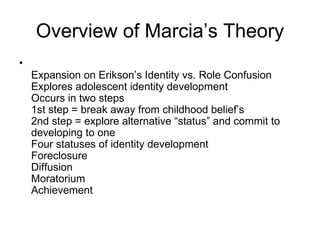
Overview of Marcia’s Theory Expansion on Erikson’s Identity vs. Role Confusion Explores adolescent identity development Occurs in two steps 1st step = break away from childhood belief’s 2nd step = explore alternative “status” and commit to developing to one Four statuses of identity development Foreclosure Diffusion Moratorium Achievement
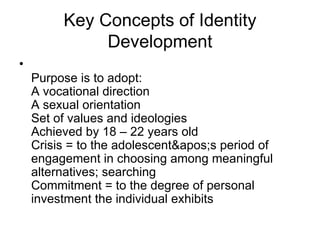
Key Concepts of Identity Development Purpose is to adopt:  A vocational direction A sexual orientation Set of values and ideologies Achieved by 18 – 22 years old Crisis = to the adolescent's period of engagement in choosing among meaningful alternatives; searching Commitment = to the degree of personal investment the individual exhibits
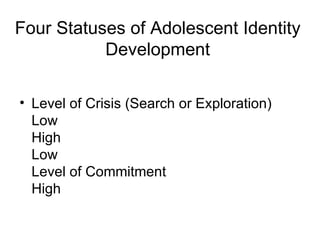
Four Statuses of Adolescent Identity Development Level of Crisis (Search or Exploration) Low High Low Level of Commitment High
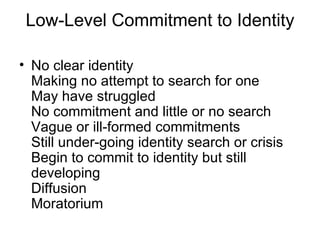
Low-Level Commitment to Identity No clear identity  Making no attempt to search for one May have struggled  No commitment and little or no search Vague or ill-formed commitments Still under-going identity search or crisis Begin to commit to identity but still developing Diffusion Moratorium
High-Level of Identity Commitment Blindly accepts identity and values given from childhood by family and others Committed to identity but no search or crisis Clear identity Well-defined personal values Expanded in adulthood Strong ego Has experienced a search or crisis Strong commitment to identity Foreclosure Achievement
Four Statuses of Adolescent Identity Development Level of Crisis (Search or Exploration) Low High Low Level of Commitment High
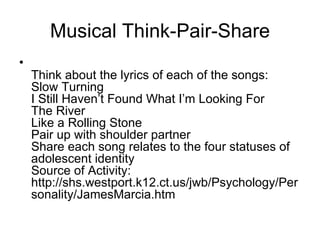
Musical Think-Pair-Share Think about the lyrics of each of the songs: Slow Turning I Still Haven’t Found What I’m Looking For The River Like a Rolling Stone Pair up with shoulder partner Share each song relates to the four statuses of adolescent identity Source of Activity: http://shs.westport.k12.ct.us/jwb/Psychology/Personality/JamesMarcia.htm
Counseling Applications Questions for Adolescent Client What occupations have you considered exploring in your future? What spiritual beliefs do you value? What is the source of these beliefs? What political ideas are important to you? Why? Have you had any doubts about your beliefs? Well-developed identity means . . .  Strong sense of personal strengths ,weaknesses, & uniqueness Higher self-esteem Increased critical thinking Advanced moral reasoning Lower levels of anxiety
Summary of Marcia’s Impact Theory examines late adolescent process of identity development Four statuses: diffusion, moratorium, foreclosure, achievement NOT stages of development Achieved when he or she has explored and committed to important aspects of identity
References Identity Development - Aspects of Identity. (n.d.). In Social Issues Reference. Retrieved July 22, 2009, from http://social.jrank.org/pages/322/Identity-Development.html The identity status approach to study of ego identity development. (1987). In H. (Author), SELF & IDENTITY. Perspectives across the lifespan. (International Library of Psychology) (pp. 161-171). New York: Routledge.  Identity Status Theory (Marcia). (n.d.). In At Learning Theories. Retrieved July 22, 2009, from http://www.learning-theories.com/identity-status-theory-marcia.html   Marcia, J. E. (1966). Development and Validation of Ego-Identity Status. Journal of Personality and Social Psychology, 3(5), 551-558.  Notes on Adolescent Identity. (n.d.). In The University of New Mexico. Retrieved July 22, 2009, from http://www.unm.edu/~jka/courses/archive/ident.html

James marcia adolescent development pp

  • 1.
    James Marcia AdolescentDevelopment By: Suzanne Ashley July 2009
  • 2.
    Brief Biography Canadiandevelopmental psychologist Emeritus Professor of Psychology Simon Fraser University British Columbia, Canada 1960s psychological fame Conducted research study By interviewing 86 males from one college www.sfu.ca
  • 3.
    How do adolescentsdevelop their identity? Guiding Question
  • 4.
    Overview of Marcia’sTheory Expansion on Erikson’s Identity vs. Role Confusion Explores adolescent identity development Occurs in two steps 1st step = break away from childhood belief’s 2nd step = explore alternative “status” and commit to developing to one Four statuses of identity development Foreclosure Diffusion Moratorium Achievement
  • 5.
    Key Concepts ofIdentity Development Purpose is to adopt: A vocational direction A sexual orientation Set of values and ideologies Achieved by 18 – 22 years old Crisis = to the adolescent's period of engagement in choosing among meaningful alternatives; searching Commitment = to the degree of personal investment the individual exhibits
  • 6.
    Four Statuses ofAdolescent Identity Development Level of Crisis (Search or Exploration) Low High Low Level of Commitment High
  • 7.
    Low-Level Commitment toIdentity No clear identity Making no attempt to search for one May have struggled No commitment and little or no search Vague or ill-formed commitments Still under-going identity search or crisis Begin to commit to identity but still developing Diffusion Moratorium
  • 8.
    High-Level of IdentityCommitment Blindly accepts identity and values given from childhood by family and others Committed to identity but no search or crisis Clear identity Well-defined personal values Expanded in adulthood Strong ego Has experienced a search or crisis Strong commitment to identity Foreclosure Achievement
  • 9.
    Four Statuses ofAdolescent Identity Development Level of Crisis (Search or Exploration) Low High Low Level of Commitment High
  • 10.
    Musical Think-Pair-Share Thinkabout the lyrics of each of the songs: Slow Turning I Still Haven’t Found What I’m Looking For The River Like a Rolling Stone Pair up with shoulder partner Share each song relates to the four statuses of adolescent identity Source of Activity: http://shs.westport.k12.ct.us/jwb/Psychology/Personality/JamesMarcia.htm
  • 11.
    Counseling Applications Questionsfor Adolescent Client What occupations have you considered exploring in your future? What spiritual beliefs do you value? What is the source of these beliefs? What political ideas are important to you? Why? Have you had any doubts about your beliefs? Well-developed identity means . . . Strong sense of personal strengths ,weaknesses, & uniqueness Higher self-esteem Increased critical thinking Advanced moral reasoning Lower levels of anxiety
  • 12.
    Summary of Marcia’sImpact Theory examines late adolescent process of identity development Four statuses: diffusion, moratorium, foreclosure, achievement NOT stages of development Achieved when he or she has explored and committed to important aspects of identity
  • 13.
    References Identity Development- Aspects of Identity. (n.d.). In Social Issues Reference. Retrieved July 22, 2009, from http://social.jrank.org/pages/322/Identity-Development.html The identity status approach to study of ego identity development. (1987). In H. (Author), SELF & IDENTITY. Perspectives across the lifespan. (International Library of Psychology) (pp. 161-171). New York: Routledge. Identity Status Theory (Marcia). (n.d.). In At Learning Theories. Retrieved July 22, 2009, from http://www.learning-theories.com/identity-status-theory-marcia.html   Marcia, J. E. (1966). Development and Validation of Ego-Identity Status. Journal of Personality and Social Psychology, 3(5), 551-558. Notes on Adolescent Identity. (n.d.). In The University of New Mexico. Retrieved July 22, 2009, from http://www.unm.edu/~jka/courses/archive/ident.html