Employee Volunteering
The State of the Art and Beyond
                 Jalal
    Volunteer Architect @ Volunteer-ID
Understanding Volunteering	
  
                                                               Butcher	
  (2010)	
  
“Volunteering	
  means	
  conduc9ng	
  work	
  
with	
  no	
  pay.”	
  (Hodgkinson,	
  2003)	
  

although	
  non-­‐remunera9on	
  has	
  been	
  
widely	
  discussed,	
  three	
  other	
  factors	
  of	
  
volunteering	
  also	
  prevail:	
  	
  
•  that	
  of	
  choice	
  and	
  free	
  will,	
  	
  
•  to	
  go	
  beyond	
  one’s	
  normal	
  
   responsibili9es	
  of	
  family	
  obliga9ons,	
  
   and	
  	
  
•  to	
  contribute	
  to	
  society	
  at	
  large	
  –	
  
   even	
  though	
  individuals	
  may	
  benefit	
  
   internally	
  from	
  its	
  prac9ce.	
  
Context:	
  Managed	
  and	
  	
  
                                   Unmanaged	
  Volunteering	
  
                                                                          Butcher	
  (2010)	


“...	
  it	
  can	
  be	
  unmanaged,	
  as	
  in	
  sporadic	
  help	
  that	
  takes	
  
   place	
  between	
  neighbors	
  and	
  friends;	
  or	
  managed	
  
 volunteering,	
  which	
  takes	
  place	
  through	
  organiza;ons	
  
              in	
  the	
  nonprofit,	
  private,	
  and	
  public	
  sectors.”	
  
Role	
  of	
  Volunteering	
  	
  
                        in	
  Society	
  and	
  in	
  Development	
  
                                                                        Butcher	
  (2010)	
  
   “...	
  not	
  only	
  to	
  add	
  to	
  the	
  crea*on	
  of	
  social	
  capital	
  
 (Putnam	
  2000)	
  or	
  to	
  promote	
  social	
  cohesion	
  and	
  the	
  
strengthening	
  of	
  democracy	
  (Olvera	
  2001),	
  but	
  also	
  as	
  
    a	
  mechanism	
  to	
  channel	
  differences	
  and	
  dissent	
  
                           among	
  the	
  popula;on.”	
  
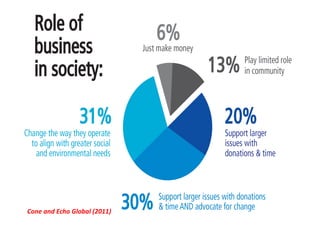
Cone	
  and	
  Echo	
  Global	
  (2011)	
  
Why	
  Employees	
  Volunteer?	
  
                                                          Pajo	
  and	
  Lee	
  (2011)   	
  
•    Altruism:	
  a	
  desire	
  to	
  help,	
  to	
  give	
  
     back,	
  to	
  assist	
  those	
  who	
  were	
  less	
  
     fortunate	
  or	
  by	
  the	
  ‘feel	
  good’	
  factor	
  
     that	
  comes	
  with	
  helping	
  others.	
  
•    Meaningfulness:	
  impact,	
  worth	
  or	
  
     significance	
  of	
  the	
  volunteer	
  ac9vity.	
  
•    OrganizaDonal	
  CiDzenship:	
  a	
  desire	
  
     to	
  reciprocate	
  posi9ve	
  treatment	
  
     from	
  the	
  employer,	
  to	
  support	
  the	
  
     company	
  or	
  to	
  present	
  a	
  favorable	
  
     image	
  of	
  the	
  enterprise.	
  
•    Role	
  Variety:	
  the	
  ac9vity	
  provided	
  
     the	
  opportunity	
  to	
  do	
  something	
  
     different	
  from	
  ‘normal’	
  work.	
  
Why	
  Employees	
  Volunteer?	
  
                                                  Pajo	
  and	
  Lee	
  (2011)   	
  
•  RelaDonal	
  &	
  Social	
  Task	
  
   CharacterisDcs:	
  a	
  posi9ve	
  affec9ve	
  
   judgment	
  about	
  the	
  ac9vity	
  and	
  
   men9oning	
  rela9onal	
  and/or	
  social	
  
   aspects.	
  
•  Networking:	
  the	
  opportunity	
  to	
  get	
  
   to	
  know	
  others	
  in	
  the	
  organiza9on	
  
   and/or	
  build	
  their	
  own	
  profile).	
  
•  Personal:	
  a	
  variety	
  of	
  idiosyncra9c,	
  
   individual	
  and	
  personalized	
  reasons	
  
   for	
  volunteering	
  
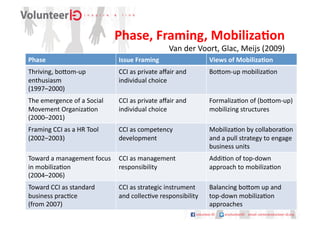
Phase,	
  Framing,	
  MobilizaDon	
  
                                                                          Van	
  der	
  Voort,	
  Glac,	
  Meijs	
  (2009)	
  
Phase	
                                       Issue	
  Framing	
                           Views	
  of	
  MobilizaDon	
  
Thriving,	
  boVom-­‐up	
                     CCI	
  as	
  private	
  affair	
  and	
       BoVom-­‐up	
  mobiliza9on	
  
enthusiasm	
                                  individual	
  choice	
  
(1997–2000)	
  
The	
  emergence	
  of	
  a	
  Social	
       CCI	
  as	
  private	
  affair	
  and	
       Formaliza9on	
  of	
  (boVom-­‐up)	
  
Movement	
  Organiza9on	
                     individual	
  choice	
                       mobilizing	
  structures	
  
(2000–2001)	
  
Framing	
  CCI	
  as	
  a	
  HR	
  Tool	
     CCI	
  as	
  competency	
                    Mobiliza9on	
  by	
  collabora9on	
  
(2002–2003)	
                                 development	
                                and	
  a	
  pull	
  strategy	
  to	
  engage	
  
                                                                                           business	
  units	
  
Toward	
  a	
  management	
  focus	
   CCI	
  as	
  management	
                           Addi9on	
  of	
  top-­‐down	
  
in	
  mobiliza9on	
                    responsibility	
                                    approach	
  to	
  mobiliza9on	
  
(2004–2006)	
  
Toward	
  CCI	
  as	
  standard	
             CCI	
  as	
  strategic	
  instrument	
       Balancing	
  boVom	
  up	
  and	
  
business	
  prac9ce	
                         and	
  collec9ve	
  responsibility	
         top-­‐down	
  mobiliza9on	
  
(from	
  2007)	
                                                                           approaches	
  
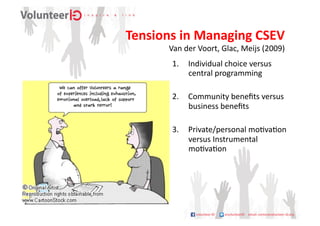
Tensions	
  in	
  Managing	
  CSEV	
  
          Van	
  der	
  Voort,	
  Glac,	
  Meijs	
  (2009)	
  
           1.  Individual	
  choice	
  versus	
  
               central	
  programming	
  

           2.  Community	
  benefits	
  versus	
  
               business	
  benefits	
  

           3.  Private/personal	
  mo9va9on	
  
               versus	
  Instrumental	
  
               mo9va9on	
  
Double-­‐Edged	
  Effects	
  	
  
                                                                         of	
  CSEV	
  Management	


                                                                        Van	
  der	
  Voort,	
  Glac,	
  Meijs	
  (2009)

                                                            1.  ProfessionalizaDon:	
  ‘‘It	
  is	
  not	
  about	
  
                                                                emo9ons	
  anymore;	
  they	
  are	
  viewed	
  
                                                                more	
  cri9cally.’’	
  

                              2.  Obliging	
  parDcipaDon:	
  ‘‘I	
  feel	
  obliged,	
  
                                  because	
  that	
  is	
  how	
  I	
  am,	
  but	
  also	
  
                                  because	
  of	
  my	
  func9on,	
  but	
  I	
  will	
  think	
  
                                  about	
  it	
  long	
  and	
  hard	
  before	
  I	
  consider	
  
                                  par9cipa9ng	
  the	
  next	
  9me.’’	
  

3.  Elite	
  co-­‐optaDon	
  and	
  support:	
  ‘‘They	
  
    need	
  a	
  patron,	
  but	
  if	
  this	
  patronage	
  is	
  
    commercially	
  mo9vated	
  rather	
  than	
  
    sincere	
  […]	
  It	
  will	
  become	
  a	
  vehicle	
  and	
  
    lose	
  its	
  credibility.’’	
  
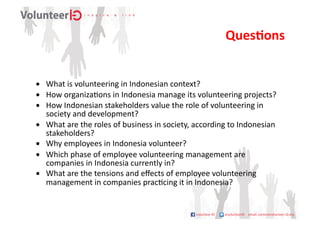
QuesDons	


•  What	
  is	
  volunteering	
  in	
  Indonesian	
  context?	
  
•  How	
  organiza9ons	
  in	
  Indonesia	
  manage	
  its	
  volunteering	
  projects?	
  
•  How	
  Indonesian	
  stakeholders	
  value	
  the	
  role	
  of	
  volunteering	
  in	
  
   society	
  and	
  development?	
  
•  What	
  are	
  the	
  roles	
  of	
  business	
  in	
  society,	
  according	
  to	
  Indonesian	
  
   stakeholders?	
  
•  Why	
  employees	
  in	
  Indonesia	
  volunteer?	
  
•  Which	
  phase	
  of	
  employee	
  volunteering	
  management	
  are	
  
   companies	
  in	
  Indonesia	
  currently	
  in?	
  
•  What	
  are	
  the	
  tensions	
  and	
  effects	
  of	
  employee	
  volunteering	
  
   management	
  in	
  companies	
  prac9cing	
  it	
  in	
  Indonesia?	
  	
  
JALAL	
  
                                         VOLUNTEER-­‐ID	
  
                                 jalal@volunteer-­‐id.org	
  
                                     +62-­‐815-­‐13803616	


THANK	
  YOU	
  SO	
  VERY	
  MUCH!	
  

Volunteer Idea Exchange (Employee Volunteering : The State of The Art and Beyond)

  • 1.
    Employee Volunteering The Stateof the Art and Beyond Jalal Volunteer Architect @ Volunteer-ID
  • 2.
    Understanding Volunteering   Butcher  (2010)   “Volunteering  means  conduc9ng  work   with  no  pay.”  (Hodgkinson,  2003)   although  non-­‐remunera9on  has  been   widely  discussed,  three  other  factors  of   volunteering  also  prevail:     •  that  of  choice  and  free  will,     •  to  go  beyond  one’s  normal   responsibili9es  of  family  obliga9ons,   and     •  to  contribute  to  society  at  large  –   even  though  individuals  may  benefit   internally  from  its  prac9ce.  
  • 3.
    Context:  Managed  and     Unmanaged  Volunteering   Butcher  (2010)   “...  it  can  be  unmanaged,  as  in  sporadic  help  that  takes   place  between  neighbors  and  friends;  or  managed   volunteering,  which  takes  place  through  organiza;ons   in  the  nonprofit,  private,  and  public  sectors.”  
  • 4.
    Role  of  Volunteering     in  Society  and  in  Development   Butcher  (2010)   “...  not  only  to  add  to  the  crea*on  of  social  capital   (Putnam  2000)  or  to  promote  social  cohesion  and  the   strengthening  of  democracy  (Olvera  2001),  but  also  as   a  mechanism  to  channel  differences  and  dissent   among  the  popula;on.”  
  • 5.
    Cone  and  Echo  Global  (2011)  
  • 6.
    Why  Employees  Volunteer?   Pajo  and  Lee  (2011)   •  Altruism:  a  desire  to  help,  to  give   back,  to  assist  those  who  were  less   fortunate  or  by  the  ‘feel  good’  factor   that  comes  with  helping  others.   •  Meaningfulness:  impact,  worth  or   significance  of  the  volunteer  ac9vity.   •  OrganizaDonal  CiDzenship:  a  desire   to  reciprocate  posi9ve  treatment   from  the  employer,  to  support  the   company  or  to  present  a  favorable   image  of  the  enterprise.   •  Role  Variety:  the  ac9vity  provided   the  opportunity  to  do  something   different  from  ‘normal’  work.  
  • 7.
    Why  Employees  Volunteer?   Pajo  and  Lee  (2011)   •  RelaDonal  &  Social  Task   CharacterisDcs:  a  posi9ve  affec9ve   judgment  about  the  ac9vity  and   men9oning  rela9onal  and/or  social   aspects.   •  Networking:  the  opportunity  to  get   to  know  others  in  the  organiza9on   and/or  build  their  own  profile).   •  Personal:  a  variety  of  idiosyncra9c,   individual  and  personalized  reasons   for  volunteering  
  • 8.
    Phase,  Framing,  MobilizaDon   Van  der  Voort,  Glac,  Meijs  (2009)   Phase   Issue  Framing   Views  of  MobilizaDon   Thriving,  boVom-­‐up   CCI  as  private  affair  and   BoVom-­‐up  mobiliza9on   enthusiasm   individual  choice   (1997–2000)   The  emergence  of  a  Social   CCI  as  private  affair  and   Formaliza9on  of  (boVom-­‐up)   Movement  Organiza9on   individual  choice   mobilizing  structures   (2000–2001)   Framing  CCI  as  a  HR  Tool   CCI  as  competency   Mobiliza9on  by  collabora9on   (2002–2003)   development   and  a  pull  strategy  to  engage   business  units   Toward  a  management  focus   CCI  as  management   Addi9on  of  top-­‐down   in  mobiliza9on   responsibility   approach  to  mobiliza9on   (2004–2006)   Toward  CCI  as  standard   CCI  as  strategic  instrument   Balancing  boVom  up  and   business  prac9ce   and  collec9ve  responsibility   top-­‐down  mobiliza9on   (from  2007)   approaches  
  • 9.
    Tensions  in  Managing  CSEV   Van  der  Voort,  Glac,  Meijs  (2009)   1.  Individual  choice  versus   central  programming   2.  Community  benefits  versus   business  benefits   3.  Private/personal  mo9va9on   versus  Instrumental   mo9va9on  
  • 10.
    Double-­‐Edged  Effects     of  CSEV  Management     Van  der  Voort,  Glac,  Meijs  (2009) 1.  ProfessionalizaDon:  ‘‘It  is  not  about   emo9ons  anymore;  they  are  viewed   more  cri9cally.’’   2.  Obliging  parDcipaDon:  ‘‘I  feel  obliged,   because  that  is  how  I  am,  but  also   because  of  my  func9on,  but  I  will  think   about  it  long  and  hard  before  I  consider   par9cipa9ng  the  next  9me.’’   3.  Elite  co-­‐optaDon  and  support:  ‘‘They   need  a  patron,  but  if  this  patronage  is   commercially  mo9vated  rather  than   sincere  […]  It  will  become  a  vehicle  and   lose  its  credibility.’’  
  • 11.
    QuesDons   •  What  is  volunteering  in  Indonesian  context?   •  How  organiza9ons  in  Indonesia  manage  its  volunteering  projects?   •  How  Indonesian  stakeholders  value  the  role  of  volunteering  in   society  and  development?   •  What  are  the  roles  of  business  in  society,  according  to  Indonesian   stakeholders?   •  Why  employees  in  Indonesia  volunteer?   •  Which  phase  of  employee  volunteering  management  are   companies  in  Indonesia  currently  in?   •  What  are  the  tensions  and  effects  of  employee  volunteering   management  in  companies  prac9cing  it  in  Indonesia?    
  • 12.
    JALAL   VOLUNTEER-­‐ID   jalal@volunteer-­‐id.org   +62-­‐815-­‐13803616   THANK  YOU  SO  VERY  MUCH!