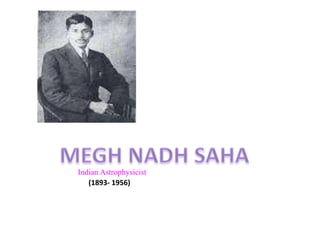
Indian Astrophysicist 
(1893- 1956)
IN A NUTSHELL…………………. 
Born October 6 1893 Dhaka Bangaladesh 
Residence India 
Nationality Indian 
Fields Physics and Mathematics 
Institution Allahabad University 
university of Calcutta 
Imperial college London 
Indian Association for cultivation of Science 
Almamater Dhaka College 
University of Calcutta 
Known For Thermal Ionization 
Saha Ionization Equation 
Spouse Radha Rani Saha 
Died February 16 1956 Delhi
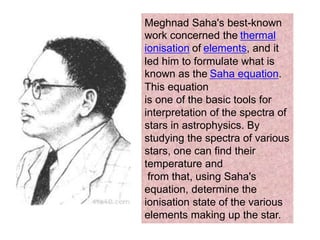
Meghnad Saha's best-known 
work concerned the thermal 
ionisation of elements, and it 
led him to formulate what is 
known as the Saha equation. 
This equation 
is one of the basic tools for 
interpretation of the spectra of 
stars in astrophysics. By 
studying the spectra of various 
stars, one can find their 
temperature and 
from that, using Saha's 
equation, determine the 
ionisation state of the various 
elements making up the star.
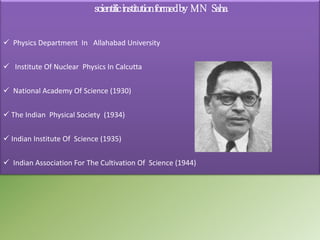
scientific institution formed by M N Saha 
 Physics Department In Allahabad University 
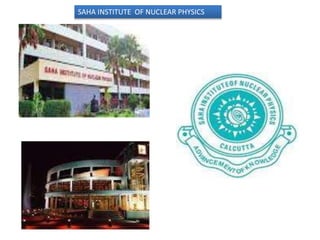
 Institute Of Nuclear Physics In Calcutta 
 National Academy Of Science (1930) 
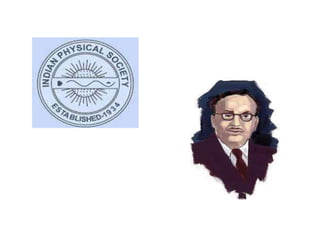
 The Indian Physical Society (1934) 
 Indian Institute Of Science (1935) 
 Indian Association For The Cultivation Of Science (1944)
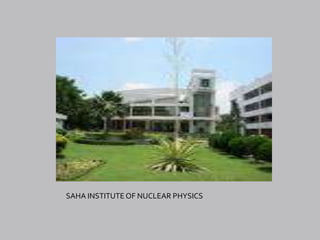
SAHA INSTITUTE OF NUCLEAR PHYSICS
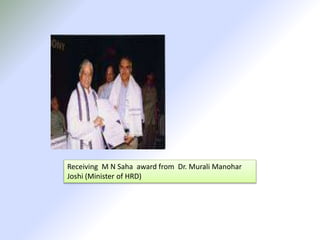
Receiving M N Saha award from Dr. Murali Manohar 
Joshi (Minister of HRD)
PRESIDENCY COLLEGE KOLKATTA
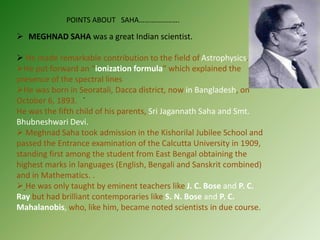
POINTS ABOUT SAHA…………………. 
 MEGHNAD SAHA was a great Indian scientist. 
 He made remarkable contribution to the field of Astrophysics. 
He put forward an “ionization formula” which explained the 
presence of the spectral lines 
He was born in Seoratali, Dacca district, now in Bangladesh, on 
. 
October 6, 1893. 
He was the fifth child of his parents, Sri Jagannath Saha and Smt. 
Bhubneshwari Devi. 
 Meghnad Saha took admission in the Kishorilal Jubilee School and 
passed the Entrance examination of the Calcutta University in 1909, 
standing first among the student from East Bengal obtaining the 
highest marks in languages (English, Bengali and Sanskrit combined) 
and in Mathematics. . 
 He was only taught by eminent teachers like J. C. Bose and P. C. 
Ray but had brilliant contemporaries like S. N. Bose and P. C. 
Mahalanobis, who, like him, became noted scientists in due course.
In 1913, he graduated from Presidency College with Mathematics 
major and got the second rank in the first one. In 1915, Meghnad Saha 
ranked first in M.Sc. Applied Mathematics exam, . 
 In 1927, Meghnad Saha was elected as a fellow of ‘London’s Royal 
Society’. 
 He invented an instrument to measure the weight and pressure of 
solar rays. 
 He produced the famous equation, which he called ‘equation of the 
reaction-isobar for ionization’, which later became known as Saha’s 
“Thermo-Ionization Equation”. 
 In 1952 he stood as an independent candidate for Parliament and 
was elected by a wide margin. 
 He not only tried to raise the status of science in independent India, 
but also served the cause of the poor 
 He was the chief architect of river planning in India. He prepared the 
original plan for Damodar Valley Project. 
Meghnad Saha was an Indian astrophysicist who nominated for the 
‘Nobel prize’ in physics in 1935-36. 
He died on february 16, 1956 due to a heart attack.
BOOKS WRITTEN BY M N SAHA 
•The Principles of Relativity (with S.N. Bose) Calcutta 
University, Calcutta, 1920. (It was a translation of 
Einstein’s papers on theory of relativity). 
•Treatise on Heat (with B.N. Srivastava), Indian Press, 
Allahabad, 1931. 
•Junior Text-Book on Heat (with B.N. Srivastava), 
Indian Press, Allahabad, 1932. 
•Treatise on Modern Physics, Vol-1 (with N.K. Saha) 
Indian Press, Allahabad, 1934. 
•My Experience in Soviet Russia, Bookman Inc, 
Calcutta, 1947.
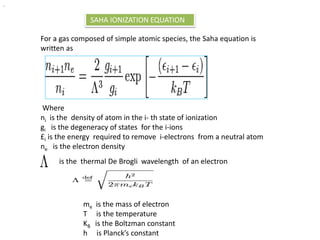
SAHA IONIZATION EQUATION 
For a gas composed of simple atomic species, the Saha equation is 
written as 
. 
Where 
ni is the density of atom in the i- th state of ionization 
gi is the degeneracy of states for the i-ions 
£i is the energy required to remove i-electrons from a neutral atom 
ne is the electron density 
is the thermal De Brogli wavelength of an electron 
me is the mass of electron 
T is the temperature 
KB is the Boltzman constant 
h is Planck’s constant
M N SAHA

M N SAHA

  • 3.
  • 4.
    IN A NUTSHELL…………………. Born October 6 1893 Dhaka Bangaladesh Residence India Nationality Indian Fields Physics and Mathematics Institution Allahabad University university of Calcutta Imperial college London Indian Association for cultivation of Science Almamater Dhaka College University of Calcutta Known For Thermal Ionization Saha Ionization Equation Spouse Radha Rani Saha Died February 16 1956 Delhi
  • 5.
    Meghnad Saha's best-known work concerned the thermal ionisation of elements, and it led him to formulate what is known as the Saha equation. This equation is one of the basic tools for interpretation of the spectra of stars in astrophysics. By studying the spectra of various stars, one can find their temperature and from that, using Saha's equation, determine the ionisation state of the various elements making up the star.
  • 6.
    scientific institution formedby M N Saha  Physics Department In Allahabad University  Institute Of Nuclear Physics In Calcutta  National Academy Of Science (1930)  The Indian Physical Society (1934)  Indian Institute Of Science (1935)  Indian Association For The Cultivation Of Science (1944)
  • 7.
    SAHA INSTITUTE OFNUCLEAR PHYSICS
  • 9.
    SAHA INSTITUTE OFNUCLEAR PHYSICS
  • 10.
    Receiving M NSaha award from Dr. Murali Manohar Joshi (Minister of HRD)
  • 11.
  • 12.
    POINTS ABOUT SAHA………………….  MEGHNAD SAHA was a great Indian scientist.  He made remarkable contribution to the field of Astrophysics. He put forward an “ionization formula” which explained the presence of the spectral lines He was born in Seoratali, Dacca district, now in Bangladesh, on . October 6, 1893. He was the fifth child of his parents, Sri Jagannath Saha and Smt. Bhubneshwari Devi.  Meghnad Saha took admission in the Kishorilal Jubilee School and passed the Entrance examination of the Calcutta University in 1909, standing first among the student from East Bengal obtaining the highest marks in languages (English, Bengali and Sanskrit combined) and in Mathematics. .  He was only taught by eminent teachers like J. C. Bose and P. C. Ray but had brilliant contemporaries like S. N. Bose and P. C. Mahalanobis, who, like him, became noted scientists in due course.
  • 13.
    In 1913, hegraduated from Presidency College with Mathematics major and got the second rank in the first one. In 1915, Meghnad Saha ranked first in M.Sc. Applied Mathematics exam, .  In 1927, Meghnad Saha was elected as a fellow of ‘London’s Royal Society’.  He invented an instrument to measure the weight and pressure of solar rays.  He produced the famous equation, which he called ‘equation of the reaction-isobar for ionization’, which later became known as Saha’s “Thermo-Ionization Equation”.  In 1952 he stood as an independent candidate for Parliament and was elected by a wide margin.  He not only tried to raise the status of science in independent India, but also served the cause of the poor  He was the chief architect of river planning in India. He prepared the original plan for Damodar Valley Project. Meghnad Saha was an Indian astrophysicist who nominated for the ‘Nobel prize’ in physics in 1935-36. He died on february 16, 1956 due to a heart attack.
  • 14.
    BOOKS WRITTEN BYM N SAHA •The Principles of Relativity (with S.N. Bose) Calcutta University, Calcutta, 1920. (It was a translation of Einstein’s papers on theory of relativity). •Treatise on Heat (with B.N. Srivastava), Indian Press, Allahabad, 1931. •Junior Text-Book on Heat (with B.N. Srivastava), Indian Press, Allahabad, 1932. •Treatise on Modern Physics, Vol-1 (with N.K. Saha) Indian Press, Allahabad, 1934. •My Experience in Soviet Russia, Bookman Inc, Calcutta, 1947.
  • 15.
    SAHA IONIZATION EQUATION For a gas composed of simple atomic species, the Saha equation is written as . Where ni is the density of atom in the i- th state of ionization gi is the degeneracy of states for the i-ions £i is the energy required to remove i-electrons from a neutral atom ne is the electron density is the thermal De Brogli wavelength of an electron me is the mass of electron T is the temperature KB is the Boltzman constant h is Planck’s constant