This document discusses a study that found a correlation between the viscosity of zinc 2-ethylhexanoate liquid and the intensity of an infrared absorption band at 1632 cm-1. Density functional theory was used to model potential molecular structures, including a zinc carboxylate dimer and a polymer, and predicted that the asymmetric carboxylate stretch would increase in intensity for the polymer due to its lower symmetry. This prediction is consistent with the observed correlation between viscosity and peak intensity.
![J. Phys. Chem. B 2007, 111, 7073-7077 7073
Correlation between Rheological Properties of Zinc Carboxylate Liquids and Molecular
Structure
Stephen C. Peterangelo and Robert T. Hart*
The Shepherd Chemical Company, 4900 Beech Street, Norwood, Ohio 45212
Aurora E. Clark
Department of Chemistry, Washington State UniVersity, Pullman, Washington 99164
ReceiVed: October 23, 2006; In Final Form: April 9, 2007
Using Fourier transform infrared spectroscopy (FTIR), the viscosity of zinc 2-ethylhexanoate liquid has been
found to correlate with the intensity of an asymmetric COO stretching resonance at 1632 cm-1. This is consistent
with the presence of the zinc carboxylate polymer, catena-2-ethylhexanato-(O,O′)-tri-µ-2-ethylhexanato-(O,O′)-
dizinc(II) as the origin of the viscosity, a conclusion that is further supported by theoretical predictions.
Density functional theory has been used to assign the IR spectra of the zinc carboxylate dimer, catena-2-
Downloaded by OHIOLINK ACCESS on September 17, 2009 | http://pubs.acs.org
ethylhexanato-(O,O′)-di-(tri-µ-2-ethylhexanato-(O,O′)-dizinc(II)-formic) acid, and the model of the molecular
liquid, µ-4-oxo-hexakis-(µ-2-ethylhexanato)-tetrazinc(II). The predicted spectra indicate that the decreased
symmetry of the polymer relative to the zinc 2-ethylhexanoate liquid increases the intensity of the asymmetric
Publication Date (Web): May 27, 2007 | doi: 10.1021/jp066943l
carboxylate stretch at 1632 cm-1 and leads to the observed correlation.
Introduction 2-ethylhexanoate. The first model complex is µ-4-oxo-hexakis-
(µ-2-ethylhexanato)-tetrazinc(II), µ-Zn4O-µ-(O2C8H15)6 mol-
Zinc carboxylates are the building blocks for an array of ecule, (1), which is representative of the basic zinc acetate
materials that exhibit vast structural diversity, arising from a structure wherein the carboxylate ligands bridge two zinc atoms
small number of chelation modes.1 The structures that form from in a syn-syn configuration.9-11 The second model is represen-
the simple reaction of Zn and a carboxylic acid are sensitive to tative of the 1-dimensional 3,1 polymer formed from an anionic
the reaction conditions and can be manipulated according to dizinc cluster with three bridging syn-syn carboxylate ions
the zinc carboxylate stoichiometric ratio,2 temperature,3 method joined by a syn-anti bridging carboxylate ligand, catena-2-
of recrystallization,4 and solvent choice.5 The basic (acid ethylhexanato-(O,O′)-tri-µ-2-ethylhexanato-(O,O′)-dizinc(II), [Zn2-
deficient) zinc carboxylate structure is a µ-4-oxo-centered (µ-O2C8H15)3(µ-O2C8H15)]n, (2). This polymer is modeled with
tetrahedron of zinc cations surrounded by an octahedron of syn- a dimeric molecule, catena-2-ethylhexanato-(O,O′)-di-(tri-µ-2-
syn bridging carboxylate anions.6 This common structural motif ethylhexanato-(O,O′)-dizinc(II)-formic)acid,[Zn2(µ-O2C8H15)3(HO2-
has been implemented in the formation of high surface area CH)]2-catena-µ-O2C8H15, (3) (Figure 1).
metal organic framework materials7 and been studied as a
molecular analog of ZnO in order to understand its photolumi-
Experimental
nescent properties.8 Reaction of zinc with carboxylic acids that
have long, branched, alkyl groups leads to products that are Sample Preparation, Analysis, and Spectroscopy. To
used industrially as high density sources of zinc that are soluble prepare samples A-M for this study, zinc oxide (99.99%,
in organic solvents. This material has properties that resemble Aldrich, Milwaukee, WI) and 2-ethylhexanoic acid (99%
both a molecular liquid (low viscosity at room temperature) and Aldrich, Milwaukee, WI) were combined in a molar ratio of
a molten polymer (a relatively high flow activation energy). In 2:3 (13 samples) or 1:2 (one sample, R) in a round-bottom flask
this study, we use Fourier transform infrared spectroscopy and heated to 90 °C under reduced pressure (∼5 mmHg) while
(FTIR) and density functional theory (DFT) calculations to gain the flask was mechanically rotated. Exact ratios of ZnO to
a better understanding of the specific molecular structures that 2-ethlyhexanoic acid are given in Table 1. Water of reaction
control the viscosity of the product of a reaction between ZnO and excess acid were distilled away from the reaction mixture
and 2-ethylhexanoic acid. after allowing sufficient residence time to promote the comple-
Our results indicate that the viscosity of zinc 2-ethylhexanoate tion of reaction.12 25 g of each of the 14 zinc 2-ethylhexanoates
liquids can be correlated with the intensity of a band at 1632 were obtained as colorless oils after 2 h. The products were
cm-1 in the FTIR spectra. As no satisfactory assignment of this analyzed for metal content by extraction of the zinc into aqueous
band exists in the literature, we have turned to DFT to solution with HCl and titration of the aqueous phase by EDTA
characterize the vibrational motion and help understand the (Table 1). Typically 0.6 g of zinc 2-ethylhexanoate was weighed
chemical and structural reasons for the fluid behavior. Two to within (0.0001 g and titrated with standardized EDTA
candidate structures have been examined, each with salient solution of 0.0503 mol/dm.3 The solution was buffered with
features that can be reasonably correlated with viscosity of zinc hexamethylenetetramine and the pH was adjusted with NaOH
solution and acetic acid as needed to maintain pH 5.5. This
* Corresponding author. E-mail: rhart@shepchem.com. method allows an accuracy of ( 0.002 mol/dm3 Zn with a
10.1021/jp066943l CCC: $37.00 © 2007 American Chemical Society
Published on Web 05/27/2007](https://image.slidesharecdn.com/j-phys-chem-2007-1274736990-phpapp02/85/J-Phys-Chem-2007-1-320.jpg)
![7074 J. Phys. Chem. B, Vol. 111, No. 25, 2007 Peterangelo et al.
Figure 2. Viscosity as a function of temperature for zinc 2-ethylhex-
anoate solution sample A.
Fenske capillary tubes at temperatures of 10, 15, 25, 30, 40,
and 50 °C. FTIR spectra were measured with a Perkin-Elmer
GX model spectrometer from the neat samples in ATR mode
(KBr beamsplitter, diamond cell, FR-DTGS detector). Four
scans were acquired for each sample in the range of 380-4000
cm-1 at a resolution of 4 cm-1. The resulting S/N was typically
better than 320.
Downloaded by OHIOLINK ACCESS on September 17, 2009 | http://pubs.acs.org
Computational Methods. The geometries of 2-ethylhexanoic
acid, HO2C8H15, 2-ethylhexanoate anion, -O2C8H15, the zinc
2-ethylhexanoate, µ-Zn4O-µ-(O2C8H15)6 (1), and the model Zn
Publication Date (Web): May 27, 2007 | doi: 10.1021/jp066943l
dimer [Zn2(µ-O2C8H15)3(HO2CH)]2-catena-µ-O2C8H15 (3), were
optimized using DFT with the B3LYP combination of exchange
and correlation functionals14,15 as implemented in the Gaussi-
an03 quantum chemistry code.16 The 6-31G* basis set17-19 was
used for all main group elements, while the LANL2 pseudo-
potential and LANL2DZ basis set20 was used to describe Zn.
The initial geometry for 1 was based upon the Koyama and
Saito crystal structure of basic zinc acetate6 for the µ-Zn4O-µ-
(O2CR)6 core, while the initial geometry of 3 was based upon
the 3,1 zinc crotonate polymer reported by Clegg, et al.21 Normal
mode coordinate analysis confirmed each structure to be a local
minimum, with no imaginary vibrations or a single imaginary
vibration less than 10 cm-1. The atomic displacements of
vibrational motion were used to assign the normal modes, and
a scaling factor of 0.9613 was applied to the frequencies.22
Figure 1. Structure and atomic labels of µ-Zn4O-µ-(O2C8H15)6 (1),
[Zn2(µ-O2C8H15)3(µ-O2C8H15)]n (2), and [Zn2(µ-O2C8H15)3(HO2CH)]2- Results and Discussion
catena-µ-O2C8H15 (3).
IR Spectroscopy and Viscosity. Thirteen samples A-M of
TABLE 1: Viscosities and [Zn] for Zinc 2-Ethylhexanoate zinc 2-ethylhexanoate were prepared at a molar ratio of 2:3 for
Solutions A-M Formed from the Shown Ratios of Zinc zinc oxide and 2-ethylhexanoic acid. The ratios were varied from
Oxide and 2-ethylhexanoic Acid at 25 °C as Described in the 0.633 to 0.667 in order to study the effect of composition on
Experimental Methods
material property. It is interesting to note that the batch
Zn:O2CR [Zn] viscosity composition is essentially uncorrelated with either the viscosity
sample reactants (mol/dm3) (Pa‚s) or the zinc concentration in the product. The measured viscosi-
A 0.667 3.96 7.860 ties at 25 °C are collected in Table 1. It can be seen that the
B 0.667 4.01 3.648 viscosity varies by about 6.0 Pa‚s among these samples, even
C 0.667 3.99 5.620
though their compositions are measured to be within (2%, and
D 0.633 3.97 3.640
E 0.649 3.99 2.240 they were prepared under nearly identical conditions. The values
F 0.664 3.97 6.180 for the 3:2 samples (A-M) agree reasonably well to the value
G 0.661 3.99 8.200 published by Andor et al.23 For these samples, there is essentially
H 0.659 4.03 2.300 no correlation between composition and viscosity. However,
I 0.662 3.99 6.458 for a sample prepared at a zinc oxide to 2-ethylhexanoic acid
J 0.663 3.94 4.959
K 0.662 3.94 5.946 ratio of 1:2 sample (R), the resulting product was too viscous
L 0.664 3.96 2.974 to measure with our apparatus.
M 0.659 4.04 2.218 As shown in Figure 2, for sample A, the viscosity as a
R 0.501 3.34 high function of temperature can be fit to a line with the mathematical
standard deviation of 0.004 mol/dm3 Zn.13 The residual water form L ) K + (∆G/RT), yielding a ∆G value of 76.36 kJ mol-1.
contents were determined by TGA mass loss (TA Instruments, Such temperature dependence is similar to that expected for a
SDT2960). Mass loss to 160 °C at 10 °C/min in air was less solution of dilute polymer.24 This suggests that the high viscosity
than 3% by mass for all samples. The viscosities were measured sample prepared at 1:2 zinc oxide to 2-ethylhexanoic acid ratio
under conditions of constant temperature in calibrated Cannon- has a polymer as its major component, while the samples](https://image.slidesharecdn.com/j-phys-chem-2007-1274736990-phpapp02/85/J-Phys-Chem-2007-2-320.jpg)
![7076 J. Phys. Chem. B, Vol. 111, No. 25, 2007 Peterangelo et al.
TABLE 3: Frequencies (Scaled by 0.9613) and Assignments of the Vibrational Modes Associated with the COO Groups of
µ-Zn4O-µ-(O2C8H15)6, (1), and [Zn2(µ-O2C8H15)3(HO2CH)]2-catena-µ-O2C8H15, (3), Based upon B3LYP/6-31G*/LANL2DZ
Optimized Structuresa
1 3
frequency frequency
mode assignment symmetryb (cm-1) mode assignment symmetryc (cm-1)
ν172-ν179 (Zn4O)str t2 496-498 ν381-ν384 syn-syn a
1409-1413
(521) (COO)sym (1426)
ν310-ν314 (COO)sym t2 1406-1409 ν387 syn-anti a
1429
(1423) (COO)sym (1456)
ν315 (COO)sym t2 1422 ν448 syn-anti|(COO)as b 1560
(1455) (1542)
ν367-ν369 (COO)as t2 1601-1603 ν449-ν450 syn-syn b
1618-1626
(1585) (COO)as (1632)
a Experimental values are given in parenthesis and are based upon the IR spectra of zinc 2-ethylhexanoate liquid; the sample with the highest
concentration of µ-Zn4O-µ-(O2C8H15)6, (1); and [Zn2(µ-O2C8H15)3(µ-O2C8H15)]n, polymer 2. b Assuming Td local symmetry of the Zn4O cage.
c Assuming C
2V local symmetry of the COO unit.
absorption of t2 modes between 496 and 498 cm-1 (521 cm-1 These assignments and interpretation of zinc carboxylate
experimental), in reasonable agreement with Braga and Longo.26 vibrational spectra allow reinterpretation of previous results.
The net result of the DFT description is that the local Td Specifically, small bands that cannot be attributed to Zn4O(O2-
Downloaded by OHIOLINK ACCESS on September 17, 2009 | http://pubs.acs.org
symmetry of the µ-Zn4O-µ-(O2CR)6 core gives rise to the two CR)6 in the Td group may be due to polymer contamination
observed COO region IR bands between 1406 and 1422 and rather than partitioning of the Zn4O(O2CR)6 molecules into Td
1601-1603 cm-1, attributable to symmetric and asymmetric
Publication Date (Web): May 27, 2007 | doi: 10.1021/jp066943l
and T (or lower) symmetry molecules in the samples.9
stretches, respectively.27,28
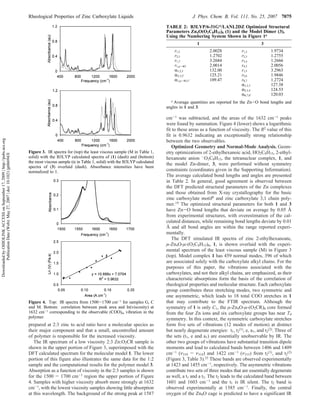
The DFT simulated IR spectra of model dimer, (3), is shown Conclusions
in Figure 3 (bottom) overlaid with the experimental spectrum In the product of the neutralization reaction between ZnO
of the most viscous sample (R). In the model dimer there are and 2-ethylhexanoic acid, a large variation of viscosity was
561 normal modes, 462 of which are associated solely with the observed despite very similar synthetic conditions and product
carboxylic C7H15 alkyl chains. Two of the nine carboxylic acid compositions. The correlation between the intensity of the IR
groups are associated with the formate groups that terminate feature at 1632 cm-1 and the sample viscosity implies that a
the polymer chain. These are the intense bands at 1757 and high molecular weight component is responsible for this
1143 cm-1 in Figure 3. The remaining seven carboxylate resonance. Symmetry arguments and DFT calculations indicate
bridging groups give rise to 14 symmetric and 7 asymmetric that a linear 3,1 polymer dissolved in basic zinc 2-ethylhex-
stretching modes. Of the symmetric modes, only 5 have a large anoate is consistent with the material behavior and observed
predicted IR intensity, with the syn-syn carboxylic modes IR spectra. Finally, the calculations presented offer the least
(bridging Zn metals) occurring between 1409 and 1413 (ν381 ambiguous assignments of the vibrational bands in zinc car-
- ν384) cm-1 and at syn-anti carboxylic vibration (bridging boxylates.
the two Zn clusters) at 1429 cm-1 (ν387) (Figure 3B, Table 3).
This compares to experimental values of 1423 and 1456 cm-1, Acknowledgment. A.E.C. thanks Washington State Uni-
respectively. The asymmetric COO stretches are predicted to versity for start-up funds used to support this work. The authors
be higher in energy than the symmetric stretches by ∼200 cm-1, thank Mr. Michael Vierheller and Mrs. Holly Skiba of The
similar to that observed in (1). Of the 7 asymmetric vibrations, Shepherd Chemical Company for assistance with experiments.
3 are calculated to have significant IR intensity with the syn- We would also like to thank the directors of The Shepherd
anti mode appearing at 1560 cm-1 (ν448) and the syn-syn Chemical Company for permission to publish this work.
symmetric vibrations absorbing between 1618 and 1626 cm-1
(ν449 - ν450). The observed experimental values are 1542 cm-1 Supporting Information Available: Tables showing B3LYP/
and 1632 cm-1. 6-31G* optimized structures. This material is available free of
Figure 4A shows the experimental FTIR region of interest charge via the Internet at http://pubs.acs.org.
from 1500 to 1700 cm-1 for three of the samples synthesized
at a Zn:O2CR ratio of 2:3. The logarithmic correlation between References and Notes
the areas of the peaks at 1632 cm-1 and the sample viscosity is (1) Mehrota, R. C.; Bora, R. Metal Carboxylates; Academic Press:
shown in Figure 4. Since the calculation results for 1 and 2 London, 1983.
(2) Dreveni, I.; Berkesi, O.; Andor, J. A.; Mink, J. Inorg. Chim. Acta
show this peak to be assignable to 3,1 linear zinc 2-ethylhex- 1996, 249, 17-23.
anoate polymer, and the samples behave thermally as dilute (3) Berkesi, O.; Katona, T.; Dreveni, I.; Andor, J. A.; Mink, J. Vib.
polymer solutions, we propose that the samples are dilute Spectrosc. 1995, 8, 167-174.
solutions of the linear 3,1 polymer 2-ethylhexanoate analog of (4) Putt, H.; Sievers, R. In Handbuch der PrapartiVen Anorganischen
¨
Chemie, 2nd ed.; Brauer, G., Ed.; F. Enke: Stuttgart, Germany, 1975; Vol
zinc crotonate in basic zinc 2-ethylhexanoate molecular liquid. 2.
This assignment offers a chemically reasonable interpretation (5) Andor, J. A.; Berkesi, O.; Dreveni, I. Proc. Conf. Colloid Chem.
of this material and its behavior. Mem. ErVin Wolfram 1990, 127-130.
(6) Koyama, H.; Saito, Y. Bull. Chem. Soc. Jpn. 1954, 27, 112-114.
Two-dimensional polymers are an unlikely viscous compo- (7) Li, H.; Eddaoudi, M.; O’Keeffe, M.; Yaghi, O. M. Nature 1999,
nent, as they are insoluble,29-33 and no precipitate was observed. 402, 276-279.
It is also possible that a known 8,5 zinc carboxylate polymer (8) Bertoncello, R.; Bettinelli, M.; Casarin, M.; Gulino, A.; Tondello,
E.; Vittadini, A. Inorg. Chem. 1992, 31, 1558-1565.
forms,12 and this could be the form responsible for the viscosity (9) Johnson, M. K.; Powell, D. B.; Cannon, R. D. Spectrochim. Acta,
increase and observed IR spectra since it has low symmetry. A 1982, 38, 125.](https://image.slidesharecdn.com/j-phys-chem-2007-1274736990-phpapp02/85/J-Phys-Chem-2007-4-320.jpg)