The intersocietal
IWGDF, ESVS, SVS
guidelines on peripheral
artery disease in
patients with diabetes
mellitus and a foot ulcer
Part of the 2023 IWGDF Guidelines on
the prevention and management of
diabetes-related foot disease
IWGDF
Guidelines
AUTHORS
Robert Fitridge1
,Vivienne Chuter2
, Joseph L. Mills3
,
Robert J. Hinchliffe4
, Nobuyoshi Azuma5
,
Christian-Alexander Behrendt6
, Edward J Boyko7
,
Michael S. Conte8
, Misty Humphries9
, Lee Kirksey10
,
Katharine McGinigle11
, Sigrid Nikol12
, Joakim
Nordanstig13
,Vincent Rowe14
, David A. Russell15
,
Jos van den Berg16
, MaaritVenermo17
,
Nicolaas C. Schaper18
INSTITUTIONS
1
Faculty of Health and Medical Sciences, University
of Adelaide, Adelaide, Australia
2
School of Health Sciences,Western Sydney
University, Campbelltown, Sydney, Australia
3
Baylor College of Medicine, Houston,Texas, USA
4
Bristol Centre for Surgical Research, University of
Bristol, Bristol, UK
5
Asahikawa Medical University, Hokkaido, Japan
6
Department ofVascular and Endovascular
Surgery, Asklepios ClinicWandsbek, Asklepios
Medical School, Hamburg, Germany
7
University ofWashington, Seattle,Washington,
USA
8
University of California, San Francisco (UCSF)
Medical Centre, San Francisco, California, USA
9
UC Davis Medical Centre, Sacramento, California,
USA
10
The Cleveland Clinic, Cleveland, Ohio, USA
11
University of North-Carolina, Chapel Hill, North
Carolina, USA
12
Clinical and Interventional Angiology, Asklepios
Klinik, Hamburg, Germany
13
Sahlgrenska University Hospital, Gothenburg,
Sweden
14
David Geffen School of Medicine, UCLA, Los
Angeles, California, USA
15
LeedsTeaching Hospitals NHSTrust, Leeds, UK
www.iwgdfguidelines.org
16
CENTROVASCOLARETICINO Ospedale
Regionale di Lugano, sede Civico and
Universitätsinstitut für Diagnostische,
Interventionelle und Pädiatrische Radiologie
Inselspital, Universitätsspital Bern Switzerland
17
Helsinki University Hospital, University of
Helsinki, Helsinki, Finland
18
Division of Endocrinology, MUMC+, CARIM and
CAPHRI Institute, Maastricht, the Netherlands
© 2023
The InternationalWorking Group on the Diabetic Foot
Intersocietal PAD Guideline
IWGDF
Guidelines
ABSTRACT
Diabetes-related foot complications have become a major cause of morbidity and are implicated in
most major and minor amputations globally. Approximately 50% of people with diabetes and a foot
ulcer have peripheral artery disease (PAD) and the presence of PAD significantly increases the risk of
adverse limb and cardiovascular events.
The International Working Group on the Diabetic Foot (IWGDF) has published evidence-based
guidelines on the management and prevention of diabetes-related foot complications since 1999. This
guideline is an update of the 2019 IWGDF guideline on the diagnosis, prognosis and management of
peripheral artery disease in people with diabetes mellitus and a foot ulcer. For this updated guideline the
IWGDF, the European Society for Vascular Surgery and the Society for Vascular Surgery decided to
collaborate to develop a consistent suite of recommendations relevant to clinicians in all countries.
This guideline is based on three new systematic reviews. Using the Grading of Recommendations,
Assessment, Development, and Evaluation (GRADE) framework clinically relevant questions were
formulated, and the literature was systematically reviewed. After assessing the certainty of the evidence,
recommendations were formulated which were weighed against the balance of benefits and harms,
patient values, feasibility, acceptability, equity, resources required, and when available, costs.
Through this process five recommendations were developed for diagnosing PAD in a person with
diabetes, with and without a foot ulcer or gangrene. Five recommendations were developed for
prognosis relating to estimating likelihood of healing and amputation outcomes in a person with diabetes
and a foot ulcer or gangrene. Fifteen recommendations were developed related to PAD treatment
encompassing prioritisation of people for revascularisation, the choice of a procedure and post-surgical
care. In addition, the Writing Committee has highlighted key research questions where current evidence
is lacking.
The Writing Committee believes that following these recommendations will help healthcare
professionals to provide better care and will reduce the burden of diabetes-related foot complications.
© 2023
The InternationalWorking Group on the Diabetic Foot
Intersocietal PAD Guideline
IWGDF
Guidelines
ABBREVIATIONS
ABI: Ankle Brachial index
ADA: American Diabetes Association
AP: Ankle pressure
CDUS: Colour Duplex ultrasound
CI: Confidence interval
CLTI: Chronic limb-threatening ischaemia
COI: Conflict of interest
CTA: Computed tomography angiography
CWD: Continuous-wave Doppler
DFU: Diabetes-related foot ulcer:
DSA: Digital subtraction angiography
EAS: European Atherosclerosis Society
EASD: European Association for the Study of Diabetes
eGRF: Estimated glomerular filtration rate
ESC: European Society of Cardiology
ESVM: European Society of Vascular Medicine
ESVS: European Society for Vascular Surgery
GLASS: Global Anatomic Staging System
GRADE: Grading of Recommendations, Assessment, Development and Evaluations
GVG: Global Vascular Guidelines
HbA1c: Haemoglobin A1c
IDSA: Infectious Diseases Society of America
IWGDF: International Working Group on the Diabetic Foot
LDL: Low Density Lipoproteins
MAC: Medial arterial calcification
MACE: Major adverse cardiovascular events
MALE: Major adverse limb events
MRA: Magnetic resonance angiography
NLR: Negative likelihood ratio
© 2023
The InternationalWorking Group on the Diabetic Foot
Intersocietal PAD Guideline
IWGDF
Guidelines
PAD: Peripheral artery disease
PICO: Population, Intervention, Comparison, Outcome
PLR: Positive likelihood ratio
SGLT-2: sodium–glucose cotransporter 2
SPP: Skin perfusion pressure
SVS: Society for Vascular Surgery
TBI: Toe Brachial index
TcPO2: Transcutaneous oxygen pressure
TP: Toe pressure
WIfI: Wound/Ischaemia/foot Infection
WFVS: World Federation of Vascular Societies
© 2023
The InternationalWorking Group on the Diabetic Foot
Intersocietal PAD Guideline
IWGDF
Guidelines
LIST OF RECOMMENDATIONS
DIAGNOSIS
1. In a person with diabetes without a foot ulcer, take a relevant history for peripheral artery disease,
examine the foot for signs of ischaemia and palpate the foot pulses at least annually, or with any
change in clinical status of the feet. (Strong, Low)
2. In a person with diabetes without a foot ulcer, if peripheral artery disease (PAD) is suspected,
consider performing pedal Doppler waveforms in combination with ankle-brachial index (ABI) and
toe-brachial index (TBI). No single modality has been shown to be optimal for diagnosis of PAD
and there is no value above which PAD can be excluded. However, PAD is less likely in the
presence of ABI 0.9-1.3; TBI ≥ 0.70; and triphasic or biphasic pedal Doppler waveforms.
(Conditional, Low)
3. In a person with diabetes and a foot ulcer or gangrene, take a relevant history for peripheral artery
disease, examine the person for signs of ischaemia and palpate the foot pulses. (Strong, Low)
4. In a person with diabetes and a foot ulcer or gangrene, evaluate pedal Doppler waveforms in
combination with ankle-brachial index (ABI) and toe-brachial index (TBI) measurements to identify
the presence of peripheral artery disease (PAD).
No single modality has been shown to be optimal for diagnosis of PAD, and there is no value above
which PAD can be excluded. However, PAD is less likely in the presence of ABI 0.9-1.3; TBI ≥ 0.70;
and triphasic or biphasic pedal Doppler waveforms. (Strong, Low)
5. In a person with diabetes without a foot ulcer in whom a non-emergency invasive foot procedure is
being considered, peripheral artery disease should be excluded by performing assessment of pedal
Doppler waveforms in combination with ankle-brachial index and toe-brachial index. Best Practice
Statement
PROGNOSIS
6. In a person with diabetes and a foot ulcer, or gangrene, consider performing ankle pressures and
ankle-brachial index (ABI) measurements to assist in the assessment of likelihood of healing and
amputation.
Ankle pressure and ABI are weak predictors of healing. A low ankle pressure (e.g. < 50 mmHg) or
ABI (e.g. < 0.5) may be associated with greater likelihood of impaired healing and greater likelihood
of major amputation. (Conditional, Low)
7. In a person with diabetes and a foot ulcer or gangrene consider performing a toe pressure
measurement to assess likelihood of healing and amputation.
A toe pressure ≥ 30 mmHg increases the pre-test probability of healing by up to 30% and a value <
30mmHg increases the pre-test probability of major amputation by approximately 20%.
(Conditional, Low)
© 2023
The InternationalWorking Group on the Diabetic Foot
Intersocietal PAD Guideline
IWGDF
Guidelines
8. In a person with diabetes and a foot ulcer or gangrene, if toe pressure cannot be performed,
consider performing a transcutaneous oxygen pressure (TcPO2) measurement or a skin perfusion
pressure (SPP) to assess likelihood of healing.
A TcPO2 ≥ 25 mmHg increases the pre-test probability of healing by up to 45% and value < 25
mmHg increases the pre-test probability of major amputation by approximately 20%. A SPP ≥
40mmHg, increases the pre-test probability of healing by up to 30%. (Conditional, Low)
9. In a person with diabetes and a foot ulcer or gangrene it is suggested that the presence of
peripheral artery disease and other causes of poor healing should always be assessed. Diabetes-
related microangiopathy should not be considered the primary cause of foot ulceration, gangrene or
poor wound healing without excluding other causes. (Conditional, Low)
10. In a person with diabetes, peripheral artery disease and a foot ulcer or gangrene, consider using the
Wound/Ischaemia/foot Infection (WIfI) classification system to estimate healing likelihood and
amputation risk. (Conditional, Low)
TREATMENT
11. In a person with diabetes, peripheral artery disease and a foot ulcer or gangrene who is being
considered for revascularisation, evaluate the entire lower extremity arterial circulation (from aorta
to foot) with detailed visualization of the below knee and pedal arteries. Best Practice Statement
12. In a person with diabetes, peripheral artery disease, a foot ulcer and clinical findings of ischaemia, a
revascularisation procedure should be considered. Findings of ischaemia include absent pulses,
monophasic or absent pedal Doppler waveforms, ankle pressure <100 mmHg or toe pressure <60
mmHg. Consult a vascular specialist unless major amputation is considered medically urgent. Best
Practice Statement
13. In a person with diabetes, peripheral artery disease, a foot ulcer, and severe ischaemia i.e., an ankle-
brachial index <0.4, ankle pressure <50mmHg, toe pressure <30mmHg or transcutaneous oxygen
pressure <30mmHg or monophasic or absent pedal Doppler waveforms, urgently consult a vascular
specialist regarding possible revascularisation. Best Practice Statement
14. In a person with diabetes, peripheral artery disease and a foot ulcer with infection or gangrene
involving any portion of the foot, urgently consult a vascular specialist in order to determine the
timing of a drainage procedure and a revascularisation procedure. Best Practice Statement
15. In a person with diabetes and a foot ulcer, when the wound deteriorates or fails to significantly
improve (e.g. a less than 50% reduction in wound area within 4 weeks) despite appropriate
infection and glucose control, wound care, and offloading, reassess the vascular status and consult
with a vascular specialist regarding possible revascularisation. Best Practice Statement
16. In a person with diabetes, peripheral artery disease and a foot ulcer or gangrene, avoid
revascularisation when the risk–benefit ratio for the probability of success of the intervention is
clearly unfavourable. Best Practice Statement
© 2023
The InternationalWorking Group on the Diabetic Foot
Intersocietal PAD Guideline
IWGDF
Guidelines
17. In a person with diabetes, peripheral artery disease and a foot ulcer or gangrene who has an
adequate single segment saphenous vein in whom infrainguinal revascularisation is indicated and
who are suitable for either approach, consider bypass in preference to endovascular therapy
(Conditional, Moderate)
18. A person with diabetes, peripheral artery disease (PAD) and a foot ulcer or gangrene, should be
treated in centres with expertise in, or rapid access to, endovascular and surgical bypass
revascularisation. In this setting, consider making treatment decisions based on the risk to and
preference of the individual, limb threat severity, anatomic distribution of PAD, and the availability of
autogenous vein. Best Practice Statement
19. In a person with diabetes, peripheral artery disease and a foot ulcer or gangrene, revascularisation
procedures should aim to restore in-line blood flow to at least one of the foot arteries. Best
Practice Statement
20. In a person with diabetes, peripheral artery disease and a foot ulcer or gangrene undergoing an
endovascular procedure, consider targeting the artery on angiography that supplies the anatomical
region of the ulcer, when possible or practical. (Conditional, Very low)
21. In a person with diabetes and either a foot ulcer or gangrene who has undergone revascularisation,
objectively assess the adequacy of perfusion e.g., using non-invasive bedside testing. Best Practice
Statement
22. A person with diabetes, peripheral artery disease and either a foot ulcer or gangrene should be
treated by a multidisciplinary team as part of a comprehensive care plan. Best Practice Statement
23. In a person with diabetes and peripheral artery disease the following target levels should be:
• HbA1c < 8% (< 64 mmol/mol), but higher target HbA1c value can be necessary depending on
the risk of severe hypoglycaemia.
• Blood pressure < 140/ 90 mmHg but higher target levels can be necessary depending on the
risk of orthostatic hypotension and other side-effects.
• Low density lipoprotein target of < 1.8 mmol/L (<70 mg/dLdL) and reduced by at least 50% of
baseline. If high intensity statin therapy (with or without ezetimibe) is tolerated, target levels <
1.4 mmol/L (55 mg/dL) are recommended.
Best Practice Statement
24. A person with diabetes and symptomatic peripheral artery disease:
• should be treated with single antiplatelet therapy,
• treatment with clopidogrel may be considered as first choice in preference to aspirin
• combination therapy with aspirin (75 mg to 100 mg once daily) plus low-dose rivaroxaban (2.5
mg twice daily) may be considered for people without a high bleeding risk.
Best Practice Statement
© 2023
The InternationalWorking Group on the Diabetic Foot
Intersocietal PAD Guideline
IWGDF
Guidelines
25. In a person with type 2 diabetes and peripheral artery disease:
with an eGFR > 30 ml/min/1.73m2, a sodium–glucose cotransporter 2 (SGLT-2) inhibitor or a
glucagon-like peptide 1 receptor agonist with demonstrated cardiovascular disease benefit should be
considered, irrespective of the blood glucose level.
SGLT-2 inhibitors should not be started in drug-naïve people with a diabetes-related foot ulcer or
gangrene and temporary discontinuation should be considered in people already using these drugs,
until the affected foot is healed. Best Practice Statement
EXTERNAL EXPERTS, PATIENT REPRESENTATIVES AND REVIEW
PROCESS
The review process had several steps, in which six external experts, four patient representatives and
guideline reviewers of the International Working Group for the Diabetic Foot (IWGDF) , European
Society for Vascular Surgery (ESVS) and Society of Vascular Surgery (SVS) were involved. The external
experts and patient representatives were from various countries and continents (Singapore, Japan, South
Africa, China, Hong Kong, Colombia, Bulgaria, Australia, England, the United States of America) . The
process started with review of the clinical questions that the Writing Committee proposed to address,
which were subsequently adjusted and which formed the basis of the guideline development. The first
preliminary version of the guideline was reviewed by the IWGDF, ESVS and members of SVS
Document Oversight Committee. The revised text was then reviewed by the external experts and
patient representatives, and subsequently a new version was submitted for review to the three
organisations. The Writing Committee met for the first time in late 2020 and the first draft of the
guideline was sent out for review in December 2022.
METHODOLOGY
This guideline is also part of a set of guidelines (and their supporting systematic reviews) of the IWGDF
on the management of diabetes-related foot ulcers, which all used the same GRADE methodology.
These guidelines address the other aspects of management and are published separately. The IWGDF
editorial board had the task of ensuring that there would not be too much overlap between these
documents and that they were consistent with each other. The ESVS and SVS Executive Board agreed
with this approach. The methodology used is described in detail in a separate IWGDF document; here a
summary is provided (1).
In brief, the Grading of Recommendations, Assessment, Development and Evaluations (GRADE) system
was followed (2, 3). GRADE is structured by the development of clinical questions and selection of
critical outcomes which are subsequently translated in the PICO (Population, Intervention, Comparison,
Outcome) format. The Writing Committee developed the clinical questions to be investigated after
consultation with the external experts and patient representatives. Critically important outcomes for
clinical questions were voted upon by the Writing Committee members. Subsequently, the PICOs were
created and voted on for inclusion by Writing Committee members. The PICOs to be included were
© 2023
The InternationalWorking Group on the Diabetic Foot
Intersocietal PAD Guideline
IWGDF
Guidelines
then reviewed by the external experts, patient representatives and the guideline committee of the
societies involved. The systematic reviews of the literature to address the clinical questions were
performed according to the preferred reporting items for systematic reviews and meta-analyses
(PRISMA) guideline (4). The process of identifying and evaluating the available evidence, with its main
conclusions, resulted in three systematic reviews on Diagnosis, on Prognosis and on Management, of
Peripheral Artery Disease in Diabetes Mellitus. These systematic reviews are published separately (insert
link here). The population of interest was people with diabetes mellitus (with or without a foot ulcer or
gangrene, depending on the clinical question). For diagnosis the intervention was any non-invasive
bedside test and the comparator an objective imaging study; for prognosis the intervention was any
non-invasive bedside test and for treatment the interventions were bypass (open) and direct
revascularisation and the comparators endovascular and indirect revascularisation respectively. The
primary outcomes were wound healing, minor and major amputation and adverse events, limb salvage
and wound healing. After the literature search all abstracts and subsequently selected articles were
reviewed by two authors, as described in our systematic reviews. We included studies in which at least
80% of participants had diabetes or in which the results of the participants with diabetes were reported
separately. All included studies were assessed for quality and risk of bias with the following instruments,
depending on the type of study: Quality in Prognosis Studies (QUIPS), the revised quality appraisal tool
for studies of diagnostic reliability (QUADAS-2), ROBINS-I (for assessing risk of bias in non-randomised
studies of interventions),the Newcastle-Ottawa Scale (for non-randomised studies, including
observational and cohort studies where details regarding allocation to intervention groups were not
provided, and the Cochrane risk of bias 2 tool for randomised-controlled trials (5-10). For each PICO
the quality of evidence was graded for risk of bias, inconsistency, imprecision, publication bias and overall
quality. The certainty of the evidence was then rated as “high,” “moderate,” “low” or “very low”.
The GRADE evidence to decision approach was subsequently used for the development of the
recommendations during online discussions of the Writing Committee (which were all recorded and
available for later review from the Secretary). In developing each recommendation and its strength the
following aspects were taken into account: benefits, harms, effect size and certainty; balance of benefits
and harms; resource use; acceptability; feasibility; equity. The strength of each recommendation was
graded as “Strong” or “Conditional”. All Writing Committee members voted on each recommendation,
for a ‘Strong” recommendation at least 75% and for a “Conditional” recommendation at least 60% had
to agree. After each recommendation, a rationale is provided for how we determined each
recommendation (1, 11).
There were situations where we could not identify sufficient direct evidence supporting the formulation
of a recommendation, but performing the actions recommended would very likely result in clear benefit
or not performing the test or intervention in marked harm. In these situations, we formulated an
ungraded Best Practice Statement with a rationale explaining how we came to this statement and we
considered GRADE criteria for developing such a statement, as advised in a recent publication of the
GRADE group on this topic (12). According to GRADE such recommendations should be formulated
as actionable statements when they are deemed necessary for practice and when the desirable effects
of an intervention clearly outweigh its undesirable effects. Although in these cases direct evidence is
lacking, they should be supported by indirect evidence.For the clinical question on the use of current
medical therapies to reduce cardiovascular risk or lower limb events in people with diabetes and
© 2023
The InternationalWorking Group on the Diabetic Foot
Intersocietal PAD Guideline
IWGDF
Guidelines
symptomatic peripheral artery disease (PAD) we did not perform a systematic review or develop
graded recommendations, as recent high-quality guidelines on these topics already exist (13-20).
However, in order to give the reader a complete overview we created a summary of these existing
guidelines, where relevant for our clinical question and adapted these to the person with diabetes
mellitus and symptomatic PAD. These recommendations were also formulated as Best Practice
Statements. We do acknowledge that for certain recommendations high quality evidence exists, as
summarised in other guidelines of organisations such as ESVS, SVS and American Diabetes Association,
but for others there is only lesser quality evidence. In order not to repeat all these evidence-based
guidelines already developed by other relevant organisations we chose to make in this area ungraded
Best Practice Statements, with references provided to the relevant guidelines. Finally, the Writing
Committee considered topics for future research and voted to focus on 5 key topics which are
discussed at the end of the guideline.
The recommendations and corresponding rationales were reviewed by the same international external
experts and committees responsible for guideline development of the three aforementioned societies.
Further details are provided in the IWGDF guidelines methodology document (1). The background
materials we developed, i.e. the three systematic reviews, the relevant evidence tables for each of the
systematic reviews as well as the summary of judgements tables that were the basis for formulating each
recommendation and Best Practice Statement, can be found in the Supplementary Materials of this
article. These systematic reviews provide the evidence for the graded recommendations made in this
Guideline.
TARGET POPULATION AND TARGET AUDIENCE
Poorly healing foot ulcers or gangrene in people with diabetes mellitus are frequently caused by several
factors acting in concert. The primary target population of this guideline is people with diabetes mellitus
with a foot ulcer or gangrene on any portion of the foot (with or without neuropathy) in whom the
presence of PAD could have contributed to the development of the ulcer and/or its poor healing
potential. The secondary target group was people with diabetes mellitus in whom the presence of PAD
was considered or needed to be excluded. People with pure venous ulcers, ulcers above the ankle ,
acute limb ischaemia, embolic disease, and non-atherosclerotic chronic vascular conditions of the lower
extremity were excluded.
The primary target audience of this guideline are vascular specialists and all other health care
professionals who are involved in the diagnosis, management and prevention of diabetes-related foot
ulcers and gangrene, who work in primary, secondary and tertiary care.
Once the guidelines are approved, the patient representatives will be approached to discuss which
elements of the guideline should be included in the “Information for Patients”. This will result in a list of
items that should be addressed in this information. Given cultural and language differences , the final text
should be produced on a national or local level.
© 2023
The InternationalWorking Group on the Diabetic Foot
Intersocietal PAD Guideline
IWGDF
Guidelines
GUIDELINE WRITING GROUP CONFLICT OF INTEREST POLICY
The three organizations participating in these guidelines are committed to developing trustworthy clinical
practice guidelines through transparency and full disclosure by those participating in the process of
guideline development. In order to prevent a major Conflict of Interest (COI) members of the Writing
Committee were not allowed to serve as an officer, board member, trustee, owner, or employee of a
company directly or indirectly involved in the topic of this guideline. Before the first and last meeting of
the Writing Committee, members were asked to report any COI in writing. In addition, at the beginning
of each meeting this question was also asked and if answered yes, the members were asked to submit
an updated COI form. These COIs included income received from biomedical companies, device
manufacturers, pharmaceutical companies, or other companies producing products related to the field.
In addition, industry relationships had to be disclosed each time and these included: ownerships of
stocks or options or bonds of a company; any consultancy, scientific advisory committee membership, or
lecturer for a company, research grants, income from patents. These incomes could either be personal
or obtained by an institution with which the member had a relationship. All disclosures were reviewed
by the three organisations and these can be found at www.iwgdfguidelines.org. No company was involved
in the development or review of the guidelines. Nobody else involved in the guideline received any
payment or remuneration of any costs.
DEFINITIONS AND TERMINOLOGY AS USED IN THIS DOCUMENT
The definitions and criteria for diabetes-related foot disease were standardised by the IWGDF and in
parallel to this guideline an update is published (21). In addition, in this guideline we used the following
terminology:
Bedside testing: any non-invasive test assessing for PAD in the lower limb using a measure of blood flow
that could be conducted at the bedside.
Chronic Limb Threatening Ischaemia: a clinical syndrome defined by the presence of peripheral artery
disease in combination with rest pain, gangrene or foot ulcer of at least 2 weeks duration. Venous,
embolic, non-atherosclerotic and traumatic aetiologies are excluded.
Diabetes-related microangiopathy: pathological structural and functional changes in the microcirculation
of people with diabetes mellitus, that can occur in any part of the body as a consequence of the disease.
Diabetes-related foot ulcer: A break of the skin of the foot that involves as a minimum the epidermis
and part of the dermis in a person with diabetes and usually accompanied by neuropathy and/or PAD in
the lower extremity.
Diabetes-related foot gangrene: A condition that occurs when body tissue dies because of insufficient
blood supply, infection or injury.
Foot perfusion: Tissue perfusion strictly means the volume of blood that flows through a unit of tissue
and is often expressed in ml blood/100 gm of tissue. With respect to clinical assessment of the foot,
© 2023
The InternationalWorking Group on the Diabetic Foot
Intersocietal PAD Guideline
IWGDF
Guidelines
perfusion is traditionally measured by the surrogate markers of systolic arterial pressure at the level of
the ankle and toe arteries. Pressure measurements may be misleading in people with diabetes due to
the frequent presence of medial calcinosis. This has led to the development of a number of alternative,
clinically used means of assessing tissue perfusion, including TcPO2 (transcutaneous pressure of Oxygen),
SPP (skin perfusion pressure), PAT (pedal acceleration time) and near-infrared spectrophotometry
(NIRS).
Multidisciplinary team: A grouping of people from relevant clinical disciplines, whose interactions are
guided by specific team functions and processes to achieve team- and person-defined favourable
outcome.
Peripheral artery disease (PAD): Obstructive atherosclerotic vascular disease of the arteries from aorta
to foot with clinical symptoms, signs, or abnormalities on non-invasive or invasive vascular assessment,
resulting in disturbed or impaired circulation in one or more extremities.
© 2023
The InternationalWorking Group on the Diabetic Foot
Intersocietal PAD Guideline
IWGDF
Guidelines
INTRODUCTION
The incidence of diabetes continues to increase in all countries. Recent estimates are that 537 million
people are affected by diabetes (1 in 11 adults worldwide) and that 783 million individuals will be
affected by 2045 (22). Diabetes is associated with significant risk of foot complications including
ulceration, gangrene and amputation. Development of diabetes-related foot ulceration (DFU) precedes
up to 85% of non-traumatic amputations with an annual incidence of ulceration of approximately 2%
and lifetime incidence of DFU up to 34% (23). Diabetes-related complications in the lower limb
including peripheral neuropathy and peripheral artery disease (PAD) typically precede the development
of DFU (24). Collectively these complications are a leading global cause of disability, hospitalisation and
amputation, with high mortality following amputation (25).
Diabetes is a significant risk factor for the development of PAD. In a recent systematic review,
Stoberock et al. (26) found that the prevalence of PAD was 10-26% in the general adult population and
20-28% in those with diabetes . In those with DFU, the prevalence of PAD was 50% which is consistent
with the findings of the multicentre Eurodiale study (26, 27). PAD in people with diabetes is
characterised by a disease pattern that is frequently multi-segmental and bilateral with impaired collateral
formation, often long segment tibial artery occlusions, and is more distally distributed in the lower limb
including frequent presentation of infragenicular arterial occlusive disease (28-30), with an increased risk
of amputation. The diagnosis of PAD and chronic limb-threatening ischaemia (CLTI) is frequently
complicated by the absence of classical symptoms of PAD such as intermittent claudication and rest
pain, probably due to factors such as sedentary lifestyle and loss of pain sensation due to, diabetes-
related peripheral neuropathy, which is present in the majority of people with an (ischaemic) DFU (27,
29). Co-existent medial artery calcification (MAC), which is also associated with peripheral neuropathy,
is common and can affect the accuracy of non-invasive tests such as the ankle-brachial index (ABI) by
causing elevation of ankle and, to a lesser extent, digital pressures (31).
In people with diabetes early diagnosis of PAD is essential (26). The disease process is associated with
greater likelihood of delayed or non-healing of DFU, gangrene and amputation in addition to elevated
rates of cardiovascular morbidity and mortality (32). The prognosis of a person with diabetes, PAD, and
foot ulceration requiring amputation is worse than many common cancers—up to 50% of people will
not survive 5 years (23, 33). PAD places the person at very high risk of adverse cardiovascular events
and thus optimal medical management of cardiovascular risk factors should be ensured (29). Early and
adequate assessment of foot perfusion is necessary to ensure that the elevated risk of delayed or poor
wound healing and amputation are identified early so that they can be addressed without treatment
delay.
Despite the severity of the outcomes of PAD in people with diabetes, and particularly for those with
DFU, there are few practice guidelines that specifically address the diagnosis and management of PAD in
this population. Formulating recommendations for this specific population should take into account the
multi-system nature of diabetes and the impact of other diabetes complications on the utility of
diagnostic tests, wound healing, amputation and survival outcomes. One of the guidelines that specifically
addressed these topics has been that of the IWGDF, with the last version produced in 2019 (34).
Instead of making a new updated version, the IWGDF together with the ESVS and the SVS decided to
© 2023
The InternationalWorking Group on the Diabetic Foot
Intersocietal PAD Guideline
IWGDF
Guidelines
collaborate in writing this new, intersociety, practice guideline on PAD in diabetes mellitus, with
emphasis on people with diabetes-related foot ulcers or gangrene. We aim to provide evidence-based
recommendations on the diagnosis, prognosis (i.e., the prognostic value of different non-invasive tests),
and treatment of PAD in people with a foot ulcer and diabetes. Each of these topics is discussed in the
different sections below. It is not our intention to detail the specific roles, tasks and responsibilities of
each medical specialty involved as these vary markedLy between and within countries and this guideline
is a multinational initiative. However, we do emphasize which expertise should be present, in terms of
knowledge, skills and competence, in order to manage the people according to the expected standards
of care.
RELATED GUIDELINES
This guideline is also part of the IWGDF Guidelines on the prevention and management of diabetes-
related foot disease. Management of PAD in these people without addressing the other aspects of DFU
treatment will frequently result in suboptimal outcomes. The reader is therefore referred to the other
IWGDF Guidelines for these aspects. This IWGDF, ESVS, SVS Intersocietal guideline on PAD in people
with diabetes mellitus is also part of the IWGDF guidelines on the management of diabetes-related foot
complications with additional chapters on Prevention, Classification, Infection, Offloading, Wound
healing, and Charcot, all available on www.iwgdfguidelines.org and published in a special issue in DMRR.
These guidelines are summarised for daily clinical use in the Practical Guidelines on the prevention and
management of diabetes-related foot disease, all available on www.iwgdfguidelines.org and published in a
special issue in DMRR. This guideline builds upon a previous version of the IWGDF guideline on
peripheral artery disease in patients with foot ulcers and diabetes, and integrates with the Global
Vascular Guidelines on the management of Chronic Limb-threatening Ischaemia (17, 34).
© 2023
The InternationalWorking Group on the Diabetic Foot
Intersocietal PAD Guideline
IWGDF
Guidelines
RECOMMENDATIONS
DIAGNOSIS
Clinical question: In a person with diabetes with or without a foot ulcer does medical history and clinical
examination (including pulse palpation) compared with a reference test (imaging- digital subtraction
angiography [DSA], magnetic resonance angiography [MRA], computed tomography angiography [CTA],
colour Duplex ultrasound [CDUS]) accurately identify PAD and reliably diagnose PAD?
Clinical question: In a person with diabetes with or without a foot ulcer, which non-invasive bedside
testing alone or in combination compared with reference tests (imaging- digital subtraction angiography
[DSA], magnetic resonance angiography [MRA], computed tomography angiography [CTA], colour
Duplex ultrasound [CDUS]) should be performed to accurately and reliably diagnose PAD?
Recommendation 1: In a person with diabetes without a foot ulcer, take a relevant history for peripheral
artery disease, examine the foot for signs of ischaemia and palpate the foot pulses at least annually, or
with any change in clinical status of the feet. (Strong, Low)
Recommendation 2: In a person with diabetes without a foot ulcer, if peripheral artery disease (PAD) is
suspected, consider performing pedal Doppler waveforms in combination with ankle brachial index
(ABI) and toe-brachial index (TBI).
No single modality has been shown to be optimal for the diagnosis of PAD, and there is no value above
which PAD can be excluded. However, PAD is less likely in the presence of ABI 0.9-1.3; TBI ≥ 0.70; and
triphasic or biphasic pedal Doppler waveforms. (Conditional, Low)
Rationale: Diagnosis and treatment of PAD is critical due to the increased risk of developing DFU as
well as the increased rate of complications from co-existent cardiovascular disease including myocardial
infarction and stroke (32). Evidence for the diagnostic accuracy of pulse palpation for PAD in people
with diabetes without DFU is limited with two studies of low quality demonstrating that although
presence of pulses does not exclude disease , there is a small increase in ability to rule disease in where
a foot pulse is absent or weak (positive likelihood ratio [PLR]1.84 to 2.46) (35, 36);(The PLR gives the
change in odds of experiencing an outcome if the test is positive, whereas the negative likelihood ratio
[NLR] expresses a change in odds of experiencing an outcome if the test is negative. A PLR or NLR of
1.0 means that the test does not change the probability of the outcome over and above the pre-test
probability and therefore is not a useful diagnostic test). However, it is important to recognise that pulse
palpation should therefore be performed, and results considered in the context of other clinical
examinations that may be associated with PAD including hair loss, muscle atrophy and reduced
peripheral skin temperature. It should be noted that these clinical examinations are highly subjective and
such findings may also be associated with neuropathy. PAD may also be asymptomatic or have an
atypical presentation in people with diabetes as in other elderly or at-risk populations (24, 37, 38). For
example, peripheral neuropathy can mask pain symptoms and autonomic neuropathy can result in a
warm foot, meaning that the widely recognised signs and symptoms of PAD may not be present (39).
These recommendations are applicable to all people with diabetes. When DFU is absent, but there are
clinical signs and symptoms of PAD or PAD is suspected, for example due to long-standing diabetes,
© 2023
The InternationalWorking Group on the Diabetic Foot
Intersocietal PAD Guideline
IWGDF
Guidelines
chronic hyperglycaemia, other diabetes complications such as peripheral neuropathy or presence of
atherosclerotic disease in other vascular beds, more frequent screening vascular assessment including
additional bedside testing is necessary. These recommendations are consistent with other (inter)national
guidelines on the management of diabetes, endorsing annual clinical assessment for PAD (and for other
foot complications) in people with diabetes (40-43).
Although based on low quality evidence, data demonstrating increased likelihood of PAD in those with
weak or absent pulses and elevated risk of cardiovascular morbidity and mortality support the
preference of a person with diabetes for clinical examination including pulse palpation to be performed
(32, 44). The non-invasive nature of clinical examination and pulse palpation suggest these assessments
would be valued by people with diabetes as initial diagnostic tests. As equipment is not required, the
Writing Committee considered pulse palpation and other forms of clinical examination having low
resource requirements, can be applied on a broad scale by a range of practitioners, and offer a method
to increase equity of health care access that is both feasible for health care providers and acceptable for
people with diabetes. We therefore made this a strong recommendation based on low certainty of
evidence and expert opinion.
Bedside testing techniques that provide objective measurement of peripheral blood flow in the lower
extremity (e.g., ankle-brachial index [ABI], toe-brachial index [TBI] and pedal Doppler waveforms) have
been shown to be useful as a means to diagnose and exclude PAD in people with diabetes. Our
systematic review demonstrates that multiple bedside testing techniques that offer objective
measurement of the peripheral circulation in the lower limb are useful as a means to rule disease in or
out for people with diabetes without a DFU but who are suspected of having PAD (44).
We identified forty studies investigating the diagnostic accuracy of non-invasive bedside tests in
populations with diabetes (44). Twenty-five of the studies were prospective, two cross sectional and the
remainder retrospective. Overall, the studies were of low quality and evidence was judged as being of
low certainty. . Although we could not identify the absolute threshold or ‘normal’ values of bedside
tests, we suggest that PAD is a more likely to be present in this population with an ABI <0.9 or >1.3, a
TBI <0.70, and presence of one or more monophasic Doppler waveforms from assessment of pedal
arteries with continuous wave Doppler (CWD) (44). In people without DFU, an ABI of <0.90 is
associated with a moderate to large increase in likelihood of PAD with PLRs ranging from 2.1 to 19.9,
however the ability to rule disease out is limited (NLR 0.29 to 0.84). A TBI <0.70 has a moderate ability
to diagnose and exclude PAD (PLRs 2.0 to 3.55, NLRs 0.25 to 0.44) and the presence of a visual
monophasic pedal Doppler waveform has a moderate ability to diagnose and exclude PAD (PLR 7.09,
NLR 0.19). Non-invasive tests are therefore likely to be beneficial for people without a DFU, however
high quality studies of diagnostic accuracy are required. A summary of results is provided in
Supplementary Table 1.
When calculating the ABI in the leg of a person with and without DFU for the purposes of diagnosing
PAD we advise to use the lower systolic blood pressure of either the dorsal pedis or posterior tibial
artery as this improves the diagnostic accuracy of the test (44). For PAD affecting arteries below the
knee this calculation method identifies the most severe disease while using the higher pressure identifies
the least affected artery. We also recommend using the three tests (ABI, TBI and pedal Doppler
© 2023
The InternationalWorking Group on the Diabetic Foot
Intersocietal PAD Guideline
IWGDF
Guidelines
waveforms). This is due to the fact that the accuracy of the tests may be affected by the presence of
other diabetes-related complications.
Due to the use of bedside measures to monitor PAD status over time, reliability (or reproducibility) of
the tests is important in determining their clinical effectiveness. Our systematic review showed the
reliability of both the ABI and TBI was good to excellent, however these tests are limited by wide
margins of error which affect the amount of change required for this to be considered a true change
rather than related to error in the measurement. For example, an ABI measured by the same rater
requires a change of 0.15 to be considered a true change (45). Therefore, care should be taken in
performing the measurement to control for factors that may introduce error including incorrect
positioning of the person being tested (this should be horizontal supine) and incorrect testing
procedures (e.g. pre-test exercise, caffeine consumption etc).
Our recommendation identifies the need to perform bedside testing in people with diabetes in whom
PAD is suspected. In people with diabetes without a DFU, the presence of PAD will increase the risk of
a future DFU and amputation, its presence will therefore influence the frequency of screening and the
measures that can be safely taken to reduce the risk of amputation, as described in the Prevention
Guidelines of the IWGDF. It is therefore critical that apart from the history and foot examination, risk
factors for PAD are also considered such as long standing or poorly controlled diabetes or diagnosis of
atherosclerosis in other vascular beds Considering the benefits and harms of this recommendation we
judge it essential to diagnose or exclude PAD in this population given the large impact of untreated
disease, the low burden of the tests to the person undergoing testing and the high likelihood that
diagnosis will be valued by them. All aforementioned bedside tests (ABI, TBI, CWD) should be
performed by trained health care professionals in a standardized manner and these tests can be applied
by a wide range of practitioners, after having received adequate training. From the perspective of
middle- or high-income countries the resources required to undertake bedside testing are relatively low
in comparison to other methods of diagnosing PAD such as CDUS, CTA, MRA and angiography. It is
likely that many people will value the knowledge that their feet need more intensive care to prevent
amputation, but this has not been studied in a sufficiently large cohort. Based on the uncertainty of the
evidence we made a conditional recommendation for additional non-invasive testing in this group of
people with asymptomatic disease. The role of additional testing in those with intermittent claudication
is outside the scope of these guidelines.
Recommendation 3: In a person with diabetes with a foot ulcer or gangrene, take a relevant history for
peripheral artery disease, examine the person for signs of ischaemia and palpate the foot pulses. (Strong,
Low)
Recommendation 4: In a person with diabetes with a foot ulcer or gangrene, evaluate pedal Doppler
waveforms in combination with ankle brachial index (ABI) and toe-brachial index (TBI) measurements
to identify the presence of peripheral artery disease (PAD).
No single modality has been shown to be optimal for the diagnosis of PAD, and there is no value above
which PAD can be excluded. However PAD is less likely in the presence of ABI 0.9-1.3; TBI ≥ 0.70; and
triphasic or biphasic pedal Doppler waveforms. (Strong, Low)
© 2023
The InternationalWorking Group on the Diabetic Foot
Intersocietal PAD Guideline
IWGDF
Guidelines
Rationale: PAD is present in approximately half of the people with a DFU (26, 27). Therefore, in any
person with diabetes and a foot ulcer or gangrene, PAD should be considered and should be excluded
with the appropriate diagnostic strategies. Subsequently, once diagnosed the second question is whether
the PAD is of sufficient severity to contribute to delayed wound healing and increased risk of
amputation. This will inform whether further investigation or intervention is required. In addition,
although cardiovascular risk factor modification is always indicated in people with diabetes, those with
symptomatic PAD (i.e., also those with a DFU) belong to the very high cardiovascular risk category and
need more intensive risk treatment, as described in the Treatment Section.
Apart from taking a clinical history, all people with a DFU or gangrene should undergo a complete
physical examination, including palpation of the lower limb pulses which can help to determine the
presence of arterial disease (46). In our systematic review on diagnosis, we identified one study of low
quality, that assessed the diagnostic accuracy of pedal pulse assessment in people with a DFU (47). Pulse
palpation had a PLR of 1.38 and a NLR 0.75 for PAD in people presenting with a foot ulcer (47). These
likelihood ratios represent a very small ability of the test to identify or exclude disease. Pulse palpation
should be seen as the first step in a systematic evaluation of the affected limb and foot, but when DFU
is present further diagnostic procedures should be performed with non-invasive bedside testing
techniques as clinical examination is not sufficient to exclude PAD. Although of limited value it should
not be discarded as in the early phase of management other tests are sometimes unavailable, or findings
may be difficult to interpret. The evidence base is small with low certainty but as previously discussed
this form of testing has low resource requirements, can be applied on a broad scale by a range of
practitioners, is feasible and may increase equity of health care access. We therefore made this a strong
recommendation based on low certainty of evidence and expert opinion. However, a systematic foot
examination for signs of ischaemia should be the starting point of a systematic evaluation, as failure to
diagnose and treat this condition may have dire consequences in many people. When DFU is present
further diagnostic testing using bedside testing techniques in the first instance should performed as
palpation of foot pulses and clinical examination alone are not sufficient to exclude PAD.
Our systematic review identified eight studies (47-54) of diagnostic accuracy of bedside testing that
included participants with active DFU, with the proportion of the study population affected ranging from
6.6% to 100% (47, 48). One study demonstrated a visual pedal Doppler waveform evaluation to be
diagnostic (PLR ≥ 10), with a moderate ability of the test to exclude PAD. In a second study ~40% of
the participants having a foot ulcer, the PLR was lower (3.04) and the NLR similar (0.35) (52). In studies
in which the majority of the study population had DFU an ABI <0.90 increased the pre-test probability
of disease by a small amount (PLR: 1.69 to 2.40) with limited ability of the test to exclude disease (NLR:
0.53 to 0.75) (47, 50, 53, 54). Similarly, data for the TBI were limited and variable with the PLR in -both
mixed populations (with and without DFU) and DFU only, ranging from 1.62 (indicating limited ability to
diagnose disease) to being diagnostic (PLR ≥ 10) and indicating the test has small to moderate ability to
exclude disease (NLR 0.30 to 0.47) (47, 50, 52, 53).
All aforementioned non-invasive tests (ABI, TBI, CWD) can be applied by a wide range of practitioners,
in particular in settings where people are treated in secondary care or specialised outpatient foot clinics.
These tests have low resource requirements relative to other methods of diagnosing PAD such as
CDUS and angiography. These factors are likely to increase equity in health care access and make the
© 2023
The InternationalWorking Group on the Diabetic Foot
Intersocietal PAD Guideline
IWGDF
Guidelines
tests feasible and acceptable for both the person having the tests and health care providers. Given the
large potential beneficial effect and its impact on subsequent treatment we made a Strong
recommendation for this population, although we acknowledge the limitations of the evidence base.
Recommendation 5: In a person with diabetes without a foot ulcer in whom a non-emergency invasive
foot procedure is being considered, peripheral artery disease should be excluded by performing pedal
Doppler waveforms in combination with ankle-brachial index and toe-brachial index. Best Practice
Statement
Rationale: Except when required as an emergency to control severe infection, all people with diabetes
who require foot surgery should have vascular testing consisting of pedal Doppler waveforms in
combination with ABI and TP or TBI. Non-emergency invasive procedures, such as elective surgery, may
be indicated in people with diabetes without a DFU with the intent to address painful foot conditions.
Particularly in those with peripheral neuropathy (55), prophylactic procedures could be considered to
address risk factors for foot ulceration, such as foot deformity and elevated localised plantar pressures.
Prior to any surgical procedure on the foot in a person with diabetes, PAD status should be established
and this finding should contribute to determination of suitability of an individual for the procedure. The
decision to perform the elective surgery should be made in a shared decision-making process that will
be influenced by balancing the benefit of the operation versus the potential harm, such as the risk of
poor wound healing based on the non-invasive assessments.
As discussed above bedside testing generally has moderate ability to diagnose PAD or to exclude this
disease in people with diabetes mellitus. Any abnormal test result should be considered indicative of
PAD. Therefore, we suggest this recommendation will reduce the risk of undiagnosed severe PAD
which would potentially negatively affecting post-surgical outcomes and it is likely that people will value
this approach. Feasibility and the impact of these tests on resource use are discussed in
recommendation 4. No randomised controlled trials (for ethical reasons) or observational studies of
sufficient quality have been performed on the added value of performing bedside tests prior to any
surgical procedure in the foot. Given the indirect evidence discussed above, the major clinical
implications of missing the diagnosis of PAD and the limited harm and additional costs, a “Best Practice
Statement” was made.
PROGNOSIS
Clinical question: In a person with diabetes, suspected PAD and a foot ulcer or gangrene, which non-
invasive bedside tests, alone or in combination, at any time point (including after revascularisation
procedures), predict DFU healing, healing after minor amputation, and major amputation?
© 2023
The InternationalWorking Group on the Diabetic Foot
Intersocietal PAD Guideline
IWGDF
Guidelines
Recommendation 6: In a person with diabetes and a foot ulcer, or gangrene, consider performing ankle
pressures and ankle-brachial index (ABI) measurements to assist in the assessment of likelihood of
healing and amputation.
Ankle pressure and ABI are weak predictors of healing. A low ankle pressure (e.g. <50 mmHg) or ABI
(e.g. <0.5) may be associated with greater likelihood of impaired healing and greater likelihood of major
amputation. (Conditional, Low)
Recommendation 7: In a person with diabetes and a foot ulcer or gangrene, consider performing a toe
pressure measurement in order to assess likelihood of healing and amputation.
A toe pressure ≥ 30 mmHg increases the pre-test probability of healing by up to 30% and a value
<30mmHg increases the pretest probability of major amputation by approximately 20%. (Conditional,
Low)
Recommendation 8: In a person with diabetes and a foot ulcer or gangrene, if toe pressure cannot be
performed, consider performing a transcutaneous oxygen pressure (TcPO2) measurement or a skin
perfusion pressure (SPP) to assess likelihood of healing.
A TcPO2 ≥ 25 mmHg increases the pre-test probability of healing by up to 45% and value <25 mmHg
has been shown to increase the pre-test probability of major amputation by approximately 20%. An SPP
≥ 40mmHg increases the pre-test probability of healing by up to 30%. (Conditional, Low)
Rationale: The presence of PAD constitutes a significantly increased risk of failure to heal and major
lower limb amputation for people with a diabetes-related foot ulcer or gangrene. Bedside testing results
are an integral component of determining the severity of ischaemia and, to that end, to determine the
need for, and urgency of, further investigations. Non-invasive bedside tests including AP, ABI and TP
should be performed in a person with a DFU or gangrene to guide further management as they can
help to predict the chance of healing and/or major amputation. TcPO2 and skin perfusion pressure (SPP)
give additional information on healing potential and are useful for measuring perfusion following forefoot
amputations when TP are no longer possible. However, in our opinion these are secondary tests due to
greater expense and less availability of the equipment and the time and expertise required to apply
them.
Assessment of the pedal arterial Doppler waveforms combined with measurement of the AP and
subsequent calculation of the ABI, are usually the first steps in the assessment of PAD. Although relevant
for its diagnosis, as discussed in the Rationales of Recommendations 1 and 2, we could not identify
sufficient data on the capacity for Doppler arterial waveform analysis to predict wound healing in
populations with DFU (44). We did identify two studies of low quality that concluded that abnormal or
absent Doppler waveforms were associated with a small (15%) increase in the likelihood of major
amputation (56, 57), further limiting its use. Similarly there are currently insufficient data to support the
use of TBI to predict healing or amputation outcomes, however TP (as a component of TBI) has been
more widely investigated and is therefore included in our recommendation.
The predictive capacity of APs and ABI for wound healing was inconsistent in the 15 studies included in
our systematic review (44). We could not identify thresholds for AP and ABI which were associated
with increased probability of healing, however a very low ankle pressure (e.g. <50 mmHg) or ABI (e.g. <
© 2023
The InternationalWorking Group on the Diabetic Foot
Intersocietal PAD Guideline
IWGDF
Guidelines
0.5) was associated with a greater likelihood of delayed healing and according to current guidelines
revascularisation should be considered when such values are measured in people with PAD and an ulcer
or gangrene (17). AP and ABI values > 50 mmHg or > 0.5, should not be used in isolation to predict
likelihood of ulcer healing given their uncertainty, but detailed clinical examination and further vascular
testing is needed, as stated in recommendation 6. Regarding amputation risk, the probability of major
amputation was increased by approximately 45% with an ABI <0.4 based on one study in people who
had undergone transmetatarsal amputation however an ABI threshold <0.9 was not associated with any
increase (44, 60).Thresholds used for AP were highly variable in the literature and we were unable to
determine which threshold was optimal (44). Other research has demonstrated an elevated ABI (>1.3)
is associated with both greater likelihood of amputation and worse amputation free survival outcomes
and therefore should be recognised as a risk factor for poor DFU outcomes. The same observations
were made in people without diabetes and an elevated ABI is therefore seen as a marker for more
severe cardiovascular disease with an elevated risk of amputation (61, 62).
TP and TBI can assess blood flow distal to the forefoot and toes, where most DFUs occur (63).Based
on ten studies of low quality we found that with TP of ≥ 30 mmHg the pretest probability of healing
was increased by up to 30% (64). Regarding major amputation, a value <30 mmHg increases the
probability of major amputation by approximately 20%, which suggests a (somewhat) lower predictive
capacity compared with the ABI. In the three studies identified, there was inconsistent and insufficient
evidence for the use of the TBI to predict either healing or major amputation.
TcPO2 and SPP are additional tests that have the advantage of measuring perfusion at tissue level and
therefore reflect both macrovascular and microvascular function. In our systematic review the majority
of available studies (n=7) which were of low quality, reported that TcPO2 can be used to predict the
likelihood of DFU healing, (58, 59, 64-71) although there is variability in the thresholds used. With a
TcPO2 ≥ 25 mmHg the pretest probability of healing is increased by up to 45%, which was higher than
reported for the other tests in the studies we included. Regarding amputation, a value < 25 mmHg
increases the probability of major amputation by approximately 20%, a predictive value that seems
lower than that of the ABI when we compared the different studies. A SPP (≥ 40mmHg) was shown to
increase the pre-test probability of healing by up to 30% in one study of low quality (72). There are
insufficient data investigating the relationship between SPP and amputation outcomes to formulate a
recommendation.
In summary, when comparing different studies, the ABI seemed to have the best predictive capacity for
major amputation, while the TP and TcPO2 seemed to have a better predictive capacity for wound
healing. It was noteworthy that there was insufficient evidence for the use of the TBI to predict either
healing or amputation outcomes. The number of prospective studies and the number of participants
included in the aforementioned studies were relatively low, the populations studied differed and results
of the tests performed were frequently not blinded. Moreover, comparison of studies was hampered by
the fact that different studies used different thresholds for disease and thus combining data for analysis
was not possible.
When bedside testing is not performed the risks of a poor clinical outcome or unnecessary, more costly,
investigations are large. As discussed earlier the majority of bedside tests are of low burden to both the
© 2023
The InternationalWorking Group on the Diabetic Foot
Intersocietal PAD Guideline
IWGDF
Guidelines
person and the health care system although training and expertise are necessary. If these tests are not
performed, the clinician has to rely only on clinical judgement and on imaging investigations. Although
imaging will provide details of the arterial anatomy, the non-invasive tests will inform the clinician about
the perfusion in the foot. However, absolute perfusion thresholds applicable for all people cannot be
provided as the outcome of the DFU is determined not only by the degree of ischaemia. Other factors
such as infection, extent of tissue loss and ulcer depth, can have a major effect on healing potential and
amputation risk, as discussed below. For this reason and the uncertainty of the evidence, we made
Conditional recommendations for use of AP, ABI and TP to predict the likelihood of healing and
amputation.
TcPO2 and SPP tests require more expensive equipment and greater expertise for application than
other bedside testing which may be a barrier for centres in low- or middLe-income countries. Although
health care expenditures may increase with each of these measurements, incorrect assessment of the
severity of PAD can result in inadequate treatment and poorer outcomes with ultimately an increase in
costs. Importantly all the aforementioned bedside tests have varying capacity to predict likelihood of
healing and of amputation, as summarised in our systematic review(73). Based on current evidence no
test has convincingly been shown to perform better than other tests as a prognostic indicator of both
healing and amputation. In the opinion of the Writing Committee multiple tests should be used. Given
the limited available evidence on TcPO2 and SPP and their higher costs we made a conditional
recommendation on these two tests.
Recommendation 9: In a person with diabetes and a foot ulcer or gangrene, it is suggested the presence
of peripheral artery disease and other causes of poor healing should always be assessed. Diabetes-
related microangiopathy should not be considered the primary cause of foot ulceration, gangrene or
poor wound healing without excluding other causes. (Conditional, Low)
Rationale: The definition of microvascular disease in DFU and its role in wound healing are not well
understood. Many clinicians have assumed that microvascular disease is present in a high proportion of
people with DFU and that it is a major cause of delayed wound healing- often despite a lack of
thorough investigation of large vessel arterial disease. As discussed elsewhere in this guideline, people
with diabetes and a DFU frequently have distal, lower leg obstructive atherosclerotic disease often with
involvement of the pedal arteries, which due to their smaller size can be difficult to image. However,
advances in imaging and technology have shown that tibial and pedal arteries are potentially treatable by
endovascular and open surgical techniques.
The term “microvascular” disease describes abnormalities affecting the arteriolar, capillary and venular
vessels. Several studies have reported microvascular abnormalities in the skin and subcutaneous tissues
in people with diabetes. These abnormalities can be structural, i.e. occlusive disease and alterations in
the blood vessel wall, and functional, such as impaired vasodilatory responses to endogenous or noxious
stimuli (74). However, in our systematic review on this topic we could not identify studies of sufficient
quality showing that such abnormalities contribute to impaired wound healing (75). One prospective
study did report that microvascular changes observed in skin-biopsies in the feet in people with diabetes
and neuro-ischaemia were associated with poorer wound healing after revascularisation (76). However,
both these microvascular changes and poorer wound healing could be due to tissue damage caused by
© 2023
The InternationalWorking Group on the Diabetic Foot
Intersocietal PAD Guideline
IWGDF
Guidelines
ischaemia and not by pre-existing diabetes-related microangiopathy. If perfusion of the foot ulcer is
adequate but the ulcer fails to heal, other causes of poor wound healing should be sought and treated,
such as infection, insufficient protection from biomechanical stress, oedema, poor glycaemic control,
poor nutritional state and underlying co-morbidities (77). Based on the lack of studies showing that
diabetes-related micro-angiopathy contributes to poor wound healing in DFU and the potential harm if
this is assumed, we made a conditional recommendation based on low certainty of evidence.
Recommendation 10: In a person with diabetes, peripheral artery disease and a foot ulcer or gangrene,
consider using the Wound/Ischaemia/foot Infection (WIfI) classification system to estimate healing
likelihood and amputation risk. (Conditional, Low)
Rationale: The Wound, Ischaemia and Foot infection (WIfI) classification system was developed to guide
the clinician in estimating the risk of amputation and potential benefit of revascularisation in people with
a foot ulcer or gangrene and is recommended by the Global Vascular Guideline for limb staging (relating
to severity of limb threat) in people with chronic limb threatening ischaemia (CLTI) (17). This system
was developed by an interdisciplinary panel of experts and stages the limb based on the presence of,
and severity of, the foot wound, ischaemia and infection. A Delphi consensus process was used to
allocate these combinations into 4 clinical stages based on very low (stage 1), low (stage 2), moderate
(stage 3) and high (stage 4) predicted one-year risk of major amputation. Consistent with all other
commonly used limb staging systems, co-morbidities of individuals which are likely to influence wound
healing and amputation risk are not incorporated into WIfI. A second distinct aspect of the WIfI system
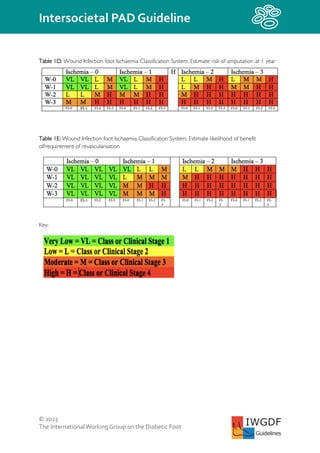
is the predicted likelihood of benefit from revascularisation (78).
A recent systematic review concluded that in people undergoing a revascularisation procedure, the
likelihood of an amputation after one-year increases with higher WIfI stages. The estimated one-year
major amputation rates from four studies comprising 569 participants were 0%, 8% (95% CI 3-21%),
11% (95% CI 6-18%) and 38% (95% CI 21-58%), for WIfI clinical stages 1-4, respectively (79). For the
population of people with a DFU, the WIfI system was evaluated in the IWGDF systematic review on
classification systems, that is published in parallel to this guideline. In summary, in people with diabetes,
PAD and a foot ulcer this systematic review identified seven studies, with low certainty evidence,
demonstrating that a high WIfI limb clinical stage is associated with longer time to healing and increased
likelihood of non-healing at 6 and 12 months (80-86). Higher WIfI clinical stages are also associated with
increased likelihood of major amputations with one study reporting amputation rate of 64% for stage 4
(87). Similarly, higher WIfI clinical stages have been linked to high rates of minor amputation and lower
rates of amputation free survival at 12 months (82, 83, 86, 88-93). For prediction of revascularisation
benefit there are few data available and inadequate evidence to determine whether WIfI
revascularisation benefit staging predicts healing or amputation outcomes in people undergoing
revascularisation.
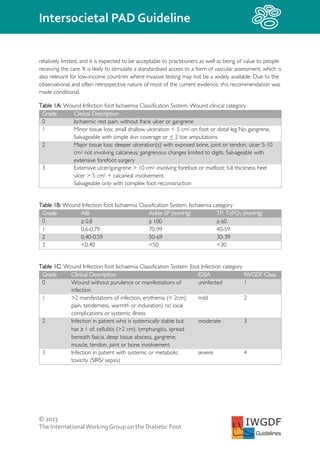
The WIfI tool (Table 1) has demonstrated predictive capacity for the key outcomes of wound healing
and amputation in people with DFU (82, 83, 86, 88-93). It uses clinical grading of infection and wound
characteristics in combination with non-invasive bedside testing to determine severity of ischaemia and it
has wide availability, also as an online tool (apps.apple.com/us/app/svs-ipg/id1014644425). Moreover, it
can be used by a wide range of practitioners making application in clinical practice feasible, its costs are
© 2023
The InternationalWorking Group on the Diabetic Foot
Intersocietal PAD Guideline
IWGDF
Guidelines
relatively limited, and it is expected to be acceptable to practitioners as well as being of value to people
receiving the care. It is likely to stimulate a standardised access to a form of vascular assessment, which is
also relevant for low-income countries where invasive testing may not be a widely available. Due to the
observational and often retrospective nature of most of the current evidence, this recommendation was
made conditional.
Table 1A: Wound Infection foot Ischaemia Classification System: Wound clinical category
Grade Clinical Description
0 Ischaemic rest pain; without frank ulcer or gangrene
1 Minor tissue loss: small shallow ulceration < 5 cm2 on foot or distal leg No gangrene.
Salvageable with simple skin coverage or < 2 toe amputations
2 Major tissue loss: deeper ulceration(s) with exposed bone, joint or tendon, ulcer 5-10
cm2 not involving calcaneus; gangrenous changes limited to digits. Salvageable with
extensive forefoot surgery
3 Extensive ulcer/gangrene > 10 cm2 involving forefoot or midfoot; full thickness heel
ulcer > 5 cm2 + calcaneal involvement.
Salvageable only with complex foot reconstruction
Table 1B: Wound Infection foot Ischaemia Classification System: Ischaemia category
Grade ABI Ankle SP (mmHg) TP, TcPO2 (mmHg)
0 ≥ 0.8 ≥ 100 ≥ 60
1 0.6-0.79 70-99 40-59
2 0.40-0.59 50-69 30-39
3 <0.40 <50 <30
Table 1C: Wound Infection foot Ischaemia Classification System: foot Infection category
Grade Clinical Description IDSA IWGDF Class
0 Wound without purulence or manifestations of
infection
uninfected 1
1 >2 manifestations of infection, erythema (< 2cm),
pain, tenderness, warmth or induration) no local
complications or systemic illness
mild 2
2 Infection in patient who is systemically stable but
has ≥ 1 of; cellulitis (>2 cm), lymphangitis, spread
beneath fascia, deep tissue abscess, gangrene,
muscle, tendon, joint or bone involvement
moderate 3
3 Infection in patient with systemic or metabolic
toxicity (SIRS/ sepsis)
severe 4
© 2023
The InternationalWorking Group on the Diabetic Foot
Intersocietal PAD Guideline
IWGDF
Guidelines
Table 1D: Wound Infection foot Ischaemia Classification System: Estimate risk of amputation at 1 year
Table 1E: Wound Infection foot Ischaemia Classification System: Estimate likelihood of benefit
of/requirement of revascularisation
Key:
© 2023
The InternationalWorking Group on the Diabetic Foot
Intersocietal PAD Guideline
IWGDF
Guidelines
TREATMENT
Clinical question: In which persons with diabetes, PAD and a foot ulcer or gangrene using clinical
findings, perfusion test findings, and/or classification systems, should revascularisation be considered?
Recommendation 11: In a person with diabetes, peripheral artery disease and a foot ulcer or gangrene
who is being considered for revascularisation, evaluate the entire lower extremity arterial circulation
(from aorta to foot) with detailed visualization of the below-knee and pedal arteries. Best Practice
Statement
Rationale: As per our recommendations 1-4 clinical examination and bedside testing should be the first
line testing undertaken to diagnose the presence of PAD. When a revascularisation is being considered
further anatomical information on the arteries of the lower limb should be obtained to assess the
presence, severity, and distribution of arterial stenoses or occlusions. In this process, adequate imaging of
the tibial and pedal vessels is of critical importance, particularly in planning intervention in people with
diabetes and a foot ulcer (17). Modalities that can be used to obtain anatomical information include:
arterial colour duplex ultrasound, computed tomographic angiography, magnetic resonance angiography,
or intra-arterial digital subtraction angiography (including anteroposterior and lateral views of the foot).
The Writing Committee considered that each of the imaging techniques have their advantages and
disadvantages and their use will depend heavily on the availability of equipment and local expertise,
preferences of the individual and associated costs. For these reasons a Best Practice statement was
formulated. Regarding their use in people with diabetes, the utility of some these techniques, such as
CDUS and CTA, can be affected by (severe) MAC, which is frequently present in the smaller arteries of
the leg in people with DFU. MRA images are incapable of defining the extent of calcification which may
be important when planning revascularisation (17). Finally, as stated in the Global Vascular Guidelines,
catheter digital subtraction angiography (DSA), represents the gold standard imaging technique,
especially for the below knee and foot arteries (17). In many centres DSA is typically used when MRA
or CTA are not available, fail to adequately define the arterial anatomy, or when an endovascular
intervention is planned. Arterial imaging should allow complete anatomical staging from aorta to foot
using, for example, TASC for aorto-iliac disease and the Global Anatomic Staging System (GLASS),
described in the Global Vascular Guidelines, for infrainguinal and pedal disease (17).
Recommendation 12: In a person with diabetes, peripheral artery disease, a foot ulcer and clinical
findings of ischaemia, a revascularisation procedure should be considered. Findings of ischaemia include
absent pulses, monophasic or absent pedal Doppler waveforms, ankle pressure < 100 mm Hg or toe
pressure < 60 mm Hg. Consult a vascular specialist unless major amputation is considered medically
urgent. Best Practice Statement
Rationale: The natural history of people with diabetes, PAD, and a DFU or gangrene remains poorly
defined, but in two studies reporting the outcomes of participants with diabetes and limb ischaemia who
were not revascularised, the limb salvage rate was around 50% at 1 year (66, 94). Our analysis of the
evidence for revascularisation suggests that revascularisation in appropriately selected people with
diabetes and hemodynamically significant PAD, can improve perfusion, expedite wound healing and
reduce major limb amputations(73). After a revascularization procedure, most studies report limb
salvage rates of 80% to 85% and ulcer healing in >60% at 12 months (95). On the other hand,
© 2023
The InternationalWorking Group on the Diabetic Foot
Intersocietal PAD Guideline
IWGDF
Guidelines
performing a revascularisation is not without risks. As summarised in the systematic review performed
by the IWGDF in 2019 (95), peri-operative or 30-day mortality was around 2% in people with diabetes
undergoing either endovascular or surgical revascularisation (95). The highest risk group includes people
with end-stage renal disease, who have a 5% perioperative mortality, 40% 1-year mortality and 1-year
limb salvage rates of around 70% (95).
People with signs of ischaemia, e.g., as defined by WIfI and the Global Vascular Guidelines; absent pulses
and monophasic or absent pedal Doppler waveforms, ankle pressure < 100 mm Hg or toe pressure <
60 mm Hg, are very likely to have significant PAD that could impact wound healing potential and
amputation risk (17, 78). We judged in our systematic review the certainty of the evidence on the
effects of revascularisation on wound healing and amputation risk as low, as many important factors that
can affect outcomes were not reported such as the availability of vein conduit, wound care, offloading
and sufficient anatomical details about the extent and severity of the lesions treated. Factors that
influence the decision to revascularise include the degree of limb threat (e.g., WIfI classification), the
amount of tissue loss, presence of infection, co-morbidities, feasibility of the different revascularisation
options and their risk.
As discussed in other parts of the IWGDF Guidelines, restoration of perfusion in the foot is only part of
the treatment required to optimise wound healing and to prevent or limit tissue loss, which should be
provided by a multidisciplinary team (77). Any revascularisation procedure should be part of a
comprehensive care plan that addresses other important issues including: prompt treatment of
concurrent infection, regular wound debridement, biomechanical off-loading, control of blood glucose,
assessment and improvement of nutritional status, as well as treatment of oedema and co-morbidities
(77). The decision to perform a revascularisation procedure and which procedure is preferred depends
therefore on several factors and in each individual the balance should be made between expected
benefits, potential risks, harms and costs, in a shared decision-making process. For these reasons we
made a Best Practice Recommendation. The care of persons with a DFU is frequently managed by
health care professionals who are not specifically trained in the treatment of PAD. Care for people with
PAD is differently organised in many countries, with different medical disciplines involved, such as
vascular surgeons, angiologists, interventional radiologists, nephrologists, cardiac surgeons and
cardiologists. For this reason, we used the term “vascular specialist consultation” in our
recommendation, but whatever the organisation of care all people with diabetes and PAD should have
access to both bypass surgery and endovascular procedures.
Recommendation 13: In a person with diabetes, peripheral artery disease, a foot ulcer, and severe
ischaemia i.e. an ankle-brachial index <0.4, ankle pressure <50mmHg, toe pressure <30mmHg or
transcutaneous oxygen pressure <30mmHg or monophasic or absent pedal Doppler waveforms,
urgently consult a vascular specialist regarding possible revascularisation. Best Practice Statement
Rationale: Severe ischaemia is defined in The Global Vascular Guidelines (GVG) as an ABI <0.4, AP
pressure <50mmHg, TP <30mmHg or TcPO2 <30mmHg or monophasic or absent pedal Doppler
waveforms (17, 78). Such perfusion deficits are, as also stated in the GVG, an indication for
revascularisation, unless contra-indicated or technically not possible. There is retrospective evidence
demonstrating that a delay in revascularisation of more than two weeks in people with diabetes results
© 2023
The InternationalWorking Group on the Diabetic Foot
Intersocietal PAD Guideline
IWGDF
Guidelines
in increased risk of limb loss (96). This is supported by observational research demonstrating that a
shorter time to revascularisation (<8 weeks) is associated with higher probability of DFU healing and
lower likelihood of limb loss (67). As shorter time to revascularisation was associated with higher
probability of DFU healing and lower likelihood of limb loss we made a Best Practice Statement
supporting urgent referral for vascular consultation in people with DFU and evidence of severe
ischaemia (Figure 1).
Figure 1: Assessment and management pathway for a person with diabetes, peripheral artery disease
and a foot ulcer with findings of ischaemia, infection or gangrene. (Colour code: yellow=conditional
recommendation, green=strong recommendation, orange= best practice recommendation)
Recommendation 14: In a person with diabetes, peripheral artery disease and a foot ulcer with infection
or gangrene involving any portion of the foot, urgently consult a vascular specialist in order to determine
the timing of a drainage procedure and a revascularisation procedure. Best Practice Statement
Rationale: In the presence of PAD and infection or gangrene, an urgent revascularisation should be
considered. In the prospective Eurodiale study participants with the combination of a foot infection and
PAD had a 1-year major amputation rate as high as 44% (80). In addition, participants with higher WIfI
infection grade had higher risk of amputation in several observational studies, as summarised in our
systematic review on Classification Systems (97). Delay in treatment can lead to rapid tissue destruction
© 2023
The InternationalWorking Group on the Diabetic Foot
Intersocietal PAD Guideline
IWGDF
Guidelines
and life-threatening sepsis as described in the IWGDF/IDSA Guidelines on Management of Diabetic
Foot Infections (98). In a person with a foot abscess or infection of a deep foot compartment that
needs immediate drainage, or where there is gangrene that must be removed to control the infection,
immediate surgery should be considered first (98). This should be accompanied by broad-spectrum
antibiotic therapy, which is subsequently tailored according to tissue culture results, as “time is tissue” in
these people. Once the sepsis is controlled and the person is stabilized, evaluation of the arterial tree
should lead to consideration for prompt revascularisation (i.e., within a few days) in people with
significant perfusion deficits. Once blood flow is improved and infection is controlled, a definitive
operation may be required in order to create a functional foot, which may require soft tissue and bone
reconstruction (99).Due to the risk of amputation in this clinical scenario, the likelihood that the person
will value avoidance of amputation, and the need for appropriate prioritisation of intervention strategies
to achieve this, the Writing Committee formulated a Best Practice Statement.
Recommendation 15: In a person with diabetes and a foot ulcer, when the wound deteriorates or fails
to significantly improve (e.g. a less than 50% reduction in wound area within 4 weeks) despite
appropriate infection and glucose control, wound care, and offloading, reassess the vascular status and
consult with a vascular specialist regarding possible revascularisation. Best Practice Statement
Rationale: Multiple factors may contribute to delayed or non-healing of DFU, including presence of
infection, wound size and depth, elevated foot pressures at the wound site and inadequate wound care.
A number of studies have demonstrated that a reduction in percentage of wound area of more than
50% by four weeks after presentation is predictive of healing at 12 weeks (100-103). This has been
shown to be the case independent of the ulcer size at baseline and supports review of treatment
protocols where adequate wound reduction is not being achieved in the four-week timeframe. Presence
of suspected CLTI or a DFU that is failing to adequately heal despite best practice care requires prompt
consultation with a vascular specialist and assessment of whether a revascularisation procedure is
indicated. There is no direct evidence supporting our recommendation which is a pragmatic statement
based on indirect evidence and expert opinion. Given the risk of poor outcomes when PAD is left
untreated in a person with a poorly healing ulcer, we have made a Best Practice Statement.
Recommendation 16: In a person with diabetes, peripheral artery disease and a foot ulcer or gangrene,
avoid revascularisation when the risk–benefit ratio for the probability of success of the intervention is
clearly unfavourable. Best Practice Statement
Rationale: Revascularisation should not be performed if there is no realistic chance of wound healing,
when major amputation is inevitable, a functional foot is unlikely to be achieved, or when life expectancy
is short and there is unlikely to be of benefit to the person. The Writing Committee considered that in
such persons any revascularisation procedure is unlikely to be of benefit to the person and may cause
harm. Many affected individuals pose high peri-procedural risk because of comorbidities. In particular, the
following people may not be suitable for revascularisation: those who are very frail, have short life
expectancy, have poor functional status, are bed bound, and/or have a large area of tissue destruction
that renders the foot functionally unsalvageable and those who cannot realistically be expected to
mobilize following revascularisation. There are occasional situations where an arterial inflow procedure is
© 2023
The InternationalWorking Group on the Diabetic Foot
Intersocietal PAD Guideline
IWGDF
Guidelines
performed to improve the likelihood of healing of a below knee amputation, so as to avoid an above
knee amputation.
There is evidence from several observational studies of a 50% healing rate for ischaemic DFU in people
with diabetes unsuitable for revascularisation and this should also be considered in determining choice of
care (67, 94). The decision to proceed to primary amputation, or to adopt a palliative approach, should
be made in conjunction with the person and the multidisciplinary team (104) including a vascular
specialist unless an emergency procedure is indicated as discussed earlier. The Writing Committee
considered that in these circumstances where healing is improbable a person is unlikely to value the
outcomes from revascularisation over no revascularisation. Similarly in such circumstances the benefit of
revascularisation will not outweigh the potential harms.
Clinical question: In people with diabetes, PAD and either a foot ulcer or gangrene how does
endovascular revascularisation compare to open or hybrid revascularisation?
Recommendation 17: In a person with diabetes, peripheral artery disease and either a foot ulcer or
gangrene who have an adequate single segment saphenous vein in whom infrainguinal revascularisation
is indicated and who are suitable for either approach, we suggest bypass in preference to endovascular
therapy (Conditional, Moderate)
Recommendation 18: A person with diabetes, peripheral artery disease (PAD) and a foot ulcer or
gangrene, should be treated in centres with expertise in, or rapid access to, endovascular and surgical
bypass revascularisation. In this setting, consider making treatment decisions based on the risk to and
preference of the individual, limb threat severity, anatomic distribution of PAD, and the availability of
autogenous vein. Best Practice Statement
Rationale: Once the decision to revascularise has been made, the next decision is whether an
endovascular, an open (i.e., bypass or endarterectomy) procedure, or a combination of both (i.e. hybrid
procedure) should be performed. Recommendation 18 highlights the complementary role of open and
endovascular techniques in contemporary vascular practice. In particular, endovascular techniques have
largely replaced open surgery in the management of aorto-iliac disease and also allow treatment of foot
and pedal arch disease.
The majority of studies we identified in our systematic review on endovascular and bypass surgical
outcomes were observational and retrospective case series, with a high risk of bias (105). The BEST CLI
trial was a large randomised clinical trial with low risk of bias comparing an endovascular first with a
surgical first approach. People with CLTI who were deemed appropriate for revascularisation for
infrainguinal arterial occlusive disease were included (106). The primary outcome was above-ankle
amputation of the index limb or a major reintervention in the index limb (new bypass, vein graft
interposition revision, thrombectomy or thrombolysis) or death. It was designed in two parallel-cohort
trials: (Cohort 1) people who had adequate single segment great saphenous vein (GSV) available for use
as a bypass conduit, and (Cohort 2) people without adequate single segment GSV who required an
alternate conduit. Treatment with a GSV bypass first approach was superior to endovascular therapy
first for the primary outcome (hazard ratio [HR], 0.68; 95% confidence interval [CI] 0.59-0.79; P
<0.001). In Cohort 2 the primary outcomes were similar between the two groups. Subgroup analysis of
© 2023
The InternationalWorking Group on the Diabetic Foot
Intersocietal PAD Guideline
IWGDF
Guidelines
people in Cohort 1 favoured surgery in people with diabetes (HR 0.72; CI 0.61-0.86) with benefit
comparable to those without diabetes (HR 0.57; CI 0.41-0.78). At the time of writing this guideline,
further results of this study have not been published. Of note whole group data for Cohort 1
demonstrated a higher rate of major amputation in those undergoing an endovascular procedure
compared with those having surgery (Surgery:74/709 (10.4%) Endovascular:106/711 (14.9%). Further
sub-analysis may demonstrate this is relevant to those with diabetes and therefore this may affect an
individual’s preference for intervention. From the perspective of the person receiving treatment, the
difference in length of hospital stay should be taken into account, which in our systematic review was
longer in the bypass publications than in endovascular publications. In addition, people might prefer to
have an endovascular approach given the more invasive approach of bypass surgery. Considering costs
there are probably no major differences except the length of hospital stay however this is yet to be
determined and may be an additional outcome of the BEST-CLI study. Subsequent analyses are also
awaited to shed more light on the anatomical patterns and extent of disease treated, as well as which
patterns of disease were not well represented or excluded. As BEST-CLI is currently the only
randomised controlled trial (RCT) in this area, the certainty of the evidence for our recommendation
was moderate. Given the important differences in outcomes in the BEST-CLI trial we recommend
considering bypass surgery as first option in people with a suitable saphenous vein. We acknowledge
that this recommendation can lead to some major changes in the policy of the many centres
whichcurrently have an ‘endovascular-first’ approach for everyone.
Our recommendation may not be feasible in the short term in all countries due to the lack of
equipment and expertise. Finally, it should be noted that in the BEST-CLI study, endovascular
procedures could be performed in the iliac and common femoral artery to ensure optimal inflow into
the bypass, emphasising that a centre treating PAD in people with a DFU should have the expertise to
perform both endovascular and bypass procedures. In addition, in some centres the immediate
availability of an endovascular approach might be a reason to opt for this treatment when an urgent
revascularisation is needed or when the surgical risk is deemed too high. For these reasons and the
moderate certainty of the evidence we made a Conditional recommendation.
In people with diabetes in whom a revascularisation is considered but who do not have a suitable single
segment great saphenous vein for bypass surgery, the results in BEST-CLI were similar for endovascular
and surgical bypass. This statement is in line with the results of our systematic review, in which the non-
randomised and observational studies showed that the evidence was inadequate to establish whether an
endovascular, open, or hybrid revascularisation technique is superior. Each of these techniques has its
advantages and disadvantages. A successful distal venous bypass can result in a marked increase of blood
flow to the foot, but general, spinal or epidural anaesthesia is usually necessary and a suitable vein, as a
bypass conduit, should be present, as in the BEST-CLI trial. An endovascular procedure has several
logistical advantages, but sometimes, very complex interventions are necessary to obtain adequate
blood flow in the foot and a failed endovascular intervention may lead to worse outcomes when an
open procedure is subsequently performed (107). Over the past few decades, there have been
significant advancements in endovascular techniques; however, parallel to this, we have seen
improvements in anaesthesia and perioperative care that have helped improve surgical outcomes. As
there is no “one size fits all” approach to treatment for people with diabetes, PAD and foot ulceration
or gangrene, it is important that a treating centre has the expertise and facilities to provide a range of
© 2023
The InternationalWorking Group on the Diabetic Foot
Intersocietal PAD Guideline
IWGDF
Guidelines
treatment options with availability of both endovascular and open techniques. We recommend that in
each person requiring lower limb revascularization, all revascularisation techniques should be considered
(Figure 2).
Figure 2: Approach to vascular intervention for a person with diabetes and a foot ulcer or gangrene.
(Colour code: yellow=conditional recommendation, green=strong recommendation, orange= best
practice recommendation)
Clinical Question: In people with diabetes, PAD and either a foot ulcer or gangrene how does direct
angiosome revascularisation compare to indirect angiosome revascularisation?
Recommendation 19: In a person with diabetes, peripheral artery disease and a foot ulcer or gangrene,
revascularisation procedures should aim to restore in-line blood flow to at least one of the foot arteries.
Best Practice Statement
Rationale: In people with diabetes and a foot ulcer or gangrene in whom revascularisation is required,
optimising blood flow to the foot is important to optimise the chance of healing the foot and avoiding
amputation. Incomplete revascularisation (including treating inflow disease when distal disease is present
or bypassing into “blind segment” arteries with no runoff), can result in delayed (or non-) wound healing
and significant risk of amputation.
Bypass surgery is ideally performed to an outflow vessel that runs into the foot. However, bypasses
performed to the peroneal artery (which rely on collateralisation to the foot) are most effective when
© 2023
The InternationalWorking Group on the Diabetic Foot
Intersocietal PAD Guideline
IWGDF
Guidelines
there is good collateralisation to the foot and a patent pedal arch is present (93). Pedal arch patency
also seems to be associated with improved wound healing and reduced risk of major amputation (108).
Recommendation 20: In a person with diabetes, peripheral artery disease and a foot ulcer or gangrene
who are undergoing an endovascular procedure, consider targeting the artery that on angiography that
supplies the anatomical region of the ulcer, when possible or practical. (Conditional, Very low)
Rationale: Angiosomes are three-dimensional regions of tissue and skin supplied by a source artery. The
six angiosomes of the foot and ankle are supplied by the posterior tibial artery (n=3), peroneal artery
(n=2) and anterior tibial artery (n=1) (Figure 3). Communications between angiosomes include direct
arterial-arterial connections, as well as “choke” vessels which link adjacent angiosomes (108-110). The
effect/ influence of angiosome-based revascularisation on wound healing and prevention of amputation
(major and minor) in the management of diabetes-related foot complications remains controversial.
Direct revascularisation involves revascularisation of the tibial artery supplying the angiosome in which
the tissue loss has occurred. The alternative to this is indirect revascularisation where the tibial artery
treated is the artery in which successful in-line flow to the foot is most likely to be achieved by
endovascular techniques or is deemed the best tibial outflow vessel for anastomosis in bypass surgery
but does not directly supply the affected area of tissue loss. Our systematic review found that open
vascular reconstruction procedures were equally effective whether direct or indirect revascularisation to
the affected foot angiosome was performed (105).
In addition, healing and amputation outcomes for direct and indirect endovascular revascularisation
shows that if direct revascularisation is possible, DFU healing time and major amputation may be
reduced compared with indirect revascularisation. There is inadequate evidence to determine whether
direct revascularisation is superior to indirect revascularisation to prevent minor amputation (111).
Indirect revascularisation with collaterals was associated with wound healing and limb salvage outcomes
which were similar to direct revascularisation outcomes and significantly better than the indirect without
collateral cohorts (112-116).
The majority of included studies in our systematic review used endovascular procedures with data
probably favouring direct revascularisation. For bypass procedures there was little difference in healing
and amputation outcomes at 12 months between direct and indirect revascularisation (116-119). These
studies had a high risk of bias, lacked randomisation (and it is unlikely that this will ever be possible) and
were mostly retrospective. Baseline variables such as wound/foot staging (e.g., by WIfI) and extent of
tissue loss were infrequently reported. Heterogeneity of the included studies was found to be high
preventing meta-analysis of data. This is likely to be due to high variability in participants and wound
stage (extent of tissue loss, severity of ischaemia, presence of infection). Comparison of primary
outcomes (healing/ amputation) or adverse events is therefore problematic. Based on the available data
it appears direct revascularisation may have improved outcomes and therefore we considered that this
procedure is likely to be preferred by people receiving treatment to improve healing and prevent
amputation. However, the Writing Committee considered there is likely to be important variability in
patient values due to the lack of cear benefit of one approach over the other. Factors such as the
severity of ischaemia and tissue loss ( e.g., WIfI staging) and patient suitability for the
procedure/presence of comorbidities, as well as availability of expertise and costs of the procedures
© 2023
The InternationalWorking Group on the Diabetic Foot
Intersocietal PAD Guideline
IWGDF
Guidelines
(which may vary between locations/countries) drives decision making in relation to the type of
procedure considered appropriate with these factors also impacting. Several studies have noted that
only a minority of foot and ankle wounds in their series corresponded to one angiosome. Kret et al,
(120) found that only 36% of wounds in their series corresponded to a single distinct angiosome.
Similarly, Aerden et al, (121) found it difficult to allocate people to direct revascularisation versus
indirect revascularisation due to the presence of multiple wounds and large wounds that had more than
one angiosome supplying them. In such cases it is the opinion of the Writing Committee that the best
quality artery should preferentially be targeted. Many clinicians will consider attempting to treat the
second vessel supplying the wound as well, although there is a lack of evidence to support this approach
(105).
Figure 3: Angiosome distribution in the lower leg and foot.
© 2023
The InternationalWorking Group on the Diabetic Foot
Intersocietal PAD Guideline
IWGDF
Guidelines
Clinical question: In people with DFU do revascularisation perfusion outcomes predict healing, major
amputation or the need for further revascularisation?
Recommendation 21: In a person with diabetes and either a foot ulcer or gangrene who has undergone
revascularisation, objectively assess adequacy of perfusion e.g., using non-invasive bedside testing. Best
Practice Statement:
Rationale: There are few available data examining the predictive capacity of post-revascularisation
perfusion measures for healing or amputation outcomes or for the need for further revascularisation in
people with diabetes. However, adequate perfusion is essential for wound healing and clinical
examination is often too unreliable. Diabetes-related PAD is characterised by atherosclerotic plaque
formation that is long and diffuse in nature and more likely to involve distal vascular beds. Frequently
long-term patency is not achieved in endovascular treatment of tibial lesions (122).
Regular assessment of perfusion post-revascularisation should therefore be undertaken due to the risk
of occlusion/ restenosis after intervention. This should be conducted in combination with regular
assessment of the foot lesion to determine whether healing is indeed taking place. We recommend that
revascularisation should aim to improve perfusion to the foot as much as possible, which will vary
according to the individual. Due to the lack of data available determining the optimum time frame for
follow-up and the likelihood that this may vary depending on the testing method being used, we have
made a Best Practice Statement based on indirect evidence and expert opinion.
Recommendation 22: A person with diabetes, peripheral artery disease and either a foot ulcer or
gangrene should be treated by a multidisciplinary team as part of a comprehensive care plan. Best
Practice Statement
Rationale: As discussed in several parts of this guideline and in other IWGDF guidelines on the diagnosis
and management of DFU, restoration of perfusion in the foot is only part of the treatment, which
should be provided by multidisciplinary care team (77). Lack access to specialist care is associated with
worse foot outcomes. In rural and remote locations and areas where specialist access is challenging
referral pathways that address care access (e.g. through virtual referral pathways) are essential to
establish to provide multidisciplinary care (123). Any revascularization procedure should therefore be
part of a comprehensive care plan that addresses other important issues including: prompt treatment of
concurrent infection, regular wound debridement, biomechanical offloading, control of blood glucose,
cardiovascular risk reduction, and treatment of co-morbidities (123). Moreover, once the ulcer has
healed the risk of recurrence is up to 50% over five years in several studies so preventive measures
need to be taken and many people need long-term follow-up by a dedicated foot complication
prevention team (23).
© 2023
The InternationalWorking Group on the Diabetic Foot
Intersocietal PAD Guideline
IWGDF
Guidelines
Clinical question: In a person with diabetes, PAD, and a foot ulcer, which medical treatments should be
advised to prevent major adverse cardiovascular events (MACE), major adverse limb events (MALE)
and death?
MACE* is defined as a composite of nonfatal stroke, nonfatal myocardial infarction, and cardiovascular
death.
MALE* is defined as the development of severe lower leg ischaemia leading to a vascular intervention
or a major lower leg amputation.
* These definitions vary slightly between studies.
People with diabetes and PAD (with or without a foot ulcer) are at a very high cardiovascular risk.
Cardiovascular risk factor goals should always be individualised taking life-expectancy, expected benefit,
treatment burden, potential drug interactions and undesirable treatment effects into account. While
taking these considerations into account the Writing Committee suggests the following treatment
targets to reduce the risk of future major adverse limb and cardiovascular events:
Recommendation 23: In a person with diabetes and peripheral artery disease the following target levels
should be:
• HbA1c < 8% (< 64 mmol/mol), but higher target HbA1c value may be necessary depending on
the risk of severe hypoglycaemia
• Blood pressure < 140/ 90 mmHg but higher target levels may be necessary depending on the
risk of orthostatic hypotension and other side-effects.
• Low density lipoprotein target of < 1.8 mmol/L (<70 mg/dL) and reduced by at least 50% of
baseline. If high intensity statin therapy (with or without ezetimibe) is tolerated, target levels <
1.4 mmol/L (55 mg/dL) are recommended.
Best Practice Statement
Recommendation 24: A person with diabetes and symptomatic peripheral artery disease:
• should be treated with single antiplatelet therapy,
• treatment with clopidogrel may be considered as first choice in preference to aspirin
• combination therapy with aspirin (75 mg to 100 mg once daily) plus low-dose rivaroxaban (2.5
mg twice daily) may be considered for people without a high bleeding risk.
Best Practice Statement
Recommendation 25: In a person with type 2 diabetes with peripheral artery disease:
• with an eGFR > 30 ml/min/1.73m2, a sodium–glucose cotransporter 2 (SGLT-2) inhibitor or a
glucagon-like peptide 1 receptor agonist with demonstrated cardiovascular disease benefit
should be considered, irrespective of the blood glucose level
• SGLT-2 inhibitors should not be started in drug-naïve people with a diabetes-related foot ulcer
or gangrene and temporary discontinuation should be considered in people already using these
drugs, until the affected foot is healed.
Best Practice Statement
© 2023
The InternationalWorking Group on the Diabetic Foot
Intersocietal PAD Guideline
IWGDF
Guidelines
Rationale: The Writing Committee decided to not write their own guidelines on pharmacological
interventions in people with diabetes, PAD and a foot ulcer or gangrene in order to reduce
cardiovascular risk or to prevent major limb events as defined above. There are already a number of
guidelines on cardiovascular risk prevention in people with diabetes and cardiovascular disease, and thus
another guideline would have little added value. We decided to base our Best Practice Statements on
the Global Vascular Guidelines for CLTI produced by the ESVS, SVS and World Federation of Vascular
Societies (WFVS) (17), as these address the specific population of people with CLTI. The advice on
antiplatelet therapy is in line with the recent ESVS antithrombotic guidelines (124). When we felt it was
applicable, we used the guidelines of the American Diabetes Association (ADA), the European
Association for the Study of Diabetes (EASD) and other guidelines on peripheral artery disease
(European Society of Cardiology [ESC]-ESVS, European Society of Vascular Medicine [ESVM], ESC-
EASD, ESC- European Atherosclerosis Society [EAS]) (13-16, 18-20).
PAD runs a more aggressive course in those with diabetes mellitus compared with those without
diabetes, with an elevated risk of lower leg amputation. In addition, the combination of diabetes and
PAD is associated with a high risk of developing complications in other vascular beds. As discussed
previously, persons with an ischaemic diabetes-related foot ulcer have an overall 5-year cardiovascular
mortality around 50% (125). Therefore, according to the international guidelines of several major
vascular and diabetes associations, these individuals should be considered as having a very high
cardiovascular risk and should be treated as such. On the other hand, they usually have, in addition to
peripheral neuropathy, other diabetes-related complications as well as several co-morbidities, resulting in
a high burden of diseases and multiple medications (27). Many affected persons are elderly, frail and are
living in vulnerable socio-economic circumstances with a low quality of life (126, 127). It is therefore
essential that cardiovascular risk factor management in these people should be individualised, tailored
and should be part of a shared decision-making process, taking life-expectancy, diabetes-related
complications/co-morbidities, expected benefit, treatment burden, drug interactions and undesirable
treatment effects into account. This care should be provided by health care worker(s) with sufficient
expertise in treating cardiovascular risk factors and glycaemia, preferably by person(s) who are part of
the multidisciplinary team for diabetes-related foot care.
Glycaemic goals
As stated in the ADA and ESC-EASD guidelines, near-normal glycaemia with HbA1c level below 7.0%
(53 mmol/mol) will decrease microvascular complications (15, 19). Tighter glucose control initiated early
in the course of diabetes in younger individuals leads to a reduction in macrovascular complications, i.e.
cardiovascular outcomes, over a 20 year timescale. Such glucose control can have beneficial effects on
microvascular complications in a shorter period of time. However, when blood glucose lowering agents
are used that have the risk of severe hypoglycaemia, this can increase the risk of cardiovascular events
and death, as detailed in the ADA and ESC-EASD guidelines (15, 18). As many people with a DFU and
PAD also have atherosclerotic disease in other vascular beds, tight glucose control can be harmful. The
risk of hypoglycaemia is markedLy lower when people are only treated with metformin, a sodium–
glucose cotransporter 2 inhibitor or a glucagon-like peptide 1 receptor agonist. Tight glucose control is
often not indicated in persons with PAD and a DFU due to the risk of hypoglycaemia outweighing the
potential benefit. The ADA recommends in the 2022 Standards of Care to aim for an Hba1c < 8% (<
© 2023
The InternationalWorking Group on the Diabetic Foot
Intersocietal PAD Guideline
IWGDF
Guidelines
64 mmol/mol) in such persons and the ESC-EASD 2019 guideline for levels below 8- 9% (<64-75
mmol/L) (15, 18). However, the target chosen will depend on factors such as age, duration of diabetes,
complications, co-morbidities and risk of hypoglycaemia. These target HbA1c levels are higher than the
level formulated in the Global Vascular Guidelines for CLTI (< 7,0%, 53 mmol/mol), but as discussed
above we concluded that the risk of such tight blood glucose control is too high in this specific
population.
Blood pressure goals
The ESC-EASD guidelines state that RCTs have demonstrated the benefit (reduction of stroke,
coronary events, and kidney disease) of lowering systolic BP to <140 mmHg and diastolic BP to <90
mmHg (15). Usually, multiple drugs are necessary to reach these levels in people with diabetes. In
younger people (e.g., younger than 65 years) level below 130/80 mmHg can be considered if there are
no contra-indications for such tight blood pressure control and the risk of orthostatic hypotension is
low. Both the ADA and ESC-EASD stress the importance of individualised treatment as overly
aggressive blood pressure lowering is not without risk in the usually elderly with a DFU and those with
multiple diabetes-related complications and co-morbidities. Therefore, we recommend in these people
blood pressures < 140/90 mmHg, but in younger individuals (e.g. < 65 years) and with a small risk of
adverse effects of the treatment, lower target levels might be considered.
Lipid goals
The ADA and EASD guidelines recommend in persons with diabetes and atherosclerotic cardiovascular
disease an LDL target of < 1.8 mmol/L (70 mmol/L) (18). In line with the ‘the lower the better’
approach, recent trials suggest that lower levels of LDL of < 1.4 mmol/L (55 mg/dL) can be beneficial in
persons with a very high cardiovascular risk. Therefore, the recent ESC-EASD and ESC-EAS guidelines
recommend that such very low LDL levels should be the target in these individuals (15, 16). In those
with recurrent events within 2 years, even LDL levels < 1.0 mmol/L (40 mg/dL) are suggested as target
in ESC-EAS guidelines (16). With statin therapy such as rosuvastatin 20-40 mg or atorvastatin 40-80 mg,
marked reductions of LDL cholesterol can be achieved if these relatively simple treatments are
tolerated. When the target is not reached ezetimibe can be added, which is available in combination
tablets with both statins. These treatments have limited side effects in most (but not all) people and are
relatively inexpensive. According to the recent ESC-EASD and ESC-EAS guidelines, an LDL-level below
1.0 mmol/L (40 mg/dL) can be the target in people with recurrent cardiovascular events (within 2
years), based on a limited number of RCT’s in which relatively few participants with CLTI and diabetes
were included. In order to reach the aforementioned very low LDL levels additional treatment with a
PCSK9 inhibitor will be necessary in a proportion of people. PCSK9 inhibitors are monoclonal antibodies
which have limited side-effects but have the drawback of high costs, parental administration and at
present there is very limited evidence of the costs-effectiveness of PCSK9 inhibitors in people with
diabetes, PAD and a foot ulcer or gangrene. In addition, the use of these expensive drugs is a problem
for many countries in the world, and for these reasons we did not include a recommendation on LDL-
level below 1.0 mmol/L (40 mg/dL) for our specific population, but we acknowledge that in several
countries PCSK9 inhibitors are used to reach these goals in those with recurrent cardiovascular events.
© 2023
The InternationalWorking Group on the Diabetic Foot
Intersocietal PAD Guideline
IWGDF
Guidelines
In line with the other cardiovascular risk reduction interventions in these usually frail, multimorbid
individuals, treatment and its goals should be based on shared decision making and should be
individualised after careful weighting the benefits, harms and costs. The LDL (and other) treatment
targets in our recommendation should not be interpreted as absolute goals but more as desired goals.
Even if the goal is only partially met, it can result in a marked reduction in cardiovascular events in these
very high-risk people. Although very low LDL levels are perhaps not achievable in all, LDL reductions up
to 50% can be achieved in many with the aforementioned potent statins (and ezetimibe), with marked
reduction in cardiovascular risk (13).
Additional therapies
Antiplatelet therapy
All guidelines strongly recommend treatment with a single antiplatelet agent in persons with
cardiovascular disease -or more specifically chronic limb threatening ischaemia (CLTI). These drugs
reduce the risk of cardiovascular events; in case of increased risk of gastric bleeding in aspirin treated
individuals a proton pump inhibitor as additional treatment should be considered. There is less
consensus which drug to choose, clopidrogel or aspirin. The ADA and ESC-EASD guideline advise in
persons with diabetes and a cardiovascular event aspirin as first choice, but did not specify for the
presence of PAD (15, 18). In the recent ESVM, ESC-ESVS and GVG Guidelines, clopidrogel is
considered as the antiplatelet agent of choice in those with PAD. This recommendation is in particular
based on ‘The Clopidogrel versus Aspirin in Patients at Risk for Ischaemic Events (CAPRIE)’ trial, in
which clopidrogel was more effective in reducing cardiovascular risk without an increased risk of
bleeding (128). It should be noted that only a subset of participants in this trial had PAD of which only
21% had diabetes. Also, a meta-analysis did not show any benefit from aspirin for those with PAD
(129). A post-hoc, sub-analysis of the CAPRIE trial showed that clopidogrel was superior to aspirin in
reducing recurrent ischemic events in patients with diabetes (130). The relative risk reduction was
comparable to those without diabetes, but due to the greater number of events, the absolute risk
reduction was even larger. Given the potential benefit, we suggest in a conditional recommendation that
clopidogrel may be considered as first choice, in line with the aforementioned Guidelines.
As an additional alternative to single antiplatelet therapy, combination therapy with aspirin (100 mg once
daily) plus low-dose rivaroxaban (2.5 mg twice daily) may be considered for persons with low bleeding
risk to prevent cardiovascular events as well as reduce extremity ischaemic events in those with CLTI, as
suggested by the Global Vascular Guidelines, ESVM and the ESC-EASD guidelines (13) (17, 20). This
suggestion is based on the COMPASS trial in which this combination therapy was more effective than
aspirin but was also associated with an increase of risk of clinically relevant bleeding, mostly
gastrointestinal (131). In this trial approximately 38% had diabetes mellitus and the benefit of the
combination therapy seemed similar in those with and without diabetes. Given this limited evidence
base and the added treatment burden for this frequently vulnerable cohort, we made a Best Practice
Statement. The ESVS antithrombotic guidelines recommend that those not at high risk of bleeding who
undergo an endovascular intervention for lower extremity PAD may be considered for a 1-6 month
course of dual antiplatelet therapy (aspirin plus clopidogrel) to reduce the risk of MACE and MALE
followed by single antiplatelet therapy (132). Similarly, those undergoing endovascular intervention who
are not at high risk of bleeding should be considered for aspirin (75-100 mg daily) and low-dose
© 2023
The InternationalWorking Group on the Diabetic Foot
Intersocietal PAD Guideline
IWGDF
Guidelines
rivaroxaban (2.5 mg twice daily) to reduce the risk of MACE and MALE (133, 134). If the bleeding risk is
considered to be high, single antiplatelet therapy should be used post-intervention.
If clopidogrel is used in addition to aspirin and low-dose rivaroxaban after endovascular intervention,
clopidogrel should only be used for <30 days as with longer-term use the bleeding risk is likely to
outweigh the benefit (135).
The ESVS antithrombotic guidelines recommend that persons undergoing infrainguinal endarterectomy
or bypass surgery who are not at high risk of bleeding should be considered for aspirin (75-100 mg
daily) and low-dose rivaroxaban (2.5 mg twice daily) to reduce the risk of MACE and MALE. Those
persons undergoing infrainguinal bypass surgery with autogenous vein who are not at high bleeding risk
may be considered for treatment with vitamin K antagonist to improve graft patency (134, 136).
Those undergoing infrainguinal bypass with prosthetic should be considered for single antiplatelet
therapy. Persons at high risk of bleeding undergoing lower extremity bypass surgery using autogenous or
prosthetic conduit may be considered for single antiplatelet therapy to improve graft patency (134).
Arterial duplex scanning post-autologous vein bypass surgery is generally advised post-procedure to
detect graft stenoses. The benefits of post-procedure surveillance following endovascular intervention
remain uncertain; we suggest following local protocols.
Sodium–glucose cotransporter 2 inhibitors and a glucagon-like peptide 1 receptor agonists
In recent years it has become increasingly clear that several sodium–glucose cotransporter 2 (SGLT-2)
inhibitors and glucagon-like peptide 1 receptor (GLP-1) agonists, which were originally developed to
lower blood glucose levels, can have beneficial cardiovascular effects in persons with type 2 diabetes
(18). These effects are independent of their blood glucose lowering effect. To what extent this benefit
can also be observed in those with type 1 diabetes mellitus, in whom glucose management with these
drugs only has a limited (SGLT-2 inhibitors) or no (GLP-1 agonists) role to play, remains to be
established. In individuals with an eGFR < 30 ml/min/1.73m2 these drugs are contra-indicated.
Therefore, we advise to consider these drugs in type 2 diabetes mellitus and peripheral artery disease
with an eGFR > 30 ml/min/1.73m2 after careful review and possibly adjustment of other blood glucose
lowering medication in order to prevent hypoglycaemia, but for SGLT2-inhibitors there are additional
caveats.
The SGLT2-inhibitor canagliflozin was associated with an increased risk of amputation in an RCT. This
was not a pre-specified endpoint and was not observed in the other SGLT2-inhibitors trials (137) or in
long-term prospective studies, as concluded in the ADA-EASD 2022 consensus report (138). In
addition, in post-hoc analyses, these drugs had beneficial cardiovascular and renal effects in persons with
peripheral artery disease (139). However, individuals with foot ulcers were frequently excluded in
SGLT2-inhibitor trials and there is a second caveat to be considered. Diabetes-related ketoacidosis is a
rare but serious side effect of SGLT2-inhibitors and prolonged fasting, acute illness and the peri-
operative period predispose to developing ketoacidosis. In these situations, the ADA-EASD recommend
temporary discontinuation of the medication, i.e., 3 days prior to surgery (138). As those with PAD, a
diabetes-related foot ulcer or gangrene have a high risk of developing a foot infection or to undergo one
or more (urgent) surgical procedures, we suggest for pragmatic reasons that SGLT-2 inhibitors should
© 2023
The InternationalWorking Group on the Diabetic Foot
Intersocietal PAD Guideline
IWGDF
Guidelines
not be started in drug-naïve individuals and that temporary discontinuation should be considered in
those already using these drugs, until the affected foot is healed.
POSTSCRIPT
The targets discussed in this text are based on reduction of cardiovascular events, but is should be
noted that this is a composite end-point and the definition between trials differs. MALE is also
sometimes differently defined and the evidence for reducing lower limb events in persons with diabetes,
PAD and a foot ulcer by pharmacological treatment is scarce. For this reason we could not provide a
specific recommendation on this topic.
FUTURE RESEARCH PRIORITIES
One of the main limitations of this Guideline is the lack of prospective randomized trials, inconsistency
of classification and outcomes reported, and lack of separation of outcome for people with CLTI with
and without diabetes. Data reporting on PAD in relation to diagnosis, prognosis and management
overwhelmingly relate to the general population. There is a paucity of high-level evidence for diagnosis
and management of those with DFU or gangrene with studies frequently including only persons with
intact feet or inadequately detailing (or controlling for) confounding factors including presences of
neuropathy, ulcer, infection, or other contributors to poor outcomes. Moreover, few studies in CLTI
cohorts provide sub-analysis for those with diabetes although they are likely to make up the majority of
the included population. As such, there is clearly a need for further research into this unique subgroup
of individuals with diabetes, in order that outcomes around the world can be improved. The Writing
Committee considers there are a number of priority areas for future research. Our systematic review of
the prognostic capacity of bedside vascular testing to predict DFU healing and amputation outcomes
demonstrated a lack of investigations of sufficient quality for several widely available tests including TBI
and TcPO2, with inconsistent use of measurement thresholds and a lack of data examining the effect of
combining test outcomes. New technologies to develop optimal tools and measures of foot perfusion
for people with DFU and PAD to guide revascularization therapies would be invaluable in guiding
revascularisation strategies for individuals and for determining when more aggressive strategies are
indicated.
© 2023
The InternationalWorking Group on the Diabetic Foot
Intersocietal PAD Guideline
IWGDF
Guidelines
FURTHER QUESTIONS
1. Which group of people with diabetes and a DFU, tissue loss or gangrene most benefit from urgent
revascularisation, and who may benefit from an initial expectant management?
The working group has made a Best Practice Statement attempting to define which people are likely to
benefit most from urgent vascular assessment and revascularisation. Further studies to clarify person-
and limb-related factors are needed and such predictions may be facilitated by new prediction methods
such as Machine Learning (140).
2. Do newer endovascular revascularisation adjuncts and techniques developed for infra-popliteal
revascularisation positively impact on patency rates and person-centred endpoints (amputation-free
survival, improved wound healing and health-related quality of life) in those with diabetes, PAD and
a foot ulcer?
A number of new technologies have been developed to enhance patency of endovascular interventions,
including drug-eluting balloons and stents, and bioresorbable vascular scaffolds/stents. Atherectomy and
lithotripsy devices have been developed to deal with heavily calcified lesions. Venous arterialisation has
also been introduced to attempt to revascularize those with “no option” for revascularisation (141,
142). The role and indications for these interventions in the general population with CLTI and in
particular, those with diabetes, remains to be clarified.
3. Identify effective regenerative therapies (e.g. cell or gene-based) to improve foot perfusion in
persons with DFU and PAD who are not candidates for standard revascularization.
Angiogenesis (formation of new blood vessels from existing ones) is important for the development of
arterial collateral formation in response to arterial occlusion and also for wound healing. Diabetes (and
hyperglycaemia) are associated with impaired angiogenesis. A number of cell-, gene- and protein-based
therapeutic approaches have, and are, being trialled for both “no option” CLTI and wound healing in
diabetes. There are currently no therapeutic therapies which have proven beneficial and trials are on-
going (143).
© 2023
The InternationalWorking Group on the Diabetic Foot
Intersocietal PAD Guideline
IWGDF
Guidelines
CONTRIBUTION OF AUTHORS
The Writing Committee was chaired by R.F. (on behalf of the IWGDF), with R.H. (on behalf of the
ESVS) and J.L.M (on behalf of the SVS) as co-chairs and supported by NCS (on behalf of the IWGDF).
V.C. acted as scientific secretary. The three organisations involved were each tasked to select six well
recognised experts in order to create an international, multidisciplinary, writing committee of eighteen
members in total. Care was taken to have a global, multidisciplinary group that included disciplines such
as vascular surgery, angiology, interventional radiology, vascular medicine, endocrinology, epidemiology
and podiatry.
All members of the Writing Committee were involved in summarising the available evidence in the
supporting systematic reviews, that are published separately, and in writing this guideline. Several
members (the chairs, scientific secretary, N.S, and M.S.C.) were assigned to write individual sections of
the guideline, and all authors reviewed and discussed during group meetings the evidence obtained, the
evidence to decision items according to GRADE and each recommendation. All authors reviewed and
agreed with the final document before societal review and subsequent submission for endorsement. All
members of the working group undertook Level 1 GRADE training and the several working group
members undertook Guideline Methodology training (McMaster University).
ACKNOWLEDGEMENTS
We would like to thank the following external experts for their review of our PICOs for clinical
relevance and the Guideline document: Sriram Narayanan (Singapore), Rica Tanaka (Japan), Ismail
Cassimjee (South Africa), Xu Jun (China), Heidi Corcoran (Hong Kong), Yamile Jubiz (Colombia),
Tsvetalina Tankova (Bulgaria) and our patient representatives.
© 2023
The InternationalWorking Group on the Diabetic Foot
Intersocietal PAD Guideline
IWGDF
Guidelines
REFERENCES
(1) Bus SA, Monteiro-Soares M, Game F, van Netten JJ, Apelqvist J, Fitridge R, Senneville E, Schaper NC; IWGDF
Editorial Board. Standards for the development and methodology of the 2023 International Working Group on the
Diabetic Foot guidelines. Diabetes Metab Res Rev. 2023;e3656.
(2) Guyatt GH, Oxman AD, Schünemann HJ, Tugwell P, Knottnerus A. GRADE guidelines: a new series of articles in
the Journal of Clinical Epidemiology. J Clin Epidemiol. 2011;64(4):380-2.
(3) [Current care guidelines: peripheral arterial disease]. Duodecim. 2010;126(12):1433-4.
(4) Moher D, Liberati A, Tetzlaff J, Altman DG. Preferred reporting items for systematic reviews and meta-analyses: the
PRISMA statement. Bmj. 2009;339:b2535.
(5) Lucas NP, Macaskill P, Irwig L, Bogduk N. The development of a quality appraisal tool for studies of diagnostic
reliability (QAREL). Journal of Clinical Epidemiology. 2010;63(8):854-61.
(6) Sterne JA, Hernán MA, Reeves BC, Savović J, Berkman ND, Viswanathan M, et al. ROBINS-I: a tool for assessing risk
of bias in non-randomised studies of interventions. bmj. 2016;355.
(7) Sterne JA, Savović J, Page MJ, Elbers RG, Blencowe NS, Boutron I, et al. RoB 2: a revised tool for assessing risk of
bias in randomised trials. bmj. 2019;366.
(8) Wells GA, Shea B, O’Connell D, Peterson J, Welch V, Losos M, et al. The Newcastle-Ottawa Scale (NOS) for
assessing the quality of nonrandomised studies in meta-analyses. Oxford; 2000.
(9) Whiting PF, Rutjes AW, Westwood ME, Mallett S, Deeks JJ, Reitsma JB, et al. QUADAS-2: a revised tool for the
quality assessment of diagnostic accuracy studies. Annals of Internal Medicine. 2011;155(8):529-36.
(10) Hayden JA, van der Windt DA, Cartwright JL, Côté P, Bombardier C. Assessing bias in studies of prognostic factors.
Annals of internal medicine. 2013;158(4):280-6.
(11) Schünemann H, Brożek J, Guyatt G, Oxman A. The GRADE handbook. Cochrane Collaboration London, UK; 2013.
(12) Dewidar O, Lotfi T, Langendam MW, Parmelli E, Saz Parkinson Z, Solo K, et al. Good or best practice statements:
proposal for the operationalisation and implementation of GRADE guidance. BMJ Evid Based Med. 2022.
(13) Frank U, Nikol S, Belch J, Boc V, Brodmann M, Carpentier PH, et al. ESVM Guideline on peripheral arterial disease.
Vasa. 2019;48(Suppl 102):1-79.
(14) Aboyans V, Ricco JB, Bartelink ML, Björck M, Brodmann M, Cohner T, et al. [2017 ESC Guidelines on the Diagnosis
and Treatment of Peripheral Arterial Diseases, in collaboration with the European Society for Vascular Surgery
(ESVS)]. Kardiol Pol. 2017;75(11):1065-160.
(15) Cosentino F, Grant PJ, Aboyans V, Bailey CJ, Ceriello A, Delgado V, et al. 2019 ESC Guidelines on diabetes, pre-
diabetes, and cardiovascular diseases developed in collaboration with the EASD. Eur Heart J. 2020;41(2):255-323.
(16) Mach F, Baigent C, Catapano AL, Koskinas KC, Casula M, Badimon L, et al. 2019 ESC/EAS Guidelines for the
management of dyslipidaemias: lipid modification to reduce cardiovascular risk. Eur Heart J. 2020;41(1):111-88.
(17) Conte MS, Bradbury AW, Kolh P, White JV, Dick F, Fitridge R, et al. Global Vascular Guidelines on the Management
of Chronic Limb-Threatening Ischemia. Eur J Vasc Endovasc Surg. 2019;58(1s):S1-S109.e33.
(18) 10. Cardiovascular Disease and Risk Management: Standards of Medical Care in Diabetes-2022. Diabetes Care.
2022;45(Suppl 1):S144-s74.
(19) 6. Glycemic Targets: Standards of Medical Care in Diabetes-2022. Diabetes Care. 2022;45(Suppl 1):S83-s96.
(20) Aboyans V, Ricco JB, Bartelink MEL, Bjorck M, Brodmann M, Cohnert T, et al. 2017 ESC Guidelines on the
Diagnosis and Treatment of Peripheral Arterial Diseases, in collaboration with the European Society for Vascular
Surgery (ESVS). Rev Esp Cardiol (Engl Ed). 2018;71(2):111.
(21) Van Netten JJ, Bus SA, Apelqvist J, et al. Definitions and criteria for diabetic foot disease. Diabetes Metab Res Rev.
2023;e3654.
(22) Sun H, Saeedi P, Karuranga S, Pinkepank M, Ogurtsova K, Duncan BB, et al. IDF Diabetes Atlas: Global, regional and
country-level diabetes prevalence estimates for 2021 and projections for 2045. Diabetes research and clinical
practice. 2022;183:109119.
© 2023
The InternationalWorking Group on the Diabetic Foot
Intersocietal PAD Guideline
IWGDF
Guidelines
(23) Armstrong DG, Boulton AJM, Bus SA. Diabetic Foot Ulcers and Their Recurrence. N Engl J Med.
2017;376(24):2367-75.
(24) Boyko EJ, Ahroni JH, Stensel V, Forsberg RC, Davignon DR, Smith DG. A prospective study of risk factors for
diabetic foot ulcer. The Seattle Diabetic Foot Study. Diabetes Care. 1999;22(7):1036-42.
(25) Zhang Y, Lazzarini PA, McPhail SM, van Netten JJ, Armstrong DG, Pacella RE. Global Disability Burdens of Diabetes-
Related Lower-Extremity Complications in 1990 and 2016. Diabetes Care. 2020;43(5):964-74.
(26) Stoberock K, Kaschwich M, Nicolay SS, Mahmoud N, Heidemann F, Rieß HC, et al. The interrelationship between
diabetes mellitus and peripheral arterial disease. Vasa. 2021;50(5):323-30.
(27) Prompers L, Huijberts M, Apelqvist J, Jude E, Piaggesi A, Bakker K, et al. High prevalence of ischaemia, infection and
serious comorbidity in patients with diabetic foot disease in Europe. Baseline results from the Eurodiale study.
Diabetologia. 2007;50(1):18-25.
(28) Jude EB, Oyibo SO, Chalmers N, Boulton AJ. Peripheral arterial disease in diabetic and nondiabetic patients: a
comparison of severity and outcome. Diabetes Care. 2001;24(8):1433-7.
(29) Golledge J. Update on the pathophysiology and medical treatment of peripheral artery disease. Nat Rev Cardiol.
2022;19(7):456-74.
(30) Low Wang CC, Blomster JI, Heizer G, Berger JS, Baumgartner I, Fowkes FGR, et al. Cardiovascular and Limb
Outcomes in Patients With Diabetes and Peripheral Artery Disease: The EUCLID Trial. J Am Coll Cardiol.
2018;72(25):3274-84.
(31) Ix JH, Miller RG, Criqui MH, Orchard TJ. Test characteristics of the ankle-brachial index and ankle-brachial
difference for medial arterial calcification on X-ray in type 1 diabetes. J Vasc Surg. 2012;56(3):721-7.
(32) Leibson CL, Ransom JE, Olson W, Zimmerman BR, O'Fallon W M, Palumbo PJ. Peripheral arterial disease, diabetes,
and mortality. Diabetes Care. 2004;27(12):2843-9.
(33) Yammine K, Hayek F, Assi C. A meta-analysis of mortality after minor amputation among patients with diabetes
and/or peripheral vascular disease. J Vasc Surg. 2020;72(6):2197-207.
(34) Hinchliffe RJ, Forsythe RO, Apelqvist J, Boyko EJ, Fitridge R, Hong JP, et al. Guidelines on diagnosis, prognosis, and
management of peripheral artery disease in patients with foot ulcers and diabetes (IWGDF 2019 update). Diabetes
Metab Res Rev. 2020;36 Suppl 1:e3276.
(35) Aubert CE, Cluzel P, Kemel S, Michel PL, Lajat-Kiss F, Dadon M, et al. Influence of peripheral vascular calcification
on efficiency of screening tests for peripheral arterial occlusive disease in diabetes--a cross-sectional study. Diabet
Med. 2014;31(2):192-9.
(36) Williams DT, Harding KG, Price P. An evaluation of the efficacy of methods used in screening for lower-limb arterial
disease in diabetes. Diabetes care. 2005;28(9):2206-10.
(37) Dolan NC, Liu K, Criqui MH, Greenland P, Guralnik JM, Chan C, et al. Peripheral artery disease, diabetes, and
reduced lower extremity functioning. Diabetes Care. 2002;25(1):113-20.
(38) Hirsch AT, Criqui MH, Treat-Jacobson D, Regensteiner JG, Creager MA, Olin JW, et al. Peripheral arterial disease
detection, awareness, and treatment in primary care. Jama. 2001;286(11):1317-24.
(39) Wang Z, Hasan R, Firwana B, Elraiyah T, Tsapas A, Prokop L, et al. A systematic review and meta-analysis of tests
to predict wound healing in diabetic foot. J Vasc Surg. 2016;63(2 Suppl):29S-36S.e1-2.
(40) Gerhard-Herman MD, Gornik HL, Barrett C, Barshes NR, Corriere MA, Drachman DE, et al. 2016 AHA/ACC
Guideline on the Management of Patients With Lower Extremity Peripheral Artery Disease: A Report of the
American College of Cardiology/American Heart Association Task Force on Clinical Practice Guidelines. J Am Coll
Cardiol. 2017;69(11):e71-e126.
(41) Hart T, Milner R, Cifu A. Management of a Diabetic Foot. Jama. 2017;318(14):1387-8.
(42) Hingorani A, LaMuraglia GM, Henke P, Meissner MH, Loretz L, Zinszer KM, et al. The management of diabetic foot:
A clinical practice guideline by the Society for Vascular Surgery in collaboration with the American Podiatric Medical
Association and the Society for Vascular Medicine. J Vasc Surg. 2016;63(2 Suppl):3s-21s.
(43) National Institute for Health and Care Excellence: Guidelines. Diabetic foot problems: prevention and management.
London: National Institute for Health and Care Excellence (NICE) copyright © NICE 2023; 2023.
© 2023
The InternationalWorking Group on the Diabetic Foot
Intersocietal PAD Guideline
IWGDF
Guidelines
(44) Chuter VH, Schaper NC, Mills J, Hinchliffe R, Azuma N, Behrendt C, et al. The effectiveness of bedside
investigations for diagnosing peripheral artery disease among people with diabetes mellitus: a systematic review.
Diabetes Metab Res Rev. 2023; in press.
(45) Casey S, Lanting S, Oldmeadow C, Chuter V. The reliability of the ankle brachial index: a systematic review. J Foot
Ankle Res. 2019;12:39.
(46) Wennberg PW. Approach to the patient with peripheral arterial disease. Circulation. 2013;128(20):2241-50.
(47) Vriens B, D'Abate F, Ozdemir BA, Fenner C, Maynard W, Budge J, et al. Clinical examination and non-invasive
screening tests in the diagnosis of peripheral artery disease in people with diabetes-related foot ulceration. Diabet
Med. 2018;35(7):895-902.
(48) Babaei MR, Malek M, Rostami FT, Emami Z, Madani NH, Khamseh ME. Non-invasive vascular assessment in people
with type 2 diabetes: Diagnostic performance of Plethysmographic-and-Doppler derived ankle brachial index, toe
brachial index, and pulse volume wave analysis for detection of peripheral arterial disease. Prim Care Diabetes.
2020;14(3):282-9.
(49) Dinesh R, Vinod KV, Ramkumar G. Comparison of resting/postexercise ankle-brachial index and transcutaneous
partial pressure of oxygen for noninvasive diagnosis of peripheral artery disease in type 2 diabetes mellitus. Medical
Journal Armed Forces India. 2021.
(50) Fejfarova V, Matuska J, Jude E, Pithova P, Flekac M, Roztocil K, et al. Stimulation TcPO2 Testing Improves Diagnosis
of Peripheral Arterial Disease in Patients With Diabetic Foot. Frontiers in Endocrinology. 2021;12 (no pagination).
(51) Hur KY, Jun JE, Choi YJ, Lee JH, Kim DJ, Park SW, et al. Color doppler ultrasonography is a useful tool for diagnosis
of peripheral artery disease in type 2 diabetes mellitus patients with ankle-brachial index 0.91 to 1.40. Diabetes and
Metabolism Journal. 2018;42(1):63-73.
(52) Normahani P, Poushpas S, Alaa M, Bravis V, Sounderajah V, Aslam M, et al. Diagnostic Accuracy of Point-of-care
Tests Used to Detect Arterial Disease in Diabetes: TEsting for Arterial Disease in Diabetes (TrEAD) Study. Ann
Surg. 2022;276(5):e605-e12.
(53) Park SC, Choi CY, Ha YI, Yang HE. Utility of toe-brachial index for diagnosis of peripheral artery disease. Archives
of Plastic Surgery. 2012;39(3):227-31.
(54) Potier L, Halbron M, Bouilloud F, Dadon M, Le Doeuff J, Ha Van G, et al. Ankle-to-brachial ratio index
underestimates the prevalence of peripheral occlusive disease in diabetic patients at high risk for arterial disease.
Diabetes Care. 2009;32(4):e44-e.
(55) Bevilacqua NJ, Rogers LC, Armstrong DG. Diabetic foot surgery: classifying patients to predict complications.
Diabetes Metab Res Rev. 2008;24 Suppl 1:S81-3.
(56) Hering J, Angelkort B, Keck N, Wilde J, Amann B. Long-term outcome of successful percutaneous transluminal
angioplasty of the fibular artery in diabetic foot syndrome and single-vessel calf perfusion depends on doppler wave
pattern at the forefoot. Vasa. 2010;39(1):67-75.
(57) Tsai CY, Chu SY, Wen YW, Hsu LA, Chen CC, Peng SH, et al. The value of Doppler waveform analysis in
predicting major lower extremity amputation among dialysis patients treated for diabetic foot ulcers. Diabetes Res
Clin Pract. 2013;100(2):181-8.
(58) Gershater MA, Löndahl M, Nyberg P, Larsson J, Thörne J, Eneroth M, et al. Complexity of factors related to
outcome of neuropathic and neuroischaemic/ischaemic diabetic foot ulcers: a cohort study. Diabetologia.
2009;52(3):398-407.
(59) Wallin L, Björnsson H, Stenström A. Fluorescein angiography for predicting healing of foot ulcers. Acta Orthop
Scand. 1989;60(1):40-4.
(60) Zhang S, Wang S, Xu L, He Y, Xiang J, Tang Z. Clinical outcomes of transmetatarsal amputation in patients with
diabetic foot ulcers treated without revascularization. Diabetes Therapy. 2019;10(4):1465-72.
(61) Ho CY, Shanahan CM. Medial Arterial Calcification: An Overlooked Player in Peripheral Arterial Disease.
Arterioscler Thromb Vasc Biol. 2016;36(8):1475-82.
(62) Silvestro A, Diehm N, Savolainen H, Do DD, Vögelea J, Mahler F, et al. Falsely high ankle-brachial index predicts
major amputation in critical limb ischaemia. Vasc Med. 2006;11(2):69-74.
© 2023
The InternationalWorking Group on the Diabetic Foot
Intersocietal PAD Guideline
IWGDF
Guidelines
(63) Pickwell KM, Siersma VD, Kars M, Holstein PE, Schaper NC. Diabetic foot disease: impact of ulcer location on ulcer
healing. Diabetes Metab Res Rev. 2013;29(5):377-83.
(64) Kalani M, Brismar K, Fagrell B, Ostergren J, Jörneskog G. Transcutaneous oxygen tension and toe blood pressure as
predictors for outcome of diabetic foot ulcers. Diabetes Care. 1999;22(1):147-51.
(65) Bunt TJ, Holloway GA. TcPO2 as an accurate predictor of therapy in limb salvage. Ann Vasc Surg. 1996;10(3):224-
7.
(66) Elgzyri T, Larsson J, Thörne J, Eriksson KF, Apelqvist J. Outcome of ischemic foot ulcer in diabetic patients who had
no invasive vascular intervention. Eur J Vasc Endovasc Surg. 2013;46(1):110-7.
(67) Elgzyri T, Larsson J, Nyberg P, Thörne J, Eriksson KF, Apelqvist J. Early revascularization after admittance to a
diabetic foot center affects the healing probability of ischemic foot ulcer in patients with diabetes. Eur J Vasc
Endovasc Surg. 2014;48(4):440-6.
(68) Fagher K, Katzman P, Löndahl M. Transcutaneous oxygen pressure as a predictor for short-term survival in patients
with type 2 diabetes and foot ulcers: a comparison with ankle-brachial index and toe blood pressure. Acta Diabetol.
2018;55(8):781-8.
(69) Manu CA, Slim H, Huang D, Wilkins CJ, Vas PRJ, Rashid H, et al. Isolated low toe-brachial index is associated with
increased mortality and morbidity: a retrospective cohort study. J Wound Care. 2021;30(1):65-73.
(70) Mennes OA, van Netten JJ, van Baal JG, Slart R, Steenbergen W. The Association between Foot and Ulcer
Microcirculation Measured with Laser Speckle Contrast Imaging and Healing of Diabetic Foot Ulcers. J Clin Med.
2021;10(17).
(71) Rajagopalan C, Viswanathan V, Rajsekar S, Selvaraj B, Daniel L. Diabetic foot ulcers - comparison of performance of
ankle-brachial index and transcutaneous partial oxygen pressure in predicting outcome. Int J Diabetes Dev Ctries.
2018;38:179-84.
(72) Faris I, Duncan H. Skin perfusion pressure in the prediction of healing in diabetic patients with ulcers or gangrene of
the foot. J Vasc Surg. 1985;2(4):536-40.
(73) Chuter VH, Schaper N, Mills J, Hinchliffe R, Azuma N, Behrendt C, et al. A systematic review of the prognostic
capacity of lower limb vascular bedside investigations for diabetes-related foot disease outcomes. Diabetes Metab
Res Rev. 2023; in press.
(74) Sharma S, Schaper N, Rayman G. Microangiopathy: Is it relevant to wound healing in diabetic foot disease? Diabetes
Metab Res Rev. 2020;36 Suppl 1:e3244.
(75) McIllhatten A, Lanting SM, Chuter VH, Fitridge R. The prognostic capacity of measures of micovascular function on
diabetes related foot ulcer healing: A systematic review. Diabetes Metab Res Rev. 2023.
(76) Fiordaliso F, Clerici G, Maggioni S, Caminiti M, Bisighini C, Novelli D, et al. Prospective study on microangiopathy in
type 2 diabetic foot ulcer. Diabetologia. 2016;59(7):1542-8.
(77) Schaper NC, van Netten JJ, Apelqvist J, Bus SA, Fitridge R, Game F, Monteiro-Soares M, Senneville E; IWGDF
Editorial Board. Practical guidelines on the diagnosis and management of the diabetic foot. . Diabetes Metab Res
Rev. 2023; e3657.
(78) Mills JL, Sr., Conte MS, Armstrong DG, Pomposelli FB, Schanzer A, Sidawy AN, et al. The Society for Vascular
Surgery Lower Extremity Threatened Limb Classification System: risk stratification based on wound, ischaemia, and
foot infection (WIfI). J Vasc Surg. 2014;59(1):220-34.e1-2.
(79) van Reijen NS, Ponchant K, Ubbink DT, Koelemay MJW. Editor's Choice - The Prognostic Value of the WIfI
Classification in Patients with Chronic Limb Threatening Ischaemia: A Systematic Review and Meta-Analysis. Eur J
Vasc Endovasc Surg. 2019;58(3):362-71.
(80) Andersen CA, McLeod K, Steffan R. Diagnosis and treatment of the invasive extension of bacteria (cellulitis) from
chronic wounds utilising point-of-care fluorescence imaging. Int Wound J. 2022;19(5):996-1008.
(81) Fujii M, Terashi H, Yokono K, Armstrong DG. The Degree of Blood Supply and Infection Control Needed to Treat
Diabetic Chronic Limb-Threatening Ischemia with Forefoot Osteomyelitis. J Am Podiatr Med Assoc. 2021;111(2).
© 2023
The InternationalWorking Group on the Diabetic Foot
Intersocietal PAD Guideline
IWGDF
Guidelines
(82) Mathioudakis N, Hicks CW, Canner JK, Sherman RL, Hines KF, Lum YW, et al. The Society for Vascular Surgery
Wound, Ischemia, and foot Infection (WIfI) classification system predicts wound healing but not major amputation
in patients with diabetic foot ulcers treated in a multidisciplinary setting. J Vasc Surg. 2017;65(6):1698-705.e1.
(83) Weaver ML, Hicks CW, Canner JK, Sherman RL, Hines KF, Mathioudakis N, et al. The Society for Vascular Surgery
Wound, Ischemia, and foot Infection (WIfI) classification system predicts wound healing better than direct
angiosome perfusion in diabetic foot wounds. J Vasc Surg. 2018;68(5):1473-81.
(84) Hicks CW, Canner JK, Karagozlu H, Mathioudakis N, Sherman RL, Black JH, 3rd, et al. The Society for Vascular
Surgery Wound, Ischemia, and foot Infection (WIfI) classification system correlates with cost of care for diabetic
foot ulcers treated in a multidisciplinary setting. J Vasc Surg. 2018;67(5):1455-62.
(85) Robinson WP, Loretz L, Hanesian C, Flahive J, Bostrom J, Lunig N, et al. Society for Vascular Surgery Wound,
Ischemia, foot Infection (WIfI) score correlates with the intensity of multimodal limb treatment and patient-
centered outcomes in patients with threatened limbs managed in a limb preservation center. J Vasc Surg.
2017;66(2):488-98.e2.
(86) Yang S, Gu Z, Lu C, Zhang T, Guo X, Xue G, et al. Neutrophil Extracellular Traps Are Markers of Wound Healing
Impairment in Patients with Diabetic Foot Ulcers Treated in a Multidisciplinary Setting. Adv Wound Care (New
Rochelle). 2020;9(1):16-27.
(87) Zhan LX, Branco BC, Armstrong DG, Mills JL, Sr. The Society for Vascular Surgery lower extremity threatened limb
classification system based on Wound, Ischemia, and foot Infection (WIfI) correlates with risk of major amputation
and time to wound healing. J Vasc Surg. 2015;61(4):939-44.
(88) Neagu C, Doran H, Buzea A, Agache A, Georgescu D, Patrascu T. Algorithm of Medical-Surgical Treatment in the
Peripheral Arterial Disease of the Diabetic Patient. Maedica. 2020;15(3):310.
(89) Cheun TJ, Jayakumar L, Sideman MJ, Pounds LC, Davies MG. Outcomes of isolated inframalleolar interventions for
chronic limb-threatening ischaemia in diabetic patients. J Vasc Surg. 2020;71(5):1644-52.e2.
(90) Hicks CW, Canner JK, Karagozlu H, Mathioudakis N, Sherman RL, Black JH, 3rd, et al. Quantifying the costs and
profitability of care for diabetic foot ulcers treated in a multidisciplinary setting. J Vasc Surg. 2019;70(1):233-40.
(91) Hicks CW, Canner JK, Sherman RL, Black JH, 3rd, Lum YW, Abularrage CJ. Evaluation of revascularization benefit
quartiles using the Wound, Ischemia, and foot Infection classification system for diabetic patients with chronic limb-
threatening ischaemia. J Vasc Surg. 2021;74(4):1232-9.e3.
(92) Pena G, Kuang B, Edwards S, Cowled P, Dawson J, Fitridge R. Factors Associated With Key Outcomes in Diabetes
Related Foot Disease: A Prospective Observational Study. Eur J Vasc Endovasc Surg. 2021;62(2):233-40.
(93) Ricco JB, Gargiulo M, Stella A, Abualhin M, Gallitto E, Desvergnes M, et al. Impact of angiosome- and
nonangiosome-targeted peroneal bypass on limb salvage and healing in patients with chronic limb-threatening
ischaemia. J Vasc Surg. 2017;66(5):1479-87.
(94) Lepäntalo M, Mätzke S. Outcome of unreconstructed chronic critical leg ischaemia. Eur J Vasc Endovasc Surg.
1996;11(2):153-7.
(95) Forsythe RO, Apelqvist J, Boyko EJ, Fitridge R, Hong JP, Katsanos K, et al. Effectiveness of revascularisation of the
ulcerated foot in patients with diabetes and peripheral artery disease: A systematic review. Diabetes Metab Res
Rev. 2020;36 Suppl 1:e3279.
(96) Noronen K, Saarinen E, Albäck A, Venermo M. Analysis of the Elective Treatment Process for Critical Limb
Ischaemia with Tissue Loss: Diabetic Patients Require Rapid Revascularisation. Eur J Vasc Endovasc Surg.
2017;53(2):206-13.
(97) Monteiro-Soares M, Hamilton EJ, Russell DA, Sirisawasdi G, Boyko EJ, Mills JL, et al. Guidelines on the classification
of foot ulcers in people with diabetes (IWGDF 2023 update). Diab Metab Res Rev. 2023;e3648.
(98) Senneville É, Albalawi Z, Van Asten SA, Abbas ZG, Allison G, Aragón-Sánchez J, et al. Guidelines on the diagnosis
and treatment of foot infection in persons with diabetes (IWGDF/IDSA 2023). Diab Metab Res Rev. 2023;in press.
(99) Fisher TK, Scimeca CL, Bharara M, Mills JL, Sr., Armstrong DG. A stepwise approach for surgical management of
diabetic foot infections. J Am Podiatr Med Assoc. 2010;100(5):401-5.
(100) Lavery LA, Barnes SA, Keith MS, Seaman JW, Jr., Armstrong DG. Prediction of healing for postoperative diabetic
foot wounds based on early wound area progression. Diabetes Care. 2008;31(1):26-9.
© 2023
The InternationalWorking Group on the Diabetic Foot
Intersocietal PAD Guideline
IWGDF
Guidelines
(101) Coerper S, Beckert S, Küper MA, Jekov M, Königsrainer A. Fifty percent area reduction after 4 weeks of treatment
is a reliable indicator for healing--analysis of a single-center cohort of 704 diabetic patients. J Diabetes
Complications. 2009;23(1):49-53.
(102) Snyder RJ, Cardinal M, Dauphinée DM, Stavosky J. A post-hoc analysis of reduction in diabetic foot ulcer size at 4
weeks as a predictor of healing by 12 weeks. Ostomy Wound Manage. 2010;56(3):44-50.
(103) Sheehan P, Jones P, Caselli A, Giurini JM, Veves A. Percent change in wound area of diabetic foot ulcers over a 4-
week period is a robust predictor of complete healing in a 12-week prospective trial. Diabetes Care.
2003;26(6):1879-82.
(104) Dunning T. Integrating palliative care with usual care of diabetic foot wounds. Diabetes Metab Res Rev. 2016;32
Suppl 1:303-10.
(105) Chuter VH, Schaper NC, Mills J, Hinchliffe R, Azuma N, Behrendt C, et al. Outcomes of revascularisation
procedures in people with diabetes-related foot ulcer and gangrene: A systematic review. Diabetes Metab Res Rev.
2023; in press.
(106) Farber A, Menard MT, Conte MS, Kaufman JA, Powell RJ, Choudhry NK, et al. Surgery or endovascular therapy for
chronic limb-threatening ischaemia. New England Journal of Medicine. 2022;387(25):2305-16.
(107) Meecham L, Patel S, Bate GR, Bradbury AW. Editor's Choice - A Comparison of Clinical Outcomes Between
Primary Bypass and Secondary Bypass After Failed Plain Balloon Angioplasty in the Bypass versus Angioplasty for
Severe Ischaemia of the Limb (BASIL) Trial. Eur J Vasc Endovasc Surg. 2018;55(5):666-71.
(108) Troisi N, Turini F, Chisci E, Ercolini L, Frosini P, Lombardi R, et al. Pedal arch patency and not direct-angiosome
revascularization predicts outcomes of endovascular interventions in diabetic patients with critical limb ischaemia. Int
Angiol. 2017;36(5):438-44.
(109) Taylor GI, Palmer JH. The vascular territories (angiosomes) of the body: experimental study and clinical applications.
Br J Plast Surg. 1987;40(2):113-41.
(110) Attinger CE, Evans KK, Bulan E, Blume P, Cooper P. Angiosomes of the foot and ankle and clinical implications for
limb salvage: reconstruction, incisions, and revascularization. Plast Reconstr Surg. 2006;117(7 Suppl):261s-93s.
(111) Fossaceca R, Guzzardi G, Cerini P, Cusaro C, Stecco A, Parziale G, et al. Endovascular treatment of diabetic foot in
a selected population of patients with below-the-knee disease: is the angiosome model effective? Cardiovasc
Intervent Radiol. 2013;36(3):637-44.
(112) Acín F, Varela C, López de Maturana I, de Haro J, Bleda S, Rodriguez-Padilla J. Results of infrapopliteal endovascular
procedures performed in diabetic patients with critical limb ischaemia and tissue loss from the perspective of an
angiosome-oriented revascularization strategy. Int J Vasc Med. 2014;2014:270539.
(113) Alexandrescu VA, Brochier S, Limgba A, Balthazar S, Khelifa H, De Vreese P, et al. Healing of Diabetic
Neuroischemic Foot Wounds With vs Without Wound-Targeted Revascularization: Preliminary Observations
From an 8-Year Prospective Dual-Center Registry. J Endovasc Ther. 2020;27(1):20-30.
(114) Bekeny JC, Alfawaz A, Day J, Naz I, Attinger CE, Fan KL, et al. Indirect Endovascular Revascularization via Collaterals:
A New Classification to Predict Wound Healing and Limb Salvage. Ann Vasc Surg. 2021;73:264-72.
(115) Zheng XT, Zeng RC, Huang JY, Pan LM, Su X, Wu ZH, et al. The Use of the Angiosome Concept for Treating
Infrapopliteal Critical Limb Ischemia through Interventional Therapy and Determining the Clinical Significance of
Collateral Vessels. Ann Vasc Surg. 2016;32:41-9.
(116) Špillerová K, Settembre N, Biancari F, Albäck A, Venermo M. Angiosome Targeted PTA is More Important in
Endovascular Revascularisation than in Surgical Revascularisation: Analysis of 545 Patients with Ischaemic Tissue
Lesions. Eur J Vasc Endovasc Surg. 2017;53(4):567-75.
(117) Azuma N, Uchida H, Kokubo T, Koya A, Akasaka N, Sasajima T. Factors influencing wound healing of critical
ischaemic foot after bypass surgery: is the angiosome important in selecting bypass target artery? Eur J Vasc
Endovasc Surg. 2012;43(3):322-8.
(118) Lejay A, Georg Y, Tartaglia E, Gaertner S, Geny B, Thaveau F, et al. Long-term outcomes of direct and indirect
below-the-knee open revascularization based on the angiosome concept in diabetic patients with critical limb
ischaemia. Ann Vasc Surg. 2014;28(4):983-9.
© 2023
The InternationalWorking Group on the Diabetic Foot
Intersocietal PAD Guideline
IWGDF
Guidelines
(119) Neville RF, Attinger CE, Bulan EJ, Ducic I, Thomassen M, Sidawy AN. Revascularization of a specific angiosome for
limb salvage: does the target artery matter? Ann Vasc Surg. 2009;23(3):367-73.
(120) Kret MR, Cheng D, Azarbal AF, Mitchell EL, Liem TK, Moneta GL, et al. Utility of direct angiosome revascularization
and runoff scores in predicting outcomes in patients undergoing revascularization for critical limb ischaemia. Journal
of vascular surgery. 2014;59(1):121-8.
(121) Aerden D, Denecker N, Gallala S, Debing E, Van den Brande P. Wound morphology and topography in the
diabetic foot: hurdles in implementing angiosome-guided revascularization. Int J Vasc Med. 2014;2014:672897.
(122) Mustapha J, Finton SM, Diaz-Sandoval LJ, Saab FA, Miller LE. Percutaneous transluminal angioplasty in patients with
infrapopliteal arterial disease: systematic review and meta-analysis. Circulation: Cardiovascular Interventions.
2016;9(5):e003468.
(123) McDermott KM, Srinivas T, Abularrage CJ, editors. Multidisciplinary approach to decreasing major amputation,
improving outcomes, and mitigating disparities in diabetic foot and vascular disease. Seminars in Vascular Surgery;
2022: Elsevier.
(124) Aboyans V, Criqui MH, Abraham P, Allison MA, Creager MA, Diehm C, et al. Measurement and interpretation of
the ankle-brachial index: a scientific statement from the American Heart Association. Circulation.
2012;126(24):2890-909.
(125) Hinchliffe RJ, Brownrigg JR, Andros G, Apelqvist J, Boyko EJ, Fitridge R, et al. Effectiveness of revascularization of the
ulcerated foot in patients with diabetes and peripheral artery disease: a systematic review. Diabetes Metab Res Rev.
2016;32 Suppl 1:136-44.
(126) Siersma V, Thorsen H, Holstein PE, Kars M, Apelqvist J, Jude EB, et al. Importance of factors determining the low
health-related quality of life in people presenting with a diabetic foot ulcer: the Eurodiale study. Diabet Med.
2013;30(11):1382-7.
(127) Ribu L, Hanestad BR, Moum T, Birkeland K, Rustoen T. A comparison of the health-related quality of life in patients
with diabetic foot ulcers, with a diabetes group and a nondiabetes group from the general population. Qual Life
Res. 2007;16(2):179-89.
(128) A randomised, blinded, trial of clopidogrel versus aspirin in patients at risk of ischaemic events (CAPRIE). CAPRIE
Steering Committee. Lancet. 1996;348(9038):1329-39.
(129) Berger JS, Krantz MJ, Kittelson JM, Hiatt WR. Aspirin for the prevention of cardiovascular events in patients with
peripheral artery disease: a meta-analysis of randomized trials. Jama. 2009;301(18):1909-19.
(130) Bhatt DL, Marso SP, Hirsch AT, Ringleb PA, Hacke W, Topol EJ. Amplified benefit of clopidogrel versus aspirin in
patients with diabetes mellitus. American Journal of Cardiology. 2002;90(6):625-8.
(131) Anand SS, Caron F, Eikelboom JW, Bosch J, Dyal L, Aboyans V, et al. Major Adverse Limb Events and Mortality in
Patients With Peripheral Artery Disease: The COMPASS Trial. J Am Coll Cardiol. 2018;71(20):2306-15.
(132) Twine CP, Kakkos SK, Aboyans V, Baumgartner I, Behrendt CA, Bellmunt-Montoya S, et al. European Society for
Vascular Surgery (ESVS) 2023 Clinical Practice Guidelines on Antithrombotic Therapy for Vascular Diseases. Eur J
Vasc Endovasc Surg. 2023.
(133) Bonaca MP, Bauersachs RM, Anand SS, Debus ES, Nehler MR, Patel MR, et al. Rivaroxaban in peripheral artery
disease after revascularization. New England Journal of Medicine. 2020;382(21):1994-2004.
(134) Twine CP, Kakkos SK, Aboyans V, Baumgartner I, Behrendt C-A, Bellmunt-Montoya S, et al. European Society for
Vascular Surgery (ESVS) 2023 Clinical Practice Guidelines on Antithrombotic Therapy for Vascular Diseases.
European Journal of Vascular and Endovascular Surgery. 2023.
(135) Hiatt WR, Bonaca MP, Patel MR, Nehler MR, Debus ES, Anand SS, et al. Rivaroxaban and aspirin in peripheral
artery disease lower extremity revascularization: impact of concomitant clopidogrel on efficacy and safety.
Circulation. 2020;142(23):2219-30.
(136) Group DBOAoAS. Efficacy of oral anticoagulants compared with aspirin after infrainguinal bypass surgery (The
Dutch Bypass Oral Anticoagulants or Aspirin Study): a randomised trial. The Lancet. 2000;355(9201):346-51.
(137) Arnott C, Huang Y, Neuen BL, Di Tanna GL, Cannon CP, Oh R, et al. The effect of canagliflozin on amputation risk
in the CANVAS program and the CREDENCE trial. Diabetes Obes Metab. 2020;22(10):1753-66.
© 2023
The InternationalWorking Group on the Diabetic Foot
Intersocietal PAD Guideline
IWGDF
Guidelines
(138) Davies MJ, Aroda VR, Collins BS, Gabbay RA, Green J, Maruthur NM, et al. Management of hyperglycaemia in type
2 diabetes, 2022. A consensus report by the American Diabetes Association (ADA) and the European Association
for the Study of Diabetes (EASD). Diabetologia. 2022;65(12):1925-66.
(139) Barraclough JY, Yu J, Figtree GA, Perkovic V, Heerspink HJL, Neuen BL, et al. Cardiovascular and renal outcomes
with canagliflozin in patients with peripheral arterial disease: Data from the CANVAS Program and CREDENCE
trial. Diabetes Obes Metab. 2022;24(6):1072-83.
(140) Xie P, Li Y, Deng B, Du C, Rui S, Deng W, et al. An explainable machine learning model for predicting in-hospital
amputation rate of patients with diabetic foot ulcer. Int Wound J. 2022;19(4):910-8.
(141) Ho VT, Gologorsky R, Kibrik P, Chandra V, Prent A, Lee J, et al. Open, percutaneous, and hybrid deep venous
arterialization technique for no-option foot salvage. J Vasc Surg. 2020;71(6):2152-60.
(142) Shishehbor MH, Powell RJ, Montero-Baker MF, Dua A, Martínez-Trabal JL, Bunte MC, et al. Transcatheter
Arterialization of Deep Veins in Chronic Limb-Threatening Ischemia. New England Journal of Medicine.
2023;388(13):1171-80.
(143) Solly EL, Psaltis PJ, Bursill CA, Tan JTM. The Role of miR-181c in Mechanisms of Diabetes-Impaired Angiogenesis:
An Emerging Therapeutic Target for Diabetic Vascular Complications. Front Pharmacol. 2021;12:718679.

IWGDF-2023-05-PAD-Guideline.pdf

  • 1.
    The intersocietal IWGDF, ESVS,SVS guidelines on peripheral artery disease in patients with diabetes mellitus and a foot ulcer Part of the 2023 IWGDF Guidelines on the prevention and management of diabetes-related foot disease IWGDF Guidelines
  • 2.
    AUTHORS Robert Fitridge1 ,Vivienne Chuter2 ,Joseph L. Mills3 , Robert J. Hinchliffe4 , Nobuyoshi Azuma5 , Christian-Alexander Behrendt6 , Edward J Boyko7 , Michael S. Conte8 , Misty Humphries9 , Lee Kirksey10 , Katharine McGinigle11 , Sigrid Nikol12 , Joakim Nordanstig13 ,Vincent Rowe14 , David A. Russell15 , Jos van den Berg16 , MaaritVenermo17 , Nicolaas C. Schaper18 INSTITUTIONS 1 Faculty of Health and Medical Sciences, University of Adelaide, Adelaide, Australia 2 School of Health Sciences,Western Sydney University, Campbelltown, Sydney, Australia 3 Baylor College of Medicine, Houston,Texas, USA 4 Bristol Centre for Surgical Research, University of Bristol, Bristol, UK 5 Asahikawa Medical University, Hokkaido, Japan 6 Department ofVascular and Endovascular Surgery, Asklepios ClinicWandsbek, Asklepios Medical School, Hamburg, Germany 7 University ofWashington, Seattle,Washington, USA 8 University of California, San Francisco (UCSF) Medical Centre, San Francisco, California, USA 9 UC Davis Medical Centre, Sacramento, California, USA 10 The Cleveland Clinic, Cleveland, Ohio, USA 11 University of North-Carolina, Chapel Hill, North Carolina, USA 12 Clinical and Interventional Angiology, Asklepios Klinik, Hamburg, Germany 13 Sahlgrenska University Hospital, Gothenburg, Sweden 14 David Geffen School of Medicine, UCLA, Los Angeles, California, USA 15 LeedsTeaching Hospitals NHSTrust, Leeds, UK www.iwgdfguidelines.org 16 CENTROVASCOLARETICINO Ospedale Regionale di Lugano, sede Civico and Universitätsinstitut für Diagnostische, Interventionelle und Pädiatrische Radiologie Inselspital, Universitätsspital Bern Switzerland 17 Helsinki University Hospital, University of Helsinki, Helsinki, Finland 18 Division of Endocrinology, MUMC+, CARIM and CAPHRI Institute, Maastricht, the Netherlands
  • 3.
    © 2023 The InternationalWorkingGroup on the Diabetic Foot Intersocietal PAD Guideline IWGDF Guidelines ABSTRACT Diabetes-related foot complications have become a major cause of morbidity and are implicated in most major and minor amputations globally. Approximately 50% of people with diabetes and a foot ulcer have peripheral artery disease (PAD) and the presence of PAD significantly increases the risk of adverse limb and cardiovascular events. The International Working Group on the Diabetic Foot (IWGDF) has published evidence-based guidelines on the management and prevention of diabetes-related foot complications since 1999. This guideline is an update of the 2019 IWGDF guideline on the diagnosis, prognosis and management of peripheral artery disease in people with diabetes mellitus and a foot ulcer. For this updated guideline the IWGDF, the European Society for Vascular Surgery and the Society for Vascular Surgery decided to collaborate to develop a consistent suite of recommendations relevant to clinicians in all countries. This guideline is based on three new systematic reviews. Using the Grading of Recommendations, Assessment, Development, and Evaluation (GRADE) framework clinically relevant questions were formulated, and the literature was systematically reviewed. After assessing the certainty of the evidence, recommendations were formulated which were weighed against the balance of benefits and harms, patient values, feasibility, acceptability, equity, resources required, and when available, costs. Through this process five recommendations were developed for diagnosing PAD in a person with diabetes, with and without a foot ulcer or gangrene. Five recommendations were developed for prognosis relating to estimating likelihood of healing and amputation outcomes in a person with diabetes and a foot ulcer or gangrene. Fifteen recommendations were developed related to PAD treatment encompassing prioritisation of people for revascularisation, the choice of a procedure and post-surgical care. In addition, the Writing Committee has highlighted key research questions where current evidence is lacking. The Writing Committee believes that following these recommendations will help healthcare professionals to provide better care and will reduce the burden of diabetes-related foot complications.
  • 4.
    © 2023 The InternationalWorkingGroup on the Diabetic Foot Intersocietal PAD Guideline IWGDF Guidelines ABBREVIATIONS ABI: Ankle Brachial index ADA: American Diabetes Association AP: Ankle pressure CDUS: Colour Duplex ultrasound CI: Confidence interval CLTI: Chronic limb-threatening ischaemia COI: Conflict of interest CTA: Computed tomography angiography CWD: Continuous-wave Doppler DFU: Diabetes-related foot ulcer: DSA: Digital subtraction angiography EAS: European Atherosclerosis Society EASD: European Association for the Study of Diabetes eGRF: Estimated glomerular filtration rate ESC: European Society of Cardiology ESVM: European Society of Vascular Medicine ESVS: European Society for Vascular Surgery GLASS: Global Anatomic Staging System GRADE: Grading of Recommendations, Assessment, Development and Evaluations GVG: Global Vascular Guidelines HbA1c: Haemoglobin A1c IDSA: Infectious Diseases Society of America IWGDF: International Working Group on the Diabetic Foot LDL: Low Density Lipoproteins MAC: Medial arterial calcification MACE: Major adverse cardiovascular events MALE: Major adverse limb events MRA: Magnetic resonance angiography NLR: Negative likelihood ratio
  • 5.
    © 2023 The InternationalWorkingGroup on the Diabetic Foot Intersocietal PAD Guideline IWGDF Guidelines PAD: Peripheral artery disease PICO: Population, Intervention, Comparison, Outcome PLR: Positive likelihood ratio SGLT-2: sodium–glucose cotransporter 2 SPP: Skin perfusion pressure SVS: Society for Vascular Surgery TBI: Toe Brachial index TcPO2: Transcutaneous oxygen pressure TP: Toe pressure WIfI: Wound/Ischaemia/foot Infection WFVS: World Federation of Vascular Societies
  • 6.
    © 2023 The InternationalWorkingGroup on the Diabetic Foot Intersocietal PAD Guideline IWGDF Guidelines LIST OF RECOMMENDATIONS DIAGNOSIS 1. In a person with diabetes without a foot ulcer, take a relevant history for peripheral artery disease, examine the foot for signs of ischaemia and palpate the foot pulses at least annually, or with any change in clinical status of the feet. (Strong, Low) 2. In a person with diabetes without a foot ulcer, if peripheral artery disease (PAD) is suspected, consider performing pedal Doppler waveforms in combination with ankle-brachial index (ABI) and toe-brachial index (TBI). No single modality has been shown to be optimal for diagnosis of PAD and there is no value above which PAD can be excluded. However, PAD is less likely in the presence of ABI 0.9-1.3; TBI ≥ 0.70; and triphasic or biphasic pedal Doppler waveforms. (Conditional, Low) 3. In a person with diabetes and a foot ulcer or gangrene, take a relevant history for peripheral artery disease, examine the person for signs of ischaemia and palpate the foot pulses. (Strong, Low) 4. In a person with diabetes and a foot ulcer or gangrene, evaluate pedal Doppler waveforms in combination with ankle-brachial index (ABI) and toe-brachial index (TBI) measurements to identify the presence of peripheral artery disease (PAD). No single modality has been shown to be optimal for diagnosis of PAD, and there is no value above which PAD can be excluded. However, PAD is less likely in the presence of ABI 0.9-1.3; TBI ≥ 0.70; and triphasic or biphasic pedal Doppler waveforms. (Strong, Low) 5. In a person with diabetes without a foot ulcer in whom a non-emergency invasive foot procedure is being considered, peripheral artery disease should be excluded by performing assessment of pedal Doppler waveforms in combination with ankle-brachial index and toe-brachial index. Best Practice Statement PROGNOSIS 6. In a person with diabetes and a foot ulcer, or gangrene, consider performing ankle pressures and ankle-brachial index (ABI) measurements to assist in the assessment of likelihood of healing and amputation. Ankle pressure and ABI are weak predictors of healing. A low ankle pressure (e.g. < 50 mmHg) or ABI (e.g. < 0.5) may be associated with greater likelihood of impaired healing and greater likelihood of major amputation. (Conditional, Low) 7. In a person with diabetes and a foot ulcer or gangrene consider performing a toe pressure measurement to assess likelihood of healing and amputation. A toe pressure ≥ 30 mmHg increases the pre-test probability of healing by up to 30% and a value < 30mmHg increases the pre-test probability of major amputation by approximately 20%. (Conditional, Low)
  • 7.
    © 2023 The InternationalWorkingGroup on the Diabetic Foot Intersocietal PAD Guideline IWGDF Guidelines 8. In a person with diabetes and a foot ulcer or gangrene, if toe pressure cannot be performed, consider performing a transcutaneous oxygen pressure (TcPO2) measurement or a skin perfusion pressure (SPP) to assess likelihood of healing. A TcPO2 ≥ 25 mmHg increases the pre-test probability of healing by up to 45% and value < 25 mmHg increases the pre-test probability of major amputation by approximately 20%. A SPP ≥ 40mmHg, increases the pre-test probability of healing by up to 30%. (Conditional, Low) 9. In a person with diabetes and a foot ulcer or gangrene it is suggested that the presence of peripheral artery disease and other causes of poor healing should always be assessed. Diabetes- related microangiopathy should not be considered the primary cause of foot ulceration, gangrene or poor wound healing without excluding other causes. (Conditional, Low) 10. In a person with diabetes, peripheral artery disease and a foot ulcer or gangrene, consider using the Wound/Ischaemia/foot Infection (WIfI) classification system to estimate healing likelihood and amputation risk. (Conditional, Low) TREATMENT 11. In a person with diabetes, peripheral artery disease and a foot ulcer or gangrene who is being considered for revascularisation, evaluate the entire lower extremity arterial circulation (from aorta to foot) with detailed visualization of the below knee and pedal arteries. Best Practice Statement 12. In a person with diabetes, peripheral artery disease, a foot ulcer and clinical findings of ischaemia, a revascularisation procedure should be considered. Findings of ischaemia include absent pulses, monophasic or absent pedal Doppler waveforms, ankle pressure <100 mmHg or toe pressure <60 mmHg. Consult a vascular specialist unless major amputation is considered medically urgent. Best Practice Statement 13. In a person with diabetes, peripheral artery disease, a foot ulcer, and severe ischaemia i.e., an ankle- brachial index <0.4, ankle pressure <50mmHg, toe pressure <30mmHg or transcutaneous oxygen pressure <30mmHg or monophasic or absent pedal Doppler waveforms, urgently consult a vascular specialist regarding possible revascularisation. Best Practice Statement 14. In a person with diabetes, peripheral artery disease and a foot ulcer with infection or gangrene involving any portion of the foot, urgently consult a vascular specialist in order to determine the timing of a drainage procedure and a revascularisation procedure. Best Practice Statement 15. In a person with diabetes and a foot ulcer, when the wound deteriorates or fails to significantly improve (e.g. a less than 50% reduction in wound area within 4 weeks) despite appropriate infection and glucose control, wound care, and offloading, reassess the vascular status and consult with a vascular specialist regarding possible revascularisation. Best Practice Statement 16. In a person with diabetes, peripheral artery disease and a foot ulcer or gangrene, avoid revascularisation when the risk–benefit ratio for the probability of success of the intervention is clearly unfavourable. Best Practice Statement
  • 8.
    © 2023 The InternationalWorkingGroup on the Diabetic Foot Intersocietal PAD Guideline IWGDF Guidelines 17. In a person with diabetes, peripheral artery disease and a foot ulcer or gangrene who has an adequate single segment saphenous vein in whom infrainguinal revascularisation is indicated and who are suitable for either approach, consider bypass in preference to endovascular therapy (Conditional, Moderate) 18. A person with diabetes, peripheral artery disease (PAD) and a foot ulcer or gangrene, should be treated in centres with expertise in, or rapid access to, endovascular and surgical bypass revascularisation. In this setting, consider making treatment decisions based on the risk to and preference of the individual, limb threat severity, anatomic distribution of PAD, and the availability of autogenous vein. Best Practice Statement 19. In a person with diabetes, peripheral artery disease and a foot ulcer or gangrene, revascularisation procedures should aim to restore in-line blood flow to at least one of the foot arteries. Best Practice Statement 20. In a person with diabetes, peripheral artery disease and a foot ulcer or gangrene undergoing an endovascular procedure, consider targeting the artery on angiography that supplies the anatomical region of the ulcer, when possible or practical. (Conditional, Very low) 21. In a person with diabetes and either a foot ulcer or gangrene who has undergone revascularisation, objectively assess the adequacy of perfusion e.g., using non-invasive bedside testing. Best Practice Statement 22. A person with diabetes, peripheral artery disease and either a foot ulcer or gangrene should be treated by a multidisciplinary team as part of a comprehensive care plan. Best Practice Statement 23. In a person with diabetes and peripheral artery disease the following target levels should be: • HbA1c < 8% (< 64 mmol/mol), but higher target HbA1c value can be necessary depending on the risk of severe hypoglycaemia. • Blood pressure < 140/ 90 mmHg but higher target levels can be necessary depending on the risk of orthostatic hypotension and other side-effects. • Low density lipoprotein target of < 1.8 mmol/L (<70 mg/dLdL) and reduced by at least 50% of baseline. If high intensity statin therapy (with or without ezetimibe) is tolerated, target levels < 1.4 mmol/L (55 mg/dL) are recommended. Best Practice Statement 24. A person with diabetes and symptomatic peripheral artery disease: • should be treated with single antiplatelet therapy, • treatment with clopidogrel may be considered as first choice in preference to aspirin • combination therapy with aspirin (75 mg to 100 mg once daily) plus low-dose rivaroxaban (2.5 mg twice daily) may be considered for people without a high bleeding risk. Best Practice Statement
  • 9.
    © 2023 The InternationalWorkingGroup on the Diabetic Foot Intersocietal PAD Guideline IWGDF Guidelines 25. In a person with type 2 diabetes and peripheral artery disease: with an eGFR > 30 ml/min/1.73m2, a sodium–glucose cotransporter 2 (SGLT-2) inhibitor or a glucagon-like peptide 1 receptor agonist with demonstrated cardiovascular disease benefit should be considered, irrespective of the blood glucose level. SGLT-2 inhibitors should not be started in drug-naïve people with a diabetes-related foot ulcer or gangrene and temporary discontinuation should be considered in people already using these drugs, until the affected foot is healed. Best Practice Statement EXTERNAL EXPERTS, PATIENT REPRESENTATIVES AND REVIEW PROCESS The review process had several steps, in which six external experts, four patient representatives and guideline reviewers of the International Working Group for the Diabetic Foot (IWGDF) , European Society for Vascular Surgery (ESVS) and Society of Vascular Surgery (SVS) were involved. The external experts and patient representatives were from various countries and continents (Singapore, Japan, South Africa, China, Hong Kong, Colombia, Bulgaria, Australia, England, the United States of America) . The process started with review of the clinical questions that the Writing Committee proposed to address, which were subsequently adjusted and which formed the basis of the guideline development. The first preliminary version of the guideline was reviewed by the IWGDF, ESVS and members of SVS Document Oversight Committee. The revised text was then reviewed by the external experts and patient representatives, and subsequently a new version was submitted for review to the three organisations. The Writing Committee met for the first time in late 2020 and the first draft of the guideline was sent out for review in December 2022. METHODOLOGY This guideline is also part of a set of guidelines (and their supporting systematic reviews) of the IWGDF on the management of diabetes-related foot ulcers, which all used the same GRADE methodology. These guidelines address the other aspects of management and are published separately. The IWGDF editorial board had the task of ensuring that there would not be too much overlap between these documents and that they were consistent with each other. The ESVS and SVS Executive Board agreed with this approach. The methodology used is described in detail in a separate IWGDF document; here a summary is provided (1). In brief, the Grading of Recommendations, Assessment, Development and Evaluations (GRADE) system was followed (2, 3). GRADE is structured by the development of clinical questions and selection of critical outcomes which are subsequently translated in the PICO (Population, Intervention, Comparison, Outcome) format. The Writing Committee developed the clinical questions to be investigated after consultation with the external experts and patient representatives. Critically important outcomes for clinical questions were voted upon by the Writing Committee members. Subsequently, the PICOs were created and voted on for inclusion by Writing Committee members. The PICOs to be included were
  • 10.
    © 2023 The InternationalWorkingGroup on the Diabetic Foot Intersocietal PAD Guideline IWGDF Guidelines then reviewed by the external experts, patient representatives and the guideline committee of the societies involved. The systematic reviews of the literature to address the clinical questions were performed according to the preferred reporting items for systematic reviews and meta-analyses (PRISMA) guideline (4). The process of identifying and evaluating the available evidence, with its main conclusions, resulted in three systematic reviews on Diagnosis, on Prognosis and on Management, of Peripheral Artery Disease in Diabetes Mellitus. These systematic reviews are published separately (insert link here). The population of interest was people with diabetes mellitus (with or without a foot ulcer or gangrene, depending on the clinical question). For diagnosis the intervention was any non-invasive bedside test and the comparator an objective imaging study; for prognosis the intervention was any non-invasive bedside test and for treatment the interventions were bypass (open) and direct revascularisation and the comparators endovascular and indirect revascularisation respectively. The primary outcomes were wound healing, minor and major amputation and adverse events, limb salvage and wound healing. After the literature search all abstracts and subsequently selected articles were reviewed by two authors, as described in our systematic reviews. We included studies in which at least 80% of participants had diabetes or in which the results of the participants with diabetes were reported separately. All included studies were assessed for quality and risk of bias with the following instruments, depending on the type of study: Quality in Prognosis Studies (QUIPS), the revised quality appraisal tool for studies of diagnostic reliability (QUADAS-2), ROBINS-I (for assessing risk of bias in non-randomised studies of interventions),the Newcastle-Ottawa Scale (for non-randomised studies, including observational and cohort studies where details regarding allocation to intervention groups were not provided, and the Cochrane risk of bias 2 tool for randomised-controlled trials (5-10). For each PICO the quality of evidence was graded for risk of bias, inconsistency, imprecision, publication bias and overall quality. The certainty of the evidence was then rated as “high,” “moderate,” “low” or “very low”. The GRADE evidence to decision approach was subsequently used for the development of the recommendations during online discussions of the Writing Committee (which were all recorded and available for later review from the Secretary). In developing each recommendation and its strength the following aspects were taken into account: benefits, harms, effect size and certainty; balance of benefits and harms; resource use; acceptability; feasibility; equity. The strength of each recommendation was graded as “Strong” or “Conditional”. All Writing Committee members voted on each recommendation, for a ‘Strong” recommendation at least 75% and for a “Conditional” recommendation at least 60% had to agree. After each recommendation, a rationale is provided for how we determined each recommendation (1, 11). There were situations where we could not identify sufficient direct evidence supporting the formulation of a recommendation, but performing the actions recommended would very likely result in clear benefit or not performing the test or intervention in marked harm. In these situations, we formulated an ungraded Best Practice Statement with a rationale explaining how we came to this statement and we considered GRADE criteria for developing such a statement, as advised in a recent publication of the GRADE group on this topic (12). According to GRADE such recommendations should be formulated as actionable statements when they are deemed necessary for practice and when the desirable effects of an intervention clearly outweigh its undesirable effects. Although in these cases direct evidence is lacking, they should be supported by indirect evidence.For the clinical question on the use of current medical therapies to reduce cardiovascular risk or lower limb events in people with diabetes and
  • 11.
    © 2023 The InternationalWorkingGroup on the Diabetic Foot Intersocietal PAD Guideline IWGDF Guidelines symptomatic peripheral artery disease (PAD) we did not perform a systematic review or develop graded recommendations, as recent high-quality guidelines on these topics already exist (13-20). However, in order to give the reader a complete overview we created a summary of these existing guidelines, where relevant for our clinical question and adapted these to the person with diabetes mellitus and symptomatic PAD. These recommendations were also formulated as Best Practice Statements. We do acknowledge that for certain recommendations high quality evidence exists, as summarised in other guidelines of organisations such as ESVS, SVS and American Diabetes Association, but for others there is only lesser quality evidence. In order not to repeat all these evidence-based guidelines already developed by other relevant organisations we chose to make in this area ungraded Best Practice Statements, with references provided to the relevant guidelines. Finally, the Writing Committee considered topics for future research and voted to focus on 5 key topics which are discussed at the end of the guideline. The recommendations and corresponding rationales were reviewed by the same international external experts and committees responsible for guideline development of the three aforementioned societies. Further details are provided in the IWGDF guidelines methodology document (1). The background materials we developed, i.e. the three systematic reviews, the relevant evidence tables for each of the systematic reviews as well as the summary of judgements tables that were the basis for formulating each recommendation and Best Practice Statement, can be found in the Supplementary Materials of this article. These systematic reviews provide the evidence for the graded recommendations made in this Guideline. TARGET POPULATION AND TARGET AUDIENCE Poorly healing foot ulcers or gangrene in people with diabetes mellitus are frequently caused by several factors acting in concert. The primary target population of this guideline is people with diabetes mellitus with a foot ulcer or gangrene on any portion of the foot (with or without neuropathy) in whom the presence of PAD could have contributed to the development of the ulcer and/or its poor healing potential. The secondary target group was people with diabetes mellitus in whom the presence of PAD was considered or needed to be excluded. People with pure venous ulcers, ulcers above the ankle , acute limb ischaemia, embolic disease, and non-atherosclerotic chronic vascular conditions of the lower extremity were excluded. The primary target audience of this guideline are vascular specialists and all other health care professionals who are involved in the diagnosis, management and prevention of diabetes-related foot ulcers and gangrene, who work in primary, secondary and tertiary care. Once the guidelines are approved, the patient representatives will be approached to discuss which elements of the guideline should be included in the “Information for Patients”. This will result in a list of items that should be addressed in this information. Given cultural and language differences , the final text should be produced on a national or local level.
  • 12.
    © 2023 The InternationalWorkingGroup on the Diabetic Foot Intersocietal PAD Guideline IWGDF Guidelines GUIDELINE WRITING GROUP CONFLICT OF INTEREST POLICY The three organizations participating in these guidelines are committed to developing trustworthy clinical practice guidelines through transparency and full disclosure by those participating in the process of guideline development. In order to prevent a major Conflict of Interest (COI) members of the Writing Committee were not allowed to serve as an officer, board member, trustee, owner, or employee of a company directly or indirectly involved in the topic of this guideline. Before the first and last meeting of the Writing Committee, members were asked to report any COI in writing. In addition, at the beginning of each meeting this question was also asked and if answered yes, the members were asked to submit an updated COI form. These COIs included income received from biomedical companies, device manufacturers, pharmaceutical companies, or other companies producing products related to the field. In addition, industry relationships had to be disclosed each time and these included: ownerships of stocks or options or bonds of a company; any consultancy, scientific advisory committee membership, or lecturer for a company, research grants, income from patents. These incomes could either be personal or obtained by an institution with which the member had a relationship. All disclosures were reviewed by the three organisations and these can be found at www.iwgdfguidelines.org. No company was involved in the development or review of the guidelines. Nobody else involved in the guideline received any payment or remuneration of any costs. DEFINITIONS AND TERMINOLOGY AS USED IN THIS DOCUMENT The definitions and criteria for diabetes-related foot disease were standardised by the IWGDF and in parallel to this guideline an update is published (21). In addition, in this guideline we used the following terminology: Bedside testing: any non-invasive test assessing for PAD in the lower limb using a measure of blood flow that could be conducted at the bedside. Chronic Limb Threatening Ischaemia: a clinical syndrome defined by the presence of peripheral artery disease in combination with rest pain, gangrene or foot ulcer of at least 2 weeks duration. Venous, embolic, non-atherosclerotic and traumatic aetiologies are excluded. Diabetes-related microangiopathy: pathological structural and functional changes in the microcirculation of people with diabetes mellitus, that can occur in any part of the body as a consequence of the disease. Diabetes-related foot ulcer: A break of the skin of the foot that involves as a minimum the epidermis and part of the dermis in a person with diabetes and usually accompanied by neuropathy and/or PAD in the lower extremity. Diabetes-related foot gangrene: A condition that occurs when body tissue dies because of insufficient blood supply, infection or injury. Foot perfusion: Tissue perfusion strictly means the volume of blood that flows through a unit of tissue and is often expressed in ml blood/100 gm of tissue. With respect to clinical assessment of the foot,
  • 13.
    © 2023 The InternationalWorkingGroup on the Diabetic Foot Intersocietal PAD Guideline IWGDF Guidelines perfusion is traditionally measured by the surrogate markers of systolic arterial pressure at the level of the ankle and toe arteries. Pressure measurements may be misleading in people with diabetes due to the frequent presence of medial calcinosis. This has led to the development of a number of alternative, clinically used means of assessing tissue perfusion, including TcPO2 (transcutaneous pressure of Oxygen), SPP (skin perfusion pressure), PAT (pedal acceleration time) and near-infrared spectrophotometry (NIRS). Multidisciplinary team: A grouping of people from relevant clinical disciplines, whose interactions are guided by specific team functions and processes to achieve team- and person-defined favourable outcome. Peripheral artery disease (PAD): Obstructive atherosclerotic vascular disease of the arteries from aorta to foot with clinical symptoms, signs, or abnormalities on non-invasive or invasive vascular assessment, resulting in disturbed or impaired circulation in one or more extremities.
  • 14.
    © 2023 The InternationalWorkingGroup on the Diabetic Foot Intersocietal PAD Guideline IWGDF Guidelines INTRODUCTION The incidence of diabetes continues to increase in all countries. Recent estimates are that 537 million people are affected by diabetes (1 in 11 adults worldwide) and that 783 million individuals will be affected by 2045 (22). Diabetes is associated with significant risk of foot complications including ulceration, gangrene and amputation. Development of diabetes-related foot ulceration (DFU) precedes up to 85% of non-traumatic amputations with an annual incidence of ulceration of approximately 2% and lifetime incidence of DFU up to 34% (23). Diabetes-related complications in the lower limb including peripheral neuropathy and peripheral artery disease (PAD) typically precede the development of DFU (24). Collectively these complications are a leading global cause of disability, hospitalisation and amputation, with high mortality following amputation (25). Diabetes is a significant risk factor for the development of PAD. In a recent systematic review, Stoberock et al. (26) found that the prevalence of PAD was 10-26% in the general adult population and 20-28% in those with diabetes . In those with DFU, the prevalence of PAD was 50% which is consistent with the findings of the multicentre Eurodiale study (26, 27). PAD in people with diabetes is characterised by a disease pattern that is frequently multi-segmental and bilateral with impaired collateral formation, often long segment tibial artery occlusions, and is more distally distributed in the lower limb including frequent presentation of infragenicular arterial occlusive disease (28-30), with an increased risk of amputation. The diagnosis of PAD and chronic limb-threatening ischaemia (CLTI) is frequently complicated by the absence of classical symptoms of PAD such as intermittent claudication and rest pain, probably due to factors such as sedentary lifestyle and loss of pain sensation due to, diabetes- related peripheral neuropathy, which is present in the majority of people with an (ischaemic) DFU (27, 29). Co-existent medial artery calcification (MAC), which is also associated with peripheral neuropathy, is common and can affect the accuracy of non-invasive tests such as the ankle-brachial index (ABI) by causing elevation of ankle and, to a lesser extent, digital pressures (31). In people with diabetes early diagnosis of PAD is essential (26). The disease process is associated with greater likelihood of delayed or non-healing of DFU, gangrene and amputation in addition to elevated rates of cardiovascular morbidity and mortality (32). The prognosis of a person with diabetes, PAD, and foot ulceration requiring amputation is worse than many common cancers—up to 50% of people will not survive 5 years (23, 33). PAD places the person at very high risk of adverse cardiovascular events and thus optimal medical management of cardiovascular risk factors should be ensured (29). Early and adequate assessment of foot perfusion is necessary to ensure that the elevated risk of delayed or poor wound healing and amputation are identified early so that they can be addressed without treatment delay. Despite the severity of the outcomes of PAD in people with diabetes, and particularly for those with DFU, there are few practice guidelines that specifically address the diagnosis and management of PAD in this population. Formulating recommendations for this specific population should take into account the multi-system nature of diabetes and the impact of other diabetes complications on the utility of diagnostic tests, wound healing, amputation and survival outcomes. One of the guidelines that specifically addressed these topics has been that of the IWGDF, with the last version produced in 2019 (34). Instead of making a new updated version, the IWGDF together with the ESVS and the SVS decided to
  • 15.
    © 2023 The InternationalWorkingGroup on the Diabetic Foot Intersocietal PAD Guideline IWGDF Guidelines collaborate in writing this new, intersociety, practice guideline on PAD in diabetes mellitus, with emphasis on people with diabetes-related foot ulcers or gangrene. We aim to provide evidence-based recommendations on the diagnosis, prognosis (i.e., the prognostic value of different non-invasive tests), and treatment of PAD in people with a foot ulcer and diabetes. Each of these topics is discussed in the different sections below. It is not our intention to detail the specific roles, tasks and responsibilities of each medical specialty involved as these vary markedLy between and within countries and this guideline is a multinational initiative. However, we do emphasize which expertise should be present, in terms of knowledge, skills and competence, in order to manage the people according to the expected standards of care. RELATED GUIDELINES This guideline is also part of the IWGDF Guidelines on the prevention and management of diabetes- related foot disease. Management of PAD in these people without addressing the other aspects of DFU treatment will frequently result in suboptimal outcomes. The reader is therefore referred to the other IWGDF Guidelines for these aspects. This IWGDF, ESVS, SVS Intersocietal guideline on PAD in people with diabetes mellitus is also part of the IWGDF guidelines on the management of diabetes-related foot complications with additional chapters on Prevention, Classification, Infection, Offloading, Wound healing, and Charcot, all available on www.iwgdfguidelines.org and published in a special issue in DMRR. These guidelines are summarised for daily clinical use in the Practical Guidelines on the prevention and management of diabetes-related foot disease, all available on www.iwgdfguidelines.org and published in a special issue in DMRR. This guideline builds upon a previous version of the IWGDF guideline on peripheral artery disease in patients with foot ulcers and diabetes, and integrates with the Global Vascular Guidelines on the management of Chronic Limb-threatening Ischaemia (17, 34).
  • 16.
    © 2023 The InternationalWorkingGroup on the Diabetic Foot Intersocietal PAD Guideline IWGDF Guidelines RECOMMENDATIONS DIAGNOSIS Clinical question: In a person with diabetes with or without a foot ulcer does medical history and clinical examination (including pulse palpation) compared with a reference test (imaging- digital subtraction angiography [DSA], magnetic resonance angiography [MRA], computed tomography angiography [CTA], colour Duplex ultrasound [CDUS]) accurately identify PAD and reliably diagnose PAD? Clinical question: In a person with diabetes with or without a foot ulcer, which non-invasive bedside testing alone or in combination compared with reference tests (imaging- digital subtraction angiography [DSA], magnetic resonance angiography [MRA], computed tomography angiography [CTA], colour Duplex ultrasound [CDUS]) should be performed to accurately and reliably diagnose PAD? Recommendation 1: In a person with diabetes without a foot ulcer, take a relevant history for peripheral artery disease, examine the foot for signs of ischaemia and palpate the foot pulses at least annually, or with any change in clinical status of the feet. (Strong, Low) Recommendation 2: In a person with diabetes without a foot ulcer, if peripheral artery disease (PAD) is suspected, consider performing pedal Doppler waveforms in combination with ankle brachial index (ABI) and toe-brachial index (TBI). No single modality has been shown to be optimal for the diagnosis of PAD, and there is no value above which PAD can be excluded. However, PAD is less likely in the presence of ABI 0.9-1.3; TBI ≥ 0.70; and triphasic or biphasic pedal Doppler waveforms. (Conditional, Low) Rationale: Diagnosis and treatment of PAD is critical due to the increased risk of developing DFU as well as the increased rate of complications from co-existent cardiovascular disease including myocardial infarction and stroke (32). Evidence for the diagnostic accuracy of pulse palpation for PAD in people with diabetes without DFU is limited with two studies of low quality demonstrating that although presence of pulses does not exclude disease , there is a small increase in ability to rule disease in where a foot pulse is absent or weak (positive likelihood ratio [PLR]1.84 to 2.46) (35, 36);(The PLR gives the change in odds of experiencing an outcome if the test is positive, whereas the negative likelihood ratio [NLR] expresses a change in odds of experiencing an outcome if the test is negative. A PLR or NLR of 1.0 means that the test does not change the probability of the outcome over and above the pre-test probability and therefore is not a useful diagnostic test). However, it is important to recognise that pulse palpation should therefore be performed, and results considered in the context of other clinical examinations that may be associated with PAD including hair loss, muscle atrophy and reduced peripheral skin temperature. It should be noted that these clinical examinations are highly subjective and such findings may also be associated with neuropathy. PAD may also be asymptomatic or have an atypical presentation in people with diabetes as in other elderly or at-risk populations (24, 37, 38). For example, peripheral neuropathy can mask pain symptoms and autonomic neuropathy can result in a warm foot, meaning that the widely recognised signs and symptoms of PAD may not be present (39). These recommendations are applicable to all people with diabetes. When DFU is absent, but there are clinical signs and symptoms of PAD or PAD is suspected, for example due to long-standing diabetes,
  • 17.
    © 2023 The InternationalWorkingGroup on the Diabetic Foot Intersocietal PAD Guideline IWGDF Guidelines chronic hyperglycaemia, other diabetes complications such as peripheral neuropathy or presence of atherosclerotic disease in other vascular beds, more frequent screening vascular assessment including additional bedside testing is necessary. These recommendations are consistent with other (inter)national guidelines on the management of diabetes, endorsing annual clinical assessment for PAD (and for other foot complications) in people with diabetes (40-43). Although based on low quality evidence, data demonstrating increased likelihood of PAD in those with weak or absent pulses and elevated risk of cardiovascular morbidity and mortality support the preference of a person with diabetes for clinical examination including pulse palpation to be performed (32, 44). The non-invasive nature of clinical examination and pulse palpation suggest these assessments would be valued by people with diabetes as initial diagnostic tests. As equipment is not required, the Writing Committee considered pulse palpation and other forms of clinical examination having low resource requirements, can be applied on a broad scale by a range of practitioners, and offer a method to increase equity of health care access that is both feasible for health care providers and acceptable for people with diabetes. We therefore made this a strong recommendation based on low certainty of evidence and expert opinion. Bedside testing techniques that provide objective measurement of peripheral blood flow in the lower extremity (e.g., ankle-brachial index [ABI], toe-brachial index [TBI] and pedal Doppler waveforms) have been shown to be useful as a means to diagnose and exclude PAD in people with diabetes. Our systematic review demonstrates that multiple bedside testing techniques that offer objective measurement of the peripheral circulation in the lower limb are useful as a means to rule disease in or out for people with diabetes without a DFU but who are suspected of having PAD (44). We identified forty studies investigating the diagnostic accuracy of non-invasive bedside tests in populations with diabetes (44). Twenty-five of the studies were prospective, two cross sectional and the remainder retrospective. Overall, the studies were of low quality and evidence was judged as being of low certainty. . Although we could not identify the absolute threshold or ‘normal’ values of bedside tests, we suggest that PAD is a more likely to be present in this population with an ABI <0.9 or >1.3, a TBI <0.70, and presence of one or more monophasic Doppler waveforms from assessment of pedal arteries with continuous wave Doppler (CWD) (44). In people without DFU, an ABI of <0.90 is associated with a moderate to large increase in likelihood of PAD with PLRs ranging from 2.1 to 19.9, however the ability to rule disease out is limited (NLR 0.29 to 0.84). A TBI <0.70 has a moderate ability to diagnose and exclude PAD (PLRs 2.0 to 3.55, NLRs 0.25 to 0.44) and the presence of a visual monophasic pedal Doppler waveform has a moderate ability to diagnose and exclude PAD (PLR 7.09, NLR 0.19). Non-invasive tests are therefore likely to be beneficial for people without a DFU, however high quality studies of diagnostic accuracy are required. A summary of results is provided in Supplementary Table 1. When calculating the ABI in the leg of a person with and without DFU for the purposes of diagnosing PAD we advise to use the lower systolic blood pressure of either the dorsal pedis or posterior tibial artery as this improves the diagnostic accuracy of the test (44). For PAD affecting arteries below the knee this calculation method identifies the most severe disease while using the higher pressure identifies the least affected artery. We also recommend using the three tests (ABI, TBI and pedal Doppler
  • 18.
    © 2023 The InternationalWorkingGroup on the Diabetic Foot Intersocietal PAD Guideline IWGDF Guidelines waveforms). This is due to the fact that the accuracy of the tests may be affected by the presence of other diabetes-related complications. Due to the use of bedside measures to monitor PAD status over time, reliability (or reproducibility) of the tests is important in determining their clinical effectiveness. Our systematic review showed the reliability of both the ABI and TBI was good to excellent, however these tests are limited by wide margins of error which affect the amount of change required for this to be considered a true change rather than related to error in the measurement. For example, an ABI measured by the same rater requires a change of 0.15 to be considered a true change (45). Therefore, care should be taken in performing the measurement to control for factors that may introduce error including incorrect positioning of the person being tested (this should be horizontal supine) and incorrect testing procedures (e.g. pre-test exercise, caffeine consumption etc). Our recommendation identifies the need to perform bedside testing in people with diabetes in whom PAD is suspected. In people with diabetes without a DFU, the presence of PAD will increase the risk of a future DFU and amputation, its presence will therefore influence the frequency of screening and the measures that can be safely taken to reduce the risk of amputation, as described in the Prevention Guidelines of the IWGDF. It is therefore critical that apart from the history and foot examination, risk factors for PAD are also considered such as long standing or poorly controlled diabetes or diagnosis of atherosclerosis in other vascular beds Considering the benefits and harms of this recommendation we judge it essential to diagnose or exclude PAD in this population given the large impact of untreated disease, the low burden of the tests to the person undergoing testing and the high likelihood that diagnosis will be valued by them. All aforementioned bedside tests (ABI, TBI, CWD) should be performed by trained health care professionals in a standardized manner and these tests can be applied by a wide range of practitioners, after having received adequate training. From the perspective of middle- or high-income countries the resources required to undertake bedside testing are relatively low in comparison to other methods of diagnosing PAD such as CDUS, CTA, MRA and angiography. It is likely that many people will value the knowledge that their feet need more intensive care to prevent amputation, but this has not been studied in a sufficiently large cohort. Based on the uncertainty of the evidence we made a conditional recommendation for additional non-invasive testing in this group of people with asymptomatic disease. The role of additional testing in those with intermittent claudication is outside the scope of these guidelines. Recommendation 3: In a person with diabetes with a foot ulcer or gangrene, take a relevant history for peripheral artery disease, examine the person for signs of ischaemia and palpate the foot pulses. (Strong, Low) Recommendation 4: In a person with diabetes with a foot ulcer or gangrene, evaluate pedal Doppler waveforms in combination with ankle brachial index (ABI) and toe-brachial index (TBI) measurements to identify the presence of peripheral artery disease (PAD). No single modality has been shown to be optimal for the diagnosis of PAD, and there is no value above which PAD can be excluded. However PAD is less likely in the presence of ABI 0.9-1.3; TBI ≥ 0.70; and triphasic or biphasic pedal Doppler waveforms. (Strong, Low)
  • 19.
    © 2023 The InternationalWorkingGroup on the Diabetic Foot Intersocietal PAD Guideline IWGDF Guidelines Rationale: PAD is present in approximately half of the people with a DFU (26, 27). Therefore, in any person with diabetes and a foot ulcer or gangrene, PAD should be considered and should be excluded with the appropriate diagnostic strategies. Subsequently, once diagnosed the second question is whether the PAD is of sufficient severity to contribute to delayed wound healing and increased risk of amputation. This will inform whether further investigation or intervention is required. In addition, although cardiovascular risk factor modification is always indicated in people with diabetes, those with symptomatic PAD (i.e., also those with a DFU) belong to the very high cardiovascular risk category and need more intensive risk treatment, as described in the Treatment Section. Apart from taking a clinical history, all people with a DFU or gangrene should undergo a complete physical examination, including palpation of the lower limb pulses which can help to determine the presence of arterial disease (46). In our systematic review on diagnosis, we identified one study of low quality, that assessed the diagnostic accuracy of pedal pulse assessment in people with a DFU (47). Pulse palpation had a PLR of 1.38 and a NLR 0.75 for PAD in people presenting with a foot ulcer (47). These likelihood ratios represent a very small ability of the test to identify or exclude disease. Pulse palpation should be seen as the first step in a systematic evaluation of the affected limb and foot, but when DFU is present further diagnostic procedures should be performed with non-invasive bedside testing techniques as clinical examination is not sufficient to exclude PAD. Although of limited value it should not be discarded as in the early phase of management other tests are sometimes unavailable, or findings may be difficult to interpret. The evidence base is small with low certainty but as previously discussed this form of testing has low resource requirements, can be applied on a broad scale by a range of practitioners, is feasible and may increase equity of health care access. We therefore made this a strong recommendation based on low certainty of evidence and expert opinion. However, a systematic foot examination for signs of ischaemia should be the starting point of a systematic evaluation, as failure to diagnose and treat this condition may have dire consequences in many people. When DFU is present further diagnostic testing using bedside testing techniques in the first instance should performed as palpation of foot pulses and clinical examination alone are not sufficient to exclude PAD. Our systematic review identified eight studies (47-54) of diagnostic accuracy of bedside testing that included participants with active DFU, with the proportion of the study population affected ranging from 6.6% to 100% (47, 48). One study demonstrated a visual pedal Doppler waveform evaluation to be diagnostic (PLR ≥ 10), with a moderate ability of the test to exclude PAD. In a second study ~40% of the participants having a foot ulcer, the PLR was lower (3.04) and the NLR similar (0.35) (52). In studies in which the majority of the study population had DFU an ABI <0.90 increased the pre-test probability of disease by a small amount (PLR: 1.69 to 2.40) with limited ability of the test to exclude disease (NLR: 0.53 to 0.75) (47, 50, 53, 54). Similarly, data for the TBI were limited and variable with the PLR in -both mixed populations (with and without DFU) and DFU only, ranging from 1.62 (indicating limited ability to diagnose disease) to being diagnostic (PLR ≥ 10) and indicating the test has small to moderate ability to exclude disease (NLR 0.30 to 0.47) (47, 50, 52, 53). All aforementioned non-invasive tests (ABI, TBI, CWD) can be applied by a wide range of practitioners, in particular in settings where people are treated in secondary care or specialised outpatient foot clinics. These tests have low resource requirements relative to other methods of diagnosing PAD such as CDUS and angiography. These factors are likely to increase equity in health care access and make the
  • 20.
    © 2023 The InternationalWorkingGroup on the Diabetic Foot Intersocietal PAD Guideline IWGDF Guidelines tests feasible and acceptable for both the person having the tests and health care providers. Given the large potential beneficial effect and its impact on subsequent treatment we made a Strong recommendation for this population, although we acknowledge the limitations of the evidence base. Recommendation 5: In a person with diabetes without a foot ulcer in whom a non-emergency invasive foot procedure is being considered, peripheral artery disease should be excluded by performing pedal Doppler waveforms in combination with ankle-brachial index and toe-brachial index. Best Practice Statement Rationale: Except when required as an emergency to control severe infection, all people with diabetes who require foot surgery should have vascular testing consisting of pedal Doppler waveforms in combination with ABI and TP or TBI. Non-emergency invasive procedures, such as elective surgery, may be indicated in people with diabetes without a DFU with the intent to address painful foot conditions. Particularly in those with peripheral neuropathy (55), prophylactic procedures could be considered to address risk factors for foot ulceration, such as foot deformity and elevated localised plantar pressures. Prior to any surgical procedure on the foot in a person with diabetes, PAD status should be established and this finding should contribute to determination of suitability of an individual for the procedure. The decision to perform the elective surgery should be made in a shared decision-making process that will be influenced by balancing the benefit of the operation versus the potential harm, such as the risk of poor wound healing based on the non-invasive assessments. As discussed above bedside testing generally has moderate ability to diagnose PAD or to exclude this disease in people with diabetes mellitus. Any abnormal test result should be considered indicative of PAD. Therefore, we suggest this recommendation will reduce the risk of undiagnosed severe PAD which would potentially negatively affecting post-surgical outcomes and it is likely that people will value this approach. Feasibility and the impact of these tests on resource use are discussed in recommendation 4. No randomised controlled trials (for ethical reasons) or observational studies of sufficient quality have been performed on the added value of performing bedside tests prior to any surgical procedure in the foot. Given the indirect evidence discussed above, the major clinical implications of missing the diagnosis of PAD and the limited harm and additional costs, a “Best Practice Statement” was made. PROGNOSIS Clinical question: In a person with diabetes, suspected PAD and a foot ulcer or gangrene, which non- invasive bedside tests, alone or in combination, at any time point (including after revascularisation procedures), predict DFU healing, healing after minor amputation, and major amputation?
  • 21.
    © 2023 The InternationalWorkingGroup on the Diabetic Foot Intersocietal PAD Guideline IWGDF Guidelines Recommendation 6: In a person with diabetes and a foot ulcer, or gangrene, consider performing ankle pressures and ankle-brachial index (ABI) measurements to assist in the assessment of likelihood of healing and amputation. Ankle pressure and ABI are weak predictors of healing. A low ankle pressure (e.g. <50 mmHg) or ABI (e.g. <0.5) may be associated with greater likelihood of impaired healing and greater likelihood of major amputation. (Conditional, Low) Recommendation 7: In a person with diabetes and a foot ulcer or gangrene, consider performing a toe pressure measurement in order to assess likelihood of healing and amputation. A toe pressure ≥ 30 mmHg increases the pre-test probability of healing by up to 30% and a value <30mmHg increases the pretest probability of major amputation by approximately 20%. (Conditional, Low) Recommendation 8: In a person with diabetes and a foot ulcer or gangrene, if toe pressure cannot be performed, consider performing a transcutaneous oxygen pressure (TcPO2) measurement or a skin perfusion pressure (SPP) to assess likelihood of healing. A TcPO2 ≥ 25 mmHg increases the pre-test probability of healing by up to 45% and value <25 mmHg has been shown to increase the pre-test probability of major amputation by approximately 20%. An SPP ≥ 40mmHg increases the pre-test probability of healing by up to 30%. (Conditional, Low) Rationale: The presence of PAD constitutes a significantly increased risk of failure to heal and major lower limb amputation for people with a diabetes-related foot ulcer or gangrene. Bedside testing results are an integral component of determining the severity of ischaemia and, to that end, to determine the need for, and urgency of, further investigations. Non-invasive bedside tests including AP, ABI and TP should be performed in a person with a DFU or gangrene to guide further management as they can help to predict the chance of healing and/or major amputation. TcPO2 and skin perfusion pressure (SPP) give additional information on healing potential and are useful for measuring perfusion following forefoot amputations when TP are no longer possible. However, in our opinion these are secondary tests due to greater expense and less availability of the equipment and the time and expertise required to apply them. Assessment of the pedal arterial Doppler waveforms combined with measurement of the AP and subsequent calculation of the ABI, are usually the first steps in the assessment of PAD. Although relevant for its diagnosis, as discussed in the Rationales of Recommendations 1 and 2, we could not identify sufficient data on the capacity for Doppler arterial waveform analysis to predict wound healing in populations with DFU (44). We did identify two studies of low quality that concluded that abnormal or absent Doppler waveforms were associated with a small (15%) increase in the likelihood of major amputation (56, 57), further limiting its use. Similarly there are currently insufficient data to support the use of TBI to predict healing or amputation outcomes, however TP (as a component of TBI) has been more widely investigated and is therefore included in our recommendation. The predictive capacity of APs and ABI for wound healing was inconsistent in the 15 studies included in our systematic review (44). We could not identify thresholds for AP and ABI which were associated with increased probability of healing, however a very low ankle pressure (e.g. <50 mmHg) or ABI (e.g. <
  • 22.
    © 2023 The InternationalWorkingGroup on the Diabetic Foot Intersocietal PAD Guideline IWGDF Guidelines 0.5) was associated with a greater likelihood of delayed healing and according to current guidelines revascularisation should be considered when such values are measured in people with PAD and an ulcer or gangrene (17). AP and ABI values > 50 mmHg or > 0.5, should not be used in isolation to predict likelihood of ulcer healing given their uncertainty, but detailed clinical examination and further vascular testing is needed, as stated in recommendation 6. Regarding amputation risk, the probability of major amputation was increased by approximately 45% with an ABI <0.4 based on one study in people who had undergone transmetatarsal amputation however an ABI threshold <0.9 was not associated with any increase (44, 60).Thresholds used for AP were highly variable in the literature and we were unable to determine which threshold was optimal (44). Other research has demonstrated an elevated ABI (>1.3) is associated with both greater likelihood of amputation and worse amputation free survival outcomes and therefore should be recognised as a risk factor for poor DFU outcomes. The same observations were made in people without diabetes and an elevated ABI is therefore seen as a marker for more severe cardiovascular disease with an elevated risk of amputation (61, 62). TP and TBI can assess blood flow distal to the forefoot and toes, where most DFUs occur (63).Based on ten studies of low quality we found that with TP of ≥ 30 mmHg the pretest probability of healing was increased by up to 30% (64). Regarding major amputation, a value <30 mmHg increases the probability of major amputation by approximately 20%, which suggests a (somewhat) lower predictive capacity compared with the ABI. In the three studies identified, there was inconsistent and insufficient evidence for the use of the TBI to predict either healing or major amputation. TcPO2 and SPP are additional tests that have the advantage of measuring perfusion at tissue level and therefore reflect both macrovascular and microvascular function. In our systematic review the majority of available studies (n=7) which were of low quality, reported that TcPO2 can be used to predict the likelihood of DFU healing, (58, 59, 64-71) although there is variability in the thresholds used. With a TcPO2 ≥ 25 mmHg the pretest probability of healing is increased by up to 45%, which was higher than reported for the other tests in the studies we included. Regarding amputation, a value < 25 mmHg increases the probability of major amputation by approximately 20%, a predictive value that seems lower than that of the ABI when we compared the different studies. A SPP (≥ 40mmHg) was shown to increase the pre-test probability of healing by up to 30% in one study of low quality (72). There are insufficient data investigating the relationship between SPP and amputation outcomes to formulate a recommendation. In summary, when comparing different studies, the ABI seemed to have the best predictive capacity for major amputation, while the TP and TcPO2 seemed to have a better predictive capacity for wound healing. It was noteworthy that there was insufficient evidence for the use of the TBI to predict either healing or amputation outcomes. The number of prospective studies and the number of participants included in the aforementioned studies were relatively low, the populations studied differed and results of the tests performed were frequently not blinded. Moreover, comparison of studies was hampered by the fact that different studies used different thresholds for disease and thus combining data for analysis was not possible. When bedside testing is not performed the risks of a poor clinical outcome or unnecessary, more costly, investigations are large. As discussed earlier the majority of bedside tests are of low burden to both the
  • 23.
    © 2023 The InternationalWorkingGroup on the Diabetic Foot Intersocietal PAD Guideline IWGDF Guidelines person and the health care system although training and expertise are necessary. If these tests are not performed, the clinician has to rely only on clinical judgement and on imaging investigations. Although imaging will provide details of the arterial anatomy, the non-invasive tests will inform the clinician about the perfusion in the foot. However, absolute perfusion thresholds applicable for all people cannot be provided as the outcome of the DFU is determined not only by the degree of ischaemia. Other factors such as infection, extent of tissue loss and ulcer depth, can have a major effect on healing potential and amputation risk, as discussed below. For this reason and the uncertainty of the evidence, we made Conditional recommendations for use of AP, ABI and TP to predict the likelihood of healing and amputation. TcPO2 and SPP tests require more expensive equipment and greater expertise for application than other bedside testing which may be a barrier for centres in low- or middLe-income countries. Although health care expenditures may increase with each of these measurements, incorrect assessment of the severity of PAD can result in inadequate treatment and poorer outcomes with ultimately an increase in costs. Importantly all the aforementioned bedside tests have varying capacity to predict likelihood of healing and of amputation, as summarised in our systematic review(73). Based on current evidence no test has convincingly been shown to perform better than other tests as a prognostic indicator of both healing and amputation. In the opinion of the Writing Committee multiple tests should be used. Given the limited available evidence on TcPO2 and SPP and their higher costs we made a conditional recommendation on these two tests. Recommendation 9: In a person with diabetes and a foot ulcer or gangrene, it is suggested the presence of peripheral artery disease and other causes of poor healing should always be assessed. Diabetes- related microangiopathy should not be considered the primary cause of foot ulceration, gangrene or poor wound healing without excluding other causes. (Conditional, Low) Rationale: The definition of microvascular disease in DFU and its role in wound healing are not well understood. Many clinicians have assumed that microvascular disease is present in a high proportion of people with DFU and that it is a major cause of delayed wound healing- often despite a lack of thorough investigation of large vessel arterial disease. As discussed elsewhere in this guideline, people with diabetes and a DFU frequently have distal, lower leg obstructive atherosclerotic disease often with involvement of the pedal arteries, which due to their smaller size can be difficult to image. However, advances in imaging and technology have shown that tibial and pedal arteries are potentially treatable by endovascular and open surgical techniques. The term “microvascular” disease describes abnormalities affecting the arteriolar, capillary and venular vessels. Several studies have reported microvascular abnormalities in the skin and subcutaneous tissues in people with diabetes. These abnormalities can be structural, i.e. occlusive disease and alterations in the blood vessel wall, and functional, such as impaired vasodilatory responses to endogenous or noxious stimuli (74). However, in our systematic review on this topic we could not identify studies of sufficient quality showing that such abnormalities contribute to impaired wound healing (75). One prospective study did report that microvascular changes observed in skin-biopsies in the feet in people with diabetes and neuro-ischaemia were associated with poorer wound healing after revascularisation (76). However, both these microvascular changes and poorer wound healing could be due to tissue damage caused by
  • 24.
    © 2023 The InternationalWorkingGroup on the Diabetic Foot Intersocietal PAD Guideline IWGDF Guidelines ischaemia and not by pre-existing diabetes-related microangiopathy. If perfusion of the foot ulcer is adequate but the ulcer fails to heal, other causes of poor wound healing should be sought and treated, such as infection, insufficient protection from biomechanical stress, oedema, poor glycaemic control, poor nutritional state and underlying co-morbidities (77). Based on the lack of studies showing that diabetes-related micro-angiopathy contributes to poor wound healing in DFU and the potential harm if this is assumed, we made a conditional recommendation based on low certainty of evidence. Recommendation 10: In a person with diabetes, peripheral artery disease and a foot ulcer or gangrene, consider using the Wound/Ischaemia/foot Infection (WIfI) classification system to estimate healing likelihood and amputation risk. (Conditional, Low) Rationale: The Wound, Ischaemia and Foot infection (WIfI) classification system was developed to guide the clinician in estimating the risk of amputation and potential benefit of revascularisation in people with a foot ulcer or gangrene and is recommended by the Global Vascular Guideline for limb staging (relating to severity of limb threat) in people with chronic limb threatening ischaemia (CLTI) (17). This system was developed by an interdisciplinary panel of experts and stages the limb based on the presence of, and severity of, the foot wound, ischaemia and infection. A Delphi consensus process was used to allocate these combinations into 4 clinical stages based on very low (stage 1), low (stage 2), moderate (stage 3) and high (stage 4) predicted one-year risk of major amputation. Consistent with all other commonly used limb staging systems, co-morbidities of individuals which are likely to influence wound healing and amputation risk are not incorporated into WIfI. A second distinct aspect of the WIfI system is the predicted likelihood of benefit from revascularisation (78). A recent systematic review concluded that in people undergoing a revascularisation procedure, the likelihood of an amputation after one-year increases with higher WIfI stages. The estimated one-year major amputation rates from four studies comprising 569 participants were 0%, 8% (95% CI 3-21%), 11% (95% CI 6-18%) and 38% (95% CI 21-58%), for WIfI clinical stages 1-4, respectively (79). For the population of people with a DFU, the WIfI system was evaluated in the IWGDF systematic review on classification systems, that is published in parallel to this guideline. In summary, in people with diabetes, PAD and a foot ulcer this systematic review identified seven studies, with low certainty evidence, demonstrating that a high WIfI limb clinical stage is associated with longer time to healing and increased likelihood of non-healing at 6 and 12 months (80-86). Higher WIfI clinical stages are also associated with increased likelihood of major amputations with one study reporting amputation rate of 64% for stage 4 (87). Similarly, higher WIfI clinical stages have been linked to high rates of minor amputation and lower rates of amputation free survival at 12 months (82, 83, 86, 88-93). For prediction of revascularisation benefit there are few data available and inadequate evidence to determine whether WIfI revascularisation benefit staging predicts healing or amputation outcomes in people undergoing revascularisation. The WIfI tool (Table 1) has demonstrated predictive capacity for the key outcomes of wound healing and amputation in people with DFU (82, 83, 86, 88-93). It uses clinical grading of infection and wound characteristics in combination with non-invasive bedside testing to determine severity of ischaemia and it has wide availability, also as an online tool (apps.apple.com/us/app/svs-ipg/id1014644425). Moreover, it can be used by a wide range of practitioners making application in clinical practice feasible, its costs are
  • 25.
    © 2023 The InternationalWorkingGroup on the Diabetic Foot Intersocietal PAD Guideline IWGDF Guidelines relatively limited, and it is expected to be acceptable to practitioners as well as being of value to people receiving the care. It is likely to stimulate a standardised access to a form of vascular assessment, which is also relevant for low-income countries where invasive testing may not be a widely available. Due to the observational and often retrospective nature of most of the current evidence, this recommendation was made conditional. Table 1A: Wound Infection foot Ischaemia Classification System: Wound clinical category Grade Clinical Description 0 Ischaemic rest pain; without frank ulcer or gangrene 1 Minor tissue loss: small shallow ulceration < 5 cm2 on foot or distal leg No gangrene. Salvageable with simple skin coverage or < 2 toe amputations 2 Major tissue loss: deeper ulceration(s) with exposed bone, joint or tendon, ulcer 5-10 cm2 not involving calcaneus; gangrenous changes limited to digits. Salvageable with extensive forefoot surgery 3 Extensive ulcer/gangrene > 10 cm2 involving forefoot or midfoot; full thickness heel ulcer > 5 cm2 + calcaneal involvement. Salvageable only with complex foot reconstruction Table 1B: Wound Infection foot Ischaemia Classification System: Ischaemia category Grade ABI Ankle SP (mmHg) TP, TcPO2 (mmHg) 0 ≥ 0.8 ≥ 100 ≥ 60 1 0.6-0.79 70-99 40-59 2 0.40-0.59 50-69 30-39 3 <0.40 <50 <30 Table 1C: Wound Infection foot Ischaemia Classification System: foot Infection category Grade Clinical Description IDSA IWGDF Class 0 Wound without purulence or manifestations of infection uninfected 1 1 >2 manifestations of infection, erythema (< 2cm), pain, tenderness, warmth or induration) no local complications or systemic illness mild 2 2 Infection in patient who is systemically stable but has ≥ 1 of; cellulitis (>2 cm), lymphangitis, spread beneath fascia, deep tissue abscess, gangrene, muscle, tendon, joint or bone involvement moderate 3 3 Infection in patient with systemic or metabolic toxicity (SIRS/ sepsis) severe 4
  • 26.
    © 2023 The InternationalWorkingGroup on the Diabetic Foot Intersocietal PAD Guideline IWGDF Guidelines Table 1D: Wound Infection foot Ischaemia Classification System: Estimate risk of amputation at 1 year Table 1E: Wound Infection foot Ischaemia Classification System: Estimate likelihood of benefit of/requirement of revascularisation Key:
  • 27.
    © 2023 The InternationalWorkingGroup on the Diabetic Foot Intersocietal PAD Guideline IWGDF Guidelines TREATMENT Clinical question: In which persons with diabetes, PAD and a foot ulcer or gangrene using clinical findings, perfusion test findings, and/or classification systems, should revascularisation be considered? Recommendation 11: In a person with diabetes, peripheral artery disease and a foot ulcer or gangrene who is being considered for revascularisation, evaluate the entire lower extremity arterial circulation (from aorta to foot) with detailed visualization of the below-knee and pedal arteries. Best Practice Statement Rationale: As per our recommendations 1-4 clinical examination and bedside testing should be the first line testing undertaken to diagnose the presence of PAD. When a revascularisation is being considered further anatomical information on the arteries of the lower limb should be obtained to assess the presence, severity, and distribution of arterial stenoses or occlusions. In this process, adequate imaging of the tibial and pedal vessels is of critical importance, particularly in planning intervention in people with diabetes and a foot ulcer (17). Modalities that can be used to obtain anatomical information include: arterial colour duplex ultrasound, computed tomographic angiography, magnetic resonance angiography, or intra-arterial digital subtraction angiography (including anteroposterior and lateral views of the foot). The Writing Committee considered that each of the imaging techniques have their advantages and disadvantages and their use will depend heavily on the availability of equipment and local expertise, preferences of the individual and associated costs. For these reasons a Best Practice statement was formulated. Regarding their use in people with diabetes, the utility of some these techniques, such as CDUS and CTA, can be affected by (severe) MAC, which is frequently present in the smaller arteries of the leg in people with DFU. MRA images are incapable of defining the extent of calcification which may be important when planning revascularisation (17). Finally, as stated in the Global Vascular Guidelines, catheter digital subtraction angiography (DSA), represents the gold standard imaging technique, especially for the below knee and foot arteries (17). In many centres DSA is typically used when MRA or CTA are not available, fail to adequately define the arterial anatomy, or when an endovascular intervention is planned. Arterial imaging should allow complete anatomical staging from aorta to foot using, for example, TASC for aorto-iliac disease and the Global Anatomic Staging System (GLASS), described in the Global Vascular Guidelines, for infrainguinal and pedal disease (17). Recommendation 12: In a person with diabetes, peripheral artery disease, a foot ulcer and clinical findings of ischaemia, a revascularisation procedure should be considered. Findings of ischaemia include absent pulses, monophasic or absent pedal Doppler waveforms, ankle pressure < 100 mm Hg or toe pressure < 60 mm Hg. Consult a vascular specialist unless major amputation is considered medically urgent. Best Practice Statement Rationale: The natural history of people with diabetes, PAD, and a DFU or gangrene remains poorly defined, but in two studies reporting the outcomes of participants with diabetes and limb ischaemia who were not revascularised, the limb salvage rate was around 50% at 1 year (66, 94). Our analysis of the evidence for revascularisation suggests that revascularisation in appropriately selected people with diabetes and hemodynamically significant PAD, can improve perfusion, expedite wound healing and reduce major limb amputations(73). After a revascularization procedure, most studies report limb salvage rates of 80% to 85% and ulcer healing in >60% at 12 months (95). On the other hand,
  • 28.
    © 2023 The InternationalWorkingGroup on the Diabetic Foot Intersocietal PAD Guideline IWGDF Guidelines performing a revascularisation is not without risks. As summarised in the systematic review performed by the IWGDF in 2019 (95), peri-operative or 30-day mortality was around 2% in people with diabetes undergoing either endovascular or surgical revascularisation (95). The highest risk group includes people with end-stage renal disease, who have a 5% perioperative mortality, 40% 1-year mortality and 1-year limb salvage rates of around 70% (95). People with signs of ischaemia, e.g., as defined by WIfI and the Global Vascular Guidelines; absent pulses and monophasic or absent pedal Doppler waveforms, ankle pressure < 100 mm Hg or toe pressure < 60 mm Hg, are very likely to have significant PAD that could impact wound healing potential and amputation risk (17, 78). We judged in our systematic review the certainty of the evidence on the effects of revascularisation on wound healing and amputation risk as low, as many important factors that can affect outcomes were not reported such as the availability of vein conduit, wound care, offloading and sufficient anatomical details about the extent and severity of the lesions treated. Factors that influence the decision to revascularise include the degree of limb threat (e.g., WIfI classification), the amount of tissue loss, presence of infection, co-morbidities, feasibility of the different revascularisation options and their risk. As discussed in other parts of the IWGDF Guidelines, restoration of perfusion in the foot is only part of the treatment required to optimise wound healing and to prevent or limit tissue loss, which should be provided by a multidisciplinary team (77). Any revascularisation procedure should be part of a comprehensive care plan that addresses other important issues including: prompt treatment of concurrent infection, regular wound debridement, biomechanical off-loading, control of blood glucose, assessment and improvement of nutritional status, as well as treatment of oedema and co-morbidities (77). The decision to perform a revascularisation procedure and which procedure is preferred depends therefore on several factors and in each individual the balance should be made between expected benefits, potential risks, harms and costs, in a shared decision-making process. For these reasons we made a Best Practice Recommendation. The care of persons with a DFU is frequently managed by health care professionals who are not specifically trained in the treatment of PAD. Care for people with PAD is differently organised in many countries, with different medical disciplines involved, such as vascular surgeons, angiologists, interventional radiologists, nephrologists, cardiac surgeons and cardiologists. For this reason, we used the term “vascular specialist consultation” in our recommendation, but whatever the organisation of care all people with diabetes and PAD should have access to both bypass surgery and endovascular procedures. Recommendation 13: In a person with diabetes, peripheral artery disease, a foot ulcer, and severe ischaemia i.e. an ankle-brachial index <0.4, ankle pressure <50mmHg, toe pressure <30mmHg or transcutaneous oxygen pressure <30mmHg or monophasic or absent pedal Doppler waveforms, urgently consult a vascular specialist regarding possible revascularisation. Best Practice Statement Rationale: Severe ischaemia is defined in The Global Vascular Guidelines (GVG) as an ABI <0.4, AP pressure <50mmHg, TP <30mmHg or TcPO2 <30mmHg or monophasic or absent pedal Doppler waveforms (17, 78). Such perfusion deficits are, as also stated in the GVG, an indication for revascularisation, unless contra-indicated or technically not possible. There is retrospective evidence demonstrating that a delay in revascularisation of more than two weeks in people with diabetes results
  • 29.
    © 2023 The InternationalWorkingGroup on the Diabetic Foot Intersocietal PAD Guideline IWGDF Guidelines in increased risk of limb loss (96). This is supported by observational research demonstrating that a shorter time to revascularisation (<8 weeks) is associated with higher probability of DFU healing and lower likelihood of limb loss (67). As shorter time to revascularisation was associated with higher probability of DFU healing and lower likelihood of limb loss we made a Best Practice Statement supporting urgent referral for vascular consultation in people with DFU and evidence of severe ischaemia (Figure 1). Figure 1: Assessment and management pathway for a person with diabetes, peripheral artery disease and a foot ulcer with findings of ischaemia, infection or gangrene. (Colour code: yellow=conditional recommendation, green=strong recommendation, orange= best practice recommendation) Recommendation 14: In a person with diabetes, peripheral artery disease and a foot ulcer with infection or gangrene involving any portion of the foot, urgently consult a vascular specialist in order to determine the timing of a drainage procedure and a revascularisation procedure. Best Practice Statement Rationale: In the presence of PAD and infection or gangrene, an urgent revascularisation should be considered. In the prospective Eurodiale study participants with the combination of a foot infection and PAD had a 1-year major amputation rate as high as 44% (80). In addition, participants with higher WIfI infection grade had higher risk of amputation in several observational studies, as summarised in our systematic review on Classification Systems (97). Delay in treatment can lead to rapid tissue destruction
  • 30.
    © 2023 The InternationalWorkingGroup on the Diabetic Foot Intersocietal PAD Guideline IWGDF Guidelines and life-threatening sepsis as described in the IWGDF/IDSA Guidelines on Management of Diabetic Foot Infections (98). In a person with a foot abscess or infection of a deep foot compartment that needs immediate drainage, or where there is gangrene that must be removed to control the infection, immediate surgery should be considered first (98). This should be accompanied by broad-spectrum antibiotic therapy, which is subsequently tailored according to tissue culture results, as “time is tissue” in these people. Once the sepsis is controlled and the person is stabilized, evaluation of the arterial tree should lead to consideration for prompt revascularisation (i.e., within a few days) in people with significant perfusion deficits. Once blood flow is improved and infection is controlled, a definitive operation may be required in order to create a functional foot, which may require soft tissue and bone reconstruction (99).Due to the risk of amputation in this clinical scenario, the likelihood that the person will value avoidance of amputation, and the need for appropriate prioritisation of intervention strategies to achieve this, the Writing Committee formulated a Best Practice Statement. Recommendation 15: In a person with diabetes and a foot ulcer, when the wound deteriorates or fails to significantly improve (e.g. a less than 50% reduction in wound area within 4 weeks) despite appropriate infection and glucose control, wound care, and offloading, reassess the vascular status and consult with a vascular specialist regarding possible revascularisation. Best Practice Statement Rationale: Multiple factors may contribute to delayed or non-healing of DFU, including presence of infection, wound size and depth, elevated foot pressures at the wound site and inadequate wound care. A number of studies have demonstrated that a reduction in percentage of wound area of more than 50% by four weeks after presentation is predictive of healing at 12 weeks (100-103). This has been shown to be the case independent of the ulcer size at baseline and supports review of treatment protocols where adequate wound reduction is not being achieved in the four-week timeframe. Presence of suspected CLTI or a DFU that is failing to adequately heal despite best practice care requires prompt consultation with a vascular specialist and assessment of whether a revascularisation procedure is indicated. There is no direct evidence supporting our recommendation which is a pragmatic statement based on indirect evidence and expert opinion. Given the risk of poor outcomes when PAD is left untreated in a person with a poorly healing ulcer, we have made a Best Practice Statement. Recommendation 16: In a person with diabetes, peripheral artery disease and a foot ulcer or gangrene, avoid revascularisation when the risk–benefit ratio for the probability of success of the intervention is clearly unfavourable. Best Practice Statement Rationale: Revascularisation should not be performed if there is no realistic chance of wound healing, when major amputation is inevitable, a functional foot is unlikely to be achieved, or when life expectancy is short and there is unlikely to be of benefit to the person. The Writing Committee considered that in such persons any revascularisation procedure is unlikely to be of benefit to the person and may cause harm. Many affected individuals pose high peri-procedural risk because of comorbidities. In particular, the following people may not be suitable for revascularisation: those who are very frail, have short life expectancy, have poor functional status, are bed bound, and/or have a large area of tissue destruction that renders the foot functionally unsalvageable and those who cannot realistically be expected to mobilize following revascularisation. There are occasional situations where an arterial inflow procedure is
  • 31.
    © 2023 The InternationalWorkingGroup on the Diabetic Foot Intersocietal PAD Guideline IWGDF Guidelines performed to improve the likelihood of healing of a below knee amputation, so as to avoid an above knee amputation. There is evidence from several observational studies of a 50% healing rate for ischaemic DFU in people with diabetes unsuitable for revascularisation and this should also be considered in determining choice of care (67, 94). The decision to proceed to primary amputation, or to adopt a palliative approach, should be made in conjunction with the person and the multidisciplinary team (104) including a vascular specialist unless an emergency procedure is indicated as discussed earlier. The Writing Committee considered that in these circumstances where healing is improbable a person is unlikely to value the outcomes from revascularisation over no revascularisation. Similarly in such circumstances the benefit of revascularisation will not outweigh the potential harms. Clinical question: In people with diabetes, PAD and either a foot ulcer or gangrene how does endovascular revascularisation compare to open or hybrid revascularisation? Recommendation 17: In a person with diabetes, peripheral artery disease and either a foot ulcer or gangrene who have an adequate single segment saphenous vein in whom infrainguinal revascularisation is indicated and who are suitable for either approach, we suggest bypass in preference to endovascular therapy (Conditional, Moderate) Recommendation 18: A person with diabetes, peripheral artery disease (PAD) and a foot ulcer or gangrene, should be treated in centres with expertise in, or rapid access to, endovascular and surgical bypass revascularisation. In this setting, consider making treatment decisions based on the risk to and preference of the individual, limb threat severity, anatomic distribution of PAD, and the availability of autogenous vein. Best Practice Statement Rationale: Once the decision to revascularise has been made, the next decision is whether an endovascular, an open (i.e., bypass or endarterectomy) procedure, or a combination of both (i.e. hybrid procedure) should be performed. Recommendation 18 highlights the complementary role of open and endovascular techniques in contemporary vascular practice. In particular, endovascular techniques have largely replaced open surgery in the management of aorto-iliac disease and also allow treatment of foot and pedal arch disease. The majority of studies we identified in our systematic review on endovascular and bypass surgical outcomes were observational and retrospective case series, with a high risk of bias (105). The BEST CLI trial was a large randomised clinical trial with low risk of bias comparing an endovascular first with a surgical first approach. People with CLTI who were deemed appropriate for revascularisation for infrainguinal arterial occlusive disease were included (106). The primary outcome was above-ankle amputation of the index limb or a major reintervention in the index limb (new bypass, vein graft interposition revision, thrombectomy or thrombolysis) or death. It was designed in two parallel-cohort trials: (Cohort 1) people who had adequate single segment great saphenous vein (GSV) available for use as a bypass conduit, and (Cohort 2) people without adequate single segment GSV who required an alternate conduit. Treatment with a GSV bypass first approach was superior to endovascular therapy first for the primary outcome (hazard ratio [HR], 0.68; 95% confidence interval [CI] 0.59-0.79; P <0.001). In Cohort 2 the primary outcomes were similar between the two groups. Subgroup analysis of
  • 32.
    © 2023 The InternationalWorkingGroup on the Diabetic Foot Intersocietal PAD Guideline IWGDF Guidelines people in Cohort 1 favoured surgery in people with diabetes (HR 0.72; CI 0.61-0.86) with benefit comparable to those without diabetes (HR 0.57; CI 0.41-0.78). At the time of writing this guideline, further results of this study have not been published. Of note whole group data for Cohort 1 demonstrated a higher rate of major amputation in those undergoing an endovascular procedure compared with those having surgery (Surgery:74/709 (10.4%) Endovascular:106/711 (14.9%). Further sub-analysis may demonstrate this is relevant to those with diabetes and therefore this may affect an individual’s preference for intervention. From the perspective of the person receiving treatment, the difference in length of hospital stay should be taken into account, which in our systematic review was longer in the bypass publications than in endovascular publications. In addition, people might prefer to have an endovascular approach given the more invasive approach of bypass surgery. Considering costs there are probably no major differences except the length of hospital stay however this is yet to be determined and may be an additional outcome of the BEST-CLI study. Subsequent analyses are also awaited to shed more light on the anatomical patterns and extent of disease treated, as well as which patterns of disease were not well represented or excluded. As BEST-CLI is currently the only randomised controlled trial (RCT) in this area, the certainty of the evidence for our recommendation was moderate. Given the important differences in outcomes in the BEST-CLI trial we recommend considering bypass surgery as first option in people with a suitable saphenous vein. We acknowledge that this recommendation can lead to some major changes in the policy of the many centres whichcurrently have an ‘endovascular-first’ approach for everyone. Our recommendation may not be feasible in the short term in all countries due to the lack of equipment and expertise. Finally, it should be noted that in the BEST-CLI study, endovascular procedures could be performed in the iliac and common femoral artery to ensure optimal inflow into the bypass, emphasising that a centre treating PAD in people with a DFU should have the expertise to perform both endovascular and bypass procedures. In addition, in some centres the immediate availability of an endovascular approach might be a reason to opt for this treatment when an urgent revascularisation is needed or when the surgical risk is deemed too high. For these reasons and the moderate certainty of the evidence we made a Conditional recommendation. In people with diabetes in whom a revascularisation is considered but who do not have a suitable single segment great saphenous vein for bypass surgery, the results in BEST-CLI were similar for endovascular and surgical bypass. This statement is in line with the results of our systematic review, in which the non- randomised and observational studies showed that the evidence was inadequate to establish whether an endovascular, open, or hybrid revascularisation technique is superior. Each of these techniques has its advantages and disadvantages. A successful distal venous bypass can result in a marked increase of blood flow to the foot, but general, spinal or epidural anaesthesia is usually necessary and a suitable vein, as a bypass conduit, should be present, as in the BEST-CLI trial. An endovascular procedure has several logistical advantages, but sometimes, very complex interventions are necessary to obtain adequate blood flow in the foot and a failed endovascular intervention may lead to worse outcomes when an open procedure is subsequently performed (107). Over the past few decades, there have been significant advancements in endovascular techniques; however, parallel to this, we have seen improvements in anaesthesia and perioperative care that have helped improve surgical outcomes. As there is no “one size fits all” approach to treatment for people with diabetes, PAD and foot ulceration or gangrene, it is important that a treating centre has the expertise and facilities to provide a range of
  • 33.
    © 2023 The InternationalWorkingGroup on the Diabetic Foot Intersocietal PAD Guideline IWGDF Guidelines treatment options with availability of both endovascular and open techniques. We recommend that in each person requiring lower limb revascularization, all revascularisation techniques should be considered (Figure 2). Figure 2: Approach to vascular intervention for a person with diabetes and a foot ulcer or gangrene. (Colour code: yellow=conditional recommendation, green=strong recommendation, orange= best practice recommendation) Clinical Question: In people with diabetes, PAD and either a foot ulcer or gangrene how does direct angiosome revascularisation compare to indirect angiosome revascularisation? Recommendation 19: In a person with diabetes, peripheral artery disease and a foot ulcer or gangrene, revascularisation procedures should aim to restore in-line blood flow to at least one of the foot arteries. Best Practice Statement Rationale: In people with diabetes and a foot ulcer or gangrene in whom revascularisation is required, optimising blood flow to the foot is important to optimise the chance of healing the foot and avoiding amputation. Incomplete revascularisation (including treating inflow disease when distal disease is present or bypassing into “blind segment” arteries with no runoff), can result in delayed (or non-) wound healing and significant risk of amputation. Bypass surgery is ideally performed to an outflow vessel that runs into the foot. However, bypasses performed to the peroneal artery (which rely on collateralisation to the foot) are most effective when
  • 34.
    © 2023 The InternationalWorkingGroup on the Diabetic Foot Intersocietal PAD Guideline IWGDF Guidelines there is good collateralisation to the foot and a patent pedal arch is present (93). Pedal arch patency also seems to be associated with improved wound healing and reduced risk of major amputation (108). Recommendation 20: In a person with diabetes, peripheral artery disease and a foot ulcer or gangrene who are undergoing an endovascular procedure, consider targeting the artery that on angiography that supplies the anatomical region of the ulcer, when possible or practical. (Conditional, Very low) Rationale: Angiosomes are three-dimensional regions of tissue and skin supplied by a source artery. The six angiosomes of the foot and ankle are supplied by the posterior tibial artery (n=3), peroneal artery (n=2) and anterior tibial artery (n=1) (Figure 3). Communications between angiosomes include direct arterial-arterial connections, as well as “choke” vessels which link adjacent angiosomes (108-110). The effect/ influence of angiosome-based revascularisation on wound healing and prevention of amputation (major and minor) in the management of diabetes-related foot complications remains controversial. Direct revascularisation involves revascularisation of the tibial artery supplying the angiosome in which the tissue loss has occurred. The alternative to this is indirect revascularisation where the tibial artery treated is the artery in which successful in-line flow to the foot is most likely to be achieved by endovascular techniques or is deemed the best tibial outflow vessel for anastomosis in bypass surgery but does not directly supply the affected area of tissue loss. Our systematic review found that open vascular reconstruction procedures were equally effective whether direct or indirect revascularisation to the affected foot angiosome was performed (105). In addition, healing and amputation outcomes for direct and indirect endovascular revascularisation shows that if direct revascularisation is possible, DFU healing time and major amputation may be reduced compared with indirect revascularisation. There is inadequate evidence to determine whether direct revascularisation is superior to indirect revascularisation to prevent minor amputation (111). Indirect revascularisation with collaterals was associated with wound healing and limb salvage outcomes which were similar to direct revascularisation outcomes and significantly better than the indirect without collateral cohorts (112-116). The majority of included studies in our systematic review used endovascular procedures with data probably favouring direct revascularisation. For bypass procedures there was little difference in healing and amputation outcomes at 12 months between direct and indirect revascularisation (116-119). These studies had a high risk of bias, lacked randomisation (and it is unlikely that this will ever be possible) and were mostly retrospective. Baseline variables such as wound/foot staging (e.g., by WIfI) and extent of tissue loss were infrequently reported. Heterogeneity of the included studies was found to be high preventing meta-analysis of data. This is likely to be due to high variability in participants and wound stage (extent of tissue loss, severity of ischaemia, presence of infection). Comparison of primary outcomes (healing/ amputation) or adverse events is therefore problematic. Based on the available data it appears direct revascularisation may have improved outcomes and therefore we considered that this procedure is likely to be preferred by people receiving treatment to improve healing and prevent amputation. However, the Writing Committee considered there is likely to be important variability in patient values due to the lack of cear benefit of one approach over the other. Factors such as the severity of ischaemia and tissue loss ( e.g., WIfI staging) and patient suitability for the procedure/presence of comorbidities, as well as availability of expertise and costs of the procedures
  • 35.
    © 2023 The InternationalWorkingGroup on the Diabetic Foot Intersocietal PAD Guideline IWGDF Guidelines (which may vary between locations/countries) drives decision making in relation to the type of procedure considered appropriate with these factors also impacting. Several studies have noted that only a minority of foot and ankle wounds in their series corresponded to one angiosome. Kret et al, (120) found that only 36% of wounds in their series corresponded to a single distinct angiosome. Similarly, Aerden et al, (121) found it difficult to allocate people to direct revascularisation versus indirect revascularisation due to the presence of multiple wounds and large wounds that had more than one angiosome supplying them. In such cases it is the opinion of the Writing Committee that the best quality artery should preferentially be targeted. Many clinicians will consider attempting to treat the second vessel supplying the wound as well, although there is a lack of evidence to support this approach (105). Figure 3: Angiosome distribution in the lower leg and foot.
  • 36.
    © 2023 The InternationalWorkingGroup on the Diabetic Foot Intersocietal PAD Guideline IWGDF Guidelines Clinical question: In people with DFU do revascularisation perfusion outcomes predict healing, major amputation or the need for further revascularisation? Recommendation 21: In a person with diabetes and either a foot ulcer or gangrene who has undergone revascularisation, objectively assess adequacy of perfusion e.g., using non-invasive bedside testing. Best Practice Statement: Rationale: There are few available data examining the predictive capacity of post-revascularisation perfusion measures for healing or amputation outcomes or for the need for further revascularisation in people with diabetes. However, adequate perfusion is essential for wound healing and clinical examination is often too unreliable. Diabetes-related PAD is characterised by atherosclerotic plaque formation that is long and diffuse in nature and more likely to involve distal vascular beds. Frequently long-term patency is not achieved in endovascular treatment of tibial lesions (122). Regular assessment of perfusion post-revascularisation should therefore be undertaken due to the risk of occlusion/ restenosis after intervention. This should be conducted in combination with regular assessment of the foot lesion to determine whether healing is indeed taking place. We recommend that revascularisation should aim to improve perfusion to the foot as much as possible, which will vary according to the individual. Due to the lack of data available determining the optimum time frame for follow-up and the likelihood that this may vary depending on the testing method being used, we have made a Best Practice Statement based on indirect evidence and expert opinion. Recommendation 22: A person with diabetes, peripheral artery disease and either a foot ulcer or gangrene should be treated by a multidisciplinary team as part of a comprehensive care plan. Best Practice Statement Rationale: As discussed in several parts of this guideline and in other IWGDF guidelines on the diagnosis and management of DFU, restoration of perfusion in the foot is only part of the treatment, which should be provided by multidisciplinary care team (77). Lack access to specialist care is associated with worse foot outcomes. In rural and remote locations and areas where specialist access is challenging referral pathways that address care access (e.g. through virtual referral pathways) are essential to establish to provide multidisciplinary care (123). Any revascularization procedure should therefore be part of a comprehensive care plan that addresses other important issues including: prompt treatment of concurrent infection, regular wound debridement, biomechanical offloading, control of blood glucose, cardiovascular risk reduction, and treatment of co-morbidities (123). Moreover, once the ulcer has healed the risk of recurrence is up to 50% over five years in several studies so preventive measures need to be taken and many people need long-term follow-up by a dedicated foot complication prevention team (23).
  • 37.
    © 2023 The InternationalWorkingGroup on the Diabetic Foot Intersocietal PAD Guideline IWGDF Guidelines Clinical question: In a person with diabetes, PAD, and a foot ulcer, which medical treatments should be advised to prevent major adverse cardiovascular events (MACE), major adverse limb events (MALE) and death? MACE* is defined as a composite of nonfatal stroke, nonfatal myocardial infarction, and cardiovascular death. MALE* is defined as the development of severe lower leg ischaemia leading to a vascular intervention or a major lower leg amputation. * These definitions vary slightly between studies. People with diabetes and PAD (with or without a foot ulcer) are at a very high cardiovascular risk. Cardiovascular risk factor goals should always be individualised taking life-expectancy, expected benefit, treatment burden, potential drug interactions and undesirable treatment effects into account. While taking these considerations into account the Writing Committee suggests the following treatment targets to reduce the risk of future major adverse limb and cardiovascular events: Recommendation 23: In a person with diabetes and peripheral artery disease the following target levels should be: • HbA1c < 8% (< 64 mmol/mol), but higher target HbA1c value may be necessary depending on the risk of severe hypoglycaemia • Blood pressure < 140/ 90 mmHg but higher target levels may be necessary depending on the risk of orthostatic hypotension and other side-effects. • Low density lipoprotein target of < 1.8 mmol/L (<70 mg/dL) and reduced by at least 50% of baseline. If high intensity statin therapy (with or without ezetimibe) is tolerated, target levels < 1.4 mmol/L (55 mg/dL) are recommended. Best Practice Statement Recommendation 24: A person with diabetes and symptomatic peripheral artery disease: • should be treated with single antiplatelet therapy, • treatment with clopidogrel may be considered as first choice in preference to aspirin • combination therapy with aspirin (75 mg to 100 mg once daily) plus low-dose rivaroxaban (2.5 mg twice daily) may be considered for people without a high bleeding risk. Best Practice Statement Recommendation 25: In a person with type 2 diabetes with peripheral artery disease: • with an eGFR > 30 ml/min/1.73m2, a sodium–glucose cotransporter 2 (SGLT-2) inhibitor or a glucagon-like peptide 1 receptor agonist with demonstrated cardiovascular disease benefit should be considered, irrespective of the blood glucose level • SGLT-2 inhibitors should not be started in drug-naïve people with a diabetes-related foot ulcer or gangrene and temporary discontinuation should be considered in people already using these drugs, until the affected foot is healed. Best Practice Statement
  • 38.
    © 2023 The InternationalWorkingGroup on the Diabetic Foot Intersocietal PAD Guideline IWGDF Guidelines Rationale: The Writing Committee decided to not write their own guidelines on pharmacological interventions in people with diabetes, PAD and a foot ulcer or gangrene in order to reduce cardiovascular risk or to prevent major limb events as defined above. There are already a number of guidelines on cardiovascular risk prevention in people with diabetes and cardiovascular disease, and thus another guideline would have little added value. We decided to base our Best Practice Statements on the Global Vascular Guidelines for CLTI produced by the ESVS, SVS and World Federation of Vascular Societies (WFVS) (17), as these address the specific population of people with CLTI. The advice on antiplatelet therapy is in line with the recent ESVS antithrombotic guidelines (124). When we felt it was applicable, we used the guidelines of the American Diabetes Association (ADA), the European Association for the Study of Diabetes (EASD) and other guidelines on peripheral artery disease (European Society of Cardiology [ESC]-ESVS, European Society of Vascular Medicine [ESVM], ESC- EASD, ESC- European Atherosclerosis Society [EAS]) (13-16, 18-20). PAD runs a more aggressive course in those with diabetes mellitus compared with those without diabetes, with an elevated risk of lower leg amputation. In addition, the combination of diabetes and PAD is associated with a high risk of developing complications in other vascular beds. As discussed previously, persons with an ischaemic diabetes-related foot ulcer have an overall 5-year cardiovascular mortality around 50% (125). Therefore, according to the international guidelines of several major vascular and diabetes associations, these individuals should be considered as having a very high cardiovascular risk and should be treated as such. On the other hand, they usually have, in addition to peripheral neuropathy, other diabetes-related complications as well as several co-morbidities, resulting in a high burden of diseases and multiple medications (27). Many affected persons are elderly, frail and are living in vulnerable socio-economic circumstances with a low quality of life (126, 127). It is therefore essential that cardiovascular risk factor management in these people should be individualised, tailored and should be part of a shared decision-making process, taking life-expectancy, diabetes-related complications/co-morbidities, expected benefit, treatment burden, drug interactions and undesirable treatment effects into account. This care should be provided by health care worker(s) with sufficient expertise in treating cardiovascular risk factors and glycaemia, preferably by person(s) who are part of the multidisciplinary team for diabetes-related foot care. Glycaemic goals As stated in the ADA and ESC-EASD guidelines, near-normal glycaemia with HbA1c level below 7.0% (53 mmol/mol) will decrease microvascular complications (15, 19). Tighter glucose control initiated early in the course of diabetes in younger individuals leads to a reduction in macrovascular complications, i.e. cardiovascular outcomes, over a 20 year timescale. Such glucose control can have beneficial effects on microvascular complications in a shorter period of time. However, when blood glucose lowering agents are used that have the risk of severe hypoglycaemia, this can increase the risk of cardiovascular events and death, as detailed in the ADA and ESC-EASD guidelines (15, 18). As many people with a DFU and PAD also have atherosclerotic disease in other vascular beds, tight glucose control can be harmful. The risk of hypoglycaemia is markedLy lower when people are only treated with metformin, a sodium– glucose cotransporter 2 inhibitor or a glucagon-like peptide 1 receptor agonist. Tight glucose control is often not indicated in persons with PAD and a DFU due to the risk of hypoglycaemia outweighing the potential benefit. The ADA recommends in the 2022 Standards of Care to aim for an Hba1c < 8% (<
  • 39.
    © 2023 The InternationalWorkingGroup on the Diabetic Foot Intersocietal PAD Guideline IWGDF Guidelines 64 mmol/mol) in such persons and the ESC-EASD 2019 guideline for levels below 8- 9% (<64-75 mmol/L) (15, 18). However, the target chosen will depend on factors such as age, duration of diabetes, complications, co-morbidities and risk of hypoglycaemia. These target HbA1c levels are higher than the level formulated in the Global Vascular Guidelines for CLTI (< 7,0%, 53 mmol/mol), but as discussed above we concluded that the risk of such tight blood glucose control is too high in this specific population. Blood pressure goals The ESC-EASD guidelines state that RCTs have demonstrated the benefit (reduction of stroke, coronary events, and kidney disease) of lowering systolic BP to <140 mmHg and diastolic BP to <90 mmHg (15). Usually, multiple drugs are necessary to reach these levels in people with diabetes. In younger people (e.g., younger than 65 years) level below 130/80 mmHg can be considered if there are no contra-indications for such tight blood pressure control and the risk of orthostatic hypotension is low. Both the ADA and ESC-EASD stress the importance of individualised treatment as overly aggressive blood pressure lowering is not without risk in the usually elderly with a DFU and those with multiple diabetes-related complications and co-morbidities. Therefore, we recommend in these people blood pressures < 140/90 mmHg, but in younger individuals (e.g. < 65 years) and with a small risk of adverse effects of the treatment, lower target levels might be considered. Lipid goals The ADA and EASD guidelines recommend in persons with diabetes and atherosclerotic cardiovascular disease an LDL target of < 1.8 mmol/L (70 mmol/L) (18). In line with the ‘the lower the better’ approach, recent trials suggest that lower levels of LDL of < 1.4 mmol/L (55 mg/dL) can be beneficial in persons with a very high cardiovascular risk. Therefore, the recent ESC-EASD and ESC-EAS guidelines recommend that such very low LDL levels should be the target in these individuals (15, 16). In those with recurrent events within 2 years, even LDL levels < 1.0 mmol/L (40 mg/dL) are suggested as target in ESC-EAS guidelines (16). With statin therapy such as rosuvastatin 20-40 mg or atorvastatin 40-80 mg, marked reductions of LDL cholesterol can be achieved if these relatively simple treatments are tolerated. When the target is not reached ezetimibe can be added, which is available in combination tablets with both statins. These treatments have limited side effects in most (but not all) people and are relatively inexpensive. According to the recent ESC-EASD and ESC-EAS guidelines, an LDL-level below 1.0 mmol/L (40 mg/dL) can be the target in people with recurrent cardiovascular events (within 2 years), based on a limited number of RCT’s in which relatively few participants with CLTI and diabetes were included. In order to reach the aforementioned very low LDL levels additional treatment with a PCSK9 inhibitor will be necessary in a proportion of people. PCSK9 inhibitors are monoclonal antibodies which have limited side-effects but have the drawback of high costs, parental administration and at present there is very limited evidence of the costs-effectiveness of PCSK9 inhibitors in people with diabetes, PAD and a foot ulcer or gangrene. In addition, the use of these expensive drugs is a problem for many countries in the world, and for these reasons we did not include a recommendation on LDL- level below 1.0 mmol/L (40 mg/dL) for our specific population, but we acknowledge that in several countries PCSK9 inhibitors are used to reach these goals in those with recurrent cardiovascular events.
  • 40.
    © 2023 The InternationalWorkingGroup on the Diabetic Foot Intersocietal PAD Guideline IWGDF Guidelines In line with the other cardiovascular risk reduction interventions in these usually frail, multimorbid individuals, treatment and its goals should be based on shared decision making and should be individualised after careful weighting the benefits, harms and costs. The LDL (and other) treatment targets in our recommendation should not be interpreted as absolute goals but more as desired goals. Even if the goal is only partially met, it can result in a marked reduction in cardiovascular events in these very high-risk people. Although very low LDL levels are perhaps not achievable in all, LDL reductions up to 50% can be achieved in many with the aforementioned potent statins (and ezetimibe), with marked reduction in cardiovascular risk (13). Additional therapies Antiplatelet therapy All guidelines strongly recommend treatment with a single antiplatelet agent in persons with cardiovascular disease -or more specifically chronic limb threatening ischaemia (CLTI). These drugs reduce the risk of cardiovascular events; in case of increased risk of gastric bleeding in aspirin treated individuals a proton pump inhibitor as additional treatment should be considered. There is less consensus which drug to choose, clopidrogel or aspirin. The ADA and ESC-EASD guideline advise in persons with diabetes and a cardiovascular event aspirin as first choice, but did not specify for the presence of PAD (15, 18). In the recent ESVM, ESC-ESVS and GVG Guidelines, clopidrogel is considered as the antiplatelet agent of choice in those with PAD. This recommendation is in particular based on ‘The Clopidogrel versus Aspirin in Patients at Risk for Ischaemic Events (CAPRIE)’ trial, in which clopidrogel was more effective in reducing cardiovascular risk without an increased risk of bleeding (128). It should be noted that only a subset of participants in this trial had PAD of which only 21% had diabetes. Also, a meta-analysis did not show any benefit from aspirin for those with PAD (129). A post-hoc, sub-analysis of the CAPRIE trial showed that clopidogrel was superior to aspirin in reducing recurrent ischemic events in patients with diabetes (130). The relative risk reduction was comparable to those without diabetes, but due to the greater number of events, the absolute risk reduction was even larger. Given the potential benefit, we suggest in a conditional recommendation that clopidogrel may be considered as first choice, in line with the aforementioned Guidelines. As an additional alternative to single antiplatelet therapy, combination therapy with aspirin (100 mg once daily) plus low-dose rivaroxaban (2.5 mg twice daily) may be considered for persons with low bleeding risk to prevent cardiovascular events as well as reduce extremity ischaemic events in those with CLTI, as suggested by the Global Vascular Guidelines, ESVM and the ESC-EASD guidelines (13) (17, 20). This suggestion is based on the COMPASS trial in which this combination therapy was more effective than aspirin but was also associated with an increase of risk of clinically relevant bleeding, mostly gastrointestinal (131). In this trial approximately 38% had diabetes mellitus and the benefit of the combination therapy seemed similar in those with and without diabetes. Given this limited evidence base and the added treatment burden for this frequently vulnerable cohort, we made a Best Practice Statement. The ESVS antithrombotic guidelines recommend that those not at high risk of bleeding who undergo an endovascular intervention for lower extremity PAD may be considered for a 1-6 month course of dual antiplatelet therapy (aspirin plus clopidogrel) to reduce the risk of MACE and MALE followed by single antiplatelet therapy (132). Similarly, those undergoing endovascular intervention who are not at high risk of bleeding should be considered for aspirin (75-100 mg daily) and low-dose
  • 41.
    © 2023 The InternationalWorkingGroup on the Diabetic Foot Intersocietal PAD Guideline IWGDF Guidelines rivaroxaban (2.5 mg twice daily) to reduce the risk of MACE and MALE (133, 134). If the bleeding risk is considered to be high, single antiplatelet therapy should be used post-intervention. If clopidogrel is used in addition to aspirin and low-dose rivaroxaban after endovascular intervention, clopidogrel should only be used for <30 days as with longer-term use the bleeding risk is likely to outweigh the benefit (135). The ESVS antithrombotic guidelines recommend that persons undergoing infrainguinal endarterectomy or bypass surgery who are not at high risk of bleeding should be considered for aspirin (75-100 mg daily) and low-dose rivaroxaban (2.5 mg twice daily) to reduce the risk of MACE and MALE. Those persons undergoing infrainguinal bypass surgery with autogenous vein who are not at high bleeding risk may be considered for treatment with vitamin K antagonist to improve graft patency (134, 136). Those undergoing infrainguinal bypass with prosthetic should be considered for single antiplatelet therapy. Persons at high risk of bleeding undergoing lower extremity bypass surgery using autogenous or prosthetic conduit may be considered for single antiplatelet therapy to improve graft patency (134). Arterial duplex scanning post-autologous vein bypass surgery is generally advised post-procedure to detect graft stenoses. The benefits of post-procedure surveillance following endovascular intervention remain uncertain; we suggest following local protocols. Sodium–glucose cotransporter 2 inhibitors and a glucagon-like peptide 1 receptor agonists In recent years it has become increasingly clear that several sodium–glucose cotransporter 2 (SGLT-2) inhibitors and glucagon-like peptide 1 receptor (GLP-1) agonists, which were originally developed to lower blood glucose levels, can have beneficial cardiovascular effects in persons with type 2 diabetes (18). These effects are independent of their blood glucose lowering effect. To what extent this benefit can also be observed in those with type 1 diabetes mellitus, in whom glucose management with these drugs only has a limited (SGLT-2 inhibitors) or no (GLP-1 agonists) role to play, remains to be established. In individuals with an eGFR < 30 ml/min/1.73m2 these drugs are contra-indicated. Therefore, we advise to consider these drugs in type 2 diabetes mellitus and peripheral artery disease with an eGFR > 30 ml/min/1.73m2 after careful review and possibly adjustment of other blood glucose lowering medication in order to prevent hypoglycaemia, but for SGLT2-inhibitors there are additional caveats. The SGLT2-inhibitor canagliflozin was associated with an increased risk of amputation in an RCT. This was not a pre-specified endpoint and was not observed in the other SGLT2-inhibitors trials (137) or in long-term prospective studies, as concluded in the ADA-EASD 2022 consensus report (138). In addition, in post-hoc analyses, these drugs had beneficial cardiovascular and renal effects in persons with peripheral artery disease (139). However, individuals with foot ulcers were frequently excluded in SGLT2-inhibitor trials and there is a second caveat to be considered. Diabetes-related ketoacidosis is a rare but serious side effect of SGLT2-inhibitors and prolonged fasting, acute illness and the peri- operative period predispose to developing ketoacidosis. In these situations, the ADA-EASD recommend temporary discontinuation of the medication, i.e., 3 days prior to surgery (138). As those with PAD, a diabetes-related foot ulcer or gangrene have a high risk of developing a foot infection or to undergo one or more (urgent) surgical procedures, we suggest for pragmatic reasons that SGLT-2 inhibitors should
  • 42.
    © 2023 The InternationalWorkingGroup on the Diabetic Foot Intersocietal PAD Guideline IWGDF Guidelines not be started in drug-naïve individuals and that temporary discontinuation should be considered in those already using these drugs, until the affected foot is healed. POSTSCRIPT The targets discussed in this text are based on reduction of cardiovascular events, but is should be noted that this is a composite end-point and the definition between trials differs. MALE is also sometimes differently defined and the evidence for reducing lower limb events in persons with diabetes, PAD and a foot ulcer by pharmacological treatment is scarce. For this reason we could not provide a specific recommendation on this topic. FUTURE RESEARCH PRIORITIES One of the main limitations of this Guideline is the lack of prospective randomized trials, inconsistency of classification and outcomes reported, and lack of separation of outcome for people with CLTI with and without diabetes. Data reporting on PAD in relation to diagnosis, prognosis and management overwhelmingly relate to the general population. There is a paucity of high-level evidence for diagnosis and management of those with DFU or gangrene with studies frequently including only persons with intact feet or inadequately detailing (or controlling for) confounding factors including presences of neuropathy, ulcer, infection, or other contributors to poor outcomes. Moreover, few studies in CLTI cohorts provide sub-analysis for those with diabetes although they are likely to make up the majority of the included population. As such, there is clearly a need for further research into this unique subgroup of individuals with diabetes, in order that outcomes around the world can be improved. The Writing Committee considers there are a number of priority areas for future research. Our systematic review of the prognostic capacity of bedside vascular testing to predict DFU healing and amputation outcomes demonstrated a lack of investigations of sufficient quality for several widely available tests including TBI and TcPO2, with inconsistent use of measurement thresholds and a lack of data examining the effect of combining test outcomes. New technologies to develop optimal tools and measures of foot perfusion for people with DFU and PAD to guide revascularization therapies would be invaluable in guiding revascularisation strategies for individuals and for determining when more aggressive strategies are indicated.
  • 43.
    © 2023 The InternationalWorkingGroup on the Diabetic Foot Intersocietal PAD Guideline IWGDF Guidelines FURTHER QUESTIONS 1. Which group of people with diabetes and a DFU, tissue loss or gangrene most benefit from urgent revascularisation, and who may benefit from an initial expectant management? The working group has made a Best Practice Statement attempting to define which people are likely to benefit most from urgent vascular assessment and revascularisation. Further studies to clarify person- and limb-related factors are needed and such predictions may be facilitated by new prediction methods such as Machine Learning (140). 2. Do newer endovascular revascularisation adjuncts and techniques developed for infra-popliteal revascularisation positively impact on patency rates and person-centred endpoints (amputation-free survival, improved wound healing and health-related quality of life) in those with diabetes, PAD and a foot ulcer? A number of new technologies have been developed to enhance patency of endovascular interventions, including drug-eluting balloons and stents, and bioresorbable vascular scaffolds/stents. Atherectomy and lithotripsy devices have been developed to deal with heavily calcified lesions. Venous arterialisation has also been introduced to attempt to revascularize those with “no option” for revascularisation (141, 142). The role and indications for these interventions in the general population with CLTI and in particular, those with diabetes, remains to be clarified. 3. Identify effective regenerative therapies (e.g. cell or gene-based) to improve foot perfusion in persons with DFU and PAD who are not candidates for standard revascularization. Angiogenesis (formation of new blood vessels from existing ones) is important for the development of arterial collateral formation in response to arterial occlusion and also for wound healing. Diabetes (and hyperglycaemia) are associated with impaired angiogenesis. A number of cell-, gene- and protein-based therapeutic approaches have, and are, being trialled for both “no option” CLTI and wound healing in diabetes. There are currently no therapeutic therapies which have proven beneficial and trials are on- going (143).
  • 44.
    © 2023 The InternationalWorkingGroup on the Diabetic Foot Intersocietal PAD Guideline IWGDF Guidelines CONTRIBUTION OF AUTHORS The Writing Committee was chaired by R.F. (on behalf of the IWGDF), with R.H. (on behalf of the ESVS) and J.L.M (on behalf of the SVS) as co-chairs and supported by NCS (on behalf of the IWGDF). V.C. acted as scientific secretary. The three organisations involved were each tasked to select six well recognised experts in order to create an international, multidisciplinary, writing committee of eighteen members in total. Care was taken to have a global, multidisciplinary group that included disciplines such as vascular surgery, angiology, interventional radiology, vascular medicine, endocrinology, epidemiology and podiatry. All members of the Writing Committee were involved in summarising the available evidence in the supporting systematic reviews, that are published separately, and in writing this guideline. Several members (the chairs, scientific secretary, N.S, and M.S.C.) were assigned to write individual sections of the guideline, and all authors reviewed and discussed during group meetings the evidence obtained, the evidence to decision items according to GRADE and each recommendation. All authors reviewed and agreed with the final document before societal review and subsequent submission for endorsement. All members of the working group undertook Level 1 GRADE training and the several working group members undertook Guideline Methodology training (McMaster University). ACKNOWLEDGEMENTS We would like to thank the following external experts for their review of our PICOs for clinical relevance and the Guideline document: Sriram Narayanan (Singapore), Rica Tanaka (Japan), Ismail Cassimjee (South Africa), Xu Jun (China), Heidi Corcoran (Hong Kong), Yamile Jubiz (Colombia), Tsvetalina Tankova (Bulgaria) and our patient representatives.
  • 45.
    © 2023 The InternationalWorkingGroup on the Diabetic Foot Intersocietal PAD Guideline IWGDF Guidelines REFERENCES (1) Bus SA, Monteiro-Soares M, Game F, van Netten JJ, Apelqvist J, Fitridge R, Senneville E, Schaper NC; IWGDF Editorial Board. Standards for the development and methodology of the 2023 International Working Group on the Diabetic Foot guidelines. Diabetes Metab Res Rev. 2023;e3656. (2) Guyatt GH, Oxman AD, Schünemann HJ, Tugwell P, Knottnerus A. GRADE guidelines: a new series of articles in the Journal of Clinical Epidemiology. J Clin Epidemiol. 2011;64(4):380-2. (3) [Current care guidelines: peripheral arterial disease]. Duodecim. 2010;126(12):1433-4. (4) Moher D, Liberati A, Tetzlaff J, Altman DG. Preferred reporting items for systematic reviews and meta-analyses: the PRISMA statement. Bmj. 2009;339:b2535. (5) Lucas NP, Macaskill P, Irwig L, Bogduk N. The development of a quality appraisal tool for studies of diagnostic reliability (QAREL). Journal of Clinical Epidemiology. 2010;63(8):854-61. (6) Sterne JA, Hernán MA, Reeves BC, Savović J, Berkman ND, Viswanathan M, et al. ROBINS-I: a tool for assessing risk of bias in non-randomised studies of interventions. bmj. 2016;355. (7) Sterne JA, Savović J, Page MJ, Elbers RG, Blencowe NS, Boutron I, et al. RoB 2: a revised tool for assessing risk of bias in randomised trials. bmj. 2019;366. (8) Wells GA, Shea B, O’Connell D, Peterson J, Welch V, Losos M, et al. The Newcastle-Ottawa Scale (NOS) for assessing the quality of nonrandomised studies in meta-analyses. Oxford; 2000. (9) Whiting PF, Rutjes AW, Westwood ME, Mallett S, Deeks JJ, Reitsma JB, et al. QUADAS-2: a revised tool for the quality assessment of diagnostic accuracy studies. Annals of Internal Medicine. 2011;155(8):529-36. (10) Hayden JA, van der Windt DA, Cartwright JL, Côté P, Bombardier C. Assessing bias in studies of prognostic factors. Annals of internal medicine. 2013;158(4):280-6. (11) Schünemann H, Brożek J, Guyatt G, Oxman A. The GRADE handbook. Cochrane Collaboration London, UK; 2013. (12) Dewidar O, Lotfi T, Langendam MW, Parmelli E, Saz Parkinson Z, Solo K, et al. Good or best practice statements: proposal for the operationalisation and implementation of GRADE guidance. BMJ Evid Based Med. 2022. (13) Frank U, Nikol S, Belch J, Boc V, Brodmann M, Carpentier PH, et al. ESVM Guideline on peripheral arterial disease. Vasa. 2019;48(Suppl 102):1-79. (14) Aboyans V, Ricco JB, Bartelink ML, Björck M, Brodmann M, Cohner T, et al. [2017 ESC Guidelines on the Diagnosis and Treatment of Peripheral Arterial Diseases, in collaboration with the European Society for Vascular Surgery (ESVS)]. Kardiol Pol. 2017;75(11):1065-160. (15) Cosentino F, Grant PJ, Aboyans V, Bailey CJ, Ceriello A, Delgado V, et al. 2019 ESC Guidelines on diabetes, pre- diabetes, and cardiovascular diseases developed in collaboration with the EASD. Eur Heart J. 2020;41(2):255-323. (16) Mach F, Baigent C, Catapano AL, Koskinas KC, Casula M, Badimon L, et al. 2019 ESC/EAS Guidelines for the management of dyslipidaemias: lipid modification to reduce cardiovascular risk. Eur Heart J. 2020;41(1):111-88. (17) Conte MS, Bradbury AW, Kolh P, White JV, Dick F, Fitridge R, et al. Global Vascular Guidelines on the Management of Chronic Limb-Threatening Ischemia. Eur J Vasc Endovasc Surg. 2019;58(1s):S1-S109.e33. (18) 10. Cardiovascular Disease and Risk Management: Standards of Medical Care in Diabetes-2022. Diabetes Care. 2022;45(Suppl 1):S144-s74. (19) 6. Glycemic Targets: Standards of Medical Care in Diabetes-2022. Diabetes Care. 2022;45(Suppl 1):S83-s96. (20) Aboyans V, Ricco JB, Bartelink MEL, Bjorck M, Brodmann M, Cohnert T, et al. 2017 ESC Guidelines on the Diagnosis and Treatment of Peripheral Arterial Diseases, in collaboration with the European Society for Vascular Surgery (ESVS). Rev Esp Cardiol (Engl Ed). 2018;71(2):111. (21) Van Netten JJ, Bus SA, Apelqvist J, et al. Definitions and criteria for diabetic foot disease. Diabetes Metab Res Rev. 2023;e3654. (22) Sun H, Saeedi P, Karuranga S, Pinkepank M, Ogurtsova K, Duncan BB, et al. IDF Diabetes Atlas: Global, regional and country-level diabetes prevalence estimates for 2021 and projections for 2045. Diabetes research and clinical practice. 2022;183:109119.
  • 46.
    © 2023 The InternationalWorkingGroup on the Diabetic Foot Intersocietal PAD Guideline IWGDF Guidelines (23) Armstrong DG, Boulton AJM, Bus SA. Diabetic Foot Ulcers and Their Recurrence. N Engl J Med. 2017;376(24):2367-75. (24) Boyko EJ, Ahroni JH, Stensel V, Forsberg RC, Davignon DR, Smith DG. A prospective study of risk factors for diabetic foot ulcer. The Seattle Diabetic Foot Study. Diabetes Care. 1999;22(7):1036-42. (25) Zhang Y, Lazzarini PA, McPhail SM, van Netten JJ, Armstrong DG, Pacella RE. Global Disability Burdens of Diabetes- Related Lower-Extremity Complications in 1990 and 2016. Diabetes Care. 2020;43(5):964-74. (26) Stoberock K, Kaschwich M, Nicolay SS, Mahmoud N, Heidemann F, Rieß HC, et al. The interrelationship between diabetes mellitus and peripheral arterial disease. Vasa. 2021;50(5):323-30. (27) Prompers L, Huijberts M, Apelqvist J, Jude E, Piaggesi A, Bakker K, et al. High prevalence of ischaemia, infection and serious comorbidity in patients with diabetic foot disease in Europe. Baseline results from the Eurodiale study. Diabetologia. 2007;50(1):18-25. (28) Jude EB, Oyibo SO, Chalmers N, Boulton AJ. Peripheral arterial disease in diabetic and nondiabetic patients: a comparison of severity and outcome. Diabetes Care. 2001;24(8):1433-7. (29) Golledge J. Update on the pathophysiology and medical treatment of peripheral artery disease. Nat Rev Cardiol. 2022;19(7):456-74. (30) Low Wang CC, Blomster JI, Heizer G, Berger JS, Baumgartner I, Fowkes FGR, et al. Cardiovascular and Limb Outcomes in Patients With Diabetes and Peripheral Artery Disease: The EUCLID Trial. J Am Coll Cardiol. 2018;72(25):3274-84. (31) Ix JH, Miller RG, Criqui MH, Orchard TJ. Test characteristics of the ankle-brachial index and ankle-brachial difference for medial arterial calcification on X-ray in type 1 diabetes. J Vasc Surg. 2012;56(3):721-7. (32) Leibson CL, Ransom JE, Olson W, Zimmerman BR, O'Fallon W M, Palumbo PJ. Peripheral arterial disease, diabetes, and mortality. Diabetes Care. 2004;27(12):2843-9. (33) Yammine K, Hayek F, Assi C. A meta-analysis of mortality after minor amputation among patients with diabetes and/or peripheral vascular disease. J Vasc Surg. 2020;72(6):2197-207. (34) Hinchliffe RJ, Forsythe RO, Apelqvist J, Boyko EJ, Fitridge R, Hong JP, et al. Guidelines on diagnosis, prognosis, and management of peripheral artery disease in patients with foot ulcers and diabetes (IWGDF 2019 update). Diabetes Metab Res Rev. 2020;36 Suppl 1:e3276. (35) Aubert CE, Cluzel P, Kemel S, Michel PL, Lajat-Kiss F, Dadon M, et al. Influence of peripheral vascular calcification on efficiency of screening tests for peripheral arterial occlusive disease in diabetes--a cross-sectional study. Diabet Med. 2014;31(2):192-9. (36) Williams DT, Harding KG, Price P. An evaluation of the efficacy of methods used in screening for lower-limb arterial disease in diabetes. Diabetes care. 2005;28(9):2206-10. (37) Dolan NC, Liu K, Criqui MH, Greenland P, Guralnik JM, Chan C, et al. Peripheral artery disease, diabetes, and reduced lower extremity functioning. Diabetes Care. 2002;25(1):113-20. (38) Hirsch AT, Criqui MH, Treat-Jacobson D, Regensteiner JG, Creager MA, Olin JW, et al. Peripheral arterial disease detection, awareness, and treatment in primary care. Jama. 2001;286(11):1317-24. (39) Wang Z, Hasan R, Firwana B, Elraiyah T, Tsapas A, Prokop L, et al. A systematic review and meta-analysis of tests to predict wound healing in diabetic foot. J Vasc Surg. 2016;63(2 Suppl):29S-36S.e1-2. (40) Gerhard-Herman MD, Gornik HL, Barrett C, Barshes NR, Corriere MA, Drachman DE, et al. 2016 AHA/ACC Guideline on the Management of Patients With Lower Extremity Peripheral Artery Disease: A Report of the American College of Cardiology/American Heart Association Task Force on Clinical Practice Guidelines. J Am Coll Cardiol. 2017;69(11):e71-e126. (41) Hart T, Milner R, Cifu A. Management of a Diabetic Foot. Jama. 2017;318(14):1387-8. (42) Hingorani A, LaMuraglia GM, Henke P, Meissner MH, Loretz L, Zinszer KM, et al. The management of diabetic foot: A clinical practice guideline by the Society for Vascular Surgery in collaboration with the American Podiatric Medical Association and the Society for Vascular Medicine. J Vasc Surg. 2016;63(2 Suppl):3s-21s. (43) National Institute for Health and Care Excellence: Guidelines. Diabetic foot problems: prevention and management. London: National Institute for Health and Care Excellence (NICE) copyright © NICE 2023; 2023.
  • 47.
    © 2023 The InternationalWorkingGroup on the Diabetic Foot Intersocietal PAD Guideline IWGDF Guidelines (44) Chuter VH, Schaper NC, Mills J, Hinchliffe R, Azuma N, Behrendt C, et al. The effectiveness of bedside investigations for diagnosing peripheral artery disease among people with diabetes mellitus: a systematic review. Diabetes Metab Res Rev. 2023; in press. (45) Casey S, Lanting S, Oldmeadow C, Chuter V. The reliability of the ankle brachial index: a systematic review. J Foot Ankle Res. 2019;12:39. (46) Wennberg PW. Approach to the patient with peripheral arterial disease. Circulation. 2013;128(20):2241-50. (47) Vriens B, D'Abate F, Ozdemir BA, Fenner C, Maynard W, Budge J, et al. Clinical examination and non-invasive screening tests in the diagnosis of peripheral artery disease in people with diabetes-related foot ulceration. Diabet Med. 2018;35(7):895-902. (48) Babaei MR, Malek M, Rostami FT, Emami Z, Madani NH, Khamseh ME. Non-invasive vascular assessment in people with type 2 diabetes: Diagnostic performance of Plethysmographic-and-Doppler derived ankle brachial index, toe brachial index, and pulse volume wave analysis for detection of peripheral arterial disease. Prim Care Diabetes. 2020;14(3):282-9. (49) Dinesh R, Vinod KV, Ramkumar G. Comparison of resting/postexercise ankle-brachial index and transcutaneous partial pressure of oxygen for noninvasive diagnosis of peripheral artery disease in type 2 diabetes mellitus. Medical Journal Armed Forces India. 2021. (50) Fejfarova V, Matuska J, Jude E, Pithova P, Flekac M, Roztocil K, et al. Stimulation TcPO2 Testing Improves Diagnosis of Peripheral Arterial Disease in Patients With Diabetic Foot. Frontiers in Endocrinology. 2021;12 (no pagination). (51) Hur KY, Jun JE, Choi YJ, Lee JH, Kim DJ, Park SW, et al. Color doppler ultrasonography is a useful tool for diagnosis of peripheral artery disease in type 2 diabetes mellitus patients with ankle-brachial index 0.91 to 1.40. Diabetes and Metabolism Journal. 2018;42(1):63-73. (52) Normahani P, Poushpas S, Alaa M, Bravis V, Sounderajah V, Aslam M, et al. Diagnostic Accuracy of Point-of-care Tests Used to Detect Arterial Disease in Diabetes: TEsting for Arterial Disease in Diabetes (TrEAD) Study. Ann Surg. 2022;276(5):e605-e12. (53) Park SC, Choi CY, Ha YI, Yang HE. Utility of toe-brachial index for diagnosis of peripheral artery disease. Archives of Plastic Surgery. 2012;39(3):227-31. (54) Potier L, Halbron M, Bouilloud F, Dadon M, Le Doeuff J, Ha Van G, et al. Ankle-to-brachial ratio index underestimates the prevalence of peripheral occlusive disease in diabetic patients at high risk for arterial disease. Diabetes Care. 2009;32(4):e44-e. (55) Bevilacqua NJ, Rogers LC, Armstrong DG. Diabetic foot surgery: classifying patients to predict complications. Diabetes Metab Res Rev. 2008;24 Suppl 1:S81-3. (56) Hering J, Angelkort B, Keck N, Wilde J, Amann B. Long-term outcome of successful percutaneous transluminal angioplasty of the fibular artery in diabetic foot syndrome and single-vessel calf perfusion depends on doppler wave pattern at the forefoot. Vasa. 2010;39(1):67-75. (57) Tsai CY, Chu SY, Wen YW, Hsu LA, Chen CC, Peng SH, et al. The value of Doppler waveform analysis in predicting major lower extremity amputation among dialysis patients treated for diabetic foot ulcers. Diabetes Res Clin Pract. 2013;100(2):181-8. (58) Gershater MA, Löndahl M, Nyberg P, Larsson J, Thörne J, Eneroth M, et al. Complexity of factors related to outcome of neuropathic and neuroischaemic/ischaemic diabetic foot ulcers: a cohort study. Diabetologia. 2009;52(3):398-407. (59) Wallin L, Björnsson H, Stenström A. Fluorescein angiography for predicting healing of foot ulcers. Acta Orthop Scand. 1989;60(1):40-4. (60) Zhang S, Wang S, Xu L, He Y, Xiang J, Tang Z. Clinical outcomes of transmetatarsal amputation in patients with diabetic foot ulcers treated without revascularization. Diabetes Therapy. 2019;10(4):1465-72. (61) Ho CY, Shanahan CM. Medial Arterial Calcification: An Overlooked Player in Peripheral Arterial Disease. Arterioscler Thromb Vasc Biol. 2016;36(8):1475-82. (62) Silvestro A, Diehm N, Savolainen H, Do DD, Vögelea J, Mahler F, et al. Falsely high ankle-brachial index predicts major amputation in critical limb ischaemia. Vasc Med. 2006;11(2):69-74.
  • 48.
    © 2023 The InternationalWorkingGroup on the Diabetic Foot Intersocietal PAD Guideline IWGDF Guidelines (63) Pickwell KM, Siersma VD, Kars M, Holstein PE, Schaper NC. Diabetic foot disease: impact of ulcer location on ulcer healing. Diabetes Metab Res Rev. 2013;29(5):377-83. (64) Kalani M, Brismar K, Fagrell B, Ostergren J, Jörneskog G. Transcutaneous oxygen tension and toe blood pressure as predictors for outcome of diabetic foot ulcers. Diabetes Care. 1999;22(1):147-51. (65) Bunt TJ, Holloway GA. TcPO2 as an accurate predictor of therapy in limb salvage. Ann Vasc Surg. 1996;10(3):224- 7. (66) Elgzyri T, Larsson J, Thörne J, Eriksson KF, Apelqvist J. Outcome of ischemic foot ulcer in diabetic patients who had no invasive vascular intervention. Eur J Vasc Endovasc Surg. 2013;46(1):110-7. (67) Elgzyri T, Larsson J, Nyberg P, Thörne J, Eriksson KF, Apelqvist J. Early revascularization after admittance to a diabetic foot center affects the healing probability of ischemic foot ulcer in patients with diabetes. Eur J Vasc Endovasc Surg. 2014;48(4):440-6. (68) Fagher K, Katzman P, Löndahl M. Transcutaneous oxygen pressure as a predictor for short-term survival in patients with type 2 diabetes and foot ulcers: a comparison with ankle-brachial index and toe blood pressure. Acta Diabetol. 2018;55(8):781-8. (69) Manu CA, Slim H, Huang D, Wilkins CJ, Vas PRJ, Rashid H, et al. Isolated low toe-brachial index is associated with increased mortality and morbidity: a retrospective cohort study. J Wound Care. 2021;30(1):65-73. (70) Mennes OA, van Netten JJ, van Baal JG, Slart R, Steenbergen W. The Association between Foot and Ulcer Microcirculation Measured with Laser Speckle Contrast Imaging and Healing of Diabetic Foot Ulcers. J Clin Med. 2021;10(17). (71) Rajagopalan C, Viswanathan V, Rajsekar S, Selvaraj B, Daniel L. Diabetic foot ulcers - comparison of performance of ankle-brachial index and transcutaneous partial oxygen pressure in predicting outcome. Int J Diabetes Dev Ctries. 2018;38:179-84. (72) Faris I, Duncan H. Skin perfusion pressure in the prediction of healing in diabetic patients with ulcers or gangrene of the foot. J Vasc Surg. 1985;2(4):536-40. (73) Chuter VH, Schaper N, Mills J, Hinchliffe R, Azuma N, Behrendt C, et al. A systematic review of the prognostic capacity of lower limb vascular bedside investigations for diabetes-related foot disease outcomes. Diabetes Metab Res Rev. 2023; in press. (74) Sharma S, Schaper N, Rayman G. Microangiopathy: Is it relevant to wound healing in diabetic foot disease? Diabetes Metab Res Rev. 2020;36 Suppl 1:e3244. (75) McIllhatten A, Lanting SM, Chuter VH, Fitridge R. The prognostic capacity of measures of micovascular function on diabetes related foot ulcer healing: A systematic review. Diabetes Metab Res Rev. 2023. (76) Fiordaliso F, Clerici G, Maggioni S, Caminiti M, Bisighini C, Novelli D, et al. Prospective study on microangiopathy in type 2 diabetic foot ulcer. Diabetologia. 2016;59(7):1542-8. (77) Schaper NC, van Netten JJ, Apelqvist J, Bus SA, Fitridge R, Game F, Monteiro-Soares M, Senneville E; IWGDF Editorial Board. Practical guidelines on the diagnosis and management of the diabetic foot. . Diabetes Metab Res Rev. 2023; e3657. (78) Mills JL, Sr., Conte MS, Armstrong DG, Pomposelli FB, Schanzer A, Sidawy AN, et al. The Society for Vascular Surgery Lower Extremity Threatened Limb Classification System: risk stratification based on wound, ischaemia, and foot infection (WIfI). J Vasc Surg. 2014;59(1):220-34.e1-2. (79) van Reijen NS, Ponchant K, Ubbink DT, Koelemay MJW. Editor's Choice - The Prognostic Value of the WIfI Classification in Patients with Chronic Limb Threatening Ischaemia: A Systematic Review and Meta-Analysis. Eur J Vasc Endovasc Surg. 2019;58(3):362-71. (80) Andersen CA, McLeod K, Steffan R. Diagnosis and treatment of the invasive extension of bacteria (cellulitis) from chronic wounds utilising point-of-care fluorescence imaging. Int Wound J. 2022;19(5):996-1008. (81) Fujii M, Terashi H, Yokono K, Armstrong DG. The Degree of Blood Supply and Infection Control Needed to Treat Diabetic Chronic Limb-Threatening Ischemia with Forefoot Osteomyelitis. J Am Podiatr Med Assoc. 2021;111(2).
  • 49.
    © 2023 The InternationalWorkingGroup on the Diabetic Foot Intersocietal PAD Guideline IWGDF Guidelines (82) Mathioudakis N, Hicks CW, Canner JK, Sherman RL, Hines KF, Lum YW, et al. The Society for Vascular Surgery Wound, Ischemia, and foot Infection (WIfI) classification system predicts wound healing but not major amputation in patients with diabetic foot ulcers treated in a multidisciplinary setting. J Vasc Surg. 2017;65(6):1698-705.e1. (83) Weaver ML, Hicks CW, Canner JK, Sherman RL, Hines KF, Mathioudakis N, et al. The Society for Vascular Surgery Wound, Ischemia, and foot Infection (WIfI) classification system predicts wound healing better than direct angiosome perfusion in diabetic foot wounds. J Vasc Surg. 2018;68(5):1473-81. (84) Hicks CW, Canner JK, Karagozlu H, Mathioudakis N, Sherman RL, Black JH, 3rd, et al. The Society for Vascular Surgery Wound, Ischemia, and foot Infection (WIfI) classification system correlates with cost of care for diabetic foot ulcers treated in a multidisciplinary setting. J Vasc Surg. 2018;67(5):1455-62. (85) Robinson WP, Loretz L, Hanesian C, Flahive J, Bostrom J, Lunig N, et al. Society for Vascular Surgery Wound, Ischemia, foot Infection (WIfI) score correlates with the intensity of multimodal limb treatment and patient- centered outcomes in patients with threatened limbs managed in a limb preservation center. J Vasc Surg. 2017;66(2):488-98.e2. (86) Yang S, Gu Z, Lu C, Zhang T, Guo X, Xue G, et al. Neutrophil Extracellular Traps Are Markers of Wound Healing Impairment in Patients with Diabetic Foot Ulcers Treated in a Multidisciplinary Setting. Adv Wound Care (New Rochelle). 2020;9(1):16-27. (87) Zhan LX, Branco BC, Armstrong DG, Mills JL, Sr. The Society for Vascular Surgery lower extremity threatened limb classification system based on Wound, Ischemia, and foot Infection (WIfI) correlates with risk of major amputation and time to wound healing. J Vasc Surg. 2015;61(4):939-44. (88) Neagu C, Doran H, Buzea A, Agache A, Georgescu D, Patrascu T. Algorithm of Medical-Surgical Treatment in the Peripheral Arterial Disease of the Diabetic Patient. Maedica. 2020;15(3):310. (89) Cheun TJ, Jayakumar L, Sideman MJ, Pounds LC, Davies MG. Outcomes of isolated inframalleolar interventions for chronic limb-threatening ischaemia in diabetic patients. J Vasc Surg. 2020;71(5):1644-52.e2. (90) Hicks CW, Canner JK, Karagozlu H, Mathioudakis N, Sherman RL, Black JH, 3rd, et al. Quantifying the costs and profitability of care for diabetic foot ulcers treated in a multidisciplinary setting. J Vasc Surg. 2019;70(1):233-40. (91) Hicks CW, Canner JK, Sherman RL, Black JH, 3rd, Lum YW, Abularrage CJ. Evaluation of revascularization benefit quartiles using the Wound, Ischemia, and foot Infection classification system for diabetic patients with chronic limb- threatening ischaemia. J Vasc Surg. 2021;74(4):1232-9.e3. (92) Pena G, Kuang B, Edwards S, Cowled P, Dawson J, Fitridge R. Factors Associated With Key Outcomes in Diabetes Related Foot Disease: A Prospective Observational Study. Eur J Vasc Endovasc Surg. 2021;62(2):233-40. (93) Ricco JB, Gargiulo M, Stella A, Abualhin M, Gallitto E, Desvergnes M, et al. Impact of angiosome- and nonangiosome-targeted peroneal bypass on limb salvage and healing in patients with chronic limb-threatening ischaemia. J Vasc Surg. 2017;66(5):1479-87. (94) Lepäntalo M, Mätzke S. Outcome of unreconstructed chronic critical leg ischaemia. Eur J Vasc Endovasc Surg. 1996;11(2):153-7. (95) Forsythe RO, Apelqvist J, Boyko EJ, Fitridge R, Hong JP, Katsanos K, et al. Effectiveness of revascularisation of the ulcerated foot in patients with diabetes and peripheral artery disease: A systematic review. Diabetes Metab Res Rev. 2020;36 Suppl 1:e3279. (96) Noronen K, Saarinen E, Albäck A, Venermo M. Analysis of the Elective Treatment Process for Critical Limb Ischaemia with Tissue Loss: Diabetic Patients Require Rapid Revascularisation. Eur J Vasc Endovasc Surg. 2017;53(2):206-13. (97) Monteiro-Soares M, Hamilton EJ, Russell DA, Sirisawasdi G, Boyko EJ, Mills JL, et al. Guidelines on the classification of foot ulcers in people with diabetes (IWGDF 2023 update). Diab Metab Res Rev. 2023;e3648. (98) Senneville É, Albalawi Z, Van Asten SA, Abbas ZG, Allison G, Aragón-Sánchez J, et al. Guidelines on the diagnosis and treatment of foot infection in persons with diabetes (IWGDF/IDSA 2023). Diab Metab Res Rev. 2023;in press. (99) Fisher TK, Scimeca CL, Bharara M, Mills JL, Sr., Armstrong DG. A stepwise approach for surgical management of diabetic foot infections. J Am Podiatr Med Assoc. 2010;100(5):401-5. (100) Lavery LA, Barnes SA, Keith MS, Seaman JW, Jr., Armstrong DG. Prediction of healing for postoperative diabetic foot wounds based on early wound area progression. Diabetes Care. 2008;31(1):26-9.
  • 50.
    © 2023 The InternationalWorkingGroup on the Diabetic Foot Intersocietal PAD Guideline IWGDF Guidelines (101) Coerper S, Beckert S, Küper MA, Jekov M, Königsrainer A. Fifty percent area reduction after 4 weeks of treatment is a reliable indicator for healing--analysis of a single-center cohort of 704 diabetic patients. J Diabetes Complications. 2009;23(1):49-53. (102) Snyder RJ, Cardinal M, Dauphinée DM, Stavosky J. A post-hoc analysis of reduction in diabetic foot ulcer size at 4 weeks as a predictor of healing by 12 weeks. Ostomy Wound Manage. 2010;56(3):44-50. (103) Sheehan P, Jones P, Caselli A, Giurini JM, Veves A. Percent change in wound area of diabetic foot ulcers over a 4- week period is a robust predictor of complete healing in a 12-week prospective trial. Diabetes Care. 2003;26(6):1879-82. (104) Dunning T. Integrating palliative care with usual care of diabetic foot wounds. Diabetes Metab Res Rev. 2016;32 Suppl 1:303-10. (105) Chuter VH, Schaper NC, Mills J, Hinchliffe R, Azuma N, Behrendt C, et al. Outcomes of revascularisation procedures in people with diabetes-related foot ulcer and gangrene: A systematic review. Diabetes Metab Res Rev. 2023; in press. (106) Farber A, Menard MT, Conte MS, Kaufman JA, Powell RJ, Choudhry NK, et al. Surgery or endovascular therapy for chronic limb-threatening ischaemia. New England Journal of Medicine. 2022;387(25):2305-16. (107) Meecham L, Patel S, Bate GR, Bradbury AW. Editor's Choice - A Comparison of Clinical Outcomes Between Primary Bypass and Secondary Bypass After Failed Plain Balloon Angioplasty in the Bypass versus Angioplasty for Severe Ischaemia of the Limb (BASIL) Trial. Eur J Vasc Endovasc Surg. 2018;55(5):666-71. (108) Troisi N, Turini F, Chisci E, Ercolini L, Frosini P, Lombardi R, et al. Pedal arch patency and not direct-angiosome revascularization predicts outcomes of endovascular interventions in diabetic patients with critical limb ischaemia. Int Angiol. 2017;36(5):438-44. (109) Taylor GI, Palmer JH. The vascular territories (angiosomes) of the body: experimental study and clinical applications. Br J Plast Surg. 1987;40(2):113-41. (110) Attinger CE, Evans KK, Bulan E, Blume P, Cooper P. Angiosomes of the foot and ankle and clinical implications for limb salvage: reconstruction, incisions, and revascularization. Plast Reconstr Surg. 2006;117(7 Suppl):261s-93s. (111) Fossaceca R, Guzzardi G, Cerini P, Cusaro C, Stecco A, Parziale G, et al. Endovascular treatment of diabetic foot in a selected population of patients with below-the-knee disease: is the angiosome model effective? Cardiovasc Intervent Radiol. 2013;36(3):637-44. (112) Acín F, Varela C, López de Maturana I, de Haro J, Bleda S, Rodriguez-Padilla J. Results of infrapopliteal endovascular procedures performed in diabetic patients with critical limb ischaemia and tissue loss from the perspective of an angiosome-oriented revascularization strategy. Int J Vasc Med. 2014;2014:270539. (113) Alexandrescu VA, Brochier S, Limgba A, Balthazar S, Khelifa H, De Vreese P, et al. Healing of Diabetic Neuroischemic Foot Wounds With vs Without Wound-Targeted Revascularization: Preliminary Observations From an 8-Year Prospective Dual-Center Registry. J Endovasc Ther. 2020;27(1):20-30. (114) Bekeny JC, Alfawaz A, Day J, Naz I, Attinger CE, Fan KL, et al. Indirect Endovascular Revascularization via Collaterals: A New Classification to Predict Wound Healing and Limb Salvage. Ann Vasc Surg. 2021;73:264-72. (115) Zheng XT, Zeng RC, Huang JY, Pan LM, Su X, Wu ZH, et al. The Use of the Angiosome Concept for Treating Infrapopliteal Critical Limb Ischemia through Interventional Therapy and Determining the Clinical Significance of Collateral Vessels. Ann Vasc Surg. 2016;32:41-9. (116) Špillerová K, Settembre N, Biancari F, Albäck A, Venermo M. Angiosome Targeted PTA is More Important in Endovascular Revascularisation than in Surgical Revascularisation: Analysis of 545 Patients with Ischaemic Tissue Lesions. Eur J Vasc Endovasc Surg. 2017;53(4):567-75. (117) Azuma N, Uchida H, Kokubo T, Koya A, Akasaka N, Sasajima T. Factors influencing wound healing of critical ischaemic foot after bypass surgery: is the angiosome important in selecting bypass target artery? Eur J Vasc Endovasc Surg. 2012;43(3):322-8. (118) Lejay A, Georg Y, Tartaglia E, Gaertner S, Geny B, Thaveau F, et al. Long-term outcomes of direct and indirect below-the-knee open revascularization based on the angiosome concept in diabetic patients with critical limb ischaemia. Ann Vasc Surg. 2014;28(4):983-9.
  • 51.
    © 2023 The InternationalWorkingGroup on the Diabetic Foot Intersocietal PAD Guideline IWGDF Guidelines (119) Neville RF, Attinger CE, Bulan EJ, Ducic I, Thomassen M, Sidawy AN. Revascularization of a specific angiosome for limb salvage: does the target artery matter? Ann Vasc Surg. 2009;23(3):367-73. (120) Kret MR, Cheng D, Azarbal AF, Mitchell EL, Liem TK, Moneta GL, et al. Utility of direct angiosome revascularization and runoff scores in predicting outcomes in patients undergoing revascularization for critical limb ischaemia. Journal of vascular surgery. 2014;59(1):121-8. (121) Aerden D, Denecker N, Gallala S, Debing E, Van den Brande P. Wound morphology and topography in the diabetic foot: hurdles in implementing angiosome-guided revascularization. Int J Vasc Med. 2014;2014:672897. (122) Mustapha J, Finton SM, Diaz-Sandoval LJ, Saab FA, Miller LE. Percutaneous transluminal angioplasty in patients with infrapopliteal arterial disease: systematic review and meta-analysis. Circulation: Cardiovascular Interventions. 2016;9(5):e003468. (123) McDermott KM, Srinivas T, Abularrage CJ, editors. Multidisciplinary approach to decreasing major amputation, improving outcomes, and mitigating disparities in diabetic foot and vascular disease. Seminars in Vascular Surgery; 2022: Elsevier. (124) Aboyans V, Criqui MH, Abraham P, Allison MA, Creager MA, Diehm C, et al. Measurement and interpretation of the ankle-brachial index: a scientific statement from the American Heart Association. Circulation. 2012;126(24):2890-909. (125) Hinchliffe RJ, Brownrigg JR, Andros G, Apelqvist J, Boyko EJ, Fitridge R, et al. Effectiveness of revascularization of the ulcerated foot in patients with diabetes and peripheral artery disease: a systematic review. Diabetes Metab Res Rev. 2016;32 Suppl 1:136-44. (126) Siersma V, Thorsen H, Holstein PE, Kars M, Apelqvist J, Jude EB, et al. Importance of factors determining the low health-related quality of life in people presenting with a diabetic foot ulcer: the Eurodiale study. Diabet Med. 2013;30(11):1382-7. (127) Ribu L, Hanestad BR, Moum T, Birkeland K, Rustoen T. A comparison of the health-related quality of life in patients with diabetic foot ulcers, with a diabetes group and a nondiabetes group from the general population. Qual Life Res. 2007;16(2):179-89. (128) A randomised, blinded, trial of clopidogrel versus aspirin in patients at risk of ischaemic events (CAPRIE). CAPRIE Steering Committee. Lancet. 1996;348(9038):1329-39. (129) Berger JS, Krantz MJ, Kittelson JM, Hiatt WR. Aspirin for the prevention of cardiovascular events in patients with peripheral artery disease: a meta-analysis of randomized trials. Jama. 2009;301(18):1909-19. (130) Bhatt DL, Marso SP, Hirsch AT, Ringleb PA, Hacke W, Topol EJ. Amplified benefit of clopidogrel versus aspirin in patients with diabetes mellitus. American Journal of Cardiology. 2002;90(6):625-8. (131) Anand SS, Caron F, Eikelboom JW, Bosch J, Dyal L, Aboyans V, et al. Major Adverse Limb Events and Mortality in Patients With Peripheral Artery Disease: The COMPASS Trial. J Am Coll Cardiol. 2018;71(20):2306-15. (132) Twine CP, Kakkos SK, Aboyans V, Baumgartner I, Behrendt CA, Bellmunt-Montoya S, et al. European Society for Vascular Surgery (ESVS) 2023 Clinical Practice Guidelines on Antithrombotic Therapy for Vascular Diseases. Eur J Vasc Endovasc Surg. 2023. (133) Bonaca MP, Bauersachs RM, Anand SS, Debus ES, Nehler MR, Patel MR, et al. Rivaroxaban in peripheral artery disease after revascularization. New England Journal of Medicine. 2020;382(21):1994-2004. (134) Twine CP, Kakkos SK, Aboyans V, Baumgartner I, Behrendt C-A, Bellmunt-Montoya S, et al. European Society for Vascular Surgery (ESVS) 2023 Clinical Practice Guidelines on Antithrombotic Therapy for Vascular Diseases. European Journal of Vascular and Endovascular Surgery. 2023. (135) Hiatt WR, Bonaca MP, Patel MR, Nehler MR, Debus ES, Anand SS, et al. Rivaroxaban and aspirin in peripheral artery disease lower extremity revascularization: impact of concomitant clopidogrel on efficacy and safety. Circulation. 2020;142(23):2219-30. (136) Group DBOAoAS. Efficacy of oral anticoagulants compared with aspirin after infrainguinal bypass surgery (The Dutch Bypass Oral Anticoagulants or Aspirin Study): a randomised trial. The Lancet. 2000;355(9201):346-51. (137) Arnott C, Huang Y, Neuen BL, Di Tanna GL, Cannon CP, Oh R, et al. The effect of canagliflozin on amputation risk in the CANVAS program and the CREDENCE trial. Diabetes Obes Metab. 2020;22(10):1753-66.
  • 52.
    © 2023 The InternationalWorkingGroup on the Diabetic Foot Intersocietal PAD Guideline IWGDF Guidelines (138) Davies MJ, Aroda VR, Collins BS, Gabbay RA, Green J, Maruthur NM, et al. Management of hyperglycaemia in type 2 diabetes, 2022. A consensus report by the American Diabetes Association (ADA) and the European Association for the Study of Diabetes (EASD). Diabetologia. 2022;65(12):1925-66. (139) Barraclough JY, Yu J, Figtree GA, Perkovic V, Heerspink HJL, Neuen BL, et al. Cardiovascular and renal outcomes with canagliflozin in patients with peripheral arterial disease: Data from the CANVAS Program and CREDENCE trial. Diabetes Obes Metab. 2022;24(6):1072-83. (140) Xie P, Li Y, Deng B, Du C, Rui S, Deng W, et al. An explainable machine learning model for predicting in-hospital amputation rate of patients with diabetic foot ulcer. Int Wound J. 2022;19(4):910-8. (141) Ho VT, Gologorsky R, Kibrik P, Chandra V, Prent A, Lee J, et al. Open, percutaneous, and hybrid deep venous arterialization technique for no-option foot salvage. J Vasc Surg. 2020;71(6):2152-60. (142) Shishehbor MH, Powell RJ, Montero-Baker MF, Dua A, Martínez-Trabal JL, Bunte MC, et al. Transcatheter Arterialization of Deep Veins in Chronic Limb-Threatening Ischemia. New England Journal of Medicine. 2023;388(13):1171-80. (143) Solly EL, Psaltis PJ, Bursill CA, Tan JTM. The Role of miR-181c in Mechanisms of Diabetes-Impaired Angiogenesis: An Emerging Therapeutic Target for Diabetic Vascular Complications. Front Pharmacol. 2021;12:718679.