Positive but skeptical
A study of attitudes towards Internet voting in Sweden
Montathar Faraon @ Södertörn University

CeDEM-Asia International Conference for E-Democracy and Open Government

4-6 December 2014, Hong Kong
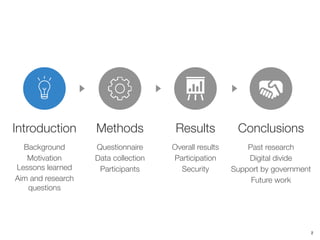
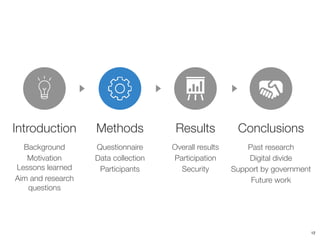
Results
Overall results
Participation
Security
Conclusions
Past research
Digital divide
Support by government
Future work
Introduction
Background
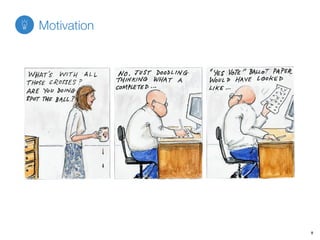
Motivation

Lessons learned
Aim and research
questions
Methods
Questionnaire
Data collection
Participants
2
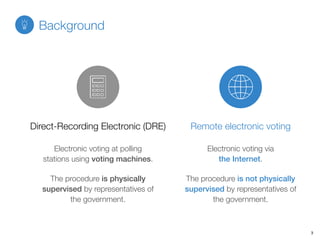
Electronic voting at polling
stations using voting machines.
The procedure is physically
supervised by representatives of
the government.
Direct-Recording Electronic (DRE)
Electronic voting via 

the Internet.
The procedure is not physically
supervised by representatives of
the government.
Remote electronic voting
Background
3
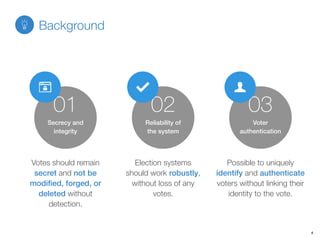
02
Reliability of
the system
Election systems
should work robustly,
without loss of any
votes.
01
Secrecy and
integrity
Votes should remain
secret and not be
modified, forged, or
deleted without 

detection.
03
Voter
authentication
Possible to uniquely
identify and authenticate
voters without linking their
identity to the vote.
Background
4
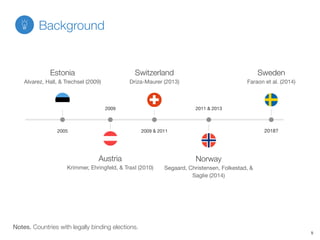
2009
2005
2011 & 2013
2018?
Estonia

Alvarez, Hall, & Trechsel (2009)
Austria

Krimmer, Ehringfeld, & Traxl (2010)
Switzerland

Driza-Maurer (2013)
2009 & 2011
Norway

Segaard, Christensen, Folkestad, &
Saglie (2014)
Sweden

Faraon et al. (2014)
Notes. Countries with legally binding elections.
Background
5
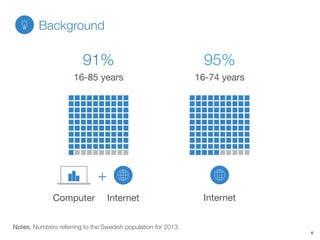
91%
16-85 years
95%
16-74 years
+
Computer Internet Internet
Notes. Numbers referring to the Swedish population for 2013.
Background
6
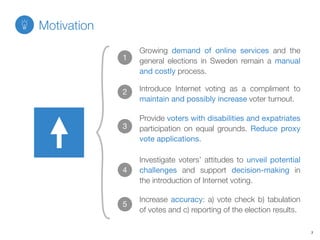
1
Growing demand of online services and the
general elections in Sweden remain a manual
and costly process.
2 Introduce Internet voting as a compliment to
maintain and possibly increase voter turnout.
3
Provide voters with disabilities and expatriates
participation on equal grounds. Reduce proxy
vote applications.
Increase accuracy: a) vote check b) tabulation
of votes and c) reporting of the election results.
5
4
Investigate voters’ attitudes to unveil potential
challenges and support decision-making in
the introduction of Internet voting.
Motivation
7
Motivation
8
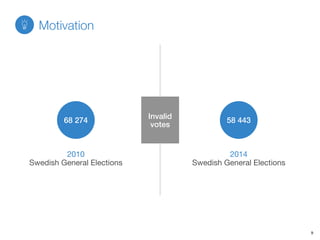
2010

Swedish General Elections
Invalid
votes
58 44368 274
2014

Swedish General Elections
Motivation
9
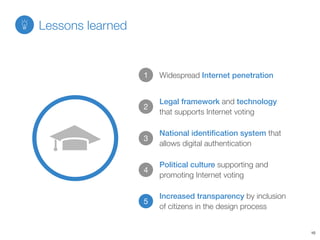
Widespread Internet penetration1
Legal framework and technology
that supports Internet voting
2
National identification system that
allows digital authentication
3
Political culture supporting and
promoting Internet voting
4
Increased transparency by inclusion
of citizens in the design process
5
Lessons learned
10
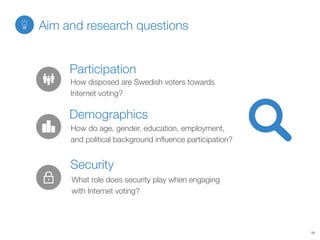
How disposed are Swedish voters towards
Internet voting?
Participation
How do age, gender, education, employment,
and political background influence participation?
Demographics
What role does security play when engaging
with Internet voting?
Security
Aim and research questions
11
Results
Overall results
Participation
Security
Conclusions
Past research
Digital divide
Support by government
Future work
Introduction
Background
Motivation

Lessons learned
Aim and research
questions
Methods
Questionnaire
Data collection
Participants
12
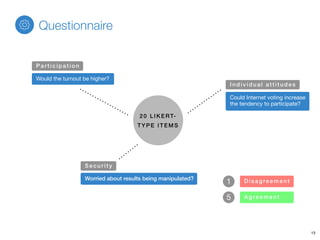
2 0 LIKERT-
T YP E ITEMS
Would the turnout be higher?
Pa rtic ip ati on
Worried about results being manipulated?
Se c urity
Could Internet voting increase
the tendency to participate?
Individual attitudes
1
5
Disagreement
Agreement
Questionnaire
13
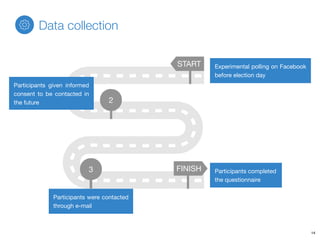
Experimental polling on Facebook
before election day
START
FINISH
2
3
Participants given informed
consent to be contacted in
the future
Participants completed
the questionnaire
Participants were contacted
through e-mail
Data collection
14
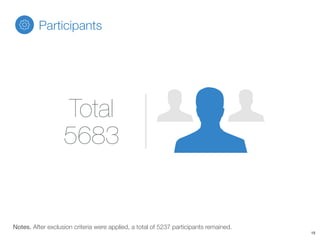
Total
5683
Notes. After exclusion criteria were applied, a total of 5237 participants remained.
Participants
15
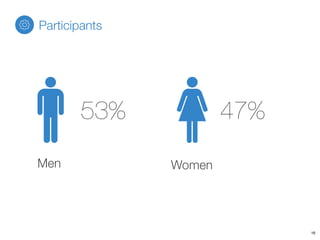
47%
Men
53%
Women
Participants
16
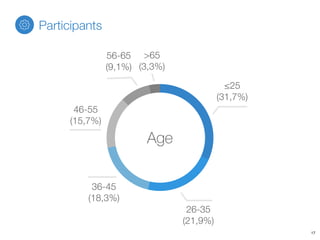
>65
(3,3%)
56-65
(9,1%)
46-55
(15,7%)
36-45
(18,3%)
26-35
(21,9%)
≤25
(31,7%)
Age
Participants
17
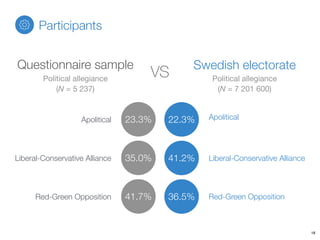
VS
Questionnaire sample
Political allegiance 

(N = 5 237)
Apolitical 23.3%
35.0%
41.7%
Apolitical22.3%
41.2%
36.5%
Liberal-Conservative Alliance Liberal-Conservative Alliance
Red-Green Opposition Red-Green Opposition
Swedish electorate
Participants
Political allegiance 

(N = 7 201 600)
18
Results
Overall results
Participation
Security
Conclusions
Past research
Digital divide
Support by government
Future work
Introduction
Background
Motivation

Lessons learned
Aim and research
questions
Methods
Questionnaire
Data collection
Participants
19
Participation Scale
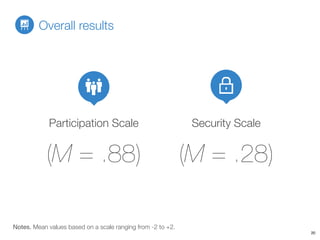
(M = .88) (M = .28)
Overall results
Security Scale
Notes. Mean values based on a scale ranging from -2 to +2.
20
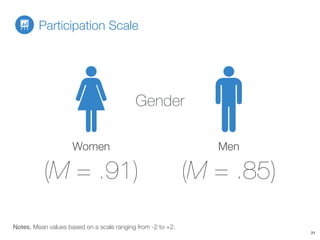
Participation Scale
21
Men
(M = .85)
Women
Notes. Mean values based on a scale ranging from -2 to +2.
(M = .91)
Gender
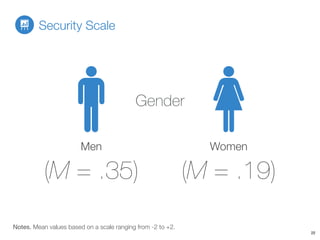
Security Scale
22
Men
(M = .35)
Women
Notes. Mean values based on a scale ranging from -2 to +2.
(M = .19)
Gender
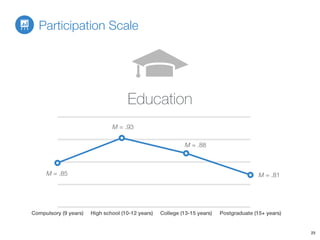
Participation Scale
23
Compulsory (9 years) High school (10-12 years) College (13-15 years) Postgraduate (15+ years)
M = .85
M = .93
M = .88
M = .81
Education
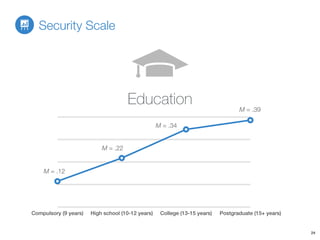
Security Scale
24
Compulsory (9 years) High school (10-12 years) College (13-15 years) Postgraduate (15+ years)
M = .12
M = .22
M = .34
M = .39
Education
Results
Overall results
Participation
Security
Conclusions
Past research
Digital divide
Support by government
Future work
Introduction
Background
Motivation

Lessons learned
Aim and research
questions
Methods
Questionnaire
Data collection
Participants
25
26
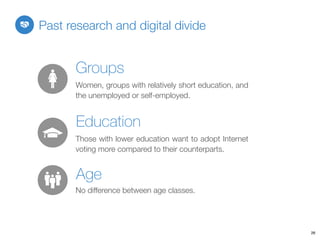
Past research and digital divide
Women, groups with relatively short education, and
the unemployed or self-employed.
Groups
Those with lower education want to adopt Internet
voting more compared to their counterparts.
Education
No difference between age classes.
Age
27
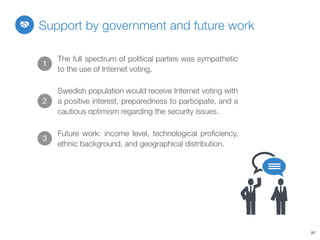
Support by government and future work
1
The full spectrum of political parties was sympathetic
to the use of Internet voting.
2
Future work: income level, technological proficiency,
ethnic background, and geographical distribution.
3
Swedish population would receive Internet voting with
a positive interest, preparedness to participate, and a
cautious optimism regarding the security issues.
E-mail
montathar.faraon@sh.se
Twitter
@constituo linkedin.com/in/constituo/
28
Thank you for your attention!
LinkedIn

Montathar Faraon: Positive but skeptical: A study of attitudes towards Internet voting in Sweden

  • 1.
    Positive but skeptical Astudy of attitudes towards Internet voting in Sweden Montathar Faraon @ Södertörn University CeDEM-Asia International Conference for E-Democracy and Open Government 4-6 December 2014, Hong Kong
  • 2.
    Results Overall results Participation Security Conclusions Past research Digitaldivide Support by government Future work Introduction Background Motivation
 Lessons learned Aim and research questions Methods Questionnaire Data collection Participants 2
  • 3.
    Electronic voting atpolling stations using voting machines. The procedure is physically supervised by representatives of the government. Direct-Recording Electronic (DRE) Electronic voting via 
 the Internet. The procedure is not physically supervised by representatives of the government. Remote electronic voting Background 3
  • 4.
    02 Reliability of the system Electionsystems should work robustly, without loss of any votes. 01 Secrecy and integrity Votes should remain secret and not be modified, forged, or deleted without 
 detection. 03 Voter authentication Possible to uniquely identify and authenticate voters without linking their identity to the vote. Background 4
  • 5.
    2009 2005 2011 & 2013 2018? Estonia
 Alvarez,Hall, & Trechsel (2009) Austria
 Krimmer, Ehringfeld, & Traxl (2010) Switzerland
 Driza-Maurer (2013) 2009 & 2011 Norway
 Segaard, Christensen, Folkestad, & Saglie (2014) Sweden
 Faraon et al. (2014) Notes. Countries with legally binding elections. Background 5
  • 6.
    91% 16-85 years 95% 16-74 years + ComputerInternet Internet Notes. Numbers referring to the Swedish population for 2013. Background 6
  • 7.
    1 Growing demand ofonline services and the general elections in Sweden remain a manual and costly process. 2 Introduce Internet voting as a compliment to maintain and possibly increase voter turnout. 3 Provide voters with disabilities and expatriates participation on equal grounds. Reduce proxy vote applications. Increase accuracy: a) vote check b) tabulation of votes and c) reporting of the election results. 5 4 Investigate voters’ attitudes to unveil potential challenges and support decision-making in the introduction of Internet voting. Motivation 7
  • 8.
  • 9.
    2010
 Swedish General Elections Invalid votes 5844368 274 2014
 Swedish General Elections Motivation 9
  • 10.
    Widespread Internet penetration1 Legalframework and technology that supports Internet voting 2 National identification system that allows digital authentication 3 Political culture supporting and promoting Internet voting 4 Increased transparency by inclusion of citizens in the design process 5 Lessons learned 10
  • 11.
    How disposed areSwedish voters towards Internet voting? Participation How do age, gender, education, employment, and political background influence participation? Demographics What role does security play when engaging with Internet voting? Security Aim and research questions 11
  • 12.
    Results Overall results Participation Security Conclusions Past research Digitaldivide Support by government Future work Introduction Background Motivation
 Lessons learned Aim and research questions Methods Questionnaire Data collection Participants 12
  • 13.
    2 0 LIKERT- TYP E ITEMS Would the turnout be higher? Pa rtic ip ati on Worried about results being manipulated? Se c urity Could Internet voting increase the tendency to participate? Individual attitudes 1 5 Disagreement Agreement Questionnaire 13
  • 14.
    Experimental polling onFacebook before election day START FINISH 2 3 Participants given informed consent to be contacted in the future Participants completed the questionnaire Participants were contacted through e-mail Data collection 14
  • 15.
    Total 5683 Notes. After exclusioncriteria were applied, a total of 5237 participants remained. Participants 15
  • 16.
  • 17.
  • 18.
    VS Questionnaire sample Political allegiance
 (N = 5 237) Apolitical 23.3% 35.0% 41.7% Apolitical22.3% 41.2% 36.5% Liberal-Conservative Alliance Liberal-Conservative Alliance Red-Green Opposition Red-Green Opposition Swedish electorate Participants Political allegiance 
 (N = 7 201 600) 18
  • 19.
    Results Overall results Participation Security Conclusions Past research Digitaldivide Support by government Future work Introduction Background Motivation
 Lessons learned Aim and research questions Methods Questionnaire Data collection Participants 19
  • 20.
    Participation Scale (M =.88) (M = .28) Overall results Security Scale Notes. Mean values based on a scale ranging from -2 to +2. 20
  • 21.
    Participation Scale 21 Men (M =.85) Women Notes. Mean values based on a scale ranging from -2 to +2. (M = .91) Gender
  • 22.
    Security Scale 22 Men (M =.35) Women Notes. Mean values based on a scale ranging from -2 to +2. (M = .19) Gender
  • 23.
    Participation Scale 23 Compulsory (9years) High school (10-12 years) College (13-15 years) Postgraduate (15+ years) M = .85 M = .93 M = .88 M = .81 Education
  • 24.
    Security Scale 24 Compulsory (9years) High school (10-12 years) College (13-15 years) Postgraduate (15+ years) M = .12 M = .22 M = .34 M = .39 Education
  • 25.
    Results Overall results Participation Security Conclusions Past research Digitaldivide Support by government Future work Introduction Background Motivation
 Lessons learned Aim and research questions Methods Questionnaire Data collection Participants 25
  • 26.
    26 Past research anddigital divide Women, groups with relatively short education, and the unemployed or self-employed. Groups Those with lower education want to adopt Internet voting more compared to their counterparts. Education No difference between age classes. Age
  • 27.
    27 Support by governmentand future work 1 The full spectrum of political parties was sympathetic to the use of Internet voting. 2 Future work: income level, technological proficiency, ethnic background, and geographical distribution. 3 Swedish population would receive Internet voting with a positive interest, preparedness to participate, and a cautious optimism regarding the security issues.
  • 28.