I V I G I N F U S I O N
BY:Ankit Khandelwal
P u r p o s e o f t h e p r o g r a m :
• To ensure that Intravenous Immune Globulin (IVIG) is
safely administered to patients for clinically indicated
conditions with a goal to optimize patient outcomes.
T r a n s f u s i o n o f I V I G P r o d u c t s
• Monitor and document pre-transfusion vital signs prior to
transfusion of IVIG. These include temperature, pulse, respiration
rate and blood pressure.
• Complete the compatibility label / tag leaving it attached to the
IVIG product until the transfusion is complete.
• Confirm and document identifying information linking the
recipient and IVIG product immediately prior to IVIG transfusion
in the presence of the recipient.
P h a s e o f I V I G t r a n s f u s i o n :
• Pre – infusion
• Peri infusion
• Post infusion
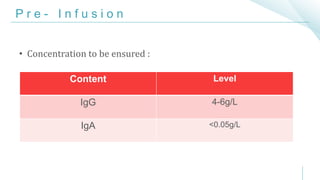
P r e - I n f u s i o n
• Concentration to be ensured :
Content Level
IgG 4-6g/L
IgA <0.05g/L
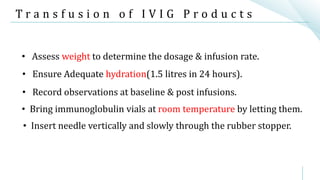
T r a n s f u s i o n o f I V I G P r o d u c t s
• Ensure Adequate hydration(1.5 litres in 24 hours).
• Assess weight to determine the dosage & infusion rate.
• Bring immunoglobulin vials at room temperature by letting them.
• Record observations at baseline & post infusions.
• Insert needle vertically and slowly through the rubber stopper.
P e r i - I n f u s i o n
• Infusion rates should be calculated and prescribed in ml/kg/hr for
PlasmaGlob.
• Rate of Infusion
Mg/kg/min(mg/kg/hr) Ml/kg/min. Time of Administration
1(60) 0.01 After 30 minutes if tolerated increase rate
2(120) 0.02 After 30 minutes if tolerated increase rate
4(240) 0.04 After 30 minutes if tolerated increase rate
8(480) 0.08 After 30 minutes if tolerated increase rate
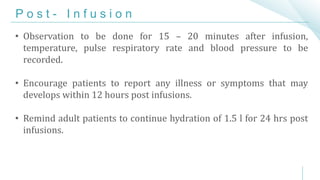
P o s t - I n f u s i o n
• Observation to be done for 15 – 20 minutes after infusion,
temperature, pulse respiratory rate and blood pressure to be
recorded.
• Encourage patients to report any illness or symptoms that may
develops within 12 hours post infusions.
• Remind adult patients to continue hydration of 1.5 l for 24 hrs post
infusions.

IVIG INFUSION

  • 1.
    I V IG I N F U S I O N BY:Ankit Khandelwal
  • 2.
    P u rp o s e o f t h e p r o g r a m : • To ensure that Intravenous Immune Globulin (IVIG) is safely administered to patients for clinically indicated conditions with a goal to optimize patient outcomes.
  • 3.
    T r an s f u s i o n o f I V I G P r o d u c t s • Monitor and document pre-transfusion vital signs prior to transfusion of IVIG. These include temperature, pulse, respiration rate and blood pressure. • Complete the compatibility label / tag leaving it attached to the IVIG product until the transfusion is complete. • Confirm and document identifying information linking the recipient and IVIG product immediately prior to IVIG transfusion in the presence of the recipient.
  • 4.
    P h as e o f I V I G t r a n s f u s i o n : • Pre – infusion • Peri infusion • Post infusion
  • 5.
    P r e- I n f u s i o n • Concentration to be ensured : Content Level IgG 4-6g/L IgA <0.05g/L
  • 6.
    T r an s f u s i o n o f I V I G P r o d u c t s • Ensure Adequate hydration(1.5 litres in 24 hours). • Assess weight to determine the dosage & infusion rate. • Bring immunoglobulin vials at room temperature by letting them. • Record observations at baseline & post infusions. • Insert needle vertically and slowly through the rubber stopper.
  • 7.
    P e ri - I n f u s i o n • Infusion rates should be calculated and prescribed in ml/kg/hr for PlasmaGlob. • Rate of Infusion Mg/kg/min(mg/kg/hr) Ml/kg/min. Time of Administration 1(60) 0.01 After 30 minutes if tolerated increase rate 2(120) 0.02 After 30 minutes if tolerated increase rate 4(240) 0.04 After 30 minutes if tolerated increase rate 8(480) 0.08 After 30 minutes if tolerated increase rate
  • 8.
    P o st - I n f u s i o n • Observation to be done for 15 – 20 minutes after infusion, temperature, pulse respiratory rate and blood pressure to be recorded. • Encourage patients to report any illness or symptoms that may develops within 12 hours post infusions. • Remind adult patients to continue hydration of 1.5 l for 24 hrs post infusions.