1 
Immunoglobulin Replacement Therapy: 
Individualizing a Regimen 
Vincent R. Bonagura MD 
Alexandra and Steven Cohen Children’s Medical Center NY 
Carla Duff, CPNP, MSN, CCRP 
University of South Florida at All Children’s Hospital 
Mary Hintermeyer, MSN, CPNP 
Children’s Hospital of Wisconsin 
Richard L. Wasserman MD. PhD 
Medical City Children’s Hospital 
M. Elizabeth M. Younger CRNP, PhD 
Johns Hopkins University School of Medicine
2 
Disclosures 
• Dr. Bonagura 
– Baxter, consulting, speaking and teaching, advisory committees, investigator receiving honoraria 
– CSL Behring, consulting, speaking and teaching, advisory committees, investigator receiving honoraria 
• Ms. Duff 
– CSL Behring, nurse consultant receiving consulting fee 
– Baxter, advisory board member receiving consulting fee 
– Immune Deficiency Foundation, Vice-Chair Nurse Advisory Committee receiving pro bono 
• Ms. Hintermeyer 
– No disclosures 
• Dr. Wasserman 
– Baxter, consulting, speaking and teaching, advisory committees, investigator receiving honoraria, consulting fee 
– CSL Behring, consulting, speaking and teaching, advisory committees, investigator receiving honoraria, consulting fee principle investigator 
– Investigator/Consultant/– ADMA, BPL, Kedrion, Korean Green Cross 
• Dr. Younger 
– RMS Medical Products, Advisory Board membership receiving consulting fee 
– CSL Behring, independent contractor, consulting, advisory board membership receiving consulting fee, research support 
– Immune Deficiency Foundation, Chair, Nurse Advisory Committee receiving pro bono
3 
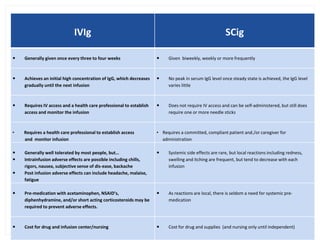
IVIg vs SCIg: Which to Choose? 
Consider: 
• Patient’s wishes 
• Patient co-morbidities 
• Patient’s previous experiences with Ig therapy 
• Clinical outcomes 
• Safety 
• Side effect profile 
• Accessibility/availability 
• Financial considerations 
• Lifestyle considerations
IVIg SCig 
 Generally given once every three to four weeks  Given biweekly, weekly or more frequently 
 Achieves an initial high concentration of IgG, which decreases 
gradually until the next infusion 
 No peak in serum IgG level once steady state is achieved, the IgG level 
varies little 
 Requires IV access and a health care professional to establish 
access and monitor the infusion 
 Does not require IV access and can be self-administered, but still does 
require one or more needle sticks 
• Requires a health care professional to establish access 
and monitor infusion 
• Requires a committed, compliant patient and./or caregiver for 
administration 
 Generally well tolerated by most people, but… 
 Intrainfusion adverse effects are possible including chills, 
rigors, nausea, subjective sense of dis-ease, backache 
 Post infusion adverse effects can include headache, malaise, 
fatigue 
 Systemic side effects are rare, but local reactions including redness, 
swelling and itching are frequent, but tend to decrease with each 
infusion 
 Pre-medication with acetaminophen, NSAID’s, 
diphenhydramine, and/or short acting corticosteroids may be 
required to prevent adverse effects. 
 As reactions are local, there is seldom a need for systemic pre-medication 
 Cost for drug and infusion center/nursing  Cost for drug and supplies (and nursing only until independent)
5 
Dosing Issues 
• Trough/steady state IgG level 
–Should dose be prescribed to achieve a particular level 
• Patients with undetectable levels of IgA 
–Do these patients need a low IgA product? 
–There is no FDA approved low IgA SCIg product; can these 
patients safely receive SCIg? 
• 1:1 versus AUC 
• Starting SCIg in naïve patients 
• Reaction management, side effect prevention
6 
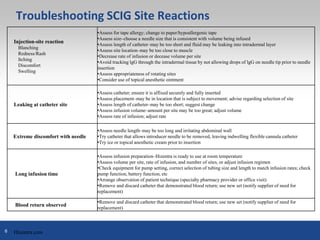
Troubleshooting SCIG Site Reactions 
Injection-site reaction 
Blanching 
Redness/Rash 
Itching 
Discomfort 
Swelling 
•Assess for tape allergy; change to paper/hypoallergenic tape 
•Assess size–choose a needle size that is consistent with volume being infused 
•Assess length of catheter–may be too short and fluid may be leaking into intradermal layer 
•Assess site location–may be too close to muscle 
•Decrease rate of infusion or decease volume per site 
•Avoid tracking lgG through the intradermal tissue by not allowing drops of lgG on needle tip prior to needle 
insertion 
•Assess appropriateness of rotating sites 
•Consider use of topical anesthetic ointment 
Leaking at catheter site 
•Assess catheter; ensure it is affixed securely and fully inserted 
•Assess placement–may be in location that is subject to movement; advise regarding selection of site 
•Assess length of catheter–may be too short; suggest change 
•Assess infusion volume–amount per site may be too great; adjust volume 
•Assess rate of infusion; adjust rate 
Extreme discomfort with needle 
•Assess needle length–may be too long and irritating abdominal wall 
•Try catheter that allows introducer needle to be removed, leaving indwelling flexible cannula catheter 
•Try ice or topical anesthetic cream prior to insertion 
Long infusion time 
•Assess infusion preparation–Hizentra is ready to use at room temperature 
•Assess volume per site, rate of infusion, and number of sites, or adjust infusion regimen 
•Check equipment for pump setting, correct selection of tubing size and length to match infusion rates; check 
pump function, battery function, etc 
•Arrange observation of patient technique (specialty pharmacy provider or office visit) 
•Remove and discard catheter that demonstrated blood return; use new set (notify supplier of need for 
replacement) 
Blood return observed 
•Remove and discard catheter that demonstrated blood return; use new set (notify supplier of need for 
replacement) 
Hizentra.com
7 
Insurance Issues 
• Coverage gaps 
–Manufacturer’s assistance 
–Patient assistance programs 
–Creative prescribing 
• Billing/coding 
–Correct J codes 
–Proactive preauthorization and renewals 
• Deductibles 
–?assistance
8 
Clinical Case History: 1973 
1970 1975 1980 1985 1990 1995 2000 2005 
2.5 year old male 
Presented with temp. 1040 F, RR 35/min, HR 100/min 
Maternal uncle died at 3 years of age of pneumococcal meningitis 
Serum IgG was 35mg/dL, IgM 10 mg/dL, IgA <7 mg/dL 
Blood flow cytometry phenotype showed: 
• 3% CD19+ lymphocytes 
• absolute number of CD19+ lymphocytes = 53/cc
9 
Diagnosis? 
Bruton agammaglobulinemia (XLA) 
– Confirmed by Btk gene sequencing
10 
Treatment and Follow-up 
1970 1975 1980 1985 1990 1995 2000 2005 
IV antibiotics, antipyretics 
24 hrs later, IVIg 300 mg/kg over 4 hrs. given every 4 weeks 
4 weeks after 2nd treatment trough IgG level = 435 mg/dL, 
IgM 28 mg/dL, IgA <7 mg/dL 
Patient well until 6 months later 
Developed acute sinusitis 
and bilateral otitis media 
IgG level 389 mg/dL 
Parents report multiple 
sticks for IV access 
6 Months later
11 
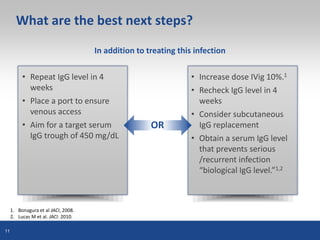
What are the best next steps? 
1. Bonagura et al JACI, 2008. 
2. Lucas M et al. JACI. 2010. 
In addition to treating this infection 
• Repeat IgG level in 4 
weeks 
• Place a port to ensure 
venous access 
• Aim for a target serum 
IgG trough of 450 mg/dL 
• Increase dose IVig 10%.1 
• Recheck IgG level in 4 
weeks 
• Consider subcutaneous 
IgG replacement 
• Obtain a serum IgG level 
that prevents serious 
/recurrent infection 
“biological IgG level.”1,2 
OR
1970 1975 1980 1985 1990 1995 2000 2005 
12 
Increase IVIg dose 10%,1 parents not ready to accept 
SCIg replacement 
3.5 Years old 
IgG level 4 weeks after the increase = 480 mg/dL 
At 3 years of age, patient developed RUL pneumonia and 
has a 1kg wt gain without a change in IgG dose 
IgG trough = 450 mg/dL 
At age 3.5 yrs, parents report that the child has developed anxiety before his IV 
infusions because he requires multiple sticks to gain venous access. His parents 
say he complains of his head hurting for 4 days after his IVIgtreatments 
1. Bonagura et al. JACI. 2008.
13 
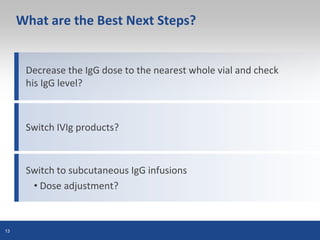
What are the Best Next Steps? 
Decrease the IgG dose to the nearest whole vial and check 
his IgG level? 
Switch IVIg products? 
Switch to subcutaneous IgG infusions 
• Dose adjustment?
1970 1975 1980 1985 1990 1995 2000 2005 
14 
Dose adjustment Upon Switch to SCIg and Modify 
Dose Slowly to Establish the “Biological IgG Level”1* 
4 Years old 
Patient did well until age 4 yrs when he developed “needle phobia” 
Parents request that their son return to IVIg 
IgG serum level on 475 mg/kg/mo = 620 mg/dL 
Clinically stable, no pneumonia or serious infection 
*Biological trough concept is equivalent to adjust dose to clinical response. 
1. Orange et al. Clin Immunol. 2010.
15 
Patient Age 17 
1970 1975 1980 1985 1990 1995 2000 2005 
17 Years old 
Patient has been accepted to college and wants to have more control 
over his treatment 
He requests return to SCIg treatment to facilitate his treatment 
while at college 
Patient returns to SCIg on 160 mg/kg/week
16 
“College Course” 
1970 1975 1980 1985 1990 1995 2000 2005 
Patient has an infection-free first semester and then develops acute sinusitis 
twice and an RUL pneumonia 1 month later during his 2nd semester 
His parents call and say that their son has missed his weekly SCIg 
infusions as frequently as 3 times/month 
Serum IgG level = 380 mg/dL
17 
What are the best next steps? 
In addition to treating this infection 
Encourage changing 
back to monthly IVIg 
to ensure adherence 
at 480 mg/kg/mo? 
Increase the dose 
of IgG given SC 10% 
over this patient’s 
biological IgG level 
of 480 mg/kg/mo 
divided by 4 and 
given weekly? 
OR
18 
Encourage Change Back to IGIV Infusions 
1970 1975 1980 1985 1990 1995 2000 2005 
30 Years old 
Patient finishes college and at age 30, no serious infections, but he complains 
of severe post infusion headaches on and off, chills, and on occasion, fever 
A routine urinalysis the day after infusion shows proteinuria with white cells; 
cultures are negative
19 
What is the Best Next Step? 
Consider 
returning 
to SCIg 
infusions at 
the same IgG 
dose/month? 
OR 
Reduce IgG dose 
given IV by 10% 
and check IgG 
level 4 weeks 
later? 
Change the IVIg 
product? 
Pretreat IVIg 
infusions with 
steroids and 
antihistamine?
20 
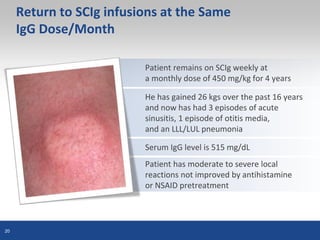
Return to SCIg infusions at the Same 
IgG Dose/Month 
Patient remains on SCIg weekly at 
a monthly dose of 450 mg/kg for 4 years 
He has gained 26 kgs over the past 16 years 
and now has had 3 episodes of acute 
sinusitis, 1 episode of otitis media, 
and an LLL/LUL pneumonia 
Serum IgG level is 515 mg/dL 
Patient has moderate to severe local 
reactions not improved by antihistamine 
or NSAID pretreatment
21 
What is the Best Next Step? 
Change from 9 mm to 12 mm 
softset infusion sets? 
Pretreat with antihistamine? 
Increase the dose of IgG replacement to 
480 mg/kg/mo given as 120 mg/kg/week? 
Discuss changing SCIg product? 
Discuss returning to IVIg replacement?
22 
All of the Above!  
Patient doesn’t want to return to IVIg infusions as he travels 
a lot and needs the flexibility that SC infusion provides. 
Pretreatment with a non-sedating antihistamine and lengthening 
the SC needle depth markedly reduces his local reactions. 
The patient is married and has a young daughter who has had 2 
episodes of otitis media and sinusitis.
23 
What are the Best Next Steps? 
Continue to periodically monitor the father’s IgG level. 
Counsel the parents that all males born to them will be normal, 
but females born to them have a 50% chance of being XLA carriers. 
Check the daughter’s IgG, IgM, and IgA levels.
24 
More Cases for Consideration 
• 15 yr old male with CVID, on IVIg for several years. 
Recent problems with persistent headaches post 
infusion 
• 34 yr old male with newly diagnosed CVID with very 
low IG levels; 
–History of multiple severe infections 
–No insurance 
–Rural residence 
• 42 yr old female, CVID, on SCIg several years 
–Recent development persistent erythema, lumps at SCIG 
sites

Immunoglobulin Replacement Therapy: Individualizing a Regimen

  • 1.
    1 Immunoglobulin ReplacementTherapy: Individualizing a Regimen Vincent R. Bonagura MD Alexandra and Steven Cohen Children’s Medical Center NY Carla Duff, CPNP, MSN, CCRP University of South Florida at All Children’s Hospital Mary Hintermeyer, MSN, CPNP Children’s Hospital of Wisconsin Richard L. Wasserman MD. PhD Medical City Children’s Hospital M. Elizabeth M. Younger CRNP, PhD Johns Hopkins University School of Medicine
  • 2.
    2 Disclosures •Dr. Bonagura – Baxter, consulting, speaking and teaching, advisory committees, investigator receiving honoraria – CSL Behring, consulting, speaking and teaching, advisory committees, investigator receiving honoraria • Ms. Duff – CSL Behring, nurse consultant receiving consulting fee – Baxter, advisory board member receiving consulting fee – Immune Deficiency Foundation, Vice-Chair Nurse Advisory Committee receiving pro bono • Ms. Hintermeyer – No disclosures • Dr. Wasserman – Baxter, consulting, speaking and teaching, advisory committees, investigator receiving honoraria, consulting fee – CSL Behring, consulting, speaking and teaching, advisory committees, investigator receiving honoraria, consulting fee principle investigator – Investigator/Consultant/– ADMA, BPL, Kedrion, Korean Green Cross • Dr. Younger – RMS Medical Products, Advisory Board membership receiving consulting fee – CSL Behring, independent contractor, consulting, advisory board membership receiving consulting fee, research support – Immune Deficiency Foundation, Chair, Nurse Advisory Committee receiving pro bono
  • 3.
    3 IVIg vsSCIg: Which to Choose? Consider: • Patient’s wishes • Patient co-morbidities • Patient’s previous experiences with Ig therapy • Clinical outcomes • Safety • Side effect profile • Accessibility/availability • Financial considerations • Lifestyle considerations
  • 4.
    IVIg SCig Generally given once every three to four weeks  Given biweekly, weekly or more frequently  Achieves an initial high concentration of IgG, which decreases gradually until the next infusion  No peak in serum IgG level once steady state is achieved, the IgG level varies little  Requires IV access and a health care professional to establish access and monitor the infusion  Does not require IV access and can be self-administered, but still does require one or more needle sticks • Requires a health care professional to establish access and monitor infusion • Requires a committed, compliant patient and./or caregiver for administration  Generally well tolerated by most people, but…  Intrainfusion adverse effects are possible including chills, rigors, nausea, subjective sense of dis-ease, backache  Post infusion adverse effects can include headache, malaise, fatigue  Systemic side effects are rare, but local reactions including redness, swelling and itching are frequent, but tend to decrease with each infusion  Pre-medication with acetaminophen, NSAID’s, diphenhydramine, and/or short acting corticosteroids may be required to prevent adverse effects.  As reactions are local, there is seldom a need for systemic pre-medication  Cost for drug and infusion center/nursing  Cost for drug and supplies (and nursing only until independent)
  • 5.
    5 Dosing Issues • Trough/steady state IgG level –Should dose be prescribed to achieve a particular level • Patients with undetectable levels of IgA –Do these patients need a low IgA product? –There is no FDA approved low IgA SCIg product; can these patients safely receive SCIg? • 1:1 versus AUC • Starting SCIg in naïve patients • Reaction management, side effect prevention
  • 6.
    6 Troubleshooting SCIGSite Reactions Injection-site reaction Blanching Redness/Rash Itching Discomfort Swelling •Assess for tape allergy; change to paper/hypoallergenic tape •Assess size–choose a needle size that is consistent with volume being infused •Assess length of catheter–may be too short and fluid may be leaking into intradermal layer •Assess site location–may be too close to muscle •Decrease rate of infusion or decease volume per site •Avoid tracking lgG through the intradermal tissue by not allowing drops of lgG on needle tip prior to needle insertion •Assess appropriateness of rotating sites •Consider use of topical anesthetic ointment Leaking at catheter site •Assess catheter; ensure it is affixed securely and fully inserted •Assess placement–may be in location that is subject to movement; advise regarding selection of site •Assess length of catheter–may be too short; suggest change •Assess infusion volume–amount per site may be too great; adjust volume •Assess rate of infusion; adjust rate Extreme discomfort with needle •Assess needle length–may be too long and irritating abdominal wall •Try catheter that allows introducer needle to be removed, leaving indwelling flexible cannula catheter •Try ice or topical anesthetic cream prior to insertion Long infusion time •Assess infusion preparation–Hizentra is ready to use at room temperature •Assess volume per site, rate of infusion, and number of sites, or adjust infusion regimen •Check equipment for pump setting, correct selection of tubing size and length to match infusion rates; check pump function, battery function, etc •Arrange observation of patient technique (specialty pharmacy provider or office visit) •Remove and discard catheter that demonstrated blood return; use new set (notify supplier of need for replacement) Blood return observed •Remove and discard catheter that demonstrated blood return; use new set (notify supplier of need for replacement) Hizentra.com
  • 7.
    7 Insurance Issues • Coverage gaps –Manufacturer’s assistance –Patient assistance programs –Creative prescribing • Billing/coding –Correct J codes –Proactive preauthorization and renewals • Deductibles –?assistance
  • 8.
    8 Clinical CaseHistory: 1973 1970 1975 1980 1985 1990 1995 2000 2005 2.5 year old male Presented with temp. 1040 F, RR 35/min, HR 100/min Maternal uncle died at 3 years of age of pneumococcal meningitis Serum IgG was 35mg/dL, IgM 10 mg/dL, IgA <7 mg/dL Blood flow cytometry phenotype showed: • 3% CD19+ lymphocytes • absolute number of CD19+ lymphocytes = 53/cc
  • 9.
    9 Diagnosis? Brutonagammaglobulinemia (XLA) – Confirmed by Btk gene sequencing
  • 10.
    10 Treatment andFollow-up 1970 1975 1980 1985 1990 1995 2000 2005 IV antibiotics, antipyretics 24 hrs later, IVIg 300 mg/kg over 4 hrs. given every 4 weeks 4 weeks after 2nd treatment trough IgG level = 435 mg/dL, IgM 28 mg/dL, IgA <7 mg/dL Patient well until 6 months later Developed acute sinusitis and bilateral otitis media IgG level 389 mg/dL Parents report multiple sticks for IV access 6 Months later
  • 11.
    11 What arethe best next steps? 1. Bonagura et al JACI, 2008. 2. Lucas M et al. JACI. 2010. In addition to treating this infection • Repeat IgG level in 4 weeks • Place a port to ensure venous access • Aim for a target serum IgG trough of 450 mg/dL • Increase dose IVig 10%.1 • Recheck IgG level in 4 weeks • Consider subcutaneous IgG replacement • Obtain a serum IgG level that prevents serious /recurrent infection “biological IgG level.”1,2 OR
  • 12.
    1970 1975 19801985 1990 1995 2000 2005 12 Increase IVIg dose 10%,1 parents not ready to accept SCIg replacement 3.5 Years old IgG level 4 weeks after the increase = 480 mg/dL At 3 years of age, patient developed RUL pneumonia and has a 1kg wt gain without a change in IgG dose IgG trough = 450 mg/dL At age 3.5 yrs, parents report that the child has developed anxiety before his IV infusions because he requires multiple sticks to gain venous access. His parents say he complains of his head hurting for 4 days after his IVIgtreatments 1. Bonagura et al. JACI. 2008.
  • 13.
    13 What arethe Best Next Steps? Decrease the IgG dose to the nearest whole vial and check his IgG level? Switch IVIg products? Switch to subcutaneous IgG infusions • Dose adjustment?
  • 14.
    1970 1975 19801985 1990 1995 2000 2005 14 Dose adjustment Upon Switch to SCIg and Modify Dose Slowly to Establish the “Biological IgG Level”1* 4 Years old Patient did well until age 4 yrs when he developed “needle phobia” Parents request that their son return to IVIg IgG serum level on 475 mg/kg/mo = 620 mg/dL Clinically stable, no pneumonia or serious infection *Biological trough concept is equivalent to adjust dose to clinical response. 1. Orange et al. Clin Immunol. 2010.
  • 15.
    15 Patient Age17 1970 1975 1980 1985 1990 1995 2000 2005 17 Years old Patient has been accepted to college and wants to have more control over his treatment He requests return to SCIg treatment to facilitate his treatment while at college Patient returns to SCIg on 160 mg/kg/week
  • 16.
    16 “College Course” 1970 1975 1980 1985 1990 1995 2000 2005 Patient has an infection-free first semester and then develops acute sinusitis twice and an RUL pneumonia 1 month later during his 2nd semester His parents call and say that their son has missed his weekly SCIg infusions as frequently as 3 times/month Serum IgG level = 380 mg/dL
  • 17.
    17 What arethe best next steps? In addition to treating this infection Encourage changing back to monthly IVIg to ensure adherence at 480 mg/kg/mo? Increase the dose of IgG given SC 10% over this patient’s biological IgG level of 480 mg/kg/mo divided by 4 and given weekly? OR
  • 18.
    18 Encourage ChangeBack to IGIV Infusions 1970 1975 1980 1985 1990 1995 2000 2005 30 Years old Patient finishes college and at age 30, no serious infections, but he complains of severe post infusion headaches on and off, chills, and on occasion, fever A routine urinalysis the day after infusion shows proteinuria with white cells; cultures are negative
  • 19.
    19 What isthe Best Next Step? Consider returning to SCIg infusions at the same IgG dose/month? OR Reduce IgG dose given IV by 10% and check IgG level 4 weeks later? Change the IVIg product? Pretreat IVIg infusions with steroids and antihistamine?
  • 20.
    20 Return toSCIg infusions at the Same IgG Dose/Month Patient remains on SCIg weekly at a monthly dose of 450 mg/kg for 4 years He has gained 26 kgs over the past 16 years and now has had 3 episodes of acute sinusitis, 1 episode of otitis media, and an LLL/LUL pneumonia Serum IgG level is 515 mg/dL Patient has moderate to severe local reactions not improved by antihistamine or NSAID pretreatment
  • 21.
    21 What isthe Best Next Step? Change from 9 mm to 12 mm softset infusion sets? Pretreat with antihistamine? Increase the dose of IgG replacement to 480 mg/kg/mo given as 120 mg/kg/week? Discuss changing SCIg product? Discuss returning to IVIg replacement?
  • 22.
    22 All ofthe Above!  Patient doesn’t want to return to IVIg infusions as he travels a lot and needs the flexibility that SC infusion provides. Pretreatment with a non-sedating antihistamine and lengthening the SC needle depth markedly reduces his local reactions. The patient is married and has a young daughter who has had 2 episodes of otitis media and sinusitis.
  • 23.
    23 What arethe Best Next Steps? Continue to periodically monitor the father’s IgG level. Counsel the parents that all males born to them will be normal, but females born to them have a 50% chance of being XLA carriers. Check the daughter’s IgG, IgM, and IgA levels.
  • 24.
    24 More Casesfor Consideration • 15 yr old male with CVID, on IVIg for several years. Recent problems with persistent headaches post infusion • 34 yr old male with newly diagnosed CVID with very low IG levels; –History of multiple severe infections –No insurance –Rural residence • 42 yr old female, CVID, on SCIg several years –Recent development persistent erythema, lumps at SCIG sites