G.Sujatha, N. Dhivya, K. Ayyadurai, D.Thyagarajan / International Journal of Engineering
            Research and Applications (IJERA) ISSN: 2248-9622 www.ijera.com
                        Vol. 2, Issue4, July-August 2012, pp.1541-1546
                   Advances In Electronic - Nose Technologies
             * G.Sujatha1, N. Dhivya2, K. Ayyadurai3 and D.Thyagarajan4
       1
     Assistant Professor (Electrical Engineering), College of Food and Dairy Technology, Koduvalli, Chennai-52.
   2
    PG Student (M.Tech, Food Technology), College of Food and Dairy echnology,Koduvalli,Chennai-52.
     3
       Retd. Professor and Head, Department of Veterinary Biochemistry, Madras Veterinary College, Chennai 7
          4
            Dean, Faculty of Food Sciences, College of Food and Dairy Technology, Koduvalli, Chennai-52.


ABSTRACT:
          Food quality analysis is one among the most      array of electronic chemical sensors with partial
important, complex and challenging discipline in the       specificity and appropriate pattern recognition
food sector. Due to its strict interaction with the        system, capable of recognizing simple or complex
quality of life it is extremely important to improve       odors”.
the performances of the methods in the field of food
quality analysis. Now a days electronic noses have         2. HISTORICAL   MILESTONES                         IN
provided a plethora of benefits to a variety of            DEVELOPMENT OF E- nose
commercial industries, including the agricultural,                   The first real tool for measuring aromas was
biomedical,     cosmetics,    environmental,    food,      developed by Hartman in 1954. The sensing element
manufacturing, military, pharmaceutical, regulatory,       was a microelectrode, a simple platinum wire of 0.8
and various scientific research fields using mainly        mm in diameter, which measured the flow of current
metal oxide(MOS), metal oxide field effect                 by a sensitive milli voltmeter. Metal oxide
transistor(MOSFET), acoustic (bulk (BAW) and               semiconductor gas sensors (MOS) were first used
surface (SAW) wave) and polymer sensor. These              commercially. In 1960‟s MOS were used as
sensors has unique advantage of providing fast results     household gas alarms in Japan under the names of
by identifying, characterizing and quantifying the         Taguchi or Figaro. Moncrieff (1961) worked on the
target analytes of interests present in the flavor         concept that different coatings materials, such as
emitted by foods without destructing them. All these       polyvinyl chloride, gelatin, and vegetable fats could
sensors are highly sensitive and inexpensive.              be capable of providing different and complementary
However, these sensors face a numerous problems            data for the discrimination of simple and complex
during operations in different aspects. Among the          aromas. His studies were limited to the use of a single
four sensors, polymer based on nano material may           temperature-sensitive resistor, but postulated that an
overcome the problems encountered by the                   array with six thermistors, provided with six different
environment including the temperature and humidity.        coatings, could discriminate large numbers of
                                                           different aromas. The principle of BAW sensors was
Key Words: E-nose, metal oxide, acoustic and               introduced by King in 1964 with his Piezoelectric
polymer sensors, gas sensor, aroma detection.              Sorption Detector. Buck et al. (1965) studied the
                                                           modulation of conductivity as an answer to
1. INTRODUCTION                                            differentiating aromas bouquets, while Dravnieks and
         Now, many of the food industries are              Trotter (1965) used the modulation of contact
looking forward for the non destructive food quality       potential to monitor aromas. These studies have been
analysis techniques. The emerging non destructive          considered as a first approach to aromas evaluation
food quality analysis techniques are capable of            because of the lack of analytical instruments. The
evaluating the finished products quality by analyzing      hydrogen sensitive PdMOS (palladium metal oxide
their sensory outputs which may be in the form of          semiconductor) device was developed in 1973 by a
flavor, odor, color, texture and taste. Electronic Nose    group of Swedish researchers (Lundström et al.,
(E - nose) seems to be a new electronic device which       1975, 1990 and 1993). The first gas sensor based on a
can report on the finished products quality by             SAW oscillator was introduced by Wohltjen and
analyzing the head space gas which is generally            Dessy (1979). Conducting organic polymer (CP)
composed of the volatile organic chemicals that            sensors have been under development for
contributes to the typical flavor for the different food   approximately 10 years (Hodgins, 1997) since
materials.                                                 1990‟s. CP sensors rely on changes of resistance by
          The term “electronic nose” was coined in         the adsorption of gas.
1988 by Gardner and Bartlett, (1994) who later
defined it as “an instrument which comprises an


                                                                                                 1541 | P a g e
G.Sujatha, N. Dhivya, K. Ayyadurai, D.Thyagarajan / International Journal of Engineering
              Research and Applications (IJERA) ISSN: 2248-9622 www.ijera.com
                          Vol. 2, Issue4, July-August 2012, pp.1541-1546
Table: 1 Sensor Types, sensitivity and their detection principle
S.No       Sensor Type                                           Sensitive Material     Detection Principle


1          Metal Oxides Semi-conducting                        Doped            semi-   Resistance change
           (MOS, Taguchi)                                      conducting       metal
                                                               oxides (SnO2, GaO)
2          Metal Oxide Semiconductor field-effect sensors      Catalytic metals         Electric field change
           (MOSFET)
3          Conducting polymer sensors                          Modified Conducting      Resistance change
                                                               Polymers
4          Acoustic sensors: Surface and                       Organic or inorganic     Mass change (frequency
           Bulk acoustic wave (SAW and, BAW)                   film layers              shift)


3. BIOLOGICAL AND ARTIFICIAL                                         The E - nose often consists of non-selective
    OLFACTION                                              sensors that interact with volatile molecules that
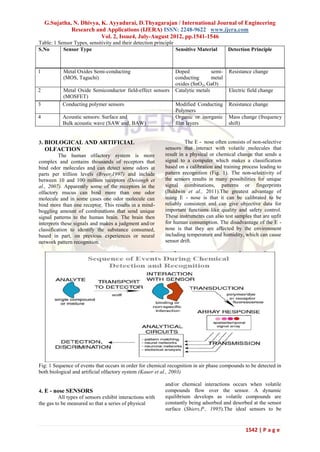
          The human olfactory system is more               result in a physical or chemical change that sends a
complex and contains thousands of receptors that           signal to a computer which makes a classification
bind odor molecules and can detect some odors at           based on a calibration and training process leading to
parts per trillion levels (Breer,1997) and include         pattern recognition (Fig. 1). The non-selectivity of
between 10 and 100 million receptors (Deisingh et          the sensors results in many possibilities for unique
al., 2007). Apparently some of the receptors in the        signal combinations, patterns or fingerprints
olfactory mucus can bind more than one odor                (Baldwin et al., 2011).The greatest advantage of
molecule and in some cases one odor molecule can           using E - nose is that it can be calibrated to be
bind more than one receptor. This results in a mind-       reliably consistent and can give objective data for
boggling amount of combinations that send unique           important functions like quality and safety control.
signal patterns to the human brain. The brain then         These instruments can also test samples that are unfit
interprets these signals and makes a judgment and/or       for human consumption. The disadvantage of the E -
classification to identify the substance consumed,         nose is that they are affected by the environment
based in part, on previous experiences or neural           including temperature and humidity, which can cause
network pattern recognition.                               sensor drift.


Fig: 1 Sequence of events that occurs in order for chemical recognition in air phase compounds to be detected in
both biological and artificial olfactory system (Kauer et al., 2003)

                                                           and/or chemical interactions occurs when volatile
4. E - nose SENSORS                                        compounds flow over the sensor. A dynamic
          All types of sensors exhibit interactions with   equilibrium develops as volatile compounds are
the gas to be measured so that a series of physical        constantly being adsorbed and desorbed at the sensor
                                                           surface (Shiers,P., 1995).The ideal sensors to be


                                                                                                1542 | P a g e
G.Sujatha, N. Dhivya, K. Ayyadurai, D.Thyagarajan / International Journal of Engineering
            Research and Applications (IJERA) ISSN: 2248-9622 www.ijera.com
                        Vol. 2, Issue4, July-August 2012, pp.1541-1546
integrated in an electronic nose should fulfill the        metal film. To shift the selectivity of a metal oxide
following criteria (Demarne, et al. 1992, Mari and         film towards different chemical compounds the film
Barbi 1992, Bartlett, et al. 1993, Hodgins,1995 and        is doped with noble catalytic metals (e.g. platinum or
1997): high sensitivity towards chemical compounds;        palladium), or the working temperature is changed
low sensitivity towards humidity and temperature;          within the range of 50–400°C. Although the
selectivity to respond to different compounds present      selectivity is also greatly influenced by the particle
in the headspace of the sample; high stability; high       size of the polycrystalline semiconductor, the MOS
reproducibility and reliability; short reaction and        sensors are usually less selective than other
recovery time; durable; easy calibration; easy to          technologies such as CP, BAW, SAW or MOSFET.
process data output. Various kinds of gas sensors are      However MOS sensors are extremely sensitive to
available, but only four technologies are currently        ethanol (Mielle, 1996 and Wünsche et al, 1995).
used in commercialized electronic noses: metal oxide
semiconductors (MOS); metal oxide semiconductor            4.2Metal       oxide    semiconductor       field-effect
field effect transistors (MOSFET); conducting              transistor sensors (MOSFET)
organic polymers (CP); piezoelectric crystals (bulk                  A MOSFET sensor comprises three layers, a
acoustic wave = BAW). Others such as fibre optics          silicon semiconductor, a silicon oxide insulator and a
(Dickinson, et al.1996, Nakagawa, et al.1997,              catalytic metal (usually palladium, platinum, iridium
Eguchi, 1992 and Sutter and Jurs 1997),                    or rhodium), also called the gate. A normal transistor
electrochemical (Mari, and Barbi 1992 and                  operates by means of three contacts, two allow the
Baltruschat, et al.1997) are still in the developmental    current in (source) and out (drain), and the third acts
stage and may be integrated in the next generation of      as the gate contact that regulates the current through
E - Noses. Such sensors can be divided into two main       the transistor. In the MOSFET transistor, the gate and
classes: hot (MOS, MOSFET) and cold (CP, SAW,              drain contacts are shortcut, giving a diode mode
BAW). The former operate at high temperatures and          transistor with convenient electronics for operation,
are considered to be less sensitive to moisture with       characterized by an IV-curve. The applied voltage on
less carryover from one measurement to another.            the gate and drain contact creates an electric field,
Therefore, they should offer the best ratio of drift and   which influences the conductivity of the transistor.
lifetime to sensitivity (Shiers, 1995).                    When polar compounds interact with this metal gate,
                                                           the electric field, and thus the current flowing
4.1Metal oxide semiconductor sensors (MOS)                 through the sensor, is modified. The recorded
          The metal oxide coating may be either of the     response corresponds to the change of voltage
n-type (mainly zinc oxide, tin dioxide, titanium           necessary to keep a constant preset drain current
dioxide or iron (III) oxide) which responds to             (Lundström et al., 1992 and 1993). The metal oxide
oxidizing compounds, or of the p-type (mainly nickel       semi- conductor field-effect transistor (MOSFET)
oxide or cobalt oxide) which responds to reducing          sensors rely on a change of electrostatic potential.
compounds (Mielle, 1996, Huheey, 1983 and                            As in the coating of MOS sensors, the gate
Greenwood       and    Earnshaw      1988).    N-type      structure of a MOSFET sensor is either a thick, dense
semiconductors increase the reactivity with oxidizing      metal film (100–200 nm) or a thin, porous metal film
molecules whereas excited p-type promotes reactions        (6–20 nm). The thick, continuous metal gate responds
with reducing compounds (Huheey, 1983 and                  almost exclusively to molecules that dissociate
Greenwood and Earnshaw 1988).                              hydrogen on the catalytic metal surface. It is
          The film deposition technique further            implicitly assumed that the insulator is not exposed to
divides each sensor type into thin (6–1000 nm) or          the ambient molecules. The dissociated hydrogen
thick (10–300 µm) film MOS sensors. Film                   atoms diffuse within microseconds through the metal
deposition includes physical or chemical vapour            causing a dipole layer at the metal–insulator
deposition, evaporation, or spraying for thin films,       interface, leading to a potential change in the
and screen printing or painting for thick films            transistor. Detection of molecules such as ammonia
(Demarne and Sanjines 1992). The thin film devices         or carbon monoxide is not possible with such a layer
offer a faster response and significantly higher           since no hydrogen atoms are released (Spetz et al.,
sensitivities, but are much more difficult to              1992). However, it transpired that the latter
manufacture in terms of reproducibility. Therefore,        compounds respond well when the metal gate is
commercially available MOS sensors are often based         thinned. The selectivity and sensitivity of MOSFET
on thick film technologies. Due to the high operating      sensors may be influenced by the operating
temperature (typically 200–650°C), the organic             temperature (50–200°C), the composition of the
volatiles transferred to the sensors are totally           metal gate, and the microstructure of the catalytic
combusted to carbon dioxide and water on the               metal (Lundström et al, 1975 and 1993). MOSFET
surface of the metal oxide, leading to a change in the     sensors, like MOS sensors, have a relatively low
resistance (Wünsche et al., 1995).                         sensitivity to moisture and are thought to be very
          The mechanism is based on an oxygen              robust. However, high levels of manufacturing
exchange between the volatile molecules and the


                                                                                                 1543 | P a g e
G.Sujatha, N. Dhivya, K. Ayyadurai, D.Thyagarajan / International Journal of Engineering
            Research and Applications (IJERA) ISSN: 2248-9622 www.ijera.com
                        Vol. 2, Issue4, July-August 2012, pp.1541-1546
expertise are necessary to achieve good quality and          as chromatographic stationary phases, lipids or any
reproducibility. (Schaller et al.,1998).                     non-volatile compounds that are chemically and
                                                             thermally stable (Guilbault and Jordanel, 1988,
4.3 Conducting organic polymer sensors (CP                   Nieuwenhuizen and Nederlof, 1992, Holmberg ,
Sensors)                                                     1997).
          Conducting organic polymer (CP) sensors                      When an alternating electrical potential is
are like MOS sensors, rely on changes of resistance          applied at room temperature, the crystal vibrates at a
by the adsorption of gas. These sensors comprise a           very stable frequency, defined by its mechanical
substrate (e.g. fibre-glass or silicon), a pair of gold-     properties. Upon exposure to a vapour, the coating
plated electrodes, and a conducting organic polymer          adsorbs certain molecules, which increases the mass
such as polypyrrole, polyaniline or polythiophene as         of the sensing layer and hence decreases the
a sensing element. The polymer film is deposed by            resonance frequency of the crystal. This change may
electrochemical deposition between both electrodes           be monitored and related to the volatile present
previously fixed to the substrate (Mielle, 1996 and          (Hodgins, 1997). The crystals may be made to vibrate
Amrani et al., 1995).                                        in a bulk acoustic wave (BAW) or in a surface
          As the conducting polymer is grown out of a        acoustic wave (SAW) mode by selecting the
solution, the deposited film contains cation sites           appropriate combination of crystal cut and type of
balanced by anions from the electrolyte and the              electrode configuration (Wünsche et al, 1995).
solvent residue (Wünsche et al., 1995 and Hodgins et                   BAW and SAW sensors differ in their
al., 1995 and 1997).The cation sites probably consist        structure. BAW are 3-dimensional waves travelling
of polar ions or bipolar ions which are small regions        through the crystal, while SAW are 2-dimensional
of positive charge in the polymer chain providing            waves that propagate along the surface of the crystal
mobile holes for electron transport.                         at a depth of approximately one wavelength
          When a voltage is passed across the                (Nieuwenhuizen et al, 1992 and Holmberg , 1997).
electrodes, a current passes through the conducting          These devices are also called „quartz crystal micro-
polymer. The addition of volatile compounds to the           balance‟ (QCM or QMB) because, similar to a
surface alters the electron flow in the system and           balance, their responses change in proportion to the
therefore the resistance of the sensor (Shiers, 1995).       amount of mass adsorbed. BAW sensors vibrate with
The volatiles may interact at least with (i) the             a frequency of 10–30 M Hz. Their thin coating (1
polymer itself, (ii) the counter ion, or (iii) the solvent   µm–10 nm) is deposited by spin coating, airbrushing
(Hodgins, 1997). Therefore, good selectivity in the          or inkjet printing (Wünsche et al., 1995, Mielle, 1996,
CP sensors may be achieved by altering one of these          and Holmberg, 1997).
parameters or the electrical growth of the polymer                     The manufacturing technique includes
coating.                                                     photolithography and airbrushing, and is fully
           In general, these sensors show good               compatible with planar integrated circuits,
sensitivities, especially for polar compounds.               fabrication, especially planar silicon technology. This
However, their low operating temperature (< 50°C)            enables SAW structures and conditioning circuits to
makes them extremely sensitive to moisture (Shiers,          be incorporated on the same silicon substrate,
1995). Although such sensors are resistant to                resulting in robust and inexpensive SAW sensors
poisoning (Zannoni, 1995), they have a lifetime of           (Caliendo et al., 1992).
only about 9–18 months. This short life may be due                     Since piezoelectric sensors may be coated
to the oxidation of the polymer, or to exposure of the       with an unlimited number of materials, they present
sensor to different chemicals that may develop               the best selectivity (Mielle, 1996 and Hodgins, 1997).
contact resistances between the polymer and the              However, the coating technology is not yet well
electrodes. Unlike MOS sensors, the CP sensors are           controlled, which induces poor batch- to-batch
not yet widely marketed, and laboratory-scale                reproducibility (Mielle, 1996 and Wünsche et al,
manufacturing renders them expensive. The difficulty         1995). SAW sensors, though limited by the noise
of producing good batch- to-batch reproducibility and        caused by their high operating frequency, are more
a pronounced drift of the response are their main            sensitive than BAW sensors. However, both sensors
disadvantages (Mielle, 1996)                                 require a higher concentration of volatiles to elicit
                                                             response levels comparable to other sensor types
4.4 Acoustic sensors                                         (Mielle, 1996 and Hodgins, 1997). The difficulty of
         Piezoelectric sensors are based on a change         integrating BAW and SAW sensors into an electronic
of mass, which may be measured as a change in                nose resides in the more complex electronics and
resonance frequency. These sensors are made of tiny          their high sensitivity to disturbances such as
discs, usually quartz, lithium niobate (LiNbO3) or           temperature and humidity fluctuations (Mielle, 1996
lithium tantalite (LiTaO3), coated with materials such       and Wünsche et al., 1995).


                                                                                                   1544 | P a g e
G.Sujatha, N. Dhivya, K. Ayyadurai, D.Thyagarajan / International Journal of Engineering
                Research and Applications (IJERA) ISSN: 2248-9622 www.ijera.com
                            Vol. 2, Issue4, July-August 2012, pp.1541-1546
  Table: 2 Summary of advantages of Electronic Nose Sensor Type
S.No     Sensor Type                  Advantages                                     Disadvantage
1        Metal oxides semi-           Very high sensitivity, limited                 High temperature operation, high
         conducting (MOS)             sensing range and rapid response.              power consumption, sulfur and
                                                                                     weak acid poisoning.
2          Metal   oxide  field-effect     Small sensor size and inexpensive         Requires environmental control,
           Sensors (MOSFET)                operating costs                           baseline drift and low sensitivity
                                                                                     to ammonia and carbon dioxide.

3          Conducting polymer              Ambient temperature operation,            Sensitive to humidity and
           Sensors(CP)                     sensitive to many volatile organic        temperature and sensor life is
                                           compounds, short response time,           limited.
                                           inexpensive and resistive to sensor
                                           poisoning
4          Acoustic sensors:     surface   High sensitivity, good response time,     Complex circuitry, temperature
           and bulk acoustic wave (SAW     diverse sensor coatings, small,           sensitive, specificity to analyte
           and BAW)                        inexpensive, sensitive to virtually all   groups affected by polymeric-
                                           gases                                     film sensor coating


    5. CONCLUSION                                               6.     Buck, T.M., Allen, F.G., Dalton, M.
             Although these sensors are sensitive and                  (1965), Detection of chemical species by
    inexpensive, they face different kinds of problems,                surface     effects    on      metals    and
    especially drift, noise, repeatability, environmental              semiconductors. In: Surface Effects In
    influence (temperature and humidity), poisoning and                Detection; Bregmand, J.I., Dravnieks, A.,
    non - linearity in sensor response. Among the four                 (Eds.), Spartan books inc.: Washington,
    categories discussed, the application of suitable                  D.C., USA; 1-27.
    polymer as a base material may help to overcome             7.     Caliendo, C. and Verona, E. (1992)
    these problems. E - nose, with a nose – on – chip                  Surface acoustic wave (SAW) Gas sensor.
    which is a single computer chip containing the                     In: Gas Sensors, Sberveglieri, G. (Ed.),
    polymer sensors and processing compounds for                       Dordrecht: Kluwer Academic Publishers,
    detection of flavors will suffice the requirements of              281–306
    various food industries in monitoring their products.       8.     Deisingh, A.K., Stone, D.C and
                                                                       Thompson, M. (2004), Applications of
    REFERENCES                                                         electronic noses and tongues in food
      1.    Amrani, M.E.H., Persaud, K.C and                           analysis. Int. J. Food sci. Technol. 39(6),
            Payne.     P.(1995)     A     high-frequency               587-604.
            measurements of conducting polymers -               9.     Demarne, V., and Sanjinés, R. (1992),
            Development of a new technique for sensing                 Thin film semiconducting metal oxide gas
            volatile chemicals. Measurement Science                    sensors. In: Sberveglieri, G. (Ed.), Gas
            and Technology, 6(10), 1500–1507                           sensors. Dordrecht: Kluwer Academic
      2.    Breer, H. (1997) Sense of smell - signal                   Publishers, 89–116
            recognition and transductions in olfactory          10.    Dickinson, T. A., White, J., Kauer, J. S.
            receptor neurons. In: Handbook of                          and Walt, D. R. A, (1996), Chemical-
            Biosensors and Electronic Noses: Medicine,                 detecting system based on a cross reactive
            Food,Eenvironment; Rogers, E.K, (Ed.);                     optical sensor array. Nature, 382, 697–700
            CRC press: Boca Raton, Fl, USA, 521-532.            11.    Dravnieks, A and Trotter, P.J. (1965),
      3.    Bartlett, P.N., Blair. N and Gardner,J.                    Polar vapor detector based on thermal
            (1993)     Electronic    Nose     Principles,              modulation of contact potential. J. Sci.
            Applications     and     Outlook.      ASIC,               Instrum., 42, 624-627.
            15Ecolloque, Montpellier, 478–486                   12.    Eguchi, K. (1992) Optical gas sensors. In:
      4.     Baldwin, E.A., Bai, J., Plotto, A and                     Gas Sensors, Sberveglieri, G. (Ed.),
            Dea, S (2011) Electronic noses and tongues:                Dordrecht: Kluwer Academic Publishers,
            Application for the food and pharmaceutical                307–328
            industries, Sensors, 11( 1), 4744-4766;             13.    Gardner, J.W.; Bartlett, P.N. (1994), A
      5.    Baltruschat,     H.,    Kamphausen,       I.,              brief history of electronic noses. Sens.
            Oelgeklaus, R., Rose, J., and Wahlkamp,                    Actuat. b: chem., 18, 211-220.
            M., (1997), Detection of volatile organic           14.    Guilbault, G. and Jordan, J. M. (1988)
            solvents using potentio dynamic gas sensors.               Analytical uses of piezoelectric crystal: A
            Analytical Chemistry, 69(4), 743–748


                                                                                                    1545 | P a g e
G.Sujatha, N. Dhivya, K. Ayyadurai, D.Thyagarajan / International Journal of Engineering
          Research and Applications (IJERA) ISSN: 2248-9622 www.ijera.com
                      Vol. 2, Issue4, July-August 2012, pp.1541-1546
      review. Critical Reviews, Analytical                   Food Science Technology, Special Issue On
      Chemistry, 19, 1–28                                    Flavor Perception, 7, 432–438
15.   Hartman, J.D. (1954) A possible method           28.   Nakagawa, M., Kawabata, S., Nishiyama,
      for the rapid estimation of flavors in                 K., Utsunomiya, K., Yamamoto, I., Wada,
      vegetables. Proc. Amer. soc. hort. sci., 64,           T., Yamashita, Y. and Yamashita, N.
      335-342.                                               (1997), Analysis of constituents in mixed
16.   Hodgins, D. (1995), A sixth sense. Dairy               odor vapors using an array of the T-A1203
      industries international, 60, 32–33                    chemiluminescence-based       sensors.    In:
17.   Hodgins, D. (1997), The Electronic nose:               Proceedings of the 3rd European Conference
      Sensor array-based instruments that emulate            on optical chemical sensors and biosensors,
      the human nose. In: Techniques for                     Kunz, R. E (Guest Ed), Europt(R)ode III,
      analyzing food aroma, Marsili, R. (Ed.),               Zurich. Amsterdam, Lausanne: Elsevier, 76
      New york: Marcel Dekker inc., 331–371            29.   Nieuwenhuizen, M. S. and Nederlof, A. J.
18.   Huheey, J. E. (1983) The Solid State. In:              (1992) Silicon based surface acoustic wave
      Inorganic Chemistry, Huheey, J. E. (Ed.),              gas sensors. In: Sensors and sensory systems
      New York: Harper & Row Publishers, 201–                for an Electronic nose, Gardner,J. W. and
      203                                                    Bartlett, P. N. (Eds),. Dordrecht: Kluwer
19.   Kauer,J., White,W.,         Turner, T. and             Academic Publishers, 131–145
      Talamo, B (2003), Principle           of odor    30.   Shiers, V. P. (1995) Electronic nose
      recognition by olfactory system applied to             technology- Evaluations and developments
      detect low concentration explosives, Tufts             for the food industry. In: Conference
      University School of Medicine.                         Proceedings 1995, Maarssen (Ed.), Food
20.   King, W. H. JR. (1964) Piezoelectric                   Ingredients Europe: Frankfurt: Miller
      sorption detector. Analytical Chemistry, 36,           Freeman Technical, 198–200
      1735–1739                                        31.   Spetz, A., Winquist, F., Sundgren, H. and
21.   Kohl, D. (1992) Oxidic semiconductor gas               Lund Ström, I. (1992) Field effect gas
      sensors. In: Gas Sensors, Sberveglieri, G.             sensors. In: Gas Sensors, Sberveglieri,
      (Ed.), Dordrecht: Kluwer Academic                      G.(Ed),. Dordrecht: Kluwer Academic
      Publishers, 43–88                                      Publishers, 219–279
22.   Lundström, I., Shivaraman, M. S.,                32.   Sutter, J. M. and Jurs, P. C. (1997) Neural
      Svensson, C. and Lundkvist, L. (1975),                 network classification and quantification of
      physics letters 26, 55 – 57.                           organic vapors based on fluorescence data
23.   Lundström, I., Spetz, A., Winquist, F.,                from a fiber-optic sensor array. Analytical
      Ackelid, U. and Sundgren, H. (1990)                    chemistry, 69, 856–862
      Catalytic Metals And Field-Effect Devices        33.   Wohltjen, H. and Dessy, R. Surface
      A Useful Combination. Sensors and                      acoustic wave probe for chemical analysis.
      actuators, B1, 31 (4),15–20                            II.    Gas     Chromatography      Detector.
24.   Lundström, I., Svensson, C., Spetz, A.,                Analytical Chemistry, 51, 1465–1470
      Sundgren, H. and Winquist, F. (1993)             34.   Wohltjen, H. and Dessy, R. (1979) Surface
      From Hydrogen Sensors To Olfactory                     acoustic wave probe for chemical analysis.
      Images – Twenty Years With Catalytic                   III. Thermo-mechanical Polymer Analyzer.
      Field-Effect Devices.Sensors And Actuators             Analytical Chemistry, 51, 1470–1478
      B1, 13–14, 16–23                                 35.   Wünsche, L. F., Vuilleumier, C., Keller,
25.   Moncrieff, R.W. (1961), An instrument for              U., Byfield, M. P., May, I. P. and
      measuring and classifying odors. J. Appl.              Kearney,       M.     J.    (1995)     Scent
      Physiol., 16, 742-749.                                 Characterization: From human perception to
26.   Mari, C. M. and Barbi, G. B. (1992),                   Electronic nose. Proceedings Of The
      Electrochemical Gas Sensors. In: Gas                   13th International Congress Of Flavors,
      Sensors, Sberveglieri, G. (Ed.), Dordrecht:            Fragrances and Essential Oils, 15–19
      Kluwer Academic Publishers, 329–36                     October 1995,Istanbul, Turkey, 3, 295–313
27.   Mielle, P. (1996) Electronic Noses:              36.   Zannoni, M. (1995) Preliminary results of
      Towards      the     objective    instrumental         employ of an artificial nose for the
      characterization of food aroma. Trends in              evaluation of cheese. Scienza E Tecnica
                                                             Lattiero-Casearia,        46,       277–289


                                                                                         1546 | P a g e

Iu2415411546

  • 1.
    G.Sujatha, N. Dhivya,K. Ayyadurai, D.Thyagarajan / International Journal of Engineering Research and Applications (IJERA) ISSN: 2248-9622 www.ijera.com Vol. 2, Issue4, July-August 2012, pp.1541-1546 Advances In Electronic - Nose Technologies * G.Sujatha1, N. Dhivya2, K. Ayyadurai3 and D.Thyagarajan4 1 Assistant Professor (Electrical Engineering), College of Food and Dairy Technology, Koduvalli, Chennai-52. 2 PG Student (M.Tech, Food Technology), College of Food and Dairy echnology,Koduvalli,Chennai-52. 3 Retd. Professor and Head, Department of Veterinary Biochemistry, Madras Veterinary College, Chennai 7 4 Dean, Faculty of Food Sciences, College of Food and Dairy Technology, Koduvalli, Chennai-52. ABSTRACT: Food quality analysis is one among the most array of electronic chemical sensors with partial important, complex and challenging discipline in the specificity and appropriate pattern recognition food sector. Due to its strict interaction with the system, capable of recognizing simple or complex quality of life it is extremely important to improve odors”. the performances of the methods in the field of food quality analysis. Now a days electronic noses have 2. HISTORICAL MILESTONES IN provided a plethora of benefits to a variety of DEVELOPMENT OF E- nose commercial industries, including the agricultural, The first real tool for measuring aromas was biomedical, cosmetics, environmental, food, developed by Hartman in 1954. The sensing element manufacturing, military, pharmaceutical, regulatory, was a microelectrode, a simple platinum wire of 0.8 and various scientific research fields using mainly mm in diameter, which measured the flow of current metal oxide(MOS), metal oxide field effect by a sensitive milli voltmeter. Metal oxide transistor(MOSFET), acoustic (bulk (BAW) and semiconductor gas sensors (MOS) were first used surface (SAW) wave) and polymer sensor. These commercially. In 1960‟s MOS were used as sensors has unique advantage of providing fast results household gas alarms in Japan under the names of by identifying, characterizing and quantifying the Taguchi or Figaro. Moncrieff (1961) worked on the target analytes of interests present in the flavor concept that different coatings materials, such as emitted by foods without destructing them. All these polyvinyl chloride, gelatin, and vegetable fats could sensors are highly sensitive and inexpensive. be capable of providing different and complementary However, these sensors face a numerous problems data for the discrimination of simple and complex during operations in different aspects. Among the aromas. His studies were limited to the use of a single four sensors, polymer based on nano material may temperature-sensitive resistor, but postulated that an overcome the problems encountered by the array with six thermistors, provided with six different environment including the temperature and humidity. coatings, could discriminate large numbers of different aromas. The principle of BAW sensors was Key Words: E-nose, metal oxide, acoustic and introduced by King in 1964 with his Piezoelectric polymer sensors, gas sensor, aroma detection. Sorption Detector. Buck et al. (1965) studied the modulation of conductivity as an answer to 1. INTRODUCTION differentiating aromas bouquets, while Dravnieks and Now, many of the food industries are Trotter (1965) used the modulation of contact looking forward for the non destructive food quality potential to monitor aromas. These studies have been analysis techniques. The emerging non destructive considered as a first approach to aromas evaluation food quality analysis techniques are capable of because of the lack of analytical instruments. The evaluating the finished products quality by analyzing hydrogen sensitive PdMOS (palladium metal oxide their sensory outputs which may be in the form of semiconductor) device was developed in 1973 by a flavor, odor, color, texture and taste. Electronic Nose group of Swedish researchers (Lundström et al., (E - nose) seems to be a new electronic device which 1975, 1990 and 1993). The first gas sensor based on a can report on the finished products quality by SAW oscillator was introduced by Wohltjen and analyzing the head space gas which is generally Dessy (1979). Conducting organic polymer (CP) composed of the volatile organic chemicals that sensors have been under development for contributes to the typical flavor for the different food approximately 10 years (Hodgins, 1997) since materials. 1990‟s. CP sensors rely on changes of resistance by The term “electronic nose” was coined in the adsorption of gas. 1988 by Gardner and Bartlett, (1994) who later defined it as “an instrument which comprises an 1541 | P a g e
  • 2.
    G.Sujatha, N. Dhivya,K. Ayyadurai, D.Thyagarajan / International Journal of Engineering Research and Applications (IJERA) ISSN: 2248-9622 www.ijera.com Vol. 2, Issue4, July-August 2012, pp.1541-1546 Table: 1 Sensor Types, sensitivity and their detection principle S.No Sensor Type Sensitive Material Detection Principle 1 Metal Oxides Semi-conducting Doped semi- Resistance change (MOS, Taguchi) conducting metal oxides (SnO2, GaO) 2 Metal Oxide Semiconductor field-effect sensors Catalytic metals Electric field change (MOSFET) 3 Conducting polymer sensors Modified Conducting Resistance change Polymers 4 Acoustic sensors: Surface and Organic or inorganic Mass change (frequency Bulk acoustic wave (SAW and, BAW) film layers shift) 3. BIOLOGICAL AND ARTIFICIAL The E - nose often consists of non-selective OLFACTION sensors that interact with volatile molecules that The human olfactory system is more result in a physical or chemical change that sends a complex and contains thousands of receptors that signal to a computer which makes a classification bind odor molecules and can detect some odors at based on a calibration and training process leading to parts per trillion levels (Breer,1997) and include pattern recognition (Fig. 1). The non-selectivity of between 10 and 100 million receptors (Deisingh et the sensors results in many possibilities for unique al., 2007). Apparently some of the receptors in the signal combinations, patterns or fingerprints olfactory mucus can bind more than one odor (Baldwin et al., 2011).The greatest advantage of molecule and in some cases one odor molecule can using E - nose is that it can be calibrated to be bind more than one receptor. This results in a mind- reliably consistent and can give objective data for boggling amount of combinations that send unique important functions like quality and safety control. signal patterns to the human brain. The brain then These instruments can also test samples that are unfit interprets these signals and makes a judgment and/or for human consumption. The disadvantage of the E - classification to identify the substance consumed, nose is that they are affected by the environment based in part, on previous experiences or neural including temperature and humidity, which can cause network pattern recognition. sensor drift. Fig: 1 Sequence of events that occurs in order for chemical recognition in air phase compounds to be detected in both biological and artificial olfactory system (Kauer et al., 2003) and/or chemical interactions occurs when volatile 4. E - nose SENSORS compounds flow over the sensor. A dynamic All types of sensors exhibit interactions with equilibrium develops as volatile compounds are the gas to be measured so that a series of physical constantly being adsorbed and desorbed at the sensor surface (Shiers,P., 1995).The ideal sensors to be 1542 | P a g e
  • 3.
    G.Sujatha, N. Dhivya,K. Ayyadurai, D.Thyagarajan / International Journal of Engineering Research and Applications (IJERA) ISSN: 2248-9622 www.ijera.com Vol. 2, Issue4, July-August 2012, pp.1541-1546 integrated in an electronic nose should fulfill the metal film. To shift the selectivity of a metal oxide following criteria (Demarne, et al. 1992, Mari and film towards different chemical compounds the film Barbi 1992, Bartlett, et al. 1993, Hodgins,1995 and is doped with noble catalytic metals (e.g. platinum or 1997): high sensitivity towards chemical compounds; palladium), or the working temperature is changed low sensitivity towards humidity and temperature; within the range of 50–400°C. Although the selectivity to respond to different compounds present selectivity is also greatly influenced by the particle in the headspace of the sample; high stability; high size of the polycrystalline semiconductor, the MOS reproducibility and reliability; short reaction and sensors are usually less selective than other recovery time; durable; easy calibration; easy to technologies such as CP, BAW, SAW or MOSFET. process data output. Various kinds of gas sensors are However MOS sensors are extremely sensitive to available, but only four technologies are currently ethanol (Mielle, 1996 and Wünsche et al, 1995). used in commercialized electronic noses: metal oxide semiconductors (MOS); metal oxide semiconductor 4.2Metal oxide semiconductor field-effect field effect transistors (MOSFET); conducting transistor sensors (MOSFET) organic polymers (CP); piezoelectric crystals (bulk A MOSFET sensor comprises three layers, a acoustic wave = BAW). Others such as fibre optics silicon semiconductor, a silicon oxide insulator and a (Dickinson, et al.1996, Nakagawa, et al.1997, catalytic metal (usually palladium, platinum, iridium Eguchi, 1992 and Sutter and Jurs 1997), or rhodium), also called the gate. A normal transistor electrochemical (Mari, and Barbi 1992 and operates by means of three contacts, two allow the Baltruschat, et al.1997) are still in the developmental current in (source) and out (drain), and the third acts stage and may be integrated in the next generation of as the gate contact that regulates the current through E - Noses. Such sensors can be divided into two main the transistor. In the MOSFET transistor, the gate and classes: hot (MOS, MOSFET) and cold (CP, SAW, drain contacts are shortcut, giving a diode mode BAW). The former operate at high temperatures and transistor with convenient electronics for operation, are considered to be less sensitive to moisture with characterized by an IV-curve. The applied voltage on less carryover from one measurement to another. the gate and drain contact creates an electric field, Therefore, they should offer the best ratio of drift and which influences the conductivity of the transistor. lifetime to sensitivity (Shiers, 1995). When polar compounds interact with this metal gate, the electric field, and thus the current flowing 4.1Metal oxide semiconductor sensors (MOS) through the sensor, is modified. The recorded The metal oxide coating may be either of the response corresponds to the change of voltage n-type (mainly zinc oxide, tin dioxide, titanium necessary to keep a constant preset drain current dioxide or iron (III) oxide) which responds to (Lundström et al., 1992 and 1993). The metal oxide oxidizing compounds, or of the p-type (mainly nickel semi- conductor field-effect transistor (MOSFET) oxide or cobalt oxide) which responds to reducing sensors rely on a change of electrostatic potential. compounds (Mielle, 1996, Huheey, 1983 and As in the coating of MOS sensors, the gate Greenwood and Earnshaw 1988). N-type structure of a MOSFET sensor is either a thick, dense semiconductors increase the reactivity with oxidizing metal film (100–200 nm) or a thin, porous metal film molecules whereas excited p-type promotes reactions (6–20 nm). The thick, continuous metal gate responds with reducing compounds (Huheey, 1983 and almost exclusively to molecules that dissociate Greenwood and Earnshaw 1988). hydrogen on the catalytic metal surface. It is The film deposition technique further implicitly assumed that the insulator is not exposed to divides each sensor type into thin (6–1000 nm) or the ambient molecules. The dissociated hydrogen thick (10–300 µm) film MOS sensors. Film atoms diffuse within microseconds through the metal deposition includes physical or chemical vapour causing a dipole layer at the metal–insulator deposition, evaporation, or spraying for thin films, interface, leading to a potential change in the and screen printing or painting for thick films transistor. Detection of molecules such as ammonia (Demarne and Sanjines 1992). The thin film devices or carbon monoxide is not possible with such a layer offer a faster response and significantly higher since no hydrogen atoms are released (Spetz et al., sensitivities, but are much more difficult to 1992). However, it transpired that the latter manufacture in terms of reproducibility. Therefore, compounds respond well when the metal gate is commercially available MOS sensors are often based thinned. The selectivity and sensitivity of MOSFET on thick film technologies. Due to the high operating sensors may be influenced by the operating temperature (typically 200–650°C), the organic temperature (50–200°C), the composition of the volatiles transferred to the sensors are totally metal gate, and the microstructure of the catalytic combusted to carbon dioxide and water on the metal (Lundström et al, 1975 and 1993). MOSFET surface of the metal oxide, leading to a change in the sensors, like MOS sensors, have a relatively low resistance (Wünsche et al., 1995). sensitivity to moisture and are thought to be very The mechanism is based on an oxygen robust. However, high levels of manufacturing exchange between the volatile molecules and the 1543 | P a g e
  • 4.
    G.Sujatha, N. Dhivya,K. Ayyadurai, D.Thyagarajan / International Journal of Engineering Research and Applications (IJERA) ISSN: 2248-9622 www.ijera.com Vol. 2, Issue4, July-August 2012, pp.1541-1546 expertise are necessary to achieve good quality and as chromatographic stationary phases, lipids or any reproducibility. (Schaller et al.,1998). non-volatile compounds that are chemically and thermally stable (Guilbault and Jordanel, 1988, 4.3 Conducting organic polymer sensors (CP Nieuwenhuizen and Nederlof, 1992, Holmberg , Sensors) 1997). Conducting organic polymer (CP) sensors When an alternating electrical potential is are like MOS sensors, rely on changes of resistance applied at room temperature, the crystal vibrates at a by the adsorption of gas. These sensors comprise a very stable frequency, defined by its mechanical substrate (e.g. fibre-glass or silicon), a pair of gold- properties. Upon exposure to a vapour, the coating plated electrodes, and a conducting organic polymer adsorbs certain molecules, which increases the mass such as polypyrrole, polyaniline or polythiophene as of the sensing layer and hence decreases the a sensing element. The polymer film is deposed by resonance frequency of the crystal. This change may electrochemical deposition between both electrodes be monitored and related to the volatile present previously fixed to the substrate (Mielle, 1996 and (Hodgins, 1997). The crystals may be made to vibrate Amrani et al., 1995). in a bulk acoustic wave (BAW) or in a surface As the conducting polymer is grown out of a acoustic wave (SAW) mode by selecting the solution, the deposited film contains cation sites appropriate combination of crystal cut and type of balanced by anions from the electrolyte and the electrode configuration (Wünsche et al, 1995). solvent residue (Wünsche et al., 1995 and Hodgins et BAW and SAW sensors differ in their al., 1995 and 1997).The cation sites probably consist structure. BAW are 3-dimensional waves travelling of polar ions or bipolar ions which are small regions through the crystal, while SAW are 2-dimensional of positive charge in the polymer chain providing waves that propagate along the surface of the crystal mobile holes for electron transport. at a depth of approximately one wavelength When a voltage is passed across the (Nieuwenhuizen et al, 1992 and Holmberg , 1997). electrodes, a current passes through the conducting These devices are also called „quartz crystal micro- polymer. The addition of volatile compounds to the balance‟ (QCM or QMB) because, similar to a surface alters the electron flow in the system and balance, their responses change in proportion to the therefore the resistance of the sensor (Shiers, 1995). amount of mass adsorbed. BAW sensors vibrate with The volatiles may interact at least with (i) the a frequency of 10–30 M Hz. Their thin coating (1 polymer itself, (ii) the counter ion, or (iii) the solvent µm–10 nm) is deposited by spin coating, airbrushing (Hodgins, 1997). Therefore, good selectivity in the or inkjet printing (Wünsche et al., 1995, Mielle, 1996, CP sensors may be achieved by altering one of these and Holmberg, 1997). parameters or the electrical growth of the polymer The manufacturing technique includes coating. photolithography and airbrushing, and is fully In general, these sensors show good compatible with planar integrated circuits, sensitivities, especially for polar compounds. fabrication, especially planar silicon technology. This However, their low operating temperature (< 50°C) enables SAW structures and conditioning circuits to makes them extremely sensitive to moisture (Shiers, be incorporated on the same silicon substrate, 1995). Although such sensors are resistant to resulting in robust and inexpensive SAW sensors poisoning (Zannoni, 1995), they have a lifetime of (Caliendo et al., 1992). only about 9–18 months. This short life may be due Since piezoelectric sensors may be coated to the oxidation of the polymer, or to exposure of the with an unlimited number of materials, they present sensor to different chemicals that may develop the best selectivity (Mielle, 1996 and Hodgins, 1997). contact resistances between the polymer and the However, the coating technology is not yet well electrodes. Unlike MOS sensors, the CP sensors are controlled, which induces poor batch- to-batch not yet widely marketed, and laboratory-scale reproducibility (Mielle, 1996 and Wünsche et al, manufacturing renders them expensive. The difficulty 1995). SAW sensors, though limited by the noise of producing good batch- to-batch reproducibility and caused by their high operating frequency, are more a pronounced drift of the response are their main sensitive than BAW sensors. However, both sensors disadvantages (Mielle, 1996) require a higher concentration of volatiles to elicit response levels comparable to other sensor types 4.4 Acoustic sensors (Mielle, 1996 and Hodgins, 1997). The difficulty of Piezoelectric sensors are based on a change integrating BAW and SAW sensors into an electronic of mass, which may be measured as a change in nose resides in the more complex electronics and resonance frequency. These sensors are made of tiny their high sensitivity to disturbances such as discs, usually quartz, lithium niobate (LiNbO3) or temperature and humidity fluctuations (Mielle, 1996 lithium tantalite (LiTaO3), coated with materials such and Wünsche et al., 1995). 1544 | P a g e
  • 5.
    G.Sujatha, N. Dhivya,K. Ayyadurai, D.Thyagarajan / International Journal of Engineering Research and Applications (IJERA) ISSN: 2248-9622 www.ijera.com Vol. 2, Issue4, July-August 2012, pp.1541-1546 Table: 2 Summary of advantages of Electronic Nose Sensor Type S.No Sensor Type Advantages Disadvantage 1 Metal oxides semi- Very high sensitivity, limited High temperature operation, high conducting (MOS) sensing range and rapid response. power consumption, sulfur and weak acid poisoning. 2 Metal oxide field-effect Small sensor size and inexpensive Requires environmental control, Sensors (MOSFET) operating costs baseline drift and low sensitivity to ammonia and carbon dioxide. 3 Conducting polymer Ambient temperature operation, Sensitive to humidity and Sensors(CP) sensitive to many volatile organic temperature and sensor life is compounds, short response time, limited. inexpensive and resistive to sensor poisoning 4 Acoustic sensors: surface High sensitivity, good response time, Complex circuitry, temperature and bulk acoustic wave (SAW diverse sensor coatings, small, sensitive, specificity to analyte and BAW) inexpensive, sensitive to virtually all groups affected by polymeric- gases film sensor coating 5. CONCLUSION 6. Buck, T.M., Allen, F.G., Dalton, M. Although these sensors are sensitive and (1965), Detection of chemical species by inexpensive, they face different kinds of problems, surface effects on metals and especially drift, noise, repeatability, environmental semiconductors. In: Surface Effects In influence (temperature and humidity), poisoning and Detection; Bregmand, J.I., Dravnieks, A., non - linearity in sensor response. Among the four (Eds.), Spartan books inc.: Washington, categories discussed, the application of suitable D.C., USA; 1-27. polymer as a base material may help to overcome 7. Caliendo, C. and Verona, E. (1992) these problems. E - nose, with a nose – on – chip Surface acoustic wave (SAW) Gas sensor. which is a single computer chip containing the In: Gas Sensors, Sberveglieri, G. (Ed.), polymer sensors and processing compounds for Dordrecht: Kluwer Academic Publishers, detection of flavors will suffice the requirements of 281–306 various food industries in monitoring their products. 8. Deisingh, A.K., Stone, D.C and Thompson, M. (2004), Applications of REFERENCES electronic noses and tongues in food 1. Amrani, M.E.H., Persaud, K.C and analysis. Int. J. Food sci. Technol. 39(6), Payne. P.(1995) A high-frequency 587-604. measurements of conducting polymers - 9. Demarne, V., and Sanjinés, R. (1992), Development of a new technique for sensing Thin film semiconducting metal oxide gas volatile chemicals. Measurement Science sensors. In: Sberveglieri, G. (Ed.), Gas and Technology, 6(10), 1500–1507 sensors. Dordrecht: Kluwer Academic 2. Breer, H. (1997) Sense of smell - signal Publishers, 89–116 recognition and transductions in olfactory 10. Dickinson, T. A., White, J., Kauer, J. S. receptor neurons. In: Handbook of and Walt, D. R. A, (1996), Chemical- Biosensors and Electronic Noses: Medicine, detecting system based on a cross reactive Food,Eenvironment; Rogers, E.K, (Ed.); optical sensor array. Nature, 382, 697–700 CRC press: Boca Raton, Fl, USA, 521-532. 11. Dravnieks, A and Trotter, P.J. (1965), 3. Bartlett, P.N., Blair. N and Gardner,J. Polar vapor detector based on thermal (1993) Electronic Nose Principles, modulation of contact potential. J. Sci. Applications and Outlook. ASIC, Instrum., 42, 624-627. 15Ecolloque, Montpellier, 478–486 12. Eguchi, K. (1992) Optical gas sensors. In: 4. Baldwin, E.A., Bai, J., Plotto, A and Gas Sensors, Sberveglieri, G. (Ed.), Dea, S (2011) Electronic noses and tongues: Dordrecht: Kluwer Academic Publishers, Application for the food and pharmaceutical 307–328 industries, Sensors, 11( 1), 4744-4766; 13. Gardner, J.W.; Bartlett, P.N. (1994), A 5. Baltruschat, H., Kamphausen, I., brief history of electronic noses. Sens. Oelgeklaus, R., Rose, J., and Wahlkamp, Actuat. b: chem., 18, 211-220. M., (1997), Detection of volatile organic 14. Guilbault, G. and Jordan, J. M. (1988) solvents using potentio dynamic gas sensors. Analytical uses of piezoelectric crystal: A Analytical Chemistry, 69(4), 743–748 1545 | P a g e
  • 6.
    G.Sujatha, N. Dhivya,K. Ayyadurai, D.Thyagarajan / International Journal of Engineering Research and Applications (IJERA) ISSN: 2248-9622 www.ijera.com Vol. 2, Issue4, July-August 2012, pp.1541-1546 review. Critical Reviews, Analytical Food Science Technology, Special Issue On Chemistry, 19, 1–28 Flavor Perception, 7, 432–438 15. Hartman, J.D. (1954) A possible method 28. Nakagawa, M., Kawabata, S., Nishiyama, for the rapid estimation of flavors in K., Utsunomiya, K., Yamamoto, I., Wada, vegetables. Proc. Amer. soc. hort. sci., 64, T., Yamashita, Y. and Yamashita, N. 335-342. (1997), Analysis of constituents in mixed 16. Hodgins, D. (1995), A sixth sense. Dairy odor vapors using an array of the T-A1203 industries international, 60, 32–33 chemiluminescence-based sensors. In: 17. Hodgins, D. (1997), The Electronic nose: Proceedings of the 3rd European Conference Sensor array-based instruments that emulate on optical chemical sensors and biosensors, the human nose. In: Techniques for Kunz, R. E (Guest Ed), Europt(R)ode III, analyzing food aroma, Marsili, R. (Ed.), Zurich. Amsterdam, Lausanne: Elsevier, 76 New york: Marcel Dekker inc., 331–371 29. Nieuwenhuizen, M. S. and Nederlof, A. J. 18. Huheey, J. E. (1983) The Solid State. In: (1992) Silicon based surface acoustic wave Inorganic Chemistry, Huheey, J. E. (Ed.), gas sensors. In: Sensors and sensory systems New York: Harper & Row Publishers, 201– for an Electronic nose, Gardner,J. W. and 203 Bartlett, P. N. (Eds),. Dordrecht: Kluwer 19. Kauer,J., White,W., Turner, T. and Academic Publishers, 131–145 Talamo, B (2003), Principle of odor 30. Shiers, V. P. (1995) Electronic nose recognition by olfactory system applied to technology- Evaluations and developments detect low concentration explosives, Tufts for the food industry. In: Conference University School of Medicine. Proceedings 1995, Maarssen (Ed.), Food 20. King, W. H. JR. (1964) Piezoelectric Ingredients Europe: Frankfurt: Miller sorption detector. Analytical Chemistry, 36, Freeman Technical, 198–200 1735–1739 31. Spetz, A., Winquist, F., Sundgren, H. and 21. Kohl, D. (1992) Oxidic semiconductor gas Lund Ström, I. (1992) Field effect gas sensors. In: Gas Sensors, Sberveglieri, G. sensors. In: Gas Sensors, Sberveglieri, (Ed.), Dordrecht: Kluwer Academic G.(Ed),. Dordrecht: Kluwer Academic Publishers, 43–88 Publishers, 219–279 22. Lundström, I., Shivaraman, M. S., 32. Sutter, J. M. and Jurs, P. C. (1997) Neural Svensson, C. and Lundkvist, L. (1975), network classification and quantification of physics letters 26, 55 – 57. organic vapors based on fluorescence data 23. Lundström, I., Spetz, A., Winquist, F., from a fiber-optic sensor array. Analytical Ackelid, U. and Sundgren, H. (1990) chemistry, 69, 856–862 Catalytic Metals And Field-Effect Devices 33. Wohltjen, H. and Dessy, R. Surface A Useful Combination. Sensors and acoustic wave probe for chemical analysis. actuators, B1, 31 (4),15–20 II. Gas Chromatography Detector. 24. Lundström, I., Svensson, C., Spetz, A., Analytical Chemistry, 51, 1465–1470 Sundgren, H. and Winquist, F. (1993) 34. Wohltjen, H. and Dessy, R. (1979) Surface From Hydrogen Sensors To Olfactory acoustic wave probe for chemical analysis. Images – Twenty Years With Catalytic III. Thermo-mechanical Polymer Analyzer. Field-Effect Devices.Sensors And Actuators Analytical Chemistry, 51, 1470–1478 B1, 13–14, 16–23 35. Wünsche, L. F., Vuilleumier, C., Keller, 25. Moncrieff, R.W. (1961), An instrument for U., Byfield, M. P., May, I. P. and measuring and classifying odors. J. Appl. Kearney, M. J. (1995) Scent Physiol., 16, 742-749. Characterization: From human perception to 26. Mari, C. M. and Barbi, G. B. (1992), Electronic nose. Proceedings Of The Electrochemical Gas Sensors. In: Gas 13th International Congress Of Flavors, Sensors, Sberveglieri, G. (Ed.), Dordrecht: Fragrances and Essential Oils, 15–19 Kluwer Academic Publishers, 329–36 October 1995,Istanbul, Turkey, 3, 295–313 27. Mielle, P. (1996) Electronic Noses: 36. Zannoni, M. (1995) Preliminary results of Towards the objective instrumental employ of an artificial nose for the characterization of food aroma. Trends in evaluation of cheese. Scienza E Tecnica Lattiero-Casearia, 46, 277–289 1546 | P a g e