Rethinking Client Onboarding
January 2014
Stephanie Baruk sbaruk@chappuishalder.com
2
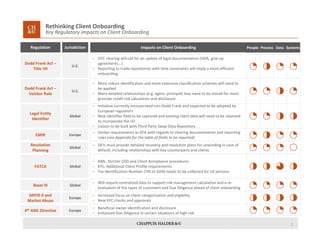
– OTC clearing will call for an update of legal documentation (ISDA, give‐up 
agreements…)
– Reporting to trade repositories with time constraints will imply a more efficient 
onboarding
Dodd Frank Act –
Title VII
U.S.
– More robust identification and more extensive classification schemes will need to 
be applied
– More detailed relationships (e.g. agent, principal) may need to be stored for more 
granular credit risk calculation and disclosure
Dodd Frank Act –
Volcker Rule
U.S.
Legal Entity 
Identifier
Global
– Initiative currently incorporated into Dodd Frank and expected to be adopted by 
European regulators
– New identifier field to be captured and existing client data will need to be cleansed 
to incorporate the LEI
– Liaison to be built with Third Party Swap Data Repository
EMIR Europe
– Similar requirements as DFA with regards to clearing documentation and reporting 
rules (see Appendix for the table of fields to be reported)
FATCA Global
– AML: Stricter CDD and Client Acceptance procedures
– KYC: Additional Client Profile requirements
– Tax Identification Number (TIN or GIIN) needs to be collected for US persons
Basel III Global
– Will require centralized data to support risk management calculation and a re‐
evaluation of the types of customers and Due Diligence ahead of client onboarding
MIFID II and 
Market Abuse
Europe
– Increased focus on client categorization and eligibility
– New KYC checks and approvals
– Beneficial owner identification and disclosure
– Enhanced Due Diligence in certain situations of high risk
4th AML Directive Europe
Rethinking Client Onboarding
Key Regulatory impacts on Client Onboarding
Regulation Jurisdiction Impacts on Client Onboarding People Process SystemsData
Resolution 
Planning
Global
– SIFIs must provide detailed recovery and resolution plans for unwinding in case of 
default, including relationships with key counterparts and clients
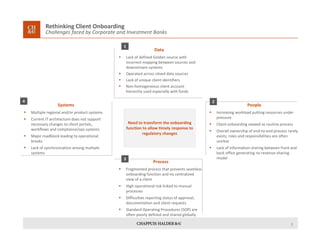
Systems
 Multiple regional and/or product systems 
 Current IT architecture does not support 
necessary changes to client portals, 
workflows and compliance/ops systems
 Major roadblock leading to operational 
breaks 
 Lack of synchronization among multiple 
systems
1
3
Need to transform the onboarding 
function to allow timely response to 
regulatory changes
24
Data
 Lack of defined Golden source with 
incorrect mapping between sources and 
downstream systems
 Operated across siloed data sources
 Lack of unique client identifiers
 Non‐homogeneous client account 
hierarchy used especially with funds 
Process
 Fragmented process that prevents seamless 
onboarding function and no centralized 
view of a client
 High operational risk linked to manual 
processes
 Difficulties reporting status of approval, 
documentation and client requests
 Standard Operating Procedures (SOP) are 
often poorly defined and shared globally
People
 Increasing workload putting resources under 
pressure
 Client onboarding viewed as routine process
 Overall ownership of end‐to‐end process rarely 
exists; roles and responsibilities are often 
unclear
 Lack of information sharing between front and 
back office generating no revenue‐sharing 
model
Rethinking Client Onboarding
Challenges faced by Corporate and Investment Banks
3
4
Rethinking Client Onboarding
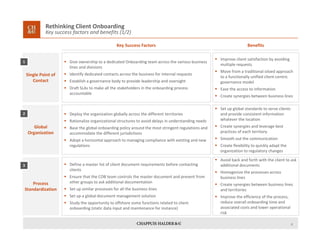
Key success factors and benefits (1/2)
Key Success Factors Benefits
Single Point of 
Contact
 Give ownership to a dedicated Onboarding team across the various business 
lines and divisions
 Identify dedicated contacts across the business for internal requests
 Establish a governance body to provide leadership and oversight
 Draft SLAs to make all the stakeholders in the onboarding process 
accountable
 Improve client satisfaction by avoiding 
multiple requests
 Move from a traditional siloed approach 
to a functionally unified client‐centric 
governance model
 Ease the access to information
 Create synergies between business lines
1
Global 
Organization
 Deploy the organization globally across the different territories
 Rationalize organizational structures to avoid delays in understanding needs
 Base the global onboarding policy around the most stringent regulations and 
accommodate the different jurisdictions
 Adopt a horizontal approach to managing compliance with existing and new 
regulations 
 Set up global standards to serve clients 
and provide consistent information 
whatever the location
 Create synergies and leverage best 
practices of each territory
 Smooth out the communication
 Create flexibility to quickly adapt the 
organization to regulatory changes
2
Process 
Standardization
 Define a master list of client document requirements before contacting 
clients
 Ensure that the COB team controls the master document and prevent from 
other groups to ask additional documentation
 Set up similar processes for all the business lines
 Set up a global document management solution 
 Study the opportunity to offshore some functions related to client 
onboarding (static data input and maintenance for instance)
 Avoid back and forth with the client to ask 
additional documents
 Homogenize the processes across 
business lines
 Create synergies between business lines 
and territories
 Improve the efficiency of the process, 
reduce overall onboarding time and 
associated costs and lower operational 
risk
3
5
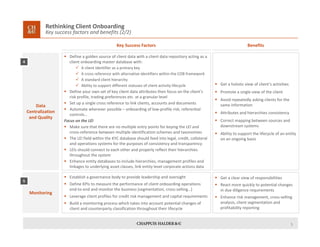
Key Success Factors Benefits
Data 
Centralization 
and Quality
 Define a golden source of client data with a client data repository acting as a 
client onboarding master database with:
 A client identifier as a primary key 
 A cross reference with alternative identifiers within the COB framework
 A standard client hierarchy
 Ability to support different statuses of client activity lifecycle
 Define your own set of key client data attributes then focus on the client’s 
risk profile, trading preferences etc. at a granular level
 Set up a single cross reference to link clients, accounts and documents
 Automate wherever possible – onboarding of low‐profile risk, referential 
controls…
Focus on the LEI
 Make sure that there are no multiple entry points for keying the LEI and 
cross‐reference between multiple identification schemes and taxonomies
 The LEI field within the KYC database should feed into legal, credit, collateral 
and operations systems for the purposes of consistency and transparency
 LEIs should connect to each other and properly reflect their hierarchies 
throughout the system
 Enhance entity databases to include hierarchies, management profiles and 
linkages to underlying asset classes, link entity level corporate actions data
 Get a holistic view of client’s activities
 Promote a single view of the client
 Avoid repeatedly asking clients for the 
same information
 Attributes and hierarchies consistency
 Correct mapping between sources and 
downstream systems
 Ability to support the lifecycle of an entity 
on an ongoing basis
4
Rethinking Client Onboarding
Key success factors and benefits (2/2)
Monitoring
 Establish a governance body to provide leadership and oversight
 Define KPIs to measure the performance of client onboarding operations 
end‐to‐end and monitor the business (segmentation, cross‐selling…)
 Leverage client profiles for credit risk management and capital requirements
 Build a monitoring process which takes into account potential changes of 
client and counterparty classification throughout their lifecycle
 Get a clear view of responsibilities
 React more quickly to potential changes 
in due diligence requirements 
 Enhance risk management, cross‐selling 
analysis, client segmentation and 
profitability reporting
5

CH&Cie - Rethinking Client Onboading

  • 1.
  • 2.
    2 – OTC clearing will call for an update of legal documentation (ISDA, give‐up  agreements…) – Reporting to trade repositories with time constraints will imply a more efficient  onboarding Dodd Frank Act – Title VII U.S. –More robust identification and more extensive classification schemes will need to  be applied – More detailed relationships (e.g. agent, principal) may need to be stored for more  granular credit risk calculation and disclosure Dodd Frank Act – Volcker Rule U.S. Legal Entity  Identifier Global – Initiative currently incorporated into Dodd Frank and expected to be adopted by  European regulators – New identifier field to be captured and existing client data will need to be cleansed  to incorporate the LEI – Liaison to be built with Third Party Swap Data Repository EMIR Europe – Similar requirements as DFA with regards to clearing documentation and reporting  rules (see Appendix for the table of fields to be reported) FATCA Global – AML: Stricter CDD and Client Acceptance procedures – KYC: Additional Client Profile requirements – Tax Identification Number (TIN or GIIN) needs to be collected for US persons Basel III Global – Will require centralized data to support risk management calculation and a re‐ evaluation of the types of customers and Due Diligence ahead of client onboarding MIFID II and  Market Abuse Europe – Increased focus on client categorization and eligibility – New KYC checks and approvals – Beneficial owner identification and disclosure – Enhanced Due Diligence in certain situations of high risk 4th AML Directive Europe Rethinking Client Onboarding Key Regulatory impacts on Client Onboarding Regulation Jurisdiction Impacts on Client Onboarding People Process SystemsData Resolution  Planning Global – SIFIs must provide detailed recovery and resolution plans for unwinding in case of  default, including relationships with key counterparts and clients
  • 3.
    Systems  Multiple regional and/or product systems   Current IT architecture does not support  necessary changes to client portals,  workflows and compliance/ops systems Major roadblock leading to operational  breaks   Lack of synchronization among multiple  systems 1 3 Need to transform the onboarding  function to allow timely response to  regulatory changes 24 Data  Lack of defined Golden source with  incorrect mapping between sources and  downstream systems  Operated across siloed data sources  Lack of unique client identifiers  Non‐homogeneous client account  hierarchy used especially with funds  Process  Fragmented process that prevents seamless  onboarding function and no centralized  view of a client  High operational risk linked to manual  processes  Difficulties reporting status of approval,  documentation and client requests  Standard Operating Procedures (SOP) are  often poorly defined and shared globally People  Increasing workload putting resources under  pressure  Client onboarding viewed as routine process  Overall ownership of end‐to‐end process rarely  exists; roles and responsibilities are often  unclear  Lack of information sharing between front and  back office generating no revenue‐sharing  model Rethinking Client Onboarding Challenges faced by Corporate and Investment Banks 3
  • 4.
    4 Rethinking Client Onboarding Key success factors and benefits (1/2) Key Success Factors Benefits Single Point of  Contact  Give ownership to a dedicated Onboarding team across the various business  lines and divisions Identify dedicated contacts across the business for internal requests  Establish a governance body to provide leadership and oversight  Draft SLAs to make all the stakeholders in the onboarding process  accountable  Improve client satisfaction by avoiding  multiple requests  Move from a traditional siloed approach  to a functionally unified client‐centric  governance model  Ease the access to information  Create synergies between business lines 1 Global  Organization  Deploy the organization globally across the different territories  Rationalize organizational structures to avoid delays in understanding needs  Base the global onboarding policy around the most stringent regulations and  accommodate the different jurisdictions  Adopt a horizontal approach to managing compliance with existing and new  regulations   Set up global standards to serve clients  and provide consistent information  whatever the location  Create synergies and leverage best  practices of each territory  Smooth out the communication  Create flexibility to quickly adapt the  organization to regulatory changes 2 Process  Standardization  Define a master list of client document requirements before contacting  clients  Ensure that the COB team controls the master document and prevent from  other groups to ask additional documentation  Set up similar processes for all the business lines  Set up a global document management solution   Study the opportunity to offshore some functions related to client  onboarding (static data input and maintenance for instance)  Avoid back and forth with the client to ask  additional documents  Homogenize the processes across  business lines  Create synergies between business lines  and territories  Improve the efficiency of the process,  reduce overall onboarding time and  associated costs and lower operational  risk 3
  • 5.
    5 Key Success Factors Benefits Data  Centralization  and Quality  Define a golden source of client data with a client data repository acting as a  client onboarding master database with: A client identifier as a primary key   A cross reference with alternative identifiers within the COB framework  A standard client hierarchy  Ability to support different statuses of client activity lifecycle  Define your own set of key client data attributes then focus on the client’s  risk profile, trading preferences etc. at a granular level  Set up a single cross reference to link clients, accounts and documents  Automate wherever possible – onboarding of low‐profile risk, referential  controls… Focus on the LEI  Make sure that there are no multiple entry points for keying the LEI and  cross‐reference between multiple identification schemes and taxonomies  The LEI field within the KYC database should feed into legal, credit, collateral  and operations systems for the purposes of consistency and transparency  LEIs should connect to each other and properly reflect their hierarchies  throughout the system  Enhance entity databases to include hierarchies, management profiles and  linkages to underlying asset classes, link entity level corporate actions data  Get a holistic view of client’s activities  Promote a single view of the client  Avoid repeatedly asking clients for the  same information  Attributes and hierarchies consistency  Correct mapping between sources and  downstream systems  Ability to support the lifecycle of an entity  on an ongoing basis 4 Rethinking Client Onboarding Key success factors and benefits (2/2) Monitoring  Establish a governance body to provide leadership and oversight  Define KPIs to measure the performance of client onboarding operations  end‐to‐end and monitor the business (segmentation, cross‐selling…)  Leverage client profiles for credit risk management and capital requirements  Build a monitoring process which takes into account potential changes of  client and counterparty classification throughout their lifecycle  Get a clear view of responsibilities  React more quickly to potential changes  in due diligence requirements   Enhance risk management, cross‐selling  analysis, client segmentation and  profitability reporting 5