
Newgen Presentation on FATCA
• 12 weeks before we hit FATCA deadline
• If you have not yet started, think about Assessment, Gaps, Rules, Audit,
Reports... Risks
• Adapt to the change and then change to Last
The Clock is Ticking
What are the main Challenges for Banks?
• Regions:
AsiaPAC, North America,
Europe
• Sample Size:
63 Organizations
• Interviewees:
 CIO’s
 Compliance Head
 Head of Risk
 Operation Managers
Key findings from Survey conducted by Newgen
Time is Critical- Pre-Configured Templates
Unpredictable FATCA regulations- Agile BPM Platform
Ensure Compliance– Logs and Document Management Solution
Complicated FATCA Procedures - Case Management and
Workflow
Monitoring and Reporting Tools needed – Configurable Reports
using Reporting tool
Customer Relationship - Communication Management
23
Countries
92
Compliance Officers
63
Financial Institutions
1
2
3
4
5
• FATCA compliance is a derivative of Core Banking/AML?
 FATCA needs comprehensive, risk mitigation and case management approach.
• FATCA is not my problem, it is the compliance or legal or technology or ???
 FATCA requires program governance and ownership with joint participation and alignment.
• FATCA is about identification, I guess ?
 Cursory analysis of customers is not enough. Needs domain experience and ability to execute.
• FATCA is all about IRS ?
 FATCA is not a one time, quick fix solution. Sons and Daughters of FATCA are just shaping up.
The Myth Busters
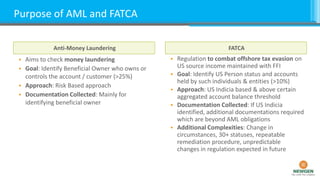
• Regulation to combat offshore tax evasion on
US source income maintained with FFI
• Goal: Identify US Person status and accounts
held by such individuals & entities (>10%)
• Approach: US Indicia based & above certain
aggregated account balance threshold
• Documentation Collected: If US Indicia
identified, additional documentations required
which are beyond AML obligations
• Additional Complexities: Change in
circumstances, 30+ statuses, repeatable
remediation procedure, unpredictable
changes in regulation expected in future
FATCA
• Aims to check money laundering
• Goal: Identify Beneficial Owner who owns or
controls the account / customer (>25%)
• Approach: Risk Based approach
• Documentation Collected: Mainly for
identifying beneficial owner
Anti-Money Laundering
Purpose of AML and FATCA
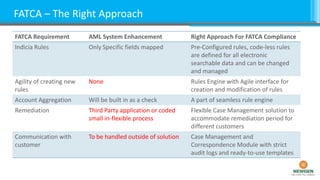
FATCA Requirement AML System Enhancement Right Approach For FATCA Compliance
Indicia Rules Only Specific fields mapped Pre-Configured rules, code-less rules
are defined for all electronic
searchable data and can be changed
and managed
Agility of creating new
rules
None Rules Engine with Agile interface for
creation and modification of rules
Account Aggregation Will be built in as a check A part of seamless rule engine
Remediation Third Party application or coded
small in-flexible process
Flexible Case Management solution to
accommodate remediation period for
different customers
Communication with
customer
To be handled outside of solution Case Management and
Correspondence Module with strict
audit logs and ready-to-use templates
FATCA – The Right Approach
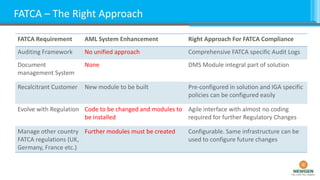
FATCA Requirement AML System Enhancement Right Approach For FATCA Compliance
Auditing Framework No unified approach Comprehensive FATCA specific Audit Logs
Document
management System
None DMS Module integral part of solution
Recalcitrant Customer New module to be built Pre-configured in solution and IGA specific
policies can be configured easily
Evolve with Regulation Code to be changed and modules to
be installed
Agile interface with almost no coding
required for further Regulatory Changes
Manage other country
FATCA regulations (UK,
Germany, France etc.)
Further modules must be created Configurable. Same infrastructure can be
used to configure future changes
FATCA – The Right Approach
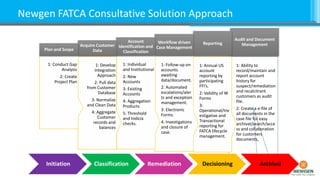
Newgen FATCA Consultative Solution Approach
1: Ability to
record/maintain and
report account
history for
suspect/remediation
and recalcitrant
customers as audit
file.
2: Create a e-file of
all documents in the
case file for easy
archival/search/acce
ss and collaboration
for customers
documents,
Audit and Document
Management
1: Annual US
account
reporting by
participating
FFI’s.
2: Validity of W
Forms
3:
Operational/Inv
estigative and
Transactional
reporting for
FATCA lifecycle
management.
Reporting
1: Follow-up on
accounts
awaiting
data/document.
2: Automated
escalations/aler
ts and exception
management.
3: Electronic
Forms.
4: Investigations
and closure of
case.
Workflow driven
Case Management
1: Individual
and Institutional
2: New
Accounts
3: Existing
Accounts
4: Aggregation
Products
5: Threshold
and Indicia
checks.
Account
Identification and
Classification
1: Develop
Integration
Approach
2: Pull data
from Customer
Database
3: Normalize
and Clean Data
4: Aggregate
Customer
records and
balances
Acquire Customer
Data
1: Conduct Gap
Analysis
2: Create
Project Plan
Plan and Scope
Initiation Classification Remediation Decisioning Archival
• Management of Customer Data
• Quality of Current Customer Data
• Identification of FATCA Reportable customers
• Unpreparedness of Technology
• Unpredictability of Regulation
• Keeping up with Future sons and daughters of FATCA
Operational Challenges of Implementing FATCA
Heterogeneous Source I/P Systems (Core)
Deposit (Retail), Capital Markets, Trust, Wealth, Investment,
Insurance Systems etc.
Multiple entities with multiple core applications
Feed file from all core systems
Multiple file formats with varying data structures
Unique identifier & secondary identifier
Data Modeling & Transformation
Field level mapping for all feed files
Field wise data conversion of all feed files in a uniform
structure
Data type, length, mandatory & format validations
CIF & Account records linkages and balance aggregation
across feed files
Normalization & Cleansing
Normalize for homogeneous representation (e.g. KYC data
from all systems represented uniformly)
CIF level & Account level data mapping (e.g. addresses stored
at both levels)
Cleansing activity for ambiguous data elements (e.g. free text
fields)
Exception management for missing data elements
Data Processing
Process rule(s) on applicable sets of data from all feed files
Remediation case management for success
Identified indicia association at field level with conforming,
resolving & waiver documentation requirement
Exception case management for failures (with view to RM’s
/ compliance users)
Reconciliation dashboard with drill down
Data Input, Modeling, Transformation & Processing
Newgen FATCA Solution Suite
United
States
Financial
Institutions
Foreign
Financial
Institutions
Legacy Systems
KYC
Electronic
Documents
Data
Warehouse
USIndicia
ChangeInStatus
EntityLegalStatus
Check Points
Registration and Segregation
Master
Folder
Rules driven
Due Diligence
Case Validation
Entity
Analysis
Exempt
Due Diligence and Audit
Documentation
Due
Diligence
Decision and Reporting
Auto-
Resolve
Report to Tax
Electronic Form
W-8 W-9
Know Your Customer System
Monitoring and Control
WHT Reporting
Case Management
Document Management
Communication Management
Real Time Data Validation
Change in Status & Periodic Review
Integration IRS form instructions
1. FATCA Readiness Surveys
2. Gap Analysis and Mapping of Data with Pre-Configured Rules
3. Extract data through Standard templates
4. Test-Run FATCA Solution
5. Implementation
6. User Approval
7. Compliance Sign Off
8. Training
Eight Step Newgen FATCA Program
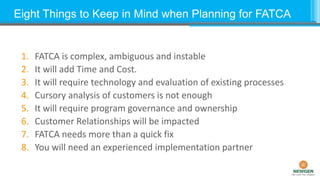
1. FATCA is complex, ambiguous and instable
2. It will add Time and Cost.
3. It will require technology and evaluation of existing processes
4. Cursory analysis of customers is not enough
5. It will require program governance and ownership
6. Customer Relationships will be impacted
7. FATCA needs more than a quick fix
8. You will need an experienced implementation partner
Eight Things to Keep in Mind when Planning for FATCA
• Completeness and Readiness of a Future Ready Solution. Have deep domain
expertise in FATCA regulations, reduces your risk to re-invent and go with the best
practices.
• Reduced risk through best practice templates and on-time implementation.
• Significantly lower cost of ownership and resource tie-up with user empowered
training program
• Much lower costs for the solution to adapt to new requirements with the
configurable BPM framework
• Lower TCO driven by 60 day roadmap
• New age technology enables ease of integration with multiple systems
• Extensibility of the solution to other valuable process automation initiatives.
Been there, Done it, Proven results
Customer Case Study
• Four of the Largest Caribbean
Banks
• Over 20+ live cases in the final
stages
Challenges
• Complicated On-Boarding processes
• Identification of FATCA Eligible individuals
• Non-uniform and Isolated, systems and manual processes
• Manage complex customer relationships
• Adapting to changing market dynamic
Benefits
• Pre-configured Solution Accelerator reduces implementation timeline significantly
• Uniform customer onboarding & KYC processes
• Centralized & Decentralized FATCA compliance control & audit
• Agility in Processes, specific to privacy islands like Bahamas
• Extensive audit trails ensure constant monitoring
• Flexible and configurable solution provide easy change management
• Alerts and notifications for monitoring all cases
• Real-time Automatic reporting and dashboards
Parameters of Project Success
Complete Solution
Complete and Seamlessly Integrated Solution
Onboarding – FATCA Rules Engine – Case Management – Reporting – CMS
Domain Expertise Best Practice Process templates for key FATCA Rule-Sets and domain consultants with knowledge
pool of regulatory framework.
Delivery Expertise Newgen has a dedicated implementation team of consultants trained on Newgen BPM, besides a
pool of trained partners in various regions
The Winning Risk-Free Equation
• Software Products in Business Process Management, Enterprise Content Management , Case
Management & Customer Communication Management
• Global footprint with 1100+ ECM, BPM and Case Management installations in 50 countries
across Verticals including Banking, Financial Services, Insurance, Shared Service Center and
Business Process Outsourcing, Government, Healthcare …
• Credited with world’s largest implementations
• Employee strength 1300+
• Innovative culture, Dedicated R&D centre, 40 patents
• Certified for ISO 9001:2008, ISO 27001:2005 and CMMI Level3
Newgen Overview – Company Snapshot
Investors
Offices
Singapore
USA
• Florida
• Washington DC
Canada
UK
UAE
IndiaSubsidiaries
2013 Impact Report
2013 ECM Wave
2013 Global Software Leaders Report
2011 Market Share Report
2014 Critical capabilities in case management report
2013 CCM MQ
2013,2012, 2011,2010,2009 ECM MQ Report
2014 iBPMS MQ participation, 2012 BPMS Market Update Report, 2010 BPM MQ
2011 Retail Loan Origination Vendor Landscape Report
Good Condition and Low Risk
Flexible and cost effective
Emerging market’s top 100 software
vendors
No 1 in India Content Management
Market
Top 3 value for money2011 BPM Decision Matrix
Industry Recognition
Very Large Installations
Comprehensive Case Management2012 ECM vendor evaluation Report
Our Global Customer Relationships
Banking &
Finance
Insurance
BPO &
Shared
Services
Government
Singapore Star
Shipping
RTBA
Customers in APAC

Newgen Presentation on FATCA

  • 1.
  • 2.
    • 12 weeksbefore we hit FATCA deadline • If you have not yet started, think about Assessment, Gaps, Rules, Audit, Reports... Risks • Adapt to the change and then change to Last The Clock is Ticking
  • 3.
    What are themain Challenges for Banks? • Regions: AsiaPAC, North America, Europe • Sample Size: 63 Organizations • Interviewees:  CIO’s  Compliance Head  Head of Risk  Operation Managers Key findings from Survey conducted by Newgen Time is Critical- Pre-Configured Templates Unpredictable FATCA regulations- Agile BPM Platform Ensure Compliance– Logs and Document Management Solution Complicated FATCA Procedures - Case Management and Workflow Monitoring and Reporting Tools needed – Configurable Reports using Reporting tool Customer Relationship - Communication Management 23 Countries 92 Compliance Officers 63 Financial Institutions 1 2 3 4 5
  • 4.
    • FATCA complianceis a derivative of Core Banking/AML?  FATCA needs comprehensive, risk mitigation and case management approach. • FATCA is not my problem, it is the compliance or legal or technology or ???  FATCA requires program governance and ownership with joint participation and alignment. • FATCA is about identification, I guess ?  Cursory analysis of customers is not enough. Needs domain experience and ability to execute. • FATCA is all about IRS ?  FATCA is not a one time, quick fix solution. Sons and Daughters of FATCA are just shaping up. The Myth Busters
  • 5.
    • Regulation tocombat offshore tax evasion on US source income maintained with FFI • Goal: Identify US Person status and accounts held by such individuals & entities (>10%) • Approach: US Indicia based & above certain aggregated account balance threshold • Documentation Collected: If US Indicia identified, additional documentations required which are beyond AML obligations • Additional Complexities: Change in circumstances, 30+ statuses, repeatable remediation procedure, unpredictable changes in regulation expected in future FATCA • Aims to check money laundering • Goal: Identify Beneficial Owner who owns or controls the account / customer (>25%) • Approach: Risk Based approach • Documentation Collected: Mainly for identifying beneficial owner Anti-Money Laundering Purpose of AML and FATCA
  • 6.
    FATCA Requirement AMLSystem Enhancement Right Approach For FATCA Compliance Indicia Rules Only Specific fields mapped Pre-Configured rules, code-less rules are defined for all electronic searchable data and can be changed and managed Agility of creating new rules None Rules Engine with Agile interface for creation and modification of rules Account Aggregation Will be built in as a check A part of seamless rule engine Remediation Third Party application or coded small in-flexible process Flexible Case Management solution to accommodate remediation period for different customers Communication with customer To be handled outside of solution Case Management and Correspondence Module with strict audit logs and ready-to-use templates FATCA – The Right Approach
  • 7.
    FATCA Requirement AMLSystem Enhancement Right Approach For FATCA Compliance Auditing Framework No unified approach Comprehensive FATCA specific Audit Logs Document management System None DMS Module integral part of solution Recalcitrant Customer New module to be built Pre-configured in solution and IGA specific policies can be configured easily Evolve with Regulation Code to be changed and modules to be installed Agile interface with almost no coding required for further Regulatory Changes Manage other country FATCA regulations (UK, Germany, France etc.) Further modules must be created Configurable. Same infrastructure can be used to configure future changes FATCA – The Right Approach
  • 8.
    Newgen FATCA ConsultativeSolution Approach 1: Ability to record/maintain and report account history for suspect/remediation and recalcitrant customers as audit file. 2: Create a e-file of all documents in the case file for easy archival/search/acce ss and collaboration for customers documents, Audit and Document Management 1: Annual US account reporting by participating FFI’s. 2: Validity of W Forms 3: Operational/Inv estigative and Transactional reporting for FATCA lifecycle management. Reporting 1: Follow-up on accounts awaiting data/document. 2: Automated escalations/aler ts and exception management. 3: Electronic Forms. 4: Investigations and closure of case. Workflow driven Case Management 1: Individual and Institutional 2: New Accounts 3: Existing Accounts 4: Aggregation Products 5: Threshold and Indicia checks. Account Identification and Classification 1: Develop Integration Approach 2: Pull data from Customer Database 3: Normalize and Clean Data 4: Aggregate Customer records and balances Acquire Customer Data 1: Conduct Gap Analysis 2: Create Project Plan Plan and Scope Initiation Classification Remediation Decisioning Archival
  • 9.
    • Management ofCustomer Data • Quality of Current Customer Data • Identification of FATCA Reportable customers • Unpreparedness of Technology • Unpredictability of Regulation • Keeping up with Future sons and daughters of FATCA Operational Challenges of Implementing FATCA
  • 10.
    Heterogeneous Source I/PSystems (Core) Deposit (Retail), Capital Markets, Trust, Wealth, Investment, Insurance Systems etc. Multiple entities with multiple core applications Feed file from all core systems Multiple file formats with varying data structures Unique identifier & secondary identifier Data Modeling & Transformation Field level mapping for all feed files Field wise data conversion of all feed files in a uniform structure Data type, length, mandatory & format validations CIF & Account records linkages and balance aggregation across feed files Normalization & Cleansing Normalize for homogeneous representation (e.g. KYC data from all systems represented uniformly) CIF level & Account level data mapping (e.g. addresses stored at both levels) Cleansing activity for ambiguous data elements (e.g. free text fields) Exception management for missing data elements Data Processing Process rule(s) on applicable sets of data from all feed files Remediation case management for success Identified indicia association at field level with conforming, resolving & waiver documentation requirement Exception case management for failures (with view to RM’s / compliance users) Reconciliation dashboard with drill down Data Input, Modeling, Transformation & Processing
  • 11.
    Newgen FATCA SolutionSuite United States Financial Institutions Foreign Financial Institutions Legacy Systems KYC Electronic Documents Data Warehouse USIndicia ChangeInStatus EntityLegalStatus Check Points Registration and Segregation Master Folder Rules driven Due Diligence Case Validation Entity Analysis Exempt Due Diligence and Audit Documentation Due Diligence Decision and Reporting Auto- Resolve Report to Tax Electronic Form W-8 W-9 Know Your Customer System Monitoring and Control WHT Reporting Case Management Document Management Communication Management Real Time Data Validation Change in Status & Periodic Review Integration IRS form instructions
  • 12.
    1. FATCA ReadinessSurveys 2. Gap Analysis and Mapping of Data with Pre-Configured Rules 3. Extract data through Standard templates 4. Test-Run FATCA Solution 5. Implementation 6. User Approval 7. Compliance Sign Off 8. Training Eight Step Newgen FATCA Program
  • 13.
    1. FATCA iscomplex, ambiguous and instable 2. It will add Time and Cost. 3. It will require technology and evaluation of existing processes 4. Cursory analysis of customers is not enough 5. It will require program governance and ownership 6. Customer Relationships will be impacted 7. FATCA needs more than a quick fix 8. You will need an experienced implementation partner Eight Things to Keep in Mind when Planning for FATCA
  • 14.
    • Completeness andReadiness of a Future Ready Solution. Have deep domain expertise in FATCA regulations, reduces your risk to re-invent and go with the best practices. • Reduced risk through best practice templates and on-time implementation. • Significantly lower cost of ownership and resource tie-up with user empowered training program • Much lower costs for the solution to adapt to new requirements with the configurable BPM framework • Lower TCO driven by 60 day roadmap • New age technology enables ease of integration with multiple systems • Extensibility of the solution to other valuable process automation initiatives. Been there, Done it, Proven results
  • 15.
    Customer Case Study •Four of the Largest Caribbean Banks • Over 20+ live cases in the final stages Challenges • Complicated On-Boarding processes • Identification of FATCA Eligible individuals • Non-uniform and Isolated, systems and manual processes • Manage complex customer relationships • Adapting to changing market dynamic Benefits • Pre-configured Solution Accelerator reduces implementation timeline significantly • Uniform customer onboarding & KYC processes • Centralized & Decentralized FATCA compliance control & audit • Agility in Processes, specific to privacy islands like Bahamas • Extensive audit trails ensure constant monitoring • Flexible and configurable solution provide easy change management • Alerts and notifications for monitoring all cases • Real-time Automatic reporting and dashboards
  • 16.
    Parameters of ProjectSuccess Complete Solution Complete and Seamlessly Integrated Solution Onboarding – FATCA Rules Engine – Case Management – Reporting – CMS Domain Expertise Best Practice Process templates for key FATCA Rule-Sets and domain consultants with knowledge pool of regulatory framework. Delivery Expertise Newgen has a dedicated implementation team of consultants trained on Newgen BPM, besides a pool of trained partners in various regions The Winning Risk-Free Equation
  • 17.
    • Software Productsin Business Process Management, Enterprise Content Management , Case Management & Customer Communication Management • Global footprint with 1100+ ECM, BPM and Case Management installations in 50 countries across Verticals including Banking, Financial Services, Insurance, Shared Service Center and Business Process Outsourcing, Government, Healthcare … • Credited with world’s largest implementations • Employee strength 1300+ • Innovative culture, Dedicated R&D centre, 40 patents • Certified for ISO 9001:2008, ISO 27001:2005 and CMMI Level3 Newgen Overview – Company Snapshot Investors Offices Singapore USA • Florida • Washington DC Canada UK UAE IndiaSubsidiaries
  • 18.
    2013 Impact Report 2013ECM Wave 2013 Global Software Leaders Report 2011 Market Share Report 2014 Critical capabilities in case management report 2013 CCM MQ 2013,2012, 2011,2010,2009 ECM MQ Report 2014 iBPMS MQ participation, 2012 BPMS Market Update Report, 2010 BPM MQ 2011 Retail Loan Origination Vendor Landscape Report Good Condition and Low Risk Flexible and cost effective Emerging market’s top 100 software vendors No 1 in India Content Management Market Top 3 value for money2011 BPM Decision Matrix Industry Recognition Very Large Installations Comprehensive Case Management2012 ECM vendor evaluation Report
  • 19.
    Our Global CustomerRelationships Banking & Finance Insurance BPO & Shared Services Government
  • 20.

Editor's Notes

  • #20 Put Indian Banks First