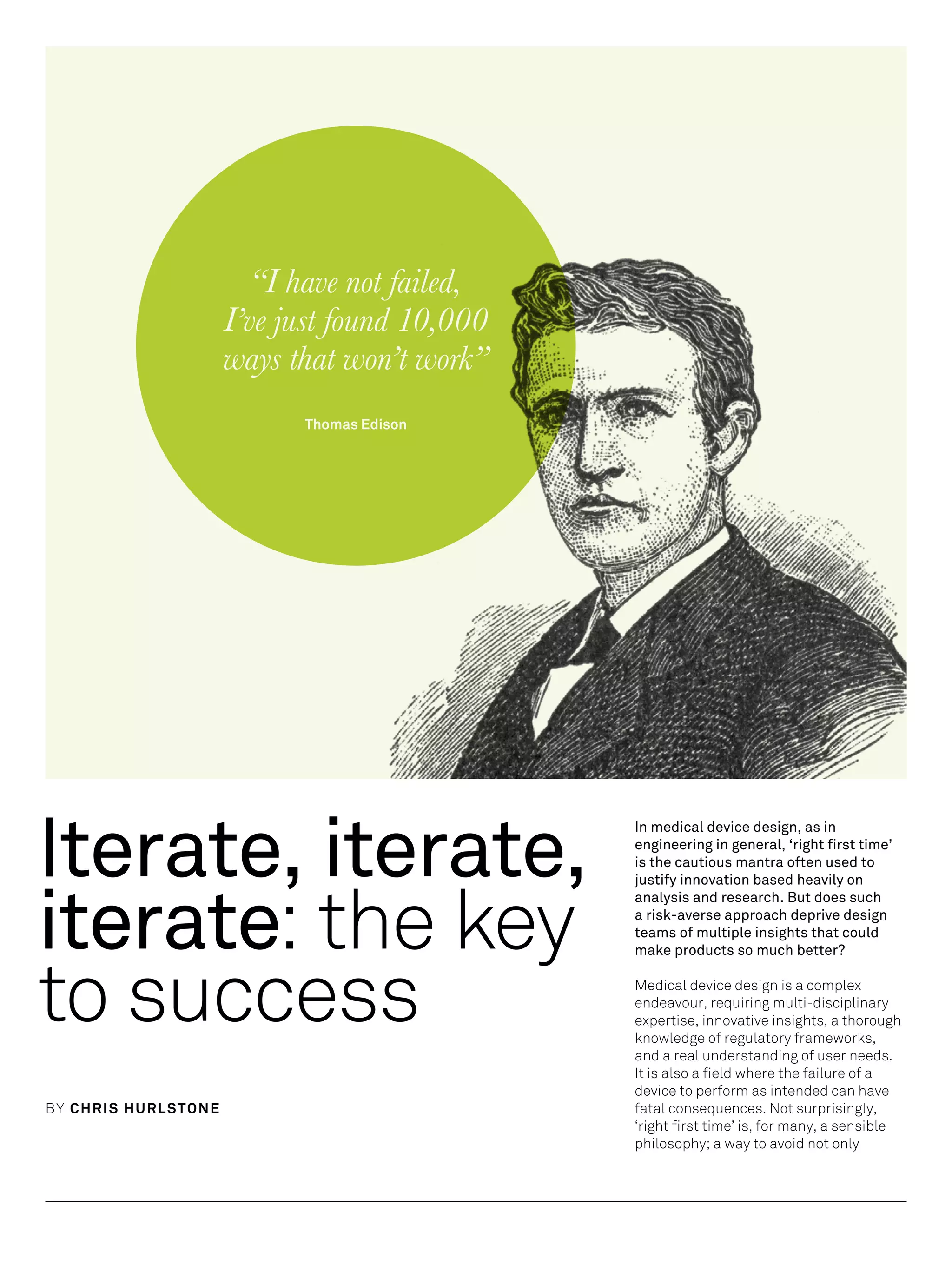
“I have not failed,
I’ve just found 10,000
ways that won’t work”
Thomas Edison

Iterate, iterate,
iterate: the key
to success
BY CHRI S HUR LST O NE

In medical device design, as in
engineering in general, ‘right first time’
is the cautious mantra often used to
justify innovation based heavily on
analysis and research. But does such
a risk-averse approach deprive design
teams of multiple insights that could
make products so much better?
Medical device design is a complex
endeavour, requiring multi-disciplinary
expertise, innovative insights, a thorough
knowledge of regulatory frameworks,
and a real understanding of user needs.
It is also a field where the failure of a
device to perform as intended can have
fatal consequences. Not surprisingly,
‘right first time’ is, for many, a sensible
philosophy; a way to avoid not only
www.team-consulting.com

10 — 11

product failure, but also the perceived
costs (in terms of time and money) of a
‘trial and error’ approach. It is also the
result of a mind-set wary of multiple
iterations in such a highly regulated
industry, and recent developments in
technology have also played their part
by giving designers and engineers the
opportunity to get ever closer to the ‘real
thing’ - identifying and resolving errors on
the way - before the first prototype is even
commissioned.
For example, increased computing power
has made high end engineering analysis
packages more accessible, especially
those capable of modelling the most
complex aspects of medical device design
(such as stress analysis, mouldflow,
fluid dynamics and system kinetics).
Corresponding developments in software
have also resulted in CAD packages able
to incorporate ever increasing levels of
’reality’ into virtual models in the form
of, say, manufacturing tolerances,
component inter-dependencies, or
material properties and finishes which
allow photo-realistic visual renderings.
To support this analysis, comprehensive,
sophisticated technical research can
now be undertaken quickly and cheaply
from virtually any computer with an
internet link. The opportunity to review
the work of others in the field, on a global
basis, adds further depth to the research
process. This helps build confidence
that the development course identified
is robust and well targeted, or gives a
steer to change direction in the light of
information obtained.
To some, these tools can feel as though
they give greater certainty than ever
before of being ‘right first time’ when first
committing to manufacture. So why do
anything else?
The answer lies partly in technological
advances elsewhere in the product
development field. For example, rapid
prototyping has undergone a radical
transformation in recent years with new
advances in techniques such as SLA, SLS
and 3D printing now allowing designers
to generate prototypes more quickly and
more accurately.

Medical device design
is a complex endeavour,
requiring multidisciplinary expertise,
innovative insights,
a thorough knowledge of
regulatory frameworks,
and a real understanding
of user needs.

The materials used are also evolving
and – though still limited – are getting
closer to representing the polymers
that will be used in final production.
Developments in the service offering
have also helped, fuelled by growing
competition within the rapid prototyping
industry. Increased efficiency now makes
a turnaround of 24 hours or less both
commonplace and affordable, and similar
improvements have been made with
other rapid prototyping techniques, from
CNC machining and stamping to photoand chemical-etching. In parallel, the
development of faster and more accurate
rapid inspection techniques, such as 3D
scanning, has enabled corresponding
development activities, such as
dimensional analysis, to keep pace.
But perhaps the most significant changes
in rapid prototyping technologies
have been in the field of rapid tooling.
Injection moulded components, in fully
representative materials, can now be
delivered within three weeks, and at
costs comparable with those for ‘old
fashioned’ vacuum cast prototypes. As a
result, the decision to commit to tooling
is no longer one which requires either
high levels of confidence in the design,
or huge budgets, and this shift opens up
significant opportunities for further, and
more extensive development testing.
Rapidly tooled parts deliver a sufficiently
accurate representation of design
features such as living hinges, snaps,
detents and plastic springs. These are
the type of details difficult to reproduce
in the past but which benefit hugely
from physical handling and assessment
during the development process, as it is
very difficult for FEA or computer based
dynamic analysis to replicate – or replace
– one very important but extremely subtle
characteristic of a design: ‘feel’.
Manufacturers are also extremely keen
to have parts in their hands as soon as
possible, for example to assess potential
issues with automated assembly such
as bowl feeding. Rapid prototyping and
tooling therefore allows quick, easy and
relatively inexpensive ‘proactive iteration’,
capable of yielding unexpected insights
which, when planned into a development
programme, can be extremely beneficial >
Team / insight.

NEVER
UNDERESTIMATE THE
VALUE OF SURPRISE
to the design process. And this is never
truer than in the area of human factors
engineering.
No matter how much time and effort
has been expended in the design of a
device, new insights will always result
when it is placed in the hands of a user.
When such formative studies take
place at a relatively late stage of the
development process, designers will not
want to discover that their prototype
fails to deliver the experience planned,
or performance level expected. But by
combining numerous small, formative
studies with a programme of quick-fire
iteration, undertaken earlier in the
development process, ‘poor’ performance
is no longer so significant, and the new
and unexpected insights that will
invariably emerge instead become a
positive steer for the next stages of
product development.
As our Human Factors team correctly
point out, we should “never underestimate
the value of surprise”. User-device
interaction invariably yields results
that would be impossible to determine
through even the most intensive deskor lab-based research, yet these results
can make all the difference when it comes
to minimising potential use error and
maximising eventual user acceptance.
Rapid iteration is therefore a powerful

strategy for getting a product right, but
it must be used with caution and skill,
and as part of a structured approach. If
developers become tempted to explore yet
more product variations, and commission
yet more prototypes, the development
can become increasingly unfocused; the
ability to investigate many options quickly
can also be poorly exploited by a desire
to prove that every potential flaw has
been thoroughly explored; and there is
a risk that programmes are scheduled
over-optimistically, running at a pace
which mirrors the speed available from
these new technologies, even when
this is not practicable. Rapid progress
is important in product development,
but must never become an over-riding
priority. Risk management, for example,
must be rigorous and cannot be rushed,
and formal testing should be always be
thorough and not compromised.
The best approach is a balance. Using
the understanding generated by phases
of detailed analysis, design teams should
be encouraged to undergo bursts of rapid
iteration with the freedom to experience
surprising results and explore them in
more detail. This is when ‘wrong’ can
be good and hence it is important that
design teams are aware of the new
technologies available - and able to
select them appropriately - in order
to generate prototypes capable of

yielding the most valuable and relevant
information.
Not least, developers need to be firm
on when iteration should stop. Total
perfection is not the goal – not only is it
(probably) impossible, but with typical
product lifecycles now surprisingly short
in some sectors, the ideal solution will
not stay that way for long. The point
will always come when further iteration
will not deliver any tangible user or
market benefits, but skill and insight is
sometimes needed to know when this
point has been reached.
At Team Consulting we deploy rapid
iteration to investigate a multitude of
interesting ideas which we then sift –
using multi-disciplinary and market
experience – in order to identify the best
development direction. We are not afraid
of ‘mistakes’ early on in the process, just
as we know we have to be ‘right first time’
at the point of design verification and
validation, because faults discovered at
this late stage can be extremely costly
and time consuming to address. Early
and rapid iteration helps us build our
understanding sooner rather than later,
leading to an end result that meets the
brief safely, robustly and profitably.

— Chris is director of engineering and
has a strong track record in delivering
innovative solutions to many of Team’s
international clients.
chris.hurlstone@team-consulting.com

Iterate iterate iterate: the key to success | Insight, issue 2

  • 1.
    “I have notfailed, I’ve just found 10,000 ways that won’t work” Thomas Edison Iterate, iterate, iterate: the key to success BY CHRI S HUR LST O NE In medical device design, as in engineering in general, ‘right first time’ is the cautious mantra often used to justify innovation based heavily on analysis and research. But does such a risk-averse approach deprive design teams of multiple insights that could make products so much better? Medical device design is a complex endeavour, requiring multi-disciplinary expertise, innovative insights, a thorough knowledge of regulatory frameworks, and a real understanding of user needs. It is also a field where the failure of a device to perform as intended can have fatal consequences. Not surprisingly, ‘right first time’ is, for many, a sensible philosophy; a way to avoid not only
  • 2.
    www.team-consulting.com 10 — 11 productfailure, but also the perceived costs (in terms of time and money) of a ‘trial and error’ approach. It is also the result of a mind-set wary of multiple iterations in such a highly regulated industry, and recent developments in technology have also played their part by giving designers and engineers the opportunity to get ever closer to the ‘real thing’ - identifying and resolving errors on the way - before the first prototype is even commissioned. For example, increased computing power has made high end engineering analysis packages more accessible, especially those capable of modelling the most complex aspects of medical device design (such as stress analysis, mouldflow, fluid dynamics and system kinetics). Corresponding developments in software have also resulted in CAD packages able to incorporate ever increasing levels of ’reality’ into virtual models in the form of, say, manufacturing tolerances, component inter-dependencies, or material properties and finishes which allow photo-realistic visual renderings. To support this analysis, comprehensive, sophisticated technical research can now be undertaken quickly and cheaply from virtually any computer with an internet link. The opportunity to review the work of others in the field, on a global basis, adds further depth to the research process. This helps build confidence that the development course identified is robust and well targeted, or gives a steer to change direction in the light of information obtained. To some, these tools can feel as though they give greater certainty than ever before of being ‘right first time’ when first committing to manufacture. So why do anything else? The answer lies partly in technological advances elsewhere in the product development field. For example, rapid prototyping has undergone a radical transformation in recent years with new advances in techniques such as SLA, SLS and 3D printing now allowing designers to generate prototypes more quickly and more accurately. Medical device design is a complex endeavour, requiring multidisciplinary expertise, innovative insights, a thorough knowledge of regulatory frameworks, and a real understanding of user needs. The materials used are also evolving and – though still limited – are getting closer to representing the polymers that will be used in final production. Developments in the service offering have also helped, fuelled by growing competition within the rapid prototyping industry. Increased efficiency now makes a turnaround of 24 hours or less both commonplace and affordable, and similar improvements have been made with other rapid prototyping techniques, from CNC machining and stamping to photoand chemical-etching. In parallel, the development of faster and more accurate rapid inspection techniques, such as 3D scanning, has enabled corresponding development activities, such as dimensional analysis, to keep pace. But perhaps the most significant changes in rapid prototyping technologies have been in the field of rapid tooling. Injection moulded components, in fully representative materials, can now be delivered within three weeks, and at costs comparable with those for ‘old fashioned’ vacuum cast prototypes. As a result, the decision to commit to tooling is no longer one which requires either high levels of confidence in the design, or huge budgets, and this shift opens up significant opportunities for further, and more extensive development testing. Rapidly tooled parts deliver a sufficiently accurate representation of design features such as living hinges, snaps, detents and plastic springs. These are the type of details difficult to reproduce in the past but which benefit hugely from physical handling and assessment during the development process, as it is very difficult for FEA or computer based dynamic analysis to replicate – or replace – one very important but extremely subtle characteristic of a design: ‘feel’. Manufacturers are also extremely keen to have parts in their hands as soon as possible, for example to assess potential issues with automated assembly such as bowl feeding. Rapid prototyping and tooling therefore allows quick, easy and relatively inexpensive ‘proactive iteration’, capable of yielding unexpected insights which, when planned into a development programme, can be extremely beneficial >
  • 3.
    Team / insight. NEVER UNDERESTIMATETHE VALUE OF SURPRISE to the design process. And this is never truer than in the area of human factors engineering. No matter how much time and effort has been expended in the design of a device, new insights will always result when it is placed in the hands of a user. When such formative studies take place at a relatively late stage of the development process, designers will not want to discover that their prototype fails to deliver the experience planned, or performance level expected. But by combining numerous small, formative studies with a programme of quick-fire iteration, undertaken earlier in the development process, ‘poor’ performance is no longer so significant, and the new and unexpected insights that will invariably emerge instead become a positive steer for the next stages of product development. As our Human Factors team correctly point out, we should “never underestimate the value of surprise”. User-device interaction invariably yields results that would be impossible to determine through even the most intensive deskor lab-based research, yet these results can make all the difference when it comes to minimising potential use error and maximising eventual user acceptance. Rapid iteration is therefore a powerful strategy for getting a product right, but it must be used with caution and skill, and as part of a structured approach. If developers become tempted to explore yet more product variations, and commission yet more prototypes, the development can become increasingly unfocused; the ability to investigate many options quickly can also be poorly exploited by a desire to prove that every potential flaw has been thoroughly explored; and there is a risk that programmes are scheduled over-optimistically, running at a pace which mirrors the speed available from these new technologies, even when this is not practicable. Rapid progress is important in product development, but must never become an over-riding priority. Risk management, for example, must be rigorous and cannot be rushed, and formal testing should be always be thorough and not compromised. The best approach is a balance. Using the understanding generated by phases of detailed analysis, design teams should be encouraged to undergo bursts of rapid iteration with the freedom to experience surprising results and explore them in more detail. This is when ‘wrong’ can be good and hence it is important that design teams are aware of the new technologies available - and able to select them appropriately - in order to generate prototypes capable of yielding the most valuable and relevant information. Not least, developers need to be firm on when iteration should stop. Total perfection is not the goal – not only is it (probably) impossible, but with typical product lifecycles now surprisingly short in some sectors, the ideal solution will not stay that way for long. The point will always come when further iteration will not deliver any tangible user or market benefits, but skill and insight is sometimes needed to know when this point has been reached. At Team Consulting we deploy rapid iteration to investigate a multitude of interesting ideas which we then sift – using multi-disciplinary and market experience – in order to identify the best development direction. We are not afraid of ‘mistakes’ early on in the process, just as we know we have to be ‘right first time’ at the point of design verification and validation, because faults discovered at this late stage can be extremely costly and time consuming to address. Early and rapid iteration helps us build our understanding sooner rather than later, leading to an end result that meets the brief safely, robustly and profitably. — Chris is director of engineering and has a strong track record in delivering innovative solutions to many of Team’s international clients. chris.hurlstone@team-consulting.com