Presentation on


          BY:
  SUCHORIT CHATTERJEE
      MBA 3rd SEM
          SITM
     ITC Limited public conglomerate company headquartered
in Kolkata, India.

     Its turnover is $7 billion and a market capitalization of over $33 Billion.

     It started off as the Imperial Tobacco Company, and shares ancestry
with Imperial Tobacco of the United Kingdom, but it is now fully independent,
and was rechristened to Indian Tobacco Company in 1970 and then to I.T.C.
Limited in 1974

     The company is currently headed by Yogesh Chander Deveshwar. It
employs over 26,000 people at more than 60 locations across India and is listed
on Forbes 2000.

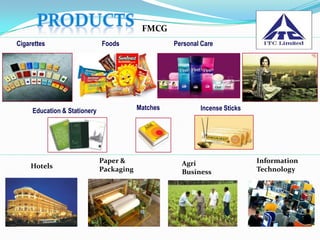
      ITC has a diversified presence in Cigarettes, Hotels, Paperboards &
Specialty Papers, Packaging, Agri-Business, Packaged Foods & Confectionery,
Information Technology, Branded Apparel, Personal Care, Stationery, Safety
Matches and other FMCG products.
       ITC's aspiration to be an exemplar in sustainability practices
 is manifest in its status as the only company in the world of its size and diversity
to be 'carbon positive', 'water positive' and 'solid waste recycling positive.

     ITC's businesses have created sustainable livelihoods for more than 5
million people, a majority of whom represent the poorest in rural India.

    ITC was the first company in India to voluntarily seek a corporate
governance rating .

    ITC's Agri-Business is one of India's largest exporters of agricultural
products.

      ITC is one of the country's biggest foreign exchange earners (US $ 3.2
billion in the last decade).

     As one of India's most valuable and respected corporations, ITC is widely
perceived to be dedicatedly nation-oriented.

 The vision of the company is expressively captured in its corporate positioning
statement: "Enduring Value. For the Nation. For the Shareholder."
       The company was founded as Wills, Watkins & Co. by Henry Overton
Wills and his partner Watkins, who opened a shop in Castle Street, Bristol in
1786. After the retirement of his partner in 1789, it became Wills & Co.

         In 1826 his two sons, William Day Wills and Henry Overton Wills took
over the company.

        In 1830, the company was renamed W.D. & H.O. Wills.

      In 1901 Sir William Henry Wills formed the Imperial Tobacco
Company from a merger of W.D. & H.O. Wills with seven other British tobacco
companies

        ITC was incorporated on August 24, 1910 under the name Imperial
Tobacco Company of India Limited. As the Company's ownership progressively
Indianised, the name of the Company was changed from Imperial Tobacco
Company of India Limited to India Tobacco Company Limited in 1970 and
then toI.T.C. Limited in 1974.
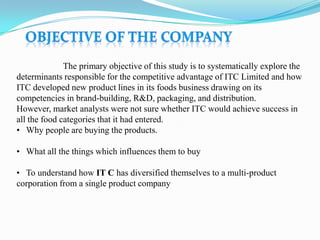
The primary objective of this study is to systematically explore the
determinants responsible for the competitive advantage of ITC Limited and how
ITC developed new product lines in its foods business drawing on its
competencies in brand-building, R&D, packaging, and distribution.
However, market analysts were not sure whether ITC would achieve success in
all the food categories that it had entered.
• Why people are buying the products.

• What all the things which influences them to buy

• To understand how IT C has diversified themselves to a multi-product
corporation from a single product company
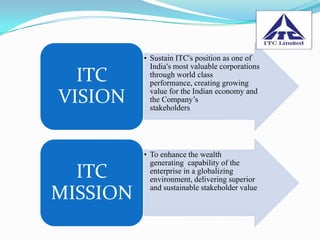
• Sustain ITC's position as one of
            India's most valuable corporations
  ITC       through world class
            performance, creating growing

VISION      value for the Indian economy and
            the Company’s
            stakeholders


          • To enhance the wealth
            generating capability of the
  ITC       enterprise in a globalizing
            environment, delivering superior

MISSION     and sustainable stakeholder value
FMCG
    Cigarettes                    Foods                 Personal Care            Lifestyle Retailing


,


         Education & Stationery               Matches           Incense Sticks


                                  Paper &                 Agri                   Information
        Hotels                    Packaging                                      Technology
                                                          Business
The Basic Concept used by ITC is:

“PRICE IS SOMETHING WHICH CUSTOMER IS READY TO PAY FOR YOUR
PRODUCT”

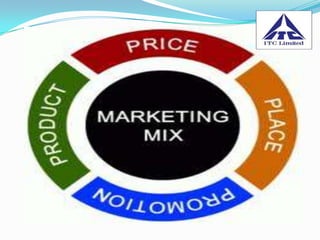
            Pricing is an important strategic issue because it is related to
product positioning. Furthermore, pricing affects other marketing mix elements
such as product features, channel decisions, and promotion.

              While there is no single recipe to determine pricing, the following is
a general sequence of steps that are followed for developing the pricing of
product:
1. Develop marketing strategy - perform marketing
analysis, segmentation, targeting, and positioning. Methods Adopted: Box Plot
Method: i.e. Market Segmentation
2. Make marketing mix decisions - define the product, distribution, and
promotional tactics.
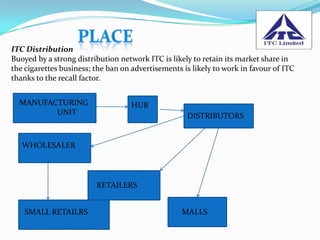
ITC Distribution
Buoyed by a strong distribution network ITC is likely to retain its market share in
the cigarettes business; the ban on advertisements is likely to work in favour of ITC
thanks to the recall factor.


  MANUFACTURING                     HUB
         UNIT                                       DISTRIBUTORS


   WHOLESALER


                         RETAILERS


    SMALL RETAILRS                                 MALLS
 A particular budget is allocated for the promotion of the products,.

 The local promotionscheme is decided by the Area Sales Manages, it give its
suggestion to the District officeand that is forwarded to the Head Quarter in
Kolkata.

 In another promotional scheme for Biscuits a particular number of cases is
given freely to the distributors according to the amount of sale they make, this
was a drop down promotion i.e. of the number of free cases that a particular
distributors gets, off them acertain part is reserved for the retailers and customer
if they buy a certain level of biscuit quantity
Itc

Itc

  • 1.
    Presentation on BY: SUCHORIT CHATTERJEE MBA 3rd SEM SITM
  • 2.
    ITC Limited public conglomerate company headquartered in Kolkata, India.  Its turnover is $7 billion and a market capitalization of over $33 Billion.  It started off as the Imperial Tobacco Company, and shares ancestry with Imperial Tobacco of the United Kingdom, but it is now fully independent, and was rechristened to Indian Tobacco Company in 1970 and then to I.T.C. Limited in 1974  The company is currently headed by Yogesh Chander Deveshwar. It employs over 26,000 people at more than 60 locations across India and is listed on Forbes 2000.  ITC has a diversified presence in Cigarettes, Hotels, Paperboards & Specialty Papers, Packaging, Agri-Business, Packaged Foods & Confectionery, Information Technology, Branded Apparel, Personal Care, Stationery, Safety Matches and other FMCG products.
  • 3.
    ITC's aspiration to be an exemplar in sustainability practices is manifest in its status as the only company in the world of its size and diversity to be 'carbon positive', 'water positive' and 'solid waste recycling positive.  ITC's businesses have created sustainable livelihoods for more than 5 million people, a majority of whom represent the poorest in rural India.  ITC was the first company in India to voluntarily seek a corporate governance rating .  ITC's Agri-Business is one of India's largest exporters of agricultural products.  ITC is one of the country's biggest foreign exchange earners (US $ 3.2 billion in the last decade).  As one of India's most valuable and respected corporations, ITC is widely perceived to be dedicatedly nation-oriented.  The vision of the company is expressively captured in its corporate positioning statement: "Enduring Value. For the Nation. For the Shareholder."
  • 4.
    The company was founded as Wills, Watkins & Co. by Henry Overton Wills and his partner Watkins, who opened a shop in Castle Street, Bristol in 1786. After the retirement of his partner in 1789, it became Wills & Co.  In 1826 his two sons, William Day Wills and Henry Overton Wills took over the company.  In 1830, the company was renamed W.D. & H.O. Wills.  In 1901 Sir William Henry Wills formed the Imperial Tobacco Company from a merger of W.D. & H.O. Wills with seven other British tobacco companies  ITC was incorporated on August 24, 1910 under the name Imperial Tobacco Company of India Limited. As the Company's ownership progressively Indianised, the name of the Company was changed from Imperial Tobacco Company of India Limited to India Tobacco Company Limited in 1970 and then toI.T.C. Limited in 1974.
  • 5.
    The primary objectiveof this study is to systematically explore the determinants responsible for the competitive advantage of ITC Limited and how ITC developed new product lines in its foods business drawing on its competencies in brand-building, R&D, packaging, and distribution. However, market analysts were not sure whether ITC would achieve success in all the food categories that it had entered. • Why people are buying the products. • What all the things which influences them to buy • To understand how IT C has diversified themselves to a multi-product corporation from a single product company
  • 6.
    • Sustain ITC'sposition as one of India's most valuable corporations ITC through world class performance, creating growing VISION value for the Indian economy and the Company’s stakeholders • To enhance the wealth generating capability of the ITC enterprise in a globalizing environment, delivering superior MISSION and sustainable stakeholder value
  • 8.
    FMCG Cigarettes Foods Personal Care Lifestyle Retailing , Education & Stationery Matches Incense Sticks Paper & Agri Information Hotels Packaging Technology Business
  • 9.
    The Basic Conceptused by ITC is: “PRICE IS SOMETHING WHICH CUSTOMER IS READY TO PAY FOR YOUR PRODUCT” Pricing is an important strategic issue because it is related to product positioning. Furthermore, pricing affects other marketing mix elements such as product features, channel decisions, and promotion. While there is no single recipe to determine pricing, the following is a general sequence of steps that are followed for developing the pricing of product: 1. Develop marketing strategy - perform marketing analysis, segmentation, targeting, and positioning. Methods Adopted: Box Plot Method: i.e. Market Segmentation 2. Make marketing mix decisions - define the product, distribution, and promotional tactics.
  • 10.
    ITC Distribution Buoyed bya strong distribution network ITC is likely to retain its market share in the cigarettes business; the ban on advertisements is likely to work in favour of ITC thanks to the recall factor. MANUFACTURING HUB UNIT DISTRIBUTORS WHOLESALER RETAILERS SMALL RETAILRS MALLS
  • 11.
     A particularbudget is allocated for the promotion of the products,.  The local promotionscheme is decided by the Area Sales Manages, it give its suggestion to the District officeand that is forwarded to the Head Quarter in Kolkata.  In another promotional scheme for Biscuits a particular number of cases is given freely to the distributors according to the amount of sale they make, this was a drop down promotion i.e. of the number of free cases that a particular distributors gets, off them acertain part is reserved for the retailers and customer if they buy a certain level of biscuit quantity