
SOLUTIONS®


                         Competency Models: Types and Techniques

                         • Top Management Programme 2011
TRAINING


                         • Dr. Michael Layton
                         • HSBC - Mr. Miguel Cortes – Senior
                           Executive
DELIVERING INNOVATIVE


                        © 2010 ITAM, Inc. | All rights reserved.
What is Competency Mapping?


   It is about identifying preferred
 behaviors and personal skills which
 distinguish excellent and outstanding
 performance from the average. A
 Competency is the ingredients (skills,
 knowledge, attributes and behaviors)
 that contribute to excellence.


      CapitalWave, Inc.                           HSBC - Mr. Miguel Cortes – Senior Executive
© 2010 CapitalWave, Inc.rights reserved.
 © 2010 ITAM, Inc. | All | All rights reserved.

                                                                                Page 2
When should Competencies be Used?


  The use of Competencies can include:
assessment during recruitment, assessment
during further development; as a profile
during assessment to guide future
development needs; succession planning
and promotion; organizational development
analysis.

  Techniques used to map Competencies
include Critical Incident Analysis and
Repertory Grid.

      CapitalWave, Inc.                           HSBC - Mr. Miguel Cortes – Senior Executive
© 2010 CapitalWave, Inc.rights reserved.
 © 2010 ITAM, Inc. | All | All rights reserved.

                                                                                Page 3
What is Critical Incident Technique?


 Respondents are asked to relate specific
 incidents, which highlighted exemplary
 behaviors in critical situations. This is
 based on the assumption that the best
 and the worst of a person surfaces in a
 crisis.


      CapitalWave, Inc.                           HSBC - Mr. Miguel Cortes – Senior Executive
© 2010 CapitalWave, Inc.rights reserved.
 © 2010 ITAM, Inc. | All | All rights reserved.

                                                                                Page 4
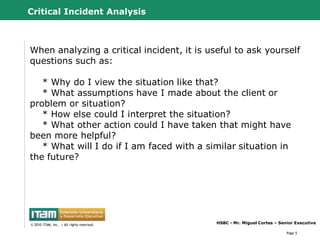
Critical Incident Analysis


When analyzing a critical incident, it is useful to ask yourself
questions such as:

   * Why do I view the situation like that?
   * What assumptions have I made about the client or
problem or situation?
   * How else could I interpret the situation?
   * What other action could I have taken that might have
been more helpful?
   * What will I do if I am faced with a similar situation in
the future?


      CapitalWave, Inc.                           HSBC - Mr. Miguel Cortes – Senior Executive
© 2010 CapitalWave, Inc.rights reserved.
 © 2010 ITAM, Inc. | All | All rights reserved.

                                                                                Page 5
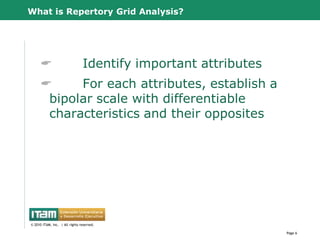
What is Repertory Grid Analysis?


                                Identify important attributes
           For each attributes, establish a
       bipolar scale with differentiable
       characteristics and their opposites


      CapitalWave, Inc.
© 2010 CapitalWave, Inc.rights reserved.
 © 2010 ITAM, Inc. | All | All rights reserved.

                                                                 Page 6
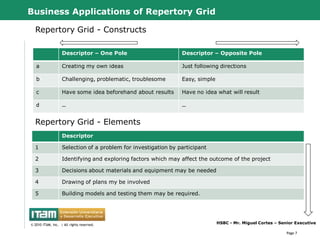
Business Applications of Repertory Grid

   Repertory Grid - Constructs

                    Descriptor – One Pole                        Descriptor – Opposite Pole

    a               Creating my own ideas                        Just following directions

    b               Challenging, problematic, troublesome        Easy, simple

    c               Have some idea beforehand about results      Have no idea what will result

    d               …                                            …


   Repertory Grid - Elements
                    Descriptor

   1                Selection of a problem for investigation by participant

   2                Identifying and exploring factors which may affect the outcome of the project

   3                Decisions about materials and equipment may be needed

   4                Drawing of plans my be involved

   5                Building models and testing them may be required.


        CapitalWave, Inc.                                                       HSBC - Mr. Miguel Cortes – Senior Executive
© 2010 CapitalWave, Inc.rights reserved.
 © 2010 ITAM, Inc. | All | All rights reserved.

                                                                                                              Page 7
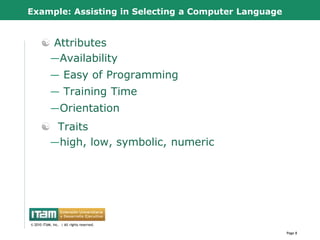
Example: Assisting in Selecting a Computer Language


        Attributes
        —Availability
            — Easy of Programming
            — Training Time
            —Orientation
        Traits
        —high, low, symbolic, numeric


      CapitalWave, Inc.
© 2010 CapitalWave, Inc.rights reserved.
 © 2010 ITAM, Inc. | All | All rights reserved.

                                                      Page 8
Business Applications of Repertory Grid


        Market Research
    Quality Control
    Compliance
    Job Analysis and Design
    Decision Making


      CapitalWave, Inc.                           HSBC - Mr. Miguel Cortes – Senior Executive
© 2010 CapitalWave, Inc.rights reserved.
 © 2010 ITAM, Inc. | All | All rights reserved.

                                                                                Page 9
Example Models


        Competency models
         “Organizational” Approaches Models
         “HR Systems” Approaches Models
         “Team” Approaches Models
               Individualistic Models


      CapitalWave, Inc.                           HSBC - Mr. Miguel Cortes – Senior Executive
© 2010 CapitalWave, Inc.rights reserved.
 © 2010 ITAM, Inc. | All | All rights reserved.

                                                                               Page 10
“Organizational” Approach Model


             Elliot Jaques provides a normative model of
      effective hierarchical organizations with an
      emphasis on competencies. The elements include
      the present and potential competencies of
      individuals along the dimensions of cognitive
      capacity, valuing the work, and non-disruptive
      personality.
             Peter Senge‟s approach to a whole
      organization competency model is captured in his
      notion of the "learning organization." Its essential
      characteristics include nurturing the growth of new
      capabilities, transformational learning for survival,
      learning through performance and practice, and the
      inseparability of process and content.


      CapitalWave, Inc.                           HSBC - Mr. Miguel Cortes – Senior Executive
© 2010 CapitalWave, Inc.rights reserved.
 © 2010 ITAM, Inc. | All | All rights reserved.

                                                                               Page 11
“HR Systems” Approach Model

        Dubois focuses on the whole human
 resources system, but emphasizes
 competency improvements through training
 and development strategies and
 programming: the contingencies are driven
 by organizational strategy but outcomes are
 focused on individual employees‟ competency
 enhancement. Charles Snow‟s contingency
 model links organizational performance to
 HRM and competency. Strategies depend on
 extent to which cause-effect relations
 affecting organizational performance are
 known and degree of formalized standards of
 desirable performance.
      CapitalWave, Inc.                           HSBC - Mr. Miguel Cortes – Senior Executive
© 2010 CapitalWave, Inc.rights reserved.
 © 2010 ITAM, Inc. | All | All rights reserved.

                                                                               Page 12
“TEAM” Approach Model


      Campion‟s model, which applies to
professional work, suggests that teams
composed of individuals with complementary
competencies are more effective and have
higher levels of job satisfaction than teams
whose members have the same competency
sets. This is especially true for work that is
complex and varied in scope.


      CapitalWave, Inc.                           HSBC - Mr. Miguel Cortes – Senior Executive
© 2010 CapitalWave, Inc.rights reserved.
 © 2010 ITAM, Inc. | All | All rights reserved.

                                                                               Page 13
“Individualistic” Approach Model


 Traditional Person-Job Match Model
           This model assumes that employees have jobs with
           specific and identifiable tasks. Work is generally
           standardized and repetitive in an organizational hierarchy.
           Job performance is readily verifiable. This model works
           best with organizations defined by stable environments
 Strategy Based Model
           This model assumes that employees have roles defined by
           the organization‟s strategic goals. Work is flexibly defined
           and often carried out in a flattened, decentralized or
           matrix structure. Role performance is only partially
           verifiable. This model functions most effectively in
           organizations in competitive, complex or highly stressed
           environments.

      CapitalWave, Inc.                           HSBC - Mr. Miguel Cortes – Senior Executive
© 2010 CapitalWave, Inc.rights reserved.
 © 2010 ITAM, Inc. | All | All rights reserved.

                                                                               Page 14
“Individualistic” Approach Model (continued..)


 The Strategy Development Model
         This model assumes that employees with broad,
 strategic “attributes” will create their own roles which
 interact to produce the organization‟s strategy. Work is
 constantly evolving within a network of organizational
 relationships. This model is described in terms of
 organizations in chaotic, unpredictable, or very rapidly
 changing environments.
 Intellectual Capital Model
         These models emphasize the linkages and dynamic
 interaction among human capital, structural capital, and
 customer (client) capital. These models stress the
 knowledge that resides in employees and strategies to use
 it and value it differently.

      CapitalWave, Inc.                           HSBC - Mr. Miguel Cortes – Senior Executive
© 2010 CapitalWave, Inc.rights reserved.
 © 2010 ITAM, Inc. | All | All rights reserved.

                                                                               Page 15
Which Competency Model is Right?


 Companies create and use the Competency
 models to specify the employee behaviors,
 knowledge, and motivations that they believe
 are necessary to produce organizationally critical
 results.

 But if the model is not quite right, the
 organization will suffer. To determine the right
 model it is essential to look at actual data --
 assessments of employees„ competencies and of
 the results they achieve.


      CapitalWave, Inc.                           HSBC - Mr. Miguel Cortes – Senior Executive
© 2010 CapitalWave, Inc.rights reserved.
 © 2010 ITAM, Inc. | All | All rights reserved.

                                                                               Page 16
Competencies Equal Critical Success


 As a conclusion we can say that ,it is through
 the competencies of its employees executives,
 managers, and individual contributors -- that an
 organization
 executes its strategy and achieves results that
 are crucial to its success.


      CapitalWave, Inc.                           HSBC - Mr. Miguel Cortes – Senior Executive
© 2010 CapitalWave, Inc.rights reserved.
 © 2010 ITAM, Inc. | All | All rights reserved.

                                                                               Page 17
Questions?


      CapitalWave, Inc.                           HSBC - Mr. Miguel Cortes – Senior Executive
© 2010 CapitalWave, Inc.rights reserved.
 © 2010 ITAM, Inc. | All | All rights reserved.

                                                                               Page 18

ITAM Competency Models Types And Techniques 2011

  • 1.
    SOLUTIONS® Competency Models: Types and Techniques • Top Management Programme 2011 TRAINING • Dr. Michael Layton • HSBC - Mr. Miguel Cortes – Senior Executive DELIVERING INNOVATIVE © 2010 ITAM, Inc. | All rights reserved.
  • 2.
    What is CompetencyMapping? It is about identifying preferred behaviors and personal skills which distinguish excellent and outstanding performance from the average. A Competency is the ingredients (skills, knowledge, attributes and behaviors) that contribute to excellence. CapitalWave, Inc. HSBC - Mr. Miguel Cortes – Senior Executive © 2010 CapitalWave, Inc.rights reserved. © 2010 ITAM, Inc. | All | All rights reserved. Page 2
  • 3.
    When should Competenciesbe Used? The use of Competencies can include: assessment during recruitment, assessment during further development; as a profile during assessment to guide future development needs; succession planning and promotion; organizational development analysis. Techniques used to map Competencies include Critical Incident Analysis and Repertory Grid. CapitalWave, Inc. HSBC - Mr. Miguel Cortes – Senior Executive © 2010 CapitalWave, Inc.rights reserved. © 2010 ITAM, Inc. | All | All rights reserved. Page 3
  • 4.
    What is CriticalIncident Technique? Respondents are asked to relate specific incidents, which highlighted exemplary behaviors in critical situations. This is based on the assumption that the best and the worst of a person surfaces in a crisis. CapitalWave, Inc. HSBC - Mr. Miguel Cortes – Senior Executive © 2010 CapitalWave, Inc.rights reserved. © 2010 ITAM, Inc. | All | All rights reserved. Page 4
  • 5.
    Critical Incident Analysis Whenanalyzing a critical incident, it is useful to ask yourself questions such as: * Why do I view the situation like that? * What assumptions have I made about the client or problem or situation? * How else could I interpret the situation? * What other action could I have taken that might have been more helpful? * What will I do if I am faced with a similar situation in the future? CapitalWave, Inc. HSBC - Mr. Miguel Cortes – Senior Executive © 2010 CapitalWave, Inc.rights reserved. © 2010 ITAM, Inc. | All | All rights reserved. Page 5
  • 6.
    What is RepertoryGrid Analysis?  Identify important attributes  For each attributes, establish a bipolar scale with differentiable characteristics and their opposites CapitalWave, Inc. © 2010 CapitalWave, Inc.rights reserved. © 2010 ITAM, Inc. | All | All rights reserved. Page 6
  • 7.
    Business Applications ofRepertory Grid Repertory Grid - Constructs Descriptor – One Pole Descriptor – Opposite Pole a Creating my own ideas Just following directions b Challenging, problematic, troublesome Easy, simple c Have some idea beforehand about results Have no idea what will result d … … Repertory Grid - Elements Descriptor 1 Selection of a problem for investigation by participant 2 Identifying and exploring factors which may affect the outcome of the project 3 Decisions about materials and equipment may be needed 4 Drawing of plans my be involved 5 Building models and testing them may be required. CapitalWave, Inc. HSBC - Mr. Miguel Cortes – Senior Executive © 2010 CapitalWave, Inc.rights reserved. © 2010 ITAM, Inc. | All | All rights reserved. Page 7
  • 8.
    Example: Assisting inSelecting a Computer Language  Attributes —Availability — Easy of Programming — Training Time —Orientation  Traits —high, low, symbolic, numeric CapitalWave, Inc. © 2010 CapitalWave, Inc.rights reserved. © 2010 ITAM, Inc. | All | All rights reserved. Page 8
  • 9.
    Business Applications ofRepertory Grid  Market Research  Quality Control  Compliance  Job Analysis and Design  Decision Making CapitalWave, Inc. HSBC - Mr. Miguel Cortes – Senior Executive © 2010 CapitalWave, Inc.rights reserved. © 2010 ITAM, Inc. | All | All rights reserved. Page 9
  • 10.
    Example Models Competency models  “Organizational” Approaches Models  “HR Systems” Approaches Models  “Team” Approaches Models  Individualistic Models CapitalWave, Inc. HSBC - Mr. Miguel Cortes – Senior Executive © 2010 CapitalWave, Inc.rights reserved. © 2010 ITAM, Inc. | All | All rights reserved. Page 10
  • 11.
    “Organizational” Approach Model Elliot Jaques provides a normative model of effective hierarchical organizations with an emphasis on competencies. The elements include the present and potential competencies of individuals along the dimensions of cognitive capacity, valuing the work, and non-disruptive personality. Peter Senge‟s approach to a whole organization competency model is captured in his notion of the "learning organization." Its essential characteristics include nurturing the growth of new capabilities, transformational learning for survival, learning through performance and practice, and the inseparability of process and content. CapitalWave, Inc. HSBC - Mr. Miguel Cortes – Senior Executive © 2010 CapitalWave, Inc.rights reserved. © 2010 ITAM, Inc. | All | All rights reserved. Page 11
  • 12.
    “HR Systems” ApproachModel Dubois focuses on the whole human resources system, but emphasizes competency improvements through training and development strategies and programming: the contingencies are driven by organizational strategy but outcomes are focused on individual employees‟ competency enhancement. Charles Snow‟s contingency model links organizational performance to HRM and competency. Strategies depend on extent to which cause-effect relations affecting organizational performance are known and degree of formalized standards of desirable performance. CapitalWave, Inc. HSBC - Mr. Miguel Cortes – Senior Executive © 2010 CapitalWave, Inc.rights reserved. © 2010 ITAM, Inc. | All | All rights reserved. Page 12
  • 13.
    “TEAM” Approach Model Campion‟s model, which applies to professional work, suggests that teams composed of individuals with complementary competencies are more effective and have higher levels of job satisfaction than teams whose members have the same competency sets. This is especially true for work that is complex and varied in scope. CapitalWave, Inc. HSBC - Mr. Miguel Cortes – Senior Executive © 2010 CapitalWave, Inc.rights reserved. © 2010 ITAM, Inc. | All | All rights reserved. Page 13
  • 14.
    “Individualistic” Approach Model Traditional Person-Job Match Model This model assumes that employees have jobs with specific and identifiable tasks. Work is generally standardized and repetitive in an organizational hierarchy. Job performance is readily verifiable. This model works best with organizations defined by stable environments Strategy Based Model This model assumes that employees have roles defined by the organization‟s strategic goals. Work is flexibly defined and often carried out in a flattened, decentralized or matrix structure. Role performance is only partially verifiable. This model functions most effectively in organizations in competitive, complex or highly stressed environments. CapitalWave, Inc. HSBC - Mr. Miguel Cortes – Senior Executive © 2010 CapitalWave, Inc.rights reserved. © 2010 ITAM, Inc. | All | All rights reserved. Page 14
  • 15.
    “Individualistic” Approach Model(continued..) The Strategy Development Model This model assumes that employees with broad, strategic “attributes” will create their own roles which interact to produce the organization‟s strategy. Work is constantly evolving within a network of organizational relationships. This model is described in terms of organizations in chaotic, unpredictable, or very rapidly changing environments. Intellectual Capital Model These models emphasize the linkages and dynamic interaction among human capital, structural capital, and customer (client) capital. These models stress the knowledge that resides in employees and strategies to use it and value it differently. CapitalWave, Inc. HSBC - Mr. Miguel Cortes – Senior Executive © 2010 CapitalWave, Inc.rights reserved. © 2010 ITAM, Inc. | All | All rights reserved. Page 15
  • 16.
    Which Competency Modelis Right? Companies create and use the Competency models to specify the employee behaviors, knowledge, and motivations that they believe are necessary to produce organizationally critical results. But if the model is not quite right, the organization will suffer. To determine the right model it is essential to look at actual data -- assessments of employees„ competencies and of the results they achieve. CapitalWave, Inc. HSBC - Mr. Miguel Cortes – Senior Executive © 2010 CapitalWave, Inc.rights reserved. © 2010 ITAM, Inc. | All | All rights reserved. Page 16
  • 17.
    Competencies Equal CriticalSuccess As a conclusion we can say that ,it is through the competencies of its employees executives, managers, and individual contributors -- that an organization executes its strategy and achieves results that are crucial to its success. CapitalWave, Inc. HSBC - Mr. Miguel Cortes – Senior Executive © 2010 CapitalWave, Inc.rights reserved. © 2010 ITAM, Inc. | All | All rights reserved. Page 17
  • 18.
    Questions? CapitalWave, Inc. HSBC - Mr. Miguel Cortes – Senior Executive © 2010 CapitalWave, Inc.rights reserved. © 2010 ITAM, Inc. | All | All rights reserved. Page 18