IT Strategy
Today Three eras of IT/IS revolution Strategic Information Systems The role of IT/IS in competition Porter’s 5 competitive forces Porter’s value chain Some other academic views Cases Managerial issues
Three eras of I.T. evolution Mainframe Era (1950’s-1970’s) Microcomputer Era (late 1970’s to 1980’s) Network Era (late 1980’s to present) Ubiquitous computing (wireless)
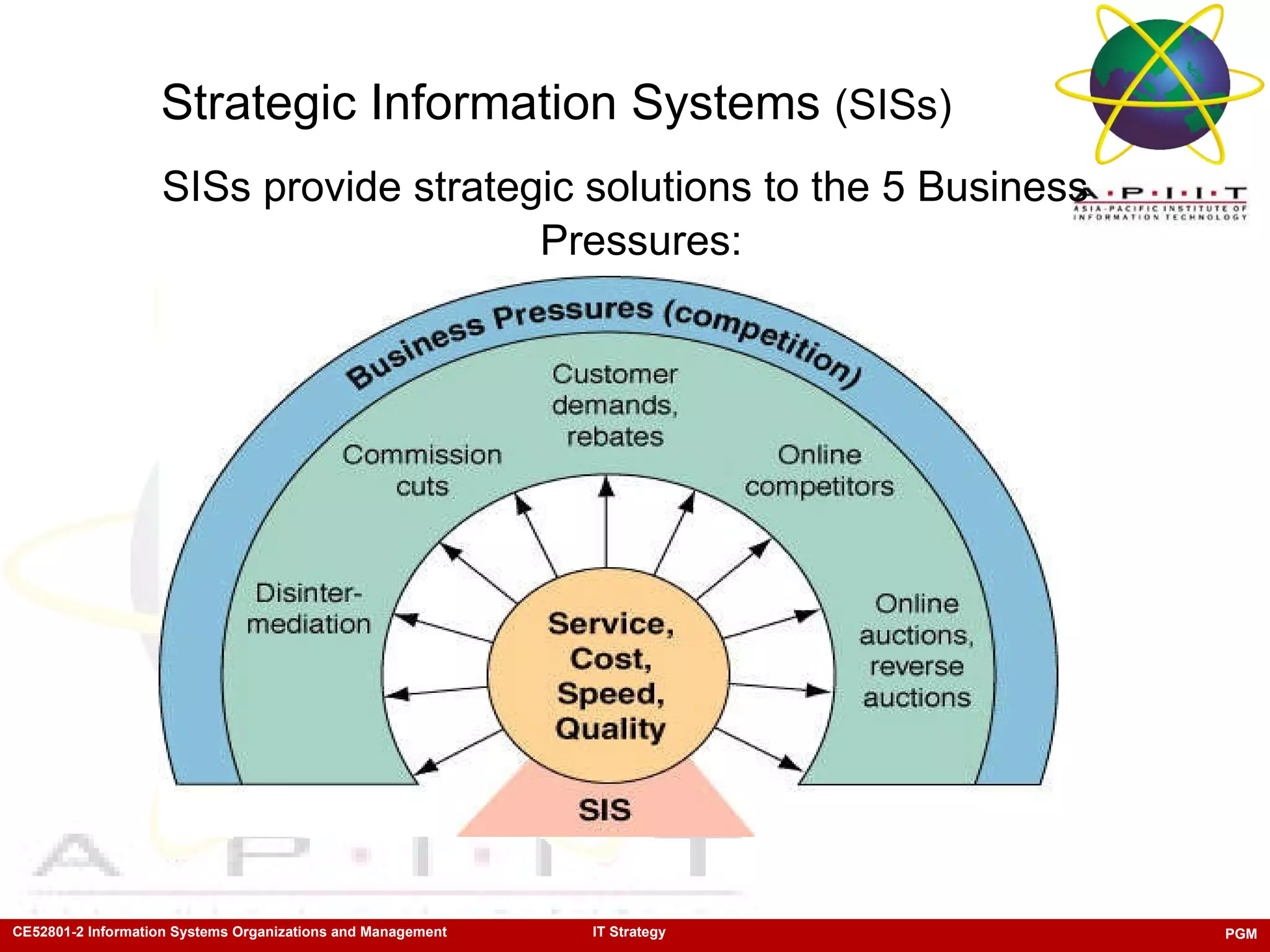
Strategic Information Systems  (SISs) SISs provide strategic solutions to the 5 Business Pressures:
The Role of IT in Business Innovation IT creates applications that provide strategic advantages to companies IT is a competitive weapon IT supports strategic change ,  e.g,  re-engineering IT networks with business partners IT provides cost reduction IT provides competitive business intelligence
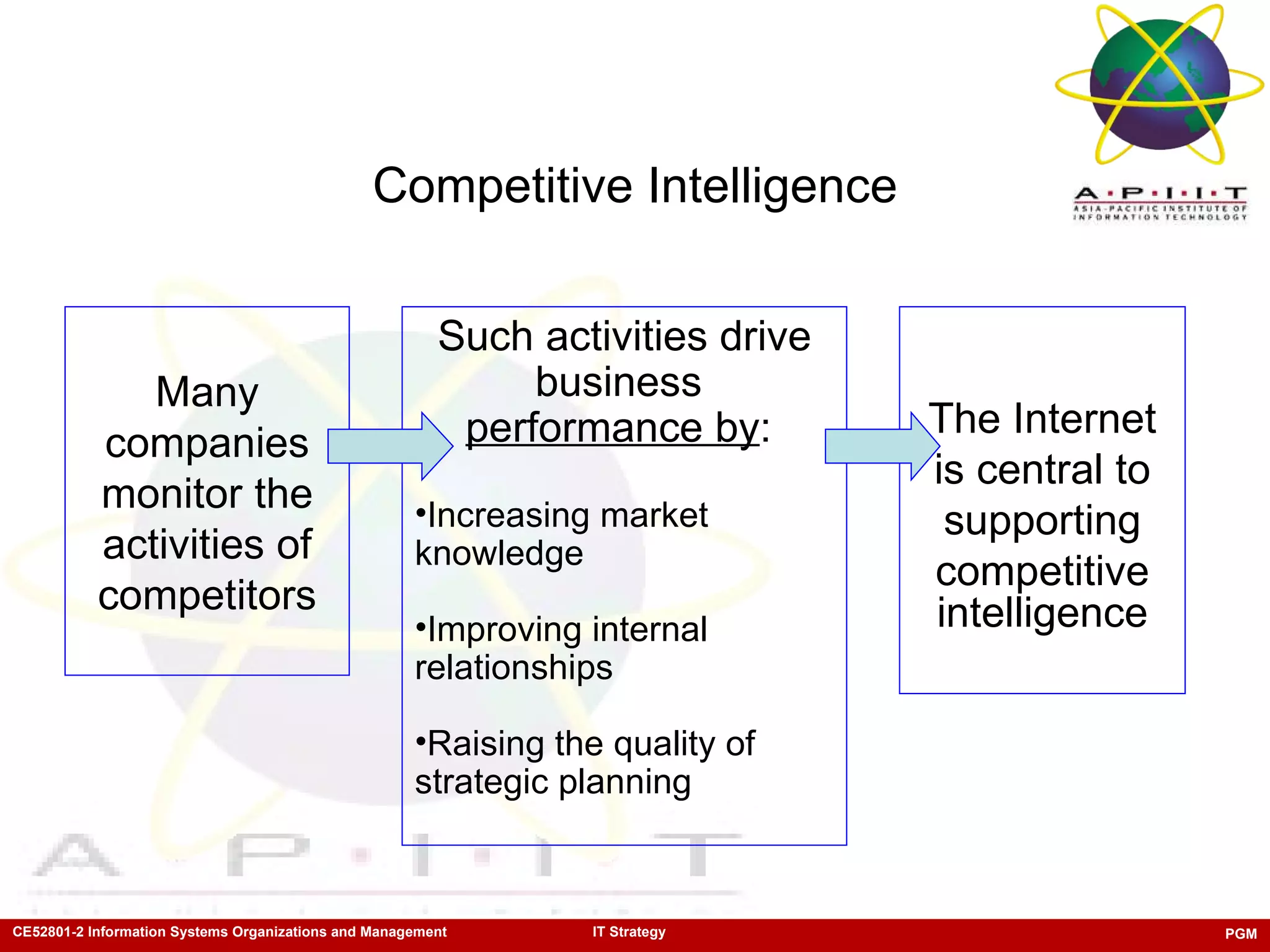
Competitive Intelligence The Internet is central to supporting competitive intelligence Such activities drive business  performance by :  Increasing market knowledge Improving internal relationships Raising the quality of strategic planning Many companies monitor the activities of competitors
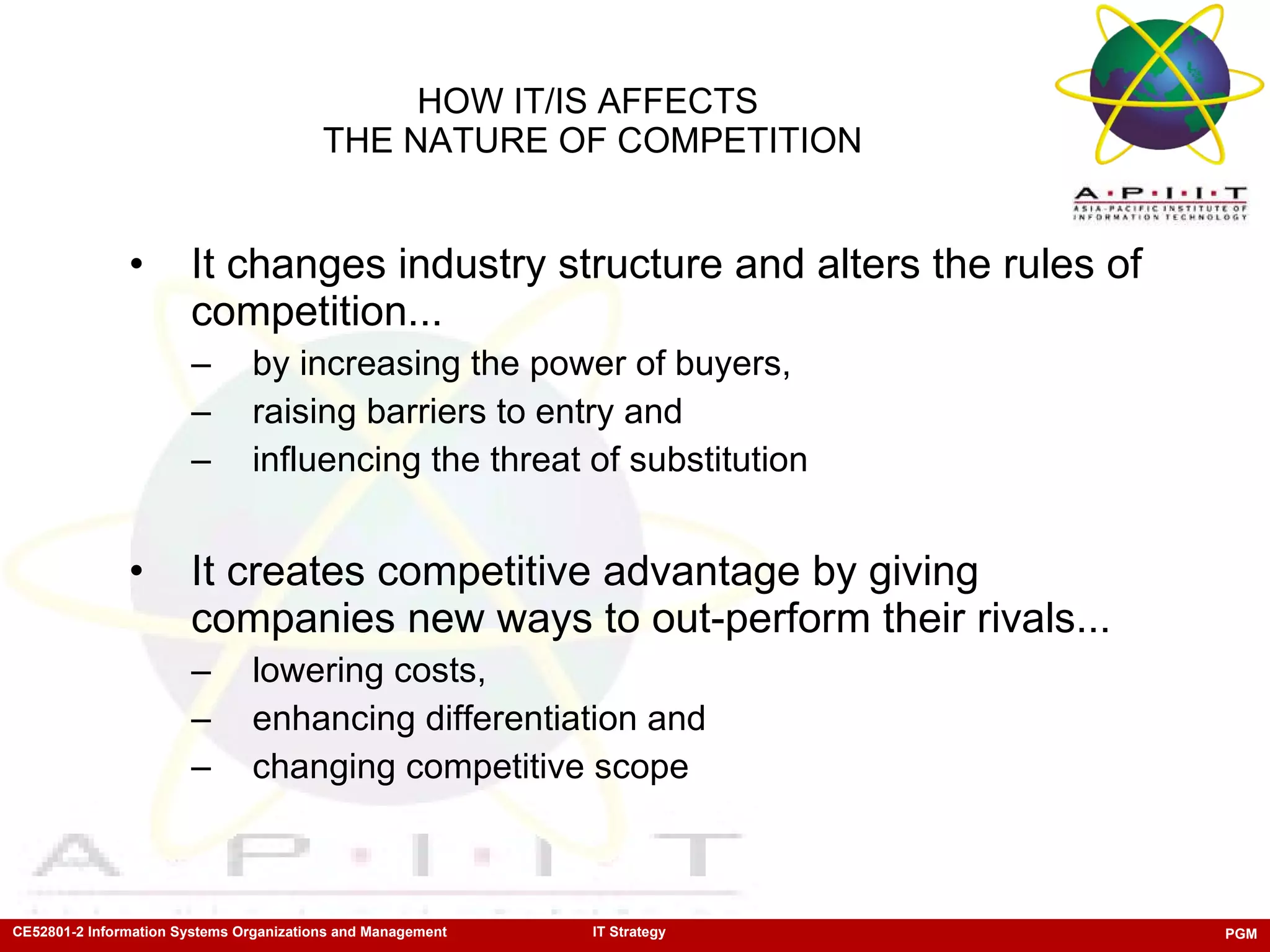
It changes industry structure and alters the rules of competition... by increasing the power of buyers,  raising barriers to entry and  influencing the threat of substitution It creates competitive advantage by giving  companies new ways to out-perform their rivals... lowering costs,  enhancing differentiation and  changing competitive scope HOW IT/IS AFFECTS  THE NATURE OF COMPETITION
It spawns whole new businesses, often from within a company's own operations... by making  new businesses technologically feasible creating derived demand for new products and  creating new businesses within old ones. HOW IT/IS AFFECTS  THE NATURE OF COMPETITION
Technology  versus  Management of technology I.T. is so accessible today that organisations cannot compete on technology alone. The competitive advantage is derived from how the technology is used. Today the management of technology   has become a critical issue in competing more effectively.  The issue is not whether to invest in I.T. but where and how.
What can help us: think and  analyse situations
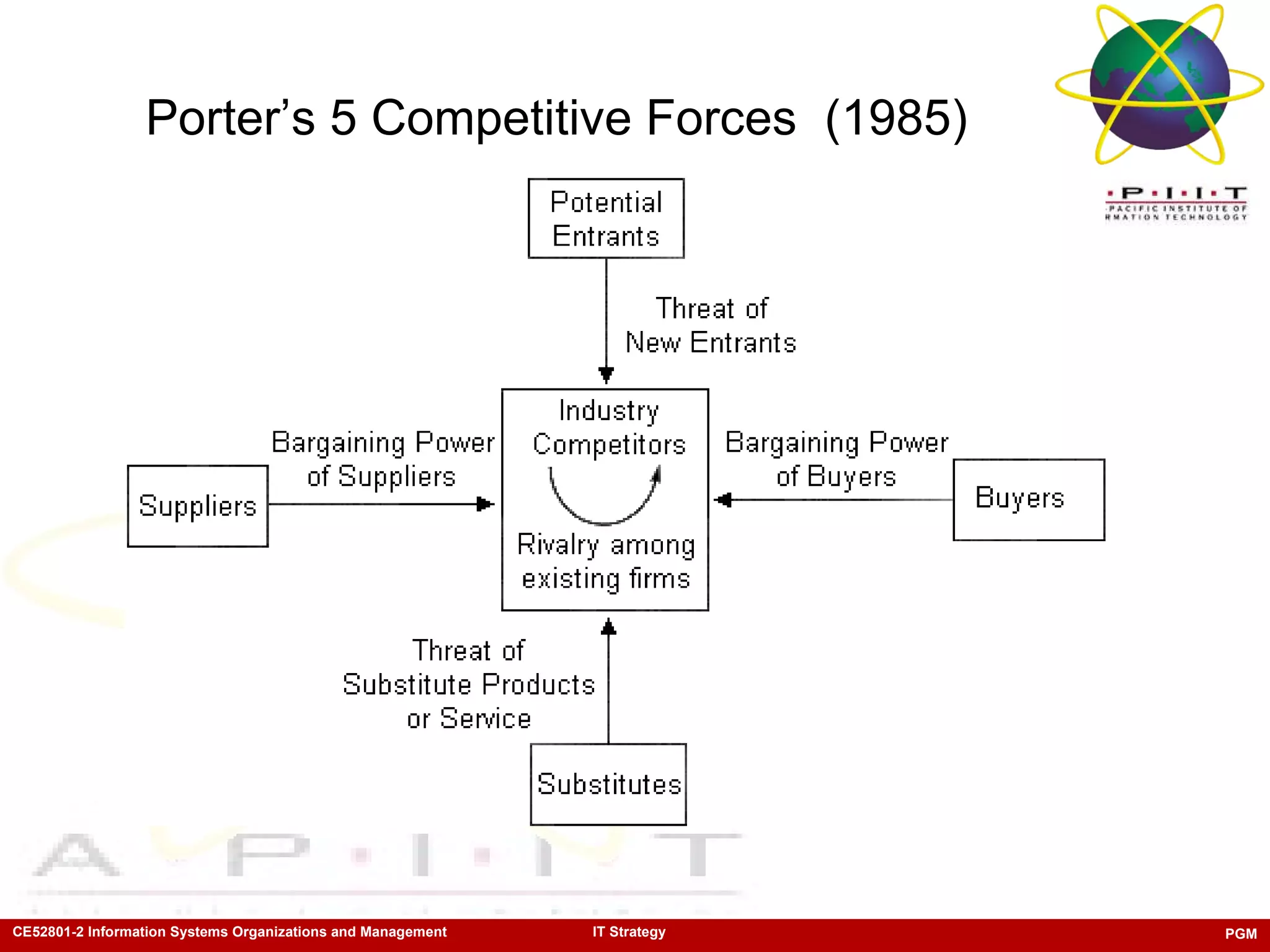
Porter’s 5 Competitive Forces  (1985) The threat of entry of new competitors. The bargaining power of suppliers. The bargaining power of customers (buyers). The threat of substitute products or services. The rivalry among existing firms in the industry.
Porter’s 5 Competitive Forces  (1985)
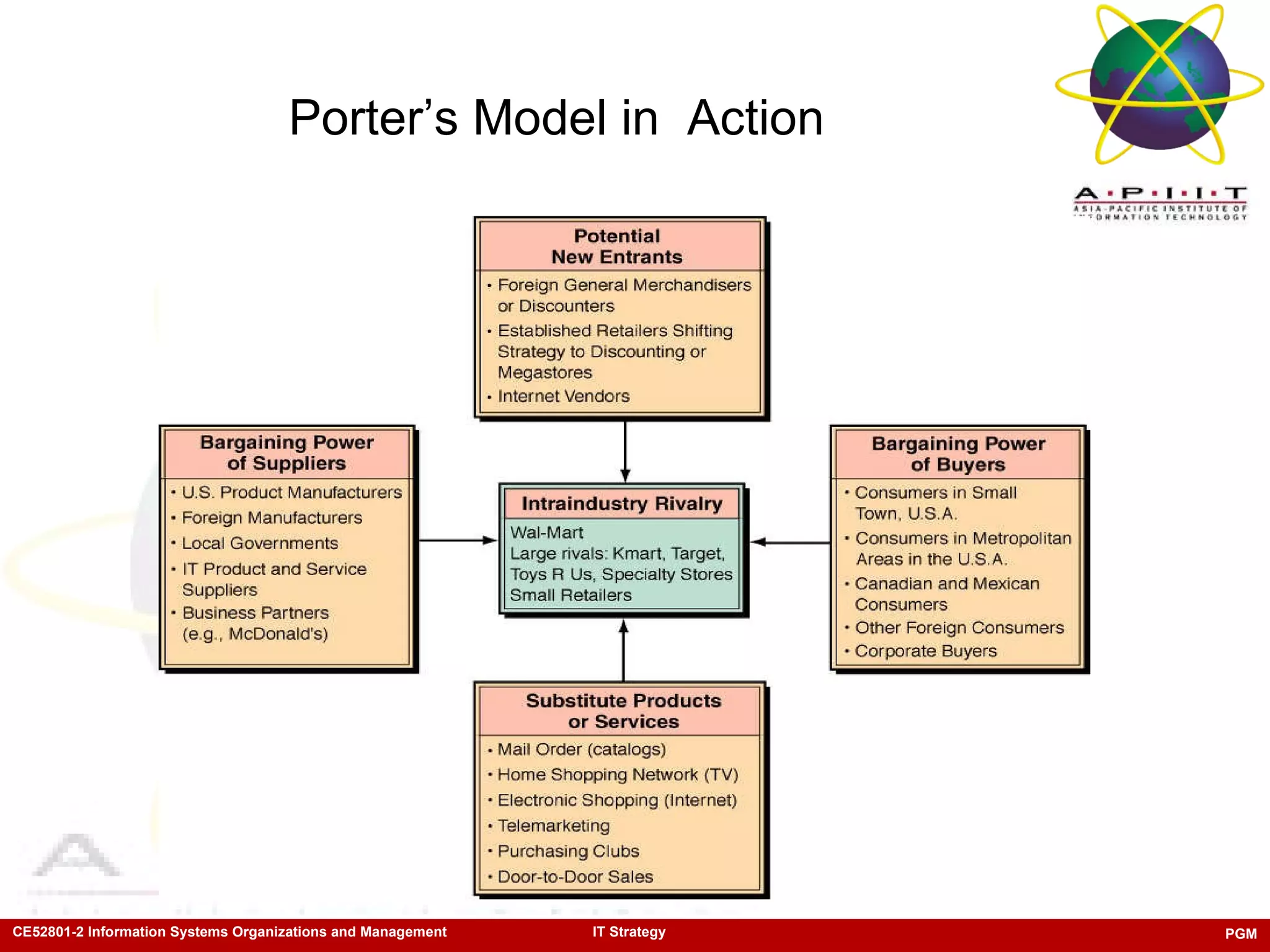
Porter’s Model in  Action
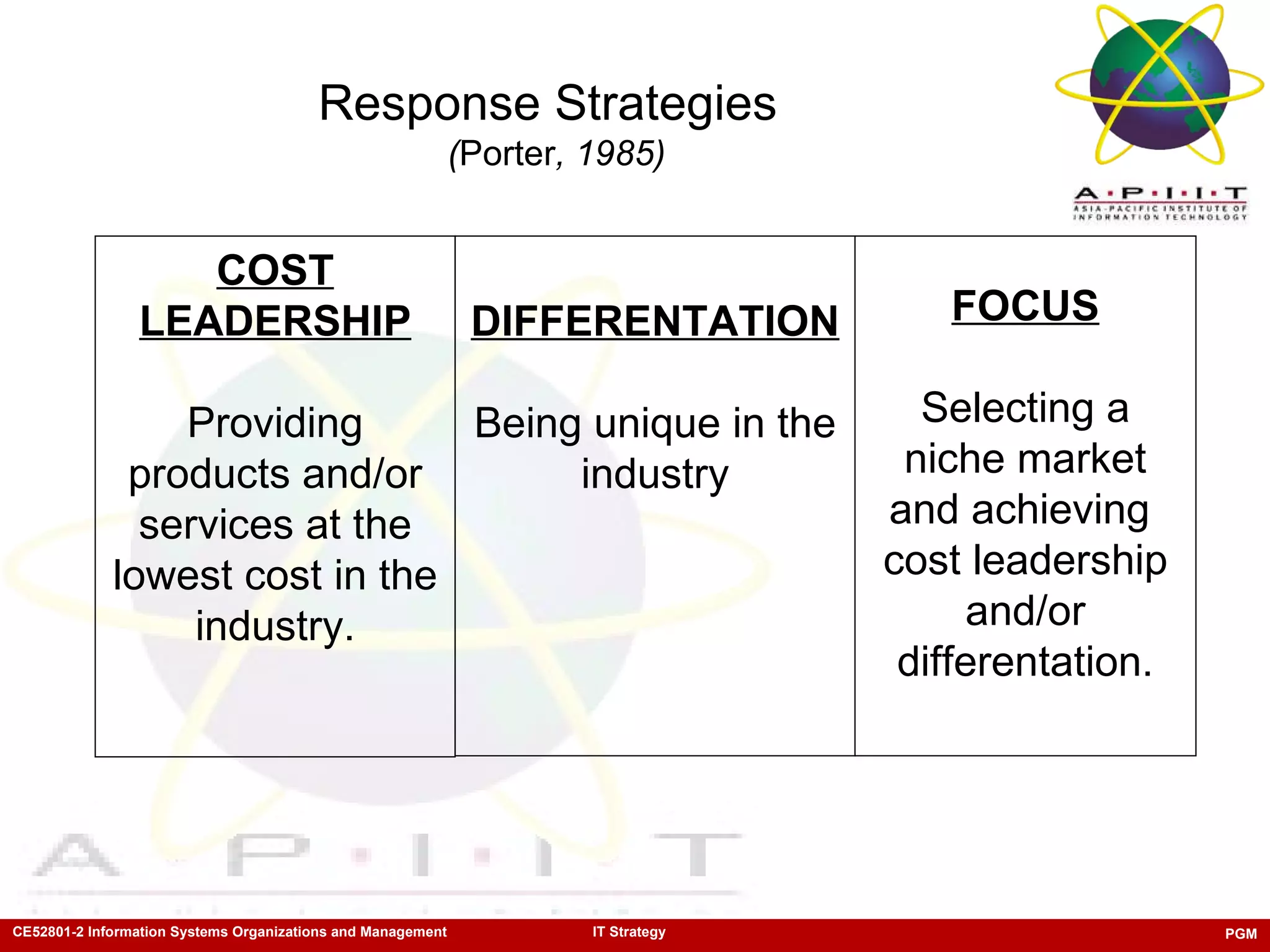
Response Strategies   ( Porter , 1985) FOCUS Selecting a niche market and achieving  cost leadership and/or differentation. DIFFERENTATION Being unique in the industry COST LEADERSHIP Providing products and/or services at the lowest cost in the industry.
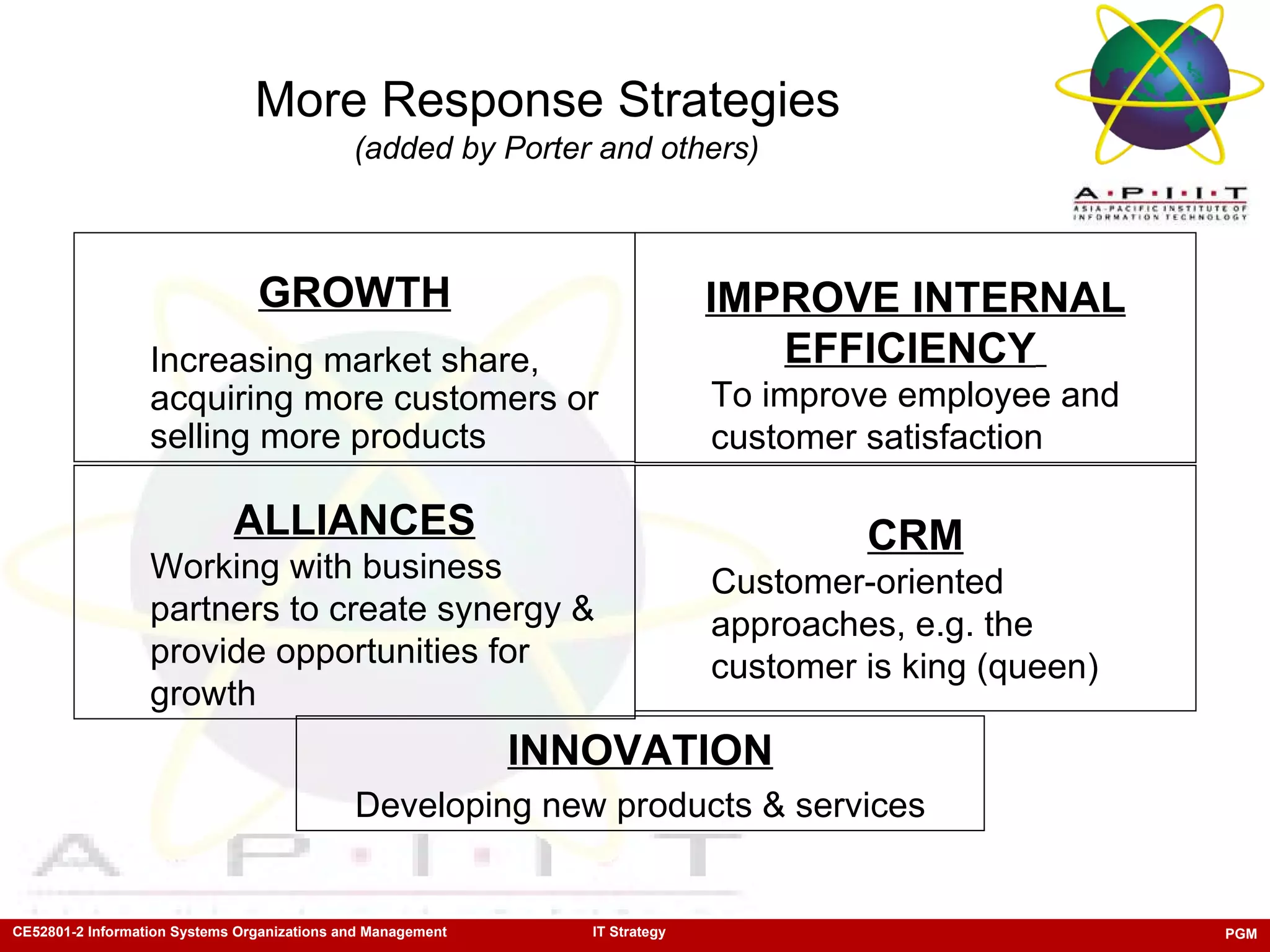
More Response Strategies   (added by Porter and others) INNOVATION Developing new products & services GROWTH Increasing market share, acquiring more customers or selling more products  IMPROVE INTERNAL EFFICIENCY   To improve employee and customer satisfaction ALLIANCES Working with business partners to create synergy & provide opportunities for growth CRM Customer-oriented approaches, e.g. the customer is king (queen)
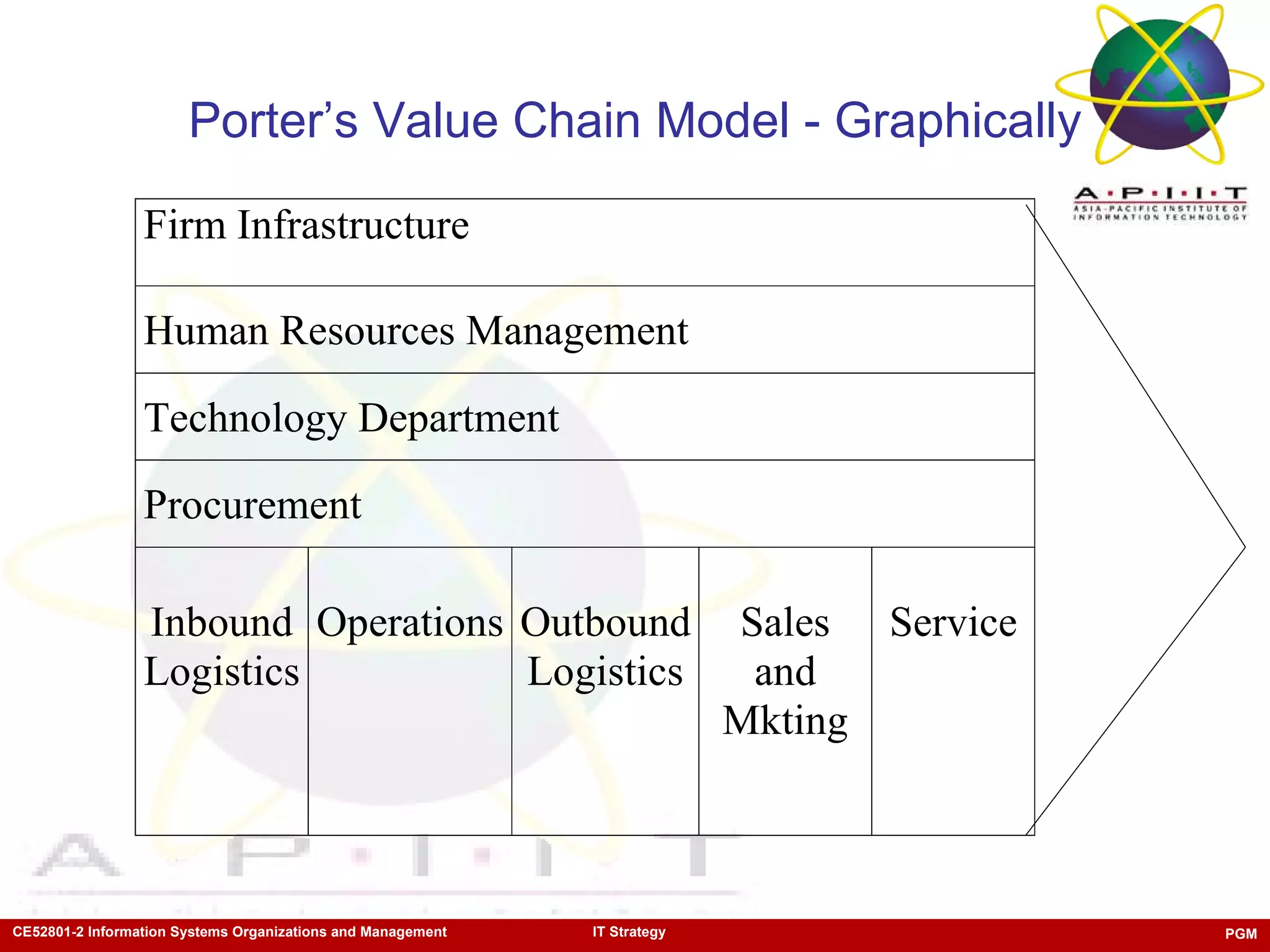
Porter’s Value Chain Model - Graphically
Porter’s Value Chain Model (1985) PRIMARY ACTIVITIES  Inbound logistics  (inputs) Operations (manufacturing & testing) Outbound logistics (storage & distribution) Marketing & sales Service Supply  Chain
Porter’s Value Chain Model SUPPORT ACTIVITIES   Firm Infrastructure Human Resources Management  Technology Development Procurement
VALUE SYSTEM   A firm’s value chain is part of a larger stream of activities, which Porter calls a  “Value System ” Includes the suppliers that provide the  necessary inputs AND their value chains Applies to both products & services, for any  organization, PUBLIC or PRIVATE The basis for the Supply Chain Management Think about UPSTREAM and DOWNSTREAM
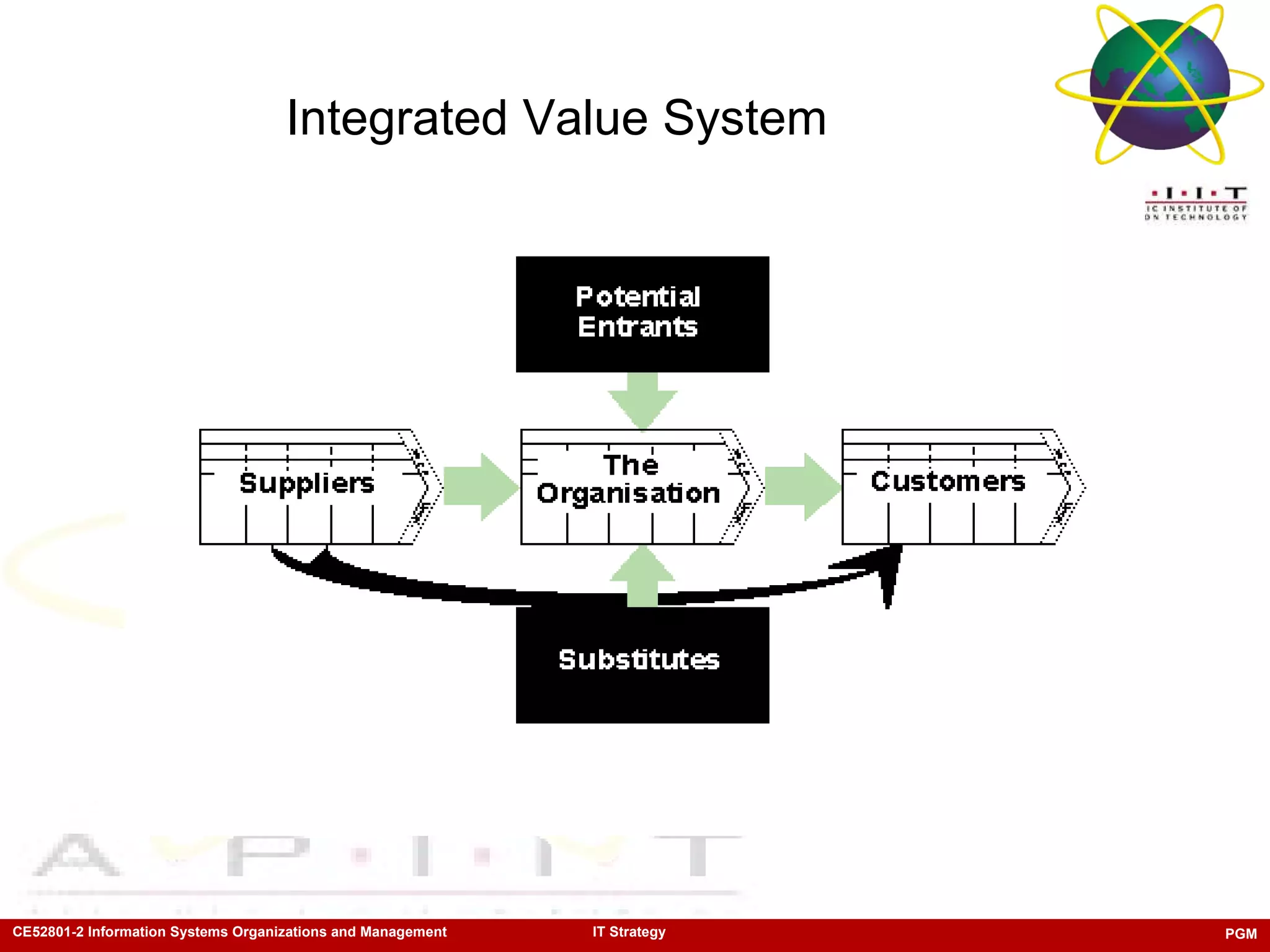
Integrated Value System
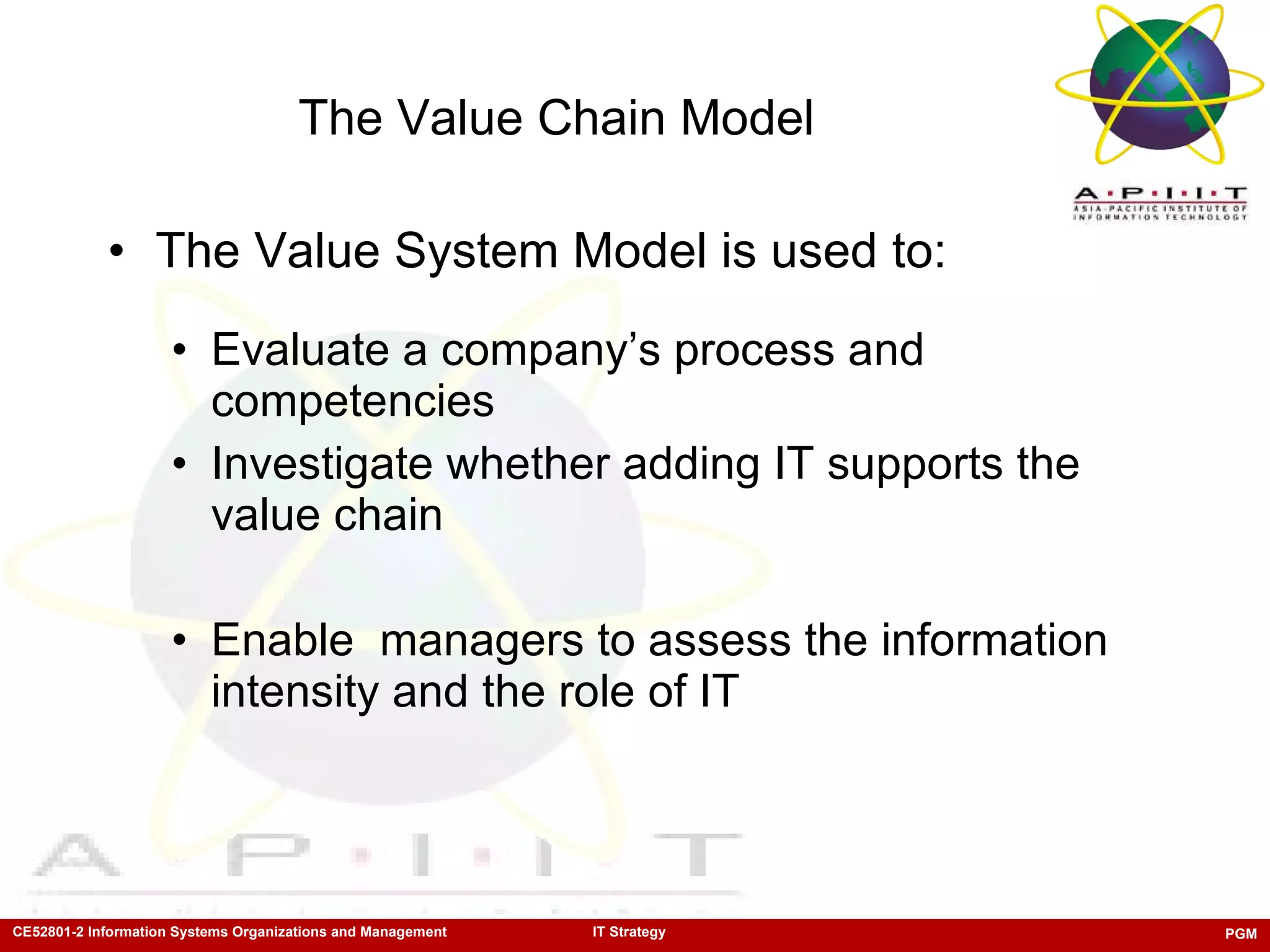
The Value Chain Model The Value System Model is used to: Evaluate a company’s process and competencies Investigate whether adding IT supports the value chain Enable  managers to assess the information intensity and the role of IT
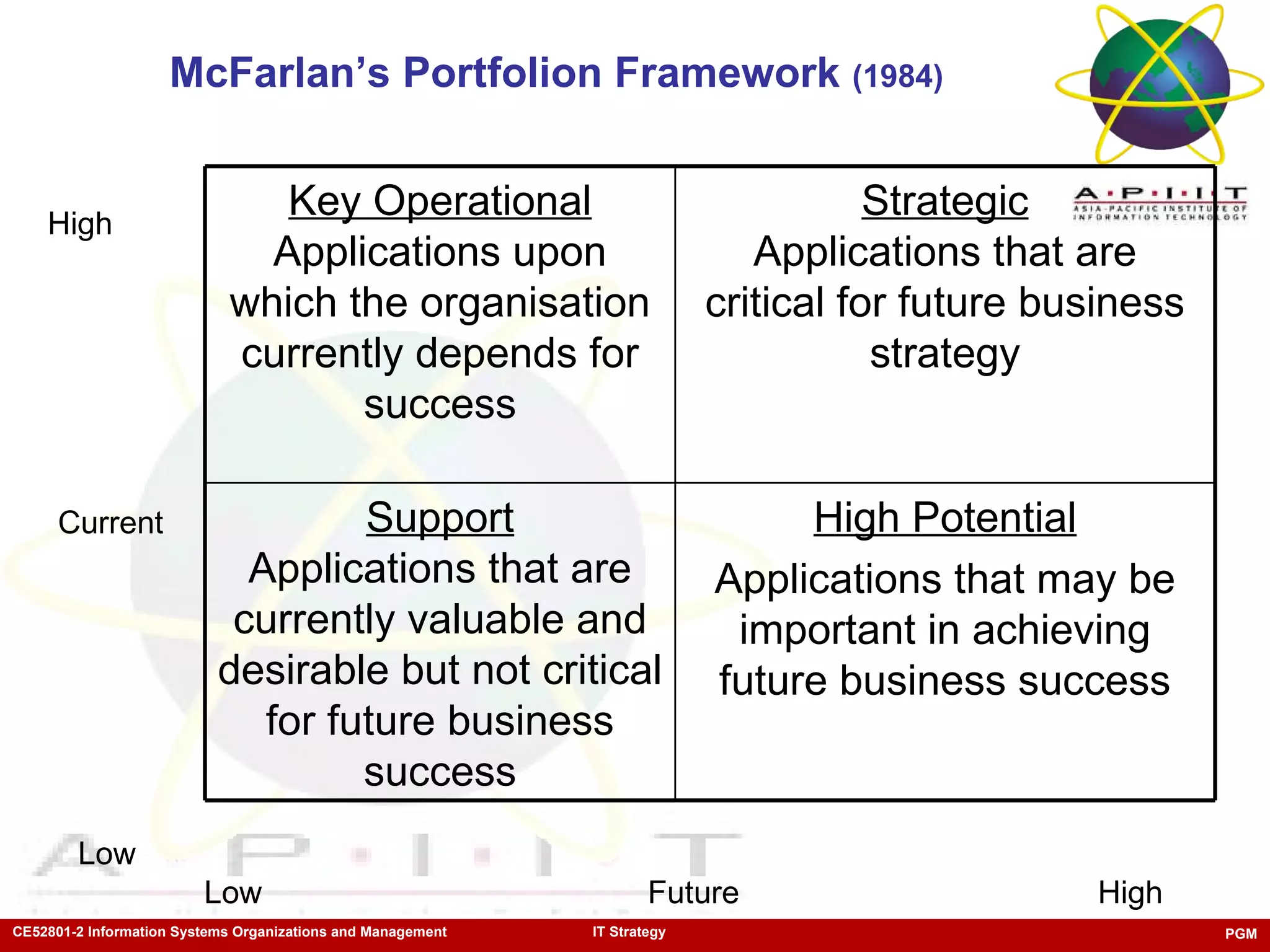
McFarlan’s Portfolion Framework  (1984) High Current Low Low High Future High Potential Applications that may be important in achieving future business success Support Applications that are currently valuable and desirable but not critical for future business success Strategic Applications that are critical for future business strategy Key Operational Applications upon which the organisation currently depends for success
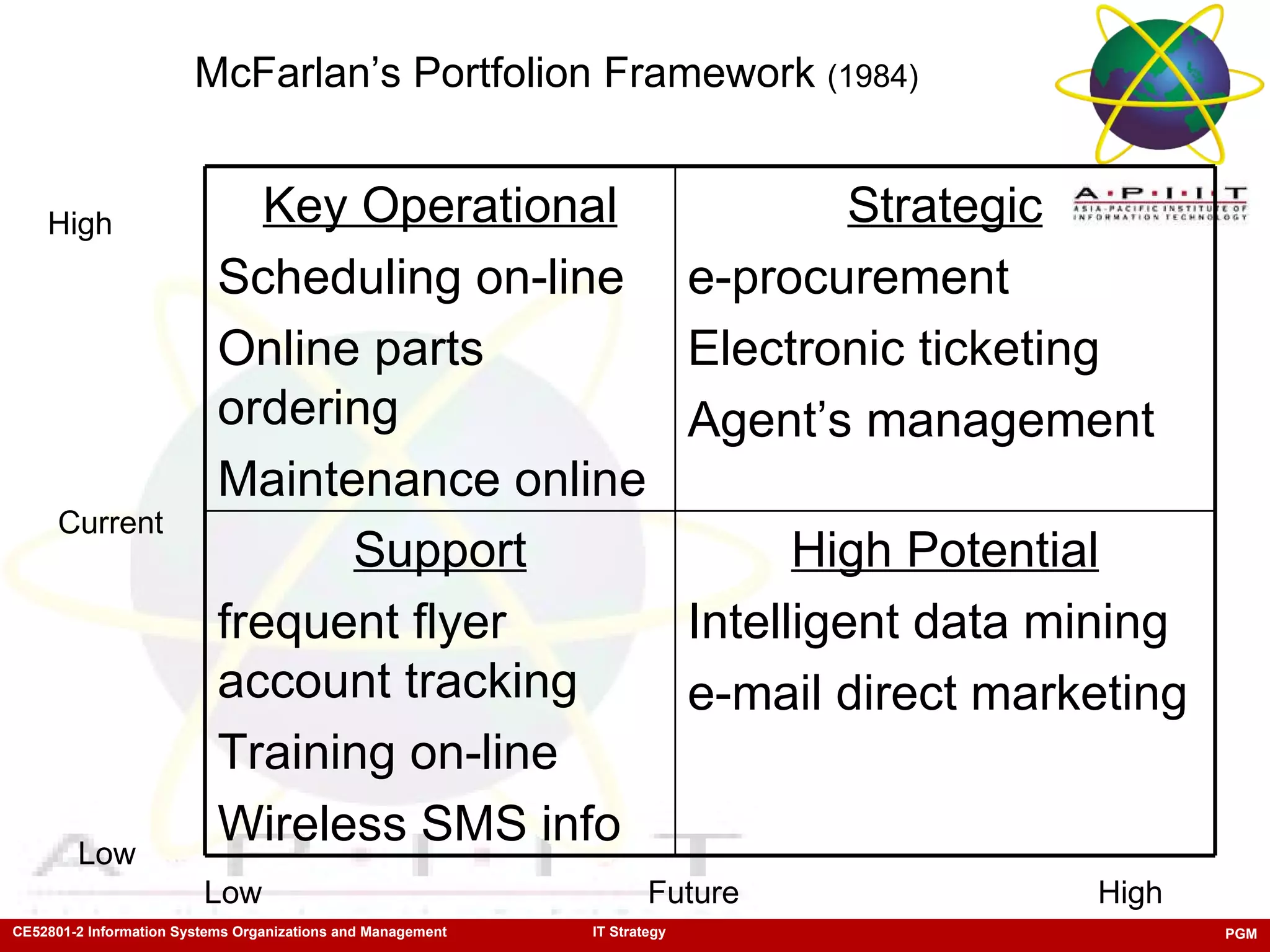
McFarlan’s Portfolion Framework  (1984) High Current Low Low High Future High Potential Intelligent data mining e-mail direct marketing Support frequent flyer account tracking Training on-line Wireless SMS info Strategic e-procurement Electronic ticketing Agent’s management Key Operational Scheduling on-line Online parts ordering Maintenance online
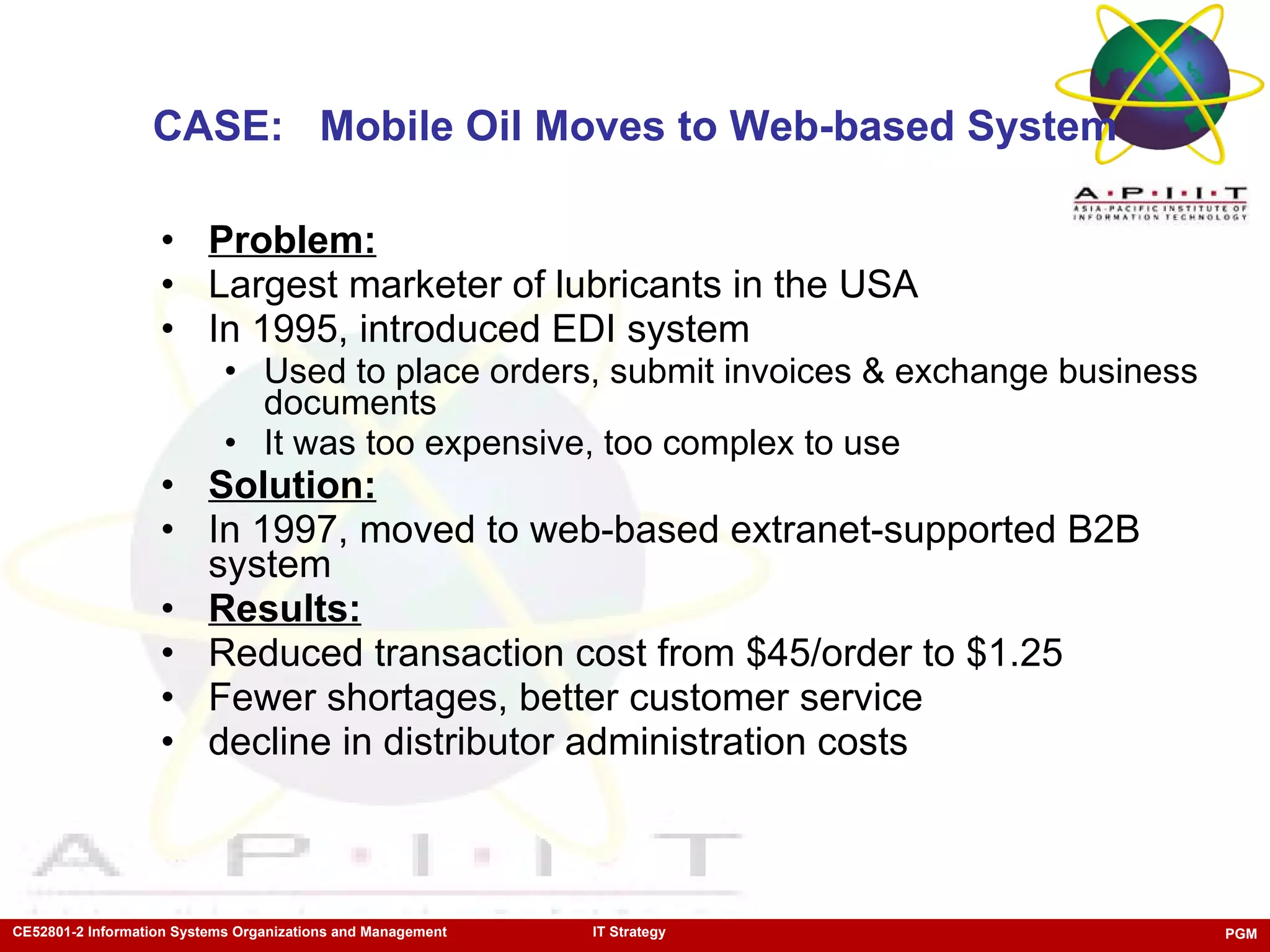
CASE:  Mobile Oil Moves to Web-based System Problem:   Largest marketer of lubricants in the USA In 1995, introduced EDI system Used to place orders, submit invoices & exchange business documents It was too expensive, too complex to use Solution: In 1997, moved to web-based extranet-supported B2B system Results: Reduced transaction cost from $45/order to $1.25 Fewer shortages, better customer service decline in distributor administration costs
Examples of EDI/Internet-based SIS   (for individual Companies) Electronic Auctions  Electronic Biddings Buyer-Driven Commerce Single Company Exchange Direct Sales
CASE: Total Quality Management at FPL Florida Power & Light    largest US utility company Leader in implementing total quality management Several successful SIS programs: Generation Equipment Management System (GEMS) Tracks electrical generators, saving $5 million/ yr. 20 different quality control applications Reduced customer complaints by 50% Trouble Call Management System Reduced black out time from 70 to 48 min.
CASE: Geisinger Implements an Intranet Problem: As a result of mergers & acquisitions, Geisinger (a health maintenance organization) had 40 different IT legacy systems in need of an upgrade & integration.  Solution : In 1993, Geisinger implemented an innovative Intranet: with the following features: “ Tel-a-Nurse” Clinical Management System Human Resource Management  Results: Geisinger reduced costs and unnecessary medical work.
CASE:  Caltex Corporation Major multinational company selling gasoline & petrol products.  In 2000, created a centralized e-purchasing corporate exchange (www.caltex.com) Suppliers build electronic catalogues with Ariba’s software.  Many benefits to buyers and suppliers, particularly in Asia, Africa & the Middle East. System enables Caltex to successfully handle complex multinational business environments.
CASE :  Port of Singapore Problem : The Port of Singapore, the world’s largest international port, faced increased global competition. Solution : Implementation of Intelligent Systems   Results: Reduction in Cycle Time  4 hours versus 16 - 20 hours in neighboring ports Reduction in uploading/ loading time 30 sec. versus 4-5 min./ truck in neighboring ports
SIS  Implementation  Major Issues to be Considered: Justification Justifying SIS may be difficult due to the intengible nature of their benefits.  Risks & Failures The magnitude, complexity, continuous changes in technology and business environment may result in failures. Finding appropriate SIS Identifying appropriate SIS is not a simple task.
Managerial Issues  (cont.) Sustaining Competitive Advantage Is Challenging As companies become larger and more sophisticated, they develop resources to duplicate the systems of their competitors quickly Ethical Issues Gaining competitive advantage through the use of IT may involve unethical or even illegal actions Companies can use IT to monitor the activities of other companies and may invade the privacy of individuals working there
Suggested Reading Information Technology for Management Old Book Chapter 3 – Information Systems for Competitive Advantage pp 80 to 119 New Book Chapter 12 – Information Systems for Competitive Advantage pp 505 to 518 Computing Press – read it
Q & A

IT Strategy

  • 1.
  • 2.
    Today Three erasof IT/IS revolution Strategic Information Systems The role of IT/IS in competition Porter’s 5 competitive forces Porter’s value chain Some other academic views Cases Managerial issues
  • 3.
    Three eras ofI.T. evolution Mainframe Era (1950’s-1970’s) Microcomputer Era (late 1970’s to 1980’s) Network Era (late 1980’s to present) Ubiquitous computing (wireless)
  • 4.
    Strategic Information Systems (SISs) SISs provide strategic solutions to the 5 Business Pressures:
  • 5.
    The Role ofIT in Business Innovation IT creates applications that provide strategic advantages to companies IT is a competitive weapon IT supports strategic change , e.g, re-engineering IT networks with business partners IT provides cost reduction IT provides competitive business intelligence
  • 6.
    Competitive Intelligence TheInternet is central to supporting competitive intelligence Such activities drive business performance by : Increasing market knowledge Improving internal relationships Raising the quality of strategic planning Many companies monitor the activities of competitors
  • 7.
    It changes industrystructure and alters the rules of competition... by increasing the power of buyers, raising barriers to entry and influencing the threat of substitution It creates competitive advantage by giving companies new ways to out-perform their rivals... lowering costs, enhancing differentiation and changing competitive scope HOW IT/IS AFFECTS THE NATURE OF COMPETITION
  • 8.
    It spawns wholenew businesses, often from within a company's own operations... by making new businesses technologically feasible creating derived demand for new products and creating new businesses within old ones. HOW IT/IS AFFECTS THE NATURE OF COMPETITION
  • 9.
    Technology versus Management of technology I.T. is so accessible today that organisations cannot compete on technology alone. The competitive advantage is derived from how the technology is used. Today the management of technology has become a critical issue in competing more effectively. The issue is not whether to invest in I.T. but where and how.
  • 10.
    What can helpus: think and analyse situations
  • 11.
    Porter’s 5 CompetitiveForces (1985) The threat of entry of new competitors. The bargaining power of suppliers. The bargaining power of customers (buyers). The threat of substitute products or services. The rivalry among existing firms in the industry.
  • 12.
  • 13.
  • 14.
    Response Strategies ( Porter , 1985) FOCUS Selecting a niche market and achieving cost leadership and/or differentation. DIFFERENTATION Being unique in the industry COST LEADERSHIP Providing products and/or services at the lowest cost in the industry.
  • 15.
    More Response Strategies (added by Porter and others) INNOVATION Developing new products & services GROWTH Increasing market share, acquiring more customers or selling more products IMPROVE INTERNAL EFFICIENCY To improve employee and customer satisfaction ALLIANCES Working with business partners to create synergy & provide opportunities for growth CRM Customer-oriented approaches, e.g. the customer is king (queen)
  • 16.
    Porter’s Value ChainModel - Graphically
  • 17.
    Porter’s Value ChainModel (1985) PRIMARY ACTIVITIES Inbound logistics (inputs) Operations (manufacturing & testing) Outbound logistics (storage & distribution) Marketing & sales Service Supply Chain
  • 18.
    Porter’s Value ChainModel SUPPORT ACTIVITIES Firm Infrastructure Human Resources Management Technology Development Procurement
  • 19.
    VALUE SYSTEM A firm’s value chain is part of a larger stream of activities, which Porter calls a “Value System ” Includes the suppliers that provide the necessary inputs AND their value chains Applies to both products & services, for any organization, PUBLIC or PRIVATE The basis for the Supply Chain Management Think about UPSTREAM and DOWNSTREAM
  • 20.
  • 21.
    The Value ChainModel The Value System Model is used to: Evaluate a company’s process and competencies Investigate whether adding IT supports the value chain Enable managers to assess the information intensity and the role of IT
  • 22.
    McFarlan’s Portfolion Framework (1984) High Current Low Low High Future High Potential Applications that may be important in achieving future business success Support Applications that are currently valuable and desirable but not critical for future business success Strategic Applications that are critical for future business strategy Key Operational Applications upon which the organisation currently depends for success
  • 23.
    McFarlan’s Portfolion Framework (1984) High Current Low Low High Future High Potential Intelligent data mining e-mail direct marketing Support frequent flyer account tracking Training on-line Wireless SMS info Strategic e-procurement Electronic ticketing Agent’s management Key Operational Scheduling on-line Online parts ordering Maintenance online
  • 24.
    CASE: MobileOil Moves to Web-based System Problem: Largest marketer of lubricants in the USA In 1995, introduced EDI system Used to place orders, submit invoices & exchange business documents It was too expensive, too complex to use Solution: In 1997, moved to web-based extranet-supported B2B system Results: Reduced transaction cost from $45/order to $1.25 Fewer shortages, better customer service decline in distributor administration costs
  • 25.
    Examples of EDI/Internet-basedSIS (for individual Companies) Electronic Auctions Electronic Biddings Buyer-Driven Commerce Single Company Exchange Direct Sales
  • 26.
    CASE: Total QualityManagement at FPL Florida Power & Light  largest US utility company Leader in implementing total quality management Several successful SIS programs: Generation Equipment Management System (GEMS) Tracks electrical generators, saving $5 million/ yr. 20 different quality control applications Reduced customer complaints by 50% Trouble Call Management System Reduced black out time from 70 to 48 min.
  • 27.
    CASE: Geisinger Implementsan Intranet Problem: As a result of mergers & acquisitions, Geisinger (a health maintenance organization) had 40 different IT legacy systems in need of an upgrade & integration. Solution : In 1993, Geisinger implemented an innovative Intranet: with the following features: “ Tel-a-Nurse” Clinical Management System Human Resource Management Results: Geisinger reduced costs and unnecessary medical work.
  • 28.
    CASE: CaltexCorporation Major multinational company selling gasoline & petrol products. In 2000, created a centralized e-purchasing corporate exchange (www.caltex.com) Suppliers build electronic catalogues with Ariba’s software. Many benefits to buyers and suppliers, particularly in Asia, Africa & the Middle East. System enables Caltex to successfully handle complex multinational business environments.
  • 29.
    CASE : Port of Singapore Problem : The Port of Singapore, the world’s largest international port, faced increased global competition. Solution : Implementation of Intelligent Systems Results: Reduction in Cycle Time 4 hours versus 16 - 20 hours in neighboring ports Reduction in uploading/ loading time 30 sec. versus 4-5 min./ truck in neighboring ports
  • 30.
    SIS Implementation Major Issues to be Considered: Justification Justifying SIS may be difficult due to the intengible nature of their benefits. Risks & Failures The magnitude, complexity, continuous changes in technology and business environment may result in failures. Finding appropriate SIS Identifying appropriate SIS is not a simple task.
  • 31.
    Managerial Issues (cont.) Sustaining Competitive Advantage Is Challenging As companies become larger and more sophisticated, they develop resources to duplicate the systems of their competitors quickly Ethical Issues Gaining competitive advantage through the use of IT may involve unethical or even illegal actions Companies can use IT to monitor the activities of other companies and may invade the privacy of individuals working there
  • 32.
    Suggested Reading InformationTechnology for Management Old Book Chapter 3 – Information Systems for Competitive Advantage pp 80 to 119 New Book Chapter 12 – Information Systems for Competitive Advantage pp 505 to 518 Computing Press – read it
  • 33.

Editor's Notes

  • #3 Today’s action
  • #4 What do these suggest in terms of IT working envirnments? Mainframe – computers hidden away by anoraks doing repetitive jobs Micro’s – on desktops doing support jobs Networks - ???????? Global business e commerce etc
  • #5 Don’t confuse with Porter’s 5 comp forces Disintermediation – getting rid of the intermediaries – agents. Between buyers and sellers Commission cuts –similar to above Rebates – buying power – supermarkets Online competitors – Reverse auction – an ebuying mechanism – sellers are invited to bid for fullfilment of an order
  • #6 How?????
  • #7 Can mean the difference between success and failure Hertz monitor car rental prices Banks monitor each other’s rates and services Supermarkets prices Chat rooms – for consumer tips Complaints – hotels and holiday resorts
  • #8 What industries have been changed for ever by IT/IS?
  • #15 Different competitive environments requiring different strategic information needs Competing on margins rationalisation of the industry will be taking place, aiming to reduce costs. Supplier links will be vitally important . Competing on differences of features of product or services the customer database is of prime importance.
  • #16 Growth – Reaching customers that otherwise wouldn’t – new marketing channels Alliances – B2B – allainces with suppliers – JIT, replenishment Innovation – Such as what? Improve internal – BPR later CRM – one to one environment - call centres E-bookers holidays
  • #23 Careful one companies support is another’s key operational For example, on-line training could be key operational for a software vendor
  • #24 For Analyzing Existing, Planned & Potential Information Systems Can be applied to any type of application Current and Future as perceived by management