A Business Leader’s Discussion of Technology

      Using Technology to Transform Business

          Giving you the ability to compete and win


                  September 16, 2010
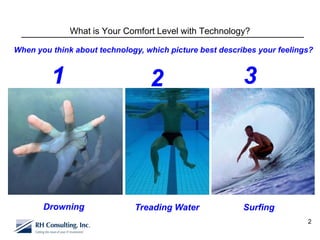
What is Your Comfort Level with Technology?

When you think about technology, which picture best describes your feelings?


         1                        2                       3


       Drowning               Treading Water              Surfing
                                                                          2
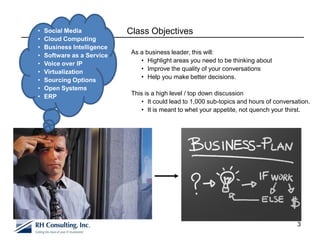
•   Social Media            Class Objectives
•   Cloud Computing
•   Business Intelligence
                             As a business leader, this will:
•   Software as a Service
                                • Highlight areas you need to be thinking about
•   Voice over IP
                                • Improve the quality of your conversations
•   Virtualization
                                • Help you make better decisions.
•   Sourcing Options
•   Open Systems
                             This is a high level / top down discussion
•   ERP
                                • It could lead to 1,000 sub-topics and hours of conversation.
                                • It is meant to whet your appetite, not quench your thirst.


                                                                                         3
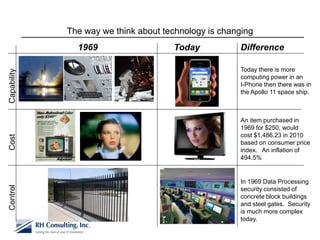
The way we think about technology is changing
               1969                   Today           Difference

                                                      Today there is more
Capability


                                                      computing power in an
                                                      I-Phone then there was in
                                                      the Apollo 11 space ship.


                                                      An item purchased in
                                                      1969 for $250, would
                                                      cost $1,486.23 in 2010
Cost


                                                      based on consumer price
                                                      index. An inflation of
                                                      494.5%


                                                      In 1969 Data Processing
Control


                                                      security consisted of
                                                      concrete block buildings
                                                      and steel gates. Security
                                                      is much more complex
                                                      today.
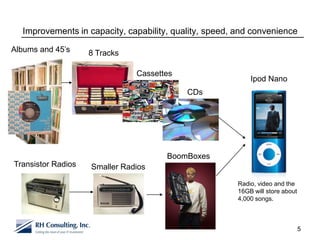
Improvements in capacity, capability, quality, speed, and convenience

Albums and 45’s     8 Tracks

                               Cassettes
                                                            Ipod Nano
                                           CDs


                                      BoomBoxes
Transistor Radios   Smaller Radios

                                                        Radio, video and the
                                                        16GB will store about
                                                        4,000 songs.


                                                                                5
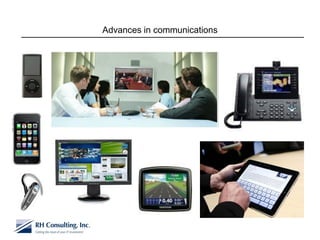
Advances in communications
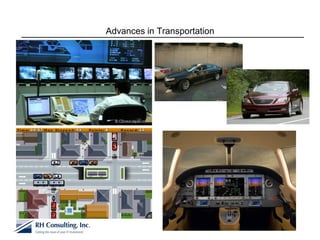
Advances in Transportation
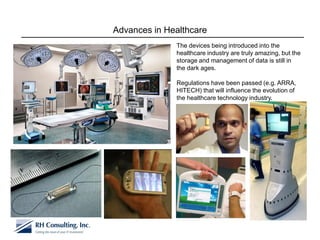
Advances in Healthcare
              The devices being introduced into the
              healthcare industry are truly amazing, but the
              storage and management of data is still in
              the dark ages.

              Regulations have been passed (e.g. ARRA,
              HITECH) that will influence the evolution of
              the healthcare technology industry.
1) Business Focus


Factors that influences a company’s success or failure
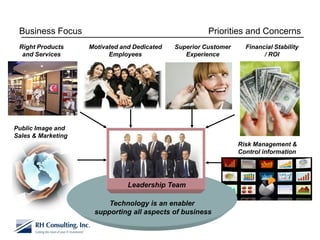
Business Focus                                           Priorities and Concerns
 Right Products     Motivated and Dedicated     Superior Customer     Financial Stability
  and Services            Employees                Experience               / ROI


Public Image and
Sales & Marketing
                                                                    Risk Management &
                                                                    Control information
                                    Business
                                   Leadership


                                Leadership Team

                         Technology is an enabler
                     supporting all aspects of business
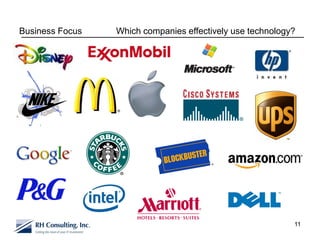
Business Focus   Which companies effectively use technology?


                                                           11
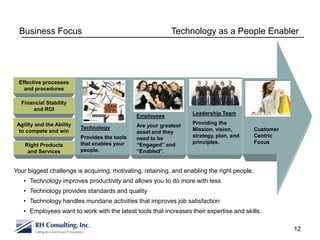
Business Focus                                             Technology as a People Enabler


 Effective processes
   and procedures

  Financial Stability
      and ROI
                                                                    Leadership Team
                                                Employees
 Agility and the Ability                        Are your greatest   Providing the
                           Technology                               Mission, vision,         Customer
  to compete and win                            asset and they
                           Provides the tools                       strategy, plan, and      Centric
                                                need to be
                           that enables your                        principles.              Focus
    Right Products                              “Engaged” and
     and Services          people.              “Enabled”.


Your biggest challenge is acquiring, motivating, retaining, and enabling the right people.
   • Technology improves productivity and allows you to do more with less
   • Technology provides standards and quality
   • Technology handles mundane activities that improves job satisfaction
   • Employees want to work with the latest tools that increases their expertise and skills.

                                                                                                        12
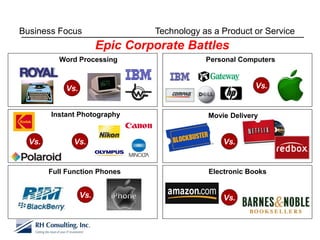
Business Focus                   Technology as a Product or Service
                        Epic Corporate Battles
          Word Processing                    Personal Computers


            Vs.                                           Vs.


        Instant Photography                  Movie Delivery


  Vs.          Vs.                                Vs.


        Full Function Phones                  Electronic Books


                  Vs.                             Vs.
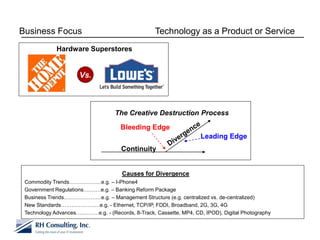
Business Focus                                     Technology as a Product or Service
             Hardware Superstores


                      Vs.


                                   The Creative Destruction Process

                                      Bleeding Edge
                                                                    Leading Edge
                                      Continuity


                                      Causes for Divergence
 Commodity Trends………………e.g. – I-Phone4
 Government Regulations……….e.g. – Banking Reform Package
 Business Trends…………………e.g. – Management Structure (e.g. centralized vs. de-centralized)
 New Standards………………….e.g. - Ethernet, TCP/IP, FDDI, Broadband, 2G, 3G, 4G
 Technology Advances………….e.g. - (Records, 8-Track, Cassette, MP4, CD, IPOD), Digital Photography
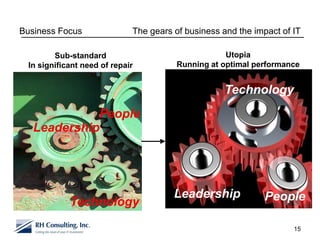
Business Focus                The gears of business and the impact of IT

         Sub-standard                                Utopia
  In significant need of repair          Running at optimal performance


                                                     Technology
             People
   Leadership


                                        Leadership             People
             Technology

                                                                      15
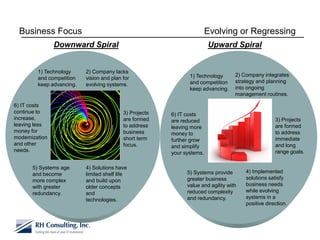
Business Focus                                                         Evolving or Regressing
                Downward Spiral                                          Upward Spiral


         1) Technology     2) Company lacks
                                                                1) Technology       2) Company integrates
         and competition   vision and plan for
                                                                and competition     strategy and planning
         keep advancing.   evolving systems.
                                                                keep advancing.     into ongoing
                                                                                    management routines.

6) IT costs
continue to                                3) Projects   6) IT costs
increase,                                  are formed    are reduced                                 3) Projects
leaving less                               to address    leaving more                                are formed
money for                                  business      money to                                    to address
modernization                              short term    further grow                                immediate
and other                                  focus.        and simplify                                and long
needs.                                                   your systems.                               range goals.

       5) Systems age      4) Solutions have
       and become          limited shelf life                  5) Systems provide       4) Implemented
       more complex        and build upon                      greater business         solutions satisfy
       with greater        older concepts                      value and agility with   business needs
       redundancy.         and                                 reduced complexity       while evolving
                           technologies.                       and redundancy.          systems in a
                                                                                        positive direction.
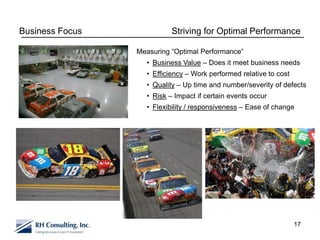
Business Focus             Striving for Optimal Performance

                 Measuring “Optimal Performance”
                   • Business Value – Does it meet business needs
                   • Efficiency – Work performed relative to cost
                   • Quality – Up time and number/severity of defects
                   • Risk – Impact if certain events occur
                   • Flexibility / responsiveness – Ease of change


                                                                    17
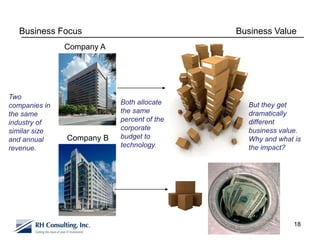
Business Focus                           Business Value
               Company A


Two
companies in               Both allocate      But they get
the same                   the same           dramatically
industry of                percent of the     different
similar size               corporate          business value.
and annual     Company B   budget to          Why and what is
revenue.                   technology.        the impact?


                                                           18
Business Focus                                                         Section Recap


America has been able to compete on a global scale because of her people, ingenuity
and productivity.

How well are you served by your current technology?

Are you prepared to compete on a global scale?

Have you done things during the downturn that will allow you to prosper in the future?

What obstacles have been in your way?


                                                                                         19
2. Current State of Technology
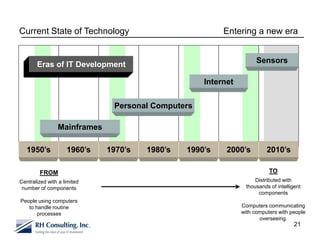
Current State of Technology                             Entering a new era


                                                                    Sensors
       Eras of IT Development

                                                   Internet


                              Personal Computers

                Mainframes

   1950’s           1960’s   1970’s   1980’s   1990’s    2000’s         2010’s

        FROM                                                             TO
Centralized with a limited                                         Distributed with
 number of components                                          thousands of intelligent
                                                                    components
People using computers
   to handle routine                                          Computers communicating
       processes                                              with computers with people
                                                                     overseeing.
                                                                                    21
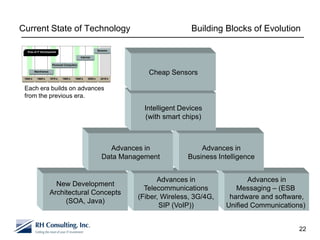
Current State of Technology                                                             Building Blocks of Evolution

   Eras of IT Development                                   Sensors

                                             Internet


                        Personal Computers

          Mainframes
                                                                          Cheap Sensors
 1950’s    1960’s      1970’s   1980’s   1990’s    2000’s     2010’s


 Each era builds on advances
 from the previous era.

                                                                         Intelligent Devices
                                                                         (with smart chips)


                                                                Advances in                Advances in
                                                              Data Management          Business Intelligence


                                                                             Advances in                 Advances in
                         New Development
                                                                         Telecommunications          Messaging – (ESB
                       Architectural Concepts
                                                                       (Fiber, Wireless, 3G/4G,    hardware and software,
                            (SOA, Java)
                                                                              SIP (VoIP))         Unified Communications)


                                                                                                                       22
Current State of Technology                                      Proliferating older concepts
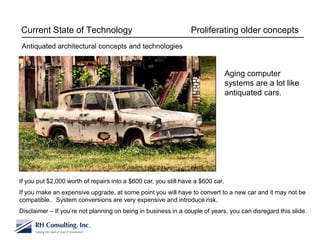
 Antiquated architectural concepts and technologies


                                                                                 Aging computer
                                                                                 systems are a lot like
                                                                                 antiquated cars.


If you put $2,000 worth of repairs into a $600 car, you still have a $600 car.
If you make an expensive upgrade, at some point you will have to convert to a new car and it may not be
compatible. System conversions are very expensive and introduce risk.
Disclaimer – If you’re not planning on being in business in a couple of years, you can disregard this slide.
Current State of Technology                                          Looking Forward
• System of Systems – Technology will be viewed as systems consisting of
  interconnected systems. This will result in a massive increase in interconnections
• Data Tsunami – Massive growth of data (projected at nearly 50% per year, a
  significant % in Healthcare).
• Business Intelligence - More data and more automation needs greater advances in
  how to interpret the data.
• Business Process Management - More emphasis is needed on adapting technology to
  the business (business process workflow management).
• Customer expectations – Customers demand for accuracy will increase while
  tolerance will decrease.
• Virtual Workplace - advances make it easier to work anywhere (increasing flexibility &
  reducing office expenses).
• Increased Telecom Traffic – High Resolution capabilities will continue to tax already
  stressed networks.
• Government Regulation - Errors will occur and some will be blown out of proportion,
  This will result in government’s desire for increased regulation.

                                                                                           24
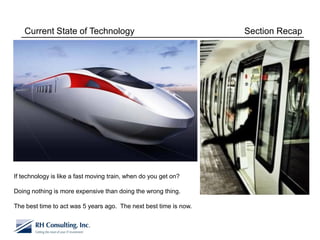
Current State of Technology                                     Section Recap


If technology is like a fast moving train, when do you get on?

Doing nothing is more expensive than doing the wrong thing.

The best time to act was 5 years ago. The next best time is now.
3. Internal View

Things you need to know to improve success
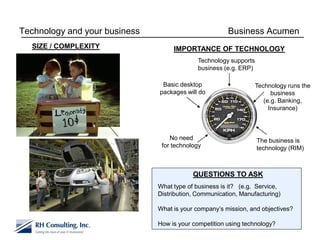
Technology and your business                           Business Acumen
  SIZE / COMPLEXITY                 IMPORTANCE OF TECHNOLOGY
                                             Technology supports
                                             business (e.g. ERP)

                                Basic desktop                      Technology runs the
                               packages will do                          business
                                                                      (e.g. Banking,
                                                                        Insurance)


                                   No need                         The business is
                                for technology                     technology (RIM)


                                           QUESTIONS TO ASK
                               What type of business is it? (e.g. Service,
                               Distribution, Communication, Manufacturing)

                               What is your company’s mission, and objectives?

                               How is your competition using technology?
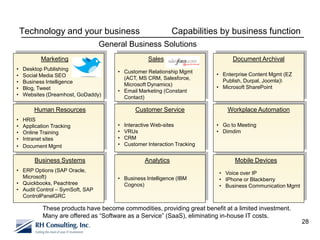
Technology and your business                              Capabilities by business function
                                 General Business Solutions
           Marketing                               Sales                        Document Archival
•   Desktop Publishing                • Customer Relationship Mgmt
•   Social Media SEO                                                      • Enterprise Content Mgmt (EZ
                                        (ACT, MS CRM, Salesforce,
•   Business Intelligence                                                   Publish, Durpal, Joomla)
                                        Microsoft Dynamics)
•   Blog, Tweet                                                           • Microsoft SharePoint
                                      • Email Marketing (Constant
•   Websites (Dreamhost, GoDaddy)       Contact)

        Human Resources                       Customer Service                Workplace Automation
•   HRIS
•   Application Tracking              •   Interactive Web-sites           • Go to Meeting
•   Online Training                   •   VRUs                            • Dimdim
•   Intranet sites                    •   CRM
•   Document Mgmt                     •   Customer Interaction Tracking


        Business Systems                          Analytics                      Mobile Devices
• ERP Options (SAP Oracle,                                                 • Voice over IP
  Microsoft)                          • Business Intelligence (IBM         • IPhone or Blackberry
• Quickbooks, Peachtree                 Cognos)                            • Business Communication Mgmt
• Audit Control – SymSoft, SAP
  ControlPanelGRC

            These products have become commodities, providing great benefit at a limited investment.
            Many are offered as “Software as a Service” (SaaS), eliminating in-house IT costs.
                                                                                                           28
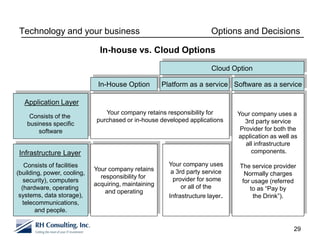
Technology and your business                                           Options and Decisions

                               In-house vs. Cloud Options
                                                                        Cloud Option

                              In-House Option         Platform as a service Software as a service

   Application Layer
                                 Your company retains responsibility for        Your company uses a
     Consists of the
                              purchased or in-house developed applications        3rd party service
    business specific
        software                                                                 Provider for both the
                                                                                application as well as
                                                                                   all infrastructure
 Infrastructure Layer                                                                components.

    Consists of facilities                              Your company uses       The service provider
                             Your company retains        a 3rd party service
(building, power, cooling,                                                        Normally charges
                               responsibility for         provider for some
   security), computers                                                          for usage (referred
                             acquiring, maintaining          or all of the
  (hardware, operating
                                 and operating                                      to as “Pay by
 systems, data storage),                                Infrastructure layer.        the Drink”).
   telecommunications,
        and people.


                                                                                                    29
Technology and your business                                              Options and Decisions
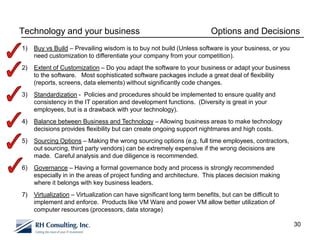
1)   Buy vs Build – Prevailing wisdom is to buy not build (Unless software is your business, or you
     need customization to differentiate your company from your competition).
2)   Extent of Customization – Do you adapt the software to your business or adapt your business
     to the software. Most sophisticated software packages include a great deal of flexibility
     (reports, screens, data elements) without significantly code changes.
3)   Standardization - Policies and procedures should be implemented to ensure quality and
     consistency in the IT operation and development functions. (Diversity is great in your
     employees, but is a drawback with your technology).
4)   Balance between Business and Technology – Allowing business areas to make technology
     decisions provides flexibility but can create ongoing support nightmares and high costs.
5)   Sourcing Options – Making the wrong sourcing options (e.g. full time employees, contractors,
     out sourcing, third party vendors) can be extremely expensive if the wrong decisions are
     made. Careful analysis and due diligence is recommended.
6)   Governance – Having a formal governance body and process is strongly recommended
     especially in in the areas of project funding and architecture. This places decision making
     where it belongs with key business leaders.
7)   Virtualization – Virtualization can have significant long term benefits, but can be difficult to
     implement and enforce. Products like VM Ware and power VM allow better utilization of
     computer resources (processors, data storage)

                                                                                                        30
Technology and your business                                            Pitfalls and Challenges
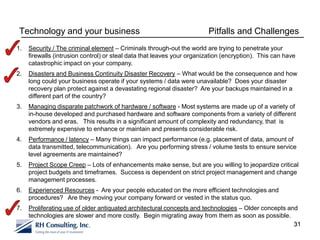
1.   Security / The criminal element – Criminals through-out the world are trying to penetrate your
     firewalls (intrusion control) or steal data that leaves your organization (encryption). This can have
     catastrophic impact on your company.
2.   Disasters and Business Continuity Disaster Recovery – What would be the consequence and how
     long could your business operate if your systems / data were unavailable? Does your disaster
     recovery plan protect against a devastating regional disaster? Are your backups maintained in a
     different part of the country?
3.   Managing disparate patchwork of hardware / software - Most systems are made up of a variety of
     in-house developed and purchased hardware and software components from a variety of different
     vendors and eras. This results in a significant amount of complexity and redundancy, that is
     extremely expensive to enhance or maintain and presents considerable risk.
4.   Performance / latency – Many things can impact performance (e.g. placement of data, amount of
     data transmitted, telecommunication). Are you performing stress / volume tests to ensure service
     level agreements are maintained?
5.   Project Scope Creep – Lots of enhancements make sense, but are you willing to jeopardize critical
     project budgets and timeframes. Success is dependent on strict project management and change
     management processes.
6.   Experienced Resources - Are your people educated on the more efficient technologies and
     procedures? Are they moving your company forward or vested in the status quo.
7.   Proliferating use of older antiquated architectural concepts and technologies – Older concepts and
     technologies are slower and more costly. Begin migrating away from them as soon as possible.
                                                                                                      31
Technology and your business                                                                Building in Quality
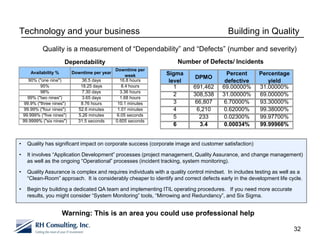
             Quality is a measurement of “Dependability” and “Defects” (number and severity)
                        Dependability                                 Number of Defects/ Incidents
                                                 Downtime per
       Availability %        Downtime per year                   Sigma                     Percent       Percentage
                                                      week                   DPMO
       90% ("one nine")          36.5 days         16.8 hours     level                   defective         yield
             95%                18.25 days          8.4 hours       1        691,462     69.00000%       31.00000%
             98%                 7.30 days         3.36 hours
                                                                    2        308,538     31.00000%       69.00000%
      99% ("two nines")          3.65 days         1.68 hours
     99.9% ("three nines")      8.76 hours        10.1 minutes      3         66,807      6.70000%       93.30000%
     99.99% ("four nines")     52.6 minutes       1.01 minutes      4          6,210      0.62000%       99.38000%
    99.999% ("five nines")     5.26 minutes      6.05 seconds       5           233       0.02300%       99.97700%
    99.9999% ("six nines")     31.5 seconds      0.605 seconds
                                                                    6           3.4       0.00034%       99.99966%


•     Quality has significant impact on corporate success (corporate image and customer satisfaction)

•     It involves “Application Development” processes (project management, Quality Assurance, and change management)
      as well as the ongoing “Operational” processes (incident tracking, system monitoring).

•     Quality Assurance is complex and requires individuals with a quality control mindset. In includes testing as well as a
      “Clean-Room” approach. It is considerably cheaper to identify and correct defects early in the development life cycle.

•     Begin by building a dedicated QA team and implementing ITIL operating procedures. If you need more accurate
      results, you might consider “System Monitoring” tools, “Mirrowing and Redundancy”, and Six Sigma.


                        Warning: This is an area you could use professional help

                                                                                                                        32
Technology and your business                             The role of the IT Department
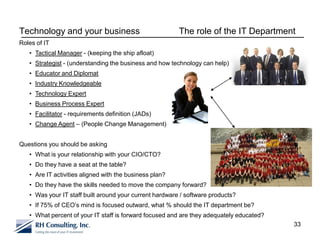
Roles of IT
   • Tactical Manager - (keeping the ship afloat)
   • Strategist - (understanding the business and how technology can help)
   • Educator and Diplomat
   • Industry Knowledgeable
   • Technology Expert
   • Business Process Expert
   • Facilitator - requirements definition (JADs)
   • Change Agent – (People Change Management)


Questions you should be asking
   • What is your relationship with your CIO/CTO?
   • Do they have a seat at the table?
   • Are IT activities aligned with the business plan?
   • Do they have the skills needed to move the company forward?
   • Was your IT staff built around your current hardware / software products?
   • If 75% of CEO’s mind is focused outward, what % should the IT department be?
   • What percent of your IT staff is forward focused and are they adequately educated?
                                                                                          33
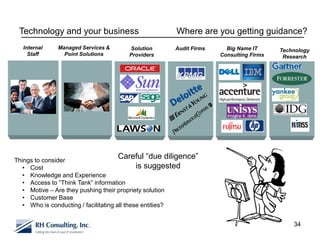
Technology and your business                           Where are you getting guidance?
   Internal    Managed Services &       Solution        Audit Firms     Big Name IT      Technology
     Staff       Point Solutions        Providers                     Consulting Firms    Research


Things to consider
                                    Careful “due diligence”
   • Cost                                     is suggested
   • Knowledge and Experience
   • Access to “Think Tank” information
   • Motive – Are they pushing their propriety solution
   • Customer Base
   • Who is conducting / facilitating all these entities?


                                                                                             34
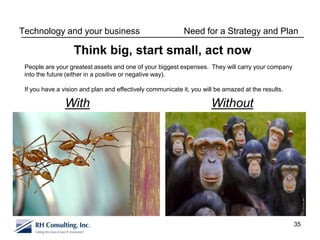
Technology and your business                                Need for a Strategy and Plan

                   Think big, start small, act now
 People are your greatest assets and one of your biggest expenses. They will carry your company
 into the future (either in a positive or negative way).

 If you have a vision and plan and effectively communicate it, you will be amazed at the results.

                With                                                  Without


                                                                                                    35
Corporate Focus                                          Closing Words of Wisdom


• Technology is critical to your success and it has become an exceptional bargain.

• Doing nothing is more expensive than doing the wrong thing. Your competition is
  evolving and if you aren’t you’re losing ground.

• There are still many pitfalls and you want to avoid them.

• Having a vision, strategy and plan is of utmost importance.

• Don’t keep building upon older infrastructure.

• Simplify then automate.

• Make sure you have the right technology expertise.

• Give IT a seat at the table.


                                                                                     36
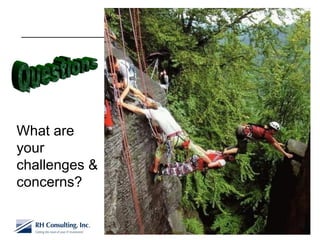
What are
your
challenges &
concerns?
Appendices
Appendix                                                                       Richard Hissrich Profile

Richard Hissrich is the owner and president of RH Consulting, Inc. Mr. Hissrich has over 35
years of IT experience with fortune 500 companies in the financial, manufacturing and
technology consulting industries. He held a wide variety of leadership and strategic planning
positions aimed at addressing company’s highest priority focus areas (e.g., modernization
planning, business/technology strategy, quality assurance, testing, sourcing options, release
management, development methodology, expense reduction). Rich is a member of the Institute
of Management Consultants (IMC) and the Healthcare Information Management Systems
Society (HIMSS).


Selected Accomplishments:

  – Developed the processes and procedures that allowed a financial institution to implement release management.
    This resulted allowed the company to handle higher volumes of annual application change with lower
    development costs.

  – Planned and helped manage the Year-2000 Readiness test, which was largest and most complex testing effort
    conducted by this financial company. This resulted in an almost flawless transition into the new century.

  – Helped manage the evolution of a limited focus testing department into an enterprise quality assurance
    organization supporting corporate-wide testing. This resulted in improved application quality and a reduction in
    overall testing costs.

  – Helped develop a 5 year technology modernization plan including a target state definition, a roadmap for
    implementation, governance processes, and an education program. This resulted in increased business
    functionality, reduced risk and ongoing incremental progress toward the desired target state.


                                                                                                                   39

It Ceo View 2010 09 17

  • 1.
    A Business Leader’sDiscussion of Technology Using Technology to Transform Business Giving you the ability to compete and win September 16, 2010
  • 2.
    What is YourComfort Level with Technology? When you think about technology, which picture best describes your feelings? 1 2 3 Drowning Treading Water Surfing 2
  • 3.
    Social Media Class Objectives • Cloud Computing • Business Intelligence As a business leader, this will: • Software as a Service • Highlight areas you need to be thinking about • Voice over IP • Improve the quality of your conversations • Virtualization • Help you make better decisions. • Sourcing Options • Open Systems This is a high level / top down discussion • ERP • It could lead to 1,000 sub-topics and hours of conversation. • It is meant to whet your appetite, not quench your thirst. 3
  • 4.
    The way wethink about technology is changing 1969 Today Difference Today there is more Capability computing power in an I-Phone then there was in the Apollo 11 space ship. An item purchased in 1969 for $250, would cost $1,486.23 in 2010 Cost based on consumer price index. An inflation of 494.5% In 1969 Data Processing Control security consisted of concrete block buildings and steel gates. Security is much more complex today.
  • 5.
    Improvements in capacity,capability, quality, speed, and convenience Albums and 45’s 8 Tracks Cassettes Ipod Nano CDs BoomBoxes Transistor Radios Smaller Radios Radio, video and the 16GB will store about 4,000 songs. 5
  • 6.
  • 7.
  • 8.
    Advances in Healthcare The devices being introduced into the healthcare industry are truly amazing, but the storage and management of data is still in the dark ages. Regulations have been passed (e.g. ARRA, HITECH) that will influence the evolution of the healthcare technology industry.
  • 9.
    1) Business Focus Factorsthat influences a company’s success or failure
  • 10.
    Business Focus Priorities and Concerns Right Products Motivated and Dedicated Superior Customer Financial Stability and Services Employees Experience / ROI Public Image and Sales & Marketing Risk Management & Control information Business Leadership Leadership Team Technology is an enabler supporting all aspects of business
  • 11.
    Business Focus Which companies effectively use technology? 11
  • 12.
    Business Focus Technology as a People Enabler Effective processes and procedures Financial Stability and ROI Leadership Team Employees Agility and the Ability Are your greatest Providing the Technology Mission, vision, Customer to compete and win asset and they Provides the tools strategy, plan, and Centric need to be that enables your principles. Focus Right Products “Engaged” and and Services people. “Enabled”. Your biggest challenge is acquiring, motivating, retaining, and enabling the right people. • Technology improves productivity and allows you to do more with less • Technology provides standards and quality • Technology handles mundane activities that improves job satisfaction • Employees want to work with the latest tools that increases their expertise and skills. 12
  • 13.
    Business Focus Technology as a Product or Service Epic Corporate Battles Word Processing Personal Computers Vs. Vs. Instant Photography Movie Delivery Vs. Vs. Vs. Full Function Phones Electronic Books Vs. Vs.
  • 14.
    Business Focus Technology as a Product or Service Hardware Superstores Vs. The Creative Destruction Process Bleeding Edge Leading Edge Continuity Causes for Divergence Commodity Trends………………e.g. – I-Phone4 Government Regulations……….e.g. – Banking Reform Package Business Trends…………………e.g. – Management Structure (e.g. centralized vs. de-centralized) New Standards………………….e.g. - Ethernet, TCP/IP, FDDI, Broadband, 2G, 3G, 4G Technology Advances………….e.g. - (Records, 8-Track, Cassette, MP4, CD, IPOD), Digital Photography
  • 15.
    Business Focus The gears of business and the impact of IT Sub-standard Utopia In significant need of repair Running at optimal performance Technology People Leadership Leadership People Technology 15
  • 16.
    Business Focus Evolving or Regressing Downward Spiral Upward Spiral 1) Technology 2) Company lacks 1) Technology 2) Company integrates and competition vision and plan for and competition strategy and planning keep advancing. evolving systems. keep advancing. into ongoing management routines. 6) IT costs continue to 3) Projects 6) IT costs increase, are formed are reduced 3) Projects leaving less to address leaving more are formed money for business money to to address modernization short term further grow immediate and other focus. and simplify and long needs. your systems. range goals. 5) Systems age 4) Solutions have and become limited shelf life 5) Systems provide 4) Implemented more complex and build upon greater business solutions satisfy with greater older concepts value and agility with business needs redundancy. and reduced complexity while evolving technologies. and redundancy. systems in a positive direction.
  • 17.
    Business Focus Striving for Optimal Performance Measuring “Optimal Performance” • Business Value – Does it meet business needs • Efficiency – Work performed relative to cost • Quality – Up time and number/severity of defects • Risk – Impact if certain events occur • Flexibility / responsiveness – Ease of change 17
  • 18.
    Business Focus Business Value Company A Two companies in Both allocate But they get the same the same dramatically industry of percent of the different similar size corporate business value. and annual Company B budget to Why and what is revenue. technology. the impact? 18
  • 19.
    Business Focus Section Recap America has been able to compete on a global scale because of her people, ingenuity and productivity. How well are you served by your current technology? Are you prepared to compete on a global scale? Have you done things during the downturn that will allow you to prosper in the future? What obstacles have been in your way? 19
  • 20.
    2. Current Stateof Technology
  • 21.
    Current State ofTechnology Entering a new era Sensors Eras of IT Development Internet Personal Computers Mainframes 1950’s 1960’s 1970’s 1980’s 1990’s 2000’s 2010’s FROM TO Centralized with a limited Distributed with number of components thousands of intelligent components People using computers to handle routine Computers communicating processes with computers with people overseeing. 21
  • 22.
    Current State ofTechnology Building Blocks of Evolution Eras of IT Development Sensors Internet Personal Computers Mainframes Cheap Sensors 1950’s 1960’s 1970’s 1980’s 1990’s 2000’s 2010’s Each era builds on advances from the previous era. Intelligent Devices (with smart chips) Advances in Advances in Data Management Business Intelligence Advances in Advances in New Development Telecommunications Messaging – (ESB Architectural Concepts (Fiber, Wireless, 3G/4G, hardware and software, (SOA, Java) SIP (VoIP)) Unified Communications) 22
  • 23.
    Current State ofTechnology Proliferating older concepts Antiquated architectural concepts and technologies Aging computer systems are a lot like antiquated cars. If you put $2,000 worth of repairs into a $600 car, you still have a $600 car. If you make an expensive upgrade, at some point you will have to convert to a new car and it may not be compatible. System conversions are very expensive and introduce risk. Disclaimer – If you’re not planning on being in business in a couple of years, you can disregard this slide.
  • 24.
    Current State ofTechnology Looking Forward • System of Systems – Technology will be viewed as systems consisting of interconnected systems. This will result in a massive increase in interconnections • Data Tsunami – Massive growth of data (projected at nearly 50% per year, a significant % in Healthcare). • Business Intelligence - More data and more automation needs greater advances in how to interpret the data. • Business Process Management - More emphasis is needed on adapting technology to the business (business process workflow management). • Customer expectations – Customers demand for accuracy will increase while tolerance will decrease. • Virtual Workplace - advances make it easier to work anywhere (increasing flexibility & reducing office expenses). • Increased Telecom Traffic – High Resolution capabilities will continue to tax already stressed networks. • Government Regulation - Errors will occur and some will be blown out of proportion, This will result in government’s desire for increased regulation. 24
  • 25.
    Current State ofTechnology Section Recap If technology is like a fast moving train, when do you get on? Doing nothing is more expensive than doing the wrong thing. The best time to act was 5 years ago. The next best time is now.
  • 26.
    3. Internal View Thingsyou need to know to improve success
  • 27.
    Technology and yourbusiness Business Acumen SIZE / COMPLEXITY IMPORTANCE OF TECHNOLOGY Technology supports business (e.g. ERP) Basic desktop Technology runs the packages will do business (e.g. Banking, Insurance) No need The business is for technology technology (RIM) QUESTIONS TO ASK What type of business is it? (e.g. Service, Distribution, Communication, Manufacturing) What is your company’s mission, and objectives? How is your competition using technology?
  • 28.
    Technology and yourbusiness Capabilities by business function General Business Solutions Marketing Sales Document Archival • Desktop Publishing • Customer Relationship Mgmt • Social Media SEO • Enterprise Content Mgmt (EZ (ACT, MS CRM, Salesforce, • Business Intelligence Publish, Durpal, Joomla) Microsoft Dynamics) • Blog, Tweet • Microsoft SharePoint • Email Marketing (Constant • Websites (Dreamhost, GoDaddy) Contact) Human Resources Customer Service Workplace Automation • HRIS • Application Tracking • Interactive Web-sites • Go to Meeting • Online Training • VRUs • Dimdim • Intranet sites • CRM • Document Mgmt • Customer Interaction Tracking Business Systems Analytics Mobile Devices • ERP Options (SAP Oracle, • Voice over IP Microsoft) • Business Intelligence (IBM • IPhone or Blackberry • Quickbooks, Peachtree Cognos) • Business Communication Mgmt • Audit Control – SymSoft, SAP ControlPanelGRC These products have become commodities, providing great benefit at a limited investment. Many are offered as “Software as a Service” (SaaS), eliminating in-house IT costs. 28
  • 29.
    Technology and yourbusiness Options and Decisions In-house vs. Cloud Options Cloud Option In-House Option Platform as a service Software as a service Application Layer Your company retains responsibility for Your company uses a Consists of the purchased or in-house developed applications 3rd party service business specific software Provider for both the application as well as all infrastructure Infrastructure Layer components. Consists of facilities Your company uses The service provider Your company retains a 3rd party service (building, power, cooling, Normally charges responsibility for provider for some security), computers for usage (referred acquiring, maintaining or all of the (hardware, operating and operating to as “Pay by systems, data storage), Infrastructure layer. the Drink”). telecommunications, and people. 29
  • 30.
    Technology and yourbusiness Options and Decisions 1) Buy vs Build – Prevailing wisdom is to buy not build (Unless software is your business, or you need customization to differentiate your company from your competition). 2) Extent of Customization – Do you adapt the software to your business or adapt your business to the software. Most sophisticated software packages include a great deal of flexibility (reports, screens, data elements) without significantly code changes. 3) Standardization - Policies and procedures should be implemented to ensure quality and consistency in the IT operation and development functions. (Diversity is great in your employees, but is a drawback with your technology). 4) Balance between Business and Technology – Allowing business areas to make technology decisions provides flexibility but can create ongoing support nightmares and high costs. 5) Sourcing Options – Making the wrong sourcing options (e.g. full time employees, contractors, out sourcing, third party vendors) can be extremely expensive if the wrong decisions are made. Careful analysis and due diligence is recommended. 6) Governance – Having a formal governance body and process is strongly recommended especially in in the areas of project funding and architecture. This places decision making where it belongs with key business leaders. 7) Virtualization – Virtualization can have significant long term benefits, but can be difficult to implement and enforce. Products like VM Ware and power VM allow better utilization of computer resources (processors, data storage) 30
  • 31.
    Technology and yourbusiness Pitfalls and Challenges 1. Security / The criminal element – Criminals through-out the world are trying to penetrate your firewalls (intrusion control) or steal data that leaves your organization (encryption). This can have catastrophic impact on your company. 2. Disasters and Business Continuity Disaster Recovery – What would be the consequence and how long could your business operate if your systems / data were unavailable? Does your disaster recovery plan protect against a devastating regional disaster? Are your backups maintained in a different part of the country? 3. Managing disparate patchwork of hardware / software - Most systems are made up of a variety of in-house developed and purchased hardware and software components from a variety of different vendors and eras. This results in a significant amount of complexity and redundancy, that is extremely expensive to enhance or maintain and presents considerable risk. 4. Performance / latency – Many things can impact performance (e.g. placement of data, amount of data transmitted, telecommunication). Are you performing stress / volume tests to ensure service level agreements are maintained? 5. Project Scope Creep – Lots of enhancements make sense, but are you willing to jeopardize critical project budgets and timeframes. Success is dependent on strict project management and change management processes. 6. Experienced Resources - Are your people educated on the more efficient technologies and procedures? Are they moving your company forward or vested in the status quo. 7. Proliferating use of older antiquated architectural concepts and technologies – Older concepts and technologies are slower and more costly. Begin migrating away from them as soon as possible. 31
  • 32.
    Technology and yourbusiness Building in Quality Quality is a measurement of “Dependability” and “Defects” (number and severity) Dependability Number of Defects/ Incidents Downtime per Availability % Downtime per year Sigma Percent Percentage week DPMO 90% ("one nine") 36.5 days 16.8 hours level defective yield 95% 18.25 days 8.4 hours 1 691,462 69.00000% 31.00000% 98% 7.30 days 3.36 hours 2 308,538 31.00000% 69.00000% 99% ("two nines") 3.65 days 1.68 hours 99.9% ("three nines") 8.76 hours 10.1 minutes 3 66,807 6.70000% 93.30000% 99.99% ("four nines") 52.6 minutes 1.01 minutes 4 6,210 0.62000% 99.38000% 99.999% ("five nines") 5.26 minutes 6.05 seconds 5 233 0.02300% 99.97700% 99.9999% ("six nines") 31.5 seconds 0.605 seconds 6 3.4 0.00034% 99.99966% • Quality has significant impact on corporate success (corporate image and customer satisfaction) • It involves “Application Development” processes (project management, Quality Assurance, and change management) as well as the ongoing “Operational” processes (incident tracking, system monitoring). • Quality Assurance is complex and requires individuals with a quality control mindset. In includes testing as well as a “Clean-Room” approach. It is considerably cheaper to identify and correct defects early in the development life cycle. • Begin by building a dedicated QA team and implementing ITIL operating procedures. If you need more accurate results, you might consider “System Monitoring” tools, “Mirrowing and Redundancy”, and Six Sigma. Warning: This is an area you could use professional help 32
  • 33.
    Technology and yourbusiness The role of the IT Department Roles of IT • Tactical Manager - (keeping the ship afloat) • Strategist - (understanding the business and how technology can help) • Educator and Diplomat • Industry Knowledgeable • Technology Expert • Business Process Expert • Facilitator - requirements definition (JADs) • Change Agent – (People Change Management) Questions you should be asking • What is your relationship with your CIO/CTO? • Do they have a seat at the table? • Are IT activities aligned with the business plan? • Do they have the skills needed to move the company forward? • Was your IT staff built around your current hardware / software products? • If 75% of CEO’s mind is focused outward, what % should the IT department be? • What percent of your IT staff is forward focused and are they adequately educated? 33
  • 34.
    Technology and yourbusiness Where are you getting guidance? Internal Managed Services & Solution Audit Firms Big Name IT Technology Staff Point Solutions Providers Consulting Firms Research Things to consider Careful “due diligence” • Cost is suggested • Knowledge and Experience • Access to “Think Tank” information • Motive – Are they pushing their propriety solution • Customer Base • Who is conducting / facilitating all these entities? 34
  • 35.
    Technology and yourbusiness Need for a Strategy and Plan Think big, start small, act now People are your greatest assets and one of your biggest expenses. They will carry your company into the future (either in a positive or negative way). If you have a vision and plan and effectively communicate it, you will be amazed at the results. With Without 35
  • 36.
    Corporate Focus Closing Words of Wisdom • Technology is critical to your success and it has become an exceptional bargain. • Doing nothing is more expensive than doing the wrong thing. Your competition is evolving and if you aren’t you’re losing ground. • There are still many pitfalls and you want to avoid them. • Having a vision, strategy and plan is of utmost importance. • Don’t keep building upon older infrastructure. • Simplify then automate. • Make sure you have the right technology expertise. • Give IT a seat at the table. 36
  • 37.
  • 38.
  • 39.
    Appendix Richard Hissrich Profile Richard Hissrich is the owner and president of RH Consulting, Inc. Mr. Hissrich has over 35 years of IT experience with fortune 500 companies in the financial, manufacturing and technology consulting industries. He held a wide variety of leadership and strategic planning positions aimed at addressing company’s highest priority focus areas (e.g., modernization planning, business/technology strategy, quality assurance, testing, sourcing options, release management, development methodology, expense reduction). Rich is a member of the Institute of Management Consultants (IMC) and the Healthcare Information Management Systems Society (HIMSS). Selected Accomplishments: – Developed the processes and procedures that allowed a financial institution to implement release management. This resulted allowed the company to handle higher volumes of annual application change with lower development costs. – Planned and helped manage the Year-2000 Readiness test, which was largest and most complex testing effort conducted by this financial company. This resulted in an almost flawless transition into the new century. – Helped manage the evolution of a limited focus testing department into an enterprise quality assurance organization supporting corporate-wide testing. This resulted in improved application quality and a reduction in overall testing costs. – Helped develop a 5 year technology modernization plan including a target state definition, a roadmap for implementation, governance processes, and an education program. This resulted in increased business functionality, reduced risk and ongoing incremental progress toward the desired target state. 39