Prepared by:
CYNDY A. BELARMINO
INTRODUCTION
-Each of us has his/her own informal way of
looking at our own and other people's development.
-These paradigms of human development while
obviously lacking in scholastic vigor, provide us
with a conceptual framework for understanding
ourselves and other's.
There are three major Issues on Human
Development
• Nature versus Nurture
• Continuity versus Discontinuity
• Stability versus Change
WHAT IS A NATURE IN HUMAN DEVELOPMENT
Nature is what we think of as pre-wiring and is
influenced by genetic inheritance and other
biological factors.
WHAT IS A NURTURE IN HUMAN
DEVELOPMENT
• Nurture is generally taken as the influence of
external factors after conception, the product of
exposure, life experiences and learning on an
individual human.
COMPARISSON BETWEEN NATURE VERSUS
NURTURE
• NATURE
genes or heredity factor
physical appearance
personality characteristics
• NURTURE
environmental variables
childhood experience
how we were raised
social relationship
sorrounding cultures
NATURE VERSUS NURTURE
WHAT IS THE CONTINUITY IN HUMAN
DEVELOPMENT
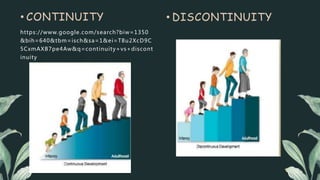
• Continuity view say that development is a
continuous process that is gradual and cumulative.
• For example, a child learns to crawl, and then to
stand and then to walk. They are gradually
learning how to walk. It's just like hiking up the
mountain path: a slow, steady ascent that leads to
the top.
WHAT IS DISCONTINUITY IN HUMAN
DEVELOPMENT
• Discontinuity view of development believes that people pass
through stages of life that are qualitatively different from each
other.
• For example, children go from only being able to think in very
literal terms to being able to think abstractly. They have moved
into the 'abstract thinking' phase of their lives. As you can
imagine, discontinuous development is like walking up the stairs: a
series of stages, or steps, that get you to the top of the
mountain.
• CONTINUITY
https://www.google.com/search?biw=1350
&bih=640&tbm=isch&sa=1&ei=T8u2XcD9C
5CxmAXB7pe4Aw&q=continuity+vs+discont
inuity
• DISCONTINUITY
STABILITY VERSUS CHANGE
• STABILITY
 The belief that personality traits
developed in the first 5years
predict adult personality
 Some aspects of temperament,
such as energy level and
outgoingness, seem relatively
stable
• CHANGE
 Personalities are modified
through interactions with family,
experience at school and
acculturation.
 Socia attitudes usually change a
great deal form childhood to
adulthood
THANK YOU FOR LISTENING

ISSUES ON HUMAN DEVELOPMENT

  • 1.
  • 2.
    INTRODUCTION -Each of ushas his/her own informal way of looking at our own and other people's development. -These paradigms of human development while obviously lacking in scholastic vigor, provide us with a conceptual framework for understanding ourselves and other's.
  • 3.
    There are threemajor Issues on Human Development • Nature versus Nurture • Continuity versus Discontinuity • Stability versus Change
  • 4.
    WHAT IS ANATURE IN HUMAN DEVELOPMENT Nature is what we think of as pre-wiring and is influenced by genetic inheritance and other biological factors.
  • 5.
    WHAT IS ANURTURE IN HUMAN DEVELOPMENT • Nurture is generally taken as the influence of external factors after conception, the product of exposure, life experiences and learning on an individual human.
  • 6.
    COMPARISSON BETWEEN NATUREVERSUS NURTURE • NATURE genes or heredity factor physical appearance personality characteristics • NURTURE environmental variables childhood experience how we were raised social relationship sorrounding cultures
  • 7.
  • 8.
    WHAT IS THECONTINUITY IN HUMAN DEVELOPMENT • Continuity view say that development is a continuous process that is gradual and cumulative. • For example, a child learns to crawl, and then to stand and then to walk. They are gradually learning how to walk. It's just like hiking up the mountain path: a slow, steady ascent that leads to the top.
  • 9.
    WHAT IS DISCONTINUITYIN HUMAN DEVELOPMENT • Discontinuity view of development believes that people pass through stages of life that are qualitatively different from each other. • For example, children go from only being able to think in very literal terms to being able to think abstractly. They have moved into the 'abstract thinking' phase of their lives. As you can imagine, discontinuous development is like walking up the stairs: a series of stages, or steps, that get you to the top of the mountain.
  • 10.
  • 11.
    STABILITY VERSUS CHANGE •STABILITY  The belief that personality traits developed in the first 5years predict adult personality  Some aspects of temperament, such as energy level and outgoingness, seem relatively stable • CHANGE  Personalities are modified through interactions with family, experience at school and acculturation.  Socia attitudes usually change a great deal form childhood to adulthood
  • 12.
    THANK YOU FORLISTENING