Issues on
human
development
MODULE 3
• A pattern of movement or change
that begins at conception
• It includes growth and decline
HUMAN DEVELOPMENT
• Nature vs. Nurture
• Continuity vs. Discontinuity
• Stability vs. Change
THREE ISSUES IN
DEVELOPMENT
Nature versus Nurture
The degree to which human
behavior is determined by
genetics/biology (nature) or learned
through interacting with the
environment (nurture)
— Behavior is caused by innate
characteristics
Inherited
GENES provides the blueprint for
all behavior
Nature
Nurture
• Behavior is shaped by
interactions with the
environment
• Born an empty vessel
• Quality depends on external
influences
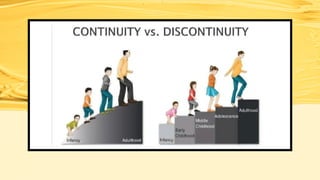
Continuity vs. discontinuity
Viewed that human development involves
gradual cumulative change from conception to
death (CONTINUITY) and some believe that
developing skill proceeds through a series of
abrupt changes (DISCONTINUITY)
You start by practicing on
training wheels, getting
used to the feeling of
balance and steering. You
keep practicing, getting
better and better at each
step. It's like slowly climbing
a staircase, one step at a
time.
Discontinuity
Continuity
Examples
The moment you take off
the training wheels is a
sudden change. It's a big
jump, and you might fall a
few times. But you're now
able to do something you
couldn't before.
Stability Vs. change
Deals with the issue whether or
not personality traits during
infancy endure throughout
lifespan.
Stability
• The belief that personality traits
developed in the first 5 years predict adult
personality.
• Some aspects of temperament, such as
energy level and outgoingness, seem
relatively stable
Change
• Personalities are modified through
interactions with family, experiences at
school, and acculturation.
• Social attitudes usually change a great
deal from childhood to adulthood.
Sarah's always been
outgoing and friendly,
enjoying being around
people. This hasn't changed
much over the years, even
though she's grown older.
Change
Stability
Examples
When Sarah was younger,
she loved playing with dolls
and drawing pictures. Now,
she's more interested in
sports, playing soccer and
reading about different
countries.
Thank you!

Issues-on-human-development-MODULE-3.pptx

  • 1.
  • 2.
    • A patternof movement or change that begins at conception • It includes growth and decline HUMAN DEVELOPMENT
  • 3.
    • Nature vs.Nurture • Continuity vs. Discontinuity • Stability vs. Change THREE ISSUES IN DEVELOPMENT
  • 4.
    Nature versus Nurture Thedegree to which human behavior is determined by genetics/biology (nature) or learned through interacting with the environment (nurture)
  • 5.
    — Behavior iscaused by innate characteristics Inherited GENES provides the blueprint for all behavior Nature
  • 6.
    Nurture • Behavior isshaped by interactions with the environment • Born an empty vessel • Quality depends on external influences
  • 7.
    Continuity vs. discontinuity Viewedthat human development involves gradual cumulative change from conception to death (CONTINUITY) and some believe that developing skill proceeds through a series of abrupt changes (DISCONTINUITY)
  • 9.
    You start bypracticing on training wheels, getting used to the feeling of balance and steering. You keep practicing, getting better and better at each step. It's like slowly climbing a staircase, one step at a time. Discontinuity Continuity Examples The moment you take off the training wheels is a sudden change. It's a big jump, and you might fall a few times. But you're now able to do something you couldn't before.
  • 10.
    Stability Vs. change Dealswith the issue whether or not personality traits during infancy endure throughout lifespan.
  • 11.
    Stability • The beliefthat personality traits developed in the first 5 years predict adult personality. • Some aspects of temperament, such as energy level and outgoingness, seem relatively stable
  • 12.
    Change • Personalities aremodified through interactions with family, experiences at school, and acculturation. • Social attitudes usually change a great deal from childhood to adulthood.
  • 13.
    Sarah's always been outgoingand friendly, enjoying being around people. This hasn't changed much over the years, even though she's grown older. Change Stability Examples When Sarah was younger, she loved playing with dolls and drawing pictures. Now, she's more interested in sports, playing soccer and reading about different countries.
  • 14.