Purpose: To familiarize everyone with the foundational  beliefs and structures of an ISSN school.  Driving Questions:  What are the foundational beliefs of an ISSN school? What ISSN structures make those beliefs a reality in the school? ISSN 101
Welcome & Introductions Intro to Asia Society & ISSN ISSN Beliefs Global Competency Graduate Profile Design Matrix Graduation Portfolio System (GPS) Performance Outcomes S.A.G.E. ISSN Ning and Asia Society Resources Online
“ the global is part of our everyday local lives” Who are you? W h ere do you teach? What ’ s one specific example of how the global is part of your local life? from Oxfam ’ s Education for Global  Citizenship:  A Guide for Schools
What are the gifts you bring to your role(s) in your school? What is your greatest challenge in your job right now? Check-In
 
School development organization Began in 2003 34 schools in seven states Mission:  To develop college-ready, globally competent high school graduates International Studies Schools Network
 
Globalization of the economy Cultural diversity and the need for global citizens Issues of global significance Why focus on global competence?
Globalization is driving demand for an  internationally competent  workforce One in five jobs is tied to international trade High cost of missed opportunities To be globally competitive, educated Americans  must be  globally competent Globalization of the Economy
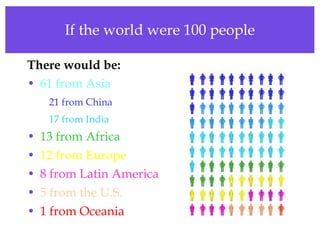
If the world were 100 people There would be: 61 from Asia 21 from China 17 from India 13 from Africa 12 from Europe 8 from Latin America 5 from the U.S. 1 from Oceania
Almost all our challenges have an international  dimension: health, global warming, energy/water, immigration, terrorism Our security is intertwined with our understanding  of other cultures World languages and cultural knowledge are essential Global Issues, Local Solutions
“ Global competence is the capacity and disposition to understand and act on issues of global significance. ” Veronica Boix Mansilla and Anthony Jackson,  Educating for Global Competence:  Preparing Our Youth to Engage the World , 2011 “ Earth at Night ”  CC by cote on Flickr
Read the ISSN “belief statement” On the back of the card, list the attributes of a  school that operates from these beliefs.  Include everything you can think of that relates  to this belief: structures, classroom behaviors,  student experiences, etc.  ISSN Beliefs
Find the others who have the same belief card  as you do Share the attributes you listed and continue to brainstorm together Become an “expert group” on this belief and  make sure everyone is ready to teach others ISSN Beliefs
Find a partner who has a different belief card;  share your beliefs and attributes with each other. Merge with another team with two other beliefs,  and share again. Finally, merge into a group of six so that all of  the beliefs are represented. ISSN Beliefs
“ Expand your Global Connections ”  CC by langwitches on Flickr
 
Global Leadership Performance Outcomes Investigate the World:  Students investigate the world beyond their immediate environment Recognize Perspectives:  Students recognize their own and others’ perspectives Communicate Ideas:  Students communicate their ideas effectively with diverse audiences Take Action:  Students translate their ideas into appropriate actions to improve conditions
Global Leadership Performance Outcomes
Where do you see the ISSN Beliefs manifested in these two documents? What, if anything, was missing? ISSN Graduate Profile & Global Leadership Performance Outcomes
“ Global awareness instruction . . . ”  CC by Scott McLeod on Flickr
 
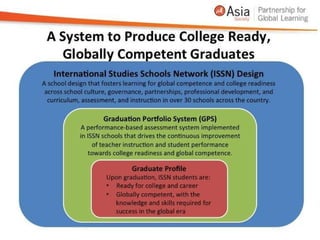
ISSN Design Model
Choose one. Write on the back . . . How does this relate to you on a personal level? How does this relate to you on a professional level? Share at your table. Listeners respond to the quote and/or the connections shared. Global Perspectives Quotes
Group 1: Vision, Mission, Culture; Academics; Globally focused curriculum Group 2: Project based learning; World language; Out of school opportunities Group 3: AP/College; Multiple Forms Assessment; Engaging Instructional Strategies Group 4: Multi-tiered interventions; Technology & new media; Service learning; Internships Group 5: Diverse faculty & staff; Professional learning; Family & student involvement; Use of data Group 6: Travel opportunities; Partnerships (local); Partnerships (national/international)
Please create a T-chart for each of the areas you  are assigned: What are we doing in this area already?  (put school abbreviations next to specific examples) What are the possibilities? Post your charts for the gallery walk The ISSN Design Matrix
Read what’s there Add your comments Contribute additional examples Rotate when you’re ready Take a break when you’ve finished Sit with your content area colleagues ISSN Matrix Gallery Walk
“ Teaching students about the world is not a subject in itself, separate from other content areas, but should be an integral part of all subjects taught. We need to open global gateways and inspire students to explore beyond their national borders. ” Vivien Stewart,  “ Becoming Citizens of the World, ”   Educational Leadership , April 2007 “ Open Gate in La Paz ”  CC by jaytkendall on Flickr
 
A process to produce and assess student work in relation  to a set of performance outcomes and rubrics that demonstrate college readiness and global competence in: 6 Core Subject Areas Interdisciplinary Coursework Aligned with Common Core & State Standards What is the Graduation Portfolio System?
 
Investigate the World Recognize Perspectives Take Action Communicate Ideas In your content area, how do students . . . ?
S tudent Choice Are there options for students to make choices about content, process, and/or  product within this task? A uthentic Is this task asking students to do something adults do in the “real world”? G lobal How are students being asked to investigate the world, recognize multiple  perspectives, communicate effectively, and/or take action? Public  E xhibition of Learning How will students have the opportunity to present their learning to an authentic audience?  S.A.G.E. The Elements of Quality Task Design
www.issnny.ning.com Join school, region, & content area groups! Sign up for the ISSN Ning (online network) Check out the Asia Society resources online www.asiasociety.org/education
old idea s   new ideas ideas to discuss everyday ideas    with my school/colleagues What ideas stood out to you today?
Campus Conversations

ISSN 101 for NYC

  • 1.
  • 2.
    Purpose: To familiarizeeveryone with the foundational beliefs and structures of an ISSN school. Driving Questions: What are the foundational beliefs of an ISSN school? What ISSN structures make those beliefs a reality in the school? ISSN 101
  • 3.
    Welcome & IntroductionsIntro to Asia Society & ISSN ISSN Beliefs Global Competency Graduate Profile Design Matrix Graduation Portfolio System (GPS) Performance Outcomes S.A.G.E. ISSN Ning and Asia Society Resources Online
  • 4.
    “ the globalis part of our everyday local lives” Who are you? W h ere do you teach? What ’ s one specific example of how the global is part of your local life? from Oxfam ’ s Education for Global Citizenship: A Guide for Schools
  • 5.
    What are thegifts you bring to your role(s) in your school? What is your greatest challenge in your job right now? Check-In
  • 6.
  • 7.
    School development organizationBegan in 2003 34 schools in seven states Mission: To develop college-ready, globally competent high school graduates International Studies Schools Network
  • 8.
  • 9.
    Globalization of theeconomy Cultural diversity and the need for global citizens Issues of global significance Why focus on global competence?
  • 10.
    Globalization is drivingdemand for an internationally competent workforce One in five jobs is tied to international trade High cost of missed opportunities To be globally competitive, educated Americans must be globally competent Globalization of the Economy
  • 11.
    If the worldwere 100 people There would be: 61 from Asia 21 from China 17 from India 13 from Africa 12 from Europe 8 from Latin America 5 from the U.S. 1 from Oceania
  • 12.
    Almost all ourchallenges have an international dimension: health, global warming, energy/water, immigration, terrorism Our security is intertwined with our understanding of other cultures World languages and cultural knowledge are essential Global Issues, Local Solutions
  • 13.
    “ Global competenceis the capacity and disposition to understand and act on issues of global significance. ” Veronica Boix Mansilla and Anthony Jackson, Educating for Global Competence: Preparing Our Youth to Engage the World , 2011 “ Earth at Night ” CC by cote on Flickr
  • 14.
    Read the ISSN“belief statement” On the back of the card, list the attributes of a school that operates from these beliefs. Include everything you can think of that relates to this belief: structures, classroom behaviors, student experiences, etc. ISSN Beliefs
  • 15.
    Find the otherswho have the same belief card as you do Share the attributes you listed and continue to brainstorm together Become an “expert group” on this belief and make sure everyone is ready to teach others ISSN Beliefs
  • 16.
    Find a partnerwho has a different belief card; share your beliefs and attributes with each other. Merge with another team with two other beliefs, and share again. Finally, merge into a group of six so that all of the beliefs are represented. ISSN Beliefs
  • 17.
    “ Expand yourGlobal Connections ” CC by langwitches on Flickr
  • 18.
  • 19.
    Global Leadership PerformanceOutcomes Investigate the World: Students investigate the world beyond their immediate environment Recognize Perspectives: Students recognize their own and others’ perspectives Communicate Ideas: Students communicate their ideas effectively with diverse audiences Take Action: Students translate their ideas into appropriate actions to improve conditions
  • 20.
  • 21.
    Where do yousee the ISSN Beliefs manifested in these two documents? What, if anything, was missing? ISSN Graduate Profile & Global Leadership Performance Outcomes
  • 22.
    “ Global awarenessinstruction . . . ” CC by Scott McLeod on Flickr
  • 23.
  • 24.
  • 25.
    Choose one. Writeon the back . . . How does this relate to you on a personal level? How does this relate to you on a professional level? Share at your table. Listeners respond to the quote and/or the connections shared. Global Perspectives Quotes
  • 26.
    Group 1: Vision,Mission, Culture; Academics; Globally focused curriculum Group 2: Project based learning; World language; Out of school opportunities Group 3: AP/College; Multiple Forms Assessment; Engaging Instructional Strategies Group 4: Multi-tiered interventions; Technology & new media; Service learning; Internships Group 5: Diverse faculty & staff; Professional learning; Family & student involvement; Use of data Group 6: Travel opportunities; Partnerships (local); Partnerships (national/international)
  • 27.
    Please create aT-chart for each of the areas you are assigned: What are we doing in this area already? (put school abbreviations next to specific examples) What are the possibilities? Post your charts for the gallery walk The ISSN Design Matrix
  • 28.
    Read what’s thereAdd your comments Contribute additional examples Rotate when you’re ready Take a break when you’ve finished Sit with your content area colleagues ISSN Matrix Gallery Walk
  • 29.
    “ Teaching studentsabout the world is not a subject in itself, separate from other content areas, but should be an integral part of all subjects taught. We need to open global gateways and inspire students to explore beyond their national borders. ” Vivien Stewart, “ Becoming Citizens of the World, ” Educational Leadership , April 2007 “ Open Gate in La Paz ” CC by jaytkendall on Flickr
  • 30.
  • 31.
    A process toproduce and assess student work in relation to a set of performance outcomes and rubrics that demonstrate college readiness and global competence in: 6 Core Subject Areas Interdisciplinary Coursework Aligned with Common Core & State Standards What is the Graduation Portfolio System?
  • 32.
  • 33.
    Investigate the WorldRecognize Perspectives Take Action Communicate Ideas In your content area, how do students . . . ?
  • 34.
    S tudent ChoiceAre there options for students to make choices about content, process, and/or product within this task? A uthentic Is this task asking students to do something adults do in the “real world”? G lobal How are students being asked to investigate the world, recognize multiple perspectives, communicate effectively, and/or take action? Public E xhibition of Learning How will students have the opportunity to present their learning to an authentic audience? S.A.G.E. The Elements of Quality Task Design
  • 35.
    www.issnny.ning.com Join school,region, & content area groups! Sign up for the ISSN Ning (online network) Check out the Asia Society resources online www.asiasociety.org/education
  • 36.
    old idea s new ideas ideas to discuss everyday ideas with my school/colleagues What ideas stood out to you today?
  • 37.