SIMPLIFICATION OF INDUCTION TO PLURIPOTENCY USING
A SINGLE POLYCISTRONIC EPISOMAL PLASMID
Zankesh Patel, Derek Woloszyn, Jessica Krugman, Ari Morgenstern, Alicia Lee, Wilson Wong and Rick Cohen*
Rutgers University, Biomedical Engineering, Rutgers University, Piscataway, NJ, United States
Reprogramming of somatic cells into Induced Pluripotent Stem Cells (IPSCs) can be
accomplished by a variety of methods utilizing recombinant proteins, modified RNAs,
DNA plasmids, or viral vectors hosting a popular set of four transcription factors:
Oct4, Sox2, KLF4, and C-Myc (or L-Myc). More recently non-genetically modifying
methods have gained popularity as they lend themselves to translational and
eventually clinically related research paradigms. One such method involves insertion
of 4 or 5 plasmids harboring EBNA-1 and OriP, two motifs that allows for episomal
duplication of these plasmids in human cells. Therefore the transferred DNA not only
expresses the desired set of genes, but also maintains their presence over the course
of several cell divisions. While this simple method allows for robust reprogramming,
preparation of 5 plasmids is costly and time consuming. Here we developed a single
episomal plasmid, pERC-V1, which contains Oct4, Sox2, KLF4, L-Myc and a fusion of
RFP and Blasticidin-S-Deaminase. pERC-V1 is capable of reprogramming human
foreskin fibroblasts when transferred to cells via electroporation using the NEON
system in conjunction with an optimized culturing methodology. Together the system
produces proto-colonies within 7 days, and mature expandable colonies within 21
days. In the long term, we aim to improve the efficiency of the plasmid, and to
remove the few remaining animal derived products and still achieve robust, and rapid
reprogramming in a simple single step manner.
Support: The Satell Foundation, The Stem Cell Training Course (stemcellcourse.org),
and Rutgers University.
W-2143
ABSTRACT
Plasmids: The EBNA1/Ori P based *pERC-V1 and *pERC-V2 plasmids use a hybrid
CAG promoter to drive the expression of a single poly-cistronic gene comprised of 6
genes separated by F2A, T2A, or P2A sequences; Oct4; Sox2; KLF4; L-Myc; and a
fusion of mRFP with Blasticidin-S-Deaminase. The RFP-Blast fusion gene is used to
help visual tracking, selection and enrichment of transfected cells. The pERC-V2
contains a PGK promoter upstream from the EBNA1 cassette. The plasmids were
amplified using STBL3 bacteria and were purified using low endotoxin purification
maxiprep kit Omega Biotek) together with an extra Triton X-114 extraction step.

Cell Culture: All cell culture was carried out using 4% O2 levels using a Galaxy 170R
(Eppendorf) incubator. Human foreskins fibroblasts were obtained from LifeLine Cell
Technology or through IRB approved collaboration (Dr. Daniel Hirsch, Somerset
Medical Center, Somerville NJ), derived and cultured using FibroLife media
containing 2% heat inactivated hESC qualified FBS (Hyclone). Passaging was
accomplished with enzymatic dissociation using TrypLE (Life Tech).
NEON Electroporation: Once 90 % confluence was reached, fibroblasts were rinsed
with PBS-EDTA (340 mOsm, PeproTech), and detached with TypLE. Cells were
filtered into a 50 mL conical bottom tube using a 40 µ cell strainer (BD) and diluted
1:1 with cell culture media. A 10 uL sample was enumerated using a standard bright
line hemacytometer while the remainder was centrifuged for 5 min at RT at 1000
RPM (150 x g). The pellet was suspended in PBS to at 1x10⁶ cells/mL, then 4 mL was
removed and re-centrifuged. The pellet was suspended with “R” electroporation
solution at 1.1x10⁶ cells per 100 µL. Cells were mixed with 5.5 µg (10 µL) of pERC-V1
or V2 DNA, and then 100 µL of cells-DNA were withdrawn into an electroporation tip
and pulsed according to the NEON system instructions (1700 Volt, 10 ms, 1 pulse).
The 100 µL tip volume was diluted into 900 µL of incubated Reprogramming Media
Step 1 (FibroLife with 5 small molecules (=5SM from Tocris = Na-Butyrate, PS48,
A-83-01, P53 inhibitor, and Epigenetic modifier + 2% FBS), and then 100 uL aliquots
(500 ng of DNA/100,000 cells), were placed into all wells of a Matrigel coated and
pre-equilibrated 6 well dish.
Reprogramming: The day after electroporation, the media was changed to
Reprogramming Medium Step 2 (enriched DMEM/F12, 270 mOsmo (PeproTech),
containing 20 % Knock-out Serum replacer, 0.1mM β-mercaptoethanol, 20 ng/mL
FGF-2, and 5 SM cocktail). The media was refreshed every other day until colonies
were visibly distinguished, then changed daily until passaged. All other growth
factors were obtained from PeproTech.
Primary IPSC Picking : At 21 days post electroporation clearly passable colonies
were observed and picked onto new Matrigel coated dishes using mechanical
dissociation without or with limited Dispase treatment (0.5 mg/mL for 3-5 min) using
the HARC picking tool*. Following both types of initial passaging techniques,
replicates were plated in the presence of 2 µM Y-27632 (Tocris). The media in some
cultures was changed from Reprogramming Media Step 2 to PeproGrow-hESC media
the following day.
Cell Culture – IPSC Expansion: Once the primary selected colonies were of
appropriate size, the cultures of presumptive IPSCs were selected and passaged
using Dispase, or cleaned of any visible fibroblasts using pick-to-remove techniques
and then passaged using high Osmo PBS/EDTA (PeproTech). Briefly, media was
aspirated from dishes and replaced with 1-2 mL of PBS/EDTA, and returned to the
incubator for 3-5 min. Once the texture of the colonies turned from uniform and
smooth to mostly phase bright and rough, the PBS/EDTA was aspirated and cells
triturated off the surface by forceful pipetting with 5 mL of PeproGrow-hESC media.
The supernatant containing the cells was triturated once more, and diluted to
appropriate density prior to plating (1:10 to 1:100 dilution). For Immunostaining
techniques cells were plated at a density of 10,000 to 20,000 cells per well.
*info on Plasmids, and HARC™ picking tools – contact rickcohen@stemcellcourse.org
MATERIAL AND METHODS
•  A single polycistronic Episomal plasmid containing Oct4, Sox2, KLF4 and L-
Myc can reprogram somatic cells into pluripotent derivatives.
•  Inclusion of 5 Enhancers of Reprogramming; Sodium Butyrate, PS48 and
A-83-01, p53 inhibitor, and Epigenetic modifier markedly accelerates
appearance of first sign of colony formation to 10 days, with clear colony
formation observed by 14 days. By 21 days, robust growth of colonies
filling each well is observed.
•  Low passage cultures grow robustly in a new Insulin-Free Phenol Red Free
media, PeproGrow hESC (Peprotech), and xeno-free version
•  Immunoanalysis reveal canonical expression of epitopes and genes normally
found in hESCs/IPSCs.
•  Differentiation techniques reveal that these cells can form neurons and
beating cardiomyocytes. Other lineages are being tested.
•  Future work will use Q-PCR to examine if any residual episomal vector
persists, and Q-RT-PCR to analyze and compare gene expression in lentiviral
versus episomal IPSC derived lines.
•  Our long term goal is to use non-genetically modifying methods together
with robust xeno-free system for clinically relevant cell lines for translational
research
•  Thanks to all the current Rutgers Undergraduate students who helped in
this on-going study; Kelsey Stecklow, Bijal Nisraiyya, Margaret Wang, Pooja
Patel, Sanjna Patel and Riddhy Panchal
SUMMARY
6/18/2014 6:30 to 8:30 PM
Neural and Cardiac Differentiation: For Neural – 1 day following passaging the media
was changed to PeproGrow-NSC (PGN) +10 uM EC23 (Tocris) up to 4 days; PGN +
Purmorphamine/FGF-2/HRG-beta/A-83-01/SB-431542/CHIR99021 up to a week; PGN
+ FGF-2/PDGF-AA/EGF/A-83-01/SB-431542/CHIR99021/Penacidil thereafter for
expansion and PGN + NT3/IGF1-LR3/Forskolin for final differentiation. For cardio
differentiation we used Matrigel sandwich method where first three medias are
changed cold and contain 5.5 uL of undiluted Matrigel; Day 1 - hESC media; Day 2 -
PeproGrow-Cardio no Insulin (PGC) + 100 ng/mL Activin A; Day 3 to 8 – PGC + 10 ng/
mL BMP4 + FGF-2 no Insulin – no media change.; Day 8 onwards PGC with Insulin and
10 uM KY02111 until beating is observed 21-30 days.
Immunological Analysis: Immunofluorescence using standard pluripotency antibodies;
Nanog (Sigma) , Lin28 (Epitomics), and Tra-1-60 (Life Technologies), was carried out
using pERC-V1 and V2 IPSC lines. Cardiotin (Millipore), and Smooth Muscle Actin
(Millipore) was used to stain previously beating clusters of cardio myocytes, while Tuj1
was used to identify neurons.
pERC-V1, 16.2 kb OR ★pERC-V2, 16.7 kb
CAG promoter
Amp
WPREOct4-2A-Sox2-2A-KLF4-2A-L-Myc-2A-RFP/Blast β-Globin-polyA
pBR322 Ori OriP EBNA-1 ★PGK promoter Electroporation of human foreskin fibroblasts : Fibroblasts begin to express the poly-
cistronic gene as reflected by the RFP signal within 24 hrs post electroporation.
Blasticidin is supplemented into the reprogramming medium at a concentration of 5 –
10 ug/ml for up to 5-7 days. During this time the selection enriches the proportion of
transfected and potentially reprogrammable cells. Cell death is also observed in RFP+
cells either due to electroporation, and/or from pathways activated by foreign DNA.
RESULTS
Phase Contrast
 RFP
12d
 21d
Generation of IPSCs with a single episomal vector with 5 small molecules under
low oxygen concentrations: After 12 days, early indications of cellular reorganization
is observed and by 21 days post-electroporation, robust clear passable colonies are
seen This is consistently seen over 3 separate experiments using 3 different fibroblast
lines. Without the use of small molecules no colonies are observed, whereas at normal
oxygen tension ¼ of numbers of colonies are generated.
Primary passaging of pERC-V1 reprogrammed IPSCs (top): Colonies replated after
Dispase treatment tended to attach better than those mechanically picked. When
treated with Y-27632, colonies survived the process more efficiently and formed
colonies within 4 days. By 7 days post passaging many colonies with canonical
mature IPSC colonies were observed.
New passaging tools (bottom): The HARC™ picking tools v1.0 & 2.0 (Patent
Pending) were used successfully to remove non-reprogrammed cells and to pick
mechanically without or with limited Dispase treatment. The HARC v1.0 (top right) is
a single piece unit that offers variety of 4-6 mm blade types, seen here is the classical
straight-edge, whereas the v2.0 (bottom right) features a changeable tip that
accommodates user selected rotation, and multiple tips types including straight-
edge, notched, fan, and point. Some designs are available as “chisel or flat grind”
type blades in several types of single use, or limiter reuse materials. Contact
rickcohen@stemcellcourse.org for more information about these tools.
DAPI
 Cardiotin
 αSMA
DAPI Lin28 Tra-1-60 NanogMATERIAL AND METHODS (CONT’)
Episomally reprogrammed cells express canonical stem cell markers; Indirect
immunofluorescence staining techniques using standard pluripotency antibodies;
Lin28 (green), Tra-1-60 (red) and Nanog (purple); were used to verify that these
presumptive cultures resembled IPSC cell lines generated by other methodologies.
Other markers like SSEA4 were also positive, while little or no staining was observed
with SSEA1 (data not shown).
Episomally reprogrammed cells can generate putative neurons: Following the
multistep protocol described in the Methods sections, cultures were fixed and stained
with anti-b-III-tubulin antibodies to determine if early/committed neurons are present
in the cultures. Two types of staining was observed, light in smaller less elaborated
cells, and much more intense, in mature looking neurons
Phase β-III-tubulin DAPI
Episomally reprogrammed cells can generate beating cardiomyocytes : Following
the multistep Matrigel Sandwich Method described in the Methods section, IPSCs
were differentiated into beating cardiac myocytes and maintained for 14-21 days in
culture. Those areas were “marked” to be able to cross reference after staining. The
cultures were fixed and stained with cardiotin (green) and αSMA (red) antibodies The
majority of Cardiotin+ cells also expressed SMA, while occasionally areas that were
SMA single positve were observed

ISSCR-2014-poster

  • 1.
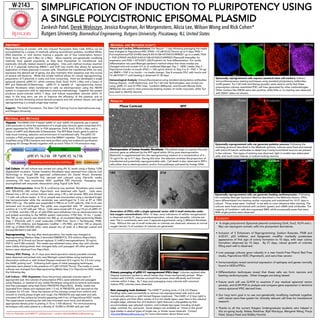
    SIMPLIFICATION OF INDUCTIONTO PLURIPOTENCY USING A SINGLE POLYCISTRONIC EPISOMAL PLASMID Zankesh Patel, Derek Woloszyn, Jessica Krugman, Ari Morgenstern, Alicia Lee, Wilson Wong and Rick Cohen* Rutgers University, Biomedical Engineering, Rutgers University, Piscataway, NJ, United States Reprogramming of somatic cells into Induced Pluripotent Stem Cells (IPSCs) can be accomplished by a variety of methods utilizing recombinant proteins, modified RNAs, DNA plasmids, or viral vectors hosting a popular set of four transcription factors: Oct4, Sox2, KLF4, and C-Myc (or L-Myc). More recently non-genetically modifying methods have gained popularity as they lend themselves to translational and eventually clinically related research paradigms. One such method involves insertion of 4 or 5 plasmids harboring EBNA-1 and OriP, two motifs that allows for episomal duplication of these plasmids in human cells. Therefore the transferred DNA not only expresses the desired set of genes, but also maintains their presence over the course of several cell divisions. While this simple method allows for robust reprogramming, preparation of 5 plasmids is costly and time consuming. Here we developed a single episomal plasmid, pERC-V1, which contains Oct4, Sox2, KLF4, L-Myc and a fusion of RFP and Blasticidin-S-Deaminase. pERC-V1 is capable of reprogramming human foreskin fibroblasts when transferred to cells via electroporation using the NEON system in conjunction with an optimized culturing methodology. Together the system produces proto-colonies within 7 days, and mature expandable colonies within 21 days. In the long term, we aim to improve the efficiency of the plasmid, and to remove the few remaining animal derived products and still achieve robust, and rapid reprogramming in a simple single step manner. Support: The Satell Foundation, The Stem Cell Training Course (stemcellcourse.org), and Rutgers University. W-2143 ABSTRACT Plasmids: The EBNA1/Ori P based *pERC-V1 and *pERC-V2 plasmids use a hybrid CAG promoter to drive the expression of a single poly-cistronic gene comprised of 6 genes separated by F2A, T2A, or P2A sequences; Oct4; Sox2; KLF4; L-Myc; and a fusion of mRFP with Blasticidin-S-Deaminase. The RFP-Blast fusion gene is used to help visual tracking, selection and enrichment of transfected cells. The pERC-V2 contains a PGK promoter upstream from the EBNA1 cassette. The plasmids were amplified using STBL3 bacteria and were purified using low endotoxin purification maxiprep kit Omega Biotek) together with an extra Triton X-114 extraction step. Cell Culture: All cell culture was carried out using 4% O2 levels using a Galaxy 170R (Eppendorf) incubator. Human foreskins fibroblasts were obtained from LifeLine Cell Technology or through IRB approved collaboration (Dr. Daniel Hirsch, Somerset Medical Center, Somerville NJ), derived and cultured using FibroLife media containing 2% heat inactivated hESC qualified FBS (Hyclone). Passaging was accomplished with enzymatic dissociation using TrypLE (Life Tech). NEON Electroporation: Once 90 % confluence was reached, fibroblasts were rinsed with PBS-EDTA (340 mOsm, PeproTech), and detached with TypLE. Cells were filtered into a 50 mL conical bottom tube using a 40 µ cell strainer (BD) and diluted 1:1 with cell culture media. A 10 uL sample was enumerated using a standard bright line hemacytometer while the remainder was centrifuged for 5 min at RT at 1000 RPM (150 x g). The pellet was suspended in PBS to at 1x10⁶ cells/mL, then 4 mL was removed and re-centrifuged. The pellet was suspended with “R” electroporation solution at 1.1x10⁶ cells per 100 µL. Cells were mixed with 5.5 µg (10 µL) of pERC-V1 or V2 DNA, and then 100 µL of cells-DNA were withdrawn into an electroporation tip and pulsed according to the NEON system instructions (1700 Volt, 10 ms, 1 pulse). The 100 µL tip volume was diluted into 900 µL of incubated Reprogramming Media Step 1 (FibroLife with 5 small molecules (=5SM from Tocris = Na-Butyrate, PS48, A-83-01, P53 inhibitor, and Epigenetic modifier + 2% FBS), and then 100 uL aliquots (500 ng of DNA/100,000 cells), were placed into all wells of a Matrigel coated and pre-equilibrated 6 well dish. Reprogramming: The day after electroporation, the media was changed to Reprogramming Medium Step 2 (enriched DMEM/F12, 270 mOsmo (PeproTech), containing 20 % Knock-out Serum replacer, 0.1mM β-mercaptoethanol, 20 ng/mL FGF-2, and 5 SM cocktail). The media was refreshed every other day until colonies were visibly distinguished, then changed daily until passaged. All other growth factors were obtained from PeproTech. Primary IPSC Picking : At 21 days post electroporation clearly passable colonies were observed and picked onto new Matrigel coated dishes using mechanical dissociation without or with limited Dispase treatment (0.5 mg/mL for 3-5 min) using the HARC picking tool*. Following both types of initial passaging techniques, replicates were plated in the presence of 2 µM Y-27632 (Tocris). The media in some cultures was changed from Reprogramming Media Step 2 to PeproGrow-hESC media the following day. Cell Culture – IPSC Expansion: Once the primary selected colonies were of appropriate size, the cultures of presumptive IPSCs were selected and passaged using Dispase, or cleaned of any visible fibroblasts using pick-to-remove techniques and then passaged using high Osmo PBS/EDTA (PeproTech). Briefly, media was aspirated from dishes and replaced with 1-2 mL of PBS/EDTA, and returned to the incubator for 3-5 min. Once the texture of the colonies turned from uniform and smooth to mostly phase bright and rough, the PBS/EDTA was aspirated and cells triturated off the surface by forceful pipetting with 5 mL of PeproGrow-hESC media. The supernatant containing the cells was triturated once more, and diluted to appropriate density prior to plating (1:10 to 1:100 dilution). For Immunostaining techniques cells were plated at a density of 10,000 to 20,000 cells per well. *info on Plasmids, and HARC™ picking tools – contact rickcohen@stemcellcourse.org MATERIAL AND METHODS •  A single polycistronic Episomal plasmid containing Oct4, Sox2, KLF4 and L- Myc can reprogram somatic cells into pluripotent derivatives. •  Inclusion of 5 Enhancers of Reprogramming; Sodium Butyrate, PS48 and A-83-01, p53 inhibitor, and Epigenetic modifier markedly accelerates appearance of first sign of colony formation to 10 days, with clear colony formation observed by 14 days. By 21 days, robust growth of colonies filling each well is observed. •  Low passage cultures grow robustly in a new Insulin-Free Phenol Red Free media, PeproGrow hESC (Peprotech), and xeno-free version •  Immunoanalysis reveal canonical expression of epitopes and genes normally found in hESCs/IPSCs. •  Differentiation techniques reveal that these cells can form neurons and beating cardiomyocytes. Other lineages are being tested. •  Future work will use Q-PCR to examine if any residual episomal vector persists, and Q-RT-PCR to analyze and compare gene expression in lentiviral versus episomal IPSC derived lines. •  Our long term goal is to use non-genetically modifying methods together with robust xeno-free system for clinically relevant cell lines for translational research •  Thanks to all the current Rutgers Undergraduate students who helped in this on-going study; Kelsey Stecklow, Bijal Nisraiyya, Margaret Wang, Pooja Patel, Sanjna Patel and Riddhy Panchal SUMMARY 6/18/2014 6:30 to 8:30 PM Neural and Cardiac Differentiation: For Neural – 1 day following passaging the media was changed to PeproGrow-NSC (PGN) +10 uM EC23 (Tocris) up to 4 days; PGN + Purmorphamine/FGF-2/HRG-beta/A-83-01/SB-431542/CHIR99021 up to a week; PGN + FGF-2/PDGF-AA/EGF/A-83-01/SB-431542/CHIR99021/Penacidil thereafter for expansion and PGN + NT3/IGF1-LR3/Forskolin for final differentiation. For cardio differentiation we used Matrigel sandwich method where first three medias are changed cold and contain 5.5 uL of undiluted Matrigel; Day 1 - hESC media; Day 2 - PeproGrow-Cardio no Insulin (PGC) + 100 ng/mL Activin A; Day 3 to 8 – PGC + 10 ng/ mL BMP4 + FGF-2 no Insulin – no media change.; Day 8 onwards PGC with Insulin and 10 uM KY02111 until beating is observed 21-30 days. Immunological Analysis: Immunofluorescence using standard pluripotency antibodies; Nanog (Sigma) , Lin28 (Epitomics), and Tra-1-60 (Life Technologies), was carried out using pERC-V1 and V2 IPSC lines. Cardiotin (Millipore), and Smooth Muscle Actin (Millipore) was used to stain previously beating clusters of cardio myocytes, while Tuj1 was used to identify neurons. pERC-V1, 16.2 kb OR ★pERC-V2, 16.7 kb CAG promoter Amp WPREOct4-2A-Sox2-2A-KLF4-2A-L-Myc-2A-RFP/Blast β-Globin-polyA pBR322 Ori OriP EBNA-1 ★PGK promoter Electroporation of human foreskin fibroblasts : Fibroblasts begin to express the poly- cistronic gene as reflected by the RFP signal within 24 hrs post electroporation. Blasticidin is supplemented into the reprogramming medium at a concentration of 5 – 10 ug/ml for up to 5-7 days. During this time the selection enriches the proportion of transfected and potentially reprogrammable cells. Cell death is also observed in RFP+ cells either due to electroporation, and/or from pathways activated by foreign DNA. RESULTS Phase Contrast RFP 12d 21d Generation of IPSCs with a single episomal vector with 5 small molecules under low oxygen concentrations: After 12 days, early indications of cellular reorganization is observed and by 21 days post-electroporation, robust clear passable colonies are seen This is consistently seen over 3 separate experiments using 3 different fibroblast lines. Without the use of small molecules no colonies are observed, whereas at normal oxygen tension ¼ of numbers of colonies are generated. Primary passaging of pERC-V1 reprogrammed IPSCs (top): Colonies replated after Dispase treatment tended to attach better than those mechanically picked. When treated with Y-27632, colonies survived the process more efficiently and formed colonies within 4 days. By 7 days post passaging many colonies with canonical mature IPSC colonies were observed. New passaging tools (bottom): The HARC™ picking tools v1.0 & 2.0 (Patent Pending) were used successfully to remove non-reprogrammed cells and to pick mechanically without or with limited Dispase treatment. The HARC v1.0 (top right) is a single piece unit that offers variety of 4-6 mm blade types, seen here is the classical straight-edge, whereas the v2.0 (bottom right) features a changeable tip that accommodates user selected rotation, and multiple tips types including straight- edge, notched, fan, and point. Some designs are available as “chisel or flat grind” type blades in several types of single use, or limiter reuse materials. Contact rickcohen@stemcellcourse.org for more information about these tools. DAPI Cardiotin αSMA DAPI Lin28 Tra-1-60 NanogMATERIAL AND METHODS (CONT’) Episomally reprogrammed cells express canonical stem cell markers; Indirect immunofluorescence staining techniques using standard pluripotency antibodies; Lin28 (green), Tra-1-60 (red) and Nanog (purple); were used to verify that these presumptive cultures resembled IPSC cell lines generated by other methodologies. Other markers like SSEA4 were also positive, while little or no staining was observed with SSEA1 (data not shown). Episomally reprogrammed cells can generate putative neurons: Following the multistep protocol described in the Methods sections, cultures were fixed and stained with anti-b-III-tubulin antibodies to determine if early/committed neurons are present in the cultures. Two types of staining was observed, light in smaller less elaborated cells, and much more intense, in mature looking neurons Phase β-III-tubulin DAPI Episomally reprogrammed cells can generate beating cardiomyocytes : Following the multistep Matrigel Sandwich Method described in the Methods section, IPSCs were differentiated into beating cardiac myocytes and maintained for 14-21 days in culture. Those areas were “marked” to be able to cross reference after staining. The cultures were fixed and stained with cardiotin (green) and αSMA (red) antibodies The majority of Cardiotin+ cells also expressed SMA, while occasionally areas that were SMA single positve were observed