High-Content Classification of Nucleocytoplasmic
Import or Export Inhibitors
YONG-JUN KWON,1
AUGUSTE GENOVESIO,1
NAM YOUL KIM,1
HI CHUL KIM,1
SUNGYONG JUNG,1
BRIGITTE DAVID-WATINE,2
ULF NEHRBASS,1
and NEIL EMANS1
Transcription factors of the nuclear factor κ B family are the paradigm for signaling dependent nuclear translocation and are
ideally suited to analysis through image-based chemical genetic screening. The authors describe combining high-content image
analysis with a compound screen to identify compounds affecting either nuclear import or export. Validation in silico and in
vitro determined an EC50 for the nuclear export blocker leptomycin B of 2.4 ng/mL (4.4 nM). The method demonstrated high
selectivity (Z′ >0.95), speed, and robustness in a screen of a compound collection. It identified the IκB protein kinase inhibitor
BAY 11 7082 as an import inhibitor, the p38 mitogen-activated protein (MAP) kinase inhibitor PD98509 as an import enhancer,
and phorbol ester as an export inhibitor. The results establish a robust method for identifying compounds regulating nucleocy-
toplasmic import or export and also implicate MAP kinases in nuclear import of nuclear factor κ B. (Journal of Biomolecular
Screening XXXX:xx-xx)
Key words: NF-κB, nucleocytoplasmic transport, signal transduction, second messenger-activated kinases, high-content
screening, automation, image recognition
© Society for Biomolecular Sciences www.sbsonline.org 1
INTRODUCTION
DEFECTS IN THE NUCLEOCYTOPLASMIC TRANSPORT of tran-
scription factors are implicated in diseases ranging from
cancer to inflammatory illnesses, such as asthma. Chemical
genetic phenotypic screens offer insight into the mechanisms
underlying these conditions when the disease phenotype can be
examined and manipulated at a cellular level through the
screening of collections of small-molecule modulators.
In the case of asthma, signal transduction plays a role in the
recruitment and activation of inflammatory cells in the asth-
matic airway. A large number of transcription factors, such as
the signal transducers and activators of transcription, activator
protein 1, nuclear factor of activated T cells, cyclic adenosine
monophosphate response-element binding proteins, guanine-
adenine and thymine-adenine repeats, Ets family proteins, and
nuclear factor κ B (NF-κB) proteins, have been involved in the
physiopathology of asthma.1-3
The NF-κB pathway is directly implicated in the pathogene-
sis of cancer, diabetes, and systemic inflammatory response syn-
drome. Cytoplasmic to nuclear translocation is a key step in
NF-κB regulation. In unstimulated cells, NF-κB is retained in the
cytoplasm through masking of the nuclear localization signals on
NF-κB dimers by inhibitory proteins known as IκBs.4,5
Upon
exposure of cells to an NF-κB–activating stimuli, the IκB protein
kinase (IKK) complex phosphorylates IκBs on 2 conserved
N-terminal serine residues. Phosphorylated IκB is then ubiquiti-
nated and degraded, thus releasing NF-κB, which is recognized
by the nuclear import machinery and quickly shuttled into the
nucleus to regulate NF-κB–dependent gene expression.
Cis-acting elements of IκBs govern its protein stability and sub-
cellular localization.6,7
IκBα comprises 3 domains: an N-terminal
regulatory domain that controls signal-dependent degradation, a
central ankyrin repeat domain that is necessary for NF-κB bind-
ing, and a C-terminal region rich in proline, glutamate/aspartate,
serine, and threonine regulating basal turnover. An additional
sequence, a leucine-rich nuclear export sequence (NES) within
the last ankyrin repeat, is postulated to function during the ter-
mination of NF-κB activity.8
Activated NF-κB stimulates the
synthesis of IκBα mRNA,9,10
and newly synthesized IκB pro-
teins can enter the nucleus to bind to and remove NF-κB from
gene promoters.11
It is believed that the C-terminal NES of IκBα
can actively export these IκBα NF-κB complexes out to the cyto-
plasm to restore the preinduction repression.8
1
Institut Pasteur-Korea, Seongbuk-Gu, Seoul, Korea.
2
Nuclear Cell Biology Group, Institut Pasteur, Paris, France.
Received Jan 10, 2007, and in revised form Feb 15, 2007. Accepted for publi-
cation Feb 25, 2007.
Journal of Biomolecular Screening XX(X); XXXX
DOI:10.1177/1087057107301319
J Biomol Screen OnlineFirst, published on May 16, 2007 as doi:10.1177/1087057107301319
Copyright 2007 by Society for Biomolecular Sciences.
The leucine-rich NES is a highly conserved sequence used by
a variety of proteins to facilitate their delivery from the nucleus to
the cytoplasm and is important in regulating protein function
through subcellular localization.12
Nuclear export of proteins,
such as HIV Rev,13,14
cyclin B1,14
and protein kinase A inhibitor,15
can be inhibited by leptomycin B, a Streptomyces metabolite.16
Several groups have reported that CRM1 (exportin 1), related to
the β-importin family of nuclear proteins, is the receptor for the
leucine-rich NES and that leptomycin B interferes with the inter-
action between CRM1 and NES by directly binding to CRM1.17-21
Nuclear import and export of NF-κB are mediated through inter-
actions with the importin and exportin proteins.22
High-content screens are growing in importance as a research
and drug discovery tool, as the cell-based models and the tech-
nology to image these assays—automated image acquisition
and measurement—proliferate.23,24
High-content screens exploit
image analysis algorithms to extract measurement of protein
localization and concentration from image data. Our interest was
to develop a highly robust algorithm for measuring nucleocyto-
plasmic transport independent of the requirement for image seg-
mentation or cell recognition as part of a screen to discern
nuclear import inhibitors from export inhibitors. This method has
application in the identification of small-molecule modulators of
transcription factor biology.
MATERIALS AND METHODS
Chemicals
All fine chemicals were purchased from Sigma-Aldrich (St.
Louis, MO). DRAQ5 was from BioStatus (Shepshed, UK).
Kinase and phosphatase inhibitors were purchased as 95% to
99% pure 10-mM stock solutions in dimethylsulfoxide or water
(Biomol, Hamburg, Germany). Stock solutions and formatted
assay plates were stored at –20 °C. Primary rabbit antibodies
against NF-κB were from Santa Cruz Biotechnology (Santa
Cruz, CA), secondary goat anti-rabbit Alexa 488 antibodies
were purchased from Molecular Probes (Eugene, OR), and goat
serum was from Gibco-BRL (Carlsbad, CA).
Cell lines and cell culture
HeLa cells (ATCC, Manassas, VA) were cultivated in
high-glucose glutamax Dulbecco’s Modified Eagle Medium
(Invitrogen, Carlsbad, CA) supplemented with 110 mg/mL
sodium pyruvate, 10% fetal calf serum (Gibco), and 1% peni-
cillin streptomycin (Invitrogen). HEK 293 cells were cultivated in
Dulbecco’s Modified Eagle Medium/F12 (Invitrogen) supple-
mented with 10% fetal calf serum and 1% penicillin strepto-
mycin. HeLa cells in 96-well plates (seeding density of 15,000
cells/well) were incubated for 16 h.
NF-κκB immunofluorescent detection
Cells were washed twice with phosphate-buffered saline
(PBS), fixed for 10 min with 4% (w/v) paraformaldehyde in
PBS, and then washed with PBS. Permeabilization was per-
formed with 0.1% TX-100 PBS for 10 min, and cells were
washed in PBS and then incubated with a 1:200 dilution of rab-
bit anti–NF-κB in 10% goat serum–PBS overnight at 4 °C.
Plates were washed 3 times with PBS for 10 min on an orbital
rotator. Alexa 488 goat antirabbit secondary antibody (1:1000)
was incubated with the cells for 60 min at room temperature,
and cells were washed 3 times for 10 min with PBS on an
orbital shaker before the addition of 5 µM of DRAQ5 in PBS
for 10 min at 37 °C.
Cell imaging
The NF-κB nucleocytoplasmic transport was imaged using
the Opera ultra-high-throughput confocal screening system
(Evotec Technologies, Hamburg, Germany). The Opera is a fully
automated, 4-color laser excitation confocal system (405, 488,
532, 637 nm) based on an inverted microscope architecture
to image cells cultivated in 96- or 384-well coverslip-bottomed
microplates (Greiner, Monroe, NC). Images were acquired with
0.7 NA 20 × water immersion or 40 × 0.7 NA water immersion
lenses (Olympus Instruments, Tokyo, Japan) at room tempera-
ture with confocality generated by a nipkow disc system and
image acquisition via 3 parallel 16-bit CCD cameras. Images
were corrected for optical vignetting using the Opera acquisition
software and a standard reference set of 1 to 10 µm multicolor
fluorescent beads. Images were exported as 16 bit. TIFF files
were scaled before export to Adobe Photoshop.
Cell-based screening
Cells were treated with 0.1 to 20 ng/mL leptomycin B in
culture medium for 40 min to arrest nuclear export.
Compounds in DMSO or H2O were diluted into culture
medium just prior to screening at 10 µM for all compounds
except bafilomycin (1 µM) in culture medium with or without
5 ng/mL leptomycin B before transfer to cells. Cells were fixed as
above to arrest the assay. Plates were imaged by Opera using
488/637 nm excitation and 510 nm (50 nm bandpass) or 680nm
(50 nm bandpass) filters, respectively. Typically, 3 image pairs
were acquired per well.
RESULTS
Our rationale was to establish a high-content screen capable
of identifying compounds affecting either nuclear import or
export of transcription factors, such as NF-κB. High-throughput
Kwon et al.
2 www.sbsonline.org Journal of Biomolecular Screening XX(X); XXXX
immunofluorescent detection of NF-κB transport was quanti-
fied with a novel image analysis algorithm to screen a collection
of kinase and phosphatase inhibitors. A symmetrical high-con-
tent imaging screen scheme was designed to discriminate
between compounds affecting nuclear export or import of NF-
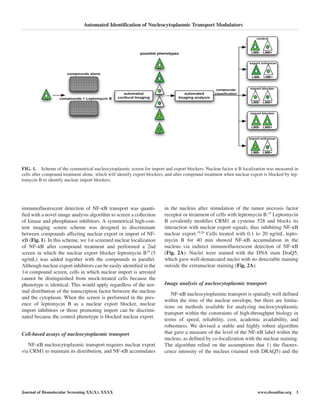
κB (Fig. 1). In this scheme, we 1st screened nuclear localization
of NF-κB after compound treatment and performed a 2nd
screen in which the nuclear export blocker leptomycin B19
(5
ng/mL) was added together with the compounds in parallel.
Although nuclear export inhibitors can be easily identified in the
1st compound screen, cells in which nuclear import is arrested
cannot be distinguished from mock-treated cells because the
phenotype is identical. This would apply regardless of the nor-
mal distribution of the transcription factor between the nucleus
and the cytoplasm. When the screen is performed in the pres-
ence of leptomycin B as a nuclear export blocker, nuclear
import inhibitors or those promoting import can be discrimi-
nated because the control phenotype is blocked nuclear export.
Cell-based assays of nucleocytoplasmic transport
NF-κB nucleocytoplasmic transport requires nuclear export
via CRM1 to maintain its distribution, and NF-κB accumulates
in the nucleus after stimulation of the tumor necrosis factor
receptor or treatment of cells with leptomycin B.25
Leptomycin
B covalently modifies CRM1 at cysteine 528 and blocks its
interaction with nuclear export signals, thus inhibiting NF-κB
nuclear export.19,26
Cells treated with 0.1 to 20 ng/mL lepto-
mycin B for 40 min showed NF-κB accumulation in the
nucleus via indirect immunofluorescent detection of NF-κB
(Fig. 2A). Nuclei were stained with the DNA stain DraQ5,
which gave well-demarcated nuclei with no detectable staining
outside the extranuclear staining (Fig. 2A).
Image analysis of nucleocytoplasmic transport
NF-κB nucleocytoplasmic transport is spatially well defined
within the rims of the nuclear envelope, but there are limita-
tions on methods available for analyzing nucleocytoplasmic
transport within the constraints of high-throughput biology in
terms of speed, reliability, cost, academic availability, and
robustness. We devised a stable and highly robust algorithm
that gave a measure of the level of the NF-κB label within the
nucleus, as defined by co-localization with the nuclear staining.
The algorithm relied on the assumptions that 1) the fluores-
cence intensity of the nucleus (stained with DRAQ5) and the
Automated Identification of Nucleocytoplasmic Transport Modulators
Journal of Biomolecular Screening XX(X); XXXX www.sbsonline.org 3
FIG. 1. Scheme of the symmetrical nucleocytoplasmic screen for import and export blockers. Nuclear factor κ B localization was measured in
cells after compound treatment alone, which will identify export blockers, and after compound treatment when nuclear export is blocked by lep-
tomycin B to identify nuclear import blockers.
expression level of NF-κB are independent of leptomycin B
concentration and 2) that as NF-κB enters the nucleus, the co-
localization of the NF-κB signal with nuclear staining
increases. Based on these 2 assumptions, we developed a quan-
titative measure of NF-κB localization in the nucleus.
In a typical experiment, three 2-color images were indepen-
dently analyzed per condition and used to compute the standard
deviation. A gray-scale image was defined as the function G:
Ω⊂N2 →→ !. The function G represents the NF-κB signal and
R the nuclear stain. In terms of image processing, each image
Kwon et al.
4 www.sbsonline.org Journal of Biomolecular Screening XX(X); XXXX
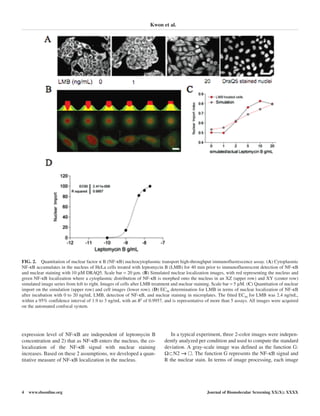
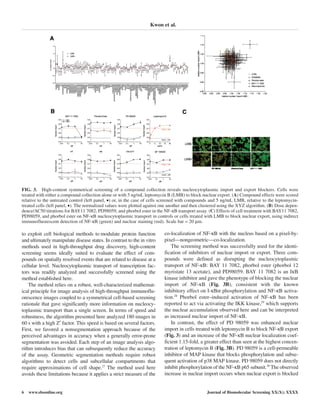
FIG. 2. Quantitation of nuclear factor κ B (NF-κB) nucleocytoplasmic transport high-throughput immunofluorescence assay. (A) Cytoplasmic
NF-κB accumulates in the nucleus of HeLa cells treated with leptomycin B (LMB) for 40 min prior to immunofluorescent detection of NF-κB
and nuclear staining with 10 µM DRAQ5. Scale bar = 20 µm. (B) Simulated nuclear localization images, with red representing the nucleus and
green NF-κB localization where a cytoplasmic distribution of NF-κB is morphed onto the nucleus in an XZ (upper row) and XY (center row)
simulated image series from left to right. Images of cells after LMB treatment and nuclear staining. Scale bar = 5 µM. (C) Quantitation of nuclear
import on the simulation (upper row) and cell images (lower row). (D) EC50 determination for LMB in terms of nuclear localization of NF-κB
after incubation with 0 to 20 ng/mL LMB, detection of NF-κB, and nuclear staining in microplates. The fitted EC50 for LMB was 2.4 ng/mL,
within a 95% confidence interval of 1.9 to 3 ng/mL with an R2
of 0.9957, and is representative of more than 5 assays. All images were acquired
on the automated confocal system.
is normalized as follows: The mean of pixel intensity is
1
computed by G =
n (x, y) ∈Ω
G(x, y) and the standard deviation by
1
σG =
n (x, y) ∈Ω
(G(x, y) – G)2
, and the pixels are normalized by
Gσ(x, y) =
G(x, y) – G
.
σG
After similar normalization of the nuclear intensity R, a cor-
relation value between R and G is computed via Corr (R, G) =
(x, y) ∈Ω
Rσ(x, y)Gσ(x, y). Thus, the degree of co-localization between
NF-κB labeling and the nuclear stain is quantified, irrespective
of the geometry and the number of cells.
Validation of the image analysis algorithm
A simulation of NF-κB entry into the nucleus was used to
validate the image analysis algorithm. NF-κB distribution in
the cell was represented by a subtraction of 2 evolving
Gaussian shapes, and the nuclear stain was represented by a
nonevolving thresholded Gaussian (Fig. 2B). This permitted
the volume of the shape(s) to remain constant and thus
respected assumption 1 that leptomycin B treatment would not
alter intensities of NF-κB or the nucleus. The simulation is
depicted in a vertical and XY image in Figure 2B and C. The
green intensity was linearly evolved to fill the center and thus
tended to increase the number of pixels that had a high value of
G and R, satisfying assumption 2.
Figure 2B shows the evolution between the 2 situations:
where the NF-κB simulation (green) shape was entirely absent
from the nucleus and where it morphed linearly from an NF-
κB–free empty nucleus to a filled nucleus. The identical simu-
lation is shown in Figure 2B but in 2 dimensions and with
additive white Gaussian noise added to mimic the predicted
real experimental situation. These simulations were conceived
to represent the repression of nuclear export of NF-κB through
an increasing exposure of cells to leptomycin B. The measure-
ment algorithm extracted a linearly increasing coefficient for
nuclear entry, as was expected (Fig. 2C). It was then applied to
images of HeLa cells that were treated with increasing concen-
trations of leptomycin B for 40 min before fixation, indirect
immunofluorescent detection of the NF-κB distribution, and
nuclear staining with DRAQ5 (Fig. 2A). The nuclear localiza-
tion coefficient across a logarithmic gradient of leptomycin B
was fitted to a variable slope model and gave an EC50 for lep-
tomycin B of 2.4 ng/mL (4.4 nM), within the 95% confidence
limits of 1 ng/mL and 3 ng/mL.
Nucleocytoplasmic import/export screen
A symmetrical screen was devised as a suitable method to
allow the discrimination between compounds affecting nuclear
import or nuclear export (Fig. 3A). It comprised 2 parallel
screens: In the 1st screen, compounds were screened for their
effects on endogenous NF-κB localization in wild-type cells,
allowing the identification of compounds that caused nuclear
localization of NF-κB through an inhibition of export. In the
2nd screen, cells were treated with compounds and leptomycin
B, and in this case, inhibitors of nuclear import could be dis-
tinguished from compounds that had a null phenotype in the 1st
screen (Fig. 3A).
A collection of kinase and phosphatase inhibitors covering
most of the kinase families in the genome were used in this
screen, and the collection also contained leptomycin B as an
internal control. Leptomycin B was identified as a pure export
blocker in the screens, and the collected screen data are pre-
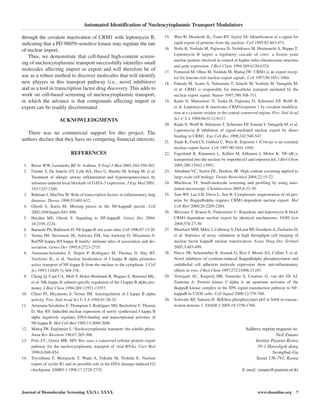
sented in Figure 3A. Molecules acting on nuclear import or
export were identified using cluster analyses of the effect of a
compound on both screens, shown in the XY plot in Figure 3A.
This resolved an import blocker, export blocker, and import
enhancer compound well outside the distribution of the control.
Three compounds were defined as disrupting the nucleocyto-
plasmic transport of NF-κB: BAY 11 7082, phorbol ester (phor-
bol 12 myristate 13 acetate), and PD98059. BAY 11 7082 is an
IκB-α kinase inhibitor and gave the phenotype of blocking the
nuclear import of NF-κB (Fig. 3B). In contrast, the effect of PD
98059 was to enhance nuclear import and was demonstrated only
in cells treated with leptomycin B to block NF-κB export (Fig. 3),
whereas PD 98059 increased the NF-κB nuclear localization
coefficient 1.15-fold (Fig. 3B) over the highest concentration of
leptomycin B. We determined the concentration dependence
(AC50) of the selected compounds on nucleocytoplasmic trans-
port. BAY 11 7082 had an AC50 of 5 µM for the inhibition of
nuclear import when measured in the presence of leptomycin B.
In contrast, phorbol ester promoted nuclear localization of NF-
κB 1.3-fold at 10 nM irrespective of the addition of leptomycin
B, and it is classified as a nuclear export inhibitor. The AC50 for
PD98059 was 1 µM, with a strong nuclear localization pheno-
type observed when NF-κB export was blocked, implying that its
target (p38 mitogen-activated protein [MAP] kinase) may regu-
late the rate of nuclear import (Fig. 3B).
DISCUSSION
A method is presented and validated for the identification of
small-molecule disruptors of nuclear import or export. This
method may have applications in the chemical genomic identi-
fication of molecules involved in nucleocytoplasmic transport
and their evaluation as therapeutic drugs.
Chemical biology—the application of high-throughput and
high-content methods for identifying small molecules that are suit-
able to assign function to the genome and its protein complement—
is emerging as a tool for both cell biology and drug discovery.23,24
In this context, image-based, high-content methods are gaining
interest for their combination of image-based analyses, automa-
tion, and compound library screening, and they provide a means
Automated Identification of Nucleocytoplasmic Transport Modulators
Journal of Biomolecular Screening XX(X); XXXX www.sbsonline.org 5
to exploit cell biological methods to modulate protein function
and ultimately manipulate disease states. In contrast to the in vitro
methods used in high-throughput drug discovery, high-content
screening seems ideally suited to evaluate the effect of com-
pounds on spatially resolved events that are related to disease at a
cellular level. Nucleocytoplasmic transport of transcription fac-
tors was readily analyzed and successfully screened using the
method established here.
The method relies on a robust, well-characterized mathemat-
ical principle for image analysis of high-throughput immunoflu-
orescence images coupled to a symmetrical cell-based screening
rationale that gave significantly more information on nucleocy-
toplasmic transport than a single screen. In terms of speed and
robustness, the algorithm presented here analyzed 180 images in
60 s with a high Z′ factor. This speed is based on several factors.
First, we favored a nonsegmentation approach because of the
perceived advantages in accuracy when a generally error-prone
segmentation was avoided. Each step of an image analysis algo-
rithm introduces bias that can subsequently reduce the accuracy
of the assay. Geometric segmentation methods require robust
algorithms to detect cells and subcellular compartments that
require approximations of cell shape.27
The method used here
avoids these limitations because it applies a strict measure of the
co-localization of NF-κB with the nucleus based on a pixel-by-
pixel—nongeometric—co-localization.
The screening method was successfully used for the identi-
fication of inhibitors of nuclear import or export. Three com-
pounds were defined as disrupting the nucleocytoplasmic
transport of NF-κB: BAY 11 7082, phorbol ester (phorbol 12
myristate 13 acetate), and PD98059. BAY 11 7082 is an IκB
kinase inhibitor and gave the phenotype of blocking the nuclear
import of NF-κB (Fig. 3B), consistent with the known
inhibitory effect on I-κBα phosphorylation and NF-κB activa-
tion.28
Phorbol ester–induced activation of NF-κB has been
reported to act via activating the IKK kinase,29
which supports
the nuclear accumulation observed here and can be interpreted
as increased nuclear import of NF-κB.
In contrast, the effect of PD 98059 was enhanced nuclear
import in cells treated with leptomycin B to block NF-κB export
(Fig. 3) and an increase of the NF-κB nuclear localization coef-
ficient 1.15-fold, a greater effect than seen at the highest concen-
tration of leptomycin B (Fig. 3B). PD 98059 is a cell-permeable
inhibitor of MAP kinase that blocks phosphorylation and subse-
quent activation of p38 MAP kinase. PD 98059 does not directly
inhibit phosphorylation of the NF-κB p65 subunit.30
The observed
increase in nuclear import occurs when nuclear export is blocked
Kwon et al.
6 www.sbsonline.org Journal of Biomolecular Screening XX(X); XXXX
FIG. 3. High-content symmetrical screening of a compound collection reveals nucleocytoplasmic import and export blockers. Cells were
treated with either a compound collection alone or with 5 ng/mL leptomycin B (LMB) to block nuclear export. (A) Compound effects were scored
relative to the untreated control (left panel, •) or, in the case of cells screened with compounds and 5 ng/mL LMB, relative to the leptomycin-
treated cells (left panel, •). The normalized values were plotted against one another and then clustered using the XYZ algorithm. (B) Dose depen-
dence/AC50 titrations for BAY11 7082, PD98059, and phorbol ester in the NF-κB transport assay. (C) Effects of cell treatment with BAY11 7082,
PD98059, and phorbol ester on NF-κB nucleocytoplasmic transport in controls or cells treated with LMB to block nuclear export, using indirect
immunofluorescent detection of NF-κB (green) and nuclear staining (red). Scale bar = 20 µm.
through the covalent inactivation of CRM1 with leptomycin B,
indicating that a PD 98059–sensitive kinase may regulate the rate
of nuclear import.
Thus, we demonstrate that cell-based high-content screen-
ing of nucleocytoplasmic transport successfully identifies small
molecules affecting import or export and will therefore be of
use as a robust method to discover molecules that will identify
new players in this transport pathway (i.e., novel inhibitors)
and as a tool in transcription factor drug discovery. This adds to
work on cell-based screening of nucleocytoplasmic transport,
in which the advance is that compounds affecting import or
export can be readily discriminated.
ACKNOWLEDGMENTS
There was no commercial support for this project. The
authors declare that they have no competing financial interests.
REFERENCES
1. Busse WW, Lemanske RF Jr: Asthma. N Engl J Med 2001;344:350-362.
2. Finotto S, De Sanctis GT, Lehr HA, Herz U, Buerke M, Schipp M, et al:
Treatment of allergic airway inflammation and hyperresponsiveness by
antisense-induced local blockade of GATA-3 expression. J Exp Med 2001;
193:1247-1260.
3. Rahman I, MacNee W: Role of transcription factors in inflammatory lung
diseases. Thorax 1998;53:601-612.
4. Ghosh S, Karin M: Missing pieces in the NF-kappaB puzzle. Cell
2002;109(Suppl):S81-S96.
5. Hayden MS, Ghosh S: Signaling to NF-kappaB. Genes Dev 2004;
18:2195-2224.
6. Baeuerle PA, Baltimore D: NF-kappa B: ten years after. Cell 1996;87:13-20.
7. Verma IM, Stevenson JK, Schwarz EM, Van Antwerp D, Miyamoto S:
Rel/NF-kappa B/I kappa B family: intimate tales of association and dis-
sociation. Genes Dev 1995;9:2723-2735.
8. Arenzana-Seisdedos F, Turpin P, Rodriguez M, Thomas D, Hay RT,
Virelizier JL, et al: Nuclear localization of I kappa B alpha promotes
active transport of NF-kappa B from the nucleus to the cytoplasm. J Cell
Sci 1997;110(Pt 3):369-378.
9. Cheng Q, Cant CA, Moll T, Hofer-Warbinek R, Wagner E, Birnstiel ML,
et al: NK-kappa B subunit-specific regulation of the I kappa B alpha pro-
moter. J Biol Chem 1994;269:13551-13557.
10. Chiao PJ, Miyamoto S, Verma IM: Autoregulation of I kappa B alpha
activity. Proc Natl Acad Sci U S A 1994;91:28-32.
11. Arenzana-Seisdedos F, Thompson J, Rodriguez MS, Bachelerie F, Thomas
D, Hay RT: Inducible nuclear expression of newly synthesized I kappa B
alpha negatively regulates DNA-binding and transcriptional activities of
NF-kappa B. Mol Cell Biol 1995;15:2689-2696.
12. Mattaj IW, Englmeier L: Nucleocytoplasmic transport: the soluble phase.
Annu Rev Biochem 198;67:265-306.
13. Fritz CC, Green MR: HIV Rev uses a conserved cellular protein export
pathway for the nucleocytoplasmic transport of viral RNAs. Curr Biol
1996;6:848-854.
14. Toyoshima F, Moriguchi T, Wada A, Fukuda M, Nishida E: Nuclear
export of cyclin B1 and its possible role in the DNA damage-induced G2
checkpoint. EMBO J 1998;17:2728-2735.
15. Wen W, Meinkoth JL, Tsien RY, Taylor SS: Identification of a signal for
rapid export of proteins from the nucleus. Cell 1995;82:463-473.
16. Nishi K, Yoshida M, Fujiwara D, Nishikawa M, Horinouchi S, Beppu T:
Leptomycin B targets a regulatory cascade of crm1, a fission yeast
nuclear protein, involved in control of higher order chromosome structure
and gene expression. J Biol Chem 1994;269:6320-6324.
17. Fornerod M, Ohno M, Yoshida M, Mattaj IW: CRM1 is an export recep-
tor for leucine-rich nuclear export signals. Cell 1997;90:1051-1060.
18. Fukuda M, Asano S, Nakamura T, Adachi M, Yoshida M, Yanagida M,
et al: CRM1 is responsible for intracellular transport mediated by the
nuclear export signal. Nature 1997;390:308-311.
19. Kudo N, Matsumori N, Taoka H, Fujiwara D, Schreiner EP, Wolff B,
et al: Leptomycin B inactivates CRM1/exportin 1 by covalent modifica-
tion at a cysteine residue in the central conserved region. Proc Natl Acad
Sci U S A 1999;96:9112-9117.
20. Kudo N, Wolff B, Sekimoto T, Schreiner EP,YonedaY,Yanagida M, et al:
Leptomycin B inhibition of signal-mediated nuclear export by direct
binding to CRM1. Exp Cell Res 1998;242:540-547.
21. Stade K, Ford CS, Guthrie C, Weis K: Exportin 1 (Crm1p) is an essential
nuclear export factor. Cell 1997;90:1041-1050.
22. Fagerlund R, Kinnunen L, Kohler M, Julkunen I, Melen K: NF-κB is
transported into the nucleus by importin α3 and importin α4. J Biol Chem
2005;280:15942-15951.
23. Abraham VC, Taylor DL, Haskins JR: High content screening applied to
large-scale cell biology. Trends Biotechnol 2004;22:15-22.
24. Mitchison TJ: Small-molecule screening and profiling by using auto-
mated microscopy. Chembiochem 2005;6:33-39.
25. Tam WF, Lee LH, Davis L, Sen R: Cytoplasmic sequestration of rel pro-
teins by IkappaBalpha requires CRM1-dependent nuclear export. Mol
Cell Biol 2000;20:2269-2284.
26. Meissner T, Krause E, Vinkemeier U: Ratjadone and leptomycin B block
CRM1-dependent nuclear export by identical mechanisms. FEBS Lett
2004;576:27-30.
27. Morelock MM, Mikic I, Callaway S, DeLeon RP, GoodacreA, Zacharias D,
et al: Statistics of assay validation in high throughput cell imaging of
nuclear factor kappaB nuclear translocation. Assay Drug Dev Technol
2005;3:483-499.
28. Pierce JW, Schoenleber R, Jesmok G, Best J, Moore SA, Collins T, et al:
Novel inhibitors of cytokine-induced IkappaBalpha phosphorylation and
endothelial cell adhesion molecule expression show anti-inflammatory
effects in vivo. J Biol Chem 1997;272:21096-21103.
29. Vertegaal AC, Kuiperij HB, Yamaoka S, Courtois G, van der Eb AJ,
Zantema A: Protein kinase C-alpha is an upstream activator of the
IkappaB kinase complex in the TPA signal transduction pathway to NF-
kappaB in U2OS cells. Cell Signal 2000;12:759-768.
30. Schwabe RF, Sakurai H: IKKbeta phosphorylates p65 at S468 in transac-
tivaton domain 2. FASEB J 2005;19:1758-1760.
Address reprint requests to:
Neil Emans
Institut Pasteur-Korea
39-1 Hawolgok-dong
Seongbuk-Gu
Seoul 136-791, Korea
E-mail: emans@pasteur.or.kr
Automated Identification of Nucleocytoplasmic Transport Modulators
Journal of Biomolecular Screening XX(X); XXXX www.sbsonline.org 7

Kwon et al 2007 jbs

  • 1.
    High-Content Classification ofNucleocytoplasmic Import or Export Inhibitors YONG-JUN KWON,1 AUGUSTE GENOVESIO,1 NAM YOUL KIM,1 HI CHUL KIM,1 SUNGYONG JUNG,1 BRIGITTE DAVID-WATINE,2 ULF NEHRBASS,1 and NEIL EMANS1 Transcription factors of the nuclear factor κ B family are the paradigm for signaling dependent nuclear translocation and are ideally suited to analysis through image-based chemical genetic screening. The authors describe combining high-content image analysis with a compound screen to identify compounds affecting either nuclear import or export. Validation in silico and in vitro determined an EC50 for the nuclear export blocker leptomycin B of 2.4 ng/mL (4.4 nM). The method demonstrated high selectivity (Z′ >0.95), speed, and robustness in a screen of a compound collection. It identified the IκB protein kinase inhibitor BAY 11 7082 as an import inhibitor, the p38 mitogen-activated protein (MAP) kinase inhibitor PD98509 as an import enhancer, and phorbol ester as an export inhibitor. The results establish a robust method for identifying compounds regulating nucleocy- toplasmic import or export and also implicate MAP kinases in nuclear import of nuclear factor κ B. (Journal of Biomolecular Screening XXXX:xx-xx) Key words: NF-κB, nucleocytoplasmic transport, signal transduction, second messenger-activated kinases, high-content screening, automation, image recognition © Society for Biomolecular Sciences www.sbsonline.org 1 INTRODUCTION DEFECTS IN THE NUCLEOCYTOPLASMIC TRANSPORT of tran- scription factors are implicated in diseases ranging from cancer to inflammatory illnesses, such as asthma. Chemical genetic phenotypic screens offer insight into the mechanisms underlying these conditions when the disease phenotype can be examined and manipulated at a cellular level through the screening of collections of small-molecule modulators. In the case of asthma, signal transduction plays a role in the recruitment and activation of inflammatory cells in the asth- matic airway. A large number of transcription factors, such as the signal transducers and activators of transcription, activator protein 1, nuclear factor of activated T cells, cyclic adenosine monophosphate response-element binding proteins, guanine- adenine and thymine-adenine repeats, Ets family proteins, and nuclear factor κ B (NF-κB) proteins, have been involved in the physiopathology of asthma.1-3 The NF-κB pathway is directly implicated in the pathogene- sis of cancer, diabetes, and systemic inflammatory response syn- drome. Cytoplasmic to nuclear translocation is a key step in NF-κB regulation. In unstimulated cells, NF-κB is retained in the cytoplasm through masking of the nuclear localization signals on NF-κB dimers by inhibitory proteins known as IκBs.4,5 Upon exposure of cells to an NF-κB–activating stimuli, the IκB protein kinase (IKK) complex phosphorylates IκBs on 2 conserved N-terminal serine residues. Phosphorylated IκB is then ubiquiti- nated and degraded, thus releasing NF-κB, which is recognized by the nuclear import machinery and quickly shuttled into the nucleus to regulate NF-κB–dependent gene expression. Cis-acting elements of IκBs govern its protein stability and sub- cellular localization.6,7 IκBα comprises 3 domains: an N-terminal regulatory domain that controls signal-dependent degradation, a central ankyrin repeat domain that is necessary for NF-κB bind- ing, and a C-terminal region rich in proline, glutamate/aspartate, serine, and threonine regulating basal turnover. An additional sequence, a leucine-rich nuclear export sequence (NES) within the last ankyrin repeat, is postulated to function during the ter- mination of NF-κB activity.8 Activated NF-κB stimulates the synthesis of IκBα mRNA,9,10 and newly synthesized IκB pro- teins can enter the nucleus to bind to and remove NF-κB from gene promoters.11 It is believed that the C-terminal NES of IκBα can actively export these IκBα NF-κB complexes out to the cyto- plasm to restore the preinduction repression.8 1 Institut Pasteur-Korea, Seongbuk-Gu, Seoul, Korea. 2 Nuclear Cell Biology Group, Institut Pasteur, Paris, France. Received Jan 10, 2007, and in revised form Feb 15, 2007. Accepted for publi- cation Feb 25, 2007. Journal of Biomolecular Screening XX(X); XXXX DOI:10.1177/1087057107301319 J Biomol Screen OnlineFirst, published on May 16, 2007 as doi:10.1177/1087057107301319 Copyright 2007 by Society for Biomolecular Sciences.
  • 2.
    The leucine-rich NESis a highly conserved sequence used by a variety of proteins to facilitate their delivery from the nucleus to the cytoplasm and is important in regulating protein function through subcellular localization.12 Nuclear export of proteins, such as HIV Rev,13,14 cyclin B1,14 and protein kinase A inhibitor,15 can be inhibited by leptomycin B, a Streptomyces metabolite.16 Several groups have reported that CRM1 (exportin 1), related to the β-importin family of nuclear proteins, is the receptor for the leucine-rich NES and that leptomycin B interferes with the inter- action between CRM1 and NES by directly binding to CRM1.17-21 Nuclear import and export of NF-κB are mediated through inter- actions with the importin and exportin proteins.22 High-content screens are growing in importance as a research and drug discovery tool, as the cell-based models and the tech- nology to image these assays—automated image acquisition and measurement—proliferate.23,24 High-content screens exploit image analysis algorithms to extract measurement of protein localization and concentration from image data. Our interest was to develop a highly robust algorithm for measuring nucleocyto- plasmic transport independent of the requirement for image seg- mentation or cell recognition as part of a screen to discern nuclear import inhibitors from export inhibitors. This method has application in the identification of small-molecule modulators of transcription factor biology. MATERIALS AND METHODS Chemicals All fine chemicals were purchased from Sigma-Aldrich (St. Louis, MO). DRAQ5 was from BioStatus (Shepshed, UK). Kinase and phosphatase inhibitors were purchased as 95% to 99% pure 10-mM stock solutions in dimethylsulfoxide or water (Biomol, Hamburg, Germany). Stock solutions and formatted assay plates were stored at –20 °C. Primary rabbit antibodies against NF-κB were from Santa Cruz Biotechnology (Santa Cruz, CA), secondary goat anti-rabbit Alexa 488 antibodies were purchased from Molecular Probes (Eugene, OR), and goat serum was from Gibco-BRL (Carlsbad, CA). Cell lines and cell culture HeLa cells (ATCC, Manassas, VA) were cultivated in high-glucose glutamax Dulbecco’s Modified Eagle Medium (Invitrogen, Carlsbad, CA) supplemented with 110 mg/mL sodium pyruvate, 10% fetal calf serum (Gibco), and 1% peni- cillin streptomycin (Invitrogen). HEK 293 cells were cultivated in Dulbecco’s Modified Eagle Medium/F12 (Invitrogen) supple- mented with 10% fetal calf serum and 1% penicillin strepto- mycin. HeLa cells in 96-well plates (seeding density of 15,000 cells/well) were incubated for 16 h. NF-κκB immunofluorescent detection Cells were washed twice with phosphate-buffered saline (PBS), fixed for 10 min with 4% (w/v) paraformaldehyde in PBS, and then washed with PBS. Permeabilization was per- formed with 0.1% TX-100 PBS for 10 min, and cells were washed in PBS and then incubated with a 1:200 dilution of rab- bit anti–NF-κB in 10% goat serum–PBS overnight at 4 °C. Plates were washed 3 times with PBS for 10 min on an orbital rotator. Alexa 488 goat antirabbit secondary antibody (1:1000) was incubated with the cells for 60 min at room temperature, and cells were washed 3 times for 10 min with PBS on an orbital shaker before the addition of 5 µM of DRAQ5 in PBS for 10 min at 37 °C. Cell imaging The NF-κB nucleocytoplasmic transport was imaged using the Opera ultra-high-throughput confocal screening system (Evotec Technologies, Hamburg, Germany). The Opera is a fully automated, 4-color laser excitation confocal system (405, 488, 532, 637 nm) based on an inverted microscope architecture to image cells cultivated in 96- or 384-well coverslip-bottomed microplates (Greiner, Monroe, NC). Images were acquired with 0.7 NA 20 × water immersion or 40 × 0.7 NA water immersion lenses (Olympus Instruments, Tokyo, Japan) at room tempera- ture with confocality generated by a nipkow disc system and image acquisition via 3 parallel 16-bit CCD cameras. Images were corrected for optical vignetting using the Opera acquisition software and a standard reference set of 1 to 10 µm multicolor fluorescent beads. Images were exported as 16 bit. TIFF files were scaled before export to Adobe Photoshop. Cell-based screening Cells were treated with 0.1 to 20 ng/mL leptomycin B in culture medium for 40 min to arrest nuclear export. Compounds in DMSO or H2O were diluted into culture medium just prior to screening at 10 µM for all compounds except bafilomycin (1 µM) in culture medium with or without 5 ng/mL leptomycin B before transfer to cells. Cells were fixed as above to arrest the assay. Plates were imaged by Opera using 488/637 nm excitation and 510 nm (50 nm bandpass) or 680nm (50 nm bandpass) filters, respectively. Typically, 3 image pairs were acquired per well. RESULTS Our rationale was to establish a high-content screen capable of identifying compounds affecting either nuclear import or export of transcription factors, such as NF-κB. High-throughput Kwon et al. 2 www.sbsonline.org Journal of Biomolecular Screening XX(X); XXXX
  • 3.
    immunofluorescent detection ofNF-κB transport was quanti- fied with a novel image analysis algorithm to screen a collection of kinase and phosphatase inhibitors. A symmetrical high-con- tent imaging screen scheme was designed to discriminate between compounds affecting nuclear export or import of NF- κB (Fig. 1). In this scheme, we 1st screened nuclear localization of NF-κB after compound treatment and performed a 2nd screen in which the nuclear export blocker leptomycin B19 (5 ng/mL) was added together with the compounds in parallel. Although nuclear export inhibitors can be easily identified in the 1st compound screen, cells in which nuclear import is arrested cannot be distinguished from mock-treated cells because the phenotype is identical. This would apply regardless of the nor- mal distribution of the transcription factor between the nucleus and the cytoplasm. When the screen is performed in the pres- ence of leptomycin B as a nuclear export blocker, nuclear import inhibitors or those promoting import can be discrimi- nated because the control phenotype is blocked nuclear export. Cell-based assays of nucleocytoplasmic transport NF-κB nucleocytoplasmic transport requires nuclear export via CRM1 to maintain its distribution, and NF-κB accumulates in the nucleus after stimulation of the tumor necrosis factor receptor or treatment of cells with leptomycin B.25 Leptomycin B covalently modifies CRM1 at cysteine 528 and blocks its interaction with nuclear export signals, thus inhibiting NF-κB nuclear export.19,26 Cells treated with 0.1 to 20 ng/mL lepto- mycin B for 40 min showed NF-κB accumulation in the nucleus via indirect immunofluorescent detection of NF-κB (Fig. 2A). Nuclei were stained with the DNA stain DraQ5, which gave well-demarcated nuclei with no detectable staining outside the extranuclear staining (Fig. 2A). Image analysis of nucleocytoplasmic transport NF-κB nucleocytoplasmic transport is spatially well defined within the rims of the nuclear envelope, but there are limita- tions on methods available for analyzing nucleocytoplasmic transport within the constraints of high-throughput biology in terms of speed, reliability, cost, academic availability, and robustness. We devised a stable and highly robust algorithm that gave a measure of the level of the NF-κB label within the nucleus, as defined by co-localization with the nuclear staining. The algorithm relied on the assumptions that 1) the fluores- cence intensity of the nucleus (stained with DRAQ5) and the Automated Identification of Nucleocytoplasmic Transport Modulators Journal of Biomolecular Screening XX(X); XXXX www.sbsonline.org 3 FIG. 1. Scheme of the symmetrical nucleocytoplasmic screen for import and export blockers. Nuclear factor κ B localization was measured in cells after compound treatment alone, which will identify export blockers, and after compound treatment when nuclear export is blocked by lep- tomycin B to identify nuclear import blockers.
  • 4.
    expression level ofNF-κB are independent of leptomycin B concentration and 2) that as NF-κB enters the nucleus, the co- localization of the NF-κB signal with nuclear staining increases. Based on these 2 assumptions, we developed a quan- titative measure of NF-κB localization in the nucleus. In a typical experiment, three 2-color images were indepen- dently analyzed per condition and used to compute the standard deviation. A gray-scale image was defined as the function G: Ω⊂N2 →→ !. The function G represents the NF-κB signal and R the nuclear stain. In terms of image processing, each image Kwon et al. 4 www.sbsonline.org Journal of Biomolecular Screening XX(X); XXXX FIG. 2. Quantitation of nuclear factor κ B (NF-κB) nucleocytoplasmic transport high-throughput immunofluorescence assay. (A) Cytoplasmic NF-κB accumulates in the nucleus of HeLa cells treated with leptomycin B (LMB) for 40 min prior to immunofluorescent detection of NF-κB and nuclear staining with 10 µM DRAQ5. Scale bar = 20 µm. (B) Simulated nuclear localization images, with red representing the nucleus and green NF-κB localization where a cytoplasmic distribution of NF-κB is morphed onto the nucleus in an XZ (upper row) and XY (center row) simulated image series from left to right. Images of cells after LMB treatment and nuclear staining. Scale bar = 5 µM. (C) Quantitation of nuclear import on the simulation (upper row) and cell images (lower row). (D) EC50 determination for LMB in terms of nuclear localization of NF-κB after incubation with 0 to 20 ng/mL LMB, detection of NF-κB, and nuclear staining in microplates. The fitted EC50 for LMB was 2.4 ng/mL, within a 95% confidence interval of 1.9 to 3 ng/mL with an R2 of 0.9957, and is representative of more than 5 assays. All images were acquired on the automated confocal system.
  • 5.
    is normalized asfollows: The mean of pixel intensity is 1 computed by G = n (x, y) ∈Ω G(x, y) and the standard deviation by 1 σG = n (x, y) ∈Ω (G(x, y) – G)2 , and the pixels are normalized by Gσ(x, y) = G(x, y) – G . σG After similar normalization of the nuclear intensity R, a cor- relation value between R and G is computed via Corr (R, G) = (x, y) ∈Ω Rσ(x, y)Gσ(x, y). Thus, the degree of co-localization between NF-κB labeling and the nuclear stain is quantified, irrespective of the geometry and the number of cells. Validation of the image analysis algorithm A simulation of NF-κB entry into the nucleus was used to validate the image analysis algorithm. NF-κB distribution in the cell was represented by a subtraction of 2 evolving Gaussian shapes, and the nuclear stain was represented by a nonevolving thresholded Gaussian (Fig. 2B). This permitted the volume of the shape(s) to remain constant and thus respected assumption 1 that leptomycin B treatment would not alter intensities of NF-κB or the nucleus. The simulation is depicted in a vertical and XY image in Figure 2B and C. The green intensity was linearly evolved to fill the center and thus tended to increase the number of pixels that had a high value of G and R, satisfying assumption 2. Figure 2B shows the evolution between the 2 situations: where the NF-κB simulation (green) shape was entirely absent from the nucleus and where it morphed linearly from an NF- κB–free empty nucleus to a filled nucleus. The identical simu- lation is shown in Figure 2B but in 2 dimensions and with additive white Gaussian noise added to mimic the predicted real experimental situation. These simulations were conceived to represent the repression of nuclear export of NF-κB through an increasing exposure of cells to leptomycin B. The measure- ment algorithm extracted a linearly increasing coefficient for nuclear entry, as was expected (Fig. 2C). It was then applied to images of HeLa cells that were treated with increasing concen- trations of leptomycin B for 40 min before fixation, indirect immunofluorescent detection of the NF-κB distribution, and nuclear staining with DRAQ5 (Fig. 2A). The nuclear localiza- tion coefficient across a logarithmic gradient of leptomycin B was fitted to a variable slope model and gave an EC50 for lep- tomycin B of 2.4 ng/mL (4.4 nM), within the 95% confidence limits of 1 ng/mL and 3 ng/mL. Nucleocytoplasmic import/export screen A symmetrical screen was devised as a suitable method to allow the discrimination between compounds affecting nuclear import or nuclear export (Fig. 3A). It comprised 2 parallel screens: In the 1st screen, compounds were screened for their effects on endogenous NF-κB localization in wild-type cells, allowing the identification of compounds that caused nuclear localization of NF-κB through an inhibition of export. In the 2nd screen, cells were treated with compounds and leptomycin B, and in this case, inhibitors of nuclear import could be dis- tinguished from compounds that had a null phenotype in the 1st screen (Fig. 3A). A collection of kinase and phosphatase inhibitors covering most of the kinase families in the genome were used in this screen, and the collection also contained leptomycin B as an internal control. Leptomycin B was identified as a pure export blocker in the screens, and the collected screen data are pre- sented in Figure 3A. Molecules acting on nuclear import or export were identified using cluster analyses of the effect of a compound on both screens, shown in the XY plot in Figure 3A. This resolved an import blocker, export blocker, and import enhancer compound well outside the distribution of the control. Three compounds were defined as disrupting the nucleocyto- plasmic transport of NF-κB: BAY 11 7082, phorbol ester (phor- bol 12 myristate 13 acetate), and PD98059. BAY 11 7082 is an IκB-α kinase inhibitor and gave the phenotype of blocking the nuclear import of NF-κB (Fig. 3B). In contrast, the effect of PD 98059 was to enhance nuclear import and was demonstrated only in cells treated with leptomycin B to block NF-κB export (Fig. 3), whereas PD 98059 increased the NF-κB nuclear localization coefficient 1.15-fold (Fig. 3B) over the highest concentration of leptomycin B. We determined the concentration dependence (AC50) of the selected compounds on nucleocytoplasmic trans- port. BAY 11 7082 had an AC50 of 5 µM for the inhibition of nuclear import when measured in the presence of leptomycin B. In contrast, phorbol ester promoted nuclear localization of NF- κB 1.3-fold at 10 nM irrespective of the addition of leptomycin B, and it is classified as a nuclear export inhibitor. The AC50 for PD98059 was 1 µM, with a strong nuclear localization pheno- type observed when NF-κB export was blocked, implying that its target (p38 mitogen-activated protein [MAP] kinase) may regu- late the rate of nuclear import (Fig. 3B). DISCUSSION A method is presented and validated for the identification of small-molecule disruptors of nuclear import or export. This method may have applications in the chemical genomic identi- fication of molecules involved in nucleocytoplasmic transport and their evaluation as therapeutic drugs. Chemical biology—the application of high-throughput and high-content methods for identifying small molecules that are suit- able to assign function to the genome and its protein complement— is emerging as a tool for both cell biology and drug discovery.23,24 In this context, image-based, high-content methods are gaining interest for their combination of image-based analyses, automa- tion, and compound library screening, and they provide a means Automated Identification of Nucleocytoplasmic Transport Modulators Journal of Biomolecular Screening XX(X); XXXX www.sbsonline.org 5
  • 6.
    to exploit cellbiological methods to modulate protein function and ultimately manipulate disease states. In contrast to the in vitro methods used in high-throughput drug discovery, high-content screening seems ideally suited to evaluate the effect of com- pounds on spatially resolved events that are related to disease at a cellular level. Nucleocytoplasmic transport of transcription fac- tors was readily analyzed and successfully screened using the method established here. The method relies on a robust, well-characterized mathemat- ical principle for image analysis of high-throughput immunoflu- orescence images coupled to a symmetrical cell-based screening rationale that gave significantly more information on nucleocy- toplasmic transport than a single screen. In terms of speed and robustness, the algorithm presented here analyzed 180 images in 60 s with a high Z′ factor. This speed is based on several factors. First, we favored a nonsegmentation approach because of the perceived advantages in accuracy when a generally error-prone segmentation was avoided. Each step of an image analysis algo- rithm introduces bias that can subsequently reduce the accuracy of the assay. Geometric segmentation methods require robust algorithms to detect cells and subcellular compartments that require approximations of cell shape.27 The method used here avoids these limitations because it applies a strict measure of the co-localization of NF-κB with the nucleus based on a pixel-by- pixel—nongeometric—co-localization. The screening method was successfully used for the identi- fication of inhibitors of nuclear import or export. Three com- pounds were defined as disrupting the nucleocytoplasmic transport of NF-κB: BAY 11 7082, phorbol ester (phorbol 12 myristate 13 acetate), and PD98059. BAY 11 7082 is an IκB kinase inhibitor and gave the phenotype of blocking the nuclear import of NF-κB (Fig. 3B), consistent with the known inhibitory effect on I-κBα phosphorylation and NF-κB activa- tion.28 Phorbol ester–induced activation of NF-κB has been reported to act via activating the IKK kinase,29 which supports the nuclear accumulation observed here and can be interpreted as increased nuclear import of NF-κB. In contrast, the effect of PD 98059 was enhanced nuclear import in cells treated with leptomycin B to block NF-κB export (Fig. 3) and an increase of the NF-κB nuclear localization coef- ficient 1.15-fold, a greater effect than seen at the highest concen- tration of leptomycin B (Fig. 3B). PD 98059 is a cell-permeable inhibitor of MAP kinase that blocks phosphorylation and subse- quent activation of p38 MAP kinase. PD 98059 does not directly inhibit phosphorylation of the NF-κB p65 subunit.30 The observed increase in nuclear import occurs when nuclear export is blocked Kwon et al. 6 www.sbsonline.org Journal of Biomolecular Screening XX(X); XXXX FIG. 3. High-content symmetrical screening of a compound collection reveals nucleocytoplasmic import and export blockers. Cells were treated with either a compound collection alone or with 5 ng/mL leptomycin B (LMB) to block nuclear export. (A) Compound effects were scored relative to the untreated control (left panel, •) or, in the case of cells screened with compounds and 5 ng/mL LMB, relative to the leptomycin- treated cells (left panel, •). The normalized values were plotted against one another and then clustered using the XYZ algorithm. (B) Dose depen- dence/AC50 titrations for BAY11 7082, PD98059, and phorbol ester in the NF-κB transport assay. (C) Effects of cell treatment with BAY11 7082, PD98059, and phorbol ester on NF-κB nucleocytoplasmic transport in controls or cells treated with LMB to block nuclear export, using indirect immunofluorescent detection of NF-κB (green) and nuclear staining (red). Scale bar = 20 µm.
  • 7.
    through the covalentinactivation of CRM1 with leptomycin B, indicating that a PD 98059–sensitive kinase may regulate the rate of nuclear import. Thus, we demonstrate that cell-based high-content screen- ing of nucleocytoplasmic transport successfully identifies small molecules affecting import or export and will therefore be of use as a robust method to discover molecules that will identify new players in this transport pathway (i.e., novel inhibitors) and as a tool in transcription factor drug discovery. This adds to work on cell-based screening of nucleocytoplasmic transport, in which the advance is that compounds affecting import or export can be readily discriminated. ACKNOWLEDGMENTS There was no commercial support for this project. The authors declare that they have no competing financial interests. REFERENCES 1. Busse WW, Lemanske RF Jr: Asthma. N Engl J Med 2001;344:350-362. 2. Finotto S, De Sanctis GT, Lehr HA, Herz U, Buerke M, Schipp M, et al: Treatment of allergic airway inflammation and hyperresponsiveness by antisense-induced local blockade of GATA-3 expression. J Exp Med 2001; 193:1247-1260. 3. Rahman I, MacNee W: Role of transcription factors in inflammatory lung diseases. Thorax 1998;53:601-612. 4. Ghosh S, Karin M: Missing pieces in the NF-kappaB puzzle. Cell 2002;109(Suppl):S81-S96. 5. Hayden MS, Ghosh S: Signaling to NF-kappaB. Genes Dev 2004; 18:2195-2224. 6. Baeuerle PA, Baltimore D: NF-kappa B: ten years after. Cell 1996;87:13-20. 7. Verma IM, Stevenson JK, Schwarz EM, Van Antwerp D, Miyamoto S: Rel/NF-kappa B/I kappa B family: intimate tales of association and dis- sociation. Genes Dev 1995;9:2723-2735. 8. Arenzana-Seisdedos F, Turpin P, Rodriguez M, Thomas D, Hay RT, Virelizier JL, et al: Nuclear localization of I kappa B alpha promotes active transport of NF-kappa B from the nucleus to the cytoplasm. J Cell Sci 1997;110(Pt 3):369-378. 9. Cheng Q, Cant CA, Moll T, Hofer-Warbinek R, Wagner E, Birnstiel ML, et al: NK-kappa B subunit-specific regulation of the I kappa B alpha pro- moter. J Biol Chem 1994;269:13551-13557. 10. Chiao PJ, Miyamoto S, Verma IM: Autoregulation of I kappa B alpha activity. Proc Natl Acad Sci U S A 1994;91:28-32. 11. Arenzana-Seisdedos F, Thompson J, Rodriguez MS, Bachelerie F, Thomas D, Hay RT: Inducible nuclear expression of newly synthesized I kappa B alpha negatively regulates DNA-binding and transcriptional activities of NF-kappa B. Mol Cell Biol 1995;15:2689-2696. 12. Mattaj IW, Englmeier L: Nucleocytoplasmic transport: the soluble phase. Annu Rev Biochem 198;67:265-306. 13. Fritz CC, Green MR: HIV Rev uses a conserved cellular protein export pathway for the nucleocytoplasmic transport of viral RNAs. Curr Biol 1996;6:848-854. 14. Toyoshima F, Moriguchi T, Wada A, Fukuda M, Nishida E: Nuclear export of cyclin B1 and its possible role in the DNA damage-induced G2 checkpoint. EMBO J 1998;17:2728-2735. 15. Wen W, Meinkoth JL, Tsien RY, Taylor SS: Identification of a signal for rapid export of proteins from the nucleus. Cell 1995;82:463-473. 16. Nishi K, Yoshida M, Fujiwara D, Nishikawa M, Horinouchi S, Beppu T: Leptomycin B targets a regulatory cascade of crm1, a fission yeast nuclear protein, involved in control of higher order chromosome structure and gene expression. J Biol Chem 1994;269:6320-6324. 17. Fornerod M, Ohno M, Yoshida M, Mattaj IW: CRM1 is an export recep- tor for leucine-rich nuclear export signals. Cell 1997;90:1051-1060. 18. Fukuda M, Asano S, Nakamura T, Adachi M, Yoshida M, Yanagida M, et al: CRM1 is responsible for intracellular transport mediated by the nuclear export signal. Nature 1997;390:308-311. 19. Kudo N, Matsumori N, Taoka H, Fujiwara D, Schreiner EP, Wolff B, et al: Leptomycin B inactivates CRM1/exportin 1 by covalent modifica- tion at a cysteine residue in the central conserved region. Proc Natl Acad Sci U S A 1999;96:9112-9117. 20. Kudo N, Wolff B, Sekimoto T, Schreiner EP,YonedaY,Yanagida M, et al: Leptomycin B inhibition of signal-mediated nuclear export by direct binding to CRM1. Exp Cell Res 1998;242:540-547. 21. Stade K, Ford CS, Guthrie C, Weis K: Exportin 1 (Crm1p) is an essential nuclear export factor. Cell 1997;90:1041-1050. 22. Fagerlund R, Kinnunen L, Kohler M, Julkunen I, Melen K: NF-κB is transported into the nucleus by importin α3 and importin α4. J Biol Chem 2005;280:15942-15951. 23. Abraham VC, Taylor DL, Haskins JR: High content screening applied to large-scale cell biology. Trends Biotechnol 2004;22:15-22. 24. Mitchison TJ: Small-molecule screening and profiling by using auto- mated microscopy. Chembiochem 2005;6:33-39. 25. Tam WF, Lee LH, Davis L, Sen R: Cytoplasmic sequestration of rel pro- teins by IkappaBalpha requires CRM1-dependent nuclear export. Mol Cell Biol 2000;20:2269-2284. 26. Meissner T, Krause E, Vinkemeier U: Ratjadone and leptomycin B block CRM1-dependent nuclear export by identical mechanisms. FEBS Lett 2004;576:27-30. 27. Morelock MM, Mikic I, Callaway S, DeLeon RP, GoodacreA, Zacharias D, et al: Statistics of assay validation in high throughput cell imaging of nuclear factor kappaB nuclear translocation. Assay Drug Dev Technol 2005;3:483-499. 28. Pierce JW, Schoenleber R, Jesmok G, Best J, Moore SA, Collins T, et al: Novel inhibitors of cytokine-induced IkappaBalpha phosphorylation and endothelial cell adhesion molecule expression show anti-inflammatory effects in vivo. J Biol Chem 1997;272:21096-21103. 29. Vertegaal AC, Kuiperij HB, Yamaoka S, Courtois G, van der Eb AJ, Zantema A: Protein kinase C-alpha is an upstream activator of the IkappaB kinase complex in the TPA signal transduction pathway to NF- kappaB in U2OS cells. Cell Signal 2000;12:759-768. 30. Schwabe RF, Sakurai H: IKKbeta phosphorylates p65 at S468 in transac- tivaton domain 2. FASEB J 2005;19:1758-1760. Address reprint requests to: Neil Emans Institut Pasteur-Korea 39-1 Hawolgok-dong Seongbuk-Gu Seoul 136-791, Korea E-mail: emans@pasteur.or.kr Automated Identification of Nucleocytoplasmic Transport Modulators Journal of Biomolecular Screening XX(X); XXXX www.sbsonline.org 7